
Brewers Option Logan Henderson, Blake Perkins
TODAY: Lockridge and Sproat have been told they’re making the Opening Day roster, as per Adam McCalvy.
MARCH 19: The Brewers made a few camp cuts on Thursday. Starter Logan Henderson, outfielder Blake Perkins, and corner bat Tyler Black were all sent out and will open the season with Triple-A Nashville.
Two weeks ago, Henderson had seemingly been well positioned for a spot in the Opening Day rotation. There are at least two jobs up for grabs after the Freddy Peralta trade and with Quinn Priester beginning the season on the injured list. The Brewers have rotation roles committed to Jacob Misiorowski, Chad Patrick and (assuming he’s fully built up) Brandon Woodruff.
The 24-year-old Henderson was firmly in the mix after impressing over his first five MLB starts a year ago. His odds of breaking camp were set back when he reported minor elbow soreness last week. Henderson had finished the 2025 season on the injured list with elbow inflammation. The team didn’t consider this recent flareup especially alarming — he’s already throwing again — but he hasn’t appeared in a Spring Training game in two weeks.
Skipper Pat Murphy indicated the demotion is largely about giving Henderson a chance to build his workload in the minors. “Part of this move is to make sure he can go post regularly,” Murphy told reporters (link via Adam McCalvy of MLB.com). “We’re not going to immediately build him up to five innings. We’re going to let him go two innings and see how he responds, two innings and see how he responds. Just make sure he’s responding each time because he’s had (an injury) history.”
This probably paves the way for Brandon Sproat and Kyle Harrison to round out the rotation. Harrison left yesterday’s appearance with a blister, but it’s not expected to be an issue moving forward. Robert Gasser and Shane Drohan are also still in the mix, with Drohan having the far more impressive camp of those two.
Acquired from the Red Sox in the Caleb Durbin trade, Harrison has allowed 12 runs (eight earned) across 9 2/3 spring innings. That’s obviously not ideal, but he has struck out 15 opponents while averaging 95 mph on his fastball. Sproat came over from the Mets as part of the Peralta return. He has allowed five runs with a 10:2 strikeout-to-walk ratio over nine innings.
In any case, the Brewers will lean heavily on their bullpen while frequently shuttling starters up and down from Nashville. There’s more clarity on the position player side, which is down to 14 a week before Opening Day. The final camp cut will almost certainly be third catcher Reese McGuire, a non-roster invitee.
McCalvy notes that the Perkins option means Brandon Lockridge is heading north with the club. The speedster won the fourth outfield role by hitting .314 with four homers and three steals in 12 games this spring. He’ll join Gary Sánchez, Jake Bauers and utility infielder David Hamilton on the season-opening bench.
The Brewers’ Rotation Options After Peralta Trade
The Brewers traded ace Freddy Peralta and swingman Tobias Myers to the Mets last week. Milwaukee generally, though not always, trades its best players as they approach their final year before free agency. There was never much chance they were going to meet Peralta’s asking price on another contract. That left the front office to decide whether to move him for controllable pieces or hold him through his final arbitration year and collect a compensatory draft pick when he signed elsewhere.
They opted for the former once the Mets put Jett Williams and Brandon Sproat on the table, albeit in a deal that also cost them a potential rotation arm in Myers. It’s obviously not the start of a rebuild for a team that had MLB’s best record and advanced to the NL Championship Series a year ago. They’re counting on their pitching pipeline to continue to produce as they aim for a fourth straight division title.
How will Pat Murphy’s starting staff line up?
Locks
Woodruff is back as the veteran anchor and their clear #1 starter. The righty accepted a $22.025MM qualifying offer, a move that probably surprised Milwaukee’s front office to an extent. President of baseball operations Matt Arnold acknowledged that getting Woodruff back made them more comfortable parting with Peralta (relayed by Curt Hogg of The Milwaukee Journal-Sentinel). The 2026 payroll factors into that to an extent, yet Peralta’s $8MM salary shouldn’t have been a hang-up even by Brewers’ standards. There were other players they could have moved (e.g. Andrew Vaughn, Trevor Megill) if ownership mandated a payroll reduction.
The Brewers can feel comfortable about having an established top-of-the-rotation starter. The big question is how many innings they can reasonably expect. Woodruff missed all of 2024 rehabbing from shoulder surgery. A handful of smaller injuries delayed his ’25 debut, and he sustained a season-ending lat strain after 12 starts. He has pitched 131 2/3 frames over the past three seasons. Woodruff enters camp fully healthy, but it’s fair to wonder if he can shoulder 150 innings.
The 25-year-old Priester is now the second-most experienced Milwaukee starter. He and Robert Gasser are the only other starters with more than a year of MLB service time; the majority of Gasser’s service came on the injured list working back from UCL surgery.
Priester began the ’25 season in Triple-A with the Red Sox. Dealt to Milwaukee in a rare April trade of significance, the former first-rounder was a revelation. He tossed 157 1/3 innings of 3.32 ERA ball behind a massive 56.1% grounder percentage. Milwaukee had a stretch of 19 consecutive wins in his outings between May and September. Priester has serviceable but not elite swing-and-miss stuff. It’s a sinker-slider profile geared toward keeping the ball on the ground. That approach comes with some batted ball variability but plays well in front of a strong infield defense.
Upside Plays
Misiorowski was arguably the #1 pitching prospect in MLB when the Brewers called him up in June. He began his career in electric fashion, allowing two earned runs or fewer in six of his first seven starts. Milwaukee didn’t let him work deep into games, but he lit up the radar gun while missing plenty of bats. His performance wavered down the stretch, and evaluators’ longstanding concerns about his command pushed him into a bullpen role for the playoffs. Misiorowski impressed again in October, striking out 16 over 12 innings of three-run ball in a trio of postseason outings.
Overall, the 6’7″ righty finished his debut campaign with a 4.36 ERA across 66 innings. He’s certainly not going to be the back-end innings eater usually associated with a mid-4.00s ERA, though. Misiorowski has ace stuff with walk issues that may yet land him in high-leverage relief. He should get a full look in the rotation this year, albeit with questions about his start-to-start efficiency.
Henderson may not be a Misiorowski-level prospect, yet his 2025 debut was also highly anticipated by Milwaukee fans. He was called up in April and pitched well over four starts before being squeezed off the MLB roster. The Brewers brought him back up after the trade deadline. He made one start before being diagnosed with elbow inflammation and spending the rest of the season on the injured list. The 23-year-old righty allowed five runs while striking out a third of opponents over his first 25 1/3 MLB innings.
Baseball America ranked Henderson 96th on their Top 100 prospects list last week. They credit him with plus control and a plus changeup, while his 93 MPH fastball plays above its velocity because of his release angle and spin. Henderson has always been effective in the minors, posting a 3.26 ERA with a 32% strikeout rate over his career. Can he continue to miss bats at a high rate against MLB hitters without really trusting his cutter or slider? He might also run into some home run trouble as a fly-ball pitcher with average velocity whose fastball works best at the top of the strike zone. There are questions about the ultimate ceiling, but Henderson’s first five starts couldn’t have gone much better.
Sproat will try to immediately replace Peralta in the starting five. He also landed in the back quarter of the aforementioned BA prospect list — a few spots above Henderson, in fact. Sproat has much bigger stuff, sitting 96-97 with above-average to plus grades on his slider, curveball and changeup. His command isn’t nearly as polished. Sproat walked 10.4% of opponents over 26 Triple-A appearances last year, and he was hit around a little bit over four starts as a September call-up. The 6’3″ righty has a shot to be a mid-rotation starter, but the command will need to improve if he’s going to get there.
Back-End Arms
Patrick was a 26-year-old rookie whom the Brewers acquired from the A’s in 2023 for journeyman infielder Abraham Toro. There wasn’t a whole lot of fanfare when he broke camp for his MLB debut last spring. Patrick went on to a seventh-place finish in Rookie of the Year balloting after tossing 119 2/3 innings of 3.53 ERA ball. There’s a decent chance he would have placed more highly had the team’s rotation depth not pushed him to Triple-A when Woodruff returned to action on July 6.
The righty spent six weeks in the minors through no real fault of his own. He worked in a swing role once he was recalled in the middle of August. Patrick pitched well in either role and had an excellent postseason, firing nine innings of two-run ball with 11 strikeouts. He has a six-pitch mix led by a plus cutter that helped him punch out a quarter of opponents. Patrick probably doesn’t have the ceiling of some of his teammates but should enter camp with a leg up on Henderson and Sproat for the fourth or fifth starter role.
Acquired from San Diego in the Josh Hader trade, Gasser had an impressive five-start debut in 2024. He blew out and underwent elbow surgery that kept him off an MLB mound until last September. The southpaw started two games and gave up six runs (only two earned) with four walks and five strikeouts across 5 2/3 frames. His minor league rehab numbers were quite a bit better. The 26-year-old Gasser has a 3.72 ERA with a 28% strikeout rate in just over 200 career Triple-A frames. He’s on the older side for a prospect because of the injury but still looks like a viable back-end starter.
Likely Relievers
Angel Zerpa, Aaron Ashby and DL Hall each have starting experience but fit better in the bullpen. All three were used primarily as relievers last season — with the Royals, in Zerpa’s case — and join Jared Koenig in giving Milwaukee a quartet of big arms from the left side out of the bullpen.
Zerpa has solid command and gets a ton of ground-balls, but his sinker/slider combination leaves him vulnerable to right-handed hitters. He’d probably need to pick up a splitter or cutter if he’s going to turn over a righty-heavy lineup twice in a game. Ashby hasn’t managed to stay healthy as a starter, while Hall’s command is too big an obstacle. They’re all capable of working multiple innings and could get some action as openers, as Ashby did a few times in the postseason to match him up against Kyle Tucker and Shohei Ohtani.
The other two starters on the 40-man roster, Carlos Rodriguez and Coleman Crow, project as up-and-down arms. Rodriguez has decent stuff but has been walk-prone in the minors. He has allowed 18 runs in 22 career big league innings. Milwaukee added Crow to the roster at the beginning of the offseason to keep him out of minor league free agency. He’s the organization’s #30 prospect at Baseball America and has fringy stuff despite impressive strikeout rates in the minors.
——————————–
Even without Peralta, Milwaukee has a talented group of starters. Their collective lack of experience behind Woodruff means they’ll probably add a fifth starter or swingman on a one-year deal to reduce the load on their young arms. As is always the case for the Brewers, they’re likely to mix in some tandem starts/openers while shuffling pitchers up and down from Triple-A. Woodruff is their only starter who can’t be sent to the minor leagues, while Rob Zastryzny is their only out-of-options reliever. They’ll have a lot of roster flexibility if they want to incorporate bullpen games or a six-man rotation to keep pitchers’ innings in check.
Brewers Trade Freddy Peralta To Mets
The Mets made another splash, acquiring All-Star starter Freddy Peralta and swingman Tobias Myers from the Brewers for prospects Jett Williams and Brandon Sproat. The teams announced the blockbuster trade on Wednesday night. New York designated right-hander Cooper Criswell for assignment in a corresponding move.
After losing out on Kyle Tucker, the Mets have signed Bo Bichette and traded for Luis Robert Jr. and Peralta. Tonight’s move is arguably the biggest of the three, as Peralta gives them a legitimate #1 starter atop what had been a talented but volatile rotation. He’s coming off a career season that landed him fifth in NL Cy Young balloting.
Peralta set a career mark with 176 2/3 innings while managing a personal-best 2.70 earned run average. He punched out 28.2% of opponents behind a near-13% swinging strike rate while issuing walks at a 9.1% clip. Peralta’s underlying marks have been consistently strong over his five seasons as a full-time starter. He misses bats at a plus rate with solid command. He had been a little susceptible to the longball between 2023-24, which elevated his ERA slightly (3.77) over that span. A dip in homer rate was the biggest factor in last year’s results, but estimators like FIP and SIERA feel he has been more or less the same pitcher five years running.
The 6’0″ righty challenges hitters with his fastball, a 94-95 MPH offering that plays up because of its plus spin and life. He backs that up with a changeup that he’ll throw to hitters of either handedness and a pair of breaking balls (though he only uses his slider against righties). His willingness to attack hitters up in the zone with the fastball leads to a fly-ball approach and the occasional home run, but it’s a worthwhile tradeoff for the few baserunners he’ll allow. Opposing hitters have mustered a .210/.288/.367 batting line over the past three seasons.
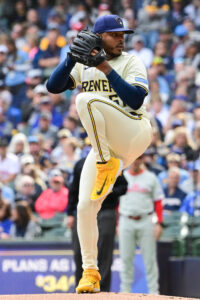
Peralta also brings an excellent durability track record to stabilize a rotation that was light on established innings sources. He hasn’t required a single stint on the injured list in three years. He’s tied for fifth with 95 starts and ranks 15th with 516 innings over that stretch. Only Dylan Cease and Zack Wheeler have more strikeouts in that time. Peralta and Cease are the only pitchers to record 200+ strikeouts in each of the past three seasons. He battled some shoulder issues in 2021-22, including a lat strain that limited him to 18 appearances four years ago, but his recent health record has been clean.
Mets president of baseball operations David Stearns knows Peralta well from his time running baseball operations with Milwaukee. He’s probably the best starting pitcher who’ll get traded this offseason, so the Mets would surely have been involved even without that connection, but the familiarity only made him a more natural fit. Stearns also brought back closer Devin Williams on a three-year free agent contract as his biggest bullpen move of the winter.
The Stearns-led front office wisely locked Peralta up on an extension before his breakout. Peralta had been an unheralded amateur signee by the Mariners whom the Brewers acquired as one of three prospects in an Adam Lind trade when he was in rookie ball. He worked in a swing role with mixed results over his first two seasons. Milwaukee secured him on a $15.5MM guarantee with a pair of $8MM club options over the 2019-20 offseason. It almost immediately became one of the sport’s most team-friendly contracts.
Peralta is headed into the final season of that deal and playing on the second of those $8MM options. The Mets will happily pick up that salary and the associated $8.8MM luxury tax hit. RosterResource projects them for a $365MM competitive balance tax payroll. They ended last season with $347MM in CBT commitments and paid another $91.6MM in taxes.
This is much more affordable from a salary perspective than were the Bichette and Robert acquisitions, though the pitcher is less than a year from a monster payday of his own. He’s on track to hit free agency before his age-31 season and could command the second-largest contract in the class after Tarik Skubal. He’s a lock to reject a qualifying offer barring a major injury. The Mets would receive a compensation pick after the fourth round in ’27 if he walks. As a revenue sharing recipient, Milwaukee would’ve gotten a pick after the first round had they kept him (assuming he signed elsewhere for $50MM+).
The Mets will presumably make an effort to keep him long term, but the main focus is on 2026. Peralta slots ahead of touted rookie Nolan McLean at the top of the staff. Sean Manaea, Clay Holmes, David Peterson and Kodai Senga are also penciled into what could be a six-man rotation — though the latter two have come up in trade rumors this offseason. Jonah Tong didn’t dominate the way McLean did after a late-season promotion, but he’s a top prospect who’ll be in the mix. They’re getting another touted arm, Christian Scott, back from elbow surgery.
Myers projects for a swing role but is likely to make some starts over the course of a 162-game season as well. The 27-year-old righty is more than a throw-in addition, as he has pitched well for Milwaukee over the past two years. Myers held a rotation spot for the majority of the ’24 season. He started 25 of 27 games as a rookie and posted an even 3.00 earned run average through 138 innings. He recorded a solid 22.3% strikeout rate while limiting his walks to a 6.3% clip.
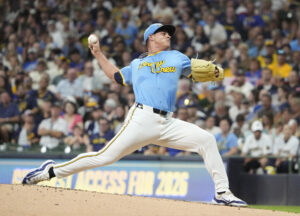
An oblique strain sidelined Myers to open last season. The Brewers activated him in late April but optioned him to Triple-A after a handful of shaky appearances. Myers was up and down in a swing role for the remainder of the season. He was mostly squeezed out of the rotation by Milwaukee’s bigger arms, but he pitched well in the second half and finished the year with a 3.55 ERA across 50 2/3 frames. He had similar numbers over 12 starts with Triple-A Nashville.
Myers works in the 93-94 MPH range with his fastball. He uses a cutter and slider as his breaking balls and tweaked his changeup to more of a splitter midway through last season. The pitch got good results in a small sample, as opponents hit .108 while swinging through it almost 40% of the time. That should give him a better offering against left-handed hitters after he struggled with southpaws as a rookie.
The righty has between one and two years of service time. He won’t reach arbitration for another two seasons and is under club control through 2030. He has a minor league option remaining, which gives the Mets flexibility to move him between MLB and Triple-A Syracuse.
The Brewers deserve credit for helping Myers develop into a serviceable back-end starter. He’d once been a reasonably well-regarded prospect — Cleveland regrettably traded Junior Caminero to the Rays for him when the slugging infielder was in rookie ball — but he’d seemingly hit a wall in the upper minors. Milwaukee added him as a minor league free agent over the 2022-23 offseason, and he’s now a secondary but meaningful part of a trade that netted them a pair of top prospects.
Williams and Sproat each placed on the back half of Baseball America’s Top 100 prospects list, which was released this morning. BA had Williams as the slightly more highly regarded of the two, but they’re essentially within the same tier. Williams is a right-handed hitter whom the Mets took in the first round out of a Dallas-area high school in 2022. He’s on the shorter side at 5’7″ but has plus athleticism and an up-the-middle defensive profile. Scouts credit him with plus speed and a strong arm with more power than one might expect based on his size.
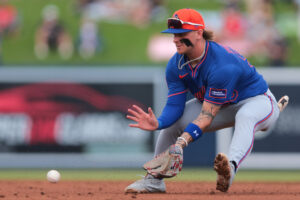
That athleticism was on display in the upper minors. Williams combined for 17 homers and 34 stolen bases while hitting .261/.363/.465 across 572 plate appearances. He looked no worse for wear after a right wrist surgery had cost him a good chunk of the ’24 season. Williams raked at a .281/.390/.477 clip in Double-A. He struggled after a second half promotion to Triple-A, where he hit .209 with a .285 on-base percentage across 34 games. That’s not a huge concern for a 21-year-old who would have been young for the level even if he’d spent the entire season in Double-A.
Williams is a patient hitter who has worked a lot of walks in the minors. Although big league pitchers will be better positioned to attack the smaller strike zone, he has the makings of a potential top-of-the-lineup spark plug. Williams has played mostly shortstop and has experience at second base and in center field. He’s likely to begin the season at Triple-A Nashville and could challenge Joey Ortiz or Garrett Mitchell/Blake Perkins for playing time midway through the season.
Sproat, 25, is a big league ready rotation option. A second-round pick out of the University of Florida in 2023, he debuted as a September call-up. The 6’3″ righty made four starts, giving up 11 runs across 20 2/3 innings. Sproat otherwise spent the season in Triple-A, where he worked to a 4.24 ERA across 121 frames. He fanned 22.1% of opponents while issuing walks at a slightly elevated 10.4% clip. He has a six-pitch mix and works in the 96-97 MPH range on his sinker and four-seam fastball.
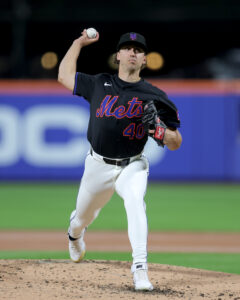
Baseball America’s scouting report credits Sproat with a plus changeup and slider. They write that he has the upside of an average or better starter, albeit with some relief risk based on his average control. He’s not as highly-regarded as McLean or Tong, but it’s not surprising the Mets weren’t willing to part with either of those prospects for a rental. McLean seems categorically untouchable. Michael Marino reported that Milwaukee had tried to involve Tong in discussions on Peralta but were quickly rebuffed. They then turned to a Williams/Sproat framework. It seems they needed to part with Myers to push the deal over the top.
Milwaukee wasn’t going to move Peralta without landing a strong prospect return. His salary was affordable enough that they didn’t need to trade him for salary relief. They certainly weren’t going to re-sign him, though, and it’s their usual operating procedure to hear clubs out on veteran stars who are approaching free agency. It doesn’t make a trade inevitable — they held Willy Adames and let him walk for a compensatory draft pick — but Peralta joins Josh Hader, Corbin Burnes and Williams as recent stars traded within a year or two of reaching the open market.
The Brewers never go into a full rebuild. They’re coming off a 97-win season and advanced to the NLCS. They’ll expect to compete for a fourth consecutive NL Central title. Milwaukee won the division in ’24 after the Burnes trade, which was the most direct parallel for their decision on Peralta. They also landed two prospects in that deal, Ortiz and left-hander DL Hall, who were borderline Top 100 talents who were at the MLB level. Williams and Sproat are probably a little more highly-regarded than the players they got in the Burnes trade, though their deal with Baltimore also included a competitive balance draft pick and didn’t involve the secondary piece in Myers.
Brandon Woodruff will slot atop the rotation after accepting the qualifying offer. Quinn Priester, Jacob Misiorowski, Logan Henderson, Chad Patrick, Robert Gasser and Sproat could all battle for jobs. The Brewers haven’t closed the door on giving Angel Zerpa or Aaron Ashby rotation looks, though they’re each likelier to end up in relief. President of baseball operations Matt Arnold acknowledged that getting Woodruff back made them more comfortable parting with Peralta (relayed by Curt Hogg of The Milwaukee Journal-Sentinel).
There’s a lot of upside with this group, but they’ll probably need to dip into the lower tiers of free agency for a back-end arm to provide innings. RosterResource projects their payroll around $126MM, roughly $11MM north of where they began the ’25 season. They should nevertheless be able to sign a starter for a few million dollars as Spring Training approaches. They wouldn’t have issued the QO to Woodruff if ownership weren’t willing to approve at least a slight payroll bump.
Milwaukee fans are familiar with the churn, but it’s surely a blow to lose another homegrown star and fan favorite. Peralta was third in franchise history in strikeouts and eighth in wins. He’s a two-time All-Star who has been a part of seven playoff teams over the past eight years. He’s out of the division but anchoring the rotation for what looks to be one of their top competitors in the National League.
Michael Marino first reported that the Brewers and Mets were discussing Peralta for Williams and Sproat. Pat Ragazzo of Sports Illustrated indicated talks were accelerating, while Jeff Passan of ESPN first had the agreement. Joel Sherman of The New York Post reported Myers’ inclusion. Respective images courtesy of Benny Sieu, Michael McLoone, Sam Navarro and Brad Penner — Imagn Images.
Mets, Brewers In Conversations About Freddy Peralta
The Mets and Brewers are in discussions about star right-hander Freddy Peralta, according to reports from Pat Ragazzo of Sports Illustrated and Jon Heyman of The New York Post. There’s no deal in place, but The Post’s Joel Sherman characterizes talks as “serious.” Ragazzo adds that middle infield/center field prospect Jett Williams has come up in conversations.
This morning, Michael Marino reported that Milwaukee was looking to acquire Williams and rookie right-hander Brandon Sproat in a Peralta deal. According to Marino, the Mets rebuffed earlier interest from the Brew Crew in top pitching prospect Jonah Tong. Meanwhile, Sherman adds that swingman Tobias Myers would likely head from Milwaukee to Queens if a deal gets across the finish line.
Peralta has been a top target for teams in need of rotation help. He’s coming off a fifth place Cy Young finish behind 176 2/3 innings of 2.70 ERA ball. The Mets have been in the rotation market all offseason but haven’t been keen on making long-term free agent commitments. President of baseball operations David Stearns reiterated this morning that he still hoped to add a starter (link via Jorge Castillo of ESPN).
Mets’ Trade Talks With Padres Involve Nick Pivetta, Ramon Laureano, Mason Miller
The Mets and Padres have been discussing the possibility of a trade that would send established talent to New York while San Diego obtained MLB-ready younger talent and some salary relief. According to The Athletic’s Ken Rosenthal, Dennis Lin, and Will Sammon, right-hander Nick Pivetta, outfielder Ramon Laureano, and star relievers Mason Miller, Adrian Morejon and Jeremiah Estrada are players of interest for New York. The Padres have shown interest in the Mets’ “young major leaguers and all of their top prospects, both pitchers and position players,” including Nolan McLean, Brandon Sproat, and Jonah Tong.
The Athletic’s reporters made a point of noting that Francisco Lindor, Fernando Tatis Jr. and Jake Cronenworth weren’t brought up in these negotiations. This only somewhat lessens the blockbuster potential here given all of the high-profile names already under discussion, though it is also possible that the talks remain somewhat exploratory in nature. As Rosenthal/Lin/Sammon note, San Diego president of baseball operations A.J. Preller is always “weighing a dizzying number of possible moves and contingency plans,” and Mets PBO David Stearns is likewise no stranger to major trade concepts.
Pivetta’s name surfaced in trade rumors earlier this week, and Preller recently downplayed the idea that the Padres would trade any of their top bullpen arms. San Diego had an elite relief corps in 2025, but one major name from that group is already gone since closer Robert Suarez left for the Braves in free agency. The depleted nature of the Friars’ rotation also puts more pressure on the bullpen to pick up more of the run-prevention slack, and by that same token, makes it seemingly less likely that the Padres would trade Pivetta and further diminish the starting staff.
That said, Pivetta can opt out of his contract following the 2026 season. The backloaded four-year, $55MM contract Pivetta signed last season still has $51MM remaining, which breaks down as $19MM in 2026, a $14MM player option for 2027, and an $18MM player option for 2028 if Pivetta chooses to remain in San Diego next winter. The 2027 player option turns into a club option in the event of a long-term injury, but if Pivetta has the same kind of healthy and very effective season that he posted in 2025, he’ll surely trigger his opt-out.
If Preller could turn Pivetta into multiple controllable players who can still help the Padres win in 2026, that would be quite a way of threading the needle for the long-time executive. The Mets wouldn’t have much interest in giving up one of their top young talents for what might well be just one year of Pivetta’s services, and McLean might not be available at any price — the Athletic trio write that “McLean is thought to be untouchable, or close to it.” The New York Post’s Jon Heyman adds that outfield prospect Carson Benge is also considered to be virtually unavailable in trade talks.
By comparison, the likes of Tong, Sproat, and Jett Williams may be more available, though Stearns has been naturally hesitant about trading away any top minor leaguers. A trade package of Pivetta, Laureano as a short-term outfield add for 2026, and a reliever with four seasons of control like Miller or Estrada might well convince Stearns to part ways with some premium prospect talent, but on the other hand, that would be a lot for the Padres to move in a single trade.
The Athletic’s writers note that the Padres might get a greater overall return by sending Pivetta, Laureano, etc. elsewhere in individual deals, so it would take a gigantic trade package for the club to include multiple trade chips into a single swap. For Miller in particular, San Diego would want a ton back, given how much the Padres had to give up to land the closer from the A’s just last July.
Getting Pivetta’s salary off the books is one way for the Padres to shake up the roster given the team’s limited payroll flexibility, while short-term commitments to Pivetta and Laureano probably hold more appeal to Stearns than signing free agents to longer-term contracts. The sky is the limit when two creative executives like Preller and Stearns are cooking up trade scenarios, so this is certainly a situation worth monitoring as the offseason progresses.
Mets Activate Reed Garrett, Designate Justin Garza
The Mets announced five roster moves in advance of today’s game with the Reds, including their official selection of Brandon Sproat‘s contract from Triple-A. Sproat will make his MLB debut as today’s Mets starter, and New York is also welcoming right-hander Reed Garrett back from the 15-day injured list. In corresponding 28-man and 40-man roster moves, right-handers Kevin Herget and Wander Suero were optioned to Triple-A, and righty Justin Garza was designated for assignment.
Garza was acquired in a trade with the Giants in June, and his five appearances with the Mets marked the righty’s first Major League action since the 2023 season when he pitched with the Red Sox. While Garza’s first four Mets outings were scoreless, he was torched for four runs in his last game on June 20, and he was optioned to Triple-A Syracuse the next day. His Triple-A work has been far from stellar, as Garza has an 8.17 ERA over 25 1/3 innings in Syracuse.
If Garza clears waivers and is outrighted off the Mets’ 40-man roster, he has the right to reject that assignment in favor of free agency, since Garza has already been outrighted earlier in his career. Given the late date on the regular-season calendar and the frequency of the Mets’ bullpen shuffles, Garza might prefer to just stick in the organization if he thinks another call back to the majors might still be in the cards.
A waiver claim is a possibility, if another team is willing to look past Garza’s lack of success in 2025. He has added some velocity to his fastball this season and is now averaging better than 96.1mph in the big leagues and in Triple-A, even if that added heat has actually led to a downturn in his strikeout rate. Garza has also been a lot more homer-prone in 2025 than in past seasons.
Garrett was retroactively placed on the IL on August 23, and he’ll return in short order since his bout of elbow inflammation fortunately didn’t turn out to be too serious. The time off could also act as a bit of a reset, as Garrett struggled to a 15.43 ERA over his last 4 2/3 innings prior to hitting the injured list.
Garrett ranks second on the Mets with 54 appearances, and he’ll resume his role as one of the few true regulars within New York’s revolving door of a bullpen. Over 52 1/3 innings, Garrett has a 3.61 ERA and a strong 28.3% strikeout rate, even if his 11% walk rate is on the high side.
Mets To Promote Brandon Sproat
11:45am: The Mets will indeed call up Sproat for his major league debut this weekend, per Chase Ford of MiLB Central. He’ll make his big league debut on Sunday. The Mets will need to open spots on the active and 40-man rosters for Sproat.
9:15am: The Mets have already called up two of the organization’s top three pitching prospects. Nolan McLean has taken the National League by storm, and Jonah Tong looked sharp in his MLB debut last week. The third member of their touted Triple-A trio could soon join them in the majors. SNY’s Andy Martino reports that righty Brandon Sproat is receiving “strong consideration” to make a start for the big league club in the near future.
A possible promotion for Sproat comes at the same time the Mets have been mulling a minor league stint for struggling righty Kodai Senga, who has a 6.56 ERA over his past eight starts (averaging just 4 1/3 innings per outing in that time).
That’s not as straightforward a decision as it might seem. The five-year, $75MM contract Senga signed when he came to MLB from Japan’s Nippon Professional Baseball stipulates that he cannot be optioned to the minors without his consent. It’s not expressly clear that the Mets have asked him about to accept an optional assignment, though Mike Puma of the New York Post implied as much yesterday when writing that the organization expects to know whether Senga would approve the move by this weekend. Puma added that one way or another, the organization expects Sproat to make his big league debut before season’s end.
Sproat, 24, was the Mets’ second-round pick in 2023. The former Florida Gators standout has had an up-and-down year in Triple-A. He struggled to an ERA north of 6.00 in April/May before dominating with a combined 2.22 ERA in June and July. Sproat alternated between quality starts and clunkers throughout August. He’s sitting on a 4.24 ERA overall, and he’s punched out 22.1% of his opponents against a 10.6% walk rate. Those numbers look far better if you toss out the first two months of the season; Sproat has a 3.13 ERA, 25.7% strikeout rate and 10.1% walk rate in his past 14 starts. He tossed seven scoreless frames against the Yankees’ top affiliate his last time out, fanning nine hitters against only two walks along the way.
The uneven nature of Sproat’s season, coupled with the influx of talent from this year’s draft, has dropped him down — or even entirely off — most top-100 lists around the industry. ESPN’s Kiley McDaniel still lists him 83rd in the game, and Baseball America has Sproat at No. 98. Baseball America notes that his turnaround in Syracuse coincided with increased usage of his curveball, changeup and two-seamer, helping to diversify his repertoire and make him less predictable, as opponents had become too keyed-in on his four-seamer. The 6’3″, 215-pound Sproat is sitting 96.4 mph on that four-seamer this season, and both his changeup and slider draw above-average to plus grades from scouts.
While Sproat’s seemingly inevitable addition to the 40-man roster and his MLB debut will come after Sept. 1, he’ll still be eligible for postseason play. Any player in an organization prior to September is eligible for postseason rosters. Technically, the Mets would need to petition for him to be an injury replacement, but teams make this move every year. At times, we’ve even seen top prospects who weren’t on the 40-man roster at the beginning of September get selected to the roster in October make their MLB debuts in the playoffs (e.g. Shane McClanahan, Adalberto Mondesi, Alex Kirilloff).
Mets Notes: Tong, Duran, Siri
There is some feeling within the Mets organization that right-handed pitching prospect Jonah Tong could make his MLB debut before the 2025 season is up, Mike Puma of the New York Post reports. Tong only just made his debut with Triple-A Syracuse on August 16 and hadn’t been projected as “a consideration for the Major League roster this year,” Puma writes, but “that stance has changed in recent days.”
The shift is due to both the Mets’ rotation needs, and Tong’s continued excellence in his third pro season. A seventh-round pick for New York in the 2022 draft, Tong has emerged as a top-100 prospect — Baseball America has the right-hander 42nd on their midseason top 100 list, and MLB Pipeline has Tong in their 44nd spot. It is easy to see why, as Tong has an absurd 1.43 ERA and 40.5% strikeout rate over 113 2/3 combined innings at the Double-A and Triple-A levels in 2025. That includes 11 2/3 scoreless innings during his brief time in Syracuse.
Naturally there’s some risk in bringing the 22-year-old up to the Show in such relatively rapid fashion, and Tong’s 10.6% walk rate stands out as a potential weakness to be exploited by big league hitters. That said, Tong’s unusual delivery could also leave some hitters baffled, not to mention his plus fastball that has a ton of break if relatively little velocity (in the 91-94mph range).
Promoting Tong doesn’t necessarily mean he’d be in the majors for the rest of the season, of course, as the Mets could potentially use him for a spot start during a crowded stretch of the schedule. New York is six games into a stretch of 26 games in 27 days, with September 4 as the only off-day during that stretch. This puts even more pressure on a rotation that hasn’t provided much in the way of length or results lately, and the Mets already turned to another rookie in Nolan McLean to take Frankie Montas‘ rotation spot earlier this month.
At this point it wouldn’t be a shock to see McLean, Tong, and another top prospect in Brandon Sproat all get onto the mound before the Mets’ season is over. This need for help from the farm (in addition to any club’s natural reticence about moving top prospects) may have been a reason why the Amazins didn’t make much progress in trade talks with the Twins about Jhoan Duran.
The Mets were loosely linked to Duran’s market just prior to the trade deadline, and the New York Post’s Jon Heyman reported that the Mets weren’t willing to move any of McLean, Tong, Sproat, Jett Williams, or Carson Benge. This quintet are the consensus top prospects within New York’s farm system, and Baseball America has all five players within their league-wide top-100 prospects list. Minnesota was known to be seeking at least one top-100 type for Duran’s services, and found such an offer from another NL East club in the Phillies, who landed Duran for Eduardo Tait and Mick Abel.
Duran has looked excellent in Philadelphia, while the Mets have gotten mixed result from their deadline bullpen acquisitions. Tyler Rogers and Gregory Soto have both pitched well since coming to Queens, but Ryan Helsley has struggled badly. Shaky pitching on both the bullpen and rotation has contributed to the Mets’ 7-13 record in August, and the Phillies have pulled out to a six-game lead over New York in the NL East.
In other Mets news, manager Carlos Mendoza told reporters (including MLB.com’s Anthony DiComo) on Wednesday that Jose Siri is expected to start a minor league rehab assignment this week. Siri fractured his left tibia after fouling a ball off his leg back in April, and what was expected to be an absence of 8-10 weeks has now lasted well over four months. Since he played in only 10 games with the Mets before the injury, Siri figures to need at least a week of minor league action to get fully ramped up for a return to the active roster.
This makes him a candidate for an IL activation once rosters expand on September 1, though Siri will be returning to a more crowded outfield picture. New York went into the season planning to use Siri and Tyrone Taylor in a center field timeshare, but the deadline acquisition of Cedric Mullins has now created a more traditional lefty-righty platoon up the middle with Taylor. A player with Siri’s elite glove always has value on a roster, of course, so the Mets could use him as something of a defensive specialist if nothing else.
Mets To Promote Nolan McLean
The Mets will call up top pitching prospect Nolan McLean to make his MLB debut this Saturday, reports SNY’s Andy Martino. He’ll step into the rotation spot vacated by Frankie Montas‘ move to the bullpen. Jon Heyman of the New York Post reported earlier this morning that righty Paul Blackburn was also headed to the bullpen when he’s ready to be reinstated from the injured list, setting the stage for either McLean or fellow prospect Brandon Sproat to make his debut.
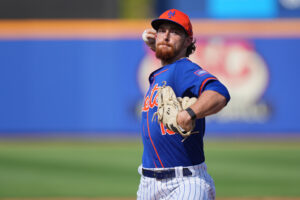
As we noted yesterday when the Mets moved Montas to the ‘pen, the Saturday start aligns far better with McLean’s turn in the Triple-A rotation than with that of Sproat. McLean has also simply outpitched Sproat this season, though both well-regarded prospects have excelled recently.
The timing of the move likely isn’t a coincidence. Saturday marks the first day on the calendar where there’s not enough time remaining for players to accrue enough service to exhaust their rookie eligibility. By waiting until Saturday to promote McLean, the Mets have ensured that he’ll still qualify as a rookie next season and therefore still be able to earn the Mets potential future draft picks via the league’s Prospect Promotion Incentive (PPI) program. In all likelihood, McLean is just one of several top prospects around the league who’ll be promoted after Aug. 15.
McLean, 24, was the Mets’ third-round pick in 2023. He’s rated as one of the system’s more promising young arms since that selection, but his stock has exploded in 2025 as he’s ripped through Double-A and Triple-A lineups. McLean has pitched a combined 113 2/3 innings between those two levels and compiled a tidy 2.45 ERA while punching out 27.2% of his opponents. His 10.7% walk rate is still too high, but his huge 54.7% ground-ball rate can help to erase a few of those free passes by way of the double-play ball.
This year’s terrific run has not only vaulted McLean toward the top of the Mets’ in-house prospect lists — it’s made him a consensus top-100 prospect in the sport. He sits 37th among all big league prospects at MLB.com, 40th at Baseball America and 53rd at FanGraphs on each outlet’s post-deadline reranking of the sport’s top young talents.
The 6’2″, 215-pound McLean is an Oklahoma State product whose athleticism draws plenty of praise. He was a two-sport star in high school, playing both baseball and football, and he was a two-way player at OSU, where he was a third baseman and outfielder in addition to his work on the mound. He’s since dialed in only on pitching and experienced an uptick in velocity, now sitting 95 mph with a four-seamer that can climb to 98 mph when he needs to reach back for a bit extra. MLB.com’s report on McLean calls his sweeper a “monster” of a pitch with “elite” spin rate. He’s sitting 85.5 mph with that pitch and also mixing in a sinker, cutter and seldom-used changeup.
Because McLean will retain rookie eligibility going into next year, he could earn the Mets a draft pick down the line. If McLean were to win National League Rookie of the Year or finish top-three in NL MVP voting next season, the Mets would gain that pick. Even if McLean doesn’t hit either of those goals, the fact that he’ll be a top-100 prospect who accrued a full year of service as a rookie opens a three-year window for him to net the Mets a compensatory pick based on award voting. If McLean were to land any top-three finish in Cy Young or MVP voting before reaching arbitration, the Mets would still gain a pick. Players can only net their team one pick under the league’s PPI program, but the timing of his promotion means McLean could do so at any point from 2026-28.
Setting aside the PPI aspect of the promotion, McLean’s promotion comes at a time when he cannot accrue a year of service this season. He’ll be controllable for at least six full years beyond the current campaign — potentially more than that, depending on whether he’s optioned at any point in the future. The earliest he could become a free agent would be after the 2031 season, and the earliest McLean could qualify for arbitration would be following the 2028 season.
Mets Move Frankie Montas To Bullpen
The Mets will move struggling right-hander Frankie Montas from the rotation to the bullpen, manager Carlos Mendoza announced Tuesday (link via Anthony DiComo of MLB.com). The team has not yet announced who will start in place of Montas on Saturday. The Mets have righty Paul Blackburn on a minor league rehab assignment, but Mendoza indicated that Blackburn will make at least one more rehab appearance and is not an option to step into Montas’ rotation spot this weekend.
Notably, Saturday is the first day that prospects can be promoted to the major leagues but still fall shy of the requisite 45 days on the active roster that exhausts a player’s rookie status. In other words, beginning Saturday, the Mets will be able to turn to a top prospect like Nolan McLean or Brandon Sproat without burning either pitcher’s rookie eligibility. That’s key for teams with top-100 prospects, as promoting those prospects early in the 2026 season can then net the teams a compensatory draft pick, based on Rookie of the Year voting.
It’s been a miserable season for the veteran Montas, who inked a surprisingly strong two-year, $34MM contract with an opt-out provision over the winter. That opt-out is a moot point by now, with the 32-year-old righty being relegated to bullpen work after logging a 6.38 ERA in his first eight appearances of the year (36 2/3 innings).
Montas began the season on the injured list due to a lat strain and didn’t pitch in the majors until late June. He’s allowed four or more earned runs in four of seven starts and has yet to complete six innings in an outing. Setting aside a solid season debut in which he tossed five shutout frames, Montas has been clobbered for a 7.39 ERA and yielded an average of 2.27 homers per nine innings pitched in six starts and one three-inning relief appearance (his most recent outing).
It appears that Montas won’t get the opportunity to improve on that rotation performance anytime soon. It’s difficult to fathom a scenario where he’d turn down the $17MM player option he’s facing at season’s end, so it’s in the Mets’ best interest to get him back on track, but their recent play doesn’t afford them the luxury of keeping a struggling veteran in the rotation while he tries to sort things out.
The freefalling Mets, who’ve lost seven in a row, currently have Kodai Senga, Sean Manaea, Clay Holmes and David Peterson in the rotation. Sproat and McLean stand as the two most logical replacements. (Fellow top prospect Jonah Tong was only just promoted to Triple-A and has yet to throw a pitch there.) Sproat last pitched Aug. 7 and would be on eight days’ rest, whereas McLean pitched on the 10th. Based on their current schedules, McLean seems like the more straightforward option, and he’s pitched more effectively this season anyhow.