
Taillon Unlikely To Pitch In 2020 Regardless Of Season Schedule
The uncertain start date for the season and the likelihood that, if there is a 2020 season, it’d extend into at least late October, has created some intriguing possibilities about players unexpectedly returning from injury earlier than anticipated. In theory, Pirates righty Jameson Taillon would be one such player to watch, but Taillon tells Jason Mackey of the Pittsburgh Post-Gazette that the organization has already ruled out a return in 2020 — regardless of start date (Twitter link).
Taillon, 27, underwent his second career Tommy John surgery last August. The righty acknowledged that the thought of pushing back the season end date prompted him to inquire with the team, but the Pirates “shut me down pretty quickly,” Taillon says. Even in the event that Taillon’s arm were ready for game activity before the close of a potentially pushed-back season, the club would have concerns about the impact of a shortened offseason heading into 2021.
Pittsburgh controls Taillon through the 2022 season, so he’ll still have at least two years as a Pirate remaining — barring a trade. That seems quite likely to be explored a ways down the road, given the team’s penchant making its most desirable players available once their escalating salary and waning team control reach a nexus. In the case of Taillon, it would seem prudent to wait until he’s able to demonstrate his health, which would mean a mid-2021 trade at the earliest.
Of course, it’s also worth noting that Taillon will be paid just $2.25MM in 2020 — again, assuming some form of season is played — and would likely stand to earn that same sum in 2021 regardless of whether games are played. That’s an eminently affordable rate even for the Pirates, so financial motivations won’t play much of a role in any talks in which they may engage (save for the inquiring team’s desire to land a quality pitcher at a relative pittance).
Rookie Radar: NL Central
We’ve already run through the NL West, the NL East, the AL West and the AL Central in our look at some of the up-and-coming talent that figures to step into the Major League spotlight whenever play resumes. Let’s take a run through the NL Central…
Chicago Cubs
Nico Hoerner is the most interesting name to watch. The 2018 first-rounder skyrocketed through the system to make his MLB debut late last season, and while his .282/.305/.436 output didn’t exactly set the world on fire, it capped an impressive rise for a 22-year-old in his first full pro season. The Cubs hope there’s a potential everyday option at second base here. We could also see 27-year-old Robel Garcia and his light-tower power get another audition, though his contact skills (or lack thereof) are a notable red flag.
The organization lacks high-end, MLB-ready pitching prospects, but it wasn’t that long ago that righty Adbert Alzolay was considered to be just that. He was limited by a triceps injury last year and pitched just 81 2/3 innings between the minors and a brief MLB call-up, but his strikeout numbers are intriguing. Other rotation options include Cory Abbott, Tyson Miller and Justin Steele, but no one from the bunch is regarded as a blue chipper.
In the ‘pen, expect some combination of James Norwood, Dillon Maples and Duane Underwood Jr. to be called into action as injuries arise. All three are on the 40-man roster.
Cincinnati Reds
Shogo Akiyama will be one of the most interesting “rookies” to watch this season. He’s of course new to the MLB circuit but no stranger to playing professionally, having starred for Japan’s Seibu Lions over a nine-year career in Nippon Professional Baseball. A career .301/.376/.454 hitter in Japan, Akiyama hit .296 or better with at least a .385 OBP in each of his final five seasons with the Lions.
The Reds are suddenly a somewhat veteran club, so there aren’t many rookies who’ll be trusted with an Opening Day role. Well-regarded catcher Tyler Stephenson could be summoned in the event of an injury to Tucker Barnhart or Curt Casali. Shortstop Jose Garcia drew some eyes with a big spring showing but has yet to reach Double-A. He probably needs some more minor league time.
If a starter goes down, right-hander Tony Santillan has steadily climbed the ranks, although he struggled in a pitcher-friendly Double-A setting a year ago. Still, with the Reds set to potentially lose both Trevor Bauer and Anthony DeSclafani to free agency next winter, they’ll probably want to get a look at Santillan at some point.
The bullpen has a host of potential options — Vladimir Gutierrez, Reiver Sanmartin, Joel Kuhnel and Tejay Antone among them. Gutierrez has worked as a starter but struggled enormously in Triple-A, and his power fastball would seemingly play well in relief. Kuhnel has already made his MLB debut.
Milwaukee Brewers
The Brewers signed 10 Major League free agents this winter, traded for several players who’ll be on the Opening Day roster and don’t have a particularly well-regarded farm. All of that is to say — their rookie contributions might be few and far between. (To be fair, there are some semantics at play here; neither Keston Hiura nor Luis Urias is technically a rookie despite lacking a full season in the Majors. Both are highly intriguing young players.)
Jacob Nottingham might be called upon should Omar Narvaez or Manny Pina fall to injury. Outfielder Tyrone Taylor made his MLB debut last year but is buried behind a host of more experienced options. Former first-round pick Corey Ray has yet to debut but also finds himself on the wrong end of that deep outfield mix. Milwaukee picked up Mark Mathias in a small trade with the Indians and kept the versatile infielder on the 40-man roster, but it might take multiple injuries and/or a huge Triple-A showing to get to the Majors.
Righty Devin Williams leads the pack of bullpen candidates, having debuted with a 3.95 ERA in 13 2/3 frames last year. Right-handers J.P. Feyereisen and Angel Perdomo figure to emerge at some point, too, and waiver claim Eric Yardley provides a left-handed option who posted big numbers in Triple-A with the Padres last season. Rotation candidates include righty Drew Rasmussen, who had a nice year in Double-A in ’19. Trey Supak was rocked in seven Triple-A starts after a solid Double-A showing himself.
Pittsburgh Pirates
Right-hander Mitch Keller barely still qualifies a a rookie and should have a rotation spot for much of the season. Keller, long one of MLB’s premier prospects, was clobbered in his debut effort, but it’ll be interesting to see how he fares without the juiced ball and (presumably) without the prior front office/coaching staff’s emphasis on a two-seam fastball.
The Bucs have already talked extension with third base prospect Ke’Bryan Hayes — one of the game’s best defensive minor leaguers. Hayes didn’t have a great year at the plate in Triple-A in 2019, but he’ll open the season there and should break into the big leagues this year. As the club’s potential third baseman of the future, he’s a definite name to watch.
After that pairing, there’s a drop. Jason Martin and Jared Oliva might get some time in the outfield, and depending on injuries middle infielder Kevin Kramer and first baseman Will Craig are possibilities.
It feels like Nick Burdi has been a prospect forever, but the 27-year-old was healthy and opened some eyes this spring with a good showing. He’s undergone both Tommy John and thoracic outlet surgery but boasts a triple-digit heater when healthy. Blake Cederlind and Cody Ponce could see time in the ‘pen, as JT Brubaker could in the rotation.
St. Louis Cardinals
Among NL Central prospects who could plausibly debut in 2020, outfielder Dylan Carlson is perhaps the most highly regarded. A consensus top 20 minor leaguer who belted 26 home runs, stole 20 bases and posted a combined OPS north of .900 between Double-A and Triple-A last year, Carlson is viewed as a potential cornerstone piece. He’ll have to stave off Tyler O’Neill, Lane Thomas and fellow rookie Justin Williams, but Carlson has the highest ceiling of the bunch.
Yadier Molina just keeps on going, so there’s little hope of Andrew Knizner seeing meaningful time unless there’s an unfortunate injury to Molina. But Knizner is touted as a potential starting catcher himself and is more or less MLB-ready. Likewise, infielder Edmundo Sosa is ready for an MLB look but lacks an obvious path given the team’s veteran infield mix.
Left-handers Genesis Cabrera and Kwang-Hyun Kim give the Cards a southpaw option both in the rotation and in the bullpen. Kim, long one of the better pitchers in the Korea Baseball Organization, had an eye-opening spring showing. Right-hander Junior Fernandez tops the list of intriguing bullpen candidates thanks to a sub-2.00 ERA in the minors last year and a heater that averaged nearly 97 mph on a brief MLB cup of coffee.
Breakout Candidate: Max Fried
Max Fried ranked among the Braves’ top prospects from the time they acquired him as the headlining young piece in a trade that sent Justin Upton to the Padres until he exhausted his rookie status in 2018. From 2015-17, Fried was considered among the best in a deep system,but he never entered the club’s top five prospects (at either MLB.com or Baseball America) and was at times outranked by Sean Newcomb, Kolby Allard, Touki Toussaint, Tyrell Jenkins, Manny Banuelos, Aaron Blair, Joey Wentz, Luiz Gohara and current teammate Mike Soroka. Fried’s outlook is now considerably brighter than most of that bunch, and it’s possible that by the end of the next season — whenever that is — he’ll even have surpassed Soroka as Atlanta’s top arm.
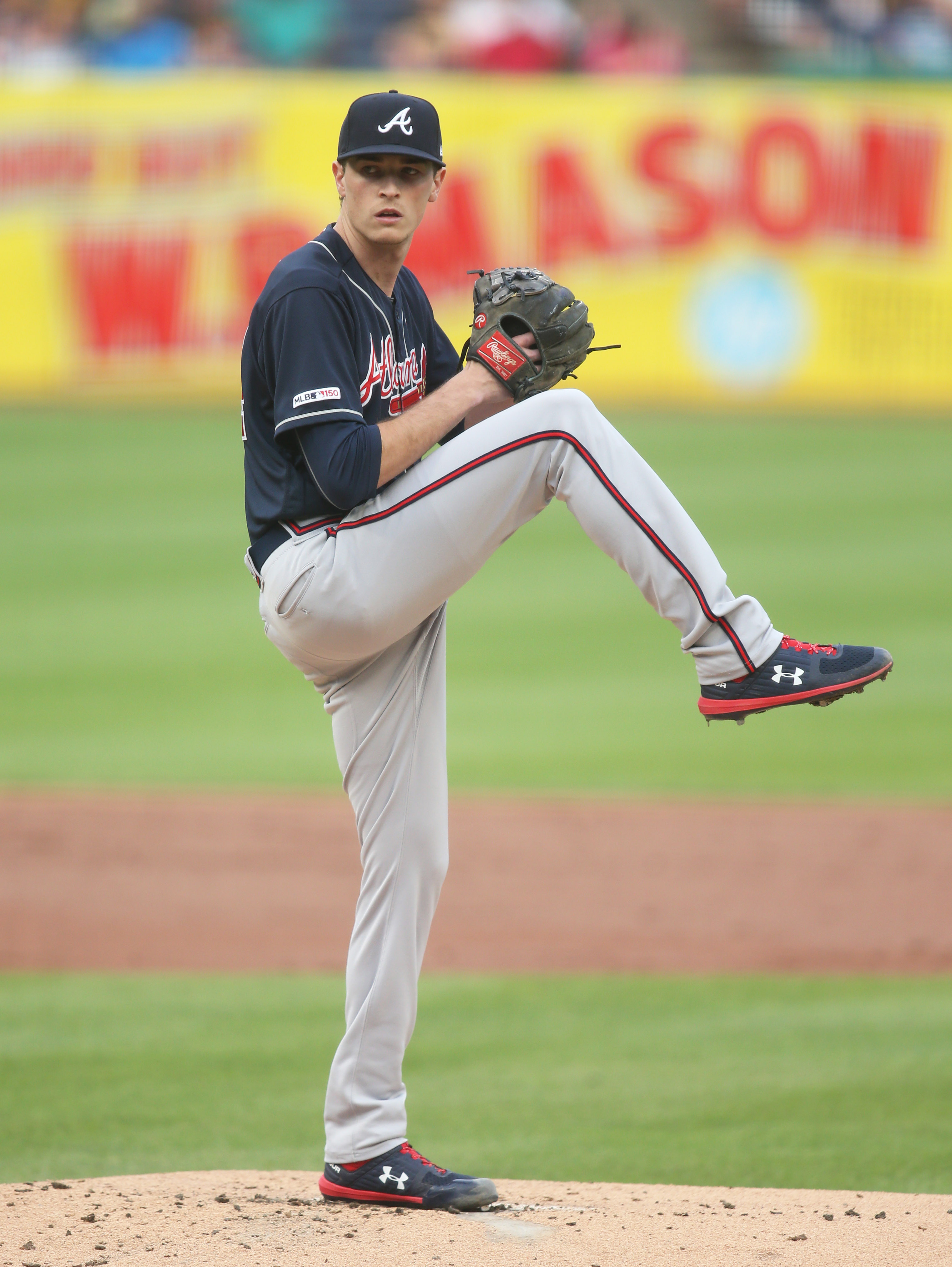
Fried recently turned 26, and although it’s been nearly eight years since San Diego took him with the seventh overall pick in the 2012 draft and more than five years since Atlanta acquired him, he has just 225 1/3 MLB innings under his belt. Fried underwent Tommy John surgery as a prospect, slowing his march to the big leagues, and some of the names ranked ahead of him got earlier looks when rotation spots did open up. To this point in his young career, he has a 3.83 ERA and an FIP that’s an exact match. He’s been a quality arm, but the 2019 season was his first full year in the rotation. He produced a 4.02 ERA through 165 2/3 frames.
If you want to argue that Fried has, to an extent, already broken out — that’s defensible. Last year’s ERA, after all, was better than the league average when considering the juiced ball’s impact around the league (and especially given Fried’s hitter-friendly home park). Park- and league-adjusted metrics like ERA- and ERA+ had him anywhere from nine to 16 percent better than the average pitcher. Last year’s 3.72 FIP was 15 percent better than the league average, per FIP-. In all, Fried was worth about three wins above replacement (3.0 rWAR, 2.7 fWAR). He’s clearly already a good pitcher.
The question is whether there’s another gear for Fried to reach. The left-hander ranked 22nd among 75 pitchers who threw at least 150 innings with a solid but not elite K-BB% (18.0). More impressively, he tied for eighth-best with a 3.32 xFIP. Fried’s blend of high-end strikeout rates (9.4 K/9, 24.6 percent of the hitters he faced), walk rates (2.6 BB/9, 6.7 percent) and ground-ball rate (53.6%) all contribute to him faring well in terms of fielding-independent pitching metrics.
Looking at his individual pitches, Fried upped his four-seam velocity to a career-best 93.8 mph average in 2019. That’s particularly strong for a lefty, as southpaws tend to have lower average velocities than their right-handed peers. It’s a low-spin offering, however, and Fried’s pedestrian swinging-strike rate on that four-seamer reflects that. He does locate the pitch well, and his improved ability to work ahead in the count — his first-pitch strike rate jumped from 57.8 percent in 2018 to 63.7 percent in 2019 — allowed him to use his curveball more often. Fried’s curveball was lauded as his best pitch during his prospect days (one of the best curves in all of minor league baseball, for that matter), and he demonstrated why in 2019.
Only eight pitchers in the game garnered more swinging-strikes on their curves in 2019, and while it’s true that Fried threw more hooks than the average pitcher, his 15.5 percent swinging-strike rate topped quality curveballs like those of Jose Berrios and Sonny Gray, aligning more closely with the whiff rates of Stephen Strasburg (15.3 percent) and Charlie Morton (16.4 percent). Fried also generated a called strike on 18 percent of his curveballs; just over one third of the time that he threw the pitch, it resulted in a strike without the ball being put into play.
The curveball was always supposed to be Fried’s bread and butter, but he broke out a slider in 2019 that looks to be equally effective — if not even better. Hitters whiffed on the new pitch at a 15.3 percent clip that nearly matched his curve, and they chased it out of the strike zone at a 41 percent rate — the best of all his offerings. Fried’s spin on the slider isn’t at the elite levels of his curve, but it ranked in the 76th percentile. Opponents batted .212/.241/.327 when putting his curve into play and .200/.230/.331 when putting his slider into play. Not bad for a pitch he’d literally never thrown in a big league game until March 28, 2019.
When hitters did make contact against Fried, the quality of said contact wasn’t particularly impressive. Per Statcast, Fried allowed hitters to barrel just 4.4 percent of the pitches put into play against him, ranking 16th of 242 pitchers. Opponents batted .270/.324/.419 against Fried in 2019, which translated to a .315 wOBA. But based on the quality of contact he allowed and his strong K/BB numbers, Statcast projected a .297 expected wOBA for Fried. That 18-point gap between his actual wOBA and his xwOBA was the 34th-largest among 242 big league pitchers (with most who ranked ahead of him being pitchers who were shelled at an unsustainable rate in the first place — not quality performers).
The pitching-rich Braves still have more arms on the way. Ian Anderson and Kyle Wright highlight their current crop of minor league arms. Soroka, of course, is a highly talented pitcher in his own right — evidenced by a runner-up finish in NL Rookie of the Year voting a sixth-place nod in 2019 Cy Young balloting. It’s easy for Fried to get a little lost in the shuffle after Soroka’s electric debut and the constant hype surrounding their rich farm system. But it seems very possible that we’ve yet to see the best Fried has to offer, and there’s reason to think that his best will be enough to push him into the upper echelon of NL starters.
AL Central Notes: Buxton, Fulmer, Royals
The Twins‘ expectation is that center fielder Byron Buxton would’ve been in center field on Opening Day had the season commenced on time, writes Phil Miller of the Minneapolis Star-Tribune. The 26-year-old underwent surgery to repair a torn labrum in his left (non-throwing) shoulder last September, and manager Rocco Baldelli said in a weekend conference call that Buxton’s rehab from the procedure “could not have gone smoother.” Buxton was a bit limited early in camp during the first spring training, but he’ll be on a normal schedule if a second (likely abbreviated) training camp is able to come together. Injuries have plagued much of Buxton’s career — crashing into the center field fence on the regular and frequently laying out for diving attempts take their toll on a body — but he turned in a .262/.314/.513 slash line (114 OPS+, 111 wRC+) in 295 plate appearances when healthy last season. Despite playing in only 87 games, he tied for fifth among MLB outfielders in Statcast’s Outs Above Average metric.
More out of the division…
- Michael Fulmer‘s rehab from Tommy John surgery is on track, and the Tigers right-hander would likely be ready for a minor league rehab stint in early July if play has resumed by that point, writes Chris McCosky of the Detroit News. Fulmer’s 2018 season was cut short due to knee surgery, and he sustained the UCL tear that led to his Tommy John surgery last spring. A late start to the year and an pushed-back end date would give Fulmer some additional innings, though he’s quick to say that he “[doesn’t] think there are any positives to take out of” the COVID-19 pandemic, even while acknowledging that it could allow him to get in more work in 2020. Fulmer, the 2016 American League Rookie of the Year (159 innings, 3.06 ERA, 5.4 rWAR), hasn’t pitched since September 2018 and will be arbitration-eligible for the third time next winter. He’s a Super Two player and remains under club control through the 2022 season.
- Lynn Worthy of the Kansas City Star takes an interesting look at the manner in which the Royals‘ front office is operating amid the suspended state of play. And while the makeshift manner in which the club’s player development staff now has to interact with players is obviously a sub-optimal setup, assistant general manager J.J. Picollo believes that the club “will end up with better processes for our offseason communication” as a result of needing to be more nimble with their interactions. Regular Zoom meetings; webinars on nutrition, pitch grips and new technologies to utilize; and more concrete one-on-one communication schedules have been put into place via a variety of platforms.
Padres Release Gordon Beckham
The Padres released infielder Gordon Beckham earlier this month, as first indicated on the Pacific Coast League’s transactions log. The move came back on March 14, it seems, although there was never a formal announcement from the club.
Beckham, 33, inked a minor league pact with San Diego early in February but had a rough showing in camp. Although he drew five walks, Beckham was also hitless in 14 at-bats. He spent the 2019 campaign with the Tigers, hitting .215/.271/.372 with six homers, a dozen doubles and a pair of triples in 240 trips to the plate.
Beckham made his big league debut just one year after being selected with the No. 8 overall pick in the 2008 draft by the White Sox. He wasn’t able to replicate a strong rookie campaign, though, and eventually settled in as a journeyman utility infielder. He’s appeared in the big leagues each year since 2009, but Beckham carries a tepid .237/.300/.367 slash in 3782 plate appearances as a big leaguer.
Rosters Expected To Temporarily Expand To 29 Players
If Major League Baseball is indeed able to begin a season later this summer, teams are expected to be allowed 29-man rosters for the first month of the truncated campaign, per USA Today’s Bob Nightengale (Twitter link).
It’s a sensible temporary solution in light of the fact that clubs wouldn’t be afforded the traditional six-week run-up to the season that Spring Training provides. Permitting all 30 clubs to carry an extra three players — standard roster size was already slated to expand from 25 to 26 this season — will help clubs to manage pitcher workloads early in the year. And, with the expected addition of frequent doubleheaders, an extra player or two on the bench would allow managers to more easily rest regulars who are dealing with minor injuries or simply need a breather.
Whether the league would place any restrictions on the number of pitchers isn’t yet known, but clubs had previously been capped at a maximum of 13 pitchers. It’s also not clear whether a 30th player would be permissible on the day of a twin bill (as was the case in allowing a 26th man in previous seasons). The specifics of roster expansion and the format of a rebooted “spring” training are among the many items that still need to be hammered out even after MLB and the MLBPA reached an agreement on service time, player salaries and the 2020 draft last night.
Noah Syndergaard Undergoes Tommy John Surgery
March 27: Syndergaard underwent surgery yesterday at the Hospital for Special Surgery in West Palm Beach, Fla., tweets Anthony DiComo of MLB.com.
March 24, 2:58pm: The Mets have formally announced that Syndergaard will undergo Tommy John surgery on Thursday. He’ll be out until at least April of 2021. General manager Brodie Van Wagenen offered the following statement, via press release:
After experiencing discomfort in his elbow before Spring Training was suspended due to the pandemic, Noah and our health and performance department have been in constant contact. Based on the persistence of his symptoms, Noah underwent a physical examination and MRI that revealed the ligament tear. A second opinion from Dr. Neal ElAttrache confirmed the diagnosis and the recommendation for surgery. Noah is an incredibly hard worker and a tremendous talent. While this is unfortunate, we have no doubt that Noah will be able to return to full strength and continue to be an integral part of our Championship pursuits in the future.
2:41pm: Mets right-hander Noah Syndergaard has been diagnosed with a torn ulnar collateral ligament in his right elbow and is expected to undergo Tommy John surgery, ESPN’s Jeff Passan reports (via Twitter). It’s a rather stunning and out-of-the-blue development, as Syndergaard looked relatively sharp in Spring Training — three runs on five hits and no walks with 11 strikeouts in eight innings — and wasn’t known to be experiencing any notable discomfort.
The Syndergaard news is a devastating blow to a Mets rotation that looked to have the makings of a quality group. Jacob deGrom, of course, has won the past two National League Cy Young Awards and will return to front the staff, but Syndergaard had been slotted into the second spot in the rotation behind him. His injury makes last summer’s acquisition of Marcus Stroman all the more important but also serves to highlight the team’s inability to work out an extension with righty Zack Wheeler despite multiple attempts over the past couple of seasons. Wheeler signed a fjve-year deal with the division-rival Phillies this winter, though an extension prior to reaching the open market likely wouldn’t have proved as costly — particularly were it agreed upon prior to the 2019 campaign.
Beyond the combination of deGrom and Stroman, the Mets will turn to Steven Matz and rebound candidates Rick Porcello and Michael Wacha — both signed to one-year deals in the offseason. Porcello remained a durable workhorse for the Red Sox but was tattooed for a 5.52 ERA and better than 10 hits per nine innings in his 32 starts and 174 1/3 innings last year. Wacha, meanwhile, battled injuries for the third time in four seasons, spending time on the IL due to a knee problem and finishing out the year on the sideline due to shoulder troubles. Since emerging as a full-time member of the Cardinals’ rotation in 2014, Wacha averaged 24 starts and 134 innings per season.
The injury to Syndergaard will put to test general manager Brodie Van Wagenen’s offseason comments about having “probably the deepest rotation in baseball.” After all, if any of deGrom, Stroman, Matz, Porcello or Wacha struggles or lands on the injured list, the Mets’ slate of alternatives in the upper minors looks decidedly pedestrian. Walker Lockett, Stephen Gonsalves, Franklyn Kilome and Corey Oswalt — the latter three of whom were already optioned out of Major League camp — are the top names on the 40-man roster. Veteran righty Erasmo Ramirez was trying to win a job in camp on a non-roster deal after enduring a pair of miserable seasons.
With Syndergaard out for all of the 2020 season — assuming there is one — the Mets will be left with only one year of club control remaining over the powerhouse righty. Syndergaard is owed a $9.7MM salary after avoiding arbitration this winter, and he’ll surely command the exact same salary for the 2021 campaign; virtually all arbitration-eligible players who miss an entire season due to injury are brought back at the same rate they’d earned the previous season (with the exception of first-time eligible players). And given the timing of the surgery, Syndergaard can reasonably expect to pitch the bulk of next season, so there’s almost no chance he’ll be non-tendered, barring some notable setback(s) prior to December. Syndergaard is slated to become a free agent upon conclusion of the 2021 season.
MLB Has Discussed Expanded Playoff Format For 2020 Season
Last month, when the New York Post’s Joel Sherman reported on the league’s exploration of an expanded playoff format, all indications were that the goal was for a 2022 implementation, should an agreement be reached with the MLBPA. Now, however, MLB Network’s Jon Heyman tweets that the league is at least considering a shift to a 14-team format in 2020, although he adds that “nothing [is] close to final” on this front. Increased revenue has always surely the primary goal of the proposition, but the shortened 2020 season has unsurprisingly heightened concerns about revenue.
The previously reported iteration of playoff expansion included first-round byes for the top team in each league, a televised event wherein the top teams that do not receive byes select their first-round opponents, and three-game series in the first round of play (as opposed to the current winner-take-all Wild Card games). Adopting that format — or some similarly structured permutation — this season would serve as a litmus test for the viability of that structure moving forward.
In theory, the playoff expansion would prove beneficial for clubs that were non-contenders in 2019 but invested heavily over the winter in an effort to return to the postseason hunt. The White Sox, Rangers, Angels, Diamondbacks and Reds, for instance, all improved considerably over the winter (and, in the Reds’ case, dating back to the 2019 trade deadline). None of that bunch has been regarded as a division favorite, but the addition of two new playoff slots in each league greatly improves their odds of capitalizing on those investments.
As with virtually everything pertaining to baseball at the moment, the potential implementation of an expanded postseason is far from a certainty. But with the two sides at least bracing for the possibility of playing games in empty stadiums (per Heyman), the revenue increase would become more crucial to owners and players alike. It seems inevitable that decreased revenues in 2020 will impact the extent to which clubs are willing to spend in free agency next winter, and recouping some of those dollars could help future market value to align more closely with what we saw in the 2019-20 offseason.
There’s no guarantee that an expanded playoff structure in 2020 would carry over into future seasons, but considering that it was already an agenda item for the league, it stands to reason that a 2020 rollout could have a lasting effect.
Injury Notes: Pirates, Calhoun, Pederson, May
The Pirates have at least two and as many as three potential rotation pieces slowed by injuries at the moment, and director of sports medicine Todd Tomczyk provided updates on lefty Steven Brault and right-handers Clay Holmes and Jameson Taillon to reporters Wednesday (Twitter thread via Adam Berry of MLB.com). Brault, slowed by a shoulder strain, was shut down from throwing early this month. But while the initial prognosis suggested that he’d be reevaluated after two weeks, the 27-year-old has yet to start up a throwing program more than three weeks since that announcement. Holmes, diagnosed with a foot fracture earlier this month, has been throwing from one knee from a distance of 75 to 90 feet. Taillon, the club’s top pitching talent, is throwing from 120 feet in his rehab from Tommy John surgery. He’s still expected to miss the entire season given the timing of last August’s operation, but it’s still encouraging to hear that the righty is ramping up his throwing efforts without issue.
A couple more injury updates…
- Rangers outfielder Willie Calhoun provided a positive update on his recovery from a jaw fracture, tweeting that he has been cleared for baseball activities and daily workouts. After being struck in the face by a fastball during a Cactus League at-bat late in camp, Calhoun had been limited to lighter exercise like riding a stationary bike, as Texas manager Chris Woodward told MLB.com’s T.R. Sullivan yesterday (Twitter link). The club still expects him to be ready for the season opener — whenever it may be. Calhoun’s availability, or lack thereof, will probably have direct ramifications for prospect Nick Solak. A highly touted hitter without a clear opening on the diamond, Solak would’ve opened the season in left field had Calhoun been on the injured list. But with Calhoun projected to open in left field, Rougned Odor at second base, Todd Frazier at third base and Danny Santana in center field, there’s no clear spot for Solak to slot into the lineup. A rotation through several positions each week could get him regular at-bats, but the Rangers could also want him to receive everyday reps at one position in Triple-A. Then again, if the season opens with expanded rosters — as is reportedly under consideration — a player with Solak’s bat and versatility could prove a particularly valuable commodity to have on hand.
- Joc Pederson and Dustin May were both limited during Spring Training, but Dodgers president of baseball operations Andrew Friedman told reporters (including MLB.com’s Ken Gurnick) that the two players are “essentially recovered” and should be ready to fully participate whenever a second Spring Training camp opens. Pederson missed time with a hip injury, while May was bothered by a side problem and was largely limited to playing catch at the time of the league shutdown.
Mets Option Paul Sewald, Daniel Zamora
The Mets announced Thursday that they’ve optioned right-hander Paul Sewald and left-hander Daniel Zamora to Triple-A Syracuse.
This will mark the final option year for the 29-year-old Sewald, who has been up and down between the Mets and their top minor league affiliate for much of the past three seasons. The 2012 tenth-round pick made 57 appearances and racked up 65 1/3 innings out of the ‘pen in his debut effort back in 2017. His time in the big leagues since that time has been more sparse. He spent just 19 2/3 frames with the Mets this past season. To date, Sewald has posted a 5.16 ERA in 141 1/3 innings — an ugly number despite strong marks of 9.5 K/9 and 3.0 BB/9. Fielding-independent metrics are more bullish on him, in part because of his abnormally low strand rate (64.3 percent). Given Sewald’s prior MLB experience, he’ll likely be called upon again in 2020 as injuries arise.
Zamora, 26, has only pitched 17 2/3 innings in the Majors, but he’s managed 24 punchouts against six unintentional walks in that tiny sample (a 31.1 percent overall strikeout rate). A rare 40th-rounder who’s made it to the big leagues, Zamora has steadily posted quality ERA, strikeout and walk marks throughout his minor league tenure and should continue to receive opportunities to establish himself in the big league bullpen.
The Mets brought Brad Brach back for the 2020 season and also inked Dellin Betances, adding that pair of righties to the existing core of Edwin Diaz, Seth Lugo, Jeurys Familia, Justin Wilson and Robert Gsellman. That limited the chances of either Sewald or Zamora earning Opening Day roster spots, although if the league does begin with expanded rosters this summer when teams ramp up (as has been rumored), it’s possible that either could again be considered for a bullpen spot.