
Sponsored: Win Father’s Day With Dugout Mugs
The following is a sponsored post from Dugout Mugs.
Baseball dads are the unsung heroes of the ballpark, and deserve more than just a pat on the back for their unwavering support. They’re the real MVPs, juggling schedules, cheering from the stands, being a human snack dispenser, and playing catch until the mosquitos come out. So, when it comes to gifts, let’s ditch the clichés (ties, gift cards, and stretched out polos) and step up to the plate with something truly unique.
Enter Dugout Mugs. Now, I know what you’re thinking. “A mug? Really?” But picture this: a hollowed-out baseball bat barrel, transformed into a one-of-a-kind drinking vessel. YES, we’re serious…it’s the perfect blend of form and function, just like that one kid on the team who’s surprisingly good at bunting.
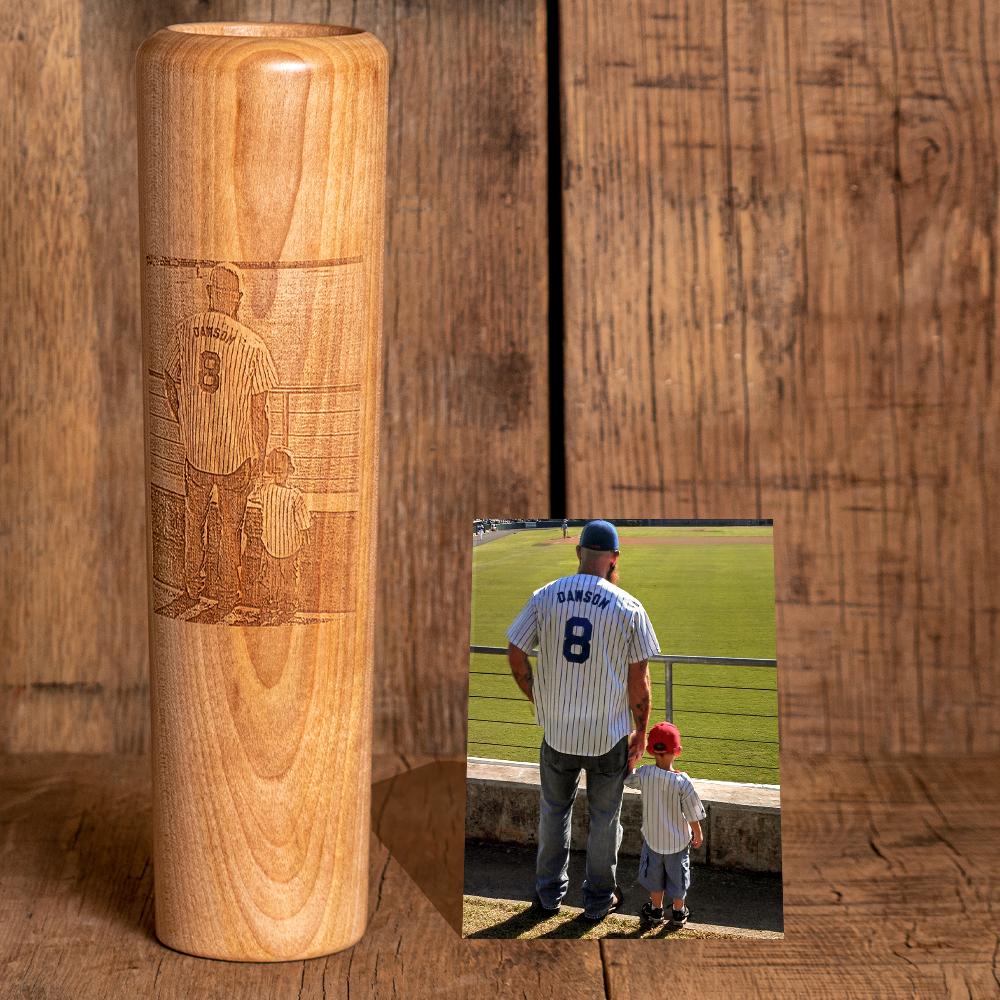
But wait, there’s more! The Dugout Mug isn’t just a drinking apparatus; it’s a conversation starter. With customizable options galore, you can slap on a team logo (MLB, travel ball, etc) a custom message, or even a picture. This is DEFINITELY a home run in the nostalgia department!
“Shut up and take my money,” right? Not just yet. We haven’t even told you about the rest of their roster. We’re talking bottle openers made from baseballs and bat handles, wine glasses that are more bat than glass, shot glasses made from bat knobs, whiskey mugs, and more.
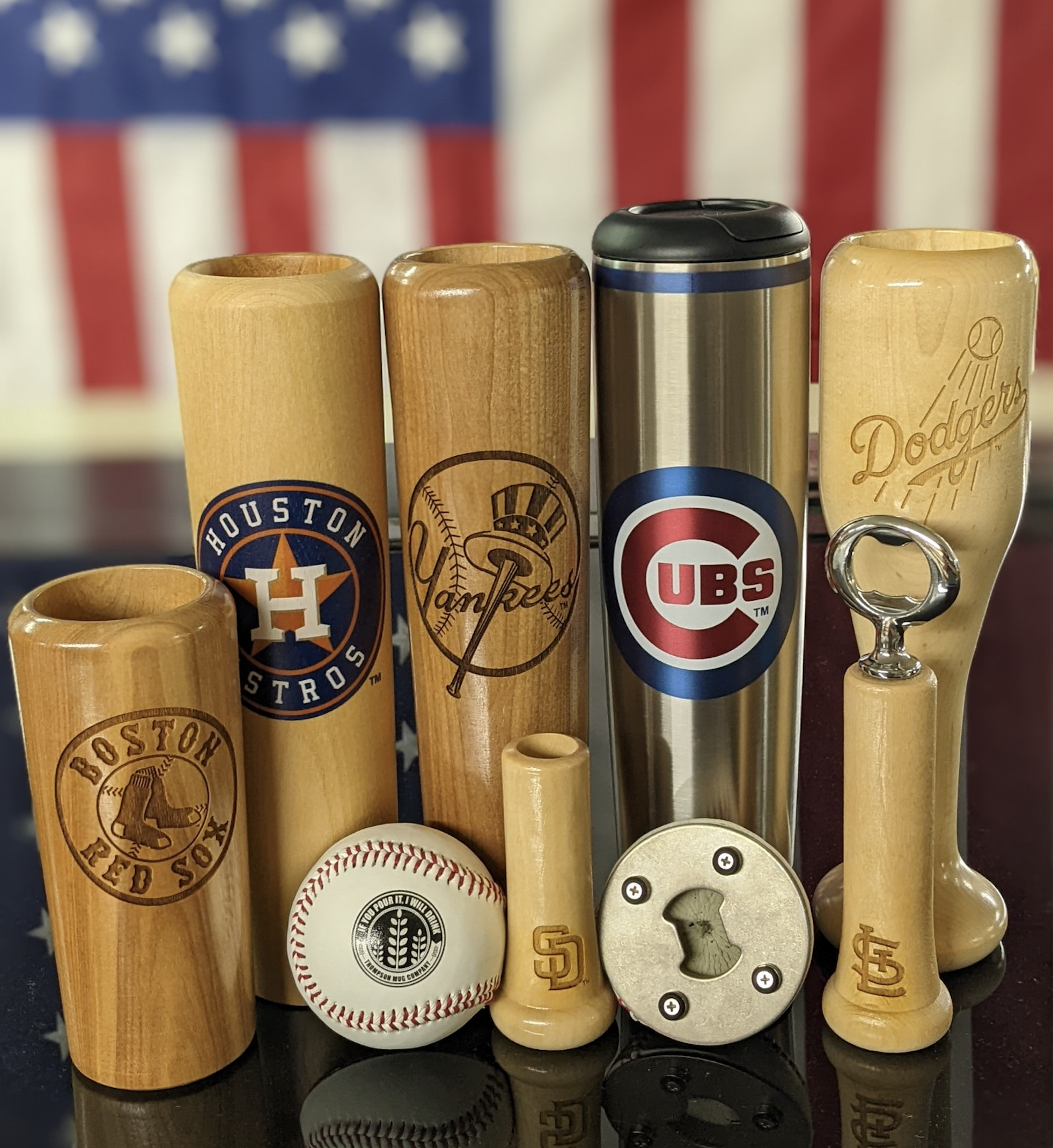
But perhaps the best part of all is the sense of community that comes with each Dugout Mug. Don’t believe us? Just ask any of of their 3 million (plus) followers online, or read some of their 50,000+ 5-star reviews they have online (yes, seriously).
So, there you have it, folks. The guys over at Dugout Mugs have your back this Father’s Day, so give them the nod and have them come out of the bullpen to close the deal!
Live Chat With Fantasy Baseball Expert Nicklaus Gaut
Fantasy baseball expert Nicklaus Gaut will be holding a live chat today at 11am central time, exclusively with Trade Rumors Front Office subscribers. Use the link below to ask a question in advance, participate in the live event, and read the transcript afterward.

Unlock Subscriber-Exclusive Articles Like This One With a Trade Rumors Front Office Subscription
- Access weekly subscriber-only articles by Tim Dierkes, Steve Adams, and Anthony Franco.
- Join exclusive weekly live chats with Anthony.
- Remove ads and support our writers.
- Access GM-caliber tools like our MLB Contract Tracker
Tim Dierkes’ MLB Mailbag: Severino, Blue Jays, James Wood
Welcome to another edition of my subscriber mailbag! If you're wondering where this paywall thing came from, please read about that here. Today's mailbag gets into Luis Severino's solid start, the future of the Blue Jays, the trajectory of Nationals prospect James Wood, and assessing free agent mega-contracts.
Dmitry asks:
I noticed Luis Severino is doing much better this year. GB rates ticked up, along with his barrels % and overall FB runs value. What's different this year? Did the Mets unlock something Matt Blake couldn't? Better health? Just needed a change of scenery?
Severino has reinvented himself as a groundball pitcher. His 56% groundball rate this year ranks sixth among all qualified starters. In a sense it's good that he's done so, because as with last year's disaster season, his strikeout and walk rates have remained unimpressive. I usually start by looking at a pitcher's K-BB%, and Severino's 11.0% mark is pretty bad and basically the same as it was when he posted a 6.65 ERA last year.
Most of Severino's success came in 2017-18, when he put up 11 WAR across 384 2/3 innings for the Yankees. He missed almost all of 2019 due to a shoulder/lat injury, and then had Tommy John surgery in February 2020. His TJ recovery included a setback along the way due to a shoulder injury. Severino's layoff between MLB games was just shy of two years.
Severino's 2022 season gave hope that he could return to his pre-Tommy John form. Most of his velocity returned, and even though he missed more than two months due to another lat strain, his strikeout and walk rates were reminiscent of the Severino of old over a 102 inning span. It was enough to convince the Yankees to pick up his $15MM club option for 2023. Severino's 2023 season was so bad that he remarked last summer,"Right now, I feel like I am the worst pitcher in the game, no doubt about it."
As you might expect, Severino tinkered with his repertoire heading into 2024. According to SNY's Andy Martino, Severino went to Driveline. Martino wrote, "There, he split his hard slider into a cutter and a sweeper. Neither was as powerful as his old slider, but the two offerings combined to show hitters different speeds and different looks." Martino added, "Severino has added ride to his velocity, creating a more powerful fastball. Played off his new cutter/sweeper mix, which features variances in speed, and a changeup and sinker that helps him get ground balls, and Severino looks like a more complete pitcher." Martino provided a third reason as well, suggesting that Severino tipped his pitches often as a Yankee and has cleaned that up with the Mets.
Indeed, Severino has started using a sinker often. He's using it 16.7% of the time so far this year, according to Brooks Baseball. His career high for sinkers was 2.6% last year. He explained to Tim Britton of The Athletic, "Just to have that pitch in my pocket that can help me get a groundball here, get a double play, get out of an inning with one pitch instead of striking out two guys. I was just thinking about how I can be more productive and save more pitches." An open-mindedness toward sinkers, which have gone out of style in baseball, is a conscious choice for the Mets, which pitching coach Jeremy Hefner explains in Britton's article.
Severino has a 3.00 ERA as of this writing, and if he stays healthy and lands under 4.00 for the season, his one-year deal will have been a big success for Mets president of baseball operations David Stearns. There's probably too much emphasis on that 3.00 ERA through these first 45 innings, though. I think a pretty big correction is coming, because a portion of Severino's success comes from a .250 BABIP and 8.3% home run per flyball rate. He's a bit less interesting with a league average strikeout rate and subpar walk rate, even as one of the league's best groundballers. Severino's SIERA sits at 4.11, though Statcast's expected ERA is solid at 3.59. So he's not allowing a lot of hard contact and could be a 2-3 WAR type moving forward. What Severino is doing this year seems a bit like what Marcus Stroman did last year, but with more velocity.
I took a look at recent starting pitcher seasons with a K-BB% of 12 or below and a groundball rate of 50% or better. There is a survivorship bias, because if that combo isn't working for a pitcher, he'll be removed from the rotation. But this is a weird combination, especially for a pitcher who throws 96. Here are a few comps other than Stroman's 2023:
Unlock Subscriber-Exclusive Articles Like This One With a Trade Rumors Front Office Subscription
- Access weekly subscriber-only articles by Tim Dierkes, Steve Adams, and Anthony Franco.
- Join exclusive weekly live chats with Anthony.
- Remove ads and support our writers.
- Access GM-caliber tools like our MLB Contract Tracker
Fantasy Baseball Live Chat
Nicklaus Gaut is holding a live fantasy baseball chat with Trade Rumors Front Office subscribers at 11am central time today. You can find the link below.
Unlock Subscriber-Exclusive Articles Like This One With a Trade Rumors Front Office Subscription
- Access weekly subscriber-only articles by Tim Dierkes, Steve Adams, and Anthony Franco.
- Join exclusive weekly live chats with Anthony.
- Remove ads and support our writers.
- Access GM-caliber tools like our MLB Contract Tracker
MLB Mailbag: Go, Arraez, Mariners, Red Sox, Braves
Trade Rumors Front Office subscribers sent in their mailbag questions, and I answered a bunch of them! Let's get to it. For those surprised to see the paywall, please read the explanation here.
Chris asks:
It's my understanding that Woo-Suk Go was included in the Luis Arraez trade mostly for salary relief. What is going wrong for Go so far that caused the Padres to change their minds on him so soon after signing him?
The way things went down with the Padres and Go was a bad look for the team:
- Sign him to a two-year, $4.5MM free agent deal in January
- Watch him get hammered in six spring training outings; send him to Double-A
- Go pitches well in ten outings aside from an inflated BABIP
- Include him in the Arraez deal as an apparent salary dump, four months after the signing and without using him in the Majors
While the standard XX-B free agent has to consent to a trade if he's signed and then traded before June 15th, Go was signed internationally, so he had no say in the matter.
Unlock Subscriber-Exclusive Articles Like This One With a Trade Rumors Front Office Subscription
- Access weekly subscriber-only articles by Tim Dierkes, Steve Adams, and Anthony Franco.
- Join exclusive weekly live chats with Anthony.
- Remove ads and support our writers.
- Access GM-caliber tools like our MLB Contract Tracker
Transcript For Chat With Fantasy Baseball Expert Nicklaus Gaut
Fantasy baseball expert Nicklaus Gaut held a live chat today, dishing out advice on Paul Skenes, Wyatt Langford, Corbin Carroll, and many more.
Unlock Subscriber-Exclusive Articles Like This One With a Trade Rumors Front Office Subscription
- Access weekly subscriber-only articles by Tim Dierkes, Steve Adams, and Anthony Franco.
- Join exclusive weekly live chats with Anthony.
- Remove ads and support our writers.
- Access GM-caliber tools like our MLB Contract Tracker
Tim Dierkes’ MLB Mailbag: Mason Miller, Vlad Jr., Orioles, White Sox, Marlins, And More
As explained here, we have been writing Trade Rumors Front Office originals such as this one for the last four years or so, but moving forward they'll be available on the website and not just in subscribers' inboxes. In the near future, expect to see roughly six such paywalled posts per week here on MLBTR. This week's mailbag explores the logic behind a Mason Miller trade, the Giants' slow start, Vladimir Guerrero Jr.'s true talent level, potential rotation upgrades for the Orioles, musings about the White Sox and Angels, and a look at Kim Ng's tenure as Marlins GM.
Phillip asks:
Mason Miller and Lucas Erceg are amazing, and totally wasted on the A's right now, despite them playing better than expected. But any trade would best be for solid prospects-SEVERAL solid prospects- who are 2-3 seasons away instead of MLB-ready guys who would also be wasted on the current and near-future teams. Given that, what team has those far away prospects to pay for one of those splendid slingers? Not Baltimore, more's the pity.
This brings up a philosophical question: should bad teams have nice things? Mason Miller provides a reason to watch the A's, and his season has been insane so far. And while he's under team control through the 2029 season, we can't count on him to hold up or on this franchise to be willing to pay him those last few years if he does.
So the cold-hearted logical answer is for the A's to trade Miller as soon as possible, as he might be at peak value and could be a lot less valuable the next time this organization has a realistic shot at contending. (I am aware that the A's are not awful so far this year at 15-17, but I do not think they have a realistic chance at making the playoffs anytime soon).
It's worth considering that Miller was a starter in college and all through the minors. He came down with a "mild UCL sprain" in mid-May of last year, which involved a four-month recovery period and short appearances when he returned in September.
A's GM David Forst explained to MLB.com's Martin Gallegos last December that he'd like to see Miller stay healthy for a year as a reliever before the team considers moving him back into a starting role. When a pitcher excels as a closer to the degree Miller has thus far, it's often hard to get him out of that role, but if he can eventually transition back to starting, he could theoretically be even more valuable. But given last year's UCL sprain and the attrition rate of the game's hardest throwers, there's a pretty good case that Miller is indeed at peak value right now.
I don't know where the hell the A's are going to be (as an organization) in 2026, when Miller will receive his first arbitration salary. Given the extra uncertainty around the franchise these next few years, Phillip's case makes some sense: trade Miller (and/or Erceg) now for prospects who are several years away from the Majors.
The problem with this idea is that a prospect's uncertainty is higher the further away he is from the Majors. Trading Miller this summer might require threading the following needles:
Unlock Subscriber-Exclusive Articles Like This One With a Trade Rumors Front Office Subscription
- Access weekly subscriber-only articles by Tim Dierkes, Steve Adams, and Anthony Franco.
- Join exclusive weekly live chats with Anthony.
- Remove ads and support our writers.
- Access GM-caliber tools like our MLB Contract Tracker
Trade Rumors Front Office: Changes To Article Delivery
Four years ago, I created our Trade Rumors Front Office subscription service. Facing some challenges with the online advertising revenue model, we launched a premium version of MLBTR with a paid subscription. For $29.89 per year, a Trade Rumors Front Office subscription removes ads on all our sites and in our app, grants access to tools such as the Contract Tracker and Agency Database, and provides exclusive articles and chats from Tim Dierkes, Steve Adams, Anthony Franco, and Nicklaus Gaut. I think we’re offering great value for the price.
To date, the exclusive articles and chats have been delivered entirely via email. This has resulted in a missed benefit for new subscribers, who had no access to previously-sent articles. Sometimes people sign up specifically because they hear about a certain Front Office original we sent out. They would inquire about it and I’d forward the email to them along with other recent exclusives. This was not an efficient system, so I’ve decided to create an archive of Trade Rumors Front Office articles on MLBTR itself. New subscribers will be able to go back and check out previous content as soon as they sign up.
This will be accomplished in the form of a paywall. Roughly once per day on average, a paywalled Trade Rumors Front Office article or live chat will appear on MLBTR. We averaged 16.6 posts per day on MLBTR last year, to give you a sense of how often you’ll run into this paywall. If you’re a logged-in subscriber, you will not see the paywall. Everyone else will see just a snippet of the article before running into it.
Trade Rumors Front Office subscribers will continue to receive these articles via email as well. If you’re a subscriber and you decide you no longer need the emails because the articles are on the website, you can go here and unsubscribe from emails as needed. We have not yet built the paywall technology in our iOS and Android apps, so the exclusive articles will not appear there. If you’re an app user and paid subscriber you’ll want to continue receiving the emails.
Putting these Front Office articles on MLBTR is not just about creating an archive. It will also serve as marketing for the subscription service. A portion of MLBTR readers are interested in paying to read these articles, and I don’t think it makes sense to hide them. Some people will see the topics and read an excerpt and be convinced to subscribe. If that may apply to you, I should point out that it’s risk-free, in that we offer a 100% money-back guarantee if you’re unsatisfied for any reason.
Others will choose not to subscribe, whether due to lack of interest or their financial situation. Our ad-supported readers remain appreciated and vital to this website. It’s worth pointing out that the core function of MLBTR is not changing. We’re still going to curate, contextualize, and analyze news from the around the game in real-time and provide up-to-the-minute transaction breakdowns as we have since 2005. That remains free and ad-supported. The Trade Rumors Front Office articles that will appear on this site are opinion and analysis-based, as you’ll see. We have no intention of paywalling news posts, which would not make sense.
We’re producing six Trade Rumors Front Office MLB articles/chats per week at present, two of which are fantasy baseball-centric. Could the number increase from six? It’s possible we’ll paywall additional opinion and analysis posts, particularly time-intensive ones such as our Offseason in Review and Offseason Outlook series.
Whether you’re a Trade Rumors Front Office subscriber or someone who enjoys the free ad-supported MLB Trade Rumors, you’re welcome here. After 18+ years we’re still going strong, and it’s a privilege to be able to do this for a living. Thanks for reading, and feel free to ask questions in the comment section.
New Team Rumors Functionality On MLBTR Mobile Website
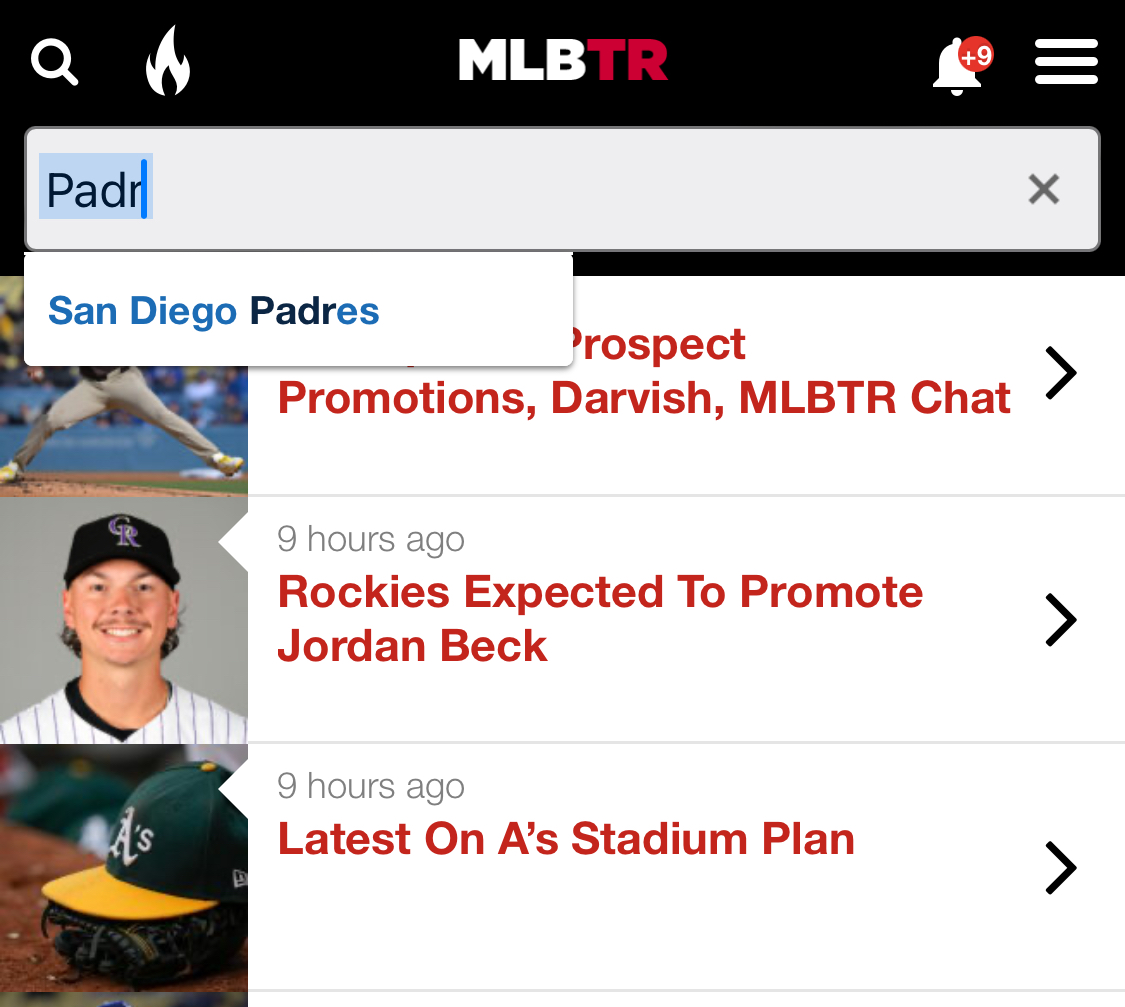
In early March, we rolled out improvements to MLBTR’s search functionality. As I mentioned at the time, in the process we eliminated a somewhat inconvenient Teams menu that had been in the navigation bar on the mobile website. To review, the new way to get to the team page is to type a few letters of that team name into the search box. You can start with the city name or the team name. Usually about three or four letters does the trick:
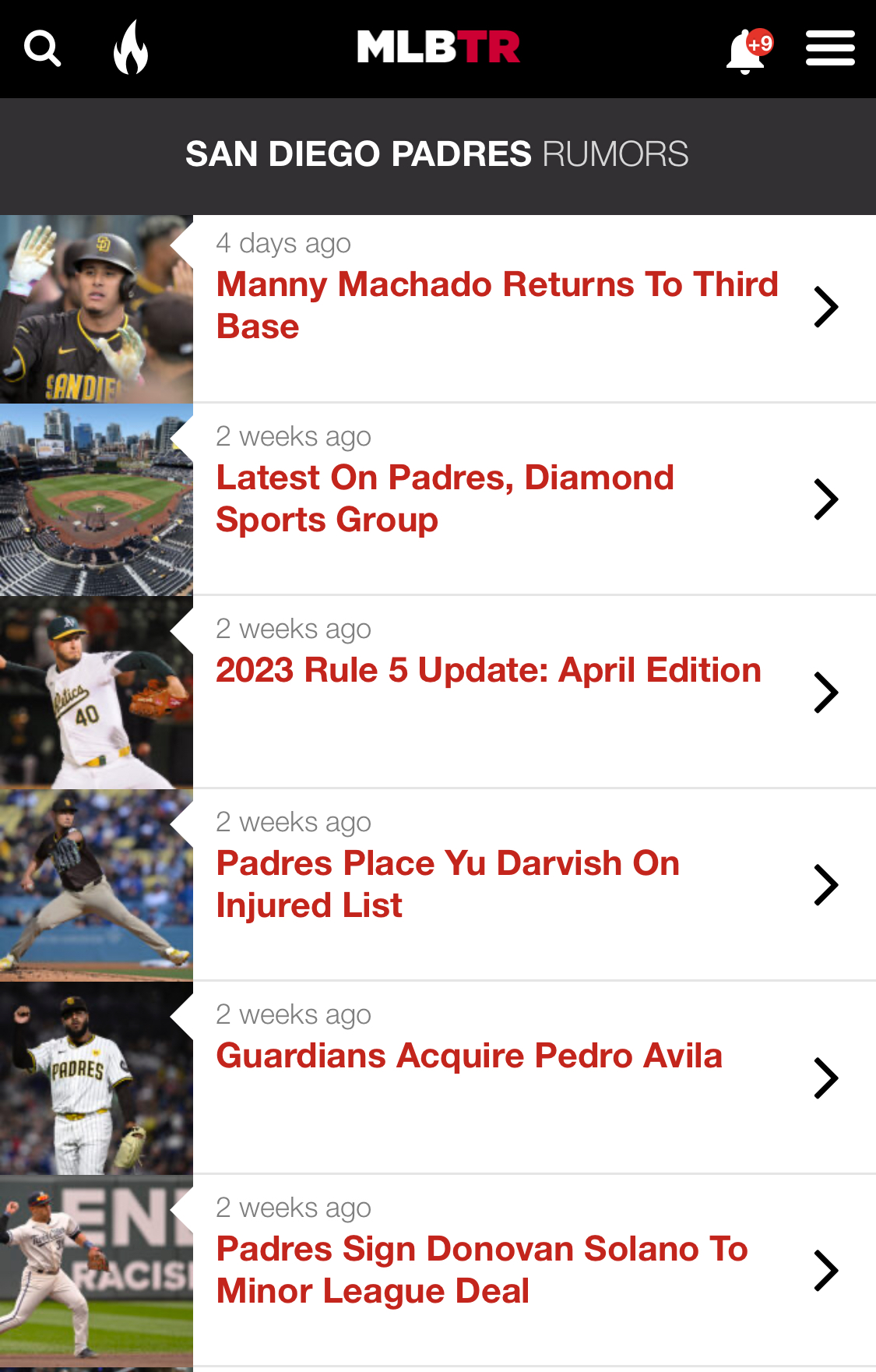
That’ll bring you to our team archive, with all posts tagged with that club in chronological order:
Based on reader suggestions, we have created two additional ways to access team rumors. The first utilizes the favorite teams you have selected in your MLBTR account. Here’s how to select your favorite teams.
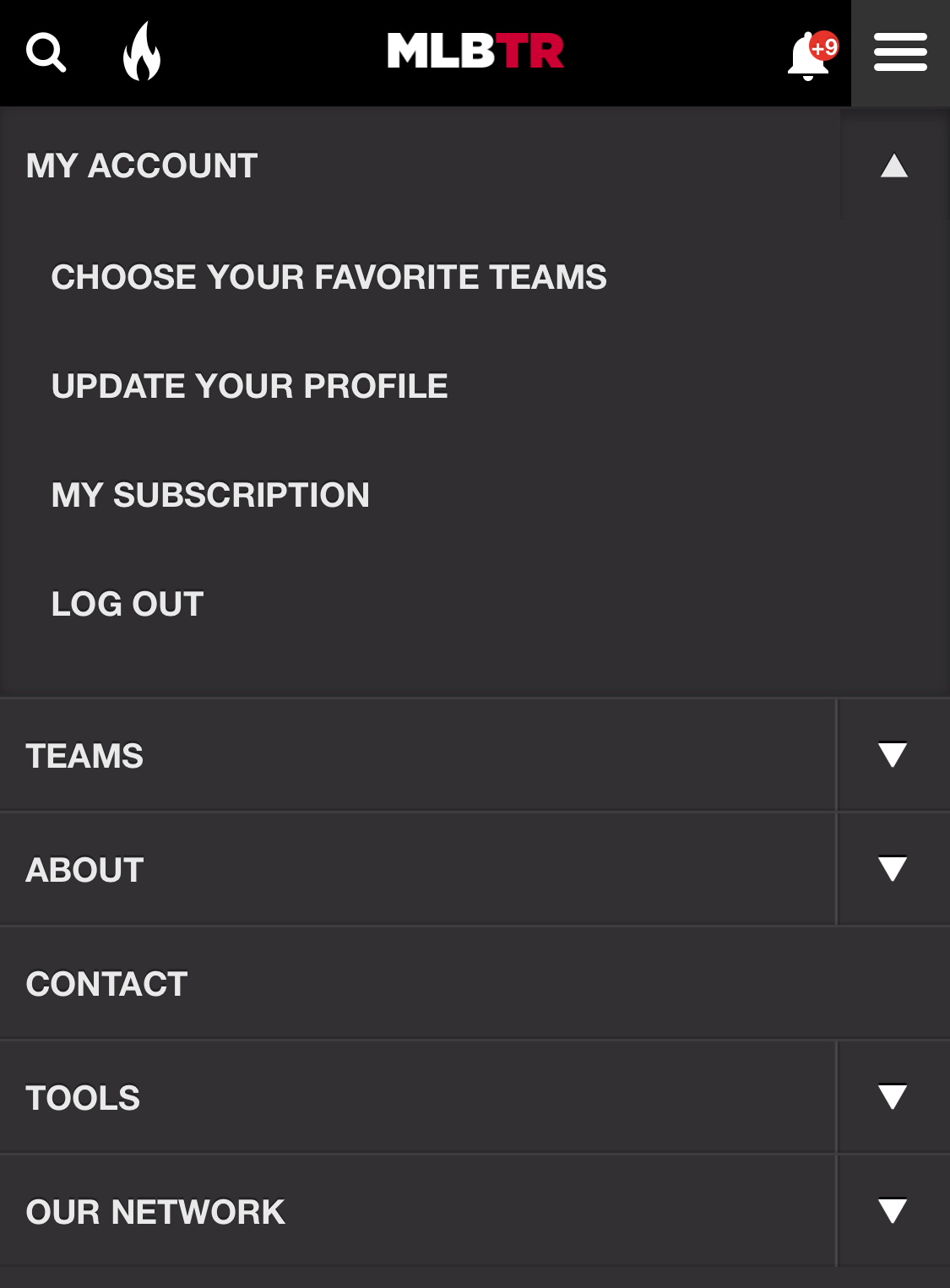
First, create a free commenter account on MLBTR if you don’t already have one. Then, once you’re logged in (assuming you’re on a mobile device), tap the three lines icon in the upper right, then the dropdown for My Account, and then Choose Your Favorite Teams:
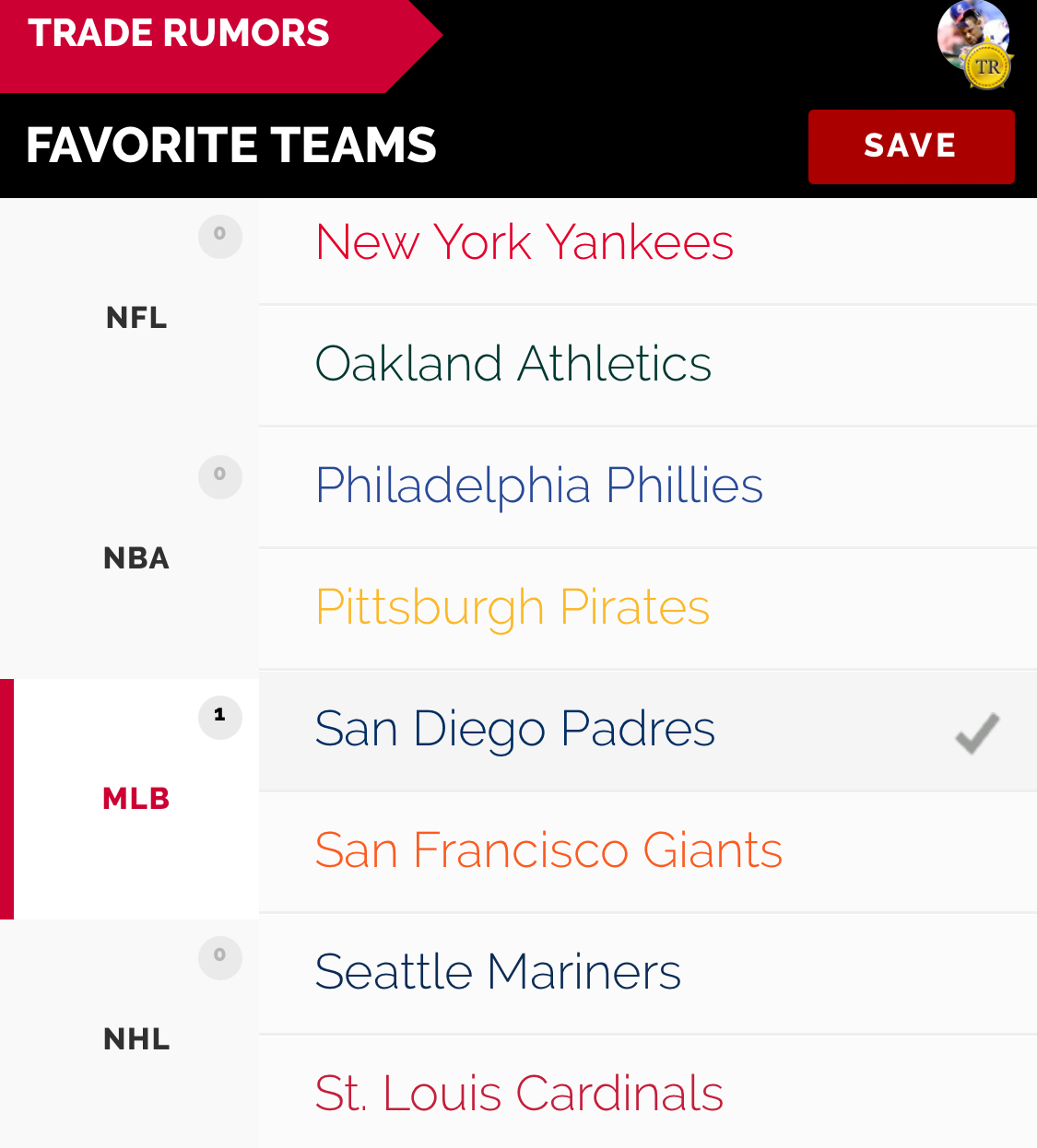
We’re going to make some improvements to simplify the Favorite Team picker, which currently shows NFL teams by default. But for now, on the left you’ll see MLB, so tap that. Scroll to the team(s) you want and select them. Then hit Save:
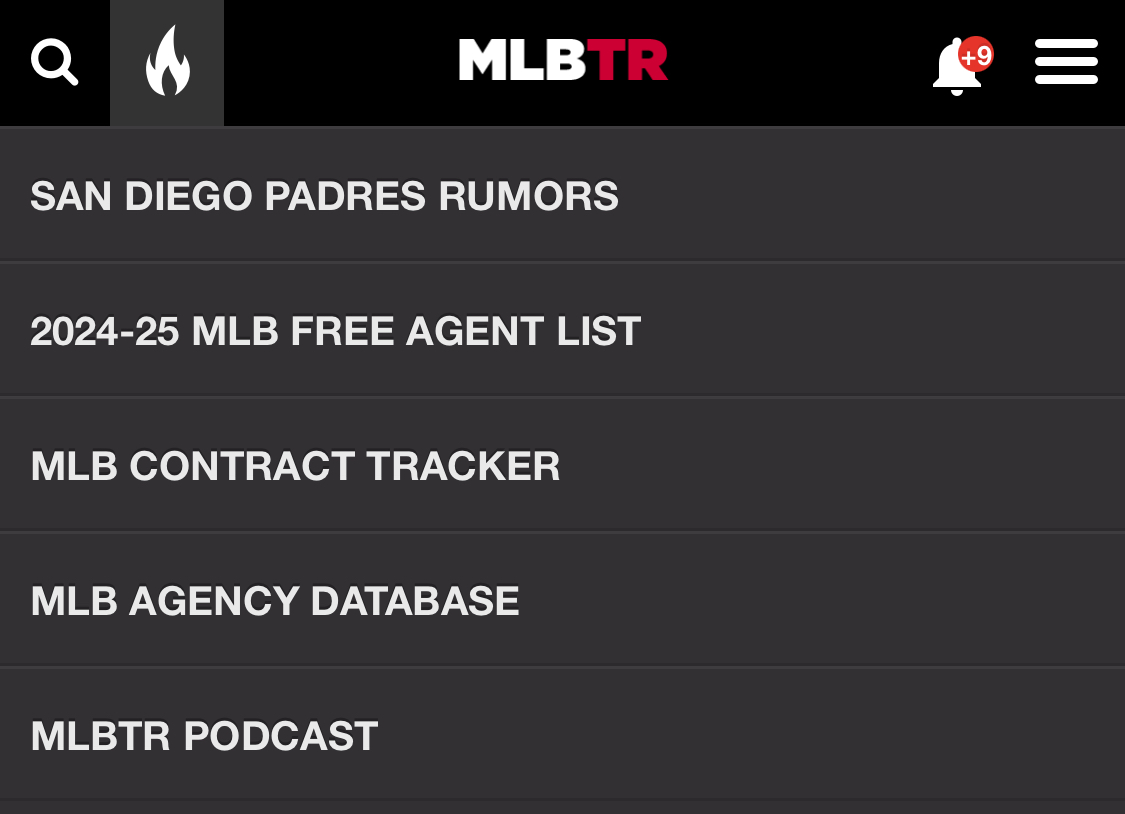
After you save your favorite teams, navigate back to mlbtraderumors.com in your browser. Go to the flame menu up top. You’ll see that the first entry is now a link to the team rumors pages of your favorites. This will show up to three favorite teams for a given sport.
So those are two options to reach a team’s rumor page: type it into the search bar, or favorite it and access it via the flame menu. We have also brought back the original way: choosing a team from a list of all of them. To do so, go to the three lines icon in the upper right, then hit the dropdown for Teams. You’ll see all 30 teams listed by division, with minimal need for scrolling. Tap a team and you’ll go to its rumor page.
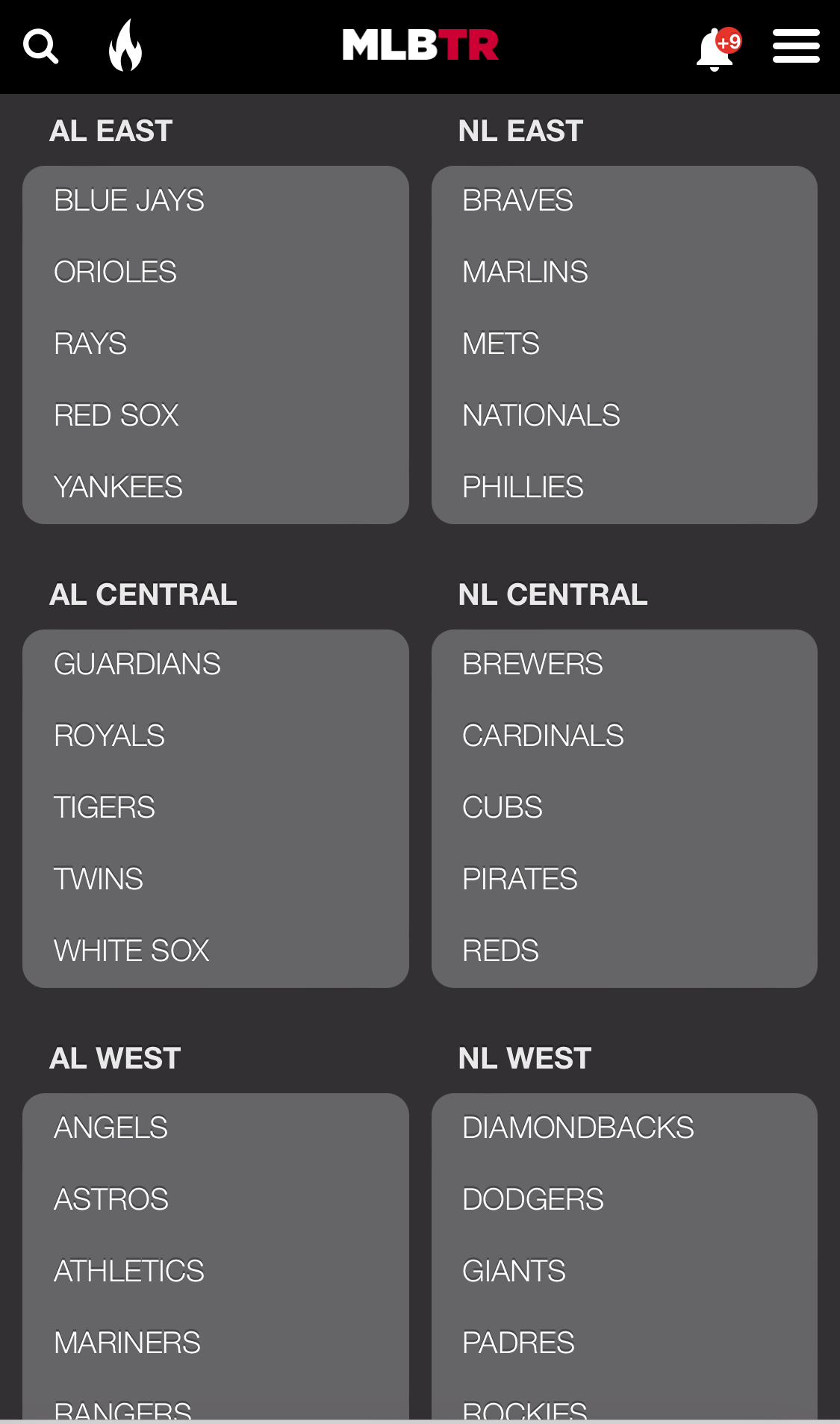
After you land on a team rumor page, you can also hit your browser’s Back button to return to this list of all 30 and select a different team.
If you’re on the MLBTR mobile website, you now have three different ways to navigate to a team’s rumor page. Enjoy!
Sponsored: Shohei Ohtani Signs With Rapsodo

The following is a paid advertisement from Rapsodo. Rapsodo is the leading provider of baseball analytics technology, offering simulators that combine high-speed cameras and radar to capture and analyze athlete performance metrics. From pitch velocity and spin rate to launch angle and exit velocity, Rapsodo’s products provide comprehensive data to help pitchers refine their mechanics, hitters improve their swings, and coaches make data-driven decisions to enhance team performance.
In a move poised to reshape the landscape of baseball technology, Rapsodo has officially announced a groundbreaking partnership with baseball’s best two-way player, none other than Shohei Ohtani.
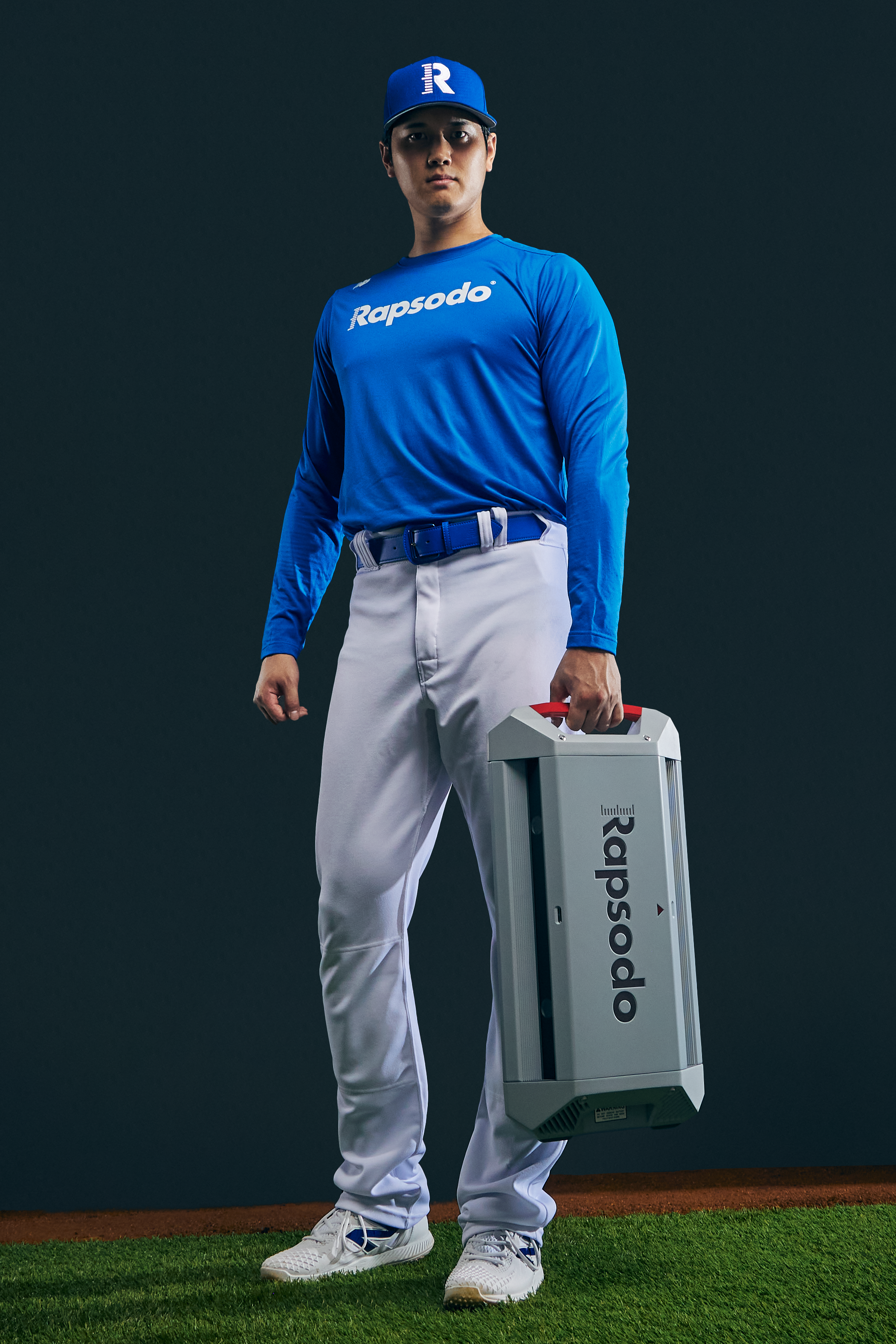
This collaboration marks a pivotal moment in the convergence of sports and technology, revolutionizing player development and performance analytics across all of baseball, from youth to MLB.
Since bringing his talents to MLB, Ohtani has been an advocate for Rapsodo, using the technology to help him develop both on the mound and at the plate.
“I had been using Rapsodo for a few seasons and thought it was such a great tool; I only wished I had started using it earlier,” said the three-time MLB all-star.
At the heart of this partnership lies Rapsodo’s state-of-the-art pitching and hitting ball flight monitors, PRO 2.0 and PRO 3.0, which provide players with valuable insights into their performance metrics.
Rapsodo’s baseball flight monitors deliver real-time data on hitting and pitching metrics like pitch velocity, spin rate, trajectory, distance, exit velocity and more, empowering players to optimize mechanics and take their game to new heights.
Despite being an incredibly gifted player, Ohtani uses advanced data and technology to refine his skills, validate his intuition, and further adjust both his hitting and pitching mechanics.
In an interview with Rapsodo back in February, Shohei talked about how and why he utilizes their industry-leading player development tools:
“Mainly to quantify my growth as a player daily. For example, I check to see if I’m making the correct hit on my swing, making sure I have an efficient pitch, and help me design a pitch that’s difficult to hit. Having the ability to see the data and confirm it connects to my growth as a player.”
In the midst of his rehab from Tommy John surgery, the two-time American League MVP has relied on PRO 3.0 to assist in recovery, consistently tracking performance and ensuring a confident return to the mound without causing further injury.
“Since my pitching rehab started, I check to see if my pitching data matches the intention that I am throwing. I think being able to check the data helps smooth out my rehab process.
While the two-way player rehabs on the pithing side, he has stepped into the role as designated hitter for the Los Angeles Dodgers this season. Based on recent comments by Dodgers manager Dave Roberts, it doesn’t seem like he’ll be pitching anytime this year.
“We’ll see how that progression goes,” Roberts said. “If his arm is healthy enough, we’ll have that conversation in the field. I do know he’s not gonna pitch this year. But right now, our only focus is him being a designated hitter.”
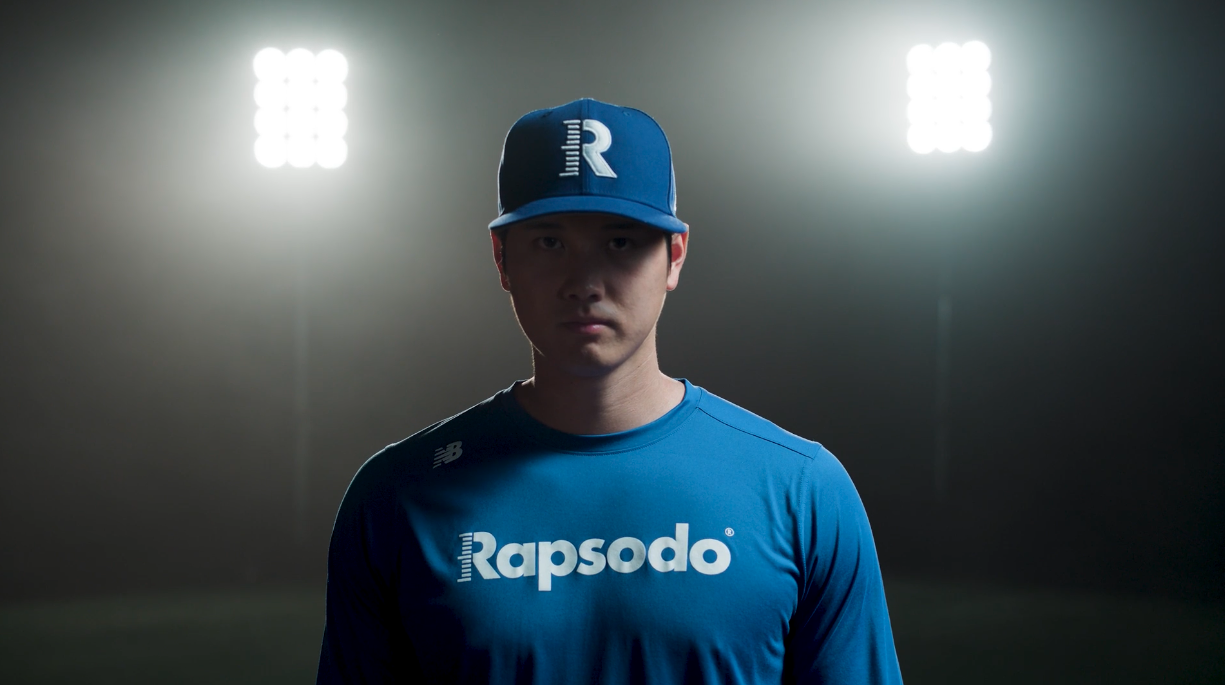
Ohtani has an MLB-leading 36 hits in 115 plate appearances so far as the Dodgers’ DH, good for an MLB-best .364 batting average. So far in the early going, he has six home runs, 14 RBI, and 20 runs scored.
Ohtani embodies the spirit of what Rapsodo stands for. He dares to defy tradition, proving you’re never too young to follow your dreams and play the game on your own terms. He shows the world the power that data and technology has on the game, and with it, anyone can be a record-breaking, two-way force at ANY level of baseball.
“I wish these tools were available to me earlier. I think if I had something like this during my Little League years, how much better could I have been now?” the superstar said.
“When I look at the youth level players and see the tools available, I feel quite envious that they can use them.” He added, “I think they should use these tools for growth and the earlier you start using them, I believe the faster your growth will be.”
Throughout the partnership, Rapsodo will roll out content they captured with Ohtani from their production shoot. Fans can see all of this on Rapsodo’s Twitter, Instagram, Facebook, Tik Tok, YouTube, and LinkedIn channels.
Every athlete has a story, even the best in the game. Rapsodo is on a mission to tell those stories while providing athletes everywhere the tools they need to play like never before and #PlayWithoutLimits.
If you’re interested in learning more about Rapsodo and their products, click here to visit their website.