
Advertise With MLB Trade Rumors
The Trade Rumors network includes MLB Trade Rumors, Hoops Rumors, Pro Football Rumors, and Pro Hockey Rumors. Our four sites have a huge reach: 389 million pageviews last year. Beyond the websites, MLBTR has a strong presence in other media, including our podcast, newsletter, and social. To learn more about advertising opportunities with our company, check out our media kit here.
Offseason In Review: Chicago Cubs
The Cubs retained Cody Bellinger at a bargain price, replaced Marcus Stroman, found a potential first base solution, and supplemented their bullpen – all while staying below the first competitive balance tax threshold.
Major League Signings
- Cody Bellinger, CF/1B: three years, $80MM. 2025 and ’26 seasons are player options.
- Shota Imanaga, SP: four years, $53MM. 2026 is a player option that triggers additional options.
- Hector Neris, RP: one year, $9MM. Includes $9MM club option for 2025
Options Exercised
- Kyle Hendricks, SP: $16MM club option
- Yan Gomes, C: $6MM club option
Trades and Claims
- Acquired cash considerations from Blue Jays for RP Brendon Little
- Acquired 1B Michael Busch and RP Yency Almonte from Dodgers for SP Jackson Ferris and OF Zyhir Hope
- Acquired cash from Phillies for RP Michael Rucker
- Acquired SP Matt Thompson from White Sox for RP Bailey Horn
Notable Minor League Signings
Extensions
- None
Notable Losses
- Marcus Stroman, Jeimer Candelario, Michael Rucker
The Cubs’ offseason kicked off with an important choice by starting pitcher Marcus Stroman on November 4th: he decided to opt out of the remaining one year and $21MM left on his contract. This created financial flexibility and a vacant rotation spot, making some sort of starting pitching addition feel inevitable.
The following day, the Cubs locked in a rotation spot by making the expected decision to exercise Kyle Hendricks’ $16.5MM club option. They also picked up the $6MM option on catcher Yan Gomes.
Then the Cubs made a move few people saw coming: they brought in Craig Counsell as manager, which required the largest contract in MLB history for that job both in terms of total and average annual value. David Ross was fired in the process. Counsell had managed the Brewers for nearly nine years, taking them to the playoffs in five of the last six seasons. Counsell is regarded as one of the game’s better managers, and he often succeeded despite below-average payrolls in Milwaukee.
The stunning Counsell-for-Ross move conjured memories of Theo Epstein’s opportunistic switch nine years prior from Rick Renteria to Joe Maddon. The Cubs’ signature player acquisition that offseason was the signing of Jon Lester, ranked second on MLBTR’s top 50 free agents list. After the Counsell hiring, it was natural to wonder if Cubs president of baseball operations Jed Hoyer would deliver an additional offseason prize such as Shohei Ohtani or Yoshinobu Yamamoto.
The Cubs did show interest in some of the offseason’s biggest names. Reports suggest they made a real effort to sign Ohtani before he landed with the Dodgers on a heavily-deferred ten-year, $700MM deal, though the Cubs weren’t seemingly a finalist. According to ESPN’s Alden Gonzalez and Jeff Passan, as Ohtani’s free agency drew to a close, agent Nez Balelo “proposed the same deal to at least three other teams,” the Giants, Blue Jays, and Angels. As late as December 5th, Hoyer shot down a report that the Cubs’ optimism on Ohtani had waned, but it probably should have been waning around then. The Cubs are not mentioned in that Gonzalez/Passan insider account of the signing. Whether the Cubs dropped out due to an unwillingness to meet Ohtani’s asking price or due to his preference to play elsewhere remains unknown.
Though Hoyer saw Yamamoto on a September scouting trip to Japan, the Cubs were largely absent from reports about his offseason free agent pursuit. The reporting on Yamamoto’s free agency provided no indication that the Cubs met with Yamamoto or made an offer. It is known that both New York teams made strong offers to Yamamoto, who of course wound up joining Ohtani on the Dodgers. There isn’t much indication that the Cubs could have reasonably won the bidding for Yamamoto, nor that they tried to.
Likewise, the Cubs may have had interest in then-Padres outfielder Juan Soto, but if so they kept it quiet in the rumor mill. Soto differed from Ohtani and Yamamoto in that it wasn’t up to the player – that prize went to the team that made the best offer. Soto was a bit of a tough fit for a Cubs team with Ian Happ and Seiya Suzuki locked in at the outfield corners.
One major trade target that made ample sense was Tyler Glasnow of the Rays. According to Ken Rosenthal and Fabian Ardaya of The Athletic, “the Cubs remained in the Glasnow talks until the end, but were not willing to make a comparable offer” to the Dodgers’ proposal of Ryan Pepiot and Jonny DeLuca. Glasnow’s preferences also mattered. As Rosenthal and Ardaya put it, “He effectively could rule out certain teams by telling [Rays president of baseball operations Erik] Neander he would only stay with them for one season before entering free agency.” The Cubs probably could’ve offered enough to land Glasnow for 2024, but they would not necessarily have been able to sign him to an extension.
Korean outfielder Jung Hoo Lee was quietly on the Cubs’ radar as well, according to Patrick Mooney of The Athletic. Like so many of this offseason’s big names, Lee wound up in the NL West.
As 2023 drew to a close, Cubs fans’ dreams of Ohtani, Yamamoto, Soto, or Glasnow had been dashed. The team had added a managerial star, but nothing else.
A pair of key moves came within a three-day span in January. First, the Cubs signed 30-year-old southpaw Shota Imanaga to a four-year, $53MM deal. The team also owes a posting fee of at least $9.825MM to his former team, the Yokohama DeNA BayStars. Imanaga will earn $23MM for his first two seasons with the Cubs, after which the team must decide whether to exercise a three-year, $57MM option covering his age 32-34 seasons. If they do so, it’d bring Imanaga’s total to five years and $80MM, similar to preseason contract projections. If the Cubs decline, Imanaga will have a $15MM player option for ’26. If exercised, the Cubs will have to decide on two years and $42MM for 2027-28. If the Cubs decline their first option, Imanaga exercises his ’26 player option, and the Cubs decline their 2027-28 option, the pitcher has another $15MM option for ’27.
It’s a fairly complicated structure that offers the Cubs some measure of protection as opposed to the $80MM guarantee a starter like Eduardo Rodriguez received. Early returns on Imanaga suggest he can perform as a mid-rotation starter, in which case his contract represents a solid deal for the Cubs. I don’t blame the Cubs for preferring Imanaga on his contract to Stroman at $21MM for one year or $37MM for two.
First base was a clear need for the Cubs, and they reportedly entertained a traditional solution in Rhys Hoskins as well as an interesting one in Josh Naylor. Eventually, though, Hoyer made an addition no one saw coming by trading prospects for the Dodgers’ Michael Busch, as well as reliever Yency Almonte. Busch, an MLB-ready 26-year-old rookie, comes with six years of control remaining. He won’t even be paid an arbitration salary until 2027, and he’s under team control for a total of six more years. If Busch develops into the above average hitter his scouting reports and Triple-A work suggest, this will become an inspired pickup by the Cubs.
The Cubs inked Hector Neris to a one-year deal in late January, at a $9MM salary a bit beyond Hoyer’s typical comfort zone for relievers. At that point, the Cubs could have considered their offseason done. They’d replaced Stroman, found a first base solution, and supplemented the bullpen.
Cody Bellinger has been conspicuously absent from this post thus far, and that’s because Bellinger reportedly sought $200MM or more on a long-term deal. Back in November, I thought he’d get it, and not from the Cubs. I also felt that the Cubs’ motivation on Bellinger would be limited, given the presence of slick-fielding center field prospect Pete Crow-Armstrong. There were signs the Cubs lacked full confidence in running PCA out to begin the season, however. Two, specifically: their interest in Jung Hoo Lee and Kevin Kiermaier.
So the Cubs hung back and remained opportunistic on Bellinger. As late as February 19th, owner Tom Ricketts said, “There has been some discussions but it hasn’t become a negotiation yet,” calling out agent Scott Boras to get serious. About a week later, Bellinger’s deal with the Cubs was done, at a mere $80MM guarantee over three years. Yes, there’s downside risk in that Bellinger will only forgo his two opt-outs if he performs poorly. But if he plays well again this year and opts out, the Cubs will have only committed $30MM. The Bellinger signing lengthens the Cubs’ lineup and pushes Crow-Armstrong back to Triple-A. Bellinger can also slide over to first base should circumstances warrant it.
Ricketts made his position on payroll clear in that February 19th interview: “We’re right there at CBT (Competitive Balance Tax) levels. It’s kind of our natural place for us. That should be enough to win our division and be consistent every year.” That was before the Bellinger signing; with him, the Cubs are estimated at about $234MM, only $3MM below the first CBT threshold to which Ricketts referred.
As the calendar turned to March, the Cubs were presented with a slew of opportunities to jump on further Boras surprise bargains and push the team from “should be enough to win our division” to “likely to win our division.” Likely because of Ricketts’ unwillingness to push payroll past its current point (an estimated 10th in MLB), the Cubs passed on several big name free agents they very much could have used.
Matt Chapman was next off the board, signing a three-year, $54MM deal with the Giants that included a pair of opt-outs. Chapman would have been a “nice-to-have” for the Cubs, plugging in at third base and pushing Christopher Morel mostly to the DH spot. It’s possible Chapman’s comfort in the Bay Area meant the Cubs would have had to go higher than the Giants, however. The Cubs’ current plan seems to be mixing and matching at third base with Morel, Nick Madrigal, and Patrick Wisdom.
The Giants also seized the opportunity to sign Blake Snell at two years and $62MM with an opt out. Snell made a lot of sense at this price for the Cubs, though both he and Chapman would’ve required the Cubs to forfeit their second-round draft pick. Jordan Montgomery remained on the market, however, and he would not require draft pick forfeiture.
The Cubs’ rotation, when everyone is healthy, will feature Justin Steele, Kyle Hendricks, Shota Imanaga, Jameson Taillon, and Jordan Wicks. There is reason to believe this is not a collection of five 180-inning pitchers. Javier Assad, Ben Brown, and Drew Smyly are additional options to cover the inevitable injuries, such as the current ones to Steele and Taillon. Signing Montgomery to a one-year, $25MM deal and pushing everyone down a spot was an opportunity the Cubs should’ve jumped on. Instead Montgomery landed with the Diamondbacks, a team Ricketts would like to emulate, because, “You don’t have to have the highest payroll or the biggest stars. If you’re playing well, anybody can beat anybody. I was happy for the Diamondbacks.”
If the Cubs face any kind of starting pitching depth problem this year, and Snell and Montgomery are useful pitchers, it will be pretty easy to point to their availability in March. To be fair, the same can be said of many teams.
Once everyone is healthy, the Cubs’ rotation looks decent, and their offense looks fairly deep. The club also features strong defense up the middle. They’re right in the middle of an NL Central that currently has all five teams projecting for 80-82 wins. For a lot of teams, that’s good enough.
How would you grade the Cubs' offseason?
-
B 56% (992)
-
C 26% (464)
-
A 8% (146)
-
D 6% (98)
-
F 4% (70)
Total votes: 1,770
Free Agent Prediction Contest Winners Notified
In early November, we ran our annual free agent prediction contest here at MLBTR. We had 6,135 entrants, which I believe is an all-time record.
The contest concluded last week on Opening Day, with the unsigned Mike Clevinger and Brandon Belt excluded from the results. Tasked with predicting the destinations of our other 48 top free agents, one contestant managed to guess 13 players correctly for a .271 batting average. Congratulations to Jeff Freedman, who correctly predicted where Shohei Ohtani, Cody Bellinger, Blake Snell, Aaron Nola, Matt Chapman, Sonny Gray, Teoscar Hernandez, Lucas Giolito, J.D. Martinez, Jack Flaherty, Reynaldo Lopez, Jason Heyward, and Tim Anderson would sign. Jeff wins $500 for his prognostication abilities.
No one else exceeded 11 correct guesses, which was good for a .229 average. As for the MLBTR staff race, Leo Morgenstern and Nick Deeds beat the rest of us with an excellent nine correct. You can check out the leaderboard here.
The first, second, and third place finishers won cash prizes, and the entire top 15 snagged a free one-year subscription to Trade Rumors Front Office. All winners have been notified, so if you’re in the top 15 on the leaderboard be sure to check the email you used to sign up for the contest. Thanks for playing and we look forward to doing it again next winter!
Sponsored: Remove The Stress Of Planning And Cooking With Factor
The following is a paid advertisement from Factor.

Baseball players in the “best shape of their life” during spring training is a cliché, but you don’t need a personal chef to enjoy healthy meals like the pros.
Enter Factor.
If there’s one thing most people dread as they’re looking to start a healthier lifestyle, it’s cooking a full meal— especially after a long day at the office. There are many struggles to integrate affordable, healthy meals into diets when juggling work, hobbies, and just life in general. It’s not fun and can be extremely frustrating at times.
Factor is the perfect solution when it comes to balancing lifestyle, convenience, and nutrition. I know, I know. Just another meal kit company, right? Wrong. Factor involves no cooking whatsoever. Just open up the package, pop it in the microwave, and it’s ready to eat in just 2 minutes. It makes eating better easier — more convenient — and takes away the stress of planning and cooking a full meal.
Forget the chicken breast, broccoli, and having a chalky protein shake. There’s nothing worse than knowing exactly what is for dinner every…single…night. But with Factor, there is a wide variety of meals, including Calorie Smart, Protein Plus, or even Vegan + Veggie options. Plus, the ability to add-on protein shakes, ready-made lunches, and quick breakfasts too.
And the best part? Everything gets delivered directly to the front door every week. No more meal prepping or grocery shopping.
Think of Factor as more than just a meal delivery service – it’s a substitute for the at-home personal chef that every athlete dreams of. Every meal is chef-crafted and dietitian-approved. Optimal nutrition every single time for lunch and/or dinner. Factor was recently named a Best Meal Delivery Service 2023-2024 for Best Overall Prepared Meals by U.S. News & World Report, along with being voted a leading ready-to-eat meal delivery service in USA Today’s 2023 10 Best Readers’ Choice Awards.
Now, here’s the real deal. After partnering with Factor, MLB Trade Rumors is able to share an exclusive offer: 50% off plus free wellness shots for life*.
Don’t miss out on this deal!
It’s an exclusive VIP pass to a healthier, more convenient lifestyle.
So, join here unlocking peak performance, one delicious bite at a time. Factor is the MVP of on-the-go nutrition for busy lifestyles — MLB player or not. Get into the best shape of YOUR life.
*See disclaimer at the bottom for details.
Offseason In Review: Chicago White Sox
In his first offseason as White Sox GM, Chris Getz made four key trades and a series of small free agent deals as the team enters another rebuilding phase.
Major League Signings
- Erick Fedde, SP: two years, $15MM
- John Brebbia, RP: one year, $5.5MM (including buyout of 2025 mutual option)
- Martin Maldonado, C: one year, $4.25MM (including buyout of 2025 club option)
- Tim Hill, RP: one year, $1.8MM
- Paul DeJong, SS: one year, $1.75MM
- Chris Flexen, SP: one year, $1.75MM
2024 spending: $20.8MM
Total spending: $30.05MM
Options Exercised
- None
Trades and Claims
- Claimed RP Alex Speas off waivers from Rangers
- Acquired SP Mike Soroka, SP Jared Shuster, IF Nicky Lopez, IF Braden Shewmake, and SP Riley Gowens from Braves for RP Aaron Bummer
- Selected SP Shane Drohan from Red Sox in Rule 5 draft
- Acquired C Max Stassi and $6.26MM from Braves for a player to be named later
- Acquired cash from Mets for RP Yohan Ramirez
- Acquired OF Dominic Fletcher from Angels for SP Cristian Mena
- Acquired RP Prelander Berroa, OF Zach DeLoach, and 2024 Competitive Balance Round B draft pick for RP Gregory Santos
- Claimed OF Peyton Burdick off waivers from Orioles. Later claimed back by Orioles off waivers
- Acquired RP Bailey Horn from Cubs for SP Matt Thompson
- Acquired SP Drew Thorpe, SP Jairo Iriarte, OF Samuel Zavala, and RP Steven Wilson from Padres for Dylan Cease
Notable Minor League Signings
- Joe Barlow, Jesse Chavez, Brad Keller, Corey Knebel, Chad Kuhl, Dominic Leone, Bryan Shaw, Danny Mendick, Mike Moustakas, Rafael Ortega, Brett Phillips, Kevin Pillar
Extensions
- None
Notable Losses
- Dylan Cease, Tim Anderson, Mike Clevinger, Gregory Santos, Aaron Bummer, Liam Hendriks, Elvis Andrus, Yasmani Grandal, Clint Frazier, Trayce Thompson
Back in October, I was skeptical of White Sox owner Jerry Reinsdorf saying, “We want to get better as fast as we possibly can,” as part of the justification for hiring internal GM candidate Chris Getz without conducting outside interviews. It was just too tall of an order for a team that lacked talent and has an owner averse to big free agent contracts. Based on the moves Getz ended up making in his first offseason as GM, a quick turnaround and 2024 contention were never actually the goals.
Given Liam Hendriks’ August Tommy John surgery, the White Sox chose to decline his $15MM option for 2024, instead triggering a buyout in the same amount that will be paid out over the next decade. The club also declined their $14MM club option on Tim Anderson, paying a $1MM buyout after finding no takers via trade. This outcome was unsurprising after Anderson’s abysmal 2023. The White Sox opted for a cheap defensive-minded veteran replacement at shortstop, signing free agent Paul DeJong in November. Anderson’s eight-year White Sox career officially ended when he inked a $5MM deal with the Marlins in February.
Though Getz chose to retain manager Pedro Grifol, the Sox did turn over the coaching staff early in the offseason, bringing in Marcus Thames as hitting coach and also adding Grady Sizemore, Drew Butera, Matt Wise, and Jason Bourgeois. Getz also dropped this memorable line to the media: “I don’t like our team.”
Getz would go on to back up that statement by giving the White Sox a major makeover. The first strike happened in mid-November, with reliever Aaron Bummer getting shipped to Atlanta for a five-player package. Taking advantage of Chicago’s lack of depth, four of the five players acquired were on the 40-man roster. It was a whole lot of players the Braves didn’t need. The biggest name, Mike Soroka, may have otherwise wound up non-tendered. But as a $3MM flier for a threadbare White Sox rotation, Soroka fits. Shuster provides another backend rotation candidate; he’ll start the season at Triple-A. Given that Bummer was coming off a 6.79 ERA and rebuilding teams don’t have much need for decently-compensated relievers anyway, sending him off for depth pieces was a solid first trade for Getz.
The White Sox’s biggest free agent offseason expenditure came during the Winter Meetings with the signing of Erick Fedde. The former Nationals top prospect, now 31, rejuvenated his career in South Korea in 2023. Now he’s a key part of Chicago’s rotation. The Fedde signing seems like a reasonable play for innings, with a hint of upside for a sub-4.00 ERA season. This is very much a Rotation of Opportunity in 2024. Perhaps nothing demonstrates that better than Garrett Crochet getting the Opening Day nod. As James Fegan noted at Sox Machine, Crochet has 73 big league innings to his name, “it’s his first time back in [the starting pitcher] routine since essentially his sophomore year of college, and Tommy John surgery rehab and a shoulder strain didn’t make 2023 a typical platform year from the bullpen.”
A veteran backup catcher was on Getz’s shopping list this winter, given the inexperience of Korey Lee and Edgar Quero. He found one in another deal with the Braves, who were serving as a way station for Max Stassi. The White Sox are only on the hook for $740K of Stassi’s $7MM salary this year, so he makes for a low-risk addition. Several weeks later, the White Sox inked Martin Maldonado to a one-year deal, possibly stifling an opportunity for Lee or Quero assuming Stassi sticks. Logically, if one of the young catchers seems ready this summer, one or both veterans will be traded.
In January, news came that Reinsdorf is seeking a new stadium for the White Sox in the South Loop. Everything so far has been standard: a request for over a billion dollars in public money, promises of an economic boom around a new stadium, questionable reasoning about why the current stadium won’t work, and a vague threat that the team could be moved. All of this is outside the scope of our Offseason In Review series, but the ballpark situation figures to hang over the team for the foreseeable future.
In February, Getz added Dominic Fletcher in a trade with the Diamondbacks, hopefully filling the Sox’s long-standing right field vacancy in the process. Fletcher, 26, hit well in limited action as a rookie with Arizona last year. Coming into the 2023 season, Baseball America rated Fletcher as a 40-grade prospect with a strong glove and a “line-drive swing with average bat speed.” Projection systems suggest Fletcher’s bat is not currently MLB-caliber, despite his brief success in ’23. Still, the bar is astoundingly low here, as the White Sox haven’t had their primary right fielder post a 1-WAR season since Avisail Garcia in 2017. Fletcher may have the right field job out of the gate, though minor league signing Kevin Pillar will likely be lurking as his potential platoon partner or backup.
The Fletcher addition fits with Getz’s stated goal of improving the team’s defense. Aside from Fletcher, the Sox have improved up the middle with DeJong, Nicky Lopez, and Maldonado. Groundballers like Fedde and Soroka should appreciate that, and defense is generally much cheaper on the market than offense. Of course, a tradeoff has been made, as offensive expectations for Fletcher, DeJong, Lopez, and Maldonado are quite low.
On the same day as the Fletcher trade, Getz dealt his best reliever, Gregory Santos, to the Mariners for Prelander Berroa, Zach DeLoach, and the #69 pick in this year’s draft. The two prospects project as a potential setup man and a fourth outfielder if things go well, and the draft pick will further boost organizational depth. With dim prospects in the short-term, trading away relievers for quality prospects is usually a good move. DeLoach may not have the ideal arm for right field, but as a 25-year-old who played 138 games at Triple-A last year, he could push Fletcher for playing time this year.
Of course, those departures leave the White Sox with one of the game’s shakiest-looking bullpens. New additions Steven Wilson, John Brebbia, and Tim Hill will see high-leverage work. The idea of Michael Kopech in the rotation seems to have been abandoned, and the once-highly-regarded righty will try to find success in relief.
Dylan Cease was the undercurrent of Getz’s entire offeason. With two years of control remaining, Cease was seemingly shopped all winter. Getz waited out the acquisitions of Aaron Nola, Sonny Gray, Eduardo Rodriguez, Tyler Glasnow, Yoshinobu Yamamoto, Lucas Giolito, Chris Sale, Shota Imanaga, Marcus Stroman, and Corbin Burnes, all pitchers who had crossover with Cease’s market. Blake Snell didn’t reach an agreement until March 18th, and as of this writing Jordan Montgomery remains available. The Dodgers, Braves, Cardinals, Reds, Yankees, Mets, Mariners, Orioles, and Rangers were linked to Cease at various points, but it was the Padres who swooped in to make a late deal on March 13th.
As I wrote in my subscriber-only mailbag last week, comparing the trade to the handful of rare precedents, I like the deal for the White Sox. Aside from Wilson, something of a throw-in, Getz acquired three prospects graded 50 or 55 for Cease. Looking at deals made for James Paxton, Joe Musgrove, and Gerrit Cole, teams generally fell short of that return.
Without Cease, the White Sox rotation has the potential to be awful. RosterResource currently projects Crochet, Fedde, Soroka, Chris Flexen, and Nick Nastrini as the starting five. Drew Thorpe, perhaps the key piece in the Cease trade, has a great opportunity here, but did not help his short-term chances with yesterday’s spring training outing. The projected White Sox rotation has produced exactly two good Major League seasons to date: Soroka’s 4-WAR effort in 2019, and Flexen’s 3-WAR 2021.
Trading Cease is something of a concession the White Sox are not going to be good in 2024 or 2025. They’re projected to win 66 games this year, and it’s hard to see them leaping into contention in ’25. Luis Robert may be at peak value coming off a healthy 5-WAR season, and he’s controlled through 2027. A case could be made that if his performance is largely irrelevant on bad teams in ’24 and ’25, and the team might just be turning the corner in ’26, the optimal move is to cash him in now for the maximum return. But the White Sox probably don’t see their timeline that way, and keeping Robert simply as a reason to watch the team is defensible.
Should the White Sox be taking advantage of their low payroll this year to try to add prospect capital? In a mailbag earlier this month, I explored the concept of sign-and-flips by non-contending teams, and we found success stories to be pretty rare in practice. As Anthony Franco put it, “If the guy was any good, he wasn’t signing a low-base MLB deal with a non-contender.” So you might suggest the White Sox should’ve landed one-year free agents like Teoscar Hernandez or Luis Severino with a mind toward flipping them, but those players might not have been interested.
Overall, this was a good first offseason for Getz, who traded three of his more marketable players aside from Robert and got respectable returns. It’s likely he’ll continue to listen on Eloy Jimenez and would trade Yoan Moncada if he has any kind of resurgence. As far as the season ahead, it’s going to be ugly.
How would you grade the White Sox's offseason?
-
C 30% (860)
-
D 25% (707)
-
F 21% (613)
-
B 19% (552)
-
A 4% (126)
Total votes: 2,858
Out Of Options 2024
Every spring at MLBTR, we publish a list of players who are out of minor league options and cannot be sent to the minor leagues without first clearing outright waivers. Option status is particularly relevant as teams set their rosters prior to Opening Day. A lack of minor league options is often a key reason a certain player will make the roster over another who had a superior spring performance, and it’s a frequent factor in March trades.
The following is a list of all 40-man players throughout the league with fewer than five years of service time — players with more than five years of service can refuse an optional assignment — and no minor league options remaining. We’ve included players who have signed extensions or multi-year deals, even though they’re often less likely to be optioned.
Angels
- Jo Adell, LF
- Mickey Moniak, CF
- Jose Quijada, RP
- Luis Rengifo, 2B
- Jose Suarez, SP
- Matt Thaiss, C
Astros
- Brandon Bielak, SP
- Mauricio Dubon, 2B
- Jon Singleton, 1B
Athletics
- Miguel Andujar, 1B
- Paul Blackburn, SP
- Luis Medina, SP
- Kyle Muller, SP
- Sean Newcomb, RP
- Mitch Spence, SP
- Abraham Toro, 3B
Blue Jays
- Ernie Clement, SS
- Mitch White, RP
Braves
- Luis Guillorme, 2B
- Pierce Johnson, RP
- Angel Perdomo, RP
- Jackson Stephens, RP
Brewers
- Jake Bauers, RF
- Eric Haase, C
- Joel Payamps, RP
- Colin Rea, SP
- Thyago Vieira, RP
- Bryse Wilson, RP
Cardinals
- Ryan Fernandez, RP
- JoJo Romero, RP
Cubs
- Yency Almonte, RP
- Adbert Alzolay, RP
- Miguel Amaya, C
- Mark Leiter Jr., RP
- Julian Merryweather, RP
- Justin Steele, SP
- Mike Tauchman, CF
Diamondbacks
- Emmanuel Rivera, 3B
Dodgers
- Evan Phillips, RP
Giants
- Joey Bart, C
- Thairo Estrada, 2B
- LaMonte Wade Jr., 1B
Guardians
- Deyvison De Los Santos, 3B
- Estevan Florial, CF
- Sam Hentges, RP
- Ben Lively, SP
Mariners
- Mauricio Llovera, RP
- Luke Raley, RF
- Trent Thornton, RP
- Taylor Trammell, CF
- Austin Voth, RP
- Seby Zavala, C
Marlins
- Christian Bethancourt, C
- Vidal Brujan, 2B
- Edward Cabrera, SP
- JT Chargois, RP
- Nick Gordon, CF
- Jesus Sanchez, RF
- Sixto Sanchez, SP
Mets
- Phil Bickford, RP
- Brooks Raley, RP
- Yohan Ramirez, RP
- Sean Reid-Foley, RP
- Zack Short, 2B
- Tyrone Taylor, RF
- Michael Tonkin, RP
Nationals
- Luis Garcia, 2B
- Carter Kieboom, 3B
- Nasim Nunez, SS
- Tanner Rainey, RP
- Keibert Ruiz, C
- Ildemaro Vargas, 3B
- Jordan Weems, RP
Orioles
- Mike Baumann, RP
- Cole Irvin, SP
- Jorge Mateo, SS
- Nick Maton, 3B
- Ryan McKenna, RF
- Tyler Nevin, 1B
- Cionel Perez, RP
- Ramon Urias, 3B
- Jacob Webb, RP
Padres
- Pedro Avila, RP
- Enyel De Los Santos, RP
- Stephen Kolek, RP
- Luis Patiño, RP
Phillies
- Connor Brogdon, RP
- Jake Cave, CF
- Dylan Covey, RP
- Cristian Pache, LF
- Cristopher Sanchez, SP
- Edmundo Sosa, 3B
- Ranger Suarez, SP
Pirates
- Roansy Contreras, SP
- Bailey Falter, SP
- Josh Fleming, RP
- Ali Sanchez, C
Rangers
- Carson Coleman, RP
- Jonathan Hernandez, RP
- Josh Sborz, RP
- Leody Taveras, CF
Rays
- Garrett Cleavinger, RP
- Zack Littell, SP
- Isaac Paredes, 3B
- Harold Ramirez, DH
- Jose Siri, CF
Red Sox
- Bryan Mata, SP
- Reese McGuire, C
- Pablo Reyes, SS
- Justin Slaten, RP
Reds
- Jose Barrero, SS
- Stuart Fairchild, LF
- Ian Gibaut, RP
Rockies
- Sam Hilliard, CF
- Nolan Jones, LF
- Justin Lawrence, RP
- Nick Mears, RP
- Anthony Molina, SP
- Elehuris Montero, 1B
Royals
- Matt Sauer, SP
Tigers
- Miguel Diaz, RP
- Zach McKinstry, 3B
- Joey Wentz, SP
Twins
- Jay Jackson, RP
- Steven Okert, RP
- Brock Stewart, RP
White Sox
- Shane Drohan, SP
- Erick Fedde, SP
- Chris Flexen, SP
- Deivi Garcia, RP
- Jimmy Lambert, RP
- Touki Toussaint, RP
Yankees
- Victor Gonzalez, RP
- Jahmai Jones, DH
- Ben Rortvedt, C
Navigation Improvements Made To MLBTR Mobile Website
As you might imagine, as the owner of MLB Trade Rumors, I am a heavy user of the website. When it comes to website traffic, 80% of ours comes via mobile devices, so I often navigate the site on my phone. In recent years, I’ve experienced difficulty in getting good results from MLBTR’s search tool, as well as in general navigation. This year, I set out to fix that.
I started by gathering data on what MLBTR users usually search for, and I found that in the offseason it’s almost always a player name, team name, or an attempt to find free agent-related links. Within the limited real estate of MLBTR’s mobile web navigation bar, we’ve made it easier to find those things.
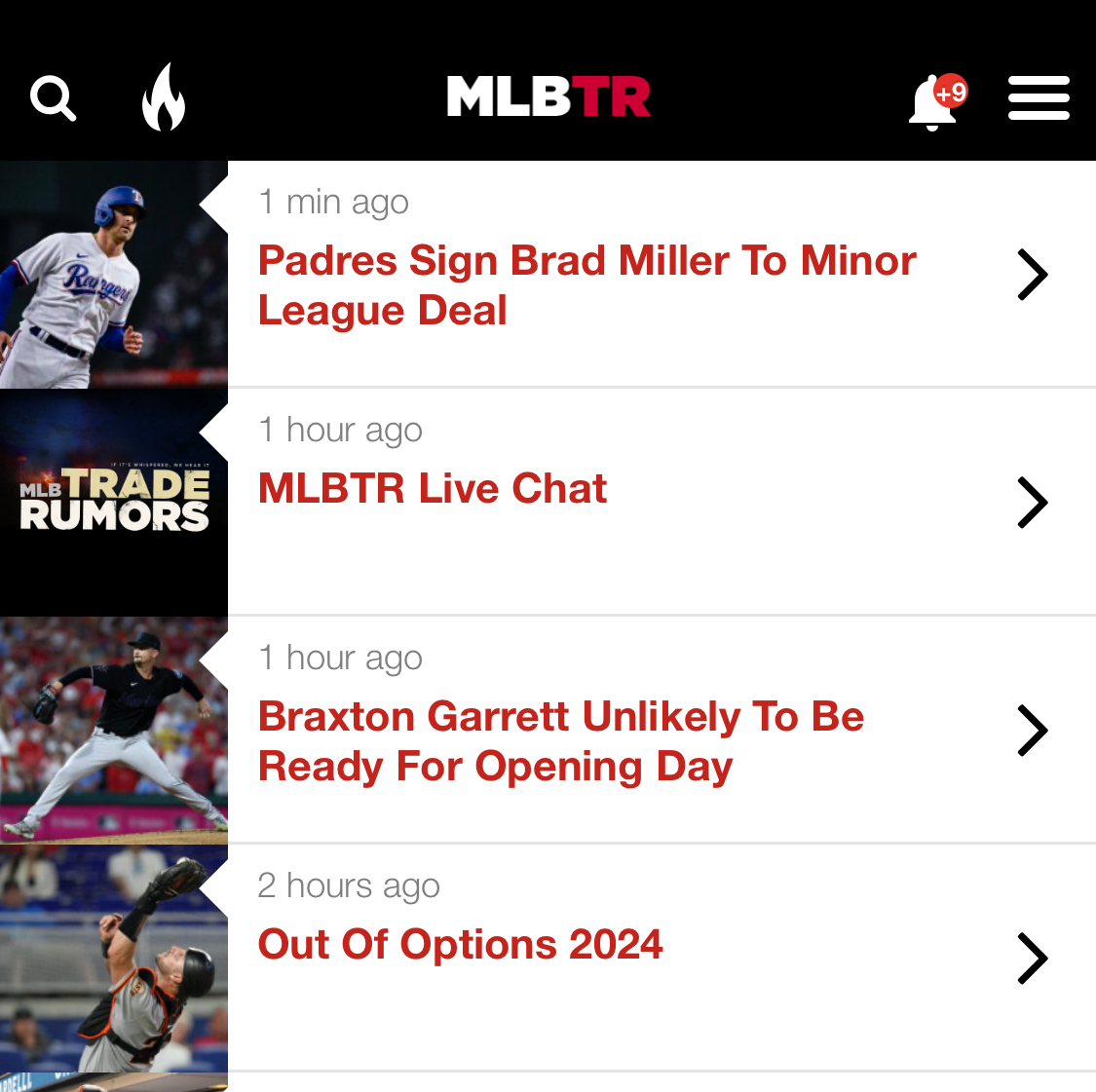
Previously, the search icon was not on the home screen; it was instead buried within the “three lines” menu. We’ve moved that to the main navigation bar in the upper left, signified by the classic magnifying glass icon:
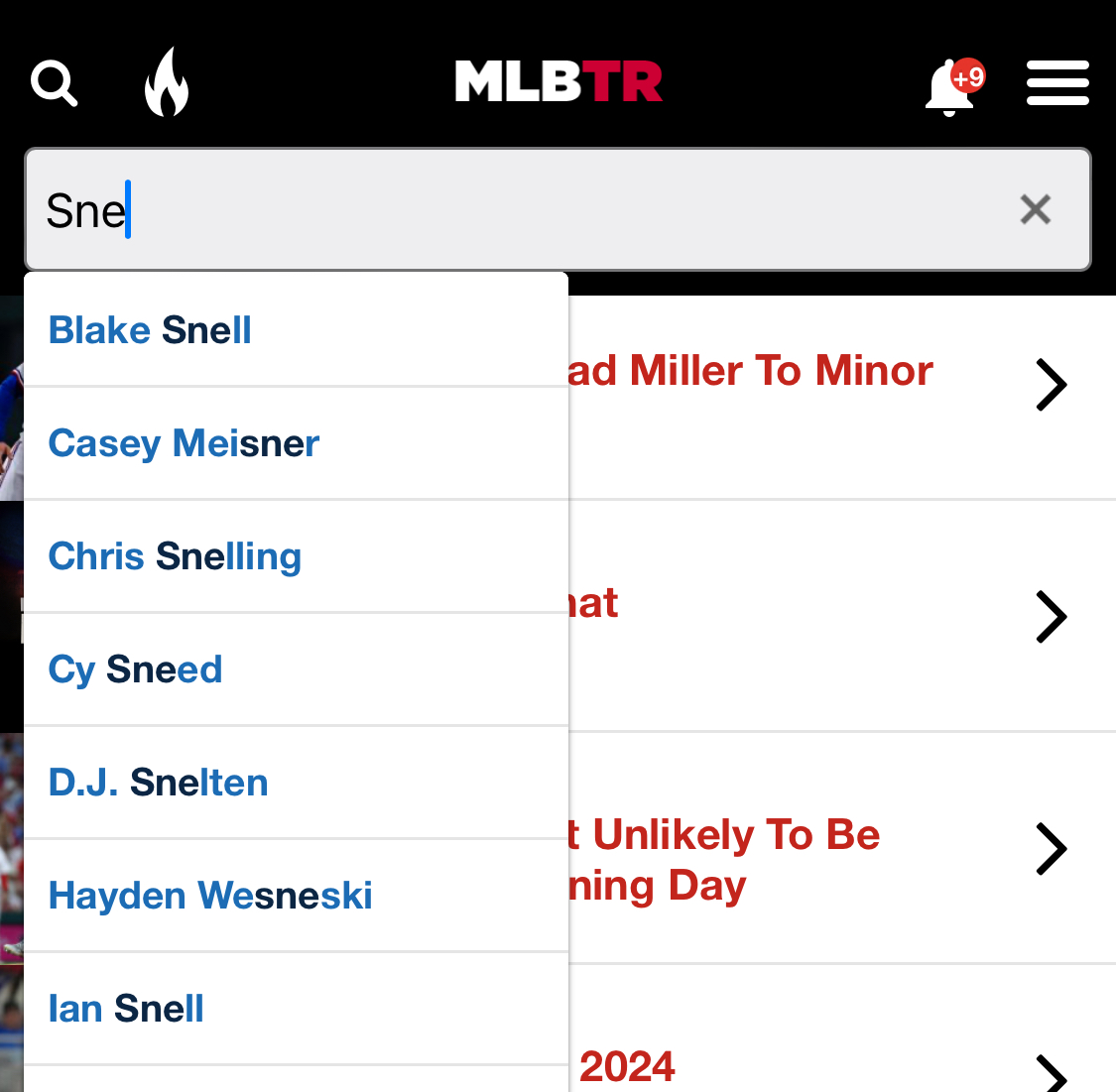
Given the indication that people tend to search for player or team names rather than specific post headlines, we’ve limited the autocomplete to players and teams. Type a few letters of the player’s name and you’ll see the options:
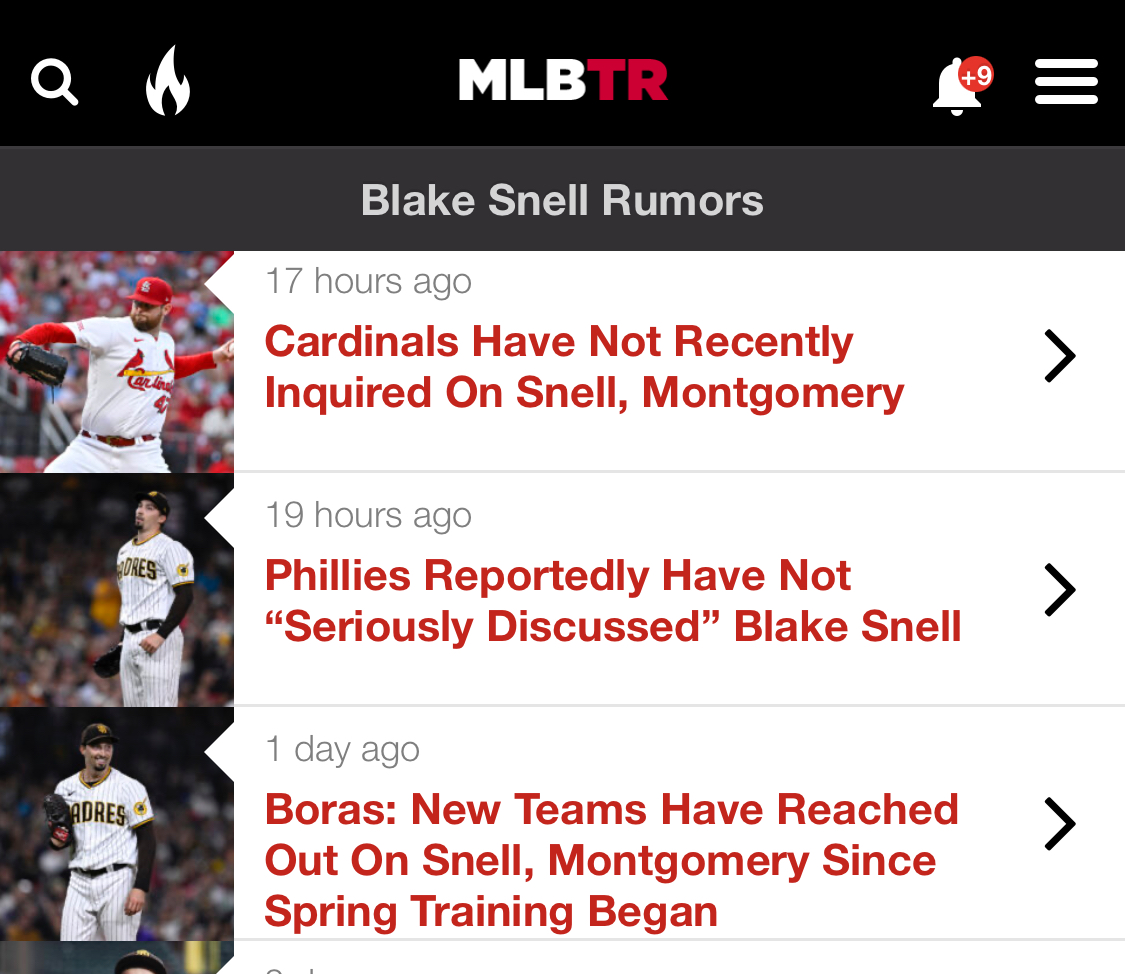
This allows you to get to the player’s chronological archive quickly and easily, where you’ll see the latest posts on him at the top. It’s also helpful for difficult-to-spell player names. Here’s what a player page looks like:
When it comes to navigating to the team archives, I grappled with the best way to do it. Previously, we had a Teams link in the navigation bar on the mobile website. In practice, I didn’t think using this link on a phone was all that convenient – especially if you were seeking a team name in the middle or end of the alphabet. You’d hit Teams and then often do a fair bit of scrolling and then pick out your team from the list of 30.
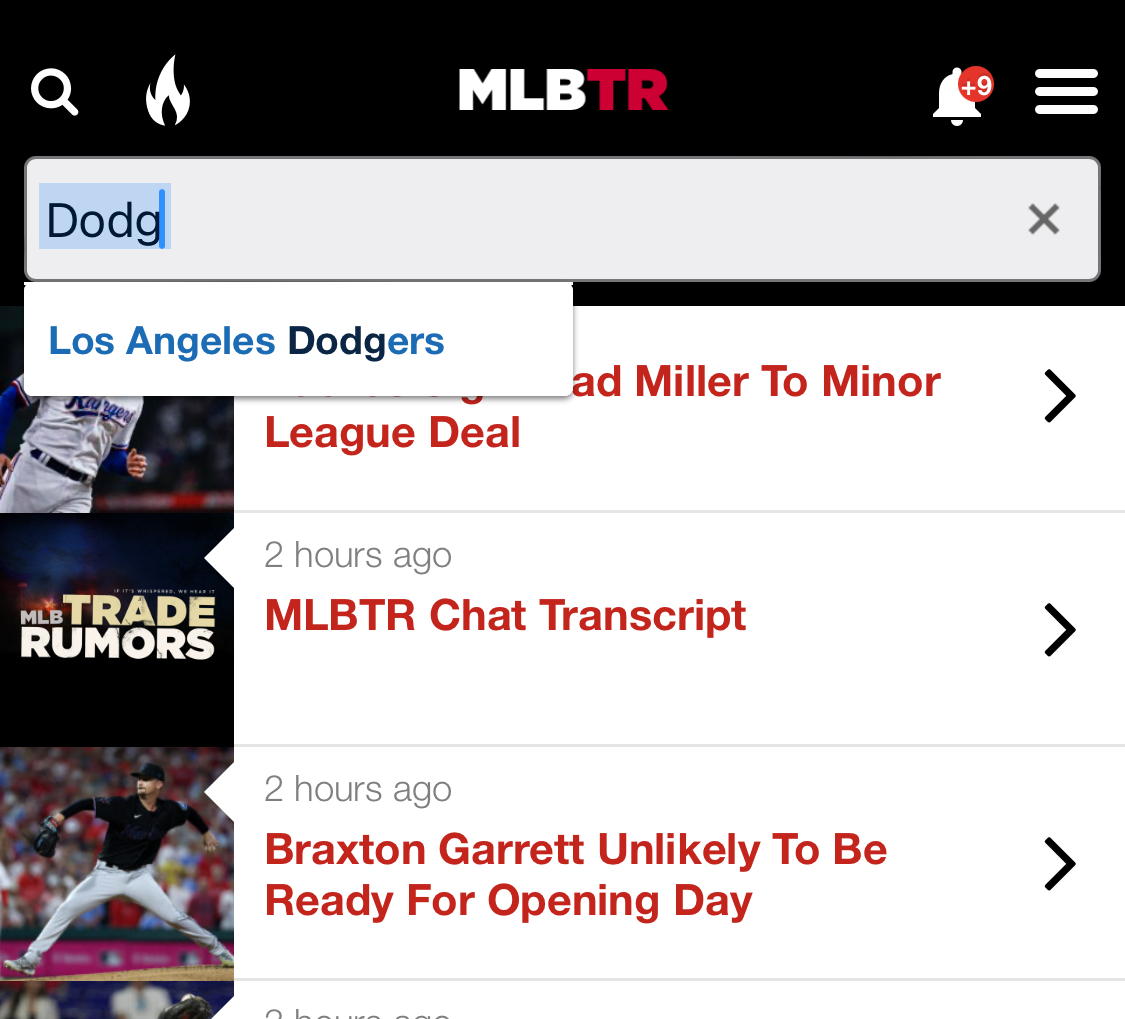
The new way to get to the team page is to type a few letters of that team name into the search box. You can start with the city name or the team name. Usually about three or four letters does the trick:
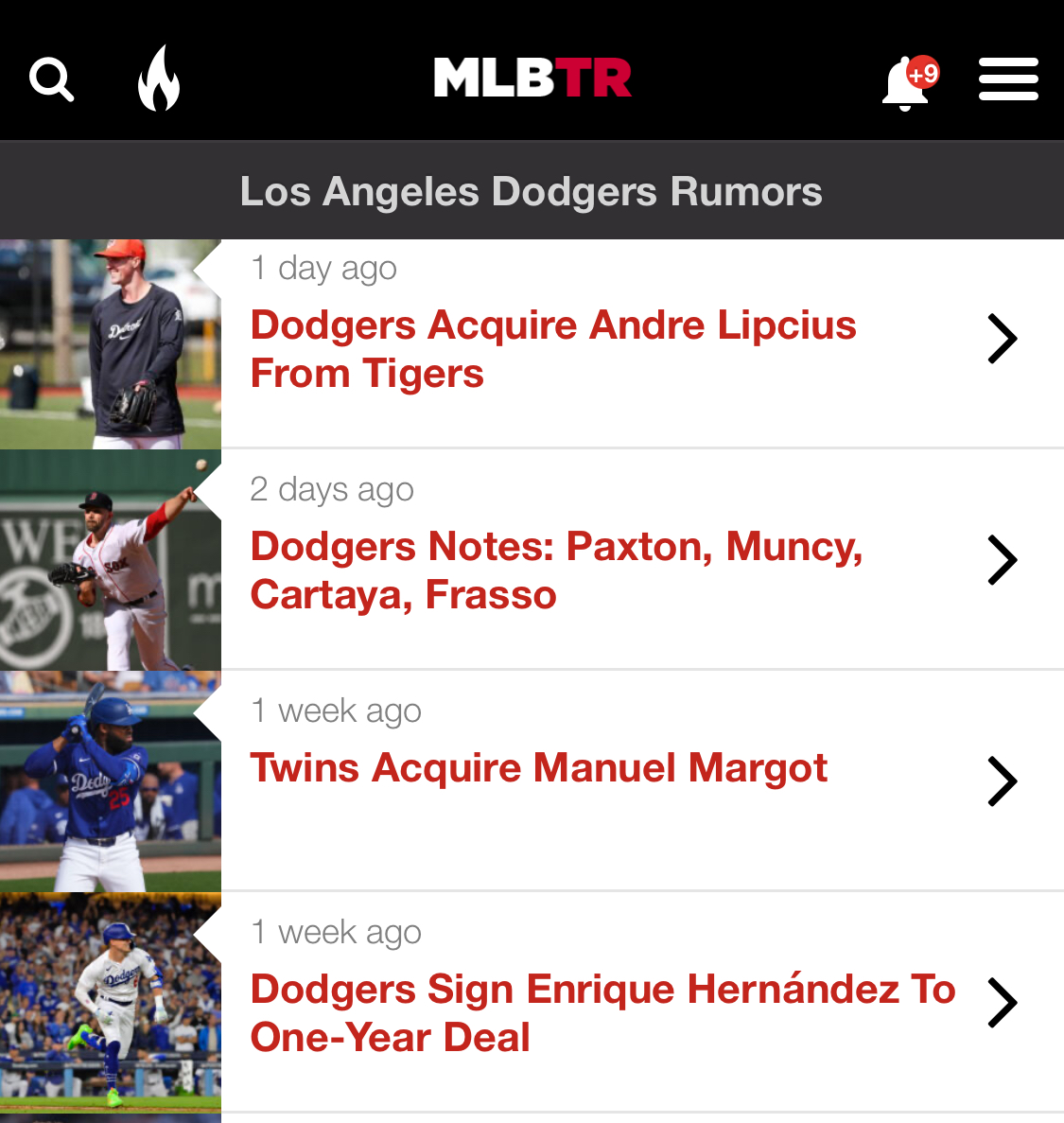
That’ll bring you to our team archive, with all posts tagged with that club in chronological order:
Though the autocomplete function in the search box gets you directly to player and team archive pages, there may be cases where you have a specific post in mind. You can still type any phrase into the box and then hit the Search button on your phone to get more algorithmic results rather than our human-curated player and team archives.
I also wanted to solve the issue of finding free agent-related links easily, while keeping some flexibility to curate a few relevant links depending on the time of year. To accomplish this, the “flame” icon was born. Tapping that brings you to various “hot” and timely reference links:
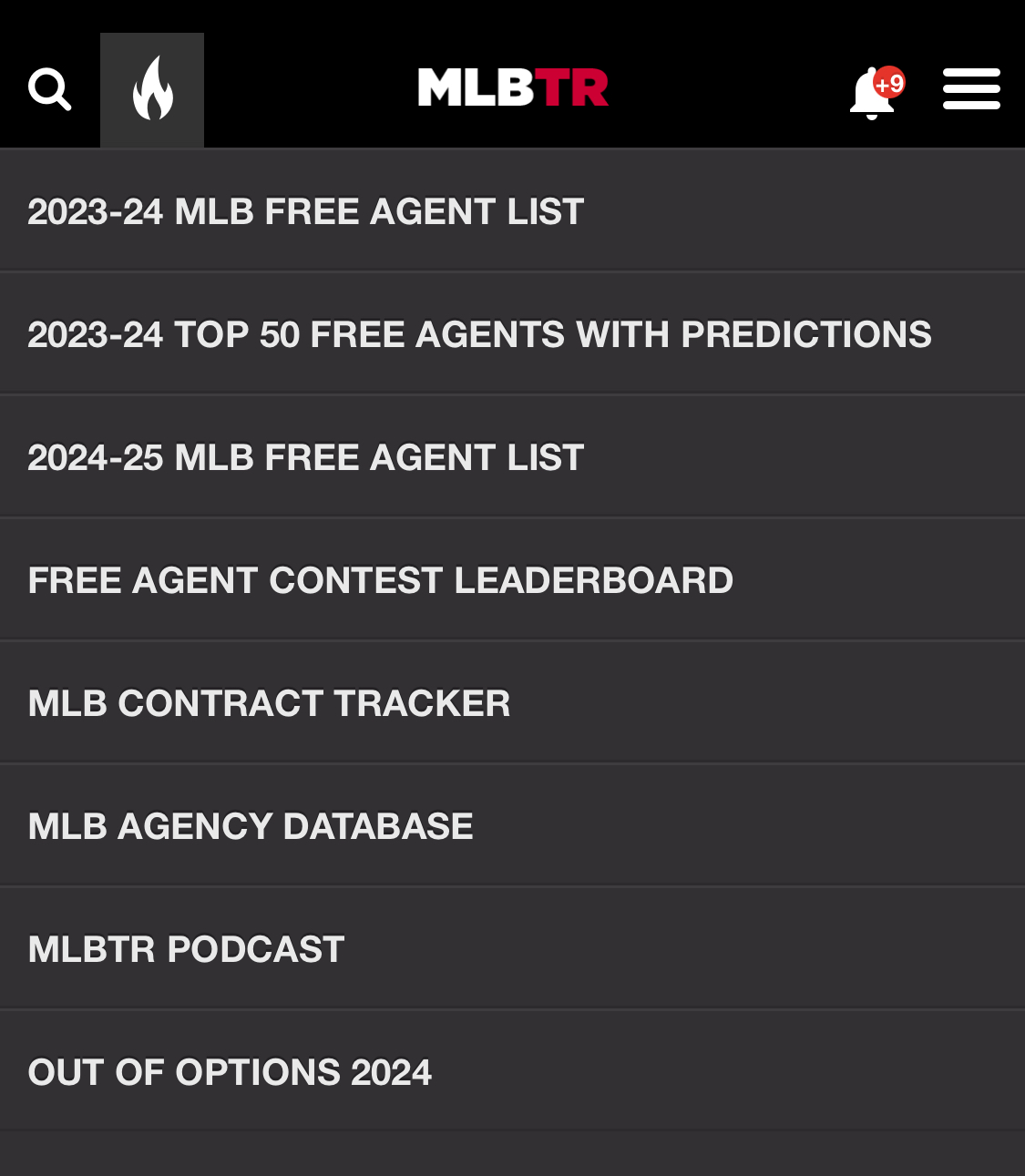
We’ll change some of these links at different times of year, for example putting some trade-related links up in July.
In my experience, these changes to the MLBTR mobile website navigation bar have made the site faster and easier to navigate. If you have any questions or comments, please leave them below.
Sign Up For The Free MLBTR Newsletter
With the launch of our 2024-25 Top 50 Free Agents list, it’s the perfect time to sign up for the free MLBTR newsletter. The newsletter is written by Cliff Corcoran, who has an extensive resume contributing to Sports Illustrated, The Athletic, Baseball Prospectus, and other outlets. Cliff will take you through the hot stove highlights of the previous day, boiling down MLBTR’s posts into the essential stories and providing his analysis. It’s a great morning read that will help you stay on top of the biggest MLB stories.
Additionally, we’ve introduced a new feature in the newsletter called MLBTRivia! As the name suggests, this is a trivia question with a hot stove connection. This feature runs Monday through Thursday.
On Fridays, we’ve added an Ask Darragh section to the newsletter. MLBTR writer and podcast host Darragh McDonald will answer a question from a reader every week.
Sign up for the MLBTR newsletter in the box below:
This free newsletter arrives via email Monday through Friday in the morning. Be sure to check your inbox and click the link in the confirmation email. If you’re not seeing the box to input your email, you can simply click this link to sign up.
Improvements To Our MLB Contract Tracker
Our MLB Contract Tracker is an amazing research tool, full of features and capabilities you can’t get anywhere else. You can filter by player name, team, position, batting handedness, throwing handedness, contract type (MLB deal, minor league deal, extension), number of years, amount of total money, average annual value, type of option, age in the first year of the deal, age in the last year of the deal, service time for those who signed extensions, Super Two status, qualifying offer status, agency at the time of signing, and any date range from 10-5-09 to present. Subscribe to Trade Rumors Front Office today to gain access!
We just finished data entry for the 2009-10 offseason, which was led by Matt Holliday, John Lackey, and Jason Bay. Was anyone around here back then? Throughout the year, MLBTR’s Mark Polishuk and Bryan Grosnick will continue working backward to add more years to the database. Of course, the MLB Contract Tracker is also updated daily as new deals come in. Before you know it, we’ll have Jackson Holliday in there.
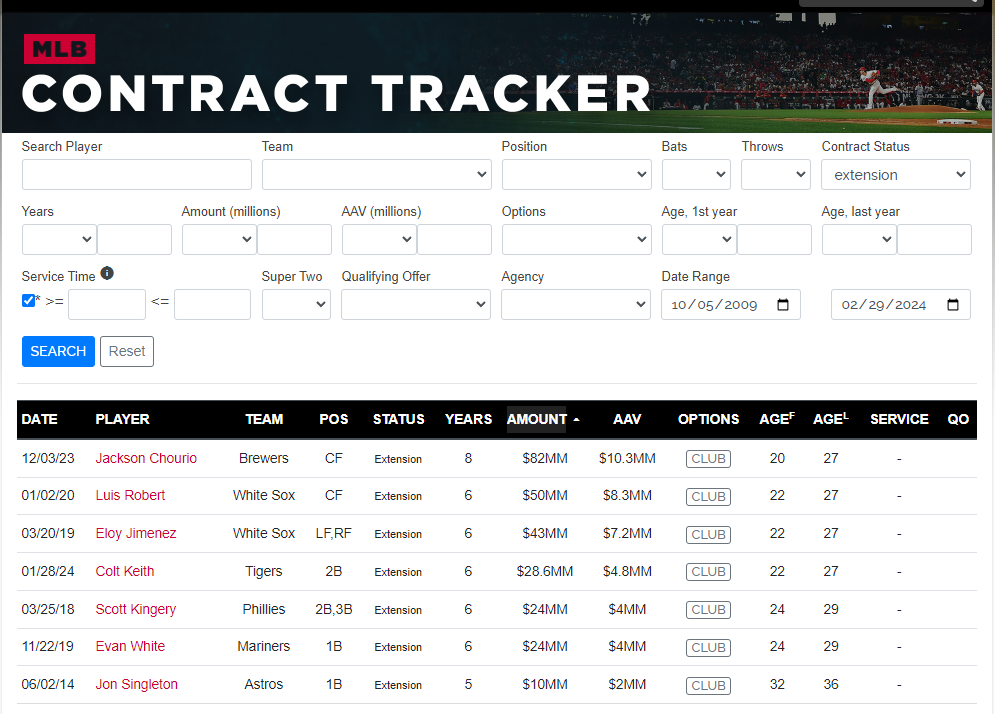
For the real contract data nerds, we have also upgraded our service time filter. Now, we have a checkbox for players who signed extensions with zero MLB service:
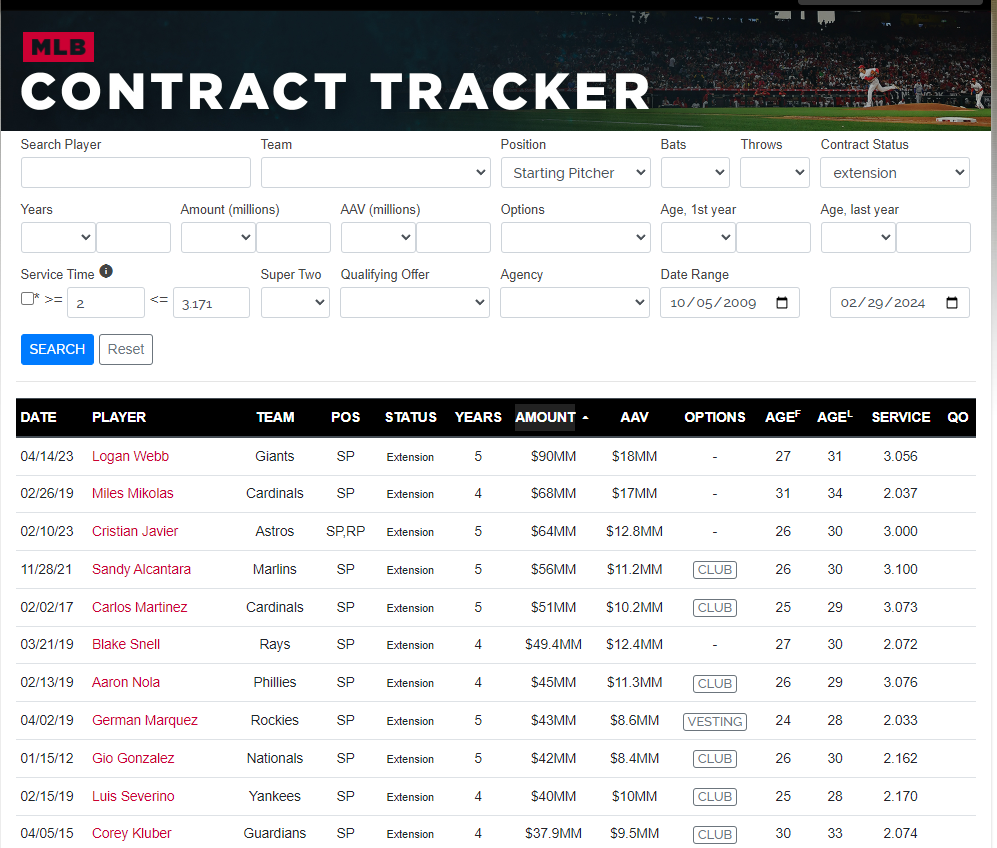
We have also refined the service time filter so that you can select custom ranges. For example, here’s a search of starting pitcher extensions for those with at least two and less than four years of MLB service:
We’re proud of the work that goes into the MLB Contract Tracker. Subscribe today and gain access to this tool as well as exclusive articles, while also removing ads from this website!
Testimonials From Trade Rumors Front Office Subscribers
There are many reasons to subscribe to Trade Rumors Front Office. I thought they’d be more meaningful coming from real members:
Remove Ads, Support Our Writers
The information we get from the expert writers at MLB Trade Rumors just can’t be found elsewhere! Too many formerly independent outlets are now owned by commercial conglomerates who control the content! The economy is tough; do your part to keep this effort independent. As an added bonus, the banner ads will disappear; that alone is worth the cost!
J. Allen M.
Supporting the writers is by far the most important thing to me. I have been reading MLBTR for many years and enjoying it for free. Same with Fangraphs. When an option came to get a paid membership, I jumped on it for both. While I enjoy reading this, it’s important to remember that there are skilled professionals, who take a ton of time to scour the web, do research, and write wonderful articles. I don’t want MLBTR to go away, so I am glad to support it, and hope to be reading this for many years to come.
Dmitry C.
I love the ability to read all the information on MLBTR without the hassle of dealing with the many annoying advertisements. The site looks cleaner and the cost to sign up for a yearly subscription is minimal. It is well worth the investment to have one less place that attacks my eyes with advertising.
Ken D.
The work of MLB Trade Rumors writers is outstanding – informative and well-written. They are at the top of their field, and it has been a good feeling to know that my subscription supports their work.
Robert A.
I subscribe in support of MLBTR writers as they provide some best analysis in the business. MLBTR is the best source for transactions bar none. I love that they cover even small transactions that are largely ignored by other sites. Great work that I am happy to support.
Philip P.
I subscribed to MLB Trade Rumors the day that option became available, and I’m so glad I did. I get value from this site every single day and am proud to support the great staff who create such quality content.
Rick S.
I cannot be happier with my Front Office subscription. I have been a passionate user of Trade Rumors since soon after its launch. One of the major appeals for me is that TR is a small team with great values – people who are open and honest about the goals of their small business. By supporting them with my extremely inexpensive subscription, I am proud to be supporting this small family of smart, passionate and talented sports fans.
Charlie S.
It is so nice to not see ads on the website or app – much cleaner look and easier to read. Plus the knowledge that I am directly supporting great writers and content.
Jeff O.
I have been a subscriber for more than a year, and I couldn’t be more satisfied. The baseball, hockey and pro basketball sites are my go-to for news about my Cards, Blues and Warriors, often times scooping local and national media sources. I check Trade Rumors several times a day, and the fact that I can do this, undisturbed by ads, makes the subscription even more valuable to me.
Tony B.
I’ve read MLB Trade Rumors for years and decided to subscribe so that it can continue to be the go-to site for details on free agent signings, contract extensions, and trade talks. Being ad-free is a bonus, but mostly I am proud to support the writers and the team that creates this valuable resource.
Mike O.
Getting rid of the ads makes the site a lot more delightful, and it’s nice to know that I’m helping the site stay in business and invest in making tools that make it even more useful.
Matt C.
I became a front office subscriber to support the site and its writers when there was a need. The amount is nothing for the value I get and the time I spend on the site – not only for the quality and timeliness of the posts, but also the accuracy. The content is clearly created by professional writers, and curated with thought.
Tom G.
As a long-time “free” user of MLBTR, I stepped up to being a paid subscriber for several reasons: primarily, to support the Trade Rumors staff and to ensure the continued flow of great content that goes beyond reporting news, or grinding statistics. The additional benefits of the subscriber-only posts and articles provide thoughtful insight for me as a fan, and fantasy player alike. At a mere eight cents a day, it’s an enormous value!
Randy C.
If your favorite time of year is the MLB Hot Stove league, you should subscribe to MLB Trade Rumors. MLB Trade Rumors is the best year round source of unbiased, no-hype, no clickbait MLB information. Every team receives attention. You can track current and future year Free Agents and receive expert analysis on a weekly basis. A great throwback internet site with no hot takes, no uninformed comments and no intrusions on your experience if you subscribe.
Chris K.
Expert Answers To Your Hot Stove Questions
MLBTR is an industry staple for information and analysis. We utilize their content daily, and it serves as a positive resource in our quest to remain informed with the best and latest information.
Matt Kleine, Milwaukee Brewers Assistant General Manager
I love the extra subscriber chats. MLBTR was already the best source for up-to-date news and opinion. But being a subscriber makes it even better. Plus, supporting this site is an easy decision, because they do such great work and deserve to be compensated. Thanks guys for all you do!
David M.
My favorite part of being a MLBTR subscriber is the Friday chats with Anthony Franco. My questions get answered, the regulars show up each week, and access to expert analysis is at my fingertips.
Michael D.
They provide excellent news coverage and analysis to a degree I haven’t found anywhere else. When you pair their content with knowledgeable and relaxed contributors who see baseball through different lenses, it makes for entertaining and thorough baseball reads.
Kalman W.
For 3 dollars a month, you get all the tools to become an amazing baseball fan. My favorite part are the Chats which you basically get automatically answered any baseball question you have! Support the best writers in America today with a MLBTR Front Office subscription!
Mendel C.
The Front Office chats and bonus material have really deepened my awareness of current events in baseball. I look forward to them each week and feel that they convey the kind of perspective we would get from interacting with actual MLB front offices.
Robert A.
The team provides additional very high level analysis of team trends, player agent insights, special private chats where you are sure to get answered because the groups are much smaller. This content alone is fascinating. My friends are constantly wondering how I have so much baseball insight.
Mark Z.
The subscriber-only chats and articles provide the best MLB conversation and insight available. Whether it’s related to roster construction, player performance, or predicting what’ll happen next, the MLBTR Front Office content offers well-rounded perspectives week after week.
Brian R.
In the age of mass-produced, lifeless articles, Trade Rumors Front Office provides a host of thought-provoking pieces and insider access to the experts whose content you’ve likely enjoyed for years. The value proposition is unmatched in sports media. There simply does not exist any outlet providing comparable coverage for $2.99 per month.
Patrick T.
As a Trade Rumors Front Office subscriber, not only do I get extra articles and chats each week but my chat questions almost always get answered due to smaller group size. Highly recommended!
Jeff O.
MLB Trade Rumors is an indispensable resource for fans who want to know more about possible trades and signings than just the players and the numbers. The site’s analysis reflects the staff’s deep knowledge and expertise. And I love that I get all of that good stuff without ads.
Wendy T.
I am constantly impressed with the depth of knowledge of the staff at MLBTR as to almost all aspects of all 30 teams. My subscription really enhances their excellent coverage with additional in-depth analysis and the weekly chat is great. Great value for the price.
John B.
Access Our GM-Caliber Tools & Analysis
The contract tracker and agency database that come with a Front Office subscription are the most powerful tools an avid fan or smaller agency can have. Knowing the tireless work that MLB teams and our data and analytics team puts in at Wasserman Baseball, I can assure any smaller agency or committed fan that does not have the resources available to them that we do that the premium content they will receive from MLBTR is well worth the investment.
B.B. Abbott, MLB agent
As a writer covering baseball, I consider the MLBTR Contract Tracker and Agency Database indispensable tools. Not only are they thorough and current, they’re one-of-a-kind. Simply put, there’s nothing else like this out there. As a longtime MLBTR writer, I may be a little biased here, but I believe the site’s trackers and databases allow baseball people to develop a far deeper understanding of the sport and how it works behind the scenes.
Ben Nicholson-Smith, Sportsnet.ca
The contract tracker alone would be worth the price of admission, but MLBTR amplifies its value by tacking on an agency database you can’t find anywhere else on top of the in-depth, year-round coverage of trades and rumors you’ve come to know and love from the site. I can’t imagine writing about baseball and not having MLBTR as a resource.
Carlos Collazo, Baseball America