
Quick Hits: Peraza, Amateur Draft, Cardinals, Pitchers
Jose Peraza was linked to the Orioles, Indians, and two other unknown teams this offseason, though Peraza tells Peter Abraham of the Boston Globe that he heard from eight or nine clubs while on the open market. Peraza chose to sign with the Red Sox because of their recent success (“It’s a great place to play baseball if you want to win a championship“) and the opportunity they presented for regular second base work. “Second base is my most comfortable position. I played a lot of second base in the minors. I know I can help this team playing there,” Peraza said. He saw quite a bit of second base action over his four seasons in Cincinnati, though the Reds gave Peraza more time as a shortstop (almost exclusively so in 2018) and also used him as an outfielder. Peraza might get some utility action with the Sox but will likely see the most action as Boston’s first-choice option at the keystone.
More from around the baseball world…
- The title of Keith Law’s latest piece for The Athletic (subscription required) says it all: “How do you prepare for the draft when there are no games to watch?” Law speaks to several sources from teams and the league itself about how the 2020 amateur draft will be impacted by the COVID-19 shutdown, as universities and high schools have already halted their seasons. Some of the draft’s top prospects, therefore, will have had little or no chance to play in front of scouts in weeks or even at all by the time the draft rolls around on June 12. Pushing the draft back altogether could be an option, and other ideas suggested include holding prospect combines or “thrown-together tournaments” (in the words of one GM) so evaluators could look at the players in both workout and game scenarios. There is no perfect solution to solve such a major interruption in the usual pre-draft process, of course, though Law suggests that Major League Baseball should “work with amateur institutions to waive the typical restrictions on amateur players. Nobody’s eligibility should be at stake here, not in these extraordinary circumstances.”
- The Cardinals “will not make any [transactions] until we have more clarity on what the future holds,” president of baseball operations John Mozeliak told Rick Hummel of the St. Louis Post-Dispatch. This means everything from roster cuts, minor league assignments, releases, or any other moves that would have been expected within the next week had Spring Training progressed as per usual. Despite some speculation on the subject, the league didn’t issue an official freeze on roster moves while the next steps are figured out during this shutdown period, even though some veterans on minor league contracts are approaching the opt-out dates in their contracts. A couple of teams have made some minor league re-assignments in the interim, while the Nationals made the most notable move in releasing Hunter Strickland and David Hernandez.
- “The longer the delay lasts, the longer it will take for the pitchers to reset, to rebuild,” ESPN.com’s Buster Olney writes about a timeline for the “second Spring Training” that will be required should the season get back on track. The latest reports suggest that late May or early June could be earliest date for a new Opening Day, and should the season be delayed until closer to mid-summer, “some staffers believe something close to a month…will be required to get the pitchers up to speed.” This is yet another complication facing the league and the MLBPA over the coming weeks or months as they try to work out what will be a heavily-reduced schedule.
AL Notes: Pitchers, Mariners, Sale, Click
Pitchers are creatures of habit, yet the indeterminate delay to the 2020 season is the biggest possible disruption to any preseason routine. Like every team, the Mariners are trying to figure out the best way of keeping their pitchers on some type of regular throwing schedule to keep them prepared, while not really knowing when actual games will get underway. “You don’t want to lose a whole lot of momentum. We also don’t want to build them too quickly,” manager Scott Servais told MLB.com’s Greg Johns and other media. “Most guys are at three or four innings, at 50-60 pitches, so we’ll try to keep them right there with our starters. And then we’ll ramp them up once we get closer to knowing what the for-certain Opening Day would be. For now, we just want guys to stay active, play some catch. You won’t see anybody throwing sides or catchers with gear on, we’re just going to try to slow it down here for the next few days.”
More from around the American League….
- One pitcher whose routine may not be impacted by the elongated offseason is Chris Sale, as Red Sox chief baseball officer Chaim Bloom told reporters (including MassLive.com’s Chris Cotillo) that “from a medical perspective, nothing really changes with” Sale’s loosely-established timeline. “There’s uncertainty regarding his pitching status generally that we want to resolve. We’re still going to want to resolve that,” Bloom said. “We’re still going to want to progress him. We haven’t gotten to that point yet, but we’re still going to work, even during this time period, without games, to get some progress and get some more definition on his status.” A flexor strain led to Sale being shut down earlier this month, and if all is proceeding well, he should be on the verge of resuming throwing. The delayed Opening Day could mean that Sale won’t miss any regular-season action, though naturally the Sox are taking things as carefully as possible with the ace southpaw.
- James Click “rose from constructing an ultimate frisbee website on a whim to shepherding the Houston Astros forward,” the Houston Chronicle’s Chandler Rome writes in a profile of the Astros‘ new general manager. Click’s pre-Houston resume included a stint as a writer and database-builder for Baseball Prospectus, which led to 14 years working in the Rays’ front office thanks to a recommendation from another new Rays intern and former BP writer in Chaim Bloom, now Boston’s chief baseball officer. Rome’s piece is a strong look at an executive whose arrival at a GM position comes with the added challenge of trying to reconfigure the Astros after an offseason of scandal and public scorn.
Contract Renewals: Rays, Devers, Olson
In the wake of a couple of newsworthy pre-arbitration contract renewals over the weekend, MLBTR’s Jeff Todd took to YouTube on Monday to offer a detailed explanation of the process. If you’re interested in checking it out, click the video below:
Here are the some of latest and most notable team-imposed pre-arb salaries for 2020:
- The Rays have renewed the contracts of outfielder Austin Meadows and left-hander Ryan Yarbrough, Marc Topkin of the Tampa Bay Times reports. Meadows will earn $578,900, and Yarbrough will get $563,400. In Meadows’ case, it’s possible he and the Rays will work out a long-term arrangement in the near future. There’s interest from both sides in making that happen, after the 24-year-old broke out in 2019 with a .291/.364/.558 line, 33 home runs and 12 steals. For now, Meadows still has five years of team control left; he’s not slated to even reach arbitration until after the 2021 season. Yarbrough has the same amount of control left, but the Super Two player is scheduled for his first trip through arbitration next winter. The 28-year-old was a rather effective member of the Rays’ pitching staff from 2018-19.
- The Red Sox have renewed third baseman Rafael Devers for $692,500, Alex Speier of the Boston Globe tweets. This will be the last pre-arb year for Devers, who’s eligible to reach arbitration for the first of three potential times next offseason. It stands to reason the Red Sox will try to keep Devers around for the long haul, considering his tremendous output last year, but the two parties haven’t engaged in extension talks yet.
- The Athletics have renewed first baseman Matt Olson on a $603,500 salary, per Jon Heyman of MLB Network. Oakland was interested in extending Olson as of last season, but there haven’t been any rumblings about his long-term future since June. If nothing changes by next winter, the big-hitting Olson will head to arbitration for the first of three possible trips.
Quick Hits: COVID-19, Red Sox, Catching, Rays, Meadows Extension Talks
Commissioner Rob Manfred has a conference call planned with MLB owners on Monday to discuss the coronavirus, but all indications point to the season opening as planned, per The Athletic’s Ken Rosenthal and Evan Drellich. MLB has been in contact with the CDC, and each team has a specified point person in charge of their specific situations. Locker room protocol across the North American sports landscape has been adjusted to help protect players from COVID-19, and fan access to players has also been limited as a precaution (though some players have prepared pre-signed autographs for fans at spring games). In Italy, all sporting events are planned to move forward without fans present, and the NBA has begun preparations for such a circumstance as well. As of right now, MLB plans to have fans present as the regular season kicks off at the end of March, but a lot can obviously change over the next three weeks.
- In non-virus news, catchers around the league are giving umpires a better view to call balls and strikes by receiving from a knee instead of the traditional crouch, per Jason Mastrodonato of the Boston Herald. Christian Vazquez employed the stance for the Red Sox some last year, and the returns were good. He finished fifth in statcast’s Runs from Extra Strikes metric, trailing only Roberto Perez, Yasmani Grandal, Tyler Flowers and Austin Hedges, the latter of whom led the field by a substantial margin. Red Sox interim manager Ron Roenicke notes that receiving from a knee makes it tougher to block pitches, but the premium placed on stealing strikes makes the tradeoff worth it on the whole.
- In contract news, the Rays and Austin Meadows have begun preliminary discussions about a potential extension, per Marc Topkin of the Tampa Bay Times. Both sides are open to the possibility, though talks have not yet reached the exchange-of-numbers stage. After a monster 2019, Meadows won co-MVP honors for the team and proved himself a key offensive cog moving forward. Meadows slashed .291/.364/.558 with 33 home runs and 89 RBIs (142 wRC+) in 2019. Locking up the soon-to-be 25-year-old would certainly be a boon for an organization ever-mindful of its financial limitations.
Orioles Claim Hector Velazquez
The Baltimore Orioles added Hector Velazquez to their roster today, claiming the right-hander off waivers from the Boston Red Sox, tweets Jason Mastrodonato of the Boston Herald. The Orioles PR department has confirmed the move. The Red Sox DFA’ed Velazquez on March 5.
Velazquez, 31, spent the last couple of seasons as a swingman in Boston. After a solid season as a starter in 2017 for for the Pawtucket Red Sox, he made his big league with 8 appearances spread out throughout the year. The total product got Velazquez more involved in the Red Sox’ 2018 title run as he threw 85 innings, appeared in 47 games, and finished with a 3.18 ERA/4.15 FIP. Outside of a couple of stints on the IL, Velazquez spent most of 2018 on the major league roster.
Last season was more of an up-and-down year for Velazquez both in terms of performance and his relationship to Triple-A. The sinkerballer made 34 total appearances for the Red Sox, starting 8 games for the second consecutive season, and finishing with a 5.43 ERA/4.74 FIP. Somewhat nontraditionally, Velazquez threw more changeups in 2019 than any other offering, though on the whole, he invokes a relatively egalitarian mix of sinkers, changeups, fastballs and sliders.
The Orioles will add him to their long relief mix, tweets MASN’s Roch Kubatko. It’s been an offseason-long goal for the Orioles to add pitching depth so as to avoid rushing naive arms to the majors.
Chris Sale Discusses Elbow Outlook
Red Sox lefty Chris Sale has avoided the worst case scenario — for now. That’s the good news. But the situation “sucks,” he acknowledged in a discussion with reporters including Ian Browne of MLB.com (links to Twitter).
Sale has not incurred new damage to the ulnar collateral ligament in his pitching elbow. But he’s still not in the clear. His most recent attempt to ramp up ran into yet more elbow trouble, casting doubt as to whether he can proceed without surgical intervention.
At this point, the veteran southpaw says, he simply doesn’t know what to anticipate. On the one hand, there’s still hope that he’ll be able to return relatively early in the 2020 season. Once the inflammation subsides in a few weeks’ time, he’ll attempt to start throwing again. If everything goes well, Sale might conceivably miss only a month or so of action.
And what if the elbow keeps barking? That would seem to put an end to the rest-and-rehab approach that he and the team have employed since last summer. Sale acknowledged that Tommy John surgery is a possibility. It isn’t entirely clear whether other surgical approaches may also be considered.
It’s a tough spot for the Red Sox, who have $145MM invested in the star southpaw for the next five seasons. Sale offered a tough self-assessment. “I was able to get through most of my career doing what I love to do and helping my team win,” he said. “For sure, over the last year and up to this point, I’ve done nothing but fall flat on my face.”
Those harsh words are surely a reflection of a trying situation. But it’s hard to fault Sale himself for the fix he’s in. He has long been durable, productive, and (by all indications) hard-working. Unfortunately, elbow woes are common for hurlers.
Chris Sale Diagnosed With Flexor Strain
March 5: Sale has been diagnosed with a flexor strain, Roenicke tells reporters (Twitter link via Mastrodonato). He’ll be shut down from throwing until next week and even then will be limited to simply playing catch. The next steps will depend on how he responds to that activity. Roenicke notes that Sale’s “UCL looks the same as the last image.”
March 4, 4:35pm: At this point, there’s no expectation that Sale will require Tommy John surgery, Ken Rosenthal of The Athletic tweets.
9:05am: We learned yesterday that star Red Sox lefty Chris Sale had undergone an MRI after he experienced elbow soreness, with Dr. James Andrews set to review the results. That has now occurred, but a diagnosis and course of treatment remain unknown.
Boston manager Ron Roenicke tells reporters, including Jason Mastrodonato of the Boston Herald (Twitter link) and Peter Abraham of the Boston Globe (Twitter link), that the club has sought another opinion. Another premier specialist, Dr. Neal ElAttrache, will review the imaging and weigh in with his opinion.
Presumably, the hope is to land upon a consensus after receiving the viewpoints of Andrews, ElAttrache, and the Sox’ own team medical staff. All involved are taking their time, says Roenicke, because there’s a “need to get this right.”
Sale will ultimately decide upon what course of treatment he deems best. But there’s a shared interest in arriving upon the best long-term approach to his as-yet-unclear elbow ailment. The Red Sox owe Sale $145MM over the next five seasons.
Roenicke says that fans and media shouldn’t read into the ongoing uncertainty. Sale isn’t necessarily staring down Tommy John surgery, it seems. Indeed, it’s not really even clear whether that is a possibility on the table at the moment.
What is known to this point: Sale was shut down and received platelet-rich plasma treatment in August after visiting Andrews. The southpaw said he had been cleared of ligament damage. He was cleared to throw over the winter; indications were that he’d be a full participant in Spring Training. Sale was delayed at the outset of camp, with the explanation given that he was dealing with a case of pneumonia, but began throwing recently without evident issue. But his elbow began barking after facing live hitters recently, prompting this new round of medical analysis.
Red Sox Sign Collin McHugh, Designate Hector Velazquez
8:45am: McHugh’s deal comes with $3.625MM available via incentives, tweets Sean McAdam of the Boston Sports Journal. Heyman tweets that those incentives beginning at 30 innings pitched and run up through 115 innings pitched. McHugh’s roster bonuses begin at 15 days on the active roster and range up through 90 days.
8:22am: McHugh’s base salary will be $600K, tweets Alex Speier of the Boston Globe. He’ll be able to boost that sum by unlocking bonuses based on innings pitched and days spent on the active roster.
8:15am: The Red Sox announced Thursday that they’ve signed right-hander Collin McHugh to a one-year, Major League contract. In order to open a spot on the roster for the Moye Sports client, Boston has designated righty Hector Velazquez for assignment.
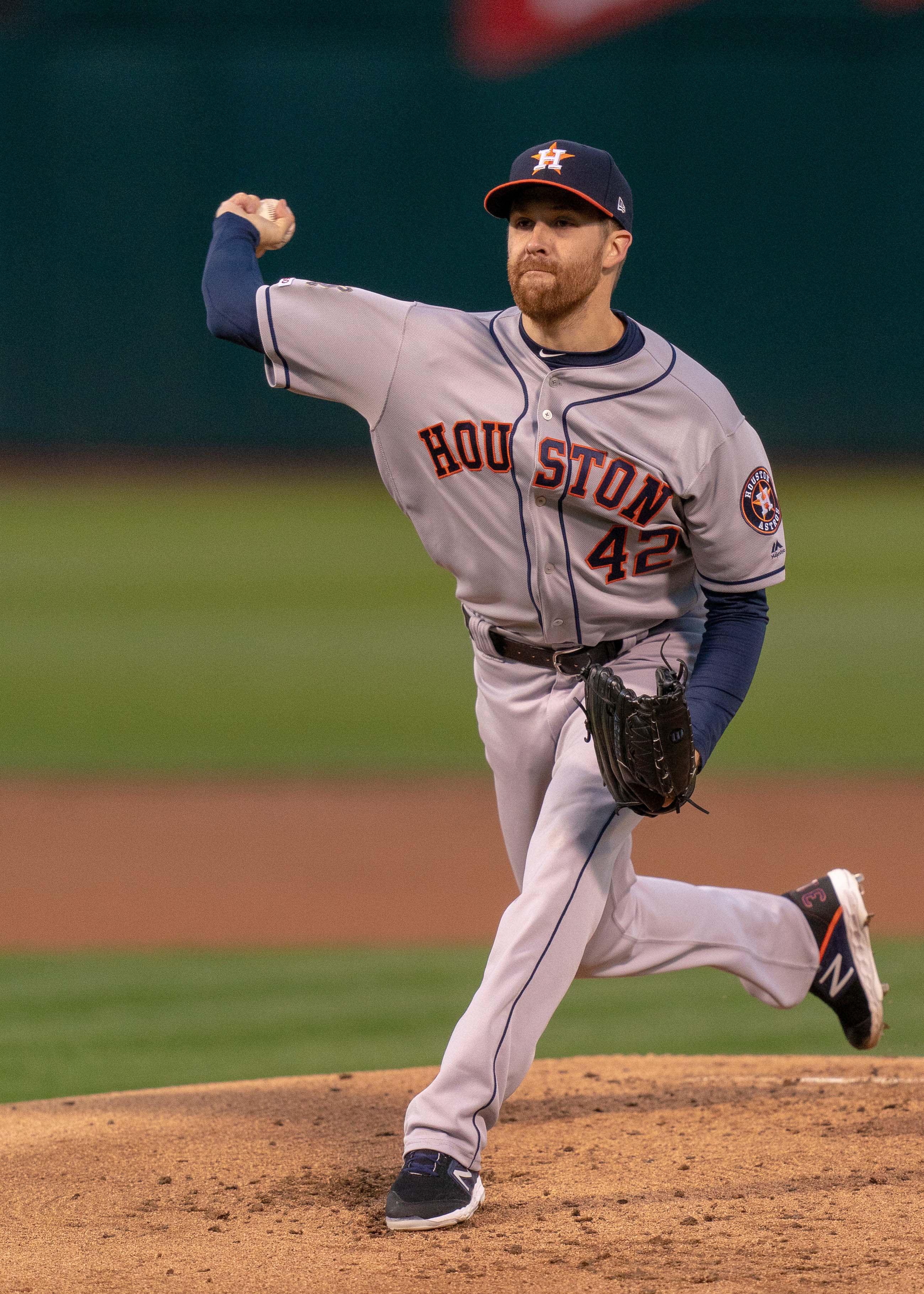
Boston’s announcement on McHugh coalesces with growing uncertainty surrounding the status of ace Chris Sale, who this week underwent an MRI on a problematic right elbow that has since been assessed by some of the industry’s leading surgeons. While Sale is reportedly expected to avoid going under the knife for the time being, he’ll open the year on the injured list and be sidelined for a yet-to-be-determined period of time. Adding some depth in the form of McHugh is certainly a sensible approach and arguably would’ve been necessary even had Sale been healthy.
That said, McHugh himself isn’t a lock to step right into the rotation and contribute as a starter. The 32-year-old missed about a third of the 2019 season due to elbow discomfort and finished out the year on the injured list. MLB Network’s Jon Heyman reported last week that McHugh had been cleared to begin throwing after undergoing a non-surgical “tenex” procedure on his elbow over the winter. His exact timetable to get on a big league mound isn’t yet clear, but he may have to begin the season on the injured list himself if he’s only recently begun throwing.
McHugh made eight starts last year but spent the rest of the 2018-19 seasons in the Astros’ bullpen. His 2019 effort was dragged down by those elbow troubles, which surely contributed to the downward trends in his velocity, swinging-strike rate, opponents’ exit velocity and opponents’ hard-hit rate. McHugh tossed 74 2/3 innings for the ‘Stros last year but turned in a 4.70 ERA that was his highest mark since 2013.
In 2018, though, McHugh was utterly dominant out of the Houston ‘pen. Through 72 1/3 frames, he recorded a stellar 1.99 ERA with averages of 11.7 strikeouts, 2.6 walks and 0.75 home runs per nine innings pitched. And prior to that he was a steady rotation piece, racking up 606 1/3 innings of 3.70 ERA ball (3.60 FIP) with 8.4 K/9 against 2.5 BB/9 from 2014-17.
The manner in which the Red Sox utilize McHugh has not yet come to light, though he could conceivably be deployed in a variety of roles. As noted, he has extensive experience both starting and relieving. With Sale sidelined, the Boston rotation currently has Eduardo Rodriguez, Nathan Eovaldi and Martin Perez locked into starting gigs. Boston has discussed utilizing one or even two openers in the remaining two slots, and manager Ron Roenicke recently revealed that the club will consider stretching left-hander Darwinzon Hernandez out to pitch in lengthier stints. McHugh could function as an opener, a bulk reliever who follows an opener or simply as a conventional starter, depending on the status of his elbow and on how the organization best believes his talents can be maximized.
For now, the Red Sox still appear likely to rely on a hodgepodge of journeymen and fringe prospects to round out their pitching staff, but the ability to eventually insert a health McHugh into the thick of that mix holds clear appeal.
As for Velazquez, he’ll either be traded, run through outright waiver or released within the next seven days. The 31-year-old right-hander was knocked around to the tune of a 5.43 ERA through 56 1/3 innings in 2019. And although he notched a 3.12 ERA with 5.9 K/9, 2.7 BB/9 and a 47 percent grounder rate in 109 2/3 innings from 2017-18, Velazquez’s secondary metrics are less encouraging than that earned run average. His 4.28 FIP was noticeably higher, and he ranked near the bottom of the league in terms of spin rates, hard-hit rates and opponents’ exit velocity. He has a minor league option left and has worked as both a starter and reliever, so it’s possible another club will take him on as a depth piece.
Latest On Boston’s Rotation
Ever since last week’s news that Chris Sale will begin the 2020 season on the injured list, there has been much speculation about how the Red Sox would fill his absence. Even though it currently seems that he won’t need to go under the knife for Tommy John surgery, the team will still need to replace him in some fashion.
It was recently revealed that the Boston brass are open-minded as to how they go about filling Sale’s innings, having put the opener strategy on the table.
Jason Mastrodonato of The Boston Herald spoke with Red Sox manager Ron Roenicke, who gave some details about a presentation from chief baseball officer Chaim Bloom. (Bloom, of course, was with the Rays when they pioneered the use of the opener.)
Roenicke outlined that they are still considering using two openers, as well as using some pitchers to “pitch three innings every three days.”
It seems the approach is still in a very speculative stage. One element being considered is the stretching out of Darwinzon Hernández. Before last year, Hernández had primarily been a starter in the minors. But 2019 saw him oscillate between starting and the bullpen, making 12 starts and and five appearances at two minor levels to go along with one start and 28 relief appearances in the big leagues. What form his contribution will take in 2020 seems to still be up in the air.
“We talked about it again a couple days ago,” Roenicke said, “and I think that talk is probably going to continue on with him. Especially the better he does at more innings, we’ll probably keep talking about it. Maybe he’s at two innings and then goes to three. Then we’re like, ‘OK, do we try this guy and see how he does starting?’ Those conversations I imagine will probably happen through the years.”
Another name to watch out for is Ryan Weber, according to Peter Abraham of The Boston Globe. Abraham notes that the Red Sox are trying to maximize Weber’s five-pitch mix by increasing the use of his cutter.
Much like Hernández, Weber’s position within the staff doesn’t seem to be locked down. But that doesn’t seem to be bothering him. “If I get the ball in the first inning or the third inning, I’m going to pitch the way I pitch,” Weber said. “I’m comfortable starting or relieving.” Weber made 16 starts for the AAA Pawtucket Red Sox in 2019. But at the big league level, only three of his 18 appearances were starts.
The bottom line seems to be that all options are being kept open for now. As Roenicke says, “I think we’re still hoping that one of these guys that we’re looking at in camp is going to ‘wow’ us basically and we know we can go with him as a starter every fifth day,” he said. “So I think that’s what we’re waiting for.”
If Hernández and Weber don’t provide that ‘wow’ factor, Boston does have other options, as recently outlined by MLBTR’s Connor Byrne. Though the Fenway faithful will surely be hoping for Sale’s speedy recovery and that whatever emergency measures are required are only temporary fixes.
8 AL East Pitchers Looking For Bounce-Back Years
After taking a look at eight American League East hitters hoping to bounce back from down seasons in 2020, we’ll do the same here with an octet of the division’s pitchers…
Nathan Eovaldi, RHP, Red Sox:
The flamethrowing Eovaldi was one of Boston’s many heroes during its World Series run in 2018, convincing the team to re-sign him to a four-year, $68MM contract thereafter. But the first year of the pact was a disaster for both sides, as Eovaldi missed significant time with elbow problems and didn’t perform well when he was able to pitch. The 30-year-old wound up with career-worst numbers in ERA (5.99), FIP (5.90) and BB/9 (4.66), thereby offsetting a personal-high K/9 of 9.31. There’s optimism he’ll rebound this year, which would be a boon for a Red Sox team that just traded David Price and has seen elbow issues weigh down Chris Sale this spring.
Chris Sale, LHP, Red Sox:
Speaking of Sale, the longtime ace simply didn’t deliver the type of results we had grown accustomed to seeing last season. The 30-year-old was still awfully good, notching 13.32 K/9 and 2.26 BB/9, but turned in a bloated ERA (4.40) and FIP (3.39) in comparison to prior campaigns. He also saw his mean fastball velocity dip by over a mile an hour from the prior couple years, as he averaged 93.2 mph with the pitch. That’s not what the Red Sox wanted after signing Sale to a five-year, $145MM extension last spring. Considering that deal won’t even take effect until this season, it’ll be all the worse for the Red Sox if his current elbow injury proves to be serious.
Blake Snell, LHP, Rays:
Like Sale, Snell turned in fine numbers last year. However, in terms of bottom-line production, he wasn’t the Cy Young winner we witnessed the previous season, owing in part to elbow troubles that required arthroscopic surgery in late July. Snell ultimately totaled 107 innings of 4.29 ERA/3.32 FIP ball after putting up 1.89 and 2.85 in those respective categories during the prior campaign. There was still plenty to like, however, including 12.36 K/9 against 3.36 BB/9, a fastball that stayed in the 95-96 mph range and swinging-strike rate (17.7) that climbed more than 2.5 percent from his superb 2018 effort. Once again, though, there are some health questions in play. Snell may miss the start of the regular season after undergoing a cortisone shot in his elbow last week.
Jose Alvarado, LHP, Rays:
He was somewhat quietly among the elite relievers in baseball in 2018, but last year didn’t go nearly as well for Alvarado. The 24-year-old did average a whopping 98.2 mph on his fastball and strike out 11.7 batters per nine, though an untenable walk rate (8.1 BB/9, up almost double from the previous season) led to a 4.80 ERA/4.18 FIP in 30 innings. To be fair to Alvarado, he wasn’t healthy all that often in 2019, missing time with oblique and elbow injuries. He also sat out for a while because of a family matter.
J.A. Happ, LHP, Yankees:
Happ had a career-best stretch with multiple teams from 2015-18, which persuaded the Yankees to re-sign him to a two-year, $34MM contract heading into 2019. The decision doesn’t look great so far, though, as Happ stumbled to a 4.91 ERA/5.22 FIP in 161 2/3 innings last season. Along the way, his strikeouts per nine (7.81) dropped by almost two full batters from the previous season, while his home run-to-fly ball rate (18.3) jumped by about 5 percent. Now, it’s imperative for the Yankees that they get a bounce-back effort from Happ, considering the well-documented hardships they’re suddenly facing in their rotation. And there’s a lot at stake for the 37-year-old Happ, whose $17MM option for 2021 will vest if he accumulates 165 innings or 27 starts this season.
Alex Cobb, RHP, Orioles:
Back and hip injuries limited Cobb to just three starts in 2019 (all in April), the second season of a four-year, $57MM contract that has blown up in Baltimore’s face so far. Cobb had a horrific time in the 12 1/3 innings he did pitch last year, yielding 15 earned runs on 21 hits (including an eye-popping nine homers).
Mychal Givens, RHP, Orioles:
Givens was an oft-rumored trade candidate throughout last season, but the Orioles decided not to sell low on him during a career-worst year. Like many pitchers in 2019, the 29-year-old proved extremely susceptible to the home run, giving them up on 22.8 percent of fly balls en route to a 4.57 ERA/4.50 FIP with eight blown saves in 19 attempts; he also registered a below-average walk rate of 3.71 per nine. On the bright side, though, Givens fanned a career-high 12.29 batters per nine and continued to average better than 95 mph on his fastball. With this being his penultimate year of team control, Givens continues to look like a trade candidate for Baltimore, but the team won’t get a max return if he doesn’t revisit his old form.
Richard Bleier, LHP, Orioles:
Despite a dearth of strikeouts and a lack of velocity, Bleier offered lights-out results as a member of the Yankees’ and Orioles’ bullpens from 2016-18. Last year was more of the same in terms of strikeouts, walks and grounders (4.88 K/9, 1.3 BB/9, 59.9 percent GB rate), but the run prevention wasn’t there. Bleier ended up with a horrid 5.37 ERA (with a more encouraging 4.19 FIP) over 55 1/3 innings. While Bleier continued to hold down same-handed hitters, who posted a weak .238 weighted on-base average off him, righties tattooed him for a .410 wOBA. In other words, the average righty hit like the 2019 version of Anthony Rendon against Bleier.