AL Notes: Sox, Astros, Yankees
Checking in on a few American League franchises…
- White Sox first-round pick Garrett Crochet will arrive in Chicago sometime this week for a physical, Scott Merkin of MLB.com tweets. Crochet fully intends to sign with the club. “After we get the contract all buttoned up, I should be signing. Yeah, it’s not completely official, but should be here in a few days’ time,” said Crochet, a left-hander from Tennessee whom the White Sox chose 11th overall. His pick carries a recommended slot value of $4,547,500.
- The Red Sox turned to one of their most valuable players to help lure an undrafted free agent, Chris Cotillo of MassLive.com details. In an effort to land St. Joseph’s University right-hander Jordan DiValerio, Boston enlisted the help of ace Chris Sale. DiValerio told Cotillo he received a text Sunday from his agent, who said, ‘”Hey, expect a call from Chris Sale.’ I was like, ‘No way. Are you serious?’ And then, he told me if I got a call from a random number, to pick it up.” While DiValerio was already leaning toward the Red Sox at that point, the call from Sale only helped the club’s cause. “He said it’s one of the best, if not the best organization in baseball,” DiValerio stated. “He said once you get in, the family environment is really just incredible. He’s so happy to be a part of it. He told me I’m going to be happy to be in it as well.”
- Owner Jim Crane informed Astros employees Tuesday that the team will not lay off or furlough anyone through the end of October, Jake Kaplan of The Athletic tweets. However, any member of the staff who makes $100K or more will have to take a pay cut.
- The Yankees, meanwhile, have told their staff that they’ll continue with the status quo in terms of employment and pay, per James Wagner of the New York Times. The team had previously only committed to them through June 15.
The Longest Flirtation In Baseball
For those who love the will-they-won’t-they back-and-forth of a classic rom-com, Major League Baseball has a story for you. The Chicago White Sox and lefty hurler Gio Gonzalez are drawn to each other. There’s no denying the connection. They’re the Ross and Rachel of the MLB (or Jim and Pam, or whatever reference is relevant these days). Though they’ve never stayed together long, these would-be soulmates are on the verge of finally making it work. Should baseball return in 2020, their long-standing flirtation should finally consummate with Gonzalez in black-and-white, taking the hill in front of the Southside faithful.
Gonzalez, 34, has long been a productive pitcher in the bigs, but he hasn’t gotten the respect he deserves of late. Though Gonzalez is aging, he certainly pitched well enough to prove himself a viable rotation candidate. And yet, following the 2018 season, Gonzalez languished on the free-agent market. He eventually accepted a minor league deal with the Yankees, but he never made an appearance for their big-league team. He found his way back to Milwaukee where he went 3-2 with a 3.50 ERA/4.04 FIP across 87 1/3 innings (17 starts). Again, solid numbers for Gonzalez, but again there wasn’t much buzz around him as he returned to free agency.
Fear not, for an old friend came to the rescue. The White Sox signed Gonzalez to a $5MM guarantee just before Christmas with plans of slotting him into the rotation. The White Sox are a team on the rise with a young rotation in need of guaranteed, quality innings. Lucas Giolito and Dallas Keuchel are set to front the rotation with less proven assets like Reynaldo Lopez and Dylan Cease likely to follow. Gonzalez should help the young arms take their time and weather the storm, should there be one.
Regardless of fit, we know the White Sox like Gonzalez. This was, after all, the third time they’d acquired him. The White Sox first drafted Gonzalez 38th overall in the 2004 June Draft. But he didn’t last long in their system, as the Sox traded Gonzalez to the Phillies after the 2005 season (with Aaron Rowand and Daniel Haigwood) for Jim Thome.
Just a year later, Gonzalez found himself headed back to Chicago. The White Sox and Phillies connected on a new deal wherein the Phils acquired Freddy Garcia for Gonzalez and Gavin Floyd. Garcia made just 11 starts for the Phillies before leaving as a free agent after 2007. Floyd found his sea legs in Chicago after struggling to make good on his top draft pick status in Philly. He ended up playing seven seasons with the White Sox, going 63-65 with a 4.22 ERA/4.20 FIP in that time, settling in as a decent rotation piece.
Gonzalez’s second stint with the White Sox lasted barely longer than the first. He did, however, begin to flourish. Upon his return, Gonzalez quickly became a top arm in their system, topping out of as their number one ranked prospect by Baseball America in 2008 (#26 overall in the majors).
Still, they traded him – again – this time to the Oakland Athletics (along with Fautino De Los Santos and Ryan Sweeney) in exchange for Nick Swisher. Swisher was a personality match with the White Sox, a spiritual successor to Rowand and other hard-nosed dirt dogs to play on the grass in Chicago – but he only lasted one season (.219/.332/.410 with 24 home runs).
Gonzalez became the gem of that deal for Oakland, making his debut in 2008 as a 22-year-old. It took Gonzalez a couple seasons to find his footing, but by the end of 2011, Gonzalez was an established pro. He put together back-to-back 200-inning seasons for the A’s, amassing 8.3 rWAR/6.5 fWAR across 2010 and 2011 before Oakland shipped him to Washington.
At this point, Gonzalez was entering his age-26 season with some runway to finally settle in after being traded four times already. Gonzalez became a rotation stalwart for the Nationals from 2012 to 2018, a two-time All-Star, and a 124-game winner.
His best season was his first in Washington. The 26-year-old Gonzalez led the league in wins going 21-8 with a 2.89 ERA/2.82 FIP across 199 1/3 innings. As the Nats’ nominal ace, Gonzalez led them to their first-ever postseason appearance. Of course, this was the season the Nationals famously withheld Stephen Strasburg from the playoffs to ensure his long-term health. An undercurrent of that story, however, was Gonzalez, whose dominance that year made such a bold move possible. Gio started games one and five of the NLDS, pitching well but lasting just five innings in both outings – a common thread for Gonzalez. The Nats went 1-1 in those games but ultimately lost the series to the Cardinals.
Gonzalez never put up another season quite like his 2012, but he nonetheless gave the Nats solid work for 6+ seasons. Regardless, there wasn’t a ton of interest when the Nats shopped him during the 2018 season. Gonzalez was eventually traded to the Brewers, for whom he pitched well in five late-season starts. He even got a pair of postseason starts, though he went just two innings in the first outing and left due to injury one inning into his second.
Eight seasons after arriving in Washington and 16 years after Chicago selected him in the first round, Gonzalez may finally have the opportunity to pitch for the White Sox. Of course, a lot stands in the way of Gonzalez making his debut in Chicago, but that’s nothing new. Now in his third stint in the organization, the White Sox hope Gonzalez will help lead this young team.
Of course, if they don’t make the leap many expect, Chicago could embark on one last selloff of veterans before making a run at contention again in 2021. If that happens, Gonzalez could find his name in the trade papers once again. But for now, as before, Gio Gonzalez is a member of the Chicago White Sox.
Each AL Team’s Top Recent Draft Class
With the MLB draft scheduled for next week, let’s take a look at each American League team’s most successful draft class in recent memory. Using Baseball Reference’s draft tracker, we can sum the combined career bWAR of each player selected by each team in a given year. It’s a simple shorthand, not a perfect measure, but it’ll give some insight into which teams have really hit in certain years.
First, a quick note on the methodology. For simplicity, we’re limiting this search to the 2006-2015 classes. A player’s value is only included if he signed with the club, although he needn’t have actually played for his drafting team in the majors. (So, the 2008 Yankees don’t get credit for drafting but failing to sign Gerrit Cole, while the 2007 Red Sox do get credit for drafting and signing Anthony Rizzo, even though he was traded before ever playing an MLB game for Boston). Of course, a player drafted in 2006 has had more time to rack up value than one drafted in 2015, so we’ll note in each team’s capsule if a more recent class is on the verge of taking over from an older class. On to the results…
- Angels: 2009 (109.3 bWAR) – Go figure. Picking one of the greatest players of all time is a heck of a way to kick off a draft class. But this 2009 class wasn’t just about Mike Trout, even if he’s accounted for about two-thirds of its cumulative value. That year, the Angels also selected Patrick Corbin, Randal Grichuk, Garrett Richards and Tyler Skaggs. Former MLBTR contributor Chuck Wassterstrom took a behind-the-scenes look at this class a few years ago.
- Astros: 2009 (53.2 bWAR) – Not a single one of the Astros’ top five rounders in 2009 reached the majors. The late rounds, though, were a smashing success with J.D. Martinez (20th), Dallas Keuchel (7th) and Kiké Hernández (6th) accounting for the class’ value. Of course, Martinez did his damage elsewhere after the Astros released him.
- A’s: 2012 (37.7 bWAR) – The A’s 2012 class produced seven big leaguers, most notably Matt Olson. He leads a group that also included Addison Russell and Max Muncy, who have played most or all of their MLB careers elsewhere.
- Blue Jays: 2009 (39.2 bWAR) – They won’t get credit for selecting James Paxton in supplemental round one here, but Yan Gomes was a nice find in the tenth round, though he would play only briefly in Toronto before being dealt to Cleveland. Outside of Gomes, the Blue Jays found a few nice role players, including Jake Marisnick, Aaron Loup, Ryan Goins, and others.
- Indians: 2011 (38.7 bWAR) – Selecting Francisco Lindor eighth overall in 2011 was a key to Cleveland’s 2016 AL pennant. So too was then-closer Cody Allen, whom they grabbed in the 23rd round. With Lindor mid-prime, the class’ value should just continue to grow.
- Mariners: 2006 (40.2 bWAR) – Doug Fister and Chris Tillman went on to become mid-rotation starters for a time (Fister arguably even a bit more than that), albeit with other clubs. Fifth overall pick Brandon Morrow disappointed as a starter but had a late-career renaissance as a quality reliever before various injuries derailed him.
- Orioles: 2007 (43.2 bWAR) – Although only four players from this class would wind up making the Majors, the combination of Jake Arrieta and Matt Wieters makes the 2007 draft a pretty solid one for the O’s. While Wieters, the fifth overall pick, maybe didn’t turn out to be the franchise cornerstone he was hailed to be, he has nonetheless had a nice career. Arrieta had a slow start in Baltimore, but would of course earn a Cy Young with the Cubs. It’s worth noting that this spot will be taken by the 2010 class before too long, almost entirely on the back of Manny Machado.
- Rangers: 2008 (33.3 bWAR) – Despite garnering only a 25th-round selection, Tanner Roark has turned out to be the most productive player in this class. First-round choice Justin Smoak deserves a mention too, though his career didn’t really take off until he’d been traded out of Texas. The 2011 class, headed by Kyle Hendricks, is not far behind and could claim this title in the near future.
- Rays: 2006 (81.5 bWAR) – Franchise legend Evan Longoria does a lot of the heavy lifting for this class, having amassed 56 total WAR by age 34. Even so, there are some other quality players here: Desmond Jennings and Alex Cobb are the other notables, with Jennings carving out a solid MLB career as a tenth-round pick.
- Red Sox: 2011 (70.2 bWAR) – This is far and away the best Sox draft class in recent memory, and it shouldn’t surprise anyone. Mookie Betts, one of the finest players in baseball, established himself as Boston’s franchise player after he was selected in the fifth round. Even outside of Betts, this class yielded a few key members of the Red Sox 2018 World Series team, with Jackie Bradley Jr. and relief ace Matt Barnes also coming out of that draft.
- Royals: 2007 (47.1 bWAR) – Speaking of drafting World Series contributors, the Royals in 2007 added both Mike Moustakas and Greg Holland, both of whom turned out to be central in the Royals’ playoff runs in 2014 and 2015. And that’s before mentioning third-rounder Danny Duffy, who’s still with Kansas City and inked a nice extension prior to 2017.
- Tigers: 2007 (20.6 bWAR) – With just 20.6 WAR, the Tigers’ best draft in recent memory doesn’t compare favorably to the rest of the AL, and that partly illuminates the franchise’s current standing in baseball. The notable player from the 2007 class is Rick Porcello, who had some nice years to begin his career with the Tigers and would later win a Cy Young. Maybe they get bonus points for discovering high-schooler D.J. LeMahieu, who wouldn’t sign with the team, in round 41?
- Twins: 2009 (32.4 bWAR) – Between Kyle Gibson and Brian Dozier, the Twins drafted a pair of staples on the Minnesota teams of the mid-2010s. But with both playing elsewhere now, keep an eye on the 2012 draft class, which features a trio of young centerpieces for a new era of Twins baseball: Byron Buxton, Jose Berrios, and Taylor Rogers are up-and-comers who could rack up a lot of value as they enter their primes.
- White Sox: 2010 (55.3 bWAR) – Chris Sale carries the 2010 class for the South Siders, by far the best draftee in an otherwise mediocre string of years for Chicago. That said, 2010 yielded a couple of other role players for the White Sox, with Addison Reed, Jake Petricka, and Tyler Saladino all making nice MLB contributions.
- Yankees: 2006 (69.4 bWAR) – Whereas many teams’ success in a given year is determined by one standout player, the Yankees’ installment on this list displays a surprising breadth of quality players, without a single superstar. Evidently, the 2006 Yankees cornered the market on MLB relievers: Ian Kennedy, David Robertson, Dellin Betances, Mark Melancon, and Joba Chamberlain are the five most productive players from the Bombers’ draft that year (granted, Kennedy didn’t transition to the bullpen until last year).
Never On Top, But Still The Champs
The Washington Nationals have had more time than your average champ to take a bow after their World Series victory last October. Their win in Game Seven over the Astros more than seven months ago stands as the most recent non-exhibition game, and though Major League Baseball continues to bob and weave their way back to play amidst this pandemic, the Nats are still the champs until a new one is crowned. Luckily for baseball fans, Davey Martinez’s crew in Washington certainly made the most of their first World Series victory from a lore perspective. Their turnaround after starting 19-31 has been the most often trumpeted fact from their run to the top, but there are plenty more factoids that add flavor to the Nats’ first championship.
For example, as their Twitter account graciously reminds us, they’re “The Greatest Comeback Team In MLB History” after reversing an in-game deficit five times when facing elimination in the postseason. Then there’s Ryan Zimmerman hitting the first home run in their World Series history 15 years after the Nats made him the first-ever draft pick. Howie Kendrick certainly has a story to share, as does Stephen Strasburg, as does, believe it or not, Gerardo Parra, who bonded the clubhouse around – of all things – a South Korean children’s song.
They also became the first team to win a World Series via four road wins, they took out the Astros just weeks before news broke of the sign-stealing scandal, and they coined multiple slogans along the way, like “Stay In The Fight,” “Bumpy Roads Lead To Beautiful Places,” and “Go 1-0 Every Day.”
But despite the rings, the accolades, and the lore aplenty, there’s at least one thing the Nationals did not accomplish. The 2019 Nats became just the second team in the Wild Card Era to win the World Series without spending a single day in first place (2003 Marlins).
Of course, the introduction of the wild card in 1995 makes this fun fact possible. Since the single wild card was brought into play, we have 25 seasons of wild card history. Seven wild cards survived the gauntlet of the playoffs to win it all: 1997 Marlins, 2002 Angels, 2003 Marlins, 2004 Red Sox, 2011 Cardinals, 2014 Giants, 2019 Nationals (that’s it, right?). While the run in the early aughts gave the wild card some serious juju, the shine had worn off a bit in recent years. Still, each of the past two decades brought a 30% championship rate for wild card entrants.
Meanwhile, World Series champions on the whole over the past 25 years have spent an average of 95.88 games in first. Of course, we’re dealing with a small sample size here and a fairly large spread. A standard deviation of ~54 games means that roughly 95% of our champs should have spent somewhere between 41 and 150 games in first, meaning there really are many ways to skin this cat – especially since more than a quarter of World Series champs fell beyond those bounds (thanks a lot, sample size).
The 2016 Cubs came pretty close to running the table, leading the NL Central for 154 games before capping a season for the ages. They were outdone – White Sox fans will not be surprised to hear – by their crosstown rival. The White Sox were in first place for 161 games during the 2005 season before sweeping the Astros. They did, in fairness, share first place with the Tigers and Twins for (small) portions of the season. The ’02 Angels and ’97 Marlins, meanwhile, barely managed to escape our list by spending 12 and 11 days in first, respectively.
So while the Nationals had a season for the ages in 2019, there’s yet more for this team to accomplish (if/when play resumes for the 2020 season). The Braves would seem to rule the roost, but the Phillies held a share of the NL East lead for 60 days of the 2019 season, and the Mets took the top spot for a cool 14 days. The Marlins’ 105-loss season didn’t share a ton in common with the Nats’ by the end of the year, but this fact they shared: neither managed to lead the division for even a day.
Remembering A Yankees-White Sox Blockbuster
In late July of 2017, the Yankees were mired in a weeks-long skid and working to avoid their second straight season without a playoff berth. After a 38-23 start to the season, the Yankees suffered a loss to the Twins on July 17 to fall to a so-so 47-44. They were in the midst of a free-fall, and general manager Brian Cashman decided he had seen enough. While the Yankees did get a win on the 18th, Cashman acted aggressively that night to acquire third baseman Todd Frazier and two relievers – right-handers David Robertson and Tommy Kahnle – from the White Sox. In doing so, Cashman surrendered three prospects – left-hander Ian Clarkin and outfielders Blake Rutherford and Tito Polo – as well as reliever Tyler Clippard.
The deal played some role in helping the Yankees to a 91-win finish, a playoff berth and a trip to the ALCS, where they lost to the eventual champion Astros in seven games. Frazier seemed to be a hugely positive influence in the clubhouse (remember the thumbs-down craze?), and on the field, he slashed a decent .222/.365/.423 with 11 home runs in 241 plate appearances. Frazier was only a rental at the time, though, and he wound up with the Mets the next offseason on a two-year, $17MM guarantee.
Robertson, a Yankee from 2008-14 before he signed a four-year, $46MM contract with the White Sox prior to 2015, was excellent in his return to the Bronx. He threw 104 2/3 innings of 2.49 ERA ball with 12.21 K/9 and 2.37 BB/9 over parts of two seasons, though he left the Yankees as a free agent yet again when the Phillies inked him to a two-year, $23MM in advance of the 2019 campaign.
Kahnle, meanwhile, is still in the Bronx. The year the White Sox gave him up, Kahnle (who entered the pros as a fifth-rounder of the Yankees back in 2010) was amid a breakout season in which he wound up throwing 62 2/3 frames of 2.59 ERA/1.83 FIP ball with 13.79 K/9 and 2.44 BB/9 between the two teams. The 2018 season proved to be an injury-shortened disaster for Kahnle, who could only manage a 6.56 ERA/4.19 FIP in 23 1/3 innings, but he bounced back last year with a 3.67 ERA/3.33 FIP and 12.91 K/9 and 2.93 BB/9 across 61 1/3 innings.
The Yankees can control Kahnle at reasonable prices through 2021, so he should continue to be an important part of their bullpen for at least a little while longer. However, when they made this deal, the Yankees were no doubt hoping it would help propel them to a championship. That hasn’t happened, though they have made three consecutive playoff appearances since swinging the trade. As for the White Sox, who were still a long way from contention when they agreed to the swap, here’s how their return has gone so far…
- Ian Clarkin: The former first-rounder (No. 33 in 2013) struggled enough in Double-A in 2018, his first full year in Chicago’s system, for the team to designate him for assignment. He threw 13 1/3 innings with the Cubs’ Double-A club last season and is now in the San Diego organization.
- Blake Rutherford: The 18th pick in 2016, Rutherford topped out as Baseball America’s 45th-best prospect after 2017, though his stock has dropped since then. After the 23-year-old batted .265/.319/.365 with seven homers in 480 PA at Double-A last season, FanGraphs’ Eric Longenhagen ranked him as Chicago’s No. 15 prospect.
- Tito Polo: Now 25, Polo only lasted in the White Sox’s system through 2018. He divided last season between the Mariners’ Triple-A team and the Mexican League. He’s currently a free agent.
- Tyler Clippard: Less than a month after acquiring Clippard, the White Sox traded the veteran to the Astros for cash considerations.
Almost three full years since this trade occurred, it seems Kahnle has emerged as the most valuable long-term asset involved. Now, Chicago’s only hope is for Rutherford to turn into a viable major leaguer, as the other players it received left the organization and didn’t bring back any assets when they departed.
Latest On Furloughs, Pay Cuts Among MLB Clubs
6:09pm: The Rangers have committed to $400 a week for their minor leaguers through at least June, Levi Weaver of The Athletic was among those to report. The same goes for the Braves, per David O’Brien of The Athletic, as well as the Diamondbacks, Nick Piecoro of the Arizona Republic adds.
12:59pm: The Padres will also pay their minor leaguers the $400 weekly stipend through the end of August, Dennis Lin of The Athletic tweets.
12:34pm: Most of MLB’s 30 organizations agreed a ways back to pay their employees through the end of May. There were instances of lengthier commitments, but May 31 was broadly used as an initial endpoint, at which time fiscal matters would be reassessed. Minor league players have been receiving $400 weekly stipends during this time, but that arrangement is also only promised through the end of May. As you’d expect, clubs have begun to inform employees (both on the business and baseball operations side) and minor leaguers of their next steps. And, as you’d expect, in some instances it’s not pretty.
Yesterday was a particularly dark day in the Athletics organization, as ESPN’s Jeff Passan reports that the team informed minor league players they will no longer be paid their stipend as of June 1. Robert Murray of The Score shares the email that was sent to Oakland minor leaguers — one which was signed by GM David Forst rather than managing partner John J. Fisher. (Forst, of course, is being asked to play the messenger in this instance and is not the one making the decisions.)
Minor league players are generally undercompensated as a whole, and the $400 weekly stipend they’ve received over the past two months will now seemingly go down as the only baseball-related compensation they’ll receive in the calendar year. Their contracts, which are in a state of suspension but not terminated, bar them from “perform[ing] services for any other Club” and also render them ineligible for unemployment benefits, per The Athletic’s Emily Waldon (Twitter link).
As for the operations side of the equation, Athletics front office personnel will be either furloughed or see their pay reduced effective June 1 and running through the end of October, The Athletic’s Alex Coffey reports (Twitter thread). She adds that the maximum cut is 33 percent, and those determinations are based on seniority. Scouts aren’t considered front-office personnel, but they’ll be hit hard as well; USA Today’s Bob Nightengale tweets that A’s amateur and pro scouts alike will be furloughed from June 16 through Oct. 31. Fisher did write a letter to the club’s fanbase confirming the dramatic cuts (Twitter link via the San Francisco Chronicle’s Susan Slusser), emphasizing the pain that went into the decisions and his “deep commitment to the long-term future of the A’s.”
Those cutbacks are similar to the substantial cuts the Angels put in place earlier this month, but other L.A. club isn’t taking such rash measures. The Dodgers have informed all employees earning more than $75K that they’ll be subject to pay reductions beginning June 1, Ramona Shelburne of ESPN (Twitter thread). The extent of the reductions is dependent on overall salary — larger salaries get larger percentage cuts — and will be capped at 35 percent for the most part, although that they could be greater for the team’s very top executives. Those measures are being taken in an effort to avoid the type of large-scale furloughs being put in place in Oakland and Anaheim.
Across the country, the Nationals have implemented a series of partial furloughs both in baseball ops and business ops, Jesse Dougherty of the Washington Post reports (Twitter thread). The Nats are still covering full benefits and haven’t made any layoffs, but they’re implementing a sequence of 10 to 30 percent reductions in pay and total hours. The Brewers, meanwhile aren’t making any baseball ops furloughs but are furloughing some business operation employees, Todd Rosiak of the Milwaukee Journal-Sentinel tweets.
It’s not yet clear how every organization plans to handle the minor league pay dilemma, but Baseball America’s Kyle Glaser has heard from at least three clubs that plan to continue varying levels of compensation. The Phillies will keep paying their minor leaguers through at least June, but likely at less than the current $400 stipend. The White Sox are paying $400 per week through the end of June, and the Marlins have committed to paying their minor leaguers the full $400 per week through August — the would-be conclusion of the 2020 minor league season. The Marlins already informed players earlier this month that about 40 percent of the baseball ops department will be furloughed on June 1.
White Sox Release 25 Minor Leaguers
The White Sox are the latest team to make significant cuts in the minors, per The Athletic’s James Fegan, who reports that they have let go of 25 players (Fegan provides the entire list in his tweet). The White Sox will pay all of their minor leaguers, including those they just released, through the end of June, Fegan adds.
As you’d expect, most of the names here aren’t especially familiar. However, there are at least a couple notable players, including outfielder Josue Guerrero, whom the White Sox signed to a $1.1MM million bonus out of the Dominican Republic in 2016. Josue Guerrero, the nephew of Hall of Famer Vladimir Guerrero and the cousin of the Blue Jays’ Vladimir Guerrero Jr., didn’t post inspiring numbers as part of the White Sox’s system. In 244 plate appearances in rookie ball from 2017-19, the 20-year-old hit .224/.282/.365 with five home runs.
The White Sox also said goodbye to left-hander Byron Andre Davis, who Fegan notes was part of the return they received from the Royals in a 2017 trade centering on outfielder Melky Cabrera. Davis, now 26, dealt with injuries over the past couple years and hasn’t pitched in the minors since 2017.
Latest On MLB Teams’ Plans For Employees
A variety of MLB teams have already revealed plans for the year for non-player employees. Some have instituted furloughs and/or pay cuts while others have committed to carry employees through the fall. Still other teams are taking things on a month-to-month basis, with several revealing their latest plans in recent days.
At least three teams have decided to continue paying employees in full through at least the end of June. The Cardinals are one such team, Derrick Goold of the St. Louis Post-Dispatch reports on Twitter. The Twins are also in that camp, Jeff Passan of ESPN.com tweets. And the White Sox are adjusting work hours but not take-home pay, per Ken Rosenthal of The Athletic (via Twitter).
Elsewhere in the central divisions, there were some cuts. The Cubs are keeping their full slate of employees at full-time capacity, but are instituting some salary reductions, Jeff Passan of ESPN.com reported on Twitter. And though the Pirates will not draw down their baseball operations staff, they will reduce pay in that arena while furloughing some business employees, as Jason Mackey of the Pittsburgh Post-Gazette reports.
Out west, the Giants will retain their entire full-time staff but will be trimming pay for those earning over $75K, Henry Schulman of the San Francisco Chronicle reports. Part-timers have been furloughed.
The Astros have committed to maintaining full pay and benefits for full-time employees, but only through June 5th, Chandler Rome of the Houston Chronicle reports. Whether some action could occur beyond that point remains to be seen. The Orioles are also still in flux, but the organization appears to be leaning towards keeping staff as usual through June, per Dan Connolly of The Athletic (via Twitter).
12 Years Later, This Trade’s Still Paying Off For Yankees
It has been a dozen years since the Yankees swung a trade for outfielder Nick Swisher, who paid immediate dividends as part of the franchise and whose acquisition continues to benefit the organization to this day. On Nov. 13, 2008, the Yankees sent two minor league pitchers – Jeff Marquez and Jhonny Nunez – as well as veteran infielder Wilson Betemit to the White Sox for Swisher and young hurler Kanekoa Texeira. Most of the pieces in the swap – Marquez, Nunez and Texeira – failed to pan out in the majors, but the move revived the switch-hitting Swisher’s career and helped him land a sizable payday in free agency down the road.
If we go back to the start, Swisher opened his career as a rather effective member of the Athletics, who chose him 16th overall in the 2002 draft. As a member of the big club from 2004-07, Swisher batted .251/.361/.464 (118 wRC+) with 80 home runs and 10.0 fWAR over 1,924 plate appearances, aiding Oakland in three plus-.500 seasons and a playoff berth. However, almost six years after spending a high pick on him, the A’s sold the affable Swisher, dealing him to the White Sox in January 2008 for a package led by left-hander Gio Gonzalez. That worked out fine for Oakland, which received a couple terrific years from Gonzalez before trading him to the Nationals in December 2011 in yet another notable transaction.
While the A’s profited from Gonzalez’s presence, his career took a bad turn in his first year out of Oakland. The 2008 campaign was one of the worst of Swisher’s time in the game, and he was unable to win the favor of then-White Sox manager Ozzie Guillen as a result. While Swisher was seemingly a solid clubhouse presence in the majors, Guillen thought the opposite. He said in November 2008, a little while after the White Sox parted with Swisher: “To be honest with you, I was not happy with the way he was reacting at the end of the season. He wasn’t helping me either.” Maybe the relationship would have been better had Swisher produced, though he instead struggled to a .219/.332/.410 line (93 wRC+) in 588 PA. But Swisher did pop 24 home runs, his third of nine straight seasons with 20-plus, and Yankees general manager Brian Cashman decided to buy low on him.
To this day, the Swisher pickup looks like one of the most brilliant decisions of Cashman’s lengthy tenure atop New York’s front office. Swisher was a quality contributor throughout his time as a Yankee, including in a 2009 campaign that saw the team win its most recent World Series championship. From that season through 2012, Swisher’s last as a Yankee, he hit .268/.367/.483 (128 wRC+) with 105 HRs and 14.4 fWAR across 2,501 PA, also earning his lone All-Star berth in the process. But the Yankees were not willing to commit to Swisher once he became a free agent before 2013, which, for multiple reasons, was a wise call in hindsight.
In January 2013, the Ohio-born Swisher returned to his native state on a four-year, $56MM contract with the Indians. Unfortunately for Cleveland, it didn’t get anything close to the Yankees’ version of Swisher. Owing in part to knee problems, Swisher slashed a below-average .228/.311/.377 (92 wRC+) with 32 homers and minus-0.5 fWAR in 1,146 PA in an Indians uniform. They dealt Swisher and fellow outfielder Michael Bourn to the Braves for infielder Chris Johnson in August 2015. That proved to be Swisher’s final season in MLB, though he did return to the Yankees on a minor league contract in 2016 before his career came to an end later that year.
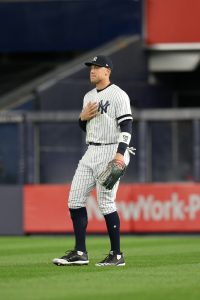
The season after Swisher said goodbye to pro baseball, another star was born in New York. Towering right fielder Aaron Judge, a top 100 prospect in his younger days, exploded on the scene in 2017, batting .284/.422/.627 (174 wRC+), smacking 52 homers and racking up 8.3 fWAR. Judge fell short of AL MVP honors then, but he won Rookie of the Year in his league and was part of a club that took the eventual title-winning Astros to a seven-game LCS.
While injuries have somewhat limited Judge’s availability since his initial season, you can’t argue with the production he has managed when he has been able to take the field. Since his second year, Judge has recorded a line of .278/.392/.528 (good for a 146 wRC+) and amassed 54 dingers with 9.7 fWAR.
Judge is now 28 years old, a two-time All-Star and perhaps the face of the Bronx-based franchise, but he may have never gotten there if not for Swisher. Allowing Swisher to depart in free agency entitled the Yankees to a compensatory selection in the ensuing draft. They used that pick, No. 32 in 2013, on Judge – a former Fresno State Bulldog. So, not only did the Yankees benefit from Swisher’s best seasons as a pro, but stealing him from the White Sox 12 years ago is still paying off for them in a big way.
Photo courtesy of USA Today Sports Images.
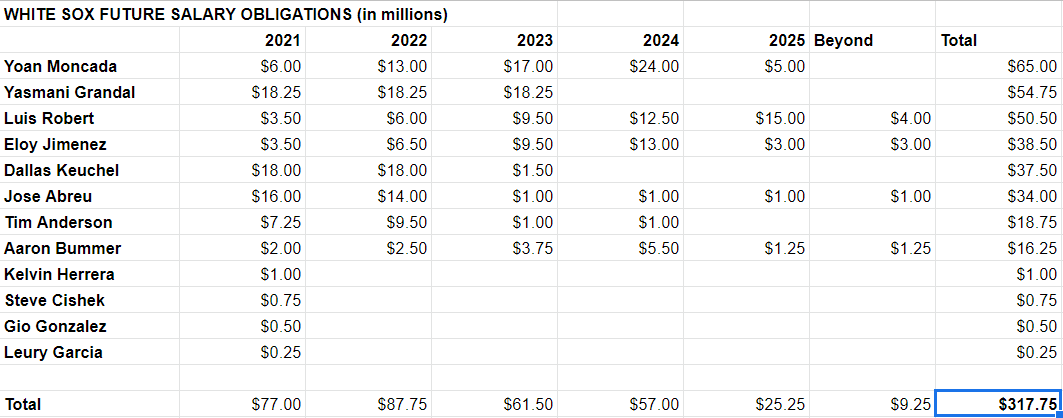
How Does White Sox’ Future Payroll Look After Busy Offseason?
2020 salary terms are set to be hammered out in the coming days. But what about what’s owed to players beyond that point? The near-term economic picture remains questionable at best. That’ll make teams all the more cautious with guaranteed future salaries.
Every organization has some amount of future cash committed to players, all of it done before the coronavirus pandemic swept the globe. There are several different ways to look at salaries; for instance, for purposes of calculating the luxury tax, the average annual value is the touchstone, with up-front bonuses spread over the life of the deal. For this exercise, we’ll focus on actual cash outlays that still have yet to be paid.
We’ll run through every team, with a big assist from the Cot’s Baseball Contracts database. Next up is the White Sox:
(click to expand/view detail list)
White Sox Total Future Cash Obligation: $317.75MM
*includes buyout of club options
*2023 option over Dallas Keuchel vests with clean physical, IP thresholds