
Which 15 Players Should The Astros Protect In An Expansion Draft?
In a few weeks, we’ll be running a two-team mock expansion draft here at MLBTR. Currently, we’re creating 15-player protected lists for each of the existing 30 teams. You can catch up on the rules for player eligibility here.
So far, we’ve done the Twins, Royals, Tigers, Indians, White Sox, Rays, Yankees, Red Sox, Blue Jays, and Orioles. The Astros are next.
We’ll start by removing free agents George Springer, Michael Brantley, Josh Reddick, Yuli Gurriel, and Brad Peacock from consideration. Next, we’ll lock in Zack Greinke, Justin Verlander, and Jose Altuve due to their no-trade clauses. We’ll also protect Forrest Whitley, as he’s a Baseball America Top 100 prospect with a 2020 ETA. I’m also going to protect Alex Bregman, Yordan Alvarez, Carlos Correa, Roberto Osuna, Ryan Pressly, and Kyle Tucker. So we’ll take up ten spots with this group:
Zack Greinke
Justin Verlander
Jose Altuve
Alex Bregman
Yordan Alvarez
Carlos Correa
Roberto Osuna
Ryan Pressly
Kyle Tucker
Forrest Whitley
That leaves five spots remaining for these 20 players:
Bryan Abreu
Rogelio Armenteros
Joe Biagini
Chris Devenski
Aledmys Diaz
Dustin Garneau
Josh James
Martin Maldonado
Francis Martes
Jack Mayfield
Lance McCullers Jr.
Cionel Perez
Austin Pruitt
Joe Smith
Cy Sneed
Myles Straw
Garrett Stubbs
Abraham Toro
Jose Urquidy
Framber Valdez
With that, we turn it over to the MLBTR readership! In the poll below (direct link here), select exactly five players you think the Astros should protect in our upcoming mock expansion draft. Click here to view the results.
Alex Bregman Seeking New Representation
3:00pm: Chandler Rome of the Houston Chronicle points out that Bregman’s departure from Klutch coincides with last week’s announcement that Uninterrupted, a film production company co-founded by fellow Klutch client LeBron James, is creating a documentary exploring the Astros’ sign-stealing scandal in 2017. Bleacher Report’s Tyler Conway has more on the forthcoming docuseries.
12:56pm: Star Astros third baseman Alex Bregman is seeking new representation, according to MLB.com’s Mark Feinsand (via Twitter). Once a change is made, it’ll be reflected in MLBTR’s Agency Database.
This is an interesting move for a variety of reasons (no, not related to trashcan-banging schemes). For one thing, while player movement between agencies is hardly unusual, it’s rare that we see reporting of a “free agent” in search of a new rep.
Bregman is not just any ballplayer, either. The 26-year-old has just kept improving and was undeniably one of the best in the sport in 2019.
Other teams won’t have a chance to lure the Houston stalwart for some time. Bregman is under contract through 2024 under the deal worked out by his now-former agent, Brodie Scoffield, which covered five seasons (beginning in 2020) and guaranteed $100MM. At the time of the pact, Scoffield had recently left the Legacy Agency to form his own outfit, Tidal Sports Group. He brought Bregman and other major clients with him. Legacy was later acquired by GSE Worldwide.
Bregman was the crown jewel of the client list when hoops powerhouse Klutch Sports bought Tidal earlier this year, although there’s been a good bit of turmoil surrounding that firm in recent weeks. MLB Network’s Jon Heyman tweeted recently that an arbitrator ruled Klutch/Scoffield will be required to split agent fees 50-50 with GSE for not only Bregman but other clients including Marcus Stroman, Kevin Gausman and Keston Hiura over the next five years.
The role that said arbitration hearing played in Bregman’s departure from the firm isn’t known at this time. Regardless, he’s sure to be pursued widely by virtually every agency in the game. Even though he’s currently signed through 2024, Bregman will still be up for a new contract in advance of the 2025 campaign — his age-31 season. And so long as he maintains his all-around excellence, the Astros may eventually hold some degree of interest in hammering out another long-term deal to retain him into his mid-30s.
The Astros Made A Precedent-Setting $10MM Investment…That Didn’t Pay Off
It isn’t any secret young and controllable star talent is just about the most valued commodity in baseball, and over the last three offseasons, we’ve seen four instances of clubs looking to gain even more potential control (and score a future payroll bargain in the process) by extending players before they have made their Major League debuts.
Scott Kingery inked a six-year, $24MM deal with the Phillies in March 2018 that also contains three club option years, meaning that Kingery’s contact could ultimately become a nine-year, $65MM pact. The White Sox inked both Eloy Jimenez and Luis Robert to six-year deals (with two club option years) over the last two offseasons, with Jimenez signing receiving $43MM and Robert $50MM in guaranteed money. The Mariners also got in on the action with first base prospect Evan White last November, signing White to a six-year deal worth $24MM in guaranteed money and up to $31.5MM more over three seasons’ worth of club options.
The logic for the teams is simple. An early-career extension eliminates any of the service-time manipulation we so often see with top prospects, and thus the Phillies, White Sox, and Mariners were or will be able to get the players into their lineups as soon as possible. The clubs were willing to bet that their youngsters would provide immediate dividends at the MLB level, and thus would become more expensive as they entered their arbitration years, so these extensions lock in cost certainty over those arb years and also give the teams control over 2-3 free agent seasons. Those free agent years could become extraordinarily valuable if, as hoped, these players develop into star big leaguers — we’ve already seen quality production from Jimenez and Kingery in 2019.
From the perspective of the four players, there is also sound reasoning in signing these extensions so early in their professional careers. The quartet has guaranteed financial security for themselves and their families before even seeing so much as a big league pitch…or, in White’s case, even a Triple-A pitch. (In Robert’s case, this is actually his second big payday, as Chicago gave him a $26MM bonus as an international amateur in 2017.) No matter how confident a prospect may be in their ability, the transition to the majors is always something of an unknown. There’s always the risk of a fluke injury scuttling a promising career, or perhaps a player — like so many star minor leaguers in the past — simply doesn’t produce against MLB competition.
It’s also fair to assume that, before putting pen to paper on their extensions, Kingery, Jimenez, White, and Robert all considered the case of Jon Singleton. The former Astros first baseman was the first non-international player to sign an extension before the start of his Major League career, agreeing to a five-year, $10MM deal with Houston back in June 2014. Singleton’s deal contained three club option years that added up to $20MM if were all exercised, plus another $5MM more in potential bonuses.
All in all, it could have been a $35.5MM contract over eight seasons had Singleton lived up to his potential. Unfortunately for both Singleton and the Astros, that promise didn’t develop into a reality. After hitting .171/.290/.331 over 420 plate appearances in 2014-15, Singleton never played in the big leagues again, and didn’t play any affiliated ball in 2018-19 before signing with a Mexican League team this past April.
Singleton was an eighth-round pick for the Phillies in the 2009 draft, and he came to Houston as part of the trade package in the deal that sent Hunter Pence to Philadelphia at the 2011 trade deadline. As one of the early building blocks of the Astros’ total rebuild process, Singleton picked up where he left off in the Phils’ farm system, beating up on minor league pitching and quickly becoming a staple of top-100 prospect lists. His stock was never higher than during the lead-up to the 2013 season, as Baseball Prospectus ranked Singleton as the 25th-best prospect in the sport, and MLB.com and Baseball America weren’t far behind in slotting Singleton 27th.
In both 2012 and 2013, however, Singleton tested positive for marijuana, and he served a 50-game suspension during the 2013 season. Marijuana addiction was an ongoing problem for Singleton, as he spoke openly in 2014 about his efforts to break his addiction, including a month-long stay in a rehab facility in 2013. As it happened, Singleton’s issues continued to plague his career, leading to a 100-game suspension prior to the 2018 season after the first baseman failed a test for a drug of abuse for the third time in his pro career. Houston released Singleton in May 2018.
Needless to say, these off-the-field problems provide an important detail in looking back at Singleton’s decision to accept the Astros’ offer. Signing the first “pre-career” extension made Singleton a notable figure in baseball transaction history, and it also opened him up to some rare public criticism from his peers. Such veterans as Mark Mulder and Bud Norris were open in their displeasure with Singleton’s deal (and, more specifically, the advice given to Singleton by agent Matt Sosnick), arguing that the Houston prospect had shortchanged his future earning potential. As Mulder put it in a tweet, he questioned if Singleton “doesn’t believe in himself to be great.”
Almost six years after the fact, of course, Singleton made the right choice. Shortly after his extension was announced, MLBTR’s Jeff Todd wrote a detailed piece about the wisdom of Singleton’s decision in the context of several other top first base prospects and comparable players, noting how relatively few of those players ended up topping Singleton’s $10MM guarantee, and many of those who did top the $10MM figure had the benefit of some actual Major League success. Plus, there was also the additional element of Singleton’s drug issues — coming off two suspensions and a lackluster 2013 season in the minors, one can certainly understand why Singleton was attracted by the security of an eight-figure contract.
Looking at the extension from the Astros’ end, the Singleton extension can be chalked up as a definite miss. Calling it a true “mistake,” however, is a stretch. Considering the money Singleton surrendered due to his 2018 suspension, the Astros’ overall investment in the first baseman ended up being less than $9MM, which was a more than reasonable bet to make considering Singleton’s high prospect ceiling at the time.
The early-career extension was a key tactic of then-general manager Jeff Luhnow, as he navigated through all of the young players amassed in trades and draft picks during the Astros’ lean rebuilding years. George Springer also received an extension offer before his MLB career even began, as Houston reportedly tabled a seven-year, $23MM deal in September 2013. Matt Dominguez and Robbie Grossman also received extension offers either before or just after their big league careers got underway.
These other examples illustrate the pros and cons any young player must face in deciding on an extension. In Springer’s case, he made the right call in turning down that extension, as he has already made more than $28MM in his career and had agreed to a $21MM salary for 2020 (though that number will now be reduced by an as-yet-determined amount due to the shortened 2020 season). On the flip side, Dominguez and Grossman probably both would have been happy to have Singleton’s $10MM deal in hindsight — Dominguez hasn’t played in the majors since 2016, and Grossman has yet to hit the $10MM mark in career earnings despite racking up 675 appearances with the Astros, Twins, and A’s over the last seven seasons.
It could be telling that there was almost a four-year gap between Singleton’s contract and the next pre-career extension in Kingery, as teams may have been wary of making such a commitment given how Singleton underachieved. Baseball’s transactions marketplace also underwent some significant changes between 2014 and 2018, with the stagnant free agent winters of 2017-18 and 2018-19 perhaps underscoring how free agency was no longer a guaranteed pot of gold at the end of the service time window for many players.
With four pre-career deals in three years, it stands to reason that we will see more of these contracts in the future — especially perhaps in the wake of the coronavirus pandemic, as financial security could become even more of a priority for players. Much will depend on how Kingery, Jimenez, Robert, and White live up their deals, and whether or not Singleton will continue to be the lone cautionary tale for teams trying to score themselves a bargain on the extension front.
How The Athletics Acquired A Cornerstone From A Division Rival
Apparently the Astros didn’t know everything that was coming in 2017. Their Nov. 20 trade with the Athletics netted them right-hander Brandon Bailey … in exchange for budding outfield star Ramon Laureano.
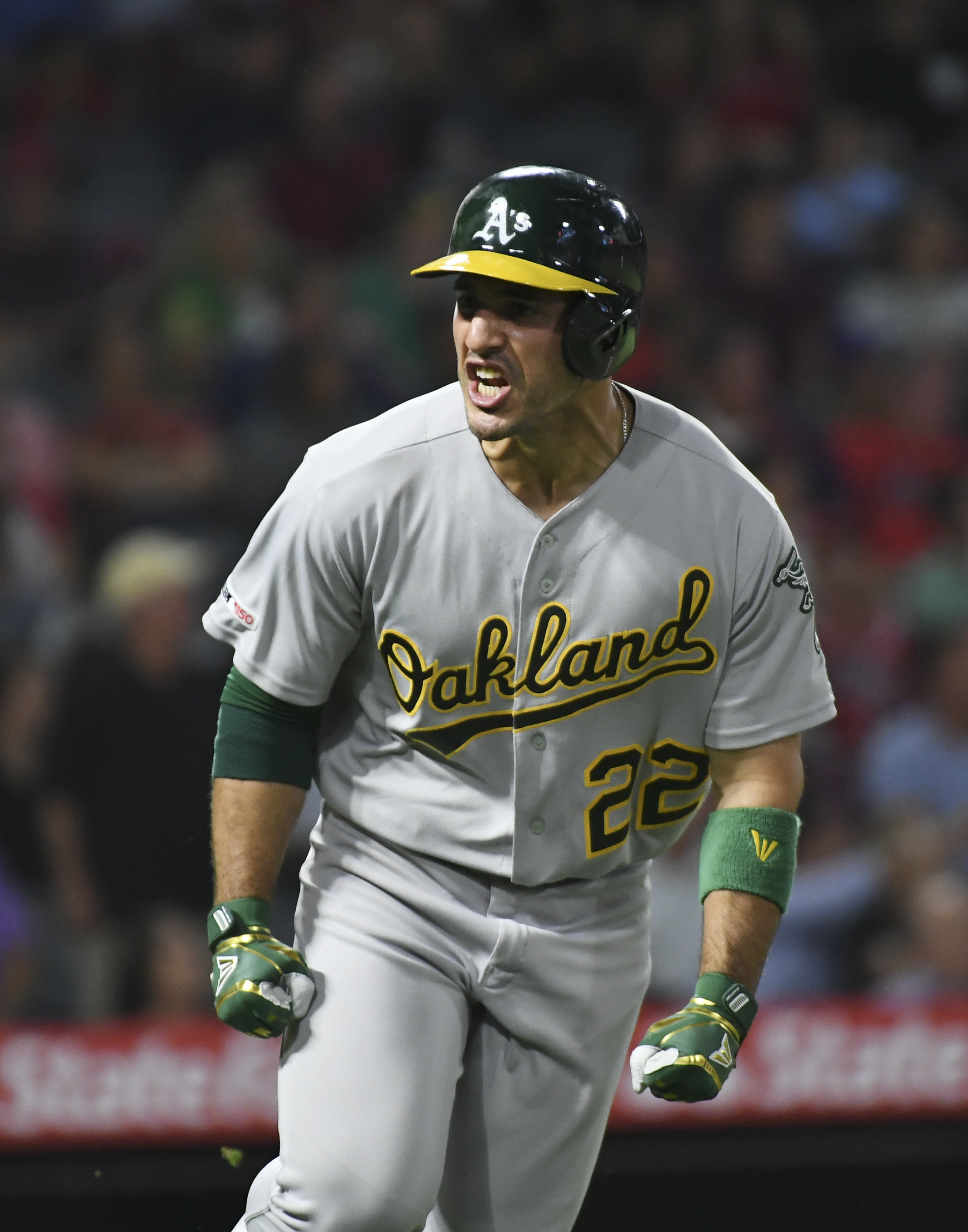
At the time of the swap, it barely drew notice. It certainly didn’t seem like any sort of egregious misstep. Laureano had turned in a woeful .227/.298/.369 slash in Double-A that year. He connected on 11 home runs and swiped 24 bags, showing a bit of pop and some speed, but his walk rate was cut in half from its 2016 mark. Scouting reports praised his glovework, but the Astros apparently didn’t think his defense was as good as it’s proven to be. Former GM Jeff Luhnow admitted to Chandler Rome of the Houston Chronicle last April that the Astros didn’t “quite [have] the defense rated as well as it’s played in the big leagues,” plainly calling the trade “one I’d love to have back.”
Laureano’s glove in 2019 didn’t play out quite as well as it did in 2018 — at least not in the estimation of most metrics. In just 385 innings in 2018, he logged +6 Defensive Runs Saved, a 3.7 Ultimate Zone Rating and +2 Outs Above Average. Those numbers dipped to +3, +0.7 and -5, respectively, in 1041 innings between center field and right field this past season. Even as his overall numbers might’ve taken a step back, Laureano showed off a cannon from both center and right. In 1426 innings at the MLB level, he’s racked up 17 assists — earning every bit of his “Laser Ramon” nickname.
As for his work at the plate, Laureano’s 2019 output matched his standout showing from his 2018 debut. Over the life of 481 plate appearances, he turned in a .288/.340/.521 batting line with 24 long balls and 13 stolen bases (in 15 attempts). That was good for a 126 wRC+ that lined up nicely with the 130 mark he posted as a rookie in 2018.
Overall, Laureano has appeared in 171 MLB games and taken 687 plate appearances — just over a full regular season’s worth of work. Between his outrageous arm, solid all-around defense, well-regarded baserunning ability and his strong work at the plate, he’s been worth 6.0 fWAR and 5.9 bWAR. That trade, considering the club control (through 2024) and low cost of acquisition, stands out as one of the best moves in recent memory for A’s executive vice president of baseball operations Billy Beane, GM David Forst and the rest of the Oakland staff.
Speaking of that cost of acquisition, it’s worth taking a look at what the Astros did get. The now-25-year-old Bailey is still a prospect of some note — albeit one that the ‘Stros almost lost for nothing. Houston opted to leave Bailey unprotected in December’s Rule 5 Draft, and the Orioles (headed up by former Astros assistant GM Mike Elias) snagged him with the second overall pick. Baltimore since returned him, but that selection speaks to Bailey’s ability in and of itself.
Last year, the right-hander logged a 3.30 ERA in a pitcher-friendly Double-A setting, averaging an even 10 strikeouts against 3.98 walks per nine innings pitched. He’s not an elite prospect, but Eric Longenhagen ranked him 30th among Houston farmhands at FanGraphs this winter, labeling him as a potential reliever with a “robust” arsenal. Clearly though, even if Bailey meets or exceeds that ceiling, he has a long way to go before making the Laureano swap look like anything less than a heist.
So, why did Houston move Laureano in the first place? The trade took place just prior to the deadline to set 40-man rosters in advance of the 2017 Rule 5 Draft, and the Astros weren’t set on adding Laureano after his aforementioned down year in Double-A. It’s a mistake that every club has made in some shape or form, and I’ll be the first to say that it’s not really fair to look back and make harsh judgments with the benefit of hindsight. That said, Astros decisionmakers have to cringe when they look back at the players they chose to preserve over Laureano.
The Astros themselves actually kept a 40-man roster spot open, which they used to select outfielder-turned-left-hander Anthony Gose from the Rangers in the Rule 5 Draft. Gose never pitched for Houston and wound up back with the Rangers. Preston Tucker was already on the 40-man roster but had posted a 102 wRC+ in Triple-A in 2017 without appearing in a big league game. He was designated for assignment less than a month after trading Laureano (clearing a roster spot for Hector Rondon). Houston also dedicated a 40-man roster spot to backup catcher Juan Centeno, whom they claimed off waivers a few days after trading Laureano.
As for players actually selected to the 40-man roster in protection from the Rule 5 Draft, Houston added lefty Cionel Perez and righty Dean Deetz. The former is still with the team but has yet to establish himself as a regular member of the pitching staff. The latter was hit with an 80-game PED suspension later that offseason and outrighted off the 40-man roster earlier this winter. He’s pitched 3 1/3 innings in the Majors.
Both Perez and Deetz were more highly regarded prospect at the time, and no one was labeling the Laureano deal any sort of heist or steal for the A’s. The purpose here isn’t to look back and say, “How could the Astros have possibly done this?!” but rather to give a tip of the cap to a savvy acquisition from the A’s that has not only greatly boosted their own long-term outlook but done so at the expense of a division powerhouse.
Oakland, after all, has Laureano penciled in as its center fielder for the next half decade and figures to reap enormous surplus value from his remaining pre-arb years and early arbitration seasons. For a low-payroll club, that’s all the more valuable. The Astros, meanwhile, are set to lose their entire outfield to free agency this winter. Vaunted prospect Kyle Tucker gives them one likely replacement, but it must be particularly difficult to see another would-be outfield cornerstone thriving with their closest competitor for AL West supremacy.
Astros Hope To Extend George Springer
Whether a game is played in 2020 or not, George Springer is slated to become a free agent for the first time this coming winter. The Astros, however, hope to broker a long-term deal with their star outfielder, per Chandler Rome of the Houston Chronicle. While he was overseeing the baseball ops department in between the firing of Jeff Luhnow and hiring of new GM James Click, owner Jim Crane “made it clear” to Springer’s representatives at Excel Sports Management that his club was interested in a long-term deal, Rome writes. Such talks aren’t permitted during the league’s transaction freeze, though the two sides can come back to the table once that freeze is lifted.
Crane made that desire clear not only in his words but also through his actions. As we noted at the time the two sides avoided arbitration, it’s uncommon these days for a team and player to agree on a one-year arrangement after arbitration numbers are filed. But Crane not only bucked the “file-and-trial” trend that permeates the game with regard to Springer — he inked the slugger at a $21MM rate that checked in north of the $20MM midpoint between Springer’s $22.5MM submission and the club’s $17.5MM figure.
Paired with Rome’s report on the situation, that seems like a clear show of good faith that the club hopes to keep Springer around for the long haul — keeping him in Houston alongside already-extended stars Alex Bregman and Jose Altuve. Bregman’s five-year, $100MM extension and Altuve’s $151MM extension both run through the 2024 campaign.
Keeping Springer would be a critical move for the Astros, who currently stand to lose four of their nine 2019 everyday players to free agency this winter. Beyond Springer, each of Michael Brantley, Josh Reddick and Yuli Gurriel is slated to hit the open market. While top prospect Kyle Tucker should be ready to slot into one of those outfield vacancies and Abraham Toro could perhaps occupy first base, that still leaves the club with a pair of holes in the lineup.
The financial feasibility, of course, remains to be seen. Houston has $116MM on the books in 2021 — including $134MM in total luxury tax obligations. That’s not including what should be significant arbitration raises to Roberto Osuna (earning $10MM in 2020), Carlos Correa ($8MM in 2020) and Lance McCullers Jr. ($4.1MM in 2020) — plus smaller raises for Chris Devenski ($2MM in 2020), Aledmys Diaz ($2.6MM in 2020) and Joe Biagini ($1MM in 2020). The Astros barely spent in free agency this winter as the team seemingly eyed a 2021 dip under the luxury threshold, but there’s certainly room to pay Springer on a long-term deal and still successfully make that luxury maneuver next season.
Springer, 31 in September, landed third on MLBTR’s Free Agent Power Rankings back in late February — trailing only Mookie Betts and J.T. Realmuto. Skeptics will surely question the legitimacy of his excellence at the plate in the wake of the team’s sign-stealing scandal — and it’s only fair to point out that Springer had one of his best seasons amid that trash-can scandal in 2017. But the slugger’s best season was actually in 2019, when he laid waste to opposing pitching with a .292/.383/.591 slash line (150 OPS+, 156 wRC+) and ripped 39 home runs in just 122 games/556 plate appearances.
It should also be emphasized that while Springer and his teammates surely benefited from that sign-stealing operation, his offensive ability has never been in doubt. He was the 11th overall pick in the 2011 draft and posted an OPS of .900 or better at each minor league level (plus in the Arizona Fall League) on his way to the big leagues. Springer posted a 129 wRC+ in three seasons prior to that nefarious 2017 campaign and, over the course of his MLB career, has been 31 percent better than the league average hitter per OPS+ and 33 percent better per wRC+. He also rates well defensively in both center field and right field.
A long-term deal for Springer would be likely be expected to cover at least five years under normal circumstances, although the loss of revenue presents some uncertainty as to what to expect with regard to contract negotiations — extensions and free agency alike — whenever transactions do resume.
AL West Notes: Mariners, Rangers, Astros
Some news and notes from around the American League West…
- While Spring Training impressions were limited due to the mid-March shutdown, the Mariners were still encouraged by the progress demonstrated by some expected key players, manager Scott Servais said this week on MLB Network Radio on SiriusXM (Twitter link, with audio). In particular, lefty Justus Sheffield and righties Justin Dunn and Logan Gilbert looked to have taken notable strides. Sheffield, the centerpiece of the Mariners’ James Paxton return, allowed two runs on five hits and no walks with 12 punchouts in eight spring innings. Dunn, acquired alongside Jarred Kelenic in the Robinson Cano/Edwin Diaz blockbuster, whiffed 10 hitters in six innings while holding opponents to two runs in 6 2/3 frames. Gilbert, Seattle’s first-rounder in 2018, pitched four shutout innings with four strikeouts, no walks and one hit. The M’s are hopeful that this trio can soon ascend to the big league rotation alongside Marco Gonzales as the organization emerges from an accelerated rebuilding process. There’s clearly more to the belief that strides were made than those surface-level stats, but the trio’s showing nevertheless was heartening for Mariners fans.
- Rangers slugger Joey Gallo spoke with reporters about the dimensions of the newly constructed Globe Life Field, noting that the team’s new home park was “playing big as hell” during his batting practice session (link via Evan Grant of the Dallas Morning News). Gallo pointed out that the park is particularly deep in center field, where it’s 407 feet straightaway. That said, as Grant points out, the distance may not make a huge difference for Gallo, whose home runs to center field have averaged 434 feet in distance. GM Jon Daniels added that Gallo has been hitting with the roof closed, and opening it while hitting game balls against live pitching could change things. Still, it’d be a notable change for the Rangers to suddenly find themselves in a pitcher-friendly or even neutral park after long playing in one of the game’s most hitter-friendly stadiums. Gallo did offer positive reviews of the park’s artificial surface, calling it the “best turf I’ve ever been on” and touting its lack of “lingering side effects.” Gallo acknowledges that Rangers players were worried about the surface heading into the season, but his early experiences have allayed some of those concerns.
- The Astros are facing a potential exodus in the outfield this coming offseason, and Jake Kaplan of The Athletic notes in his latest mailbag column that they’re looking at a similar slate of departures post-2021, when Justin Verlander, Zack Greinke, Carlos Correa and Lance McCullers Jr. could all hit the open market. Houston will see George Springer, Michael Brantley, Yuli Gurriel and Josh Reddick hit the market after whatever type of 2020 season we get. Given their poorly regarded farm system — not to mention the loss of draft picks in 2020-21 — the ‘Stros are faced with an increasingly precarious position. It’s of course possible that the Astros could yet work out some extensions with various members of that core, but it’s also eminently apparent that a fair bit of roster turnover can be expected in the next couple of years — with several high-profile names likely to depart.
AL Notes: JDM, Red Sox, Astros, Click, Yanks, LeMahieu
Let’s check in on some of the American League’s highest-profile clubs…
- Major League Baseball handed down its decision on Boston’s sign-stealing scandal from its World Series-winning season in 2018 a couple weeks ago, stripping the Red Sox of their second-round pick this year and suspending scout/replay coordinator J.T. Watkins for the upcoming campaign. Count designated hitter J.D. Martinez among those who are not pleased with Watkins’ short-term ban. The superstar slugger told Peter Abraham of the Boston Globe, “They just ruined this guy’s career with no evidence.” In regards to the overall punishment, Martinez said to Abraham: “If they went to court with that, it would get thrown out. There was nothing there. The judge would laugh.”
- Speaking of teams that have recently been embroiled in sign-stealing scandals … Astros general manager James Click succeeded Jeff Luhnow atop the front office in the offseason as a result of the prior regime’s transgressions. Chandler Rome of the Houston Chronicle profiles Click, how he has adjusted to the job, how the rookie GM’s trying to work through the coronavirus and how he’s attempting to change the culture of a franchise in turmoil. As you’d expect, Click has stayed in touch with owner Jim Crane and new manager Dusty Baker during the pandemic. Regarding the Astros as a whole, Click said to Rome: “I have a better feel for the organization now. While it’s not ideal to do it remotely, it is certainly something that can be done. It’s hard to say how much more of a feel I have for the organization, but definitely more, and I’m hoping they also have a feel for me. We’re all still getting to know each other.”
- As we covered last week, the Yankees could lose one of their MVPs, infielder DJ LeMahieu, when free agency opens next offseason. Kristie Ackert of the New York Daily News argues that they shouldn’t risk it, writing that the Yankees need to do all they can to keep the soon-to-be 32-year-old LeMahieu from hitting the market with an extension. LeMahieu stated in March that he and the Yankees haven’t engaged in “serious” negotiations, so it’s unclear how much of a priority he is for New York. However, you can’t go against Ackert’s point that he’s a key part of the team’s current roster. LeMahieu played all over the Yankees’ infield after signing a two-year, $24MM contract going into last season, slashed .327/.375/.518 with 26 home runs and 5.4 fWAR in 655 plate appearances, and was in the running for AL MVP honors.
AL West Notes: Calhoun, Rangers, Athletics, Astros
Rangers outfielder Willie Calhoun suffered a horrible injury – a fractured jaw – when he took a 95 mph pitch to the face in early March. Fortunately, though, Calhoun’s doing well in his recovery. Calhoun told MLB Network Radio (via Brice Paterik of the Dallas Morning News} that he’s “back up to 100 percent.” He’s in line to play a key role for the Rangers this year after turning in a productive 2019 campaign, and could be a breakout candidate, but it took some time for the light bulb to go on for the former high-end prospect. The 25-year-old Calhoun believes he owes some of his recent success to Rangers general manager Jon Daniels. “JD really flat out just told me the stuff I needed to work on and he was saying at the time I don’t think I was doing as well offensively,” Calhoun said. “He said ‘if you’re going to be an offense only guy you’ve got to put up offense only numbers, like J.D. Martinez type numbers.” Calhoun got into better shape after that talk with Daniels, and the results have been encouraging since then. Check out Paterik’s piece for more quotes from Calhoun.
- Former Athletics minor leaguer Miguel Marte has passed away of COVID-19 at the age of 30, per Susan Slusser of the San Francisco Chronicle. Marte, a catcher/first baseman from the Dominican Republic, played in the A’s system from 2008-12. He left behind a wife and two children. If you’re interested in helping them, a GoFundMe page has been set up.
- The Astros have also lost somebody to the coronavirus. Bill Gladstone, who owned Single-A affiliate the Tri-City ValleyCats passed away of the illness Thursday, according to Chandler Rome of the Houston Chronicle. “Bill was a class act with a great passion for the game,” the Astros said in a statement. “Our entire Astros family sends our heartfelt condolences to his son, Doug, his daughter, Susan and to the entire Gladstone family.”
- As a result of the pandemic, roughly half of the Rangers’ full-time employees in baseball and business operations will face a reduction in pay after May 15, Evan Grant of the Dallas Morning News tweets. Those cuts in salary could range from 10 to 20 percent, and there’s no indication as to how long they’ll last, but the Rangers aren’t planning to lay off any of those employees at this point.
Justin Verlander Provides Rehab Update
Reigning AL Cy Young winner Justin Verlander was hampered by a pair of spring health troubles — a lat strain and a groin injury that required surgery — but the Houston ace told reporters Thursday that he’s progressed to playing long toss (Twitter links via Brian McTaggart of MLB.com). The lat strain, per Verlander, is mostly healed up, and he’s made “a big stride” in his rehab from the groin surgery as well.
Both updates are encouraging for the Astros, although there’s still no formal word from the team on a timetable for the right-hander’s return to the mound. At the time of Verlander’s surgery in mid-March, Astros general manager James Click put a rough six-week timetable on his rehab process. We’re a couple days past that point now, although with the 2020 season in limbo, it’s only sensible to be a bit cautious in the rehab process.
Verlander added that the surgery is “already showing some benefit in my mechanics” as he works to make his delivery as efficient as possible (link via the Houston Chronicle’s Chandler Rome). Notably, Verlander revealed that the surgery stemmed from an MRI that revealed his adductor muscle had nearly torn off the bone completely.
Verlander, 37, is signed through the 2021 season at $33MM per year under the terms of the extension he signed with Houston late in Spring Training last year. He responded to that contract with arguably the best season of his Hall of Fame career. Verlander led the league with 223 innings and pitched to a 2.58 ERA with a masterful 300-to-42 K/BB ratio (12.1 K/9, 1.7 BB/9) and narrowly edged now-former teammate Gerrit Cole for Cy Young honors in the AL. He made at least 30 starts for the 13th time in 14 years, and his 179 ERA+ represented a career best.
Nearly Half The Astros’ Starting Lineup Is Up For Free Agency This Winter
The Astros’ run atop the AL West has been buoyed by the presence of one of MLB’s most prolific sluggers, George Springer, and a revolving door of steady veterans in the corners. (Yes, you may insert your jokes here about what else has propelled their run of winning seasons, but the aim here is to take an actual look at the looming roster conundrums they’ll face.) Michael Brantley and Josh Reddick flanked Springer in 2019, while other iterations of the club have included Nori Aoki and Marwin Gonzalez in left field. Over the past few years, the since-traded Jake Marisnick has been a glove-first reserve option to help stabilize the mix.
Now, the Astros stand to not only lose Springer to free agency this coming winter, but also both Brantley and Reddick. Springer will hit the open market for the first time after reaching six years of MLB service, while Brantley’s two-year, $32MM deal and Reddick’s four-year, $52MM pact are both set to expire. Things get even murkier for the Astros with the impending departure of Yuli Gurriel, whose initial five-year deal with the team comes to a close with the 2020 season. Gurriel agreed to a new one-year deal overwriting the final season of that previous pact last offseason, and he’s set to join Springer, Brantley and Reddick this coming winter.
It’s rare that any team, let alone a perennial World Series contender, enters an offseason with the potential of turning over 44 percent of its starting lineup, but that’s the precise situation in which newly hired GM James Click will find himself before year’s end.
On the plus side, the ‘Stros have some likely replacements in house already. Kyle Tucker, 23, has been regularly ranked among the game’s elite prospects since being selected just three picks after Houston took Alex Bregman in the 2015 draft. (Bregman, of course, was a college player while Tucker was coming out of high school, hence the discrepancy in their timeline to the big leagues.)
A 2018 cup of coffee for Tucker didn’t produce much in the way of results (.141/.236/.203, 72 plate appearances), but he had a big Triple-A season in 2019 and hit .269/.319/.537 in an identical sample of plate appearances. In 998 PAs at the Triple-A level, Tucker has a .297/.375/.571 slash with 58 homers and 50 steals (in 59 tries). Tucker has All-Star potential that he hasn’t yet had a regular chance to show off due to the team’s largely set outfield mix. At the same time, the Astros have steadfastly refused to consider making him available in trades. He should get his opportunity in 2021 at the latest, and his ability to play all three outfield spots (even if he fits best in a corner long term) give the Astros some flexibility in pursuing other options. The club doesn’t have many pure outfield options right now, having traded the likes of J.D. Davis, Ramon Laureano, Derek Fisher and Teoscar Hernandez away in recent years.
At first base, the club could turn things over to Abraham Toro, who hit .306/.393/.513 in the pitcher-friendly Double-A Texas League before clubbing Pacific Coast League opposition at a .424/.506/.606 clip in 79 PAs. Toro didn’t do much in limited MLB time at the plate, but his bat appears mostly MLB-ready. He’s a third base prospect with questions about his glovework there, and some scouting reports (including those at FanGraphs, MLB.com and Baseball America) suggest that he could fit better at first base or (in FanGraphs’ case) left field. Yordan Alvarez is technically an option in left field or at first base, but the Astros feel better about him as a regular designated hitter and may not be keen on deploying his glove on an everyday basis.
Assuming Tucker and Toro are entrusted with two spots in the lineup, the Astros will still need to bring in at least two everyday players via trade or free agency, and they’ll need to do so with some semblance of cost efficiency. Houston already has nearly $117MM on the books in 2021 and more than $134MM worth of luxury tax obligations. That’s before factoring in arbitration raises on the 2020 salaries of Roberto Osuna ($10MM), Carlos Correa ($8MM), Lance McCullers Jr. ($4.1MM), Chris Devenski ($2MM), Aledmys Diaz ($2.6MM), Joe Biagini ($1MM) and Dustin Garneau ($650K).
Re-signing any of Gurriel, Brantley or Reddick would fill one spot without requiring a particularly long-term commitment, although Reddick’s bat has waned in recent seasons. C.J. Cron and Jake Lamb will both be options at first base, while Nick Markakis, Kevin Pillar and old friends Marwin Gonzalez and Hunter Pence represent short-term outfield possibilities. Springer and Mookie Betts are the top options on the outfield market, but signing either would likely bring the ‘Stros within striking distance of a second straight season of luxury penalization. More affordable names include Marcell Ozuna, Joc Pederson and Jackie Bradley Jr.
Trade candidates are a bit more difficult to suss out this far in advance, although it wouldn’t be a surprise if Corey Dickerson (Marlins), Ender Inciarte (Braves), Gregory Polanco (Pirates), Brian Goodwin (Angels), Eddie Rosario (Twins) or Kyle Schwarber (Cubs) were to appear on the rumor circuit this summer.
Regardless of how Click and his staff choose to proceed, the Astros seem likely to be in the hunt for multiple regulars this winter, and their notable arbitration class and crop of high-priced 2021 salaries will necessitate a creative and/or low-cost addition or two.