
Trying To Identify “Mystery Teams” For Manny Machado
The apparent staring contest between Manny Machado, the White Sox and the Phillies doesn’t seem to have an end in sight, and the saga will surely drag on even longer if reports of unidentified suitors prove true. With the identities of said teams (assuming for a moment that they do indeed exist) yet unknown — it’s perhaps worthwhile to at least take a high-level pass throughout the league to see just who could plausibly emerge as a surprise dark-horse in the Machado auction.
It seems safe to eliminate the league’s perennial lowest spenders. While the Rays have an atypical amount of flexibility even after signing Charlie Morton, it’s impossible to imagine a team with this payroll history sustaining even a $25MM annual salary — let alone a salary of $30MM or more. Similarly, the Athletics figure to be priced out of the Machado market, as do the Pirates and the Marlins (the latter of which, once again, is rebuilding anyway). The Reds are already projected to set a new franchise-record payroll in 2019, and adding Machado when they already have strong infield options isn’t all that plausible.
Great as Machado is, there are also some clubs who simply don’t have space in their infield for him. The Astros could afford to add Machado to their ranks, for instance, but Houston wouldn’t displace any of Alex Bregman, Carlos Correa or Jose Altuve to accommodate Machado. The Nationals have Anthony Rendon, Trea Turner and newly signed Brian Dozier comprising their non-first-base infield slots. I wouldn’t characterize the group of Josh Donaldson, Dansby Swanson, Ozzie Albies and Johan Camargo as quite as strong an infield mix, but it’s fair to say that the Braves probably don’t have space for yet another left-side infielder, barring a trade. Machado would also take Atlanta’s payroll to record heights.
Looking further, it’s unlikely that a team in the early stages of a pure rebuild is going to sign Machado the type of contract he’s seeking. The Royals are trying to pare back payroll, and the Tigers have yet to signal that they’re ready to emerge from their own restructuring. The Orioles aren’t going to bring him back into the mix on the heels of selling off the vast majority of their appealing veteran assets last summer. If it turns out that the Mariners wanted to clear money for Machado and/or Bryce Harper all along this winter, well then kudos to Jerry Dipoto on the most entertaining offseason in MLB history. But, since we’re trying to be rational, it seems like a lock that Machado doesn’t align with Seattle’s “re-imagining” movement.
Several mid-market teams are said to be facing payroll constraints that’ll probably keep them out of the Machado market. The Indians have been trying to shed payroll for much of the winter, and the Diamondbacks are currently being weighed down by huge commitments to Zack Greinke and Yasmany Tomas, the latter of whom is no longer even on the roster. The Rockies‘ projected payroll already checks in north of $150MM, making a deal tough to envision. And if they’re going to give this type of annual salary to anyone, they’d probably prefer to offer it to Nolan Arenado, anyhow.
There are also several teams who typically spend heavily but are again refraining from doing so. The Dodgers don’t really have a need on the left side of the infield, but they could conceivably move Justin Turner or perhaps even Corey Seager to second base if it meant opening the hot corner for a player of Machado’s caliber, but there have at least been some reports that L.A. is vying to stay below the luxury tax line, and they’ve not spent like a big-market club to date. The Cubs could bid farewell to Addison Russell in some capacity and install Machado at shortstop, but persistent reports out of Chicago suggest their budget isn’t even flexible enough to bolster the relief corps. The Giants seem likelier to rebuild than to add a free agent of this magnitude, and the Rangers have been zeroed in on smaller-scale additions as they embark on their own soft reset. The Blue Jays are no strangers to large payrolls ($160MM+ in each of the past two seasons) but have made only marginal additions as they face the reality of a top-heavy division and the disbanding of the core that recently carried them to the ALCS.
The Red Sox arguably don’t have a dire need for Machado, though they could likely find a way to fit him into the mix. However, they’re just a few million shy of the top luxury bracket, and some reports have implied that an unwillingness to top that threshold is preventing them from even adding a reliever to the ‘pen. They’re picking an odd time to draw a line in the sand, but Machado never seemed all that likely a target anyhow. Their chief rival, the Yankees, made (and very arguably still makes) sense on paper, but it doesn’t seem like they’ll outbid the field to further muddle an already crowded infield picture.
Beyond this grouping, of course, we know that both the White Sox and Phillies are legitimate Machado suitors who needn’t be explored as we try to pin down any potential mystery clubs. All of that said, there are still six clubs that strike me as reasonable guesses when trying to pin down potential Machado mystery clubs. Here’s a look at the remaining teams, and how/why they could conceivably add Machado to the mix (listed alphabetically):
- Angels: The Halos have larger priorities — namely, trying to extend Mike Trout — but it wouldn’t be that hard to fit Machado into the mix. Zack Cozart could be slotted in at second base to make room for Machado at third base. Recent comments from GM Billy Eppler have suggested that the Angels’ spending is likely near its max following the addition of Cody Allen, but they only have Trout under control for another two seasons. There’s every reason to try to maximize the chance of winning immediately, and the Albert Pujols albatross will be off the books after the 2021 season. If the Halos somehow find a way to extend Trout, they’d only be on the hook for all three mega-salaries for one season (2021).
- Brewers: Milwaukee is already in record payroll territory, but Ryan Braun is a free agent after the 2020 season and they’ve watched the division-rival Cubs largely sit this offseason out. With a clear infield need, the Brewers could theoretically add Machado, slide Travis Shaw over to second base and boast an exceptionally deep lineup. Milwaukee has just $48MM in guaranteed money on the 2020 payroll and $35.5MM in 2021. There’s likely some bad blood after October’s Jesus Aguilar incident — Christian Yelich made his feelings toward Machado known after that game — but presumably the hatchet could be buried if Machado were suddenly helping the Brewers win an extra five-plus games per year for the foreseeable future.
- Cardinals: President of baseball ops John Mozeliak certainly didn’t sound like someone who was planning on a big free-agent splash over the weekend, but the Cards were prioritizing corner-infield bats earlier this winter prior to acquiring Paul Goldschmidt and could still fit Machado into the fold. Doing so would likely mean sliding either Paul DeJong or Matt Carpenter to second base for a season — the latter of which is probably a particularly unpalatable defensive alignment. But the St. Louis lineup would be exceptionally deep. As mentioned above with regard to the Rockies and Arenado, perhaps the Cardinals would simply prefer to give Goldschmidt a $30MM+ annual salary on an extension if they have the resources available, but Machado is a half decade younger.
- Mets: The Mets’ infield is overcrowded as is — so much so that Jeff McNeil is likely to play in the outfield next season — so they’d have to make a move in order to fit Machado into the mix. But new GM Brodie Van Wagenen has been vocal about his win-now attitude, and shipping Todd Frazier off in order to open regular time for Machado at the hot corner isn’t outlandish. What could be outlandish would be the Wilpon family green-lighting a payroll north of $160MM, but even with all the moves they’ve made, it’s not that hard to see an on-paper scenario where Machado fits into the mix.
- Padres: San Diego’s hopeful core is quite young, which presents them with the potential to carry a few notable veteran long-term contracts. Last offseason’s Eric Hosmer deal already looks regrettable, but the Padres did front-load the deal, so their annual commitment to Hosmer drops to $13MM beginning in 2023. The Padres project at a payroll just south of $84MM right now and have about $64MM on the books next season. The Padres haven’t historically been big spenders in the past, but the current ownership group did authorize a $108MM Opening Day payroll back in 2015. The Padres are known to be looking for a third baseman, and Machado would give them a long-term answer.
- Twins: The Twins are the only team in baseball that doesn’t have a single dollar committed to any player in 2020. With a completely blank payroll slate, they’d have little problem fitting a major salary onto the long-term books. Looking at the 2019 roster, the infield appears full at first glance, but Machado is the type of player for whom a team should be willing to shuffle the deck. Miguel Sano could slide over to first base, pushing C.J. Cron to the bench role that Tyler Austin currently occupies. A $4.8MM bench bat would be an overpay for a team like the Twins, and owner Jim Pohlad would need to approve a record payroll by as much as $10MM for the upcoming season. That, however, would be a one-year expenditure before payroll naturally regressed. Meanwhile, the Indians aren’t improving, the Tigers and Royals aren’t threats to contend, and if any club should have an interest in keeping Machado away from the ChiSox, one would imagine it’d be a division rival.
Projecting Payrolls: Chicago Cubs
Although substantial time has passed since the last installment in this series, only the reliever market has moved in a significant way. As such, we move on to the 12th piece while the biggest fish remain unhooked. Below find the links to the earlier posts in this series.
Philadelphia Phillies
Los Angeles Dodgers
Los Angeles Angels
Atlanta Braves
New York Yankees
Chicago White Sox
Boston Red Sox
Minnesota Twins
Milwaukee Brewers
San Francisco Giants
St. Louis Cardinals
If you have questions about financial information made available to the public and the assumptions used in this series, please refer to the Phillies piece linked above.
Today, we look into a club coming off of its best four-year stretch in franchise history and flush with cash, yet one who also appears to be fully intent to sit out free agency this winter: the Chicago Cubs.
Team Leadership
Concluding 65 years of ownership by the Wrigley family, the Tribune Company purchased the Cubs in 1981. The franchise had, incredibly, missed the playoffs for 35 straight seasons prior to the transaction. The team went on to make the postseason six times under Tribune ownership, including three times from 2003-08. The final two years of Tribune ownership were executed under the direction of Sam Zell, a real estate mogul who purchased the Tribune in late 2007. Then, in October 2009, the Ricketts family famously acquired the Cubs for $845 million. Ownership of the franchise is managed by team chairman Tom Ricketts, who authorized an aggressive tank followed by the most successful time period in Cubs history.
While the Ricketts family initially kept general manager Jim Hendry in place running the baseball operations department, they made the splashiest of splashy moves in 2011, relieving Hendry of his duties and replacing him with new President of Baseball Operations and renowned curse breaker Theo Epstein. Epstein got his band back together, bringing in former proteges Jed Hoyer and Jason McLeod to be his general manager and vice president of scouting and player development, respectively, both after two years in San Diego. The results have been undeniable: the club averaged a putrid 67 wins per year during the first three years of the Epstein regime and flipped the switch in 2015, averaging 97 per year over the next four years.
Historical Payrolls
Before hitting the numbers, please recall that we use data from Cot’s Baseball Contracts, we’ll use average annual value (“AAV”) on historical deals but actual cash for 2019 and beyond, and deferrals will be reflected where appropriate. And, of course, the value of examining historical payrolls is twofold: they show us either what type of payroll a team’s market can support or how significantly a given ownership group is willing to spend. In the most useful cases, they show us both. We’ll focus on a 15-year span for the Cubs, covering 2005-18 for historical data as a means to understanding year 15: 2019. This period covers two competitive windows and two ownership groups for the Cubs, and it’s not terribly difficult to see where the Ricketts-authorized tank began. We’ll also use Opening Day payrolls as those better approximate expected spending by ownership.

Payroll spiked from 2008-10 as the Cubs paid to keep their 2007-08 winners together. Publicly available reported revenue increases climbed to fuel the spending, growing from $179 million in 2005 all the way to $239 million in 2008. Of course, take all publicly available revenue figures with a significant grain of salt as only ownership and the front office truly know the finances. However, revenue largely stagnated in the following half decade, reaching only $266 million in 2013 during the tank.
What followed is difficult to describe as I’ve never seen anything like it. Revenue climbed to $302 million in 2014, $340 million in 2015, $434 million in 2016 (!), and $457 million in 2017. While 2018 revenue hasn’t yet been reported, it is entirely possible that revenue has increased more than $200 million over just five years. Striking. Seen in that light, the 2016-18 payrolls are hardly surprising.
Ricketts ownership and the Epstein-led front office have been keen to stay under the luxury tax threshold during their time in charge, exceeding the threshold only in 2016, incurring a tax of just under $3 million before staying under the threshold in each of the next two years. The Cubs have simultaneously been major players in the international market, throwing a $30 million guarantee at outfielder Jorge Soler in 2012 and following with a boisterous international class in 2013 that included young stars Gleyber Torres and Eloy Jimenez and a massive 2015 class that yielded just under $19 million in signing bonuses. Major League spending captures a significant portion of Cubs spending, but international amateur spending has been a key facet of Cubs expenditures in recent years.
Future Liabilities
Cubs spending in 2019 will surely hit a new franchise high.
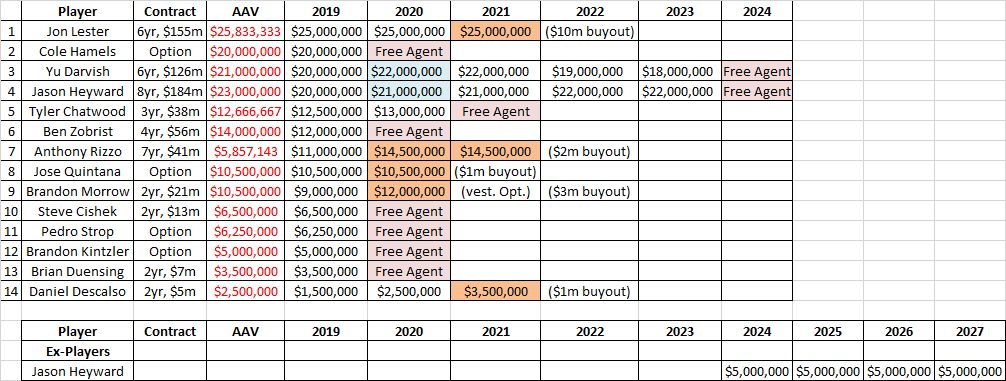
That is a lot of guaranteed money.
The 2019 Cubs are spending $88 million guaranteed on starting pitching, led by $20 million-plus salaries for Lester, Hamels, and Darvish. To say that these commitments are risky is a massive understatement.
- Lester has been a paragon of stability, but he has seen his FIP rise each year as a Cub, from 2.92 in 2015 to 4.39 in 2018. He’ll enter 2019 with 2,520 combined regular season and playoff innings on his odometer. He just turned 35.
- Hamels pitched a year and a half to the tune of a 4.87 FIP prior to joining the Cubs at the trade deadline in 2018. He was rejuvenated with the Cubs, but he’ll enter 2019 with 2,653 combined regular season and playoff innings on his own odometer, also having just turned 35.
- Darvish largely enjoyed success since arriving from Japan before a disastrous debut season with the Cubs that ended in May due to an elbow injury.
- Tyler Chatwood bombed in his first year as a Cub, losing his rotation job and throwing fewer than 10 innings for the club after the trade deadline.
- Jose Quintana posted a career-worst FIP of 4.43, fueled in large part by a career-worst home run rate.
Projection systems expect the Cubs rotation to be wildly successful in 2019, especially when the arbitration-eligible Kyle Hendricks is added to the fold. Still, Cubs fans are at least a bit anxious after the across-the-board struggles from 2018.
A trio of lefty hitters figure prominently on the balance sheet, two of whom will be around for years to come. Rizzo and Heyward have been lineup mainstays for years, though Rizzo has obviously been substantially more productive on the field. Unlike Rizzo and Heyward, Zobrist finds himself in a walk year in a season in which he turns 38.
The remaining notable deals are all for relief pitchers, at least four of which find themselves staring down free agency come November. In a highly competitive 2019 National League Central division, the team will need strong production from multiple arms in the group of Morrow, Cishek, Strop, Kintzler, and Duensing.
Finally, Heyward’s signing bonus stands out as the only deferred money for the franchise. But it’s a big number: $20 million payable after his contract expires. Presumably franchise revenue will be so astronomical in the mid-2020s so as to see this amount as largely rounding error, but $5 million is still $5 million.
As a result of stellar drafting in the early part of this decade and a trio of impact trades, the Cubs feature significant talent in the arbitration ranks, including multiple Most Valuable Player candidates and Cy Young contender.
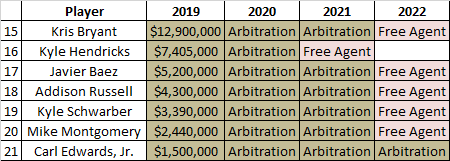
All seven players listed above figure to play key roles for the team in 2019, though Russell finds himself mired in a mess of his own making. As the arbitration chart shows, each player is controllable for at least one year beyond 2019 as well with offensive stars Bryant, Baez, and Schwarber each controllable through 2021.
What Does Team Leadership Have to Say?
So, so, so much.
While ownership, the front office, and manager Joe Maddon have spoken at great length about the budget this offseason, comments from Tom Ricketts in recent days likely shed the most light on the spending plans. In response to questions about expected payroll, Ricketts suggested that “when you make any free-agent signing — not to pick on Darvish, but any of them — you know that you can’t spend that dollar twice and you have to budget that into the future, so that’s going to limit what you can do in the following year. And one of the things this year that we knew going into the offseason was that we weren’t going to have as much flexibility as years past.” When Ricketts moved on to discussing the team’s local tax burden, it seemed that the budget has very little, if any, room.
As we will detail below, it’s close to inevitable that the Cubs will incur a luxury tax in 2019. However, Ricketts more or less stated that the budget is tapped out, jiving with what the front office has said for months now.
In the face of big moves by the rival Cardinals and Brewers, the Cubs appear content to have their offseason largely dictated by their budget.
Are the Cubs a Player for Bryce Harper or Manny Machado?
Ummmm…honestly, I don’t know. Almost certainly not. But crazier things have happened.
The Cubs haven’t been connected to Machado at all this offseason, and given their impressive collection of infield talent, this doesn’t come as a huge surprise.
But Harper? The Cubs have been connected to Harper for years. This article humorously chronicles some of the 2017 nuggets that suggested Harper would — or wouldn’t — join the Cubs. These rumors have become par for the course. Many of the rumors have centered around the close relationship between Bryant and Harper, both Las Vegas natives.
After the Cubs surprisingly bowed out of the playoffs in quick fashion, Epstein lamented that “the offense broke,” leading to significant speculation that the Cubs would seek to add a significant bat.
Nevertheless, budgetary constraints combined with Maddon clearly stating that a Harper signing is “not going to happen” seemingly slammed the door shut on any pursuit.
Despite all of the above, Chicago Sun-Times writer Gordon Wittenmyer commented in December that sources indicated that the Cubs front office requested that Harper and his agent, Scott Boras, come back to the team before Harper decides to sign elsewhere in order to give the Cubs a chance to make a final play for the young star.
What Will the 2019 Payroll Be?
Well, it’ll be a new team record, that’s for sure. But just how high will it go?
Currently, team payroll comes in at $202.1 million before accounting for the luxury tax. If spending sticks approximately where it currently stands, the team figures to incur a luxury tax of approximately $4.4 million based on a luxury tax payroll figure of just under $228 million and a 20 percent tax on the overage.
So how much room is there for additional expenditures? I suspect that ownership would push total spending up around $220 million given the need for an in-season acquisition or two. Given that, don’t expect to see additional expenditures prior to the start of the season save for a possible minimal commitment to a backup catcher or a reliever.
Projected 2019 Payroll: $210 million
Projected 2019 Payroll Space: $2.9 million
If you’d like to go even further down the rabbit hole of Cubs payrolls, I refer you to my series of articles that have appeared on The Athletic going into tremendous detail on team spending.
3 Remaining Needs: AL East
In the final installment of our 3 Remaining Needs series, let’s take a look at the division that boasted the best and worst teams of the 2018 season. The AL East perfectly reflects the class warfare plaguing the American League, as the gap between the competitive upper class and, well, the Orioles could not be more stark. Even within the upper crust, however, there is plenty of variance, as the low-payroll Rays have done their best to keep pace with payroll behemoths in Boston and New York. Meanwhile, the Blue Jays have taken a step back but are still looking to prepare their roster for an anticipated influx of premium young talent.
[Previous installments: NL West, NL East, NL Central, AL West, AL Central]
Baltimore Orioles
- Trade Mychal Givens. It’s a no-brainer for the Orioles to sell off their veteran pieces for prospects, only they don’t have much to sell off. Alex Cobb and Andrew Cashner can be shopped, but they’d be salary dumps if they’re moveable at all and they might be better off providing a veteran base for a rotation that should have younger arms auditioning for at least two turns out of every five. The O’s have invested too much in Dylan Bundy over the years to trade him now for pennies on the dollar; better to hang onto the upside. That leaves Givens (10.3 K/9) as the most attractive piece on an otherwise barren roster. Once the major free agent bullpeners are off the market, teams should come calling for a hard-throwing late-inning arm with three seasons of control remaining.
- Sign trade bait for July. With a hugely uncertain roster situation, the Orioles should be willing to take some risks and snap up whatever the market leaves. While they’re not likely to snag any major free agents, even on pillow deals, they should be scouring the bargain bin for vets on one-year deals that could potentially bring something back at the trade deadline. Frankly, the particular position doesn’t matter so much as the value opportunity that’s presented. Needless to say, the same reasoning also supports active waiver-wire scanning, such as the team’s recent claims of Rio Ruiz and Hanser Alberto.
- Boost their international operations. The O’s longstanding aversion to spending on international amateur talent is well-documented. That was beginning to change before the club turned over the reins to new GM Mike Elias, but the org’s initial foray onto the market did not exactly go without a hitch as the club’s top reputed targets (Sandy Gaston and the Mesa brothers) landed elsewhere. That served as a reminder that bringing in top talent — not to mention, unearthing lower-cost gems — involves more than having and spending the available funds.
Boston Red Sox
- Replace/re-sign Craig Kimbrel. The Red Sox haven’t done much work to rebuild their bullpen as of yet, but the degree to which they’ll need to is still unknown. With no clear market developing for Kimbrel at this time, a reunion is not at all out of the question. If they don’t bring him back to Boston, they’ll need to do something to bolster a unit currently over-reliant on holdovers Ryan Brasier and Matt Barnes.
- Explore upgrades at catcher. Boston somehow managed to win a World Series in a season where its catchers batted a combined .194/.246/.288 in 619 plate appearances. Regardless of the defensive Christian Vazquez and Sandy Leon can frame and throw with the best of them, and Blake Swihart (if he ever catches) may yet turn into something if given any semblance of an opportunity, but the catcher position in Boston was an utter black hole on offense last season. It wasn’t quite as bad as having a pitcher hit each time through the order, but it was closer than any AL team should be. That the team hasn’t done anything to this point suggests it may not be at the top of the priority list, but it’s hard to deny that there’s an opportunity to improve. Speaking of backstops …
- Resolve the status of Blake Swihart. The Red Sox need to finally determine if Swihart has any kind of real role with the team. Again, it’s tough to criticize a team that won a World Series in 2018, but even Boston’s most steadfast defenders have to concede that the team didn’t exactly manage its roster all that effectively as pertains to Swihart. Boston wouldn’t put Swihart behind the plate, wouldn’t put him in the field and wouldn’t DH him. Swihart had just 48 plate appearances through May 31 in 2018 despite not spending a single day on the disabled list or in the minors. He had 99 PAs prior to the All-Star break — again, without a DL stint or any time in the minors. He can’t be optioned, and the Sox clearly don’t have a spot for him. It may have worked in 2018, but the Sox were effectively operating with a 24-man roster for a good chunk of 2018. They need more flexibility, and Swihart probably would like a chance to actually play somewhere.
New York Yankees
- Trade Sonny Gray. Once Brian Cashman began the offseason by declaring Gray would be traded, there seemed little room for negotiation. The market for Gray may not fully materialize until all of the top starting arms are off the market, but there doesn’t seem to be much value in bringing him back to New York. There’s no room in the rotation at present, even if there are questions around the age and durability of their top five. Still, the Yanks are not shy about in-season acquisitions and they have depth in Triple A they can rely on. Specifically, Domingo German (5.57 ERA) and Luis Cessa (5.24 ERA) underperformed last season relative to advanced metrics like FIP and xFIP.
- Seriously pursue a premium free agent. No, the Yanks do not need Bryce Harper or Manny Machado. The club won 100 games last year and is a threat to do so again (in a highly stratified American League) without making further upgrades. Still, this division — more so than the two other wings of the AL — promises to host a year-long battle. And … well … this is the Yankees we are talking about. What good is it being a financial behemoth if you can’t use your might to elbow out other teams when rare market opportunities come along? We’re not here to say that the Yankees must land one of these two players, or that they simply have to pursue both even if it makes a mess of the team’s roster and financial planning. But it would be odd if the Yanks didn’t at least put in a strong bid for either or both. With the allure of the pinstripes and New York City helping the cause, they just might come away with a bargain.
- Add another relief arm. Whether or not the club makes any other notable roster moves, this seems like an easy way to improve. The bullpen has been a notable strength in the Bronx of late, and that promises to continue. But the deeper the unit is, the more support it can provide to a highly talented but somewhat risky rotation. Limiting the wear and tear on the starting unit will not only max out its results all year long, but give the Yankees the best chance of having a powerful staff when crunch time comes late in the season.
Tampa Bay Rays
- Make another free agent splash. A big name would surely help the club draw some fans to the park, and perhaps help jump start a still-flagging ballpark effort. More importantly, the team can still tap into some funds to improve its chances of sneaking up on the BoSox and Yanks. As things stand, there’s still just under $60MM on the books for 2019. With a number of quality free agents still out there and awaiting a deal, the Rays should be willing to be aggressive in doling out short-term money to get significant pieces. Charlie Morton could deliver great value, and adding Avisail Garcia may be a decent risk, but there’s no reason to stop there.
- Make a run at J.T. Realmuto. Whether or not the free agent market offers another golden opportunity, the Rays should see if they can pull of an intra-state coup by coaxing the Marlins to send their star backstop up the coast. There’s nothing wrong with a Mike Zunino–Michael Perez pairing behind the dish, but Realmuto is the game’s best. The Tampa Bay front office would have flexibility in resolving the preexisting options, particularly since Perez can still be optioned. He’d be a nice depth piece and could perhaps also remain on the roster as part of a three-catcher mix. Alternatively, the Rays could still deal away Zunino.
- Add some veteran bullpen pieces. The Rays’ fascinating bullpen usage has shown no small amount of promise. Part of the strategy, of course, is to lean on a high volume of young pitching. But it’s hard to deny the value of veteran leadership and of established, steady performance. The current Tampa Bay bullpen unit features just one player — Chaz Roe — with more than three years of MLB service time. Allocating some remaining funds to one or more quality free agents would seem to make sense. Old friend Sergio Romo is among the many remaining possibilities.
Toronto Blue Jays
- Prepare for potential spring trades. Entering the winter, it seemed that veteran first baseman Justin Smoak would pop up in the rumor mill with some frequency. We broke down his potential suitors in anticipation of just that, but nothing of note has materialized to this point. There has been more chatter surrounding righty Marcus Stroman, but no indication to date that there’s any momentum toward a deal. Things may be quiet now, but more and more of the offseason business is stretching up to and into Spring Training, when teams will see their rosters in the flesh and injuries will begin to pop up. The Jays should anticipate some late-breaking interest in these players and be ready to pounce on any good opportunities that come up.
- Put the payroll space to work. Neither Smoak nor Stroman need to be moved for purely financial reasons. Indeed, the Jays should also be willing at least to poke around for bargains on the market. The Jays are only projected to have a payroll of roughly $110MM next season right now, well below recent levels of spending. The team has a variety of players who have a decent amount of MLB experience but who have yet to establish themselves fully. It’s fine to give opportunities to players of that kind, but that shouldn’t be allowed to clog things up if there’s a chance to add better talent — even if it costs a bit of money. The Toronto organization could find some opportunities to acquire talent as teams make final payroll decisions, whether that takes the form of snagging unwanted arbitration-year players or taking on an under-water contract that’s packaged with prospects.
- Add to the bullpen. The Jays have little in the way of established arms at the back of the ‘pen, and even if they don’t realistically expect to contend, there’s value in having a few stabilizing pieces to prevent a constant churn of DFAs and other various 40-man machinations throughout the course of the season. Scooping up some useful arms on one- or even two-year deals can also always yield a viable summer trade chip. Last year, the club enjoyed some opportunities at the trade deadline due to its arsenal of veteran relievers, and there’s good reason to pursue a similar course again.
MLBTR Chat: Harper And Machado Edition
As you might expect, today’s live chat with MLBTR owner Tim Dierkes included many questions involving Bryce Harper and Manny Machado. Click here to read the transcript. You can catch Tim’s chats every Monday at 2pm central time.
Poll: The LeMahieu And Lowrie Signings
On Thursday, news broke that the Mets, one of the few teams who’d continued to kindle the Hot Stove throughout the winter, were again firing up, with the signing of 34-year-old Jed Lowrie. And then on Friday, amidst a chaotic deluge of arbitration settlements, the Yankees added to perhaps the league’s most crowded infield mix, signing second baseman (and now, perhaps, utility infielder) DJ LeMahieu.
On the surface, both deals were head-scratchers: the Mets, of course, just replaced a pop-up option at the keystone with a potential hall-of-famer, and already seemed set at third and short. First base was tentatively reserved for a Peter Alonso/Dominic Smith/J.D. Davis mix, and the team had spent much of this month assembling depth options of every sort. So where would Lowrie fit? And why wouldn’t the team have used its (ostensibly) few remaining resources where it needed it most, viz. in center field, or to tighten a loose mid-relief corps?
The Yankees, then, may have seized the enigmatic upper hand with Friday’s LeMahieu signing. Gleyber Torres, an early-season option at shortstop during Didi Gregorius‘ absence, looked to have second-base on lock for the next half-dozen years at least, and the team has young, good, and very cheap options at the corner spots. Plus, there’s the addition of shortstop Troy Tulowitzki, brought in to hold down the early-season fort if he can make his way to the field, who seemed interested in New York only because of its clear path to playing time. LeMahieu has played positions other than his native second before, but none since 2014, since which time he’s entrenched himself as (arguably) the game’s premier defender at the position. Utility men don’t typically make $12MM a year, especially on the heels of two below-league-average offensive seasons, so perhaps the signing is a mere precursor to a move on a larger scale.
Lowrie has been excellent over the last two seasons, accruing 8.5 fWAR in 310 games. He appeared in more games last season, though, than he did from 2015-16, and nearly as many games in ’17 as he did from ’10-’12. Injuries have always been a major part of the profile, and the soon-to-be 35-year-old had mostly dropped the utility moniker in recent years, appearing only in cameo roles at positions other than second. So where will the team deploy him? Third base is an option, but that’d move Todd Frazier to first, where, after three middling offensive seasons, he seems a disjointed fit at best. Such a move, too, would likely keep Peter Alonso in the minors, where the recurrence of a demolition tour would seem of little benefit to anyone. Lowrie probably doesn’t have the range for short at this point in his career, and a utility role wouldn’t be appropriate for someone of his pay grade. Perhaps Frazier will shift full-time to the bench, where the club already has much younger and much cheaper options, or is sent away in a back-page trade, netting a fringe return at best. Steamer, for its part, forecasts Lowrie to be just two percent better offensively than Frazier next season, so hoping for a straight upgrade seems presumptuous.
LeMahieu is part of the rare breed, since Statcast data was made public, to post well-above-average exit velocities and a well-below-average launch angle. The combo works for Christian Yelich, but for most others – Eric Hosmer, Ian Desmond – it spells disaster. If the Yanks can rework LeMahieu’s swing – he already boasts an opposite-field-dominated approach that should fit perfectly in their park – and transplant his defensive wizardry at second to another position(s), the club may have a bargain on its hand, but such an outcome seems unlikely. He doesn’t fit at first, and the club has now lost leverage in a potential Miguel Andujar trade. If the rookie-of-the-year runner-up can shore-up his defensive woes and find a bit better control of the strike zone, the Yankees are looking at a perennial all-star. With a value nowhere near his potential peak, shipping out Andujar now – or moving him to first base – seems altogether shortsighted.
Do you like the respective moves? Pick your answer in the poll below.
Did the Lowrie and LeMahieu signings make sense for the Mets and Yanks?
-
Yes, they were smart moves 33% (4,104)
-
No, they didn't 25% (3,124)
-
Lowrie did, LeMahieu didn't 24% (3,055)
-
Lemahieu did, Lowrie didn't 18% (2,192)
Total votes: 12,475
Taking Stock Of The Relief Market
The flow of free agency isn’t what it used to be, but there has been a fair amount of movement at the top of the bullpen market. Of the 13 relievers who earned a spot on MLBTR’s Top 50 Free Agents list, eight are already off the board. Further down the line, though, the hurlers have mostly been left waiting.
Let’s check in on where things stand with just over a month to go before the start of Spring Training:
Premium Relievers
There’s no doubting that Craig Kimbrel remains the premium name on the market, even if it’s still not clear which teams are truly pursuing him. It’s tough to ignore his historic excellence, even if he dealt with some consistency issues at an inopportune time in 2018. Just how far his asking price will have to drop remains to be seen.
Otherwise, Adam Ottavino is perhaps the only other reliever who not only possesses top-end stuff but deployed it to full effect in the just-completed campaign. He’d still fit on any number of staffs as a set-up man or closer. Ottavino has been discussed a fair bit all winter long and still seems to have strong demand.
Top Alternative Relievers
Teams that look to the next tier of arms still have some names to consider. It wasn’t long ago that Cody Allen seemed likely to be considered among the best-available hurlers, so he could be a bargain if he’s able to get back on track. Brad Brach has also established some real upside, though he wasn’t at his best last year. Despite miserable results all year long, Ryan Madson still delivers power stuff and impeccable K/BB numbers.
Results have been strong of late for Bud Norris, who has been more effective as a reliever. Much the same can be said of Adam Warren, another former swingman who has settled in as a steady pen piece. Sergio Romo is still tough to square up, though he has been a bit prone to the long ball when good contact is made.
Teams looking for upside may look to coax former closers Brad Boxberger and Hunter Strickland with promises of opportunities and incentives. David Phelps and AJ Ramos are among the interesting hurlers returning from injury.
On the left side, Justin Wilson is still among the more interesting and frustrating hurlers around. He still racks up the strikeouts, but his control issues remain a major concern. Oliver Perez was shockingly effective last year, racking up a 43:7 K/BB ratio and allowing only 17 hits and five earned runs in 32 1/3 innings, though that showing came at 37 years of age and on the heels of a few decidedly less productive campaigns. Tony Sipp is another older southpaw who had a strong bounceback season.
There are other notable names, too. Luis Avilan and Xavier Cedeno have been quietly effective of late. Dan Jennings has continued to generate good results despite underwhelming underlying stats. Zach Duke‘s ERA lagged his peripherals, but he was probably in the best overall form of several veteran bounceback candidates (Jerry Blevins, Jake Diekman, Aaron Loup).
Other Names To Consider
John Axford, Tony Barnette, Matt Belisle, Joaquin Benoit, Blaine Boyer, Santiago Casilla, Tyler Clippard, Tim Collins, Jorge De La Rosa, Randall Delgado, Cory Gearrin, Chris Hatcher, Greg Holland, Daniel Hudson, Jim Johnson, Shawn Kelley, George Kontos, Brandon Maurer, Zach McAllister, Peter Moylan, Drew Storen, Nick Vincent, Alex Wilson, Blake Wood
Looking At The Best Remaining Landing Spots For A.J. Pollock
It was far from clear last winter when and where Lorenzo Cain would sign. Still, his status as the lone standout center fielder on the market gave confidence that he’d ultimately find a solid deal. That’s ultimately just what happened, as Cain landed just above MLBTR’s prediction (4/$70MM) with a five-year, $80MM pact.
This time around, A.J. Pollock entered the market without a terribly clear outlook. As with Cain, it was possible to imagine quite a few teams signing him, but hard to point to any particularly obvious fits. Likewise, he’s also obviously the best-available, up-the-middle outfield option. Pollock’s checkered health background led MLBTR to predict a contract of four years and $60MM, even though he has the edge on Cain in age.
So, how do things look now that the calendar has flipped to 2019? Though Pollock remains unsigned, the market has changed shape around him.
Several teams that seemed to be suitors may no longer be. Having signed Michael Brantley, the Astros don’t appear to be much of a fit. While the Mets would surely still like to upgrade, they seem to be limited financially from doing so, with the team evidently choosing to rely on bounceback candidates Juan Lagares and Keon Broxton up the middle. The Reds have added two veteran outfielders; if they were ever a likely suitor, they probably aren’t now.
It’s questionable, perhaps, whether the White Sox are still a plausible landing spot. On the one hand, the club just reached agreement with veteran Jon Jay, who has spent most of his career patrolling center. Of course, he’d also be a plausible corner piece. And it’s fair to wonder what the Chicago front office will do if it fails to land either Bryce Harper or Manny Machado. There still seem to be some scenarios where Pollock fits, depending upon how aggressive the organization ends up being.
Of course, the South Siders’ decisionmaking will surely also include reference to their division rivals in Cleveland. While the Indians have focused to this point on clearing salary, and may not be interested in adding any back, it’s also possible that they’ll find a way to squeeze in a significant contract. Pollock remains a strong roster fit, though the club does not need to focus up the middle specifically with Leonys Martin on hand.
The National League East also has a few possible landing spots. While the Phillies are weighing more significant additions, the team could still check back in after the Harper/Machado situations have further evolved. Innumerable possibilities — and lots of dollars — remain available to the Phils. It is less clear that the Braves will have the need and the willingness to chase down Pollock at this point, though they have been connected in the past. The club has other options up the middle, but could like the idea of utilizing Pollock at times in the corners while forming a ball-hawing, still offensively-capable outfield unit. Given the Atlanta organization’s recent history, though, it seems unlikely that it’ll chase the market.
Out west, the fit is yet more speculative. The Giants have long made some sense but aren’t exactly playing an active role in the offseason to this point. It’s possible to imagine a deal, but new president of baseball ops Farhan Zaidi is no doubt realistic about the organization’s immediate outlook and will surely prefer not to tie up future payroll. There’s certainly a way to imagine the division-favorite Dodgers as a landing spot, particularly after the club dealt away a pair of right-handed-hitting outfielders, but signing a sizable deal with Pollock doesn’t really match the front office’s recent approach. Plus, Chris Taylor remains available as a right-handed-hitting center fielder.
Beyond those clubs, there are a few others that could be matches — but only if you squint. Pollock would be a luxury for the Rockies or Angels, but with other priorities and limitations those hopeful contenders likely won’t consider him at full price. The D-Backs would surely like to have Pollock back, but only at a discount. The Tigers or Rangers could still surprise, perhaps, as both have ample spending capacity against their historical levels, but there’s no reason at this point to believe that either club will hand out a long-term deal with little in the way of 2019 hopes and dreams. While the Athletics may or may not believe Ramon Laureano is ready to hold down near-everyday duties in center, they’re unlikely to allocate significant resources to the outfield with so many right-handed-hitting outfield options already available and ongoing rotation needs.
Given those considerations, where do you think Pollock is likeliest to land at this point? (Poll link for app users.)
Where is A.J. Pollock Likeliest To Sign?
-
One of the previously rumored teams (Astros, Mets, Reds) 15% (2,543)
-
One of the dark-horse teams (Rockies, Angels, D-Backs, Rangers, Tigers, Athletics) 15% (2,456)
-
Braves 14% (2,316)
-
Phillies 13% (2,226)
-
White Sox 11% (1,793)
-
Dodgers 10% (1,626)
-
Giants 8% (1,376)
-
Indians 7% (1,243)
-
[team MLBTR neglected to mention] 6% (1,008)
Total votes: 16,587
Poll: The Mariners’ Direction
The 2018 Mariners piled up 89 wins, their most victories in a season since 2003, but the club still extended its playoff drought to 17 years. No North American pro sports franchise owns a longer postseason-less streak than the Mariners, who have elected to radically reconstruct their major league roster and minor league farm system over the past couple months. Believing the Mariners were neither good enough to compete for a title nor bad enough to bottom out with the talent they had, general manager Jerry Dipoto set out to “re-imagine” their roster this winter. Dipoto has done just that in ultra-aggressive fashion, having traded one familiar veteran after another in hopes of assembling a roster capable of striving for relevance as early as 2020 or ’21.
Dating back to Nov. 8, the Mariners have shipped out catcher Mike Zunino, left-hander James Paxton, second baseman Robinson Cano, shortstop Jean Segura, first baseman Carlos Santana (acquired for Segura), outfielders Ben Gamel and Guillermo Heredia, and relievers Edwin Diaz, Juan Nicasio, Alex Colome and James Pazos. In return, the Mariners have received a few 30-something veterans (first baseman/designated hitter Edwin Encarnacion, outfielder Jay Bruce and reliever Anthony Swarzak), substantial salary relief (including $64MM from the Cano trade) and a host of potential long-term pieces. The team’s hope is that recently acquired outfielder Mallex Smith, catcher Omar Narvaez, shortstop J.P. Crawford and outfielder Domingo Santana – all major leaguers who are controllable for three or more years – will be part of the solution for the foreseeable future, and it has the same plan for the bevy of prospects it has landed in its multitude of recent trades.
Prior to Dipoto’s November/December transactions spree, the Mariners had the majors’ worst farm system and none of MLB.com’s top-1oo prospects. But they got three such farmhands – lefty Justus Sheffield (No. 31), outfielder Jarred Kelenic (No. 62) and righty Justin Dunn (No. 89) – in those trades. Unsurprisingly, thanks to the additions of Sheffield, Kelenic, Dunn and an array of other prospects, the Mariners now boast one of the majors’ most improved systems, per Jim Callis of MLB.com.
Adding to the long-term optimism, the Mariners made a major strike in free agency to kick off the New Year when they signed Japanese lefty Yusei Kikuchi. While Kikuchi’s not on the level of countryman Shohei Ohtani, whom Dipoto badly wanted last winter before he signed with the division-rival Angels, he could nonetheless be a game-changing acquisition. Kikuchi will slot in near the top of the Mariners’ rotation immediately, and at 27, he’s young enough and controllable for long enough (possibly through 2025) that he could be a key factor for perennially contending Seattle clubs. The same applies to Smith, Narvaez, Crawford, Santana, Sheffield, Kelenic, Dunn (and the other acquired prospects), not to mention outfielder Mitch Haniger and left-hander Marco Gonzales.
Haniger and Gonzales – each controllable for the next handful of years – stand out as the most valuable players remaining from last season’s Mariners team. Both players, especially Haniger, no doubt possess high trade value, but it seems they’ll remain on hand as prominent members of Seattle’s next core. Still, with several other trade candidates on the roster (Encarnacion, Bruce, Swarzak, second baseman Dee Gordon, third baseman Kyle Seager and righty Mike Leake), the ever-active Dipoto may not be done flipping veterans for prospects and/or future salary room in advance of next season.
No matter what happens between now and Opening Day, the Mariners’ 2019 roster will look far different than it did last year, when the club tallied the majors’ 11th-most wins but once again fell short of a playoff spot. Are you on board with Seattle’s decision to take a step back in 2019 with the goal of becoming a perennial contender thereafter? Or should Dipoto & Co. have taken more of a win-now approach this winter in an effort to snap the team’s embarrassing playoff drought next season?
(poll link for app users)
Are the Mariners going in the right direction?
-
Yes 72% (10,750)
-
No 28% (4,081)
Total votes: 14,831
3 Remaining Needs: AL Central
Our 3 Remaining Needs series skips over to the Cleveland-dominated American League Central, home to three of MLB’s least successful franchises in 2018. The Tribe still figure to have a stranglehold on the division, though the upstart Twins have kicked off the winter with a flurry of moves, and prospect-rich White Sox are shooting well beyond their typical free-agent moon. Here’s a look at the three most pressing needs for each team in the division (listed in order of 2018 finish) . . .
[Previous installments: NL West, NL East, NL Central, AL West]
Cleveland Indians
- Find an outfielder (or three). The Tribe probably don’t need to do anything this winter if their aim is simply to lock down a fourth straight division crown, but surely the title-starved club, rife with franchise icons on the infield and in the rotation, has set its sights a good deal higher. If so, they’ll need to fix their desolate outfield situation, which currently features some haphazard mix of Jordan Luplow, Jake Bauers, Leonys Martin, Greg Allen, and Tyler Naquin. Jason Kipnis could be an option as well, though the club has already swapped penciled-in third baseman Yandy Diaz for Bauers, which should force Jose Ramirez back to the hot corner and Kipnis – who suffered through a second consecutive subpar season in ’18 – back to second. The Indians saved about $18MM by dealing Yonder Alonso and Edwin Encarnacion, so this should be their first priority.
- Address the pen. Behind star-level closer Brad Hand, the Tribe pen is surprisingly thin. Tyler Olson, essentially a LOOGY at this point in his career, is otherwise the club’s highest-producing returner, with a 2.94 xFIP in just 29 IP. Stunningly, not a single other returning Indian reliever posted higher than 0.1 fWAR in 2018, with heralded midseason acquisition Adam Cimber posting a dreadful 3.15 K/9 over an identical 3.15 BB/9 in his stint with the club. Cleveland has long treasured bargain pickups in this area, and may again be left shuffling through the bin in search of help.
- Acquire a catcher. Recent deals have stripped the club of star prospect Francisco Mejia and the up-and-down Yan Gomes, leaving just a combination of Roberto Perez and Eric Haase behind the dish, each of whom project around replacement level. An upper-minors savior isn’t in the wings, so the club will likely be forced to look elsewhere for an upgrade.
Minnesota Twins
- Solidify the back end of the rotation. The Twins have gone all-in on righty power (Nelson Cruz, C.J. Cron, Jonathan Schoop) this winter, but have still yet to address a number of staff holes. A top end of Jose Berrios, Jake Odorizzi, and Kyle Gibson – plus a returning Michael Pineda – is a nice start, but three of the four are free agents after the season, and the club has little in the way of track record after that. Youngsters Stephen Gonsalves, Lewis Thorpe, and Fernando Romero could fill in eventually, but none appear poised to immediately lock down a role.
- Shore up the pen. Taylor Rogers quietly had one of MLB’s best relief seasons in 2018 (a dominant 54 FIP-) and Trevor May is a quality arm, but the Twins lack anything in the way of cohesion beyond that. Figureheads Addison Reed and Trevor Hildenberger struggled mightily with the long ball last year and, with the fickle nature of even longtime bullpen success stories, can hardly be counted on in the season to come. Lefty Andrew Vasquez deserves at least an early-season look after sporting minor league numbers that nearly defy belief, but the club would do well to hunt down two or three more proven performers in the back end.
- Don’t mess with Kepler. German-born Max Kepler has accrued nearly three full seasons’ worth of MLB at-bats in his young career and has yet to produce even a league-average line, but a closer look suggests there may be much more to come. Indeed, the 25-year-old quietly accumulated a solid 2.6 fWAR last season despite a balls-in-play average of just .236, and his plate-discipline profile (11.6 BB%/15.7 K%) stood as one of the AL’s best. Kepler earns plus defensive marks wherever he plays, and could be a breakout center-field candidate if Byron Buxton again sputters early in the season. Kepler is an apparently a sought-after commodity on the trade market this winter, but the man who Steamer projects to produce a 110 wRC+ (Brandon Nimmo, by comparison, is at 112) should have a long-term home in Minneapolis.
Detroit Tigers
- Find a taker for Nick Castellanos. Castellanos, 26, had his best offensive season last year, slashing .298/.354/.500 (130 wRC+) with a celestial 48% hard-hit rate. He’s entering the last year of team control, though, and would seem to have to have little on-field value for a rebuilding Tiger club; numerous teams are said to have had interest, but the price (somewhat oddly, given his defensive ineptitude) remains exorbitant.
- Continue to hunt for flip candidates. Thus far in the offseason, Detroit has signed Matt Moore, Tyson Ross, and Jordy Mercer, all of whom (but especially the former two) could have legitimate mid-season trade value if they unexpectedly return to form. Pickups of this ilk seem ideal for a Tiger team in flux; a few more, perhaps at multiple spots in the outfield and in the bullpen, could be an excellent jumpstart for the nascent rebuild.
- Add prospect depth. It’s been years – decades, maybe – since the Tiger farm churned out multiple big leaguers at a time, with the team instead preferring to assemble their best clubs through shrewd trades and lavish free-agent signings. Now, though, seems the perfect time to amass a burgeoning juggernaut on the farm; the club is off to a great start, with three of the league’s top-50 prospects in place, but strength in numbers will be the order of the next few seasons in Motown.
Chicago White Sox
- Sign one of (or both) Manny Machado and Bryce Harper. This remains a long shot, to be sure, but the talk in Chicagoland seems to be intensifying around each superstar. Whether the White Sox, who’ve never handed out a free-agent contract north of $70MM in club history, are willing to meet the respective enormous demands is unclear, but a seat at the table may be sufficient for the long-suffering fans on the Southside.
- Find guys who put the ball in play. The White Sox led baseball with a hard-to-believe 26.3 K% last year, and received meager ancillary benefit, with a mid-pack team ISO of just .160. Among regulars, only Jose Abreu had a strikeout percentage under 20%, which may well be a first in major-league history. A power-driven lineup makes sense in the homer-happy Guaranteed Rate Field, but it won’t mean much if the club continues to strike out at a historic collective pace.
- Find guys who keep the ball in play. Chicago’s 115 xFIP- was dead-last in MLB last year, aided in no small part by a league-worst 4.09 BB/9 and the tendency of its starters to deliver up the gopher ball. Head culprit James Shields is gone, but the club needs, urgently, to be on the scent of pitchers with a track record of limiting the home run. Perhaps no pitcher would be a better fit than Marcus Stroman (0.81 career HR/9), but others, like Gio Gonzalez, Mike Leake, Sonny Gray, and even perhaps Martin Perez, who was homer-allergic in his previous few seasons prior to last, would be excellent choices as well.
Kansas City Royals
- Scour the depths for pitching help. Kansas City’s pitching staff was, by any account, an unmitigated disaster last season, as the team’s hurlers struck out a mere 7.27 men per nine on the way to near-league-worst output. The team, oddly, has poured so much of its resources into finding high-contact offensive players, but seems thoroughly disinterested in identifying their inverse on the pitching staff. The 2018 Royals featured nine regular contributors who struck out seven or fewer men last season, none of whom received much help from the unit’s highest-priced contingent of Ian Kennedy and Danny Duffy. Put simply, the Royals need mound help wherever they can find it.
- Cash in peak-value assets. 30-year-old Whit Merrifield‘s value will likely never be higher – fresh off a 5.2 fWAR season, the versatile IF/OF has already piqued the interest of a number of a clubs, all of whom have been informed that he likely is not available. Such a strategy seems unsound – Merrifield, after all, projects around league-average next season, would seem to have hit his zenith, and doesn’t figure to be a key cog in the next contending Royals club. Plus, there’s the troubling track record – it took Whit three tries to progress beyond Double-A, and another three to get past AAA. If a crater is on the horizon, Kansas City will certainly be kicking themselves in the seasons to come.
- Find regular at-bats for Brett Phillips and Jorge Soler. The two former top-50 prospects have seen their value slide precipitously over the last two seasons, but it’s certainly not time to give up on either yet. Alex Gordon and the newly-signed Billy Hamilton figure to take up two-thirds of the outfield slots, and team favorite Jorge Bonifacio is likely to contend at the other, but the non-contending Royals must find a way to get both of these players at least 400 plate appearances in 2019.
3 Remaining Needs: NL West
In the latest edition of MLBTR’s “3 Remaining Needs” series, we’ll focus on the National League West, a division ruled by the iron-fist of the Dodgers — division champs for six years running. With at least two playoff teams in each of the last three seasons, however, the competition remains fierce. Though the Diamondbacks are likely to take a step back this year, the Giants have new leadership in the front office, the Padres have the foreword to their Cinderella story ready to print, and the Rockies will be giving all they’ve got in what could be Nolan Arenado‘s last season in Colorado.
[Previous installments: NL East, NL Central, AL West]
Arizona Diamondbacks
- Replace A.J. Pollock. Whether they move Ketel Marte to center field or find a replacement on the trade market, the position needs to be addressed. Jarrod Dyson doesn’t offer enough upside, even to build value as a trade candidate, nor do the veterans signed to minor league deals thus far this offseason (Abraham Almonte, Kelby Tomlinson, Matt Szczur). They can attempt to build the value of an otherwise depreciating asset, a la Socrates Brito, they can move Marte to center and sign a stopgap veteran to flip at the deadline, a la Asdrubal Cabrera or Brian Dozier, or they can engage the trade market for an option in between those two, a la Michael A. Taylor, Kevin Pillar or Randal Grichuk.
- Trade Zack Greinke. Or if not Greinke, then at least one of Robbie Ray or Zack Godley. The Dbacks also have winter acquisitions Luke Weaver and Merrill Kelly slated for the rotation, plus Taijuan Walker aiming for a midseason return. That’s not necessarily a terrible collection if they’re looking to contend, but considering the Dodgers depth, the Rockies urgency, and the sleeping giant in San Diego, it’s a tough row to hoe for the Diamondbacks in the West, and the Wild Card race is no less forgiving – especially now that they’ve bolstered a perennial contender in St. Louis. Assuming Arizona is willing to take a step back – even if just for a year – then it behooves them to make room at the major league level for the group of Jon Duplantier, Taylor Widener and Taylor Clarke, their #1, #2 and #11 ranked prospects (per MLB.com). All three are at least 24 and coming off strong seasons in either Double or Triple A. Clarke is the closest, but also has the lowest ceiling, which is even more reason to give him a go while the others season in Triple A. Besides, trading one of their major league starters will help accomplish task #3.
- Further build prospect depth. They’ve got a ton of top 100 draft picks in June and already jumpstarted their youth movement by trading Goldschmidt and letting Corbin and (presumably) Pollock walk. While they’re at it, they should explore lesser returns for Nick Ahmed, Andrew Chafin, Yoshihisa Hirano or Alex Avila. They’ve resisted overtures for David Peralta thus far, but he’s 31 and still controllable on a year-to-year basis through 2020, which makes him perfect for a contender like Cleveland.
Colorado Rockies
- Upgrade at catcher. Extending Arenado maybe should be the main priority, but if he’s set on testing free agency, the Rockies would do just as well devoting their energy to making Colorado as attractive a destination as possible, and that means building a sustainable winner. The budget is likely too tight for Yasmani Grandal, but Chris Iannetta and Tony Wolters struggled at the dish last season, so if they can backload a deal to spike after 2020 when most of their long-term money comes off the books,
- Add a veteran to the bench. The Rockies are in the midst of a mini youth movement with David Dahl, Garrett Hampson, Ryan McMahon and Raimel Tapia slated for significant playing time. They’ve added Daniel Murphy, who likely replaces DJ LeMahieu, but they could use a vet on the bench to fill the shoes of Carlos Gonzalez, Matt Holliday and Gerardo Parra.
- Keep an eye on pitching. The Rockies have their best rotation in years, but they could use an extra arm at the right price. Antonio Senzatela has the inside track on the fifth starter role for now, and they have a host of options in the organization, but there’s room for the right guy. Same goes for the bullpen, which is stocked with high-priced veterans like Wade Davis, Jake McGee, Bryan Shaw and Mike Dunn. They need to replace the production they received last season from Adam Ottavino, but they may want to give this group a couple months to make it work. Basically, they have no cause to overreach on pitching, but if they have a target or two they like whose prices drop, they should be ready to bite.
Los Angeles Dodgers
- Find a catcher. Say what you will about Grandal’s playoff woes, but he was still a top-notch regular-season producer with the Dodgers from 2015-18. Now a free agent, reports have indicated the 30-year-old Grandal is unlikely to return to the Dodgers. At the major league level, the Grandal-less Dodgers are bereft at catcher aside from Austin Barnes, who took sizable steps backward last season after an excellent 2017. The Dodgers do have a pair of appealing backstop prospects in Keibert Ruiz and Will Smith, but they aren’t ready to assume the reins yet. Los Angeles will at least need to find a stopgap, then, though free agency’s not teeming with possibilities. If healthy, the Pirates’ Francisco Cervelli– who has reportedly been on the Dodgers’ radar – would make for a nice one-year Band-Aid. Former Dodger Russell Martin might also be available, but the current Blue Jay owns a pricey $20MM salary. Welington Castillo of the White Sox ($7.75MM guaranteed) could become expendable if Chicago goes after Grandal, and the Mets have two trade candidates in Travis d’Arnaud and Kevin Plawecki. Of course, the Marlins’ J.T. Realmuto is far and away the premier option on the market, and the Dodgers have been involved in talks for him. However, LA is not ready to meet Miami’s lofty demands for the 27-year-old.
- Land another offensive threat, especially if Realmuto doesn’t end up in LA. The Dodgers’ offense led the majors in wRC+ and finished fourth in runs in 2018, but the group has since lost Yasiel Puig, Matt Kemp and Manny Machado. The back-to-back NL pennant winners still carry a boatload of formidable producers – including Justin Turner, Max Muncy, Corey Seager (whose 2018 absence paved the way for the Machado pickup), Cody Bellinger, Chris Taylor and Joc Pederson – but why stop there? The Dodgers don’t seem inclined to, judging by their interest in No. 1 free agent Bryce Harper and Tigers outfielder Nicholas Castellanos – a righty who’d provide balance to a lefty-heavy lineup.
- You can never have enough great starting pitching. Even though they traded Alex Wood to the Reds this month, the Dodgers’ starting staff remains as deep as any in the game. As things stand, Clayton Kershaw, Walker Buehler, Hyun-Jin Ryu, Rich Hill, Kenta Maeda, Ross Stripling, Julio Urias, Caleb Ferguson and Dennis Santana represent a group of rather strong choices. Nevertheless, the Dodgers may want another front-end presence to join Kershaw (who hasn’t been as durable or as otherworldly of late) and Buehler, as they’ve pursued a trade for the Indians’ Corey Kluber. The two-time AL Cy Young winner has exceeded 200 innings in each season since 2014. That type of durability would be a breath of fresh air for the Dodgers, who have seen Kershaw, Ryu, Hill and Urias deal with significant injuries in recent years.
San Diego Padres
- Acquire a top of the rotation veteran. The Padres have been linked to Corey Kluber, Marcus Stroman and Sonny Gray recently – they clearly want to bring in a veteran to anchor their young rotation. Clayton Richard, their innings leader form a year ago, was recently cut loose, signaling a raising of the bar in San Diego. They’re looking not just for an innings eater, but a quality ace to set the standard on the hill. Joey Lucchesi, 25 had a solid rookie season, sporting a 4.08 ERA, 2.98 BB/9 to 10.04 K/9, but he needs some help in the rotation if the Padres are going to start to push the Rockies and Dodgers.
- Get a third baseman. Wil Myers, Christian Villanueva, Cory Spangenberg and Chase Headley were the four Padres who saw action at third in 2018, and three are now gone. Villanueva’s in Japan, Spanbenberg’s a Brewer and Headley has fallen off the map since the Padres released him last May. Myers, meanwhile, is more a fit at first base – where, because of Eric Hosmer‘s presence, he can no longer play in San Diego – or in the corner outfield. As a result, upgrading at the hot corner is reportedly the Padres’ No. 1 priority heading into next season. Whether they can do it is the question. While the Padres seem bullish on Yankees third baseman Miguel Andujar, whom the Bombers may move this offseason, they likely don’t have the ammunition at the major league level to acquire him. The Padres could also try for the Phillies’ Maikel Franco, whom they had interest in last summer and who will lose his spot in Philly if it signs Machado. In terms of salary, more expensive trade candidates include the Mariners’ Kyle Seager (though he could be immovable for Seattle), the Marlins’ Martin Prado, the Mets’ Todd Frazier, and current Cardinal and ex-Padre Jedd Gyorko. Free agency features Hosmer’s pal Mike Moustakas, among other less exciting choices.
- Clear the outfield logjam. Along with Myers, the Padres have a gaggle of other MLB outfielders in Hunter Renfroe, Franchy Cordero, Franmil Reyes, Manuel Margot and Travis Jankowski. Excluding Myers, San Diego could option any of those players to the minors, but the team may be better off moving at least one of them if it helps address a position of greater need. The Padres could try to deal Myers, but despite his middling production from 2017-18 and the $64MM left on his contract, they’re still bullish on the 28-year-old. It seems more likely another outfielder will go.
San Francisco Giants
- Acquire at least one starting outfielder. Perhaps the Giants could help the Padres with their backlog of outfielders, if the two division rivals are willing to make a trade. Few 2018 teams were worse off in the grass than the Giants, whose outfielders hit an ugly .238/.307/.363 with 0.1 fWAR over nearly 2,200 plate appearances. The only bright spot was Andrew McCutchen, whom the Giants traded to the Yankees in August and who’s now on the Phillies. So now what? Well, new team president Farhan Zaidi wants the Giants to get younger and more athletic. The 26-year-old Harper checks the young and athletic boxes, but there’s no indication the Giants are interested in coming anywhere close to his asking price. Unfortunately for the Giants, no one else in free agency looks like a perfect fit, but that’s not to say it would be wise to avoid the open market entirely. On the trade front, the Giants have reportedly shown interest in Blue Jays defensive standout Kevin Pillar, who will turn 30 on Jan. 4. Pillar has never been a real threat at the plate, meaning he wouldn’t do a lot to upgrade a San Francisco offense which scored the majors’ second-fewest runs in 2018. Nevertheless, as a player who has totaled at least 2.0 fWAR four years in a row, he’d give the Giants a desperately needed quality regular in the outfield. With Steven Duggar, Mac Williamson and Chris Shaw penciled into No. 1 roles, the Giants don’t have a single established starter in the grass at this juncture.
- Add to the pitching staff. Derek Holland led all Giants in innings last season and was quite effective from their rotation, but he’s now a free agent. Whether he’ll return is unclear, but San Francisco’s probably going to have to re-sign him or bring in someone else capable of eating innings. Madison Bumgarner is coming off back-to-back injury-shortened years and, if he’s not a trade candidate prior to the 2019 campaign, may become one by midseason; Jeff Samardzija had a horrendous 2018, both because of injury and performance issues; Johnny Cueto may not pitch in 2019, having undergone Tommy John surgery; and while there’s hope for Dereck Rodriguez, Chris Stratton and Andrew Suarez, only Rodriguez’s production was worth writing home about last season. Yusei Kikuchi – whom the Giants “scouted extensively,” according to Zaidi – would’ve been a great fit. Sadly for San Francisco, he’s going to Seattle. The 27-year-old Kikuchi may have been the only long-term possibility in free agency for the Giants, as nearly everyone remaining on the market is over 30. But there are a lot of hurlers in that bunch who could be sensible, affordable short-term targets, and the Giants could use pitcher-friendly AT&T Park to their advantage to scoop up at least one of them. The same logic applies to the Giants’ bullpen. Their relief unit performed well last year, but there could be an opening or two to fill if the Giants trade Will Smith or Tony Watson.
- Bolster the catching and infield depth. After undergoing season-ending hip surgery in August, catcher Buster Posey may not be ready at the start of the upcoming campaign. There’s little behind him in San Francisco, whose only other 40-man catcher is Aramis Garcia, though it could select ex-Phillies starter Cameron Rupp from Triple-A at some point. Free agent Nick Hundley, Posey’s backup from 2017-18, could return to the team. Across the infield, the Giants seem to have set starters at every position, but it’s not the promising group it would’ve looked like a few years back. Injury-prone first baseman Brandon Belt battled more health issues last season and dealt with a dip in production, and has been in trade rumors this month; second baseman Joe Panik was neither good nor healthy; shortstop Brandon Crawford wasn’t the same player from 2017-18 that he was over the prior two years; and third baseman Evan Longoria, at 33, appears to have hit a wall. Alen Hanson and Pablo Sandoval lead the Giants’ depth options, but there’s room for more. The team agrees, evidenced by its recent reported interest in free agents Troy Tulowitzki and Josh Harrison.