
How AL Teams Have Addressed Their Weakest Positions Of 2018
We took a look this morning at what National League teams have done to improve their weakest position (as per bWAR) from the past season, and now let’s turn our attention to the 15 American League clubs….
Angels (Third base, -0.1 bWAR): Unfortunately for the Halos, this was a close competition to decide their least-productive position, as they received an even 0.0 bWAR from first base and only 0.1 bWAR from their right fielders. L.A. will be counting on a healthy season from Zack Cozart to upgrade the hot corner, though if the Angels were able to land Josh Harrison, Cozart could be shifted to second base while Harrison plays third, with sophomore infielder David Fletcher backing up both positions. In right field, the Angels are hoping Kole Calhoun can bounce back from a rough season, though there has been some speculation that the team could try to unload Calhoun to free up some payroll space. Justin Bour was signed to play first base in at least a timeshare with Albert Pujols, though given how Pujols has struggled in recent years, it wouldn’t be a shock to see the future Hall-of-Famer supplanted by Bour and DH Shohei Ohtani (once Ohtani returns from Tommy John surgery) entirely.
Astros (Left field, 1.3 bWAR): Michael Brantley is coming to Houston after signing a two-year, $32MM deal, giving the Astros perhaps an overload of left-handed outfielders, though Brantley should provide some solid pop in the lineup. The Astros’ second-weakest area was their 1.4 bWAR from their designated hitters, though Brantley is likely to help in that regard as well, as his injury history will probably mean that he gets the occasional partial-rest day as the DH. Houston has continued to be linked to such first base/DH options as Edwin Encarnacion or the Cardinals’ Jose Martinez, so the DH spot could still receive some more attention.
Athletics (Catcher, -0.5 bWAR): Even after signing Chris Herrmann to pair with Josh Phegley, Oakland continues to be on the lookout for a more stable everyday backstop. A reunion with Jonathan Lucroy won’t be happening now that Lucroy has signed with the Angels. Assuming Yasmani Grandal is too expensive for the A’s, there isn’t much in the way of a clear upgrade from a hitting perspective left on the free agent catching market, though Martin Maldonado provides a nice defensive boost. I’d guess that a trade is more likely if the A’s are to land another regular catcher.
Blue Jays (Left field, 0.2 bWAR): Teoscar Hernandez saw the bulk of the left field playing time last season, hitting .239/.302/.468 for a 107 wRC+ over 523 PA, but also looking completely out of his element defensively. While the rebuilding Jays are likely to give Hernandez another shot to prove he can handle the position, he won’t have a very long leash, as Billy McKinney, Anthony Alford, and Dwight Smith Jr. are all on hand to soak up playing time and perhaps relegate Hernandez to future DH duty. Toronto also received only 0.4 bWAR at both second base and third base last season, though the team hopes that uber-prospect Vladimir Guerrero Jr. will soon provide a major splash at the hot corner. Brandon Drury will handle third base until Guerrero arrives, and then slide over to second base in a timeshare or perhaps an everyday role if Devon Travis doesn’t improve on a rough 2018 campaign.
Indians (Right field, 0.5 bWAR): Cleveland has spent much of its offseason focus on cutting payroll and overhauling its first base/DH situation, leaving a lot of work still to be done on the Tribe’s biggest weakness, its shaky outfield. Brantley, Rajai Davis, and Lonnie Chisenhall have all signed elsewhere, while Cleveland’s only additions have been Jordan Luplow, minor league signings Trayce Thompson and Brandon Barnes, and first baseman Jake Bauers, who could see a bit of time as a corner outfielder. The Indians have looked to add young outfielders in trade talks about their starting pitching, with names like the Dodgers’ Alex Verdugo or the Reds’ Nick Senzel or Taylor Trammell popping up on the Tribe’s radar, though it remains to be seen if Cleveland still feels the financial need to move Corey Kluber or Trevor Bauer.
Mariners (First base, 0.1 bWAR): Technically, Seattle has added Edwin Encarnacion to handle first, though the M’s are widely expected to flip Encarnacion elsewhere as part of their stunning roster overhaul. With the Mariners firmly in rebuild mode for at least 2019, they might choose to just rely on internal options for first base, like giving another shot to Ryon Healy and/or Dan Vogelbach. Jay Bruce is also on hand to play some first base, if he isn’t also traded before Opening Day.
Orioles (First base, -2.5 bWAR): Baltimore already cleaned house on many of its veterans at the last trade deadline, though Chris Davis (and the $92MM remaining on his contract) is all but immovable in the wake of Davis’ horrific 2018 season. There’s nothing the O’s can really do here except hope that Davis can regain some of his old form. If the O’s are able to trade Mark Trumbo in the last year of his contract, you could see Trey Mancini gets moved to first base and Davis shifted into DH duty, as the rebuilding Orioles obviously want to prioritize Mancini’s development and may want to get him to a more defensively-friendly position than left field.
Rangers (Center field, 0.2 bWAR): Roster Resource currently has Joey Gallo slated as the Texas center fielder, as a nod to the Rangers’ acquisition of Patrick Wisdom for third base and the team’s glut of left-handed hitting first base/DH/corner outfield options. While Gallo’s versatility is a nice weapon for the Rangers to utilize, and he has acquitted himself well defensively over 100 career innings in center field, nobody sees him as a regular answer at the position. Delino DeShields has the glove and the baserunning for center, though his hitting cratered last season and he had trouble staying healthy last year. The Rangers could add a low-cost veteran outfielder into the mix, simply because Gallo and DeShields are both imperfect enough fits to work as a proper timeshare, though Texas might first have to deal another first baseman/corner outfielder to find another everyday spot for Gallo’s bat.
Rays (First base, 1.4 bWAR): Just when you thought Jake Bauers was the first baseman of the future, the Rays dealt him to the Cleveland as part of a three-team swap that saw Yandy Diaz come back to Tampa Bay. Diaz’s positional versatility makes him a better fit with the Rays’ desire to mix and match around the diamond, which leaves Ji-Man Choi as the top choice at either first base or DH, with Diaz, Matt Duffy, Joey Wendle, Brandon Lowe, or perhaps prospect Nathaniel Lowe all rotating through the other position as matchups dictate. There continue to be whispers that the Rays could acquire a more potent bat for its first base/DH mix, however, so stay tune. Right field (1.6 bWAR) and catcher (1.7 bWAR) were also relative weak spots for Tampa, though the team hopes that Austin Meadows can step into regular outfield duty now that Mallex Smith has been dealt, and Mike Zunino was acquired in the Smith trade to address the Rays’ longstanding need behind the plate.
Red Sox (Catcher, -1.4 bWAR): Boston is reportedly still getting some calls about its catchers, even though the trio of Christian Vazquez, Sandy Leon, and Blake Swihart provided sub-replacement level production for the team in its World Series season. Vazquez and Leon can at least hang their hats on good defense and game-calling ability, while Swihart isn’t too far removed from being a top prospect, even if his ultimate future might not be behind the plate. The Red Sox seem satisfied with their mix at least from a defensive standpoint, though I’m surprised that the Sox have rarely been mentioned as candidates to acquire a new catcher, whether it’s a big name like J.T. Realmuto or even just a regular who can provide at least average production. It’s worth noting that Boston also received negative bWAR totals at third base (-0.4) and second base (-0.2). The Sox will count on improvement from Rafael Devers for the former, and will be hoping that Dustin Pedroia can return healthy next season, with Brock Holt and Eduardo Nunez on hand as infield backups.
Royals (Relief pitching, -3.0 bWAR): The old “Law Firm” bullpen of the 2015 World Series run was a distant memory for the 2018 Royals, who endured some brutal relief pitching among the team’s many struggles last season. The Royals haven’t done anything to really address their pen thus far, and in fact have added more inexperience in the form of Rule 5 Draft pickups Chris Ellis and Sam McWilliams. Expect K.C. to pursue the usual rebuilding-team strategy of signing a couple of inexpensive veteran arms, who can ideally help stabilize the pen in the first few months of the season and then be flipped at the trade deadline.
Tigers (DH, -0.9 bWAR): Now that Victor Martinez has retired, the Tigers can get a bit more flexibility from their DH spot by giving Miguel Cabrera some regular rest days away from first base, or the team could give some rest to defensively-challenged bats like Christin Stewart or Nick Castellanos (assuming Castellanos isn’t traded, of course). Detroit also received just -0.5 bWAR at catcher last season, and has since parted ways with longtime backstop James McCann. Greyson Greiner and John Hicks now comprise the catching corps, and while veteran Bobby Wilson was signed for depth, the Tigers are likely to add at least one more experienced backstop going into Spring Training. Interestingly, the Tigers asked the Dodgers about catching prospect Keibert Ruiz as part of trade talks involving Castellanos, though L.A. balked at the request.
Twins (First base, 0.8 bWAR): C.J. Cron‘s 30-homer career year with the Rays last season earned him nothing more than a trip to DFA limbo, leading Minnesota to claim the veteran to step in as Joe Mauer‘s replacement. Cron doesn’t bring much to the table apart from decent hitting numbers, though even duplicating his 2.0 bWAR 2018 season would be a solid upgrade for the Twins, especially at his arbitration-avoiding $4.8MM salary.
White Sox (Left field, -0.5 bWAR): Chicago was regarded as something of a sleeping giant this offseason, though their most notable acquisitions (Yonder Alonso, Alex Colome and Ivan Nova) have been more of the modest variety than any true game-changers. It could be that they’re waiting to see how things stand as one of three apparent finalists for Manny Machado, though the Sox are reportedly wary of spending the kind of gigantic money it will take to land Machado or Bryce Harper. The White Sox were linked to Brantley before he signed with Houston, and they have at least some level of interest in Harper, indicating that the team is taking steps to remake its poor outfield production. Chicago outfielders combined for just a cumulative -0.3 bWAR last season, the second-lowest total of any outfield in baseball. Avisail Garcia has already been non-tendered, leaving the Sox with a current combination of Nicky Delmonico, Adam Engel, Daniel Palka, and Leury Garcia that is still begging for an upgrade. There haven’t yet been any reports connecting the White Sox to A.J. Pollock, the top non-Harper outfielder in free agency, though Pollock makes sense for Chicago on paper.
Yankees (First base, 0.6 bWAR): Late-season folk hero Luke Voit and former top prospect Greg Bird are slated for first base duty next season, though it seems like everyone is waiting for the other shoe to drop with Machado. If Machado does end up in New York, it could lead to Miguel Andujar being traded, unless the Yankees see more value in keeping Andujar and simply installing him at first base. Given Andujar’s defensive shortcomings as a third base, a move across the diamond might not be a bad idea even if Machado signs elsewhere. Didi Gregorius‘ injury absence has created a lot of moving parts within the Yankees’ infield, as New York could shift Gleyber Torres to play shortstop and then require a second baseman, Andujar could be traded or change positions, Machado could sign, etc. With all this uncertainty and several trade possibilities to consider, I’d be a little surprised if Voit or Bird is the Opening Day first baseman, though the Yankees could address other needs and stand pat at first base, if for no other reason than to give Voit a longer look.
How NL Teams Have Addressed Their Weakest Positions Of 2018
While we’re not even halfway through the offseason yet, the start of the new year feels like a natural checkpoint to look at what the National League’s 15 teams have done to upgrade themselves so far this winter. Specifically, we’ll see what each NL team has done in regards to its least-productive position in 2018, as determined by bWAR. Needless to say, we’ll ignore the DH category in this look at the National League’s clubs, and we can also set aside the pinch-hitter category unless a team has made significant strides with its bench. The breakdown…
Braves (Relief pitching. 2.0 bWAR): Atlanta wins the door prize as the team with the best “worst” position, as you might expect from a division winner’s well-rounded roster. It could also be argued that the Braves could improve from within, in the form of a healthy season from closer Arodys Vizcaino and some new blood in the form of the team’s many young starter candidates, who could be deployed as relief depth. Still, a top-tier reliever (as either a closer or set-up man) would go a long way towards making the Braves’ pen into a true strength. Atlanta has been more focused on position players and starting pitchers than relievers this winter, though the Braves had been linked to Edwin Diaz and Joakim Soria before those two landed on new teams. There has been some speculation that Atlanta could pursue a reunion with Craig Kimbrel, but only if Kimbrel drastically lowers his reported asking price. Given the Braves’ prospect depth and GM Alex Anthopoulos’ creativity in swinging deals, the team can’t be counted out in any sort of trade scenario for a high-profile reliever.
Brewers (Shortstop, -0.1 bWAR): Orlando Arcia turned in a sub-replacement season that saw him post his typical subpar batting line and also middling defensive numbers (-0.3 UZR/150, though a +4 Defensive Runs Saved). There hasn’t been much indication that Milwaukee is ready to move on from Arcia, however, since he’s only just 24 and his hitting did improve later in the season, plus he was actually one of the Brewers’ hottest bats during their postseason run. The Brewers have been more focused on second base upgrades rather than shortstops, though the team was one of many who observed Troy Tulowitzki‘s recent open workout for scouts. Tulowitzki fits the model of a short-term veteran who could back up Arcia and also provide cover at second or third base in a pinch, and he could be a lottery ticket on the off-chance that he stays healthy and regains any of his old All-Star form.
Cardinals (Relief pitching, -2.7 bWAR): The Andrew Miller signing was a bold strike for a Cards pen that has struggled to find consistent left-handed relief in recent years. Miller struggled with injuries in 2018, though if he returns to his form of the previous three seasons, he is the type of elite arm that can greatly enhance a relief corps by himself. St. Louis probably won’t add another premium reliever in the wake of their deal with Miller, though another depth arm could be acquired, or perhaps a veteran free agent who is still available deep into Spring Training and could be had at a bargain price.
Cubs (Center field, 1.8 bWAR): Albert Almora displayed some excellent glovework but didn’t hit, while Ian Happ had a 106 wRC+ but was a mediocre fielder in his 403 2/3 innings as a center fielder last season. Jason Heyward also saw some center field time last season and contributed his usual good defensive performance, while still struggling to contribute at the plate. It seems likely that Chicago will continue with this mix in 2019, as the club might use what seemingly limited payroll flexibility it has on other areas of need.
Diamondbacks (Catcher and right field, -0.3 bWAR): After being acquired from the Cardinals as part of the Paul Goldschmidt trade, Carson Kelly goes from being blocked by Yadier Molina to being Arizona’s catcher of the future. Kelly also figures to be a big part of the Diamondbacks’ present, as he will likely get the bulk of playing time as the D’Backs split at-bats between Kelly, Alex Avila, and John Ryan Murphy. As for right field, the D’Backs are hoping for a better year from Steven Souza Jr., who was limited to just 72 games and 272 plate appearances while battling a nagging pectoral injury.
Dodgers (Second base, 0.7 bWAR): Breakout star Max Muncy and super-utilityman Enrique Hernandez are the Dodgers’ top two current options at second base, and going with this pair could be an improvement simply by dint of moving on from the unproductive trio of Brian Dozier, Logan Forsythe, and Chase Utley. Still, with Muncy and Hernandez perhaps needed elsewhere around the diamond as part of the Dodgers’ perpetual juggling of positions, L.A. has also been linked to DJ LeMahieu and Josh Harrison as potential free agent targets.
Giants (Left field, -0.2 bWAR): It’s been a very quiet winter in San Francisco, as new GM Farhan Zaidi continues to evaluate his roster and figure out what to do with the Giants’ plethora of highly-paid but underachieving players. Outfield continues to be San Francisco’s most obvious need, as the team will look to add some experience to a young mix of Chris Shaw, Mac Williamson, Austin Slater, and projected everyday center fielder Steven Duggar. Whatever additions the Giants do make, they’re likely to be of the short-term variety, so you can probably cross the Giants off the list of potential Bryce Harper suitors.
Marlins (Relief pitching, -8.3 bWAR): Yes, you’re reading that correctly. The Marlins were far worse than even the league’s 29th-best bullpen, the Royals and their -3.0 bWAR collective mark. Furthermore, Miami has already traded one of its better arms in Kyle Barraclough, moved to the Nationals in a rare early-October swap. The rebuilding Marlins certainly won’t be spending big on any major upgrades, and will instead likely look to add a couple of low-cost veterans to try and stabilize the relief corps as much as possible.
Mets (First base, -0.6 bWAR): Brodie Van Wagenen’s roster overhaul has included some action at first base, as Jay Bruce (who probably wasn’t going to find much time in the crowded Mets outfield) was sent to the Mariners as part of the blockbuster Robinson Cano/Edwin Diaz deal. While top prospect Peter Alonso figures to arrive sometime in 2019, the Mets have a variety of options in the meantime. Jeff McNeil or Todd Frazier could see time at first, former well-regarded Dominic Smith is still in the mix, or Cano could get some first base at-bats while McNeil spells him at second base.
Nationals (Second base, -0.6 bWAR): You may be surprised to learn that catcher wasn’t Washington’s biggest weak point in 2018, though the Nats’ backstops weren’t far behind at -0.4 bWAR. While the newly-acquired Yan Gomes and Kurt Suzuki should be a big help behind the plate, the Nats also haven’t been lax in observing the second base market. LeMahieu, Harrison, Dozier, Marwin Gonzalez, and Jed Lowrie are some of the names Washington has reportedly been in contact with, so it seems likely that some type of addition will be made before Opening Day. Internally, Wilmer Difo is on hand, plus Howie Kendrick will be back after missing most of last season due to a ruptured Achilles.
Padres (Starting pitching, -4.1 bWAR): It seems like the Padres have checked in on virtually every pitcher available in free agency or the trade market, as they are aiming to upgrade their rotation with at least one frontline name. The long list of names linked to the Friars includes Dallas Keuchel, Noah Syndergaard, Corey Kluber, Trevor Bauer, Sonny Gray, Marcus Stroman, Yusei Kikuchi, Mike Leake, and probably a couple dozen more we haven’t yet heard about. With the game’s deepest minor league system, the Padres can be a player in any trade negotiation, though the club is reportedly unwilling to deal any of its very top prospects (Fernando Tatis Jr., MacKenzie Gore or Luis Urias), which could be a setback in trying to land a true ace-level starter.
Phillies (Shortstop, -1.7 bWAR): Philadelphia addressed this position in decisive fashion, landing Jean Segura in a major five-player trade with the Mariners. The chain reaction of the trade also improved the team at another position, as Rhys Hoskins‘ dreadful left field glove balanced out his strong offense, leaving the Phillies with just 0.1 bWAR from its left fielders in 2018. Hoskins’ move to first base is a big help in that respect, and the signing of Andrew McCutchen also provides a notable boost in right field, where the Phillies had more sub-replacement level production (-1.0 bWAR). More could still be on the way for the Phillies, who have also been interested in several top pitchers and relievers, plus (of course) Harper and Manny Machado.
Pirates (Shortstop, -0.7 bWAR): Given how little the Bucs got out of the position last season, the team was willing to let longtime shortstop Jordy Mercer depart in free agency. Prospect Kevin Newman is penciled in for more playing time in 2019 and Erik Gonzalez was also acquired as a more general utility infield option, though Pittsburgh has also been looking around at other veteran shortstop options. The Pirates are another team that has scouted Tulowitzki, plus the Bucs have also been rumored to have interest in free agent Freddy Galvis and the Diamondbacks’ Nick Ahmed.
Reds (Center field, 0.3 bWAR): The outfield as a whole didn’t produce much for the Reds last season, with just 0.5 bWAR at each corner spot to go along with the lack of production in center field. As we enter 2019, however, Cincinnati could very have an entirely different starting outfield come Opening Day. The newly-acquired Yasiel Puig and Matt Kemp will be sharing time with Scott Schebler and Jesse Winker in right field and left field, while Schebler is currently atop the center field depth chart after Billy Hamilton was non-tendered. The Reds have been busy this winter but have yet to really expand payroll as promised, so the team still has room to make a big splash in center field — maybe even in the form of A.J. Pollock, as the Reds reportedly have interest in the free agent. On the trade front, the Reds have also asked the Braves about Ender Inciarte.
Rockies (First base, -0.8 bWAR): After showing interest in a wide array of available first baseman, the Rockies landed their much-needed big bat by signing Daniel Murphy to a two-year deal that contains a mutual option for the 2021 season. Murphy didn’t play until June 12 due to a recovery from microfracture knee surgery, and after an understandable slow start to get his timing back, he hit .328/.366/.508 over his final 273 plate appearances of the 2018 season. Now that he’ll be playing in Coors Field and will have an easier defensive assignment as a first baseman rather than at second base, it’s easy to imagine Murphy thriving in Colorado’s lineup. Of further note, the Rockies were probably the league’s most top-heavy team last season, reaching the NLDS thanks to giant contributions from Nolan Arenado, Trevor Story and the starting rotation and relatively little else around the diamond. The Rox also received a negative-bWAR score at catcher (-0.3), as well as a cumulative 0.8 bWAR from their entire outfield. Little has been done to address these areas yet this winter, go GM Jeff Bridich and his front office certainly still have some work to do before Opening Day.
MLB Free Agent Prediction Contest Leaderboard Now Available
Were you one of the 6,845 people who entered in MLBTR’s Free Agent Prediction Contest back in November? If so, you’ll want to check out our new contest leaderboard. With 21 of the top 50 free agents signed, 11 people are tied with a .286 batting average (six correct predictions). Of those, Kris Freel currently wears the crown with correct picks on Nathan Eovaldi, J.A. Happ, Josh Donaldson, Jeurys Familia, Andrew Miller, and Joe Kelly. MLBTR writer Ty Bradley is one of about 100 people with five correct, leading our website staff.
To find out how you’re doing, simply type your name into the search box. You can also click anyone’s name to see the picks they made, and try the “Staff Only” button to see how the seven participating MLBTR writers are doing.
Free Agent Faceoff: Robertson Vs. Britton Vs. Ottavino
Seven-time All-Star closer Craig Kimbrel entered the winter as the undisputed No. 1 reliever available in free agency, but it’s not as easy to identify the second-best option on the open market. When the offseason commenced, MLBTR’s Tim Dierkes, Steve Adams and Jeff Todd lumped four relievers close together behind Kimbrel in terms of projected earning power. They forecast that Jeurys Familia, David Robertson and Zach Britton would each earn three-year, $33MM contracts, while Adam Ottavino would come in a bit behind at three years and $30MM. Familia’s now off the board, having rejoined the Mets on a three-year, $30MM guarantee, while fellow bullpen arms Andrew Miller, Joe Kelly and Joakim Soria have also received lucrative contracts.
With Familia, Miller, Kelly and Soria no longer in the free-agent mix, it’s clear that Robertson, Britton and Ottavino are the most desirable non-Kimbrel relievers without teams. There has been widespread interest in all three over the past couple months, with some of the same clubs in contention for multiple members of the group. But who’s the most appealing hurler among the trio?
Perhaps the answer is the right-handed Robertson, who has put together nine straight highly productive seasons of 60-plus innings. Undoubtedly one of the most durable and effective relievers in recent memory, the longtime Yankee is coming off a season in which he logged a 3.23 ERA/2.97 FIP with 11.76 K/9, 3.36 BB/9 and a 45.3 percent groundball rate across a career-best 69 2/3 innings. Never one to rely on high-90s velocity, Robertson continued to confound hitters with his breaking stuff, as FanGraphs rated his curve as the most valuable pitch of its kind among 2018 relievers. Batters posted a dreadful .196 weighted on-base average against that pitch and an even worse .145 mark when he threw his slider, according to Statcast.
If there’s one concern with Robertson, it’s his age. He’s set to turn 34 in April, meaning it’s fair to wonder whether he’ll continue to thrive over the course of a multiyear deal. Britton, meanwhile, is three years younger, having turned 31 on Dec. 22. Aside from Kimbrel, Britton likely had the best peak of anyone in this winter’s class of free-agent relievers. The left-hander amassed anywhere from 65 2/3 innings to 76 1/3 in each season as the Orioles’ closer between 2014-16, a three-year span in which he converted 120 of 128 save opportunities, led relievers in groundball rate (77.9 percent), placed second in ERA (1.38) and recorded 9.26 K/9 against 2.37 BB/9.
Britton was close to infallible during his heyday, but he fell off between 2017-18, when forearm, knee and Achilles injuries limited him to 78 innings. Britton still managed a terrific 3.00 ERA and a fantastic 72.8 percent grounder rate in that period, which he spent with the O’s and Yankees. His K/9 (7.27) and BB/9 (4.5) each went in the wrong direction, though, and his power sinker wasn’t as imposing.
Unlike Robertson and Britton, Ottavino brings little game-ending experience to the table, evidenced by his 17 career saves. He’s also a onetime Tommy John surgery patient and a 33-year-old whose career with the Cardinals and Rockies hasn’t been all that consistent. The righty has put together a handful of outstanding seasons and a few poor campaigns, though it seems he found another gear in 2018. After a woeful 2017 in Colorado, Ottavino spent last offseason working to improve his command in his native New York City, as former FanGraphs writer Travis Sawchik detailed in May, and the results were astounding.
Using primarily sliders and sinkers, Ottavino pitched to a 2.43 ERA/2.74 FIP with 12.98 K/9 and 4.17 BB/9 across a personal-best 77 2/3 frames last season. In the process, his first-pitch strike rate increased nearly 14 percent from 2017 and his out-of-zone swing rate climbed by almost 5 percent. Further, as Mike Petriello of MLB.com pointed out in October, Ottavino was a soft-contact wiz in 2018, trailing only all-world relievers Edwin Diaz and Blake Treinen in xwOBA against (.229; Robertson’s was .276, while Britton checked in at .311).
Although it’s obvious that Ottavino’s career has been less impressive than those of Robertson and Britton, it’s possible he’s the best of the three right now. Cases could be made for both Robertson and Britton, however, and it’ll be interesting to see how much guaranteed money these three high-end relievers ultimately receive in the coming weeks. Which one would you sign?
(poll link for app users)
Which reliever do you prefer?
-
Zach Britton 39% (6,736)
-
David Robertson 37% (6,285)
-
Adam Ottavino 24% (4,146)
Total votes: 17,167
Top 20 Remaining Free Agents
Since free agency opened across Major League Baseball on Oct. 29, nearly half of MLBTR’s top 50 available players have come off the board. Twenty-three of those players have landed new contracts, leaving 27 without teams as the New Year approaches. Based on the original rankings compiled by MLBTR’s Tim Dierkes, Steve Adams and Jeff Todd, here’s a look at where the 20 best free agents left currently stand as 2018 nears an end:
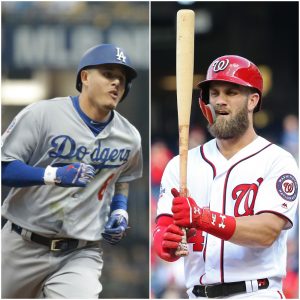
1. Bryce Harper, OF (original prediction: 14 years, $420MM): With Scott Boras as his agent, it’s unsurprising that Harper – who may be in line for a record-setting contract – remains unsigned. As you’d expect, there has been no shortage of offseason rumors centering on the 26-year-old Harper, who has been connected to his only team to date – the Nationals – as well as the Dodgers, Phillies, Braves, Cubs, Cardinals, Giants, Yankees and White Sox over the past couple months. On paper, the most logical landing spot for the superstar may be Los Angeles, which jettisoned pricey outfielders Yasiel Puig and Matt Kemp in a trade with the Reds earlier this month. However, despite their financial might, the Dodgers haven’t handed out exorbitant free-agent contracts during president Andrew Friedman’s reign, and they’re reportedly not inclined to give Harper the long-term pact he wants.
2. Manny Machado, SS/3B (original prediction: 13 years, $390MM): As a 26-year-old who has been an elite player at times, Machado entered free agency in a similar position to Harper. Like Harper, Machado has drawn interest from the the Phillies, Yankees and White Sox, having met with all three teams this month. Various reports have indicated Machado wants to play for the Yankees, yet the infield-needy club doesn’t seem prepared to go to the $300MM mark for him. Regardless, we may find out his next destination soon.
3. Dallas Keuchel, LHP (original prediction: four years, $82MM): While Keuchel’s still an easily above-average starter, the career-long Astro hasn’t been able to replicate the AL Cy Young-winning form he showed in 2015. Both Keuchel’s recent decline in production and his age (he’ll be 31 on New Year’s Day) are working against him on the open market, but he’s nonetheless seeking a five-year deal. His desire for security over the next half-decade has reportedly led to leeriness from the Phillies and Nationals (and maybe others). But beyond Philadelphia and Washington, a bevy of other teams have shown interest in Keuchel during free agency. The Boras client is going to do well on his next contract, then, though he may have no choice but to drop his price before he puts pen to paper with someone.
4. Craig Kimbrel, RP (original prediction: four years, $70MM): Although Kimbrel is one of the greatest relievers in history, he showed some cracks last season as a member of the World Series-winning Red Sox. Compared to Kimbrel’s otherworldly 2017 campaign, his strikeout rate fell by nearly 11 percentage points, his swinging-strike rate dropped by more than 2.5 points and his walk rate increased by over 7 ticks. Kimbrel was still outstanding, granted, but maybe not enough to merit the massive contract he’s pursuing. The richest deal ever given to a reliever – five years, $86MM – belongs to the Yankees’ Aroldis Chapman, who signed it when he was still in his late 20s. Kimbrel will turn 31 in May, and there hasn’t been strong reported interest in him thus far. The Red Sox, Phillies, Cardinals and Braves have been connected to Kimbrel in rumors, but none of those clubs are itching to meet his demands.
5. Yasmani Grandal, C (original prediction: four years, $64MM): Grandal reportedly turned down a four-year, $60MM offer from the Mets, who have since filled their vacancy behind the plate with Wilson Ramos. In the estimation of MLBTR readers, he made a mistake in spurning the Mets’ generous proposal. Along with New York, each of the Nationals, Braves, Astros, White Sox and Angels entered the offseason as potential Grandal suitors but have since made acquisitions behind the plate. In some cases (Atlanta, Houston, Chicago and Anaheim), those pickups haven’t been particularly expensive, so perhaps Grandal will still end up in one of those cities. The longtime Dodger probably won’t continue his career with them, however, as they’ve been more connected to Marlins star J.T. Realmuto – whose presence on the trade market doesn’t do Grandal any favors – and aren’t champing at the bit to hand out a long-term deal to the switch-hitting 30-year-old.
6. A.J. Pollock, CF (original prediction: four years, $60MM): Even though he’s 31 and has dealt with a spate of injuries during his career, reports have indicated Pollock’s holding out for a lengthy commitment worth $80MM or more. When healthy, Pollock’s probably worth that type of money. The problem is that the soon-to-be former Diamondback is coming off a three-year stretch in which he missed 249 games. Further, perhaps because of his supposed demands, a couple of the teams that have been connected to Pollock this offseason may have already moved on from him. The Astros signed Michael Brantley, while the Reds acquired Puig and Kemp. The Mets and Braves may be among the teams still in play for Pollock, a qualifying offer recipient, though the former’s GM has suggested otherwise and the latter doesn’t seem likely to give a lucrative, long-term contract to a 30-something.
7. Yusei Kikuchi, LHP (original prediction: six years, $42MM): As a free agent from Japan, the 27-year-old Kikuchi is the only player on this list with no major league track record. Further, unlike other free agents, there’s a deadline for Kikuchi to sign. Kikuchi’s Japanese team, the Seibu Lions, posted him Dec. 4, giving him and Boras until Jan. 2 to hammer out a deal with a major league club. Assuming Kikuchi does sign, there’s optimism he’ll become the latest big league success story from his homeland. In the meantime, it’s anyone’s guess which team Kikuchi will choose, as he implied earlier this month he’s open to joining any of the majors’ 30 franchises.
8. Marwin Gonzalez, UTIL (original prediction: four years, $36MM): There’s a lot to like about Gonzalez, a switch-hitting, league-average offensive player who can line up at every infield position and both corner outfield spots. Gonzalez, who will turn 30 in March, reportedly drew interest from just about every team at the start of the offseason. Things have been quiet on the Gonzalez front lately, though, aside from a connection to the Padres three weeks ago.
9. Zach Britton, RP (original prediction: three years, $33MM); 10. David Robertson, RP (OP: three years, $33MM); 11. Adam Ottavino, RP (OP: three years, $30MM): Considering these three are the best non-Kimbrel relievers available and have some common teams chasing them, we’ll group them together. The Phillies, Yankees and Red Sox have been after all three at times, and there has been plenty of interest from other clubs. Still, given that Britton, Robertson and Ottavino are all over 30, it’s unclear whether three-year estimates will prove overly optimistic.
12. Jed Lowrie, 2B (original prediction: three years, $30MM): Lowrie was one of the A’s best players and among the majors’ premier second basemen from 2017-18, but he’s also a soon-to-be 35-year-old with an extensive injury history. Moreover, he’s part of a market which features several other starting-caliber second basemen, and Oakland – arguably his most likely destination at one point – removed itself from the equation when it acquired Jurickson Profar last week. The switch-hitting Lowrie nonetheless wants a three-year deal, though he may have to settle for two.
13. Kelvin Herrera, RP (original prediction: one year, $8MM): With a strong platform season, the 28-year-old, flamethrowing Herrera may have been in line to sign the second-richest deal among relievers this winter. Instead, after a tremendous start with the Royals, he scuffled following a June trade to the Nationals. Worsening matters, Herrera’s season ended in late August on account of a torn Lisfranc ligament in his left foot. Herrera’s now making progress in his rehab, though reported interest in him has been almost nonexistent so far this offseason. Minnesota’s the only team that has been connected to Herrera on MLBTR’s pages since the 2018 campaign ended.
14. Gio Gonzalez, LHP (original prediction: two years, $24MM): Gonzalez is a longtime innings eater who has totaled at least 2.0 fWAR in nine straight seasons, yet only the Mets have shown reported interest in him thus far. He can probably thank his age (33) and somewhat disappointing 2018 for that. Compared to 2017 – one of Gonzalez’s most effective seasons – his inning, strikeout, walk and run prevention numbers all went in the wrong direction.
15. Brian Dozier, 2B (original prediction: one year, $10MM); 16. DJ LeMahieu, 2B (OP: two years, $18MM): The Nationals have been tied to these two accomplished second basemen in free agency, though it stands to reason Dozier and LeMahieu have more than one matching suitor. The Dozier rumor mill has been nearly silent, however, owing to the surprisingly poor 2018 the former Twins star endured with them and the Dodgers. LA may end up replacing Dozier with LeMahieu, who also had a less-than-ideal season from an offensive standpoint. However, the stellar defensive track record the 30-year-old LeMahieu built as a member of the Rockies at least gives him a high floor.
17. Mike Moustakas, 3B (original prediction: two years, $16MM): Moustakas was one of the most well-known stragglers on a slow-moving market last offseason. Moose entered the winter looking like a potential $85MM player, but he ultimately re-signed with the Royals in March for just a $6.5MM guarantee. Now, after his offensive production declined in 2018 between Kansas City and Milwaukee, it’s an open question whether Moustakas will do much better this offseason. So far, the Brewers, Cardinals, Phillies and Mets have shown some level of interest in the 30-year-old.
18. Cody Allen, RP (original prediction: two years, $16MM): Allen enjoyed tons of success as the Indians’ closer from 2013-17, and had that continued last season, he could have been in line for a huge contract. Unfortunately for Allen, though, his numbers came crashing down in 2018, and his velocity dropped as the year progressed. Given that teams can’t regard the 30-year-old as a shutdown option anymore, reported interest has been scarce. It seems the Indians could bring Allen back, while the division-rival Twins have also considered him.
19. Nick Markakis, OF (original prediction: two years, $16MM): Brantley and Andrew McCutchen are off the board, and Harper and Pollock are unrealistic for most teams. That could work to the advantage of Markakis, the next best free-agent outfielder available, though he’s more of a satisfactory regular than a high-impact one. Markakis was a first-time All-Star in 2018, but the 35-year-old’s offensive production cratered over the season’s last two months, giving him a final batting line that was more decent than exceptional. Still, as a roughly league-average hitter who gets on base, can handle both lefties and righties and hasn’t missed more than seven games in a season since 2012, Markakis could give some team an acceptable stopgap over the next year or two. A return to Atlanta, where he has played since 2015, may be in the offing.
20. Derek Holland, LHP (original prediction: two years, $15MM): After four straight down or injury-limited seasons with the Rangers and White Sox, Holland had to settle for a minors deal with the Giants last February. It proved to be a perfect match, as Holland made the Giants’ roster and returned to relevance in San Francisco. Across 171 1/3 innings (36 appearances, 30 starts), Holland showed better velocity than he offered in 2017 and posted a 3.57 ERA/3.87 FIP, a career-high K/9 (8.88), a personal-best infield fly percentage (11.8) and his second-highest swinging-strike rate (10.1 percent). So, even though Holland’s still unemployed, he’ll get a guaranteed contract – potentially from his old team in Texas – this offseason.
Photos courtesy of USA Today Sports Images.
3 Remaining Needs: AL West
In the latest edition of MLBTR’s “3 Remaining Needs” series, we’ll focus on the American League West, which boasted two playoff teams and an 89-win third-place finisher in 2018. It appears the division will once again feature, at most, three playoff contenders in 2019, as two of its clubs are in rebuilding phases.
[Previous installments: NL East, NL Central]
Houston Astros
- Add at least one more starter. With Justin Verlander, Gerrit Cole and Collin McHugh set to occupy 60 percent of the Astros’ rotation in 2019, they’re obviously in better shape than most teams. Still, it’s clear the Astros are worse off than they were last season, when Dallas Keuchel, Charlie Morton and Lance McCullers Jr. followed Verlander and Cole to comprise one of the majors’ most formidable rotations. Keuchel is now in free agency, where he may land a richer deal than the Astros are willing to fork over; Morton already left for the Rays on the open market; and McCullers will miss most or all of next season after undergoing Tommy John surgery. That leaves Josh James, who turned heads as a rookie in 2018, and Framber Valdez as the Astros’ projected No. 4 and No. 5 starters going into next season. Down in the minors, the Astros have a super prospect in 6-foot-7 righty Forrest Whitley, a 21-year-old who could debut in 2019, though he has only thrown 41 innings above Single-A thus far. All that said, there’s room for at least one veteran pickup via trade or free agency.
- Upgrade behind the plate, if possible. As with their rotation, the Astros aren’t in poor shape here. They signed the offensively solid Robinson Chirinos in free agency, and he’s slated to complement defensive wiz Max Stassi in a decent behind-the-plate tandem. Chirinos is a weak defender who’s only under contract for a year, though, while Stassi’s offense plummeted off a cliff after a hot April and May last season. Given the pair’s limitations, it’s possible the Astros will attempt to jettison the out-of-options Stassi in favor of someone better. They’ve continued to show interest in Miami’s J.T. Realmuto, the premier catcher in the game last season, but the Marlins’ asking price has been prohibitive to this point. Free agency also has one terrific option, Yasmani Grandal, whom Houston showed interest in early in the offseason. Things have been quiet since then, though.
- Pick up a left-handed reliever. In spite of Joe Smith‘s ruptured Achilles, Houston’s still stacked with proven right-handed relievers. It’s not as fortunate from the other side, however, as the only southpaw bullpen options on its 40-man roster are Cionel Perez (11 1/3 major league innings) and Reymin Guduan (19 1/3). Maybe one or both of those hard-throwing hurlers will break out next year, but in the meantime, it wouldn’t hurt to have some veteran insurance. The Astros don’t have to break the bank on the top lefty reliever in free agency, Zach Britton, although they have chased him in the past. Rather, they could go for one of the many cheaper veterans available.
Oakland Athletics
- Improve the rotation. The Athletics went bargain hunting for starters in 2018, signing Trevor Cahill, Brett Anderson and Edwin Jackson to low-cost deals. Surprisingly, all three moves paid dividends, and each of those veterans helped the injury-depleted A’s amass 97 wins and earn a wild-card berth. Cahill is now with the division-rival Angels, while Anderson and Jackson are free agents, leaving multiple glaring weaknesses in the A’s rotation. The team did re-sign Mike Fiers in free agency, but he’s not the most exciting choice, and the rest of its projected rotation includes pitchers who are either unproven or underwhelming. The A’s could certainly deploy the “opener” on a regular basis next season, as they did to positive results in 2018, yet there would still be space for actual starting additions. In true A’s fashion, they’re probably not going to make a big-money splash in free agency, but there are enough affordable veterans out there who could emerge as the Cahill, Anderson or Jackson of next year’s team.
- Get another catcher. If you’re an A’s fan, it’s unlikely you’re eager to watch the Chris Herrmann–Josh Phegley duo in action. Those two own a combined lifetime wRC+ of 139, and neither have been defensive stalwarts. Oakland’s arguably a fit for Realmuto or Grandal, though there’s no indication the team has pursued either to this point. More realistically, a free agent such as Martin Maldonado could make sense as Jonathan Lucroy‘s successor. Maldonado’s not much of a hitter, but as a longtime defensive standout, A’s pitchers would likely benefit from his presence.
- Find left-handed relief depth. The lone lefty in the A’s bullpen is an excellent one, Ryan Buchter. There are no lefty options to be found after him, though, so the club could stand to buy itself some more aid. As noted above in the Astros section, reasonably priced free-agent possibilities abound.
Seattle Mariners
- Keep shedding costly veterans. The Mariners were nearly a 90-win team last season, but their success in the standings didn’t convince general manager Jerry Dipoto that they were true contenders. As a result, Dipoto has undertaken an aggressive “re-imagining” campaign that has seen the Mariners part with Robinson Cano, Edwin Diaz, James Paxton, Jean Segura, Carlos Santana (acquired for Segura), Mike Zunino, Alex Colome, Juan Nicasio and Ben Gamel in a bevy of trades. There are more trade candidates on hand, too, including just-acquired veterans Edwin Encarnacion, Jay Bruce and Anthony Swarzak, not to mention holdovers Dee Gordon, Mike Leake and Kyle Seager. Admittedly, it would be a major challenge to move all (or even most) of those players, but at least a couple are real candidates to don different uniforms come 2019. Meanwhile, if it wants to continue upgrading its formerly atrocious farm system, Seattle wouldn’t have any trouble finding takers for the likes of Mitch Haniger, Mallex Smith or Marco Gonzales. It appears they’ll remain in place, however, with Dipoto hoping they’ll be key parts of the next contending Mariners team.
- Pursue more starters and relievers. With Paxton gone, Leake and Gonzales are the only M’s starters who are good bets to perform respectably in 2019. It’s not a certainty either will be on the team then, though, nor is it clear what the club will get from Felix Hernandez, Wade LeBlanc or prized prospect Justus Sheffield (acquired for Paxton). Because Seattle’s unlikely to contend next season, it’s not going to spring for someone like Keuchel in free agency, but Japanese import Yusei Kikuchi is a worthwhile target. Dipoto has made it known he’s a fan of the 27-year-old Kikuchi, who figures to sign a deal long enough to make him a factor on Seattle’s next good team – if the GM’s plan works, of course. Regardless of whether Kikuchi becomes the latest Japanese star to join the Mariners, it would be wise for them to pursue other vet arms – both starters and relievers. They could search for their next LeBlanc, who was unexpectedly effective in 2018 after signing a cheap, major league deal, and perhaps flip the player(s) at the deadline for more prospects. Safeco Field is a good place for a pitcher to improve his stock, after all.
- Bolster bench depth. The M’s projected bench for 2019 includes David Freitas, Ryon Healy and Kristopher Negron, with minor leaguers Dan Vogelbach, Joey Curletta, Kaleb Cowart, Dylan Moore, John Andreoli and Braden Bishop also in the 40-man fold. Aside from the mediocre Healy, there’s not an established major leaguer in the bunch. On one hand, there’s an argument Seattle should mostly stick with that group and see if anyone is capable of grabbing a role in the majors. On the other, it wouldn’t hurt to bring in vets on minor league deals or perhaps cheap MLB pacts, potentially giving the M’s more players to flip for youth during the season.
Los Angeles Angels
- Continue searching for starters. Having added Cahill and Matt Harvey in free agency, it’s possible the Angels’ heavy lifting is done in their rotation. It probably shouldn’t be, though, as neither of the Angels’ new additions are all that trustworthy. Elsewhere in their rotation, there’s hope for Andrew Heaney, Tyler Skaggs and Jaime Barria, but they also come with question marks. If the Angels are going to make an aggressive push toward contention during Mike Trout‘s final two years of control, Keuchel or Kikuchi may give them the front-end starter they don’t seem to have at the moment (the injured Shohei Ohtani excluded). Keuchel would be especially pricey, though, and it’s unknown whether owner Arte Moreno wants to spend much higher than the team’s projected Opening Day payroll of $167MM.
- Address the bullpen. The Angels are reportedly interested in free agent David Robertson, who’d be a quality pickup for a team in need of shutdown innings late in games. He’s far from the only free-agent reliever capable of boosting the Halos, though. While most of the top free-agent relievers are righties, the team should also have its eye on lefties. After trading Jose Alvarez this month, the sole southpaw reliever on the Angels’ 40-man is Williams Jerez, who struggled mightily across 15 major league innings in 2018.
- Buy infield insurance. The Angels are golden at shortstop with Andrelton Simmons, but the rest of their infield picture looks somewhat bleak. What if Zack Cozart scuffles again after an injury-shortened 2018? What if David Fletcher doesn’t hit enough to hold down a starting job? What if the newly signed Justin Bour puts up a second straight disappointing offensive season? Those are all valid questions the Halos have to consider, meaning they should be monitoring the market with the fear that their infield plans (Simmons aside) could go awry next season. They’re reportedly interested in free agent Josh Harrison, who’d provide a nice fallback option at both second and third. Fellow free agent Marwin Gonzalez, who can play every infield position and both corner outfield spots, would make even more sense. However, he may be out of the Angels’ price range.
Texas Rangers
- Land more pitching. The rebuilding Rangers may trade their top starter, Mike Minor, but even if they keep him, there’s room to add to their rotation. The club already made one noteworthy pickup in Lance Lynn, whom it signed to a three-year, $30MM contract this month. With Lynn in the mix, the Rangers are likely now pushing for Kikuchi, who could slot in near the top of their rotation for several years. Besides Kikuchi, Texas should be focusing on low-cost stopgaps who can eat innings and allow young hurlers such as Jonathan Hernandez, Taylor Hearn, Brock Burke and Joe Palumbo to get more seasoning in the minors. Assuming Minor goes, Lynn would be the Rangers’ only decent bet to handle a heavy workload next season. Edinson Volquez and Drew Smyly may join Lynn in that regard, but it’s hard to be overly optimistic considering the recent arm problems which have stalled their careers. Similarly, despite the presence of lights-out closer Jose Leclerc, bullishness likely isn’t merited with Texas’ bullpen. As a non-contender, the team shouldn’t be splurging on any free-agent relievers, but it’s a logical landing spot for affordable veterans who could potentially become trade candidates during the season. The Rangers have already inked two such arms in Jesse Chavez (two years, $8MM), whom they signed last winter, traded over the summer and brought back this offseason, and Jeanmar Gomez (minor league deal).
- Consider trading Leclerc and others. Although he enjoyed his best season in 2018, the Rangers just traded 25-year-old infielder Jurickson Profar because they didn’t believe he’d stick around for the long haul. Perhaps we’ll see even more deals along those lines from general manager Jon Daniels prior to next season. The Rangers may not have a more appealing trade chip than the 25-year-old Leclerc, whose value is likely at its zenith. Texas may try to extend Leclerc as a result, but there’s a legitimate case the team should trade him this offseason. The Rangers aren’t ready to win, and a shutdown closer isn’t a must-have piece for a team in that position. Leclerc’s controllable for the next four years, including one more pre-arb campaign, and would probably net a bounty in return. The likes of Minor, Nomar Mazara, Joey Gallo and Shin-Soo Choo also shouldn’t be untouchable, though they would bring back more modest packages than Leclerc. The club may simply hold Mazara and Gallo – who are under control for three and four more years, respectively – as opposed to selling low. The two were closer to average than spectacular in 2018, but youth is on the duo’s side (Gallo’s 25, Mazara’s 23), meaning one or both could emerge as long-term core members in Arlington. At 36 and with two years left on his deal, Choo’s time with the Rangers is waning. Choo can still produce offensively, but as an expensive DH/corner outfielder who’s on the wrong end of the aging curve, he’d probably be impossible to trade without taking back another team’s undesirable contract in return. That may not be worth the trouble for the Rangers.
- Address third base. After the revered Adrian Beltre retired last month, third base temporarily belonged to Profar. Now that Profar’s gone, the Rangers’ No. 1 option at the hot corner looks to be Patrick Wisdom, whom they acquired from the Cardinals during the Winter Meetings. A first-round pick of the Redbirds back in 2012, Wisdom finally debuted in the majors last year and held his own, albeit over just 58 plate appearances. Maybe the 27-year-old will take the opportunity in Texas and run with it, but in the meantime, it appears the club will add a veteran fallback. Harrison and Matt Davidson are among the players who have been connected to the Rangers in the rumor mill.
Poll: Yasmani Grandal’s Next Contract
Yasmani Grandal entered free agency as the clear-cut best catcher on the open market, but he remains without a job nearly two months after the offseason began. Part of that seems to be Grandal’s own doing, as the longtime Dodger reportedly turned down a generous proposal from the Mets – a four-year, $60MM offer. In the wake of Grandal’s rejection, the Mets pivoted to the No. 2 catcher in free agency, Wilson Ramos, whom they reeled in on a two-year, $19MM guarantee.
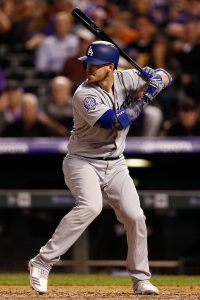
At the outset of the offseason, MLBTR predicted Grandal would score a four-year, $64MM contract and listed the Mets, Nationals, Rangers, Twins, Red Sox, Astros, Angels, Phillies, Braves and Rockies as potential suitors. The Twins, Red Sox, Astros, Philllies and Rockies could still be in the mix for the 30-year-old Grandal, though at least some of those teams may prefer to swing a deal for Marlins trade chip J.T. Realmuto.
It’s doubtful the other clubs are in on Grandal, on the other hand. The Nationals have already added Yan Gomes and Kurt Suzuki this winter, thus taking them out of the running for free-agent catchers who will garner major league contracts and Realmuto. The Rangers could still use a catcher, having parted with Robinson Chirinos at the start of the offseason and signed the offensively challenged Jeff Mathis, but it would be surprising to see the rebuilding franchise spend big on a 30-something player. The Angels showed interest in Grandal earlier this month, but they may be out of the equation after signing free agent Jonathan Lucroy on Friday. The Braves, meanwhile, re-signed Tyler Flowers toward the end of last season and then reunited with Brian McCann on a $2MM guarantee in free agency, giving them a pair of respected veterans.
While at least a few of the above teams may be eyeing Grandal, the only ones that have actually shown reported interest in him this winter have been the Dodgers, Reds, White Sox and the aforementioned Mets, Astros and Angels. It doesn’t appear Grandal’s going to return to the Dodgers in 2019, though, considering multiple reports have indicated they aren’t keen on bringing him back on anything other than a short-term deal. The White Sox have signed James McCann since they were first publicly connected to Grandal, and they also have capable veteran backstop Welington Castillo on hand. Cincinnati, which selected Grandal 12th overall in the 2010 draft, may still be a candidate to sign him, but it has a passable, low-cost starter in Tucker Barnhart and seems more focused on upgrading its rotation than its situation behind the plate.
The Dodgers already tried to bring Grandal back in 2019 on a $17.9MM qualifying offer, but he declined it, meaning it would cost a team significant major league payroll space, a draft pick and international bonus pool allotments to sign him. Grandal’s status as a QO recipient takes away from his appeal to some degree, yet he has nonetheless been among the majors’ most accomplished catchers over the past several years.
Since 2014, which he spent with the Padres, the switch-hitting Grandal ranks top five at his position in home runs (104; third), wRC+ (115; third) and fWAR (12.2; fifth). And while Grandal had some well-documented problems as a defender in the 2018 postseason, he’s still a highly regarded pitch framer who has thrown out a roughly league-average percentage of base stealers in his career. Clearly, then, Grandal shouldn’t have trouble finding a lucrative contract prior to next season. But it’s an open question whether he erred in saying no to the Mets’ $60MM offer.
(poll link for app users)
How Much Guaranteed Money Will Yasmani Grandal Receive On His Next Deal?
-
$40MM-$49MM 22% (3,535)
-
$30MM-$39MM 20% (3,229)
-
$10MM-19MM 18% (2,927)
-
$50MM-$59MM 15% (2,402)
-
$20MM-$29MM 14% (2,238)
-
$60MM or more 10% (1,649)
Total votes: 15,980
Photo courtesy of USA Today Sports Images.
Offseason Outlook: Baltimore Orioles
The final entry in MLBTR’s annual Offseason Outlook series is (obviously) rather late to the party this year. My apologies to Orioles fans for the delay. I made an error when we were determining who on the MLBTR staff would write which Outlook this winter, and the result was that the Orioles Outlook regrettably slipped through the cracks. Thankfully (or perhaps not if you’re an Orioles fan), it’s been a rather quiet offseason in Baltimore for the new front office thus far, leaving a pretty wide slate of possibilities to explore. Here’s a look at where things stand in Baltimore as a rebuild that has been a long time coming is in its nascent stage.
Guaranteed Contracts
- Chris Davis, 1B: $92MM through 2022 ($6MM annually deferred, without interest, all the way through 2037)
- Alex Cobb, RHP: $43MM through 2021 ($4.5MM annually deferred through 2032)
- Mark Trumbo, 1B/OF/DH: $13.5MM through 2019
- Andrew Cashner, RHP: $8MM through 2019 (plus incentives; deal includes $10MM vesting option that will trigger with 187 IP in 2019)
Arbitration-Eligible Players (service time in parentheses; projections via MLBTR contributor Matt Swartz)
- Jonathan Villar (4.113) – $4.4MM
- Dylan Bundy (3.026) – $3.0MM
- Mychal Givens (3.069) – $2.0MM
Free Agents
- Adam Jones, Tim Beckham (non-tendered), Caleb Joseph (non-tendered)
[Baltimore Orioles depth chart | Baltimore Orioles payroll outlook]
The Orioles won more games than any team in the American League over a five-year span from 2012-16, but even toward the end of that run, there were some cracks beginning to show in the foundation. The team’s core was largely headed for free agency at the same time, the rotation often appeared thin even when things were going well in Baltimore, and owner Peter Angelos made the bizarre decision to wholly ignore international amateurs in free agency (while simultaneously re-signing Chris Davis to an albatross contract), which didn’t exactly position his front office for long-term success.
The result was perhaps more catastrophic than even the most pessimistic observers could have forecast. Baltimore lost a stunning 115 games in 2018. Orioles pitchers yielded 270 more runs than the team’s feeble offense could generate. In the field, the Orioles’ collective -94 Defensive Runs Saved was the third-worst mark among MLB teams. Nearly anything that could go wrong in Baltimore did go wrong, and now-former GM Dan Duquette saw the writing on the wall this summer when he gutted the roster in advance of the non-waiver trade deadline. Gone were Manny Machado, Zach Britton, Brad Brach, Darren O’Day and Kevin Gausman. Adam Jones, too, would have been shipped out had he not invoked his no-trade rights.
Months later, it’d be Duquette who was shown the door, along with longtime manager Buck Showalter, as Lou and John Angelos (the sons of Peter Angelos who have taken a prominent role in team control over the past year) opted to clean house from top to bottom. Newly minted general manager Mike Elias was plucked from an Astros organization that has long been on the cutting edge of data-driven baseball operations decisions, and Elias subsequently hired Brandon Hyde away from the Cubs (another progressive organization) as his new skipper. Former Astros executive Sig Mejdal has joined Elias in the Baltimore front office as an assistant general manager, while incumbent farm director Brian Graham and scouting director Gary Rajsich were ousted from the organization as well.
So where does the new-look front office turn as it looks to bring about the next wave of competitive baseball in Baltimore? Elias will no doubt be aggressive in adding to his analytics department, his international scouting staff and player development department as he looks to serve as the architect for a more modern organizational infrastructure. Most of those additions won’t be headline-grabbing news and won’t be of particular interest even to some O’s fans (let alone the broader base of MLB fans), but those will nonetheless be critical steps in a process that should span several years.
Looking at the roster, Duquette’s regime acted fairly aggressively in shipping out trade assets at the deadline, leaving the Orioles with few pieces to legitimately dangle on the trade market. Dylan Bundy would be of interest to other teams given his remaining three seasons of control, but he finished the season extremely poorly, and it doesn’t seem likely that the O’s would sell low on him. The last thing Elias wants to do as an incoming GM is to trade a longtime top prospect only to watch him break out in a new setting, and a strong first half or even a strong 2019 season on the whole would enhance Bundy’s trade value.
Alex Cobb also seems unlikely to be moved, with the $43MM he’s owed still looming large. Baltimore could perhaps eat a notable portion of that remaining sum in an effort to clear that ill-fated contract from the books, though that won’t be an easy sell. Cobb did pitch more effectively after the All-Star break, but his strikeout rate in the second half actually went down slightly (from 6.1 to 5.9 K/9) as his walk rate increased (from 2.3 to 2.7 BB/9). He allowed less hard contact and fewer home runs, but the O’s would probably need to eat half the contract to even find a taker. Andrew Cashner is a similarly unappealing trade asset, and if we were all impressed that Jerry Dipoto managed to shed the remainder of Robinson Cano‘s contract, we’d have to consider it a legitimate miracle if Elias somehow found anyone to absorb a decent chunk of the Chris Davis contract. There may be a Trumbo taker out there if the Orioles agree to eat $9-10MM in salary, but the return wouldn’t be meaningful.
The O’s do have one particularly appealing trade chip, however, in the form of presumptive 2019 closer Mychal Givens. He may not be an elite reliever, but Givens is a hard-throwing (soon to turn) 29-year-old with three seasons of club control remaining and a strong 10.3 K/9 mark across the past three years. His 3.99 ERA in 2018 was elevated a bit due to a bizarre plummet in his strand rate (64.5 percent in ’18; 76.2 percent career), but Givens does an excellent job of limiting hard contact and missing bats. With a $2MM projected salary in arbitration, he’s affordable for any club in baseball and represents a nice alternative for teams that don’t want to spend $7-8MM+ on an annual basis for free-agent arms. There’s a glut of relief options available for now, but the O’s would be wise to float Givens’ name later in the offseason if there are contending teams who missed their top targets and are underwhelmed with the remnants of the free-agent class.
Frankly, though, the Orioles themselves should look to benefit from that swarm of relievers on the open market. Invariably, there’s a handful of solid bullpen pieces that is left standing each winter, and a rebuilding team like the Orioles is well positioned to add some bargains with an eye toward flipping them to contenders in July. While Baltimore surely wants to see what it has in younger relievers such as Tanner Scott, Cody Carroll, etc., there’s plenty of space in the bullpen to add a veteran or two while still leaving ample opportunity to evaluate in-house options.
The same should be true in the starting rotation. There’s zero sense in Baltimore doing something outlandish like signing Dallas Keuchel, of course, but there’s also good reason to roll the dice on a veteran starter who lingers on the market and is struggling to find a fit. If a Drew Pomeranz or Ervin Santana is available on a cheap one-year contract two months from now, signing a veteran bounceback candidate could eventually yield a summer trade chip and would create some depth to take pressure off younger arms like Josh Rogers, David Hess and Luis Ortiz (among others). At the very least, the O’s should be adding a fairly hefty number of pitchers, both starters and relievers, on minor league contracts with invites to Spring Training.
It’s a similar story in the lineup, where there are few established names. Trey Mancini will get another crack in left field (or at DH if the Orioles move on from Trumbo) and look to bounce back from a disappointing .299 OBP in 2018. Cedric Mullins will get a lengthy audition in center. DJ Stewart could get the same in right field, but there’s room for this team to add a veteran outfielder in the Jon Jay or Cameron Maybin mold for some insurance. The O’s are also the type of team that could afford to buy low on a bounceback candidate like Avisail Garcia in hopes of turning him into a prospect this summer.
Turning to the infield, Davis will be at first base and hoping to rebound to whatever extent possible from his disastrous 2018 struggles. Jonathan Villar could hold some appeal on the trade market after a solid run in Baltimore, but if he stays put, he’ll be in line for a middle-infield spot. His ability to play multiple positions should free up the Orioles to pursue veteran infielders on one-year deals and prioritize overall rather than pigeonholing themselves into finding one player at a specific position; a half season hitting homers at Camden Yards before being flipped to a contender might not sound like a bad plan for a rebound candidate like Brian Dozier, for instance. Renato Nunez may have been intriguing enough following his waiver claim (.275/.336/.445) to earn a longer look at third base. Rule 5 picks Richie Martin and Drew Jackson, too, could figure prominently into the infield mix since the Orioles know they won’t be contending anyhow. Behind the plate, Chance Sisco will eventually need to be given another chance to prove he can be the team’s catcher of the future, and the O’s have both Andrew Susac and Austin Wynns on the 40-man roster as backup options.
Outside of a few salary dumps and perhaps some bargain-bin shopping, it doesn’t figure to be an extremely active winter for Elias, Mejdal and the rest of the Orioles’ front office. It’s always possible that a newly hired executive will be surprisingly active — Jerry Dipoto wasn’t bashful about making trades immediately in Seattle, and A.J. Preller was hyper-aggressive in his first year on the job in San Diego — but the bulk of the heavy lifting from a trade perspective was already completed this past summer. There’s enough uncertainty on the Orioles’ roster that some short-term veteran additions should be expected, but the Angelos family hired Elias knowing that this rebuild was going to be a marathon rather than a sprint.
Poll: The Padres’ Offseason Approach
The Padres, owners of one 90-win season in the last two decades, remain mired in the latest iteration of what has amounted, over the club’s 50-year history, to something approximating a near-interminable rebuild. This time, though, the club hasn’t taken half-measures, having carefully assembled a lot of prospects to rival any in the game’s history: indeed, by FanGraphs’ latest count, San Diego has a staggering 46 players who project to be major league contributors of some sort, including eight of the game’s top 75 prospects.
The major league team, though, has yet to reap the benefits. Highly touted outfielders Hunter Renfroe and Manuel Margot have graduated and quickly sputtered in their first exposures, and the club’s recent mound graduates, with the possible exception of the “churve”-hurling Joey Lucchesi, seem more of the back-end variety. The richly-paid duo of Wil Myers and Eric Hosmer has also failed to impress, with the latter riding his grounder-heavy ways to a near-replacement-level season for the fourth time in seven years, and the former posting a combined 2.3 fWAR since signing a huge extension prior to the 2017 season.
Holes abound elsewhere on the diamond: Myers, at midseason, tried his hand at third, to mostly disastrous results, and the club received meager-at-best production up the middle (though blue-chip prospects Fernando Tatis Jr. and Luis Urias are knocking loudly at the door). Franmil Reyes did open eyes in limited ’18 action, but he hardly seems suited for a corner-outfield spot, and his minor league numbers, in six seasons before last season’s AAA breakout, leave little by which to be encouraged (ditto Franchy Cordero). Catcher remains an issue, though Austin Hedges did show signs in the season’s second half.
On the mound, the club can hang its hat only on its always-stellar bullpen, with Kirby Yates, Craig Stammen, Jose Castillo, and Matt Strahm (who seems ticketed for a rotation audition in the Spring) all posting brilliant seasons in 2018. The rotation, apart from Robbie Erlin and his microscopic walk rate, was generally awful last season. Lucchesi led the charge with just 1.1 fWAR, while the rest of his rotation mates combined for a sickly 3.0 fWAR altogether. In short, it’s a team that could use an upgrade at very nearly every position on the diamond.
Still, the bleakness of the near-future outlook apparently hasn’t dissuaded the Front Office from scouring the trade market for major, short-term upgrades – in the last two months alone, the club has reportedly targeted Corey Kluber (link), Noah Syndergaard (link), J.T. Realmuto (link), and Marcus Stroman (link), among surely others. Two of the four have exactly three years of control remaining (with Realmuto and Stroman having just two), but the Padres would be seem to be paying an unnecessary premium on the stars to contribute in 2019 and 2020, years in which the club has seemingly little chance to compete.
Does this strategy make sense? Could the big-league ready prospects couple with the bonafide stars to form a legitimate contender in the next two seasons? Or would the club be best-served to wait, see how their current crop progresses in the upcoming season, and re-evaluate in a year from now? Pick your answer in the poll below.
Should The Padres Be Aggressive On The Trade Market This Winter?
-
No, they won't be ready to compete until 2020 at the very earliest 76% (8,632)
-
Yes, it's their time 24% (2,743)
Total votes: 11,375
3 Remaining Needs: NL Central
Our 3 Remaining Needs series slides west to the NL Central, another lively offseason division with a surprise player moving to the fore. Though heavy lifting may have concluded in many of the NL’s charter cities, others still have piles of work at hand. Let’s get to the most pressing needs for each of the five teams in the NL’s staunchest division last season (teams listed in order of 2018 standings) . . .
[Previous installment: NL East]
Milwaukee Brewers
- Address second base. The keystone was a black hole for an otherwise prodigious lineup last year, with midseason acquisition Jonathan Schoop performing so badly at times that 6’4, 230 pound Travis Shaw was asked to learn the position. With the likely impending departure of 3B Mike Moustakas, Shaw will slide back across the diamond, leaving a gaping hole at second. Top prospect Keston Hiura is on the way, but may still be a year or so off, and the options at hand are, in the interim, woefully insufficient. The club has been connected to free agent Jed Lowrie, but may prefer a short-term stopgap to keep Hiura’s spot warm.
- Add a proven arm to the rotation. Milwaukee’s rotation consists, at current, of three number-five starters, three rookies vying for the fourth and fifth spots, and a rehabbing Jimmy Nelson set to make his return at some point early in the season. Ideally, the club would be a perfect fit for a top-end hurler, but seems to have neither the financial nor the prospect capital to make such a deal happen. Corbin Burnes, Brandon Woodruff, and Freddy Peralta all had promising debuts last season, but the Crew would do well to somehow slot a proven commodity into the mix.
- Find a legitimate backup shortstop. Former top prospect Orlando Arcia‘s 2018 season was, to put it mildly, not a good one. The purported defensive wiz was anything but magical on that side of the ball last season, to say nothing of his league-worst 54 wRC+. If he again slumps out of the gate, the club can’t exactly look to Tyler Saladino or Hernan Perez to hold down the fort, especially given its question marks at second. A veteran backup capable of handling the bat against both sides (and, perhaps, handling second-base duties in a pinch as well) would be a perfect fit for the reigning division champs.
Chicago Cubs
- Solidify the back end of the bullpen. An aging Cubs pen that struggled with the free pass last season faces further uncertainty at present, what with the loss of Jesse Chavez and the hazy future of closer Brandon Morrow, who’s found it nearly impossible to stay healthy for a full major-league season. Upper-minors reinforcements are scarce, so the club will likely have to dip into what little reserves it has or scour the fringes of the market for a bargain pickup.
- See if Jason Heyward‘s albatross can be moved (with cash incentive). This is speculative, at best, but the Cubs have as few holes as any team in baseball, and still lurk at the edges of the Bryce Harper market. Finding a team willing to take on at least some of the $118.5MM still owed to Heyward could be just enough to lift the free-spending Cubbies to the Harper Sweepstakes’ fore; the club, after all, would still boast a number of capable right-field options for the upcoming campaign even if they were to deal Heyward and miss on the 26-year-old superstar.
- Add depth in the upper minors. Star-caliber graduations from 2015-17 have decimated a farm that was once the jewel of the National League. At current, the system offers little in the way of high-impact talent, which could be a major impediment to a big mid-season acquisition, should the Cubs be hit by injuries and/or ineffectiveness. Both Ian Happ and Kyle Schwarber could be leveraged in this way – with multiple years of team control remaining for each, the prospect capital acquired could be, come July, the lone bullet(s) in the Cubbies’ gun.
St. Louis Cardinals
- Find a taker for Jose Martinez. Martinez has raked to the tune of a 130 wRC+ after years of uneven performance in the minors since debuting for the club in late 2016. The acquisition of Paul Goldschmidt, however, and the 30-year-old’s frightening defense in an outfield corner, make him a much better fit elsewhere, ideally on an AL club. Though the return might be insubstantial, even with his four years of team control remaining, it’ll likely add more value to the club than Martinez will as a part-time fill-in and occasional pinch-hitter.
- Continue to add to the bullpen. Despite possessing a hothouse of flame-throwers in the pen, the 2018 unit was arguably the NL’s worst (4.50 xFIP, 4.34 BB/9). The club took a major step to address the issue with last week’s signing of Andrew Miller, but it’s still a unit light on track record and heavy on control issues. The Giants’ Will Smith and Tony Watson, former Central stalwarts both, have each been linked with the Redbirds this month, and either could catapult the club to a place very near the projected top of the division.
- Add a lefty bat. In addition to the perennially-awesome Matt Carpenter, the Cards’ only other left-handed regulars are the mercurial Kolten Wong and the will-be 33-year-old Dexter Fowler, who often struggled to hit the ball out of the infield last season. The bench, too, is stacked mostly with solid right-handed hitters of all types – there is, it seems, scarcely a club out there in more dire need of left-handed infusion, and this one might need a couple.
Pittsburgh Pirates
- Add to the rotation. The unit, though possessing of four proven MLB arms, is arguably the division’s thinnest – after the 3-4 of Joe Musgrove and Trevor Williams, the latter of whom has posted consecutive shaky-peripheral (4.54 xFIP, 6.64 K/9 in ’18) seasons, the club has little on which it can depend. Chad Kuhl, dreadful anyway in ’18, had Tommy John in September, and youngsters Nick Kingham and Clay Holmes showed little in their scattered opportunities. Top prospect Mitch Keller is close, but the team would be well-served to add a couple proven, back-end arms (in addition to the newly-signed Jordan Lyles, who’s spent much of the last three seasons as a reliever) to cover their backs.
- Find a shortstop. Following the departure of longtime Pirate Jordy Mercer, the club is left with just a combination of Kevin Newman and newly-acquired Erik Gonzalez at the position, neither of whom inspire much confidence on the offensive side. The Buccos have long prized defense at the position, and may indeed be content with a combination of the two, but a sub-70 wRC+ anywhere on the diamond is a gaping hole, regardless of defensive prowess.
- Assemble more depth on the bench. Gregory Polanco will already miss the first two months of the season, at the very least. If Starling Marte or Corey Dickerson incurs an injury, the club’s outfield mix will look exceptionally weak. Positional versatility, a hallmark of the successful Pirate teams of the mid-decade, is in short supply on the current version, and the club will need to bolster its depth if it harbors any real hope of contending in an increasingly difficult division.
Cincinnati Reds
- Make another impact move. The club, which for years has been an absentee on the free-agent market, and hadn’t made an industry-shaking acquisition since 2011’s trade for Mat Latos, has already announced its intention to contend this offseason, jettisoning far-away talent for short-term impact in a pair of December trades to acquire Tanner Roark, Yasiel Puig, Alex Wood, and Matt Kemp. But, given the quality of the Central, the returns aren’t nearly enough; the Reds are still at least seven, and perhaps closer to ten or twelve, wins away from seriously challenging for a playoff spot. Landing an elite-level talent via trade – which the club, with a throng of upper-level projected regulars on the farm, is certainly capable of doing – could catapult them squarely into the mix.
- Shore up center field. Following last week’s procurement of Kemp and Puig, the Reds are flush with outfield thump from both sides, but are still left without a true center fielder in their midst. It’s true that Great American Ballpark has less space in the outfield than most, and that the club has been successful with a decaying Shin-Soo Choo manning the position for much of a season, but the rotation is a contact-heavy one that will undoubtedly suffer with a subpar defender left free to roam. Top prospect Nick Senzel could be an option, but the club will likely be best-served to pluck its feast from outside the organization.
- Add depth to the bench/pen. Both units here are severely undernourished – an infusion would require perhaps three 85 FIP- or lower bullpen arms, and bench bats capable of handling multiple positions and offering adequate output at the plate. It’ll be a tall task to imbue the club with this much reinforcement, but a necessary one if Dick Williams, Nick Krall, and Co. hope to contend next season.