
Braves Interested In Garrett Crochet
White Sox lefty Garrett Crochet continues to be one of the most interesting names in the lead-up to the deadline. With just over 24 hours left to go, it’s unclear if he will be traded at all, but plenty of teams are interested. He’s already been connected to the Dodgers, Phillies and Padres to varying degrees, with Jon Heyman of The New York Post adding Atlanta to the pile today on X. Travis Sawchik of theScore reported on X last week that the Sox would prefer not to trade Crochet within the division, so the odds of him landing with another A.L. Central team would appear to be low.
Crochet is fairly unprecedented as a trade candidate due to his unusual trajectory. He was quickly called up to the majors in 2020 when he was only 21 years old. The Sox kept him in a relief role the year after and he pitched fairly well, but then Tommy John surgery wiped out most of his 2022 and 2023 seasons.
That left him in a strange spot coming into 2024. He had only thrown 73 major league innings due to the missed injury time and another 12 1/3 in the minors as part of his rehab assignment while coming back from surgery last year. But he collected service time while on the injured list and crossed three years of service in 2023, qualifying for arbitration. Since he had hardly pitched, his salary only got bumped to $800K, barely above the league minimum.
The Sox stretched him out as a starter here in 2024 and the results have vastly outpaced any reasonable expectations. The lefty has thrown 114 1/3 innings, already eclipsing his workload over the four previous years combined. He has allowed just 3.23 earned runs per nine innings, striking out 34.6% of batters faced. He has also limited walks to a 5.6% clip and gotten grounders on 46.8% of balls in play.
Most clubs would be clinging tightly to a pitcher who suddenly became an ace at the age of 25 but there are also factors pushing him onto the trade block. As mentioned, he has already qualified for arbitration and has just two years of club control remaining beyond this one. The Sox are absolutely awful this year, despite Crochet’s contributions, with a 27-81 record that could see them finish as one of the worst clubs of all time.
Given the low point the Sox are at, it’s fair to wonder if they can be competitive again in their window of control over Crochet. They reportedly explored an extension with him but didn’t get far, so he’s likely more valuable to them as a trade chip than as a player.
An ace pitcher with a tiny salary and two extra years of club control should give Crochet massive trade appeal but there are also complications. With the limited workload that he carried into this year, it’s led to questions about the best way to press forward, with some suggesting a move to relief work down the stretch would be the best option.
According to reporting from last week, Crochet prefers to continue in a starting role, believing that would be best for his health. He would want to sign an extension with any new club before being moved to the bullpen.
Relievers work fewer innings than starters overall but they have to pitch more frequently and essentially on-call. Perhaps Crochet believes he can better prepare his body for the regular schedule of starting, whereas bullpen work could involve pitching at any time, even on back-to-back days. It’s also possible that he and his reps are simply trying to leverage the trade interest into locking in some financial security, which is understandable. For a guy that has already missed significant time, it would be nice to have some money in the bank before a club leans on him heavily for a World Series run.
That could perhaps scare off some clubs that don’t want to both send significant prospects to Chicago and also commit notable dollars to Crochet. However, Jack Harris of the Los Angeles Times reports today that the Dodgers don’t view the extension as an obstacle.
This situation is somewhat analogous to the Tyler Glasnow circumstances from the offseason. While not exactly the same as Crochet, he had some workload concerns and was available in trade, though the Rays reportedly made an extension a condition of trade talks. In the end, the Dodgers sealed the deal, sending Ryan Pepiot and Jonny DeLuca to the Rays for Glasnow and Manuel Margot and locking Glasnow up through 2028.
It’s understandable why they might want to go down that path again, given their pitching challenges. Dustin May and Emmet Sheehan both required season-ending surgeries while Walker Buehler and Yoshinobu Yamamoto are each on the injured list as well. Bobby Miller struggled so bad that he got optioned down to the minors.
The club’s current rotation is fronted by Glasnow and Clayton Kershaw. Glasnow has a spotty health track record while Kershaw just returned from a lengthy absence due to shoulder surgery. They are backed up by three rookies in Gavin Stone, River Ryan and Justin Wrobleski. General manager Brandon Gomes has said the club is looking for “impact” additions and Crochet would certainly qualify. They already have lined up with the Sox on one major trade today, a three-team blockbuster that also involved the Cardinals.
Crochet’s modest salary is certainly part of the appeal for the Dodgers, as they are slated to be third-time payors of the competitive balance tax and are currently over the top tier. That means they will pay a 110% tax on any money they take on, so someone like Crochet would be more appealing than a veteran who is already making eight figures annually. The theoretical extension would increase his cost but the new deal would start in 2025 and wouldn’t impact his current CBT hit.
Turning to Atlanta, they have their own rotation challenges. Spencer Strider is out for the season due to UCL surgery while Max Fried, Hurston Waldrep and Huascar Ynoa are also on the IL at the moment. Reynaldo López was removed from his most recent start due to forearm tightness and is slated for an MRI.
That leaves them with a rotation nucleus consisting of Chris Sale and Charlie Morton. Sale is having a great season but missed most of the previous four years due to injury and is now 35 years old. Morton is 40 years old and his strikeout rate has been declining for four straight years. Spencer Schwellenbach has been filling in nicely but has ten big league starts to his name.
Adding Crochet in there would obviously be appealing and Atlanta is not afraid to sign extensions, having given multi-year pacts to most of their roster. Crochet’s minimal salary at present is also appealing on account of their CBT status. RosterResource has them at $273MM, just under the third CBT tier of $277MM. Going over that line would result in their top 2025 draft pick being bumped back ten spots, as well as an increased taxation rate.
As for the report that the Sox don’t want to move him within the division, that’s perfectly understandable. Most clubs don’t want to see their best players thriving on clubs that they play more often than others and the Sox should have plenty of suitors even while crossing a couple of teams off the list.
The Royals have a fairly strong rotation and just traded for Michael Lorenzen today, so they will probably be focused on adding offense in the days to come. The Twins and Guardians could use some rotation help but it seems they may have to shop in the non-Crochet aisle. The market also features such guys as Yusei Kikuchi, Jameson Taillon, Cal Quantrill and others.
Yankees Discussing Nestor Cortes In Trade Talks
The Yankees are firm deadline buyers, but they’ve also been discussing left-hander Nestor Cortes with other teams, reports Jon Heyman of the New York Post. He adds an unexpected name to the starting pitching market — presumably one for whom the Yankees would prefer to add big league talent. (Heyman adds that the Yankees have some interest in Cardinals utilityman Tommy Edman but does not go so far as to suggest the two sides have discussed a Cortes-for-Edman swap.)
On the one hand, it’s always a bit surprising to see a win-now club of this nature discuss an active member of its rotation in trades. On the other, the Yankees went down a similar path just two years ago with another left-hander, Jordan Montgomery, when they traded him to the Cardinals in exchange for center fielder Harrison Bader.
At the time, Montgomery was a quality fourth option in a deep Yankees rotation but not one who was going to make the team’s postseason rotation. There’s similar context here. The Yankees could go with a postseason rotation including a combination of Gerrit Cole, Carlos Rodon, Marcus Stroman, Luis Gil and/or a returning Clarke Schmidt. There’s also the possibility that GM Brian Cashman adds a more impactful arm to the group before tomorrow’s deadline.
Cortes, 29, is in the midst of a generally solid season but has floundered of late. He’s pitched to a 4.13 ERA in 124 1/3 innings, striking out 22.5% of his opponents (right on par with league average) and issuing walks at a tiny 5% clip along the way. However, he’s run into a rough patch of late, failing to complete five innings in each of his past three starts and serving up a total of 15 runs over the course of 13 2/3 innings during that mini-slump.
Like Montgomery in 2022, Cortes is affordable ($3.95MM salary) and controlled for one additional year. A new team would be able to retain him for the 2025 season via arbitration. He’ll be owed a raise of some note but should still see his salary fall well shy of $10MM.
This hasn’t been Cortes’ best season, but he’s solidified himself as a quality big league starter — and taken a unique path to getting there. The Orioles selected Cortes out of the Yankees’ system in the 2017 Rule 5 Draft but designated him for assignment that April and returned him to the Yankees. Just 18 months later, Cortes was designated for assignment by the Yankees, this time getting traded to the Mariners for international bonus allotments. Things didn’t pan out in Seattle, and Cortes returned to the Yanks as a minor league free agent in the 2020-21 offseason.
Since returning to the Bronx, Cortes touts a 3.38 ERA in 439 innings. He’s entrenched himself into the New York rotation, but with their control over the lefty dwindling and a solid collection of alternative options on the big league roster, flipping Cortes for some big league help in the infield — be it Edman or any number of other infield options presently on the market — or an outfielder who could push Jazz Chisholm Jr. to second base more regularly could work to the Yankees’ benefit.
All that said, it’d be somewhat surprising if the Yankees moved Cortes and didn’t backfill the rotation with a different addition. Cole has only made seven starts after spending the first two months of the season on the injured list with an elbow issue. Gil looks to have recovered from a rough patch he hit in June, but he’s up to 107 1/3 innings after pitching only four innings last year while mending from Tommy John surgery. Schmidt has been on the injured list since late May due to a lat strain. Rodon, like Gil, hit a rough spot in June and has righted the ship of late — but his track record in New York is spotty, to put things lightly. Stroman’s results have been solid (3.64 ERA) but he’s sporting career-worst strikeout, walk and ground-ball rates (leading to a 5.22 FIP and 4.85 SIERA).
There’s some sense to moving Cortes to address needs in another area — but only if they’re also adding a starting pitcher who’d more concretely slot into a playoff rotation and make up the remainder of Cortes’ innings for the balance of the regular season. That’s a tricky tightrope to walk, but it’s one the Yankees have navigated in the very recent past.
Reds Acquire Ty France
The Reds announced Monday that they’ve acquired first baseman Ty France and cash from the Mariners in exchange for minor league catcher Andruw Salcedo. Seattle designated France for assignment last week. Cincinnati also placed catcher Austin Wynns on the 10-day injured list due to a lat strain, selected the contract of catcher Eric Yang from Triple-A Louisville and transferred righty Graham Ashcraft to the 60-day IL to open a 40-man spot. Their 40-man roster is now at capacity. Seattle is reportedly sending around $1.29MM to cover part of France’s remaining salary.
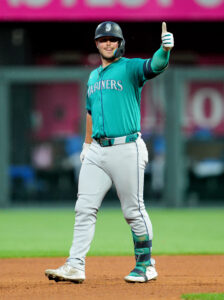
Entering the season, the notion of the Reds acquiring a first baseman would’ve seemed silly. Cincinnati had an infield surplus and a particular glut of first basemen, with Christian Encarnacion-Strand, Spencer Steer and offseason signee Jeimer Candelario all standing as options at the position. However, Encarnacion-Strand’s season ended early due to wrist surgery, while Steer has seen significant time in the outfield. Candelario has spent much of the year at third base but has been at first base more frequently since Noelvi Marte returned from an 80-game PED suspension. France figures to slide in at first base — certainly against left-handed pitching — while Candelario could see increased time at designated hitter.
Originally drafted by the Padres, France went to Seattle alongside Andres Munoz in the 2020 trade that sent catcher Austin Nola from Seattle to San Diego. He broke out immediately with the M’s and for several seasons was one of their most productive hitters — even earning a well-deserved All-Star nod in 2022. From 2020-22, France posted a combined .285/.355/.443 batting line. He belted 42 homers despite playing in the game’s most pitcher-friendly park, adding 68 doubles and three triples along the way. He didn’t walk much (6.5%) but also went down on strikes in only 16.7% of his plate appearances.
France’s bat took a step back in 2023, when he hit .250/.337/.366 with a dozen homers. His bat-to-ball skills remained strong, however, and his batted-ball metrics remained in line with those that he’d posted during that strong 2020-22 run. A dip in his homer-to-flyball rate was at least partially to blame, and the Mariners tendered France a contract despite the down year, understandably betting on his track record and the ostensibly fluky nature of his ’23 downturn.
The rebound the M’s had expected never manifested, unfortunately, and this year’s struggles are more alarming. France’s contact skills have dipped noticeably. After making contact on 91.2% of pitches in the strike zone in the three preceding seasons, his contact rate on balls in the zone has dropped to 87%. He’s chased off the plate less but also swung less in general as well, dropping from a 52.5% swing rate to a 48% mark. As he’s gotten more passive and made contact in the zone less often, pitchers have attacked him more (58% first-pitch strike rate in 2021-23; 61.2% in ’24). The change in approach hasn’t worked out, as France’s strikeout rate has spiked to a career-worst 24.4%.
The Reds, in dire need of an offensive jolt, will send a low-level catching prospect to the Mariners in hope of turning France around. He’ll move from one of the worst settings for a hitter (Seattle’s T-Mobile Park) to one of the best (Cincinnati’s Great American Ball Park) — and that swap alone should help France in the power department. The Reds will hope that the change in scenery and some new coaching input and new data from their front office can help France get back to his prior form. They’ve received an awful .215/.266/.363 slash from their first basemen this season, so France will have a low bar to clear when it comes to providing an upgrade..
If France is indeed able to return to form — or at least more closely approximate his peak form — he’ll be a multi-year option for Cincinnati. He’s not currently signed to a contract for the 2025 season but is arbitration-eligible one final time this winter. The Reds would owe him a raise on this year’s $6.775MM salary, though his early struggles in Seattle should tamp down the weight of any salary increase and keep him shy of $10MM. If not, France would be a trade or (likelier) non-tender candidate in the offseason.
As for the Mariners, they’ll bring in a 21-year-old catcher who’s played parts of four seasons in the Reds’ system. Salcedo carries a .246/.347/.330 batting line in a still-small sample of 98 professional games. He’s fanned in 27.5% of his plate appearances but also walked at a hearty 11.4% clip. He’s not regarded among the Reds’ top prospects, but that sort of low-level lottery ticket return is to be expected for a veteran player on a notable salary. In the meantime, they’ll continue to give regular playing time at first base to top prospect Tyler Locklear while also scouring the market for an additional bat to add to the mix after acquiring Randy Arozarena from the Rays last week.
Ronald Blum of the Associated Press reported the specifics of the cash considerations.
Rangers Trade Michael Lorenzen To Royals
The Rangers announced Monday morning that they’ve traded right-hander Michael Lorenzen to the Royals in exchange for minor league lefty Walter Pennington. Jon Heyman of the New York Post reported shortly before the announcement that Kansas City had been showing interest in Lorenzen. Pennington is on the 40-man roster, so no corresponding moves were necessary.
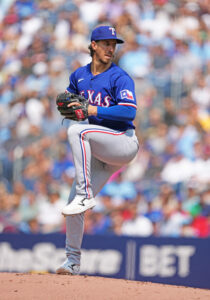
A trade of Lorenzen isn’t a signal that the third-place Rangers are punting on their season. There’s been plenty of talk over the past couple weeks that with Max Scherzer, Dane Dunning, Tyler Mahle and eventually Jacob deGrom all getting healthy, Texas could move an arm from its current rotation. Lorenzen, playing on an affordable one-year contract and slated to become a free agent at season’s end, has stood as the most obvious of the bunch to change hands. With Lorenzen headed to Kansas City, the Rangers’ rotation will include Scherzer, Nathan Eovaldi, Jon Gray, Andrew Heaney and perhaps Dunning — although Mahle is on the cusp of wrapping up a minor league rehab assignment and could take that fifth spot.
Lorenzen, 32, has pitched 101 2/3 innings with the Rangers and turned in a very solid 3.81 earned run average, although the rest of his numbers aren’t as encouraging. Lorenzen’s 17.9% strikeout rate is well below the 22.3% league average, while his 11.5% walk rate is considerably higher than the 8.2% league average. He’s kept the ball on the ground at a nice 42.3% clip, but Lorenzen has also benefited from a .243 average on balls in play and 80.7% strand rate that are both considerably better than his career marks of .279 and 74.2%. Some regression on one or both is likely.
Even with some regression, however, Lorenzen is a solid enough back-end starter. This year’s numbers are a decent approximation of who he’s been since reaching free agency three years ago and pursuing a career as a starting pitcher after previously spending five seasons in the Reds’ bullpen. Lorenzen posted a 4.20 ERA, 18.9% strikeout rate and 8.8% walk rate in 250 2/3 innings between the Angels, Tigers and Phillies over the 2022-23 seasons. Add in this year’s work and he’s at a 4.09 ERA with strikeout and walk rates that are worse-than-average but not egregiously so.
That’s a good indication of what to expect moving forward for the Royals, and Lorenzen has shown some flashes of higher output at times. His first two starts following a trade to the Phillies last summer will always be memorable for Phils fans; he tossed eight innings of two-run ball in his team debut and followed it up with a no-hitter against the Nationals his next time out, in his home debut at Citizens Bank Park. However, Lorenzen faded down the stretch, as he was pushing to a career-high innings workload (and also tossed a career-high 124 pitches in that no-hitter). The Phils moved him to the bullpen late in the season.
Kansas City’s rotation is generally full, with Cole Ragans, Seth Lugo, Brady Singer, Michael Wacha and Alec Marsh representing a sound one through five. Marsh has been hit hard after a solid start to the season, however, yielding a 6.37 ERA over his past 10 starts. He’s had a few solid outings mixed in throughout that stretch, but since May 27 he’s given up at least three runs in eight of his 10 starts (and at least four in six of them).
Lorenzen could step into that rotation spot, perhaps pushing Marsh to the bullpen or even to Triple-A Omaha. Lorenzen has already pitched enough innings to boost his $4.5MM base salary to $5.5MM, and he’d earn bonuses of $300K, $350K, $400K and $450K for reaching 120, 140, 160 and 180 innings, respectively. The Royals could technically use Lorenzen in the bullpen — they just saw both John Schreiber and Hunter Harvey exit their most recent game due to injury — but that’d be somewhat of a surprising usage given that they traded a big league-ready reliever who’s in the midst of a terrific Triple-A season in order to acquire Lorenzen.

Pennington, 26, will join the Rangers and give them an immediate option out of the ‘pen. The Rangers haven’t been able to find a consistently effective lefty relief option this season, but Pennington could fit that bill. Undrafted in the shortened 2020 draft, the 6’2″, 205-pound southpaw signed out of the Colorado School of Mines — and earlier this season became just the second player from that school to ever reach the majors (and the first since Roy Hartzell back in 1906).
The Royals called Pennington up for a brief debut, but he threw just two-thirds of an inning before being sent back down to Omaha. He’s been lights-out with the Storm Chasers this season, pitching to a pristine 2.26 ERA with a 32.9% strikeout rate, an 8.3% walk rate and a 52.6% ground-ball rate in 59 2/3 frames. Pennington sits 92-93 mph with a sinker, 89-90 mph with his cutter and 83-85 mph with a slider, rounding out a trio of primary offerings. More than half of his pitches this year have been sliders, and he’s held both lefties and righties in check along the way, yielding near-identical batting lines of .198/.250/.286 (to righties) and .156/.262/.278 (to lefties).
Pennington is in the first of three minor league option years. He can’t reach a full year of big league service in 2024, meaning the Rangers will control him through the 2030 season at the very least (although future optional assignments could push that free agent trajectory back even further). He makes for a potential long-term option in the Texas bullpen — a nice pull for a rental starter whose spot in the rotation was in jeopardy given the sheer volume of veteran arms the Rangers have coming back from injury.
Cubs Acquire Isaac Paredes For Christopher Morel, Two Prospects
The Cubs and Rays have lined up on an eye-opening trade in advance of the deadline, as Isaac Paredes is on his way to Chicago. Christopher Morel and right-handers Hunter Bigge and Ty Johnson, comprise the three-player package heading to Tampa Bay in the other end of the deal.
Paredes has been a popular figure in trade rumors in recent days, with such teams as the Dodgers, Astros, Rangers, and Mariners all linked to the All-Star. Instead, a more surprising suitor has won the bidding, as Paredes will instead go to a Cubs team that sits in last place in the NL Central with a 50-56 record.
Still, it isn’t entirely surprising that the Cubs have made such a bold move, as the team is clearly aiming to contend in 2025 after stumbling to their disappointing result this year. President of baseball operations Jed Hoyer said earlier this week that the Cubs’ deadline moves would be made with an eye towards competing next season as opposed to making a late run now, though Paredes is certainly a boost to Chicago’s lineup right now.
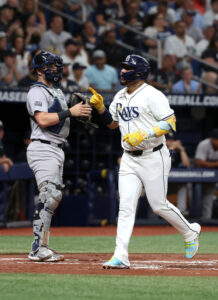 There are also some long-term ties at play, since Paredes began his pro career as an international signing for the Cubs back in 2015. He was moved along with Jeimer Candelario to the Tigers at the 2017 deadline in the trade that brought Alex Avila and Justin Wilson to Chicago, and Paredes made his MLB debut in a Detroit uniform in 2020.
Acquired in a trade with the Tigers early in the 2022 season, Paredes emerged as a very productive regular over his three years in Tampa. He has a 129 wRC+ over his 1377 plate appearances in a Rays uniform, highlighted by a 31-homer season in 2023 and an All-Star appearance this year. Despite a recent slump, Paredes is still hitting .247/.355/.438 with 16 home runs this season, across 425 PA while getting regular work at both corner infield spots.
Most of that work came at third base, and Paredes figures to take right over from Morel at the hot corner at Wrigley Field. Paredes’ glovework as a third baseman has been more solid than outstanding, yet even average defense is a big upgrade from Morel, whose struggles in the field have been well documented. The right-handed hitting Paredes could also spell Michael Busch (a lefty-swinger) at first base when a tough southpaw is on the mound, and Paredes also has a good deal of experience at second base, even though the Rays have used him only in the corner infield spots in 2024. On paper, however, the Cubs already have their 2025 starting infield set, with Paredes at third base, Busch at first, Nico Hoerner at second base, and Dansby Swanson at shortstop.
Infielders Matt Shaw and James Triantos are two of Chicago’s top prospects, so their arrival in a year or two could further shake up the Cubs’ infield picture and perhaps where Paredes ultimately ends up around the diamond. In perhaps the key element of today’s trade, the Cubs have plenty of time to figure this all out, as Paredes is under arbitration control through the 2027 season. Paredes is earning a $3.4MM salary this year, in the first of four arb-eligible seasons via his Super Two status.
Even though Paredes was only just starting his trips through the arb process, that escalating price tag surely factored into the Rays’ decision to part ways with a controllable, productive player who is still just 25 years old. With payroll always a concern in Tampa, the Rays have never shied away from selling high on a player before his price tag becomes too onerous for the organization, as part of the Rays’ constant churn of replacing pricier players for cheaper options that can provide similar or better production.
This strategy has been on full display since the start of July, as Tampa Bay has now moved Paredes, Randy Arozarena, Jason Adam, Zach Eflin, Aaron Civale, and Phil Maton in the last four weeks. This blitz of trades figures to continue right up until the July 30th deadline, and such names as Yandy Diaz and Pete Fairbanks have also been mentioned as potential trade candidates. All of these moves have come despite the fact that the Rays are still playing solid baseball, as their 54-52 record has them only 3.5 games out of the final AL wild card berth.
Star prospect Junior Caminero has been expected to receive a longer look in the big leagues at this point this season, and very well could have been called up already if his minor league season hadn’t been interrupted by injuries. With Paredes traded, Caminero now has a clear path to regular playing time at third base, so it wouldn’t be surprising to see Caminero in Tampa Bay later this week once the dust has fully settled from the team’s deadline moves.
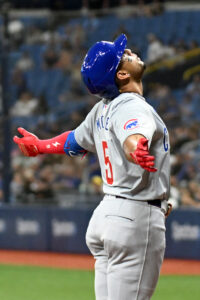 Morel is only in his third Major League season, but he has thus far played at every position except first base and catcher as the Cubs have tried to find a suitable way to get Morel’s bat into the lineup. Second base could be a more viable option for Morel now that he is no longer blocked by Hoerner, or the Rays could cycle him into their first base/DH mix as well.
Perhaps the first order of business is getting Morel’s bat on track, as he has hit only .199/.302/.374 with 18 homers in 420 PA this season. Between this 93 wRC+ and his tough defensive number, Morel has been a sub-replacement level player in 2024, with a -0.1 fWAR. It is an unfortunate setback for the 25-year-old, who hit a much more respectable .241/.311/.471 with 42 homers in his first 854 MLB plate appearances.
There is probably always going to be a lot of swing-and-miss in Morel’s game, but even being a “three true outcomes” type of player has plenty of utility if Morel can keep drawing walks and putting the ball over the fence. The Rays are also surely thinking that a change of scenery could benefit Morel, or perhaps that the team’s own staff can help him unlock some greater potential (as has been done with Paredes and a number of other hitters who can come through Tampa’s organization).
Bigge was a 12th-round pick out of Harvard in the 2019 draft, and he made his MLB debut just this month, amassing a 2.70 ERA in his first 3 1/3 innings (over four appearances) in the Show. Bigge has worked only as a reliever in his pro career, and delivered a 4.25 ERA across 159 innings in the minors, with a big 30.42% strikeout rate but also a 15.06% walk rate.
The control is the biggest obstacle preventing Bigge from fully realizing his potential, as MLB Pipeline rates his cutter, slider, and his upper-90s fastball all as plus pitches, and his curveball also has promise. However, Pipeline puts Bigge only 29th in their ranking of Chicago’s prospects, with those control problems in mind. Bigge has so much tantalizing stuff that it is easy to see why the Rays had interest, and given Tampa Bay’s history of pitching development, nobody would be surprised if Bigge becomes a dangerous bullpen weapon with his new team.
Johnson was a 15th-round pick for the Cubs in the 2023 draft, and the Ball State product has a 3.54 ERA in 61 total innings in 2024 (33 2/3 frames in A ball, and 27 1/3 innings at high-A). Starting 10 of his 18 games, Johnson has also shown some nice ability to miss bats, with a 32.5% strikeout rate in his brief pro career.
Marc Topkin of the Tampa Bay Times (X link) was the first to report that Paredes was heading to Chicago. MLB.com’s Mark Feinsand reported that the Rays were receiving Morel as part of a three-player package, and The Athletic’s Sahadev Sharma reported Bigge and Johnson as the other two players.
Photo courtesy of USA Today Sports Images
Rangers Acquire Carson Kelly
The Rangers are acquiring catcher Carson Kelly from the Tigers to fortify their catching corps. In return, Texas will ship catching prospect Liam Hicks and right-handed pitching prospect Tyler Owens to Detroit. Both teams have announced the deal.
Kelly, 30, was signed by the Tigers back in August of last year after he was designated for assignment by the Diamondbacks earlier that month. A second-round pick by the Cardinals in 2012, Kelly was a consensus top-50 prospect in the sport when he was shipped to Arizona as part of the return for then-franchise face Paul Goldschmidt prior to the 2019 season. The first three years of Kelly’s tenure in Arizona went solidly enough, as he paired strong work behind the plate with a collective .239/.333/.435 slash line that was good for a league average wRC+ of 100. Kelly took a step back in 2022, however, and his 2023 season with the Diamondbacks was nothing short of abysmal as he hit just .226/.283/.298 in 32 games backing up Gabriel Moreno before being DFA’d.
While Kelly did not immediately show signs of improvement upon joining the Tigers for the stretch run last year, instead hitting a paltry .173/.271/.269 in 18 games, Detroit brass still saw fit to pick up a $3.5MM club option on his services for the 2024 campaign back in November. That decision has since proven to be a wise one, as Kelly has emerged as the club’s primary catcher this year. At the plate, he’s slashed a solid .242/.327/.393 (106 wRC+) with a 19.3% strikeout rate that would be his best in a full season. Meanwhile, he’s received excellent marks from Statcast for his work behind the plate this year including elite grades for his blocking and control of the running game in addition to above-average framing numbers. That strong all-around profile combined with the low financial cost of his remaining salary figured to make Kelly one of the more attractive catching options on the market this summer.
For the Rangers, the addition of Kelly should fortify a position that has been somewhat disappointing for the club this year. After an All-Star campaign in 2023, Jonah Heim has taken a step back offensively this year and is hitting just .234/.281/.346 (75 wRC+) in 90 games, while backup Andrew Knizner has been nothing short of disastrous offensively. In 37 games with the Rangers this year, Knizner has slashed just .167/.183/.211 with a wRC+ of 4, indicating he’s been 96% worse than the league average hitter this year. The addition of Kelly should provide the club with a substantial upgrade over Knizner in their catching tandem while simultaneously allowing the Rangers to lighten the workload of Heim as he works through his struggles and looks to recapture the form that made him one of the league’s most valuable backstops last year.
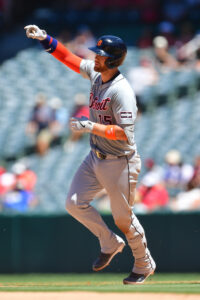
In order to add Kelly to their lineup, the Rangers are parting with a pair of prospects playing at the Double-A level this year. Owens is perhaps the more notable name of the two, as it’s the second time he’s been traded this year. The righty was acquired by the Rangers back in January as part of the deal that sent outfielder J.P. Martinez to Atlanta. The Braves’ 13th-round pick in the 2019 draft, Owens sports an upper-90’s fastball alongside a slider and a cutter but has typically struggled with command throughout his career. A strong 2024 may be helping to assuage some of those concerns, however, as the righty has pitched to a strong 2.80 ERA in 35 1/3 innings of work as a multi-inning reliever for the Rangers at the Double-A level. He’s struck out a respectable 24.5% of batters faced while walking just 6.5%, and it’s not hard to imagine the 23-year-old pitching in Triple-A for the Tigers before the season comes to an end.
Alongside Owens, the Tigers are also adding Hicks, a Double-A catcher who has shown considerable on-base ability at every level throughout his career. After tearing up the Arizona Fall League to the tune of a .449/.553/.522 slash line in 85 trips to the plate last autumn, Hicks has kicked off his age-25 season by posting a solid .364 on-base percentage in 80 games in a return to the Double-A level. A career .264/.380/.360 hitter in Double-A, Hicks’s lack of power production and lackluster grades from scouts behind the plate have tended to keep him on the fringes of most organizational top 30 lists, but it’s not hard to imagine him being useful catching depth for the big league club in the near future.
Kelly’s departure likely opens up a big league catching job for Dillon Dingler, the club’s #10 prospect according to Baseball America. Dingler receives strong grades for his work behind the plate and has flashed 20-homer power in the minor leagues but entered the 2024 season with serious questions about his contact abilities after striking out 30.7% of the time across parts of three seasons at the Double-A level. Dingler struggled badly in a brief promotion to Triple-A late last year but returned to the level in 2024 and has looked much better at the plate, posting an excellent .308/.379/.559 slash line with a 137 wRC+ and a 20.3% strikeout rate against a 10% walk rate. Dingler’s improved offensive numbers should be enough to earn him considerable playing time in the majors behind the plate as part of a tandem with Jake Rogers, who has struggled to a 68 wRC+ in 64 games this year but has posted excellent defensive numbers.
Ken Rosenthal of The Athletic first broke the news of Kelly’s trade to the Rangers. Evan Petzold of the Detroit Free Press reported the return of Hicks and Owens headed to Detroit.
Image Courtesy of USA Today Sports.
Padres To Acquire Jason Adam From Rays
The Padres acquired right-hander Jason Adam from the Rays in exchange for three prospects, per announcements from both clubs. The Padres are sending righty Dylan Lesko, outfielder Homer Bush Jr. and catcher J.D. Gonzalez to Tampa. The Friars designated right-hander Glenn Otto for assignment to open a roster spot while the Rays reinstated Jeffrey Springs from the 60-day injured list to take Adam’s spot.
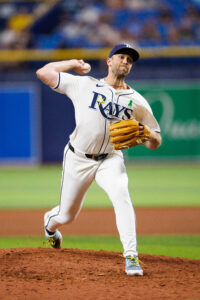
Like so many other players before him, Adam bounced around the league before finally becoming his best self in Tampa. He was drafted by the Royals back in 2010 and subsequently spent time in several organizations, including the Padres, as well as the Twins, Blue Jays and Cubs. He was non-tendered by the Cubs after 2021, at that point sitting on a 4.71 earned run average through 78 1/3 major league innings. He had struck out 27.9% of batters faced but also given out walks at a high rate of 11.4%.
The Rays signed him going into 2022 and he has taken his game to another level since then. He made 170 appearances as a Ray with a 2.30 ERA, 30.4% strikeout rate, 8.3% walk rate and 44.7% ground ball rate. He has 24 saves and 51 holds in that time. That includes 47 appearances this year with a 2.49 ERA. His 27.8% strikeout rate in 2024 is a few ticks below recent years but his 47.3% ground ball rate is a personal best.
All contending clubs are looking to bolster their bullpens at this time of year and that’s especially true of the Padres. Their relief corps has a combined ERA of 4.19, which places them in the bottom third of the league. They’ve received good results from Robert Suarez, Jeremiah Estrada, Yuki Matsui and others but guys like Wandy Peralta and Enyel De Los Santos have struggled, with Peralta currently on the injured list.
Adding Adam and his skills to that relief group is understandably appealing, as is his modest salary. Though he turns 33 years old next month, his long journey to being established at the major league level has led to him having a delayed path to notable earnings. He qualified for arbitration for the first time going into 2023 as a Super Two player and made $1.775MM last year, getting a modest bump to $2.7MM here in 2024. He is eligible for two more arbitration seasons before he’s slated for free agency after 2026.
The Padres had to make significant salary cuts in the offseason, which led to Juan Soto getting trading to the Yankees. They have still attempted to field a competitive team here in 2024 and have succeeded. They are currently on a seven-game winning streak that has bumped them to 57-50 and possession of a National League Wild Card spot. But they seemingly want to avoid the competitive balance tax this year and are currently on pace to do so.
RosterResource calculates their CBT number at $225MM, roughly $12MM away from the $237MM base threshold. That appears to give them a decent amount of wiggle room but that’s an unofficial estimate. Adam has less than a $1MM left to be paid out this year, so he will only marginally increase San Diego’s CBT number, perhaps leaving the front office room for further moves.
The Rays aren’t buried in the standings but have decided to do some selling this year anyway, seemingly due to a combination of strong depth as well as a seller’s market. Their record is currently 53-52, just four games out of a playoff spot, yet they have already traded multiple established big leaguers for younger talent. They have sent Zach Eflin to the Orioles, Aaron Civale to the Brewers, Randy Arozarena to the Mariners and now Adam to the Padres.
They still have a chance to compete down the stretch but have not been shy about making these kinds of moves, seemingly content to add some young talent and save some money while trying to backfill the lost talent from within their own system. With Springs, Shane Baz and Drew Rasmussen nearing returns from elbow surgeries, they had readymade rotation replacements. Baz came up to take Civale’s spot and Springs is about to do the same for Eflin. Arozerena’s playing time can be given to guys like Richie Palacios or Jonny DeLuca, while the club always has intriguing bullpen arms on hand and can likely put together a solid relief corps even without Adam.
Lesko, 20, is viewed as the most intriguing part of their return in this deal. The Padres selected him 15th overall in 2022 and he has received plenty of love from prospect evaluators since then. His time in the minors has seen him miss plenty of bats but also the strike zone. He has thrown 69 2/3 innings over 16 starts at the High-A level this year with a 6.46 ERA. He has struck out 25% of batters faced but walked 16.5% of them.
Despite the control issues, he is still considered one of the better prospects in the league. FanGraphs currently lists him #88 overall and MLB Pipeline #76. Baseball America had him #38 overall coming into the year but he’s no longer on the top 100 and was recently bumped to #5 in the Padres’ system. Perhaps the Padres are moving on from a prospect that they have soured on or they have simply accepted this as the price of getting a quality reliever who is affordable and controllable. Either way, Tampa has a strong reputation of getting the best out of players and could perhaps get Lesko back on track in the years to come.
Bush is naturally the son of former big leaguer Homer Bush. The younger Bush was a fourth-round pick of the Padres last year. He is a speed-and-defense specialist with a contact-based approach at the plate. In 130 minor league games, he has seven home runs, a 9.5% walk rate and 15.7% strikeout rate, leading to a line of .290/.383/.379. He also has 65 steals in 76 tries. BA currently ranks him 12th in the Padres’ system.
Gonzalez was a third-round pick last year and BA currently ranks him #8 in the system. He is only hitting .205/.322/.230 in Single-A this year but is projected to potentially be a two-way player from behind the plate someday.
Otto was claimed off waivers in September. He began the year on the injured list with a right teres major strain. He began a rehab assignment in early June and was optioned later that month. He has tossed 15 1/3 innings in the minors this year with a 7.63 ERA. The Friars will have a few days to consider trades or put him on waivers.
The Padres have made a notable upgrade to their bullpen for the stretch run but surely aren’t done. Bob Nightengale of USA reports on X that they are now going to turn their attentions to the rotation. The Rays have already made a number of future-focused moves but could perhaps consider more, with players like Pete Fairbanks, Brandon Lowe and Yandy Díaz candidates to go in the coming days.
Robert Murray of FanSided first reported that Adam was heading to the Padres on X. Kiley McDaniel of ESPN reported Lesko’s inclusion on X. Jeff Passan of ESPN reported on X that Bush and a third prospect were also going to Tampa. Joel Sherman of The New York Post first relayed Gonzalez on X.
Kodai Senga Likely To Miss Rest Of Regular Season Due To “High Grade” Calf Strain
TODAY: Senga has been moved to the 60-day injured list to open up a 40-man roster spot for Jesse Winker, who was officially acquired from the Nationals. Sept. 25 is now the earliest that Senga is eligible to return to action, but by all accounts his 2024 season seems to be over.
SATURDAY, 12:46PM: Senga has a “high grade” calf strain and isn’t likely to pitch again during the regular season, manager Carlos Mendoza told ESPN’s Jorge Castillo (X link) and other reporters. There is a rough recovery timeline of 8-10 weeks, so it is possible Senga might be available should the Mets make a postseason run.
11:24AM: Kodai Senga‘s first start of the 2024 season was cut short by injury, and the Mets announced today that the right-hander has been placed on the 15-day injured list due to a left calf strain. Righty Eric Orze was also optioned to Triple-A Syracuse, and the two roster spots will be filled by Tylor Megill (called up from Triple-A) and new arrival Ryne Stanek (acquired yesterday in a trade with the Mariners).
After suffering a capsule strain in his shoulder during Spring Training, Senga’s recovery was delayed by some mechanical adjustments and then a triceps injury, pushing his season debut back to last night’s game against the Braves. Despite the long layoff, Senga was looking sharp, and finished the start with two earned runs on two hits and a walk over 5 1/3 innings of work. Unfortunately, that final out of Senga’s start saw the righty fall to the ground while leaving the mound during an Austin Riley pop-up, and Senga very gingerly walked off the field after consulting with team trainers.
Senga was scheduled to undergo an MRI today, and the results of that scan have now led to this immediate placement on the 15-day IL. More details on the severity of the strain will likely be revealed later today, though from the admittedly non-scientific method of looking at the obvious pain on Senga’s face in the aftermath of the injury, one would suspect he’ll be missing longer than just 15 days. Depending on the nature of the strain, it isn’t out of the question that Senga’s season could be in jeopardy.
Even if Senga is able to pitch again in 2024, the calf strain is another brutal setback in what has been a frustrating sophomore season for the righty in Major League Baseball. The longtime NPB star came to the majors with much fanfare when he signed a five-year, $75MM free agent deal with New York during the 2022-23 offseason, and immediately delivered on the hype by posting a 2.98 ERA over 166 1/3 innings in 2023. Amidst an otherwise hugely disappointing season for the Mets, Senga’s quick impact at least provided some hope that the franchise might be able to turn things around in relatively short order.
Ironically, the Mets have indeed gotten on track this year, except with virtually no contributions from Senga apart from Friday’s start. The rotation has been something of a weak link in general due to injuries, though the group of Sean Manaea, Luis Severino, and Jose Quintana have been solid if unspectacular. Senga’s return was supposed to add an ace alongside that trio, but New York has now been bit again by the injury bug, between Senga’s calf strain and Christian Scott‘s UCL strain.
Megill or Jose Butto could get another look in the rotation with Senga out, as Adrian Houser is probably no longer an option after being designated for assignment earlier this week. With the Mets increasingly looking like legitimate contenders, the trade deadline presents an obvious route for the Amazins to bring a new starter into the fold, though naturally such deals are difficult to find. Any new pitchers will add to New York’s already immense luxury tax bill, and president of baseball operations David Stearns might not be too keen on trading significant talent from the farm system.
Brewers Reinstate Devin Williams From 60-Day Injured List
Devin Williams is finally ready for his 2024 debut, as the Brewers are reinstating the star closer from the 60-day injured list. Right-hander Janson Junk was designated for assignment to open up a spot for Williams on the 26-man and 40-man rosters.
An MRI during Spring Training revealed that Williams had two stress fractures in his back, and after a long period of recovery, he is set to return to a big league mound. Williams has logged four minor league rehab outings this month, tossing four scoreless innings during these last tune-ups. Despite his long layoff, this was apparently all the rehab work Williams and the Brewers felt was necessary, and he figures to see some action in today’s game with the Marlins.
With the trade deadline on Tuesday, Williams’ return counts as an unofficial sort of midseason acquisition for the first-place Brewers. Even without their All-Star closer available, Milwaukee’s relief corps has still been one of the more effective units in the game, ranking third in bullpen ERA heading into Sunday’s action. Trevor Megill has posted a 2.41 ERA and 20 saves in Williams’ absence, but he’ll now drop back into a setup role as Williams returns to ninth-inning work.
Bryan Hudson has also been a key piece of the Brewers’ pen, but since he was just sidelined due to an oblique injury, Williams should be a more than suitable replacement. The Crew also acquired righty Nick Mears from the Rockies in a trade yesterday, further bolstering the relief corps for the stretch drive and (the Brewers hope) into October.
Williams made his MLB debut in 2019, delivering a 3.95 ERA over his first 13 2/3 innings of big league ball. After that respectable start to his career, the right-hander has been nothing short of tremendous, posting a sterling 1.75 ERA and a stunning 40.5% strikeout rate over 200 1/3 innings since the start of the 2020 season. An 11.7% career walk rate and a lack of premium velocity are issues, but Williams has otherwise been one of the game’s best at inducing soft contact and missing bats. Initially acting as the Brewers’ setup man behind Josh Hader, Williams has seamlessly transitioned into the closer’s job after Hader was dealt at the 2022 trade deadline.
The Brewers acquired Junk from the Angels as part of the Hunter Renfroe trade in November 2022, and the righty has a 5.87 ERA over 15 1/3 innings and seven overall appearances in a Milwaukee uniform. He spent almost all of the 2023 season in the minors and has been shuttled back and forth between Milwaukee and Triple-A Nashville this year.
Working mostly as a starter during his pro career, Junk was deployed primarily as a multi-inning reliever this season. Though Junk has only a 6.75 ERA in his eight innings of MLB work in 2024, his 2.55 ERA across 35 1/3 innings in Nashville indicates that he may have unlocked something with this semi-permanent move to the bullpen. This could make him a candidate to be claimed away by a team in need of bullpen innings, but if Junk does clear waivers, he doesn’t have the ability to reject an outright assignment. It also stands to reason that the Brewers could try and work out a trade involving Junk prior to the July 30 deadline.
Mets Acquire Jesse Winker
7:47AM: The trade has been officially announced.
TODAY, 7:25AM: The Nationals will be acquiring right-handed pitching prospect Tyler Stuart in the trade, The Athletic’s Will Sammon reports (via X). Stuart was a sixth-round pick in the 2022 draft, and he has a 3.96 ERA, 25.4% strikeout rate, and 5.6% walk rate in 84 innings for Double-A Binghampton this season. The 6’9″ righty was a reliever at Southern Miss but has worked almost exclusively as a starter in his pro career, and MLB Pipeline (which ranks Stuart 17th in the Mets’ farm system) feels he’ll need to develop a third pitch beyond his solid slider and 94mph fastball in order to stick as a starting pitcher.
YESTERDAY: The Mets are poised to acquire outfielder Jesse Winker from the Nationals, according to ESPN’s Jeff Passan. As noted by Andrew Golden of The Washington Post, the deal is currently in place pending a physical. The return headed to D.C. in exchange for Winker’s services is not yet known.
Winker, 31 next month, was a first-round pick by the Reds back in 2012 and posted excellent numbers across five seasons with the club. From 2017 through 2021, Winker slashed .288/.385/.504 with a 132 wRC+ as the club’s regular left fielder, though he was generally protected from left-handed pitching during his years in Cincinnati. Even as he typically sat against southpaws, however, Winker’s ability to mash right-handed pitching earned him an All-Star nod back in 2021 when he posted a 148 wRC+ in 485 trips to the plate. Following the 2021 season, Winker found himself dealt to Seattle alongside Eugenio Suarez in a blockbuster that sent Justin Dunn, Jake Fraley, and Brandon Williamson to Cincinnati.
Upon departing the Reds, however, Winker began to struggle. A down season in Seattle where he posted a wRC+ of just 108 alongside a career-low isolated slugging percentage led the Mariners to deal Winker back to the NL Central following the 2022 campaign, this time alongside Abraham Toro in order to land second baseman Kolten Wong from the Brewers. Winker’s time in Milwaukee represented a low point for him, as he battled neck injuries and struggled badly when healthy enough to take the field. While Winker walked at his typically strong 13.2% clip with the Brewers, he hit .198 while mustering just one home run in 197 trips to the plate, leaving him with a 65 wRC+ that was 35% worse than league average last year.
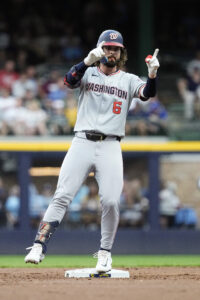 That disastrous 2023 campaign led Winker to sign with the rebuilding Nationals on a minor league deal in his first trip through free agency last winter, and Winker found himself selected to the club’s Opening Day roster. While splitting time between left field and DH for the Nationals, Winker has rebounded back to the level of offense that was standard for him in his days with the Reds. In 100 games with Washington this year, he’s hit an impressive .253/.372/.417 with 11 home runs, 14 stolen bases, and a fantastic 14.1% walk rate in 376 trips to the plate this year.
Winker’s production still comes predominantly against right-handed pitching, against whom he sports a 138 wRC+ on the year, but he’s improved substantially against southpaws this year to post a roughly average 93 wRC+ against them. That’s a major step up from his career year in 2021 when he posted a wRC+ of just 57 against lefties.
For the Mets, Winker appears unlikely to be an everyday player given the presence of J.D. Martinez as the club’s regular DH and Brandon Nimmo patrolling left field on an everyday basis. With usual center fielder Harrison Bader currently dealing with an ankle injury, it’s possible that Winker could see some starts in left field with Nimmo sliding over to center while Bader is injured. Both Nimmo and Winker also have sporadic experience in right field through their careers as well, meaning the Mets could look to install each into an outfield corner on either side of Bader while Starling Marte is on the injured list in a move that would likely push Jeff McNeil either out of the lineup or back onto the infield dirt.
Regardless of how often Winker figures to be in the Mets lineup, he’s sure to provide a boost to the club’s offense. DJ Stewart is currently being utilized as a defensively-limited bat off the bench in Queens but has delivered a wRC+ of just 95 with a .674 OPS against right-handed pitching. Winker’s 128 wRC+ and .834 OPS against right-handers both clear those marks easily, and it’s easy to imagine Winker being used in a similar role to the one Stewart has accumulated 184 trips to the plate in this year while bouncing between DH, the outfield corners, and even first base as needed.
Photo courtesy of USA Today Sports Images