
Garrett Crochet Rumors: Deadline Day
White Sox ace Garrett Crochet has been the hottest name on the trade market this month, both because of the Sox’ own failed attempt to extend him and because his camp has since indicated that the left-hander wants an extension before pitching in October for a new club. Crochet’s 114 1/3 innings this season have already eclipsed his prior career total. He’s said to be against a move to the bullpen, believing that staying on a starter’s routine is best for his health, and aiming for financial security before pushing his workload even deeper into postseason waters.
It’s rubbed many fans the wrong way to see such a business-like approach, and it’s taken many in the industry aback — White Sox GM Chris Getz included, apparently. Via Sox Machine’s James Fegan, Getz spoke with reporters yesterday and acknowledged that he was “surprised and taken back” by how Crochet’s camp handled the situation, particularly as he’d had a conversation with the left-hander’s agent at CAA just the night before.
“I think most fans and even players without knowing everything, it makes sense,” said Getz. “We understand why a stance would be taken. Now how you go about expressing that is what was a bit hurtful, quite honestly, considering I felt like we could have handled it a little bit differently and still I think everyone accomplished what they wanted to accomplish. … But Garrett and I are fine, we are good. I’ll continue to be one of his top supporters. In regard to how it affects the coming days, tough to tell.”
We’ll round up today’s Crochet chatter here and break out any major developments into their own posts…
- USA Today’s Bob Nightengale reports that the White Sox have become increasingly optimistic that they’ll find someone to meet their asking price on Crochet even in the wake of his extension revelation. Per Nightengale, the Sox believe that they’ll trade Crochet between now and the 5:00pm CT deadline but expect to hang onto center fielder Luis Robert Jr. — as was reported to be the case regarding Robert just last night.
- Both Ken Rosenthal of The Athletic and Bruce Levine of 670 The Score suggest that Crochet’s market remains strong. Rosenthal lists the Padres, Dodgers, Braves, Phillies, Red Sox and Orioles as teams with varying levels of interest. Levine echoes much of that same list and quotes an executive from a rival AL club stating the relative obvious: “You don’t get a chance to find a top pitcher like that often. You must get creative.”
- The Yankees inquired on Crochet at some point but were told in those initial talks that the two parties “didn’t match up” in a trade, reports Jon Heyman of the New York Post. The Yankees could always revisit talks, particularly with so many alternative rotation options off the board. New York has been tied to Tigers righty Jack Flaherty as well, and the Yankees are seeking a rotation upgrade as they simultaneously explore the possibility of moving Nestor Cortes in a separate deal.
Astros Acquire Yusei Kikuchi
The Astros are paying up to get one of the top pitchers on the market. Houston and Toronto announced a trade sending Yusei Kikuchi to the Astros for rookie righty Jake Bloss, outfielder/first baseman Joey Loperfido and minor league infielder Will Wagner. Toronto already had ample 40-man roster space to accommodate the move.
Kikuchi is behind Jack Flaherty as arguably the second-best rental starter on the market. Houston was tied to Flaherty as well as more controllable pitchers like Jameson Taillon, Erick Fedde and Zach Eflin last week. There was never much doubt that the Astros would bring in a starter, as general manager Dana Brown hasn’t been shy about the team’s need for a mid-rotation arm. The asking price on Flaherty always seemed like it might be beyond Houston’s comfort zone, making Kikuchi a sensible fallback.
The 33-year-old Kikuchi has had mixed results this season and throughout his career more broadly. Over 115 2/3 innings this year, he carries a 4.75 ERA that’s right in line with his 4.72 mark in parts of six MLB campaigns. Kikuchi’s strikeout and walk profile is quite a bit more impressive than that run prevention figure suggests. He has punched out 26.2% of opposing hitters while walking only 6% of batters faced. Among pitchers with 100+ innings, Kikuchi ranks 19th in strikeout percentage and 16th in strikeout/walk rate differential. He’s getting swinging strikes at a 12.4% rate that places him among the top 30 in that group.
A .340 average on balls in play and modest 70.6% left on base rate have nevertheless pushed his ERA close to 5.00. Those marks were nearer to league average in 2023, when the Japanese southpaw turned in a 3.86 ERA over 32 starts with similar strikeout and walk rates as he’s posted this season. Houston is betting on positive regression in those sequencing and batted ball results.
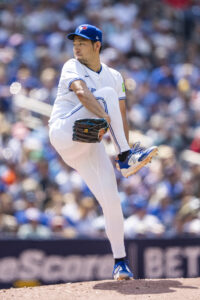
Teams have long been intrigued by Kikuchi, who boasts some of the best raw stuff of any left-hander in baseball. His fastball sits north of 95 MPH and he has the ability to miss bats with all four of his offerings (four-seam, curveball, slider, changeup). Kikuchi has had a difficult time keeping the ball in the park throughout his MLB career, though. He’s allowing homers at an elevated 1.32 clip per nine this season and has given up more longballs than the average pitcher in every full season of his major league tenure. Right-handed batters have generally given him trouble, though he’s holding them a more manageable .280/.323/.441 slash in 409 plate appearances this year.
While Kikuchi isn’t without flaws, he’s a plug-and-play option for the middle of a Houston rotation that certainly needed one. The Astros have been hit hard by starting pitching injuries all year. They lost Cristian Javier and José Urquidy to Tommy John surgery. Depth starter J.P. France went down with a season-ending shoulder issue. Justin Verlander has had two injured list stints and has been shelved since the middle of June because of neck soreness. Lance McCullers Jr. has hit continued snags in his effort to return from a flexor tendon surgery. They had to slow down Luis Garcia in his work back from Tommy John surgery, though he’s again throwing bullpen sessions after being pulled off a minor league rehab stint earlier this month.
Framber Valdez is leading the rotation and has a 3.43 ERA over 18 starts. Hunter Brown has bounced back from a disastrous April and pitched like a top-of-the-rotation arm for the last three months. Ronel Blanco has been a godsend after injuries pushed him into the fifth starter role out of camp. He carries a 2.95 ERA across 119 frames.
While that’s a decent top three, the depth is questionable. Spencer Arrighetti has a 5.58 ERA over his first 19 MLB starts. Houston had pushed Bloss to the majors within a year of drafting him, largely reflecting their lack of alternatives in the upper minors. The Astros are hoping to get Verlander and Garcia (and potentially McCullers) back at some point, but they’ve also pushed Blanco to new workload heights. The 30-year-old righty had never thrown more than 88 innings in a major or minor league campaign before this year. He’s already 31 innings beyond that.
Kikuchi, who hasn’t missed a start in two years, has provided the kind of durability that the Astros have generally lacked. There’s injury risk with any pitcher, of course, but the Astros are no doubt thrilled to land a pitcher who is tied for fifth in MLB in starts going back to last year’s Opening Day.
Doing so comes at a cost. Bloss is arguably the top pitching prospect in a fairly thin Houston farm system. A third-round pick out of Georgetown last summer, the 6’3″ righty quickly pitched his way towards the top of the prospect pipeline. Baseball America recently ranked him the #2 prospect in the organization, while he’s in the overall Top 100 (and second in the organization) at FanGraphs.
BA suggests he’s likely to fit at the back of a rotation, while FanGraphs credits him with mid-rotation potential. Both outlets write that his mid-90s fastball plays especially well at the top of the strike zone because of its backspin and Bloss’ deceptively low release height. He has a pair of solid breaking pitches, while his changeup is a work in progress.
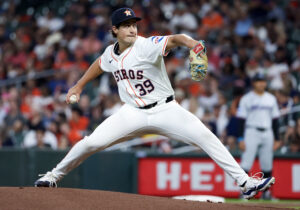
Opponents have hit him hard over his three big league starts. He has given up nine runs on 16 hits (including five homers) over 11 2/3 innings. Were it not for Houston’s injury woes, he probably wouldn’t have made his MLB debut yet. Bloss has pitched very well in the minors this season, working to a 1.64 ERA with a 25.6% strikeout rate across 66 innings. Yet he’d made all of eight starts at Double-A and one Triple-A appearance before being pushed to the big leagues out of necessity. A more typical development path would probably still have him at Double-A right now.
Bloss has all three options remaining. The 23-year-old is under control for at least six seasons beyond this one and could stick around even longer if the Jays send him to the minors for further development. Bloss could factor into next year’s rotation as the Jays try to quickly return to contention, maybe slotting into the rotation spot vacated by Kikuchi’s departure.
Getting Bloss alone would’ve been a strong return for a half-season of Kikuchi’s services. Loperfido, 25, ranked as Houston’s #5 prospect on BA’s latest update. A seventh-round selection out of Duke in 2021, he hit his way to the big leagues earlier this year. Loperfido combined for a .278/.370/.510 slash between three minor league levels last season. He was obliterating Triple-A pitching early this season and owns a .272/.365/.568 mark with 13 homers over 39 games in the Pacific Coast League this year.

Of course, the PCL is an extremely favorable environment for hitters. BA’s scouting report credits Loperfido with above-average but not elite power. He was striking out an elevated 28% clip against Triple-A pitching. The whiffs have carried over in his first look at MLB arms. Loperfido has fanned in 36.4% of his 118 MLB plate appearances to date. He’s hitting .236/.299/.358 in 38 games.
Loperfido isn’t a great athlete or defensive player. He was drafted as a second baseman but he’s moved off the position entirely this year. Houston has divided his time between the outfield and first base in Triple-A. They haven’t given him any major league starts at first base, which is a bit of a surprise considering the mediocre production they’ve gotten out of the position from Jon Singleton and the since-released José Abreu.
Wagner is the third piece in the deal, but he’s a prospect in his own right. The son of seven-time All-Star Billy Wagner, Will ranks 19th in the Houston system at Baseball America. A former 18th-round pick out of Liberty, Wagner has outperformed his draft stock and is posting huge numbers in Triple-A. He’s hitting .307/.424/.429 with a massive 16.2% walk percentage against a tiny 10.2% strikeout rate across 324 plate appearances.
The left-handed hitting Wagner is old for the level — today is his 26th birthday — but he has little more to prove in the minors. He has divided his time between first, second and third base this year. He’d be eligible for the Rule 5 draft this winter if not selected onto the 40-man roster but could get a look in Toronto before the end of this season.
That’s three controllable players at or near the MLB level. The Astros were fine giving them up while they’re in a tight battle with the Mariners and Rangers for the AL West crown. Beyond the prospects, they’re adding salary to what is already a franchise-high payroll. The Astros had a competitive balance tax estimate around $256MM before the deal (as calculated by RosterResource). Unless there are cash considerations involved, they’ll take on roughly $3.33MM remaining on Kikuchi’s $10MM salary. That pushes them beyond the $257MM threshold that marks the second tier of luxury penalization. They’re taxed at a 32% rate on spending up to $277MM, so they’ll take on roughly $1MM in taxes on top of the money they owe Kikuchi.
Toronto sheds some money from its tax ledger — more than the Astros are taking on. Kikuchi’s three-year, $36MM free agent deal was frontloaded to pay him $16MM in the first season. Toronto’s competitive balance tax hit was nevertheless the contract’s $12MM average annual value, so Kikuchi had a higher CBT hit than actual salary this year.
When a player on a guaranteed contract is traded, the CBT ledger is recalculated based on the salary remaining at the time of the trade. The Astros assume the prorated amount of a $10MM salary while the Jays drop the prorated portion of the $12MM for which Kikuchi had counted against their books — approximately $4MM. That could aid them in trying to slip below the $237MM base threshold this year. Their exact CBT number is pending the reporting of the amount of cash they included in the Justin Turner trade with Seattle this afternoon.
The Athletic’s Jim Bowden first reported the Astros were nearing a deal for Kikuchi that would send Bloss to Toronto. ESPN’s Jeff Passan confirmed a Kikuchi trade was in place. Ken Rosenthal, Kaitlyn McGrath and Chandler Rome of the Athletic reported that the Jays were acquiring two other prospects. Ben Nicholson-Smith and Shi Davidi of Sportsnet first reported Loperfido and Wagner were in the deal.
Images courtesy of USA Today Sports.
Braves Acquire Jorge Soler
Jorge Soler is headed back to Atlanta. The Braves reacquired both Soler and reliever Luke Jackson from the Giants on Monday night in what amounts to a salary dump for San Francisco. The Giants acquire minor league infielder Sabin Ceballos and take on the salary for injured reliever Tyler Matzek. Atlanta designated Darius Vines for assignment to open a 40-man roster spot.
Atlanta is looking to recreate the magic of their 2021 deadline. The Braves brought in Soler and Eddie Rosario that summer to address an outfield that had lost Ronald Acuña Jr. to a season-ending ACL tear. Those outfield acquisitions drove Atlanta’s run to a championship, with Soler snagging World Series MVP honors behind a three-homer performance in the Fall Classic.
The Braves unfortunately lost Acuña to another ACL tear in late May, leaving them shorthanded in the outfield as the deadline approached. They already took a flier on Rosario, signing him after he was released by the Nationals. That hasn’t worked thus far, as Rosario is hitting .164/.186/.345 in 16 games.
Soler should step into everyday playing time in right field. Adam Duvall has gotten the bulk of the work there since the Acuña injury, but he’s hitting only .188/.251/.336 over 295 plate appearances. Atlanta signed Duvall to work as a short side platoon bat alongside Jarred Kelenic in left field. Duvall has continued to hit left-handed pitching (.261/.361/.533 in 108 plate appearances), but he owns a dismal .153/.190/.239 line while striking out a third of the time against righties.

Duvall can now return to the more limited role which the Braves had envisioned him playing. Kelenic has been pressed mainly into center field action since Michael Harris II went down with a hamstring strain. Once Harris is ready to return, that’ll push Kelenic back to left field.
It’s an abrupt end to what proved a very brief stint for Soler in the Bay Area. The Giants signed him to a three-year, $42MM deal at the start of Spring Training. His tenure started inauspiciously, as he didn’t hit well for two months and missed some time with a minor shoulder strain. The Cuban-born slugger has been on a tear since the calendar flipped to June, hitting .280/.374/.486 over his most recent 204 plate appearances.
Thanks to his cold start, Soler’s season line is still below his typical level. He owns a .240/.330/.419 slash with 12 homers across 392 trips. His 11.2% walk percentage and 24.7% strikeout rate are in line with his normal marks, but Soler’s power output is down from last year’s 36-homer pace. While some of that is surely attributable to the challenge of hitting at Oracle Park, his batted ball metrics have also dropped. Soler’s average exit velocity is down a tick, while his 39.9% hard contact rate is eight percentage points below last year’s figure.
That’s probably part of the Giants’ rationale in getting out from under the contract within a few months of signing it. Atlanta desperately needed to inject some life into an offense that has hit .227/.281/.417 in July. The Braves have hovered around .500 for the better part of three months and have dropped back to the pack in the NL Wild Card race. At 56-49, they’re narrowly in possession of the top Wild Card spot. Only one and a half games separate them from the Diamondbacks, the top non-playoff team at the moment.
While the Braves are clearly reacquiring Soler for his bat, they’ll need to count on him to hold his own defensively. Soler didn’t play a single inning on defense for the Giants. He only made 31 starts in right field (compared to 102 at DH) last year with the Marlins. Marcell Ozuna has the designated hitter spot secured in Atlanta, so the Braves will trust Soler to play more or less every day in the field. Ozuna’s contract contains a $16MM club option for next season, which the Braves probably anticipate exercising. With Soler signed through 2026, they’d have a lot of defensively-limited hitters at that point. That’s a risk they’re prepared to take for the short-term lineup boost.
Atlanta’s “run it back” ethos doesn’t stop with Soler. Jackson was also a member of their ’21 World Series winner. The right-hander had the best year of his career that season, working to a 1.98 ERA across 63 2/3 innings. Jackson’s elbow blew out the next year, sending him for Tommy John surgery that seemed as if it’d end his Braves tenure. He hit free agency during the 2022-23 offseason and landed in San Francisco on a two-year, $11.5MM guarantee.
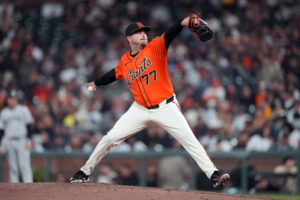
Jackson spent the first half of last season finishing his Tommy John rehab. He returned to throw 33 1/3 frames of 2.97 ERA ball down the stretch. Jackson quickly landed on the shelf with a lower back strain and hasn’t managed the same caliber of production since returning in late April. He’s carrying a 5.40 earned run average over 35 innings. His 21.9% strikeout percentage and 9.9% walk rate are each slightly worse than average, though he’s getting ground-balls at a strong 51% clip.
The 32-year-old (33 in August) has looked much sharper of late. Jackson is running a 13:1 strikeout-to-walk ratio with three runs allowed in nine innings this month. The velocity on his slider and four-seam fastball are each in line with his career marks. The Braves can plug him into middle relief with the possibility for higher-leverage work alongside Joe Jiménez, Pierce Johnson and A.J. Minter if Jackson’s recent form kicks off a strong second half.
Atlanta is taking on a substantial amount of money for these reunions. There’s no cash changing hands, although Matzek’s inclusion in the deal provides a small financial counterbalance. He’s in the second season of a two-year, $3.1MM contract that has mostly been ruined by elbow problems. Matzek missed all of last season recovering from Tommy John surgery. He made 11 appearances early this season, allowing 11 runs in 10 innings, before going back on the injured list with elbow inflammation. Matzek remains on the 60-day IL with no clear return timetable. His deal contains a $5.5MM team option for next season that is sure to be declined.
The Giants paid Soler a $9MM signing bonus. He’s playing this season on a $7MM salary, around $2.3MM of which is still owed. Atlanta is taking on matching $13MM salaries covering the 2025-26 seasons. Jackson is making $6.5MM this year (roughly $2.1MM remaining) and is guaranteed at least a $2MM buyout on a $7MM option for next year. Matzek is due around $620K through season’s end. The Braves assume nearly $3.8MM in salary commitments for the stretch run plus the $28MM in future guarantees on Soler’s and Jackson’s deals.
RosterResource calculates Atlanta’s CBT number around $282MM. That pushes them past the $277MM third tier of penalization and positions their first-round pick in next year’s draft to drop 10 spots. Atlanta is a second-time payor, so they’re taxed at a 62% rate on spending up to the $297MM mark. The Giants shave nearly $7MM off their tax ledger and have an estimated $244MM mark at RosterResource. They’re still above the $237MM base threshold and may not be looking to drop any more money.
San Francisco also grabs a prospect in the deal. Ceballos, 21, was Atlanta’s third-round pick out of Oregon last year. A righty-hitting third baseman, he has a .259/.353/.354 slash with a 9.8% walk rate and 19.1% strikeout percentage in High-A this season. Baseball America ranked him as the #26 prospect in a weak Atlanta farm system, crediting him with a plus arm and some raw power upside.
As for Vines, he’ll either be traded tomorrow or (more likely) placed on waivers this week. The 26-year-old righty has made eight big league appearances, turning in a 5.45 ERA over 33 innings. He owns a 5.14 earned run average across 14 starts with Triple-A Gwinnett this season.
Mike Rodriguez first reported the Giants were trading Soler to the Braves. Robert Murray of FanSided was first to report Jackson’s inclusion. Bob Nightengale of USA Today reported that the Braves were assuming the entire contract.
Images courtesy of USA Today Sports.
Brewers Acquire Frankie Montas
The Reds and Brewers lined up on an intra-division trade Monday night. Cincinnati is reportedly sending right-hander Frankie Montas to Milwaukee for young outfielder Joey Wiemer, veteran right-hander Jakob Junis and cash.
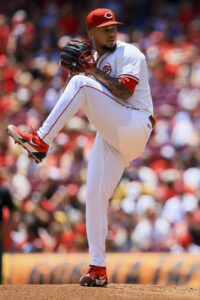
Montas, 31, gives the Brewers a veteran arm to plug into a rotation that’s been decimated by injury, although the big right-hander isn’t having anywhere close to his best season. The longtime A’s hurler signed a one-year, $16MM contract after missing nearly the entire 2023 season due to shoulder surgery and hasn’t recaptured the form that established him as a quality big leaguer from 2019-22, when he logged 480 1/3 innings of 3.67 ERA ball with a 25.4% strikeout rate against a 7.2% walk rate.
Rather, the 2024 version of Montas is sitting on a 5.01 ERA with a diminished 19% strikeout rate against a 10% walk rate that stands as his worst since 2017. His 95.3 mph average fastball is down 1.5 mph from its 96.8 mph peak back in 2019, and Montas has seen a huge dip in swinging-strike rate, falling from a peak 13.7% to 10.4% this season.
It’s been an ugly season for Montas, but the Brewers also have a history of getting more out of pitchers than one would expect at first glance. They’ve gotten strong results from righties Colin Rea and Tobias Myers this season despite minimal to nonexistent track records from both. Milwaukee presumably has a plan to get Montas back into form, but it’s nevertheless a modest surprise to see them deal a former top prospect (Wiemer) within the division to effectively rent Montas for the final two months of the 2024 season.
That said, Wiemer’s inclusion in the deal speaks to the manner in which his stock has dropped over the past year-plus. Entering the 2023 season, he was regarded by some as one of the sport’s top-100 prospects. However, the 2020 fourth-rounder stumbled through his first taste of the majors last year, hitting just .204/.283/.362 in 410 plate appearances. Wiemer pounded 13 homers and swiped 11 bags but also struck out in just under 29% of his plate appearances. He’s also shown glaring platoon splits in limited big league action, slashing .263/.290/.481 against lefties but registering a woeful .169/.271/.281 slash against fellow righties. Wiemer’s power has been missing in action this season in Triple-A Nashville, where he’s hit .242/.387/.358 with only three homers in 253 plate appearances.
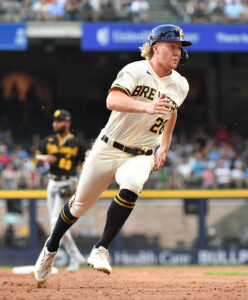
Wiemer’s platoon splits suggest that he could at the very least be a useful part-time player, and he’s also graded out exceptionally well in the outfield. In 1095 innings across all three outfield spots — primarily center — he’s been credited with six Defensive Runs Saved, seven Outs Above Average and a 5.8 Ultimate Zone Rating. Statcast pegged him in the 93rd percentile of MLB outfielders in terms of range and 96th percentile in terms of value generated with his arm.
If nothing else, Wiemer has the look of a short-side platoon fourth outfielder. He’s in the second of three option years and is under club control through at least the 2029 season. The Reds will hope there’s some more in the tank, but pulling a controllable MLB-ready outfielder — even one in the midst of a down season — in exchange for the rental of a struggling veteran starter had some understandable appeal for Cincinnati.
The Reds will also pick up their own veteran rental in the deal. The 31-year-old Junis is on a one-year, $7MM contract that contains a mutual option for the 2025 season. He’s spent most of the year on the injured list but returned in June and has a 2.42 ERA in 26 innings, working primarily as a long reliever. He’s fanned 18.8% of his opponents against a 5% walk rate. Had Junis been healthy this year, he might’ve gotten a look in the rotation, but the Brewers must not be bullish on his chances of holding up in that role. He hasn’t worked more than three innings since returning from the injured list.
Junis gives the Reds an experienced swingman who could potentially start some games or at least serve as a bulk option behind an opener. His inclusion in the swap also adds something of a financial counterweight; Montas is owed $4.7MM of his $14MM salary still, plus the $2MM buyout on a $20MM mutual option for next season. Junis is still owed $1.35MM of his $4MM salary plus a $3MM buyout on his $8MM mutual option. (Mutual options, it should be noted, are generally accounting measures and are almost never exercised; it’s been about a decade since the last time a player and team both agreed to exercise a mutual option.)
The Brewers are reportedly still sending about $1MM to the Reds in the deal to offset the gap in the option buyouts. In total, Milwaukee is taking on about $3.35MM in extra expenses in order to facilitate the trade.
Robert Murray of FanSided first reported the Brewers were acquiring Montas. MLB.com’s Mark Feinsand reported Junis and Wiemer were headed back to Cincinnati. Feinsand reported the cash considerations.
Pirates Acquire Jalen Beeks From Rockies
The Pirates announced the acquisition of lefty reliever Jalen Beeks from the Rockies for minor league reliever Luis Peralta. Pittsburgh had an open spot on their 40-man roster after this afternoon’s trade with the Red Sox.
Colorado claimed Beeks off waivers from the Rays over the winter. Tampa Bay was evidently not planning to tender him a contract for his final season of arbitration. Rather than allow him to hit the market, Colorado took a flier and agreed to a modest $1.675MM salary. Beeks has had a generally productive season. He’s second on the Rox with 49 1/3 innings out of the bullpen and has pitched in their highest-leverage spots overall.
Beeks has worked to a 4.74 ERA in 45 appearances. He’s carrying a career-low 18% strikeout rate and 9.2% swinging strike percentage. Beeks has a league average 8.5% walk percentage and 44.7% grounder rate. He somewhat bizarrely had far more success at Coors Field than he did on the road for the Rox.
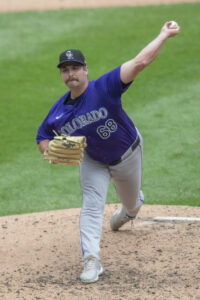 A former 12th round pick of the Red Sox, Beeks had a solid run as a long reliever for Tampa Bay between 2019-22. He combined for a 3.70 ERA with average strikeout and walk numbers in 184 2/3 frames over that stretch. Beeks allowed nearly six earned runs per nine last season, though, leading the Rays to move on.
Pittsburgh plugs him behind Aroldis Chapman as the second lefty in Derek Shelton’s bullpen. They’re assuming roughly $500K in salary for the stretch run. Beeks will surpass the six-year service threshold in September and hit free agency at the beginning of the offseason. Colorado didn’t have much incentive to keep him, so they’ll cash him in for an intriguing bullpen prospect.
Peralta, 23, is the younger brother of Brewers staff ace Freddy Peralta. The 5’11” southpaw signed with Pittsburgh out of the Dominican Republic in 2017. Peralta has divided his season between High-A and Double-A, turning in a 0.91 ERA over 39 2/3 innings. He’s striking out an eye-opening 41% of batters faced against an elevated 11.5% walk rate. Baseball America had Peralta as the #24 prospect in the Pittsburgh system, writing that he relies heavily on a mid-90s fastball with good life at the top of the strike zone. He’d be eligible for the Rule 5 draft this winter if Colorado doesn’t select him onto the 40-man roster.
MLB.com’s Mark Feinsand first reported the terms of the deal. Image courtesy of USA Today Sports.
Dodgers Acquire Amed Rosario
The Dodgers and Rays continue to be two of the deadline’s more active teams, as Los Angeles reacquired Amed Rosario from Tampa Bay. Minor league righty Michael Flynn heads to the Rays in return in a one-for-one swap. To create roster space for Rosario, the Dodgers have designated Ryan Yarbrough for assignment
Rosario has now been a deadline pickup for the Dodgers in consecutive years, after L.A. acquired him from the Guardians in exchange for Noah Syndergaard last July. Rosario hit .256/.301/.408 over 133 plate appearances for the Dodgers following the trade, primarily playing second base with a few appearances at his old shortstop position, after primarily playing short in his previous six seasons with the Guardians and Mets.
After signing a one-year, $1.5MM deal with the Rays last winter, Rosario moved into more of a full utility role, spending most of his time at second base and left field while still getting substantial playing time at shortstop and third base. The initial expectation was that the right-handed hitting Rosario would mostly face left-handed pitching, but between injuries and his respectable splits, Rosario ended up facing more right-handers than southpaws while hitting an overall .307/.331/.417 across 275 PA for Tampa Bay. Rosario has a 115 wRC+, which would be a career high if he can keep it going over the rest of the season.
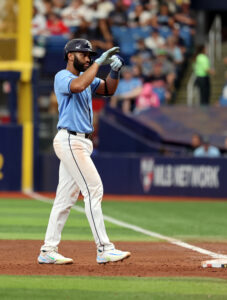
Rosario could just slot back right back into regular second-base duty in a platoon with Gavin Lux, but a larger role is probably in store for Rosario while the Dodgers try to manage several injuries. With Mookie Betts, Max Muncy, Miguel Rojas, Chris Taylor, and the newly-acquired Tommy Edman all on the mend, Rosario figures to get a decent dose of playing time all over the infield.
With only around $500K still owed to Rosario in salary for the rest of the season, the trade is a cost-effective move for the Dodgers that might pay big dividends, considering Rosario’s quality numbers and his familiarity with playing in Los Angeles. The deal also continues Andrew Friedman’s long history of trading with his former team, as the L.A. president of baseball operations has swung several deals since leaving the Rays for the Dodgers back in 2014.
Flynn is just over a week away from his 28th birthday, and he’ll get to celebrate by once more changing organizations during his pro career. A sixth-round pick for the Pirates in 2018, Flynn also spent time in the Mariners’ farm system before joining the Dodgers this season, and he has a 4.95 ERA over 36 1/3 relief innings for Triple-A Oklahoma City.
As with most Pacific Coast League numbers, a look behind the ERA is necessary in the hitter-friendly league, and Flynn has a 32.1% strikeout rate and 9.6% walk rate. His strikeout numbers have increased exponentially over his last two seasons, and given the Rays’ penchant for uncovering hidden gems, it stands to reason that Tampa has seen something in Flynn that might put him in line for his Major League debut.
Since the Dodgers’ injury woes also extend to their pitching staff, Yarbrough’s DFA counts as a bit of a surprise, as he has been a fairly effective arm for L.A. since being picked up from the Royals at last year’s trade deadline. This season Yarbrough has a 3.74 ERA in 67 1/3 innings while working as a long reliever and occasional bulk pitcher, albeit with such unimpressive metrics as an 8.9% walk rate and a 13.9% strikeout rate. That latter number is one of the lowest K-rates in the sport, though he has also been one of the league’s best at limiting hard contact, albeit with some significant help from a .214 BABIP.
Yarbrough’s 4.96 SIERA apparently carried more weight for the Dodgers than his ERA of over a run lower, so Los Angeles has now sent the veteran to the DFA wire. The left-hander’s ability to eat innings out of the pen could make him a candidate for a waiver claim, particularly since several teams might have holes to fill in their relief corps if other relievers are traded by the deadline.
Ken Rosenthal of the Athletic first reported the Dodgers were acquiring Rosario. Robert Murray of FanSided reported Flynn was going back to Tampa. Juan Toribio of MLB.com first reported the Yarbrough DFA.
Guardians Acquire Lane Thomas
The Guardians have landed outfielder Lane Thomas in a trade with the Nationals, both teams announced. A trio of prospects — left-hander Alex Clemmey and infielders Jose Tena and Rafael Ramirez — are going back to Washington.
It was almost exactly three years ago that Thomas was part of another prominent deadline trade, coming to Washington from the Cardinals in exchange for Jon Lester. The move to the Nats and more consistent playing time unlocked something in Thomas, who performed brilliantly over the remainder of the 2021 season and then settled into a regular role in the Nationals’ outfield over the last three years. This season, Thomas has hit .253/.331/.407 with eight homers and 28 steals (out of 40 attempts) over 341 plate appearances, despite missing about a month of action with a sprained MCL.
Thomas’ emergence in Washington was soon followed by more trade speculation, as it wasn’t clear whether or not the Nationals would view this newfound breakout player as a building block, or as a trade asset to aid in their rebuild. Today’s move answers that question, as the Nats have dealt Thomas (who turns 29 next month) in the second of his three arbitration-eligible seasons. Thomas is earning $5.45MM this season and will be in for a raise next year before hitting the free agency market in the 2025-26 offseason.
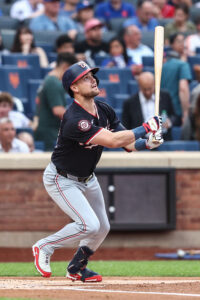
This extra year of control added to Thomas’ trade value, and ironically, the Guards themselves have traditionally looked to deal such increasingly-pricey players as they approach the end of their team control. With Cleveland in first place in the AL Central, the Guardians have instead looked to bolster their roster in major fashion, as Thomas can step right in as the team’s new regular right fielder. The left-handed hitting Will Brennan should still get a decent chunk of at-bats since Thomas has been much better against southpaws than against right-handed pitchers this season, but Thomas brings a needed right-handed bat to a Cleveland lineup perhaps a bit overloaded with lefty-swingers and switch-hitters.
The Guardians are opting for extra hitting over defense here, as Thomas’ public defensive metrics (-9 Defensive Runs Saved, -8.1 UZR/150, -7 Outs Above Average) have been very lacking. Cleveland has traditionally prioritized glovework in the outfield, yet while the lineup’s production has been better in 2024 than in recent seasons, Guards hitters have provided roughly average numbers league-wide. It seems quite possible the Guardians might still address their bigger need for rotation help before tomorrow’s deadline, but the Thomas trade is a key first step towards upgrading the roster for the stretch run.
From Washington’s perspective, the three-player package is a nice return for a season and two months’ worth of Thomas’ services. The Nationals have added one MLB-ready player in Tena who has already gotten some time in the Show, and two longer-term assets, including a noteworthy pitching prospect in Clemmey.
Cleveland’s second-round pick in the 2023 draft, Clemmey is just 11 days removed from his 19th birthday, and he has a 4.67 ERA over 69 1/3 innings at A-level Lynchburg this season. Clemmey has struck out batters at an impressive 32.6% rate, but his 15.8% walk rate is evidence of some control issues early in his pro career.
Baseball America ranked Clemmey seventh among Guardians prospects and MLB Pipeline had him eighth on their list, with both outlets wowed by his high-90s fastball. The fastball earned a 70 grade from both scouting reports and his curveball received a 60, giving him some impressive upside for rotation work if he can develop at least one more quality offering. While projections might be a bit difficult for such a young pitcher, Clemmey already looks like he could be a quality reliever, though obviously the Nationals will fully explore his potential as a starter.
Ramirez was ranked 20th in BA’s list of Guardians prospects and 22nd by MLB Pipeline. He is the son of former Braves/Astros infielder Rafael Ramirez Sr., and while the elder Ramirez spent most of his 13 Major League seasons at shortstop, the 19-year-old Ramirez might eventually end up as a third baseman or second baseman, as per the scouting reports. Ramirez is in his third year of pro ball and hasn’t hit much in A-ball this season after posting much bigger numbers in rookie ball in 2023.
Tena made his big league debut in the form of 18 games and 34 PA for Cleveland last season, and he has appeared in three games for the Guards in 2024. An international signing in 2017, Tena has spent his whole career in Cleveland’s farm system, and he has an eye-popping .308/.365/.522 slash line and 22 homers in 494 career PA at the Triple-A level.
Despite these big numbers, the 23-year-old Tena always seemed to be a bit of an odd man out amidst the Guards’ infield picture, especially with Jose Ramirez and Andres Gimenez locking down two positions. Tena’s big strikeout numbers probably didn’t play well within a Cleveland organization that prizes contact hitting, but he’ll now get another opportunity in the District. The Nationals have an infield cornerstone of their own in CJ Abrams and Luis Garcia Jr. has done well to re-establish himself as a regular second baseman, though Tena could potentially look to make an impact at third base or in a utility role.
The Athletic’s Ken Rosenthal (X link) was the first to report that Cleveland acquired Thomas, and FanSided’s Robert Murray (via X) reported that Clemmey was part of the trade package. ESPN’s Jeff Passan specified that the Nationals would be receiving three players in return for Thomas, and USA Today’s Bob Nightengale was the first to report on the inclusion of Tena and Ramirez.
Photo courtesy of USA Today Sports Images
Mariners Acquire Justin Turner
The Mariners have acquired Justin Turner and cash considerations from the Blue Jays, per announcements from both clubs, with outfield prospect RJ Schreck going to the Blue Jays in return. Turner was playing for the Jays at the time the trade was reported but was removed from the game.

Turner has remarkably continued to be an above-average hitter as he approaches his 40th birthday, which is in November, though he has unsurprisingly tailed off a bit from his peak. With the Dodgers from 2014 to 2022, Turner hit .296/.375/.490 for a wRC+ of 137. He signed with the Red Sox last year and slashed .276/.345/.455 for a 114 wRC+, a noticeable drop-off from his work in Los Angeles but still 14% above average.
He signed with the Jays coming into 2024, a one-year deal with a $13MM guarantee plus bonuses based on plate appearances. His offense has taken another small dip but is still decent. He is drawing walks at an 11.2% clip this year while limiting his strikeouts to a 17.2% rate. His .253/.348/.370 batting line translates to a 109 wRC+.
The Mariners are 56-51 and battling the Astros and Rangers in the American League West. Their pitching has been great this year but the offense has been a disappointment. Collectively, they are hitting .218/.300/.368 for a wRC+ of 95, which places them in the bottom third of the league. Their 27.7% strikeout rate is easily the worst in the majors. On top of those season-long struggles, they recently lost Julio Rodríguez and J.P. Crawford to the injured list.
The club has been actively trying to reconfigure the offense in recent days, acquiring Randy Arozarena from the Rays and now Turner from the Jays. Given the club’s punch-out problem, it’s perhaps not a coincidence that Turner has always been tough to strike out. He has a 15.4% strikeout rate in his career and has never been higher than 17.6% in a full season. For context, the major league average is 22.3% this year.
Turner has played all around the infield in his career but the expectations of his glovework have naturally diminished as he has pushed further into his late 30s. He has dabbled at second base in recent seasons but the Jays haven’t put him there this year. He’s still made some appearances at third base this season but only five starts, with his last regular playing time there coming in 2022. He only has 11 starts at first base this year but that might just be because Vladimir Guerrero Jr. is there most days, as Turner got into 41 games there for the Sox last season. Divish relays on X that Seattle manager Scott Servais said Turner will likely play first in Seattle more than he did in Toronto.
The Mariners recently traded Ty France to the Reds, opening up their first base spot. They’ve been using Tyler Locklear and Jason Vosler there in recent days, but now Turner could jump into that mix. The club had initially planned for Mitch Garver to be something close to an everyday DH this year but his underwhelming season has nudged him into more of a traditional backup catcher role. That means there could also be DH at-bats to be shared between Turner, Vosler and Locklear.
The Jays have been in sell mode for a while, having already flipped Yimi García, Nate Pearson and Danny Jansen in recent days. Now they have flipped Turner for Schreck, a 24-year-old who the M’s selected in the ninth-round of last year’s draft. He started this year in High-A and performed very well at the plate. In his 344 plate appearances, he drew walks at a 16.6% rate while only striking out 13.7% of the time. He also hit 12 home runs, leading to a slash of .261/.401/.464 and a 148 wRC+. On top of that, he added seven steals while playing all three outfield slots.
He then got bumped to Double-A and has a brutal slash of .143/.294/.250 there, but in a tiny sample of eight games with a .190 batting average on balls in play that is surely not sustainable. The Jays will perhaps bring him over to their own Double-A club in the coming days and hope for better help from the baseball gods.
Beyond the prospect, the Jays are likely happy to unload some of of Turner’s contract. There’s about $4.3MM left to be paid out and some part of that amount will be subtracted from the competitive balance tax calculation. The Jays are reportedly paying down $2MM in the deal.
With the trades of Turner, Jansen, García and Pearson, the Jays have made significant progress towards ducking under the tax line this year. RosterResource estimates that they are currently just under $242MM, putting them less than $5MM away from the $237MM base threshold, though the cash going to Seattle in the Turner trade should alter that calculus.
Between now and tomorrow’s deadline, they could still move rentals Yusei Kikuchi, Kevin Kiermaier and Trevor Richards. They could also consider deals for guys like Isiah Kiner-Falefa, Chad Green or Chris Bassitt, who are each making notable salaries through 2025. If they manage to reset their CBT status this year, it would mean they could pay the tax in 2025 as a “first-time” payor instead of a “third-time” payor while also having lower penalties for signing free agents that rejected qualifying offers. MLBTR explored Toronto’s CBT situation a couple of weeks ago.
Ken Rosenthal of The Athletic first reported on X that Turner was going to the Mariners. Ryan Divish of The Seattle Times first relayed that a prospect was involved that it was Schreck (X link one and two). Ronald Blum of the Associated Press reported the cash considerations.
Cardinals Acquire Fedde, Pham; Dodgers Acquire Edman, Kopech In Three-Team Deal With White Sox
What’s a trade deadline without a convoluted three-team swap? The Cardinals, White Sox and Dodgers have announced a three-team, eight-player deal (possibly including up to 10 players) that breaks down as follows:
- Cardinals receive: right-hander Erick Fedde, outfielder Tommy Pham (both from White Sox), PTBNL or cash (from Dodgers), cash (from White Sox)
- Dodgers receive: right-hander Michael Kopech (from White Sox), infielder/outfielder Tommy Edman (from Cardinals), right-hander Oliver Gonzalez (from Cardinals)
- White Sox receive: infielder/outfielder Miguel Vargas, minor league infielder Alexander Albertus, minor league infielder Jeral Perez, PTBNL or cash (all from Dodgers)
It’s a massive exchange of veteran names that’ll have significant postseason implications for a pair of National League contenders. The Cardinals, in need of rotation help and a right-handed bat, checked two boxes with today’s swap, while the Dodgers added some needed positional versatility to help cover multiple weak spots in the lineup and a hard-throwing reliever with an extra season of club control.

Starting with the Cardinals, they’ll bolster their starting staff not just this season but also in 2025. Fedde, a former first-round pick and top prospect with the Nationals, flamed out in five seasons here in MLB before heading to the KBO’s NC Dinos for one year. He spent the 2023 season in South Korea, added a splitter and changed the shape of his breaking ball, and dominated KBO opponents en route to an MVP Award. He returned to MLB on a two-year, $15MM deal with the White Sox and has immediately established himself as a new and highly improved pitcher.
In 121 2/3 innings for the ChiSox, Fedde has pitched to a sharp 3.11 ERA. His 21.5% strikeout rate is shy of league-average by one percentage point, but his 6.8% walk rate is strong and his 44.7% grounder rate is also a bit better than average. He’s avoided hard contact (88.1 mph average exit velocity, 36% hard-hit rate) and kept opponents off balance with a four-pitch mix including a cutter, sinker, slider and split-changeup.
Fedde solidifies the back of a veteran Cardinals rotation that has been without lefty Steven Matz (back strain) since late April. The Cards have been relying on righty Andre Pallante to help patch things over, and while he’s been a godsend in that role (3.42 ERA in nine starts), the 25-year-old is also already just four innings shy of his 2023 total and can be a vital piece in the bullpen as well.
The addition of Fedde will prove vital for a Cardinals club that only had three starters signed through the 2025 season as well. Sonny Gray is being paid $25MM annually from 2024-26, while Miles Mikolas is owed $20MM next year. Matz will be in the fourth and final season of his own $44MM contract next year, but his ongoing health troubles make it tough to bank on him. The Cardinals hold club options over veterans Lance Lynn and Kyle Gibson, but neither is a lock to be picked up. Fedde, owed $7.5MM this year and next, gives the Cardinals some long-term stability at a highly affordable rate.
In addition to their desired rotation upgrade, the Cards will get the right-handed bat they’ve been seeking. It’ll come in the form of a reunion with Pham, whom they originally selected in the 16th round of the 2006 draft. Pham made his big league debut with the 2014 Cardinals and spent the next three-plus seasons in St. Louis before being traded to the Rays in a deal that brought Genesis Cabrera and Justin Williams back to the Cardinals.
Pham, now 36, has since played for six additional teams. The Rays traded him Padres after two seasons, and he’s since signed free-agent deals with the Reds, Mets and White Sox — getting traded at the deadline in three consecutive seasons. Pham has remained productive at the plate even as he’s become a year-to-year mercenary in his mid-30s. He slashed .256/.328/.446 between the Mets and D-backs in 2023 and owns a .266/.330/.380 output in 297 plate appearances with the White Sox.

Pham won’t receive everyday at-bats in his return to Busch Stadium, but Pham’s hefty .255/.377/.471 line against lefties will make him a useful part-time player for manager Oli Marmol. He’ll make for a nice platoon partner for glove-first center fielder Michael Siani (with Pham presumably taking over in left field and Lars Nootbaar manning center against southpaws).
In order to open a 40-man roster spot, the Cardinals designated catcher Nick Raposo for assignment. The 26-year-old signed with the Cards as an undrafted free agent after the truncated five-round draft in 2020. He was selected to the MLB roster earlier this summer to help account for some catching injuries, but he didn’t get into a big league game. He’s hitting .193/.251/.349 in Triple-A this season but turned in a more encouraging .241/.321/.386 slash last year between Double-A and Triple-A. The Cards could trade him before tomorrow’s deadline, and if not, he’ll be placed on outright waivers.
That the Cardinals were able to acquire both Fedde and Pham while only surrendering Edman and a 17-year-old they just signed as an international free agent earlier this year is somewhat remarkable. It’s a nice feather in the cap of president of baseball operations John Mozeliak, general manager Mike Girsch and the rest of the St. Louis baseball ops staff. The Cards added two big league contributors to a contending club and did so not only without sacrificing any prospects — but without sacrificing anyone who’s contributed to their second-place team at any point this season.
That’s not to denigrate Edman as a player, of course — far from it. The switch-hitting 29-year-old is as versatile as he is talented when healthy, and he’ll presumably be healthy enough to join the Dodgers in short order. Edman hasn’t played this season due to a longer-than-expected recovery process from offseason wrist surgery and an ankle sprain he suffered while rehabbing that wrist. Edman has played four games with the Cardinals’ Double-A affiliate on a minor league rehab assignment and figures to now continue his rehab work in the Dodgers’ system. He’ll have about two more weeks of rehab window before he needs to be activated, though Los Angeles can certainly do so sooner if they see fit.
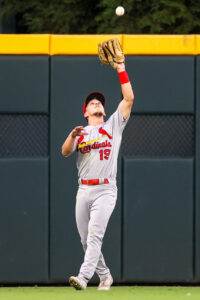
Edman has spent four-plus seasons in the big leagues, playing second base, shortstop, third base and all three outfield positions. He rather incredibly grades out as an above-average defender at each of those positions, per Statcast and Defensive Runs Saved alike. That jack-of-all-trades skill set is emblematic of the type of player the Dodgers try to roster as often as possible. Edman, once healthy, will give L.A. an option at shortstop or second base, helping to cover for the loss of Mookie Betts. Once Betts returns, Edman can either play shortstop (with Betts moving to second base), second base (with Betts at short and Miguel Rojas in a utility role) or anywhere in the outfield (with Rojas and Betts handling middle infield duties).
Beyond the defensive wizardry, Edman has proven himself a capable hitter. He’s yet to recreate the terrific .304/.350/.500 line he posted as a Cardinals rookie in 2019, but he’s a career .265/.319/.408 hitter in 2425 plate appearances. He’s not a big home run threat but has hit between 11 and 13 homers in all four of his full big league seasons (plus five homers in the shortened 2020 campaign). He doesn’t walk especially often (6.2%) but also rarely strikes out (16.5%). On top of that, Edman offers 88th percentile sprint speed (per Statcast) and has swiped 106 bags in 123 attempts at the MLB level (86.2%).
Edman signed a two-year, $16.5MM contract in the 2022-23 offseason, buying out his final two seasons of arbitration eligibility. He’s earning $7MM this season and another $9.5MM next year. The Dodgers are a third-time luxury tax offender in the top tier of penalization, so they’ll pay a 110% tax on the average annual value both of Edman’s contract and of Kopech’s one-year deal with the club.
Onto Kopech, the 28-year-old former top prospect gives the Dodgers one of baseball’s hardest-throwing relievers for the remainder of this year and all of 2025. He’ll be arbitration-eligible this winter and owed a raise on this year’s modest $3MM salary.
The White Sox have used Kopech both as a starter and reliever, but lackluster command of his dynamic arsenal has undercut his effectiveness in both roles. He’s been used exclusively out of the ‘pen in 2024 and saved nine games while pitching 43 2/3 innings of 4.74 ERA ball. The earned run average isn’t going to draw much fanfare, but Kopech has averaged a blistering 98.5 mph on his four-seamer, fanned 30.9% of his opponents and generated a gaudy 14.1% swinging-strike rate. He’s been plagued by a 12.6% walk rate and 1.65 HR/9, but Kopech has shown flashes of potential as a powerhouse, shutdown reliever.
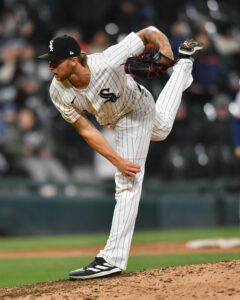
Kopech is currently in the midst of his best stretch of the season. After getting blown up for four runs back on July 7, he’s rattled off 5 2/3 shutout innings with an 8-to-1 K/BB ratio. The Dodgers, who have a knack for maximizing pitching performances, are surely thrilled to get their hands on a pitcher with Kopech’s blazing heater and hard slider. Whether they can coax the level of performance from him that has long seemed dormant in Kopech’s talented but inconsistent right arm remains an open question, but if they’re able to do so, he’s a high-octane weapon who can take on a leverage role in a bullpen that has seen closer Evan Phillips struggle of late.
Los Angeles will also pick up the 17-year-old Gonzalez, who’s not considered to be among the Cardinals’ top-ranked prospects but did command a relatively notable $400K signing bonus out of Panama just seven months ago. The 6’4″, 200-pound righty has pitched 21 1/3 innings for the Cardinals’ Rookie-level Dominican Summer League affiliate and posted a 4.22 ERA while punching out 28.6% of his opponents against a 7.7% walk rate.
Turning to the rebuilding White Sox’ end of the deal, their return is headlined by Vargas, who’ll presumably step right onto the big league roster. The 24-year-old ranked among the sport’s top 100 prospects heading into the 2023 season but has fallen down the depth chart in Los Angeles after struggling to carry his excellent minor league production over to the majors. Vargas has appeared in 129 big league games and taken 434 plate appearances, but he’s a .201/.294/.364 hitter in that time.
Rough as those numbers are, Vargas has continued to absolutely pummel Triple-A pitching this season. He’s hitting .290/.440/.556 in Oklahoma City and has a career .297/.412/.512 batting line there in 996 plate appearances. He’s played third base, second base, first base and left field in his career, with the bulk of his experience coming at third base and second base. Vargas has regularly been blocked by more veteran, more expensive players at those positions but should get a full run at third base or second base with his new team.
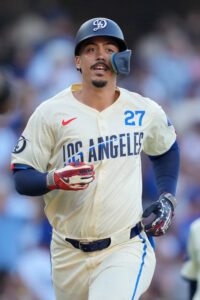
Some Sox fans may bristle at the notion of a former top prospect headlining this deal, rather than a current one, but Vargas still has five seasons of club control remaining and has already gotten his feet wet in the majors. He’s an on-base machine who’s walked at an impressive 11.1% clip even while struggling in the big leagues and has fanned in a below-average 20.7% of his MLB plate appearances. It’s not hard to envision a scenario where he improves on both of those rate stats as he gets more big league experience and begins to solidify himself as a bona fide MLB-caliber hitter.
Joining Vargas in the White Sox’ system will be Albertus and Perez: both 19-year-old infielders who signed with the Dodgers as international free agents in 2022 (Albertus out of Aruba, Perez out of the Dominican Republic). Baseball America ranked both players inside the Dodgers’ top-20 prospects heading into the 2024 season, and both currently reside in that same range on MLB.com’s updated list of the top 30 Dodgers prospects.
Albertus has split the season between the Dodgers’ Rookie-level Arizona Complex League affiliate and Class-A affiliate. He tore through the former at a .342/.479/.459 pace with more walks (18.9%) than strikeouts (14%) and is hitting .229/.317/.329 in 82 plate appearances against more advanced pitching. Baseball America credits him with a plus hit tool and the potential for average power, calling him a bat-first infield prospect who could see regular playing time across multiple positions. MLB.com lauds him for having one of the most disciplined approaches in a deep Dodgers system and calls him a potential regular at second or third.
Perez has spent the entire season in Class-A and carries a hearty .264/.380/.420 batting line with 10 homers in 350 trips to the plate. He’s walked at a huge 13.7% clip against a 22% strikeout rate despite being just over two years younger than the average player in the league. Both BA and MLB.com note that he lacks a true plus tool but is solid across the board. Like Albertus, he draws praise for an advanced approach at the plate that’s well beyond his years. Perez has good contact skills and the ability to play multiple positions.
For a White Sox club that is often characterized by low-OBP, all-or-nothing hitters, the focus on bringing in three infielders with huge on-base ceilings feels like a rather targeted focus. None of the three players are going to jump to immediately land among the top 50 prospects in the game — Vargas isn’t even prospect-eligible anymore — but they all have a relatively similar feel and offer a potential glimpse at the type of hitters that rookie GM Chris Getz would prefer to see populating his roster in future seasons.
KPRC-2’s Ari Alexander reported Sunday night that the Sox, Dodgers and Cards had engaged in some level of discussions on a three-team deal involving Fedde and Edman. Daryl Van Schouwen of the Chicago Sun-Times reported Monday that a three-team deal was nearing the finish line. Ken Rosenthal and Katie Woo of The Athletic reported that Fedde would go to the Cardinals and Edman to the Dodgers. USA Today’s Bob Nightengale first reported that Vargas, Perez and Albertus were headed to the White Sox. FanSided’s Robert Murray reported that Pham was going to the Cardinals. Derrick Goold of the St. Louis Post-Dispatch reported that the Cardinals were giving up an low-level minor leaguer.
Pirates, Red Sox Swap Quinn Priester For Nick Yorke
The Red Sox and Pirates announced a one-for-one dealing sending right-hander Quinn Priester to Boston and second base prospect Nick Yorke to Pittsburgh. Boston already has a vacancy on their 40-man roster and optioned Priester to Triple-A Worcester. Pittsburgh assigned Yorke to their top affiliate in Indianapolis.
Priester, 23, has pitched in the majors in each of the past two seasons. He has started 16 of 20 appearances, struggling to a 6.46 ERA across 94 2/3 innings. His 15.4% strikeout rate and 9.2% walk percentage are each on the wrong side of league average, the strikeouts especially so. Preister has kept the ball on the ground at a robust 53.9% clip but seen an inordinate amount of the fly balls against him clear the fence. He’s allowing more than 1.8 home runs per nine innings.
While he hasn’t had the most auspicious start to his major league career, Priester isn’t far removed from being one of the top pitching prospects in the sport. The Bucs selected him 18th overall out of high school in the 2019 draft. By the 2020-21 offseason, he’d cracked most Top 100 prospect lists. Evaluators had particular praise for Priester’s curveball during his time in the minors, but he’s had a fairly balanced five-pitch mix (sinker, slider, four-seam, curveball, changeup) in the majors.

Some scouting reports had questions about the quality of Priester’s fastball — specifically whether he had enough movement to miss bats. His sinker and four-seam each sit around 93 MPH and have been hit hard by major league hitters. He’s had far more success in the minors, though. Priester owns a 3.81 ERA over parts of three Triple-A campaigns. That includes a 3.21 mark with 36 strikeouts and just seven walks over 33 2/3 innings this year.
Boston’s player development staff will try to help Priester translate his intriguing raw stuff and minor league production into better MLB results. They’ll have plenty of time to do so. The 6’3″ hurler is in his second of three option years. He has around 133 days of major league service. It’s possible he crosses the 172-day threshold to reach a full service year in 2024, but he’d still be under control for five seasons beyond this one. If the Sox send him down to Triple-A Worcester at any point, that could push his free agent timeline back and give Boston six full years of control.
Priester will begin his Sox tenure in the minors. Boston has Nick Pivetta, Brayan Bello, Tanner Houck, Kutter Crawford and recent trade pickup James Paxton in their rotation. The Paxton acquisition nudged sixth starter Cooper Criswell back to relief. Priester probably slots seventh on the depth chart and can move up and down off the MLB roster as needed.
Pittsburgh has a fair bit of rotation depth themselves. Paul Skenes and Jared Jones had clearly surpassed Priester on the organizational hierarchy. Mitch Keller fits comfortably as their #3 arm. Luis Ortiz, Marco Gonzales and Martín Pérez are rounding out the starting five while Jones is shelved by a lat strain. The Bucs could soon welcome Bailey Falter back from the IL and bump Pérez from the rotation. As MLBTR’s Darragh McDonald explored in a post for Front Office subscribers a couple weeks ago, that enabled them to trade a starter for a controllable bat.
Yorke is on the doorstep of the majors. Boston’s first-round pick out of high school in the 2020 draft, he’s having a strong season in the high minors. Yorke hit .251/.325/.366 over 45 Double-A contests and has been particularly impressive since a promotion to Triple-A. Over 38 games for the Sox’s affiliate in Worcester, he turned in a .310/.408/.490 slash with six homers and nearly as many walks (14.2%) as strikeouts (18.9%).

The 22-year-old Yorke has played mostly second base in his professional career. He has a bit of experience in left field as well. The Bucs are presumably planning to use him at the former position. Pittsburgh hasn’t gotten much out of second base all season. Nick Gonzales, whom Pittsburgh took 10 picks ahead of Yorke in the 2020 draft, faded offensively after a hot start. He went on the injured list yesterday with a groin strain that’ll cost him at least a few weeks. That had seemed to push Jared Triolo or Alika Williams into short-term action.
Yorke, despite having no MLB experience, might already be a better hitter than either Triolo or Williams. He’ won’t directly join the MLB roster but could be up before too long. They’ll need to put him on their 40-man roster by next offseason at the latest to keep him out of the Rule 5 draft.
Eric Longenhagen of FanGraphs ranked Yorke 13th among Red Sox prospects earlier this month. Baseball America had him 14th in the system on their most recent update. Both outlets praise his hitting feel but write that he doesn’t have great athleticism or defensive chops. He has a chance to be a bat-first regular at the keystone who could make an impact down the stretch. While Yorke isn’t generally viewed as having the highest upside, there’d be ample value in a near-MLB regular whom the Bucs control for the next six-plus seasons.
ESPN’s Jeff Passan first reported the Red Sox and Pirates were finalizing a trade swapping Yorke for Priester. Images courtesy of USA Today Sports.