
Cardinals Sign Brandon Crawford
February 27: The Cardinals made the deal official, announcing it today. Per Slusser, Crawford will make a salary of $2MM.
February 26: The Cardinals are reportedly in agreement with shortstop Brandon Crawford on a major league deal, pending a physical. Financial terms have not yet been reported. Crawford is a Wasserman client. The Cardinals will need to make a 40-man roster move once the deal is finalized.
St. Louis has been looking for a veteran infielder who could take on the backup shortstop job. Crawford was perhaps the top unsigned player who could fill that role. It’ll assuredly be a low-cost flier on the 13-year big league veteran, who’ll take on a depth job for the first time in his career. Crawford has been a starting shortstop since debuting with the Giants back in 2011.
The UCLA product had an excellent run over his time in the Bay Area. Crawford helped the Giants to World Series titles in 2012 and ’14. He was one of the sport’s preeminent defensive infielders during the last decade. Crawford won three consecutive Gold Glove awards in 2015-17 and took a step forward with the bat in his late-20s. He earned a Silver Slugger in 2015 and turned in average or better offensive production in six of the eight seasons between 2014-21.

Crawford inked a six-year extension over the 2015-16 offseason. That put him on track to reach free agency after the 2021 campaign. He surprisingly turned in the best season of his career that year, hitting .298/.373/.522 en route to a fourth-place finish in NL MVP balloting. The Giants kept him around for another two years at $16MM annually on an extension signed towards the end of that season.
While an understandable decision during Crawford’s resurgent season, the latter extension did not pan out. Crawford’s offensive production plummeted beginning in 2022. He hit .231/.308/.344 two seasons ago. His production fell off further last year. The left-handed hitter put up a personal-worst .194/.273/.314 slash line in 320 trips to the plate. Crawford punched out in more than a quarter of his plate appearances for the first time in his career.
Injuries have sent him to the shelf on a few occasions over the last two years. Since the start of 2022, he has had IL stints related to his left knee (twice), right knee, right calf, left forearm and right hamstring. None of those required a long-term absence, but it’s possible that playing through any number of those issues has taken a toll on his performance.
The Cardinals can’t expect much from Crawford offensively as he enters his age-37 campaign. Public metrics are split on how valuable he remains on the other side of the ball. Crawford isn’t the elite defender he was at his peak. Statcast still grades him as a solid gloveman, giving him above-average marks every season since it began tracking in 2015. That includes an estimated four runs above average a year ago.
Defensive Runs Saved has been far less forgiving. DRS has graded Crawford as a well below-average defender two years running. It marked him 14 runs below par in 725 2/3 innings last season. Among shortstops, only Tim Anderson and Amed Rosario fared more poorly by that estimate.
St. Louis will be hopeful of at least passable glovework in a rotational role. The Cards are going to turn the position to rookie Masyn Winn. The 21-year-old struggled in a very limited MLB look at the end of last season, hitting .172/.230/.238 in 37 games. Prospect evaluators have praised his defensive acumen and power upside, though, and the Cards haven’t made any effort to block his path to MLB playing time.
Winn’s presence pushed last year’s Opening Day shortstop, Tommy Edman, to center field. While he’s still capable of handling the middle infield, the Crawford signing will allow manager Oli Marmol to keep Edman in the outfield even on days when Winn needs a breather. It also affords the Cardinals some security in case Edman isn’t available early in the season. The switch-hitter is working back from an arthroscopic right wrist procedure. He’s hopeful of being ready for Opening Day but has yet to begin taking live batting practice with less than a month until the regular season.
Aside from Edman, St. Louis didn’t have a clear backup shortstop on their 40-man roster. Neither Brendan Donovan nor José Fermín is a great fit there. Crawford takes that role. Roster Resource projects the St. Louis payroll around $182MM, pending the Crawford deal. He shouldn’t add more than a couple million dollars to that ledger.
As for the Giants, they’ll officially bid farewell to one of the faces of the franchise’s recent history. It became clear towards the end of last season that things were headed in this direction. San Francisco is going to turn shortstop over to a top prospect of their own, Marco Luciano. They signed longtime division rival Nick Ahmed to a minor league deal to serve as glove-first veteran depth. Crawford returned from the injured list on the final day of last season so he could receive a proper send-off from the San Francisco fanbase. He’s the final player from their 2012 and ’14 World Series teams to depart the organization, although Pablo Sandoval has since returned on a non-roster pact.
Susan Slusser of the San Francisco Chronicle first indicated Crawford and St. Louis were in talks. Katie Woo of the Athletic was first to report the sides had reached an agreement. Derrick Goold of the St. Louis Post-Dispatch reported it was a major league deal.
Image courtesy of USA Today Sports.
Twins Acquire Manuel Margot
The Twins announced the acquisition of veteran outfielder Manuel Margot, infield prospect Rayne Doncon and cash from the Dodgers in exchange for minor league shortstop Noah Miller. Los Angeles is reportedly covering $6MM of Margot’s $10MM salary for the upcoming season. The Dodgers originally received $4MM from the Rays when acquiring Margot alongside Tyler Glasnow earlier this winter; Tampa Bay also remains on the hook for a $2MM buyout on a $12MM club option for 2025.
The Twins placed right-hander Josh Winder on the 60-day injured list to open a roster spot for Margot, announcing that Winder has a scapular stress fracture. His exact timeline in unclear but he’ll be ineligible to rejoin the club until late May at the earliest.
Minnesota has been on the lookout for a right-handed-hitting outfielder who could cover all three spots for much of the offseason. They’d previously been tied to free agents like Adam Duvall and Enrique Hernandez, and they’d also maintained an interest in re-signing Michael A. Taylor, who belted 21 home runs as a Twin in 2023. However, it seems they’ve found a deal to their liking on the trade front, presumably ending those free agent pursuits.
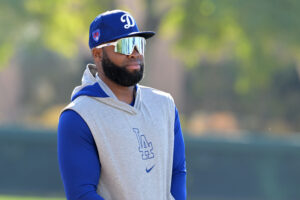
In Margot, the Twins are acquiring that righty bat they’ve been seeking but are also buying low on a player who’s been hampered by knee troubles dating back to the 2022 season. Margot missed roughly half of the ’22 campaign with a significant strain of the patellar tendon in his right knee. He was limited to just 363 plate appearances and turned in a solid, if unspectacular .274/.325/.375 slash (101 wRC+). He followed that up with a .264/.310/.376 line in 336 plate appearances this past season.
Had Margot enjoyed a season of his typical defensive excellence in ’23, that offensive output would’ve made him an above-average all-around contributor. But in the wake of that knee injury, his once-elite defensive grades slipped closer to average. Statcast noted that Margot’s range and sprint speed both declined in 2023. Defensive Runs Saved pegged him at -3 on the season, while Statcast’s Outs Above Average credited him at +3. Either way, it’s a notable drop for a player who posted 13 DRS and 16 OAA as recently as 2021. The Twins, presumably, are confident that as Margot distances himself from that knee injury, he can rebound in the field — if not back to peak form than at least to a clearly above-average defender at all three spots.
In Minnesota, Margot will provide the Twins with some insurance in the event of another injury to rarely-healthy center fielder Byron Buxton. Beyond that, he’ll give the Twins a righty bat that can spell lefty-swingers Matt Wallner and Max Kepler in the corners. Margot is a career .281/.341/.420 hitter (109 wRC+) against left-handed pitching, so he’ll likely see his fair share of pinch-hitting opportunities for a Twins club that tends to play matchups throughout the game. Margot can also serve as a late-game defensive upgrade in left over Wallner or a late-game pinch runner. Even with a downturn in his sprint speed, he still ranked in the 75th percentile of MLB players last year, per Statcast.
The Twins will also pick up Doncon, a 20-year-old infielder who signed with the Dodgers for just under $500K as an international amateur during the 2021-22 signing period. FanGraphs ranked him 12th among Los Angeles prospects as recently as last season, touting potentially plus raw power and an above-average hit tool as his best tools. The Athletic’s Keith Law ranked him 19th among L.A. farmhands just last week.
Doncon has played shortstop, second base and third base in the Dodgers’ system and climbed as high as A-ball during 2023 — his age-19 season. He spent the entire year at that level and posted underwhelming numbers (.216/.283/.368) — but did so against much older competition. Scouting reports suggest he’ll have to move to either third base, second base or the outfield as he fills out his projectable 6’2″, 176-pound frame. Doncon possesses significant power potential but questions about his pitch recognition and eventual defensive home. He’s a couple years off from being a potential big league factor, but at this point he’s a more highly regarded prospect than Miller.
Doncon’s inclusion in the deal aligns with the Twins’ general M.O. in deals of this nature; Minnesota tends to push trade partners to include prospects of varying quality even when they’re the team acquiring the established player (e.g. Jose Salas in the Pablo Lopez trade, Gabriel Gonzalez in the Jorge Polanco deal, Ronny Henriquez in the Isiah Kiner-Falefa swap, Brayan Medina in the Chris Paddack trade, Francis Peguero in the Sonny Gray trade, etc.).
As for the Dodgers’ end of things, they’ll add a former supplemental first-rounder in the deal. Miller, 21, was the No. 36 overall pick by the Twins in 2021 but hasn’t lived up to that billing at the plate thus far. He’s regarded as a solid defender at shortstop but has posted only a .220/.326/.318 batting line in the minor leagues, including a .223/.309/.340 slash in High-A last year. Miller gives the Dodgers a glove-first shortstop option who can begin the 2024 season either with a second run at High-A or in Double-A. Even if his bat never comes around, there’s utility upside for Miller within the next few years based on the quality of his defense.
Like Doncon, it should be noted Miller’s pedestrian production in 2023 came against much older and more advanced competition. Both players were more than two years younger than the average player at their respective minor league levels. Neither needs to be protected from the Rule 5 Draft until after the 2025 season.
As with the Twins getting Doncon included in this deal, the Dodgers’ acquisition of Miller fits a recent pattern. Los Angeles has bought low on recent high-profile draftees that needn’t be added to their 40-man roster this winter while performing maintenance to make room for new acquisitions. In addition to Miller, the Dodgers picked up former Yankees first-rounder Trey Sweeney in their Victor Gonzalez swap and former Cubs second-rounder Jackson Ferris in trading away Michael Busch.
Perhaps most importantly for the Dodgers, the trade of Margot frees up a roster space. In that sense, this trade has largely facilitated the team’s re-signing of utilityman Enrique Hernandez to a one-year contract. The Twins had been in the mix to sign Hernandez and were reportedly one of four finalists. Instead they’ll go with a hitter who’s been more productive over the past few seasons and can capably fill the same role in the outfield, but lacks the infield versatility. Taking on $4MM of Margot’s deal makes the transactions cash-neutral for the Dodgers, who subsequently guaranteed Hernandez the same amount in free agency.
Juan Toribio of MLB.com first reported that Margot had been traded to Minnesota. Jon Heyman of the New York Post reported that Miller was going back to Los Angeles. Daniel Alvarez Montes of El Extra Base reported Doncon’s inclusion in the deal. Jeff Passan of ESPN added that the Dodgers were sending cash to the Twins as well. Aaron Gleeman of the Athletic first reported the Twins were taking on $4MM.
Dodgers Sign Enrique Hernández To One-Year Deal
The Dodgers announced that they have signed utility player Enrique Hernández to a one-year deal. No corresponding move will be necessary as they opened a roster spot by trading outfielder Manuel Margot to the Twins. Hernández, a Wasserman client, will reportedly make $4MM this year.
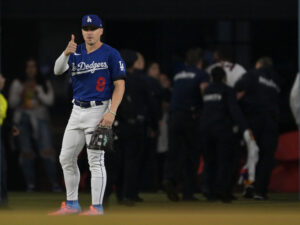
As news started to leak out about about Margot being traded to Minnesota, speculation turned to Hernández almost immediately. There was reporting over the weekend that the Giants, Angels, Twins and Padres were interested in him but he will instead head back to the club that he’s played for throughout most of his career.
Now 32, Hernández spent 2015 to 2020 with the Dodgers, largely deployed as a serviceable multi-positional guy. He hit .240/.312/.425 over those six years, production that led to a wRC+ of 98. Though that offense was slightly below average, he still helped the club by being able to slot in all over the place. He played all four infield positions and all three outfield spots during that time, and even made an appearance on the mound.
Going into 2021, he reached free agency and signed with the Red Sox on a two-year, $14MM deal. He was excellent in the first year of that pact, hitting 2o home runs and slashing .250/.337/.449 for a wRC+ of 109. He spent most of his time in center field, getting strong grades there, while also lining up at the middle infield spots.
In 2022, his offense took a step back. He went on the injured list due to a right hip flexor strain and missed over two months. Nonetheless, the Sox still had faith in a bounceback. In September of that year, they gave him a $10MM salary to stick around for 2023. He finished 2022 with a line of .222/.291/.338 for a wRC+ of 74.
With Trevor Story set to miss significant time in 2023 recovering from elbow surgery, the Sox tried to make Hernández their everyday shortstop, though the experiment didn’t work out. The defensive metrics didn’t like his work there, as he was saddled with a grade of -6 from Defensive Runs Saved and -12 Outs Above Average. He also hit just .222/.279/.320 before getting flipped back to the Dodgers at the deadline. Returning to his old stomping grounds seemed to suit him, as he hit .262/.308/.423 while bouncing all over the diamond for the Dodgers.
The Dodgers may never have been fully committed to Margot, as they took him on as part of the Tyler Glasnow trade. The Rays were looking to move some payroll in the Glasnow deal but also saved some more by including Margot, who is owed $12MM this year in the form of a $10MM salary and then a $2MM buyout on a club option for 2025.
The Dodgers are set to have a regular outfield of James Outman, Teoscar Hernández and Jason Heyward this year. Margot and his right-handed bat could have platooned with Heyward, who had a bounceback year in 2023 while being mostly shielded from southpaws, but the Dodgers also have other options for that role. Right-hander Chris Taylor is also on the roster and now Hernández will join him, giving the club two guys who could platoon with Heyward while also adding some infield depth as well. Hernández has hit .257/.343/.458 in his career against lefties for a 115 wRC+, compared to .228/.290/.377 and a wRC+ of 80 versus righties.
The Dodgers are going to have a middle infield combo of Gavin Lux at shortstop and Mookie Betts at second base. The former missed all of 2023 after tearing his ACL and damaging the LCL in his right knee, while Betts only recently moved to the infield after spending most of his career in right field. Miguel Rojas is on the roster as a glove-first depth option and Taylor is in the mix there as well, but Hernández can help out while also taking Margot’s role as the fourth outfielder.
The Dodgers are over the fourth and final line of the competitive balance tax and are a third-time payor. That means any money added to the payroll now comes with a 110% tax rate. However, they will end up being cash neutral today as they are saving $4MM in the Margot deal and giving $4MM to Hernández.
Fabian Ardaya and Ken Rosenthal of The Athletic first reported that the two sides were nearing a deal. Jeff Passan of ESPN first reported that it would be a one-year pact. Hernández himself first relayed that the deal was done. Jack Harris of the Los Angeles Times. had the $4MM salary.
Kodai Senga Diagnosed With Posterior Capsule Strain In Right Shoulder, Will Open Season On IL
TODAY: Senga received a PRP injection in his right shoulder and won’t throw for at least three weeks, the Mets told Anthony DiComo and other reporters. This creates a rough timeline of late April/early May for Senga’s return if he returns from his shutdown period and is then able to ramp up as per usual, though things are still very fluid for a recovery plan. “We’ve got to be careful, but we’ll be flexible, as well,” Mets manager Carlos Mendoza said. “Senga knows his body well. He knows he’s going to be pretty honest, and this is the conversation I’m having with him — making sure he voices his opinion, so we will have to adjust as we get going with his throwing program.”
FEBRUARY 22: The Mets were dealt some difficult injury news on Thursday morning. New York president of baseball operations David Stearns announced that staff ace Kodai Senga was diagnosed with a moderate posterior capsule strain in his throwing shoulder (relayed by Anthony DiComo of MLB.com). Senga is being shut down until his symptoms subside. He’s out indefinitely and will open the year on the injured list.
Senga sat out the team’s workout yesterday after reporting arm fatigue. The Mets sent him for testing yesterday. That evidently revealed the shoulder strain. It subtracts the team’s best starter from the Opening Day rotation mix, although Stearns downplayed the urgency to go outside the organization for additional help (video link via the New York Post).
Senga, 31, signed a five-year, $75MM deal with the Mets last offseason after an 11-year run in Japan’s Nippon Professional Baseball. The former Softbank Hawks ace outperformed even some of the more optimistic expectations for his MLB debut, pitching 166 1/3 innings of 2.98 ERA ball with a 29.1% strikeout rate and 11.1% walk rate. Senga made the NL All-Star team, finished second in NL Rookie of the Year voting and even landed seventh on the NL Cy Young ballot.
Following last summer’s trades of Max Scherzer and Justin Verlander, Senga stood as the presumptive favorite to take the ball for the Mets on Opening Day. He’d have been followed, in some order, by Jose Quintana and offseason acquisitions Adrian Houser, Sean Manaea and Luis Severino. Instead, with Senga sidelined, one of those four (Quintana, most likely) will take the ball on Opening Day, while a battle for the fifth spot among in-house options like Tylor Megill, Joey Lucchesi and Jose Butto plays out during spring training. Many Mets fans will surely hope that the Senga injuries spurs further activity on either the trade or free agent front, but that seems quite unlikely.
“I don’t thinks so,” Stearns replied when asked whether Senga’s injury increases the likelihood of adding someone from outside the organization. “We’re always going to be opportunistic and hear what’s out there, but I don’t think it really changes our thought process.”
The free agent market still features several notable names; each of Blake Snell, Jordan Montgomery, Michael Lorenzen and Mike Clevinger remains unsigned. Presumably, the agents for all of those arms will be reaching out to the Mets in the wake of an ominous injury to their top starter.
However, the team’s mindset throughout the offseason has been to avoid long-term investments ahead of what looks like a largely transitional season. (Yoshinobu Yamamoto was the lone exception to that thinking, due to the 25-year-old’s atypical youth relative to other free agents.) That aversion to long-term deals will surely rule out a run at Snell or Montgomery, barring a change of heart from owner Steve Cohen, and the Mets’ luxury-tax status might make them reluctant to spend further on back-of-the-rotation arms like Lorenzen and Clevinger. Any spending for the Mets at this point comes with a 110% tax, so they’d effectively be paying double for any rotation additions.
Marlins Sign Tim Anderson
TODAY: The Marlins have officially announced Anderson’s signing. Sandy Alcantara (who will miss all of 2024 recovering from Tommy John surgery) was placed on the 60-day injured list to create a 40-man roster spot for Anderson.
FEBRUARY 22: The Marlins and free agent shortstop Tim Anderson are in agreement on a one-year, $5MM contract, reports Jesse Rogers of ESPN. The deal is pending a physical. Anderson is repped by Excel Sports Management.
Anderson, 30, was arguably the best shortstop in a very weak middle infield class. A two-time All-Star and 2019 batting champ, he looked like one of the better shortstops in the majors as recently as a season ago. He’s coming off the worst year of his career, though, as he struggled to a .245/.286/.296 batting line in 524 plate appearances. Anderson connected on just one home run.
While his offensive profile has never been driven primarily by power, he reached double digits in homers each year between 2017-21. That dropped to six homers in a 2022 season cut short by a ligament tear in his left middle finger, although he still managed a .301/.339/.395 slash. His entire offensive profile plummeted last season.
Anderson struck out in 23.3% of his plate appearances, his highest rate since 2018. He put more than three-fifths of his batted balls on the ground, a personal-high clip. That led to his worst average and on-base marks since 2018 in addition to the lowest power production of his career.
That led the White Sox to buy Anderson out for $1MM in lieu of a $14MM club option, ending a strong eight-year run on Chicago’s South Side. General manager Chris Getz has kicked off at least an abbreviated rebuild, bringing in Paul DeJong on a modest $1.75MM free agent deal to solidify the defense.
Anderson has increasingly struggled on that side of the ball as well. By measure of Defensive Runs Saved, he has rated a combined 23 runs below average over the past two seasons. Only Bobby Witt Jr. has a lower total at the position. Statcast’s Outs Above Average metric hasn’t been nearly as bearish, grading Anderson slightly below par in both years. It’s possible that lower body injuries have played a role in that downturn. Over the past three seasons, he has missed time with a left hamstring strain, a right groin strain, and a sprained left knee (in addition to the aforementioned finger injury).
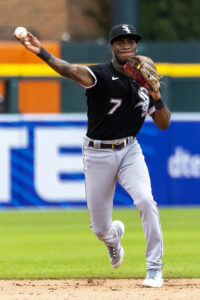
The veteran infielder expressed a willingness to move to the other side of the second base bag. That won’t be necessary in Miami, which has sought shortstop help throughout the winter. The Fish let Joey Wendle depart after a lackluster 2023 campaign. Jon Berti is best suited in a utility role, while none of Xavier Edwards, Jacob Amaya or Vidal Bruján is established at the MLB level.
Miami has a two-time batting champ, Luis Arraez, at the keystone. The up-the-middle pairing of Anderson and Arraez isn’t likely to be a great defensive group, but there’s significant offensive upside if Anderson rebounds. Between 2019-22, Anderson had an excellent .318/.347/.473 line in more than 1600 trips to the plate. Among hitters with at least 2000 plate appearances over the past five seasons, he’s still third in batting average. Arraez leads the way at .326, while only Freddie Freeman (.315) also stands above Anderson, who has hit .300 since 2019.
It’s a fairly inexpensive pickup for the Fish on what is remarkably their first major league free agent deal of the offseason. That means it’s also the first MLB contract for new president of baseball operations Peter Bendix, who has presided over a quiet winter in South Florida. Ever present payroll constraints contributed to Miami’s decision to let Jorge Soler walk after a 36-homer season. They haven’t replaced Soler at DH or addressed the rotation in response to Sandy Alcantara’s Tommy John surgery, but Anderson brings a higher ceiling than last year’s collection of shortstops.
Roster Resource calculates the team’s player payroll around $100MM. That’s above last season’s approximate $93MM season-opening mark but still places them firmly in the league’s bottom third in spending. Miami will need to make a corresponding 40-man roster move once the signing is finalized, but that’ll likely be accomplished by placing Alcantara on the 60-day injured list.
If Anderson returns to form, he’ll have a shot at a better multi-year deal a year from now. He’ll return to free agency next winter in advance of his age-32 season. Willy Adames headlines what otherwise looks like another weak group of free agent shortstops. Gleyber Torres will be the top second baseman, while Anderson and Amed Rosario (who signed a $1.5MM deal with Tampa Bay this week) are the most interesting rebound candidates.
Pirates Extend Mitch Keller
The Pirates announced that they have signed right-hander Mitch Keller to five-year contract extension. The deal was previously-reported by Jeff Passan and Kiley McDaniel of ESPN. It’s a $77MM guarantee for the 27-year-old righty, per Jason Mackey of the Pittsburgh Post-Gazette. Kevin Gorman of the Pittsburgh Tribune-Review reports that the new contract includes the 2024 campaign and runs through 2028. The Tidal Sports Group client had previously been slated to reach free agency following the 2025 campaign.
Keller had already agreed to a one-year, $5.4425MM deal for the upcoming season, avoiding an arbitration hearing in the process. As such, he’ll be guaranteed four years and $71.5575MM in new money. The Associated Press reports the financial breakdown. While Keller’s salary for 2024 is unchanged, he also collects a $2.0575MM signing bonus. He’ll make $15MM in 2025, $16.5MM in ’26, $18MM in ’27 and $20MM in 2028.
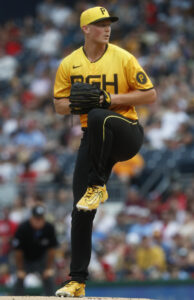
That aligns closely with the four-year, $73.5MM extension between the Twins and Pablo Lopez a year ago. Lopez, like Keller now, had between four and five years of big league service at the time of the agreement. A look at MLBTR’s Contract Tracker shows several other comps of note, including Kyle Freeland‘s five-year, $64.5MM deal with the Rockies.
A 2014 second-round pick and longtime top prospect, Keller has taken major steps forward over the past two seasons, pitching to a combined 4.08 ERA in 353 1/3 innings. That solid but unspectacular ERA masks some more promising underlying trends. Keller’s 2022 season took off when he added a sinker to his arsenal in mid-May, helping to take some pressure off what had been a rather hittable four-seam fastball. He was dominant for the first two-thirds of the 2023 season before stumbling with a handful of meltdown starts over the final couple months as he pitched to a new career-high workload (194 1/3 frames).
That ugly start in 2022 and similarly rocky finish in 2023 bookend a stretch of 41 starts that underscore the upside the Pirates are chasing with this signing. At his best from ’22-’23, Keller rattled off a stretch of 240 1/3 innings of 3.25 ERA ball, fanning 23.5% of his opponents against a sharp 7.9% walk rate and strong 48.4% ground-ball rate. And even with the tough finish to his 2023 campaign, Keller ended the year with career-best marks in strikeout rate (25.5%), walk rate (6.7%), average exit velocity (87.7 mph) and hard-hit rate (35.6%). There are plenty of arrows pointing up with regard to the 6’2″, 220-pound righty, and the Bucs surely view him as someone capable of that low-3.00s ERA who can team with 2023 No. 1 overall pick Paul Skenes to anchor the rotation moving forward.
Skenes figures to debut this summer, and the Keller extension gives the organization a chance at a dynamic one-two punch atop the staff for the foreseeable future. For the 2024 season, the Bucs’ rotation will also include veterans Martin Perez and Marco Gonzales, though neither lefty is guaranteed anything beyond the current campaign. (Gonzales has a $15MM club option with no buyout.)
The Pirates’ ability to either develop or acquire sufficient rotation help beyond the ’24 season will be critical to their chances of reversing a nearly decade-long run of losing baseball at PNC Park. Prospects like Quinn Priester, Kyle Nicolas, Jackson Wolf, Jared Jones, Anthony Solometo and Bubba Chandler give the Pirates a solid stock of promising young arms alongside Skenes. Each of Skenes, Jones and Chandler has garnered some top-100 fanfare this season (as Priester has in the past).
Of course, the Pirates’ history of developing starting pitching has been suspect, at best. Much of the struggles came under the now-former front office regime, but we’ve seen touted talents like Gerrit Cole, Tyler Glasnow, Jameson Taillon and Joe Musgrove all struggle to reach their ceilings with the Bucs before being traded. Cole, Glasnow and Musgrove, in particular, broke out with their new clubs. Even Keller took a long road to reach the form that led to today’s five-year agreement. It’ll be imperative for the Pirates that they improve their development of young pitchers and/or find help outside the organization. Notably, they’ve been in constant contact with the Marlins about Miami’s bevy of young pitchers and have explored other trade possibilities as well.
Keller joins outfielder Bryan Reynolds and third baseman Ke’Bryan Hayes as core pieces the Pirates have signed to long-term deals over the past few years. It’s a breath of fresh air for Bucs fans who’d grown accustomed to seeing their best players traded as their arbitration prices escalated. The long-term deals signed by each player don’t necessarily preclude eventual trades — as evidenced by Andrew McCutchen — but it’s nevertheless an encouraging trend for Pittsburgh fans to see a trio of extensions that each top $70MM in guaranteed money, considering their $60MM extension with Jason Kendall back in 2000 stood as the richest in franchise history for upwards of two decades.
Each of Keller, Reynolds and Hayes are now signed through at least the 2028 season — the same year that the team’s control windows over shortstop Oneil Cruz and outfielder Jack Suwinski extend. That quintet, paired with Skenes and catchers Henry Davis and Endy Rodriguez, could form the nucleus of the Pirates’ next contending club. Reynolds’ seven-year, $100MM extension and Hayes’ eight-year, $70MM pact are both generally affordable, even by the Pirates’ modest standards, which should give the Bucs flexibility to supplement that core in other ways.
It’s unlikely the Pirates ever dive into the deep end of the free agent market. But if owner Bob Nutting ever decides he’s finally comfortable spending in even the second tiers of the open market — Francisco Liriano‘s three-year, $39MM contract is the largest free agent signing in Pirates history — the Pirates would have the chance to complement their growing foundation with some meaningful talent and break away from their lengthy run near or at the bottom of the NL Central.
Tigers Sign Gio Urshela
The Tigers added to their infield on Thursday, announcing the signing of Gio Urshela to a one-year, $1.5MM guarantee. Detroit added that Urshela, a client of Rep 1 Baseball, would receive $100K bonuses at each of 500, 530, 560, 590 and 620 plate appearances. That pushes the deal’s maximum value to $2MM.
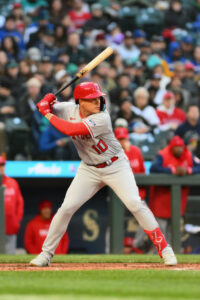
It’s the second instance this week of a veteran infielder agreeing to a $1.5MM free agent deal that falls well shy of what most pundits expected entering the offseason. Urshela’s deal matches the $1.5MM deal that Amed Rosario inked with the Rays on Tuesday. Detroit president of baseball operations Scott Harris recently suggested his club wasn’t likely to sign any “everyday-type” hitters to big league deals, citing a desire to commit to the wave of young prospects bubbling up to the majors. However, at this price point, Urshela was likely too enticing an opportunity for a team without a clear answer at third base.
Prior to this agreement, the Tigers looked to be preparing to begin the season with a platoon of Zach McKinstry and either Andy Ibanez or Matt Vierling at the hot corner. That pair would presumably hold things own until 2022 first-round pick Jace Jung worked his way to the big leagues.
The Tigers, perhaps not coincidentally, informed Jung today that he wouldn’t be making the Opening Day roster (X link via Evan Woodbery of MLive.com). They’ve also said fellow prospect Justyn-Henry Malloy will move off of third base and focus exclusively on outfield work. The addition of Urshela gives the Tigers a viable everyday option at third base while Jung finishes off his development — or at the very least provides a strong right-handed bat to complement with the lefty-swinging McKinstry.
Beyond the fit at third base, Urshela provides insurance in other ways. He’s played some shortstop in the big leagues, including 71 innings with the Angels in 2023, and could step in for Javier Baez at times. He also gives Detroit a veteran to be leaned upon in the event that top prospect Colt Keith, who signed a six-year extension before making his MLB debut and is expected to open the year as the Tigers’ second baseman, struggles early on. Urshela could handle second base himself or take up a more prominent role at the hot corner, with McKinstry sliding over to second base should Keith ultimately be determined to be in need of some more time in the minors.
Based on track record alone, Urshela was a candidate for a multi-year deal — and he’d likely have been a lock for one had he been fully healthy last season. Dating back to a 2019 breakout with the Yankees, he carries a .291/.335/.452 batting line in 1871 trips to the plate. He’s struck out at an 18.9% clip overall in that time but improved his bat-to-ball skills over the past two seasons between Anaheim and Minnesota; since Opening Day 2022 he’s fanned in just 16.9% of his plate appearances.
Solid as his career has been since becoming a big league regular, Urshela is a rebound candidate. His power output with the Angels was curiously low to begin the 2023 season, with just two home runs and a paltry .075 ISO (slugging minus batting average) through mid-June. He never got much of a chance to right the ship after suffering a pelvic fracture on June 15 of last season. Urshela didn’t require surgery but was on crutches in the aftermath of the injury and wound up missing the remainder of the season as it healed.
Urshela has fairly even platoon splits throughout his career, though he does skew slightly more productive against left-handed pitching (.290/.328/.445 against southpaws; .272/.320/.414 versus righties). That surely held extra appeal for a Tigers club that posted a tepid .241/.312/.398 slash against lefties in 2023, with the resulting 95 wRC+ ranking 22nd among MLB teams.
From a payroll vantage point, the Urshela deal barely makes a dent. He’s effectively replacing a league-minimum player on the roster, so he’s only adding about $750K of additional guarantees to the Tigers’ projected payroll. Roster Resource pegs Detroit at a $108.4MM projection for the 2024 season, which checks in more than $90MM shy of the team’s franchise-record mark set back in 2017 (under late owner Mike Ilitch, whose son, Chris, now runs the team). As such, there ought to be further resources available if similar bargain options to this Urshela addition present themselves. There’s no indication, however, that the Tigers have considered a higher-profile splash in free agency or on the trade market in the late stages of the offseason.
ESPN’s Jeff Passan first reported the Tigers and Urshela were in agreement on a one-year, $1.5MM deal. Jon Heyman of the New York Post reported the presence of incentives, which Evan Petzold of the Detroit Free-Press specified as being worth up to $500K.
Eric Hosmer Retires
First baseman Eric Hosmer hasn’t been on a major league roster in almost a year and has now decided to hang up his spikes. He tells John Perrotto of Forbes that he has now officially retired and is pivoting into the media sphere.
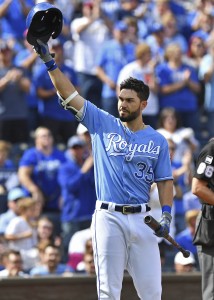 Hosmer, now 34, was one of many high-profile prospects in the Royals’ system, going back almost a couple of decades. The club leaned into a lengthy period of tanking in the early parts of this century, losing at least 87 games in nine straight seasons from 2004 to 2012. Over that time, they were able to pile up young talent in their farm system thanks to some strong draft picks. The deepest part of the rebuild was 2004 to 2007, with the club losing at least 93 games in each of those campaigns, but also getting a top-three pick in the draft for four straight years.
Those four picks were used on Alex Gordon, Luke Hochevar, Mike Moustakas and Hosmer. Those players combined with other youngsters like Lorenzo Cain, Salvador Pérez and Yordano Ventura to form a promising young core that the club was hoping to use to return to prominence.
Hosmer hit well on his way up the minor league ladder and was considered one of the top 10 prospects in the game going into 2011. He made a strong debut that year and showcased some tendencies that would go on to define his career, namely an ability to avoid strikeouts but also an inability to get under the ball. He didn’t walk much either, so the ball was often in play, with his numbers swaying from year to year depending on whether he was finding holes or not.
He only struck out in 14.6% of his plate appearances in his rookie season, well below that year’s league average of 18.6%. But 49.7% of his balls in play were pounded into the ground, noticeably above the 44.4% league average. Regardless, he still hit 19 home runs and slashed .293/.334/.465 for a wRC+ of 113.
In 2012, he suffered through a sophomore slump, hitting just .232/.304/.359 for a wRC+ of 80. Part of that was batted ball luck, as his BABIP dropped to .255 from .314 the year prior. But his grounder rate also ticked up to 53.6% and he only hit 14 homers. These sorts of oscillations continued into the next few years. In 2013, his batting average was up at .302 and he hit 17 homers, but then those numbers dipped to .270 and just nine long balls in 2014.
Despite the challenges for Hosmer in the latter year, the club’s planned return to contention finally clicked in a big way. The Royals went all the way to the World Series that year, though they ultimate were felled by the Giants in seven games. Hosmer was a big part of that run, as he hit .351/.439/.544 that postseason.
Just about everything went right the next year, despite Hosmer still putting 52% of batted balls into the dirt. He also hit 18 homers and slashed .297/.363/.459 for a wRC+ of 124. The Royals went back to the World Series and finished the job this time, taking down the Mets in five games to hoist their first trophy since 1985.
The club slipped near .500 in the next two seasons as the up-and-down performance continued for Hosmer. His bat dipped closer to league average in 2016, though he rebounded with arguably the best season of his career in 2017. His grounder rate was still very high at 55.6%, but he managed to park the ball over the fence 25 times and slashed .318/.385/.498 for a wRC+ of 135.
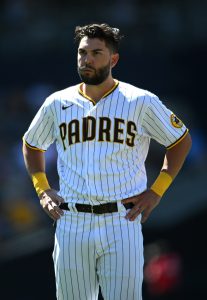 That was excellent timing for a career year, as that was his platform season for his first trip into free agency. Despite the inconsistent performance, the Padres took a chance on him, agreeing to an eight-year, $144MM deal. In addition to the offensive questions, his defensive metrics were never strong, in spite of his four Gold Glove awards while with the Royals. But the Padres had been undergoing their own period of insignificance, having just finished the seventh of what would eventually be nine straight losing seasons. The signing of Hosmer, the largest deal in franchise history at the time, was meant to signal an end of the rebuild and a return to relevance.
Unfortunately, the deal quickly went south, as Hosmer’s bat was around league average for most of his time in San Diego. From 2018 through 2021, he hit .264/.323/.415, translating to a wRC+ of 99. He was often the subject of trade rumors in that time, as the Friars looked to get out from under the deal. He was going to be sent to the Nationals as part of the deal that sent Juan Soto to San Diego, but Hosmer had a limited no-trade clause that allowed him to block the deal. That deal went through with Luke Voit taking Hosmer’s place, though Hoz was flipped to the Red Sox instead, with that club not covered by his clause. The Padres ate the remainder of Hosmer’s contract, apart from the league minimum, and included a couple of prospects in order to get Jay Groome from Boston.
A stint on the injured list due to some back inflammation limited him to just 14 games with the Sox after the deal and they released him in the offseason to clear a path for prospect Triston Casas. The Cubs took a flier on Hosmer, which was essentially a free look since the Padres were still on the hook for his salary. But he hit poorly in 31 games as a Cub last year, producing a batting line of .234/.280/.330, and was released in May. He didn’t latch on elsewhere and has now decided to officially call it a career.
Though there were some ups and downs, Hosmer still has plenty of accolades on his ledger, including four Gold Gloves, a Silver Slugger Award, an All-Star appearance and a World Series ring. He also won the World Baseball Classic with Team USA in 2017. He racked up 1,753 hits in his MLB career, including 322 doubles, 20 triples and 198 home runs. He scored 812 runs and drove in 893. Baseball Reference lists his career earnings just under $175MM. We at MLBTR salute Hosmer on a fine career and wish him the best in his next steps.
Hyun Jin Ryu Signs Eight-Year Deal With KBO’s Hanwha Eagles
Hyun Jin Ryu is headed back to South Korea. The KBO’s Hanwha Eagles announced the signing of Ryu to an eight-year deal worth 17 billion won (equivalent to just over $12.4MM). The contract also contains an opt-out provision at an unspecified date. Jeeho Yoo of Yonhap News relayed the details (on X). A Korean-language report from X Sports first reported the 17 billion won guarantee. It’s the largest contract in KBO history.
Ryu debuted with the Eagles in 2006 at age 19. He won the league’s MVP award as a rookie thanks to a 2.23 ERA through 201 2/3 innings. The southpaw turned in a 2.80 ERA in 190 appearances over a seven-year run with the Eagles. After the 2012 season, Hanwha announced they’d make Ryu available to major league teams through the posting system.
Under the MLB-KBO posting rules in effect at the time, teams placed blind bids for the right to exclusive negotiation with the player. The Dodgers bid upwards of $25MM to win that auction. That opened a 30-day window for them to sign Ryu. The sides eventually came to a six-year, $36MM guarantee with various performance bonuses.
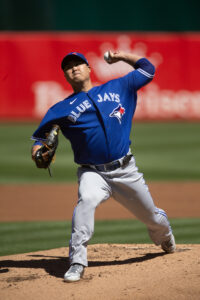
It turned out to be an excellent investment. Ryu pitched to an even 3.00 ERA over 30 starts in his debut campaign, finishing fourth in NL Rookie of the Year balloting. He turned in a 3.38 mark during his sophomore season before losing almost all of 2015-16 to shoulder and elbow problems. Ryu spent time on the injured list with various lower-body concerns between 2017-18 but remained effective when healthy. He finished his Dodger tenure with a flourish, turning in 182 2/3 innings with an MLB-best 2.32 ERA in 2019. He secured an All-Star nod and a runner-up finish to Jacob deGrom in NL Cy Young balloting.
That stellar year couldn’t have been timed any better. Ryu returned to free agency that winter, this time with all 30 teams eligible to put in offers. He signed a four-year, $80MM pact with the Blue Jays going into 2020. Through two seasons, it looked like a strong move. Ryu turned in a 2.69 ERA over 12 starts during the abbreviated schedule, finishing third in Cy Young balloting. He wasn’t as dominant the following season but managed a reasonable 4.37 ERA while starting a career-high 31 games.
Ryu’s final two seasons were impacted by injury. He battled forearm issues early in the ’22 campaign. An attempt to pitch through the injury was unsuccessful and he required Tommy John surgery in June. That kept him off an MLB mound well into the 2023 season.
The Jays reinstated Ryu on August 1. He managed 11 starts in the final two months, working to a 3.46 ERA. That’s solid production but wasn’t without some worrisome indicators. His fastball velocity sat at a personal-low 88.6 MPH. He struck out just 17% of opposing hitters and allowed 1.56 home runs per nine innings. The Jays deployed him in a very sheltered role. Skipper John Schneider called on Ryu to work beyond five innings just once. He only faced an opposing hitter for a third time in an appearance on 33 occasions.
That all worked against Ryu as he returned to the open market for what’ll be his age-37 season. At the beginning of the offseason, he said it was his preference to remain in MLB. It’s very likely that Ryu could’ve gotten a big league contract offer — the Mets and Padres reportedly showed interest — but it’s possible the market from major league teams wasn’t as robust as he’d anticipated.
Whatever the rationale, Ryu is returning to his home country. He’d spoken before about wanting to pitch for the Eagles between the end of his time in MLB and his overall playing career. He’ll do just that on a record-setting contract that runs through his age-44 season.
This almost certainly marks the end of Ryu’s time in the major leagues. He has had an excellent MLB career, allowing 3.27 earned runs per nine in 186 appearances. He tossed 1055 1/3 innings, struck out 934 batters, and collected 78 wins. A two-time Cy Young finalist, he also received down-ballot MVP votes in 2019 and ’20. Ryu made nine playoff starts over five separate seasons, working to a 4.54 ERA in 41 2/3 frames.
Image courtesy of USA Today Sports.
Brewers Re-Sign Brandon Woodruff
The Brewers officially announced the re-signing of Brandon Woodruff on Wednesday evening. It’s a two-year pact with a mutual option for the 2026 season. The McKinnis Sports client is reportedly guaranteed $17.5MM on a backloaded deal. He’ll be paid $2.5MM for the upcoming season and a modest $5MM salary in 2025. The bulk of the money is concentrated in a $10MM buyout on the mutual option, which is valued at $20MM. Woodruff receives full no-trade rights.
Milwaukee placed the righty on the 60-day injured list within a couple hours of announcing the deal. That created the necessary 40-man roster spot for Gary Sánchez, who also finalized his contract on Wednesday.
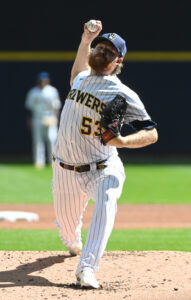 Woodruff, 31, has spent his entire career with the Brewers but it seemed like that relationship was perhaps going to end at some point. Not too long ago, the Brewers had three key players that were all on track to make eight-figure arbitration salaries in 2024 before reaching free agency. Woodruff was one of those, along with fellow righty Corbin Burnes and shortstop Willy Adames. Given the way the club operates, it was expected that at least one of that group would be traded for salary relief and to restock some future talent.
But Woodruff dealt with shoulder issues throughout 2023 and wound up requiring surgery in October, which put his 2024 season in jeopardy. MLBTR contributor Matt Swartz projected the righty for a salary of $11.6MM, a hefty amount for a pitcher who may not throw at all this year, especially for a lower-budget club like the Brewers. They reportedly explored some trade scenarios but ultimately just non-tendered Woodruff, sending him out to free agency.
That gave every club the chance to sign him, with the Mets having reported interest at one point. Their new president of baseball operations David Stearns is plenty familiar with Woodruff, as his time with the Brewers began the year after the righty was drafted. But in the end, Woodruff will be returning to Milwaukee to continue his tenure as a Brewer.
A two-year deal was always the most likely scenario for Woodruff. Pitchers facing lengthy layoffs like this, usually due to Tommy John surgery, often sign such pacts. That time frame allows the player to collect a paycheck while injured, while also giving the club a chance to potentially get a healthy full season at a relatively discounted rate. Woodruff’s situation is slightly different since he’s coming back from shoulder surgery rather than elbow surgery, but the logic is the same.
When healthy, Woodruff has been one of the better pitchers in the game. He has a 3.10 earned run average in his career, having struck out 28.9% of batters faced, walked just 6.5% of them and kept 42.8% of balls in play on the ground. Among pitchers with at least 650 innings pitched since the start of the 2017 season, that ERA ranks sixth in the majors.
But staying on the mound has been a bit of an issue for him, as he’s yet to hit 180 innings pitched in any big league season. In his big league career, he’s gone on the injured list due to a strained left oblique, a right ankle sprain and the aforementioned shoulder problems from last year.
Regardless, the Brewers are surely happy to get Woodruff back into the fold, as his results have clearly been excellent when he’s been able to take the ball. They have subtracted Burnes from this year’s rotation, having traded him to the Orioles, leaving Freddy Peralta as the de facto ace. They also acquired DL Hall in that Burnes deal, with the lefty hoping to earn a rotation spot this year. They also re-signed Wade Miley and Colin Rea while adding Jakob Junis and Joe Ross into the mix via free agency.
If Woodruff can get healthy by the end of the year, he’ll jump into that mix and help the club for the stretch run. Looking ahead to 2025, there’s not a lot of certainty for the Milwaukee rotation. Peralta is entering the final guaranteed year of his contract, though he has $8MM club options for next year and the year after, with those a virtual lock to be triggered as long as he’s healthy. Miley and Junis have mutual options for next year, with those almost never picked up by both sides. The club has a ’25 option for Rea at a modest $5.5MM salary and $1MM buyout, making it a net $4.5MM decision, but it’s not a lock they would trigger that with his inconsistent track record. Hall still isn’t established as a capable big league starter.
Taking all of that into consideration, there’s very little that can be written in ink for next year’s rotation. There are some prospects near the majors who could step up, such as Robert Gasser and Jacob Misiorowski, but it makes a lot of sense to bring Woodruff back into the fold and hopefully have him come back healthy and effective by then. If that comes to pass, he and Peralta would give the club a strong front two next year, with three spots available for younger guys or future additions.
Jon Heyman of the New York Post first reported the Brewers were signing Woodruff to a two-year deal. The Associated Press reported the financial details and the no-trade clause.