
Red Sox Sign Michael Wacha
Nov. 27: The deal is a one-year contract reportedly worth $7MM, per Alex Speier of the Boston Globe (via Twitter). That would be a raise for Wacha, who signed last offseason with the Rays for a $3MM guarantee. The deal has been made official, per Chelsea Janes of the Washington Post (via Twitter).
Nov. 26: The Red Sox are finalizing a one-year contract with Michael Wacha, reports Jeff Passan of ESPN (Twitter link). The deal is pending a physical. Wacha is represented by CAA Sports.
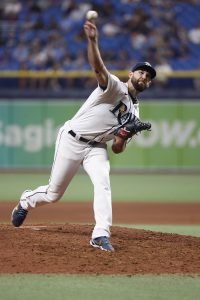
Wacha spent the 2021 campaign with the division-rival Rays. Working primarily as a starter, he tossed 124 2/3 innings across 29 appearances. Despite a league average 22.9% strikeout rate and a solid 5.9% walk percentage, the 30-year-old had trouble keeping runs off the board. Wacha pitched to a 5.05 ERA, largely on account of the 23 home runs (1.66 homers per nine innings) he surrendered.
That’s become somewhat familiar territory for Wacha, who has struggled with longballs in each of the past three seasons. He’s allowed a higher than average homer rate every year since 2019, with an ERA of 4.76 or higher in each season. Since the start of the 2019 campaign, Wacha owns a 5.11 ERA/5.07 FIP across 285 1/3 frames. While his strikeout and walk numbers have been fine, he’s not been able to effectively compensate for that home run trouble.
Nevertheless, Wacha has continued to draw interest as a buy-low target for clubs. The right-hander was an effective mid-rotation starter with the Cardinals earlier in his career, even earning an All-Star nod during a 2015 season in which he worked 181 1/3 innings of 3.38 ERA ball. Despite being a nine-year big league veteran, he’s still relatively young, not turning 31 until next July.
While Wacha’s results have gone backwards in recent years, his fastball still averages a solid 93.8 MPH. He’s also coming off his second consecutive season with a career-best swinging strike rate, as he’s generated whiffs on a bit more than 11% of his offerings over the past two years. That’s a hair better than the 10.9% league average for starters.
Financial terms remain unreported, but it’s unlikely Wacha’s deal will have a huge impact on the rest of the club’s offseason. The Sox have been known to be targeting rotation help this winter, particularly in the wake of Eduardo Rodríguez’s departure. Wacha can offer some back-of-the-rotation depth, but it’s also possible Boston bumps him into a multi-inning relief role depending on the rest of the club’s dealings. Chris Sale, Nathan Eovaldi and Nick Pivetta are locks to open the season in the rotation, while Tanner Houck, Garrett Whitlock and Connor Seabold are potential candidates for either back-of-the-rotation or bullpen roles.
Image courtesy of USA Today Sports.
Tigers, Javier Baez Have Had Recent Contract Talks
The Tigers have and free-agent shortstop Javier Baez have discussed a contract within the past few days, MLB.com’s Jon Morosi reports (via Twitter). ESPN’s Buster Olney adds that the Tigers are currently “focused” on Baez after previously talking to both Carlos Correa and Marcus Semien. Ken Rosenthal of The Athletic also tweets the Tigers and Baez are having discussions, though he also emphasizes that there’s no deal in place.
It’s not the first time the two sides have been connected, but recent talks between the two parties are nevertheless notable — particularly given various reports and industry speculation that Baez could push to sign somewhere prior to the expiration of the collective bargaining agreement next week.
Detroit has been repeatedly linked to Correa for months now, though at least some of that stems from the fact that Tigers manager AJ Hinch knows Correa well from their time together in Houston. General manager Al Avila began the offseason by stating that his team needed both a starting pitcher and a shortstop while simultaneously emphasizing that the club would not “spend like drunken sailors.” This week, speaking at Eduardo Rodriguez‘s introductory press conference, Avila struck a similar tone (links via Evan Petzold of the Detroit Free Press and Evan Woodberry of MLive.com).
“One big splash does not win you the offseason,” Avila said, adding that there was never going to be a free agent who could singlehandedly make the Tigers into a contender.
“Obviously, we want to get into the playoffs,” Avila said Tuesday, “but we have to be careful as we move forward. … We have to make sure we can field a good 26-man roster. It’s going to be a measured process. We’re going to be very careful in how we do it.”
It’s important to note that said quotes certainly don’t eliminate the possibility of Detroit beating the market to sign Correa or fellow top free agent Corey Seager. Even with Rodriguez aboard, the Tigers have minimal long-term commitments on the books. Tucker Barnhart and Robbie Grossman are signed through 2022. Miguel Cabrera and Jonathan Schoop are signed through 2023. Rodriguez is the only Tiger signed beyond that 2023 season.
That said, if Detroit truly is focused on employing a more “measured” approach, a shorter-term deal for Baez, Semien or Trevor Story would fit the bill. The combination of Rodriguez and any one of that trio would very likely cost less than signing either Correa or Seager on his own, while still providing considerable upgrades over the 2021 roster.
It was an up-and-down season in 2021 for Baez, who’ll turn 29 the day the CBA expires. After a solid first month at the plate, he alternated between brilliant numbers (May, July, September) and awful numbers (June, August) on a month-by-month basis. Notably, he finished out the year with his hottest streak of the season: .347/.426/.554 with five homers and six doubles in 115 September/October plate appearances. Perhaps more encouraging was the fact that following his trade to the Mets, Baez walked at a 7.0% clip that would represent a career-best, while his strikeout rate dropped from 36.3% with the Cubs to a somewhat more manageable 28.5%.
The ups and downs come with the territory for Baez, who’s known as a streaky hitter, but the end result this season was a .265/.319/.494 batting line and 31 homers. That would be an overwhelming upgrade for a Tigers team that saw its shortstops combine to post an awful .201/.275/.321 batting line — and that’s before considering Baez’s status as plus defensive shortstop and plus baserunner.
Baez ostensibly has a fairly wide market in free agency, as he’s also been linked to the Mariners, Rangers, Red Sox, Yankees and the incumbent Mets — albeit to varying extents.
Pirates To Re-Sign Yoshi Tsutsugo
The Pirates are reportedly re-signing Yoshi Tsutsugo on a one-year, $4MM guarantee. The deal is pending a physical. Tsutsugo is represented by Wasserman.
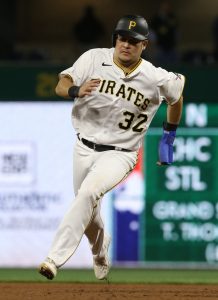
The Bucs and Tsutsugo have been in contact about a potential extension over the past few weeks, so it’s not a huge surprise they’ve eventually agreed on terms. After stints with the Rays and Dodgers didn’t prove particularly successful, Tsutsugo latched on with the Pirates on a major league deal in mid-August. It was a month-plus trial run with a team already well out of contention, but Pittsburgh could afford to give Tsutsugo everyday playing time down the stretch.
The left-handed hitting first baseman took full advantage, as MLBTR’s Steve Adams explored in late September. Over 144 plate appearances in black and yellow, Tsutsugo hit .268/.347/.535 and popped eight home runs. In addition to tapping into the raw power he’d shown for a decade as one of the better hitters in Japan’s Nippon Professional Baseball, Tsutsugo cut his strikeouts substantially in Pittsburgh. After fanning in 29.4% of his 303 plate appearances with Tampa Bay and Los Angeles from 2020-21, he went down on strikes in only 22.9% of his trips to the dish as a Pirate.
It remains to be seen if that run was a sign that Tsutsugo had turned a corner late in his second major league season. There’s a real chance he can’t sustain that kind of output over more than a 43-game sample, and Tsutsugo’s overall numbers as a big leaguer (.209/.309/.388 in 447 plate appearances) aren’t particularly impressive. At a modest $4MM guarantee, though, there’s little risk for the Pirates in giving the 29-year-old (30 on Friday) an opportunity to try to build off his late-season success over an extended showing. If he continues to perform over next season’s first couple months, the rebuilding Bucs could either look to hammer out a longer-term extension or try to move him at next summer’s trade deadline.
Tsutsugo has experience at both first base and in the corner outfield as a big leaguer. When discussing the possibility of bringing him back last week, Pittsburgh general manager Ben Cherington suggested the club would primarily look to deploy him at first base if a deal came together. Now that an extension has been agreed upon, it seems Tsutsugo is in line to assume regular first base duties next season.
That could make fellow lefty-hitting first baseman Colin Moran superfluous. Moran, who was a league average bat over 359 plate appearances in 2021, is projected by MLBTR contributor Matt Swartz for a $4MM arbitration salary and could be a non-tender candidate.
Jason Mackey of the Pittsburgh Post-Gazette first reported the Pirates and Tsutsugo were in agreement on a one-year, $4MM deal.
Image courtesy of USA Today Sports.
Wade Davis Announces Retirement
Three-time All-Star and 2015 World Series champion Wade Davis announced his retirement after a 13-year MLB career Wednesday (via a tweet from the Royals).
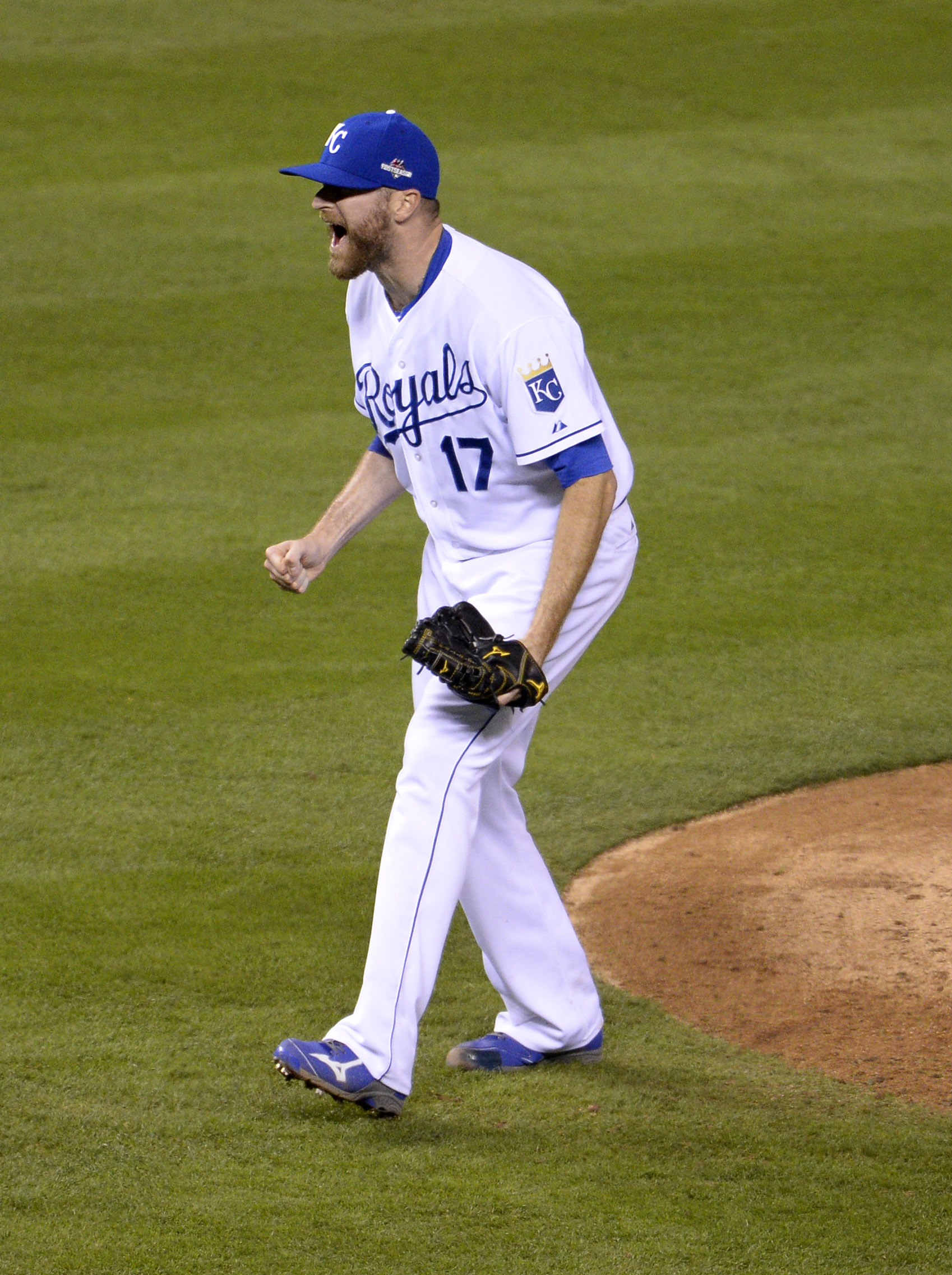
Davis, 36, began his pro career as a third-round pick by the Devil Rays back in 2004. He ranked not only among Tampa Bay’s top prospects but among the best farmhands in all of baseball from 2007-10, while developing as a rotation hopeful in a perennially strong Tampa Bay system.
After a strong run through the minors, Davis debuted as a 23-year-old in 2009, going on to enjoy some success as a member of the Rays’ rotation for the next couple of seasons. From 2009-11, Davis started 64 games and pitched to a 4.22 ERA out of the Tampa rotation — albeit with lackluster strikeout and walk rates, as well as less-flattering marks from fielding-independent pitching metrics.
A move to the bullpen in 2012 brought about a sub-3.00 ERA and nearly doubled Davis’ strikeout rate, but the Royals still had designs on moving him back into the rotation when acquiring Davis and teammate James Shields in what remains one of the more surprising and impactful blockbuster trades in recent memory. Shields, controlled two years at the time, and Davis (controlled for three) went to the Royals in exchange for then-prospects Wil Myers, Jake Odorizzi, Mike Montgomery and Patrick Leonard. It was a massive deal that had long-term implications for both clubs — a trade that set the stage for Kansas City’s eventual back-to-back World Series appearances.
Davis didn’t fare too well in his return to starting pitching, as his first season with Kansas City culminated in a 5.32 ERA in 135 2/3 innings. The Royals put Davis back in the ‘pen following those struggles, and Davis joined Greg Holland, Kelvin Herrera and (in 2015) Ryan Madson in anchoring some of the most imposing bullpens of the past decade. The dominant relief corps that Kansas City rode to a 2014 World Series loss and a 2015 World Series title, in many ways, helped to drive the emphasis teams place on cultivating a deep collection of power-armed relievers for ideal postseason usage.
Davis not only thrived in his return to the bullpen — he broke out as one of the best relief pitchers on the planet. He posted a flat 1.00 ERA with a 39.1% strikeout rate in 2014 — a brilliant strikeout rate even by today’s standards but a nearly unparalleled mark back in ’14, when the leaguewide strikeout rate was nearly four percent lower than at its recent peak in 2020. Davis finished eighth in Cy Young voting that season and somehow followed up with an even better year in 2015, when he posted a sub-1.00 ERA and landed sixth in AL Cy Young voting.
Davis’ dominance extended well beyond the regular season in that pair of World Series campaigns with Kansas City. He was almost comedically overpowering in the postseason, performing on a completely different level than the opposing lineups through which he breezed. In 25 innings of postseason play from 2014-15, Davis allowed one earned run on just 14 hits with a staggering 38-to-5 K/BB ratio.
The Royals embarked on something of a rebuild in the 2016-17 offseason, as most of their World Series core reached or was nearing free agency. That prompted the Royals to flip Davis to the reigning World Champion Cubs, netting eventual American League home run leader Jorge Soler in return. Davis’ dominance largely continued in Chicago. In all, from 2014-17, Davis made three All-Star teams while pitching to a 1.45 ERA with 79 saves and a 33.1% strikeout rate in 241 1/3 regular-season innings (plus plenty of postseason mastery).
It was wholly unsurprising that he was in demand as a free agent that winter, and the Rockies rewarded Davis with a three-year, $52MM contract that established a new average annual salary record for a reliever at $17.33MM. Davis led the National League with 43 saves in 2018, his first season with the Rox, but things unraveled thereafter. Oblique and shoulder injuries weighed Davis down in subsequent seasons, and the Rockies released him in Sept. 2020 with just weeks remaining on that three-year pact.
The 2021 season marked something of a full-circle campaign for Davis, who returned to the Royals on a minor league deal and broke camp in the team’s bullpen. Forearm and continued shoulder troubles sent Davis to the injured list on multiple occasions, however, and his once-96.5 mph heater sat at a greatly diminished 92.8 mph. Davis managed 42 2/3 innings in relief, but he was hit hard and finished out the season with a 6.75 ERA.
All told, Davis will conclude his career at 63-55 with 141 saves, 270 games finished, a 3.94 ERA and 929 strikeouts in 990 1/3 regular-season innings. He tacked on an additional 40 innings of 1.80 ERA ball, four wins, eight saves and 57 strikeouts in a sensational postseason career. Davis made more than $87MM in a 13-year career and will forever be remembered by Royals faithful for the indelible role he played in Kansas City’s baseball renaissance in 2014-15.
Photo courtesy of Imagn/USA Today Sports.
Cardinals To Sign Steven Matz
The Cardinals have made a late-night strike to bolster their rotation, reportedly reaching agreement with free agent starter Steven Matz on a four-year, $44MM guarantee, pending a physical. Incentives could eventually push that figure as high as $48MM. Matz is a client of Icon Sports Management.
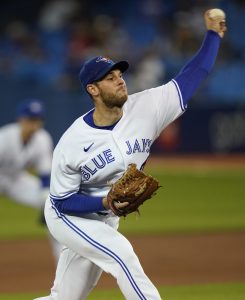
Matz reportedly fielded offers from eight clubs, and interest was robust enough that he’d been expected to sign before Thanksgiving. Teams’ affinity for the 30-year-old is also evident in the eventual contract terms, as Matz’s deal fairly handily tops MLBTR’s three-year, $27MM projection entering the winter.
The left-hander has been a reliable rotation member for the majority of the past few years. He’s eclipsed 150 innings and posted an ERA between 3.82 and 4.21 in each of the last three 162-game seasons. His peripherals haven’t been quite as impressive, but Matz has typically offered near league average rate numbers while reliably taking the ball every fifth day.
Matz has never had elite swing-and-miss stuff. That continued to be the case in 2021, as his 22.3% strikeout percentage and 9.4% swinging strike rate were both a bit shy of the respective league average marks (22.6% and 10.9%) for starting pitchers. That’s arguably less alarming for St. Louis than it would be for other clubs around the league, as the Cardinals have reportedly been seeking pitchers best equipped to take advantage of the team’s elite defense. Matz seems to fit that bill, as he annually posts walk rates lower than most and typically induces ground balls at a slightly higher than average rate.
He’s also one of the harder throwers available, averaging 94.5 MPH on his sinker in each of the past two years. That’s particularly rare for a left-handed starter, with only seven other southpaws (minimum 100 innings) throwing harder on average in 2021. He’ll add a different look to a Cardinals rotation that otherwise projects to include right-handers Adam Wainwright, Jack Flaherty, Miles Mikolas and Dakota Hudson.
Further adding to Matz’s appeal is that the Blue Jays declined to issue him a qualifying offer at the start of the offseason. The signing won’t cost St. Louis any draft pick compensation, and Toronto won’t receive any form of compensation for his departure. The Jays were reportedly among the teams to put forth an offer in hopes of keeping Matz north of the border, but that effort proved not to be enough to keep him in a Jays uniform for more than one season.
There’s plenty about Matz for the St. Louis front office to like, but this deal does come with its share of risk. While Matz was a solid performer in three of the past four seasons, his 2020 campaign was nothing short of a disaster. He was tagged for a 9.68 ERA across 30 2/3 innings that year, serving up a staggering 14 home runs in that time. Including that showing deals a heavy blow to Matz’s otherwise fairly solid recent work.
Going back to the start of 2018, he owns a cumulative 4.36 ERA/4.55 FIP in just under 500 frames. That’s not particularly impressive production in aggregate, worse than that of Anthony DeSclafani, who signed for three years and $36MM with the Giants on Monday. DeSclafani is a year older than Matz is, and perhaps the Cardinals are simply willing to write off 2020 as a small sample in an overall anomalous year.
Homers have been an issue for Matz for the bulk of his career in spite of his ground-ball proclivities, though. He’s generally given up a lot of hard contact when batters have managed to get the ball in the air against him. The 2021 campaign was the first of his career in which he’s allowed a homer per fly ball rate lower than the league mark. Whether he can sustain that kind of success keeping the ball in the yard could go a long way towards determining whether he’ll continue to post a sub-4.00 ERA over the coming seasons.
The specifics on Matz’s contract have yet to be reported, but he’ll receive an average annual value of $11MM. The Cardinals have the flexibility to accommodate an eight figure salary over the coming few seasons, with Jason Martinez of Roster Resource projecting the club’s 2022 player commitments in the $142MM range before accounting for Matz’s deal. Their obligations come out around $77MM in 2023. The franchise has opened the past few seasons with payrolls hovering right around $160MM, so a flat $11MM annual payment would leave somewhere around $7MM – $10MM in 2022 spending capacity if ownership signs off on a similar payroll next year. (Backloading the deal would obviously leave more immediate space but have a higher hit on the club’s future commitments).
That could allow St. Louis to make another addition or two elsewhere on the roster, and Katie Woo of the Athletic tweets that the Cardinals are expected to continue to add. It’s already a solid group without many obvious holes on paper, although shortstop, backup catcher and the bullpen all stand out as speculative possibilities for upgrades over the coming months.
Jeff Passan of ESPN reported that the Cardinals and Matz were in agreement on a four-year, $44MM guarantee that could max out at $48MM based on incentives.
Image courtesy of USA Today Sports.
Giants Re-Sign Anthony DeSclafani
The Giants have made the first of what’ll be multiple additions to the starting rotation, announcing agreement with free agent starter Anthony DeSclafani on a three-year, $36MM contract. (The team confirmed the contract terms). The deal pays the VC Sports Group client flat $12MM salaries each year from 2022-24.
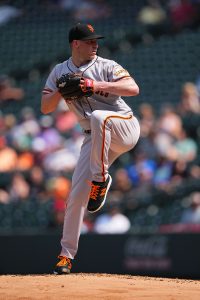
DeSclafani, 32 next April, spent this past season in San Francisco. He joined the organization on a one-year, $6MM guarantee last December. That was a buy-low play for the front office, as DeSclafani has struggled with both injuries and performance en route to a 7.22 ERA across 33 2/3 innings the year before, his final season with the Reds.
The move worked out as well as president of baseball operations Farhan Zaidi could have reasonably expected. DeSclafani stayed healthy — aside from a minimal IL stint due to ankle inflammation — and made 31 starts, finishing 18th in the National League in innings pitched. Along with taking on a heavy workload, DeSclafani posted arguably the best rate numbers of his career. He worked to a personal low 3.17 ERA and 3.62 FIP, while his 4.11 SIERA is right in line with his best marks during his time in Cincinnati.
Despite averaging north of 94 MPH on his fastball, DeSclafani’s swing-and-miss and strikeout numbers are more fine than spectacular. His 11% swinging strike rate and 22.5% strikeout rate this past season were both almost exactly in line with the respective league averages (10.9% and 22.4%) for starting pitchers. While he hasn’t been overpowering, DeSclafani has typically paired those decent strikeout numbers with plus control and a ground-ball rate at or just a tick above the league average.
Fielding independent metrics suggest DeSclafani’s more of a capable mid-rotation workhorse than a true top-of-the-rotation starter. There’s plenty of value in a third or fourth starter who soaks up average to slightly above-average innings in bulk, though, and that’s the type of pitcher DeSclafani has been over the course of his career. For a Giants team that could’ve lost all but Logan Webb from this year’s rotation, making a run at bringing DeSclafani back always seemed like a strong possibility.
San Francisco elected not to make him an $18.4MM qualifying offer at the outset of the offseason, but they struck fairly quickly to bring him back on a multi-year deal at a lesser average annual value. The guarantee comes in just a hair below MLBTR’s three-year, $42MM projection. It’s a sensible price point, although it’s worth noting that this kind of deal has become fairly atypical as teams have tended to devalue mid-tier arms in recent years. Among free agent starting pitchers, only Kyle Gibson ($30MM with the Rangers in 2019-20) and Tyler Chatwood ($38MM with the Cubs in 2017-18) have signed three-year deals worth between $30MM and $50MM over the past five offseasons.
The Giants have an abundance of payroll flexibility — both in 2022 and beyond. They’re apparently taking advantage of it to address their aforementioned rotation needs early in the offseason. In addition to the already-finalized DeSclafani reunion, the club is reportedly nearing a two-year deal with Alex Wood and was said to be making a strong run at Alex Cobb this morning. Whether all three starters will wind up in black and orange remains to be seen, but it’s clear the front office has made addressing the rotation a priority — seemingly in advance of the December 1 expiration of the current collective bargaining agreement.
To clear space on the 40-man roster for DeSclafani’s return, the Giants designated corner outfielder Alex Dickerson for assignment. That’ll almost certainly conclude Dickerson’s two and a half season tenure in the Bay Area, as he has more than enough service time to refuse an outright assignment even if he’s not traded or claimed off waivers over the coming days.
The Giants acquired Dickerson in a minor deal with the division-rival Padres in June 2019. That paid off handsomely, as the lefty-hitting outfielder performed quite well down the stretch that year and mashed in a limited sample during last year’s shortened season. Between those two campaigns, Dickerson kicked off his Giants’ career with a .294/.361/.552 showing over his first 341 plate appearances.
Impressive as he started, Dickerson couldn’t get on track in 2021. While he tallied a career-high 312 plate appearances this past season, he managed just a .233/.304/.420 line with 13 home runs. Combined with a limited defensive profile and an arbitration salary projected by MLBTR contributor Matt Swartz to land in the $3MM range, the front office determined not to bring him back in 2022.
Jeff Passan of ESPN first reported that the Giants and DeSclafani had reached agreement on a three-year, $36MM deal. Kerry Crowley of the Bay Area News Group reported that the deal paid DeSclafani an even $12MM in each season.
Image courtesy of USA TODAY Sports.
Angels Sign Aaron Loup
The Angels announced they’ve signed reliever Aaron Loup to a two-year, $17MM guarantee. (The team announced the contract terms). He’ll receive successive $7.5MM salaries in 2022 and 2023, and the deal also contains a $7.5MM club option for 2024 that comes with a $2MM buyout. Loup is a client of the Beverley Hills Sports Council.
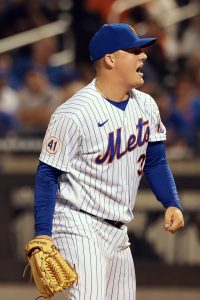
A longtime member of the Blue Jays’ bullpen early in his career, Loup had seemingly settled in as a competent journeyman not too long ago. He split the 2018 season between Toronto and the Phillies, then spent the next three years playing on either minor league or one-year big league deals with different clubs.
After an injury-wrecked 2019 campaign with the Padres, he settled for a minors pact with the Rays in 2020. Loup posted strong results in Tampa Bay but didn’t boast the kind of velocity teams typically covet from back-end arms. His 2020 numbers were enough to land him a guaranteed job with the Mets, albeit on a fairly low $3MM base salary.
Loup’s deal with the Angels shatters his previous three contracts, a testament to how effective he was in Queens. The Louisiana native worked to an incredible 0.95 ERA across 56 2/3 innings, a mark bested only by Seattle’s Casey Sadler among those with 30+ frames. Teams are looking far beyond ERA to evaluate pitchers (particularly relievers), but Loup’s underlying metrics also painted the picture of an elite late-innings arm.
The 33-year-old (34 next month) fanned a solid 26.1% of batters faced, the best full season mark of his career. That’s more good than dominant, but Loup has never been a particularly overpowering hurler. Relying primarily on a 92 MPH sinker and a mid-80s cutter/slider, the southpaw has typically been a ground-ball specialist. Loup routinely induces grounders on half or more of balls in play against him, and he continued to thrive in that regard this year. He also boasts plus control, only walking more batters than average in two of his eight career seasons with at least 20 innings pitched. His 7.3% walk percentage in 2021 was almost three points lower than the 9.8% league mark for bullpen arms.
Loup’s standout skill, however, has been contact suppression. He’s typically one of the league’s harder pitchers to square up, and that was never more true than in 2021. Only six of the 218 hitters who stepped in against him recorded an extra-base hit, and he remarkably allowed just a single home run. The Angels can’t reasonably count on Loup to be that effective moving forward, but the front office is clearly banking on him inducing plenty of grounders and otherwise unthreatening contact.
Adding to Loup’s appeal is that he stymied hitters from both sides of the plate. He’s always been a tough at-bat for left-handed hitters, and he was leveraged situationally quite a bit early in his career. But Loup has proven adept at getting righties out lately as well, holding them to a meager .205/.276/.311 line since the start of 2020. An ability to handle hitters from both sides of the plate has taken on an outsized importance in the three-batter minimum era, and Loup has proven capable of taking on that expanded role.
Loup was perhaps the top option in this offseason’s left-handed relief group. Andrew Chafin, Brooks Raley and former Angel Tony Watson now stand out as the best remaining arms in a fairly thin class. The combination of market scarcity and Loup’s recent dominance leads to a very solid contract that comes in a bit higher than generally expected.
The signing pushes the Angels’ estimated 2022 player commitments a bit north of $157MM, in the estimation of Jason Martinez of Roster Resource. Non-tenders could shave a couple million dollars off that tally, and there’s still some decent leeway before reaching the club’s near-$182MM season-opening 2021 payroll. That could give general manager Perry Minasian and his staff the chance for further upgrades, with the pitching staff and middle infield still standing out as potential target areas.
The Angels have already made one big rotation strike, signing Loup’s 2021 (and now 2022) teammate Noah Syndergaard to a $21MM deal. Even after the Syndergaard pickup, Minasian told reporters the club was hoping to further bolster the rotation (link via Rhett Bollinger of MLB.com). And while Loup should be a notable upgrade in the late innings, the club had a below-average relief corps in 2021 and is facing the potential free agent departure of closer Raisel Iglesias. An effort to retain or replace Iglesias still seems plausible, even with Loup now in the fold.
To create space on the 40-man roster, Los Angeles designated southpaw Hector Yan for assignment. The 22-year-old was highly regarded enough that the club added him to the 40-man last winter to keep him from potential selection in the Rule 5 draft. Yan struggled to a 5.25 ERA with a sky high 15.2% walk rate at High-A Tri-City, though, costing him his roster spot. The Angels will have ten days to trade Yan or place him on waivers.
Image courtesy of USA TODAY Sports.
Giants In Discussions With Alex Cobb
The Giants are in talks with free-agent righty Alex Cobb and appear to be making a “strong push” to sign the veteran righty, tweets Susan Slusser of the San Francisco Chronicle (Twitter link). Cobb is represented by the Beverly Hills Sports Council.
If a deal is indeed finalized, Cobb would fill one of four rotation vacancies for a San Francisco club that saw each of Kevin Gausman, Alex Wood, Anthony DeSclafani and Johnny Cueto reach free agency at season’s end.
The 34-year-old Cobb had something of a resurgence with the Angels last season after being acquired in an offseason deal that sent minor league infielder Jahmai Jones to Baltimore. Injuries still hampered Cobb — as has oft been the case in his career — with a wrist issue and blisters combining to limit him to 93 1/3 frames. However, when healthy, Cobb was the best he’s been in years, pitching to a 3.76 ERA with a 24.9% strikeout rate, an 8.4% walk rate and a huge 53.3% ground-ball rate.
In fact, in some regards, the 2021 season was Cobb’s best as a big leaguer. While the workload wasn’t as large as he or the Angels would’ve liked, Cobb posted career-best marks in strikeout percentage, swinging-strike rate (11.2%) and opponents’ chase rate (34.6%).
That 2021 output marked a stark turnaround for Cobb, who pitched just 217 total innings during three years with the Orioles after signing a four-year, $57MM contract in advance of the 2018 campaign — the final major acquisition from Baltimore before the eventual housecleaning and rebuild process got underway that summer. Given that Cobb’s last run through free agency lingered until Spring Training was well underway, it makes sense that he’d push for an earlier deal a second time around. Both Cobb and the Angels had publicly expressed interest in a reunion, but that looks decidedly unlikely now.
As alluded to above, Cobb would be just one of many pieces needed to complete a wide-open starting pitching puzzle at Oracle Park. In addition to the quartet of open spots behind homegrown star Logan Webb, Cobb has reached 100 innings in just two of the past seven seasons. While any team signing Cobb would surely hope for better health, it’s not something that can be banked upon given a laundry list of physical ailments that have piled up in recent years.
From a payroll vantage point, the Giants ought to have little issue adding Cobb into the fold. Roster Resource’s Jason Martinez projects a $97MM payroll at present, and Cobb should command a good bit less than the $14.25MM annual salary he received on that last contract with the Orioles. MLBTR ranked Cobb 39th on our Top 50 Free Agent list, pegging for a two-year, $16MM contract.
Red Sox Exercise 2023-24 Club Option On Alex Cora
The Red Sox announced Monday morning that they’ve exercised a club option on manager Alex Cora that covers both the 2023 and 2024 seasons.
“I am beyond grateful for this opportunity to manage the Red Sox,” Cora said in a statement within this morning’s press release. “We experienced so many special moments as a team and as a city in 2021, but we still have unfinished business to take care of. I am excited about the current state of our organization and eager to continue my work with our front office, coaches, players, and everyone who makes this such a special place.”
Cora returned to the Red Sox dugout after a one-year absence that came about after he was banned from the game for a year after commissioner Rob Manfred’s investigation into the Astros’ 2017 sign-stealing scandal. Cora, the bench coach in Houston that season, was determined to have played an integral role in putting together the team’s trash-can scheme. The 2018 Red Sox, managed by Cora, were also investigated by Manfred for improper usage of the video review room. That investigation stripped the Red Sox of a draft pick, but replay coordinator J.T. Watkins was the only employee punished; Manfred’s announcement of Cora’s punishment stated that the one-year ban was due solely to his role in the 2017 Astros scandal.
The Sox temporarily elevated Ron Roenicke to manage to club in 2020 and conducted a “search” for a new manager last offseason that seemed largely for show. The Red Sox conducted a handful of other interviews, but Cora was seen as the favorite from the outset and was ultimately returned to his prior post as soon as he was eligible.
Regardless of one’s thoughts on Cora’s history, the success he’s had as Boston’s skipper is reflected in an outstanding 284-202 record. Managers are evaluated based upon far more than wins and losses in today’s game, but a .584 winning percentage and a World Series title in his first year on the job in 2018 are both surely driving factors in today’s decision. The 2021 Red Sox, in particular, weren’t expected to be World Series contenders, but they nevertheless won 92 games and made a deep postseason run, culminating in a 4-2 ALCS loss to the Astros.
“Alex’s leadership of our staff and our players was critical to all that we accomplished in 2021,” chief baseball officer Chaim Bloom said in a statement of his own. “Along with the entire Red Sox front office, I am excited for many years of continued partnership as we work together to bring another World Series trophy to Fenway Park.”
Yankees Designate Clint Frazier, Rougned Odor And Tyler Wade For Assignment
The Yankees announced they’ve designated Clint Frazier, Rougned Odor and Tyler Wade for assignment. The moves create roster space for the selections of prospects Oswaldo Cabrera, Ron Marinaccio, Everson Pereira, Stephen Ridings and JP Sears to the 40-man roster. That keeps all five from being selected in the Rule 5 draft.
Frazier and Wade are arbitration-eligible, but the Yankees evidently determined they weren’t going to bring either player back. It’s easy to envision both attracting interest over the coming days, and New York will ten days to explore offers.
Frazier was a middle-of-the-order presence as recently as last year, when he mashed at a .267/.394/.511 clip. That came in a small sample of 160 plate appearances during a truncated season, but it was the kind of offensive upside talent evaluators have lauded for the former #5 overall pick. While Frazier’s a limited defensive player with swing-and-miss concerns, he also flashed a tantalizing blend of raw power and plate discipline.
The 2021 season was a disaster, though. Not only did the 27-year-old’s line fall to a miserly .186/.317/.317, he didn’t play past the end of June due to recurring vertigo-like symptoms. It’s certainly not how either he or the team would’ve envisioned his time in pinstripes coming to an end.
MLBTR contributor Matt Swartz projects Frazier for a modest $2.4MM salary if he were to proceed through the arbitration process. It wouldn’t be a surprise to see another team roll the dice on his upside for that affordable sum, either via trade or waiver claim. If Frazier were to clear waivers, he’d have the right to elect minor league free agency.
That’s also the case for Wade, who’s projected for an affordable $700K arb salary. The 26-year-old doesn’t bring much power potential, but he draws a fair amount of walks, runs well and can handle multiple positions. Wade is coming off a .268/.354/.323 showing in 145 plate appearances, and it’d register as a surprise if he didn’t land elsewhere in the coming days.
The Yankees swung a deal to acquire Odor from the Rangers just before the start of the 2021 season. While the left-handed hitter had some timely hits, his overall production was lackluster. Odor managed just a .202/.286/.379 mark over 361 plate appearances. The 27-year-old will be guaranteed $12MM next season, the final year of his contract. Texas remains on the hook for essentially all of that sum, so any team that acquires Odor would only owe him the league minimum salary.
Turning to the prospects involved, Ridings may be the best known. The big right-hander already made his MLB debut this past season as a COVID replacement. While he only worked five innings of relief, he looked like a potential late-game weapon. Ridings averaged 97 MPH on his fastball and generated whiffs on a massive 18.9% of his offerings. The 26-year-old also posted dominant numbers in the high minors.
Cabrera is the highest-regarded of the group, according to Baseball America. BA’s #8 organizational farmhand, Cabrera is coming off a solid .256/.311/.492 showing with 24 homers over 478 plate appearances at Double-A Somerset. He’s regarded as a high-end defensive infielder with strong bat-to-ball skills and burgeoning power.
Pereira, a lefty-hitting center fielder, was limited to 221 low minors plate appearances by injuries. The 20-year-old probably isn’t a near-term big league option, but the Yankees didn’t want to chance another team taking a shot on his upside. A highly-regarded amateur coming out of Venezuela in 2017, he raked at a .303/.398/.686 clip when healthy enough to take the field this year. Neither Sears nor Marinaccio has ever made an organizational ranking at FanGraphs or BA, but both posted strong numbers in the high minors and could be big league options in 2022.