
MLB Imposes Retroactive 20-Game Suspension On Marcell Ozuna For Violation Of Domestic Violence Policy
Major League Baseball announced a retroactive 20-game suspension without pay for Braves outfielder Marcell Ozuna, as per the terms of the MLB – MLBPA Joint Domestic Violence, Sexual Assault and Child Abuse Policy. Ozuna’s suspension was retroactively served during his time on Administrative Leave at the end of this past season; he’ll be eligible to return to the field starting in 2022. He will forfeit twenty games’ salary, as his previous Administrative Leave placement had been paid pending the results of the league’s investigation.
Ozuna was arrested on May 29 after police responded to a domestic disturbance at his residence. Court filings at the time indicated that the responding officers saw Ozuna place his hands around his wife’s neck, throw her against a wall and strike her with a cast that was on his left hand. (He had fractured two fingers in a game the week before and was on the injured list at the time).
Felony charges originally brought against Ozuna were dropped in early August, but prosecutors moved forward with a pair of misdemeanor charges. In early September, Ozuna agreed to enter into a three-to-six month domestic violence intervention program that could see those charges dropped if he completes all the required measures. The domestic violence policy allows the league to impose discipline even in the absence of criminal charges.
Ozuna signed a four-year, $65MM contract with the Braves last offseason. He remains under contract through 2024.
Mets, Max Scherzer Agree To Record-Setting Three-Year Deal
11:45am: Scherzer can opt out of the contract after the 2023 season, reports ESPN’s Jeff Passan. There’s also a full no-trade clause in the pact, per Joel Sherman of the New York Post. The $130MM guarantee will be distributed at an even $43.333MM in each year of the deal, Sherman adds.
11:41am: The agreement has been finalized and is now a “done deal,” tweets Martino.
11:03am: The Mets and three-time Cy Young winner Max Scherzer are finalizing a three-year contract worth $130MM, tweets MLB Network’s Jon Heyman. There are only “minor details” left to be sorted out before the Scott Boras client puts pen to paper on a contract that will shatter Gerrit Cole‘s $36MM annual value record. SNY’s Andy Martino had suggested just minutes beforehand that the two parties were moving close to an agreement.

The Scherzer signing is the latest in a frenzied series of free-agent signings for a Mets club that added Starling Marte (four years, $78MM), Mark Canha (two years, $26.5MM) and Eduardo Escobar (two years, $20MM) over the weekend. Scherzer joins a Mets rotation already headlined by one of the generation’s best pitchers, Jacob deGrom, giving the club a one-two punch with a combined five Cy Young Awards and 12 All-Star appearances.
As can be seen on MLBTR’s updated list of the highest average annual values (AAVs) in MLB history, the $43.33MM annual value on Scherzer’s contract establishes a new precedent by a whopping $7.33MM. MLBTR predicted would handily top the previous $36MM record by signing a three-year, $120MM deal — but he’ll break the prior record by an even wider margin. As one of the eight players on the MLBPA’s executive subcommittee, Scherzer undoubtedly takes pride in advancing the AAV record forward by more than 20 percent.
It comes as something of a surprise to see the deep-pocketed Dodgers outbid on the very type of short-term, huge-AAV deals they tend to prioritize, but Joel Sherman of the New York Post suggested this morning that Los Angeles perhaps preferred to stick to a two-year term. Scherzer, confident in his own abilities and quite likely heartened by the Mets’ aggressive weekend, opted to jump to a club that missed the postseason entirely in 2021 but has quickly come to look more formidable (and surely isn’t yet done with its winter dealings).
The contract carries some obvious risk for the Mets, given not only the sheer magnitude of the number but also given that they’re acquiring Scherzer’s age-37 through age-39 seasons. He’ll turn 40 years old shortly before the contract draws to a conclusion, and the dead arm that plagued him late in the playoffs could certainly have given some interested parties a bit of pause. Still, Scherzer is effectively an unprecedented free agent — so an unprecedented contract only feels fitting.
With three Cy Youngs in his back pocket already, plus another trio of Top 3 finishes (and a pair of fifth-place finishes), Scherzer has emerged as the greatest pitcher of the current generation. He’d be a slam-dunk Hall of Famer even if he retired today, but he’ll spend the next three seasons in Queens, hoping to help the Mets not only secure their first postseason berth since 2016 but win their first World Series title since 1986.
Despite his age, Scherzer remains one of the most dominant pitchers on the planet. Among the 129 pitchers with at least 100 innings pitched in 2021, Scherzer ranked fourth in ERA (2.46), tenth in FIP (2.97), third in strikeout rate (34.1%), 11th in walk rate (5.2%), second in K-BB% (28.9%) and third in swinging-strike rate (15.9%). He was well above average in terms of limiting hard contact, and Statcast pegged him in the 91st percentile or better in expected opponents’ batting average, expected ERA and expected opponents’ wOBA. Whether you prefer those newer metrics or simply to look at Scherzer’s 15-4 record, minuscule ERA and a similarly microscopic 0.86 WHIP — there’s no getting around the fact that “Mad Max” is not just a bona fide ace but is still one of the game’s truly elite pitchers, even in his late 30s.
The opt-out decision in Scherzer’s contract will be fascinating when it’s due. If he continues at that historic level and wants to continue pitching into his 40s, there’s every reason to expect he could find a better deal than that one-year, $43.33MM commitment for the 2024 season. After all, we just saw another future Hall of Famer, Justin Verlander, sign a two-year deal that guaranteed him $50MM through his age-39 and age-40 seasons — at a time when he’d only thrown six innings in a two-year period, owing to Tommy John surgery. Wild as it might sound for a 39-year-old Scherzer to forgo a one-year deal at more than $43MM, the possibility shouldn’t be completely dismissed.
For the 2022-23 seasons, however, Scherzer joins deGrom atop a Mets rotation that isn’t short on injury risk but is also teeming with talent. That iconic pairing will be followed by the likes of Carlos Carrasco, Taijuan Walker, David Peterson and Tylor Megill — though it certainly remains possible that the Mets will further augment the starting staff. Though both Megill and Peterson have shown plenty of promise, either has solidified himself as an MLB contributor over multiple big league seasons. And, with limited upper-level depth behind the current top five, it’s easy to see the appeal in installing another veteran arm and pushing Megill and Peterson to “overqualified” Triple-A depth roles in the event of injuries on the big league staff.
The recent free-agent flurry leaves the Mets with a jaw-dropping $268MM payroll projection, per Roster Resource’s Jason Martinez, with upwards of $273MM in luxury-tax obligations. Even with that stratospheric number in place, however, we’re not even two weeks removed from owner Steve Cohen stating plainly at GM Billy Eppler’s introductory press conference that when it comes to payroll for Eppler and the rest of the baseball operations department: “It’s whatever they need.”
We can’t know exactly what lies in store for the luxury-tax system — not with the collective bargaining agreement set to expire this week — but it appears all but set in stone that the Mets will be penalized to an extent in each of the next two seasons. Beyond the aforementioned $273MM in luxury obligations for the 2022 season, New York already has more than $191MM in luxury obligations in 2023. The team’s ultra-aggressive couple of weeks since Eppler joined the organization suggests that number will climb with not only additional moves in the current offseason but quite likely in the 2022-23 offseason.
This type of spending spree is perhaps the exact scenario Mets fans dreamed of when Cohen purchased the Mets from the Wilpon family — an ownership group that had never taken payroll beyond $158MM despite playing in the game’s largest market. Cohen’s aggressive spending and public candor even on baseball operations matters (e.g. his frustration regarding Steven Matz negotiations) hearken back to another famed New York owner, the late George Steinbrenner, who never shied away from impulsive personnel decisions or speaking his mind.
It won’t become clear for years whether this will be the norm under Cohen or if he merely felt compelled to act opportunistically in such a deep free-agent market. That’s of little consequence in the immediate future, however; Cohen and Eppler are living in the here-and-now, aggressively adding to a Mets roster that looks considerably more like a postseason threat than it did even 96 hours ago. There’s little reason to expect the Mets to take their foot off the gas, even if some of the remaining moves have to wait until the looming lockout has been resolved.
Photo courtesy of Imagn/USA Today Sports.
Sign Up For The Free MLBTR Newsletter
If you’re having a hard time keeping up with the hot stove, sign up for the free MLB Trade Rumors newsletter! The newsletter is written by Cliff Corcoran, who has an extensive resume contributing to Sports Illustrated, The Athletic, Baseball Prospectus, and other outlets. Cliff will take you through the hot stove highlights of the previous day, boiling down MLBTR’s many posts into the essential stories.
This free newsletter comes out Monday through Friday in the morning. Be sure to check your inbox and click the link in the confirmation email. If you’re not seeing the box to input your email, you can simply click this link to sign up.
Nick Castellanos Reportedly Seeking Seven- Or Eight-Year Deal
10:08am: The Phillies have had recent talks with Castellanos, tweets MLB.com’s Jon Morosi. As he points out, Philadelphia president of baseball operations Dave Dombrowski was GM in Detroit when the Tigers selected Castellanos with the No. 44 overall draft pick.
7:36am: As a strong season for Nick Castellanos progressed in Cincinnati, it became increasingly obvious that the slugger would opt out of the remaining two years and $34MM on his contract in favor of a return to the free-agent market. Castellanos, however, is perhaps seeking an even larger payday than most would expect; MLB.com’s Mark Feinsand tweets that Castellanos and agent Scott Boras are eyeing a contract of seven or even eight years in length. MLB Network’s Jon Heyman tweeted this morning that the Marlins still have interest in Castellanos even after landing Avisail Garcia, though Feinsand suggests Castellanos’ asking price is too rich for Miami’s liking.
The 29-year-old Castellanos (30 in March) posted a huge .309/.362/.576 slash with 34 home runs, 38 doubles, a triple and three steals through 585 plate appearances this past season. Castellanos briefly missed time due to a microfracture in his wrist, but he shook off the rust almost immediately upon returning and closed out the year on a .294/.335/.606 heater through the final six weeks or so of play (176 plate appearances).
Excellent as Castellanos is and has been at the plate, seven and eight years are stills jarring numbers. Castellanos’ glovework has been consistently panned by defensive metrics — both at his original position (third base) and since moving to right field on a full-time basis in 2018. The 2021 season was no exception, as virtually any metric (-7 Defensive Runs Saved, -1.9 Ultimate Zone Rating, -7 Outs Above Average) framed Castellanos as a liability in right. He also rejected a qualifying offer from the Reds, meaning any team that signs him will be subject to draft-pick forfeiture.
To his credit, Castellanos is far from a one-year wonder — even if the 2021 season was his most productive to date. While a poor three-week finish in the shortened 2020 season tanked his season numbers, he still finished with league-average output, per both wRC+ and OPS+, and he’s been consistently strong at the dish outside that season. Both wRC+ and OPS+ suggest Castellanos has been about 22 percent better than the league-average hitter dating all the way back to 2016, and his bat truly soared to new heights upon being traded from the Tigers to Cubs. Even when including that average 2020 output, Castellanos carries a .292/.346/.571 batting line (134 wRC+) through 1052 plate appearances since leaving Detroit.
It’s commonplace for agents to aim for the moon in free agency, and while it can oftentimes burn a player, there are also deals of surprising magnitude each winter. (Few would’ve expected Marcus Semien to command a seven-year deal this winter, for instance.) It’d be a surprise to see Castellanos command such a weighty commitment, but he’s arguably the best bat available in free agency this offseason and would clearly benefit from the widely expected advent of the universal designated hitter.
Twins, Byron Buxton Agree To Extension
The Twins and outfielder Byron Buxton have agreed to a seven-year contract extension worth $100MM. The Athletic’s Ken Rosenthal (Twitter links) first reported that the two sides were nearing a deal, as well the specific size and length of the contract, while ESPN.com’s Jeff Passan reported that an agreement had been reached. The extension contains a full no-trade clause. Buxton is represented by Jet Sports Management.
Rosenthal also has the breakdown of the financial particulars, which carry some notable extra incentives. Buxton will get a $1MM signing bonus and a $9MM salary for 2022, and he’ll then earn $15MM every season from 2023-28. An extra $500K in incentives is available if Buxton reaches various plate appearance thresholds (502, 533, 567, 600 and 625 PA). Some major and “believed to be unprecedented” bonus money is also available to Buxton based on his finishes in MVP voting. Buxton will earn $8MM if he wins MVP honors, $7MM for a second-place finish, $6MM for third, $5MM for fourth, $4MM for fifth, and $3MM if he finishes anywhere from sixth to tenth place in the voting.
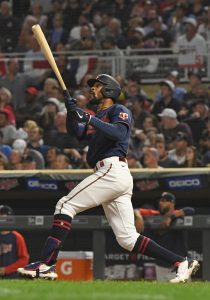 The deal secures Buxton’s future as a Twins cornerstone, and ends several months’ worth of negotiations between the two sides. Talks over the summer didn’t pan out, which then led to speculation that Minnesota might deal Buxton at the trade deadline, though that scenario also didn’t come to pass. The Twins reportedly offered Buxton an $80MM deal during the season, and more recent reports indicated that Buxton’s camp wanted extra incentives included in the contract that would push the value over $100MM.
Instead, Buxton now locks in a guaranteed $100MM, though at the cost of six free agent seasons. Buxton (who turns 28 in December) was entering his final year of team control, and was projected to earn $7.3MM in his final year of arbitration eligibility. Though that lens, this deal could be viewed as a six-year, $92.7MM commitment, though the wide range of potential bonus money could greatly increase Buxton’s earnings.
To work his way into the MVP conversation, of course, Buxton will have to stay on the field, which has been his biggest question mark over seven MLB seasons. The outfielder has battled a wide variety of injury problems over the years, with just 493 total games played in seven seasons. Buxton’s season high was 140 appearances in 2017, but his next-highest totals were only 92 games (in 2016) and 87 games (in 2019), plus he appeared in 39 of a possible 60 games during the abbreviated 2020 campaign.
With so many trips to the injured list, it isn’t surprising that it took Buxton a while to get his timing down at the plate, but his batting prowess has started to emerge over the last three years, particularly in 2021. Buxton hit .306/.358/.647 over 254 PA last season, hitting 19 home runs and stealing nine bases in 10 opportunities. Between this offensive production and his all-world defense, Buxton was worth 4.2 fWAR despite playing in only 61 of Minnesota’s games, due to a hip strain and a fracture in his left hand.
Buxton has never finished higher than 16th in AL MVP voting (in 2020). His lack of playing time has undoubtedly cost him with MVP voters and also likely cost him multiple Gold Gloves beyond his lone GG in 2017. As a result, this incentive structure seems like a decent compromise that works for both Buxton and the Twins. The team gets some flexibility in making a major financial commitment to an injury-prone player, while Buxton both guarantees himself one life-changing payday, and allows him to benefit if he is able to stay healthy and consistently produce superstar-level numbers.
Minnesota doesn’t have much long-term payroll on its books, as Randy Dobnak is the only player guaranteed beyond the 2023 season. The guaranteed portion of Josh Donaldson‘s deal is up after 2023, so Buxton will essentially replace Donaldson as the Twins’ biggest-money commitment.
Locking up Buxton also seemingly erases the possibility that the Twins were going to take a step back or rebuild entirely following their disastrous 2021 season. While Minnesota did move the likes of Nelson Cruz and Jose Berrios at the trade deadline, they didn’t engage in any kind of a full-on fire sale, preferring to try and rebound in 2022. Buxton’s no-trade clause gives him control over his own fate over the next seven seasons, though if Minnesota did change course and look to make a move with Buxton’s blessing in future years, his contract is short enough on guaranteed money that interested teams would likely still be open to absorbing the deal.
The extension also has an impact on the center field market, as Buxton is no longer a trade possibility and Starling Marte (the best everyday option in free agency) signed with the Mets on Friday. Teams looking for center field help are suddenly facing an even thinner list of possibilities.
Photo courtesy of USA Today Sports Images
Rays To Sign Corey Kluber
3:16PM: MLB Network’s Jon Heyman (Twitter link) has the breakdown of Kluber’s incentives. The righty will earn $500K bonuses for hitting the 10-start and 15-start thresholds, $1MM if he makes 20 starts, and $1.5MM for making 25 starts and 30 starts. While the Rays are known for using openers and bulk pitchers, this contract structure would seem to imply that Kluber will be normally deployed as a starting pitcher.
10:44AM: The Rays have signed Corey Kluber to a one-year deal, pending a physical. It’s an $8MM contract, plus incentives, which could take the value of the deal as high as $13MM. MLBTR had predicted a one-year, $12MM contract for Kluber, which is right in line with his earnings window, based on those incentives. Kluber is represented by Jet Sports Management.
This is yet another domino to fall in what has been an incredibly fast-moving starting pitcher market this year, as Eduardo Rodriguez, Anthony DeSclafani, Justin Verlander, Steven Matz, Noah Syndergaard, Andrew Heaney and Michael Wacha have all signed in the past two weeks.
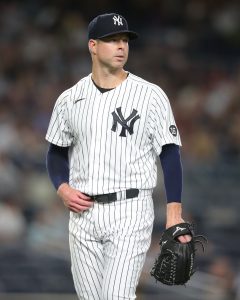
This is the second consecutive one-year deal for Kluber, after being signed by the Yankees in January. At the time, Kluber had been limited to less than 40 total innings over the previous two seasons due to various injuries. Regardless, he was still able to earn himself a guarantee of $11MM from the Yanks after demonstrating his health in a showcase. The righty was again held back by injuries in 2021, although his 80 innings pitched still were the most he’s tallied since 2018. Although he couldn’t live up to his previous Cy Young-winning form, he did manage an ERA of 3.83 with a strikeout rate of 24%.
Prior to his recent injury woes, Kluber was one of the best pitchers in all of baseball. From 2014 to 2018, he had five straight campaigns of at least 200 innings and never had an ERA above 3.50. In total, he threw 1091 1/3 innings during that time frame, second only to Max Scherzer across the league. His 1,228 strikeouts put him third, behind only Scherzer and Chris Sale. His 30.3 fWAR in that span trailed only Scherzer and Clayton Kershaw. He won the AL Cy Young in 2014 and 2017 and made the All-Star team in three straight seasons, beginning in 2016.
For the Rays, this marks another in short-term deal given to a veteran starter, in what has become something of a pattern for the low-spending organization, who signed Rich Hill, Michael Wacha and Chris Archer to one-year deals last winter. Kluber has a much higher ceiling than any of those three, based on his previous track record, but also comes with a high degree of uncertainty based on his recent injuries. The rotation is currently composed of young, highly-touted but inexperienced hurlers, such as Shane McClanahan, Drew Rasmussen, Ryan Yarbrough, Luis Patino, Shane Baz and Josh Fleming. Yarbrough is the only one of that group older than 27 years old or with more than two years’ service time. Tyler Glasnow is likely out for the entirety of 2022 after undergoing Tommy John surgery in August. Yonny Chirinos, also recovering from Tommy John, isn’t expected back until April or May. Brendan McKay just recently underwent thoracic outlet surgery but could potentially be ready by spring training. Kluber, if healthy, adds some steady veteran presence and experience into this mix.
From a financial perspective, the $8MM owed to Kluber pushes the club’s 2022 payroll close to $84MM, in the estimation of Jason Martinez of Roster Resource. This has the potential to be record-setting, as the Rays have never had an opening day payroll higher than $77MM, per Cot’s Baseball Contracts. However, it’s also possible that number comes down after the team subtracts from their substantial arbitration class, either by non-tenders or trades. They already made one such move when they recently traded Jordan Luplow and his projected $1.5MM arbitration salary to the Diamondbacks.
Ken Rosenthal of The Athletic first reported that the Rays had signed Kluber. Joel Sherman of The New York Post first added the $8MM base plus incentives framework. Marc Topkin of the Tampa Bay Times first relayed that the incentives could push the deal as high as $13MM.
Image courtesy of USA Today Sports.
Rangers Sign Marcus Semien
The Rangers made the first major strike of the offseason shortstop market, agreeing with Marcus Semien on a seven-year, $175MM contract. According to The Athletic’s Levi Weaver, Semien will earn $25MM in 2022, $26MM in each of the 2023-27 seasons, and then $20MM in 2028. Semien is represented by the Boras Corporation.
“Marcus’ reputation around the game is impeccable. He’s a leader in every clubhouse he steps into, respected for the way he goes about his work and how he treats others,” Rangers President of Baseball Operations Jon Daniels said in a press release officially announcing the signing. “There are few players in the game who garner the level of respect that he does from teammates and opponents alike. We’re thrilled to add a player of his caliber to the organization.”
There were indications that Semien was one of the free agents looking to get his next contract finalized prior to the expiration of the Collective Bargaining Agreement on December 1, as a lockout and transactions freeze are widely expected to follow. The Rangers were also known to be one of the more aggressive teams of the offseason, with money to spent and a direct interest in the shortstop market.
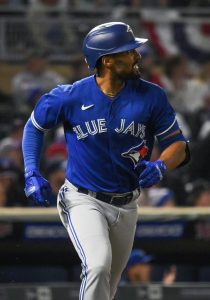 With these factors in mind, a deal between the two sides doesn’t necessarily count as a surprise, but the sheer size of the contract is a little eye-opening. MLBTR projected Semien for six years and $138MM, as though Semien is already 31 years old, he has been a very durable player throughout his career and isn’t necessarily as much of a decline risk as other players his age. Needless to say, the Rangers agreed, giving Semien the biggest contract of any free agent to date this winter. With Semien now locking in $175MM, the asking price will probably only go up for Carlos Correa (age 27), Corey Seager (28 in April), Trevor Story (who just turned 29) and Javier Baez (who turns 29 on December 1).
It also isn’t out of the question that one of these other shortstops might still end up joining forces with Semien in the Texas infield, as ESPN’s Jeff Passan reporting that Story is still under consideration. Theoretically, a scenario exists where Story signs to play shortstop, while Semien moves to second base, as he did last year with the Blue Jays alongside shortstop Bo Bichette.
If another shortstop isn’t added, Semien might conceivably still remain at second base, since Rangers incumbent Isiah Kiner-Falefa is a fine defensive shortstop in his own right. Kiner-Falefa would likely be a defensive standout anywhere he plays around the infield, however, so Texas could opt to put IKF at second or third base, and install Semien back in his former shortstop position.
The seven-year contract represents quite a turn of events for Semien, who struggled through the first six weeks of the shortened 2020 season, thus limiting his value heading into free agency last winter. Semien opted to sign a one-year deal with the Jays in order to re-establish his market, and the result was a third-place finish in AL MVP voting. Semien hit .265/.334/.538 with 45 homers during his spectacular year, appearing in all 162 games and leading the league with 724 plate appearances. In addition to Silver Slugger honors, Semien also won a Gold Glove in his first year as a second baseman since 2014.
The Rangers were very familiar with Semien from his days with the Athletics, and the infielder now returns to the AL West as the veteran face of a new era of Texas baseball. After five straight losing seasons, both president of baseball operations Jon Daniels and GM Chris Young indicated that the club was willing to spend some serious money to return to contention. The Rangers have so little on the books in future salary commitments that multiple signings seemed likely, and if the team is indeed prepared to add up to $100MM in payroll this winter alone, Semien’s $25MM average annual value represents only the first quarter of Texas’ potential outlay.
As Rome wasn’t built in a day, turning the 102-loss Rangers into an immediate contender will be a tall order, even if Texas does spend $100MM+. Both the AL West and the American League as a whole figure to be competitive in 2022, so the Rangers will need quite a bit more than just Semien to even get back above the .500 mark. The seven-year commitment, however, is a sign that the Rangers are clearly in this for the long haul, and Semien is the type of “signpost” free agent signing (i.e. Jayson Werth signing with the Nationals in December 2010, or Hyun Jin Ryu signing with the Blue Jays two offseasons ago) that announces a team is ready to turn the corner. Semien’s reputation as a strong clubhouse leader will also help for mentorship purposes with the Rangers’ younger players, and potentially attract other players to Arlington.
Because Semien rejected Toronto’s qualifying offer, the Rangers will have to give up $500K in international spending pool money, as well as their second-highest pick in the 2022 draft. The latter is a pretty significant concession, as the Rangers’ second-highest selection is the third pick of the second round. Since signing another QO-rejecting free agent would cost Texas its next highest pick (the third choice of the third round), it remains to be seen if the Rangers will now target free agents who aren’t attached to draft pick compensation. Of the other shortstops, Baez is the only one who didn’t turn down a qualifying offer, as Baez wasn’t eligible due to his midseason trade to the Mets.
As well, the Blue Jays will get draft pick compensation for Semien’s departure, as the Jays will now get an extra pick between Competitive Balance Round B and the start of the third round. The Blue Jays had interest in re-signing Semien themselves, but will now take the draft pick as a reward for their bet on Semien one year ago.
With Bichette established at shortstop, it remains to be seen if any of Correa, Seager, Story, or Baez could factor into Toronto’s plans, though most of the Jays-related news this winter has been related to their search for pitching, rather than any shortstops apart from Semien. With a Santiago Espinal/Cavan Biggio platoon penciled in for second base or third base, the Jays have some flexibility in what type of infielder they can pursue as a Semien replacement, or whether that new player comes via free agency or trade. There is no easy way to truly replace Semien’s production, of course, so a substantial addition be required to try and fill the big hole that Semien leaves in Toronto’s lineup.
FanSided’s Robert Murray (Twitter link) was the first to report that the two sides were close to a deal, with MLB Network’s Jon Heyman (Twitter link) reporting the contract length, the fact that the deal had been reached, and the dollar figure. USA Today’s Bob Nightengale also adds that the deal doesn’t contain any opt-out clauses or no-trade protection.
Photo courtesy of USA Today Sports Images
Rays Sign Wander Franco To 11-Year Extension
Seventy games into his Major League career, Rays shortstop Wander Franco has agreed to an 11-year, $182MM contract extension. The contract also comes with a $25MM club option for the 2033 season (with a $2MM buyout) and a series of $3MM escalators based on MVP voting, so the deal’s maximum value sits at $223MM over 12 years. Franco is represented by agent Manny Paula.
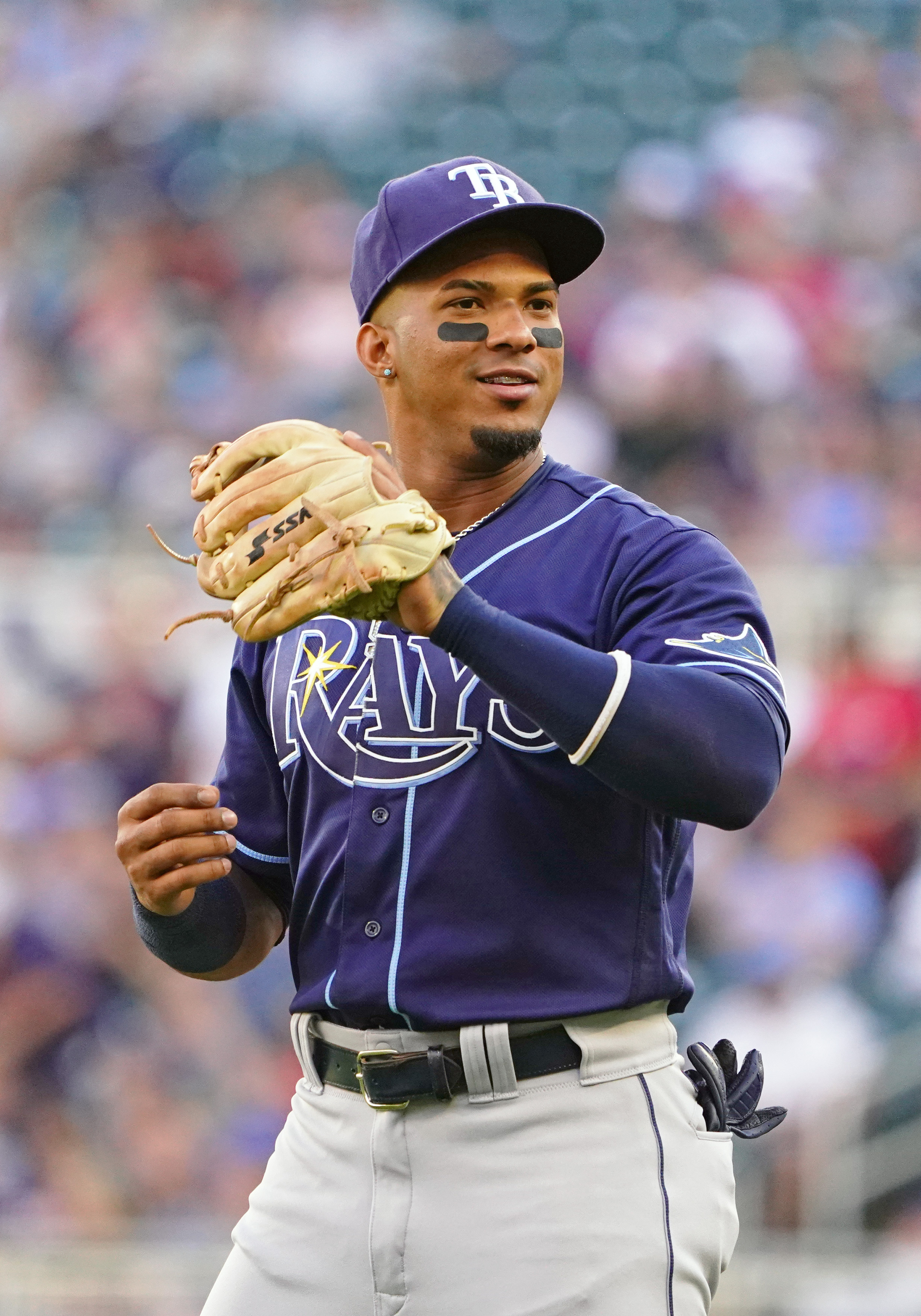
Franco’s contract is both a franchise record for the Rays, topping Evan Longoria‘s previous $100MM guarantee, and also a record for any player with less than one year of Major League service time. Ronald Acuna Jr.‘s eight-year, $100MM contract had been the largest ever signed by a player with less than a year of service, but Franco will nearly double that sum with today’s precedent-shattering agreement.
In terms of financial breakdown, Franco will receive a $5MM bonus right off the bat. The shortstop will earn $1MM in 2022, $2MM in both 2023 and 2024, $8MM in 2025, $15MM in 2016, $22MM in 2027, and then $25MM in each of the 2028-32 seasons.
Franco would receive an extra $3MM in the event of a trade, but there isn’t any no-trade protection involved in the extension. There also aren’t any provisions related to the Rays’ plan to split time between Tampa and Montreal once the team’s lease at Tropicana Field is up after the 2027 season.
Franco, who won’t turn 21 until March, ranked as the sport’s No. 1 overall prospect in each of the past three offseasons and largely justified that hype when he debuted just months after his 20th birthday. The switch-hitter slashed .288/.347/.463 with seven home runs, 18 doubles, five triples and a pair of stolen bases through 308 plate appearances.
From July 25 to Sept. 29, Franco embarked on one of the more remarkable stretches in recent memory, reaching base in a staggering 43 consecutive games in spite of his youth. During that time, he posted a combined .329/.398/.545 batting line with more walks (9.1%) than strikeouts (8.1%). Franco only appeared in 70 games this season but was impressive enough to finish third in AL Rookie of the Year voting.
Defensively, Franco received split marks for his work at shortstop, putting up six Defensive Runs Saved, average marks per Ultimate Zone Rating and a minus-3 mark in Statcast’s Outs Above Average. However, scouting reports on him have pegged him as at least an average shortstop — if not better — in addition to touting his elite hit tool, plus power and plus speed. That generally aligns with the .331/.399./535 slash he posted in his meteoric rise through 215 minor league games. Prior to Franco’s promotion, FanGraphs’ Eric Longenhagen wrote that he’d been “the best player his age on the planet since he was 14 years old” and touted him as a perennial MVP candidate. ESPN’s Kiley McDaniel, meanwhile, called him “plus at basically everything on a baseball field.” Take your pick of Franco scouting reports from the 2020-21 offseason and they’ll all generally be filled similar superlatives.
Because the Rays waited until late June to promote Franco, he was a veritable lock to fall shy of Super Two status under the current arbitration system (which could potentially change, depending on how collective bargaining talks play out). Franco wouldn’t have been arbitration-eligible until after the 2024 season and would’ve had to wait until the 2027-28 offseason to reach free agency. The 11-year length of the contract buys out all three of Franco’s pre-arbitration seasons — during which he’d likely have made under $1MM apiece — and all three arbitration years. He’s also surrendering control of six would-be free-agent seasons (though only five are fully guaranteed).
Some fans will recoil at the notion of guaranteeing $182MM to a player with just 70 big league games under his belt, but those 70 games largely confirmed what the industry has expected from Franco since he signed for a bonus of nearly $4MM as a 16-year-old: he looks the part of a budding superstar. And, a westward look toward San Diego shows what could happen by waiting to allow the player to further establish himself. Fernando Tatis Jr. didn’t sign an extension until he had accrued two years of Major League service, and his price tag ballooned to 14 years and $340MM. Franco’s price tag upon waiting would likely have extended even beyond that point and may well have become too sizable for the Rays’ typically frugal ownership.
It’s tempting to ponder just how much Franco might be “leaving on the table,” so to speak; free agent Carlos Correa has already pocketed $27MM in career salaries and is reportedly seeking a contract worth more than $300MM at the same age Franco would’ve been upon reaching free agency. Extension rumblings surrounding Juan Soto have elicited speculation of $400MM or even $500MM in total guaranteed money; Soto is 23 and has three-plus years of MLB service.
Franco would have found himself on a similar trajectory had he gone the year-to-year route, and one could certainly argue that betting on himself in hopes of setting an even more dramatic record was the more prudent path forward. That said, it’s difficult to fault anyone for accepting this type of guarantee — particularly at such a young age. Generations of Franco’s family will be financially secure because of it, and he can still take heart in knowing that he’s nearly doubled the previous precedent, thus further advancing the market for future players. Beyond that, because of his youth, Franco can still reach free agency as a 32-year-old, which is young enough to command a second substantial contract.
The possibility of “leaving money on the table” also assumes good health and continued production from Franco moving forward. Taking the extension now mitigates much of the risk associated with a career-altering injury or injuries — a danger that exists for any player. It also safeguards against Franco “merely” becoming a solid regular rather than a bona fide superstar (or, less likely, declining into a sub-par player). Promising as his beginnings were, he’d hardly be the first player to impress as a rookie before taking a few years to reach his ceiling or even stalling out entirely.
Ongoing labor talks also have to be considered. While the next collective bargaining agreement could have improved Franco’s earning power, it’s also feasible that a new CBA might have hurt him to an extent; ownership has already proposed an age-based free-agent threshold of 29.5 years, for instance, and although that particular number was a nonstarter for the players association (due to just this type of situation), the league could explore various permutations of such mechanisms. Regardless of how labor talks between MLB and the MLBPA play out, Rays president of baseball operations Erik Neander and Franco can both rest easy knowing that perhaps the most critical negotiation either will ever personally take part in has been resolved.
Any and all instances of the Rays spending money bring about the typical comments wondering how long until the player on the receiving end of the deal is traded. Such barbs are admittedly somewhat justified due to the Rays’ history of trading players — e.g. Longoria, Blake Snell, Chris Archer — in the latter stages of their extensions. But, even if that’s Franco’s ultimate fate, it’s unlikely to happen anytime soon. Extensions of this nature tend to mirror what the player would have earned absent the long-term contract; in other words, Franco may receive an up-front signing bonus, but his yearly salaries through the first six years figure are considerably lighter than they will be in the portion of his contract covering what would have been free-agent years.
In the short term, then, the Franco extension will have only minimal impact on club payroll. Tampa Bay was projected by Roster Resource’s Jason Martinez to field a payroll of around $76MM in 2021, and the Franco contract probably won’t push that mark up to even $80MM. That number still figures to drop a bit in the near future as the Rays contemplate potential trades and non-tenders related to an abnormally large arbitration class, but any trades or non-tenders of arb-eligible players in the coming days will be unrelated to Franco’s long-term pact.
At the end of the day, any contract of this magnitude involves some give and take for both sides. Any number of things could’ve gone wrong for Franco in the years to come, and the looming possibility of those pitfalls underscores the fact that the typically small-payroll Rays are taking on what is, by their standards, an unprecedented risk.
While many will be quick to declare “winners” and “losers” in Hot Stove transactions — be they trades, free-agent signings or contract extensions — there are also instances where a deal simply appears sensible for all sides. Franco receives a generational amount of money and retains the ability to reach free agency in his early 30s. The Rays secure control of a franchise cornerstone whom they hope and believe can be an all-time great. The players union surely approves of the precedent for players with under a year of service being moved forward so substantially.
Ultimately, Franco’s new contract contains positives for all parties involved — perhaps with the exception of Tampa Bay’s division rivals in the AL East who now have to wonder how to combat the emerging superstar into the 2030s.
Yancen Pujols of El Caribe reported last week that the Rays had offered a record-setting extension worth between $150-200MM. Marc Topkin of the Tampa Bay Times reported on Nov. 23 that an agreement was close, and he also had the year-to-year salary breakdown. Joel Sherman of the New York Post (Twitter link) and Hector Gomez of Z101 Sports (Twitter link) reported general parameters, and ESPN’s Jeff Passan eventually reported the specific terms of the contract (Twitter thread).
Super Two Status Set At 2.116 Years Of Service
This year’s Super Two cutoff point has been set at precisely two years and 116 days of service, MLBTR’s Tim Dierkes has learned. This marker will affect the financial value for players with between two and three years of service time.
For example, Yordan Alvarez, with two years and 113 days of service time, will just miss the cutoff, meaning the Astros slugger will not be eligible for arbitration until next offseason. On the other hand, Brewers infielder Luis Urias has two years and 120 days of service time, so he qualifies as a Super Two player and will head to arbitration for the first of four trips this winter.
Broadly, Super Two designation is one of the innumerable quirks to the ever-confounding (current) arbitration system. For the unfamiliar, Major League players earn “service time” for every day spent on an MLB roster. One year of MLB service is defined as 172 days, despite the fact that there are more days than that in the regular season.
Upon reaching three years of service time, all players become eligible for salary arbitration. Prior to that point, teams are effectively able to set (most) player salaries at any rate they wish, so long as it is north of the league minimum. Many teams have formulas they use to determine pre-arbitration salaries, and it’s quite rare for pre-arb players to earn even $1MM, barring a long-term extension. Arbitration is the first point at which players and their agents can begin negotiating with teams regarding their salary, though arbitration prices still typically fall shy of open-market value.
The “Super Two” wrinkle further complicates matters. The top 22 percent of players (in terms of total service time) with between two and three years of service also are considered eligible for arbitration and termed “Super Two” players. Any player who falls into that service bucket and spent at least 86 days of the preceding season on a 25-man roster or the Major League injured list become eligible a year early and then go through the arbitration process four times.
That fourth arb-eligible year puts a player in line for some extra salary immediately, and potentially millions more in earnings as their salaries continue to escalate through the arbitration process. Of course, since teams’ manipulation of service time has been such a point of contention for the players’ union, it remains to be seen if the current Super Two system will remain in place through the next round of Collective Bargaining Agreement talks.
For comparison’s sake, here are the Super Two cutoff points for the last 12 years….
- 2020: 2.125
- 2019: 2.115
- 2018: 2.134
- 2017: 2.123
- 2016: 2.131
- 2015: 2.130
- 2014: 2.133
- 2013: 2.122
- 2012: 2.140
- 2011: 2.146
- 2010: 2.122
- 2009: 2.139
Mariners Acquire Adam Frazier From Padres
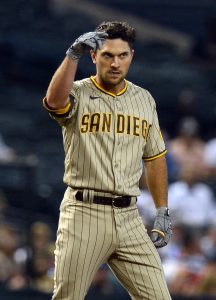
The San Diego Padres and Seattle Mariners have agreed to a three-player trade. The Padres will send All-Star second baseman Adam Frazier to Seattle for left-handed reliever Ray Kerr and outfielder Corey Rosier, reports ESPN’s Jeff Passan (via Twitter). Both teams have announced the deal, making it official.
Frazier certainly fits the mold of the type of offensive contributor that GM Jerry Dipoto tends to covet. Case and point, the Mariners were said to be interested in Frazier at the trade deadline before he ultimately landed in San Diego.
The soon-to-be 30-year-old is a contact-first bat and well-rounded player who can cover second base on a regular basis or move to the outfield. Though his defensive versatility is a plus, his bat plays best if he’s manning the keystone. Right now, that’s where he is most likely to get the bulk of his playing time. He will share the middle infield with J.P. Crawford, while Abraham Toro and Ty France fill out the infield as Dylan Moore moves into a super utility role.
Frazier was an All-Star last season with the Pirates before slowing down in San Diego. Still, he posted 4.0 rWAR and an overall slash line of .305/.368/.411 over 639 plate appearances between the Pirates and Padres. Frazier is projected to make around $7.2MM in arbitration in what will be his final season before free agency, so he rates as a relatively low-risk, low-cost acquisition for the Mariners.
While a solid contributor, it would be difficult to rank him as a true “difference-maker.” His lack of pop (.131 career ISO) makes him more of a line mover than a run creator, though he will lengthen the Mariners’ lineup and make life difficult on opposing pitchers by putting the ball in play and vying for a high batting average.
Truth be told, he’s a fairly similar player in form and function to his new double play partner in Crawford: sure-handed defenders, light on power and patience, who run well and excel at putting bat-to-ball. Don’t be surprised to see Frazier near the top of the Mariners’ batting order on a regular basis, regardless of where they put his glove.
In terms of his approach, Frazier walked in just 7.5 percent of his plate appearances, below the league-average 8.5 percent walk rate. At the same time, he struck out in a mere 10.8 percent of his plate appearances, a much stronger rate than the 22.3 percent league average. In short, Frazier puts pressure on defenses, while minimizing mistakes on the other end. He’s a quality contributor and the type of player that will give manager Scott Servais plenty of options on both ends.
In exchange for one season of Frazier, the Mariners are sending a hard-throwing southpaw reliever in Kerr and a young outfielder in Rosier. Neither have appeared on prospect lists, though Kerr did appear in Fangraphs‘ supplemental “Arm Strength Relief Sorts” section. Wrote Fangraphs, “Kerr is a late-bloomer who came into big velo ahead of the pandemic. He can dunk a basketball and has superlative weight room exploits as well as rare lefty velo, inconsistently up to 99. His splitter flashes plus and the Mariners have worked with his slider enough to create viable sweep on the pitch but it was a 30 the last I saw it. The strike-throwing and secondary consistency are present issues, too.”
At 27 years old without a Major League appearance, Kerr could be considered a non-prospect, though his ability to hit triple-digits on the radar gun provides some intrigue as a potential power arm out of the bullpen. He was signed as a non-drafted free agent back in 2017, beginning his career as a two-way player, though he has focused on pitching in recent years. The athletic ability is clearly there, the question being whether it can be channeled to turn him from a “thrower” to a “pitcher,” as the saying goes.
Last season, Kerr tossed 39 2/3 innings across 36 appearances in Double-A and Triple-A with a combined 3.18 ERA, inspiring 36.8 percent strikeout rate, and 9.8 percent walk rate. For a Padres team that’s prioritizing pitching depth this offseason, Kerr is a solid gamble to add to the 40-man roster.
Rosier, 22, was a 12th round pick in last year’s amateur draft, signing for a $125K bonus. The Maryland native played his college ball at UNC Greensboro, and he was the #249th ranked prospect in the draft, per Baseball America. He played most of last season in Low-A Modesto, slashing an impressive .390/.461/.585 in 141 plate appearances. He projects as an extra outfielder with the ability to play centerfield. At the plate, his limited power is his biggest shortcoming.
Kerr and Rosier aren’t prospects at the level of Tucupita Marcano, Jack Suwinski, and Michell Miliano, the prospect San Diego sent to Pittsburgh to acquire Frazier at the deadline. That said, there’s no reason to think they’d get back fair value. Kerr fits a need and Rosier helps backfill the farm system at a lower level.
The more motivating factor in this deal for San Diego is financial. Frazier’s deal wasn’t exorbitant, but for a team with limited payroll flexibility, clearing Frazier’s deal from the payroll helps. With Jake Cronenworth, Ha-Seong Kim and Jurickson Profar all under contract, the Padres are set with second base/utility types, where Frazier best profiles. With the financial savings, President of Baseball Ops A.J. Preller can look to re-invest into the pitching staff or in finding an impact bat for an outfield corner.