
Indians Sign Rajai Davis
The Indians announced on Thursday that they signed veteran outfielder Rajai Davis to a one-year contract. The Relativity Sports client will reportedly be guaranteed $5.25MM plus incentives which can boost the value of the pact to $6.475MM. Specifically, Davis will reportedly earn $175K for upon reaching 400 plate appearances and receive an additional $175K for every 25 plate appearances from that point forth, until reaching 550 PAs, where his incentives max out

Davis, 35, has spent the past two seasons in the AL Central, appearing in 246 games and receiving 864 total plate appearances for the division-rival Tigers. With Detroit, the fleet-footed Davis batted a combined .272/.314/.418 with 16 home runs and 54 stolen bases. Over the course of his career, Davis has been a far more productive bat against left-handed pitching, posting a cumulative .296/.351/.448 triple-slash in parts of 10 Major League seasons.
From a defensive standpoint, Davis has had inconsistent marks throughout his career but is capable of manning all three outfield positions. He has at least 700 innings at all three spots, though the bulk of that time has come in left field and center field. Davis’ collective body of work in center field has received slightly above-average reviews from Ultimate Zone Rating and Defensive Runs Saved, while he’s been below average in left field. Having turned 35 in October, it’s possible he’s slowing down a bit, as last season’s 18 stolen bases were the lowest mark of his career.
Cleveland has been in need of outfield depth, particularly with Michael Brantley likely to miss the start of the season. Davis now joins an outfield depth chart that includes Collin Cowgill, Abraham Almonte, and Lonnie Chisenhall.
The Twins and Rangers were also said to have had interest in Davis before he landed in Cleveland.
Jon Heyman of CBSSports.com (on Twitter) first reported the agreement. Ken Rosenthal of FOX Sports (via Twitter) and Chris Cotillo of SB Nation (on Twitter) added contract details, and Heyman later broke down the incentives structure (Twitter link).
Photo courtesy of USA Today Sports Images.
Pirates Re-Sign Sean Rodriguez
THURSDAY, 10:57am: The Pirates confirmed the signing via press release.
TUESDAY, 1:07pm: The Pirates have reached a deal to bring back free agent infielder/outfielder Sean Rodriguez, ESPN.com’s Jerry Crasnick reports (Twitter links). He’ll earn $2.5MM and can earn up to $500K in incentives, per Crasnick and Rob Biertempfel of the Pittsburgh Tribune-Review (via Twitter).
Rodriguez, 30, came to Pittsburgh last winter via trade. He earned $1.9MM via arbitration in 2015, so his new deal represents a slight bump up in earnings.
His primary value lies in his defensive versatility. He’s spent time at every position on the field other than pitcher and catcher. Though Rodriguez has spent a plurality of his innings at second base, he’s also accrued over 400 frames at first, short, third, and left field.
Last year, Rodriguez ended up being utilized most often at first base. He’s obviously not suited for that position from an offensive standpoint, as he slashed just .246/.281/.362 over his 240 plate appearances, but the club needed his glove there as Pedro Alvarez struggled defensively.
It seems likely that Rodriguez will be deployed more frequently elsewhere in the infield in 2016, especially early in the year. With Neil Walker now playing for the Mets and Jung Ho Kang looking to return from a significant injury, he’ll represent an important depth piece for the club. The veteran has shown more at the plate in the past, as he hit just shy of league average over 2013-14 in Tampa Bay, and a return to that level of production would make this deal an easy win for the club.
Braves Sign Tyler Flowers
DEC. 16: The Braves have now announced the signing.
DEC. 8: The Braves are in agreement on a two-year deal with catcher Tyler Flowers, pending a physical, multiple reports indicated on Tuesday evening. Flowers, a client of agent Tom O’Connell, will receive a two-year contract that guarantees him $5.3MM. He’ll reportedly take home $2MM in 2016 and $3MM in 2017 before the Braves decide on a $4MM option or a $300K buyout. Flowers can earn $1.5MM worth of incentives each season based on games caught (each year maxes out at 120 games), meaning he can earn up to $13.5MM over a three-year term in Atlanta.
With this signing, Flowers will return to the organization that drafted him back in 2005. He will presumably serve as a backup for A.J. Pierzynski, with whom he can form a solid platoon. Flowers, who will turn 30 in January, is a career .223/.289/.376 hitter across parts of seven seasons, but he’s produced offensively at a clip that is roughly average for catchers over the past two seasons (.240/.296/.378, 90 OPS+). He also delivered positive pitch-framing metrics in 2015 and has caught about 28 percent of attempted base-stealers over the past two seasons.
The addition of Flowers, on a multi-year deal no less, further calls into question the future of Christian Bethancourt with the Braves. Once viewed as Atlanta’s catcher of the future, the rocket-armed Bethancourt has struggled considerably at the plate in the Majors and also struggled tremendously with passed balls — an unexpected and unforeseen deficiency in his game. While it’s conceivable that Bethancourt will iron out the kinks in 2016 at the Triple-A level and be ready for a significant role in 2017, it has long seemed like the Braves may simply have lost faith in him. However, a club looking for a long-term upgrade behind the dish could certainly take a chance at buying low on him this offseason, as Bethancourt will be hard-pressed to earn playing time behind Flowers and Pierzynski in the coming season.
MLB.com’s Scott Merkin first reported the agreement (Twitter link). David O’Brien of the Atlanta Journal-Constitution tweeted shortly before Merkin’s report that the Braves were believed to have made some progress on a deal with Flowers. Bob Nightengale of USA Today tweeted the guarantee and incentives. Mark Bowman of MLB.com added the yearly breakdown (Twitter link).
Yadier Molina Undergoes Second Thumb Surgery
Cardinals catcher Yadier Molina underwent a second operation on his ailing left thumb yesterday, reports MLB.com’s Jenifer Langosch (on Twitter). The first surgery “didn’t take,” as Langosch puts it, and with a second operation coming in mid-December, she adds that it’s likely Molina will miss most of Spring Training.
Molina originally sustained the injury — a torn ligament — in mid-September but returned briefly in the playoffs after sitting out the final few weeks of the regular season. However, he exited Game 3 of the NLDS after very clearly aggravating his hand on a swing and didn’t return for the final game of that series. St. Louis has since added the switch-hitting Brayan Pena as a backup for Molina this offseason, but it certainly seems possible that he’ll now begin the regular season behind the plate with Molina landing on the DL for the early portion of the year.
Molina has suffered a torn ligament in each of his thumbs over the past two years, missing about seven weeks in 2014 before incurring this injury late in 2015. That pair of injuries may have impacted Molina’s offense, as he batted just .267/.309/.317 in 27 games following his 2014 injury and was sporting an uncharacteristically light .270/.310/.350 batting line in 2015 before injuring his other hand.
Beyond that, Langosch also tweets that center fielder Randal Grichuk underwent sports hernia surgery recently but is expected to be ready for Spring Training. Favorable timeline notwithstanding, Grichuk’s situation bears monitoring, as setbacks could impact his availability for the season. Grichuk projects to be the everyday center fielder in St. Louis following Jon Jay‘s trade to the Padres; he will, presumably, be flanked by Matt Holliday and Stephen Piscotty on the outfield corners.
Projected Arbitration Spending For Each Team
Now that the non-tender deadline has passed, we have a clearer picture of which arbitration eligible players will be on each team’s Opening Day roster. Of course, trades and multiyear extensions will change this, but here’s a snapshot of each team’s projected arbitration spending for 2016. (Players such as A.J. Ellis, Justin Smoak, Vance Worley and others that have already avoided arbitration are still included in these totals, but with their actual 2016 salaries in place of MLBTR’s projection.) For more information, check out our arbitration tracker and our individual salary projections by Matt Swartz.
- Angels: $17.7MM (Fernando Salas, Hector Santiago, Garrett Richards, Kole Calhoun)
- Astros: $22.9MM (Luis Valbuena, Jason Castro, Marwin Gonzalez, Dallas Keuchel, Evan Gattis, Josh Fields)
- Athletics: $21.9MM (Sam Fuld, Marc Rzepczynski, Josh Reddick, Danny Valencia, Yonder Alonso, Eric Sogard, Felix Doubront, Fernando Rodriguez, Jarrod Parker)
- Blue Jays: $37.8MM (Brett Cecil, Michael Saunders, Jesse Chavez, Justin Smoak, Ben Revere, Josh Donaldson, Drew Hutchison, Aaron Loup, Steve Delabar)
- Braves: $1.7MM (Arodys Vizcaino, Chris Withrow)
- Brewers: $7.2MM (Jean Segura, Wily Peralta, Will Smith)
- Cardinals: $17.1MM (Brandon Moss, Trevor Rosenthal, Matt Adams, Seth Maness)
- Cubs: $35.1MM (Clayton Richard, Chris Coghlan, Travis Wood, Pedro Strop, Jake Arrieta, Rex Brothers, Adam Warren, Hector Rondon, Justin Grimm)
- Diamondbacks: $22.0MM (Daniel Hudson, Matt Reynolds, Welington Castillo, Patrick Corbin, Randall Delgado, Rubby De La Rosa, A.J. Pollock, Shelby Miller)
- Dodgers: $27.7MM (A.J. Ellis, Kenley Jansen, Justin Turner, Yasmani Grandal, Luis Avilan, Joe Wieland, Scott Van Slyke, Chris Hatcher)
- Giants: $7.2MM (Brandon Belt, George Kontos)
- Indians: $15.1MM (Josh Tomlin, Bryan Shaw, Lonnie Chisenhall, Collin Cowgill, Zach McAllister, Cody Allen, Jeff Manship)
- Mariners: $7.3MM (Charlie Furbush, Anthony Bass, Leonys Martin, Evan Scribner)
- Marlins: $21.5MM (David Phelps, Dee Gordon, Adeiny Hechavarria, A.J. Ramos, Tom Koehler, Bryan Morris, Carter Capps, Jose Fernandez)
- Mets: $37.7MM (Neil Walker, Ruben Tejada, Lucas Duda, Addison Reed, Carlos Torres, Jenrry Mejia, Matt Harvey, Jeurys Familia, Josh Edgin)
- Nationals: $32.1MM (Drew Storen, Stephen Strasburg, Wilson Ramos, Jose Lobaton, Danny Espinosa, Tyler Moore, Anthony Rendon)
- Orioles: $42.9MM (Brian Matusz, Nolan Reimold, Mark Trumbo, Chris Tillman, Miguel Gonzalez, Ryan Flaherty, Zach Britton, Vance Worley, Brad Brach, Manny Machado)
- Padres: $22.7MM (Andrew Cashner, Tyson Ross, Derek Norris, Drew Pomeranz, Brett Wallace)
- Phillies: $13.5MM (Peter Bourjos, Jeremy Hellickson, Andres Blanco, Jeanmar Gomez, Freddy Galvis)
- Pirates: $26.2MM (Francisco Cervelli, Mark Melancon, Chris Stewart, Tony Watson, Jared Hughes, Jordy Mercer, Jeff Locke)
- Rangers: $15.9MM (Mitch Moreland, Tom Wilhelmsen, Chris Gimenez, Shawn Tolleson, Tanner Scheppers, Robinson Chirinos, Jake Diekman, Jurickson Profar)
- Rays: $30.6MM (Logan Morrison, Jake McGee, Logan Forsythe, Desmond Jennings, Rene Rivera, Alex Cobb, Hank Conger, Drew Smyly, Brandon Guyer, Erasmo Ramirez)
- Red Sox: $7.6MM (Junichi Tazawa, Joe Kelly, Robbie Ross)
- Reds: $16.9MM (Aroldis Chapman, Zack Cozart, J.J. Hoover)
- Rockies: $20.4MM (Adam Ottavino, Jordan Lyles, DJ LeMahieu, Charlie Blackmon, Brandon Barnes, Nolan Arenado)
- Royals: $22.1MM (Drew Butera, Mike Moustakas, Tony Cruz, Tim Collins, Jarrod Dyson, Danny Duffy, Lorenzo Cain, Louis Coleman)
- Tigers: $11.3MM (J.D. Martinez, Andrew Romine, Jose Iglesias, Justin Wilson)
- Twins: $23.7MM (Kevin Jepsen, Trevor Plouffe, Eduardo Nunez, Tommy Milone, Casey Fien, Eduardo Escobar)
- White Sox: $8.6MM (Brett Lawrie, Nate Jones, Dan Jennings, Avisail Garcia, Zach Putnam)
- Yankees: $19.9MM (Ivan Nova, Michael Pineda, Dustin Ackley, Nate Eovaldi, Didi Gregorius)
Overall we’re projecting about $614MM to be spent on 184 arbitration eligible players. The projected average team spend is $20.5MM, and the range varies from the Orioles at $42.9MM to the Braves at $1.7MM.
White Sox Acquire Todd Frazier In Three-Team Deal With Dodgers, Reds
The first domino has fallen in the Reds’ offseason rebuild, as Cincinnati has announced the trade of All-Star third baseman Todd Frazier to the White Sox in a three-team deal that also includes the Dodgers. Cincinnati will receive three prospects — infielders Jose Peraza and Brandon Dixon and outfielder Scott Schebler — from the Dodgers, who, in turn, will receive prospects Frankie Montas, Micah Johnson and Trayce Thompson from the White Sox.
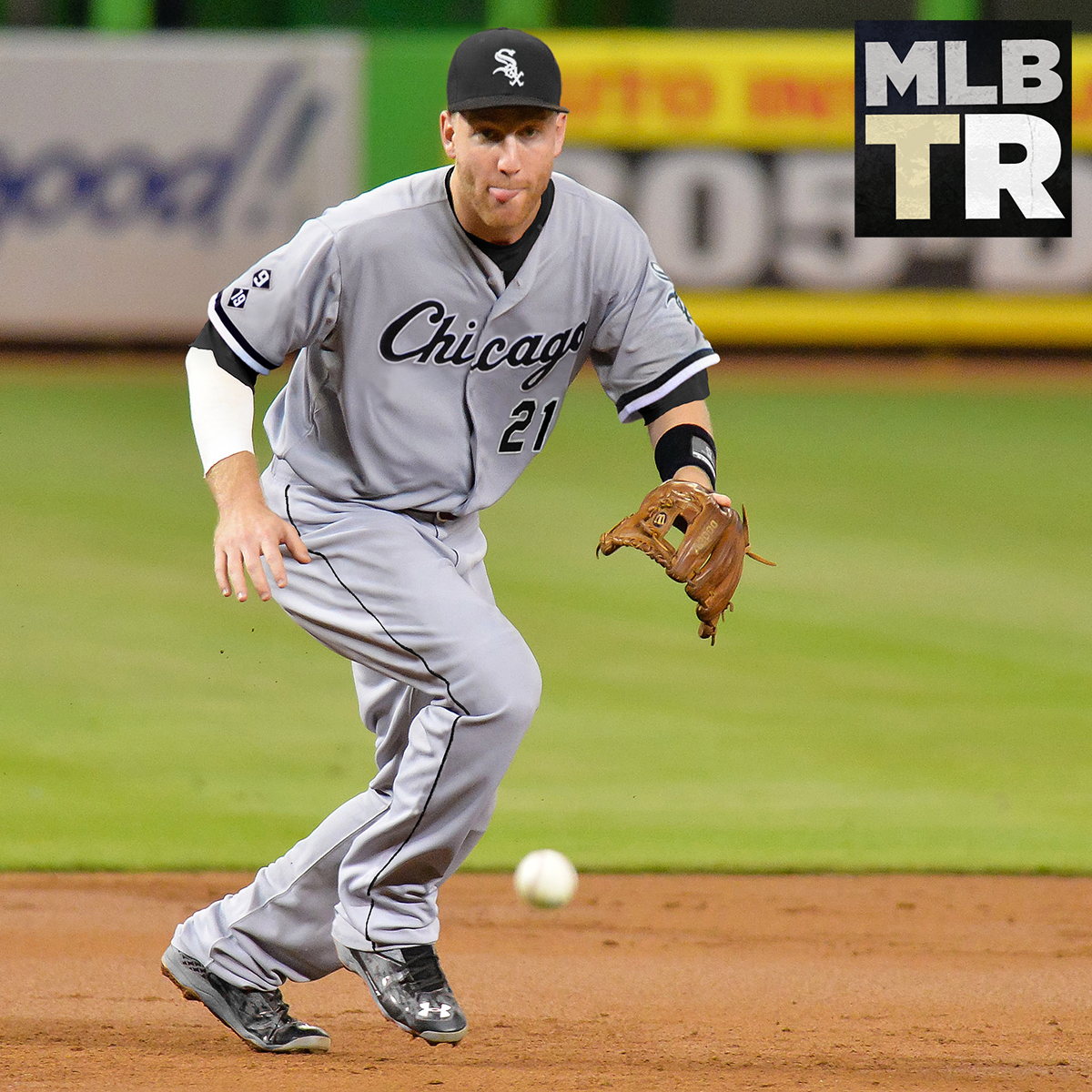
The acquisition of Frazier will give the White Sox a drastically altered infield composition, as he’ll now take over at third base with fellow trade acquisition Brett Lawrie moving over to second base. Frazier, who turns 30 in February, adds a power bat to the middle of Chicago’s lineup to complement fellow right-handed slugger Jose Abreu and also gives Chicago a well above-average defender at the hot corner. The reigning Home Run Derby champion, Frazier has batted a combined .264/.322/.479 with 64 home runs over the past two seasons with the Reds. He’s set to earn $7.5MM in 2016 and can be controlled via the arbitration process for the 2017 season, after which he will be eligible for free agency.
Frazier’s trade value probably would have been higher were it not for a dismal second half. Some will speculate that his Home Run Derby success altered his swing following the All-Star Game, but whatever the reason, Frazier’s .220/.274/.390 second half paled in comparison to his monstrous .278/.333/.550 first half.
With Frazier on board, the Sox can shift their focus to shortstop, unless the plan is to enter the season with the largely untested Tyler Saladino in that role. Assuming an outside addition at the shortstop position, Saladino could slide into a utility role and back up at three different positions around the revamped infield.
For the Reds, the centerpiece of the deal is Peraza — a fleet-footed, Major League ready infielder whom they can control for the next six seasons. Peraza has long rated as one of the Braves’ better prospects but was flipped to the Dodgers in the 13-player summer blockbuster that also included the Marlins. Peraza’s stay with the Dodgers will be brief, but he should be in line for fairly regular at-bats immediately in Cincinnati — especially if the Reds ultimately trade Brandon Phillips as well.
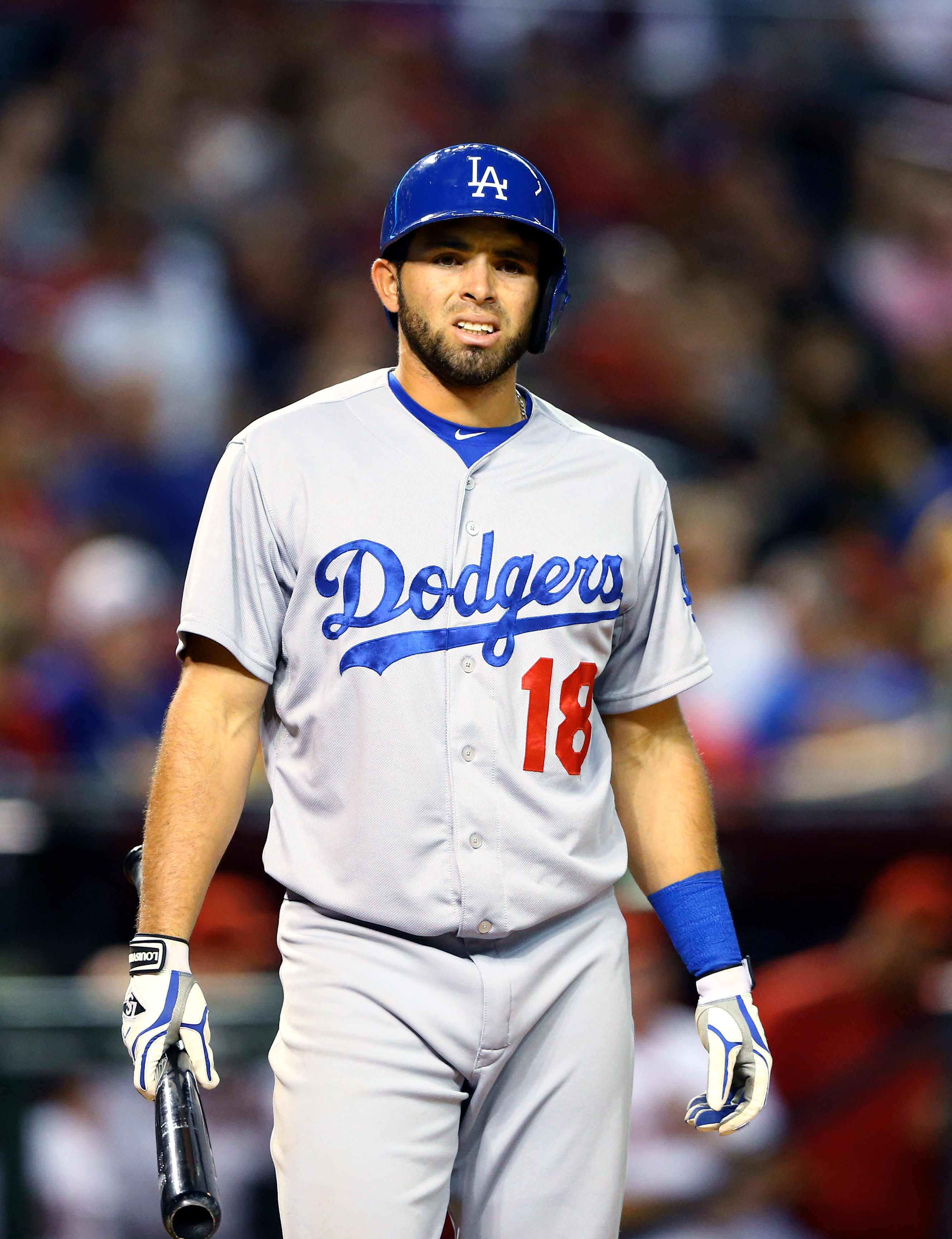
Peraza, 22 in April, made his big league debut in 2015, collecting four hits in 22 September at-bats for Los Angeles. He batted a combined .293/.316/.378 with 33 steals between his two Triple-A affiliates last season and has a pair of 60-steal seasons under his belt in the minor leagues. His youth is one of the keys to the deal, as Peraza reached the Majors at the same age we see many top prospects selected out of college in the draft. He’s three years younger than Johnson or Thompson, and the Reds are clearly banking on continued development and improved production as he catches up to his competition in terms of physical maturity. Peraza entered the 2015 campaign universally ranked as a Top 100 prospect — MLB.com had him 38th overall — and he figures to do so again in 2016, as Baseball America’s Ben Badler tweets.
BA recently ranked Peraza as the Dodgers’ No. 4 prospect, trailing only Corey Seager, Julio Urias and Jose De Leon. In Badler’s scouting report, he praised Peraza’s bat-to-ball skills and speed, noting that he could hit for average and swipe 30-plus bases in a regular role. BA’s camp is split on Peraza, it would seem, as John Manuel tweets that Peraza needs to play shortstop to have value as a regular, while J.J. Cooper opines that Peraza should be a solid regular, albeit not a star. Peraza ranks fourth on MLB.com’s list of Dodgers prospects as well and, in fact, ranks 24th on their current Top 100 list. He’s seen time at shortstop, second base and in center field in his career thus far, and second base would seem the most obvious path to at-bats for him in the event of a Phillips swap. He’ll give Cincinnati another versatile piece that can conceivably handle multiple positions, joining Eugenio Suarez in that capacity.
Like Peraza, Schebler can conceivably step right onto the Reds’ roster. He, too, made his big league debut in 2015, albeit receiving just 40 plate appearances. Schebler unquestionably struggled at the Triple-A level, as his .241/.322/.410 batting line (in the hitter-friendly Pacific Coast League, no less) was a marked departure from the .280/.365/.556 line he posted as a 23-year-old in Double-A. However, he’ll play all of next season at 25 years of age and has a history of hitting for power in the minors, as evidenced by the combined 55 homers he launched from 2013-14.
Schebler ranked 13th on MLB.com’s Dodgers Top 30 and 14th on the same list from BA. MLB.com notes that he’s best-suited for corner outfield work — an area of need in Cincinnati — and is a solid baserunner but not a big base-stealer. Some scouts, they add, are hesitant with Schebler because he relies more on raw strength than bat speed to produce his power. BA has previously pegged him as a possible regular in left field, and former Fangraphs scribe Kiley McDaniel noted heading into the 2015 season that Schebler “fits the bill as an under-the-radar performer who could surprise.” However, I’d imagine that his 2015 struggles have clouded that likelihood to some extent.
The 23-year-old Dixon didn’t rank among Los Angeles’ Top 30 prospects in the estimation of BA or MLB.com. He was selected in the third round of the 2015 draft and raked in 45 games at Class-A Advanced this past season before struggling after a promotion to Double-A. He’s played second base, third base and the outfield in his young career and posted a cumulative batting line of .263/.303/.443 with 19 homers this past season between his two levels. Dixon also turned in a nice showing in the Arizona Fall League, batting .295/.318/.508 with three homers in 16 games, and he performed well last winter while playing in the Australian Baseball League.
The Dodgers, meanwhile, pick up a number of prospects with plus tools but uncertain overall packages. Montas, 23 in March, can reach 100 mph with his fastball and has been developed as a starting pitcher, but many scouts still see him as a reliever due to a lack of control. MLB.com currently ranks him as the game’s No. 54 prospect, noting that if everything clicks he’s a potential No. 2 starter, but he could end up as a high-leverage reliever instead due to the aforementioned control issues. BA recently ranked him as the No. 17 prospect in the Double-A Southern League, with Matt Eddy writing that despite holding his velocity deep into starts, troubles with repeating his delivery and lack of strong secondary offerings could lead to relief work.
Thompson, 25 next March, ranked 14th on MLB.com’s list of top White Sox prospects. Known for his excellent athleticism — he’s the brother of NBA superstar Klay Thompson and the son of former NBA player Mychal Thompson — Trayce debuted in 2015 and batted .295/.363/.533 with five homers in 44 games. He hasn’t shown that type of power in the minor leagues, but some have questioned how much he’ll hit in the Majors and projected that he could become a fourth outfielder. Even if that’s the ultimate case, he fits much better on the Dodgers’ current roster than Schebler due to his ability to handle all three outfield positions. The presence of Yasiel Puig, Carl Crawford, Andre Ethier, Joc Pederson, Scott Van Slyke and Enrique Hernandez in L.A. seems to point to Thompson opening next season in the minor leagues, even though he’s more or less ready for big league action. (Further trades could clear a path for him in the Majors.)
Johnson, who turns 25 on Friday, has long been considered the potential second baseman of the future in Chicago, but he’ll now hope to land that role in Los Angeles. His first taste of Major League action in 2015 didn’t go too well, as he batted just .230/.306/.270 in 114 plate appearances. However, Johnson is lauded for his elite speed — he swiped 84 bases in 131 games in 2013 — and delivered a quality .316/.376/.466 batting line in 2015. MLB.com places a 75-grade on his speed (on the 20-80 scale). Johnson, though, has little in the way of power (24 homers in 1761 minor league PAs) and is said to be a shaky defender at second base. He made three errors in 32 starts at second base last season, and in just 280 innings drew ratings of -7 and -3 from Defensive Runs Saved and Ultimate Zone Rating, respectively. He could also be ticketed for Triple-A to begin the 2016 season, with veteran Chase Utley on board to hold down the fort at second base while Johnson develops.
Overall, it’s fair to question the return that Cincinnati received in the deal. The trade very clearly hinges on the development of Peraza, whom the Reds reportedly “love” and were on the verge of acquiring in the failed Aroldis Chapman trade, according to Jon Heyman of CBS Sports (Twitter link). The Reds do indeed acquire a pair of players in Peraza and Schebler that are near MLB-ready or presently MLB-ready, but neither seems to possess star-caliber upside. A pair of solid regulars — or even one solid regular, for that matter — will make this a palatable return in the long run, but most seemed to be expecting more impactful prospects in return for a player of Frazier’s caliber, especially when considering his reasonable price tag. Perhaps his poor second half tanked some of his trade value, but given the bulk of clubs that were tied to Frazier the general consensus will be that Cincinnati might have been — or at least should have been — able to acquire more in a trade of this magnitude.
Yahoo’s Jeff Passan first reported that Montas was going to the Dodgers in a trade. C. Trent Rosecrans of the Cincinnati Enquirer broke the news of a three-team deal including Frazier (on Twitter). Jon Heyman of CBS Sports reported the other prospects in the trade (links to Twitter).
Photos courtesy of USA Today Sports Images.
Rangers Sign Tony Barnette
DEC. 15: Barnette’s contract guarantees him $3.5MM over the next two years, reports Wilson (links to Twitter). Barnette will earn $1.5MM in 2016 and $1.75MM in 2017. His club option is valued at $4MM and comes with a $250K buyout, but the option’s value could escalate based on games finished, per Wilson. The Rangers also formally announced the signing today.
DEC. 10, 10:30am: Barnette’s deal also contains a club option for 2018, tweets Jeff Wilson of the Fort Worth Star-Telegram.
9:17am: The Rangers and right-handed reliever Tony Barnette are in agreement on a two-year contract, reports Evan Grant of the Dallas Morning News. Barnette, 32, is a former D-backs farmhand that never broke into the Majors before heading over to Japan and establishing himself as a dominant closer. He is represented by the Wasserman Media Group.
The Rangers will owe a $500K posting fee to Nippon Professional Baseball’s Yakult Swallows as compensation for losing Barnette, which will be in addition to the value of the contract actually issued by Texas. Barnette has a career 3.58 ERA with the Swallows in Japan but is coming off a season in which he posted a pristine 1.29 ERA with 8.0 K/9 against 2.7 BB/9 in 62 2/3 innings of work.
Nationals, Reds Discussing Brandon Phillips Trade
The Nationals are known to be eyeing second base upgrades, and Ken Rosenthal of FOX Sports hears that they’re currently discussing a potential Brandon Phillips trade with the Reds. As a player with 10+ years of Major League service time and five straight with his most recent club, Phillips has the ability to veto any trade, so he would need to approve of the deal. Cincinnati would receive prospects in the deal that is currently being discussed, sources tell Rosenthal.
Phillips, 34, had a strong season with the Reds in 2015, hitting .294/.328/.395 with a dozen homers and 23 stolen bases. The 23 steals were his highest single-season total since 2009, and Phillips’ 10.9 percent strikeout rate was easily the lowest of his career. Additionally, he continued to post strong defensive marks (+2.0 UZR, +5 DRS) in spite of his relatively advanced age.
Of course, the Nationals already have a quality defensive option at second base: Danny Espinosa. The Nats, though, reportedly would like to add a left-handed bat to complement the switch-hitting Espinosa at second base, given his history of troubles against right-handed pitching. Phillips, obviously, doesn’t meet that criteria, but he could provide an everyday option instead, freeing up Espinosa for a utility role and allowing him to start the season at shortstop while prospect Trea Turner gets some additional development time at the Triple-A level.
Phillips has a reasonable $27MM owed to him in total over the next two seasons ($13MM in 2016 and $14MM in 2017), so the Nats certainly have the financial means to add him to the fold, assuming he signs off on a potential trade. There are certainly reasons to believe that Phillips would be open to the idea; the Nationals are assuredly a better bet to contend in 2016 than the rebuilding Reds, and a trade would reunite Phillips with recently hired manager Dusty Baker — his skipper with the Reds from 2008-13.
From the Reds’ point of view, the trade would clear playing time for promising young infielder Eugenio Suarez, who impressed while filling in for the injured Zack Cozart over the final few months of the season. Cozart, though, will be healthy in 2016, leaving Suarez without a regular playing spot as things currently stand in Cincinnati.
Cubs Sign Jason Heyward
3:43pm: Heyward receives full no-trade protection from 2016-18 and limited no-trade protection in 2019-20, tweets Jon Heyman of CBS Sports. (Heyward will have 10-and-5 rights after that point, assuming he remains with the Cubs.) Heyman also reports that Heyward receives a $20MM signing bonus that is fully deferred, adding that the he’ll earn $15MM in 2016, $21.5MM in 2017-18, $20MM in 2019, $21MM in 2020-21 and $22MM in 2022-23 (links to Twitter).
Heyward can opt out after the 2018 season, and, if he chooses not to do so, will trigger a second opt-out clause following the 2019 season by reaching 550 plate appearances in 2019, Heyman adds.
DECEMBER 15, 2:34pm: The Cubs have announced the signing and are introducing Heyward today.
DECEMBER 11, 2:29pm: FOX’s Ken Rosenthal tweets that Heyward can opt out after the third year or fourth year if he meets certain plate appearance thresholds.
1:47pm: Heyward’s contract does indeed contain the option to opt out early, reports MLB Network’s Peter Gammons (Twitter link). However, he can opt out not only once, but twice, per Gammons. ESPN Chicago’s Jesse Rogers reports (also on Twitter) that the first opt-out clause comes three years into the contract, meaning Heyward can hit the open market entering his age-29 season if he chooses.
1:35pm: Bob Nightengale of USA Today hears it’s an eight-year, $184MM deal for Heyward (Twitter link) — an annual value of $23MM.
1:04pm: Heyward’s contract guarantees him less than $185MM and is believed to be for eight years, reports Wittenmyer (Twitter link).
12:12pm: Jason Heyward has chosen to sign with the Cubs, multiple sources tell Gordon Wittenmyer of the Chicago Sun-Times (Twitter link). Exact financial terms aren’t known, but Jon Heyman of CBS Sports tweets that the Cubs landed Heyward for less than $200MM despite the fact that the Nationals are said to have offered around, or exactly $200MM. An opt-out clause in the contract would certainly make some sense, though reports haven’t indicated that to be the case just yet. Still, Heyward’s agent, Casey Close of Excel Sports Management, has previously negotiated such clauses for clients Clayton Kershaw, Zack Greinke and Masahiro Tanaka.

Heyward, 26, adds to an exciting class of free-agent additions for the Cubs this offseason (really, in the past week or so), as the team has already agreed to a four-year, $56MM pact with Ben Zobrist and a two-year, $32MM contract with John Lackey (to say nothing of a one-year deal to bring back Trevor Cahill, who had a relatively quiet resurgence in the Chicago bullpen).
Like Lackey, Heyward rejected a qualifying offer at the beginning of the offseason, meaning he’ll cost Chicago a draft pick. The Cubs, then, will be forfeiting the No. 28 pick in the draft as well as their second-round pick, which would’ve fallen in the early 70s when factoring in the first Competitive Balance Round and compensation picks for teams losing free agents that rejected the qualifying offer.
The question following this addition, of course, will be how Heyward slots into the outfield. The three-time Gold Glove winner is known as one of the game’s premier defensive players but has been almost exclusively a right fielder. Consensus seems to be that he can handle center field if need be, but with a pair of highly controllable assets flanking him in the form of Kyle Schwarber and Jorge Soler, it’s conceivable that the team will make a move to flip a young outfielder (Soler has been mentioned in rumors far more than his young counterpart, Schwarber) in order to further strengthen the rotation. Of course, that would again leave the Cubs with a hole in center field that needs to be addressed.
Defensive metrics are, of course, imperfect, but it’s still notable that since debuting in 2010, Heyward leads all Major Leaguers, at any position, with 119 Defensive Runs Saved. He’s also the runaway leader in cumulative Ultimate Zone Rating in that time (+94.4), and his prorated UZR/150 of +18.4 trails only Juan Lagares and Andrelton Simmons among qualified fielders. Those rankings hold weight even when shortening the sample size to the past three years, as each metric agrees that Heyward is the best defensive player in the game aside from his former Atlanta teammate, Simmons.
Wherever he fits onto the diamond or into the lineup, Heyward will strengthen the Cubs not only defensively but on offense as well. Though many point to his lack of home run power in recent years — he’s averaged 13 per season since 2013 — Heyward has continually whittled away at his strikeout rate and posted consistently strong on-base percentage marks (especially relative to the declining league average in that regard). In his lone season with the division-rival Cardinals, Heyward batted .293/.359/.439 with 13 homers and 23 steals (in 26 attempts). His offensive output was 16 percent better than that of a league-average hitter when adjusting for park, by measure of OPS+, while a similar metric, wRC+, rated his park-adjusted offense to be 21 percent better than the league average.
That the Cubs will effectively be signing Heyward away from the Cardinals only sweetens the deal for the club. Much in the way that the D-backs felt extra value by keeping Zack Greinke away from the Dodgers and Giants in signing him, Heyward will not only strengthen the Cubs — his departure will weaken one of their two biggest rivals. The same can be said of Lackey, who will also jump from St. Louis to the other side of the storied rivalry between the two franchises.
The Heyward market was quiet for a good portion of the offseason, but in recent days, the finalists were said to be the Cubs, Cardinals, Nationals and possibly the Angels, while the Giants also reportedly had interest but didn’t progress to the point of making an offer.
Photo courtesy of USA Today Sports Images.
2016 MLB Arbitration Tracker Now Available
20 of the 183 arbitration eligible MLB players have agreed upon contracts for 2016, so there’s plenty of work left to be done. Star players such as Josh Donaldson, Jake Arrieta, Nolan Arenado, Dallas Keuchel, Manny Machado, Matt Harvey, and A.J. Pollock are among those eligible for the arbitration process for 2016. Keep track of all arbitration eligible players with MLBTR’s Arbitration Tracker! The tracker allows you to filter by signing status, team, and service time, and also contains information on Super Two players, filing numbers, and hearings. Bookmark the 2016 Arbitration Tracker today! You can also find the link under the Tools menu up top and under MLBTR Features on the sidebar.
Players will file for salary arbitration on January 12th, figures will be exchanged on January 15th, and hearings will take place during the first three weeks of February. MLBTR’s world-famous arbitration salary projections can be found here.