
Marlins, Giancarlo Stanton Agree To 13-Year, $325MM Contract
THURSDAY: The deal also includes $1MM annually in assorted award-related performance bonuses, tweets Kiley McDaniel of Fangraphs.
TUESDAY, 4:25pm: Jon Heyman of CBSSports.com tweets the full breakdown: after earning the previously-reported $30MM total over the first three years of the deal, Stanton will take home annual values of $25MM (2018), $26MM (2019, 2020), $29MM (2021, 2022), $32MM (2023, 2024, 2025), $29MM (2026), and $25MM (2027).
The deal also includes a $25MM club option for 2028, which comes with a $10MM buyout to make up the remainder of the guaranteed value in the deal.
2:29pm: The highest annual salary in the deal is $32MM, Ken Rosenthal of FOX Sports tweets. As Rosenthal notes, that rate matches the biggest single hit in the Cabrera deal but falls shy of Mike Trout’s highest-paid season.
12:31pm: ESPN’s Jayson Stark reports that Stanton’s contract is heavily backloaded — a structure which Stanton actually desired in order to leave the front office with flexibility to add significant pieces in order to contend in the immediate future.
Stanton will earn just $6.5MM in 2015, $9MM in 2016 and $14.5MM in 2017 before earning $77MM total over the following three seasons. In other words, should he opt out of his deal, he’ll have received $107MM over six years (an AAV of $17.83MM) and be walking away from seven years and $218MM (an AAV of $31.14MM).
MONDAY, 4:40pm: Marlins owner Jeffrey Loria has confirmed the signing of Stanton to a 13-year deal, reports Manny Navarro of the Miami Herald. Loria called this a “landmark day” and noted, “It means everything to the franchise. We have a face of the franchise for the next 13 years.” Loria said he expects Stanton to be a Marlin for the next 13 seasons. “I did this for the city, the fans, for Giancarlo, our team, for myself and for baseball,” Loria told Navarro.
2:18pm: Andy Martino of the New York Daily News reports (via Twitter) that the deal has been finalized and a press conference will be held at 11am on Wednesday of this week to announce the extension.
10:27am: The Marlins and outfielder Giancarlo Stanton are in agreement on a 13-year, $325MM contract extension that will set the benchmark as the new largest contract in the history of professional sports, CBS Sports’ Jon Heyman reports. While the deal hasn’t yet been made official, Heyman reports that a press conference should be held later this week and “there is a clear understanding the deal will be finalized.” Stanton is a client of the Wasserman Media Group’s Joel Wolfe.
The extension contains a full no-trade clause and Stanton “will be able to opt out not long after he turns 30,” according to Heyman, so it would seem that the opt-out clause can be triggered after the 2019 season, or after 2020 at the very latest. Stanton just celebrated his 25th birthday on November 8.

Stanton’s groundbreaking contract will buy out 11 free agent years, valuing each of those seasons in the $26-27MM range, depending on how much he’d have earned in arbitration over the next two seasons (MLBTR contributor Matt Swartz had pegged him for a $13MM salary in 2015 alone). The new contract will run through the 2027 season, after which Stanton will be 37 years of age. Of course, that assumes that Stanton does not exercise the opt-out clause, at which point he could be able to seek an even larger annual commitment over a longer term, should he continue to perform as he has to this point in his career.
The runner-up to Clayton Kershaw in this year’s MVP voting, Stanton finished the season with a .288/.395/.555 batting line and 37 home runs — a figure that tied his career best and also led the National League. Still just 25, Stanton has nearly five full seasons under his belt and has authored a .271/.364/.540 batting line with 154 home runs while playing many of his games in the pitcher-friendly Marlins Park. Defensive Runs Saved considers Stanton to be an excellent right fielder, pegging his career at +26 run. Ultimate Zone Rating has him at +14.3 — an average of 3.3 runs saved per 150 games. In total, Baseball-Reference.com values Stanton’s career to date at 21.2 wins above replacement, while Fangraphs has him at 19.5 WAR.
Unlike many players that sign prodigious contracts, however, Stanton is not only being compensated for what he has done, but for what he could do in his prime. That he’s yet to reach his prime is a frightening thought (particularly for Major League pitchers), and it’s reasonable to think that Stanton’s best years may not even have come yet. The Marlins will secure far more of Stanton’s prime than most $200MM+ extensions do, and the team is well-positioned to take on a significant long-term deal, as MLBTR’s Jeff Todd highlighted recently.
The question, of course, is how Marlins owner Jeffrey Loria will adjust the team’s payroll going forward. The Marlins have operated on a payroll between $40MM and $60MM in four of the past five seasons, but such a sum won’t be feasible if and when Stanton’s annual commitment approaches or even exceeds $30MM per season. Stanton’s extension appears to be as much a statement to the city of Miami that the Marlins intend to compete as it does a commitment to a clearly elite player.
By adding a no-trade clause, the Marlins have broken a club policy. The team’s previous record contract was that of Jose Reyes, but Reyes was dealt to Toronto just one year after signing his $106MM contract, further fueling widespread skepticism and cynicism toward the organization anytime it signed or acquired a player. That trade also enraged Stanton, who candidly tweeted at the time that he was “pissed off.” However, Stanton will have full say over his future, and it can even be argued that the Reyes/Mark Buehrle/Josh Johnson blockbuster helped set the stage for this extension, as it alleviated long-term payroll commitments for the Marlins and brought in talented, controllable names such as Henderson Alvarez, Adeiny Hechavarria, Justin Nicolino and Jake Marisnick, the latter of whom was a key component in acquiring Jarred Cosart.
The Marlins will now field a long-term outfield mix of Stanton in right field, Marcell Ozuna in center field and Christian Yelich in left field — a supremely talented trio that should hit near the top or in the middle of the team’s batting order for the foreseeable future. Miami also boasts an impressive group of young pitchers, including ace Jose Fernandez (who is recovering from Tommy John surgery), Alvarez, Cosart, and Nathan Eovaldi (to say nothing of top prospects Andrew Heaney and, eventually Tyler Kolek). Additional options that are in or potentially ready to pitch in the Majors include Tom Koehler, Anthony DeSclafani and Brian Flynn. GM Dan Jennings and president of baseball operations Michael Hill will be able to use that pitching talent as they see fit to field a strong rotation and perhaps to acquire young hitters in trades.
Stepping back and looking at the big picture, Stanton’s $25MM average annual value certainly isn’t a record, but the length and guarantee on his commitment certainly are. Currently, Miguel Cabrera is owed $292MM over the life of his contract, although that was actually a $248MM extension on top of two guaranteed contract seasons. In terms of the most amount of “new money” ever guaranteed on a contract, Alex Rodriguez‘s 10-year, $275MM contract set the bar prior to this deal. Other examples of $200MM+ contracts include 10-year, $240MM contracts to both Albert Pujols and Robinson Cano, a 10-year, $225MM extension for Joey Votto and a nine-year, $214MM pact for Prince Fielder. (Clayton Kershaw signed a seven-year, $215MM extension with the Dodgers last offseason as well.)
Stanton will surpass all of those impressive names in setting a pair of records that don’t figure to be broken in the near future. Though he’s been a fixture among trade rumors for the better part of four years, Stanton will ultimately remain rooted in Miami sports for at least the next several years and within the history books long after his days as a Marlin are done.
FOX Sports’ Ken Rosenthal first reported that Stanton and the Marlins were discussing a deal in the 10-year/$300MM range. Christopher Meola appears to have been the first to learn of the deal’s finalization, as he tweeted the exact terms on Thursday night.
White Sox Weighing Pursuit Of Melky Cabrera
The White Sox are interested in free agent outfielder Melky Cabrera and are considering pursuit, reports Jon Heyman of CBSSports.com.
Other clubs that could make sense for Cabrera, says Heyman, include the Mariners and Orioles. The Royals have been mentioned elsewhere as an outside possibility. And, of course, the Blue Jays still have interest in bringing him back.
We have not heard much in the way of rumors regarding Cabrera, a 30-year-old switch-hitter coming off of a strong .301/.351/.458 campaign. Though he certainly comes with his downsides, Cabrera is a valuable asset and one of the best position players available this year, as MLBTR’s Steve Adams explained in detail in his recent profile. Adams predicts a five-year, $66.25MM pact.
It is worth bearing in mind, of course, that a team signing Cabrera will be required to sacrifice a draft pick as compensation. Holding a protected first-round choice, that would be much easier to stomach for Chicago.
Free Agent Profile: Max Scherzer
2013 Cy Young award winner Max Scherzer is the prize of the free agent market after another superb season. He’s a strikeout machine with a strong record of durability, and agent Scott Boras will be seeking a precedent-setting contract.
Strengths/Pros
Scherzer, 30, posted a 3.02 ERA over 434 2/3 regular season innings from 2013-14. In 2013, he went 21-3 with a 2.90 ERA and 240 strikeouts for the Tigers and won the AL Cy Young award easily. He made the All-Star team in both years.
 Scherzer has been one of the game’s most dominant starting pitchers since 2012. He has a 10.5 K/9 over that period, second among qualified starters in all of baseball. His ranking is the same in K%; he’s whiffed 28.6% of batters faced during that time. He’s tallied 231 or more strikeouts in each of the past three seasons and leads all of baseball with 723 punchouts over that time. Scherzer also has good control, with a 2.5 BB/9 over the past two seasons. He uses a four-seam fastball and a change-up, also employing a slider against righties and a curveball against lefties.
Batters made contact on only 74.5% of Scherzer’s pitches from 2012-14, third best in baseball among qualified starters. Batters swung and missed on 11.9% of Scherzer’s pitches, which ranked fourth.
Skill-Interactive ERA (SIERA) is the latest ERA estimator, from Matt Swartz. Scherzer’s 2.94 SIERA ranks eighth among qualified starters over the last two seasons. His actual ERA of 3.02 is in line with that, and ranks 11th.
How about durability? Scherzer hasn’t been on the disabled list since a short stint in 2009. Even that year he made 30 starts, a number he exceeded in every subsequent season. His 434 2/3 innings from 2013-14 ranks sixth in baseball, and he tossed another 29 2/3 frames in the postseason. Still, Boras has pointed out that Scherzer has less wear and tear on his arm than Jon Lester and James Shields. This is mainly because Lester and Shields signed early-career extensions giving up free agent years, and Scherzer did not.
Put it all together, and Scherzer is an ace, one of the best pitchers in the game. He’s tallied 12.0 wins above replacement over the last two seasons, tied with Felix Hernandez for second in MLB. Clayton Kershaw is the best, but Scherzer is in the conversation for second-best.
Weaknesses/Cons
Scherzer is decidedly a flyball pitcher. This hasn’t hurt him over the last two seasons, as he’s allowed 0.75 home runs per nine innings. From 2011-12, however, he allowed 1.22 HR/9. The difference seems like nothing more than the vagaries of his home run per flyball rate, which has hovered around 7.5% over the past two seasons. Across MLB this year, 9.5% of flyballs left the yard. Applying that rate, Scherzer would have allowed 4.7 additional home runs this year and posted a 0.93 HR/9. Simply put: it would not be surprising if Scherzer is slightly below average at preventing home runs during his next contract.
Pitch efficiency is not a strong suit for Scherzer. He averaged 16.51 pitches per inning in 2014, 70th among 88 qualified starters. The average qualified starter was at 15.77 pitches per inning. Scherzer threw 3,638 pitches in 2014, third-most in baseball.
As a player who received and will turn down a qualifying offer, signing Scherzer will require forfeiture of a draft pick. Jon Lester, who is Scherzer’s biggest competition on the market, is not eligible for a qualifying offer.
Personal
Scherzer was born in St. Louis, Missouri. He attended high school in Chesterfield, MO, rooting for the Cardinals as a child. His dad even brought him to Game 4 of the 1985 World Series when he was 15 months old, according to this article from Jeff Passan. Scherzer was drafted by the Cardinals in the 43rd round in ’03. He chose not to sign and attended University of Missouri Columbia, getting drafted 11th overall by the Diamondbacks in ’06. Scherzer majored in business at Mizzou.
Scherzer currently resides in Scottsdale, Arizona with his wife. His charitable efforts are extensive, with his Scherzer’s Superstars program and other efforts.
Scherzer draws attention for having been born with one blue eye and one brown one, which is called heterochromia. Max is also well-known for embracing advanced baseball statistics, using them to help understand the game. When he was traded in 2009, Scherzer became an MLBTR reader. He told Bob Nightengale of USA Today, “Once that happened, I started becoming a pretty fanatical fan and read it just about every day.”
Market
C.C. Sabathia‘s seven-year, $161MM contract from six years ago remarkably still stands as the largest given to a starting pitcher on the open market (though the Yankees’ total outlay for Masahiro Tanaka last winter was $175MM, including a $20MM fee paid to his former team in Japan). In 2008, the average American League starting pitcher had a 4.48 ERA. Sabathia was on an island in the 2008-09 offseason, coming off a 2.70 ERA.
Scherzer is not on an island. In 2014, the average AL starter had a 3.92 ERA. As ESPN’s Buster Olney explained, “Major League Baseball’s market has never seen so much attractive pitching available all at once, although executives throughout the sport are aware this shift is something of an optical illusion, created by the historic drop in run production in recent seasons.” Scherzer’s 3.15 ERA this year ranked 26th among qualified starters. That would have ranked 12th in 2008. In ’08, 23 starters were under 3.50. In 2014, 39 starters were under 3.50, including free agents Jason Hammel, Francisco Liriano, James Shields, Edinson Volquez, and Jon Lester.
Maybe Boras can make a strong case that Scherzer is the second-best starting pitcher in baseball, but the scarcity isn’t there in baseball or in free agency. Free agency is rife with solid mid-rotation options this year, and teams ready to spend big on pitching might prefer Lester because he might not require a seventh year. Or maybe teams would rather take on Brandon McCarthy‘s injury risk at half of Scherzer’s average annual value and potentially as few as three years.
I expect Boras to seek more than $175MM for Scherzer. That kind of commitment limits a player’s suitors. As Heyman put it, “It almost seems like Scherzer is too good for the market at times.” In batting around potential fits with MLBTR’s writing team and others around the game, teams like the Cubs, Red Sox, Yankees, Dodgers, Astros, Giants, Rangers, Blue Jays, Mariners, White Sox, Orioles, Nationals, and Diamondbacks came up. Some of those clubs don’t seem to have the payroll space, others don’t seem to be prioritizing starting pitching, and others have suggested they won’t play at the top end of the market. Scherzer’s old team, the Tigers, can’t be ruled out yet.
Keep in mind that “this is an owner’s decision,” as Boras put it, as it will happen above the GM level.
Expected Contract
The Tigers made the unorthodox move of releasing a statement in March after Scherzer rejected a six-year, $144MM offer. The statement mostly made the pitcher sound greedy, and was met in kind by a statement from Boras. The Tigers’ offer was the Cole Hamels deal, which was nearly two years old at that point. Boras viewed that as an old market price, with Tanaka and Kershaw having signed more recently for $175MM and $215MM, respectively. Boras told Jon Heyman of CBS Sports in November, “It’s rare that someone shows the character and confidence to trust his ability to turn down $144 million. That’s never been done in professional sports. And that says a lot about Max Scherzer.”
It stands to reason that Boras will want the seven year term achieved by Tanaka and Sabathia. Tanaka’s deal began with his age 25 season, Sabathia’s with his age 28 campaign. Scherzer’s deal will begin with his age 30 campaign, so he’s got a tougher case, one he’ll make with the “less wear-and-tear” argument. And don’t be surprised if we hear about Boras asking for eight years, as a way of arriving at seven in the end.
For average annual value, the $30.7MM figure obtained by Kershaw is likely out of reach, though Boras may make the argument that Kershaw’s six free agent seasons cost more like $32MM per year. Greinke was at $24.5MM, Tanaka at $25MM. Felix Hernandez and Justin Verlander were at $27-28MM per year, but those extensions were not signed on the open market and only added five additional years.
Ten MLB contracts have included opt-out clauses, and Boras did four of them. The three most recent starting pitcher deals with opt-out clauses were done by Casey Close of Excel Sports Management (Tanaka, Kershaw, and Zack Greinke). Greinke and Sabathia obtained the ability to opt out after three years. Boras figures to seek the same for Scherzer, who could then hit the market again ahead of his age 33 season. The opt-out clause is not a guarantee; Boras didn’t get one for Prince Fielder in the 2011-12 offseason. But it is possible that some teams won’t view an opt-out as a big negative despite the downside risk, as explained in my article on the topic from February. The clause could allow a team to sign Scherzer and duck his decline phase, as the Yankees could have done with Sabathia had they let him go after his third year with them.
Getting past Tanaka’s $175MM outlay would be a symbolic win for Boras. I’m predicting a seven-year, $185MM deal for Scherzer.
Marlins Notes: LaRoche, Pitching, Payroll, Stanton
Earlier today the Marlins officially announced their 13-year, $325MM extension with Giancarlo Stanton. Here’s the latest on the team following that historic agreement…
- The Marlins have made a two-year, $20MM offer to Adam LaRoche, reports Barry Jackson of the Miami Herald. Recent reports have indicated that the Marlins are strongly interested in LaRoche, and Jackson’s report would back that up, though the $20MM may be a bit light to seal the deal. I recently pegged LaRoche for a two-year, $30MM deal, and he just wrapped up a two-year, $24MM pact. LaRoche is also said to be drawing interest from the Padres and White Sox.
- Also from Jackson, the Marlins have expressed interest in free agents Jason Hammel and Justin Masterson. Miami is said to covet a veteran arm to add to its rotation while ace Jose Fernandez rehabs from Tommy John surgery. James Shields‘ name has also been floated recently, though he’d obviously come at a much higher cost than either of the targets named by Jackson. The Fish are also interested in Wade Miley as a trade target, Jackson writes, but the D’Backs have very little pitching depth as it is, so moving one of their only reliable arms would seem a bit curious.
- The Marlins say their payroll will top $60MM in 2015, according to Jackson. With Stanton set to earn just $6.5MM in the first year of his extension, the Marlins currently have about $22MM committed to next year’s roster. MLBTR contributor Matt Swartz projects an additional $20.3MM in arb raises, but the Fish should be able to add at least $20MM or so worth of salary this winter. A LaRoche signing, I would think, could lead the team to shop Garrett Jones, which would remove another $5MM from the currently projected commitment.
- Jackson’s column is rife with excellent quotes from Stanton’s press conference, including quotes from Stanton himself, from agent Joel Wolfe and from team president David Samson. Jackson hears that the Marlins’ first offer to Stanton came shortly after season’s end and was worth roughly $130MM over six years. However, Wolfe says that Stanton told him, “if it’s not a lifetime contract, there’s no point in talking.”
- The Marlins still won’t be giving out no-trade clauses to other players, according to Samson, but they had no problem giving one to Stanton. The opt-out clause was much trickier, as the Marlins were very resistant. The Marlins wanted the opt-out to be conditional based on team performance, only allowing Stanton to elect free agency if the team lost a certain number of games. Samson explained, however, that Stanton made it very clear he wasn’t interested in opting out to earn more money after that point of the contract, but rather to protect himself from being part of a losing culture. “Once we believed the opt-out clause would be used as a shield and not a sword, we were OK with it,” said Samson. Stanton also comfortable with the idea of earning less money up front in the deal to surround him with better players. A new TV deal could be in the offing for the Marlins soon, which would of course allow them a better payroll.
- Also of note from Jackson is that owner Jeffrey Loria has no intentions of selling the team. Though Samson says many people place calls with interest in buying, Loria is “in it for the long run because he loves it.”
- Shifting away from Jackson’s must-read piece — the highlights here are but a fraction of the interesting points within — former MLBTR scribe Cork Gaines writes in a piece for Business Insider that the Stanton extension can be used as leverage in negotiating a new TV deal. Miami currently has the worst local TV deal in all of baseball, paying them $13-18MM annually (the Dodgers’ deal, in contrast, pays them $334MM per year, Gaines writes). Gaines notes that having a legitimate superstar on the team will increase the value of the new TV deal. Gaines speculates that negotiations could begin in 2016 as there appears to be some kind of opt-out on the current contract, which runs through 2020. Indeed, Ken Rosenthal of FOX Sports tweets that they are aiming for a new TV deal to begin in 2017 — which, perhaps not coincidentally, aligns with the first significant spike in Stanton’s salary.
- In a full column, Rosenthal points out that the Rangers, Tigers and Angels each spent significant money prior to signing their new TV deals so they had a more attractive product in place for negotiations. While history has the skeptics gearing up for a fire sale in the near future, Rosenthal opines that this doesn’t look like a club that’s merely going to tear it all down again in two years.
Free Agent Profile: Jon Lester
Ten months ago, the common belief was that Jon Lester would sign an extension that would keep him in a Red Sox jersey into his late 30s. A lot can change in a few months, however, and Lester soon found himself donning the green and gold of the Oakland A’s following a midseason trade from a surprisingly poor Boston club. Though many Red Sox fans wouldn’t have believed it would come to this, the lefty is now fair game on the open market.
Strengths/Pros
To put things in the simplest of forms, Lester is a true ace at this point in his career. He misses bats, has strong control and piles up innings. Among free agent starters, Lester’s 2.46 ERA last year leads the pack by a long shot, as does his 2.80 FIP. He was worth 6.1 wins above replacement, per Fangraphs’ version of the metric (which is based on FIP), and he was worth 5.8 wins when looking at RA9-WAR, which is based on actual runs allowed. Both metrics were tops among free agent starters. He struck out 220 hitters and walked just 48 in 219 2/3 innings this season (9.0 K/9, 2.0 BB/9).
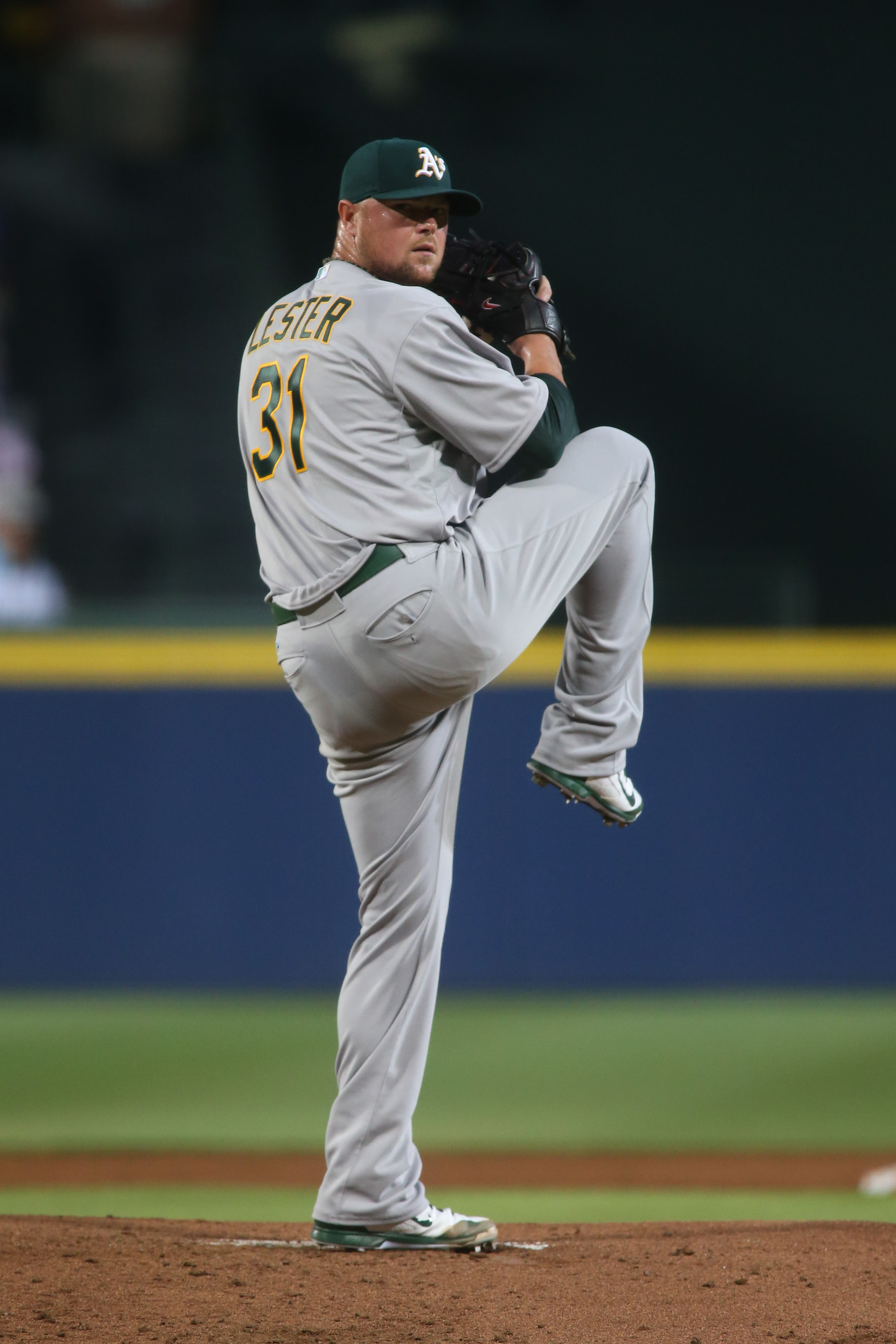 The 2014 campaign marked the sixth time in seven seasons that Lester has topped the 200-inning threshold, and he totaled a strong 191 2/3 in the lone season he fell short (2011). His 219 2/3 innings trails only Max Scherzer (220 1/3) and James Shields (227) among fellow free agents. Dating back to 2008, his age-24 season, Lester has averaged 207 innings per season. He’s hit the DL just once in that time, spending a mere 19 days on the shelf with a strained lat in his left shoulder. That minor injury is all that prevented him from seven straight 200-inning seasons.
Lester was a strikeout machine early in his career, but his K/9 numbers dipped in recent seasons, settling in the mid-7.00s before his resurgent 9.0 K/9 in 2014. Lester pounded the strike zone early this season, registering a 61.4 percent first-pitch strike rate — the highest mark of his career. Perhaps being ahead in the count more often than ever improved the effectiveness of his curveball, or perhaps it was the fact that he threw it slower than ever before (75.1 mph average), but Lester’s 18.2 percent whiff rate on his curve was easily the strongest of his career, resulting in the restored strikeout rate.
Most of Lester’s career has come in a large market in the game’s most hitter-friendly division, and he’s thrived in that setting, for the most part. Teams will appreciate that component of his game, and his postseason experience won’t hurt either. Lester has a 2.57 career ERA in 84 postseason innings. He’s a two-time World Series champion that has been on five playoff rosters.
Lester’s main competition this year will be Scherzer, with Shields representing the third-best arm on the market. However, unlike his peers atop this year’s free agent class, Lester does not have a qualifying offer attached to him; he was ineligible to receive one after being traded midseason and can therefore be signed without the forfeiture of a draft pick.
Weaknesses/Cons
Lester was flat out elite this season, much like he was in his first full three seasons, but from 2011-13, he looked more like a good starter than a truly great one. In that time, Lester posted a 4.03 ERA, 3.84 FIP, 7.7 K/9 and 3.1 BB/9 — useful numbers to be sure, but not the type of stats one associates with a pitcher in search of a six- or seven-year contract.
Though he averaged better than 93 mph on his fastball earlier in his career, Lester’s velocity settled into the mid-92 range from 2011-13 and dipped even further in 2014, averaging 91.8 mph. Of course, that’s still plenty of life, especially considering the fact that he’s left-handed.
Lester turns 31 in January, meaning that a six-year deal would run through his age-36 season and a seven-year pact would run through his age-37 campaign. Clearly, that’s a risky commitment, though such is the case with all top-of-the-market free agents. He’s younger than Shields, but Scherzer pitches most of next season at age 30, so his main competitor has age on his side.
Personal
Lester’s battle with cancer early on in his career was well-documented, and in addition to the great comeback story that culminated in him winning the clinching game of the 2007 World Series, that battle has shaped the work he’s done in the community. Lester partnered with Charity Wines to release his own line of red wine, the proceeds of which benefit the Fred Hutchinson Cancer Research Center. His NVRQT charity sends all of its proceeds to the Pediatric Cancer Research Foundation, and Lester explained how the charity came about and what it means to him in a guest column for the Boston Globe in 2013.
This past July, Peter Abraham of the Boston Globe wrote about the strides Lester has made in terms of maturity both on the mound and with the media after being a bit hot-tempered earlier in his career. (Abraham references glaring at umpires after questionable calls and the infamous chicken-and-beer incident as examples.)
Lester is married and has two sons. The Tacoma, Washington native now resides near Atlanta in the offseason.
Market
Lester is one of the arms referred to as the “Big Three” of this offseason, along with Scherzer and Shields. However, while MLBTR’s Tim Dierkes noted that a third or more of the teams in the league could have viable interest in Shields, the younger Lester figures to come with a higher price tag that may take him out of the picture for a number of clubs.
Lester stated multiple times that he’d like to return to Boston, and last winter he told reporters that he planned to be with the Red Sox until someone “ripped the jersey off his back.” However, the Red Sox made an initial offer of $70MM over four years, at that point, and while the reported $110-120MM offer they made today might have worked in March, it feels too light to make them a serious contender right now.
The other popular landing spot for Lester is the Cubs, where former Red Sox GM Theo Epstein is now president of baseball operations. Epstein and GM Jed Hoyer were members of the Boston front office when Lester emerged as a front-line starter, and the team is rich on young hitters without much in the way of high-upside pitching (Jake Arrieta is a notable exception).
Other teams that figure to enter the mix are the typical names we see assorted with high-end free agents. Though the Yankees maintain that they won’t pursue Lester, Scherzer or Shields, it’s possible they’ll change their tune if they’re unable to re-sign Brandon McCarthy and Chase Headley. The Dodgers have the cash to pull off a deal, though they’re said to be looking to tone down spending this winter. I still won’t rule them out as a possibility. The Tigers and Angels have high payrolls but cloudy long-term outlooks thanks to existing salary on the books. Neither seems a fit barring trades to create some long-term flexibility.
The rest of Lester’s market will have to consist of dark horses, and agents Seth and Sam Levinson of ACES will likely need to pitch to owners of some unlikely teams that Lester could be a franchise-altering decision. To this point, the Royals have shown some preliminary interest, and Lester is set to meet with the Braves on Thursday. The Cardinals have also been linked to Lester.
Beyond that, a team like the Astros has the long-term payroll freedom to make a move, as do the Marlins, who could feel that adding Lester would be a significant step toward building a perennial contender now that they’ve extended Giancarlo Stanton. The Nationals have plenty of money and are set to lose both Jordan Zimmermann and Doug Fister next winter. Trading one and swapping him out for Lester could is a long shot but not unthinkable. The Giants haven’t spent at this level on the free agent market since their ill-fated Barry Zito deal, but they have rotation needs and are flush with cash following the World Series. The Rangers deserve a mention as a team with a willingness to spend and a need for starters, but GM Jon Daniels has indicated they may not be big spenders on the open market. Could a reunion with his hometown Mariners be in the cards? Seattle’s primary need is offense, but if they again have trouble luring hitters to Safeco Field, GM Jack Zduriencik could double down on an existing strength and look to build an even more imposing rotation.
Expected Contract
As is often the case with big name free agents, it’s easy to look at Lester right now and think that outside of the traditional big spenders, there’s not much of a market for him if he’s seeking six or seven years at an annual value north of $20MM. With players of this caliber, the market isn’t always quick to reveal itself, but it does eventually materialize, and we typically see the top names get paid.
Lester has said free agency isn’t all about the money, but I’d be surprised if his agents hadn’t at least kicked around the goal of trying to break CC Sabathia‘s $161MM guarantee, which is still the record for a free agent pitcher. (The Yankees did spend $175MM on Masahiro Tanaka, but $20MM of that sum went to Tanaka’s former team in Japan.)
Were Lester coming off a pair of dominant seasons, as Scherzer is, I think there would be a better case for that figure. As it is, however, he showed a significant gap between his two most recent dominant seasons. Also of note is that Sabathia, like fellow high-priced hurlers Zack Greinke and Cole Hamels, signed his contract at a significantly younger age than Lester. While we have to account for some inflation, as those deals are now older (and Hamels’, of course, was not an open-market deal), Lester may have a hard time getting the seventh guaranteed season. Looking at the majority of the significant pitching contracts signed in recent history, guarantees typically stop in the age-36 season, if not sooner. If that’s the case, Lester would need to achieve a $27MM annual salary to top Sabathia on a six-year deal, which seems a touch steep.
In the end, I do think Lester can top the marks set by Hamels and Greinke. Lester was the best performer among free agent pitchers in 2014, so I can’t completely rule out him getting a seventh year and/or passing Sabathia’s mark. However, his age and the lack of a consistently dominant track record has me pegging him for a six-year, $153MM contract.
Photo courtesy of USA Today Sports Images.
Red Sox Make Offers To Lester, Sandoval
7:11pm: The Red Sox have shown a willingness to continue negotiating after their initial offer, reports Rob Bradford of WEEI.com.
4:44pm: Boston’s offer to Lester is in the $110-120MM range over six years, according to Cafardo (on Twitter). While that’s a notable step up in terms of their offer from last offseason, it’s still less than most expect Lester to accept.
11:28am: The club has indeed extended an offer to the Sandoval, tweets Nick Cafardo of the Boston Globe.
10:00am: Boston is also lining up an offer for third baseman Pablo Sandoval after his visit with the club yesterday, Sean McAdam of CSNNE.com reports.
The Lester offer is “aggressive” and is of at least five years in duration, McAdam adds.
7:29am: The Red Sox have an offer on the table to free agent lefty Jon Lester, according to a report from Gordon Edes of ESPNBoston.com. Lester is expected to take his time considering the proposal, and still has several other clubs with significant interest to explore.
Lester, the club’s once — and possibly future — ace, seems to be the top starter whose market is moving fastest at present. Clubs with reported interest also include the Cubs, Braves, Blue Jays, Royals, and Cardinals. There continue to be whispers that the Yankees could get involved, though concrete reports are lacking. A recent report suggests that six teams could be in the game.
Meanwhile, things remain quiet for the other top two starting arms, but that may not be surprising. James Shields could be a consolation prize for several teams in the mix for Lester, while Max Scherzer‘s agent, Scott Boras, has a well-documented reputation for not pushing the market with his premium players.
Royals GM Dayton Moore On Losing Billy Butler
Earlier today, the Royals bid farewell to slugger Billy Butler, who signed a three-year, $30MM deal with the A’s. It wasn’t surprising to see Butler head elsewhere after KC turned down his one-year, $12.5MM club option (our own Steve Adams actually predicted the exact terms of Butler’s new contract), but the loss still stings for the Royals. This afternoon, Royals GM Dayton Moore spoke with reporters about how the club will proceed without the the longest-tenured member of Kansas City’s roster. After watching the former All-Star sign a hefty three-year, $30MM deal, I asked Moore if he considered exercising the club option on Butler and trading him rather than letting him leave via free agency and getting nothing.
“That’s something talked about but the timing of it really didn’t allow us to do that,” Moore said. “There was nobody really willing to do that at the time. We just finished playing [in the World Series] and three days later we had to make a decision. If we would have found a viable trade partner it’s something we would have done, or looked at. I don’t know if we would have done it because I’m not sure what the package would have been, but it’s something we certainly looked at.”
Ultimately, Moore admits that he misread the market when it comes to Butler, but over the years he has learned that free agency is always difficult to predict and “hindsight is 20/20.” Even after declining the option, Moore felt that he had a good chance of retaining Butler, but things just weren’t meant to be. Now, the Royals will have to fill the void in their lineup and they’ll explore all opportunities. Moore hopes that he can take care of his right field need and some of the DH at bats with one signing, but he won’t pigeonhole himself.
“We like our flexibility, for certain.” Moore said. “It could be one guy or we could guys a day off like [Alex] Gordon or Lorenzo [Cain] or Omar [Infante].”
The Royals, Moore says, will search hard for a right-handed bat with some pop, but he also spoke at length about Kansas City’s needs in the starting rotation. That lines up with a report from Andy McCullough of the Kansas City Star, noting that the club has checked in with the agents for Ervin Santana, Brandon McCarthy, Brett Anderson, Jason Hammel, and Jon Lester. Royals fans might be sad to see Butler go, but Moore insists that the club still has “plenty of room to sign a free agent or two.”
Blue Jays Preparing Offer For Pablo Sandoval
There’s already been some Pablo Sandoval chatter today, with the Red Sox reportedly making an offer and agent Gustavo Vasquez set to chat with the Giants via phone tonight. Vasquez and Sandoval are wrapping up a visit to Boston today, and there’s plenty more on the Kung Fu Panda…
- The Blue Jays met with Sandoval’s camp at last week’s GM Meetings, writes Sportsnet’s Shi Davidi. While the meeting is said to have gone well, no offer has been made at this point.
- However, Nick Cafardo of the Boston Globe reports (via Twitter) that while there’s been no offer to this point, within the next 24 hours, the Blue Jays are indeed expected to make a formal offer to Sandoval. That report adds a third seemingly serious club to the mix. Of course, it’s worth remembering that the Jays do have a team policy against contracts of more than five years, and Sandoval is said to be seeking a six-year deal north of $100MM.
Earlier Updates
- Sean McAdam of CSNNE.com heard from a source that emphatically denied a rumor out of San Francisco that said the Giants were “out” on Sandoval at this point. The Giants are still “very much” in play for Sandoval, McAdam reports, though he does note that it’s unclear how lengthy of a contract the team is willing to issue.
- Hank Schulman of the San Francisco Chronicle shoots down another portion of the apparently erroneous report to which McAdam referred, noting that Sandoval never asked for a seven-year deal from the Giants, who are still definitely in the mix (Twitter link).
- ESPN’s Buster Olney tweets that even if the Giants don’t end up securing Sandoval, they’ll be able to walk away from the situation knowing they made a very strong, very legitimate effort.
- WEEI.com’s Alex Speier examines why it is the Red Sox prefer Sandoval to Hanley Ramirez, despite the fact that Sandoval is seeking a $100MM+ contract and comes with a significantly lesser offensive track record. Speier lists age, defense, durability and also makeup, which he notes is a concern for the Sox regarding Hanley. While Sandoval’s age and defense are larger factors, his excellent clubhouse reputation is an asset as well.
- The Red Sox and Giants remain the main players, writes Jon Heyman of CBS Sports, but the Padres, White Sox and Blue Jays are all still in the mix. Heyman notes that while the Marlins have been a speculative fit in recent months, there’s been no contact from Miami at this point.
Red Sox Claim Juan Francisco
The Red Sox have claimed Juan Francisco off waivers from the Blue Jays, Boston announced today. Francisco, 27, had been noted as a non-tender candidate by MLBTR’s Mark Polishuk, and obviously was headed in that direction before the move by the Jays to expose him to the wire.
Francisco is projected by MLBTR contributor Matt Swartz to take home a $2.2MM payday through arbitration. Boston still has time to determine whether it will go down that path, of course, but obviously his power left-handed bat holds enough appeal that the team decided to open the possibility.
Last year, Francisco posted a fairly typical .220/.291/.456 slash over 320 plate appearances for the Jays, swatting 16 home runs in the process. That is rare power in this day and age, especially for a player who is capable of playing third base. But Francisco’s strikeout issues — he was second-worst in the league, 300 PA minimum — have shown no signs of abating. And his defense at the hot corner has generally drawn substandard reviews.
The timing of the move is somewhat interesting, of course, given that Boston is said to be hotly pursuing free agent third baseman Pablo Sandoval, who also hits from the left (and right) side. But the two players profile quite differently, needless to say, and Francisco looks more like a platoon or bench option — particularly given his extremely poor splits against lefties — if the team is unable to consummate a deal with the high-dollar Sandoval.
Athletics Sign Billy Butler
TODAY: The A’s have announced the signing of Butler to a three-year deal.
YESTERDAY: The Athletics have agreed to a three-year, $30MM deal with free agent DH Billy Butler, as first reported via Twitter by Robert Murray. ESPN.com’s Buster Olney reports that the deal is finalized.
While the contract is a surprise in many respects, its terms were predicted precisely this morning by MLBTR’s Steve Adams. As Adams explained in his profile of the designated hitter, a rough 2014 season reduced his value but certainly could not detract entirely from his solid track record and young age.
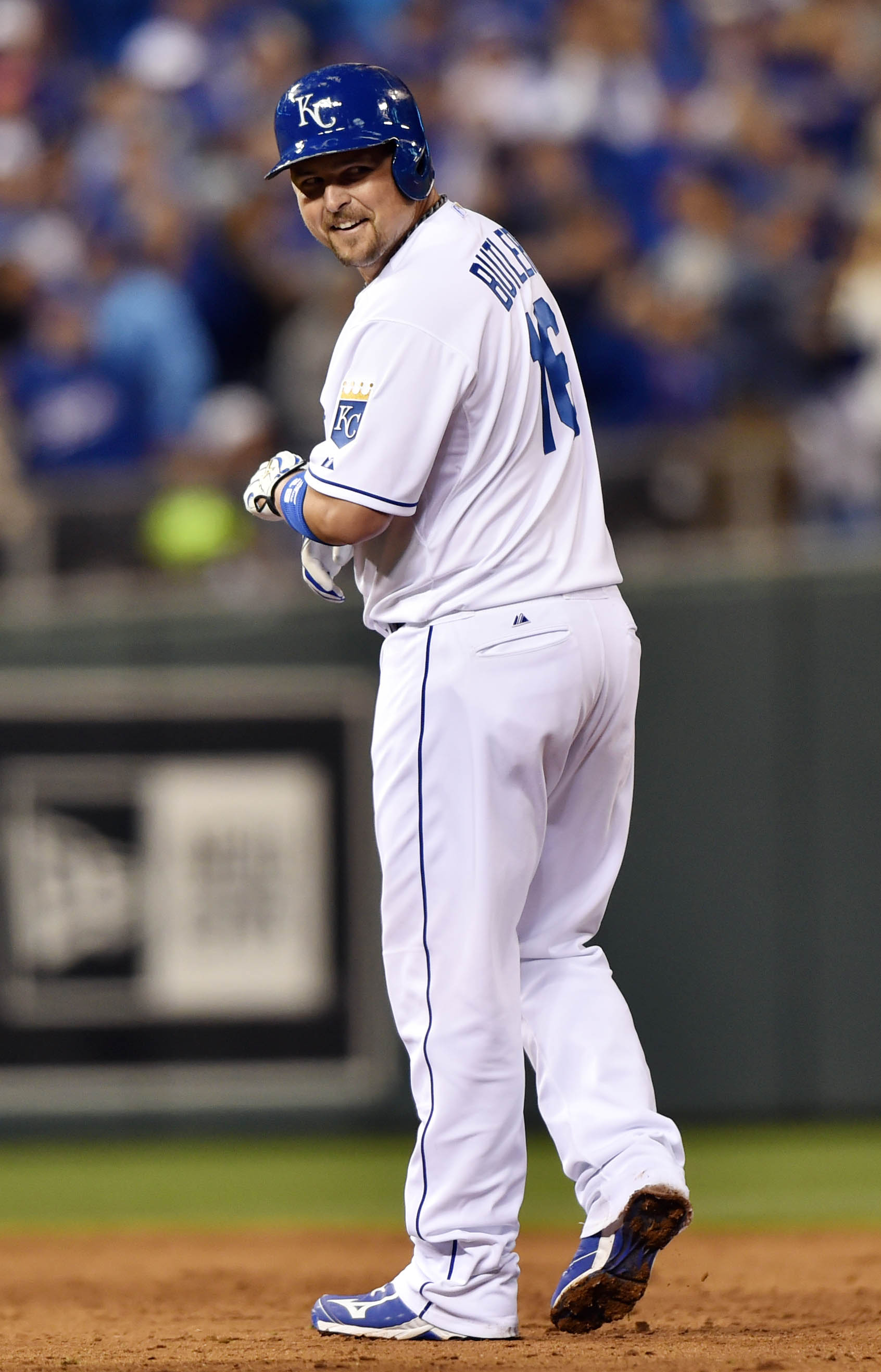
Indeed, Butler is signing on for his age-29 through age-31 seasons, making him a good bit younger than the average free agent. And he brings excellent durability to the table, with a DL-free track record over the past six seasons.
Given those factors, and Butler’s ultimate price tag, it is perhaps surprising that his former club — the Royals — was not able to find a taker for his $12.5MM option before declining it and setting him onto the open market. Olney tweets that K.C. was only interested in a one-year pact, though apparently the rest of the market saw things differently. Of course this is not the first and will not be the last time that a short-fused option or qualifying offer decision turns out to be (arguably) somewhat short-sighted.
Something will have to give for the A’s, whose roster is already chock full of players who occupy various value niches for the team. Oakland recently added Kyle Blanks to serve as a right-handed power option. And Craig Gentry functions as a right-handed platoon/bench bat capable of playing the corner outfield. It would certainly seem all but impossible for the team to keep each of those players, add Butler, and maintain two left-handed hitting outfield pieces (Josh Reddick and Sam Fuld) on top of three catching/first base/DH options (Derek Norris, John Jaso, and Stephen Vogt) to go with Brandon Moss and a utility infielder on the active roster.
Of course, Butler’s utility to the Athletics would increase significantly if he were capable of manning first base. It is worth noting that he has generally been successful enough against same-handed pitching over his career, posting a 108 wRC+ against righties while mashing lefties to the tune of a 142 wRC+ mark.
Though the O.co Coliseum would not appear to be the kind of park that might lead to a big jump in the long ball category, Butler probably has more in his bat than the mere nine he produced last year. And his low strikeout and high contact numbers probably bode well for the future, the key perhaps will be whether he can create enough solid contact to drive up a .310 BABIP and 6.9% HR/FB from 2014, each of which fell well below his career numbers.