
Offseason Outlook: Oakland Athletics
After spending much of the season in first place and making the biggest splash of any team in July trades, the A’s scuffled with an ailing offense and were eliminated by the Royals in a one-game Wild Card playoff. They’ll have to deal with a number of escalating contracts as they look to retool and return to the postseason for a fourth consecutive year in 2015.
Guaranteed Contracts
- Coco Crisp, OF: $22.75MM through 2016 (including buyout of 2017 option)
- Scott Kazmir, LHP: $13MM through 2015
- Sean Doolittle, LHP: $9.75MM through 2018 (including buyout of 2019 option)
- Eric O’Flaherty, LHP: $5.5MM through 2015
- Nick Punto, SS/2B/3B: $2.75MM through 2015
Arbitration Eligible Players (service time in parentheses; projections via Matt Swartz)
- John Jaso, C/DH (5.032): $3.3MM projected salary
- Jeff Samardzija, RHP (5.028): $9.5MM
- Kyle Blanks, 1B/DH (5.005): $1.3MM
- Brandon Moss, 1B/OF (4.160): $7.1MM
- Sam Fuld, OF (4.140): $1.6MM
- Jesse Chavez, RHP (4.108): $2.5MM
- Craig Gentry, OF (4.084): $1.5MM
- Josh Reddick, OF (4.050): $3.7MM
- Fernando Abad, LHP (3.073): $900K
- Eric Sogard, 2B (3.064): $1MM
- Fernando Rodriguez, RHP (3.051): $900K
- Ryan Cook, RHP (3.036): $1.3MM
- Jarrod Parker, RHP (3.000): $900K
- Josh Donaldson, 3B (2.158): $4.5MM
- Non-tender candidate: Rodriguez
Contract Options
- None
Free Agents
The Athletics suffered a surprising postseason exit in the Wild Card round after aggressively adding Jon Lester, Jeff Samardzija, Jason Hammel and, to a lesser extent, Sam Fuld in July trades. While the narrative that the absence of Yoenis Cespedes derailed the offense was powerful, there’s little to actually support that thinking. Cespedes’ offense actually declined upon his move to the more hitter-friendly AL East. Meanwhile, Brandon Moss was dealing with a hip injury that required offseason surgery, Coco Crisp was playing through neck injuries, John Jaso was out with a concussion and the previously hot-hitting Stephen Vogt quite literally limped to the finish on a bad ankle. Josh Donaldson’s bat went cold in September as well, though it’d be a stretch (to say the least) to pin that on the absence of Cespedes.
All of this is meant to say that while the offense should probably be addressed this offseason, it isn’t for the reasons that many would initially believe. A healthy Moss at first base will go a long ways toward reviving the offense, and Blanks provides an affordable and able platoon partner, assuming his own health rebounds. Donaldson provides a potential 30-homer bat at the hot corner. In center field, Crisp will reprise his role, and Reddick seems likely to again man right field following a strong finish (he hit .299/.337/.533 in 200 PA following a return from the disabled list). The A’s can deploy a defensively gifted platoon of Craig Gentry and Sam Fuld in left field should they wish, and some combination of Derek Norris, Jaso and Vogt will be entrusted with catching duties.
The obvious hole for the A’s is in the middle infield. Top prospect Addison Russell is no longer a consideration after heading to the Cubs in the Samardzija/Hammel deal. Jed Lowrie is hitting the open market, and the team never had a reliable offensive option at second base in 2014. A reunion with Lowrie (at either position) is certainly a possibility, and other options include Asdrubal Cabrera, Stephen Drew and Emilio Bonifacio. GM Billy Beane may need to get creative, as top shortstop prospect Daniel Robertson has yet to play at Double-A (though he was excellent at Class-A Advanced in 2014). One option on the trade market could be Luis Valbuena, who drew interest from Oakland at the trade deadline.
Alternatively, the A’s could look to the international market and pursue Korean infielder Jung-ho Kang or one of two Cuban second basemen who will soon hit the market: Jose Fernandez and Hector Olivera. However, Kang’s 38 homers aren’t seen as likely to translate to the Majors, and one scouting director to whom MLBTR’s Tim Dierkes spoke made the unfavorable comparison of Kang to Hiroyuki Nakajima. The A’s know all too well that gaudy stats from overseas often don’t translate, as they’ve received no return on the two-year deal they gave Nakajima. And, Nakajima posted those stats in Japan’s Nippon Professional Baseball, which is commonly regarded as a more advanced league than the Korea Baseball Organization. Fernandez and Olivera may come with more upside, but neither is technically a free agent yet, and there’s no telling exactly when they will be cleared by the United States Office of Foreign Assets Control and Major League Baseball. So while either Cuban second baseman would make sense, the A’s would probably need to at least solidify shortstop (a one-year deal for Drew, perhaps?) if it’s decided that Fernandez or Olivera is the answer at second.
One possibility that has been bandied about is a trade of Donaldson, though when asked about it, one Oakland official gave Susan Slusser of the San Francisco Chronicle a very frank reply: “That would be stupid.” Nonetheless, Donaldson projects to earn $4.5MM and will hit arbitration three more times as a Super Two player, making him an increasingly expensive option for the A’s. I’m of the mind that the A’s are not yet under pressure to move Donaldson. I can’t see the team parting with him for anything short of a massive return that would yield immediate help for the middle infield and possibly a cheaper alternative at third base. (One possibility I’ve envisioned would be a trade sending Mookie Betts and Will Middlebrooks, among others, to Oakland. That, however, is pure speculation, and the Red Sox are said to be loath to trade the highly touted Betts in any deal.) Suffice it to say, while a Donaldson trade is a possibility, it also strikes me as unlikely.
The D’Backs present a plausible trade partner, with three young shortstops all more or less ready to contribute in the Majors (Didi Gregorius, Chris Owings and Nick Ahmed), and the Cubs of course have a bevy of middle infielders as well, including Javier Baez, Starlin Castro and Arismendy Alcantara. It’s unlikely, of course, that the Cubs would consider parting with Russell in any trade to send him back to Oakland. Beane could also rekindle talks for Yunel Escobar. Whatever route he takes, the lack of anything resembling a league-average bat to place at second or shortstop is a clear obstacle for the A’s.
Turning to the rotation, however, things don’t look too bleak. The A’s will be getting both Jarrod Parker and A.J. Griffin back at some point during the 2015 season, and in the meantime they’re hardly wanting for arms. Samardzija, Scott Kazmir, Sonny Gray, Drew Pomeranz and Jesse Chavez can all open the season in the rotation, with Chavez perhaps eventually returning to a bullpen role as he did in 2014. Each of those pitchers turned in an ERA of 3.55 or better as a starter.
The A’s will likely add a depth piece or two, perhaps on minor league deals, as Parker and Griffin can’t be counted on immediately next season. We also probably shouldn’t rule out the possibility that the A’s add a mid-range free agent despite already having a seemingly solid crop of in-house arms from which to draw. They were in a similar situation last offseason but signed Kazmir anyway, and they added Lester, Samardzija and Hammel in July despite a respectable group of starters. Justin Masterson would present a nice buy-low option, while Francisco Liriano and Brandon McCarthy present attractive mid-range possibilities.
Adding a starter would allow the team to shift Chavez or Pomeranz to the bullpen, which is indeed an area that may need some addressing. Gregerson will hit the open market and could land as much as $20MM in Dierkes’ estimation (I’m inclined to agree), leaving a fairly significant hole. Sean Doolittle will return for a second season as closer and be joined by Eric O’Flaherty, Dan Otero, Ryan Cook and Fernando Abad in the ‘pen. Rodriguez will be 31 next June and has yet to establish himself in the bigs, making him a non-tender candidate. Evan Scribner has been outstanding at Triple-A for the past three seasons and could get a longer look, though he’s yet to be a major factor in their plans. He’ll be out of options, which could help him get a look. Even if that’s the case, Oakland still seems to need at least one additional relief arm. Jason Grilli, Joba Chamberlain, Jason Frasor, Luke Hochevar and Jason Motte all strike me as possibilities for Oakland.
Whatever additions the A’s make could have to be creative, as the team currently projects to have a payroll of just under $77MM between its guaranteed contracts, arb-eligibles and league-minimum players needed to round out the roster (assuming a non-tender of Rodriguez). Last year’s Opening Day mark of roughly $83MM was a franchise record, and while it’s possible that Beane and assistant GMs David Forst and Farhan Zaidi will have more money to work with, a significant hike doesn’t sound expected.
It’s that thinking that has likely led to speculation on a trade of Donaldson, but I personally wonder if they’ll be more open to moving a different pair of more expensive players: Samardzija and Kazmir. With Samardzija set to earn nearly $10MM and Kazmir locked in at $13MM, the A’s could theoretically make either available and replace him either via free agency or by acquiring a younger, less expensive arm in that trade. Samardzija will likely seek $100MM+ on the open market following the 2015 season, pricing him out of Oakland’s range (though they will make him a qualifying offer if he remains with the team at that point). Kazmir is more expensive and comes with a troubling injury history. That might make him more difficult to trade, but teams with larger payrolls likely won’t have major trepidation about committing that type of money to a pitcher with a 3.77 ERA and even more encouraging peripheral stats in 348 1/3 innings since returning to the Majors in 2013. He’d be an attractive option for a team looking to bolster its rotation on a short-term commitment rather than committing to a similarly risky starter on a multi-year deal.
The A’s have a number of excellent pieces in place, but some of those pieces are becoming more expensive, which limits Beane’s freedom in crafting next year’s roster. As such, I do expect some pricier veterans to be shopped this winter, and I wouldn’t be surprised to see a play for an international free agent with a more backloaded contract that becomes more expensive in 2016 once Samardzija, Kazmir, O’Flaherty and possibly Jaso are all off the books.
Oakland faces an increasingly difficult division, with the resurgent Angels, the improving Mariners and a presumably healthier Rangers club all looking like serious competition in 2015 (to say nothing of an Astros club that did make a 19-win improvement in 2014). Next season could be the final shot for this core group to make a deep postseason run before we see another of the significant roster overhauls we’ve come to expect from the Athletics.
Free Agent Profile: Pat Neshek
Pat Neshek improbably went from minor league signee to All-Star setup man after signing late with the Cardinals last winter. He’ll now look to parlay the finest season of his career into his first multi-year deal on the free agent market.
Strengths/Pros
Over the past three seasons, Neshek has quietly assembled a nice track record. He’s pitched to a 2.26 ERA with 8.0 K/9 and 2.1 BB/9 over a period of 127 1/3 innings in that timeframe. In particular, the side-armer has been a dominant weapon against right-handed hitters, limiting same-handed bats to a paltry .173/.228/.271 batting line.
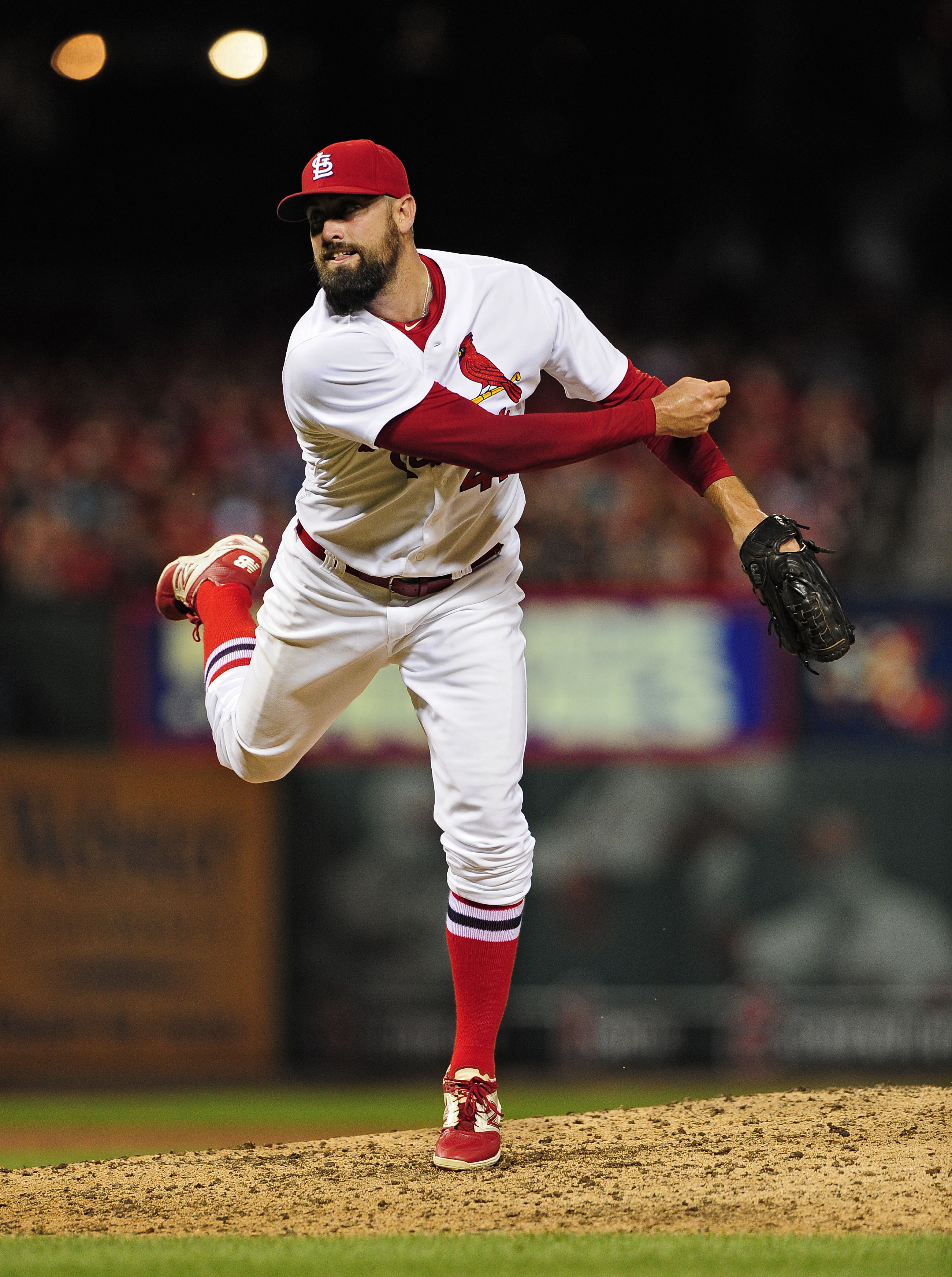
Neshek’s three-year platform looks solid from a statistical standpoint, but it downplays how great his 2014 campaign truly was. His 67 1/3 innings and 71 appearances ranked eighth and 12th among free agent relievers, respectively, and only Andrew Miller‘s 2.4 fWAR topped Neshek’s mark of 1.8 this season. Assuming the options of Darren O’Day and Huston Street are exercised, no relief pitcher can claim to have topped his 2.4 RA9-WAR, and only Koji Uehara can lay claim to a better strikeout-to-walk ratio than Neshek’s mark of 7.56. He was even dominant against left-handed hitters, stifling them to the tune of a .196/.237/.304 line. However you slice it, Neshek was one of the very best relief pitchers in Major League Baseball this season.
A .233 BABIP and 83 percent strand rate also contributed to Neshek’s ERA, but somewhat remarkably, those marks are in line with his career norms. Neshek does appear to able to consistently strand runners and induce weak contact at a better-than-average rate, though it’s fair to question if he can sustain levels this superior to the 2014 league-average reliever rates of .294 and 73.9.
Like nearly all relief pitchers, he won’t come with a qualifying offer attached, so he won’t cost a draft pick. And, while he’s had some injuries in his pro career (most notably Tommy John surgery back in 2008), he’s been healthy in each of the past four seasons. His health in 2014 was apparent, given the fact that he posted his best fastball velocity since his rookie campaign in 2006.
Neshek also stepped into the ninth inning at season’s end and picked up six saves, which might make him a bit more appealing to teams with late-inning needs.
Weaknesses/Cons
Neshek looked to be on the verge of breaking out as an elite setup man with his hometown Twins back in 2007, but the Tommy John surgery and a damaged pulley tendon in his right hand slowed his career considerably and limited him to just 22 1/3 big league innings from 2008-10. It’s been an uphill battle to reestablish himself in the Major Leagues since that time, meaning he doesn’t have a particularly lengthy track record to draw from. In fact, he’s totaled just 281 2/3 innings in the Majors.
Dominant as Neshek was against lefties in 2014, he had the opposite problem in 2013. Lefties batted .315/.367/.566 against Neshek last season, and he had enough trouble getting them out that he was at one point designated for assignment by the A’s despite possessing strong all-around numbers at the time. This season, he dramatically reduced the number of sliders he threw in favor of the fastball, and the result does seem to have been positive.
Neshek’s electric ERA was, in part, sustained thanks to a career-low homer-to-flyball rate of just 4.3 percent. Teams may worry that Neshek, who entered the season with a career 10.4 percent HR/FB ratio, will regress toward his career marks. Those who point to the change in pitch selection as a possible reason for this year’s shift won’t have a leg to stand on, either, as his slider has typically not been susceptible to homers.
Neshek’s resurgent season came at age 33, and he’ll pitch next season at age 34, so he’s older than a number of arms in the second tier of the free agent market. He also struggled down the stretch, allowing nine runs over his final 12 innings, although seven of those did come in just two bad outings.
Personal
Neshek’s unorthodox delivery stems from an injury sustained in high school that prevented him from throwing overhand. He was hit by a pitch on the wrist and described the sensation of throwing overhand following that incident to Ted Berg of USA Today by saying it felt like the ball “was ripping right through my fingertips.” Neshek’s delivery was developed to compensate for that injury but soon turned into a weapon that he used effectively in his college career at Butler.
Neshek is an avid autograph collector and has a love of collecting and trading baseball cards. Neshek started a web site for fans who share his passion. He is a fan of Out Of The Park Baseball — a popular baseball simulation game — and is even a reader of MLBTR (Hi Pat!). Neshek is often described as an outgoing, engaging person who takes a genuine interest in those around him.
Market
The relief market this season is fronted by David Robertson and Andrew Miller, but Neshek will be one of many strong options in the second tier. He and agent Barry Meister seem likely to target multiple years, and there’s certainly a case to be made. In terms of ERA, FIP, xFIP, SIERA, K%, BB% and GB%, Neshek’s three-year platform heading into free agency is comparable, if not superior, to that of Joe Smith, who signed a three-year pact with the Angels last offseason.
Of course, that doesn’t mean Smith’s contract is a reasonable expectation, as Neshek is three-and-a-half years older, has thrown fewer innings than Smith in that time and has struggled more against lefties. The point, however, is that he has rate stats commensurate with well-compensated relievers, and he is coming off an elite walk season.
In spite of the lower innings total relative to his peers, there will be no shortage of clubs that look at Neshek as a relatively affordable piece to strengthen their bullpen. I’d imagine that the Red Sox, Yankees, Cardinals, Dodgers, Tigers, Giants, Indians and Nats could all have some interest. Each of those teams either made the postseason or was within striking distance this season. However, Neshek is a player who has “only” banked about $4.5MM in his career, so I can see him going to a rebuilding or non-contending club, should that team offer the most money. The White Sox are known to be in need of bullpen help, as are the Astros, Cubs and Phillies, to name a few.
Expected Contract
Despite his standout 2014, I have a difficult time envisioning a three-year pact on an open market that is flush with relief options. I do, however, think that Neshek can land a two-year pact, possibly with an option, especially if Meister strikes quickly. Relievers are typically best-served to sign early in free agency, and Neshek should strive to do the same.
Last offseason, Edward Mujica inked a two-year, $9.5MM contract with the Red Sox despite a late-season slide that cost him his closer’s gig. While Neshek hasn’t built up Mujica’s track record of innings at the Major League level, he strikes hitters out at a higher rate and is coming off a better platform season. I expect something near Mujica’s contract to be the landing spot, as I’m projecting a two-year, $10MM contract for Neshek.
Photo courtesy of USA Today Sports Images.
Reds To Exercise Club Option On Cueto, Buy Out Hannahan And Ludwick
2:21pm: The Reds have also declined Ludwick’s $9MM option, instead paying him a $4.5MM buyout, Cotillo tweets. The 36-year-old’s down 2014 season made that salary excessive, though the steep buyout tag and Cincinnati’s outfield needs made it a closer call than it might have seemed at first glance.
1:45pm: The Reds have kicked off their offseason with two unsurprising moves, deciding to exercise a $10MM club option over starter Johnny Cueto and decline a $4MM option for utilityman Jack Hannahan, according to Chris Cotillo of MLBDailyDish.com (Twitter links). Cincinnati will pay Hannahan a $2MM buyout rather than taking him back for 2015.
Both moves were widely expected. Cueto, 28, put up a Cy Young-worthy campaign (243 2/3 innings with a 2.25 ERA) and is an unquestioned bargain at that rate. The only question seems to be whether the club will take a crack at working out another extension or, if that is not an option, will listen to trade offers.
Meanwhile, the 34-year-old Hannahan did not play to expectations with the Reds and saw only 50 plate appearances last year. Across 212 trips to the plate over the previous two seasons, Hannahan slashed an anemic .209/.294/.278.
Cincinnati still has a slightly more difficult decision to make on Ryan Ludwick, whose club option — like Hannahan’s — comes with a buyout that reaches 50% of its value. In his case, the club can either pick him up at $9MM or buy him out for $4.5MM.
Free Agent Profile: Jason Hammel
A bounceback stint with the Cubs made Jason Hammel, a 6’6 righty, one of the most anticipated summer trade targets, and he ultimately became the second piece in the deal that sent top prospect Addison Russell to Chicago. But the 32-year-old faded in Oakland and now joins a loaded market for mid-level starters. Hammel’s reps at Octagon will go out looking for multiple years, but can he achieve it without taking a lower AAV?
Pros/Strengths
Though he went through a rough stretch after moving to Oakland, putting a hurt on his bottom-line results, Hammel actually finished quite strong. He allowed just 14 earned runs over his last 50 2/3 frames for the A’s, good for a sub-3.00 mark that was more reminiscent of his sturdy open to the year with the Cubs. On the whole, you can’t argue with 176 1/3 innings of 3.47 ERA pitching, and that’s what Hammel delivered in 2014.
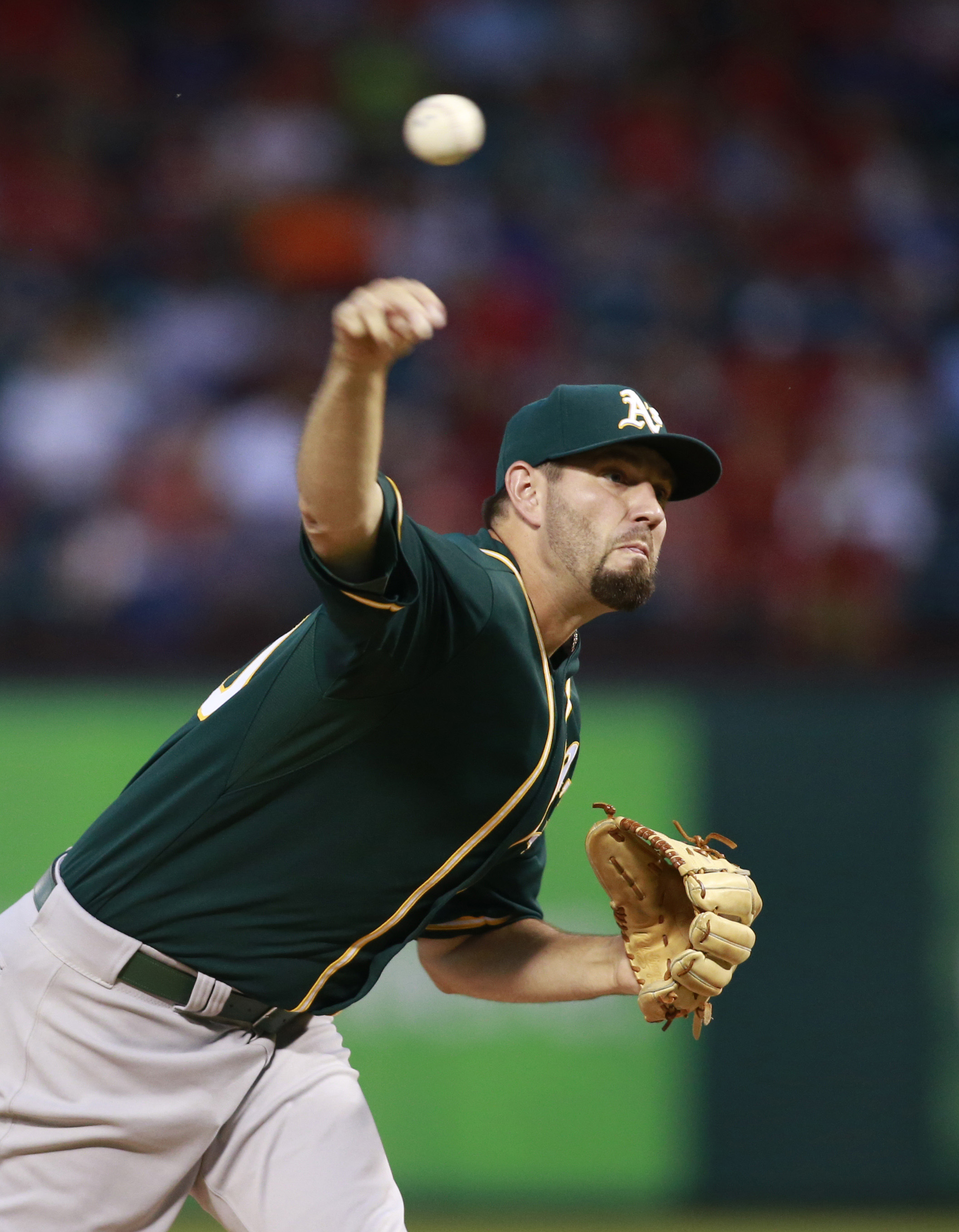
Neither is there reason to believe that those figures were the result of some dumb luck. Hammel did benefit from a .272 BABIP and 78.3% strand rate, but the 12.0% home run-per-flyball rate fell above his career average and could be due for a bit of regression. ERA estimators were generally supportive of the final earned-run tally, as Hammel posted a 3.92 FIP, 3.57 xFIP, and 3.50 SIERA.
Best of all, Hammel showed a restored ability to generate strikeouts. Back in 2012, his breakout year with the Orioles, Hammel posted 8.6 K/9 against 3.2 BB/9. In 2014, after a drop in the intervening year, he landed at 8.1 strikeouts and 2.3 walks per nine. He also has maintained his fastball velocity in the 92-93 mph range, a tick off from ’12 but in line with his career standards. And he increased the usage of his slider, with positive results.
Hammel also managed reasonable effectiveness against batters from both sides of the plate, yielding a .305 wOBA to lefties and a .297 mark to righties.
Cons/Weaknesses
In spite of his overall success last year, Hammel is not without his areas of concern. For one thing, the stellar groundball rate he reached in 2012 (53.2%) has dropped over a dozen percentage points in each of the last two years. That could be due in part to the fact that he has gone to the four-seamer more frequently, with his two-seam offering dropping in effectiveness.
Likewise, Hammel has seen an advanced proclivity to allow the long ball. His home run-per nine figures have both returned to the levels they sat when Hammel was struggling to establish himself at Coors Field. And pitching in Wrigley Field does not offer an excuse; the park actually landed in the middle of the pack in terms of permitting the long ball, and Hammel did not exhibit strong home/road splits in this department.
Then there is the question of durability — or, perhaps more to the point, innings. Hammel did miss significant time over 2012-13 with knee and elbow issues. He came back to deliver an injury-free 2014, of course, but those recent, reasonably significant issues cannot be discounted entirely.
On the whole, while his medical sheet does not look overly concerning, Hammel has yet to finish a season with more than 177 2/3 frames to his record. He nearly matched that mark this year, logging 176 1/3 innings, and probably would have bettered it had the A’s not skipped his turn down the stretch. But the fact remains that Hammel has not established himself as a 200-inning workhorse, even when he has been healthy — a fact which delivers its own concerns.
Personal
Hammel is married with one child. He writes on his personal blog that he loves spending extra time in the offseason with his wife, Elissa, and young son. LEGO construction, in particular, seem to be a preferred family pastime.
Per a somewhat outdated profile, Hammel resides in Rehoboth, Massachusetts, close to his wife’s hometown. Hammel himself was born in South Carolina and graduated from high school in Washington. He also attended Treasure Valley Community College in Oregon, from where he was plucked in the tenth round of the 2002 draft.
Market
This is where things start to get tough for Hammel. On the one hand, in terms of recent results and career workload, Hammel looks like a better bet than Scott Feldman, who landed three years and $30MM on last year’s market. And he is a good deal younger (or less risky) than the roughly comparable arms that landed two-year deals last year: Bartolo Colon (2/$20MM), Scott Kazmir (2/$22MM), Tim Hudson (2/$23MM), and Bronson Arroyo (2/$23.5MM).
But this is a different market, one that includes a good number of arms that offer more extended track records or higher upside.
I’ll crib from Tim Dierkes’s profile of Santana. As Tim noted there, the second tier of starters (behind the big three) includes not only Santana but names like Kenta Maeda, Brandon McCarthy, Francisco Liriano, Justin Masterson, Jake Peavy, and Hiroki Kuroda (assuming the latter decides to pitch). Other than Kuroda, the only players even eligible to receive qualifying offers are Santana and Liriano, meaning that Hammel will not stand out in that regard.
In some respects, Hammel’s trajectory over the last three years looks something like that of Santana entering last year’s market: first a strong year that made him look like a long-term piece, then a dud that led to a change of scenery, chased with an ultimately fulfilled chance to re-claim value. But 2013 Santana was arguably the second-best arm available in a thin market. For Hammel, there’s a case to be made that he lands outside the top ten.
Expected Contract
Though the competition is fierce, the volume of good arms loose on the market also indicates that multiple clubs will be looking to fill in the gaps that were left. But last year, in a free-spending environment that blew out previous cash outlays and awarded significantly more deals of three-or-more years in duration, only eight pitchers got more than two years guaranteed, with six others getting a second year (and that’s if you include Tim Lincecum, who was extended just before officially reaching free agency).
Ultimately, I think there is a decent chance that Hammel ends up being one of the hurlers who falls through the cracks somewhat and does not maximize his value in a competitive market. While a two-year deal at a strong AAV cannot be discounted as a realistic outcome, I’ll predict that Hammel gets a third year but has to sacrifice some annual salary to do so, landing at the Feldman deal with a three-year, $30MM contract.
Latest On The Twins’ Managerial Search
Here’s the latest news on the Twins’ hunt for Ron Gardenhire’s replacement…
TODAY
- The Twins have had no contact whatsoever with Maddon, reports Berardino, whose report indicates that expected cost may be a factor. A source in Maddon’s camp tells Berardino that the former Rays manager would have welcomed the interest but would probably be looking for a team with a clearer route to competing in the near term.
YESTERDAY
- Red Sox bench coach Torey Lovullo had his second interview with the Twins today, according to Derek Wetmore and Darren Wolfson of 1500 ESPN. Lovullo’s first interview went well, and past rumors had seemingly narrowed Minnesota’s choices down to Lovullo, Paul Molitor and Doug Mientkiewicz.
- New market addition Joe Maddon is not in the mix for Minnesota, the report adds. Molitor seems to be the favorite for the job at this point, per Wetmore and Wolfson.
- The Twins have yet to ask the Royals for permission to interview bench coach Don Wakamatsu, Mike Berardino of the St. Paul Pioneer Press tweets. It could be that the Twins have already decided upon the aforementioned finalists, or they could simply be waiting until Kansas City’s postseason run is over.
Free Agent Profile: Jake Peavy
What a difference a few months can make. For Jake Peavy, a former ace turned would-be trusty veteran, a trade deadline deal to the Giants has changed perceptions and, perhaps, his market. Approaching free agency for the first time entering his age-34 season, Peavy now looks to be one of the more intriguing players to watch. (Of course, all eyes will be on him tonight as he takes the hill looking to clinch the World Series.)
Pros/Strengths
Twelve regular season starts with the Giants late this year yielded remarkable results: a 2.12 ERA and 3.03 FIP over 78 2/3 frames. Three more post-season outings have resulted in a 3.68 earned run mark across 14 2/3 innings, with time left for more positive impressions. With a constantly evolving pitch mix and approach, as he explained recently to Eno Sarris of Fangraphs, Peavy may have found an edge in the constantly evolving battle between pitcher and hitter.
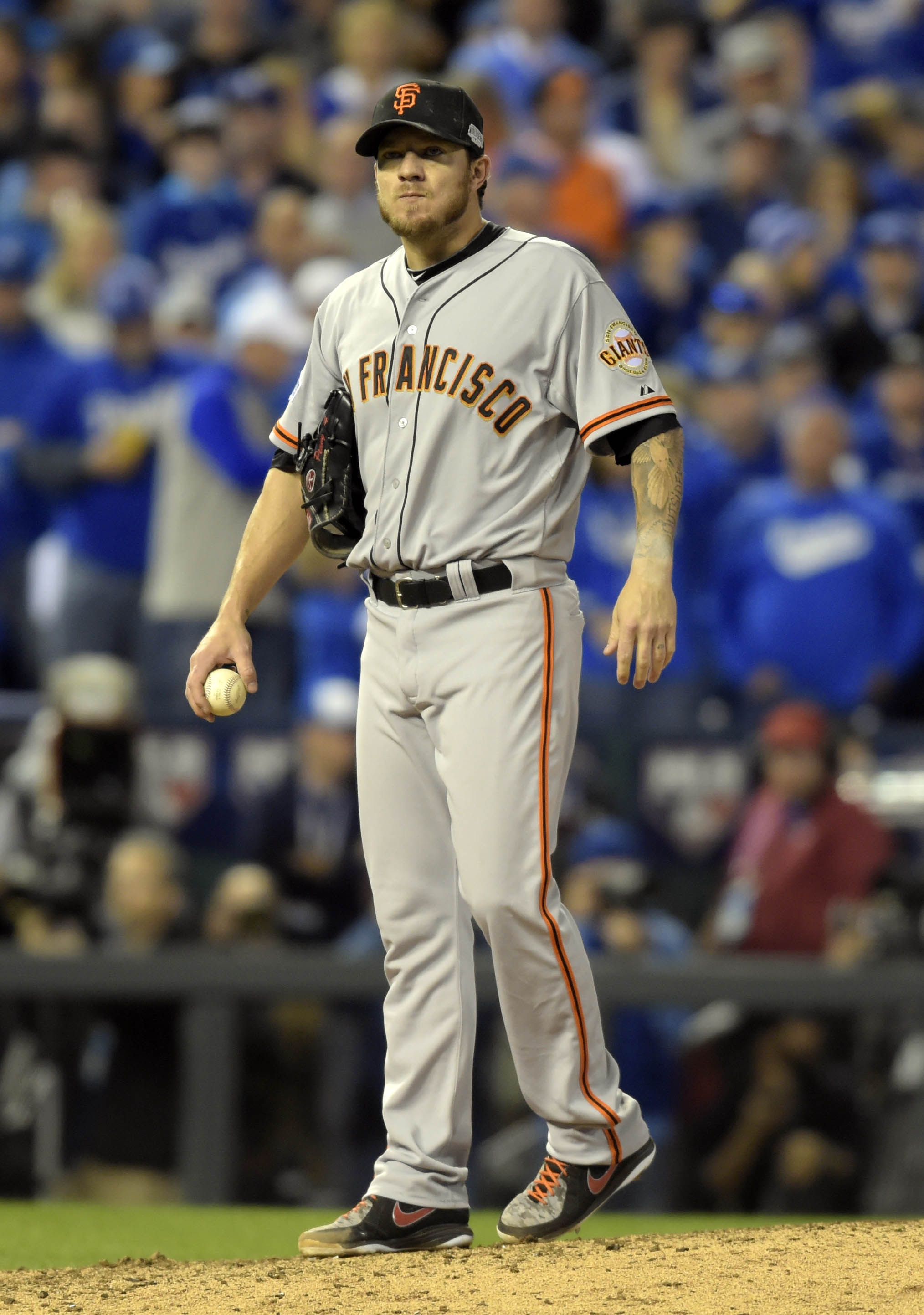
Though Peavy is no longer the strikeout threat he once was, he seems to have stabilized in the seven to seven-and-a-half strikeouts per nine range. And he continues to reliably post walk rates below three per nine innings. Though he is not a heavy groundball pitcher, Peavy has generally maintained a BABIP-against at or below .290.
Then, of course, there is Peavy’s impressive pedigree. From about 2004 through 2008, Peavy was one of the best starters in the game, and he has had excellent full-season results as recently as 2012 (3.37 ERA over 219 innings).
Peavy is often cited as a trustworthy veteran who is a positive clubhouse member. An intense competitor on the hill, the righty is certainly the type of player who holds appeal both to veteran-laden contenders and young teams looking to put a role model in place.
Cons/Weaknesses
His late run with San Francisco aside, Peavy has struggled mightily at times in recent years. He put up a 4.17 ERA in 2013 and allowed 4.72 earned per nine with the Red Sox to start the year in 2014. Neither did peripherals paint a much rosier picture, with ERA estimators pegging Peavy as a back-of-the-rotation option at best.
And it is not as if this were an isolated downturn. Sandwiching his solid work in 2012, Peavy had been an average or worse starter over the 2009-11 stretch. That decline can be traced, in part, to steady downticks in Peavy’s average fastball velocity. After working in the mid-90s earlier in his career, Peavy has not even averaged 91 mph since 2010 and just saw his average heater drop into the eighties for the first time.
Declining strikeout rates are one result; in his solid stretch with the Giants, Peavy has maintained only a 6.6 K/9 rate that falls shy of any of his full-season averages. On the year, he struck out just 7.0 per nine, his worst-ever rate. More tellingly, perhaps, Peavy’s K-BB% fell to 11.1%, far and away the worst mark his his 13-year career.
Neither has Peavy been a model of health. He has failed to reach 150 innings in four of the last six seasons. Shoulder and rotator cuff injuries are among his maladies, along with a more recent ribcage fracture. He also missed time due to an ankle injury and, further back, elbow strains. (Peavy has never undergone Tommy John surgery.)
Personal
Often described as a family man, Peavy and his long-time wife Katie have three sons. A native of Alabama, Peavy makes his permanent residence in his home state. Over the years, of course, he has moved from coast to coast, though Peavy has never chosen his own destination (aside from agreeing to extensions with the Padres and White Sox in advance of free agency).
When he is away from the ballpark, according to this aggregated profile, Peavy prefers to spend time in the outdoors. His family lives in a cabin on a substantial spread of land, and he hunts and fishes in his spare time. Peavy also plays the guitar and is a practicing Christian.
Market
In a market loaded with mid-level starters, Peavy occupies a somewhat unique place. He is the oldest of that group aside from Hiroki Kuroda, who is not expected to test interest broadly. In that respect, he probably stands alone to some extent as a solid veteran who can (theoretically, at least) be had on a somewhat shorter commitment.
A client of CAA Sports, Peavy could hold appeal to a variety of clubs that may or may not be as interested in other non-premium starters. More specifically, it is certainly possible to imagine the Giants being interested in a reunion, and the White Sox are another former club that could show interest in a shorter-term arrangement. Otherwise, the Cardinals, Angels, Rangers, Braves, D’backs, and Cubs all could make some degree of sense.
Peavy says he has interest in ending up in the same place as former Red Sox teammate Jon Lester, saying that “there’s a package deal out there for any team.” Choosing a landing spot based more on personal preferences — including, perhaps, re-uniting with Lester or other former teammates — than maximum contract would not be a surprise for Peavy. He said back in 2005 that “money is not why I’m pitching” and backed that up recently when he signed a reasonable extension with the White Sox rather than hitting the market.
Expected Contract
Though some have suggested that Peavy may have pitched his way into a three-year deal in recent months, a two-year contract still seems the likelier outcome — especially if Peavy prioritizes finding a home that suits him for non-financial reasons. Peavy should easily top the two-year, ~$22-23MM contracts given to several veterans last year, and could land a deal on the model of Ryan Dempster’s two-year, $26.5MM pact. Updating that contract for inflation, and accounting for a value boost after Peavy’s success in San Francisco, I predict that he will ultimately fall just shy of his last contract and sign for two years and $28MM.
Offseason Outlook: Detroit Tigers
The Tigers captured the AL Central crown with a 90-72 record in 2014 before the Orioles made quick work of them in the ALDS. Now, the Tigers will look to retool a bit this offseason and, once again, there will be an emphasis on fixing the bullpen.
Guaranteed Contracts
- Miguel Cabrera, 1B: $240MM through 2024
- Justin Verlander, SP: $140MM through 2020
- Anibal Sanchez, SP: $53MM through 2017
- Ian Kinsler, 2B: $46MM through 2017
- Joe Nathan, RP: $11MM through 2016
- Rajai Davis, OF: $5MM through 2015
Arbitration Eligible Players (service time in parentheses; projections via Matt Swartz)
- Rick Porcello, SP (5.170): $12.2MM
- David Price, SP (5.164): $18.9MM
- Don Kelly, 3B/OF (5.138): $1.2MM
- Al Alburquerque, RP (3.147): $1.7MM
- Andy Dirks, OF (3.139): $1.63MM
- J.D. Martinez, OF (3.036): $2.9MM
- Non-tender candidates: Dirks, Kelly
Contract Options
- Joakim Soria, RP: $7MM club option ($500K buyout)
- Alex Avila, C: $5.4MM club option ($200K buyout)
Free Agents
- Max Scherzer, Victor Martinez, Torii Hunter, Joba Chamberlain, Phil Coke, Jim Johnson, Joel Hanrahan
Other Payroll Obligations
- Prince Fielder: $30MM to be paid 2016-20
Any discussion of the Tigers’ offseason has to start with pending free agent Max Scherzer. The 2013 Cy Young Award winner says he’d like to return to Detroit, but it’s not that simple. The two sides were discussing a possible extension in the spring before things stalled and the Tigers took the unusual step of releasing a statement on the matter.
“The Detroit Tigers have made a substantial, long-term contract extension offer to Max Scherzer that would have placed him among the highest paid pitchers in baseball, and the offer was rejected,” the statement read.
The Tigers reportedly offered a six-year, $144MM extension, identical to the deal Cole Hamels signed with the Phillies in 2012. The Scott Boras client, meanwhile, may have been seeking an eight-year deal. Now, Scherzer stands as the top available free agent on the open market after another strong season and it’s feasible that he could exceed that average annual value of $24MM on a six-, seven-, or maybe even an eight-year deal with an opt-out clause in the middle. That’s probably too rich for the Tigers’ blood.
If Scherzer goes, the Tigers will have a hard time pursuing a comparable replacement. The market offers appealing alternatives like Jon Lester and James Shields, but the Tigers already have about $151MM tied up between guaranteed contracts, arb raises, the $6MM they owe the Rangers for Prince Fielder and the options on Alex Avila and Joakim Soria. Shields will require four or five years to sign, and Lester could require six or seven, making the fit unlikely. Even second-tier options like Brandon McCarthy and Francisco Liriano could prove too expensive, barring a significant boost to 2014’s Opening Day payroll of $163MM.
As such, it’s not a given that they’d sign anyone to fill the void left by a likely Scherzer departure. In-house options like Robbie Ray, Kyle Ryan, Kyle Lobstein, Drew VerHagen, and Buck Farmer could vie for jobs in the starting five. That’s not apples-for-apples, of course, but the Tigers could get by with a core four David Price, Justin Verlander, Anibal Sanchez, Rick Porcello, with their fingers crossed for a bounce back from Verlander.
In the bullpen, the Tigers have to decide on whether to exercise Joakim Soria‘s $7MM club option or buy him out for $500K. In 44 1/3 innings last season, Soria turned in a 3.25 ERA (his 2.73 xFIP gives him more credit) with 9.7 K/9 and 1.2 BB/9. It’s tough to imagine the Tigers not exercising that option. For starters, the Tigers gave up two of their best prospects in starter Jake Thompson and reliever Corey Knebel to land Soria in July, and that would be a mighty steep price to pay for a ten-week rental. Soria wasn’t sharp in his 11 innings of regular season work in Detroit (though in his defense, he was also injured), but that doesn’t mean a ton in the grand scope of things and injuries didn’t help matters. The Tigers would be wise to keep Soria in their historically shaky bullpen, and recent comments from Dombrowski indicate that they’re going to do that.
Beyond that, Tigers might want to do some tinkering with their bullpen and Dombrowski has said that it will be towards the top of their list. Joba Chamberlain seemed to be paying back the Tigers’ one-year, $2.5MM investment nicely in the first half of the season but he turned in a 4.01 ERA after the All-Star break and might not be asked back. Coke, another former Yankee, had a very rough start to the year but improved in the second half, which could leave the door open to a return. Jim Johnson, who came aboard on a minor league deal after his head-scratching 2014 with the A’s, didn’t fare much better in Detroit and will probably wind up elsewhere. We know that Soria, Nathan, and Al Alburquerque figure to be in the pen, along with left-hander Blaine Hardy and perhaps Ian Krol, though his first year in Detroit was disappointing. Flamethrower Bruce Rondon will return at some point, though it’s not clear when, as he is recovering from Tommy John surgery. Beyond that grouping, question marks and injury troubles abound, which should lead to yet another close examination of the team’s bullpen. As Tim Dierkes recently noted, the Tigers drafted Andrew Miller and almost landed him in July before the O’s beat them to the punch, so they could make a run at him this winter. However, he’d require a significant investment, possibly a four-year deal, so he could prove a tough fit as well.
Scherzer isn’t the only significant Tigers free agent hitting the open market, of course. There’s mutual interest in a return between Detroit and designated hitter Victor Martinez, but he’ll have a number of suitors offering significant money. Martinez turned in a .335/.409/.565 slash line last season and, as Jon Heyman of CBSSports.com wrote recently, he’ll be seeking out a four-year deal. The Tigers will surely attach the qualifying offer to him, but the soon-to-be 36-year-old might price himself out of Detroit, especially if he’s married to the idea of a four-year pact. If Martinez goes, the Tigers could to the trade market with an eye on Adam Lind, though they’d probably want to find a platoon partner to go with him. It’s also conceivable that Ryan Howard‘s left-handed bat could be a fit for them if the Phillies absorb the vast majority of his remaining salary.
At shortstop, Dombrowski says that the prognosis on Jose Iglesias is positive and he will be expected to take the full-time job if “he returns to the form of the past.” The Tigers could turn to Eugenio Suarez to fill the gap if Iglesias isn’t 100%, but they also might want to explore adding a depth option on a minor league deal.
The Tigers would love to have a healthy Andy Dirks back in 2015 for his projected salary of $1.63MM, but it’s far from a given that he can stay on the field after missing all of 2014 thanks to back problems. Utility man Don Kelly (.245/.332/.288 in 95 games) is also arbitration-eligible and likely on the bubble. As Dombrowski recently indicated, the Tigers could look to put Rajai Davis back in the corner outfield (his natural position) and slot J.D. Martinez on the opposite side and find a center fielder elsewhere.
Colby Rasmus is on the open market and, as recently noted by MLBTR’s Jeff Todd, guys like Dexter Fowler, Drew Stubbs, Jon Jay/Peter Bourjos, and maybe Desmond Jennings could be available via trade. Jeff recently pointed out a few potential left-handed-hitting trade possibilities that could make sense alongside Davis, such as Matt Joyce or David DeJesus, Alejandro De Aza or David Lough, Shane Victorino, Michael Saunders, and Ben Revere. This is all speculative, of course, but there should be plenty of full-time or part-time options available on the trade market for Detroit. Speaking of the outfield, Torii Hunter sounds like he wants to continue playing and would like to re-sign with the Tigers, but he’s not sure if he could accept a reduced role.
In the long term, the Tigers have a great deal of guaranteed money locked up in aging players. Meanwhile, they have shipped out a great deal of young talent including Willy Adames, Drew Smyly, and the aforementioned Thompson and Knebel. At some point, one has to wonder if the Tigers will be left with an over-the-hill core and an over-harvested farm system.
The Tigers have shown a willingness to spend in the past, but last year’s two major trades — Prince Fielder-for-Ian Kinsler and the Doug Fister swap — seem to indicate that ownership is still conscious of the bottom line. With only so much wiggle room, the Tigers will have to be creative in addressing their needs and wants this winter.
Steve Adams contributed to this post.
Blue Jays Claim Justin Smoak
The Mariners announced that the Blue Jays have claimed first baseman Justin Smoak off waivers.
The waiver claim brings to an end what has to be characterized as a disappointing tenure in Seattle for Smoak, who four years ago was the centerpiece of a trade package that sent ace Cliff Lee from the M’s to the Rangers. Smoak, who turns 28 years old in December, showed flashes of promise in his time with Seattle, but he was unable to consistently string together stretches of productivity and never showed the power that Seattle hoped to be acquiring in that deal. In 1943 plate appearances with the Mariners, Smoak batted .226/.308/.384 with 66 homers.
Smoak avoided arbitration with the Mariners last season by agreeing to a one-year, $2.6375MM deal that contained a $3.65MM club option with a $150K buyout. Should that option be declined, Smoak will be eligible for arbitration. It seems likely then, that Toronto will decline the switch-hitting Smoak’s option and work out a smaller payday for his second trip through the arb process. The Blue Jays can control Smoak through the 2016 season if he turns it around following a change of scenery.
The somewhat surprising transaction further calls into question the future of Adam Lind with the Blue Jays. Toronto is reportedly receiving trade interest in Lind, whose club option for the 2015 season is valued at $7.5MM. Toronto now has another option to pair with Edwin Encarnacion in the first base/DH mix should the team move on from Lind. While Smoak clearly comes with less offensive certainty than Lind, he’ll come at less than half the price of Lind, giving the Blue Jays further resources for the offseason and arguably greater upside at the dish in 2015.
Aroldis Chapman Changes Agents
Reds closer Aroldis Chapman has changed agents by moving to Relativity Baseball, per Jeff Passan of Yahoo Sports (via Twitter). Chapman had been represented by Hendricks Sports.
For Chapman, 26, the move comes at an important time for the contractual side of his career. He earned $5MM this year after opting into arbitration. That will no doubt happen again next year, and Chapman will be in for a significant raise after racking up 36 saves over 54 innings. Though those totals were limited by his DL stint to the start the year, the remainder of Chapman’s numbers — a 2.00 ERA, an absurd 17.7 K/9 (against 4.0 BB/9), and an equally ridiculous 3.5 H/9 — will support a nice new payday.
And that’s only the starting point for the southpaw fireballer, who is currently set up to become a free agent after the 2016 season. While that is a long way off for a reliever, he already has a hefty earning base and will cost a pretty penny to buy out ahead of time. Craig Kimbrel signed a four-year, $42MM deal (including an option year) entering his first arb-eligible season.
Free Agent Profile: Koji Uehara
Koji Uehara had a meteoric rise to becoming one of the most dominant closers in the game, but the 39-year-old also had a sharp decline at the end of the 2014 season that has seriously clouded his free agent stock.
Strengths/Pros
You’d be hard-pressed to find a relief pitcher — or any pitcher — with definitively better control than Uehara. Since jumping to the Majors in 2009, Uehara has walked 46 batters in 350 1/3 innings, and four of those have been intentional. He’s averaged just 1.2 walks per nine innings over a six-year career, and a dozen of those walks came in his rookie season. He hasn’t walked more than nine batters in any of the past five seasons.
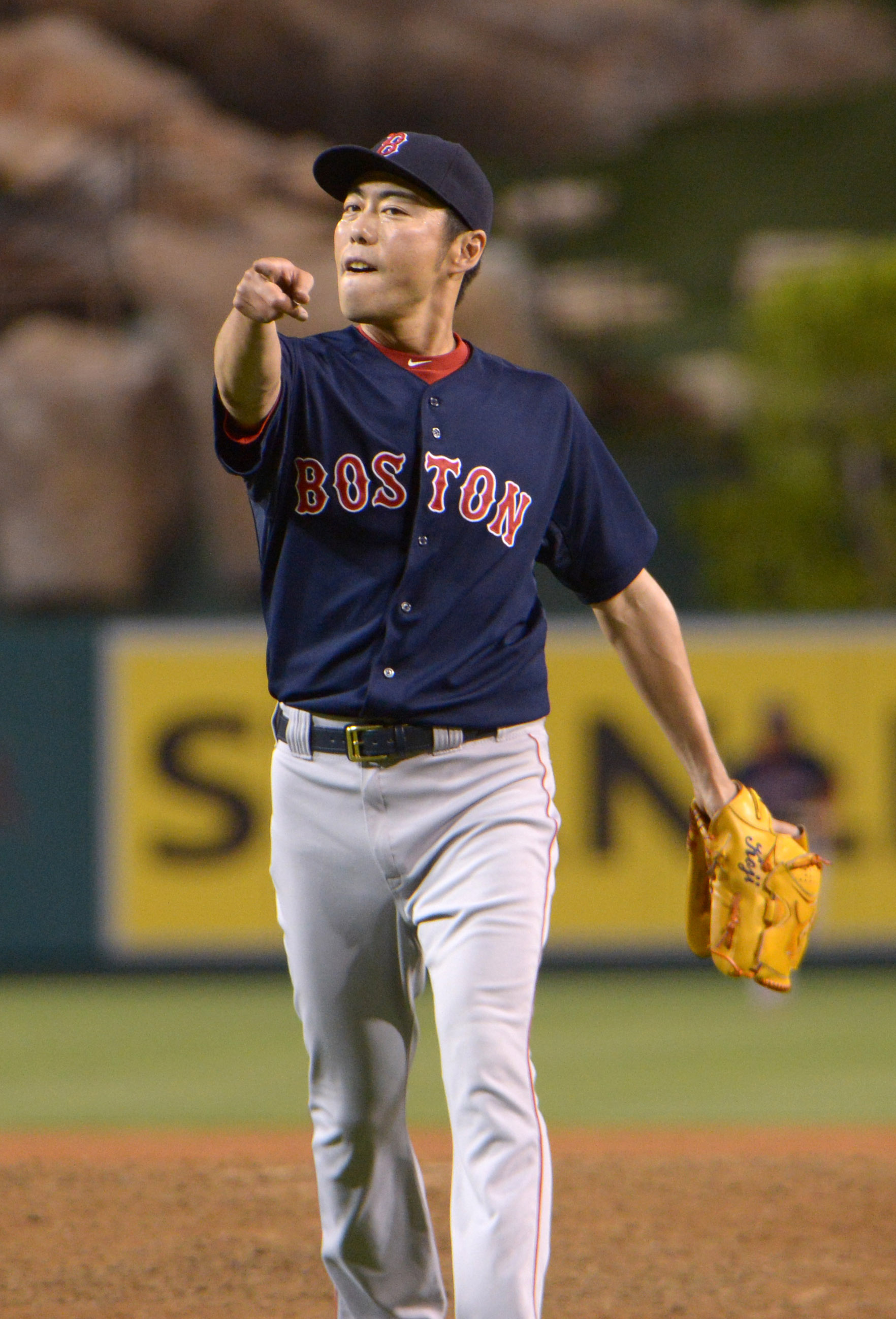
Uehara isn’t just a control artist, however. Armed with a devastating split-finger, Uehara struck out 11.2 hitters per nine innings this season and has averaged 10.6 K/9 in his MLB career. Among pitchers with at least 50 innings pitched, his ridiculous 18.8 percent swinging strike rate in 2014 was second only to Aroldis Chapman.
He battled a bit of shoulder soreness early in the year, but Uehara was able to avoid the disabled list for the second straight season. He’s been on the DL just once in the past four seasons, when he missed a little more than two months with a strained right lat. Overall, he’s been durable and highly effective as a late-inning option for the Orioles, Rangers and Red Sox.
Uehara comes with experience in a setup role and in a closing role. He took over as the closer for the 2013 Red Sox and played a significant role in their World Series victory, posting a 1.09 ERA with 12.2 K/9 and 1.1 BB/9 in the regular season before firing 13 2/3 innings of one-run ball in the playoffs. He struck out 16 hitters without issuing a walk in the postseason and was named ALCS MVP after appearing in five of the six games. Teams will value the fact that he has thrived in a major market and on the game’s biggest stage.
Weaknesses/Cons
Uehara will pitch next season at the age of 40, so clubs will inevitably have some reservation about his age.
The bigger concern for interested teams, however, will likely be the precipitous drop-off in his performance at the end of the season. Uehara yielded 10 runs over his final 7 2/3 innings this past season, leading many to wonder if he had become fatigued after a such heavy workload over the past two years. Uehara pitched only five times in the month of September, as he was shut down for a large portion of the month. Dominant as he’s been, that slide, coupled with his age, is will be seen as a reason for pause.
Uehara has never thrown hard, but his 88.2 mph average fastball last season was the second-slowest of his big league career and represented a noticeable drop from the prior year’s 89.2 mph mark. He also throws more splitters than any reliever in baseball — a pitch that is believed by many to put a high amount of stress on the elbow. Angels manager Mike Scioscia, Rays manager Joe Maddon and former Twins pitching coach Rick Anderson all weighed in on the risks of the pitch in this 2011 piece from the Associated Press.
Personal
Though a clear language barrier separates Uehara from his teammates, he’s learned enough to get by with teammates since moving to the U.S. and is wildly popular among teammates, Brian MacPherson of the Providence Journal wrote late last year. Uehara is a master of using impersonations to get a laugh out of teammates; Brian Matusz spoke kindly of a particularly amusing impression of Jim Johnson, MacPherson wrote. Craig Breslow told MacPherson that no one thinks of Uehara as someone from another continent. “They think of him as one of the guys.” Breslow was complimentary of Uehara’s one-liners, stating that because he didn’t speak quite enough English to build up context, “Every time he opens his mouth, it’s a punchline.” Drake Britton called Uehara “one of the coolest people” he’s ever met.
Uehara is married and has one child. In his time with Boston he’s been active in the community by visiting victims of the Boston Marathon bombing, participating in a golf tournament to benefit a South Florida children’s hospital and participating in a baseball camp for children, among many other events/appearances, per the Red Sox media guide.
Market
The Red Sox have made it known that they want Uehara back in 2015, and there’s mutual interest between the two sides. While they’ve taken the ambiguous stance of stating that they’re not sure whether they’ll extend a qualifying offer, I have to imagine that a QO is firmly out of the question after Uehara’s late-season struggles. While most players prefer the security of a multi-year deal and are therefore disinclined to take the QO, the 40-year-old Uehara almost certainly wouldn’t be able to top that mark and would likely accept.
While Uehara certainly has a good relationship with Boston, he said in an interview with the Boston Globe’s Peter Abraham this summer that he’s willing to go to any club in free agency: “The experience with the Red Sox has been fun. The World Series and now being selected an All-Star. But I don’t have any specific teams that I want to play for. Any team that wants me the most is fine.”
Any team in need of bullpen help on a short-term deal would be interested in Uehara, though given his age, it seems that he would likely limit himself to contending clubs in hopes off reaching another World Series. In addition to the Red Sox, I’d imagine that the Yankees, Dodgers, Tigers, Nationals, Cardinals and Giants could all show interest in Uehara.
Expected Contract
Uehara hasn’t given any indication that he’s only looking to play one more season, so it seems possible that he could get some offers of both the one- and two-year variety. On a two-year deal, given his age and poor results over his final five weeks or so, I have a difficult time envisioning him signing for a fair AAV.
While Uehara certainly may prefer the security of playing on a multi-year deal after going year-to-year for so long, there might not be much upside for him taking a lower AAV to lock in the second year. If he could find a one-year offer similar to the $10MM deal Mariano Rivera signed prior to the 2013 season, Uehara could eclipse his theoretical ceiling on a two-year guarantee even with a somewhat diminished performance in 2015. Unless he blows out his arm, it seems reasonable that he could expect to find $5-6MM next winter with any sort of reasonable success, and possibly quite a bit more.
This seems to me to be a matter of preference for the player (one-year at a higher AAV or two years with some additional security), but the I’m predicting that Uehara will sign a one-year, $11MM contract.
Photo courtesy of USA Today Sports Images.