
Cubs Part Ways With Bench Coach Andy Green
Cubs bench coach Andy Green won’t be back with the team in 2024, as Joel Sherman of the New York Post reports that Green was “dismissed.” It isn’t known exactly when Green was let go, yet Chicago has already started looking for a replacement, as USA Today’s Bob Nightengale (via X) reports that Marlins first base coach Jon Jay received an interview but won’t be hired.
The somewhat under-the-radar nature of Green’s firing is a little surprising, though in the bigger picture, a change of bench coach commonly coincides with the hiring of a new manager. With Craig Counsell now running the Cubs’ dugout, it makes sense that he would get some say in picking and choosing his staff — particularly at bench coach since the role usually serves as the manager’s top lieutenant. For instance, Green was one of David Ross’ first hires when Ross became the Cubs’ manager during the 2019-20 offseason.
Beyond his four years of experience as Chicago’s bench coach, Green is best known for his four-year stint as the Padres’ manager from 2016-19. San Diego didn’t have any winning seasons during Green’s tenure, though the Padres were rebuilding during the first few of those years before expectations were raised after the Manny Machado signing. The lack of success with the Friars didn’t entirely dim Green’s prospects as a skipper, since he interviewed with both the Mets and Guardians just this winter about managerial vacancies.
The 38-year-old Jay only just retired in April 2022, hanging up his cleats after 12 MLB seasons (which included a stop with the Cubs in 2017). It didn’t take long for Jay to jump back into the game, however, as Jay was named Miami’s first base coach shortly after ex-teammate Skip Schumaker become the Marlins’ manager last year. Jay has been cited as a potential future managerial candidate himself, as he fits the trend of clubs looking to hire younger managers more recently removed from their playing careers.
Royals Sign Four To Minor League Contracts
The Royals announced that right-hander Luis Cessa, left-hander Austin Cox, catcher Logan Porter, and outfielder Diego Hernandez have all been signed to minor league deals. Cessa is a newcomer to the organization, while Cox, Hernandez, and Porter are making quick returns after being non-tendered yesterday.
Best known for his team with the Yankees as a starter, reliever, and swingman, Cessa had a 2.51 over 64 2/3 bullpen innings with New York and Cincinnati during the 2021 season. Cessa moved back into swingman work in 2022 with mixed results (a 4.57 ERA), and things went south for the right-hander in 2023. Pressed into rotation work at the start of the year, Cessa struggled to a 9.00 ERA over 26 innings and was released by the Reds in May. That marked the end of Cessa’s big league work last year, as he caught on with the Rockies and Nationals on minor league contracts but continued to struggle badly at Triple-A.
Cessa’s career 4.43 ERA and 4.41 SIERA are virtually identical, so the righty hasn’t exactly gotten away with a lack of missed bats throughout his career. Cessa has gotten by with some good whiff and chase rates despite the low strikeout totals, and he had been good at limiting heavy contact in the form of barrels prior to 2023. Control had also never really been an issue for Cessa prior to 2023, yet his walk rates crept upwards at both the MLB and minor league levels, leaving him even less margin for error.
The 31-year-old will try to get on track with the Royals, who need pitching of all kinds whether in the rotation or bullpen. Since Kansas City isn’t expected to be a big spender this winter, it seems likely that the team will look to bring any number of veteran arms into camp on minor league or low-cost deals, in the hopes that at least a couple of them could break out and win jobs on the Opening Day roster.
None of Cox, Porter, or Hernandez were eligible for salary arbitration, but Cox and Porter were designated for assignment this past week and ultimately cut to open up some space on Kansas City’s 40-man roster. In Hernandez’s case, the outfielder will return for his sixth season in the Royals’ farm system, and will probably start 2024 back at Double-A.
Cox made his MLB debut in 2023, posting a 4.54 ERA over 35 2/3 innings before his rookie year came to an unfortunately early end. Cox tore his ACL while trying to cover first base during a fielding play in the Royals’ game with the Blue Jays on September 8, and he’ll now miss most or all of the 2024 season in recovery. It seems quite possible that a handshake deal was in place for Cox to rejoin the Royals, as he was only DFA’ed yesterday and quickly passed through waivers, so he’ll now get to rehab in a familiar environment.
Porter was another 2023 debut, as he had a .647 OPS in 38 plate appearances over his first 11 games in the Show. An undrafted free agent who signed with the Royals in 2018, Porter hit .248/.367/.394 over 594 PA at Triple-A over the last two seasons, and should again serve as a depth option at the minor league level behind the Royals’ big league catching tandem of Salvador Perez and Freddy Fermin.
Brewers Non-Tender Brandon Woodruff
The Brewers are non-tendering starter Brandon Woodruff, as first reported by Bob Nightengale of USA Today (X link). Woodruff underwent shoulder surgery in October and is expected to miss the majority of the 2024 season.
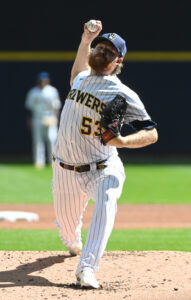
The injury put Milwaukee in a bind, as Woodruff was also entering his final season of club control. Given his excellent track record and prior salaries, he’d been projected for a hearty $11.6MM salary in arbitration, per MLBTR contributor Matt Swartz. There was no real way for Milwaukee to lower this past season’s $10.8MM salary by any meaningful amount; arbitration salaries can be cut by a maximum of 40%, and the Brewers surely would’ve had to go to an arbitration hearing if they sought such a reduction. Even if they’d won that, Woodruff would’ve been set to earn just shy of $6.5MM in a season where he isn’t expected to pitch much — if at all.
The Brewers discussed multi-year arrangements with Woodruff and trades with other clubs, but neither set of negotiations manifested in a deal. With tonight’s non-tender deadline looming, the Brewers bit the bullet and made what GM Matt Arnold described in a statement as one of the most difficult decisions of his career. Said Arnold:
“Today we had to make a very difficult decision relating to one of the best pitchers and human beings in franchise history. Throughout his 10 seasons in the organization, Brandon Woodruff has represented the Brewers with class, kindness, heart and toughness. He is recognized as a tremendous teammate, both on the field and in the community, where he and his wife, Jonie, have positively impacted so many lives around them. We remain very open to his return to Milwaukee, and regardless of what uniform he wears next, Woody will always be a member of the Brewers family.”
That the Brewers remain open to some kind of reunion is a key takeaway from Arnold’s comments, though obviously Woodruff will now be able to freely negotiate with all 29 other teams. And while the possibility of a year-long absence from the mound looms large, the 30-year-old righty’s track record will surely draw substantial interest — likely on two-year contracts that allow him to rehab with a team for the first season before hopefully enjoying a full and healthy season in year two.
Since establishing himself on the Brewers’ roster in 2018, Woodruff and teammate Corbin Burnes have formed a dominant one-two punch atop the Milwaukee rotation. The 6’4″, 240-pound righty has pitched to a combined 2.98 ERA over 637 1/3 innings in that time, striking out 29.7% of his opponents against a 6.4% walk rate. He’s posted a slightly below-average ground-ball rate (42.4%) and kept the ball in the yard rather well, particularly considering his homer-friendly home environs (0.99 HR/9). Woodruff has generated swinging strikes at a big 12.7% clip and induced chases on pitches off the plate at a hearty 33.2% rate. Simply put, he’s been one of the best and most underrated starters in the National League — at least on a per-inning basis.
If there’s a knock on Woodruff, it’s been his durability (or lack thereof). He’s never topped 179 1/3 innings in a season, has only made 30 starts on one occasion and has averaged just 22 starts per year over his past four 162-game seasons. (Notably, he did start a league-leading 13 games during the Covid-shortened 2020 campaign.)
That said, this is the first year of his big league career in which Woodruff has had a major arm injury. His most prominent other absences were due to oblique and ankle injuries. That didn’t make up for the lost time necessarily, but it paints a more favorable long-term outlook than would be the case had a series of shoulder and elbow troubles kept him off the field in recent years and culminated in this recent procedure.
Now that he’s a free agent, Woodruff becomes one of the most intriguing arms on the market — not necessarily for the 2024 season but from a longer-term perspective. Any team would surely be thrilled to stash Woodruff on the injured list in hopes of a late-2024 return and a close-to-full workload in 2025. His presence on the market gives clubs the rare opportunity to sign a top-of-the-rotation arm at a relatively bargain rate, though any deal for Woodruff will surely afford him the opportunity to return to free agency sooner than later — likely by the 2025-26 offseason.
Mariners, Red Sox Swap Luis Urias, Isaiah Campbell
The Mariners announced the acquisition of infielder Luis Urias from the Red Sox. Reliever Isaiah Campbell is headed to Boston in a one-for-one swap.
Urias, 26, was a consensus top-30 prospect in baseball entering the 2019 season. However, the infielder struggled in limited playing time with the Padres and was shipped to Milwaukee in the deal that brought Trent Grisham to San Diego. While Urias struggled through the shortened 2020 season with the Brewers, slashing just .239/.308/.294 while appearing in 41 of the club’s 60 games. Fortunately for Milwaukee, however, Urias broke out during his age-24 season and proceeded to be an above average regular for the Brewers over the next two seasons.
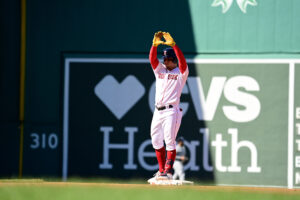
From 2021-22, Urias posted a .244/.340/.426 slash line across 1042 trips to the plate while playing strong defense at shortstop, second base, and third base to anchor the club’s infield alongside Willy Adames. The Brewers entered 2023 figuring to once again lean on Urias as a steady presence on the dirt but the 26-year-old was bit by the injury bug before his season could properly begin, landing on the injured list with a hamstring strain just after Opening Day. Urias returned in early June but struggled badly at the plate, slashing a brutal .145/.299/.236 across 20 games with the club this season. That downturn in performance led the Brewers to swap Urias to the Red Sox at the deadline this year.
Urias was used as a depth option at second base by Boston, and hit acceptably in the role with a .225/.361/.337 slash line in 109 trips to the plate with the club down the stretch. While that performance was good for a roughly league average 98 wRC+, Urias was nonetheless viewed as a likely non-tendered candidate given his $4.7MM projected salary by MLBTR’s Matt Swartz. Fortunately for both Urias and the Red Sox, however, the Mariners were willing to take a shot on Urias returning to form in 2024.
Urias makes plenty of sense for a Mariners club that could use an upgrade to its second base mix, which currently features Josh Rojas and Dylan Moore. Urias figures to provide the club with a solid right-handed complement to Rojas and fellow lefty JP Crawford up the middle who can play capable defense all around the infield. If he’s able to regain his 2021-22 form, Urias could be in line for the lion’s share of starts at the keystone given Rojas’s tepid .245/.303/.338 slash line in 350 plate appearances between Arizona and Seattle this year.
In return for Urias’s services, the Red Sox acquired right-hander Isaiah Campbell. Campbell was a second-round pick by the Mariners in the 2019 draft and made his major league debut out of the bullpen for Seattle earlier this year. Across 28 2/3 innings of work with the Mariners, Campbell impressed with a 2.83 ERA and 3.32 FIP to go along with a solid 27.5% strikeout rate. Campbell’s success is all the more impressive for a prospect who skipped the Triple-A level entirely after 24 strong innings of work at the Double-A level this year. The 25-year-old figures to be an interesting bullpen piece for the Red Sox in 2024, particularly given the righty has options remaining that will allow the club to shuttle him between Triple-A and the majors if they so choose.
Alex Speier of the Boston Globe first reported the Mariners were acquiring Urias. Ryan Divish of the Seattle Times reported the Red Sox were acquiring Campbell.
Braves, Royals Swap Kyle Wright For Jackson Kowar
The Braves have traded right-hander Kyle Wright to the Royals in exchange for fellow righty Jackson Kowar. Wright underwent shoulder surgery following the season and is expected to miss the entire 2024 campaign, though Kansas City will control him for two years after that.

Wright, 28, was the No. 5 overall pick in the 2017 draft, and while he took several years to get there, he eventually broke out with a dominant showing in 2022. After posting a 6.56 ERA through 70 innings across parts of four seasons from 2018-21, Wright turned in a career-best performance in just about every capacity in 2022. Over the life of 180 1/3 frames, he logged a 3.19 earned run average with a 23.6% strikeout rate, 7.2% walk rate, 55.6% grounder rate and 0.95 HR/9.
That ostensibly set the stage for Wright to pitch near the top of the Atlanta rotation for years to come, but as is so often the case with pitchers, injuries intervened and changed his career trajectory. Wright reported shoulder soreness during spring training and opened the year on the 15-day IL. He returned in mid-April but was placed back on the injured list just three weeks later — this time eventually being moved to the 60-day IL. Wright returned for four September appearances and was hit hard while showing diminished velocity. He underwent surgery after the conclusion of the regular season and won’t be back on a big league mound until the 2025 campaign.
Overall, Wright’s 2023 season included just 31 innings of 6.97 ERA ball with strikeout, walk and home run rates that all trended in the wrong direction. He’s eligible for arbitration this winter and projected by MLBTR contributor Matt Swartz to earn $1.4MM in his first trip through the process. He’ll all but certainly make an identical salary in 2025 after sitting out the ’24 campaign and accruing a full year of service on the 60-day injured list. Kansas City is effectively acquiring two healthy years of Wright. That first season will more or less cost them $2.8MM (next year’s ~$1.4MM salary and a matching amount the following year). Wright will be on an innings limit of some kind in ’25 and ideally be built up to a full workload in 2026.
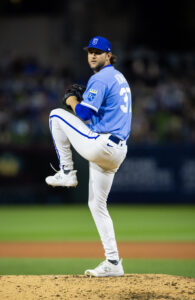
In return for this long-term upside play on Wright, the Royals will give the Braves six years of club control over Kowar — a former Florida Gators star, first-round pick and top prospect who’s yet to pan out in K.C. Kowar has one minor league option year remaining after being granted a fourth option due to injuries (hat tip to Bowman), but the 27-year-old has yielded 75 earned runs in 74 Major League innings across parts of three seasons. Suffice it to say, he’s a project and an upside play in his own right.
While Kowar clearly hasn’t had any big league success to date, he’s seen a pronounced uptick in velocity since moving to a bullpen role on a full-time basis. After averaging 95.7 mph on his heater as a starter in 2021, he averaged 97 mph in 2023. That’s impressive life, to be sure, but the pitch also has well below-average spin — and Kowar’s broader 10.7% swinging-strike rate across his entire arsenal is still slightly below league average. Kowar struck out 21.2% if his opponents in 2023 but also walked 14.6% of them — bringing his career walk rate to 13.7%.
The Braves clearly see something they like, however. Kowar ranked among Baseball America’s top-100 prospects in both the 2019-20 and 2020-21 offseasons and generally posted solid or better numbers throughout the minors up until the 2022 season. He’s been hit hard in Triple-A over the past two years, just as he has in the big leagues, but if the Braves can get him back to his pre-’22 form, they’ll have secured six years of club control over a hard-throwing bullpen arm.
Anne Rogers of MLB.com first reported the Royals were acquiring Wright for Kowar. Rogers’ colleague Mark Bowman first indicated that some type of deal involving Wright could be in the works.
Guardians, Padres Swap Scott Barlow, Enyel De Los Santos
The Guardians announced they’ve acquired reliever Scott Barlow from the Padres. Fellow reliever Enyel De Los Santos is back to San Diego in a one-for-one swap. Cleveland also announced they’ve signed outfielder Ramón Laureano to a one-year contract to avoid arbitration. Zack Meisel of the Athletic reports (on X) that Laureano will make $5.15MM next season.
Barlow has spent the majority of his career in the AL Central. The right-hander reached the big leagues with the Royals in 2018. He logged five and a half seasons in Kansas City, where he was one of the game’s more quietly effective bullpen arms. Barlow turned in a sub-3.00 ERA over 74 1/3 innings in consecutive seasons from 2021-22. That excellent run prevention took a step back this year, as he carried a 5.35 mark through 38 2/3 frames at the time of the trade deadline.
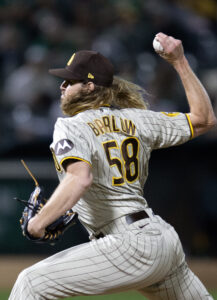
The Royals swapped Barlow to San Diego last summer. While he’d been working as Kansas City’s closer, he stepped into a setup role in deference to Josh Hader at Petco Park. Barlow made 25 appearances for the Friars down the stretch, pitching to a 3.07 ERA. While Barlow was effective, he became a trade candidate yet again as rumors of payroll constraints in San Diego arose.
MLBTR contributor Matt Swartz projects Barlow for a $7.1MM salary in what’ll be his final year of arbitration control. While that’s decent value for an effective reliever, the Padres are reportedly aiming to cut spending (potentially by as much as $50MM). Moving a non-closing reliever is one of the less impactful ways for San Diego to clear spending room, although it’s another hit to a bullpen that also stands to lose Hader to free agency.
It’s rare for the low-payroll Guardians to find themselves on this side of a trade of that nature. Cleveland tends to deal away players as they’re nearing free agency. The Guards jumped on the opportunity to add a high-quality reliever to join Trevor Stephan and Sam Hentges as a leverage bridge to star closer Emmanuel Clase.
To offset the loss of Barlow, San Diego brings back a more affordable short-term bullpen piece. De Los Santos had a nice 2023 campaign, pitching 70 times and working to a 3.29 ERA through 65 2/3 innings. The righty, 28 next month, had an average 23.7% strikeout rate and walked 9.5% of opposing hitters.
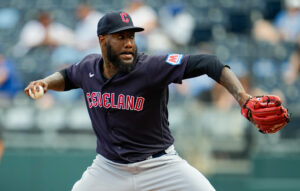
It was his second straight year with an ERA in the low 3.00s. Since signing a minor league deal over the 2021-22 offseason, he has turned in a 3.18 ERA over 119 frames. De Los Santos worked in mostly low-leverage situations but had pitched his way into the middle innings during his second season in Terry Francona’s bullpen.
De los Santos, who spent some time in the Padres system early in his minor league career, has between three and four years of MLB service. He will be eligible for arbitration for the next three years. Swartz forecasts him for an affordable $1.2MM this winter, meaning the deal should save San Diego roughly $6MM in the short term.
Images courtesy of USA Today Sports.
Marlins Acquire Vidal Brujan, Calvin Faucher From Rays
The Marlins announced the acquisition of utility player Vidal Bruján and right-hander Calvin Faucher from the Rays. Miami is sending minor league infielder Erick Lara, right-hander Andrew Lindsey and a player to be named later to Tampa Bay. The Fish already had three openings on the 40-man roster, so no further moves were necessary.
Bruján is the biggest name in the deal. While the switch-hitting utilityman has yet to find much major league success, he was once a top prospect. The Dominican Republic native was a top 10 prospect in a strong Rays system at Baseball America each year from 2019-22. He ranked in the back half of BA’s top 100 overall minor league talents throughout that run.
Praised for his speed, bat-to-ball skills and defensive flexibility, Bruján fit the general profile that Tampa Bay prioritizes. Despite excellent minor league production, he never got much consistent run at the MLB level with the Rays. Bruján struggled when he did see relatively brief stints at the highest level in the last three seasons.
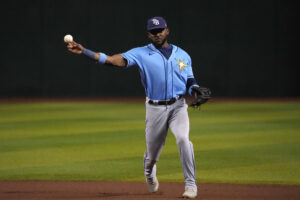
In 272 MLB plate appearances, the 25-year-old is a .157/.218/.221 hitter with three home runs. He has been far better at Triple-A Durham, hitting .273/.357/.450 over parts of three seasons. That includes a .272/.362/.477 slash with 10 home runs and 19 stolen bases (albeit with 14 times caught stealing) over 59 games for the Bulls this year.
Bruján has exhausted his minor league option years, so he’ll have to stick on the MLB roster next season. A Tampa Bay team deep in infield talent may not have been able to afford that opportunity, so they’ll clear a 40-man roster spot early in the offseason. Miami has a bit less bench depth and is without a clear answer at shortstop, where Jon Berti projects as the starter. While Bruján is unlikely to get an everyday job, he can play either middle infield position, any outfield spot, and has experience at third base.
Faucher, 28, had been designated for assignment on Tuesday. He’s now traded for the second time in his career. The former Twins draftee went to the Rays at the 2021 deadline in the Nelson Cruz/Joe Ryan swap. He debuted with Tampa Bay in 2022 and has pitched in 39 big league contests (four starts) over the past two seasons.
The results haven’t been great. Faucher owns a 6.32 ERA in 47 MLB innings. His 20.8% strikeout rate and 10% walk percentage are each a little worse than average. The UC Irvine product throws in the mid-90s and has a cutter, sweeper and curveball in his offspeed repertoire. He owns an excellent 2.75 ERA in 72 Triple-A innings over three years, striking out 29.4% of batters faced at that level.
Faucher still has one option year remaining, so the Marlins can move him between Miami and Triple-A Jacksonville for another season. It’s the second straight year in which the Fish acquired a reliever and a former top infield prospect from Tampa Bay. Last November, the sides lined up on the Xavier Edwards/JT Chargois deal. That was orchestrated by previous Miami general manager Kim Ng. Miami’s first-year president of baseball operations Peter Bendix was working in the Rays’ front office for that trade. One of his first transactions leading the Marlins is to bring in a pair of players with whom he’s familiar from their in-state rivals.
In return, Tampa Bay picks up a pair of prospects (and likely a third) who are nowhere near occupying 40-man roster spots — common practice as they churn the roster for future talent. Lara is a 17-year-old shortstop who recently signed out of the Dominican Republic. Baseball America’s Ben Badler wrote in May that he could stick at shortstop depending on his 6’2″ frame fills out. He’s a left-handed hitter.
Lindsey was a fifth-round pick this past summer out of Tennessee. The 6’3″ hurler pitched to a 2.90 ERA in 71 1/3 innings during his junior season for the Volunteers. He struck out nearly a quarter of opponents against a modest 6.4% walk rate. He turned 24 this week. BA wrote in his draft report that he sits in the mid-90s with a sinker and has a high-80s slider as his top secondary pitch.
Daniel Álvarez-Montes of El Extrabase first reported the Marlins were acquiring Bruján and Faucher.
Image courtesy of USA Today Sports.
Rockies Acquire Cal Quantrill
The Rockies announced that right-hander Cal Quantrill has been acquired in a trade with the Guardians. Cleveland will receive minor league catcher Kody Huff in return, and Colorado has designated right-hander Tommy Doyle to create room on the 40-man roster.
Some kind of move seemed imminent when the Guardians designated Quantrill for assignment earlier this week, whether or not that move was a trade or the Guards just releasing Quantrill as an early non-tender. The righty is projected to earn $6.6MM in the second of three arbitration-eligible years, which was perhaps a bit steep for a Cleveland team that traditionally has modest payrolls, and considering the fact that Quantrill struggled in 2023.
However, it was an acceptable price for a Rox team in dire need of starting pitching. Denver’s thin air has always put an extra burden on Rockies pitchers, but things went particularly sideways in 2023 when the club was hit with a long list of injuries to pitchers at the both the Major League and minor league levels. Colorado’s rotation wasn’t thought to be a strong group even going into the season, yet with injuries depleting the ranks, the Rockies’ pitching staff (both starters and relievers) finished at or near the bottom of the league in most statistical categories.
Health was a problem for Quantrill as well last year, as some nagging shoulder inflammation sent him to the injured list twice and limited him to 99 2/3 innings. This was a big drop from the 168 frames he averaged over the 2021-22 seasons, as well as a slide from his quality numbers in those previous two years. Quantrill posted a 3.16 ERA for Cleveland in 2021-22, but that number ballooned to 5.24 in 2023.
A glance at the secondary numbers is necessary, as Quantrill’s 4.50 SIERA in 2021-22 indicates that he was in some sense fortunate to deliver such a solid bottom-line ERA. Quantrill has always been a below-average strikeout pitcher who nevertheless had strong chase rates, yet his chase rate dropped off significantly to 26.5% last season, and his 13.1% strikeout rate in 2023 was almost the worst in baseball. The righty also allowed much more hard contact in 2023 than in past years.
Coors Field isn’t exactly the best ballpark for a pitcher in need of a rebound year, so Quantrill will face a difficult challenge on his new club. Simply staying healthy and eating some innings would be a decent outcome for both Quantrill and the Rockies, and Colorado’s ever-present need for pitching probably means that barring injury or a drastic downturn in performance, Quantrill stand a good chance of being tendered a contract for his final arbitration year.
Doyle made his MLB debut in the form of 2 1/3 innings over three appearances with Colorado in 2020, and then didn’t make it back to the Show until he posted a 6.85 ERA over 23 2/3 innings for the Rox this past season. The 27-year-old Doyle dealt with some injury problems in between those two Major League stints, and he had a 3.41 ERA in 37 frames with Triple-A Colorado Springs this season, with a 26.6% strikeout rate and 48.9% grounder rate helping paper over some less-flattering secondary metrics.
It wasn’t enough for the Rockies to keep him on the 40-man roster, though Doyle could stick around in the organization if he clears waivers and opts to accept an outright assignment to Triple-A. Doyle has been previously outrighted in his career, so he has the ability to reject future outright assignments in favor of free agency.
Cleveland’s ability to draft and develop young pitching has been the organization’s backbone for years, and this strength was on display again in 2023 when Tanner Bibee, Gavin Williams, and Logan Allen all looked good in their rookie seasons. This isn’t to say that the Guardians are completely set in the rotation — the rookies could hit some setbacks now that the league has a book on them, and Triston McKenzie and Shane Bieber both had injury problems last year. Bieber is a free agent next winter and has been widely seen as a trade candidate this offseason, but even with Bieber’s departure potentially looming, it’s a sign of how far Quantrill’s stock fell that the Guardians were willing to move on.
Rather than non-tender Quantrill for nothing, the Guards did get some return back in Huff, a Stanford product who was a seventh-round pick for the Rockies in the 2022 draft. He spent the 2023 season at the Rockies’ A-ball affiliate in Fresno, hitting .262/.357/.374 over 340 plate appearances. Baseball America’s scouting report on Huff describes him as a “baseball rat” type, and “his well-rounded game and advanced instincts give him a chance to be a backup catcher.” Cleveland has long prioritized defense from the catching position, and that stance doesn’t appear to be changing especially now that an ex-catcher in Stephen Vogt is the Guardians’ new manager.
Austin Dean Re-Signs With KBO’s LG Twins
Outfielder Austin Dean re-signed with the LG Twins of the Korea Baseball Organization this week (h/t to Dan Kurtz of MyKBO). He’ll receive a $300K signing bonus, an $800K salary and up to $200K in incentives.
Dean will stick with the KBO’s defending champions for a second season. The right-handed hitter signed with the Seoul-based Twins last December. He had a strong year against KBO pitching, connecting on 23 home runs in 139 games. Dean ran a .314/.376/.517 slash line through 583 trips to the plate.
A fourth-round draftee of the Marlins in 2012, Dean has played parts of five seasons at the big league level. The bulk of that time came with Miami between 2018-19. He picked up sporadic reps with the Cardinals and Giants over the subsequent three seasons. Dean hit .228/.286/.390 over 365 plate appearances against big league arms.
Dean joined pitchers Casey Kelly and Adam Plutko as foreign players on the Twins’ roster in 2023. Kelly and Plutko are back in free agency. The New York Post’s Jon Heyman reported this week that Plutko was looking to make it back to MLB after two seasons with the Twins. MLB.com’s Jon Morosi tweeted on Tuesday that Kelly could be on major league teams’ radars as well.
Brewers Sign Enoli Paredes, Jared Koenig To Minor League Deals
The Brewers have signed pitchers Enoli Paredes and Jared Koenig to minor league contracts, tweets Adam McCalvy of MLB.com. Both will be in MLB camp as non-roster invitees.
Paredes elected free agency a few weeks ago after being waived by the Astros. The right-hander had previously spent his entire career in the Houston organization. Paredes pitched out of Dusty Baker’s bullpen at times from 2020-22, tallying 32 1/3 innings over 37 cumulative appearances. He worked to a 3.90 ERA but walked almost a fifth of opposing hitters.
Now 28, Paredes spent the entire 2023 season on optional assignment to Houston’s Triple-A club. He allowed 4.80 earned runs per nine over 54 1/3 innings in the Pacific Coast League. While Paredes’ 27.3% strikeout rate there was solid, his 18.6% walk percentage was similarly untenable as the mark he’s managed in his MLB career. He has a mid-90s heater but will need to dramatically improve his strike-throwing to carve out a spot in the middle innings for Milwaukee.
Koenig, 30 in January, also spent all of 2023 in Triple-A. He was in the Padres system on a minor league pact. Koenig allowed an even 5.00 ERA over 45 frames with their top affiliate in El Paso. He kept the ball on the ground at a 51.1% clip with slightly worse than average strikeout and walk marks.
His only major league work came in 2022. Koenig pitched 39 1/3 innings over 10 appearances (five starts) with Oakland. The soft-tossing lefty posted a 5.72 ERA while striking out 12.4% of opponents in green and gold. He could provide the Brew Crew with long relief depth in Triple-A if he doesn’t break camp.