
Dodgers Select Luke Williams, Transfer Daniel Hudson To 60-Day IL
The Dodgers announced they’ve selected the contract of utility player Luke Williams. He’ll take the active roster spot of infielder/outfielder Mookie Betts, who has been placed on the paternity list. To open a spot for Williams on the 40-man roster, right-hander Daniel Hudson was transferred to the 60-day injured list. Jack Harris of the Los Angeles Times reported that Williams was with the club prior to the official announcement.
Williams could be in position to make his team debut. Initially claimed off waivers from the Marlins at the start of last offseason, he was promptly non-tendered. The Dodgers circled back to re-sign him to a minor league deal, assigning him to Triple-A Oklahoma City to open the year. The right-handed hitter has been on a tear through his first couple weeks in OKC, hitting .375/.455/.696 with seven walks and only ten strikeouts through 66 plate appearances.
Initially a third-round pick of the Phillies, Williams has briefly appeared for three teams at the MLB level. He’s a .240/.299/.316 hitter across 244 big league plate appearances. He’s up to a more impressive .307/.378/.455 line in 60 Triple-A contests split through a trio of seasons. Williams brings a fair bit of defensive flexibility to the bench, as he has ample experience at the three infield spots to the left of first base and each outfield position.
That versatility takes on some immediate importance in L.A., as Chris Taylor has been bothered by side soreness. The utilityman told reporters he’s not scheduled for imaging and hopes he can avoid an injured list stint (via Fabian Ardaya of the Athletic). He’s out of tonight’s game though, thinning the depth behind Miguel Rojas at shortstop.
It seems Betts could factor into that mix as well. He’s expected to rejoin the team tomorrow — Williams still has a pair of minor league options and could easily be sent back to Oklahoma City — and skipper Dave Roberts implied Betts could get some starts at shortstop (relayed by Juan Toribio of MLB.com). Betts has never started a professional game at shortstop, so it’s unlikely he’ll offer the plus defense there that Rojas provides. Betts has experience at second base, however, and he’s obviously a far better hitter than Rojas. The glove-first veteran is off to a meager .129/.182/.161 start to his Dodger tenure.
As for Hudson, he’s now officially ruled out through late May. The IL placement backdates to the start of the regular season. The veteran reliever has been delayed by left knee soreness as he works back from last season’s ACL tear. Roberts said today that Hudson has battled patellar tenditis in the joint. The Dodgers are targeting a June return, so there’s little reason not to place him on the 60-day IL (Ardaya link).
Jeffrey Springs Expected To Have Tommy John Surgery
Rays left-hander Jeffrey Springs is expected to have Tommy John surgery, reports Marc Topkin of the Tampa Bay Times. That will put an end to his 2023 campaign and cause him to miss the start of the 2024 season as well. Earlier today, the club had placed him on the 15-day injured list with right-hander Taj Bradley recalled to take his place on the roster.
The news comes as a devastating blow to what had previously been a feel-good story. Springs, 30, was a 30th round draft pick of the Rangers and didn’t draw a lot of fanfare as a prospect. He got to the big leagues with Texas in 2018 and 2019, but posted an uninspiring 4.90 ERA through his first 64 1/3 innings. He was traded to the Red Sox but then put up a 7.08 ERA in the shortened 2020 season.
A trade to the Rays seemed to turn things around for him. He made 43 appearances in 2021 with a 3.43 ERA, 35.2% strikeout rate, 7.8% walk rate and 34.3% ground ball rate. Last year, the club gradually stretched him out to a starter’s workload over the course of the season. He eventually posted a 2.46 ERA in 135 1/3 innings, striking out 26.2% of batters faced while walking just 5.6% and getting grounders on 40.9% of balls in play. The Rays believed in that breakout enough to give the southpaw a four-year extension with a $31MM guarantee and plenty of incentives.
He was looking to build off that breakout campaign and was off to a strong start here in 2023. He had already tossed 16 innings with a tiny 0.56 ERA, though that will now seemingly go down as the entirety of his work this year. Rehab from Tommy John surgery typically takes 14 months or longer, meaning Springs won’t be an option for the club until midway through 2024 at the earliest.
The Rays had started the season with a strong rotation, even though there were a few injuries of note. Shane Baz had his own Tommy John surgery late last year and will likely miss all of the 2023 season. Tyler Glasnow also suffered an oblique strain in the spring and has yet to make his season debut. But Springs, Shane McClanahan, Drew Rasmussen, Zach Eflin and Josh Fleming formed a solid front five, helping the Rays jump out to a 13-0 start and a current 14-3 record.
Now the club will have to navigate the rest of the season without Springs. Eflin is also on the injured list but is expected to be back this weekend after a minimum stay. Bradley made his MLB debut in a spot start for the club last week and will now seemingly get a longer audition to stick around.
Nationals Release Yadiel Hernandez
The Nationals released outfielder Yadiel Hernandez on Monday, per the transactions log at MiLB.com. He’d opened the season as a non-roster player with their Triple-A club but was cut loose after a .205/.225/.256 start to his season through a small sample of 40 plate appearances.
The 35-year-old Hernandez was a regular presence in the Nationals’ lineup from 2021-22, logging a combined 616 plate appearances while batting .271/.320/.411 with 18 home runs, 24 doubles, a triple and five steals (in six tries). Hernandez wasn’t a well-rated defender in the outfield corners but was a roughly league-average bat (100 wRC+) who lacked glaring platoon splits; he hit fellow lefties slightly better than righties during his time with the Nats. Washington designated Hernandez for assignment when setting its roster ahead of 2022’s Rule 5 Draft and successfully passed him through outright waivers.
Hernandez didn’t make his Major League debut until 2020, having spent the bulk of his prime years playing professionally in Cuba, where he was a lifetime .324/.450/.487 batter in 2167 plate appearances for los Cocodrilos de Matanzas. Hernandez defected from Cuba in 2015 but wasn’t declared a Major League free agent until 2016. He signed for a $200K bonus with the Nats late in the ’16 season and spent the 2017-19 seasons between Double-A and Triple-A.
In a total of 1564 minor league plate appearances, all coming between Double-A and Triple-A, he’s a .298/.379/.499 hitter with 68 home runs, 65 doubles and three triples. Given his age, slow start in Rochester this season and relatively limited big league track record, Hernandez isn’t likely to jump right onto an MLB roster but could be a candidate for a minor league deal with another team in need of outfield depth or perhaps could garner some interest abroad.
Athletics To Promote Mason Miller
The Athletics are planning to promote pitching prospect Mason Miller, reports Matt Kawahara of the San Francisco Chronicle. It seems possible that Miller will join the team today and could make his major league debut tomorrow. He’s not yet on the 40-man roster and will require a corresponding move.
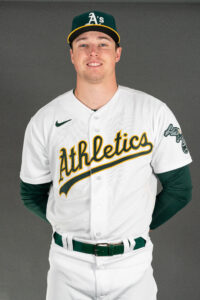
Miller, 24, was selected by the A’s in the third round of the 2021 draft, making his professional debut with a few Complex League outings shortly after that draft. He logged just six innings there, but Baseball America ranked him the #16 prospect in the system going into 2022, largely based on his work in college. He was then limited by a shoulder strain in 2022, not making his season debut until late August. He made one appearance in the Complex League, three in High-A and then two in Triple-A. He finished the year with a combined 3.86 ERA in 14 innings over those games.
It was a very limited sample, but he did rack up 25 strikeouts, exactly half of the 50 batters he faced, while keeping his walks down to a 6% rate. He was then sent to get some extra work in the Arizona Fall League, tossing 16 2/3 innings there with a 3.24 ERA, racking up another 20 punchouts. Based on that strong-but-limited showing, BA bumped him to #4 in the system coming into this year. FanGraphs was perhaps even more bullish, giving Miller the #98 spot on their preseason list of the top 100 prospects in the league. Both outlets highlight Miller’s velocity, with his fastball able to hit triple digits, while also complimenting his slider and changeup. BA adds that he was planning to re-introduce a cutter in 2023, a pitch he had been avoiding as part of his rehab.
This year, Miller started out with a Double-A appearance, allowing two earned runs over 3 2/3 innings, but striking out eight opponents. He then got bumped to Triple-A, where he tossed five shutout innings with 11 punchies. By all accounts, Miller clearly has electric stuff and great results, but in very small samples. His entire professional career consists of 28 2/3 innings in the minors and those 16 2/3 frames in the AFL, adding up to 45 1/3. He did log 239 innings in college, but it’s still unusual for a club to fast-forward a player’s rise through the minors like this. That being said, Miller seems to have excellent stuff and might be ready to get big league hitters out right now.
The A’s have been toying with using a six-man rotation this year, in part to help Shintaro Fujinami adjust from the once-a-week pitching schedule preferred in Japan to the five-day rotation that’s more common in North America. He’s been joined by Kyle Muller, JP Sears, James Kaprielian, Ken Waldichuk and Adam Oller so far, though Oller made two long relief outings before getting his first start of the year last week. He was rocked for seven earned runs in just 2 1/3 innings in that start and was optioned to the minors shortly after. It seems his struggles have perhaps opened an opportunity for Miller to make his MLB debut. The A’s weren’t expected to compete this year and are off to a 3-14 start, giving them little reason not to see what they have in Miller.
Now that Opening Day has moved into the rearview mirror, it won’t be possible for Miller to reach a full year of service time. A baseball season is 187 days long but a player needs just 172 days on the active roster or injured list to accrue a full year. With the season now 20 days in, Miller would come up just shy of that one year mark even if he stays up for good. The new collective bargaining agreement has a path for players to get a full year of service time anyway, though that only applies to those who cracked two of the preseason top 100 lists at Baseball America, MLB Pipeline or ESPN. Miller made the FanGraphs list but none of those other three, meaning he doesn’t have a path to a full service year in 2023.
Image courtesy of USA Today Sports.
Brewers Claim J.B. Bukauskas From Mariners
The Mariners announced that right-hander J.B. Bukauskas has been claimed off waivers by the Brewers. The M’s had designated him for assignment last week. To make room for Bukauskas on their 40-man roster, the Brewers have transferred infielder Luis Urías to the 60-day injured list, per Todd Rosiak of the Milwaukee Journal Sentinel. Bukauskas has been assigned to Triple-A Nashville, per Rosiak.
Now 26 years old, Bukauskas was the No. 15 overall pick by the Astros back in 2017. The ‘Stros traded him to the D-backs as part of the four-prospect package that brought Zack Greinke to Houston, but Bukauskas battled injuries and never got much of a big league look in Arizona. The Diamondbacks gave him just 17 1/3 innings in the Majors, during which time he was tagged for 15 earned runs on 24 hits and seven walks with 14 strikeouts.
A flexor strain in 2021 and a teres major strain in 2022 limited Bukauskas to just 52 1/3 innings combined between those two seasons. The Diamondbacks designated him for assignment back in January when opening a roster spot for the re-signing of Zach Davies, at which point the Mariners claimed him. Seattle successfully passed him through outright waivers a few weeks later but selected Bukauskas back to the big league roster early in the season when Andres Munoz hit the injured list.
While he’s had a rough start to his season, Bukauskas posted strong Triple-A numbers in a small sample of 20 1/3 innings last year. Overall, he carries a 3.96 ERA, 26.3% strikeout rate and 6.9% walk rate in 38 2/3 innings at that level. Bukauskas has averaged 94.5 mph on his four-seamer in the big leagues, and in his lone look with the Mariners this year he was relying on a sinker in place of that four-seamer. Dating back to his prospect days, he was touted for a plus or better changeup. He’s in his final minor league option year, so if he sticks on Milwaukee’s roster, he can give them some flexible bullpen depth for the remainder of the season.
Braves Claim Nick Solak From White Sox
The Braves announced that they have claimed infielder/outfielder Nick Solak off waivers from the White Sox and optioned him to Triple-A. The latter club had designated him for assignment on the weekend. Atlanta had an open roster spot due to losing left-hander Richard Lovelady off waivers to the Athletics last week.
Solak, 28, has spent the past four seasons in the Rangers organization. Once regarded as a polished bat with a questionable defensive outlook, the former second-round pick hit .293/.393/.491 in 135 plate appearances as a rookie in 2019 but hasn’t found much success at the plate since.
Dating back to 2020, Solak is a .246/.317/.354 hitter in 839 trips to the plate. He’s spent the bulk of his time in the Majors at second base but also has experience in left field (324 innings), in center field (108 innings) and at third base (97 innings). Defensive metrics have panned his glovework at all four spots, however.
Solak may not have much big league success, but he has a sharp .289/.369/.503 batting line in parts of four Triple-A seasons, has played multiple infield and outfield positions, and has a minor league option remaining. That’s caused him to bounce around the league this year, as several clubs have picked him up since his original DFA with the Rangers in hopes of being able to pass him through waivers themselves, thus retaining Solak as a non-roster depth option in Triple-A.
Texas initially traded Solak to Cincinnati in exchange for cash back in November. When the Reds designated him for assignment in late March, the Mariners sent cash to the Reds to acquire Solak. Current outright waiver priority is still dependent on last year’s regular-season standings and, contrary to popular belief, is not league-specific. (That only applied to now-defunct August trade waivers.) As such, Solak falling to Atlanta means that the vast majority of the league passed on him, with only the Astros and Dodgers having lower priority than the Braves at present. Atlanta could well try to pass Solak through waivers in the coming days, but for now he’ll head to Gwinnett and hope to play his way into an opportunity on the big league roster.
MLB To Experiment With Designated Pinch Runner In 2023 Atlantic League Season
Major League Baseball announced today that it will experiment with various rule changes in the Atlantic League this season, which begins April 28. Since 2019, the Atlantic League and MLB have had a partnership whereby the latter uses the former to test out rule changes before they are brought to the majors, with the general goal being a better pace of play and more game action.
This year’s season will be testing the following rules, with direct wording from the MLB release:
- New to the Atlantic League this season will be the use of a Designated Pinch Runner. Each club will list a player who is not otherwise in the starting lineup as a designated pinch runner. That player may then be substituted at any point into the game as a baserunner. The player who is substituted for, as well as the pinch runner, may then return to the game without penalty.
- Unlike the new MLB rule which allows a pitcher to disengage from the pitching rubber twice during an at-bat, the Atlantic League will permit only a single disengagement per at-bat in 2023.
- The ALPB will continue the use of the “Double-Hook” DH rule, which allows clubs to use the designated hitter throughout the game provided that the club’s starting pitcher has completed at least five innings. If the starter fails to make it through the fifth, the club then loses the DH for the remainder of the game.
Of these three changes, the first one is clearly the most significant. The “Double-Hook” rule is not in place in the majors, but was previously attempted in the Atlantic League in 2021. Initially, a team would lose its designated hitter as soon as the starter was removed from the game. Last year, that was modified so that a team could keep its DH if the starter lasted five innings, with that modification continuing into 2023. The goal here seems to discourage creative pitcher usage, such as deploying openers or bullpen games. This would also increase the importance of strong starting pitching, something that has waned with time as teams rely more and more on relievers to finish games. Even if this rule were to ultimate make it to the major leagues, it wouldn’t be a drastic change, as it would simply revert certain teams to pre-DH rules on a temporary basis. The universal DH only became permanent a year ago with the new Collective Bargaining Agreement.
The disengagement rule is already in place at the major league level, with this just being a slight modification of it. The goal there is to increase action by having more base stealing attempts. Along those same lines, we have this new designated runner rule. It’s easy to see how this would lead to increased action on the bases, with the league having many players who can hit but who lack speed, or vice versa. Pinch running is obviously not new to baseball, but it has traditionally involved the removed runner also being removed from the game entirely. This new rule would allow a pinch running specialist to repeatedly ply their trade throughout the game, whereas a slower player could be removed early in a game but continue to hold their place in the lineup.
Like all proposed rule changes, the intended goals will be tested to see if they actually work, while many will debate whether the changes are worth it. Some baseball fans are resistant to any change whatsoever, while even some who don’t consider themselves traditionalists might still have problems with certain proposals.
It’s worth stating that it’s not a given that a rule tested in the Atlantic League will inevitably make it to the majors. Some changes have made the jump, including the three-batter minimum for pitchers, the bigger bases, defensive shift restrictions and others. But there are also changes that were tried and ultimately abandoned, such as moving the pitching rubber back one foot.
MLBTR Chat Transcript
Click here to read a transcript of Tuesday’s chat with MLBTR’s Steve Adams.
Revisiting A Win-Win Trade Between The Brewers And Rays
It’s generally rare for a significant trade to happen in the first few months of a season. Teams have just finished a winter of assembling their rosters for the campaign and don’t give up and start selling so early. Some teams dealing with injuries might want upgrades, but it’s not the time of year to send out a top prospect just to patch a temporary hole in the lineup or rotation. Front offices these days seem to like to push whatever time limits they have, saving their moves until the last moments before the trade deadline, non-tender deadline or what have you.
But there are exceptions, including one prominent one that occurred just shy of two years ago. In May of 2021, the Rays sent shortstop Willy Adames and right-hander Trevor Richards to the Brewers in exchange for righties J.P. Feyereisen and Drew Rasmussen. The trade was rare not only because of the timing, but the significance. Three of the players involved were relief pitchers, but Adames was established as a solid everyday shortstop who still had three-plus years of control. Trades of such players are rare at any time and especially so at at that part of the season.
What’s also of note is that both teams were in contention. The Rays had made the postseason in the two previous years, going to the World Series in 2020. They were 27-19 when this deal was struck, just a game behind the Red Sox in the AL East. The Brewers had made the playoffs three straight years and were struggling a bit in early 2021, but their 21-23 record still had them in the mix, four games behind the Cardinals in the NL Central.
There were a few stars that aligned to make this happen. On the Rays’ end, they had a middle infield surplus that was inevitably going to lead to some kind of move. Wander Franco was the top prospect in the game and on a path to take that shortstop job from Adames. Franco was at High-A in 2019 but jumped to Triple-A in 2021 after the pandemic wiped out the minor leagues in between. At the time of the deal, Franco was hitting .283/.333/.533 for a wRC+ of 126. The Rays had other prospects of note, Taylor Walls and Vidal Bruján, in line for middle infield jobs. Walls actually got called up in the immediate aftermath of the Adames deal, but Franco was up a month later.
On the Brewers’ end, they were in a bit of a bind at shortstop. They had Orlando Arcia at the position for many years but decided it was time to move on. His defensive marks were okay but he had a career batting line of .244/.295/.366 at the end of 2020 for a wRC+ of 71. They opened the season by moving infielder Luis Urías to short, but that went sideways pretty quickly. He had already made nine errors in the first few weeks of the season and wasn’t hitting much either.
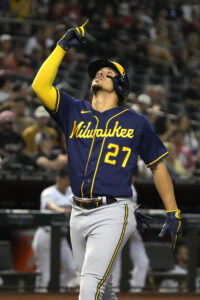
Those factors all contributed to bring this rare trade to fruition, which was since gone well for both clubs. Adames fortified the shortstop position immediately and has been a fixture there since. He was out to a slow start at the time of the trade, hitting .197/.254/.371 as a Ray, but he hit 20 home runs for the Brewers in the remainder of the 2021 campaign and produced a batting line of .285/.366/.521 in that time for a wRC+ of 136.
The Brewers ended up winning the division by finishing with a record of 95-67, five games up on the Cards. They just missed the playoffs last year, but that was no fault of Adames. He hit 31 home runs and slashed .238/.298/.458 for a wRC+ of 109. His speed and defense helped him tally 4.6 wins above replacement, per FanGraphs, tying Corbin Burnes for the team lead. He’s still with the club this year and can be retained via arbitration for 2024.
As for Richards, he was only with the club for about six weeks, getting flipped to the Blue Jays in July alongside Bowden Francis, with first baseman Rowdy Tellez coming the other way. Tellez has also been a key contributor for the Brewers, tallying 35 home runs last year and hitting .219/.306/.461 for a wRC+ of 110. Though that was very similar production to Adames at the plate, he doesn’t provide nearly as much in terms of speed or defense, leading to lesser tally of 0.8 fWAR on the year.
From the Rays’ point of view, they got more than just a few relievers, as they almost immediately started stretching Rasmussen out into a larger workload. Three of his first five outings as a Ray were of the single-inning variety, but he ramped up as the campaign went along. He eventually made 10 starts on the year, including eight to finish the season. And these weren’t just as an opener in the Tampa style. Those eight starts to end the year were all at least four innings long, with Rasmussen completing five innings in five of them.
This was a surprising development as it seemed like Rasmussen’s starting days were over, mainly due to health concerns. He had required Tommy John surgery in college in 2016, but was still drafted by the Rays in the first round, 31st overall, in 2017. They didn’t end up signing him due to concerns over that elbow, so he returned to Oregon State but needed a second TJS in August of 2017.
Despite those two surgeries, the Brewers grabbed him in the sixth round of the 2018 draft. He returned to the mound in the minors the following year, pitching mostly as a starter but logging just 74 1/3 innings. In 2020, with the minor leagues wiped out by the pandemic, Rasmussen was pitching out of the bullpen with the big league club. He tossed 15 1/3 innings over 12 appearances, posting a lackluster 5.87 ERA. He continued in that relief role early in 2021, logging 17 innings over 15 appearances with the Brewers with a 4.24 ERA.
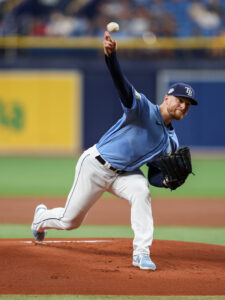
It seems the Rays hadn’t given up on the pitcher they liked so much that they used a first-round pick on just a few years prior. They nabbed him in the Adames deal and, as mentioned, stretched him out as the season wore on. With pitchers like Tyler Glasnow and Chris Archer on the injured list and alternatives like Michael Wacha, Josh Fleming and Ryan Yarbrough posting middling results, the rotation was in need of some help. Rasmussen eventually tossed 59 innings for Tampa that year over 10 starts and 10 relief appearances. He posted a 2.44 ERA, striking out 20.9% of batters faced, walking 5.7% and getting grounders at a 51.5% clip. The Rays finished 100-62 that year, eight games ahead of the Red Sox and Yankees for the division crown, though Boston would eliminate Tampa in the ALDS.
It would have been fair to wonder at that time if Rasmussen’s success with the Rays was sustainable. It was still a small sample and his total workload in the three years since his second Tommy John procedure was light, 177 innings between the majors and minors over the 2019-2021 period. But last year, he pushed those doubts aside, tossing 146 innings over 28 starts. His 2.84 ERA came with a 21.4% strikeout rate, 5.3% walk rate and 46.6% ground ball rate. He’s looked sharp through three starts here this year as well, currently sporting a 2.60 ERA with his strikeout rate up to 29.2% in the early going. He won’t reach arbitration until after this season and can be controlled for three more seasons beyond that.
Feyereisen was no slouch himself. He posted a 2.45 ERA for the Rays after the deal and then tossed 24 1/3 innings last year without allowing a single earned run. Unfortunately, he landed on the injured list in early June and wasn’t able to return, eventually undergoing shoulder surgery in December. The recovery from that procedure required a four-month shutdown period, which meant the club would be without him for the start of the 2023 campaign. He was still under club control through 2026, but the Rays were dealing with a roster crunch and designated Feyereisen for assignment shortly after that surgery, with a deal seemingly already in the works at that time. He was dealt to the Dodgers the next day in exchange for minor league lefty Jeff Belge, who posted a 3.66 ERA in High-A for the Dodgers last year. He’s started his Rays tenure with three scoreless outings in Double-A this year.
In the end, the Brewers shipped out some talented pitchers who weren’t the most essential arms on their roster. Even without Rasmussen and Feyereisen, they’ve still had excellent pitching from Burnes, Brandon Woodruff, Freddy Peralta, Devin Williams and others. In exchange, they received an excellent everyday shortstop and, indirectly, a potent bat in Tellez. The Rays parted with that excellent shortstop, but replaced him easily from within and were able to bolster their rotation and overall pitching depth.
Images courtesy of USA Today Sports.
Boston Rain Cuts Ohtani Start Short
Shohei Ohtani took the mound at the historic Fenway Park in Boston for his fourth start this season on Monday. Ohtani’s start was unfortunately cut short to two innings due to over two combined hours of rain delays.
The Angels’ ace, who entered the game with a 0.47 ERA, held Boston hitless but allowed a single run in the short outing. The combination of poor weather and delays initially seemed to play a role, as the Japanese right-hander’s early season control issues continued. Ohtani walked leadoff hitter Raimel Tapia, then threw two wild pitches that moved Tapia to third. Tapia then scored on a Rob Refsnyder groundout. Ohtani bounced back and struck out his Team Japan teammate Masataka Yoshida on an elevated 98.4 mph fastball, the hardest pitch he threw on the day.
During Ohtani’s warmup at the start of the 2nd inning, the Fenway Park grounds crew rushed onto the mound to pour quick dry dirt, leading to a short delay. The delay took about 10 minutes and was extended even further by a PitchCom issue. The delay did not faze Ohtani, who tossed a clean, efficient inning and struck out two.
During the top of the 3rd inning, the rain had reached a level where the tarp had to come out, causing an 85-minute delay. Angels skipper Phil Nevin knew that Ohtani would have to come off the mound during the second rain delay. “As much as I know he [Ohtani] keeps himself ready to go and pitch, it got past that 30-40 minute mark and I wasn’t going to send him back out,” Nevin said.
The preparation for this game was already challenging for Ohtani and the Halos even before the rain delays. The original start time on Monday was 11:10 AM EST for Patriots’ Day, which meant that it was an 8:10 AM start for Angels players. Because of the unique start time, the Angels rested core players including Mike Trout and Anthony Rendon. “That was the hardest part,” said Ohtani regarding the early start, through interpreter Ippei Mizuhara. “The bus left at 7:30, so I was up and moving by 6:45,” said Ohtani.
The game was Ohtani’s second start at Fenway Park. When asked about his experience, Ohtani said, “It’s one of my favorite parks, so I always look forward to pitching here, but the conditions didn’t allow me to have fun fully. Other than that I always look forward to pitching here.”
Ohtani’s first pitching appearance at the famed ballpark last May was one of the most dominant pitching performances in his big league career. He tossed seven shutout innings, struck out 11, got a career-high 29 swings-and-misses, and threw 81 of his 99 pitches for strikes.
Monday wasn’t the first time Ohtani has expressed his fondness for the ballpark. “That’s one of my favorite ballparks,” said Ohtani after the shutout performance last year. “I was looking forward to pitching here, and I felt like it left a really good impression on me.”
The Red Sox reportedly came close to signing Ohtani out of high school back in 2012, however, they were not on his final list of destinations when he was posted in 2017.
Ohtani is now at a 0.86 ERA, and his next turn in the rotation is supposed to be on Sunday, but today’s short outing might change the Angels’ plans. Angels beat writer Jeff Fletcher reported that Nevin said that “they will talk” about Ohtani’s upcoming pitching schedule.
UPDATE: The Angels have decided to move up Shohei Ohtani’s start from Sunday to Friday, according to Angels beat writer Jeff Fletcher. Ohtani will face the Kansas City Royals on Friday at home in Anaheim. Ohtani works on five days of rest, so his next projected start after Friday will be on April 27th against the Oakland Athletics, which is also at home. Based on Fletcher’s projected schedule, the move will allow Ohtani to face AL West rival Houston Astros and also squeezes an extra start out of him since his turns in the original schedule would have had him pitching on rest days.