
Phillies Have Offer Out To J.T. Realmuto
The Phillies secured a reunion with one of their key veteran free agents Tuesday morning when they signed Kyle Schwarber to a five-year deal, and now it appears their attention will return to their other veteran hitter who reached free agency last month. Philadelphia has an offer on the table for veteran catcher J.T. Realmuto, according to a report from Todd Zolecki of MLB.com. The details of that offer aren’t presently known, though The Athletic’s Matt Gelb adds that Realmuto is “expected” to ultimately return to Philadelphia in 2026 and suggests that he may do so on a two-year deal. Even so, Gelb makes clear that Realmuto is continuing to survey the free agent market.
The veteran backstop will play next season at the age of 35 and is coming off his worst season since his rookie campaign back in 2015. Realmuto slashed just .257/.315/.384 with a 94 wRC+ in 134 games this year. It’s the third-lowest on-base percentage and the lowest slugging percentage of his career, ignoring an 11-game cup of coffee during the 2014 season. Between Realmuto’s age and down season at the plate, it might seem likely that he would be poised to find a soft market in free agency this winter.
That’s not how things have played out, however. Realmuto has established a solid floor as a two-win regular behind the plate, and that’s allowed him to remain a valuable commodity due to a dearth of catching talent around the league. Danny Jansen and Victor Caratini are the next best options available in free agency behind Realmuto, but Jansen’s 72-game 2022 season is the only campaign in either player’s career where they’ve reached the 2.0 fWAR benchmark that Realmuto has established as a floor over the past three seasons.
Additionally, teams might be less concerned about Realmuto’s near-term future behind the plate given the fact that ABS is coming to the majors in 2026 by way of the challenge system; Realmuto has been a slightly below-average blocker and well above-average at controlling the running game behind the plate in recent years, but lackluster framing numbers have held back his overall defensive value. With the challenge system likely to reduce the impact of catcher framing, perhaps teams are a little more comfortable with using a catcher with a lackluster recent track record when it comes to pitch framing than they otherwise would have been.
Whether it’s Realmuto’s steady floor or the rule changes that will impact his job in 2026, he’s managed to garner some real interest around the league this winter. The Red Sox and Rangers are both known to have interest in Realmuto, though the fit in Texas has been downplayed by significant questions regarding the club’s ability to afford the expected price tag attached to the veteran. MLBTR predicted a two-year, $30MM guarantee for Realmuto, and as the Rangers look to cut payroll this winter it seems reasonable to expect that adding a $15MM salary to the books won’t be in the cards this winter barring a payroll-reducing trade elsewhere on the roster. The same is likely to go for other teams likely to pursue catching help this winter like the Rays and Padres.
That could make Realmuto’s market something of a two-horse race between Boston and Philadelphia, and with Carlos Narvaez locked in for the lion’s share of starts with the Red Sox next year it’s easy to see why the Phillies stand as the likely favorite. Should Philadelphia reunite with Realmuto this winter, however, both Zolecki and Gelb suggest that it might be difficult for the team to make other impact additions without first clearing salary elsewhere on the roster. Gelb notes that while Philadelphia is expected to carry a payroll north of $300MM in 2026, they’re already not too far off from that mark.
According to RosterResource, Philadelphia’s luxury tax payroll sits just under $289MM after the Schwarber deal. Assuming the Phillies plan on a payroll in the same vicinity as last year’s $314MM figure, that leaves the club with $25MM left to spend. Should Realmuto take up around $15MM of that money as the club projects, that would leave just $10MM for the team to use when revamping their outfield mix. That might not be enough to re-sign Harrison Bader, who the Phillies are known to have interest in, and could instead leave them looking at some of the lesser options available in a thin outfield market like Austin Hays, Mike Yastrzemski, Mike Tauchman, and Rob Refsnyder.
Of course, another option would be for the Phillies to look to shed payroll elsewhere on their roster in order to create financial flexibility. That the Phillies are planning to move on from Nick Castellanos this winter is one of the league’s worst-kept secrets. While they evidently plan to try and work out a trade involving the veteran in hopes of saving on at least some of his $20MM salary for next year, the club is lacking in leverage to get that sort of deal done and might wind up releasing him. Gelb suggests that a trade of someone like Alec Bohm or Matt Strahm could be a more likely way to save money, and either player would certainly have more value on the market than Castellanos.
Strahm is due $7.5MM in 2026 and has been a reliable setup man for the Phillies in each of the past three seasons, while Bohm has a 110 wRC+ at third base over the past two years and is projected by MLBTR contributor Matt Swartz for $10.3MM in his final trip through arbitration this winter. Trading both players would free up nearly $18MM in the budget, which would be more than enough to re-up with Bader and Realmuto while still leaving some money left over to add someone like Willi Castro or Yoan Moncada to the mix who could help Edmundo Sosa handle the hot corner until top prospect Aidan Miller is ready to step into the big league lineup. Zolecki notes that Miller could be ready as soon as this coming summer, while fellow top prospects Andrew Painter and Justin Crawford figure to have every opportunity to break camp with the team on Opening Day.
Jake Lamb Accepts Player Development Role With Diamondbacks
Former All-Star third baseman Jake Lamb has accepted a player development role with the Diamondbacks, reports Steve Gilbert of MLB.com. That presumably marks the end of the 35-year-old’s playing career, in which he accrued more than eight years of MLB service.
Lamb’s move into his post-playing days fittingly comes with his original organization. He was a sixth-round pick by the D-Backs in 2012 out of the University of Washington. Lamb got to the big leagues two seasons later and emerged as the team’s everyday third baseman for a few years. He hit .263 with six homers in 107 games during his first full season before breaking out as a surprise power threat.
Between 2016-17, Lamb connected on 59 home runs. He reached 30 doubles in both seasons and combined for 13 triples. The lefty-hitting infielder posted a .248/.345/.498 slash in more than 1200 plate appearances. Lamb was worth around six to seven wins above replacement over that stretch, and he earned an All-Star selection in 2017. He popped 30 homers and drove in 105 runs in his career season, one of 19 players to reach 30 homers and 100 RBI that year. He helped the Snakes to a postseason berth and went 6-13 across four playoff contests.
Unfortunately, Lamb injured his left shoulder while diving for a ground-ball early in the ’18 season. He initially returned within five weeks but landed back on the injured list around the All-Star Break. Testing revealed a rotator cuff injury that required season-ending surgery. Lamb returned in 2019 but was never able to get back to his pre-injury form.
The power that had been his calling card didn’t return. He hit .193 with six homers in 78 games. His average had fallen to .116 during the shortened 2020 season when the D-Backs moved on. Lamb bounced around as a journeyman corner bat for the next few seasons. He suited up with the Athletics, White Sox, Blue Jays, Dodgers, Mariners and Angels between 2020-23. None of those stints lasted more than 43 games, and Chicago is the only other team for which he took 100+ plate appearances.
Lamb remained a productive Triple-A hitter through the 2023 season. His minor league numbers dropped over the past two seasons, though, and Triple-A stints with the Pirates and Giants didn’t result in another MLB opportunity. Lamb finishes his playing career with a .235/.326/.427 slash line across 2650 plate appearances. He connected on 96 home runs and tallied 342 RBI. He was a part of two playoff teams, as he also made four postseason appearances with the A’s in 2020. Congratulations to Lamb on a solid career and all the best in his post-playing days.
Latest On Alex Bregman’s Market
While the relief market has moved quickly, there hasn’t been a ton of activity on the position player front. Kyle Schwarber’s return to Philadelphia on a five-year contract might open things up. Teams like the Orioles, Red Sox and Pirates were in on Schwarber amidst their pursuit of various free agent hitters.
Alex Bregman is unlikely to be a fit for Baltimore or Pittsburgh, but he’s certainly on the radar for Boston. Pete Abraham of The Boston Globe wrote this evening that the Red Sox are making Bregman a priority. The Sox enjoyed an excellent season from the three-time All-Star, who hit .273/.360/.462 with 18 homers across 495 trips to the plate. He’s also highly regarded as a clubhouse leader and could slot back in at third base, allowing the Sox to use Marcelo Mayer at second base.
[Related: The Best Fits For Alex Bregman]
Boston has been loosely linked to a number of marquee middle infielders as well. They’ve checked in on Ketel Marte and Brendan Donovan. A report tonight from Tim Healey of The Boston Globe suggested they’ve at least gauged the Rangers’ interest in moving Corey Seager, though WEEI’s Rob Bradford suggested those conversations haven’t gone anywhere. The Sox have had conversations with top free agent infielder Bo Bichette, but Julian McWilliams of CBS Sports downplayed that fit tonight as well. That all aligns with the idea that the Sox are more focused on Bregman or a pure power bat at first base (e.g. Pete Alonso).
In addition to Boston, Bregman has been tied to the Tigers and Cubs this winter. Evan Petzold of The Detroit Free-Press wrote on Monday afternoon that Detroit’s interest had been fairly muted to this point compared to last offseason, when they are believed to have put forth the highest offer. The Tigers made a six-year proposal narrowly above $170MM a year ago. Bregman opted for a three-year deal with the Sox that allowed him to opt out and return to the market this winter.
Chicago reportedly made a four-year proposal in the $115MM range last offseason. They’re back in the market and met with Bregman via Zoom a few weeks ago, according to Robert Murray of FanSided. However, the Cubs’ interest is complicated by the presence of second-year third baseman Matt Shaw. After a slow start to his career, Shaw had a nice second half that tapped into some of the ability that made him a top prospect. The Cubs have Nico Hoerner and Dansby Swanson up the middle, so adding Bregman would make for a cluttered infield.
President of baseball operations Jed Hoyer spoke generally about reports that have tied the Cubs to external third basemen. “I’ve been surprised by the number of media reports that link us to different guys. There is zero lack of confidence in Matt. I would say the opposite,” Hoyer said on Monday (link via Jesse Rogers of ESPN). He didn’t refute interest in Bregman specifically, nor are executives allowed to do so under the CBA for any free agent. The Cubs aren’t closing the door on adding a high-end bat to replace Kyle Tucker, but they appear more focused on pitching.
Theoretically, the Cubs could sign Bregman and use Shaw as a trade chip for a mid-rotation starter. That doesn’t seem to be a strong consideration. “When a team calls a player ‘untouchable,’ it’s because his value is so high that it’s just unrealistic to think that anyone else would come over the top and give you something that’s even more than that value. That’s where Matt Shaw comes into play for us,” general manager Carter Hawkins told Patrick Mooney of The Athletic. “Is he untouchable? No. No one’s untouchable, but the odds of somebody coming in and giving us an offer that would make us want to move him is really, really low.”
If the Tigers and Cubs stay on the periphery of the market, that could open an opportunity for a dark horse suitor. The Angels and Mets are speculative possibilities. Meanwhile, Mitch Bannon of The Athletic wrote that the Blue Jays could keep an eye on Bregman as a fallback if they don’t come away with one of Tucker or Bichette. The Jays don’t need a third baseman, but both Addison Barger (corner outfield) and Ernie Clement (second base) could play other positions. Toronto’s general willingness to cast a wide net makes them a viable dark horse, though it’d be a surprise if they seriously jumped in on Bregman while Bichette and Tucker are still unsigned.
Red Sox Checked In On Corey Seager
The Red Sox have had talks with the Rangers about a Corey Seager deal, reports Tim Healey and Alex Speier of the Boston Globe. Seager joins a growing list of Boston trade targets that includes Ketel Marte, Isaac Paredes, and Brendan Donovan. The club has also been connected to free agentsBo Bichette, Pete Alonso, and Eugenio Suarez. WEEI’s Rob Bradford reports there isn’t any momentum regarding Boston’s pursuit of Seager.
While the club has been connected to several players in the trade market, chief baseball officer Craig Breslow admitted some discussions have been slow to progress. “In a lot of the conversations that we’ve had, a number of teams have conveyed that they’re very comfortable holding onto their players, as are we,” Breslow said. “So that does add a little bit of a layer of difficulty to try to make these things work.”
Seager delivered a typical season in 2025, providing stellar offensive production in between IL stints. The 31-year-old notched a 138 wRC+ across 102 games. Seager fell short of 30 home runs for the first time as a Ranger, largely due to missing time with a hamstring strain (twice) and an appendectomy. His 445 plate appearances were his fewest since his final year with the Dodgers in 2021.
Texas landed Seager on a massive 10-year, $325MM deal ahead of the 2022 season. He’s been an integral part of the lineup over the past four seasons and led the team to a World Series win in 2023. Seager finished second in AL MVP voting that year, but still went home with individual hardware after securing World Series MVP honors.
Seager will make $31MM in each of the next six seasons. There have been whispers that Texas would be trimming payroll this offseason. The team already chose to non-tender Adolis García and Jonah Heim instead of paying their arbitration price tags. The Rangers also traded Marcus Semien, who had three years and $72MM remaining on his contract, but the deal brought back Brandon Nimmo, who is slated to make $101.25MM through the 2030 season. The Mets did toss in $5MM as part of the trade.
Texas could use some help in the rotation and the bullpen. Linking up with Boston in a trade could help cheaply patch those holes. Breslow has said the team is willing to deal controllable starting pitching. Boston bolstered the rotation by adding Sonny Gray and Johan Oviedo via trade. Garrett Crochet and Brayan Bello are locked into rotation spots, which leaves little room for youngsters Payton Tolle, Connelly Early, and Hunter Dobbins. Veterans Patrick Sandoval and Kutter Crawford are also expected to be back healthy.
Trevor Story served as Boston’s primary shortstop last season. After multiple injury-riddled seasons, the former Rockie came through with a resurgent year. Story launched 25 home runs and stole a career-high 31 bases. He remains on the books for $25MM in each of the next two seasons. The contract also includes a $25MM club option for 2028. Story exclusively played second base in his first year in Boston, with Xander Bogaerts holding down shortstop. He could slide back to the keystone if the club acquires Seager, though that would require some reshuffling with Ceddanne Rafaela and potentially others. Center fielder Jarren Duran has been the subject of frequent trade talks, and his departure would clear a spot for Rafaela in the outfield.
Photo courtesy of Jerome Miron, Imagn Images
Giants Have Shown Interest In Brendan Donovan
Brendan Donovan has been one of the top trade targets for clubs seeking offensive help. The Royals, Mariners, Pirates, Guardians and Astros have all been tied to the lefty-hitting utilityman at points this offseason.
Derrick Goold of The St. Louis Post-Dispatch reports that the Giants have been in the mix for Donovan as well. Goold lists San Francisco alongside Seattle and Kansas City among the teams that have kept in touch with the Cardinals as they gauge the market. Tim Healey of The Boston Globe reports that the Red Sox have also talked with the Cards about Donovan, though he’s one of myriad star infielders whom Boston has considered.
The Giants are looking to add at second base. Casey Schmitt is the favorite to start there but probably fits better as a utility player. San Francisco had one of the least productive second base groups in MLB overall. Schmitt was a league average hitter, while Tyler Fitzgerald’s strikeout issues prevented him from building off an impressive 2024 rookie season. Donovan is coming off a .287/.353/.422 season and owns a very similar line in more than 2000 career plate appearances. He’d be a significant upgrade at second base and has the flexibility to help out in the corner outfield.
Kansas City surprisingly tendered a contract to Jonathan India. He’ll probably be back at second base, so Donovan might fit better for them in left field. They could also use India at designated hitter on days when Salvador Perez is behind the plate.
Seattle is hopeful of re-signing free agent second baseman Jorge Polanco. They’ve reportedly had a gap on the contract length, and president of baseball operations Jerry Dipoto spoke yesterday of preparing for the possibility that Polanco signs elsewhere. There’s been some thought that he could sign before the Winter Meetings are out tomorrow.
A Donovan trade, if it happens at all, doesn’t appear to be imminent. Goold writes that president of baseball operations Chaim Bloom and his staff are taking their time to evaluate offers. Ryan Divish and Adam Jude of The Seattle Times write similarly that Donovan is not expected to be moved before the end of the week.
Donovan is under club control for another two seasons. MLBTR contributor Matt Swartz projects him for a $5.4MM salary. That’ll likely climb into the $8-10MM range in 2027. The Cardinals haven’t firmly committed to trading Donovan, but there’s been no indication that an extension is on the table. They’re entering a rebuild, so it’d be a surprise if he’s not in another uniform by Opening Day. The Cardinals are pursuing controllable starting pitching in their trade conversations.
Orioles Among Teams In Discussion With Marlins On Edward Cabrera
The Orioles are among the clubs in conversations with the Marlins about hard-throwing starter Edward Cabrera, report Ken Rosenthal and Will Sammon of The Athletic. There’s been a decent amount of smoke regarding a potential Cabrera trade over the past week, and The Athletic writes that Miami’s talks with other clubs have picked up.
Cabrera is one of the higher-upside arms in the sport. He got out to a slow start but turned in a 2.95 earned run average while striking out 26.5% of opponents in 20 appearances between the beginning of May and the end of August. Cabrera has always had power stuff, but he dialed in his control and walked fewer than 7% of batters faced over that four-month stretch. The 27-year-old righty was one of the more intriguing deadline trade candidates, but Miami never received an offer they found compelling.
Holding Cabrera was defensible given his talent and extended window of affordable team control. It wasn’t without risk, though, particularly from a health perspective. Cabrera has battled shoulder issues in the past, and he’d never topped 100 MLB innings in a season before this year. While the shoulder wasn’t an issue in 2025, he was diagnosed with an elbow sprain at the beginning of September. It briefly raised fears about a possible Tommy John surgery. He instead wound up missing only three weeks and returned to make two starts to finish the season.
The Marlins wouldn’t have brought Cabrera back for two largely meaningless games if they felt he were at a serious risk of re-injury. (Miami was still mathematically alive in the Wild Card race into the season’s final week but never had a real chance of getting to the playoffs.) Cabrera didn’t look any worse for wear. His fastball was back up around 98 MPH on average, and he punched out seven Mets hitters across five scoreless innings in the season’s final game.
Miami has nevertheless remained open to offers that would swap a starter for much needed offensive help. They’ve taken Eury Pérez off the table but are willing to discuss the rest of their rotation. Cabrera has the highest trade value of that group. He’s under club control for three seasons and projected by MLBTR contributor Matt Swartz for a $3.7MM salary.
The Fish could swap Cabrera for hitting while opening the season with a rotation comprising Pérez, Sandy Alcantara, Ryan Weathers, Braxton Garrett and Max Meyer. They have Janson Junk and Ryan Gusto as depth options and top prospects Robby Snelling and Thomas White looming in the high minors. They’d probably look to add a more stable source of innings at the back end, but it’d still be a high-ceiling group.
Baltimore and Miami have already lined up on one huge pitching for offense swap in recent years. The Marlins sent Trevor Rogers to the Orioles for Kyle Stowers and Connor Norby at the 2024 deadline. It initially looked lopsided in Miami’s favor with Stowers’ emergence as an impact bat. Rogers’ late-season dominance this year is potentially rebalancing the scales. The Orioles still need to raise the ceiling of the rotation alongside Rogers and Kyle Bradish, while their controllable infield talent (e.g. Jordan Westburg, Coby Mayo) aligns nicely with Miami’s needs.
Phillies Re-Sign Kyle Schwarber
The Phillies are bringing him back. Slugger Kyle Schwarber has returned to the Phils on a five-year contract, the team announced. It’s reportedly a $150MM guarantee that pays the Excel Sports Management client an even $30MM per season. The Phils had multiple 40-man vacancies and didn’t need to make a corresponding move.
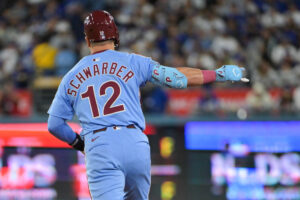
The deal is a testament to Schwarber’s elite talents as it sets new precedents in a few different ways. Schwarber is primarily a designated hitter, having played the outfield just 13 times combined over the past two years. He is also turning 33 years old in March.
Those are both qualities which tend to tamp down a player’s earning power. As shown in MLBTR’s Contract Tracker, the biggest guarantee for any free agent age-33 or older was Josh Donaldson‘s $92MM deal with the Twins, which was signed when he was still a capable third baseman. Pure designated hitters also tend not to get paid. Per the Contract Tracker, Shohei Ohtani is the only free agent DH to get to nine figures. He was obviously a special case as a two-way player and superstar. J.D Martinez signed a five-year, $110MM deal with the Red Sox in 2018. He was still an outfielder at the time but did become more of a DH over the course of that pact.
Schwarber himself has proved to be a special case, as he just keeps getting better at the plate. He has always been a guy who strikes out and walks a lot, with notable power mixed in. From 2017 to 2021, he was generally good for about 30 home runs per year. He got to 38 in 2019, but that was the year with the juiced balls.
Over the past four years, Schwarber has never finished with fewer than 38 long balls. He’s reached 46 in three of those four. In 2025, he set a new personal best with 56. He has also erased his previous platoon issues. In 2024, he slashed .300/.407/.490 for a 152 wRC+ against lefties, compared to a .218/.342/.482 line and 124 wRC+ otherwise. In 2025, those lines were .252/.366/.598 and .232/.364/.541 for respective wRC+ numbers of 162 and 146.
On top of the statistics, Schwarber has received praise for his leadership and clubhouse presence during his time with the Phillies. They clearly wanted to bring him back but plenty of other teams were interested as well. The Mets, Pirates, Reds, Red Sox, Orioles and Giants were all connected to him in recent weeks. The Bucs even reportedly made an offer of four-years and $120MM, a very bold gesture for a club that has never signed a free agent for more than $39MM.
But amid all that interest from other clubs, it always seemed like the safe bet would be Schwarber returning to Philadelphia. He was clearly beloved in the city and in the clubhouse. The Phils have a number of other needs but they have been aggressive spenders in recent years and it seemed like they would likely top whatever deal Schwarber got elsewhere. They have done so and, as mentioned, set new benchmarks for free agent deals for a hitter this age or a designated hitter of any age. MLBTR predicted he could secure a five-year, $135MM deal. He got those five years but did a bit better than predicted in terms of the average annual value.
Per RosterResource, the deal brings the Phils up to a payroll of $270MM and a competitive balance tax figure of $289MM. At the end of 2025, those numbers were $291MM and $314MM. If they plan on getting to a similar spot in 2026, they have about $20MM left to play with.
They still have a few things on the to-do list. In addition to Schwarber, they also want to bring back catcher J.T. Realmuto, who also became a free agent at the end of the 2025 season. Remaking the outfield and adding to the pitching staff are also on the agenda. $20MM wouldn’t be a ton to do all of that, so perhaps they will be willing to raise the payroll again, though they could also try to accomplish a few things on the trade market.
For the other teams, it’s possible that this opens the offseason floodgates. The position player section of free agency has been slow moving so far. Early on, Trent Grisham and Gleyber Torres accepted qualifying offers. The Mariners and Josh Naylor quickly reunited. For the past three weeks, there have been no multi-year deals for free agent hitters.
Now that Schwarber is off the board, the clubs who fell short will be pivoting to other options. Some of those clubs won’t be players for Kyle Tucker or Bo Bichette but perhaps Cody Bellinger, Pete Alonso, Eugenio Suárez, Alex Bregman and others will see their markets heat up in the coming days and weeks.
Jeff Passan of ESPN first reported the five-year, $150MM agreement. Bob Nightengale of USA Today had the even salary breakdown. Photos courtesy of Jayne Kamin-Oncea, Imagn Images
Orioles Made $150MM Offer To Kyle Schwarber
The first major free agent chip fell this morning with Kyle Schwarber returning to Philadelphia on a five-year, $150MM deal. The reunion seemed likely from the start, though the slugger had several other suitors, including at least one willing to match the $150MM price tag. Ken Rosenthal of The Athletic reported the Orioles offered Schwarber the same deal he ultimately accepted with the Phillies.
President of baseball operations Mike Elias has made it clear the team is looking for an impact bat, even after acquiring Taylor Ward. The Orioles still have a significant gap between last year’s payroll and their financial outlook for next season, giving them the potential flexibility for a large expenditure. The club has already spent some money this offseason, though it’s all gone to the bullpen. Baltimore added Ryan Helsley on a two-year, $28MM deal and picked up the $9MM option on Andrew Kittredge after acquiring him from the Cubs.
Camden Yards would’ve been a fun fit for Schwarber. Statcast’s Park Factors ranked it as the third-best home run venue for left-handed hitters. Citizens Bank Park tops the list, so Schwarber isn’t missing out on much by spurning the Orioles.
Baltimore will now turn its attention to the remaining free agent bats, including Pete Alonso. The Orioles and Red Sox are expected to meet face-to-face with the former Met this week. Baltimore’s lineup is strong up the middle and behind the plate, but there should be room to make additions at the corners and DH. Youngsters Samuel Basallo and Coby Mayo will likely factor in at first base and DH, but they wouldn’t preclude the club from adding a player like Alonso. Rosenthal noted the club is also considering Kyle Tucker in its pursuit of an elite hitter.
Pittsburgh’s interest in Schwarber was met with skepticism, but the club came through with a legitimate offer. Rosenthal had the Pirates’ proposal at four years and $120MM, while Alex Stumpf of MLB.com reported the club offered $125MM. Pittsburgh’s offer either met or exceeded the Philles’ deal in terms of average annual value, according to those reports. The fifth year could’ve been the trump card, but it’s hard to scoff at an offer worth upwards of $30MM per season.
Landing Schwarber for anywhere near those reported numbers would have easily set a franchise record for a free agent signing. The current mark is $39MM for Francisco Liriano in 2014. Pittsburgh’s last multi-year signing was a three-year deal with Ivan Nova heading into the 2017 campaign.
GM Ben Cherington previously touted the team’s increased financial flexibility this offseason, and the front office is doing what it can to make a big splash. Pittsburgh was also in on Josh Naylor before he re-signed with Seattle. Stumpf noted that the club will now turn its attention to another former Mariner, Jorge Polanco. The Pirates are expected to have an offer to him soon, per Stumpf.
Cincinnati had been connected to Schwarber given its proximity to his hometown. Rosenthal had the Reds’ offer at five years, but closer to $125MM. C. Trent Rosecrans of The Athletic reported that Schwarber and his wife met with Cincinnati brass before Thanksgiving.
Unlike the Orioles and Pirates, the Reds are not expected to redirect the money offered to Schwarber elsewhere. Their pursuit of the slugger was driven by the idea that signing him would benefit ticket sales, per Rosenthal. Schwarber is from Middletown, Ohio, less than an hour from Great American Ball Park.
Photo courtesy of Bill Streicher, Imagn Images
Mets Open To Dealing David Peterson
The Mets are willing to entertain offers on starter David Peterson, write Tim Britton and Will Sammon of The Athletic. That probably wouldn’t be for prospects but could be part of a swap for a player at a position of need.
New York has a question at first base and designated hitter with Pete Alonso remaining unsigned. Mark Vientos could step into one of those positions, but he’s a question mark coming off a replacement level season. With Edwin Díaz heading to the Dodgers (pending a physical), upgrading the late innings is a must. The Mets signed Devin Williams to give them cover in the ninth, but their setup group — especially among right-handers — isn’t good enough right now.
The Mets already pulled off one veteran for veteran swap with the Brandon Nimmo/Marcus Semien deal. That opened a spot in left field. President of baseball operations David Stearns confirmed on Monday that the club is in the outfield market (via Britton). They’ve been speculated more as a free agent suitor for Kyle Tucker or Cody Bellinger, but they’re presumably open to adding to the outfield in trade.
All that said, it’s not as if the Mets have a lockdown rotation. It’s a talented group but one without much certainty. Nolan McLean, who has made all of eight career starts, would probably have gotten the ball in Game 1 of a playoff series had they not collapsed in September. Peterson was their most reliable starter overall, though his terrible second half was part of the reason that New York squandered a playoff berth.
The 30-year-old southpaw carried a 3.06 earned run average into the All-Star Break. He allowed 6.34 earned runs per nine in the second half, including 18 runs across 16 2/3 frames in September. A lot of that is attributable to a spike in his batting average allowed on balls in play, but Peterson’s walk rate jumped in August and his strikeouts plummeted in the season’s final month.
It was still a solid performance in aggregate. The former first-rounder turned in a 4.22 ERA across a team-leading 168 2/3 innings. He got ground-balls at a very high 54.7% clip while slightly worse than average strikeout and walk numbers. Peterson’s performance has been up-and-down over the course of his career, but he has a 4.12 ERA with decent underlying marks in more than 600 innings.
Peterson is headed into his final season of club control. MLBTR contributor Matt Swartz projects him for a $7.6MM arbitration salary. He’d probably double that if he were to sign a one-year contract as a free agent, so there should be a few million dollars of surplus value. There’s a chance he pitches well enough to put himself in consideration for a qualifying offer next winter.
If he’s not traded, Peterson will open the season in Carlos Mendoza’s rotation. McLean and Sean Manaea are locked in as well. Clay Holmes stuck as a starter all year but has plenty of experience in the bullpen. Kodai Senga has come up in trade talks. Christian Scott, Jonah Tong and Brandon Sproat are high-upside talents who might all begin the season in Triple-A. The Mets are almost certainly going to add at least one starter, though they’re reportedly reluctant to go long term in free agency. They’ve been most frequently tied to Michael King as a potential target on the open market.
Rockies Add Gabe Ribas, Matt Buschmann To Coaching Staff
The Rockies finalized their previously reported hiring of Alon Leichman as pitching coach. They’ve also announced the hiring of Gabe Ribas as an assistant pitching coach and Matt Buschmann as bullpen coach.
Ribas gets his first job on an MLB staff. The 45-year-old has spent the last five seasons with the Tigers as their director of pitching. Ribas had previously worked in the Dodgers farm system and at a handful of college programs. He’d also had a brief professional playing career, topping out at the Double-A level in the San Diego system in 2004.
Buschmann, 41, reached the highest level as a player — albeit very briefly. He made three appearances for the 2016 Diamondbacks. The remainder of his 11-year playing career came in the minors. Buschmann has some experience as a big league bullpen coach. He held that role with the Blue Jays between 2019-22. He has spent the past two seasons with the Cubs as an advisor in their player development department.
Former big league catcher Dustin Garneau served as Colorado’s bullpen coach in 2025. The Rox had a 5.18 earned run average out of their relievers, beating only Washington’s 5.59 figure. Rox relievers were last in strikeout rate (19.7%) despite landing in the middle of the pack in whiffs. Garneau departed to become Atlanta’s catching coach after the season. Buschmann will get to work with a few big arms (e.g. Victor Vodnik, Seth Halvorsen, Juan Mejia) at the back of the Colorado bullpen.