
Padres Activate Dinelson Lamet
April 21: The Padres announced that Lamet has officially been reinstated from the injured list. Lefty Nick Ramirez was optioned to their alternate site to open a spot on the roster.
April 19: Padres right-hander Dinelson Lamet is expected to start against the Brewers on either Tuesday or Wednesday, according to The Athletic’s Dennis Lin (via Twitter). It will mark Lamet’s first outing since September 25, as he was sidelined by biceps tightness throughout San Diego’s postseason run.
Lamet received a PRP injection in October, and the Padres have been particularly cautious about not rushing him back into action until he is completely ready. Naturally any elbow issue is cause for concern with any pitcher, though Lamet is a recent Tommy John patient, having missed the entire 2018 season recovering from the surgery.
A simulated game in the 70-pitch range was the last checkpoint on Lamet’s path back to the mound, however, and now the righty is ready for his first official game of the 2021 season. Lamet will be thrown right into the thick of it against playoff-contender Milwaukee in his first outing, and if he starts on Tuesday, Lin notes that Lamet would then be lined up to face the Dodgers on Sunday in another huge game against San Diego’s chief rival.
A healthy and effective Lamet provides another boost to an already-strong Padres rotation. The righty finished fourth in NL Cy Young Award voting last season after posting a 2.09 ERA over 69 innings for the Friars, with a 34.8% strikeout rate that ranked fourth among all qualified starters in baseball and a fifth-ranked 27.3% strikeout-to-walk percentage.
Pirates Claim Ka’ai Tom, Designate Anthony Alford For Assignment
The Pirates have claimed outfielder Ka’ai Tom off waivers from the Athletics and designated fellow outfielder Anthony Alford for assignment in order to clear a spot on the roster, per a club announcement. Tom, the Athletics’ selection in this year’s Rule 5 Draft, was designated for assignment by Oakland earlier this week. He’ll maintain his Rule 5 designation with the Pirates, meaning he cannot be sent to the minors without first clearing waivers and being offered back to his original organization, the Indians.
Tom, 26, went just 1-for-16 in limited action with the A’s, but he forced his way onto their Opening Day roster with a huge spring showing: .310/.412/.552 with a homer, two doubles, a triple and four walks against eight strikeouts through 34 trips to the plate. His last minor league season was similarly encouraging, as he logged a combined .290/.380/.532 in 554 plate appearances between Double-A and Triple-A, adding 23 homers and five steals.
Tom has never rated as a top prospect, but he has a rock-solid track record spanning his entire minor league career and his days as a star at the University of Kentucky. Following the Rule 5 Draft in December, FanGraphs Eric Longenhagen wrote: “Tom is one of those prospects who makes me wonder, “Are we all idiots?” because he has a consistent track record of above-average offensive performance all the way from college through the upper minors, and yet because he’s a little guy without huge power he is consistently dismissed by scouts.”
The Bucs ought to be able to give Tom plenty of leash to show he has the chops to continue that strong performance in the big leagues. He started just four games with a win-now A’s club, but the Pirates aren’t expecting to win much of anything in 2021 and can afford to give him regular playing time if they choose. Alford and Dustin Fowler had been splitting time in center field for the Pirates, but neither has hit so far, leading to today’s roster shuffle.
Alford, also 26, is a wildly gifted athlete and former two-sport star who didn’t fully commit to baseball until more than two years after he was drafted. He was one of the most touted talents in the 2012 draft but worked out a deal with the Blue Jays that allowed him to play football in college. He continued doing so until Sept. 2014, and in the years since that time he’s battled injuries — most notably wrist surgery and a torn hamstring. He’s still tallied just 117 plate appearances in the Majors since his 2017 big league debut.
Alford ranked among the game’s top 100 prospects from 2016-18 on virtually any publication of note, but his opportunities to this point have been limited. He was 2-for-24 with the Pirates this season, and he carries a career .150/.222/.262 batting line in the Majors. Pittsburgh will have a week to trade him or attempt to pass him through outright waivers. If he clears, the Pirates can keep him in the organization without dedicating a 40-man roster spot to him. He’d then presumably be in line for everyday reps with their Triple-A club once the season gets underway.
Twins Place JT Riddle On Covid IL, Select Tomas Telis
The Twins announced Wednesday that they’ve placed infielder JT Riddle on the Covid-19-related injured list and selected the contract of catcher Tomas Telis from their taxi squad. Riddle becomes the fifth member of the Twins’ roster to land on the Covid-19 IL, joining shortstop Andrelton Simmons, lefty Caleb Thielbar and outfielders Max Kepler and Kyle Garlick. Because of that string of positive tests, which have already required several additions to the roster, Telis was the last remaining member of the five-man taxi squad on the road trip (as noted yesterday by MLB.com’s Do-Hyoung Park).
There’s no indication from the Twins that Riddle actually tested positive, nor is there any indication that today’s game will be postponed. Minnesota’s games on Saturday, Sunday and Monday were all postponed due to Covid issues within the organization. President of baseball operations Derek Falvey announced a week ago that Simmons had tested positive, and in the days since, both Kepler and Garlick have tested positive as well. Thielbar is on the list as a close contact but has tested negative to this point.
Riddle and Telis, teammates with the 2017-18 Marlins, both signed minor league deals with the Twins this winter. Riddle was only brought up to the big league roster when Simmons was placed on the injured list, and he’s gone 2-for-6 while appearing in four games since that promotion. Telis, meanwhile, has spent the past few years in the Twins’ system but hasn’t been called up from Triple-A or their alternate training site until today. He hit .330/.364/.490 in 82 games with Minnesota’s Triple-A club in 2019 and is a career .230/.267/.298 hitter in 267 Major League plate appearances.
Astros Sign Martin Maldonado To One-Year Extension
April 21: The Astros announced today that they’ve signed Maldonado to an extension. The team didn’t disclose terms, although Feinsand reports that Maldonado is guaranteed $5MM on the one-year deal, which contains a $5MM vesting option for the 2023 season.
April 13: The Astros are finalizing a one-year contract extension with catcher Martin Maldonado, reports Mark Feinsand of MLB.com (via Twitter). The new pact would also contain a vesting option for the 2023 season. Maldonado is a client of MVP Sports Group.
The 34-year-old Maldonado is in his second different stint with the Astros since they acquired him from the Angels for left-hander Patrick Sandoval leading up to the July 2018 trade deadline. Maldonado divided some of the next year between the Royals and Cubs, only to return to the Astros in a 2019 deal that sent infielder/outfielder Tony Kemp to Chicago. The Astros were impressed enough with Maldonado’s work that they prevented him from exiting in free agency with a two-year, $7MM guarantee.
Maldonado typically hasn’t offered much as a hitter, evidenced by his lifetime .217/.291/.352 line in 2,541 plate appearances, though he did put up a career-best .215/.350/.378 last year. Maldonado’s off to a dreadful .094/.121/.094 start with 15 strikeouts against one walk in 33 PA this season, but the Astros are willing to roll the dice for another year, no doubt owing in large part to the veteran’s history of well-regarded work behind the plate. Maldonado has earned extremely high lifetime marks from Baseball Prospectus’ Fielding Runs Above Average metric, piled up 75 Defensive Runs Saved and thrown out an easily above-average 36 percent of would-be base thieves since debuting with the Brewers in 2011.
Barring any behind-the-plate changes in Houston, it’s slated to bring back its two current catchers – Jason Castro is the other – in 2022. Castro inked a two-year, $5MM contract in free agency, though he has only taken seven trips to the plate this season. Of course, considering Maldonado and Castro for a cheap duo, the Astros could still seek an upgrade(s) in the coming months if Maldonado and Castro don’t produce to the club’s liking.
Anthony Santander Out Two To Four Weeks
11:21am: The team has now announced that Santander is on the 10-day injured list. McKenna has indeed been recalled to take his spot on the 26-man roster.
10:50am: Orioles slugger Anthony Santander will miss the next two to four weeks of action after sustaining a sprained ankle, manager Brandon Hyde announced to reporters this morning (Twitter link via Roch Kubatko of MASNsports.com). X-rays and an MRI both confirmed that there is no fracture in Santander’s ankle. A corresponding roster move is in the works, per Hyde. Santander injured the ankle last night when lunging back to first base on a pickoff attempt (video link).
Santander, 26, emerged as one of the Orioles’ best hitters from 2019-20 and was the subject of some trade inquiries over the winter. However, the O’s control him all the way through 2024 and clearly weren’t motivated to make a move based on any of those talks.
The switch-hitting Santander is out to a slow start in 2021, hitting just .196/.230/.321 in 62 plate appearances after missing some time late in Spring Training with an oblique issue. But from 2019-20, Santander delivered a .261/.302/.505 batting line with 31 dingers, 33 doubles and a pair of triples in 570 trips to the plate. A middling 5.1 percent walk rate in that time limits his on-base upside, but Santander also struck out in just 15.6 percent of his plate appearances last season.
Baltimore just welcomed outfielder Austin Hays back from the injured list yesterday, so he’ll effectively be replacing Santander in the everyday lineup moving forward. Hays and hot-hitting Cedric Mullins are both options at any of the three outfield spots, while Ryan Mountcastle and DJ Stewart can work in the corners and also mix in some at-bats as the designated hitter. Ryan McKenna, who was optioned yesterday after Hays was activated, could also quickly be brought back and added into the equation if the Orioles want to replenish some outfield depth.
Carlos Correa vs. Trevor Story
In the comment section on my recent 2021-22 MLB Free Agent Power Rankings, there was a lot of debate about the merits of shortstops Carlos Correa and Trevor Story, who seem to clearly fall behind Corey Seager in the upcoming free agent class. Which player will have greater earning power in free agency?
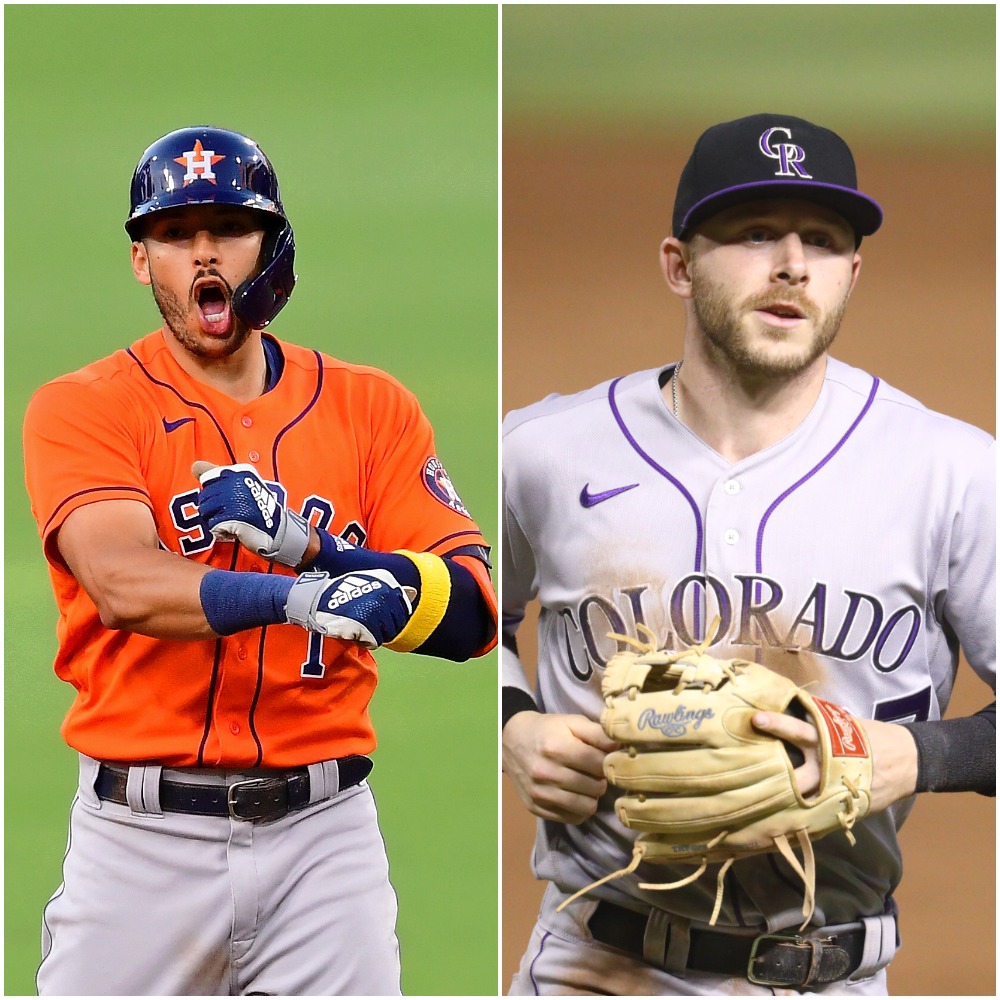
Some points of comparison:
Age on Opening Day 2022
- Correa: 27.54 years
- Story: 29.39 years
- Difference: 1.85 years
Age is a crucial factor in free agent contract length, as teams want to avoid as many decline years as possible. Capturing a player’s age 27 season in free agency is a rare thing. In the cases of Bryce Harper (13 years), Manny Machado (10 years), and Jason Heyward (eight years), teams were actually able to capture age 26. There are not any other recent cases of free agent deals that included age 26 or 27.
Machado signed for ten years and $300MM, while the Mets recently extended Francisco Lindor for ten years and $341MM, albeit with deferred money. The players were paid through age 35 and 37, respectively. A contract running through age 37, as Lindor’s does, is pretty rare. I think teams will be looking to commit to Correa and Story through age 35 or 36, at most. Paying through age 35 would mean a nine-year deal for Correa, though that might be a long shot given his inconsistency and injury history. It’d mean a seven-year deal for Story. Those terms would only be available if the players are considered highly desirable after strong 2021 seasons.
Offense
Rest of 2021 Season ZiPs/Steamer projections in wRC+
- Correa: 125 / 118
- Story: 102 / 103
2019 to present wRC+
- Correa: 126
- Story: 117
2018 to present wRC+
- Correa: 115
- Story: 121
2018 was Story’s best year (128 wRC+) and one of Correa’s worst (101), so whether you include it makes a big difference. But it’s pretty clear that Correa has a higher ceiling, with marks of 136 in 2015, 152 in 2017, and 143 in 2019. As we’ll discuss later, Correa was quite clearly affected after returning from a back injury in 2018, so I think the “2019 to present” numbers are a better reflection of his true ability.
Why use wRC+? It’s park-adjusted, so it neutralizes the fact that Story has played 50.7% of his games in Coors Field. If you cite straight-up numbers with no adjustment, you’d clearly prefer Story. I think any MLB team interested in Story would attempt to neutralize the effects of Coors, though. It is not as simple as looking at Story’s work on the road and assuming that’s how he’d play for a new team in a neutral ballpark. But since 2018, Story does have a huge split: a 136 wRC+ at home, and 105 on the road. In terms of triple slash, Story is at .266/.327/.450 on the road since 2018, and .316/.379/.642 at home.
Story may follow the path of Matt Holliday. From 2005-07, Holliday posted an even more extreme 166 at home and 108 on the road. He was not a 108 wRC+ hitter after leaving Coors, however, putting up an excellent 145 mark from 2008-13, mostly for the Cardinals. Holliday was able to spend all of his 2009 contract year away from Coors, posting a 141 wRC+ for the A’s and Cardinals that likely helped him land the largest contract of the 2009-10 offseason. DJ LeMahieu is another example of a former Rockie who continued to hit well after posting extreme splits.
In the likely event Story is traded this summer, he’ll have a chance to demonstrate his standard 120 wRC+ production in a more neutral environment for a few months. That’s more likely than a Correa trade, and being free of a qualifying offer would be an advantage for Story.
It makes little sense to remove park factors, when Minute Maid Park has suppressed offense (outside of 2019) while Coors Field has inflated it by a minimum of 12% during Story’s career. But for comparison, Correa has hit .276/.352/.483 since 2017 and .258/.334/.453 since 2018. Story stands at .278/.342/.524 since 2017 and .291/.353/.547 since 2018. Story has reached the 35 home run mark twice, while Correa’s career-best is 24.
As for Correa, what about the sign-stealing scandal? According to MLB’s report, the bulk of the Astros’ sign-stealing efforts were in 2017, in which Correa put up a career-best 152 wRC+. He was excellent both at home and on the road, though the scheme is only thought to have occurred at the Astros’ home park. MLB’s report suggested the Astros did not utilize trash-can banging in 2018, when Correa dropped down to 101. That 101 mark may be explained by a back injury, which I’ll get into later. The Astros also weren’t thought to be cheating in 2019, but Correa bounced back to a 143 mark.
Astros fan Tony Adams analyzed home data for the Astros from 2017, and found 140 total trash can bangs for George Springer and 97 for Correa. If potential free agent suitors consider Springer and Correa equally complicit in the sign-stealing, it would bode well for Correa, since the scandal didn’t seem to have much effect on Springer’s market. Ultimately, like Springer, Correa just needs to go out and have a big contract year if he wants to get paid. There’s a solid argument that in a neutral ballpark, he’s a better hitter than Story.
Defense
By measure of UZR/150, Story is at 3.9 since 2018, while Correa sits at -3.5. Story also leads in Defensive Runs Saved (DRS), though that’s a cumulative stat and he played an additional 1,042 innings in the field – 47% more than Correa did. Outs Above Average, which is part of Statcast, is more sophisticated than UZR or DRS, but doesn’t necessarily tell a clear story. Here’s each player’s OAA by year:
- 2016: Story 4 (823 innings), Correa -17 (1355.6 innings)
- 2017: Story 7 (1185.3 innings), Correa -3 (946 innings)
- 2018: Story -5 (1372.6 innings), Correa 17 (959 innings)
- 2019: Story 18 (1257.3 innings), Correa 9 (642.3 innings)
- 2020: Story 2 (491.3 innings), Correa 3 (475 innings)
It would appear that Story’s defense slipped to a below-average level in only one season, 2018, on which OAA and UZR/150 agree. There’s no clear injury in 2018 to explain the lapse, though he miss a few late September games with elbow soreness. Story was able to improve his range and reduce his errors in 2019, and seems to have settled in as an above-average defender.
We’ll talk about durability in the next section, but with Correa we have a player who has tallied 1,000 innings in the field exactly once, in his 2016 sophomore season. UZR suggested he was a bit below average that year, while OAA had him as the game’s worst defensive shortstop.
2018 is particularly odd for Correa, where OAA shows him as the game’s fourth-best defensive shortstop while UZR/150 has him as the fourth-worst. That was a year in which Correa avoided the IL until late June, at which point he missed over a month due to a back injury. He acknowledged that the injury played a role in his plummeting offense, and his OAA was lower after the injury. MLB.com’s Mike Petriello suggested to me that the Astros’ frequent shifting, and UZR’s lack of accounting for that, might account for the difference between the two stats.
Correa suffered another major injury toward the end of May 2019 – a cracked rib that cost him two months – as well as more back pain in late August of that year. Nonetheless, his defense doesn’t seem to have suffered.
Both Story and Correa have been above average defenders since 2019, ranking fourth and ninth respectively in OAA. Story is carried largely by his 2019 season, for which he was voted a Gold Glove finalist for the first time. Though he has dropped off so far this year, Story has often ranked among the top 40 in the game in terms of sprint speed, which is a factor in his defense. I think it’s safe to say that Story is the superior defender. It’s worth noting that Correa has already expressed a willingness to move to third base if needed, while the topic hasn’t really been broached for Story.
Durability
Story was drafted 45th overall by the Rockies out of high school in 2011. As a minor leaguer in 2014, he missed roughly a month due to hairline fracture on his left pinky finger. The Rockies traded longtime shortstop Troy Tulowitzki in July 2015, taking on Jose Reyes in the process. In 2016, Reyes was suspended through May to begin the year under the league’s domestic violence policy, opening the door for Story to make the team out of camp. After becoming the Rockies’ starter in 2016, Story’s season ended on July 30th due to a torn UCL in his left thumb that would require surgery. It was still good for a fourth-place Rookie of the Year finish.
A new injury popped up in May 2017, as Story strained his left shoulder and missed the minimum two weeks. In late September 2018, Story exited a game with right elbow soreness, but he missed only five games. In June of 2019, Story injured his right thumb after a headfirst slide, with the resulting IL stint costing him 11 games.
That’s the full extent of Story’s injury history in his five-plus years. He’s played in 522 games since 2017, 14th in all of MLB. Story was able to recover quickly from minor injuries in 2017, ’18, and ’19, and can safely be penciled in for 145-150 games annually.
Correa was drafted first overall by the Astros out of high school in 2012. He dealt with only minor injuries in the minor leagues until June 2014, when he suffered a fractured right fibula sliding into third base and had to undergo surgery. By January 2015, his ankle was back to 100%.
Correa opened the 2015 season at Double-A, a defensible choice since he’d yet to play at that level. He reached Triple-A by May and went on to make his big league debut on June 8th. The timing worked out well for the Astros to receive part of a seventh year of control of Correa and also avoid Super Two status, but his starting the year in the minors was justified. Correa played 99 dynamic regular season games in 2016, avoiding injury and winning the Rookie of the Year award.
2016, just Correa’s age 21 season, was perhaps the best of his career. He missed three games in June with an ankle sprain and another four with shoulder inflammation, but avoided the IL. Correa would play 153 games in the regular season that year, the only time he’s exceeded 110 Major League games in a season.
Correa’s injury history is significant, but also limited to the three-year period of 2017-19. On July 17th, 2017, according to MLB.com’s Brian McTaggart, “Correa left Monday’s 9-7 loss to the Mariners in the fourth inning after injuring the thumb on a swing, the same thumb he originally hurt sliding head-first into home July 4 in Atlanta.” The torn thumb ligament required surgery and cost him more than six weeks. He returned successfully in September of that year.
Correa’s next IL stint was in June of 2018 due to a back injury. Like the thumb the prior year, this injury cost him about a month and a half. Though he returned in mid-August, the issue lingered and affected his performance for the rest of the season. From 2015-19, 2018 is Correa’s only season with a wRC+ below 123, and it’s easy to attribute his overall 101 mark that year to his back injury. Correa had a 128 wRC+ before the injury, and just a 45 mark thereafter.
Correa’s back healed up and he started yoga in the 2018-19 offseason, but a cracked rib suffered in late May 2019 cost him a full two months. Oddly, Correa said the rib was cracked by what must have been a particularly aggressive massage. After he’d been back for about a month, he went on the IL again due to a back injury. Since then, Correa has avoided the IL, playing in 58 of 60 games in 2020.
Both Story and Correa have been starters since 2016. Story has played in 619 games – 19% more than Correa’s 520. Is Correa, who has yet to reach his 27th birthday, simply an injury-prone player? Or might he settle in at 150 games per year if he avoids headfirst slides and rough massages? If I was looking at signing him, it’s his back that I’d be concerned about, as it cost him roughly two and a half months during the 2018-19 seasons. 150 games this year would go a long way.
Overall Value
Much of Correa’s value is packed into the earlier years of his career, when he put up 13.7 WAR in 361 games from 2015-17. He’s managed only 6.1 WAR since, roughly the same as what Story did in 2019 alone. Career-wise, Correa leads Story 19.8 to 17.9.
From 2018 to present, Correa has been good for 3.7 WAR per 650 plate appearances, while Story is at 5.4. From 2019 to present, those numbers are 4.7 for Correa and 5.5 for Story. But here’s how each player projects for the rest of the season per 650 PA, according to FanGraphs:
- Correa ZiPS: 5.0
- Correa Steamer: 4.1
- Story ZiPS: 3.5
- Story Steamer: 2.9
If you buy those projections, Correa will be the better per-game player moving forward, likely due to the age difference. Aside from the durability question, that is what MLB teams must determine when offering these players contracts: who will be better over the next seven years or so?
With that lengthy comparison of Carlos Correa and Trevor Story, I turn it over to you.
Who will sign for more total dollars?
-
Carlos Correa 53% (2,545)
-
Trevor Story 47% (2,235)
Total votes: 4,780
Who will sign for a higher average annual value?
-
Trevor Story 56% (2,480)
-
Carlos Correa 44% (1,961)
Total votes: 4,441
Who will be the better player over the next seven years?
-
Trevor Story 63% (2,879)
-
Carlos Correa 37% (1,684)
Total votes: 4,563
Phillies Announce Several Roster Moves
The Phillies announced Wednesday that they’ve placed infielder Jean Segura on the 10-day injured list due to a strained right quadriceps and optioned righty Ramon Rosso to their alternate site in Lehigh Valley. In their place, the Phillies have recalled infielder/outfielder Scott Kingery and right-hander Spencer Howard.
The loss of Segura even for a brief period — the team has yet to provide a timeline — stings for the Phillies. The 31-year-old is out to an excellent start this season, slashing .333/.359/.450 with a homer, four doubles and a stolen base in his first 64 trips to the plate. The Phillies have bounced him around the diamond the past couple of seasons, but he’s been their everyday second baseman early in the 2021 campaign.
Second base duties will now likely fall to Kingery and utilityman Brad Miller. Kingery is looking for a rebound after a disastrous 2020 season that began with a three-week stint on the Covid-19 injured list. Kingery didn’t have any real ramp-up period to the shortened season, and the .159/.228/.283 slash he posted in 124 plate appearances was miles away from the solid .258/.315/.474 slash he logged through 458 trips to the plate in 2019. He also spent time on the IL with back spasms last season.
The hope was that a full, healthy Spring Training would get Kingery back to his 2020 form, but Kingery struggled mightily in Grapefruit League play. Through 15 games and 49 plate appearances, he cobbled together just a .159/.229/.295 slash that looked eerily similar to last year’s woeful showing. The Phils optioned him to their alternate site near the end of camp, and this will be his first chance at a rebound.
Howard, like Kingery, has long been regarded not only as one of the organization’s best prospects, but one of the best in the league. The 24-year-old struggled through 24 1/3 innings last year during his MLB debut effort and has logged just one inning thus far in 2021. While Howard has been a starter throughout his minor league career, president of baseball operations Dave Dombrowski indicated at the end of Spring Training that the plan for the 2021 season was to use Howard primarily out of the bullpen.
Marlins Select Sandy Leon, Place Jorge Alfaro On Injured List
The Marlins announced Wednesday morning that they’ve placed catcher Jorge Alfaro on the 10-day injured list due to a left hamstring strain and selected the contract of veteran Sandy Leon to take his spot on the roster. Miami had an open spot on its 40-man roster already.
Alfaro, 27, has gotten out to a slow start this year, slashing .229/.250/.257 with a dozen strikeouts against just one walk in 36 trips to the plate. He was removed from last night’s game against the Orioles after beating out an infield single. Chad Wallach replaced Alfaro last night, and he’ll now share time behind the dish in Miami with Leon while Alfaro mends.
Leon, 32, has seen Major League time in parts of nine seasons but has never provided much with the bat aside from what looks to be an anomalous 2016 campaign in Boston. The veteran switch-hitter posted an out-of-the-blue .310/.369/.476 slash with a career-best seven homers in 283 plate appearances that year, but Leon has mustered just a .194/.263/.306 line in 861 trips to the plate since that time. He spent the 2020 season with the Indians organization, hitting .136/.296/.242 in 81 plate appearances.
Leon may not be much of a hitter, but he’s a well-regarded pitch framer with a career 34 percent caught-stealing rate that is well above the league average. His throwing has deteriorated in recent years, including just a 2-for-11 effort in thwarting thieves last year, but Leon is regarded as a sound defensive backstop on the whole. The Marlins have yet to provide any kind of timeline for Alfaro’s injury, so it’s unclear just how long of a window Leon will have in Miami.
Brewers Sign Dee Strange-Gordon
April 21: The Brewers have now formally announced their minor league agreement with Strange-Gordon. He’s been assigned to their alternate training site for the time being.
April 8: The Brewers have agreed to a minor league contract with infielder/outfielder Dee Strange-Gordon, Ken Rosenthal of The Athletic tweets.
Milwaukee will be the second straight National League Central organization for Strange-Gordon, who spent time with Cincinnati during the offseason and in the spring. The Reds ended up releasing him toward the end of March, and though Strange-Gordon subsequently rejected minors offers from other teams, he’ll now settle for one a little over a week into the season.
While the 32-year-old Strange-Gordon has an accomplished resume – two All-Star bids, an NL batting title, a Gold Glove Award and three seasons with at least 58 stolen bases – the former Dodger, Marlin and Mariner has struggled recently. From 2018-20 in Seattle, Strange-Gordon batted a meek .266/.293/.343 (good for a 73 wRC+) in 1,091 trips to the plate. Strange-Gordon stole 55 bags in that span and saw time in the middle infield and multiple outfield positions, but the Mariners made the easy decision to decline his $14MM club option in favor of a $1MM buyout after last season.
Now that he’s joining the Brewers, Strange-Gordon will give the team some middle infield depth behind Kolten Wong and Luis Urias after it dealt Orlando Arcia to the Braves on Tuesday. The Brewers’ outfield boasts Christian Yelich, Lorenzo Cain, Jackie Bradley Jr. and Avisail Garcia as regulars, while Daniel Robertson and Billy McKinney are on their bench.
Tigers Designate Renato Nunez For Assignment
The Tigers announced Wednesday that they’ve designated first baseman Renato Nunez for assignment in order to open a roster spot for infielder Zack Short, who has been recalled from the team’s alternate training site. Detroit also plans to activate right-hander Spencer Turnbull from the Covid-19 list later today, as Evan Woodberry of MLive.com points out, which necessitates this morning’s 40-man move.
Many were surprised to see the Orioles cut Nunez loose over the winter rather than pay him a raise via arbitration. He’d slugged 43 long balls for Baltimore from 2019-20, including a 31-homer campaign back in 2019. However, as a below-average defender at both infield corners with contact issues and a generally sub-par OBP, Nunez went unclaimed on waivers despite his obvious power. He ultimately landed a minor league deal in Detroit and had his contract selected 10 days ago.
Nunez, 27, showed off that power by homering twice in 29 plate appearances as a Tiger, but the same OBP, strikeout and defensive concerns were present. The Tigers slotted him at DH (four games) more than first base (three), as he split his time in the field with both Harold Castro and Jonathan Schoop. Nunez punched out eight times in his 29 trips to the plate against just one walk, resulting in an overall .148/.207/.444 batting line. Nunez paired that output with a .188/.212/.344 slash in 33 spring plate appearances, which likely also played into the decision.
The Tigers will have a week to trade Nunez or attempt to pass him through outright waivers, although even if he goes unclaimed this time around, he can still opt for free agency by virtue of the fact that he’s already cleared waivers once before.
The 25-year-old Short will be making his big league debut the first time he gets into a game with the Tigers. Acquired from the Cubs last summer in a trade that sent Cameron Maybin to Chicago, Short is a former 17th-round pick who emerged as one of the top 30 prospects in the Cubs’ system from 2019-20, per Baseball America. He ranks 24th among Tigers farmhands right now over at MLB.com, where he’s regarded as a plus defender at multiple positions and an above-average runner with gap power. He hasn’t hit for a great average in the minors but draws tons of walks (16.4 percent), which has resulted in a .241/.377/.405 line in his minor league career.