
Red Sox Sign Garrett Richards
Feb. 3: The Red Sox have formally announced the signing. Richards will earn $8.5MM in 2021, per MLB Network’s Jon Heyman (Twitter link), and he has a $1.5MM buyout on the 2022 club option. The value of that option increases by $250K for reaching 20 and 25 games started, and would increase by an additional $500K if Richards starts 30 games. Richards, it should be noted, has made 30 starts just once in his career and has only reached 20 starts in a season on two occasions. His 2022 base salary would also increase by $500K if he’s traded.
Jan. 23: The Red Sox and right-hander Garrett Richards have agreed to a one-year, $10MM deal, ESPN.com’s Jeff Passan reports (Twitter link). The contract also includes a club option for 2022 that is also worth $10MM, according to The Boston Globe’s Alex Speier (Twitter links), with escalators that could increase both the base value of the option beyond $10MM, and also increase the value of the buyout. The deal will become official once Richards passes a physical. Richards is represented by ISE Baseball.
Reports circulated yesterday that Richards and the Sox were making progress towards an agreement, and with Richards now in the fold, Boston has taken another big step towards strengthening its rotation. Martin Perez was also re-signed last week, and between Richards, Perez, and swingman Matt Andriese, the Red Sox have added some veteran arms to the rotation mix and pushed some less-experienced arms (i.e. Tanner Houck, Chris Mazza) further down the depth chart.
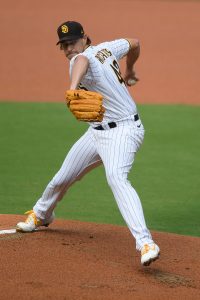 Of course, the 32-year-old Richards also cannot be called an entirely sure thing, as he is less than two years removed from a Tommy John surgery that wiped out much of his 2019 season. Richards did post some solid results in 2020, however, delivering a 4.03 ERA, 21.6K%, and 13.6K-BB% over 51 1/3 innings for the Padres, starting 10 games before being moved to the bullpen for his final four regular-season outings in anticipation for the playoffs.
Richards did have a 4.55 SIERA last year, and his Statcast numbers aren’t much to write home about apart from two key categories — a 99th percentile curveball spin rate, and a 97th percentile spin rate on his fastball. Those types of elite metrics could hint at Richards reaching another level of production under the guidance of a more analytical front office and coaching staff, like the one chief baseball officer Chaim Bloom has assembled in Boston.
Perhaps moreso than unlocking spin-rate potential, the biggest issue facing Richards and the Red Sox is just how much durability can be expected from a pitcher who has thrown only 198 2/3 total innings since the start of the 2016 season. In this sense, Richards becomes another injury question mark on a team that already has Nathan Eovaldi and Eduardo Rodriguez as its top two starters until Chris Sale makes his expected midseason return from his own Tommy John surgery. The presence of Houck, Andriese, Mazza, Nick Pivetta and company allows the Sox some flexibility in the event of an injury, and if everyone is healthy, the club can get creative in resting pitchers or moving spot starters into the rotation to keep everyone fresh.
With Richards and the newly-signed Enrique Hernandez now on the books, the Red Sox have a projected (as per Roster Resource) luxury tax number of just under $198.5MM, putting them within shouting distance of the $210MM tax threshold. If the Sox wish to stay under the threshold, some creativity may be required in carving out more payroll space, which could be part of the reason Andrew Benintendi‘s name has been floated in trade speculation.
Photo courtesy of USA Today Sports Images
Giants, James Sherfy Agree To Minor League Deal
The Giants have agreed to a minor league pact with right-hander James Sherfy and will invite him to Major League Spring Training, per MLB.com’s Jon Morosi (Twitter link). Sherfy is repped by PSI Sports Management.
Sherfy, 29, has spent his entire career to date with the division-rival Diamondbacks, who drafted him in the 10th round back in 2013. He appeared in the big leagues each year from 2017-19, pitching quite well in 2017-18 before stumbling thanks to a some ill-timed long balls with men on base in a small sample of 18 1/3 frames in 2019.
Despite a solid track record, Sherfy didn’t make it to the big leagues with the Snakes in 2020. He was in the club’s initial 60-man player pool and spent the year working out at their alternate training site, however, so he still got some work in last year.
Overall, Sherfy owns a 2.98 ERA in 45 1/3 big league innings. That’s not fully supported by fielding-independent metrics, but his 3.82 FIP and 3.88 SIERA are both solid nevertheless. Sherfy also carries better-than-averages strikeout (25.4 percent) and walk (9.0 percent) rates throughout his limited big league career to date. He’s not an especially hard thrower, averaging 93.3 mph on his fastball, but he’s had success both in Triple-A and the big leagues. On a minor league deal, there’s not much to dislike about the addition for San Francisco.
Phillies Sign Matt Moore
Feb. 3: The Phillies have announced the deal.
Jan. 29, 9:50am: Moore’s deal comes with a $3MM base salary and additional incentives, tweets The Athletic’s Ken Rosenthal.
9:39am: The Phillies have agreed to a Major League contract with free-agent left-hander Matt Moore, reports Jim Salisbury of NBC Sports Philadelphia (via Twitter). The Apex Baseball client spent the 2020 season pitching in Japan, where he fared quite well. His deal with the Phillies is pending a physical.
Moore’s career hasn’t played out the way that anyone expected it to back when he was ranked alongside Bryce Harper and Mike Trout among the game’s top three prospects. Both MLB.com and Baseball Prospectus, in fact, once ranked Moore as the game’s No. 1 overall farmhand.
Certainly, Moore looked to be well on his way to making good on that billing. The lefty made his big league debut as a 22-year-old with the Rays in 2011 and punched out 15 hitters in 9 1/3 innings of work down the stretch as part of Tampa Bay’s push to the postseason. He went on to make two appearances (one start) in the ALDS that year, tossing 10 innings and yielding just one run against the Rangers.
From 2011-13, Moore pitched 337 innings and turned in a 3.53 ERA/4.11 SIERA while punching out a solid 23.1 percent of opponents with a slightly more problematic 11.1 percent walk rate. Still, for a pitcher in his early 20s and heralded as a future ace, Moore looked very much to be on the rise. He made the All-Star team in 2013, finished ninth in AL Cy Young voting and was poised to front the Tampa Bay rotation for the foreseeable future — health permitting.
Unfortunately, that injury caveat reared its ugly head; Moore lasted just 10 innings in 2014 before going down with an ulnar collateral ligament tear. The resulting Tommy John surgery wiped out the rest of Moore’s 2014 season and most of his 2015 campaign. And while it’s common today for people to assume that every pitcher bounces back from Tommy John surgery, Moore is proof that’s certainly not the case.
After returning from the surgery, Moore struggled through an ugly 2015 season that culminated in a 5.43 ERA over 63 frames. He bounced back in 2016 enough for the Rays to be able to trade him to the Giants, but Moore’s struggles picked right back up in 2017. He bounced from San Francisco to Texas over the next couple of seasons, pitching poorly on both stops, before settling for a one-year, make-good deal with the Tigers in 2019. That match was out to a beautiful start — 10 scoreless innings — when Moore suffered a torn meniscus while fielding a grounder. The subsequent surgery to repair his knee brought his 2019 season to a close.
After an unsightly three-year run from 2017-19, Moore might’ve been relegated to minor league deal territory had he stayed in North American ball, but he secured a $3.5MM guarantee to pitch for Nippon Professional Baseball’s SoftBank Hawks in Japan. The deal worked out quite well, as Moore not only landed a bigger payday but fared brilliantly in his audition while getting in a larger workload than most MLB pitchers in last year’s pandemic-shortened season.
With the Hawks, Moore pitched to a 2.65 ERA in 13 starts and 78 innings of work. He missed two months due to a calf strain, as NPB scribe Jim Allen noted at the time of his return, but that was early in the year and Moore finished out quite well. The lefty fanned 28 percent of his opponents and walked just 7.4 percent of them, both of which would be quality marks in the Majors.
Add in the pair of rehab outings he made with the Hawks’ minor league club, and Moore’s total of 85 frames last year would’ve led the Majors. Only three pitchers even eclipsed 80 innings in 2020, and just 17 topped the 70-inning mark. It’s not a major discrepancy, but the Phillies surely view that slightly increased workload as a benefit. Staff leaders Aaron Nola and Zack Wheeler both tossed 71 innings last year, but prior to agreeing to sign Moore, Zach Eflin (59 innings) was the only other pitcher on the Phils’ current roster that even exceeded 35 frames.
Moore likely slots into the rotation behind Nola, Wheeler and Eflin. He’ll give Vince Velasquez and top prospect Spencer Howard some experienced competition for the final two rotation spots, although it’s likely that all three will start a significant number of games for the Phillies in 2021 as the club looks to be judicious with its pitchers’ workloads. Philadelphia also picked up veterans Ivan Nova and Bryan Mitchell on minor league deals recently, and further depth additions seem quite possible based on recent comments from new president of baseball operations Dave Dombrowski.
Rangers, Nick Vincent Agree To Minor League Deal
The Rangers have agreed to a minor league contract with veteran reliever Nick Vincent, reports MLB.com’s Jon Morosi (Twitter link). The right-hander will be invited to Major League camp in Spring Training. He’s represented by PSI Sports Management.
In Vincent, Texas is adding a nine-year Major League veteran who has a durable, effective track record. The 34-year-old spent the 2020 season with the Marlins, pitching to a 4.43 ERA and 4.52 SIERA in 22 1/3 innings, although nearly all of the damage done against Vincent came in his final two outings. He carried a 2.18 ERA into the final week of the season before serving up a combined six runs in two appearances at Atlanta’s Truist Park and Yankee Stadium.
As a soft-tossing righty in his mid-30s, it’s not a huge surprise that Vincent had to settle for a non-guaranteed pact, but based on his track record and the current state of the Rangers’ bullpen, he ought to have a good chance at making the club. The right-hander hasn’t been on the IL with an elbow or shoulder issue since 2014 — he did miss time in 2019 due to a pectoral strain — and has long been a steady source of quality innings. From 2013-19, Vincent punched out just under a quarter of the hitters he faced while walking batters at just a six percent clip (4.5 percent, if you throw out the intentional free passes).
On the whole, the former 18th-round pick has logged 399 innings at the Major League level, and he has a strong 3.38 ERA that is backed up by a near-identical 3.40 SIERA. Vincent’s strikeout rate dipped to 18.5 percent last year, and his hard-contact rate spiked to career-worst levels. Still, his walk rate remained strong and his track record is one that’s plenty worth a low-risk flier of this nature.
Reds Sign Nicky Delmonico
The Reds announced this morning that they’ve signed outfielder/first baseman Nicky Delmonico to a minor league contract. The CAA client will be in Major League camp for Spring Training.
Delmonico, 28. has appeared in the big leagues with the White Sox in each of the past four seasons but has not recaptured the form he showed in a promising rookie campaign back in 2017. The former Orioles and Brewers prospect batted .262/.373/482 in 166 plate appearances during that excellent showing, but he’s managed just a .210/.287/.346 output in 408 trips to the plate over the three subsequent seasons.
Cincinnati already has a relatively crowded outfield mix, with Jesse Winker, Nick Senzel, Nick Castellanos, Shogo Akiyama, Aristides Aquino and Mark Payton among the options at the big league level. Delmonico could give them a left-handed bat off the bench or a depth option to stash at the Triple-A level, where he’s a career .262/.345/.424 hitter in 824 plate appearances.
Athletics Sign Deolis Guerra To Minor League Deal
The Athletics have signed right-handed reliever Deolis Guerra to a minor league contract and invited him to Major League Spring Training, the team announced.
Guerra, 32 in April, put up decent numbers with the Angels back in 2016-17 — 78 1/3 innings, 3.68 ERA, 17.8 percent strikeout rate, 5.8 percent walk rate — but he’s received few opportunities in the big leagues since that time. He spent the 2018 season with the Rangers and pitched well in Triple-A but didn’t get a call to the Majors. He was hit hard in a combined 10 games between the Brewers and Phillies in 2019-20.
Overall, Guerra owns a lackluster 4.81 ERA in 103 Major League innings, though his 3.94 SIERA is a bit more promising. His career 18.8 percent strikeout rate is noticeably south of the MLB average at this point, but his career 5.4 percent walk rate is better than average as well. Guerra has appeared in parts of eight Triple-A seasons and pitched to a strong 3.36 ERA through 343 frames there, carrying a much stronger strikeout rate (26.8 percent) with a slightly higher walk rate (6.9 percent) than he’s had in the big leagues.
Given the turnover in the Oakland bullpen, Guerra could have an opportunity to win a spot this spring. Closer Liam Hendriks has already signed with the White Sox, while each of Yusmeiro Petit, Joakim Soria and T.J. McFarland are free agents.
Angels Acquire Alex Cobb
FEB. 2: Both teams have announced the trade. The Angels will pay $5MM of Cobb’s $15MM, and some of that includes deferrals, Connolly tweets.
FEB. 1, 12:42pm: The Angels will send infield prospect Jahmai Jones to the Orioles as part of the discussed deal, Rosenthal and colleague Fabian Ardaya report (Twitter link). The Orioles are eating more than half of Cobb’s $15MM salary in order to facilitate the deal, according to Connolly.
It’s rather surprising to see Jones included in this swap. While his stock has tumbled in recent seasons, he’s a former second-round draft pick who at one point ranked among MLB’s top 100 prospects at Baseball America, MLB.com and Baseball Prospectus. Baseball America ranked Jones 11th on the Halos’ 2020-21 list.
The 23-year-old Jones went 3-for-7 in a very brief MLB debut with the Angels in 2020, so he’s a departure from some of the Orioles’ other prospect acquisitions. He’s a near-MLB-ready piece that could be plugged into the big league mix as soon as this season. Jones has played second base and center field throughout his minor league career. His bat has stalled a bit in Double-A, where he’s batted .237/.315/.338 in a very pitcher-friendly environment.
9:54am: The two teams are indeed in talks on the trade, though MLB.com’s Joe Trezza tweets that it’s not yet close to completion. Talks still “seem to be trending in the right direction,” per MASNsports.com’s Roch Kubatko.
9:20am: The Angels and Orioles are working out a trade to send right-hander Alex Cobb from Baltimore to Anaheim, Dan Connolly and Ken Rosenthal of The Athletic report (via Twitter). Details are still being finalized, Connolly adds. The Orioles are surely including some cash to offset a portion of the $15MM that Cobb is owed under the final season of his four-year, $57MM contract with the O’s. That deal contains a 10-team no-trade clause, but the Angels either aren’t on it or Cobb is willing to waive it to move to a more competitive club.
Cobb signed late in the 2017-18 offseason, inking his surprising four-year pact with the O’s on March 21, when Spring Training was nearing its completion. He didn’t make his team debut until April 14 that year, but even with some extra time to tune up, it appeared that the lack of a full Spring Training was tough on Cobb, who was tagged for 17 runs on 30 hits in his first three starts.
From that point forth, Cobb largely righted the ship, pitching to a respectable 4.22 ERA from May through season’s end. Cobb’s strikeout percentage was nowhere near what it’d been at his best in Tampa Bay, however, and that remains the case today. A back injury torpedoed Cobb’s 2019 season, but he returned in 2020 to make 10 starts with a 4.30 ERA (4.65 SIERA), a 16.8 percent strikeout rate and an eight percent walk rate.
Cobb’s recent strikeout rates are well south of the league average, and last year’s eight percent walk rate was his highest since his rookie year back in 2011. His Statcast profile doesn’t paint a particularly favorable picture, as his hard-hit rate and average opponents’ exit velocity were among the highest marks of any pitcher in the league. Cobb’s 54.5 percent ground-ball rate is encouraging, though — particularly when considering that he’d be playing in front of a strong infield defense in Anaheim (Anthony Rendon, Jose Iglesias, David Fletcher).
Certainly, Cobb isn’t the top-of-the-rotation starter that most believe the Angels need, but the cost of acquisition here is likely to be relatively small, and he’ll give the Halos another able-bodied arm to soak up some innings. Teams need far more than five starters to get through a 162-game season under normal circumstances, and that reality will be amplified exponentially in 2021 after last year’s shortened schedule truncated every Major League pitcher’s workload.
Cobb joins Dylan Bundy, Andrew Heaney, Griffin Canning, Jose Quintana, Shohei Ohtani, Jaime Barria and Patrick Sandoval as rotation options on the 40-man roster for the Angels. It’s likely that everyone from that bunch will get some starts, and it’s worth wondering whether the Angels will consider a six-man rotation given their bulk approach to their rotation composition. That will be determined by new general manager Perry Minasian and manager Joe Maddon, the latter of whom is plenty familiar with Cobb after managing the first several seasons of his career with the Rays.
For the Orioles, subtracting Cobb from an already suspect rotation thins out the depth and, more importantly in ownership’s eyes, scales back the payroll. Even with Cobb on the books, the Orioles’ payroll sat at just $64MM, but this deal could drop them below the $60MM mark, depending on how the financial details are sorted out.
If Cobb indeed departs, left-hander John Means would be the only lock for the Baltimore rotation. Younger options like Keegan Akin and Dean Kremer seem likely to be given the opportunity to earn Opening Day spots, and the Orioles have several potential rotation pieces on their 40-man roster: Bruce Zimmerman, Jorge Lopez, Michael Baumann, Zac Lowther, Alexander Wells.
General manager Mike Elias spoke recently about the possibility of signing a veteran starting pitcher, and the need for depth is only further underscored by the trade of the team’s most experienced starter. It’s likely that whoever the Orioles bring in will command less in terms of salary than whatever sum the Orioles are saving in the Cobb deal.
Last year, Elias filled out the rotation by signing Wade LeBlanc and Tommy Milone to non-guaranteed deals that eventually paid them less than $1MM apiece upon earning roster spots in Spring Training. It’s plausible, if not likely, that the Orioles will take a similar approach in the weeks ahead.
Blue Jays, Francisco Liriano Agree To Deal
10:00pm: Liriano will make a $1.5MM salary and could earn performance bonuses if he gets to the majors as a Jay, Shi Davidi of Sportsnet tweets.
9:12pm: The Blue Jays have agreed to terms on a minor league contract with left-hander Francisco Liriano, as Rob Longley of the Toronto Sun first reported. He’ll get an invite to major league spring training.
Liriano previously pitched for the Blue Jays from 2016-17, but they sent him to the Astros in the latter season in a deal that delivered outfielder Teoscar Hernandez to Toronto. Hernandez has since enjoyed quite a bit of success as a Blue Jay, though Liriano has been inconsistent dating back to the trade. He did, however, log a solid 3.47 ERA with 50.3 percent groundball rate in 70 innings and 69 appearances as a Pittsburgh reliever in 2019. The 37-year-old opted out of last season because of concerns centering on COVID-19.
Since his career began in 2005, Liriano has pitched for six organizations and piled up 419 appearances and 300 starts. He has put up a 4.15 ERA/3.93 SIERA with above-average strikeout and walk rates of 23.3 percent and 10.5 percent, respectively, over 1,813 2/3 innings. Liriano will presumably compete for a role in Toronto’s bullpen this spring.
Cubs, Andrew Chafin Agree To Major League Deal
9:49pm: Chafin will earn $2.25MM in 2021, per MLB.com’s Mark Feinsand, who adds that the deal includes a $5.25MM mutual option or a $500K buyout for 2022. Chafin could also make up to $500K in incentives based on games pitched in each of the two seasons, bringing his total guarantee to $2.75MM.
9:31pm: The Cubs have agreed to a major league contract with left-handed reliever Andrew Chafin, according to Zach Buchanan of The Athletic. Chafin is a client of Meister Sports Management.
Chafin ended last year with the Cubs, who acquired him from the Diamondbacks for young infielder Ronny Simon at the Aug. 31 deadline. A left finger sprain limited Chafin in Chicago late in the season, though, as he didn’t make his debut with the team until Sept. 20. The 30-year-old ultimately gave the Cubs three innings of one-run ball, though his finger issues held him to just 9 2/3 frames between the two clubs.
Since he debuted with the Diamondbacks in 2014, Chafin has notched a 3.67 ERA/3.60 SIERA with roughly average strikeout and walk percentages (25.0 and 10.1) and a solid groundball rate of 52.3 percent in 274 2/3 innings. He could enter this season as the most proven southpaw in a Cubs bullpen that’s largely devoid of established options in that respect.
Orioles Re-Sign Wade LeBlanc To Minor League Contract
The Orioles have re-signed left-hander Wade LeBlanc to a minor league contract with an invitation to MLB camp, Jon Morosi of MLB.com tweets. LeBlanc will earn a $700K salary if he makes it to the majors this year.
The Orioles signed LeBlanc to a minors pact last offseason, and while he did ultimately earn a roster spot, he didn’t perform especially well or stay healthy. The journeyman ended up posting an 8.06 ERA/5.77 SIERA in 22 1/3 innings and six starts. LeBlanc’s season concluded near the end of August because of a stress fracture in his pitching elbow.
Although the soft-tossing LeBlanc wasn’t effective in 2020, Baltimore is still willing to take a low-risk chance on him again. The 36-year-old swingman does own a useful 4.55 ERA in 882 1/3 innings since he debuted in 2008, and the Orioles could use a veteran option – particularly if their potential Alex Cobb trade with the Angels goes through.