
Rockies Release Tim Melville
TODAY: The reason the Rox were able to release Melville is that minor-league transactions are not presently frozen, MLBTR has learned. We haven’t seen any such deals of late, but they’re evidently permissible by rule.
YESTERDAY: The Rockies have released right-hander Tim Melville. The 30-year-old Melville posted a farewell message on Instagram, and the Denver Post’s Kyle Newman tweets that Melville confirmed he was indeed released today.
Normally, the release of a 30-year-old journeyman who had been in camp as a non-roster invitee wouldn’t be particularly surprising. But Melville’s release is indeed quite curious given the current circumstances throughout the league.
Not long after Spring Training was shut down and baseball was put on an indefinite hiatus, it was reported that rosters would be locked. Teams aren’t even permitted to discuss contract extensions with their players at the moment, so it’s rather peculiar to see a player confirm a recent release. It’s unclear at present just how to explain the circumstances surrounding his release.
Melville was a feel-good story for Rockies fans in a mostly miserable 2019 season. The 2008 fourth-rounder (Royals) had quick cups of coffee with the Reds, Twins and Padres in 2016-17 but didn’t find any success in his limited work. He spent time with the Long Island Ducks of the independent Atlantic League in both 2017 and 2019, which eventually led him to the Rockies organization. After a nondescript run with Triple-A Albuquerque last year, injuries on the big league roster opened the door for Melville in August, and he immediately turned in the two best performances of his professional career.
Over his first two outings with the Rox, Melville held the D-backs and Braves to just one run on seven hits and five walks with 10 strikeouts through 12 frames. He made five more starts down the stretch — a pair of brutal outings (10 combined runs in five innings) and three solid but less-spectacular outings. In all, he wound up with a 4.86 ERA in 33 1/3 frames — not bad for a depth pickup who made four of his seven starts at the daunting Coors Field.
Melville achieved folk hero status among Rox fans, both for his improbable success in his first two outings and his even more improbable return to the Major Leagues. As The Athletic’s Nick Groke wrote in a terrific profile of Melville (subscription required), the right-hander took a minimum wage job at Little Miss BBQ in Phoenix, Ariz., after the 2018 season, hoping to learn about barbecue. He left the club last April to join the Ducks and was back in pro ball after just two Atlantic League starts.
Melville returned to the Rockies on a non-roster deal over the winter but was slowed by a cracked rib in Spring Training. There’s virtually no certainty in baseball at the moment, so it’s hard to know whether he’ll latch on elsewhere or explore what’s next on his barbecue career path, but whatever route he takes, Melville is a pretty easy guy to cheer for.
Angels Notes: Ballpark, Furloughs
We missed this when it came out a week ago, but Bill Shaikin of the Los Angeles Times recently provided an update on the club’s ballpark and related business development efforts. The global pandemic has obviously introduced some new variables.
The Anaheim City Council agreed to bump back the deadline for owner Arte Moreno to commit fully to a previously agreed-upon deal involving the development of the land surrounding Angel Stadium. The team now has until the end of September to decide; the final call had been due by the end of June.
Under the deal, the Halos will also get to delay a $20MM deposit until the fall, though they’ll have to throw in another $10MM in deposit cash that hadn’t been due until 2023. It certainly seems as if the organization is hoping it’ll be drawing some revenue from the 2020 campaign before it has to act irrevocably.
At the moment, the broad stadium-related business effort is still moving forward. But the Angels are obviously cash-conscious. The club has, as anticipated, decided to institute furloughs. As Fabian Ardaya of The Athletic reports (subscription link), the Angels will begin sidelining certain employees beginning at the start of June.
Impacted employees will receive benefits through the end of the year and can receive grants from a $1MM fund set up by the team. It’s a bit of a curious arrangement at first glance, but perhaps the reasoning here is to allow those impacted to receive unemployment benefits while still also gathering some support from the organization. There’ll be an impact across the board on the team’s baseball operations, but Ardaya says the minor-league and player development staff will be hit hardest.
Other teams — and, especially, their employees — are no doubt evaluating this move with interest. The Halos obviously aren’t alone here, but it’s particularly notable to see a big-market club making cuts of this kind. The expectation remains that other organizations will make similar moves in the coming days, even as the league attempts to ramp back up towards a 2020 season.
How Does Twins’ Future Payroll Look After Spurt Of Multi-Year Contracts?
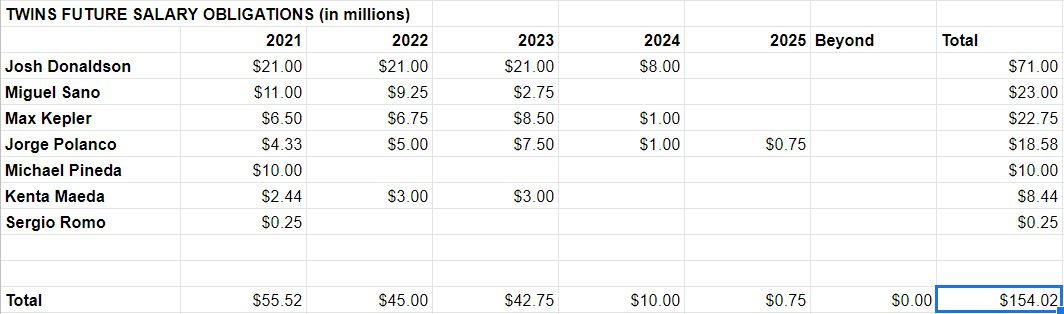
2020 salary terms are set to be hammered out in the coming days. But what about what’s owed to players beyond that point? The near-term economic picture remains questionable at best. That’ll make teams all the more cautious with guaranteed future salaries.
Every organization has some amount of future cash committed to players, all of it done before the coronavirus pandemic swept the globe. There are several different ways to look at salaries; for instance, for purposes of calculating the luxury tax, the average annual value is the touchstone, with up-front bonuses spread over the life of the deal. For this exercise, we’ll focus on actual cash outlays that still have yet to be paid.
We’ll run through every team, with a big assist from the Cot’s Baseball Contracts database. Next up is the Twins:
(click to expand/view detail list)
Twins Total Future Cash Obligation: $154.02MM
*includes buyout of club options
*does not include portion of Kenta Maeda’s 2021 salary owed by Dodgers
*estimated 2021 salary for Michael Pineda (specific contract breakdown unknown)
Which 15 Players Should The Royals Protect In An Expansion Draft?
In a few weeks, we’ll be running a two-team mock expansion draft here at MLBTR. Currently, we’re creating 15-player protected lists for each of the existing 30 teams. You can catch up on the rules for player eligibility here.
So far, we’ve done the Tigers, Indians, White Sox, Rays, Yankees, Red Sox, Blue Jays, and Orioles. The Royals are next.
We’ll start by removing free agents Ian Kennedy, Alex Gordon, and Trevor Rosenthal.
I’ll lock down six players: Jorge Soler, Whit Merrifield, Adalberto Mondesi, Hunter Dozier, Brad Keller, and Salvador Perez. While there’s a case for leaving Perez unprotected, I don’t think the Royals would do that. Here’s the initial protected group:
Jorge Soler
Whit Merrifield
Adalberto Mondesi
Hunter Dozier
Brad Keller
Salvador Perez
That leaves nine spots for the following 25 players:
Chance Adams
Scott Barlow
Danny Duffy
Maikel Franco
Jesse Hahn
Tim Hill
Cam Gallagher
Kelvin Gutierrez
Jakob Junis
Jorge Lopez
Nicky Lopez
Richard Lovelady
Ryan McBroom
Kevin McCarthy
Mike Montgomery
Jake Newberry
Ryan O’Hearn
Brett Phillips
Randy Rosario
Glenn Sparkman
Gabe Speier
Bubba Starling
Josh Staumont
Meibrys Viloria
Kyle Zimmer
With that, we turn it over to the MLBTR readership! In the poll below (direct link here), select exactly nine players you think the Royals should protect in our upcoming mock expansion draft. Click here to view the results.
Former Star & Top Prospect Headline Mets’ DH Options
National League teams didn’t build their rosters with the expectation of a universal designated hitter slot for 2020, but most are capable of filling the job from within. Some teams could really benefit from the anticipated temporoary rule change … among them, the Mets.
The advantage for the New York organization is multi-faceted. It’s not just about stuffing more hitting ability into the daily lineup in the upcoming truncated season, though that’s a factor as well. The DH would also create some important near-term roster flexibility and possibly open additional long-term strategic options.
It really all comes down to two guys: hobbled former superstar Yoenis Cespedes and one-time top prospect Dominic Smith. Without a DH slot, both face questionable roster prospects. Cespedes is working to return from major leg injuries. Nobody really knows how he’ll look at full speed in the outfield grass. Smith is all but fully blocked at first base by emergent star Pete Alonso. The Mets already know how Smith looks in the outfield and would rather not see much more of it.
The Mets are already crossing their fingers with outfield defense. J.D. Davis isn’t exactly a glove-first roster piece. The club will rely upon Brandon Nimmo for most of the action in center field; he’s a palatable but hardly exceptional performer there. Jake Marisnick can cover a lot of ground, but he’ll be a reserve. And Michael Conforto will be an everyday presence in the lineup, so there’s not much space anyway.
Under the circumstances, it’s a bit of a luxury to carry a guy like Smith. But what other choice do the Mets have? He can still be optioned, true, but that’s a heck of a way to treat a guy that turned in an eyebrow-raising .282/.355/.525 batting line in 197 plate appearances over an injury-limited 2019 season. And Cespedes? We don’t know when he’ll be ready, but he has now had ample additional time to work back to full health while the game has been paused. You can safely assume he’ll be clamoring for a return to the MLB roster as soon as possible, particularly with a newly incentive-laden contract and free agency beckoning after 2020.
Somehow fitting both of these guys on the same roster? It’s a bit tough to imagine, but the Mets could possibly make it work since Davis can play in the infield. With a DH slot, it’d at at least be plausible. And that would open the door to a potentially explosive offense, with depth to spare as injuries or performance issues arise. It’s sort of silly to consider these two talented players in a DH platoon, but if it comes to that … well, it’s a first-world problem.
The broader roster management benefits are perhaps even more significant here. Smith needs a full shot at the majors; perhaps the DH will clear a sustainable path for him in the organization or pave the way to an eventual trade. And having that bat-only position to utilize makes it much easier for the Mets to deal with, and even benefit from, the final season of the Cespedes contract.
Indians Have Ample Long-Term Payroll Flexibility
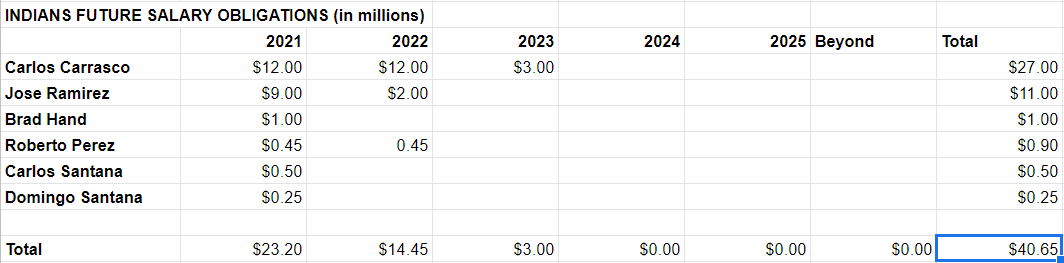
2020 salary terms are set to be hammered out in the coming days. But what about what’s owed to players beyond that point? The near-term economic picture remains questionable at best. That’ll make teams all the more cautious with guaranteed future salaries.
Every organization has some amount of future cash committed to players, all of it done before the coronavirus pandemic swept the globe. There are several different ways to look at salaries; for instance, for purposes of calculating the luxury tax, the average annual value is the touchstone, with up-front bonuses spread over the life of the deal. For this exercise, we’ll focus on actual cash outlays that still have yet to be paid.
We’ll run through every team, with a big assist from the Cot’s Baseball Contracts database. Next up is the Indians:
(click to expand/view detail list)
Indians Total Future Cash Obligation: $40.65MM
*includes buyout of club options
Oakland’s Meager Return For A Superstar
One of the highest-profile trades of the previous decade saw the Athletics send third baseman Josh Donaldson to the Blue Jays for a four-player package consisting of infielders Brett Lawrie and Franklin Barreto, right-hander Kendall Graveman and lefty Sean Nolin in November 2014. The return at the time seemed underwhelming for an Oakland team that was then coming off its third consecutive playoff berth. Donaldson was highly instrumental in the team’s success in two of those last three seasons – he combined for 13.0 fWAR from 2013-14 – and he wasn’t due to reach free agency until after 2017. Even a low-budget club like the A’s should have been able to keep Donaldson in the fold for at least a little while longer, but they decided against it, to their detriment.
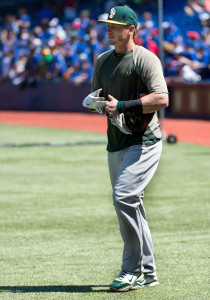
Donaldson, whom many now know as the “Bringer of Rain,” saw his star continue to rise in Toronto. He played for the Jays from 2015-18, during which he slashed .281/.383/.548 (150 wRC+) with 118 home runs and 22.2 fWAR. There were few better major leaguers during that stretch than Donaldson, who took home the AL MVP in 2015 – the first of two straight seasons in which Toronto went to the ALCS. Meanwhile, the A’s won fewer than 70 games in those two years and endured another sub-.500 campaign in 2017 before finally returning to relevance the next season. Oakland has since found its answer at third in the great Matt Chapman.
Despite Chapman’s emergence, has the Donaldson trade been worth it from the A’s standpoint? It doesn’t look like it.
The players Oakland got for Donaldson have combined for 3.8 fWAR in their uniform. Lawrie, once a seemingly can’t-miss prospect, spent one underwhelming season as an Athletic before they traded him to the White Sox in December 2015. Barreto was also considered a superb prospect in his younger days, but the now-24-year-old has done nothing in the majors so far. Graveman was useful with the A’s from 2015-18, during which he turned in 441 1/3 innings of 4.38 ERA ball, but was never more than a back-end starter with the team. He’s now a member of the division-rival Mariners. And Nolin, who only pitched for Oakland during a 2015 season in which he registered a 5.29 ERA over 29 innings, is now with the Seibu Lions of Nippon Professional Baseball.
As of now, it seems fair to call the Donaldson return an enormous disappointment for the Billy Beane-led A’s, who typically know what they’re doing. If there’s one potential silver lining, though, it’s J.B. Wendelken. The righty reliever joined the A’s in a trade with the White Sox for Lawrie in December 2015, and has since turned into a solid reliever. Going back to 2018, Wendelken has logged a 2.55 ERA/3.01 FIP with 8.76 K/9 and 2.55 BB/9 in 49 1/3 innings. Among 523 pitchers whom hitters amassed at least 100 plate appearances against last year, he ranked sixth in expected weighted on-base average (.234), placing him a couple points behind the excellent Josh Hader.
Wendelken hasn’t racked up a large amount of major league experience yet, but if the A’s are going to get anything from deciding to deal Donaldson, he may be their best hope. For the most part, barring a eureka moment for Barreto, the return that Oakland originally received is a lost cause. Donaldson’s still humming along, though. He was good enough as a Blue Jay and then an Indian for the Braves to sign him to a $23MM guarantee going into 2019, and he was so effective in Atlanta last season that Minnesota gave him a four-year, $92MM guarantee over the winter.
Photo courtesy of USA Today Sports Images.
Governors Express Support For MLB’s Summer Return
Today saw a major run of political support for the launch of a big league season. Several big-state governors expressed a willingness to host professional sports in their biggest cities on a timeline that would support MLB’s hopes for an early July launch.
New York governor Andrew Cuomo (via Denis Slattery of the New York Daily News), California governor Gavin Newsom (via Jon Passantino of CNN.com reports on Twitter), and Texas governor Greg Abbott (via Rebecca Hennes of the Houston Chronicle reports) each announced support for a summer return to play. Of course, in all cases the continued threat of the coronavirus will make in-person attendance impossible at the outset.
Television-only baseball isn’t optimal, but it’s certainly a worthwhile goal if it can be accomplished in a manner that accords with overriding public health needs. Opinions vary as to the merits of MLB’s proposals to date, which would rely upon frequent testing of participants and the elimination of certain activities that may carry a greater risk of transmission.
The concern remains that the benefits of staging a campaign don’t outweigh the dedication of resources and added potential for spread of the virus. Given the ongoing debate, this (seemingly somewhat coordinated) series of announcements represents a notable vote of confidence.
“I think this is in the best interest of all the people and in the best interest in the state of New York,” Cuomo said of the return of professional sports. “And then they’ll be up and running and when we can fill a stadium again, we can fill a stadium.”
The increasing likelihood of play resuming also draws more focus to ongoing economic chatter between the league and union. As Ken Rosenthal and Evan Drellich of The Athletic report (subscription link), the standoff on player pay continues as the sides wait for another to blink.
It seems the most immediate dispute is rather narrow — and, frankly, a bit hard to comprehend. Despite publicizing a 50/50 revenue sharing concept — but not ever making clear just what revenue would be shared — the league has yet to formally propose that approach to the players.
At the moment, per The Athletic, the league’s position is that “the union needs to drop its stance that the salary matter is closed before it makes a new proposal.” On the other hand, the MLBPA “does not think it should discuss sacrificing additional pay until the league demonstrates its financial distress.”
This seems either to be a symbolic battle that shouldn’t need to be held or yet another instance of the sides jockeying for technical advantage rather than just diving into the many practical issues that confront them. Either way, there’s obviously a need both for the league to come forward with information regarding “economic feasibility” of fan-free games and for the union to consider whether it is sufficient to justify modification of the pro rata reduction of pay that was already agreed upon.
If the negotiating parties had a greater degree of trust, they probably wouldn’t be grounded on this particular sandbar. There’s so much to lose for all involved that they’ll surely find a way to make progress. But every moment of financial bickering represents a mutual lost opportunity to generate goodwill through the return of the game. And the only lack of trust ramps up the potential risks, given that the league and union are only just beginning to jointly navigate the unknown waters of baseball in the era of the coronavirus.
The 1970s: Ten First Overall Picks, One Hall Of Famer
We have recently been revisiting the No. 1 overall picks from each decade. Having already taken a look at 2010-19, 2000-09, the 1990s and the 1980s, let’s turn our attention to the ’70s. As you’ll see below, when it comes to top overall selections, it was a disappointing decade…
1970 – Mike Ivie, C, Padres:
- There were only two eventual All-Stars from the opening round of the ’70 draft, and Ivie wasn’t one of them (those honors went to Darrell Porter and Bucky Dent). But that’s not to say Ivie didn’t have his moments. He was a 27-home run hitter with the Giants in 1979, and ended up slashing a decent .269/.324/.421 (108 wRC+) with 81 homers and 7.5 fWAR in a combined 2,962 plate appearances with the Pads, Giants, Astros and Tigers from 1971-83. While Ivie was drafted as a catcher, he saw almost no action there in the bigs, instead getting the majority of his reps at first base.
1971 – Danny Goodwin, C, White Sox:
- George Brett (29th) and Mike Schmidt (30th) are among the luminaries from this draft class. But the White Sox went with Goodwin, whom they failed to sign because he chose to play college baseball instead. They weren’t the last team to make the mistake of taking him at No. 1. More on that later.
1972 – Dave Roberts, 3B, Padres:
- No, not the current Dodgers manager, who also happens to be an ex-Padres player and skipper. Aside from pitcher, the Dave Roberts who went No. 1 played every position on the diamond during his career from 1972-82, but he never provided the Padres, Rangers, Astros or Phillies much value as a hitter. Roberts batted .239/.286/.357 (81 wRC+) with 0.6 fWAR in 2,189 trips to the plate.
1973 – David Clyde, LHP, Rangers:
- Clyde garnered tons of hype coming out of high school, but injuries played a role in what became a letdown of an MLB career. He appeared with the Rangers in five different seasons and only managed a 4.63 ERA with 4.93 K/9 against 3.89 BB/9 over 416 1/3 innings. Clyde went two picks before Robin Yount and three ahead of Dave Winfield. Yount and Winfield are now in the Hall of Fame.
1974 – Bill Almon, SS, Padres:
- The Padres had three of the first five No. 1 overall picks of the ’70s, but none of them turned out particularly well. Almon had a long career – he played with San Diego, the White Sox, Oakland, Pittsburgh, the Mets, Philadelphia and Montreal from 1974-88 – but hit a meek .254/.305/.343 (82 wRC+) with 2.5 fWAR in 3,659 PA. The Padres chose Almon four picks before the Braves hit a home run (398 of them, to be exact) with Dale Murphy at No. 5.
1975 – Danny Goodwin, C, Angels:
- You have to be a pretty good prospect to go No. 1 twice in a half-decade, but Goodwin never made a mark in the majors. The former catcher spent just about all of his time in the field as a first baseman and hit .236/.301/.373 (84 wRC+) with minus-1.2 fWAR across 707 PA among the Angels, Twins and Athletics. If it’s any consolation for the Angels, not one of that year’s other 23 first-rounders ever made an All-Star team.
1976 – Floyd Bannister, LHP, Astros:
- Bannister enjoyed a nice career with the Astros, Mariners, White Sox, Royals, Angels and Rangers from 1977-92, during which he combined for a 4.06 ERA and 30.8 fWAR in 2,388 innings. He was a one-time All-Star during that run; notably, he’s the father of Brian Bannister, who also pitched in the majors. Brian’s now the director of pitching for the Giants.
1977 – Harold Baines, OF, White Sox:
- Baines is the lone Hall of Famer in this group, though there has been plenty of debate over whether he should actually be in Cooperstown. Regardless, you can’t deny Baines put up a far better career than most who have set foot on an MLB diamond. As a member of several teams (mostly the White Sox) from 1980-2001, Baines batted .289/.356/.465 (119 wRC+) with 389 homers and 38.4 fWAR in just under 11,100 PA.
1978 – Bob Horner, 3B/1B, Braves:
- Horner had an odd career, but it was a pretty solid one. After posting a line of .278/.339/.508 (127 wRC+), hitting 215 homers and recording 19.4 fWAR in Atlanta from 1978-86, he left to play in Japan in ’87. Horner was tremendous that year with the Yakult Swallows, but he returned stateside the next season to join the Cardinals. Horner struggled then, though, and it proved to be his last season. Years later, he was a key figure in a fight against MLB owners’ collusion.
1979 – Al Chambers, OF, Mariners:
- The last No. 1 selection of the decade didn’t live up to the pick at all. Chambers totaled a meager 141 PA in the majors, all with the Mariners from 1983-85, and hit .208/.326/.292 (77 wRC+) with two HRs and minus-0.5 fWAR.
Tigers Have Just One Guaranteed Contract Beyond 2020 Season
2020 salary terms are set to be hammered out in the coming days. But what about what’s owed to players beyond that point? The near-term economic picture remains questionable at best. That’ll make teams all the more cautious with guaranteed future salaries.
Every organization has some amount of future cash committed to players, all of it done before the coronavirus pandemic swept the globe. There are several different ways to look at salaries; for instance, for purposes of calculating the luxury tax, the average annual value is the touchstone, with up-front bonuses spread over the life of the deal. For this exercise, we’ll focus on actual cash outlays that still have yet to be paid.
We’ll run through every team, with a big assist from the Cot’s Baseball Contracts database. Next up is the Tigers … whose list features just one man but a fair bit of money:
(click to expand/view detail list)
Tigers Total Future Cash Obligation: $102MM
*includes buyout of 2024 club option over Miguel Cabrera
*2024-25 club options over Cabrera ($30MM apiece) vest with top-10 finish in 2023 MVP voting
