
NL East Notes: Braves, Kimbrel, Nationals, Harper, Mets
While it’s still pretty early in Spring Training, the Braves have already been hit with a notable number of players battling injury issues. Jeff Schultz of The Athletic (links to Twitter) has a rundown of today’s updates, including the worrisome news that A.J. Minter left today’s outing after just one batter due to shoulder tightness. Beyond Minter, Dansby Swanson was scratched from today’s lineup due to continued soreness in his left wrist. The Braves also continue to ease Josh Donaldson into action after Donaldson missed much of the 2018 season due to a calf injury. Donaldson’s spring debut may still be at least “a couple of more days” away, as Atlanta manager Brian Snitker told reporters, though Snitker admitted “I don’t even know when he’s gonna play.”
The Braves already have Mike Soroka, Kevin Gausman, and Luiz Gohara dealing with shoulder soreness, while Mike Foltynewicz missed a recent start due to a sore elbow. With the possible exception of Soroka, none of these maladies seem overly concerning yet, though the sheer volume leads to inevitable speculation about how the Braves could make additions to bolster their roster of arms. Minter’s injury could be of particular import, given how the back end of Atlanta’s bullpen already has closer Arodys Vizcaino trying to bounce back from an injury-marred 2018. MLB.com’s Mark Bowman writes that the Braves have yet to have “any serious discussions” with former closer Craig Kimbrel, who is still focused on landing a long-term contract while the team has only thus far been open to signing Kimbrel to a shorter-term pact.
The latest from around the NL East…
- Speaking of Kimbrel, ESPN.com’s Buster Olney (Twitter link) hears from rival evaluators who wonder if the Nationals could make a play for the star closer. Washington is no stranger to high-profile bullpen signings, and while Sean Doolittle has pitched very well as the team’s closer, Doolittle has had his share of injury problems over the years. Inking Kimbrel would put the Nationals over the luxury tax threshold for the third straight season, and if ownership had reluctance over paying a higher tax bill, the Nats might have to move some salary in order to fit Kimbrel into the mix. Signing a free agent who rejected the qualifying offer (as Kimbrel did) would also cost the Nats its third- and sixth-highest picks in the 2019 draft. As Olney notes, the Nationals might not mind surrendering even more picks in order to make a real splurge, as the team has already lost its second- and fifth-highest draft selections (plus $1MM of international draft pool money) by signing another QO free agent in Patrick Corbin.
- Deferred money has long been a staple of the Nationals‘ contract negotiations, as several notable players (i.e. Max Scherzer, Stephen Strasburg, Corbin, Anibal Sanchez, Brian Dozier) in recent years have signed deals with the team that include significant amounts of salary to be paid out over long stretches of time. Scherzer’s deal contains $105MM in deferred money, for example, while Strasburg’s $175MM extension with the Nats contained $70MM in deferrals that will be paid out to Strasburg from 2024-30. While Scherzer, Strasburg, and Bryce Harper are all represented by Scott Boras, Barry Svrluga of the Washington Post wonders if the Nationals’ deferral-heavy strategy might have cost them a chance at Harper. Roughly a third of Washington’s reported ten-year, $300MM offer to Harper last fall was reportedly set to be paid out in deferred money for decades to come, possibly until Harper was close to 60 years old. This type of long-term payment isn’t something that appeals to every player, making Svrluga wonder if Anthony Rendon would be comfortable with deferred money as the star third baseman continues his own extension talks with the Nationals.
- The Mets have hired Rafael Perez the team’s director of international operations and Luis Marquez as their new director of international scouting, Jacob Resnick and Michael Mayer of @Metsmerized report (via Twitter). Perez is a familiar name in New York’s front office, as he is returning to the same position he previously filled from 2005-11. Marquez also previously worked for the Mets as an international scout from 2008-11.
Latest On MLB-MLBPA Rules Negotiations
TODAY: There has been “significant progress” between the league and the MLBPA about these potential rule changes, The Athletic’s Ken Rosenthal writes (subscription required). Since these changes have garnered support on both sides, they are seen as “win-win” developments that can be handled in the shorter-term, as opposed to a larger re-opening of the Collective Bargaining Agreement as a whole. In regards to the much more complicated matter of discussing financial issues, MLB and the players’ union are “proceeding with the understanding they would discuss broader economic concepts sometime after Opening Day,” Rosenthal writes.
WEDNESDAY: Major League Baseball has brought the MLB Players Association a new package proposal of potential rules changes, ESPN.com’s Jeff Passan reports.
The sides have been going back and forth on potential tweaks over recent months, all while trading barbs on a variety of matters. There are indications, per Passan, that this latest effort represents a compromise vision that could lead to an eventual deal.
MLB’s new proposal features a willingness to push back the implementation of a pitch clock until after the current CBA expires, per the report. Commissioner Rob Manfred has the power to implement the clock unilaterally but is evidently willing to utilize it as a bargaining chip. It remains to be seen whether the players will make concessions in other areas to oppose such an unpopular but financially neutral rule change.
Other aspects of the proffered approach are at least as notable. Passan says the league would like to implement:
- single trade deadline of July 31st
- three-batter minimum per pitcher (by 2020)
- 26-man roster (by 2020) and 28-man September roster (with 13 and 14-pitcher limits)
- 15-day injured list and 15-day minimum optional assignment
- further limitations on mound visits, position-player pitching, and time between innings
The proposal also contemplates joint studies on more extensive rule changes. Some of the more exotic concepts are due for real-world testing in the Atlantic League. Per J.J. Cooper of Baseball America, the indy ball outfit is slated to function as a laboratory for robot umps and a moved-back mound. The agreement covers other areas as well. Of particular note, Trackman is coming to the Atlantic League.
Mike Trout Downplays Interest In Spring Contract Talks
3:15PM: Trout provided some clarification in a follow-up comment to Torres (Twitter link), saying that his original statement “didn’t mean” he would be holding off extension talks until next offseason.
11:17AM: On the heels of Bryce Harper‘s deal with the Phillies, Angels superstar Mike Trout was asked today about his own contract situation. Though he’s still two years away from the open market, there has been no shortage of speculation about the possibility of the Halos pursuing another extension with the game’s greatest current player.
Trout’s comments may not have closed the door to talks, but they were anything but a positive sign for those who’d like to see a deal come together. When asked by Maria Torres of the Los Angeles Times (Twitter link) whether he’d like to work on a new contract, Trout responded:
“With spring training you want to get ready for the season. You don’t wanna worry about anything else.”
There are several ways to take that sort of comment, to be sure. It’s oblique enough that it arguably shouldn’t be taken to signify much of anything. Then again, Trout has to this point been fastidiously non-committal regarding his future (or even the possibility of near-term talks). And the stakes are high, as this offseason provided a potential window for the Halos to secure the franchise’s greatest-ever player for the long run.
There’s no necessary rush for the Angels, who can explore talks next fall. Trout enjoys no-trade protection and there’s zero indication that the Angels have any interest in dealing him regardless. With Trout already slated to receive $33.25MM in each of the next two seasons and plenty already in the bank, he’s unlikely to grant much of a discount.
Still, the clock is ticking on Trout’s tenure with the club. If indeed talks aren’t to be held in earnest this spring, that leaves the 2019-20 offseason as perhaps the only remaining realistic extension window. Trout is said to be focused on playing for a winning team; the Halos have missed the postseason in each of the past four seasons and have an at-best-uncertain outlook for the coming campaign. Today’s comments probably don’t represent a major change in the situation, but they do serve to highlight what’s at stake in the near future for the Angels organization.
Blue Jays To Sign Bud Norris
TODAY: The deal is now official, MLB Network’s Jon Heyman tweets. The contract contains an opt-out clause for Norris on March 21.
THURSDAY, 5:45pm: Norris would earn $3MM upon making the roster and can pick up another $1.25MM via incentives, per Robert Murray of The Athletic (Twitter link).
4:35pm: It’s a minor league deal for Norris, according to Shi Davidi of Sportsnet (Twitter link).
4:22pm: The Blue Jays have agreed to terms on a contract with free-agent right-hander Bud Norris, reports Craig Mish of SiriusXM (via Twitter). Norris is represented by the Ballengee Group.
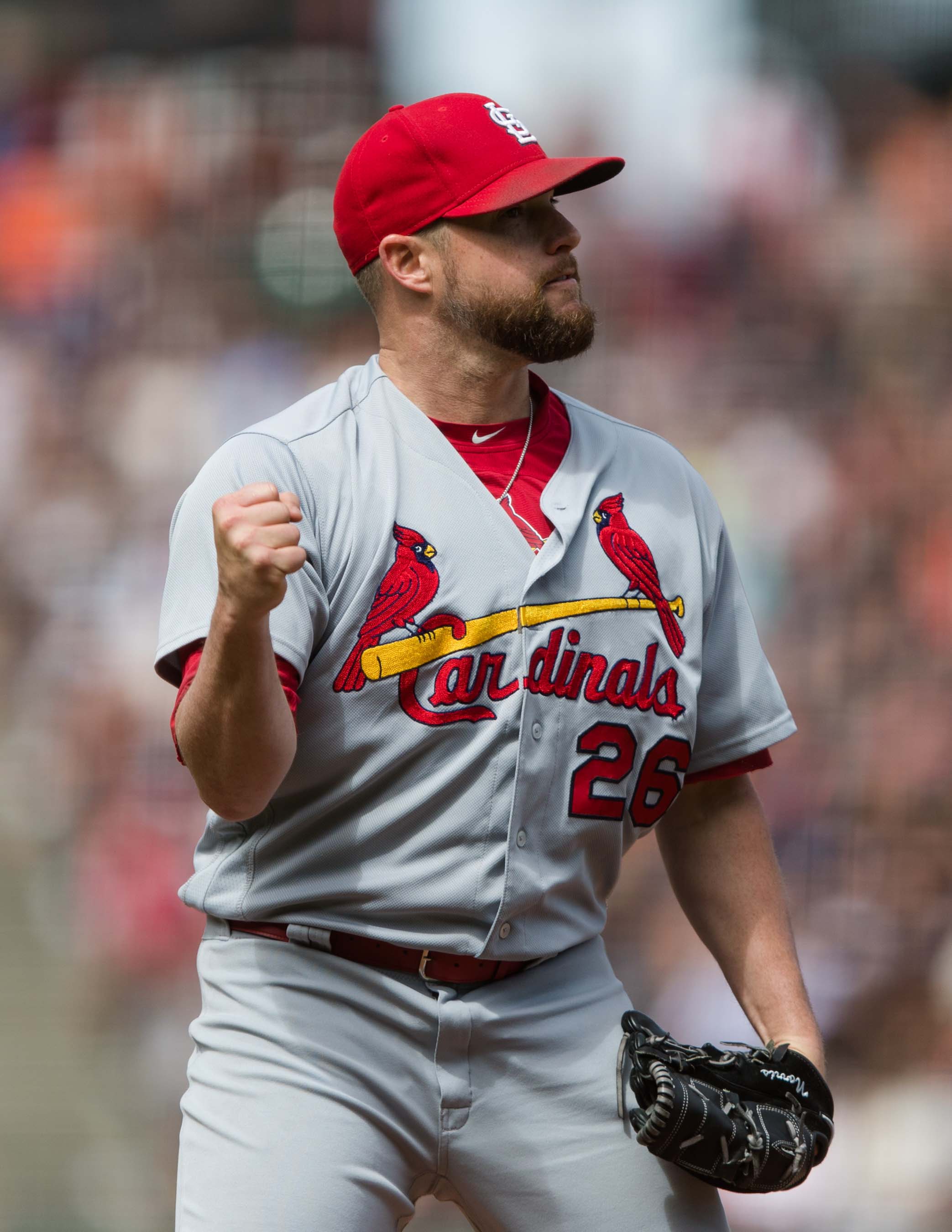
Norris, who’ll turn 34 over the weekend, turned in a solid season with the Cardinals in 2018, working primarily as the closer in St. Louis. Over the life of 57 2/3 innings, the righty turned in a 3.59 ERA with 10.5 K/9, 3.3 BB/9, 1.25 HR/9 and a 42.6 percent ground-ball rate. Fielding-independent metrics like FIP (3.99), xFIP (3.65) and SIERA (3.30) all felt that he was a generally solid bullpen piece with an ERA that was largely reflective of his overall performance.
Norris enjoyed a second consecutive season with a swinging-strike rate of 12 percent or better — the first two such campaigns of his career — and he induced swings at pitches outside the strike zone at a career-best 35.9 percent clip, as well. That mark tied him for 18th among 151 qualified relievers, while Norris registered a career-high 94.6 mph average fastball.
Looking back to Norris’ 2017 campaign, his results in terms of fielding-independent metrics, strikeout rate, ground-ball rate and swinging-strike rate were nearly identical to the marks he posted in 2018. Over those two seasons, he’s combined for 47 saves between the Angels and Cardinals. However, despite the resurgence he’s enjoyed as a reliever, the veteran nonetheless had to settle for a non-guaranteed pact. He’s far from the only veteran who’s had to do so this offseason on the heels of a solid campaign, but it still looks to be a quality low-risk pickup for a Blue Jays club that has ample room to add a veteran arm to its relief corps.
General manager Ross Atkins said early in February that his club’s focus from that point forth would be on pitching acquisitions, and Norris stands out as one of the clear best arms remaining on the relief market. He’ll slot into a late-inning mix that features Ken Giles and Ryan Tepera, with other relief options like David Paulino, Joe Biagini, fellow non-roster invitee John Axford and Rule 5 pick Elvis Luciano all vying for jobs in rookie manager Charlie Montoyo’s bulllpen.
MLBTR Chat Transcript: Harper Fallout, Extensions, Spring Trades?
Click here to read a transcript of today’s chat with host Jeff Todd.
Padres Sign Adam Warren
The Padres have inked reliever Adam Warren, per a club announcement. It’s a one-year deal with a club option. Warren, a client of Full Circle Sports Management, is promised $2.5MM on the contract, per Jon Heyman of MLB Network (Twitter links). That includes a $2MM salary for 2019 and a $500K buyout on a $2.5MM option.
Southpaw Jose Castillo was placed on the 60-day injured list to create roster space. He is dealing with a flexor strain that is obviously considered a fairly significant malady.
Outside of a forgettable 2016 run with the Cubs, Warren has steadily produced good results at the MLB level. All said, he has thrown 463 2/3 innings of 3.42 ERA pitching. Warren carries only 7.8 K/9 in the aggregate, but he had boosted his strikeout numbers over the past two years — at least, that is, until he was dealt to the Mariners in the middle of the 2018 season. Warren racked up 11.1 strikeouts per nine in his first thirty frames of the year but dropped back to 6.2 K/9 down the stretch in Seattle.
Warren projects as another solid arm within a Padres bullpen that was already one of the team’s strengths in 2018. Led by Kirby Yates and Craig Stammen, San Diego’s relief corps has added a pair of notable veterans in the last two weeks, between Aaron Loup and now the Warren signing. Warren has pitched as a multi-inning reliever in the past, and perhaps could even be deployed as an “opener” should San Diego choose to adopt that strategy.
Pirates Claim Jake Barrett
The Pirates have claimed right-handed reliever Jake Barrett, Andrew Baggarly of The Athletic tweets. Barrett had recently been designated for assignment by the Giants. Chad Kuhl was moved to the Pirates’ 60-day injured list in a corresponding move; Kuhl will likely miss the season after undergoing Tommy John surgery last September.
Barrett finds himself with his third different organization in under a month. After the Giants acquired him from the Diamondbacks in early February, Barrett then entered DFA limbo once again after San Francisco claimed Hanser Alberto.
The 27-year-old righty will now vie for a job in Pittsburgh’s bullpen this spring, following a season that saw him toss just seven MLB innings for Arizona. Barrett posted solid numbers (3.49 ERA, 2.00 K/BB rate, 8.5 K/9 over 59 1/3 innings) in his 2016 season, but has been less effective ever since, appearing in just 35 total games for the D’Backs in 2017-18 and posting a 5.03 ERA over 34 frames.
Orioles Claim Hanser Alberto, Designate Donnie Hart
The Orioles have claimed infielder Hanser Alberto off waivers from the Giants, per a club announcement. Southpaw Donnie Hart was designated for assignment to clear roster space.
If you’re keeping score at home, this is now the fourth time Alberto has been designated and claimed this winter — and the second time by the O’s. The Baltimore org had recently dropped him from the 40-man in order to claim lefty Josh Osich from the Giants, who in turn claimed (and have now waived and lost) Alberto.
In retrospect, perhaps it’d have all been easier had the O’s dropped Hart in the first place. Perhaps the team’s evaluation of the 28-year-old — and/or its non-Alberto infield assets — has changed in the meantime.
Hart has appeared in each of the past three MLB campaigns, working to a 3.43 ERA in 81 1/3 innings with 6.0 K/9 and 3.4 BB/9 along with a 52.6% groundball rate. He was knocked around in his twenty appearances in the majors last year, though he did manage 41 frames of 2.41 ERA ball at Triple-A.
MLBTR Poll: The Bryce Harper Contract
It’s not the biggest-ever salary promise if you account for inflation, but Bryce Harper‘s reported deal with the Phillies does have the highest number ever attached to a big league guarantee: $330MM. The star slugger took a discounted annual rate of pay over 13 seasons to get there. Lacking an opt-out and with full no-trade rights for the player, Harper is rather likely (though hardly assured) to remain in Philadelphia until the end of the 2031 season.
We ran through some of the post-signing reporting on the deal this morning. You’ll find some key details on the negotiations there. Harper’s value has been debated endlessly, of course. Ultimately, the market gave us an answer. But it’s one that many find unappealing, either on the high or low side. For a contract that has been this long in the making — many looked forward to Harper’s free agency before he even signed his first professional contract with the Nationals — it seems worthy of a poll.
How would you characterize the Harper deal? (Link for app users.)
What Did The Phillies Get In The Bryce Harper Deal?
-
an overpay 49% (11,646)
-
a fair market price 34% (8,108)
-
a bargain 16% (3,795)
Total votes: 23,549
Notes & Observations From The Bryce Harper Deal
“Harper’s Bazaar” has reached a conclusion. The Phillies reached an agreement to sign Bryce Harper to a 13-year, $330MM contract that now stands as the largest fully guaranteed contract in all of professional sports. While the journey to this terminus was tedious (surely even more so for those involved than for those of us following at a distance), it would appear that Harper and Boras ultimately met the goals they set out to achieve.
Boras, speaking to Joel Sherman of the New York Post (all Twitter links), made clear that Harper’s goal all offseason was to secure the longest contract possible. “Bryce wanted one city for the rest of his career,” said Boras. “That’s what I was instructed to do. It is very difficult in this time to get length of contract that takes a player to age 37, 38, 39.” That difficulty led to a trade-off in terms of annual value. Boras added that the hitter-friendly nature of Citizens Bank Park and owner John Middleton’s commitment to the courtship process both helped to sway Harper as well.
Here’s more:
- One notable aspect of Harper’s deal was the lack of a player opt-out clause — a contract term that has largely become a standard feature of big deals. Boras went on record with Tom Verducci of SI.com on this point, saying that his client “refused to allow me” to negotiate an opt-out because he wanted “to be with one team.” While some may raise an eyebrow when hearing an agent suggest that his client didn’t want an opt-out clause in the contract, Harper’s former manager, Dusty Baker, suggested the same thing in a recent interview on MLB Network Radio on SiriusXM (Twitter link, with audio). “I’ve been told that he wants to be a free agent one time in his career, so I’m sure that’s probably got a lot to do with his decision,” said Baker. If you’re looking for a broad narrative account of Harper’s market experience — with loads of intriguing details and Boras’s commentary on many aspects of the deal and process — you’ll want to give Verducci’s piece a full read.
- Talks between the Phillies and Harper’s camp escalated so rapidly on Thursday morning that general manager Matt Klentak didn’t even have time to get to the team offices, per Todd Zolecki of MLB.com. According to Zolecki, Klentak closed out the negotiations alone from his condo. Zolecki details some of the many twists and turns negotiations took this weekend, noting that at one point, because the Phillies were worried about losing Harper to a shorter-term deal with a record-shattering average annual value, they put forth three separate offers: a short-term deal with that same type of AAV, a “mid-term” deal and the 13-year, $330MM offer to which Harper eventually agreed. Tacking on those final three seasons without actually upping the $330MM guarantee many expected it’d take to sign Harper was indeed a means of lowering Harper’s luxury tax hit to provide future flexibility when constructing rosters.
- The Giants‘ top offer to Harper checked in at a hefty $310MM over a 12-year term, as first reported by Alex Pavlovic of NBC Sports Bay Area (via Twitter). The Giants would’ve been willing to go higher, according to Pavlovic, but they’d have had to push their final offer quite a ways north of $330MM given the discrepancy between taxes in California and taxes in Pennsylvania. At the end of the bidding, Boras asked the Giants to top the winning bid “by at least $20 million,” per Andrew Baggarly of The Athletic (subscription link). San Francisco was long rumored to be interested in Harper only on a short-term pact, though it appears that the team did indeed step up and make a larger push for Harper in the late stages of negotiations. Notably, as Baggarly reports, team CEO Larry Baer says that it was president of baseball ops Farhan Zaidi — not ownership — that “was the leading advocate for Harper.” While the Giants entered the fray relatively late in the game, Baer says the club’s interest emerged after Zaidi had spent time evaluating his resources and watching the market develop.
- Meanwhile, USA Today’s Bob Nightengale reports that the Dodgers never really deviated from their insistence on a short-term deal (Twitter link). Per his report, though, Los Angeles put forth offers with enormous annual values — a three-year, $135MM pact ($45MM AAV) and a four-year, $168MM offer as well ($42MM AAV). That’s contrary to what Ken Rosenthal of The Athletic reported (subscription link); his sources indicate that the Dodgers were “well below $40 million” in annual value in their bidding. It’s worth noting that Boras, in his previously mentioned comments to Sherman, flatly indicated that he received offers of $45MM in AAV (without specifying the source) and stated that Harper had a “full buffet” from which to choose. MLBTR’s Tim Dierkes opines (via Twitter), that the Dodgers “went overboard” with their insistence on a short-term deal in not even showing a willingness to pay Harper into his age-30 or age-31 season on a five- or six-year contract. It seems fair to say, too, that Harper also made a bold choice in his own right by turning down those fantastical annual salaries — if indeed they were on offer.
- While many will tab the contracts given out to Harper and Manny Machado as overpays, Eno Sarris of The Athletic argues to the contrary, calling each deal a relative bargain (subscription required). Looking at long-term projection models for each player’s production, Sarris concludes that the Phillies are effectively paying Harper at a $/WAR valuation that starts at $6MM in the first year of the contract (and increases from there with inflation). That, he notes, was considered the going rate for a win in free agency more than a decade ago (in 2008). As Sarris notes, projection systems are hardly flawless, and the same goes for the dollars-per-win argument. However, he also notes that when factoring inflation into the equation, the Harper and Machado contracts don’t rank anywhere near the top of the scale in terms of present-day dollars despite the fact that MLB revenues are higher than ever. (To that end, I’ll point out that Harper’s AAV is scarcely even higher than the $25.2MM annual value achieved by Alex Rodriguez with the Rangers nearly 20 years ago.)