
Quick Hits: Ichiro, Orioles, Duffy, Twins
Ichiro Suzuki‘s agent, John Boggs, tells Barry Bloom of MLB.com that he’s still holding out hope that the 44-year-old will land an offer from a big league club this offseason rather than return to Japan. Boggs had talks with both the Mariners and Padres, but neither of those now looks likely to come to fruition. He also notes that he’d spoken to the Mets before they signed Jay Bruce, as well as the Reds when they were more heavily exploring the market for Billy Hamilton. Boggs tells Bloom that there are still a half-dozen teams that continue to tell him to check back later in the winter once it’s clearer how the market will play out, but it remains unclear whether Ichiro will have a legitimate opportunity to return for an 18th Major League season.
A few other notes as another quiet week of free agency nears its conclusion…
- Though the stagnant offseason has been frustrating across the board, it may be particularly exhausting for Orioles fans, as the club is known to be looking for two or three starters, an outfielder, a utility infielder and some catching depth. Roch Kubatko of MASNsports.com writes that all of that is still in the works, and he spoke with manager Buck Showalter about the team’s offseason pursuits at length. Showalter suggests that the O’s are “down the road real deep on a lot of guys,” adding that GM Dan Duquette has discussed “offers and physicals” with one particular right field target. Showalter adds that a Chris Tillman reunion remains possible. The free agent has been working out at the Orioles’ spring complex in Sarasota, Fla. — a favor granted by the team to their longtime rotation stalwart.
- Royals left-hander Danny Duffy has pleaded guilty to driving under the influence after initially filing a plea of not guilty upon being cited for a DUI last August, according to the Kansas City Star’s Rustin Dodd. The 29-year-old has been placed on probation and must refrain from drinking and using illegal drugs over the course of a one-year term. He’ll be subject to random breath, blood and urine tests as part of his probation, Dodd adds.
- The Twins have hired three-time All-Star Jim Kaat as a special assistant in their front office, the team announced. The 79-year-old Kaat enjoyed an excellent 25-year career, starring for the Senators/Twins franchise in 15 of those seasons (3.34 ERA, 133 complete games, 23 shutouts over the life of 3014 1/3 innings). He joins Twins legends Rod Carew, Tony Oliva, Tom Kelly and Kent Hrbek in a role that will see him “engage in various Twins community and business initiatives both in Minnesota as well as Southwest Florida,” per the Twins’ press release announcing the hiring.
NL West Notes: Reynolds, Giants, Tomas
First baseman Mark Reynolds is hoping to return to the Rockies in 2018, but he’s seeking a big league deal this time around after playing his way onto the team on a minor league pact last season, he tells Patrick Saunders of the Denver Post. “I talked with the Rockies during the winter meetings and Jeff (general manager Jeff Bridich) told me that they had to take care of the bullpen and then see what the money situation was,” says Reynolds. “So now I’m waiting to see what happens.” The 34-year-old Reynolds hit .267/.352/.487 with 30 homers for the Rox last season, though there was a glaring 275-point difference between his OPS at home (.978, 21 homers) and on the road (.703, nine homers). Power is Reynolds’ biggest attribute, but it’s a tough selling point at a time when home runs were hit at an all-time high in 2017.
More from the division…
- Alex Pavlovic of NBC Sports Bay Area tackled some questions from Giants fans. The outfield remains a key point of focus, of course. With Andrew McCutchen expected to play every day in right, Austin Slater could share time in left with Hunter Pence while also picking up some action in center, says Pavlovic. That doesn’t mean the team is bowing out of the pursuit of another up-the-middle player, of course — or that Slater has locked up a roster spot. (He’ll be competing in camp with Jarrett Parker, Mac Williamson, and Gorkys Hernandez.) There’s one other notable name to consider in the internal mix. But as Pavlovic wrote yesterday, the San Francisco front office seems inclined to take its time with center fielder Steven Duggar. “This is a time of year when you would rather have Duggar in your back pocket and bring in a center fielder that allows us to have more time,” GM Bobby Evans explains. Of course, the club has little wiggle room if it hopes to stay under the luxury tax line; it remains to be seen just how the outfield mix will look when camp opens.
- Diamondbacks outfielder Yasmany Tomas is facing charges after he was clocked by police driving at high rates of speed, as MLB.com’s Steve Gilbert reports. Tomas, who was reportedly driving at 105 mph, was initially charged with reckless driving and criminal speeding. While the incident evinces poor judgment on the part of the 27-year-old, thankfully it is said not to have involved drugs or alcohol. It’s not the best start to the new year for Tomas, who is looking to bounce back from an injury-plagued 2017 season in which he struggled when he was on the field.
Latest On Julio Pablo Martinez
The market for top Cuban free agent Julio Pablo Martinez has begun to take shape, according to Ben Badler of Baseball America. Martinez has yet to receive signing clearance, but Badler notes it’s anticipated he will be officially named a free agent before the conclusion of the current July 2nd period.
If Martinez does indeed become eligible to sign before June 15th, he’ll have the open of signing either in the current or the ensuing period. That will help open up his options a bit.
Of the three teams that Badler tabs the leaders, one — the Rangers — might utilize its 2017-18 pool money to make a deal with Martinez. (As Badler explains, Texas will need to use or lose its remaining spending availability, which at last glance sat at about $3.53MM.) The others — the Yankees and Marlins — would almost certainly view Martinez as a major part of the 2018-19 signing class.
Martinez, 21, is considered one of the best young talents from his baseball-loving home nation. Badler provides all the necessary details about his profile in the above link. In brief, Martinez is a fleet-footed center fielder with some pop. Notwithstanding an eye-popping 30:52 K/BB ratio in his last 264 plate appearances in Cuba’s top league, Martinez is said to possess more palatable than great plate discipline abilities.
All said, Martinez seems to be a legitimately interesting prospect asset. Unlike many of the more youthful Latin American players that sign as bonus-limited international amateurs, he may actually not be that far off from the majors. Of course, he’ll still need to refine his skills and prove he’s worthy of a crack at the game’s highest level. Regardless, Martinez ought to represent an intriguing new addition for whatever organization signs him.
Giants Acquire Engelb Vielma
The Giants have acquired infielder Engelb Vielma from the Pirates, John Dreker of Pirates Prospects reports on Twitter. Rob Biertempfel of the Pittsburgh Tribune-Review first tweeted that Vielma was on the move; he had been designated for assignment recently.
This’ll be Vielma’s second stop in San Francisco — on paper, at least. He is one of several names that has already bounced from roster to roster via minor trades and the waiver wire this winter, as typically occurs for players that are on the margins of 40-man roster viability. For Vielma, this is the fourth time he has changed hands since September.
Whether the 23-year-old will end up sticking with the Giants organization remains to be seen. The club could still expose him to waivers again in an attempt to stash him as a non-roster player. Even if he makes it into camp on the 40-man, Vielma will no doubt need to show he’s worthy of continuing to occupy a roster spot.
Known as a high-end defender who can handle shortstop, Vielma has not yet demonstrated that he’ll hit much when he ultimately reaches the game’s highest level. He was placed on the Twins’ 40-man to protect him from the Rule 5 draft in advance of the 2017 season, but went on to slash just .229/.273/.280 in 455 total plate appearances split between Double-A and Triple-A.
Pitch Clock Likely For 2018 Despite Ongoing Disagreement Between MLB, MLBPA
Pace of play has been one of the chief initiatives for MLB commissioner Rob Manfred since he succeeded Bud Selig, with a pitch clock among the potential rules changes most frequently discussed in recent months. Today, both Ken Rosenthal of The Athletic (subscription required/recommended) and Jerry Crasnick of ESPN.com are reporting that the Major League Baseball Players Association is expected to reject Manfred’s latest pace-of-play proposal, but that Manfred will likely exercise his power to unilaterally implement the new measure despite a failure to reach agreement with the union.
In a follow-up (Twitter links), Rosenthal says the union has in fact “formally rejected” the league’s proposal, but that Manfred will meet with MLBPA chief Tony Clark next week to negotiate further. Jeff Passan of Yahoo Sports has obtained the memorandum on the subject issued by the commissioner’s office. He details the league’s intentions — including timing rules for pitchers and hitters along with limitations on mound visits — as well as the compromise provisions that had been floated (and could, perhaps, still be discussed).
The reports indicate that a variety of pacing measures will go into effect in 2018, with a 20-second pitch clock perhaps the most visible and notable among them. Pitch clocks aren’t exactly new, as MLB has been experimenting with their use in the minor leagues by way of a 22-second pitch clock. If it does go into effect as the reports suggest, the rule would charge pitchers with a ball if they take more than 20 seconds between pitches (after one warning per game). Hitters, meanwhile, would be required to adhere to a 30-second timer between batters; after a warning (one per game), they would presumably be charged with a strike. Another set of rules would provide that a second mound visit to a given pitcher in the same inning must result in his removal from the game. In addition, future efforts would control the amount of time between innings and the number and length of pitching warm-ups, though that does not appear to be on the docket for the upcoming season.
Understandably, players aren’t particularly excited by the notion of feeling rushed or of rules impacting the count and, perhaps, the outcome of a given plate appearance. Indeed, one player involved in the negotiations tells Rosenthal that he’s never seen players so unified against an issue. Both Rosenthal and Crasnick suggest that the players feel pace of play can be enhanced by making improvements to the instant replay system and more closely monitoring down time between innings — neither of which would require a clock that would limit them on the field. The sentiment appears to be the exact opposite among MLB owners, as Rosenthal reports that they’re “strongly in favor” of the pace-of-play initiatives that the commissioner’s office is pursuing.
Disagreement over pace-of-play efforts won’t do any favors for labor relations. Though the league and union only recently struck a new, five-year collective bargaining agreement, there already appears to be a growing sense of unrest as players and agents alike look for explanations for an unfathomably slow free-agent market (at least for players other than relievers).
Of course, just what has led to the plodding (a perhaps generous choice of adjective) pace of the free-agent market isn’t entirely clear. Theories abound, ranging from the extent of penalization under the luxury tax, to a plethora of Scott Boras clients holding up the market, to a more general sense of groupthink among like-minded general managers that all value players in similar fashion. Some have speculated about the possibility of collusion, though the league has, to no surprise, steadfastly denied and dismissed the very notion — even going so far as to obliquely, and somewhat bizarrely, place the blame on Boras in a statement to Yahoo’s Jeff Passan. (We discussed the situation at length here.)
The proposed pace-of-play changes would hardly be the first significant alterations to the fabric of the game in recent years. The implementation of instant replay itself was and still is a rather polarizing topic, while MLB has also instituted rules to protect middle infielders from injury when turning double plays and to protect catchers at home plate in situations that would previously have resulted in violent collisions. More recently, MLB has eliminated the process of lobbing four pitches outside the strike zone on intentional walks, instead allowing managers to grant a free pass by making a signal to the umpires, and mandated that batters remain in the batter’s box between pitches.
Changes to the game are often met with resistance from fans and players alike. Rosenthal, however, notes that Manfred cites focus groups and surveys in emphasizing that younger fans are “alienated” by the game’s slow pace. That notion may well be true, though there are some counterpoints to his argument. It’s fair to wonder whether trimming a few seconds off the time between pitches and/or a few minutes off the average game would really impact interest levels enough to matter. Moreover, the implementation of additional change creates the risk of turning away dedicated fans who worry that alterations may unduly alter the nature of the game.
Clearly, Manfred and his charges feel that the possibility of converting younger patrons is worth the effort despite backlash from current fans and MLB players. As Rosenthal notes, however, the players’ decision to reject the proposal would grant them absolution in the event that the new rules flop or are received even more poorly among fans than expected — which could put them in a stronger position when negotiating rule changes in future offseasons.
Rangers Sign Curt Casali
The Rangers have announced the signing of catcher Curt Casali to a minors deal with an invitation to participate in MLB Spring Training. He had recently been released by the Angels after previously signing with that organization earlier in the winter.
Texas also announced that it will bring back outfielder Jose Cardona and righty Tayler Scott. Both also have minors deals with spring invites.
The 29-year-old Casali could battle with Juan Centeno, Brett Nicholas, and Mike Ohlman for the reserve job behind regular Robinson Chirinos. The losers of that fight, presumably, will line up as organizational depth or land with other organizations.
Casali has racked up 19 home runs in 466 career MLB plate appearances — all coming with the Rays in the past four seasons — but also carries a .285 on-base percentage at the game’s highest level. He’s a .246/.349/.352 hitter in 739 career plate appearances at Triple-A.
Of course, a variety of defensive attributes are often deemed most important for reserve catchers. Casali is generally considered a sturdy all-around asset behind the dish. He has graded well as a framer and has succeeded in cutting down would-be base stealers in the majors.
The 23-year-old Cardona reached the upper minors for the first time last year but managed only a .277/.316/.385 slash in 465 Double-A plate appearances. He became a minor-league free agent at the end of the year but will return to the only professional organization he has known.
Scott, 25, landed with the Rangers last season in the deal that sent Jeremy Jeffress to the Brewers. He was bombed in his 13 appearances at Triple-A, but had been more successful with the Brewers and could yet contribute at some point as a releiver.
Nationals Sign Howie Kendrick
JANUARY 18: Washington has announced the signing.
JANUARY 15, 2:14pm: Ken Rosenthal of The Athletic reports that the two sides have reached an agreement, pending a physical (Twitter links). The contract contains an additional $2.25MM worth of incentives that can be unlocked based on plate appearances.
10:01am: The Nationals are nearing a deal with infielder/outfielder Howie Kendrick, according to Bob Nightengale of USA Today (via Twitter). The prospective contract would promise the Reynolds Sports Management client $7MM over two years.

If the contract is finalized, Kendrick will return to the place that he thrived in a late-season stint in 2017. His role is not immediately clear, but odds are he’ll see time around the infield as well as the corner outfield. Most importantly, perhaps, adding Kendrick will help the Nats ease the burden on All-Star second baseman Daniel Murphy as he returns from microfracture surgery.
In the aggregate, bringing back Kendrick at this price tag seems to make quite a lot of sense for the Nats. He represents a quality reserve and insurance policy at every position but short and center (along with the battery, of course). Star third baseman Anthony Rendon has had his share of nicks over the years. Outfielder Adam Eaton is returning from ACL surgery, so Kendrick can help reduce his wear-and-tear as well. Kendrick’s righty bat is a natural platoon match with Eaton and fellow corner outfielder Bryce Harper, each of whom hits from the left side, so he can readily spell either over the course of the season.
[RELATED: Updated Nationals Depth Chart]
MLBTR had predicted that Kendrick would get a two-year pact, but at a loftier overall guarantee ($12MM). That reflected not only his long history of solidly above-average production, much of it as a regular at second base, but also a quality output in the 2017 campaign. While he was banged up at times, Kendrick produced on both sides of the mid-season swap that sent him to Washington from the Phillies, ending the year with an overall .315/.368/.475 batting line through 334 plate appearance. And Kendrick has a lengthy record of durability before that.
Between 2010 and 2014, Kendrick functioned as the Angeles’ everyday second bagger. He thrived without standing out in any one area, averaging a .288/.332/.420 batting line with 11 homers and twelve steals per year while generally grading as a plus in the field. After moving to the Dodgers in 2015, though, Kendrick’s defensive grades at his accustomed position slipped. That spurred a move to the corner outfield, where he has been viewed as a roughly average performer, in a 2016 season that was Kendrick’s worst at the plate since he established himself as a big leaguer.
While the 2017 campaign represented something of a return to form, then, expectations will remain in check. Kendrick is already 34 years of age, after all. With the various cracks that have formed in his game, it’s not surprising to see him sign into a situation where he won’t be expected to play every day.
Entering the winter, the Nats justifiably felt most of the pieces were in place for a strong 2018 roster. Even while exploring larger moves — none of which has yet come to fruition — the team has steadily added role players over the course of the winter. Kendrick joins reliever Brandon Kintzler as a 2017 deadline acquisition who was brought back, while the team slotted Matt Adams in as its reserve first baseman and lefty bench bat. Upgrading the catching situation stands out as a remaining possibility, while both the rotation and relief unit could surely still be improved as well.
Photo courtesy of USA Today Sports Images.
MLBTR Chat Transcript: Yelich, Mets, Ellsbury, Shaw, More
Click here to read a transcript of today’s chat with host Jeff Todd.
Minor MLB Transactions: 1/18/18
Here are the day’s minor moves from around the league…
- The Padres announced a slew of non-roster invitees, including right-hander Michael Mariot and catcher Raffy Lopez, each of whom has prior Major League experience. Mariot, 29, last saw time in the Majors back in 2016 when he tossed 21 2/3 innings for the Phillies. He’s struggled to a 5.98 ERA with 8.2 K/9 against 5.1 BB/9 in 49 2/3 MLB innings to date, though he has a vastly superior 3.34 ERA with 9.5 K/9 and 3.2 BB/9 in 240 innings of Triple-A work. Lopez, meanwhile, picked up a career-high 63 plate appearances with the Blue Jays last season, hitting .222/.306/.463 in that brief time. The 30-year-old is a career .267/.342/.380 hitter in 877 plate appearances at the Triple-A level.
- First baseman Jonathan Rodriguez has a minor league deal with the Marlins, according to Anthony Fenech of the Detroit Free Press (Twitter links). The 28-year-old spent the 2017 season in the Twins organization, hitting .309/.414/.525 with 21 homers, albeit in Double-A against much younger and less experienced competition. Rodriguez has yet to reach the Majors and only has 165 career plate appearances in Triple-A.
Pirates Extend Felipe Rivero
Jan. 18: The Pirates have formally announced the extension.
Jan. 15: The Pirates have agreed to a four-year deal with closer Felipe Rivero, reports Ken Rosenthal of The Athletic (on Twitter). The deal, which will buy out all of Rivero’s arbitration seasons, is believed to guarantee Rivero about $22MM in total, per Rosenthal. It also contains a pair of club options over what would have been his first two free-agent seasons. Interestingly, Rosenthal notes that it’s unclear if an agency was involved in the negotiations. Rivero had recently hired Scott Boras to represent him, though this is the type of extension to which the Boras Corp is typically averse.
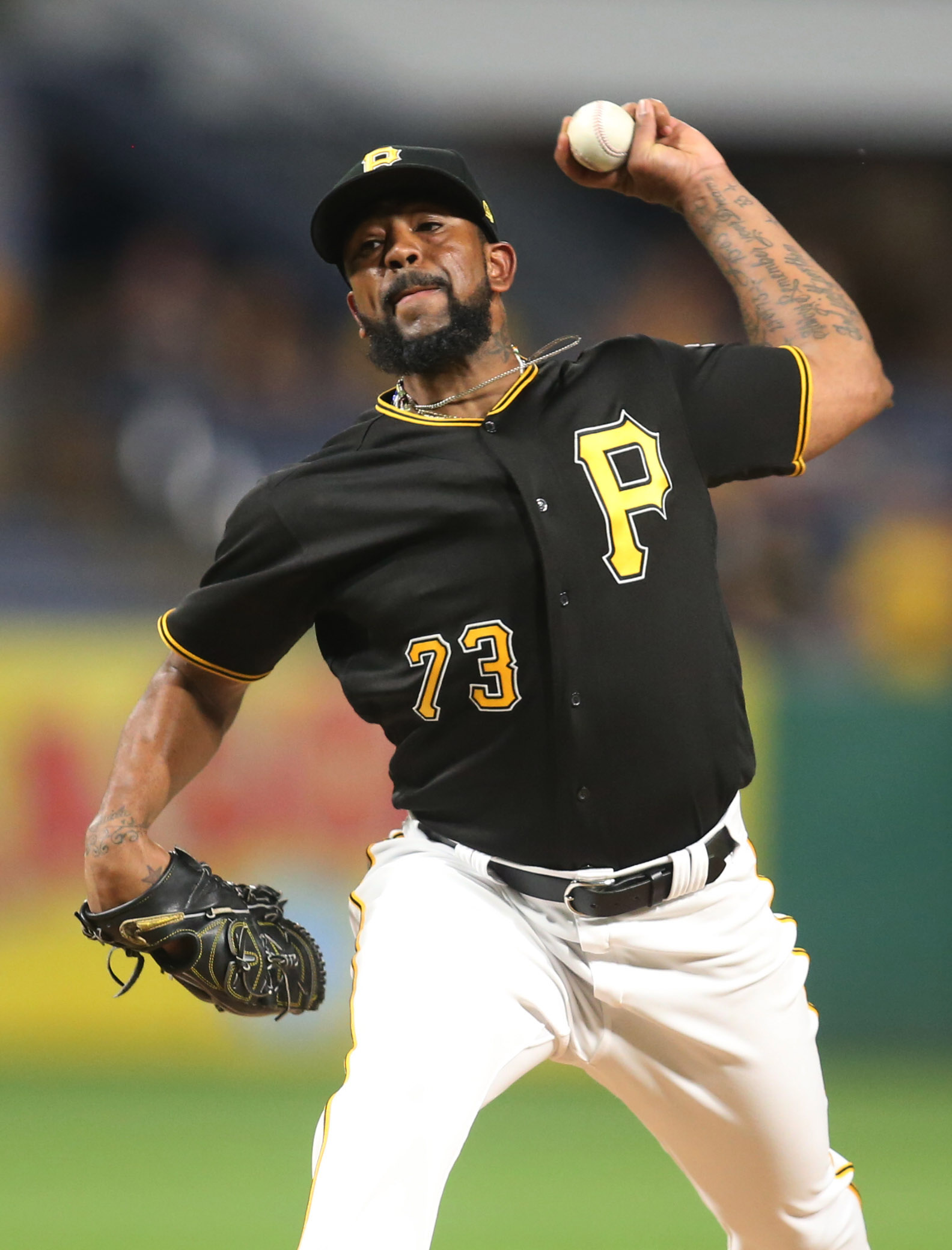
USA Today’s Bob Nightengale tweets that Rivero will earn $2.5MM in 2018, $4MM in 2019, $5.25MM in 2020 and $7.25MM in 2021. The deal also comes with a $2MM signing bonus, and his contract contains a pair of $10MM options for the 2022 and 2023 seasons. The 2022 option comes with a $1MM buyout, and the 2023 option has a $500K buyout. In all, that totals the $22MM sum Rosenthal suggested, though the contract would top out at $41MM over six years should both options be exercised.
Certainly, the timing of the deal comes as something of a surprise. The Bucs, in the past week, have traded longtime top starter Gerrit Cole to the Astros and shipped face of the franchise Andrew McCutchen to the Giants in exchange for righty Kyle Crick and outfield prospect Bryan Reynolds.
The Rivero deal, though, serves an indicator that the Pirates aren’t necessarily eyeing a full tear-down of the roster but are instead intent on turning some (relatively) high-priced and short-term assets into controllable pieces in an effort to manage payroll and re-establish a core of cost-effective young parts. It’s understandably not a popular approach among Pirates fans, but it’s a reality the Bucs have had to accept under current ownership and with one of the league’s worst TV contracts (which reportedly affords them only about $20MM annually — though that deal is nearing its expiration).
In some respects, the timing of these moves is reminiscent of the Pirates’ salary dump of Francisco Liriano, which was quickly followed up by an extension for veteran third baseman David Freese. The long-term deal for Rivero may ever so slightly lessen the sting of losing both McCutchen and Cole in the eyes of Pirates fans, though it’s nonetheless a difficult sequence of events for Pittsburgh faithful to stomach.
While the extension for Rivero technically does enhance his trade value, it now seems unlikely that he’ll be moved anytime in the near future. The Bucs now have cost certainty over Rivero for more than half a decade, and his salary won’t even climb higher than $6MM until the 2021 campaign. The Pirates can assuredly hang onto Rivero for the foreseeable future and be confident that he’ll retain plenty of trade value, barring a massive injury or unforeseen decline.
The latter of those two scenarios seems unlikely, as Rivero has looked legitimately dominant since being acquired in the 2016 deadline trade that sent Melancon to the Nationals. (A trade that, much like Pittsburgh’s recent trades, emphasized MLB-ready talent with extended team control.) In 102 2/3 innings with the Pirates, Rivero has worked to a pristine 2.10 ERA with 11.1 K/9, 3.3 BB/9, 0.6 HR/9 and a grounder rate right around 50 percent. Rivero’s swinging-strike rate jumped to an enormous 15.8 percent, and his average fastball checked in north of 98 mph.
His extension comes on the heels of a similar deal for the Padres’ Brad Hand, another southpaw closer, though Rivero’s $22MM guarantee tops the $19.75MM that Hand pulled in, and the two are in different service classes. Rivero’s deal, it seems, is a record for a pitcher in his service class and is the fourth-largest ever agreed to by a reliever at any point in the arbitration process, trailing only Craig Kimbrel, Brad Lidge and Huston Street (MLBTR Extension Tracker link). Of course, that’s largely because relievers are volatile enough that teams don’t often make them the target of long-term deals in their pre-arb and early arb years.
While the contract’s standing in historical context is among the strongest for an arb-eligible reliever, it nonetheless stands out as a strong deal for the Pirates. It’s not uncommon for upper-tier relievers to clear $10MM annually in their final years of arbitration, but Rivero will make a combined $12.5MM in his final two arb years.
Rivero figures to continue to hold down the ninth inning for the Pirates, anchoring a relief corps that features Daniel Hudson, George Kontos and A.J. Schugel. Pittsburgh’s bullpen will also very likely feature newly acquired righties Michael Feliz (picked up in the Cole trade) and Kyle Crick (McCutchen trade), and there’s room for further additions of the Pirates feel there’s value remaining on the free-agent market for relievers.
Photo courtesy of USA Today Sports Images.