
Dodgers Designate Joe Gunkel For Assignment
The Dodgers have designated Triple-A right-hander Joe Gunkel for assignment, reports J.P. Hoornstra of the Southern California News Group (Twitter link). His 40-man spot will go to vaunted prospect Cody Bellinger, who will make his Major League debut tonight in left field for the Dodgers. To clear a spot for Bellinger on the 25-man roster, the Dodgers optioned outfielder Brett Eibner back to Triple-A Oklahoma City, per Andy McCullough of the Los Angeles Times (Twitter link).
Gunkel has a solid minor league track record, having tossed 104 1/3 innings with a 2.59 ERA, 6.0 K/9 and a strong 1.3 BB/9 rate for the Orioles’ Double-A affiliate in 2015. The 2016 season wasn’t as strong for Gunkel, though he did still post a 4.02 ERA with 6.1 K/9 against 1.2 BB/9 in 161 innings between Baltimore’s Double-A and Triple-A affiliates. Baltimore designated Gunkel for assignment earlier this month to clear a spot on the roster for hard-throwing reliever Miguel Castro after picking him up from the Rockies. Shortly thereafter, he was flipped to the Dodgers for cash or a player to be named later.
Dodgers To Promote Cody Bellinger
The Dodgers will promote top prospect Cody Bellinger, according to MLB.com’s Ken Gurnick (via Twitter). The 21-year-old will provide a left-handed-hitting option at first base and the corner outfield, though it’s unknown how long he’ll remain in the majors.
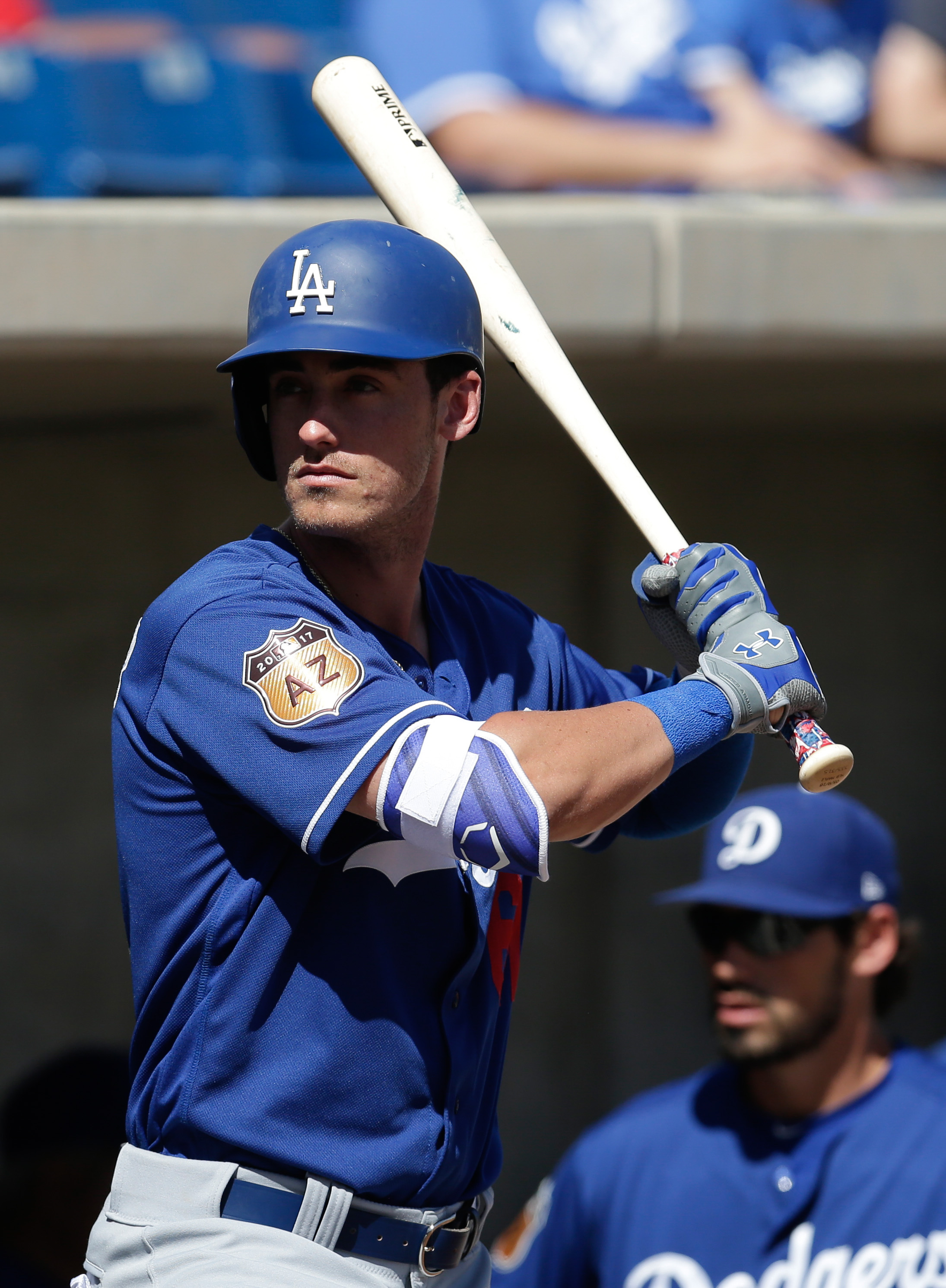
Bellinger flew up top prospect charts with a strong 2016 season, in which he slashed .271/.365/.507 over 477 plate appearances, the vast bulk of them coming at Double-A. After an excellent stint in the Arizona Fall League, Bellinger sat at seventh among all prospects leaguewide in the ranking of Baseball America.
Since that time, Bellinger has taken Triple-A by storm. Through 77 trips to the plate, he owns a .343/.429/.627 batting line with five home runs and seven steals. Adding him to the active MLB roster, though, will require the creation of a 40-man space.
The Dodgers fielded trade inquiries on the blue-chip prospect over the winter, as they have recently for other hyped youngsters such as Corey Seager, Julio Urias, and Joc Pederson. But Los Angeles has held firm on those players, all of whom will now have reached the majors. With Pederson on the DL, a need arose for another outfield bat, and it’ll be Bellinger who gets the call — at least temporarily. As Andy McCullough of the Los Angeles Times tweets, Bellinger is expected to see time in left and center.
Looking longer term, Bellinger’s promotion comes late enough into the season that his path to free agency would be delayed by one year, but not so late that he’d avoid Super Two status. If Bellinger remains in the Majors to stay, he’d accrue 159 days of Major League service time, putting on track to reach arbitration after the 2019 season and free agency upon completion of the 2023 campaign.
Photo courtesy of USA Today Sports Images.
MLBTR Chat Transcript
Click here to read a transcript of today’s chat with MLBTR’s Steve Adams.
Braves Designate Chase d’Arnaud, Select Lane Adams
The Braves have designated infielder Chase d’Arnaud for assignment, according to David O’Brien of the Atlanta Journal-Constitution (via Twitter). Atlanta has summoned outfielder Lane Adams from Triple-A to take the roster spot.
d’Arnaud, 30, has bounced around the league over his six seasons in the majors, but received his most extensive action yet last year with the Braves. Over 262 plate appearances, he slashed .245/.317/.335. While he had managed three hits and two walks in his ten trips to the plate thus far in 2016, the Braves evidently elected to go in another direction for the time being.
The 27-year-old Adams has seen the majors, but only briefly. He was off to a strong start at Triple-A, though, with a .333/.352/.588 slash line — but also 16 strikeouts against just a pair of walks — over his 54 plate appearances. He’ll join Emilio Bonifacio in the reserve outfield mix, though it’s also possible that the former could see more action in the infield with d’Arnaud’s departure from the roster.
Marlins “Moving Forward” With Jeter/Bush Group
The Marlins are “moving forward” in negotiations with the would-be ownership group headlined by Derek Jeter and Jeb Bush, according to Barry Jackson of the Miami Herald (links to Twitter). The organization is said to be “optimistic” that a deal will be reached to transfer control from current owner Jeffrey Loria to Bush, who’d be the new control person, and the four other members of the group. It’s said to be an “agreement in principle” that sets a $1.3B purchase price.
This report follows some conflicting signals sent throughout the day. Earlier, a report suggested that the Jeter/Bush group was the only possible bidder left due to a lack of interest. But even that group was said not to have submitted a firm offer, with financing still in the works. Marlins president David Samson flatly rejected this report, saying it was strewn with errors but declining to specify or correct them.
Later, Scott Soshnick of Bloomberg reported that the Jeter/Bush group had “won the auction” for the organization — which presents quite a different picture of the entire process. In addition to framing it as an “auction” for the first time, this report says that there were multiple other bidding groups, including one headed by businessman Wayne Rothbaum and another led by Tagg Romney (which included Hall-of-Fame hurler Tom Glavine). When asked to respond, Samson stated that he would not offer any comment, as Tim Healey of the Sun-Sentinel tweets.
Notably, none of the reports suggest that any paperwork has been signed. It’s important to bear in mind, too, that even in the event that a preliminary agreement is struck, it would still be subject to a lengthy finalization process — between the parties and also involving authorization from Major League Baseball.
Central Notes: Cards, Hosmer, Rodon, Nova
The broad health arena appears to offer great potential for competitive advantage to individual MLB organizations. We have heard of medical and dietary advancements for various teams, for example, and there’s surely lots going on that isn’t being discussed fully in public. For the Cardinals, one area of focus is on training, but it’s all happening as part of a broader initiative, as Derrick Goold of the St. Louis Post-Dispatch writes. The club is building up a “department of performance” that will combine training, medical, and other related functions under one roof.
Here’s more from the game’s central divisions:
- Royals first baseman Eric Hosmer tells Rustin Dodd of the Kansas City Star that he’s not looking for changes to break out of his early-season slump. “I know I’ve been through it long enough now to realize you’ve just got to stick with your approach and it will change,” said Hosmer. Of course, the 27-year-old’s offensive malaise ties into a broader picture of uneven production over his seven-year MLB career, which has continued to raise questions about his earning power on the upcoming free-agent market. And as Dodd writes, Hosmer has several teammates who are also struggling quite a bit early on. If there’s a silver lining to the club’s 7-and-12 start, though, it’s the fact that the division leaders haven’t exactly sprinted out of the gates. Entering today’s action, the Indians and Tigers sit just 3.5 games up.
- The White Sox were able to get a look at lefty Carlos Rodon yesterday, as he played catch under the watch of pitching coach Don Cooper, as Dan Hayes of CSN Chicago writes. But that doesn’t mean there’s any further clarity to the question of when the talented southpaw will be back to the majors. Details are murky on Rodon, whose biceps injury initially seemed minor. As Hayes notes, the club had initially hoped to see Rodon push past 200 frames this year, but that’s obviously no longer a viable target.
- As righty Ivan Nova continues to produce good results for the Pirates, Ken Davidoff of the New York Post looks at why things didn’t quite turn out that way when he was pitching for the Yankees. Though Nova did have his share of success in New York, he was dealt last summer on the cusp of free agency and re-signed in Pittsburgh after eleven impressive outings. He doesn’t blame the Yankees’ handling for his uneven stint there, but does say that a lack of confidence in his standing in his old organization was partially at fault. “It’s very different when you know that you’re going to pitch every five days, that’s for sure,” says Nova. He continued to explain that he previously would worry about being dropped to the bullpen or Triple-A, explaining: “It wasn’t because they told me what’s going to happen after. It was something I put in my mind. It was my mistake, my fault, to think that way instead of keeping positive all the time.”
Latest On Marlins’ Sale Efforts
12:32pm: Marlins president David Samson calls the Forbes story “inaccurate,” as Clark Spencer of the Miami Herald writes, though he did not provide details on bidding parties.
11:56am: Casting doubts on recent reports of keen interest from multiple bidding groups, Mike Ozanian of Forbes writes that the Marlins are currently drawing attention from just one potential suitor. And even that group — a team of investors led by Derek Jeter and Jeb Bush — has only yet made a “non-binding indication of interest” and is still hunting for cash to support a bid.
According to Ozanian, other potential bidders have not continued their initial pursuit of a deal with current Marlins owner Jeffrey Loria. Former hurler Tom Glavine was said to have joined forces with Tagg Romney (Mitt’s son), but that pairing has apparently fizzled already. That’s particularly problematic, per the report, since the group held out the promise of bringing a significant amount of cash to the table.
We have heard talk at times of at least one more possible challenger to take the reins in Miami. But Ozanian says that interest has also seemingly dried up beyond the two recognizable bidding groups noted above. There’s doubt, it seems, as to where an alternative to the Jeter/Bush team might come from.
If there’s truly just one passable pursuer of the organization, that surely doesn’t bode well for Loria’s sale price. As the report notes, there already seems to have been a precipitous fall in the numbers being discussed publicly. Just ten weeks ago, the club was said to be headed for a $1.6B sale.
Red Sox Place Pablo Sandoval On 10-Day DL
1:00pm: Manager John Farrell provided some details in an appearance on MLB Network Radio on Sirius XM, as Evan Drellich of CSNNE.com recounts. The injury was to the “medial side of the right knee,” said Farrell, who says that significant swelling forced the DL move. It is still not known how long of an absence is to be expected.
11:07am: The Red Sox have placed third baseman Pablo Sandoval on the 10-day DL with a right knee sprain, the club has announced. He’ll be replaced by infielder Josh Rutledge, who has been activated from his own DL stint.
Sandoval, 30, has produced uneven results thus far upon returning from a long layoff. Through 67 plate appearances, he is hitting .213/.269/.377 with three home runs. And there are some questions about his glovework, with four errors on his ledger and poor grades from advanced metrics (in quite a small sample).
Still, there are some reasons for hope with the bat. Sandoval’s .164 isolated slugging mark matches his work from 2012, which would seem to be a positive development. But it remains to be seen whether he can right the ship in the on-base department. Sandoval is suffering from a .217 BABIP despite making plenty of hard contact, though his strikeout rate is up to 19.4% on a 14.6% swinging-strike rate — well above his career figures in both areas.
While Boston will be glad to get Rutledge back, the hope had been to see both players on the roster at the same time. The switch-hitting Sandoval has continued to struggle badly against left-handed pitching, making the pair a theoretically useful platoon match. (Rutledge hits from the right side, though he hasn’t carried noticeable splits historically.)
Instead, the Sox will lean on Rutledge — along with left-handed-hitting utilityman Marco Hernandez — to cover third base during Sandoval’s absence. It’s not clear at this point just how long the organization expects to be without the veteran.
Transactions Retrospection: The Ryan Howard Extension
On April 26, 2010, Ryan Howard was a star. For four consecutive seasons, the Phillies first baseman had landed in the top five of the National League MVP voting and swatted over forty home runs. With the Phils in the midst of a five-year run of dominance, the sides linked up on a five-year, $125MM extension.
It’s easy to mock that contract now, with the Phillies still paying down the final portion of it — a whopping $10MM buyout of a $23MM option for the 2017 season. Perhaps the organization believed at the time of the signing that the $13MM decision would be an easy one, but surely since-departed GM Ruben Amaro Jr. did not expect it would be so obvious to say goodbye to (rather than retain) the slugger.
With Howard now looking to make his way back to the majors on a minor-league deal with the Braves, his huge contract is no longer weighing down the Phillies. Instead, it serves mostly as a cautionary tale.
It’s easy to go overboard in criticizing the Howard contract, because we know what became of it. Though he continued to hit at an above-average rate in 2010 and 2011, while playing out the remainder of his arbitration-eligible seasons (which had been bought out under a prior extension), the actual years covered by the five-year deal were a disaster. From 2012 through 2016, Howard averaged 19 home runs annually while slashing a miserable .226/.292/.427.
But that outcome surely wasn’t the expected one at the time of the signing. Howard hadn’t yet suffered a devastating Achilles injury. His K/BB numbers hadn’t eroded to the point that they would. (In fact, he had posted 15% or better walk rates in two full MLB seasons — 2006 and 2007 — and had to that point never ended a full year with less than a 10.7% walk rate.) The swing-and-miss was always there, but Howard hadn’t yet seen his chase rate jump suddenly (it topped 30% in 2010 and kept going up from there).
That is to say: the Phillies weren’t wrong in assessing that Howard was a heck of a player. He was! And he gave them 64 dingers and a .265/.350/.497 batting line over the next two seasons, helping the organization to two more postseason berths. That sort of reduced-but- still-useful production might’ve continued had Howard not blown out his Achilles in making the last out of the club’s stunning 2011 NLDS exit.
Of course, while the Howard extension perhaps turned sour quicker than might’ve been anticipated, that doesn’t mean it was well-conceived. Even at his best, Howard was an extremely limited player; at the time of the deal, he was already thirty years old. And the real sin was committed in making the deal so far in advance of Howard’s free agency, at the end of his peak, and in expectation of a longer run of organizational success than could be sustained. This wasn’t exactly unforeseeable, either. As MLBTR’s Tim Dierkes wrote at the time: “The length makes this an unnecessary risk, and at $25MM a year the Phillies didn’t get a discount for taking the gamble and locking him up two years before free agency.”
The Phillies did not come up with a favorable bounce on their ill-advised dice roll. That’s clear. And the deal ended up costing the organization quite a bit of money that could have been reallocated — perhaps, to other players who might’ve helped extend the contention window. (Or, perhaps to other players who might’ve been signed to unwise contracts that would have deepened the eventual financial hole.) But here, too, it’s best to avoid dramatizing the impact. When the Phillies began dismantling their once-great core, Howard’s contract meant that he’d stay on — eventually becoming the lone remaining relic. But it’d be a bit of a stretch to say that the deal impacted the team’s recent decisionmaking, or changed the timeline for a hoped-for return to contention. The delayed rebuilding launch surely wasn’t driven by this one contract.
For the Phillies, the Howard contract proved to be something like the cost expended on a fancy diamond ring in a relationship that ultimately falls apart. When put in perspective, it’s hardly the thing that stings the most. And eventually, you can look back on it all with fondness despite the hard times. By the end, Howard was even able to be seen once more as a proud part of a golden era for the franchise. The Phillies organization will no doubt remember him just that way for decades to come … with the front office also constantly reminding itself of the lesson paid for in his contract.
Minor MLB Transactions: 4/24/17
Here are the day’s minor moves from around the league…
- Mariners righty Jonathan Aro has been hit with a 50-game suspension for an unspecified violation of the Minor League Drug Prevention and Treatment Program, per an announcement. Unlike some recent suspensions, the sanction was not tied to performance-enhancing drugs, making it seem likely that Aro’s suspension relates to a drug of abuse. The 26-year-old reliever had been outrighted off of the 40-man roster previously. He has seen 11 innings of MLB action over the past two years, but has spent the bulk of his time since the start of 2015 pitching in the upper minors. In 88 Triple-A frames, Aro owns a 2.86 ERA with 8.0 K/9 against 2.0 BB/9.
- The Padres announced that they have recalled outfielder Jabari Blash from Triple-A. With Travis Jankowski hitting the 10-day DL owing to a bone bruise on his right foot, the club was in need of another option in the outfield. The 27-year-old Blash has continued to punish pitching at the highest level of the minors, though it remains unclear how long a look he’ll get at the MLB level. For now, at least, he’s holding onto a 40-man spot and will get at least a brief shot to return to active duty in the majors.
- The Twins will select the contract of right-hander Nick Tepesch from Triple-A Rochester prior to tonight’s game, two sources tell Mike Berardino of the St. Paul Pioneer Press (Twitter links). Minnesota recently optioned fifth starter Adalberto Mejia to Triple-A and placed long reliever Justin Haley on the 10-day DL, so Tepesch could conceivably fill either of those spots (though the Twins already made a pair of corresponding roster moves, recalling Kennys Vargas and Buddy Boshers). The 26-year-old Tepesch inked a minor league deal with Minnesota this offseason and has fired 18 innings with a 2.00 ERA and a 17-to-4 K/BB ratio so far in Triple-A. In 223 Major League innings — most of which came with the Rangers when Twins GM Thad Levine was an assistant GM in Texas — Tepesch has a 4.68 ERA with 5.5 K/9, 2.9 BB/9 and a 43.5 percent ground-ball rate. The corresponding 25-man and 40-man roster moves for Tepesch’s arrival remain unclear.