
Judge Rules In Orioles’ Favor In MASN Dispute
New York Supreme Court Judge Lawrence Marks has ruled in favor of the Orioles and against the Nationals in a long-running dispute relating to the rights fees owed to the latter team by the jointly-owned Mid-Atlantic Sports Network (MASN). (Hat tip to James Wagner of the Washington Post, on Twitter.) MASN, which is controlled and majority-owned by the Orioles, brought the lawsuit to challenge an arbitration award that purported to settle the annual television broadcast fees owed by the network to the Nationals (who own a minority share of MASN).
Today’s ruling vacates that award. If the decision is upheld on appeal, it would require the parties to renegotiate and/or re-arbitrate the rights fees. Importantly, the decision does not address the underlying substantive dispute, let alone decide that in favor of the Orioles/MASN.
The root of the dispute dates back to the dealmaking that paved the way for the Expos-turned-Nationals organization to move to D.C. The Orioles opposed the intrusion on their market, of course, and the compromise ultimately included a deal in which the O’s would maintain a significant ownership percentage of MASN.
Annual fees for the Nationals’ broadcast rights were also covered in the resulting set of contracts, with the first several seasons’ fees pre-established at fairly low rates. Pursuant to the agreement, the annual rights value was to be re-negotiated after 2011 (and every five years thereafter) to arrive at a fair market value of those rights.
When that negotiation failed, the arbitration was initiated, with the Orioles proposing a $34MM payout for 2012 and the Nationals requesting $109MM. The panel hearing the case was a league committee known as the Revenue Sharing Definitions Committee (RSDC). Its members, at the time, were Rays owner Stuart Sternberg, Pirates president Frank Coonelly, and Mets COO Jeff Wilpon. MLB itself, including now-commissioner Rob Manfred, also played a major role in the arbitration.
The panel ultimately decided upon a $53MM rights fee value for the 2012 season, which would rise steadily to $66MM in 2016 (thus covering the five-year period in question). But it held off on formally issuing its decision for about two years, allowing then-commissioner Bud Selig to attempt to work out a compromise, which (per the ruling) would have involved a $1B+ sale of MASN to Comcast (which obviously never occurred). In the meantime, MLB fronted the Nationals the difference between the fees they were receiving from MASN and the value that the panel had determined.
A formal decision was issued on June 30 of last year, and the Orioles instituted the present litigation shortly thereafter. Baltimore challenged a number of aspects of the arbitration, including the involvement of the league at the time and its decision to advance money to the Nationals.
Though overturning an arbitration award is an exceedingly difficult task, the court sided with MASN and the Orioles. Interestingly, though, none of the above factors played into the decision, which focused on the highly deferential standard of review and noted that the agreement had contemplated an “inside baseball” arbitration panel.
The ultimate basis cited by the court in vacating the award — and the issue that will presumably be tested on appeal — is the involvement of the law firm Proskauer Rose LLP. Not only was Proskauer representing the Nationals in the arbitration, the court explained, it was currently representing Major League Baseball in numerous other matters — with four particular attorneys sharing responsibility for both clients. Though MASN and the Orioles repeatedly raised this issue, the panel didn’t take “any step at all” to deal with the potential bias that resulted.
Applying the relevant standard of “evident partiality,” the court determined there was sufficient cause to overturn the decision of the panel. Judge Marks explained (quoting a prior case): “[T]his complete inaction objectively demonstrates an utter lack of concern for fairness of the proceeding that is ‘so inconsistent with basic principles of justice’ that the award must be vacated.”
The actual basis for the ruling is important in several regards. For one, it narrows the issues to be addressed on appeal, though the Orioles could attempt to challenge the judge’s refusal to offer relief on the other grounds argued. (Notably, the court noted in its ruling that the factual setting it considered was without precedent, making this case ripe for consideration in an appellate proceeding.) And it also leaves open the possibility that the parties could return to the same panel that decided the dispute in the first place in a second arbitration.
All said, the ruling represents a significant victory for the Orioles’ side of things — in large part because of the leverage it gives the organization in negotiations. Continued litigation and re-arbitration will, obviously, be quite expensive. And the Nationals now have no argument to demand immediate payment of a vacated award, keeping the cash in Baltimore’s pocket. It’s notable, also, that the original five-year rights fee period is now almost up, meaning the parties will soon need to sort out fees for the 2017-2021 time frame as well.
White Sox Decline Option On Alexei Ramirez
The White Sox have declined their $10MM club option on shortstop Alexei Ramirez, the team announced. Instead, Chicago will pay him a $1MM buyout.
Ramirez represented one of the most difficult option decisions in this year’s market. The 34-year-old veteran has been a solid contributor for years in Chicago, and the organization has needs all over its infield. Now, Chicago figures to be in the market for a shortstop to help bridge the gap to top prospect Tim Anderson.
As MLBTR’s Tim Dierkes explained in his offseason outlook piece on the club, Ramirez may not be worth the $9MM spread between his value and the option price, but he could earn something close to it as a free agent. He’s coming off of a disappointing, .249/.285/.357 season, with declining defensive metrics. But he had been a consistent two-to-four WAR performer for many seasons before (even while generally carrying slightly below-average batting lines).
Teams looking for additions at short can now consider Ramirez alongside the rest of a market that isn’t exactly bursting with sure things. Ian Desmond will no doubt draw the most interest, with Asdrubal Cabrera also a reasonably young option. Ramirez and Jimmy Rollins figure to be the most appealing options among the older players available.
Angels Decline Option On David Murphy
The Angels have declined their $7MM club option on outfielder David Murphy, Buster Olney of ESPN.com reports on Twitter. Instead, he’ll receive a $500K buyout.
It’s not terribly surprising to see the move. Murphy, 34, remains a useful player, and the Angels have deep pockets, but that price tag always seemed a bit steep given the team’s needs and desire to stay below the luxury tax line.
Murphy came to Los Angeles at the trade deadline, as did fellow veteran outfielders Shane Victorino and David DeJesus. But Murphy saw more action than the others.
He ultimately slashed .283/.318/.421 in 391 plate appearances on the year, with ten home runs, but put up better numbers in the first half with the Indians. Murphy saw virtually no action against lefties last year and has rather severe career platoon splits.
Now that he’s set to return to the open market, Murphy will join a group of other left-handed-hitting, non-premium outfielders that includes Gerardo Parra and Alejandro De Aza. Los Angeles could still utilize some form of platoon arrangement in left, as it did down the stretch, but will surely be interested in testing the top of the market first. Indeed, it cleared the way for that possibility by passing on Murphy’s option.
MLB Trade Rumors Turns 10
Back in June 2005, I worked at a search engine marketing company in Chicago. It was about the coolest job a kid fresh out of college could hope to have. I remember being impressed that it was normal to be on the Internet all day at work, and that people communicated with each other using AOL Instant Messenger. I had been at the company for about a year and it was a fun and interesting job. I became friends with a consultant named Jeff, and naturally we chatted about baseball. I had a lot of ideas, and he suggested I start a blog. I barely knew what that was, but he had one.
So I fired up a free blog using Blogger. The next day, I registered my own domain, rotoauthority.com, and soon moved to a more serious platform, TypePad. RotoAuthority would be where I would write a bunch of fantasy baseball posts. I was all over the forums promoting my blog, and I remember my future wife waiting patiently as I chalked the name of it all over the quad at the University of Illinois at Urbana-Champaign when we visited our alma mater. I also had the novel idea of mailing out packages of Big League Chew to baseball reporters I liked, to get RotoAuthority on their radar. I sent out a bunch of them, to Peter Gammons, Jerry Crasnick, Rob Neyer, and the like. Years later, Rob told me he chewed the gum immediately.
I mentioned to Jeff that I was thinking about naming my new company The Roto Authority, and he told me I should think bigger, I may want to start a second site at some point. The 2005 MLB season was over, and I found myself writing a bunch of stuff on RotoAuthority that had only a loose connection to fantasy baseball, including my first-ever Top 50 Free Agents list.
I still thought RotoAuthority was my meal ticket to becoming self-employed, as I used it as a vehicle to sell self-created projection spreadsheets for $9.99. I was also making a few bucks writing the Waiver Wired column for RotoWorld. Nonetheless, I was drawn to all the rumors and deals of the 2005-06 MLB offseason, and wanted to write about Bobby Abreu, Billy Wagner, and Juan Pierre without the constraints of fantasy baseball. So, so many posts about Juan Pierre. So, ten years ago on this date, I registered a new site, mlbtraderumors.com, and wrote this post about the Yankees potentially pursuing Torii Hunter. The site’s design looked like this. Raise your hand if you remember it!
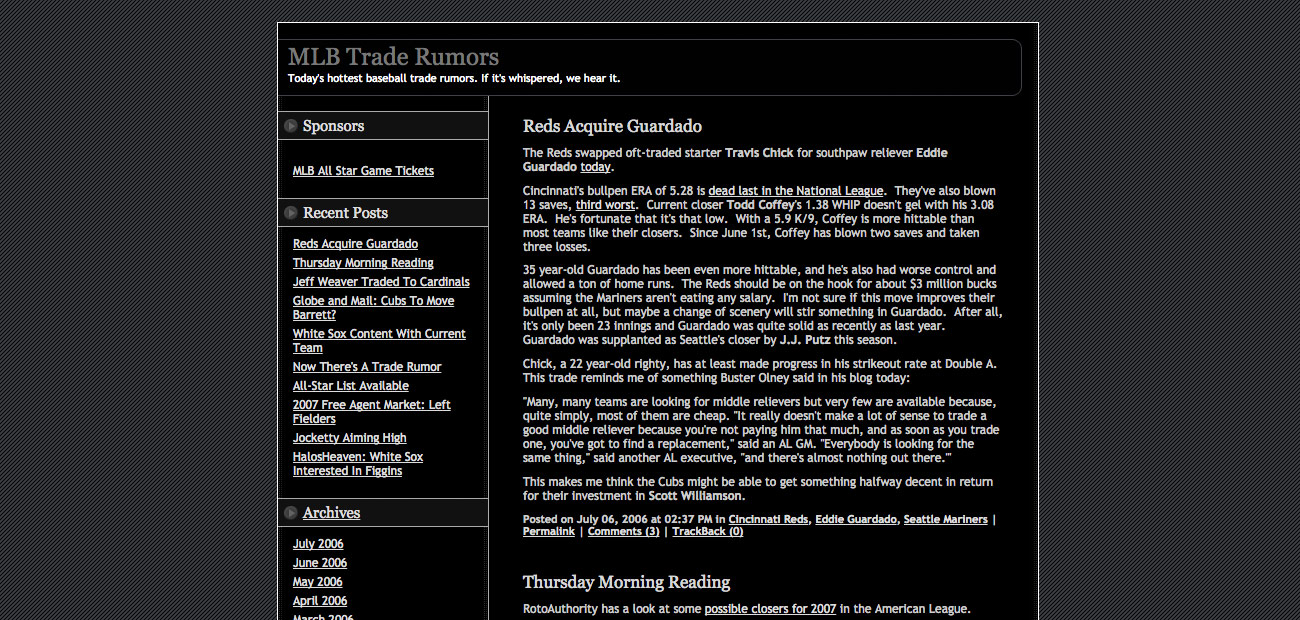
MLB Trade Rumors quickly passed up RotoAuthority in traffic, and started to take up more of my time. During busy times like the July trade deadline or the Winter Meetings, our posts went viral in an old school way, with links on forums and perhaps carrier pigeons. It certainly wasn’t succeeding because of my journalistic integrity. In the early years of MLBTR I was completely naive about the hard work and years of trust-building that goes into getting most baseball scoops. So, if someone emailed about having the same barber as Octavio Dotel and therefore knowing where he might sign, I believed it and printed it.
A major turning point came during the 2007 Winter Meetings. Someone pretended to be a Mets beat reporter (one I knew of but had not interacted with) and sent me a whopper of a trade rumor. He was happy to let me write an exclusive post on MLBTR about the potential three-team deal sending Johan Santana and Bobby Crosby to the Mets, Jose Reyes and Kevin Mulvey to the A’s, and Dan Haren to the Twins. I was not present at those Winter Meetings, but this bogus rumor spread like wildfire after I posted it, and of course was shot down.
Shot down is an understatement, actually. Here are the choice quotes from A’s GM Billy Beane:
“There’s a better chance of me breeding unicorns than there is of that deal happening.” – ESPN
“It’s ridiculous. All-time most ridiculous. Of all the trade rumors the whole time I’ve been coming here, because of the genesis and how quickly it went around, that was the finest, or the worst, whatever you like.” – San Francisco Chronicle
“I’m on the bike, and (Zaidi) is on the treadmill, and he figures out a way to get on the Internet, and he says, ‘Hey look at this.’ Of all the trade rumors in all my career, that one’s the furthest from the truth.” – Contra Costa Times
I was mortified at what I’d done and that it was on Beane’s radar to that degree. I finally realized that I had to take sourcing much more seriously, and also stop worrying about trying to break stories.
Soon after, I quit my job to focus on MLBTR full-time. A parade of great writers and friends joined me on our team and helped make the site better each year. The core of what we do hasn’t really changed since 2008. We collect, organize, and analyze everything related to MLB transactions in a timely manner, filtering out anything lacking in credibility. The format and means of sharing the information have changed, but the idea remains the same.
Thank you for indulging my trip down memory lane. I am forever grateful for the opportunity to run MLBTR for a living, and I don’t intend to stop anytime soon. I would like to express my gratitude to our many contributors over the years, and to the journalists on the beat. And of course, thanks to our readers, whether you were here for the black background days or you just discovered the site this week. Here’s to the next ten years!
Braves Likely To Transition Hector Olivera To Outfield
The Braves appear to be in the process of shifting Hector Olivera from third base to the outfield. We had heard recently that Olivera would spend some time in left in winter ball, though indications were that it was not intended as any kind of permanent move.
Now, it appears, Atlanta is set to embark upon a more dedicated transition process, as ESPN.com’s Buster Olney tweets. The Braves do indeed “seem ready to shift” Olivera to the grass after intensive internal discussion, David O’Brien of the Atlanta Journal-Constitution adds (Twitter links). He says that Olivera will still spend some time at third in Puerto Rico, but will be playing there “just in case.”
Needless to say, it probably wasn’t the club’s first choice to be considering this kind of move so soon after adding Olivera. Atlanta plugged him in at third after acquiring him over the summer from the Dodgers. The hope had been that Olivera would represent a solid hitter and reasonable-enough defender who could hold down the hot corner at a low price point ($32.5MM over the next five years).
That’s not to say that Olivera can’t still deliver value. The team has consistently expressed confidence that he’ll come around with the bat, and he put up a roughly league-average .253/.310/.405 batting line in his first 87 plate appearances in the majors. If the 30-year-old can settle in at the dish, he might well turn into a solid regular.
That still leaves the team with the somewhat difficult task of filling in at third base, if in fact Olivera will end up in left field. The Braves can utilize Adonis Garcia, as the 30-year-old rookie did have a nice (albeit unlikely to be repeated) campaign last year, but he hardly seems an everyday player. Atlanta does have some notable prospects at the position in Rio Ruiz, 21, who reached (but did not master) Double-A last year, and the younger Austin Riley. But there’s no chance that they’ll represent an option this spring, and their developmental timelines remain uncertain. This year’s free agent market is rather weak, with players like Daniel Murphy (if he’s considered there, rather than at second), David Freese, and Juan Uribe representing the best options.
As I wrote yesterday in breaking down the Braves’ offseason, the Braves have more options — both internal and external — for the outfield. It’s also worth noting that some may now end up being pushed out. Nick Swisher could be a prime candidate — and I’d guess the team would part with him before Michael Bourn, given that the latter can play center — though he clearly has negative trade value.
Mets, Terry Collins Agree To Extension
TODAY: The team has announced the deal, making it official.
YESTERDAY, 6:37pm: Collins’ will earn roughly $3MM over the life of the contract, reports Jon Heyman of CBS Sports (Twitter link).
3:42pm: The Mets have agreed to a two-year contract extension with manager Terry Collins, reports Kristie Ackert of the New York Daily News. Collins’ new contract, which provides the skipper with a raise, will be formally announced tomorrow, Ackert adds. Collins’ previous contract expired at the end of the 2015 season, but he’ll now have job security through the 2017 season. Collins reportedly doesn’t want to manage too much longer but was said to be open to continuing for at least the next two seasons.
The 66-year-old Collins is an oft-mentioned NL Manager of the Year candidate after leading the Mets to a surprising 90-win season and World Series run. He’s been managing the Mets since the 2011 campaign, though the 2015 season marked his first winning campaign. Collins dealt with a number of injuries early in the season plus questions as to when top prospects Noah Syndergaard, Steven Matz and Michael Conforto would be promoted, and he was also tasked with keeping the club focused during the Matt Harvey innings limit saga late in the season.
Collins has a lifetime managerial record of 838-850 and has seen time at the helm with both the Astros and Angels, though the Mets represent his longest stint as a big-league manager. Collins’ job security has been called into security many times over the past few seasons, but New York’s unlikely World Series run and his handling of the pressures of managing in a major market have earned him additional time to attempt to finish what he started in 2015.
Royals’ Decline Mutual Options On Rios, Guthrie
Fresh off of their World Series triumph, the Royals will open their offseason by bidding adieu to outfielder Alex Rios and righty Jeremy Guthrie. The players officially became free agents today, per an MLBPA press release.
As had been expected, Kansas City declined its mutual options over both, Andy McCullough of the Kansas City Start tweets. Rios’s option was valued at $12.5MM, with a $1.5MM buyout, while Guthrie will receive a $3.2MM buyout on a $10MM option.
Rios, 34, had a down year after joining the Royals last winter as a free agent. He slashed just .255/.287/.353 in 411 plate appearances, swiping nine bases and contributing four home runs.
Guthrie, on the other hand, came to the Royals via trade and then re-signed before the 2013 season. His deal was restructured last January to defer some of his 2014 salary back to the end of the end of the deal, with the mutual option and buyout accomplishing the task. The 36-year-old struggled to a 5.95 ERA in 148 1/3 innings this year, allowing a league-high 29 home runs in the process. That performance eliminated any possibility that the mutual option would be exercised.
Zack Greinke Opts Out Of Contract
Dodgers righty Zack Greinke has officially opted out of his contract with the Dodgers, Bill Shaikin of the Los Angeles Times reports on Twitter. The widely-expected move puts him onto the open market as one of the league’s most appealing free agents.
Greinke signed with Los Angeles as a free agent before the 2013 season, locking up a $147MM guarantee over six seasons. That was a nice enough payday as it was, but his representatives at Excel Sports Management were also wise to negotiate a provision allowing the veteran to opt out after the 2015 season. He’ll give up a guarantee of three years and $71MM, but Greinke figures to earn quite a bit more than that on the open market.
While Greinke is now 32 years of age, he’s also coming off of a sublime 2015 campaign. He led the league with a 1.66 ERA over 222 2/3 frames. Greinke retired 8.1 batters per nine via strikeout and induced a 48.0% groundball rate while permitting only 1.6 BB/9 and a league-low 0.844 WHIP.
There were some fortunate elements to Greinke’s campaign, to be sure. He allowed a .228 BABIP, 86.5% strand rate, and 7.3% HR/FB rate, all of which were on the beneficial side as against his career norms. Unsurprisingly, ERA estimators did not quite support the incredible run prevention that resulted.
That’s not to take away from Greinke’s accomplishment or his value. He’s long been one of the league’s better pitchers, and always seemed destined to opt out and cash in. But it’s fair to say, too, that he timed his career-best season perfectly.
Offseason Outlook: St. Louis Cardinals
Check out all the entries in the 2015-16 Offseason Outlook series here.
After racking up more regular-season wins than any other team in 2015, the Cardinals are set to contend again, as they usually do. First, though, they’ll need to address Jason Heyward‘s impending free agency.
Guaranteed Contracts
- Adam Wainwright, SP: $57.5MM through 2018
- Matt Carpenter, 3B: $46MM through 2019 (plus 2020 club option)
- Yadier Molina, C: $30MM through 2017 (plus 2018 mutual option)
- Jhonny Peralta, SS: $22.5MM through 2017
- Matt Holliday, OF: $18MM through 2016 (plus 2017 club option)
- Lance Lynn, SP: $15MM through 2017
- Jon Jay, OF: $6.225MM through 2016
- Jordan Walden, RP: $3.75MM through 2016 (plus 2017 club option)
Arbitration Eligible Players (service time in parentheses; projections by MLB Trade Rumors)
- Brandon Moss (5.160) – $7.9MM
- Peter Bourjos (5.062) – $1.8MM
- Steve Cishek (4.143) – $7.1MM
- Tony Cruz (4.105) – $1.0MM
- Trevor Rosenthal (3.058) – $6.5MM
- Matt Adams (3.033) – $1.5MM
- Seth Maness (2.154) – $1.2MM
- Non-tender candidates: Moss, Bourjos, Cishek, Cruz
Contract Options
- Jaime Garcia, SP: 2016 club option for $11.5MM with $500K buyout (exercised). The Cardinals also have a $12MM 2017 option with a $500K buyout
- Jonathan Broxton, RP: 2016 club option for $9MM with $1MM buyout (declined)
Free Agents
- Jason Heyward, John Lackey, Matt Belisle, Randy Choate, Mark Reynolds, Carlos Villanueva
After winning 100 games and then losing in the NLDS, the Cardinals will try to fly even faster into the wind this offseason. Whatever solutions they come up with to their immediate roster issues, it will be difficult for them to continue to perform at such a toweringly high level. Of course, they should still be a strong team. The problem of how best to maintain a 100-win team is a great one to have.
The possibility of losing Heyward looms large. Heyward, acquired last winter after the tragic death of Oscar Taveras, had the kind of season he usually has — his offensive numbers were, on the surface, a bit disappointing, but he contributed all sorts of value with his fielding and baserunning, frequently changing games with his glove and arm. His youth and broad skill set will make him a mint in free agency, although he could receive somewhat less per season than the usual top free agent might. MLBTR’s Jeff Todd recently predicted Heyward would receive a ten-year, $200MM contract, perhaps with an opt-out. Any contract at or near that level is a risk, and the Cardinals will have plenty of competition, but they could certainly bid for Heyward at that price, given their modest payroll commitments in 2017 and beyond.
If Heyward signs elsewhere, the Cardinals can be flexible. They could pursue a lower-cost free agent outfielder, but it’s more likely they’ll simply go with veterans Matt Holliday and Jon Jay plus some combination of young outfielders Randal Grichuk, Stephen Piscotty and Tommy Pham, all of whom had surprisingly strong seasons in 2015. The Cardinals could then spend their available funds on other positions.
One of those positions could be starting pitcher, but likely only if they’re acquiring a top-flight player. The Cardinals have Lance Lynn, Michael Wacha and a healthy Adam Wainwright under control for 2016, along with Jaime Garcia, whose option they’ve already decided to exercise after a successful comeback season. They also have Carlos Martinez, although a season-ending shoulder strain makes his short-term future somewhat uncertain. Their depth options, like Tyler Lyons and Tim Cooney, are also fairly good ones, and top prospect Alex Reyes could potentially enter the picture late in the season. So despite the impending departure of John Lackey, there’s little reason for the Cardinals to pursue an innings-eater type.
They could, however, conceivably aim higher — they’ve already been mentioned as a possible bidder for this winter’s top free agent, David Price. Pursuing a free agent like Price (or Heyward, for that matter) does seem a bit tricky from a budgetary perspective, at least in the short term; the Cardinals’ Opening Day payroll was $122MM in 2015, and between their $90MM or so in existing commitments for 2016 and arbitration-year salaries on top of that, they don’t appear to have much room for a highly paid player. Given their very limited future commitments ($65MM in 2016, $33MM in 2017, and practically nothing after that), though, it would seem possible for the Cardinals to increase their payroll somewhat for 2016 with the understanding that they can limit their spending in the future if they need to.
Besides, if the Cardinals were to decide to pursue top free agents, they would have ways to trim payroll. In addition to non-tendering Brandon Moss, Peter Bourjos and Steve Cishek (all of whom had subpar 2015 seasons), the Cardinals could conceivably clear payroll space by trading someone like Garcia, especially if they sign a top starter. Garcia had a brilliant comeback season in 2015 and is well worth his option, but the Cardinals could look at his injury history and figure they might be able to get more certainty by spending their money differently. The Cardinals have also already declined Jonathan Broxton’s option, and they could also attempt to save a bit by non-tendering light-hitting backup catcher Tony Cruz.
The Cardinals could also potentially upgrade at first base, particularly if Heyward leaves. They were 25th in the big leagues in home runs last season, with 137, and first could represent one way to address that problem. Chris Davis would represent a huge improvement, and Korean slugger Byung-Ho Park might be a lower-cost option. Of the two, Park might be somewhat more likely — the Cards bid on Jung-Ho Kang last offseason, and GM John Mozeliak said at the time that the organization was interested in delving further into the market for Asian players. If the Cardinals do re-sign Heyward, they could pass on first base upgrades and have Piscotty spell Matt Adams there on occasion, particularly against lefties. Adams could also become a trade candidate in that scenario — he didn’t hit well in 2015, but a team with a bigger hole at first (or a need for DH) could have interest in taking a flyer on his bat.
Trevor Rosenthal, Kevin Siegrist and Seth Maness will all presumably be back in the bullpen. The Cardinals can also hope for more from Jordan Walden, who missed most of 2015 with a shoulder injury. A variety of other pitchers, including Sam Tuivailala, Miguel Socolovich and Lyons, could also contribute. It wouldn’t be a surprise to the Cardinals add a lefty to complement Siegrist, though, particularly if they plan on saving Lyons to start if needed. Lefty Randy Choate is a free agent, and the Cards might benefit from adding someone who they trust a little more against righties. Someone like Antonio Bastardo or Tony Sipp would make sense, although those pitchers figure to be in demand this offseason, with a relatively thin group of lefty relievers on the market. If the Cardinals can’t find someone from outside the organization, minor league southpaw Dean Kiekhefer could be a possibility. The Cards will also likely at least consider re-signing righty Carlos Villanueva, who was effective in multi-inning stints last season, although the need for him would be lessened somewhat by replacing Choate with a lefty capable of pitching full innings.
The Cards will also need to address their bench somewhat. They have solid outfield depth, but they’re a bit thin on catching and infielders. At catcher, Cody Stanley would probably have been the next man up if Cruz departs, but he’ll be serving an 80-game PED suspension for much of next season. The Cardinals can also use a somewhat stronger backup catcher than they’ve had recently, too, with Yadier Molina getting older (he’s now 32) and coming off a subpar offensive season. And now that the Cardinals have outrighted Pete Kozma, they only have Greg Garcia as an obvious backup to Jhonny Peralta and Kolten Wong, unless they want to push Cuban shortstop Aledmys Diaz to the big leagues after only 58 Triple-A plate appearances (or use minor league vet Dean Anna, who remains on their 40-man roster even though they showed little interest in him last season).
Beyond the roster tweaking, though, a key problem for the Cardinals this season is how to maintain, or even approximate, the amazing pitching results they got in 2015. The Cards’ 2.82 team ERA ran a full run behind their xFIP and about three quarters of a run behind their SIERA. They held batters to a .275 wOBA with runners on base and .266 with runners in scoring position. Each mark was at least 20 points better than their nearest competitor. They left 79.4% of runners on base, more than four percentage points better than the next-best team. Ed Feng of the Power Rank calculates that the Cardinals saved 105 runs more than expected via the clustering (or lack thereof) of their opponents’ hits.
The Cardinals gave about a third of that cluster luck back on offense. Still, as Ben Lindbergh of Grantland suggested in August, it’s difficult to find reasons that fully explain how the Cardinals’ pitchers got such great results last season. It’s probably unwise, therefore, to expect them to do so again in 2016, just as the Cards’ 2014 offense didn’t maintain anything resembling the amazing .330 average with runners in scoring position they’d posted the previous year.
Obviously, though, there isn’t much the Cardinals can do to address that problem other than to attempt to upgrade their roster the way they normally would. And, of course, they won 100 games last year, and it generally takes some good fortune to be that successful, even if you’re great. The Cardinals could win ten fewer games in 2016 and still be competitive. If they’re able to re-sign Heyward, or compensate for his departure with additions elsewhere, they should be right in the thick of the NL Central race yet again.
Mets Notes: Cespedes, Murphy, Johnson, Reed, d’Arnaud, Blevins
While the scorching post-trade production of Yoenis Cespedes had many Mets fans hoping the team would be able to find a way to re-sign him. However, a team official tells ESPN New York’s Adam Rubin that while the Mets will embark on a modest pursuit of Cespedes once he hits the open market, it’s highly likely that the slugger will sign elsewhere this winter. Cespedes hit a strong .287/.337/.604 with 17 homers in 249 plate appearances for the Mets, but a shoulder injury slowed his production late in the season, as did a fastball to the left hand in a Sept. 30 at-bat against the Phillies. Slow finish aside, Cespedes probably still has a six-year deal awaiting him on the open market, and it’s tough to see the Mets outbidding the rest of the field based on their history in free agency.
A few more notes pertaining to the NL Champs…
- Daniel Murphy professed how much he’s enjoyed being a member of the Mets to Newsday’s Marc Carig, but the team isn’t likely to match the four-year offers he’s expected to command on the open market, Carig writes. The Mets do feel that Murphy has fundamentally improved as a hitter, he continues, but with a possible long-term option in Dilson Herrera, Murphy is expected to depart. Sources tell Carig that the Mets could look to re-sign Kelly Johnson to serve as a bridge to Herrera, though, especially since Johnson could spell David Wright at third base on occasion.
- Rubin tweets that it “sounds like” the Mets will retain Addison Reed via arbitration this winter and deploy him in a setup capacity next year. Reed is projected by MLBTR to earn $5.7MM in arbitration, though Rubin’s tweet seems to indicate that the Mets are comfortable with that range. He notes that the team still could use an additional late-inning arm.
- There’s a “growing thought” within the organization that it would be beneficial for Travis d’Arnaud to learn a second position to expand his versatility, Carig tweets. I’d imagine that would entail corner outfield or first base, though d’Arnaud has virtually no experience at either position. There was some talk in 2014 and earlier this season about d’Arnaud getting some reps in left field, and it seems that conversation could again resurface.
- Carig also tweets that of all the Mets’ free agents, Johnson and left-hander Jerry Blevins are the only two that are “expected” to return. Blevins tossed just four innings for the Mets this year before suffering a fractured arm on a come-back line drive to the mound. He was working his way through rehab when he slipped and fell off a curb, re-fracturing in the arm and resulting in surgery. GM Sandy Alderson picked up Blevins in exchange for outfielder Matt den Dekker last spring and saw the lefty retire the first 15 batters he faced before suffering the initial injury. With left-handed relief still an area of need and Blevin’s asking price likely on the low side, it makes sense that the Mets would want to bring him back.
- MLB.com’s Anthony DiComo runs down the club’s offseason position by position, noting that the Mets will probably cut ties with twice-suspended Jenrry Mejia this winter and also speculating on Colby Rasmus and Denard Span as potential fits in center field. Either would give Juan Lagares a platoon partner, though I personally wonder if the club would at least consider the possibility of running with Span or even Dexter Fowler full-time, then trading Lagares or using him as a fourth outfielder while his yearly salary is still modest. That, of course, is just speculation on my behalf though.