
Cubs Rumblings: Arrieta, Darvish, Cobb, Cole, Yelich
The latest on the North Siders comes from Bruce Levine of CBS Chicago…
- To this point, the Cubs and Cardinals have shown the most interest in free agent right-hander Jake Arrieta, according to Levine. The Cubs reportedly may be willing to offer a four-year, $110MM contract to the soon-to-be 32-year-old Arrieta, who mostly thrived with the team from 2013-17.
- Elsewhere on the pitching market, the Cubs remain in contact with Yu Darvish and Alex Cobb, per Levine, though he casts doubt on them being the favorites to sign the latter. They’re wary of Cobb’s asking price, which appears to be in the $17MM to $19MM range per annum, Levine relays.
- Along with the previously reported Chris Archer, the Cubs are interested in swinging a trade for Pirates righty Gerrit Cole, Levine writes. This is the first reported connection of the offseason between the Cubs and Cole, who has mostly been linked to the Yankees. Talks between the Yankees and Pirates simmered last month, though, which could pave the way for another team to swoop in and land the 27-year-old. Given that Chicago and Pittsburgh are in the same division, the Cubs are obviously quite familiar with Cole. The Scott Boras client is under control for the next two seasons, and he’ll earn a projected $7.5MM in 2018.
- Looking beyond starting pitching possibilities, Levine doesn’t rule out more additions to the Cubs’ bullpen or position player group. With Wade Davis having signed with the Rockies, the Cubs could be in the market for a closer if they don’t want to turn the ninth-inning reins to either of the just-signed Brandon Morrow–Steve Cishek tandem or another in-house option. But whether the team bids on a top free agent like Greg Holland or Addison Reed could depend on how much spending room it has left after it picks up another starter, per Levine. Further, it’s possible the Cubs could try to trade for Marlins outfielder Christian Yelich, who would likely cost them fellow center fielder Albert Almora Jr. in a deal, Levine contends. He also lists free agent center fielder Lorenzo Cain as a name to watch for the Cubs.
Poll: What’s Next For The Pirates?
As those who paid attention to the MLB offseason a year ago remember, Pirates center fielder Andrew McCutchen was among the most popular figures in the rumor mill. At the time, the Pittsburgh icon was coming off a career-worst season both offensively and defensively, which surely hindered the team in its efforts to garner suitable offers for him. Ultimately, the Pirates retained McCutchen and enjoyed a bounce-back year from him at the plate (.279/.363/.486 with 28 home runs in 650 PAs). While McCutchen struggled again in the grass, where he posted minus-14 Defensive Runs Saved and a minus-4.5 Ultimate Zone Rating, the onetime National League MVP nonetheless ranked a solid 17th among outfielders in fWAR (3.7).
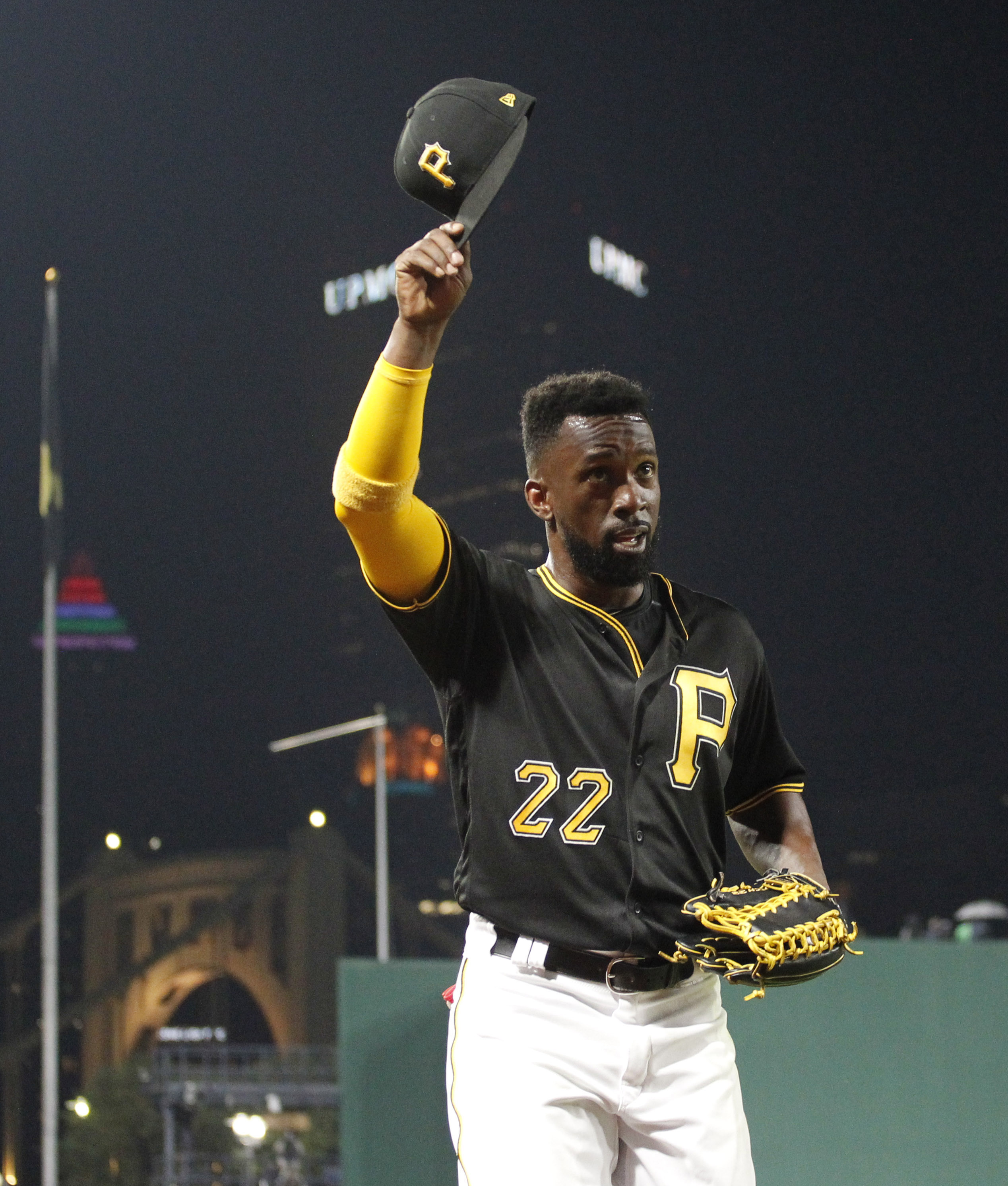
This winter, on the heels of a rebound year, rumors regarding McCutchen haven’t been nearly as abundant. The Giants are the only known team with interest in the 31-year-old, yet they don’t seem to view him as a priority. Still, although nothing looks imminent on the McCutchen front, it’s possible the five-time All-Star has played his last game with the Pirates – who drafted him 11th overall in 2005.
With McCutchen entering a contract year in 2018, in which he’ll make $14.75MM, general manager Neal Huntington acknowledged this month that the player’s time in Pittsburgh may be winding down. Trading McCutchen prior to the season wouldn’t seem to make much sense if the Pirates plan to compete next season and avoid a third straight non-playoff campaign, but a return to prominence may be a long shot.
With McCutchen in the fold, the Pirates are projected to start 2018 with a payroll of just under $104MM. That would represent a season-opening high for owner Bob Nutting, whose rosters haven’t begun any campaign above the $100MM mark since he took the helm of the franchise in 2007. The Pirates’ low-spending ways may make an offseason McCutchen trade all the more likely, though he’s not the only notable veteran they could jettison to help cut costs. Infielder Josh Harrison, who will make $10MM in his third-last year of team control next season, has drawn widespread trade interest and might find himself in the uniform of the Yankees, Mets, Blue Jays or another club by the springtime.
Unlike McCutchen and Harrison – two useful but not great assets – right-hander Gerrit Cole would bring back a significant return in a trade. Not only is the flamethrowing 27-year-old a bona fide No. 2/3 starter, but he’s due a relatively modest $7.5MM in 2018. Considering Cole’s a Scott Boras client, the likelihood of him eschewing free agency in favor of a long-term extension with the Pirates seems low. That could increase their urgency to trade Cole, who’s going into his penultimate year of team control.
No doubt cognizant of the Boras factor, Huntington was reportedly “motivated” to part with Cole earlier this month. It appeared then that Cole would join the Yankees, but talks between them and the Pirates subsequently lost momentum. Even if Pittsburgh and New York don’t eventually find common ground, though, there are plenty of other teams that would benefit from a Cole addition – and the Bucs have engaged with some of those clubs.
At times, the 2017 portion of the offseason was a slow-moving bore, but the payoff is that there will be copious trades and signings in the New Year. With enticing trade chips in McCutchen, Harrison and Cole, the Pirates may often find themselves at the center of the action leading up to April. If you were calling the shots for the club, how would you approach the next couple months?
(poll link for app users)
What should the Pirates do this winter?
-
Trade more than one 57% (8,927)
-
Keep all three and reassess during the season 22% (3,426)
-
Trade Cole 10% (1,581)
-
Trade McCutchen 8% (1,223)
-
Trade Harrison 3% (507)
Total votes: 15,664
Photo courtesy of USA Today Sports Images.
Rockies Notes: Davis, Bridich, Holland, Arenado, Harrison
The signings of Wade Davis, Bryan Shaw, and Jake McGee have given the Rockies a deep and experienced relief corps, though ESPN.com’s Keith Law (Insider subscription required and recommended) wonders if the team needed to go to such expensive lengths to reinforce its bullpen. Other teams who have relied on excellent pens in recent seasons, Law notes, have generally used their own homegrown arms or low-cost converted starters as relievers rather than sign several pricey free agents. Law also isn’t a fan of the three-year, $52MM Davis contract in general, citing Davis’ injuries and dip in performance over the last two seasons from his 2014-15 dominance.
Here’s more on the Rockies from GM Jeff Bridich’s chat with reporters (including MLB.com’s Thomas Harding and the Denver Post’s Nick Groke) on Friday…
- Despite the mutual interest between Colorado and former closer Greg Holland, the two sides weren’t able to reach agreement on a reunion, with Bridich saying two weeks ago that the team had made Holland a “strong offer” to re-sign. It seems as if the Rockies then made a swift pivot to Davis, as while Davis and the team had been linked earlier this winter, Bridich said the deal was made just within the last week.
- After so heavily remaking the bullpen, the Rockies are likely done with pitching additions altogether. “I’d be very surprised if we added another reliever or a starter,” Bridich said.
- The next step would seem to be addressing needs in the corner outfield or at first base. In Harding’s words, Bridich was “open, but non-committal” about the idea of re-signing Carlos Gonzalez, with the GM simply noting that Gonzalez was “part of the market.”
- While Bridich didn’t put a timetable on extension talks with Nolan Arenado, “there definitely are conversations that will happen” about locking up the star third baseman. Teams generally wait until Spring Training or until significant offseason business has been concluded to discuss extensions with their players, and the negotiations with Arenado will no doubt be particularly in-depth given the huge money needed to keep him at Coors Field. Arenado is scheduled to hit free agency after the 2019 season, when he’ll still just be 28 years old and in the midst of his prime. Arenado and the Rockies agreed to a two-year, $29.5MM deal last offseason to cover two arbitration years, and Arenado has one final arb-eligible season remaining in 2019 due to his Super Two status.
- “I’m not sure where the Josh Harrison stuff comes from,” Bridich said in regards to rumors connecting the Rockies to the versatile Pirates infielder/outfielder. It should be noted that this isn’t technically a denial of any trade interest, though Harrison is perhaps a better fit on a team that could make fuller use of his multi-positional ability. The Rockies have Arenado and DJ LeMahieu locked in at third and second base, respectively, so Harrison would spend most of his time as a corner outfielder if he did land on Colorado’s roster. (Then again, given that the Rox did sign Ian Desmond last winter with the intent of using him as a first baseman, maybe we shouldn’t rule out any outside-the-box ideas in regards to this team.)
National League Notes: Rockies, Realmuto, Yelich, Taillon
Dave Cameron of Fangraphs postulates that the Rockies need to upgrade more than just their bullpen if they hope to be successful in 2018. He wonders if their additions so far “haven’t improved them as much as prevented them from getting worse.” At first glance, one could say that Wade Davis and Bryan Shaw are probably improvements over Greg Holland and Pat Neshek, respectively. However, considering the low WAR contribution from relievers in comparison to other players, those upgrades seem marginal. The team still has big questions to answer at first base, and in the outfield, so although they seem to have the best bullpen in the NL as it stands right now, they need to make impactful additions in other areas or rely on significant improvements from members of their current roster. After all, projections have them significantly behind the Dodgers in the NL West, as well as St. Louis and Arizona in the Wild Card race.
Questions continue to pop up when looking towards the future. Cameron notes that the 2017 iteration of the Rockies worked in large part because Charlie Blackmon and Nolan Arenado provided them with over 12 fWAR at just $20MM between them. Unfortunately for Colorado, Blackmon is set to reach free agency at the end of 2018, and it would take a significant raise on his current salary to bring him back. The same is true for Arenado the year following. The bullpen contracts the team dished out this year will cost them something in the neighborhood of $35MM per season through 2020; that puts a significant constraint on their ability to retain their stars or further build through free agency. Cameron’s article raises some important questions about the Rockies’ offseason moves so far, and is worth a full read.
More news from around the National League as we approach New Year’s Eve…
- Speculation surrounding Marlins catcher J.T. Realmuto and outfielder Christian Yelich has been heating up lately, and Joe Frisaro of MLB.com reports that while the club is willing to listen on their two most valuable remaining trade assets, actually moving either player would require a “huge overpay”. Frisaro adds that the team is not looking to “water down” the return for either of them, making a potential salary dump inclusion of Martin Prado or Brad Ziegler less likely. MLBTR profiled Realmuto’s trade candidacy on Christmas Day, listing the Nationals, Rockies and Diamondbacks as good fits in theory. He’s projected for just a $4.2MM salary next season, and can be controlled through arbitration for two more years after that. As for Yelich, he’s been worth an average of 4 fWAR in each of the past four seasons and is owed just $43.25MM through 2021 thanks to a team-friendly contract extension.
- Jameson Taillon had a tough battle with cancer last season, causing him to miss significant time during the season. But the resilient Pirates righty is feeling confident headed into the 2018 season, and Adam Berry of MLB.com has the inside scoop. “You spend time in the clubhouse and know we have a lot of good guys as humans that are extremely determined to get better,” Taillon said. He’s reportedly working on new pitch grips and developing plans for how to attack hitters in the upcoming season. Taillon finished last season with a 4.44 ERA, though his 3.48 FIP paints a decidedly more attractive picture of his potential.
Latest On Market For Josh Harrison
In an update on the market for Pirates second baseman Josh Harrison, Rob Biertempfel of the Pittsburgh Tribune Review writes that a “handful” of organizations have at least reached out to gauge the asking price. Indeed, there’s some indication that he’s the Bucs’ most heavily pursued trade candidate.
Among the teams to have reached out are the Yankees, Mets, and Blue Jays. The Yanks were tied recently, albeit somewhat speculatively, to Harrison in relation to a potentially larger move involving Gerrit Cole. Interest from the latter two was reported a few weeks back (see here and here), though it’s notable to hear they’re still in pursuit.
Though further pursuers haven’t yet been identified, it isn’t difficult to imagine quite a few other clubs having interest. Harrison, after all, can play all over the diamond and would fit quite comfortably on a number of rosters.
His contract rights are also rather appealing. The 30-year-old will earn a reasonable $10MM in 2018 and can be controlled by successive club options. At $10.5MM and $11.5MM apiece, they won’t exactly come at a bargain rate, but the flexibility is plenty desirable in its own right.
Harrison likely won’t replicate his excellent 2014 campaign, but was plenty productive in 2017. He ended the year with a solid .272/.339/.432 batting line and career-best 16 home runs to go with a dozen steals. As usual, Harrison rated as a quality defender and baserunner, making him an approximately 3-WAR player despite only carrying league-average production at the plate.
At this point, it does not seem that any team has emerged as a clear favorite to acquire Harrison — or even that the Pirates are more likely than not to move him. While the organization could fill in from within should it deal Harrison, there’s also little question that he improves the team’s outlook for 2018. Just how inclined the Pirates will be to move him may hinge on whether they end up dealing Cole and/or long-time franchise face Andrew McCutchen.
Latest on Gerrit Cole
TODAY: Chance Adams and Miguel Andujar could be part of a hypothetical Yankees/Pirates trade for Cole, Kristie Ackert and Bill Madden of the New York Daily News report. If those two prospects and Frazier are all included, that could mean the Pirates will also include Josh Harrison in the deal. While the Yankees have also talked to the Diamondbacks about Patrick Corbin and the Tigers about Michael Fulmer, it seems as if Cole is New York’s preferred target of the three pitchers; Corbin is under control for just the 2018 season while Detroit is putting an enormous asking price on Fulmer’s services.
SATURDAY: A trade of Gerrit Cole doesn’t appear to be imminent at this point, ESPN’s Jerry Crasnick reports (via Twitter). Though it seemed at one point that talks between the Yankees and Pirates were picking up momentum, Crasnick says that multiple clubs have engaged with the Pirates since the winter meetings; the prospect of a Cole trade isn’t “Yankees or bust”.
The Yankees don’t appear to have tunnel vision on a Cole deal, either. Though the Bronx Bombers are trying to net Pittsburgh’s prized right-hander with proposals centered around Clint Frazier, Bill Brink of the Pittsburgh Post-Gazette reports that the Bombers offered similar packages to the Rays and Tigers for Chris Archer and Michael Fulmer, respectively. From my perspective, it seems as though the Yankees may not be interested in Cole specifically, but rather could have a broader objective to move the 23-year-old Frazier in exchange for pitching help. Following the club’s acquisition of Giancarlo Stanton, it appears as though Frazier is destined to be a high-ceiling depth piece for the Yankees, whose outfield picture features Aaron Judge, Aaron Hicks and Stanton, with Brett Gardner and Jacoby Ellsbury also on the roster.
In a brilliant piece for the New York Post, Joel Sherman points out that the Yankees can afford to be patient, as they did with Stanton this winter and Sonny Gray this summer. They’re not desperate for pitching right now, as their rotation is set to feature Luis Severino, Masahiro Tanaka, Gray, CC Sabathia and Jordan Montgomery. While each of those pitchers carries a question mark or two (or in Sherman’s words, “red flag possibilities”), the ballclub wouldn’t be chastised if it were to have these five in the rotation come Opening Day. Furthermore, top prospects Chance Adams and Justus Sheffield could reach the majors before long, with Adams being the more likely of the two to contribute in 2018.
From the Pirates’ side, they don’t necessarily need another outfielder. However, it stands to reason that a trade of Cole could set off a domino effect that prompts Pittsburgh to sell off other pieces. As Brink states in a separate article (one that deals with the “what if” scenario of a Cole trade), trading the right-hander could act as “the first tug on the rope that raises the white flag on 2018.” In that case, they’d be highly likely to shop Andrew McCutchen, the 2013 NL MVP, and his hypothetical trade would mean that Frazier could suddenly become a useful piece.
It’s unclear how serious the Pirates’ talks are with other potential suitors at this time, or even whether those clubs have made formal offers. Crasnick notes in his above tweet that a deal probably won’t come together before Christmas, but adds that trade talks could pick up again between then and New Year’s. It stands to reason that Pittsburgh could be patient for months, or even wait until the 2018 trade deadline to trade Cole (if they opt to move him at all). It will of course be far more evident how the Pirates’ playoff chances compare with those of the other NL Central clubs. However, there are plenty of reasons to move him now as well, including the high probability that clubs would be willing to pay more to have Cole for a full season, and the risk that the Yankees might acquire a different starter.
Pirates Chairman Bob Nutting On Offseason Moves, Buying Or Selling, Extensions
Pirates chairman and principal owner Bob Nutting discussed several topics as part of a wide-ranging Q&A with Rob Biertempfel of the Pittsburgh Tribune-Review (part one, part two). Here are some of the highlights…
- Nutting believes his team can compete in the NL Central next year, though when asked if the Pirates will be buyers or sellers this winter, the owner said “it’s my belief we need to do both.” Strictly focusing on either avenue “hurts our ability to make the best deal on the marketplace. The most important thing for the organization long-term is that every one of those deals we optimize every bit of advantage we have.” Nutting said that Pirates GM Neal Huntington “has a wide-open slate” within which to operate, as “there are more paths and opportunities open right now for the Pirates than we’ve had in any particular window I can think of.”
- Back in September, Huntington and manager Clint Hurdle both had their contracts extended through the 2021 season, a clear sign of commitment from ownership despite the Bucs’ struggles in 2017. “I certainly have a bias towards stability,” Nutting said. “That doesn’t mean you can’t make changes….We’re not stubborn, but I do believe we have the right people leading the organization now.”
- Though Starling Marte, Gregory Polanco, Francisco Cervelli, and Josh Harrison all haven’t lived up to expectations after signing extensions with the team, Nutting “would do all of those (contracts) again,” though the Pirates will be re-evaluating their training methods to see if injuries can be avoided. Extensions are “not a precise science. You need to make the very best decision you can with the information you have at the time,” the owner said. “Frankly, my role then is to make sure Neal and his team know that if they make the best decision they can, we’re not going to second-guess it three months or six months or two years later based on something that was unforeseen.”
- The Pirates didn’t make any significant in-season acquisitions to fill the voids left by Marte (suspension), Polanco (multiple DL stints) and Jung Ho Kang (restricted list), though Nutting said that the team’s lack of activity wasn’t due to a lack of financial resources. Rather, the Bucs simply didn’t count Polanco getting hurt again, or that Marte would be so rusty in the wake of his 80-game PED suspension. For Kang, however, Nutting admitted that “if we knew then what we know now, we would have done something different with Jung Ho. We had no idea — maybe we should have — that it would be an entire season (without him). We all live in an imperfect world with imperfect information.” Kang was unable to obtain a work visa to return to the United States after receiving a two-year suspended sentence for a DUI offense (his third) in his native South Korea.
- Nutting has “no interest in selling the team,” with Biertempfel noting that Nutting has previously stated that he may pass the Pirates down to his three daughters rather than explore a sale. Reports from earlier this fall indicated that film producer and businessman Thomas Tull could be exploring a $1 billion bid to buy the Pirates, though Nutting said “no one has approached us (about selling). I haven’t heard any rumor. I haven’t had any discussion. I’m not aware of any buyer.”
Pirates Reportedly “Motivated” To Move Gerrit Cole
10:19am: Joel Sherman of the New York Post reports (via Twitter) that the Yankees would also likely balk at including either of Justus Sheffield or Estevan Florial in a package for Cole. Sherman suspects that any package would be structured around Clint Frazier and Chance Adams.
10:07am: Feinsand tweets that there’s been no change since this morning, reporting that the two sides aren’t close to a deal. Like Heyman and Bowden (as well as the YES Network’s Jack Curry), Feinsand adds that the Yankees have no plans to trade Torres.
9:45am: Jim Bowden of MLB Network Radio on SiriusXM now tweets that the Pirates and Yankees are close to a deal that would send Cole to New York. Torres is not a part of those talks, according to Bowden.
Dec. 22, 8:17am: Both Feinsand and Heyman throw some cold water on the talks with the Yankees, as Feinsand now hears that the advancement in talks last night may have been “overstated.” Heyman notes that there’s no positive momentum in talks between the two sides at this time.
Dec. 21, 9:49pm: Passan adds more context in a full column, reporting that the Yankees are “hopeful” that they can entice the Pirates to agree to a deal that does not include Torres, who is the leading candidate to succeed Starlin Castro as the everyday second baseman in the Bronx. Passan suggests that Cole could very well be traded before Christmas and adds that the Pirates may also market McCutchen as they prepare for a rebuilding effort.
8:59pm: MLB.com’s Mark Feinsand tweets that talks between the Yankees and Pirates are “getting hot,” though he notes that it remains unclear if a deal is on the verge of completion.
8:24pm: FanRag’s Jon Heyman tweets that the primary sticking point in talks has been that the Yankees want to headline a package for Cole with Frazier, while the Pirates want Torres to be the headliner.
8:08pm: The Pirates and Yankees are again discussing a trade that would send right-hander Gerrit Cole to New York, according to Jeff Passan of Yahoo Sports (Twitter links). While there’s been plenty of trade talk surrounding Cole this winter, Passan now reports that the Pirates are “motivated” to get a deal done and there’s a “very strong”likelihood that he’ll be traded.
The Yankees, according to Passan, are the likeliest landing spot for Cole, with one source telling him that it’s a matter of “when” a trade will ultimately be agreed upon rather than a matter of “if.”
Talks between the Bucs and Yanks have been ongoing, to some extent, since the Winter Meetings at the least, though The Athletic’s Ken Rosenthal reported earlier this week that those negotiations had “cooled” to some extent. The Pirates at one point were said to have been pushing for Gleyber Torres to be included in the deal, though it’d be tough for the Yankees to part with the touted young infielder. Other names that have been mentioned in rumors include young outfielder Clint Frazier and right-hander Chance Adams, though the permutations of the current talks remain unreported.
Cole, 27, is controlled for another two years and comes with a projected arbitration salary of $7.5MM, per MLBTR contributor Matt Swartz. He’d give the Yankees another high-octane arm to add to the top end of a rotation that also includes Luis Severino, Sonny Gray, Masahiro Tanaka, CC Sabathia and Jordan Montgomery at present. Certainly, that strong group and the presence of Adams and Justus Sheffield in the upper minors presents the Yankees with an enviable stock of starters, but Cole, a former No. 1 overall pick, also comes with a Cy Young caliber season on his resume and stands out as a nice rebound candidate on the heels of a down season (by his standards).
Cole was one of just 15 pitchers to top 200 innings in 2017, and in his 203 frames he averaged 8.7 K/9 and 2.4 BB/9 with a 45.8 percent ground-ball rate and a fastball that averaged 96 mph. A huge spike in Cole’s HR/9 rate (from 0.54 in 2016 to 1.37 in 2017) led to a bloated 4.26 ERA, but he also maintained an ability to miss bats, limit walks and keep the ball on the ground. All of those trends point to the possibility of a return to form, though moving to the AL East (and, specifically, Yankee Stadium) isn’t necessarily a great recipe to cut back on one’s home run rate.
If Cole is ultimately traded, the question then becomes just how far the Pirates will go in terms of selling off veteran assets. Josh Harrison and Andrew McCutchen have both been oft-mentioned trade candidates this winter — speculatively speaking, Harrison could hold appeal to the Yankees — with each becoming increasingly expensive and moving closer to free agency. McCutchen will hit the open market next offseason, while Harrison is controlled through 2020 by virtue of a pair of club options but is now commanding $10MM+ per season.
Yankees Rumors: Cole, Darvish, Ellsbury
It seems the Yankees and Pirates have lost momentum toward a prospective deal involving righty Gerrit Cole. Per Ken Rosenthal of The Athletic, via Twitter, talks have “cooled” since the Winter Meetings wrapped up. While Cole’s talent would be a welcome addition to just about any big league rotation, the Bucs are reported to have a lofty asking price on the former No. 1 overall pick, and the Yankees don’t necessarily need to feel urgency to finalize a deal. New York has already agreed to bring CC Sabathia back on a one-year pact, and he’ll join Luis Severino, Sonny Gray, Masahiro Tanaka and Jordan Montgomery in a mix of quality rotation options (with prospects Justus Sheffield and Chance Adams looming in the upper minors).
A few notes out of the Bronx…
- Rosenthal also writes in a notes column (subscription required/recommended) that despite that group of starting options, the Yankees have some interest in free-agent righty Yu Darvish. A serious pursuit could require shedding some other salaries, as the Yankees have a known preference to dip under the luxury tax threshold and surely would like to enter the season with some degree of leeway in that regard, should the need for in-season additions on the trade market arise.
- While Darvish may seem a curious fit given that quality group of options, George A. King III of the New York Post also hears that the Yanks do have some degree of interest. New York is monitoring the Darvish market to see if his price comes down at all, per King, who adds that the Yankees do still want to add another starter even with the aforementioned arms in tow. Even if Darvish’s price drops to a lower level than expected, the Yankees would likely still need to move Jacoby Ellsbury‘s salary (or a significant portion of it) in order to work him into the mix and remain under the tax barrier.
- Jacoby Ellsbury “might consider” waiving his no-trade clause for a few teams, reports Jon Heyman of FanRag Sports, who suggests the Giants as a possibility in that regard. That’s probably music to the ears of many Yankees fans, though it’s worth noting that there’s no indication that the Giants would want any part of Ellsbury’s enormous contract. San Francisco has a need for a center fielder, but the Giants have their own luxury tax concerns. Even if the Yankees are willing to absorb a significant amount of the remaining $68MM+ that Ellsbury is owed, there’s no indication that the Giants view him as an upgrade. San Francisco could, for instance, simply sign a player in the Jarrod Dyson mold to a considerably shorter-term deal, knowing that he’d be a vastly superior defensive option with lesser financial risk.
Yankees, Pirates Discussing Gerrit Cole Trade
SATURDAY: In return for Cole, the Pirates have been pushing for infielder Gleyber Torres (MLB.com’s second-ranked prospect), per Jon Heyman of FanRag (Twitter link). Heyman doubts the Yankees would give up Torres, though, and he notes that it’s more likely a deal would include Frazier and at least one other piece. The two teams are continuing to negotiate.
THURSDAY: The Pirates and Yankees are discussing a trade that would send right-hander Gerrit Cole to the Bronx Bombers in exchange for a trade package that includes outfielder Clint Frazier, George A. King III of the New York Post reports. The Bucs are also reportedly looking for a young starting pitcher who is on the verge of being ready for the big leagues; righty Chance Adams may be the Yankees prospect that best fits this description, though there isn’t any indication the Pirates are specifically targeting Adams.
Cole has been linked to the Yankees in rumors throughout the Winter Meetings, though New York was (at least at one point) under the impression that Cole wasn’t being made available. Then again, Pittsburgh hasn’t given much indication all offseason if the team plans to start selling off pieces or if it still plans to contend in 2018. Cole, Andrew McCutchen, and Josh Harrison have drawn the most trade buzz this winter, with the consensus being that McCutchen is the likeliest to be dealt regardless of whether the Bucs are going for it or not. Since McCutchen is only under contract through 2018, adding a big league-ready young outfielder like Frazier would seem to fit right into the Bucs’ plans.
Trading McCutchen or Harrison would free up more money from the Pirates’ 2018 payroll, though dealing Cole would also be the bigger indicator that Pittsburgh will explore at least a soft rebuild. Cole is also set for a pretty healthy salary next season (projected by MLBTR to earn $7.5MM) in his second year of arbitration eligibility, though hardly a big sum for a team like the Yankees, their desire to get under the luxury tax threshold notwithstanding. There is no shortage of teams that would be interested in two years of control over a 27-year-old who has shown ace-like stuff in the past — the Twins, Rangers, and Orioles are a few other teams known to have checked in with the Pirates on Cole this offseason.
Cole posted a 4.26 ERA, 8.7 K/9 and 3.56 K/BB rate over 203 innings for Pittsburgh last season. It was the second time Cole has topped the 200-inning mark in his young career, as he bounced back nicely from an injury-shortened 2016 season. One worrisome number, however, was a big spike in home runs allowed, as Cole’s 1.4 HR/9 rate was more than double his 0.6 career mark prior to last season. He was hardly the only pitcher to run into trouble with the long ball in 2017, though it is a bit of a troubling statistic if Cole is moving from pitcher-friendly PNC Park to a hitters’ paradise like Yankee Stadium.
Frazier has already been part of one blockbuster deal in his young career, as he and Justus Sheffield were the headliners of the prospect package the Indians sent to the Yankees in the Andrew Miller trade in July 2016. The fifth overall pick of the 2013 draft, Frazier has long been touted as one of the game’s best prospects, ranked as high as 16th in the sport by the Baseball Prospectus top 100 list prior to the 2017 season.
For all of Frazier’s promise, however, he may be an expendable part in the Bronx. Giancarlo Stanton and Aaron Judge look to own the corner outfield slots for years to come, with Aaron Hicks, Brett Gardner, and Jacoby Ellsbury in center field and in reserve roles. (This doesn’t even account for other prospects like Estevan Florial, or the possibility that the Yankees could pursue another star outfielder like Bryce Harper in free agency.) New York’s farm system is more than deep enough to withstand the potential loss of Frazier or a pitcher like Adams for a young arm of Cole’s caliber, as he would slot right into a scary starting five that also includes Luis Severino, Masahiro Tanaka, Sonny Gray, and Jordan Montgomery.