
Latest On Marlins’ Deadline Plans
The Marlins remain one of the clearest cut sellers as the deadline approaches. While Miami has somewhat quietly played well since the beginning of June, they remain in the middle of a multi-year rebuild. They’re still seven games under .500 and have almost no shot of making the playoffs this year.
It therefore comes as no surprise that Barry Jackson of The Miami Herald writes that the Fish plan to entertain offers on Sandy Alcantara, Edward Cabrera, Jesús Sánchez and Anthony Bender in the coming weeks. All four players appeared among MLBTR’s list of the top 40 trade candidates earlier this month; Alcantara was in the top spot. Jackson adds that the Marlins are shopping impending free agent starter Cal Quantrill, though he’d have less trade value than the rest of the group.
Perhaps more interestingly, Jackson writes that the Marlins would be satisfied running it back with their current middle infield tandem of Otto Lopez and Xavier Edwards next season. That’s not to say either player is untouchable, but they’re less likely to move than any of the four Miami players who made our trade candidates writeup. The 26-year-old Lopez is hitting .250/.320/.392 while taking over at shortstop. Edwards, who moved to second base, owns a .288/.352/.347 slash with 16 stolen bases. Both players are controllable for another four seasons.
[Related: Miami Marlins Trade Deadline Outlook]
Alcantara’s availability has been expected for months. He’s making $17MM this year and next, and he’s guaranteed a $2MM buyout on a $21MM club option for 2027. That’d be a bargain rate if he recaptured his ace form, but he has had a poor first season back from Tommy John surgery. Alcantara carries a 7.22 ERA with a diminished 17.3% strikeout rate over 18 starts. He had his best month in June (4.34 ERA) but has given up 11 runs in as many innings over his past two appearances. There’s little reason for the Marlins not to listen to offers, but it’s not a given that they actually pull the trigger on what would be a sell-low trade.
Moving Cabrera this summer would arguably be selling high. The 27-year-old former top prospect has posted a 2.54 ERA while striking out more than a quarter of his opponents in his past 12 starts. He’s making less than $2MM and under arbitration control for another three seasons. Miami would demand a significant return for their top realistic trade chip.
Jackson notes that the Marlins are nevertheless willing to consider offers in part because of Cabrera’s injury history. Shoulder problems sidelined him in both 2023 and ’24. He has yet to reach 100 innings in an MLB season. Cabrera departed his final appearance before the All-Star Break with elbow fatigue. While that’s not considered a serious issue — an MRI has already come back clean and he avoided the injured list — it’s the latest reminder of the injury risk for any pitcher, especially one with a mid-upper 90s fastball.
Sánchez and Bender are each controllable role players who should draw interest. Sánchez is a lefty-hitting corner outfielder who has been a league average regular over the course of his career. This season’s .259/.321/.410 slash line is par for the course. He’s making $4.5MM this year and will go through arbitration twice more.
Bender is a 30-year-old righty reliever who also has two and a half seasons of club control. He owns a 2.06 ERA in 39 1/3 innings, though that obscures unimpressive strikeout (18.9%) and walk (10.7%) numbers. Bender gets a lot of ground-balls and has gotten fantastic results on the mid-80s breaking ball that he uses as his primary pitch. He’s playing on a $1.42MM salary that’ll make him a viable fit for any contender.
As for Quantrill, the Marlins signed him with hopes of flipping him midseason. He’s making $3.5MM on a one-year free agent deal. Quantrill has below-average numbers for a third consecutive season, though. He carries a 5.62 ERA with a 19% strikeout rate over 81 2/3 innings. He’d profile as a sixth/seventh starter or long reliever on most contenders. There’d be minimal interest, but Quantrill is affordable enough that perhaps a team navigating multiple rotation injuries will take a flier. If they can’t find a trade partner this month, Miami could place him on waivers at some point in August in hopes of shedding the final few weeks of his salary.
Marlins Sign Cal Quantrill
The Marlins announced that they have signed right-hander Cal Quantrill to a one-year deal. Left-hander Braxton Garrett has been transferred to the 60-day injured list as the corresponding move. Quantrill’s deal reportedly guarantees him $3.5MM, though the Excel Sports Management client can potentially earn another $500K via incentives.
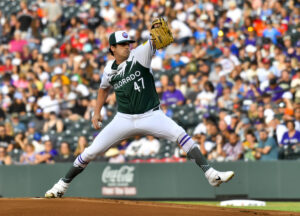
Quantrill, 30, just finished a season pitching for the Rockies. After a few years pitching for the Guardians, he was flipped to Colorado and had to navigate the challenge of pitching at altitude in 2024. Given the conditions, the results were passable. He made 29 starts and logged 148 1/3 innings, allowing 4.98 earned runs per nine. His 16.8% strikeout rate was subpar but pretty normal for him. His 10.5% walk rate was a bit higher than average while his 44.4% ground ball rate was right around par.
The Rockies could have brought Quantrill back for 2025, with MLBTR contributor Matt Swartz projecting him for a $9MM salary, but they opted to non-tender him instead. That sent him to free agency without being exposed to waivers, which made him available to work out this deal with the Marlins.
He has had some better numbers in the past. Over the 2021 and 2022 seasons with Cleveland, he worked a swing role, making 54 starts and 18 relief appearances. Over those campaigns, he posted a 3.16 ERA with an 18% strikeout rate, 6.8% walk rate and 42.6% ground ball rate. He benefited from a .274 batting average on balls in play and 77.9% strand rate in that time, which were both on the lucky side. His 4.10 FIP and 4.50 SIERA over that span were perhaps better reflections of his performance but still solid numbers for a back-end starter or swingman.
In 2023, things regressed for him a bit. He spent some time on the injured list due to shoulder inflammation and was only able to make 19 starts. He had a 5.24 ERA and was designated for assignment after the season, which led to his trade to Colorado.
The Marlins are likely looking for Quantrill to serve as a steadying force in a rotation that has talent but is in flux. With the club rebuilding, they have had a strong willingness to deal players over the past year. In the rotation, they traded Trevor Rogers to the Orioles at last year’s deadline and then Jesús Luzardo to the Phillies in this offseason. Garrett is also going to miss the 2025 season while recovering from surgery on the ulnar collateral ligament in his throwing elbow. Eury Pérez is recovering from Tommy John surgery and isn’t slated to return until around the All-Star break.
As of now, the on-paper rotation consists of Sandy Alcántara, Ryan Weathers, Edward Cabrera and Max Meyer, with plenty of uncertainty in those remaining options. Alcántara is returning after Tommy John surgery wiped out his 2024 campaign. Even if he’s successful in coming back healthy, he will likely be in trade rumors this summer. Weathers had some good numbers last year but spent a decent chunk of time on the IL due to a finger strain and still hasn’t thrown 100 innings in an MLB season. Cabrera has also never hit the 100-inning plateau and has walked 13.3% of opponents in his career. He’s also been in plenty of trade rumors and could be flipped if he shows some hints of improvement. Meyer missed the 2023 season recovering from Tommy John surgery and came back last year to make 11 big league starts with a 5.68 ERA.
The Fish have some depth options like Valente Bellozo, Adam Mazur and Connor Gillispie, but those guys all have options. Quantrill can take a rotation spot and bump those guys down to the Triple-A rotation, at least until an injury or a trade opens up an opportunity. If Quantrill pitches well, he’ll likely end up on the trade block himself.
RosterResource currently pegs the Marlins for a competitive balance number of just over $83MM, which should jump to around $86-87MM once Quantrill’s deal is factored in. It has been reported that they may need to get up to $105MM to avoid being subject to a grievance from the MLBPA, in relation to the use of their revenue-sharing funds. If the club plans to get to that number, then perhaps they will look to make further upgrades to their roster in the coming weeks.
Alden González of ESPN reported that the two sides were in agreement prior to the official announcement. Craig Mish of the Miami Herald first reported the $3.5MM guarantee. Robert Murray of FanSided reported that Quantrill can earn as much as $4MM on the deal, suggesting that there are potential incentives worth $500K.
Five Non-Tendered Pitchers To Keep An Eye On This Winter
Every year, MLB’s non-tender deadline sees clubs allow some of their players who remain under team control to test the open market early, whether it be due to an increasing price tag in arbitration or a need for additional space on the club’s 40-man roster. Earlier this evening, we discussed five hitters from this year’s crop of non-tendered players who could be worth keeping an eye on this winter. While none of those players can realistically be expected to follow in the footsteps of Cody Bellinger and Kyle Schwarber, who both re-established themselves as All-Star caliber players following their respective non-tenders, it wouldn’t be so shocking to see a player from this year’s crop of non-tendered arms emerge as a notable player at some point in the future.
The best player to be non-tendered last winter was right-hander Brandon Woodruff, who served as the co-ace of the Brewers rotation alongside Corbin Burnes for years but wound up missing the entire 2024 season as he rehabbed from shoulder surgery. Kevin Gausman stands out as another notable hurler who’s been non-tendered in recent memory, and the veteran right-hander has gone on to have a fabulous career after breaking out at the age of 29. Even if no player from this crop of arms reaches the heights Gausman has, finding an impactful reliever or even a quality starter in the non-tender pile is hardly unheard of. Just this past year, both Spencer Turnbull and Tim Hill went from non-tendered in November to pitching for playoff contenders in 2024. Could anyone from this year’s group of non-tenders follow in their footsteps? Without further ado, let’s take a look at five pitchers who hit free agency following last week’s non-tender deadline and could be worth keeping an eye on throughout the coming offseason. Players are listed in alphabetical order, with their age for the 2025 season in parentheses.
Kyle Finnegan (33)
Finnegan’s non-tender came as something of a shock, as the right-hander actually made his first career All-Star appearance this year. The righty has been a consistent, stable presence at the back of the Nationals’ bullpen throughout the rebuild, pitching to a 3.56 ERA (116 ERA+) overall with a 4.24 FIP and a 23.5% strikeout rate in his 290 1/3 innings of work. Finnegan’s spent much of his time with the club in the closer role as well, and has racked up 88 career saves in 109 opportunities for a conversion rate of 81%. Finnegan’s overall performance this year was roughly in line with his career norms, as he posted a 3.68 ERA and 4.24 FIP in 63 2/3 innings of work while racking up 38 saves in 43 opportunities this year.
Those frequent save opportunities over the years have increased Finnegan’s price tag in arbitration, and he was due to make $8.6MM in his final trip through the process this winter according to projections from MLBTR contributor Matt Swartz. Aside from the high price tag, one other red flag that may have given the Nationals pause regarding their closer was how he wore down throughout the year. After posting an excellent 2.45 ERA and 3.98 FIP in 40 1/3 innings prior to the All-Star break, Finnegan’s final 24 appearances down the stretch saw him surrender a 5.79 ERA with a 4.71 FIP and a strikeout rate of just 16.4%. Despite that potential sign of trouble, though, Finnegan offers late-inning experience, consistent results, and an upper-90s fastball that should attract plenty of attention this winter.
Hoby Milner (34)
Left-handed relief options are always in demand, and Milner figures to receive attention on the free agent market as a southpaw with previous success in the majors if nothing else, even after the Brewers opted to non-tender him rather than pay his projected salary of $2.7MM for the 2025 season. That’s certainly a defensible decision given Milwaukee’s tight budget and Milner’s poor results this year. In 64 2/3 innings of work for the Brewers this year, Milner surrendered an ugly 4.73 ERA that was 11% worse than league average by measure of ERA+. With a heater that fails to break 90 mph, Milner hardly garners attention for his stuff, as well.
That’s not to say he couldn’t be a valuable contributor to a club’s bullpen, however. Rough as Milner’s 2024 campaign was, the underlying numbers were actually far kinder to the southpaw: He struck out a solid 23.9% of opponents while walking just 5.2%, and virtually every advanced metric was extremely bullish on the lefty’s performance this year as he posted a 3.14 FIP, a 3.08 SIERA, and a 3.15 in both xERA and xFIP. Milner also enjoyed the highest groundball rate of his career (51.9%), and may have been victimized by a shockingly low strand rate of just 58.1%. Looking at the three years Milner spent as a fixture of the Milwaukee bullpen from 2022 to 2024 paints the picture of a steady left-handed reliever who could improve plenty of bullpens around the league: in 193 2/3 innings during that time, he posted a 3.44 ERA with a 3.14 FIP overall. That track record should garner major league offers this winter, even if his lackluster season this past year may limit his earning potential.
Cal Quantrill (30)
Quantrill lands on this list by virtue of being the best bet among all non-tender candidates to make 30 big league starts in 2025. The right-hander found himself moved out of his previous organization in advance of the non-tender deadline for the second consecutive winter last week. After being designated for assignment by the Guardians in the days leading up to the deadline last year, the Rockies swung a trade to add him to their rotation. That experiment went fairly well, as Quantrill pitched to a solid if unspectacular 4.98 ERA (93 ERA+) with a 5.32 FIP. Ugly as those numbers look on paper, given the realities of pitching in Coors Field they’re generally consistent with Quantrill’s history as a roughly league average fifth starter.
The right-hander enjoyed a breakout campaign during the 2020 season that was split between Cleveland and San Diego, where he pitched to a 2.25 ERA in 32 innings while working out of the bullpen. He was used as a swing man in Cleveland the following year, and continued to dominate as he posted a 2.89 ERA (despite a pedestrian 4.07 FIP) in 149 2/3 innings of work in 2021. From 2022 onwards, he settled in as a permanent fixture of the rotation and has been a consistently average back-of-the-rotation arm with a 4.35 ERA (96 ERA+) and 4.68 FIP in 80 starts. Averaging more than 26 starts per year with a roughly league average ERA should be enough to earn Quantrill a look from a rotation-needy team this year, though it’s also possible a team could have interest in seeing if he can post stronger numbers out of the bullpen like he did earlier in his career.
Jordan Romano (32)
Romano was perhaps the non-tendered that garnered the most attention in the aftermath of last week’s non-tender deadline. A two-time All-Star, Romano has been the Blue Jays’ closer throughout the majority of their recent competitive window. From 2020 to 2023, the right-hander spun an incredible 2.29 ERA in 200 2/3 innings of work with a 30.8% strikeout rate and a 3.13 FIP. Among relievers with at least 160 innings of work during that time, Romano ranked third by ERA behind only Devin Williams and Emmanuel Clase. Unfortunately, the wheels came off completely for the righty in 2024 as he was shelled for 10 runs in 13 2/3 innings before undergoing arthroscopic elbow surgery that wound up ending his season.
Terrible as Romano’s 2024 campaign was, it’s hard to imagine him not generating significant interest this winter. The right-hander was projected for a $7.75MM salary in his final trip through arbitration this winter, and it wouldn’t be a shock to see him land a similar deal in free agency if multiple clubs see him as a potential buy-low solution in the ninth inning given his strong numbers and 105 career saves in 113 chances (89% conversation rate). Romano’s market naturally still figures to be hampered at least to some extent by not just his struggles in 2024 but also questions surrounding his health. While he’s expected to be ready for Spring Training and have a normal offseason following his surgery this summer, some level of trepidation from clubs is to be expected after any elbow procedure.
Patrick Sandoval (28)
Sandoval stands as both the youngest player on this list and the one most likely to find success as a mid-rotation starter or better in the big leagues at some point in the future. The left-hander was traded from the Astros to the Angels as the return for catcher Martin Maldonado back in 2018, and the southpaw was in the big leagues the following year. While it took some time for Sandoval to get settled into the majors, he found success in a half season of work out of the rotation in 2021 and managed to build upon that with a breakout season the following year. In 2022, Sandoval pitched to an excellent 2.91 ERA with a 3.09 FIP in 148 2/3 innings of work. He struck out 23.7% of opponents and combined that with an excellent 47.4% grounder rate.
Unfortunately, Sandoval’s performance has slipped since then. 2023 was a step backwards for the lefty, as he posted a solid but relatively pedestrian 4.11 ERA (109 ERA+) with a 4.18 FIP in 144 2/3 innings of work. His strikeout rate dropped to just 19.3% that year, while his walk rate skyrocketed to 11.3%. Things took a turn for the worse this year, as he was shelled to the tune of a 5.08 ERA across 16 starts before undergoing Tommy John surgery back in June. That will leave him out of action until at least the second half of 2025, and that layoff combined with Sandoval’s recent lackluster performance made the Halos’ decision to part ways with him somewhat unsurprising. Even so, with Sandoval not scheduled to hit free agency until after the 2026 season, it wouldn’t be a surprise to see a club snap the lefty up on a two-year deal and be glad he did if he can revert to something closer to his 2022 form once he’s back on the mound.
Rockies Non-Tender Cal Quantrill, Brendan Rodgers
The Rockies announced they’ve non-tendered right-hander Cal Quantrill and second baseman Brendan Rodgers. Both players are now free agents and the club’s 40-man roster count drops to 38.
Quantrill, 30 in February, once seemed like a rotation building block for the Guardians but this is now two years in a row in which he’s lost his roster spot after a tough season. From 2020 to 2022, he tossed 368 innings for the Guards with a 3.08 earned run average. His 18.4% strikeout rate wasn’t amazing but he limited walks to a 6.7% clip and kept the ball on the ground 42.7% of the time.
But in 2023, shoulder inflammation limited him to 19 starts with a 5.24 ERA. His strikeout rate, which was already subpar, slid to 13.1%. The Guards designated him for assignment and flipped him to Colorado for minor league catcher Kody Huff.
The Rockies installed Quantrill into their beleaguered rotation, with Germán Márquez and Antonio Senzatela both recovering from Tommy John surgery. They avoided arbitration with Quantrill by agreeing to a $6.55MM salary. He went on to serve as a steady presence in the rotation but with fairly unexciting results. Over 29 starts, he logged 148 1/3 innings with a 4.98 ERA. His 44.4% ground ball rate was around league average but his 16.8% strikeout rate and 10.5% walk rate were both well below par.
MLBTR contributor Matt Swartz projected Quantrill for a raise to $9MM next year, his final season of club control, but it seems the Rockies were uninterested in bringing him back at that price point. Marquez and Senzatela should be healthy for 2025, joining a rotation that figures to also include Kyle Freeland, Ryan Feltner and Austin Gomber, while prospect Chase Dollander is waiting in the wings.
Quantrill will now look for a change of scenery. Though the recent results haven’t been amazing, the Coors Field effect will naturally factor into how he’s viewed, with some clubs hoping to engineer a bounceback by moving Quantrill away from the mountains.
As for Rodgers, he was once a third overall pick and top 100 prospect but he has failed to live up to that hype. He has taken over 1800 plate appearances to this point in his career and has a batting line of .266/.316/.409. That translates to a wRC+ of 86, indicating he’s been 14% below league average overall.
The reviews of his glovework have been mixed. Outs Above Average has given him a -5 mark for his career. He was above average in 2022 and 2023 but then dipped back down again this year. He does have 12 Defensive Run Saved in his career but in eyebrow-tilting fashion. He’s been below average by that metric in most of his seasons but had a massive +22 grade in 2022, a mark that looks like a clear outlier.
Swartz projected Rodgers for a $5.5MM salary next year. Like Quantrill, he could only be retained for one more season before he was slated for free agency. Rather than pay Rodgers in that range for 2025, they will move on, sending him to free agency while they look for alternatives at second base.
Colorado could give some runway to prospect Adael Amador, but he will be only 22 next year and has just 10 major league games under his belt so far. Perhaps they can find a placeholder to take that spot in the meantime, either someone better than Rodgers or simply cheaper. Players like Gleyber Torres, Adam Frazier, Amed Rosario and others are available in free agency.
Rockies To Lower Payroll In 2025
In an article earlier today examining the Rockies’ plans for the upcoming offseason, Patrick Saunders of The Denver Post reported that the club intends to lower their payroll headed into the 2025 campaign. Per Saunders, those plans to lower payroll come with an expectation that the club will shop second baseman Brendan Rodgers, lefty starter Austin Gomber, and righty starter Cal Quantrill on the trade market this winter.
The news surely comes as a frustrating turn of events for Rockies fans as the club comes off its second consecutive season with more than 100 losses. While the club enjoyed encouraging steps forward for young players like Michael Toglia, Brenton Doyle, Ezequiel Tovar, and Ryan Feltner, that positive momentum was in some ways offset by a major step back for 2023 standout Nolan Jones and the retirement of stalwart DH Charlie Blackmon. Now, a lowered payroll and the likely departure of three stable regulars from the club’s roster leave the Rockies with even more question marks ahead of an offseason that already featured plenty of uncertainty.
While Saunders doesn’t get into specific numbers regarding the club’s payroll plans for 2025, he does note that the club’s $147.3MM payroll for 2024 is expected to come down next year even after factoring in the departure of Blackmon, who made $13MM this year. That would suggest a payroll that maxes out in the $130MM range and could ultimately clock in somewhere below even that diminished figure. That leaves the Rockies with very little room to maneuver this winter given that RosterResource projects the club for a payroll of just a hair under $130MM in 2025 already.
Given that, it’s not necessarily a surprise that the club would look to trade some of its more expensive arbitration level players like Rodgers, Gomber, and Quantrill. The trio is projected by MLBTR contributor Matt Schwartz to make a combined $20.1MM in their final trips through arbitration this year. The bulk of that comes from a $9MM salary due to Quantrill, who Saunders suggests the Rockies are more likely to move on from than Gomber. Trading Quantrill and Gomber would free up a combined $14.6MM in the club’s budget but also give the club the opportunity to open up starts for young hurlers Saunders notes the Rockies see as knocking on the door of the majors, including ninth-overall pick of last year’s draft Chase Dollander as well as southpaws Sean Sullivan and Carson Palmquist,
Quantrill and Gomber were both the subject of trade rumors prior to this summer’s deadline, though neither ultimately wound up changing teams. As the pair head into their final seasons of arbitration eligibility, Quantrill has more big league success on his resume of the two. The right-hander put up fantastic numbers in Cleveland from 2021 to 2022, first as a swing man and then as a full-time starter. Across those two seasons, Quantrill pitched to a 3.16 ERA with a 4.10 FIP in 72 appearances, including 54 starts. With that being said, however, the righty’s 2023 season with the Guardians left much to be desired (5.24 ERA in 19 starts) and led the club to designate him for assignment last November, at which point he was dealt to the Rockies.
Quantrill’s 2024 campaign in Colorado was something of a mixed bag. The righty managed to make 29 starts and throw 148 1/3 innings, and his 4.98 ERA was roughly league average (93 ERA+) after factoring in the inflated offensive environment at Coors Field. With that being said, Quantrill also posted the highest walk rate (10.5%) of his career against a below-average 16.8% strikeout rate. Making matters more concerning for potential suitors on the trade market is the fact that Quantrill not only didn’t pitch significantly better away from Coors Field this year, he was actually slightly worse on the road with a 5.04 ERA in 15 away starts. Quantrill’s lackluster overall numbers come in large part thanks to a brutal second half that saw him surrender a 7.94 ERA in his final eight starts of the year before he was sidelined at the start of September by triceps inflammation, leaving plenty of question marks regarding what can be expected from him in 2025.
Gomber’s 2024 campaign was similar to Quantrill’s in many ways. He made 30 starts for the first time in his career and threw a career-high 165 innings, and his 4.75 ERA (97 ERA+) was roughly league average when factoring in the inflated offense in Colorado. Gomber’s strikeout rate (16.7%) was also lackluster, though Gomber does have a few notable advantages that could make him more attractive to potential trade partners. For one thing, he held opposing hitters to an excellent 5.5% walk rate, good for the ninth-lowest figure among all qualified starters this year. Additionally, Gomber’s performance in away games was much stronger than Quantrill’s as his ERA went down from 4.97 in home games to 4.55 on the road. Those positive factors combined with Gomber’s reasonable $5.6MM salary projection for next year could make him an attractive trade target for clubs in need of cost-controlled pitching next year.
Rodgers could prove to be the most attractive trade piece of the trio. The 28-year-old has generally been a roughly league average bat in recent years, slashing a solid .270/.321/.421 since the start of the 2021 season. That’s good for a 91 wRC+ after adjusting for the park factors Rodgers benefits from at Coors, but his value isn’t tied exclusively to his bat as he’s also a quality defender at second base. Rodgers won the NL Gold Glove award for his work at the keystone in 2022 thanks to an eye-popping +22 Defensive Runs Saved, though after he missed much of the 2023 season due to shoulder surgery he hasn’t looked quite the same this year with a lackluster -4 DRS and a similar -3 Outs Above Average. Even so, Rodgers is a solid if unspectacular regular at second base who could provide a relatively cheap, stable option for a club without a clear solution at the position.
Assuming the Rockies are able to clear enough payroll off the books this winter to make additions, Saunders notes that a hitter who can provide consistency in their lineup and a veteran reliever are both near the top of their list of priorities this winter. With Blackmon vacating the DH spot and no player clearly locked into the outfield alongside Jones and Doyle for 2025, it should be fairly easy for the club to work a relatively inexpensive corner bat into their lineup this winter, and it’s not difficult to find veteran bullpen help on the cheap either in most offseasons.
Beyond those goals, Saunders notes one specific name the club figures to target in free agency this winter is catcher Jacob Stallings, who enjoyed a strong rebound campaign with the Rockies after being non-tendered by the Marlins last winter. Per Saunders, the Rockies want to give young catchers Drew Romo and Hunter Goodman room to develop at the big league level but could still to turn Stallings as they look to bridge the gap for their young backstops. Stallings slashed an excellent .263/.357/.453 (114 wRC+) in 82 games with Colorado this year, although that came with defensive metrics that were a far cry from the work that earned him the NL Gold Glove at catcher in 2021.
Rockies Outright Noah Davis
The Rockies announced a flurry of roster moves this afternoon, including the selection of left-hander Ty Blach‘s contract that was first reported last night. Additionally, Colorado has placed right-hander Cal Quantrill on the 15-day injured list and announced that they’ve outrighted right-hander Noah Davis to Triple-A. It’s the first public indication that Davis had been designated for assignment, but his removal from the 40-man roster makes room for the addition of Blach.
Davis, 27, has pitched for the Rockies in each of the past three seasons. The club’s 11th-round pick in the 2018 draft has struggled badly throughout his big league career so far, accumulating a 7.71 ERA with a 5.66 FIP in 51 1/3 innings of work in the majors. While some of those struggles can surely be chalked up to the perils of calling Coors Field your home ballpark as a pitcher, it’s worth noting that Davis hasn’t pitched much better during his time at the Triple-A level. In 123 innings of work with the club’s Albuquerque affiliate, the right-hander has posted a lackluster 5.05 ERA with a 19.1% strikeout rate against an 11.9% walk rate. Those deep struggles in both the majors and the minors have seemingly convinced Rockies brass that a change of scenery would be best for both parties, and Davis will now be eligible for minor league free agency if not added back to the 40-man roster before the start of the offseason. Until then, he’ll remain with the club as a potential non-roster depth option.
As for Quantrill, the right-hander was announced last night as scratched from his scheduled start today due to right triceps inflammation, with Blach scheduled to take his place. It wasn’t clear last night whether or not Quantrill would wind up heading for the IL, but he’s now set to be out for at least the next two weeks. Given his placement on the IL is retroactive to August 29, the right-hander will be eligible to be activated from the shelf as soon as September 13.
It’s unclear if he’ll be ready to go that quickly, but there’s plenty of reason for optimism as manager Bud Black told reporters (including Patrick Saunders of the Denver Post) that he expects Quantrill to return to action at some point this season. The 29-year-old right-hander sports a below-average 4.63 ERA (99 ERA+) with a 5.04 FIP in 138 innings of work this year, but prior to a brutal run of five starts prior to the trade deadline was sporting far more palatable ratios of 4.09 and 4.71 through his first 114 1/3 innings of work in a Rockies uniform.
Rockies To Select Ty Blach
The Rockies have scratched right-hander Cal Quantrill from his start against the Orioles tomorrow due to right triceps inflammation, as noted by several members of the Colorado beat, including MLB.com’s Thomas Harding. In his place, the Rockies are expected to start left-hander Ty Blach, whose contract will be selected before tomorrow’s game. It’s not yet clear if Blach will replace another player on the active roster or will be the extra pitcher the club adds when rosters expand to 28 tomorrow. Either way, a corresponding move will be necessary to create room for Blach on the club’s 40-man roster.
Blach, 33, pitched 63 2/3 innings for the Rockies earlier this year, his seventh season in the majors and third consecutive year as a member of the Rockies. Prior to his time with Colorado, Blach was a fifth-round pick by the Giants in the 2012 draft and acted as a swing man for San Francisco from 2016 to 2019 before being traded to Baltimore midway through the 2019 campaign. Blach posted a 4.56 ERA and 4.23 FIP in a Giants uniform but suffered through five disastrous starts with the Orioles that wound up being the last appearances he’d make at the big league level until he resurfaced with the Rockies back in 2022.
During his tenure with the club, Blach has been shuttled between Triple-A and the majors regularly with a cumulative 5.90 ERA and 5.25 FIP in 186 innings of work. It’s been more of the same of those lackluster results this year, as he struggled to a 6.36 ERA with a 5.75 FIP in 18 appearances (including ten starts) before being designated for assignment just before the trade deadline last month. With Quantrill unable to take the ball and potentially ticketed for a stint on the injured list, however, it seems that the Rockies are now left to call upon Blach once again to eat innings for the club down the stretch.
As for Quantrill, it’s not yet entirely clear whether or not the right-hander will require a trip to the shelf, or if the club hopes that merely skipping his turn through the rotation will allow him to return to the mound next time up. Quantrill was a speculative trade target for pitching-needy clubs at the deadline last month due to his solid results (4.09 ERA in 21 starts) and the fact that the Rockies are reportedly uninterested in retaining the right-hander long term, but no deal ultimately came together involving the righty. Perhaps that’s for the best in the eyes of his potential suitors, as Quantrill has posted a brutal 7.23 ERA and 6.64 FIP in five starts since the trade deadline. That brutal stretch has caused his ERA to shoot up to 4.64 while his FIP has ballooned to 5.04, both well below league average figures, though perhaps his current triceps issue provides some level of explanation for the sudden struggles.
Rockies Unlikely To Extend Cal Quantrill
Right-hander Cal Quantrill‘s first season in Colorado has gone quite well, but Patrick Saunders of The Denver Post wrote recently that the club does not appear intent on keeping the hurler in Colorado long-term. Per Saunders, the club has not approached Quantrill regarding an extension and is unlikely to do so. That might result in his Rockies tenure being a fairly short one given that Saunders also notes that the Rockies have received calls on Quantrill ahead of the impending trade deadline, though they hadn’t received any firm offers as of Friday afternoon.
Quantrill, 29, was a first-round pick by the Padres back in 2016 and was shipped to Cleveland as a headliner in the package that brought Mike Clevinger to San Diego at the 2020 trade deadline. He was a clearly above average starter with the club from 2021 to 2022 with a 3.16 ERA and 4.10 FIP in 336 innings of work during that time despite a lackluster 18% strikeout rate. Quantrill suffered a down season last year as he struggled to a 5.24 ERA in 19 starts as he posted a career-worst 13.1% strikeout rate against a then career-worst 7.9% walk rate while surrendering eleven homers in just 99 2/3 innings of work.
That brutal performance left the Guardians to designate Quantrill for assignment back in November prior to the non-tender deadline. The club shipped him to the Rockies shortly thereafter, and the right-hander avoided arbitration with his new club by signing a one-year, $6.55MM deal ahead of the 2024 campaign. Things can hardly have been expected to go better for Quantrill during his first year with the Rockies, as he’s posted a 4.10 ERA in 114 1/3 innings of work that’s actually 10% better than league average by ERA+ thanks to the righty calling Coors Field home this year. Quantrill’s strikeout rate has crept back up to a more respectable 17.8% this year, although he’s walking a career-worst 8.9% of opponents so far. Most importantly for a pitcher in Colorado, Quantrill has seen his groundball rate tick up significantly to 46.4%, the best of his career.
Given Quantrill’s solid bounce back year while pitching in such a tough environment, it would hardly be a surprise if the Rockies wanted to retain the right-hander, who is controllable via arbitration next season, long-term. Saunders suggests that’s unlikely to be the club’s plan, however, noting that while Quantrill has expressed openness to the possibility of an extension, he also hopes to pitch for a contender and would likely want a three-year deal that the Rockies are hesitant to offer. A three-year pact would guarantee the right-hander a contract through his age-32 season, and Saunders suggests that the club believes they have pitching prospects currently developing in the system who will be ready to step into the rotation within the next two years.
That’s a somewhat surprising stance to take given the rarity of starting pitchers who have proven they can handle home games at Coors Field, but if the Rockies don’t intend to keep Quantrill long-term it’s hardly a surprise that they’re listening to offers on the righty. Given Quantrill’s relatively affordable price tag, extra season of team control, and experience pitching out of both the rotation and the bullpen in his career, the right-hander would surely be an attractive addition to several rotations in need of depth around the league.
While no specific names have been connected to Quantrill to this point, the Twins, Padres, and Brewers are among the clubs known to be in the market for starting pitching that could be restricted by financial limitations, a possibility that would make Quantrill a more attractive option given his aforementioned $6.55MM salary this year. The Guardians are another club that falls into that category, though it’s fair to wonder how realistic it is to think that Cleveland would give up significant prospect capital for a player they parted ways with just eight months ago.
Rockies Will Listen To Offers On Cal Quantrill, Austin Gomber
The Rockies have a reputation for hanging onto — and at times extending — veterans who would be likely trade candidates with other organizations. In recent years, they’ve declined to trade Trevor Story, Jon Gray, Daniel Bard, C.J. Cron, Brent Suter and others despite sitting near the bottom of the standings in the National League. (Bard and Cron were signed to ill-fated extensions.) Various reports have already indicated that the Rockies have zero inclination to listen to trade scenarios involving third baseman Ryan McMahon, but Will Sammon, Katie Woo and Patrick Mooney of The Athletic report that Colorado decision-makers “plan to consider” offers for some players who are controlled beyond the current season.
Right-hander Cal Quantrill and lefty Austin Gomber are the two most obvious trade candidates on the staff, and the team will indeed consider offers on each, per the report. Both are in their second season of arbitration eligibility, with Quantrill earning a $6.55MM salary and Gomber being paid just shy of half that at $3.15MM. Both are controlled through the 2025 season and are slated to become free agents in the 2025-26 offseason.
Of the two, the 29-year-old Quantrill likely has more value despite being the pricier arm. He’s posted a team-high 95 1/3 innings in 2024 and recorded a 3.78 ERA on the back of an 18% strikeout rate, 8.5% walk rate, 46.9% grounder rate and 1.13 HR/9. It’s been a nice rebound effort for Quantrill in a tough setting for any pitcher. The former No. 8 overall draft pick was torched for a 5.24 ERA last season in an injury-shortened year with the Guardians but is now in the midst of his third season of solid results in a big league rotation. Quantrill also pitched to a combined 3.16 ERA in 336 innings with Cleveland in 2021-22, showing the same blend of sub-par strikeout rates with an aversion to hard contact.
Quantrill isn’t without his flaws. His 18% strikeout rate is worse than the league-average, but right in line with his career 17.8% mark. He’s never missed bats at a high level, and his command is more good than great. Similarly, while he uses a sinker as his primary offering, his ground-ball rates are typically a bit above average but far from elite. Quantrill has in the past featured a changeup — he’s largely moved away from the pitch this season — but it hasn’t kept lefties in check as much as hoped when the pitch received plus grades back to his prospect days. Lefties have a career .241/.318/.404 slash against him, while righties are at a comparable .266/.313/.400. He’s been hittable by all opponents but also not overexposed in platoon settings.
Gomber, 30, has pitched 87 2/3 innings this season and turned in a 4.72 ERA. That number has climbed by nearly two runs since the calendar turned to June. At the end of May, Gomber was sporting a tidy 2.76 earned run average, but he’s been blasted for 28 earned runs with an 18-to-7 K/BB ratio over his past 29 frames, dating back to June 2.
Rough patches of this sort are all too familiar for the Rockies and Gomber, who came to Denver as part of the regrettable Nolan Arenado trade with St. Louis. The former fourth-round pick is second (to Kyle Freeland) on the Rockies in innings pitched dating back to his acquisition, having piled up 466 2/3 frames over 99 appearances (83 starts). He’s posted a tepid 5.13 ERA in that time and actually generated slightly better results at Coors Field (4.96 ERA) than on the road (5.31 ERA). Look back through Gomber’s month-to-month splits in any given season, and there’s typically a month or two like his April/May run in 2024, but they’re largely offset by pronounced struggles that mirror his current slump.
Gomber punched out a solid 23.2% of his opponents in his first season with the Rox, but he’s at 16.1% this year and has seen the average velocity on his fastball drop from 91.6 mph in ’21 to 90.3 mph this season, per Statcast. He’s also scaled back the usage of his slider in favor of more curveballs and changeups. Back in 2021, Statcast credited his slider with a hearty 35% whiff rate, but the pitch is down to 17.7% this season and has been hit increasingly hard over the past couple seasons, so it’s not a huge surprise to see him moving away from it.
While neither Quantrill nor Gomber would fetch the type of haul that would seismically improve the Colorado farm system, both should generate interest. That’s true not only due to their relatively affordable salaries and extra year of club control, but also due to the simple lack of alternatives on the market for teams seeking rotation help. Quantrill is a borderline playoff starter at best, and Gomber is likely seen as more of a fifth starter who can help eat innings before sliding into a bullpen role in the playoffs. For some clubs, that type of stability is all they’re seeking.
It’s far from a given that the Rockies will ultimately move either pitcher. Quantrill has spoken positively about the experience of pitching in Colorado and at Coors Field specifically. He’s exceeded expectations since being acquired from Cleveland and, historically speaking, is the type of veteran the Rockies have looked to sign for multiple years rather than trade. Their ostensible willingness to listen to offers on him would be something of a change of pace but arguably a welcome one for a club that has at multiple times passed on trade opportunities that would’ve bolstered their minor league system only to eventually lose said players for no return at all when they become free agents. Whether either pitcher drums up enough interest to warrant an offer that convinces the Rockies to move remains an open question, though.
Colorado does have other arms that are controlled/signed beyond the current season, though most are performing poorly. Dakota Hudson has an ERA just shy of 6.00 with nearly as many walks as strikeouts. He’s arbitration-eligible this winter. Kyle Freeland is signed through 2026 and will earn $16MM in each of the next two seasons. In a healthy season, he might’ve drawn interest, but he only returned from the 60-day IL a couple weeks back after a lengthy stint due to an elbow strain. He’s looked sharp since returning (two runs in 12 2/3 innings) but was clobbered for a 13.21 ERA in four starts prior to his IL trip.
The Athletic also cites righty Ryan Feltner as a name who could draw interest despite an ugly 5.60 ERA of his own. There’s some sense to that as a potential buy-low candidate. Feltner averages 95 mph on his heater and has turned in a career-low 6.2% walk rate in this year’s 91 2/3 innings. His 19.3% strikeout rate is below average by a couple percentage points, but his 10.5% swinging-strike rate isn’t far from par and he has solid spin rates on his breaking pitches.
Feltner, 27, will be arb-eligible as a Super Two player this offseason. He’s controllable for four more seasons and has a pair of minor league options remaining. A contending club might not want to plug him directly into their rotation — particularly if said team is in a tightly contested division/Wild Card race. Other clubs looking to 2025 and beyond — or perhaps those with comfortable division leads but still needing some rotation depth — could view him as a longer-term project with good raw stuff who could benefit from a change of scenery.
Latest On Rockies’ Deadline Outlook
The Rockies enter this year’s trade deadline season in a familiar place. They’re sitting at the bottom of the NL West, 20.5 games out of first place and even a whopping nine games out of fourth place. Their 27-51 record has dipped behind the Marlins for the worst in the National League. Only the White Sox (21-58) have a worse record among MLB teams. They’re staring up at a 12-game deficit in the Wild Card race. Colorado isn’t mathematically eliminated from the postseason yet, of course, but the final nail on any faint playoff aspirations they may have harbored has long since been driven into the coffin.
Normally, this would set up a team to consider itself a pure seller at the deadline. The Rockies surely view themselves in that light to an extent, but not to the same extent as onlookers might expect. Reports more than a month ago indicated the team was quite unlikely to trade third baseman Ryan McMahon, for instance, and Patrick Saunders of the Denver Post doubles down on that sentiment in his latest look at the Rockies and the trade deadline, writing that there’s “nearly zero” chance McMahon will move. Specifically, he lists McMahon as a favorite of owner Dick Monfort, suggesting that even if GM Bill Schmidt and his crew wanted to field offers on the potential All-Star infielder, a deal wouldn’t necessarily be in the cards.
On a similar note, Jon Morosi of MLB Network reports that the Rockies have yet to hold any trade discussions surrounding right-hander Cal Quantrill. The team’s decision to buy low on the righty after the Guardians designated him for assignment last November — effectively a non-tender — has paid off in spades. Quantrill is sporting a 3.50 ERA in 90 innings out of manager Bud Black’s rotation. His 17% strikeout rate and 9% walk rate are both worse than average, but Quantrill’s 46.9% grounder rate is a career-best mark. His move to Coors Field also hasn’t dampened his characteristic knack for keeping the ball in the yard; Quantrill’s 0.90 HR/9 mark is not only better than the 1.06 mark he carried into the season — it’s a career-best rate for the former No. 8 overall draft pick.
Quantrill’s success is one of the best developments for the Rox this season, but he’s also not far from free agency. The righty is being paid $6.55MM in 2024 and has just one year of team control remaining. He could command around $10MM in arbitration this winter and would be a free agent following the 2025 season. Given his 2024 rebound, dwindling club control and mounting price tag, that would make him a logical trade candidate for most clubs.
The Rockies, however, have a history of extending just this sort of veteran. They’ve done so with Daniel Bard, C.J. Cron and Elias Diaz when all had previously stood as logical deadline trade candidates. Colorado has been particularly aggressive in extending pitchers, locking up Kyle Freeland, Antonio Senzatela and German Marquez to long-term deals. Of those three starting pitcher extensions, only the Marquez pact worked out in their favor. The Rockies weren’t successful in completing an extension with Jon Gray but still held onto him at the deadline three years ago (despite trade interest) in hopes of working out a long-term deal.
While there’s no firm word yet that the Rockies have approached or plan to approach Quantrill about an extension, it’s a logical conclusion to draw based both on their operating history and the lack of trade talks to date. Add in that Quantrill has spoken previously about being motivated by pitching at Coors Field, and it’s even easier to see Rockies brass being warm to the idea.
Indeed, Saunders writes in that same weekend piece that both Quantrill and teammate Austin Gomber could be candidates for such a deal. Gomber, like Quantrill, is enjoying a rebound campaign and is arbitration-eligible through the 2025 season. The 30-year-old southpaw has a spottier track record and lesser results but also a lower price tag (both on a contract and in a trade) as a result. It bears emphasizing that there’s no firm indication yet that the Rockies will steadfastly refuse to listen to offers on either pitcher, but history tells us it’s less than likely.
All of that raises the question as to which players the Rockies might actually consider moving. Saunders notes that one of Elias Diaz or Jacob Stallings is a fair bet to change hands, as is the case with reliever Jalen Beeks and outfielder Jake Cave. Diaz, Stallings and Beeks can become free agents this winter. Cave is controlled through 2025.
The two veteran catchers are having strong years at the plate — Diaz is hitting .303/.352/.439 (107 wRC+), Stallings is at .293/.371/.466 (123 wRC+) — though Diaz is currently on the shelf with a hamstring injury. Diaz is earning $6MM to Stallings’ $1.5MM. Stallings once graded as one of the game’s premier defensive catchers, but his glovework has deteriorated a bit in recent years and it’s actually Diaz who draws more favorable marks at this point.
Beeks, 30, has stepped up as the de facto closer in Black’s bullpen after much of the relief corps has struggled at large. He’s pitched to a 3.76 ERA and saved six games in 38 1/3 innings but has done so with a subpar strikeout and walk rates (18.8% and 10%, respectively). Beeks has a $1.675MM salary that’s plenty affordable and a nice track record outside of last year’s anomalous 5.95 ERA, but it’s unlikely other clubs would look at him as an option for the same type of high-leverage role he’s currently holding down for the Rockies. The 31-year-old Cave, meanwhile, is a career backup who’s hitting .258/.312/.336 (68 wRC+). He can play all three outfield spots and first base, but he hasn’t turned in even an average offensive season since 2019 with the Twins. It’s doubtful he’d fetch much in a swap, but Beeks could draw a marginal prospect from a club seeking left-handed bullpen help.