
Blue Jays Acquire Chase Anderson
12:39pm: The Blue Jays and Brewers have formally announced the trade.
10:40am: The Blue Jays are sending minor league first baseman Chad Spanberger to Milwaukee to complete the deal, TSN’s Scott Mitchell tweets.
10:23am: The Blue Jays are set to acquire right-hander Chase Anderson from the Brewers, Robert Murray reports via Twitter. Anderson is under control through the 2021 season via a pair of club options, and the decision on that first option (valued at $8.5MM) is due today. The pitching-needy Blue Jays figure to pick that option up and plug Anderson into the rotation. Toronto will also have a $9.5MM option on Anderson in 2021 (with a $500K buyout).
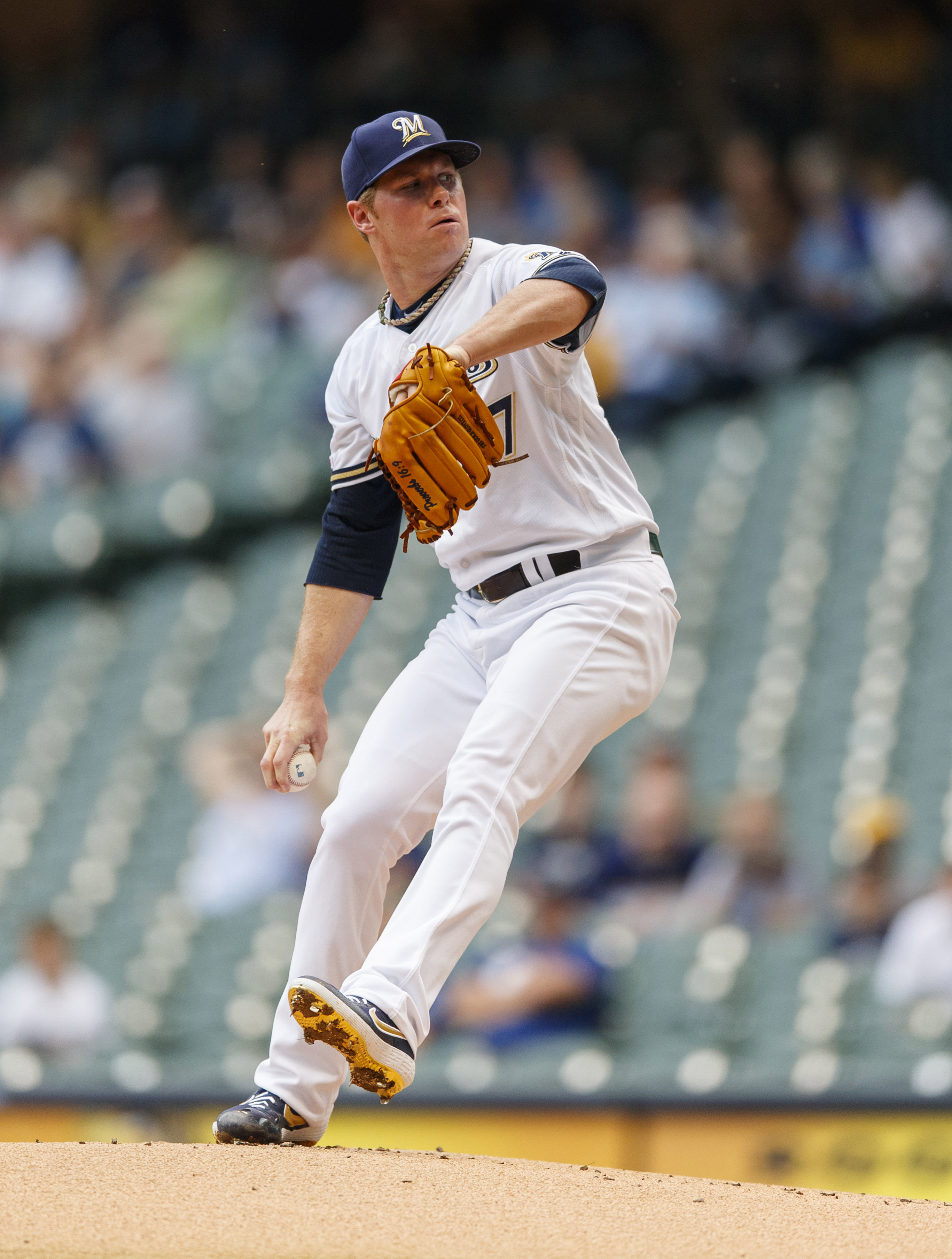
Anderson, who’ll turn 32 later this month, has been a staple on the Milwaukee staff for the past four seasons, averaging 30 appearances and 28 starts per season in that time. The Brewers have become increasingly aggressive in limiting their starters’ innings in recent seasons, which suppressed Anderson’s innings total in 2019 in particular. Five of Anderson’s 2019 appearances came in relief, but even in his 27 starts, he averaged just over 4 2/3 innings per outing (with a 4.29 ERA).
In all, over the past four seasons, Anderson has given the Brewers 590 innings of 3.83 ERA ball while averaging 7.7 K/9, 3.1 BB/9 and 1.45 HR/9 to go along with a 36.1 percent ground-ball rate. He doesn’t stand out in terms of spin rate on his fastball or curve, but Anderson’s 93.4 mph average heater in 2019 was a career-best. Anderson has also generally been well above-average in terms of limiting hard contact and opponents’ exit velocity, ranking in the 76th and 83rd percentiles, respectively, among pitchers in 2019.
Today’s trade surely signals that the Brewers weren’t sold on retaining Anderson at that $8.5MM rate. They could’ve bought him out and retained him via arbitration — Anderson has not yet reached six years of MLB service but will in 2020 — but MLBTR contributor Matt Swartz projected an even heftier salary in arbitration ($10.3MM) than he’d earn on this option. Anderson may not be given the green light to turn an opponent’s lineup over for a third time with too much frequency next year, but he’ll presumably have a longer leash on a start-to-start basis than he did with the Brewers.
The Blue Jays entered the offseason needing to add several pitchers to a beleaguered rotation that lacked even a modicum of clarity heading into 2020. Right-handers Trenth Thornton and Jacob Waguespack were the de facto members of the starting staff prior to today’s trade, but Thornton struggled to keep his ERA south of 5.00 while Waguespack threw just 65 1/3 Major League innings (4.13 ERA, 4.81 FIP). Toronto will also likely have veteran righty Matt Shoemaker back in 2020, but he’s a bit of an unknown coming off surgery to repair a torn ACL suffered early in the 2019 campaign. Righties T.J. Zeuch and Sean Reid-Foley also received auditions in 2019, as did southpaw Anthony Kay. That trio will be in the mix once again next season, as well.
Even with Anderson now on board, the Jays will surely be in the market for additional help on the starting staff — likely some higher-ed names than Anderson, who’ll be more of a back-of-the-rotation stabilizer. Toronto general manager Ross Atkins stressed at his end-of-season press conference that the Blue Jays need to find “pitching we can count on,” emphasizing that merely stockpiling depth wouldn’t be good enough. “We need to have guys that can contribute in significant ways,” he said at the time.
As for the Brewers, they’ll save themselves a $500K buyout on Anderson and turn the final two seasons of his contractual into the 24-year-old Spanberger, who was selected by the Rockies in the sixth round of the 2017 draft. Toronto had previously acquired him in the trade that sent reliever Seunghwan Oh to the Rockies. Spanberger drew praise for his 70-grade raw power over at FanGraphs prior to the season, although he didn’t post especially impressive numbers in the pitcher-friendly Eastern League, where he hit .237/.308/.399 with 13 homers and 29 doubles (108 wRC+). He spent more time in right field than at first base in 2019 and could eventually give the Brewers some bat-first corner depth.
Cubs To Decline Options On Phelps, Morrow, Graveman, Barnette
The Cubs will decline their 2020 club options on right-handers David Phelps ($5MM), Brandon Morrow ($12MM), Kendall Graveman ($3MM) and Tony Barnette ($3MM), per ESPN Chicago’s Jesse Rogers.
As we explained back in September, Phelps’ club option rose from $1MM to $5MM after he hit several escalators. Graveman, meanwhile, will become a free agent with today’s move despite the fact that he doesn’t yet have six years of Major League service time. MLBTR reported last month that the right-hander’s contract contained a clause stipulating that he be released should his 2020 option not be picked up. Phelps’ option didn’t come with a buyout, and it doesn’t appear that the $3MM options for Barnette or Graveman did either. Morrow will be paid a $3MM buyout.
Phelps, 33, posted a solid 3.18 ERA in 17 innings with the Cubs and a similarly sharp 3.41 earned run average in 34 1/3 innings on the season as a whole (between Toronto and Chicago). However, while Phelps punched out 36 hitters in those 34 1/3 frames, he also issued 17 walks — including 10 in his 17 frames as a Cub. He also posted just a 7.8 percent swinging-strike rate on the season (9.9 percent as a Cub) and 26.8 percent opponents’ chase rate (29.7 percent as a Cub) — all of which check in south of the league average and suggest that Phelps may have had a tough time replicating those strikeout numbers. On the plus side for the veteran righty, he proved himself healthy after missing 2018 due to Tommy John surgery, so he could be in line for another big league deal this winter.
Morrow, on the other hand, didn’t prove himself to be healthy at all. The right-hander was the “buzz” free agent of the 2017-18 offseason on the heels of a dominant rebound in the Dodgers’ bullpen, but he ultimately threw just 30 2/3 innings after signing a two-year, $21MM contract that winter. Back, biceps and elbow injuries all contributed to the truncated nature of Morrow’s time on the mound as the Cubs’ closer.
Like Morrow, Graveman didn’t pitch for the Cubs in 2020. He, in fact, never stepped foot on the mound as a Cub. The right-hander inked a one-year, $575K pact after undergoing Tommy John surgery in 2018 and being non-tendered by the Athletics. Chicago picked him up and helped him to rehab in 2019, with an eye toward utilizing him as an affordable starter or swingman in 2020. Whether the organization didn’t feel Graveman had progressed enough or simply didn’t wish to allocate $3MM to such a wild card isn’t clear, but he’ll head to the open market in better health than he exhibited last time around — and he’ll do so with four-plus total years of service time. In other words, any new teams that signs Graveman to a one-year deal could control him not only for 2020 but also 2021.
Barnette, meanwhile, tossed just 1 1/3 innings as a Cub after signing a $750K contract in Spring Training. He spent some time pitching with the Cubs’ Triple-A affiliate as well but was eventually placed on the restricted list for personal reasons as he sought to “reevaluate” his situation with his family while taking some time away from the game.
Pirates To Exercise Chris Archer’s 2020 Option
The Pirates will pick up right-hander Chris Archer‘s $9MM club option for the 2020 season, Nubyjas Wilborn of the Pittsburgh Post-Gazette tweets. Pittsburgh could have paid Archer a $1.75MM buyout but will now have him locked in for the upcoming season. His contract also contains an $11MM option (with a $250K buyout) for the 2021 campaign.
Archer, 31, simply hasn’t panned out as hoped in Pittsburgh. The Buccos shipped prospects Tyler Glasnow, Austin Meadows and Shane Baz to Tampa Bay in order to acquire three and a half cost-controlled seasons of Archer in what now looks like one of the more regrettable deals in recent memory. Both Glasnow and Meadows have flourished with the Rays, while Archer has given the Pirates a combined 172 innings of 4.92 ERA ball in his season and a half wearing black and yellow.
Archer was long seen as a pitcher with some yet-untapped upside, and the friendly nature of his contract surely made him all the more appealing for recently fired general manager Neal Huntington and a Pirates front office that is regularly working under some of the game’s tightest payroll restrictions. Whether the Bucs would’ve been so motivated to acquire Archer with more financial support from ownership can’t be known — just as it’s impossible to tell whether Glasnow and/or Meadows would’ve broken out to the same extent in Pittsburgh as they did in St. Petersburg. The bottom-line result, however, is a trade that has paid major dividends for the Tampa Bay organization but not for Pittsburgh. The ill-fated swap surely contributed to owner Bob Nutting’s recent organizational shakeup, which saw Huntington dismissed and assistant GM Kevan Graves tabbed as interim general manager.
The Pirates initially pushed Archer to dust off a two-seam fastball that he’d shelved years ago with the Rays, and the results weren’t pretty. The right-hander eventually scrapped that pitch over the summer and returned to a four-seam-heavy approach with his heater, though the results weren’t exactly encouraging. Archer pitched to a 4.65 ERA in 12 starts (60 innings) after ditching that pitch, although his strikeout rate (31.4 percent) and swinging-strike rate (13.6 percent) upon changing his pitch selection were markedly better than they were with the two-seamer. A shoulder injury, however, halted Archer’s season in late August.
Given his average velocity in that time (94.4 mph) and those encouraging swinging-strike trends, Archer could yet appeal to clubs who hope to coax better results out of the right-hander. Moving him now would clearly be selling low and would net a much lesser return than what the Pirates initially surrendered, but trade options for contenders seeking rotation help this winter are limited. If the Bucs opt to hold onto him in hopes of building some value in the season’s first half, Archer would likely emerge as a trade candidate next summer, so long as he proves healthy.
Braves, Tyler Flowers Agree To New Deal
The Braves have agreed to re-sign catcher Tyler Flowers after paying a $2MM buyout on his $6MM club option, MLB.com’s Mark Bowman reports (on Twitter). Declining Flowers’ option was a purely on-paper move, as he’ll be brought back on a $4MM deal for the upcoming season. It’s a strange technicality, to be sure, particularly since the Braves don’t figure to approach the luxury tax threshold in 2020. But the restructuring of the deal now means that only $4MM of Flowers’ salary counts against the 2020 payroll — as opposed to the $6MM that would’ve counted had Atlanta simply exercised his option.
Flowers, 34 in January, didn’t have his best season at the plate but remains a highly regarded pitch framer. And while his .229/.319/.413 batting line checked in at 12 to 14 percent below that of a league-average hitter, per metrics like wRC+ (88) and OPS+ (86), it was still better than that of the league-average catcher (85 wRC+). The Atlanta organization will surely be on the lookout for catching help this offseason — their other catcher in 2019, Brian McCann, already announced his retirement — but having Flowers on hand as a quality, framing-oriented backup with some pop in his bat makes plenty of sense given the affordable nature of the contract.
Looking to other defensive components behind the plate, Flowers had his share of struggles. His 16 passed balls allowed led the league, so it’s no surprise to see that he rated near the bottom of the league in terms of pitch blocking over at Baseball Prospectus. His 19 percent caught-stealing rate was also a ways below the 26 percent league average. All that said, however, Flowers’ elite framing ranked fourth in the game, per Baseball Prospectus, who rated him as the game’s ninth-most-valuable defender in spite of those blocking and throwing woes. Flowers also drew a positive mark with four Defensive Runs Saved — his ninth straight season with a positive DRS rating.
Players Electing Free Agency: 11/4/19
With every team throughout MLB in roster maintenance mode now that the offseason is underway, there’s a steady stream of players being jettisoned from 40-man rosters via outright waivers. Players who’ve previously cleared waivers and been outrighted at least once before have the option to elect free agency upon clearing a second time, as does any player who has at least three years of MLB service. We’ll track today’s slate of players opting for the open market in light of previously announced outrights here…
- First baseman/outfielder Tyler Austin elected to become a free agent rather than accept an outright assignment from the Brewers, per the Pacific Coast League’s transactions log. Austin, who turned 28 in September, only took 27 plate appearances in his brief tenure with the Brewers. He split the 2019 season between Minnesota, San Francisco and Milwaukee, batting a combined .188/.296/.409 with nine long balls in 179 trips to the plate. Austin possesses significant power (career .232 ISO) but has struck out in 36.9 percent of his career plate appearances — leading to glaring on-base issues. He could, however, be a useful platoon option at first base, given the right-handed hitter’s career .253/.345/.539 batting line against left-handed opponents. Austin was outrighted last week and would’ve been eligible for arbitration had he remained with the club.
- Blue Jays lefty Buddy Boshers opted for free agency after clearing outright waivers, per the International League transactions page. Boshers, 31, pitched 20 innings out of the Toronto bullpen and logged a 4.05 ERA (4.21 FIP) with a 26-to-10 K/BB ratio. The southpaw has been solid but not overpowering against lefties in parts of four MLB seasons, holding same-handed opponents to a .247/.295/.371 batting line through 200 plate appearances. Right-handers have had an easier go against him, hitting at a .261/.335/.442 pace through 259 plate appearances.
Jake Arrieta Declines To Exercise Opt-Out Clause
Phillies righty Jake Arrieta won’t exercise the opt-out clause in his contract, keeping him in his deal with the Phillies for the 2020 season, the Associated Press reports. Arrieta will earn $20MM for the 2020 season, the final year of the three-year, $75MM pact he signed with Philadelphia in March 2018.
MLB Network’s Jon Heyman reported in October that Arrieta was going to remain with the Phillies, and indeed, it became increasingly obvious throughout the veteran right-hander’s injury-marred year that the opt-out clause wouldn’t be a factor. Arrieta revealed in July that he was trying to keep pitching despite suffering from a bone spur in his throwing elbow, and while he toughed it out as long as possible, Arrieta eventually hit the injured list in mid-August and soon underwent season-ending surgery.
The end result was a 4.64 ERA, 2.16 K/BB rate, and 7.3 K/9 over 135 2/3 innings for Arrieta, easily his least-impressive performance since his early-career struggles as a member of the Orioles in 2010-12. Arrieta posted by far the largest hard-hit ball (38%) and home run (19.4%) percentages of his career, while his 7.1% swinging-strike rate was the third-lowest total of his career.
Arrieta’s stay in the 2017-18 free agent market was a lengthy one, as he was hampered by the qualifying offer and a feeling amongst some teams that he was beginning to a decline following a good but not great 2017 season with the Cubs. Over two seasons with the Phillies, Arrieta has a 4.26 ERA, 7.2 K/9, 51.4% grounder rate, and 2.30 K/BB rate — decent numbers, though hardly what the Phils expected from a pitcher earning $25MM in average annual value.
The best-case scenario for Arrieta and the Phillies is that the bone spur was the root cause of his struggles, and he’ll rebound for a healthy and productive age-34 season. That would be a welcome boost to a Phillies team that was let down by its starting pitching almost across the board last season, though Philadelphia is expected to be pursuing some upgrades this winter. A good year from Arrieta would also increase his chances at another multi-year in free agency next offseason, as a repeat of his 2019 numbers would likely limit his market to only one-year offers.
Cubs Exercise Club Option On Anthony Rizzo
In a move that will shock no one, the Cubs have exercised Anthony Rizzo‘s team option for the 2020 season, as ESPN’s Jesse Rogers reports. Valued at $16.5MM, it was a no-brainer for the Cubs to keep their franchise cornerstone at a relatively team-friendly price.
When Rizzo inked his seven-year contract extension in 2013, the 2020 and 2021 options were valued at $14.5MM, though Jordan Bastian of MLB.com explains that a pair of top-five MVP finishes in 2015 and 2016 caused that number to escalate to the $16.5MM mark that Rogers cited.
Since joining the Cubs in 2012, Rizzo has grown into the face of the Cubs of the 2010s, embodying the franchise’s recent run of success and 2016 World Series title. He’s been a paragon of consistency and durability; his 146 games played in 2019 marked his fewest appearances in a season since 2014.
Over the last six seasons, Rizzo has made three All-Star teams and earned two Gold Gloves (he’s a finalist again this year) while posting a cumulative OPS of .901. His on-base skills have made him a stalwart in the heart of the Cubs’ lineup—since 2014, his .388 OBP ranks sixth in baseball among players with at least 2000 plate appearances.
And he’s not going anywhere. Barring a catastrophic fall from grace, Rizzo, one of the finest first baseman in the game, should once again be well worth the $16.5MM option for 2021, his age-31 season. That puts him on track to realistically hit the open market ahead of the 2022 season, when he would be 32.
Dodgers Decline Jedd Gyorko’s Option
The Dodgers have declined their $13MM team option on infielder Jedd Gyorko (h/t to Ken Gurnick of MLB.com). He’ll instead receive a $1M buyout.
Today’s news is hardly unexpected. While LA acquired Gyorko from the Cardinals at the trade deadline to bolster their right-handed bench depth, he was never especially likely to cement himself as a long-term option. Injuries limited the veteran to 101 plate appearances between St. Louis and LA, and he was a shell of himself at the plate. Gyorko’s .174/.248/.250 line (36 wRC+) is hardly the platform season he would’ve liked.
That said, Gyorko was a productive player as recently as 2018. Each year from 2016-18, he was around ten percentage points better than a league average hitter. Nothing about his performance jumped off the page, but he was quietly a well-rounded player. Gyorko drew walks at a solid clip, struck out at an average rate, and hit for slightly above-average power. Toss in average defensive metrics at second and third base, and Gyorko was a solid everyday player, albeit not the most exciting.
While Gyorko has some shortstop experience, he’ll presumably be viewed as an insurance option at the corner infield and at second base by suitors. Second base, especially, is rife with veterans who will draw interest on short-term deals, and Gyorko certainly fits in that mix. Still just 31 with productive seasons in the not-too-distant past, it wouldn’t be surprising to see him find a major league deal this winter, although it’ll assuredly be for less than the value of the option the Dodgers declined.
Yankees To Extend Aroldis Chapman
Reports indicate that the Yankees have reached an agreement to keep closer Aroldis Chapman in pinstripes through 2022. New York will add a third year valued at $18MM in addition to the two years and $30MM that remained on Chapman’s previous contract with the club, bringing its total commitment to the hurler to $48MM over the next three seasons, according to reporting from ESPN’s Jeff Passan (link).
Chapman had been facing a Saturday deadline on an opt-out decision regarding the remaining two seasons on the five-year contract he signed with the club prior to the 2017 season, but the addition of a third season has apparently persuaded him to forego open market opportunities. His original deal with New York represented the largest guarantee ($86MM) ever given to a free agent reliever, and this extension promises to bring Chapman’s six-year Yankees outlay to a whopping $104MM.
Our own Steve Adams predicted on Friday that a three-year deal would be the 31-year-old pitcher’s most likely free agency outcome if Chapman’s representatives at Magnus Sports had been unable to reach an extension accord with New York. That both club and agency were able to come to an agreement should be a boon to the Yankees bullpen, being that Chapman’s presence will allow fellow relievers Zack Britton, Adam Ottavino, Tommy Kahnle, and Chad Green to remain in the roles they held in 2019. And that’s before accounting for the Cuban native’s personal performance.
In 2019, Chapman, though not exactly the radar gun-breaking flamethrower he once was, recorded superlative numbers by pretty much any measure. He posted 57 innings — his most since signing with New York — en route to a sparkling 2.21 ERA; his 13.4 K/9 rate and 0.47 HR/9 rate were also ready evidence of the lefthander’s late-inning dominance. Working in the tight confines of Yankee Stadium, Chapman recorded 37 saves–his seventh time in the last eight seasons eclipsing the 30-save plateau.
Had Chapman chosen to forego the remaining two years on his deal, he would have in all likelihood entered free agency with a $17.8MM qualifying offer attached to his name. Last offseason saw another great closer of the current era, Craig Kimbrel, remain on the open market well into the regular season after being attached to a QO, so it’s fair to wonder whether that spectacle encouraged Chapman to remain with the bird in hand. Regardless, tonight’s development marks a continued union between arguably the game’s best closer and a team that has in recent years come tantalizingly close to postseason paydirt.
With Chapman off the board, names like Will Harris, Will Smith, Daniel Hudson, and Dellin Betances likely represent the upper end of the 2019-2020 free agent relief class. MLBTR’s Tim Dierkes recently took a look at some of this winter’s most interesting free agent bullpen arms.
Stephen Strasburg Opts Out Of Nationals Contract
10:20 pm: Boras and the Nationals plan to start re-negotiating Strasburg’s deal on Sunday, according to USA Today’s Bob Nightengale (link). Of course, that’s no guarantee that the two sides will come to an accord, but it’s certainly noteworthy that both parties appear committed to sustaining a working relationship.
9:28 pm: In a development that promises to have far-reaching implications on this offseason’s free agent market, starter Stephen Strasburg has decided to opt out of the remaining four years and $100MM on his contract with the Nationals, as first reported by Mark Feinsand of MLB.com (link). As Feinsand notes in a follow-up tweet, the present-day value of the remaining money on his Nationals deal is closer to $88MM, due to the original agreement’s heavily deferred structure (link).
To say that Strasburg heads to the open market with momentum at his back would be a gross understatement. Always an excellent pitcher when healthy, the 31-year-old truly put it all together in 2019, leading his league in both innings pitched and wins, while maintaining typically pristine ERA (3.32) and strikeout (10.81 K/9) marks across 33 starts. And for a follow-up? The San Diego State product and former #1 overall pick laid waste to postseason hitters, allowing just 8 earned runs through 36.1 October innings; his two starts in the Fall Classic were dominant enough to see the righty named 2019’s World Series MVP, despite some tough competition from his offensive teammates. Strasburg will likely garner a fair deal of Cy Young support and now heads into free agency for the first time in his career with superagent Scott Boras as his sidekick.
The prevailing sense around D.C. has long been that the pitcher’s historical allegiance to the team that drafted him would lead to the two parties working out an extension. After all, it was just in 2016 that the hurler decided to extend with a seven-year, $175MM deal with Washington in advance of his impending free agency–a true rarity for a Boras client. However, today’s 12pm EST deadline for his opt-out decision came and went without word, and it appears that both parties declined to arrange a deadline extension to help facilitate negotiation around a new deal, as occurred with the Dodgers and Clayton Kershaw last offseason.
Instead, Mike Rizzo and his Washington front office will likely find themselves negotiating for the starter’s services against the bidding of several other competing organizations in short order. All of the teams in Strasburg’s native Southern California appear as logical fits, with the Padres, Angels, and Dodgers all projecting to have both spending capacity and rotation needs this winter.