
White Sox Sign Juan Then To Minor League Deal
The White Sox have signed right-hander Juan Then to a minor league deal, according to his transactions tracker at MLB.com. He’s been assigned to Triple-A Charlotte for now but could perhaps receive an invite to major league Spring Training.
Then (pronounced “Ten”) will be turning 24 on Wednesday, so it’s a bit of an early birthday present for him. The righty made his major league debut with the Mariners last year, getting into nine games and logging 11 innings, allowing six earned runs. He only struck out five opponents but also only gave out two walks, while 63.4% of the balls in play he allowed were on the ground. He was outrighted by the Mariners in August and was able to elect free agency at season’s end.
Originally an international signing of the Mariners, he was traded to the Yankees in 2017 for Nick Rumbelow but then came back to the M’s via the 2019 Edwin Encarnación trade. Primarily a starter in his earlier years, the Mariners added him to their 40-man roster in November of 2020 to keep him out of the Rule 5 draft. He then struggled in 2021 and was mostly injured in 2022. He was heading into his final option season last year, so the Mariners moved him to the bullpen.
In addition to the aforementioned major league work, he tossed 36 1/3 innings in the minors with an ERA of 8.92. That’s obviously an unpleasant number to look at, but it appears worse than it is. His .411 batting average on balls in play and 54.3% strand rate were both on the unfortunate side, which is why his FIP was more than three runs lower than his ERA at 5.87.
That FIP still isn’t terribly exciting, but Then is still quite young and he was considered the Mariners’ #17 prospect as recently as two years ago. FanGraphs still considered him that club’s #28 prospect as of July of 2023. Most of the results were poor last year but he had a ground ball rate higher than 50% at Double-A, Triple-A and the majors. For the White Sox, there’s no harm in bringing him into the organization in a non-roster capacity. Given his age and 27 days of MLB service time, there’s long-term upside if things break right, as he could theoretically be cheaply retained beyond this campaign.
The Sox’ bullpen has seen plenty of turnover in the past year, with Kendall Graveman, Reynaldo López, Aaron Bummer, Keynan Middleton and Joe Kelly all traded since last summer. Liam Hendriks had his 2024 option declined as he’s recovering from Tommy John surgery. The club is also planning to stretch out Garrett Crochet as a starter to see how that goes. The Sox have added Tim Hill and John Brebbia via free agency, while Rule 5 pick Shane Drohan is in the mix, but there could be a path for a non-roster player like Then to carve out a role. However, he is now out of options and will face a challenge in holding a roster spot even if he gets one.
Nationals Outright Israel Pineda
The Nationals announced that catcher Israel Pineda, who was designated for assignment last week, cleared outright waivers and has been assigned to Triple-A Rochester. He will stick with the club but without taking up a roster spot.
Pineda, 24 in April, was added to the Nationals’ roster in September of 2022 when Keibert Ruiz was injured. Pineda was kept mostly on the bench, only playing four games, hitting .077/.143/.077 in his 14 plate appearances. He then endured a challenging 2023 season, beginning the campaign on the injured list due to a right finger fracture. He was slowed by an oblique strain while rehabbing and wasn’t reinstated from the IL until early August, getting optioned to the minors at that time. Between his rehab stints and optionable assignment, he hit just .176/.229/.268 in 41 minor league games on the year.
Defensively, Baseball Prospectus looks fondly upon his work with the throwing game but is less enthused about his framing and blocking. That tracks with a scouting report from Baseball America, with that outlet still considering Pineda to be the #21 prospect in the system, but noting that his framing is a work in progress.
Since he doesn’t have a previous career outright or three years of service time, he doesn’t have the right to reject this assignment. He will stick with the Nats as non-roster depth behind Ruiz, Riley Adams and Drew Millas. Pineda will look to get back to the form he showed at the plate in 2022, when he hit 16 home runs in 99 games across three different minor league levels. He finished that year with a combined slash line of .258/.325/.458 and wRC+ of 111 before getting called up to the majors.
Angels Win Arbitration Case Against José Suarez
The Angels have won their arbitration case against left-hander José Suarez, per Jon Heyman of The New York Post. The team filed at $925K with the lefty’s camp at $1.35MM, but he will make the lesser figure this year.
Suarez, 26, qualified for arbitration for the first time this offseason. He seemed to be establishing himself as a viable rotation piece over 2021 and 2022. He appeared in 45 games for the Angels in that time, 34 of them starts, logging 207 1/3 innings while allowing 3.86 earned runs per nine. His 21.5% strikeout rate, 7.9% walk rate and 44.5% ground ball rate were all reasonably close to league averages.
But 2023 was undeniably a struggle. He allowed 26 earned runs in 24 1/3 innings to start the season, then landed on the injured list in early May due to a left shoulder strain. He didn’t return until mid-September and made five shorter appearances down the stretch. He had a 4.82 ERA in that brief return but his season-long ERA still finished at 8.29 thanks to his early struggles.
MLBTR contributor Matt Swartz projected him for a salary of $1.1MM for 2024. That ended up being roughly the midpoint between the two filings figures, but arbiters have to pick one number or the other and can’t pick midpoints.
Since they opted for the team’s figure, it will result in some small short-term savings for the Halos while reducing the earning power for the southpaw. He is still slated for two more passes through the arbitration system and those future raises will be starting from a lower starting point. He will try to put the injury-marred season behind him and get back on track in 2024.
The Angels’ rotation mix should feature arms like Reid Detmers, Griffin Canning, Patrick Sandoval and Tyler Anderson, while Suarez will be battling for a back-end job with the like of Chase Silseth, Zach Plesac, Sam Bachman and others. Suarez is out of options so he’ll need to either earn a rotation job or be bumped to the bullpen, unless the Angels are willing to remove him from the 40-man roster altogether.
The club still has one more hearing to go, with outfielder Taylor Ward having filed at $4.8MM while the Angels filed at $4.3MM.
Twins Claim Daniel Duarte, Designate Ryan Jensen
The Twins claimed right-hander Daniel Duarte off waivers from the Rangers, per announcements from both clubs. In order to open a spot on the 40-man roster, Minnesota designated fellow righty and fellow waiver claim Ryan Jensen for assignment.
Duarte, 27, made his big league debut with the 2022 Reds but pitched only 2 2/3 innings that year due to inflammation in his elbow. He was healthier and posted generally solid run-prevention numbers in 2023, totaling 31 2/3 innings of 3.69 ERA ball for Cincinnati. That earned run average masks some much shakier K/BB numbers, however. Duarte has fanned a well below-average 16.7% of his MLB opponents and walked an unsightly 15.3% of them. He’ll need to improve one or both of those areas in order to stick in the big leagues.
That said, there’s reason to hope for improvement. Duarte has fanned 26.8% of his opponents at the Triple-A level, and while his 11.6% walk rate there is still too high, it’s a far sight better than his big league mark to date. He’s averaged a strong 95.7 mph on his heater, and scouting reports on the right-hander tout his plus slider. Duarte has a minor league option remaining, so he can be an up-and-down arm for the Twins this season if they hang onto him for the remainder of the offseason and into the 2024 campaign.
Jensen, 26, was the No. 27 overall pick by the Cubs back in 2019 but hasn’t made his big league debut. The Twins claimed him off waivers in early January. Command issues have plagued him throughout his minor league tenure, and Chicago placed him on waivers shortly after the trade deadline, surely hopeful of sneaking him through in order to retain him without committing a 40-man roster spot. That didn’t happen, as Seattle claimed him on waivers. He’s since bounced to the Marlins and Twins via the waiver wire, and he’ll now spend no more than a week waiting to learn his next stop. The Twins have seven days to trade Jensen or attempt to pass him through outright waivers.
In 2023, Jensen split the year between Double-A and Triple-A, working to a combined 5.32 earned run average in 64 1/3 innings of work. He operated primarily out of the bullpen, his first season doing so after spending the first few years of his career as a starting pitcher. He sports an overall 4.42 ERA with an above-average 26% strikeout rate and ugly 14.5% walk rate in his minor league career.
Jensen has a mid-90s heater, plus ground-ball rates, above-average strikeout rates and a pair of minor league options remaining, so the Twins would surely be glad if they’re able to pass him through waivers and keep him in the organization. But he’s also been designated for assignment thrice in the past six months and claimed by a new club each time, so there’s a decent chance another team will scoop him up in hopes of tapping into some of the former first-rounder’s latent potential.
Red Sox Acquire Tyler Heineman, Designate Max Castillo
The Red Sox have acquired catcher Tyler Heineman from the Mets, per announcements from both teams. The latter club, who designated Heineman for assignment earlier this week, receive cash considerations in return. The Sox designated right-hander Max Castillo for assignment in a corresponding move.
Heineman, 33, is a switch-hitting catcher with part-time exposure in the big leagues since his 2019 debut. He has appeared in 104 games over four campaigns combined, walking in just 7.1% of his plate appearances but striking out at just a 12.4% clip. He has just one home run in that time, leading to a batting line of .218/.297/.282.
He finished the 2023 season on the Blue Jays’ roster but was claimed off waivers by the Mets in December. He lasted almost two months with that club before being nudged off the roster when they signed Adam Ottavino.
His major league track record is limited but he’s generally produced intriguing Triple-A results in a low-power, strikeout-dodging fashion. He’s stepped up to the plate 1,328 times at the Triple-A level and only has 23 homers in that time. But his 9.3% walk rate is fairly solid while his 15.1% strikeout rate is quite low. For reference, last year’s major league averages were 8.6% for walks and 22.7% for strikeouts. All of that has led to a line of .276/.350/.402.
Defensively, his track record is quite solid. Statcast considers him to be above average both in terms of throwing and blocking. Baseball Prospectus agrees and both outlets consider him to be a good pitch framer as well. The Sox have Connor Wong and Reese McGuire lined up to be their catching tandem in 2024, but Heineman still has one minor league option. That means he can be kept in Triple-A as depth until an injury creates a need at the big league level.
Castillo, 25 in May, has 59 2/3 innings of major league experience. He got those innings over the past two years, split between the Jays and the Royals. He has a 5.43 earned run average in that time, along with an 18.1% strikeout rate, 9.3% walk rate and 44.7% ground ball rate. He spent most of last year at Triple-A, posting an ERA of 4.58 in 116 innings at that level.
The Sox claimed him off waivers from the Royals a month ago but he’s now lost his roster spot a month later. Boston will have one week to work out a trade or try to pass him through waivers. He still has one option year remaining and could appeal to clubs looking for extra pitching depth.
A’s Sign Alex Wood
The A’s announced the signing of starter Alex Wood to a one-year free agent contract. The left-hander is reportedly guaranteed $8.5MM with an additional $1MM in performance incentives. Wood is an ACES client.
Wood, who celebrated his 33rd birthday earlier this month, will remain in the Bay Area for Athletics’ final season in Oakland after spending the past three seasons as a member of the Giants. A second-round pick by Altanta during the 2012 draft, spent the first several years of his career as a quality mid-rotation arm for the Braves and Dodgers with a 3.29 ERA (117 ERA+) and 3.36 FIP across 803 1/3 innings of work from 2013 to 2018. Things took a turn for the worse for Wood after he was traded to the Reds as part of a multi-player blockbuster that also sent Yasiel Puig and Matt Kemp to Cincinnati. The lefty managed just 16 appearances between the 2019 and 2020 seasons and struggled to a 5.96 ERA and 6.02 FIP across the 48 1/3 innings he was able to muster during that time.

That pair of injury-marred campaigns didn’t stop the Giants from taking a chance on Wood, however, and they were rewarded for that decision almost immediately. The lefty made 26 starts for San Francisco in 2021, pitching to a 3.83 ERA with a 3.48 FIP in 138 2/3 innings of work as the Giants stormed to a 107-win season and their first division title since 2012. The club rewarded Wood with a two-year, $25MM contract that offseason, though his second contract in San Francisco was nowhere near as successful as the first.
Wood struggled to a 5.10 ERA in 26 starts with the Giants in 2022 despite peripheral numbers that indicated a much stronger performance, including a career-best 5.4% walk rate paired with solid strikeout and grounder rates. Those struggles led the club to use Wood as a hybrid starter and bulk reliever in 2023. The veteran southpaw recorded more than 12 outs just three times after the month of June last year but struggled in the swing role with a middling 4.33 ERA to go with a 4.47 FIP. Unlike 2022, Wood’s peripherals backed up the lackluster results in 2023 as his walk rate ballooned to 9.8% while his strikeout rate dipped to just 17.2%.
Despite his struggles over the past two seasons, the addition of Wood could be a significant boost for an A’s club that lost 112 games last year thanks in part to a rotation that finished 2023 with a collective ERA of 5.74, worst among major league clubs that do not call Coors Field home. Even Wood’s diminished production of a 4.77 ERA and 4.07 FIP over the past two seasons would be a notable improvement over that figure, and if he recaptures the mid-rotation form he flashed earlier in his career Wood could be a valuable piece for the A’s to flip at the deadline as they continue their rebuild. In the meantime, Wood figures to join JP Sears and Paul Blackburn in the Oakland rotation with the likes of Luis Medina, Joe Boyle, and Joey Estes among the possibilities to round out the club’s starting five.
The deal for Wood takes another starting-caliber arm off of the market for clubs in search of pitching help. Teams in search of starting options can still look to Blake Snell and Jordan Montgomery in terms of impact options, but the lower levels of free agency have begun to dwindle with arms like Michael Lorenzen and Hyun Jin Ryu representing some of the next-best options remaining after the top-of-the-market southpaws. As for the A’s, the club has previously indicated they expect to increase payroll over their 2023 figure. Pending the terms of Wood’s deal with the club, RosterResource projects the club for a microscopic $41MM payroll as things stand in 2024, $17MM below where they stood last year. That should leave room for the club to target further rotation additions or perhaps help at shortstop in the run-up to Spring Training next month, though they remain unlikely to shop in the higher tiers of free agency.
Robert Murray of FanSided reported the A’s and Wood had reached agreement. Melissa Locked of the Athletic first reported the $8.5MM guarantee and the $1MM in performance bonuses.
Giants Trade Ross Stripling To Athletics
The A’s announced Friday that they’ve acquired right-hander Ross Stripling and cash from the Giants in exchange for minor league outfielder Jonah Cox. In order to clear a spot on the 40-man roster, infielder Jonah Bride was designated for assignment. Oakland also confirmed its previously reported one-year deal with lefty Alex Wood.

It’s a rare swap of players between the two Bay Area clubs — one that will add some direly needed pitching to an Athletics roster that’s largely devoid of proven big league arms. The 34-year-old Stripling is coming off a tough first season after signing a two-year, $25MM deal with San Francisco, though he did pitch quite a bit better as the season wore on. The veteran swingman opened the season with 32 1/3 innings of 7.24 ERA ball between the rotation and bullpen before hitting the injured list with a back strain for the next six weeks.
Perhaps Stripling was never at full strength to begin the year, because upon returning from the injured list he pitched much more like his typical self. Over the course of his final 56 2/3 frames, the right-hander notched a 4.29 earned run average with a pedestrian 18.7% strikeout rate and an elite 2.6% walk rate. That lines up far more nicely with Stripling’s broader track record; from 2016-22, he logged a 3.78 ERA in 672 innings split between the Dodgers and Blue Jays.
Stripling is owed $12.5MM this coming season. He had an opt-out opportunity following year one of his contract but unsurprisingly decided to forgo that right after his uneven showing with the Giants. Andrew Baggarly of The Athletic reports that the Giants are paying down $3.25MM of Stripling’s salary; the A’s will be on the hook for the remaining $9.25MM.
The A’s could opt to use Stripling in the rotation or in the bullpen. He has ample experience in both roles and has had success in each as well. Certainly, Oakland brass had hoped that by now, several of the young arms acquired in the trades of Matt Olson, Matt Chapman, Chris Bassitt, Sean Manaea, Frankie Montas, Sean Murphy, Lou Trivino and others would have yielded some controllable cornerstone pieces in the starting rotation.
That hasn’t happened, however. Left-hander JP Sears, who posted a 4.54 ERA in 32 starts and 172 1/3 innings out of the rotation last year, is the lone pitcher acquired in that fire sale who’s had any semblance of sustained success with the A’s. Others such as Ken Waldichuk, Kyle Muller, Adrian Martinez, Luis Medina, Zach Logue and Adam Oller (among others) have struggled. Medina did pitch fairly well in the second half of the 2023 season and is likely ticketed for a rotation spot in ’24, but that’s a sample of only 50 innings (4.32 ERA, 21.3% strikeout rate, 11.1% walk rate).
As such, it seems likely that Stripling and Wood will be reunited as not only teammates but rotation-mates. Stripling’s experience oscillating between a starting and relief role could mean he ends up in the bullpen at various points while the A’s take a look at younger arms. His familiarity with that role is a benefit to a team in the Athletics’ situation. If either Stripling or Wood can rebound after posting shaky results with the 2023 Giants, it’s quite likely that a non-contending A’s team will flip them both for younger talent prior to this summer’s trade deadline.
Stripling’s acquisition comes at the cost of the 28-year-old Bride’s roster spot. Bride, a versatile infielder/outfielder who’s played just about every position on the diamond, has appeared in each of the past two big league seasons. He’s batted just .192/.296/.232 in 293 trips to the plate, but he carries a stout .322/.450/.533 line in 401 plate appearances in Triple-A, where he’s walked more often than he’s struck out. The A’s will have a week to trade Bride or attempt to pass him through outright waivers. He still has a minor league option remaining. Between that, his plus hit tool and defensive versatility, he’s a candidate to be claimed or flipped to another club in a separate, minor trade.
As for the Giants, they’ll acquire Oakland’s sixth-round selection from just this past summer’s draft. Cox, 22, batted .287/.366/.403 with a 28.3% strikeout rate and 6.2% walk rate in 145 plate appearances split between the Athletics’ Rookie-level Arizona Complex League and Low-A clubs. Baseball America ranked him 29th among A’s farmhands heading into the 2024 season, touting him as a plus-plus runner who can handle center field. Cox is years away from being a potential big league factor, but despite struggling with strikeouts in his debut season, BA praised his strong bat-to-ball skills and credited him with an above-average hit tool.
For San Francisco, the money saved in the trade is every bit as important as the player side of the return. Moving the bulk of Stripling’s contract dropped the Giants’ payroll to a projected $154MM, per Roster Resource, and they’re now just under $200MM in luxury tax obligations. That gives them $37MM worth of AAV to work with before they come against even the first luxury threshold.
There are any number of ways for Giants president of baseball operations Farhan Zaidi to reallocate those funds. The Giants have been linked to Matt Chapman throughout the offseason, and signing him would bolster the infield defense while adding some pop (but also quite a few strikeouts) to the lineup. Cody Bellinger looks like less of a fit than he did prior to the Giants’ signing of Jung Hoo Lee on a six-year deal, but it could conceivably work out if the Giants push Michael Conforto into more of a DH role (or trade Conforto or another outfielder such as Mike Yastrzemski). San Francisco also reportedly made a late offer to Rhys Hoskins before he signed in Milwaukee, so it seems there’s the possibility of adding a bat to the first base/designated hitter mix.
Just as notable is San Francisco’s lack of rotation stability. Ace Logan Webb is one of the game’s best arms, but the trade of Stripling leaves the Giants with zero established arms beyond him. Top prospect Kyle Harrison was solid in last year’s MLB debut, but that amounted to all of 34 2/3 innings. The Giants signed oft-injured reliever Jordan Hicks and plan to plug him into the rotation — a dicey proposition that would be more befitting of a team with only one rotation hole and several workhorse arms ahead of him. Younger righties like Keaton Winn and Tristan Beck could factor into things as well, but it was obvious even before trading Stripling that the Giants needed at least one more starting pitcher.
The Giants have the resources to pursue top-of-the-market arms like Blake Snell and Jordan Montgomery, though doing so would require deviating from the front office’s prior aversion to long-term deals for pitchers. Other yet-unsigned options include Michael Lorenzen, Mike Clevinger and Hyun Jin Ryu. The trade market features names like Dylan Cease, Shane Bieber and any number of Marlins hurlers (Edward Cabrera, Braxton Garrett and Jesus Luzardo among them).
Stripling becomes the second pitcher and third free-agent signing from last offseason that the Giants will pay to pitch elsewhere in 2024. San Francisco paid the Mariners $6MM in the trade sending Anthony DeSclafani and Mitch Haniger to Seattle. (DeSclafani has since been flipped to Minnesota along with a bit of additional cash kicked in from the M’s.) They’ll have to hope for better results in this winter’s crop of signees if they hope to avoid a fifth playoff miss in six seasons under the current front office.
Braves Sign Ken Giles To Minor League Deal
The Braves announced their slate of non-roster invitees to spring training Friday, and while the majority of names within have already been reported or announced over the course of the offseason, there are a few notable names revealed within today’s release. Former Astros and Blue Jays closer Ken Giles, who recently worked out for teams, will be in camp after inking a minor league pact. Former Reds infielder Alejo Lopez and former Royals catcher Sebastian Rivero have also signed minor league contracts with non-roster invitations.
Now 33 years old, Giles was one of the game’s best relievers at his peak. He debuted with the 2014 Phillies and delivered consecutive sub-2.00 ERA seasons. From 2014-19, Giles racked up 114 saves between Philadelphia, Houston and Toronto while pitching to a 2.67 ERA and striking out one-third of his opponents against a 7.5% walk rate. Injuries have derailed that excellent start to his career; he underwent Tommy John surgery in 2020, which wiped out his 2021 season entirely.
Giles inked a two-year deal with the Mariners spanning the 2021-22 seasons, with Seattle hoping he’d be healthy for the second year of that arrangement. A strained tendon in his pitching hand pushed back his debut, however, and Giles only wound up pitching 4 1/3 innings with the M’s over the course of that two-year contract. Seattle declined a club option for the 2023 season. He pitched 20 innings in the Dodgers’ minor league ranks last year and fanned 32 hitters but also walked 19 while recording an 8.55 ERA.
Four full seasons have now been completed since Giles was last a dominant big league reliever. It’s perhaps a long shot for him to ever recapture that form, but there’s also little harm in the Braves taking what amounts to a no-risk look at him during spring training. Jon Heyman of the New York Post reports that the Rowley Sports Management client would earn at a $1.75MM rate if he’s added to the big league roster at any point.
Lopez, 27, has seen MLB time in each of the past three seasons with Cincinnati. He’s played second base, third base and all three outfield positions while posting a .265/.309/.329 batting line over the course of 181 plate appearances. The versatile Lopez has excellent bat-to-ball skills, evidenced by a 14.9% strikeout rate in the big leagues. In Triple-A, he’s walked at a 12.5% clip against a tiny 11.4% strikeout rate while batting .289/.384/.412 in 1030 plate appearances.
The 25-year-old Rivero appeared with the Royals in 2021-22, appearing in 34 games and batting .167/.236/.197 in 73 plate appearances. Rivero spent the 2023 season in the White Sox minor league system, splitting time between Double-A and Triple-A. He slashed .219/.273/.326 in that one-year stint with Chicago and is a career .247/.297/.369 hitter in parts of three Triple-A seasons. Rivero is touted as a plus defender behind the plate and sports strong framing marks in the minors in addition to a solid 27% caught-stealing rate across all levels in his professional career.
Orioles Acquire Corbin Burnes
The Orioles got their ace. Baltimore announced the acquisition of 2021 NL Cy Young winner Corbin Burnes from the Brewers for rookie infielder Joey Ortiz, left-hander DL Hall, and their 2024 Competitive Balance Round A draft pick (#34 overall). Milwaukee designated lefty Ethan Small for assignment to clear the necessary 40-man roster spot.
There’d been speculation as far back as last offseason about the possibility of the Orioles acquiring a top-end starting pitcher. Baltimore has a loaded farm system that has graduated plenty of young talent over the past two seasons. Most of that has been concentrated on the position player side, making it a natural fit for them to leverage that farm depth to bring in an impact starter.
Burnes certainly qualifies. He established himself in the Milwaukee rotation during the shortened 2020 campaign. The righty has finished in the top 10 in NL Cy Young balloting in each of the past four seasons. He won the award in ’21 thanks to an MLB-best 2.43 ERA across 167 innings. Burnes followed up with a National League-leading 243 strikeouts and a 2.94 ERA across 202 frames the following season.
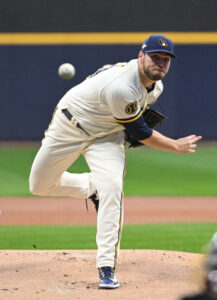
Last season was perhaps his least impressive showing since his 2020 breakout. Yet it could only be classified as a “down” year by Burnes’ immense standards. He remained a top-of-the-rotation pitcher, turning in a 3.39 ERA while logging 193 2/3 innings across 32 starts. His 25.5% strikeout rate was still a few points better than league average, as was his 12.2% swinging strike percentage. He finished eighth in Cy Young voting.
It wasn’t the same level of dominance that Burnes had shown in the preceding three years. He had fanned more than 30% of opponents with a swinging strike rate above 14% in every year from 2020-22. Burnes looked more like his old self down the stretch, however. He carried a 3.94 ERA and a 23.1% strikeout rate into the All-Star Break. In the second half, he fanned 28.6% of opponents while allowing only 2.71 earned runs per nine. Opposing hitters had a pitiful .187/.259/.294 slash line after the Midsummer Classic.
Going back to the start of 2020, Burnes has a 2.86 ERA over 105 appearances. He has punched out nearly 31% of batters faced against a modest 7.1% walk rate. Batters are hitting .197/.262/.308 in nearly 2500 trips to the plate. Neither left-handed nor righty-hitting opponents have had success against him. Outside of a two-week injured list stint early in 2021 because of a finger contusion, he hasn’t missed any time within the last three years.
Burnes is a true ace, one of the 5-10 best pitchers in baseball. He jumps to the top of a rotation that has suddenly gone from Baltimore’s biggest question to one of the higher-upside staffs in the league. Kyle Bradish slots in as the #2 arm after a breakout 2023 campaign in which he worked to a 2.83 ERA over 30 starts. Grayson Rodriguez looks to have turned a corner in the second half. The former top pitching prospect worked to a 4.35 ERA in his rookie season. After being tagged for a 7.35 ERA in his first 10 MLB outings, he turned in a 2.58 mark in his final 13 regular season starts (although he was hit hard in his lone playoff appearance).
That’s a potentially elite top three. Former All-Star John Means returned from Tommy John surgery late last season. Some residual elbow soreness kept him off the club’s playoff roster, but he’s expected to be fully healthy for 2024. If that’s true, he slots in well as the #4 starter. Dean Kremer would likely occupy the final spot, with Tyler Wells and Cole Irvin pushed into season-opening relief roles.
While the O’s could perhaps benefit from another depth addition or two, they’ve landed the true #1 that should represent the finishing move on an already great roster. Baltimore’s loaded young lineup and excellent relief corps led the team to 101 wins and an AL East title a year ago. The O’s lost star closer Félix Bautista to Tommy John surgery at year’s end but moved early in the offseason to sign Craig Kimbrel as a replacement.
It’s likely a one-year acquisition. Burnes will hit free agency next offseason shortly after his 30th birthday. With anything like his typical levels of production, he’ll be in line for a massive contract that could top eight years and $200-250MM. Burnes has been clear about his desire to test his value on the open market. Asked in December about the possibility of signing an extension if he were traded this winter, he said such an offer “would have to be something that would just absolutely blow you away to get you away from testing the free agent market.”
As recently as last week, O’s fans wouldn’t have been able to dream about the organization putting that kind of proposal on the table. Baltimore has dramatically scaled back spending since John Angelos assumed control of the franchise. On Tuesday, the Angelos family agreed to sell the organization to private equity mogul David Rubenstein. How that’ll impact the long-term payroll outlook remains to be seen, but Baltimore fans can be more optimistic about the chances of making significant investments once Rubenstein takes control of the franchise after the sale is approved by MLB in the coming months.
In any case, the primary focus is installing Burnes atop next year’s rotation. The three-time All-Star had settled on a $15.637MM contract with Milwaukee to avoid arbitration in his final season of eligibility. That makes him the highest-paid player on Baltimore’s roster and pushes their 2024 payroll projection to roughly $96MM, as calculated by Roster Resource. It’ll be their highest season-opening payroll since 2018 and is a marked increase over last year’s approximate $60MM mark.
Still, they’re in the bottom third of the league in projected spending. They’re making a push to defend a title in what is annually one of the sport’s most competitive divisions. Their only commitments beyond this season are a $1MM salary for Bautista and a handful of inexpensive option buyouts. Even if this takes them near their spending limit this offseason, they should have flexibility to further bolster the roster near the deadline.
That Baltimore did so without surrendering any of their true top-tier prospects reflects both the strength of their talent pipeline and the value ceiling for any player who is only one year from free agency. Ortiz and Hall are each highly-regarded young players but placed in the back half of Baltimore’s top 10 prospects at Baseball America.
Ortiz, 25, was a fourth-round pick in 2019 out of New Mexico State. He’d drawn praise for his defensive acumen dating back to his time in college. The right-handed hitter has been more productive at the plate than many amateur scouts anticipated. He owns a .286/.357/.449 slash in his minor league career. Ortiz posted even better numbers between the top two levels of the minors a year ago.
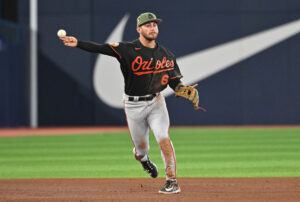
In 389 plate appearances in Norfolk, he hit .321/.378/.507 with nine homers and 30 doubles. Ortiz spent most of his time at shortstop while logging some action at both second and third base. Baltimore promoted him for the first time at the end of April. He nevertheless spent most of the season on optional assignment, appearing in only 15 big league contests. With Jackson Holliday and Gunnar Henderson as the projected left side infield for the foreseeable future, Ortiz would have had a hard time finding much playing time.
Baseball America’s scouting report rates Ortiz as a potential 70-grade (plus-plus) defensive shortstop. Assuming he’s not traded in the next six weeks, Willy Adames will open the season at shortstop. Milwaukee is likely to lose Adames to free agency next winter at the latest, though, leaving a clear path for Ortiz to emerge as the long-term answer. In the short term, he should battle Andruw Monasterio and Owen Miller for playing time at third base. If Monasterio or Miller warrant extended run at the hot corner, Ortiz is an alternative to Brice Turang at second. Turang is a gifted defender but struggled at the plate during his rookie year.
Hall, also 25, was a first-round pick out of a Georgia high school seven years ago. The 6’2″ southpaw has had the same general profile for his entire professional career: huge stuff with worrying control issues. Hall made his MLB debut in 2022 and has logged 33 big league innings over the past two seasons. He owns a 4.36 ERA with a 29% strikeout rate while working almost exclusively in relief.
His 7.6% walk percentage at the MLB level isn’t out of the ordinary. Hall has been a lot less consistent at throwing strikes in the minors, however. He handed out free passes to over 13% of batters faced in 49 innings at Norfolk a year ago, which is right in line with the 13.4% walk rate he owns in his minor league career.
That he also punched out nearly a third of batters faced in Triple-A hints at the excellent arsenal he owns. His fastball averaged nearly 96 MPH in his big league relief work. Hall also worked with a mid-80s slider and changeup while occasionally mixing in a curveball. BA’s scouting report notes that all four of those offerings could be plus or better.
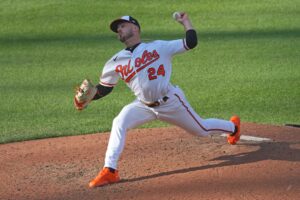
It’s top-of-the-rotation caliber stuff, but Hall’s strike-throwing has led many evaluators to project him as a high-octane reliever. Milwaukee could use him in either capacity. The Brewers have ample opportunity in the rotation behind new staff ace Freddy Peralta. Veteran lefty Wade Miley is a steadying presence. After that, Milwaukee could lean on any of Colin Rea, injury returnees Joe Ross and Aaron Ashby and prospects like Hall and Robert Gasser in the rotation.
Neither Ortiz nor Hall has reached one year of major league service. They’re each under club control for at least six seasons and three years away from arbitration. They’re the kind of high minors players that Milwaukee frequently targets. Their organizational philosophy, much like that of other small-market franchises like the Rays and Guardians, is to eschew traditional competitive windows while building the farm system by trading veterans as they get close to free agency.
GM Matt Arnold stated that trading Burnes isn’t the signal of a traditional rebuild (relayed by Curt Hogg of the Milwaukee Journal-Sentinel). Last week’s signing of Rhys Hoskins to a $34MM free agent deal that allows him to opt out after next season makes clear they’re not giving up on contending in a wide open NL Central. They’ve shown time and again they’ve nevertheless open to offers on most players to try to remain consistently competitive. After trading Josh Hader at the 2022 deadline led to discontent within the clubhouse, the front office suggested they were less inclined to make those kinds of trades during the season.
Between the shoulder injury that led Milwaukee to non-tender Brandon Woodruff and tonight’s move, the Brewers have subtracted their top two starters this offseason. Milwaukee’s payroll projection drops to around $102MM, per Roster Resource. That’s well below last year’s $118MM season-opening mark. That leaves open the possibility of Milwaukee backfilling the rotation in free agency. Arnold was noncommittal as to whether the team planned to reinvest their payroll savings (via Hogg).
Milwaukee should add a third notable young player with the draft choice they acquired. Milwaukee would have received a compensatory pick had they let Burnes depart in free agency — he’ll surely reject a qualifying offer — but that wouldn’t have been until 2025. Baltimore can make Burnes a QO next offseason (and will, unless he suffers a serious injury). As a revenue sharing recipient, they’d land a compensation pick after the first round in 2025 if he signs elsewhere for at least $50MM.
Ken Rosenthal of the Athletic first reported the Orioles were nearing a deal to acquire Burnes. Jon Heyman of the New York Post indicated the deal was agreed upon. ESPN’s Jeff Passan reported that Ortiz and Hall were among the pieces headed to the Brewers. Mark Feinsand of MLB.com reported the inclusion of the draft pick to complete the deal.
Images courtesy of USA Today Sports.
Brewers Designate Ethan Small For Assignment
The Brewers have designated left-hander Ethan Small for assignment, tweets Adam McCalvy of MLB.com. That’s the corresponding 40-man roster move for the two players acquired from Baltimore in the Corbin Burnes trade.
Small was Milwaukee’s first-round pick in 2019 after an excellent college career at Mississippi State. He was initially regarded as one or the better prospects in the organization, but his stock had dipped as he reached the upper minors. Small posted a 4.46 ERA in Double-A in 2022. Milwaukee moved him to the bullpen last year.
The 26-year-old (27 this month) posted decent numbers in relief for Triple-A Nashville. He worked to a 3.18 ERA through 51 innings, striking out 28.5% of opposing hitters. Small also walked 11.2% of batters faced and the Brewers didn’t give him much of an opportunity at the big league level. He pitched twice in the majors last season and has four MLB appearances for his career.
Small doesn’t throw especially hard, averaging 92 MPH on his fastball in his limited MLB work. Prospect evaluators credited him with a plus changeup and his atypical, over-the-top delivery makes him an unconventional look for opposing hitters.
The Brewers will have one week to trade Small or place him on outright waivers. It’s likely he’ll draw interest from another team given his draft pedigree and decent Triple-A résumé. Small has one minor league option remaining. If another team is willing to give him a spot on the 40-man roster, they could keep him in Triple-A for another season.