
Nationals Re-Sign Asdrubal Cabrera
The Nationals announced Wednesday that they’ve re-signed infielder Asdrúbal Cabrera to a one-year contract. The Octagon client will reportedly be guaranteed $2.5MM and can earn an additional $500K via incentives.
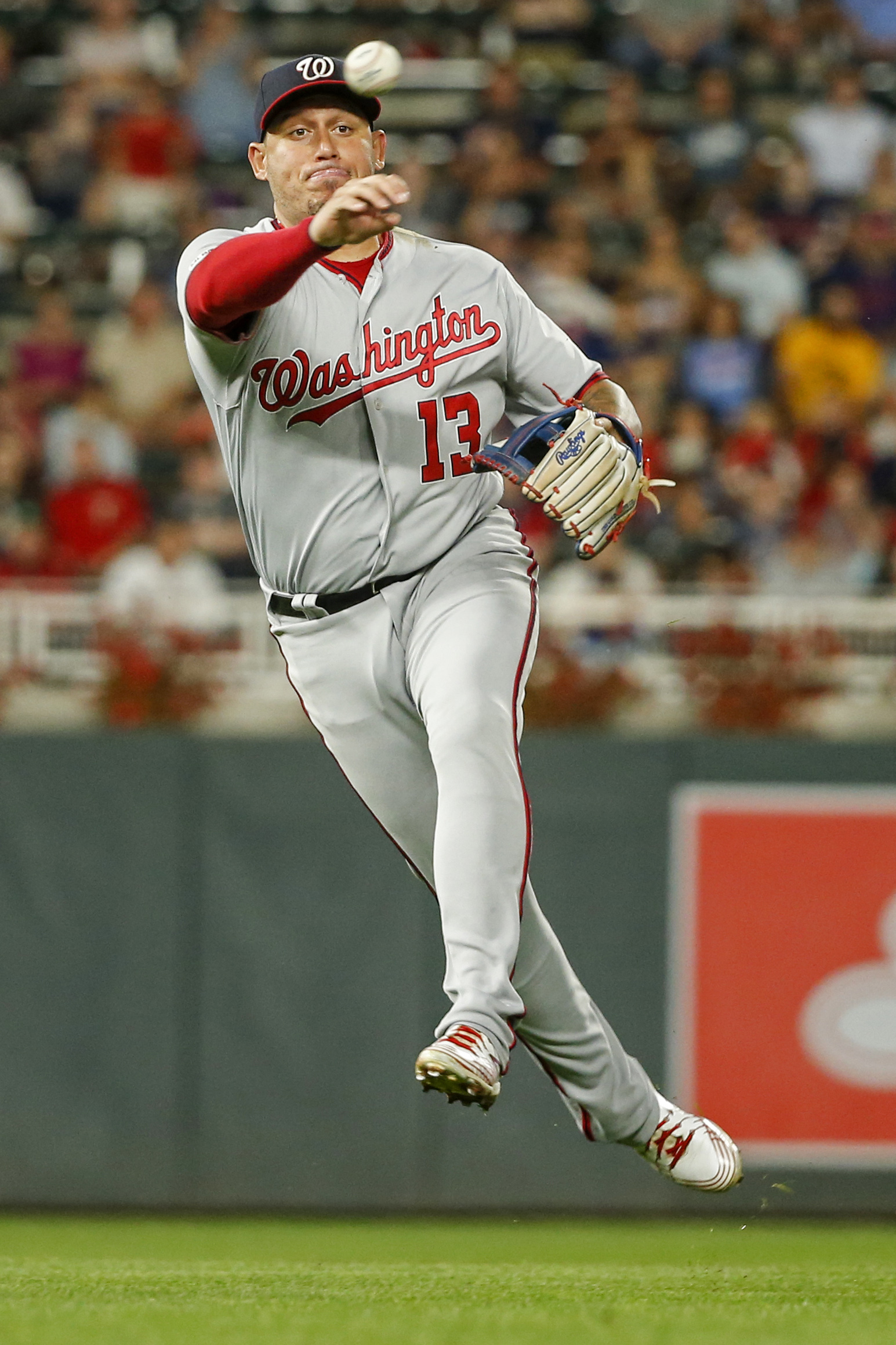
Cabrera, 34, latched on with the Nats in August. He was fantastic for the eventual World Series champs down the stretch, putting up a .323/.404/.565 line over 146 plate appearances. Of course, that doesn’t tell the whole story of Cabrera’s season. He compiled a meager .235/.318/.393 slash in Texas. The Rangers released him the first week of August, presumably after finding nothing to their liking before the July 31 trade deadline. Cabrera’s .260/.342/.441 cumulative performance (98 wRC+) was almost exactly league average.
Coupled with still-solid defensive metrics at second and third, Cabrera was worth just under two wins above replacement (1.7 bWAR, 1.9 fWAR) in 131 games. If he can replicate that solid production in 2020, he’d be a bargain on such a low-cost deal. Of course, Cabrera’s age, slow start and the saturated free agent market for infielders combined to limit his earning power.
The signing is perhaps more interesting from a broader market perspective. Cabrera and Starlin Castro, who agreed to a two-year deal with Washington yesterday, are both solid players who now look to be in line to contribute on a more-or-less everyday basis. Yet they’re not the marquee players some Nats’ fans may have been hoping for once Anthony Rendon left.
Washington looks to be one of the finalists for Josh Donaldson. The top free agent still on the market, Donaldson is reportedly sitting on multiple four-year offers, waiting for someone to match his asking price. At one point, the Nats themselves put forth a four-year proposal. It isn’t clear whether that specific offer remains on the table following the club’s recent moves.
That said, neither Castro nor Cabrera should prevent the Nats from adding Donaldson from a financial perspective. And Washington could certainly push one or both into complimentary roles to fit a player of Donaldson’s caliber on the roster. Indeed, Jim Bowden of the Athletic hears that Washington isn’t necessarily out on Donaldson.
The club’s recent moves, however, at least give them a safety net should they miss out on the Bringer of Rain (or one of the trade market’s top options). Between Castro, Cabrera, Howie Kendrick and Carter Kieboom, Washington has myriad in-house options capable of manning second and third base. Perhaps that gives them a bit less urgency than other clubs searching for upgrades on the dirt- most notably, the Braves, Rangers, and Twins- to meet the lofty acquisition cost each player would certainly require.
Robert Murray first reported (via Twitter) that the two sides were close to a deal. Jon Heyman of MLB Network reported the agreement and the terms (all Twitter links).
Latest On Josh Donaldson’s Market
7:52pm: MLB.com’s Mark Bowman looks at the situation from the Braves’ standpoint, reporting that there’s some doubt that the Braves have even “come close” to making the top offer to Donaldson.
Similarly, Darren Wolfson of 1500 SKOR North radio in Minneapolis reported today that while the Twins are still in the mix and have made a four-year offer, they’re not believed to be close to Donaldson’s reported $110MM asking price, either (Twitter links). The Twins don’t have the largest offer on the table, per Wolfson, who suggests that Minnesota could be in the $85MM range while cautioning that they’ve not yet been asked for a final offer. The two sides remain in “near-daily” communication.
That pair of reports at least implies that the Nationals might have made the biggest offer, although that’s strictly reading between the lines in speculative fashion. It’s worth noting, of course, that the Nationals have a tendency to bake deferred money into their contract offers, which weighs down the present-day value of said offers. Plus, with their recent bevy of infield signings, there’s a bit less urgency to add another option to the pile — even if Donaldson is easily the best of the bunch.
Today’s reports on Donaldson at least cast some doubt as to just how close — if at all — he’ll be able to get to his reported $110MM asking price. It’s clear that there are multiple staring contests underway at present, and the revelation that Donaldson’s camp hasn’t asked for final offers doesn’t exactly suggest that a resolution is imminent.
7:00am: Even after a run of free agent additions that plug quite a few holes with veteran players, the Nationals do not appear to be shutting the door on top remaining open market star Josh Donaldson — at least, not entirely. The Nats could still make the third baseman fit, but evidently won’t be the team that ups its bid to land him.
After agreeing to terms with Howie Kendrick, Starlin Castro, Asdrubal Cabrera, and Eric Thames, and with youngster Carter Kieboom waiting in the wings, the Nats could in theory have bailed out of the Donaldson auction altogether. But that assembly of pieces hardly makes up for the departure of Anthony Rendon. And the D.C. organization surely doesn’t wish to allow the division-rival Braves a chance at retaining Donaldson without paying full price (and then some) to do so.
After yesterday’s reported deal with Thames, the Nationals remain “in the picture,” Bob Nightengale of USA Today reports (via Twitter). Indeed, the club is “leaving [its] offer on [the] table,” Jon Heyman of MLB Network reports on Twitter. Precisely how that offer matches up to others isn’t known with specificity — reports had suggested the Nats, Braves, and Twins were in the same $100MM ballpark — but it surely helps Donaldson’s cause to keep that avenue open.
Donaldson had been said to be dangling bait to interested teams, indicating he’d sign with the first club to meet an asking price in the vicinity of $110MM. Unless something changes, it seems the Nats won’t take the hook. It remains to be seen whether some other team will. Likewise, unless the defending World Series champs withdraw their bid, the Braves, Twins, and any other pursuers (Dodgers? Rangers? mystery team(s)?) will presumably need to meet or top that number to get a deal done.
There certainly may be some momentum towards a return to Atlanta. The Nationals are at minimum preparing to move forward without Donaldson. The Twins’ hopes are said to be dimming. And it’s largely unclear whether any other team has or will engage Donaldon’s reps in earnest. Numerous observers have cast the Braves as favorites, though as ever it’s inadvisable to view free agent matchmaking as a metaphorical horse race or political contest. Market circumstances can turn on a dime.
Nationals, Carlos Tocci Agree To Minor League Deal
2:28pm: Tocci does not currently have a Spring Training invite, Sam Fortier of the Washington Post tweets. It’s possible that the Nats could add him to big league camp at some point, of course, but if not, it seems likely that he’d head straight to Triple-A Fresno.
2:09pm: The Nationals have agreed to a minor league pact with outfielder Carlos Tocci, reports Bob Nightengale of USA Today (via Twitter). The fleet-footed 24-year-old will be in Major League Spring Training as a non-roster invitee.
Tocci, once a relatively high-profile international signing by the Phillies, spent the 2018-19 seasons in the Rangers organization after Texas acquired him in the 2017 Rule 5 Draft. Selected more for his speed, defense and contact abilities than for his chances of becoming an impact player at the plate, Tocci was hidden on the Rangers’ roster in a limited role throughout the 2018 campaign. He appeared in only 66 games and took just 135 turns at the plate, posting a woeful .225/.271/.283 batting line in that time.
Struggles were somewhat foreseeable, as Tocci had played in just 17 Triple-A games through the 2017 campaign and had long faced questions about a lack of power. But Tocci’s difficulties at the plate continued into the 2019 season in Triple-A, where despite a leaguewide boom in offense, he mustered a paltry .244/.313/.308 batting line (55 wRC+). Scouting reports on Tocci have long touted his plus defensive tools, but he’ll need to make some strides with the bat if he has any hope of establishing himself as viable big league outfielder.
Tocci gives the Nats some additional depth in center field — not that the club is hurting in that regard. Victor Robles, Juan Soto and Adam Eaton are lined up to start once again in 2020, while Michael A. Taylor projects as the primary backup option. Andrew Stevenson gives the Nats another option on the 40-man roster as well, but the organization’s center-field depth in the upper minors is a bit lacking.
Nationals Sign Starlin Castro
JANUARY 7: This deal is now official.
JANUARY 3: The Nationals have a deal with infielder Starlin Castro, according to Ken Rosenthal of The Athletic (via Twitter). It’s a two-year arrangement, per Joel Sherman of the New York Post (Twitter link). The deal promises the Magnus Sports client $12MM, per Jeff Passan of ESPN.com (via Twitter).
Castro will be tasked with handling second base for the defending World Series champs. Fellow free agents Brian Dozier and Asdrubal Cabrera handled most of the work at that position last year in D.C.
The Nationals have seen plenty of Castro over the past several seasons, as he has appeared with the division-rival Marlins. He has had ups and downs over the years, but has always showed up — averaging 149 games per season since 2011 — and typically delivered a useful combination of league-average offensive production and average glovework. Poorly graded baserunning has long been a bit of a drag on his overall value.
It’s not an exciting signing, by any stretch, but does check a box for the Nats. And perhaps the club sees reason to hope for a bit more out of Castro. He’s still just 29 years of age and vastly increased his offensive productivity in the second half of the 2019 campaign. In his final 285 plate appearances of the year, he slashed a hefty .302/.334/.558 with 16 long balls. He’s never going to draw many walks, so the question is Castro can continue to make better contact — both harder and higher — and thus maintain a meaningful portion of that second-half power outburst.
Even if Castro enters the season as the presumptive second baseman, he could ultimately move into a more flexible role — especially if top prospect Carter Kieboom forces his way into an everyday role. Castro has plenty of experience on the left side of the infield and could become part of a timeshare at third base if that becomes desirable (whether in the first or second year of the deal). Castro would pair well with a lefty hitter, as he has long been much more dangerous against southpaws.
As things stand, the Nats would rely upon the switch-hitting Wilmer Difo to spell Castro and shortstop Trea Turner. The team could pursue an upgrade over Difo. It might also add a more offensive-oriented player who can spend time at first base. There could be some overlap there, as well. The team’s ultimate moves at third base — Josh Donaldson remains the chief target, with a few major trade candidates also possible — may end up dictating the finishing touches on the bench. Whether or not Ryan Zimmerman ends up returning will also be a factor.
Offseason Notes: Nationals, Free Agents, Rays, Cubs, Bryant, Contreras
The World Champion Washington Nationals are likely to move on from their remaining free agents, save for local institution Ryan Zimmerman and perhaps his first base partner Matt Adams, per MASN’s Mark Zuckerman. That means Daniel Hudson has likely priced himself out of the Nationals’ plans. Fernando Rodney could get another shot on a minor league deal, but GM Mike Rizzo has handed those out rather liberally this winter, and the bullpen barracks are looking pretty full: Javy Guerra, Fernando Abad, and David Hernandez are all competing for bullpen spots on minor league deals while Sean Doolittle, Will Harris, Tanner Rainey, Wander Suero and Roenis Elias look pretty good to secure their seats at the table. Hunter Strickland, and one of Joe Ross, Austin Voth, and Erick Fedde could also very well end up in the bullpen, leaving just a spot or two as truly up for grabs. Brian Dozier, the last of the Nats’ five remaining free agents, is all but gone now that Starlin Castro and Asdrubal Cabrera have been signed.
- The Rays have pretty consistently made themselves a good place for January free agents to take their career to the next level, per John Romano of the Tampa Bay Times. A list of short-term additions late in the free agent season have gone on to produce in Tampa Bay and earn themselves a raise the following winter. The partial list of players who went on to earn bigger paydays after leaving Tampa includes Avisail Garcia, Logan Morrison, C.J. Cron, and Corey Dickerson. The time is now for the Rays, who typically strike about this time of year, and they still have needs to fill. Expect Tampa to add another bat and another catcher before the winter is out.
- The Cubs have lingered in the shadows throughout the winter, and though a Kris Bryant trade has been clearly telegraphed, the star third baseman remains in Chicago due to asking price, per David Kaplan of NBC Sports Chicago. Speaking to people around the game, Kaplan found real skepticism that Bryant remains the foundational superstar he was in 2016. That hasn’t stopped the Cubs from asking for the moon, with the same being true of their asking price for Willson Contreras. Theo Epstein and the Cubs are in a tough place after seeing their championship window slam closed last season, and it’s understandable for the braintrust in Chicago to hold out hope for a franchise-altering return for one of their homegrown stars. But if the return they seek never materializes, it’ll be interesting to see what kind of alternative plan they can cook up to keep these Cubs viable.
MLBTR Polls: Washington Nationals’ Recent Additions
The defending champion Washington Nationals began their offseason in a holding pattern, awaiting the fates of two of their brightest stars: Anthony Rendon and Stephen Strasburg. What shook out couldn’t have been more on-brand for the pitching-focused Nats. Strasburg re-upped with the only professional organization he’s known, while Rendon joined Mike Trout, Shohei Ohtani, and Joe Maddon on an Angels’ team frontrunning for Best Smiles in the AL West, if not the division crown.
Following those twining, superstar sagas, the Nats embarked on a period of relative calm throughout much of December. While waiting in the hallway with the Twins and Braves for Josh Donaldson to make his final contract demands, Nats’ GM Mike Rizzo contented himself with bringing back as much of the championship gang as he could manage. Living legend Howie Kendrick will be back for three-to-five starts per week somewhere in the infield, Yan Gomes returns to block Patrick Corbin sliders and share in the catching duties with Kurt Suzuki, and even mid-season bullpen stabilizer Javy Guerra will get another crack to stick in the bullpen on a minor league deal. Ryan Zimmerman continues to wait in the shadows, certain to re-sign at some point, though how regularly Mr. National will see the field in 2020 is entirely unclear.
This week, however, the Nats grew tired of waiting for Donaldson and moved to add a trio of free agents. Asdrubal Cabrera is the most familiar new/old face. The man most-often charged with protecting Juan Soto in the lineup during 2019’s second half returns to Washington on a one-year, $2.5MM guarantee. Cabrera put up insane numbers in August and September for the Nats (.323/.404/.565). While he bonded nicely with the club in his second stint in the District, the Nats’ can hardly expect Cabrera to put up anything close to the Rendonian line he boasted over the season’s final two months. Somewhere between Kendrick, (presumably) Zimmerman, and top prospect Carter Kieboom, Cabrera represents a capable option to gather loose change at-bats between first, second, and third base.
But the Nationals added a rival to that infield mix as well, inking Starlin Castro to a somewhat surprising two-year, $12MM deal. Ten years into his big league career, Castro turns just 30-years-old in March while carrying an uninspiring .280/.319/.414 career line. The Nats plan to let Castro have second base until Kieboom or somebody else takes it from him, and while he fits an organization ethos that trusts veteran contributors more than the average big league team, it’s hard to get too excited about a guy whose only real elite skill has been volume. He doesn’t strike out a ton, but he won’t take walks, and neither his speed nor power elicit much awe.
Castro did absolutely rip left-handed pitching in 2019, and in the right light, Castro’s home/road, left/right and 1sthalf/2ndhalf splits can all point to a player who deserves more credit than I’m giving him. For instance, he hit .302/.334/.558 in the second half and .286/.332/.447 away from Marlins Park. Together, Cabrera and Castro give the Nats two relatively similar players whose contributions will have to be monitored, like your favorite sublet, on a month-to-month basis.
Perhaps the most unassailable move made in this past week, funny enough, is the addition of spin-rate-savant Will Harris. Nats’ fans no doubt already hold a fondness for Harris after he surrendered the World Series winning home run to Kendrick late in game seven. Years of playoff disappointment prior to 2019 should have those in the District well-prepared to look beyond the volatility of playoff results and appreciate Harris for what he is: one of the best relievers in the league. After all, Astros’ manager AJ Hinch is hardly a doofus, and quibble if you will about his decision to let $324MM man Gerrit Cole languish away in the bullpen while Harris and Kendrick put the foul pole to work – but his decision to pitch Harris in that moment was entirely defensible. That he wanted Harris on the hill should further brighten the hearts of Nats’ fans, even if the three-year, $24MM deal given him at age-35 might cause some seat-squirming. Still, this is a guy with a 2.36 ERA/2.99 FIP over the last five seasons, and he insures the Nats’ bullpen against further wear-and-tear on Sean Doolittle or stagnation from hard-throwing righty Tanner Rainey.
Donaldson could still find himself suiting up next to Trea Turner on the left side of the Nats’ infield, but Rizzo has historically stuck to his number with position players, and if Donaldson’s demands have stretched beyond his comfortability, don’t expect the disciplined Rizzo to panic. Cabrera, Castro and Harris may not be the cavalry Nats’ fans expected to ride in to defend their first ever championship, but they’re here to help all the same. The question is, do they?
(Poll link for app users)
Grade the Nats' re-signing of Asdrubal Cabrera
-
B 40% (3,620)
-
C 34% (3,046)
-
A 17% (1,487)
-
D 6% (575)
-
F 3% (241)
Total votes: 8,969
(Poll link for app users)
Grade the Nats' signing of Starlin Castro
-
B 41% (3,418)
-
C 32% (2,657)
-
A 16% (1,316)
-
D 9% (736)
-
F 3% (224)
Total votes: 8,351
(Poll link for app users)
Grade the Nats' signing of Will Harris
-
A 43% (3,526)
-
B 37% (3,034)
-
C 14% (1,146)
-
D 3% (266)
-
F 2% (155)
Total votes: 8,127
Talks Between Nationals, Cubs On Kris Bryant Have ‘Gone Nowhere’
Recent talks between the Cubs and Nationals regarding Kris Bryant have “gone nowhere,” reports Ken Rosenthal of the Athletic (via Twitter). Negotiations seemed to hit an impasse a few weeks ago, when the Cubs reportedly insisted upon the inclusion of promising center fielder Víctor Robles in any Bryant deal.
Notably, Washington has agreed to terms with Asdrúbal Cabrera on a one-year deal since Rosenthal’s report. Perhaps that takes them out of the running for Bryant or Nolan Arenado, two of the top trade candidates on the market, regardless. Cabrera, though, wouldn’t figure to stand in the way of an acquisition of a player as good as Bryant or Arenado. Indeed, Washington still doesn’t seem to be entirely ruling out a signing of star free agent Josh Donaldson. There’s yet opportunity to circle back to more eye-catching names than Cabrera and Starlin Castro, who the Nationals brought aboard yesterday.
Understandably, the Cubs seem to be setting a high price in talks on Bryant. Interested suitors, meanwhile, are wary of Bryant’s service time grievance. At the moment, the 28-year-old has two years of team control remaining. His $18.5MM projected salary is notable but still an unquestionable bargain for a player of his caliber. If Bryant wins the grievance, however (an outcome that would be unexpected but hardly impossible), he’d reach free agency at the end of next season instead. In that case, he would still be a highly appealing trade chip, but his value would no doubt take a hit. Thus, Bryant seems likely to stay put until the grievance is resolved.
Either way, it doesn’t appear Bryant will be headed to the nation’s capital, barring an unforeseen reignition of talks. Teams who lose out on Donaldson and Arenado would figure to be Bryant’s most ardent pursuers. The Braves, Rangers, and Twins have been among the most active searchers for upgrades at the hot corner. Of course, there’s no urgent need for the Cubs to trade Bryant, who, despite the pending grievance, might still be amenable to working out a long-term deal.
Josh Donaldson Reportedly Sets Asking Price
Weeks of bidding has reportedly driven the price tag for Josh Donaldson into the nine-figure range over a four-year term, with at least three clubs said to be sitting at that lofty price point. The end game may now be upon us.
The star third baseman has given teams what amounts to a firm and final asking price, according to a report from Ken Rosenthal of The Athletic (subscription link). Donaldson is “simply waiting for one of the clubs to hit his number” — around $110MM — per the report.
It seems, then, that the Braves, Nationals, Twins, Rangers, Dodgers, and any other lurkers need only place a single phone call to Donaldson’s reps to get the paperwork started. With the first three of those clubs reportedly already close to Donaldson’s asking price, it doesn’t seem like a huge stretch to bridge the gap. On the other hand, it may be that these teams feel they’ve already moved well out of their comfort zone for a 34-year-old player with a not-so-distant injury history, however talented he may be.
We have seen this sort of bidding situation emerge before. Sometimes, the player ends up picking from among multiple, roughly equivalent offers, as reportedly occurred a few years back with Jason Heyward and Ben Zobrist. In other cases, a team leaps up to meet the asking price, as then-Blue Jays and now-Braves GM Alex Anthopoulos did to land Russell Martin — a situation he discussed last year.
It’s interesting now to see Anthopoulos weighing another tough call on an older free agent. He has twice acquired Donaldson, first via trade in Toronto and then through free agency in Atlanta, and has twice been rewarded for doing so. But while Anthopoulos made no shortage of big-money strikes during his time with the Jays, he has run quite a tight ship with the Braves. Most teams pressing to win end up going out on a limb at some point or another. No doubt Anthopoulos is presently weighing whether to do so with Donaldson or take on somewhat different risks by seeking an alternative path to the quality bat he wishes to acquire.
The calculus is much the same for the other teams involved. For the Nationals, the luxury tax line is fast approaching after a series of other moves. Adding Donaldson would probably mean going past it, though that seems to be a palatable outcome after dipping under the bar last year and going on to snag a World Series win. The Twins have ample flexibility after piecing together a cost-conscious series of rotation moves. It’s arguable that the Minnesota organization is most in need of a boost and best positioned to take on the long-term financial risks. But there are probably other ways the team could go to improve as well.
It could be that we’re seeing a bit of a staring contest here. Even if every organization knows that it controls its own destiny with regard to Donaldson — meet his ask and he’s yours — they’d each rather get him for less. There are some exceptionally talented alternatives in Kris Bryant and Nolan Arenado, but they’ll each require a sacrifice of talent and it’s far from clear how appealing the trade terms will be in both cases. Other possibilities, such as trading for Kyle Seager or signing Todd Frazier, rate as backup plans in comparison to the addition of Donaldson or one of his talent-level peers.
Nationals Sign David Hernandez
The Nationals have inked veteran reliever David Hernandez, according to the Baseball America transactions log. (BA stalwart Matt Eddy has handed the controls over to Chris Hilburn-Trenkle.)
Details aren’t available, but it’s surely a minor-league deal for the 34-year-old hurler. Hernandez is coming off of an especially trying campaign in which he carried a putrid 8.02 ERA over 42 2/3 innings with the Reds. He failed to turn things around in a late stint at Triple-A with the Yankees.
Thing is, little about Hernandez’s effort suggested those excruciating results. He racked up 11.2 K/9 against 4.2 BB/9 while carrying career highs in swinging-strike rate (14.7%), chase rate (35.3%), and first-strike rate (65.2%). Hernandez allowed more homers than you’d like, but 1.48 per nine hardly stood out in a season of the long ball.
In large part, Hernandez seems to have been the victim of poor fortune. He allowed a hefty .393 batting average on balls in play and carried a meager 54.5% strand rate. Statcast measurements indicate that opponents didn’t hit the ball any harder than usual. He was kicked around for a .376 wOBA that dwarfed the .318 xwOBA that the contact quality suggested.
The Nats will see in camp whether Hernandez deserves a shot at turning things around. He’s surely a better option than his 2019 ERA would suggest, though it remains to be seen whether he’ll warrant a pen slot in D.C.
Nationals Sign Will Harris
JAN. 3: The Nationals have announced the deal.
JAN. 2: The Nationals have agreed to a deal with free agent right-hander Will Harris, The Athletic’s Ken Rosenthal reports (Twitter link). The contract is a three-year pact worth $24MM, as per USA Today’s Bob Nightengale (via Twitter). Harris is represented by agent Gavin Kahn.
Reports from earlier today suggested that Harris could be nearing a signing, as he had multi-year offers on the table from more than one team. Though Harris has a long track record of success, a three-year commitment is significant considering that the righty turned 35 last August, and only two other relievers (Drew Pomeranz and Will Smith) received three or more guaranteed years in free agency this offseason. MLBTR projected a two-year, $18MM deal for Harris, as we ranked him 22nd on our list of the winter’s top 50 free agents.
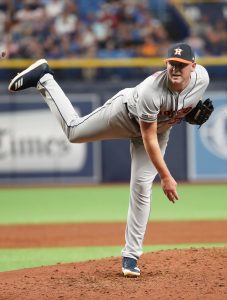 The three-year pact was a major factor for Harris, as he told Mark Berman of KRIV Fox 26 (Twitter links). “The Nationals knew the importance of [the three-year deal] and they kept that on the table & made the decision that much easier,” Harris said. “We agreed to terms last weekend. From the beginning of the process the Nationals were pretty high on me. The interest was mutual.”
While Harris’ age is a natural question mark, he has a pretty clean injury history, with only two IL stints (totaling around six weeks in 2017 due to shoulder inflammation) over his nine MLB seasons. In that time, he has quietly posted some outstanding numbers, particularly as a member of Houston’s bullpen from 2015-19. Harris has a 2.36 ERA, 4.38 K/BB rate, and 9.5 K/9 over 297 innings, averaging 59 frames per season.
As you might expect from an Astros pitcher, Harris had an outstanding spin rate (96th percentile) on his fastball in 2019. His Statcast metrics also place him among the league’s best in curveball spin, hard-hit ball percentage, and xwOBA (.235, with only a .269 wOBA). Harris has also been consistently good at keeping the ball on the ground during his career, with a 49.6% grounder rate.
Unfortunately for Harris, the most famous pitch of his career is one that he couldn’t keep out of the air — the low fastball that Howie Kendrick just got enough of, as Kendrick launched Harris’ offering off the right field foul pole for the homer that put the Nationals ahead in Game Seven of last year’s World Series. In some unique baseball irony, Harris will now be joining the team that caused that bad memory, and he’ll even be sharing a clubhouse with Kendrick (who re-signed with the Nats on a one-year deal).
Clearly there aren’t any hard feelings on Harris’ part, and the Nationals are undoubtedly happy to add such a highly-touted reliever to their bullpen. Washington’s relief corps was a well-publicized mess for much of last season, before Daniel Hudson‘s late-season emergence helped stabilize the pen enough to take the Nats through the postseason. Harris will lineup behind closer Sean Doolittle in 2020, and Harris’ presence now means that he’ll essentially replace Hudson in the District’s pen, Jesse Dougherty of the Washington Post tweets. The Nats were willing to give Hudson more than a one-year guarantee but not more than $6.5MM in average annual value, so they instead spent some extra money to land a more consistent reliever in Harris.
After re-signing Kendrick, Stephen Strasburg, and Yan Gomes, Harris represents the first major new face to join the Nationals this offseason. The bullpen was unquestionably a major need for the Nats, who also have to figure out vacancies at third base in the wake of Anthony Rendon‘s departure, second base, and first base, though Kendrick will be deployed around the infield in some manner and star prospect Carter Kieboom is expected to play a bigger role in 2020.
The $8MM average annual value of Harris’ deal brings Washington’s estimated luxury tax number to just under $184MM, as per Jason Martinez of Roster Resource. The Nats are still reportedly in the hunt for Josh Donaldson, whose market is now rumored to be in the four-year, $100MM range. Landing Donaldson, therefore, would put the Nats either right up against or slightly over the $208MM tax threshold, though since the club got under the threshold last season, they would be taxed at only a first-timer rate if they surpassed $208MM this season. The Nationals slightly exceeded the Competitive Balance Tax line in both 2017 and 2018, though they stayed in the lowest penalty zone (less than $20MM in overage).
Photo courtesy of USA Today Sports Images