
Top Hot Stove Storylines Entering 2014
An impressive flurry of activity before the Winter Meetings left some feeling that there would be little left to tackle before the 2014 season kicks off. And yet, while just seven of MLBTR's top fifty free agents were still available last time this year, fully twice that number remains this time around. Meanwhile, by this point in the 2013 offseason, David Wright and Evan Longoria had already entered huge new extensions. So far this year, however, only Hunter Pence's deal has approached those in magnitude, and he was set to hit the free agent market anyway.
All of which is to say that there is plenty of time left for major decisions before the start of the 2014 season. Here are a few of the most impactful situations to watch as we enter the new year:
Free Agency
Perhaps the biggest reason for the hold up in the current free agent market, of course, is the Masahiro Tanaka posting. With only a $20MM surcharge required for whatever team wins the bidding war, Tanaka is a virtual free agent. Given his open market status, young age, high-end billing, and complete lack of a MLB track record, his courtship will be fascinating and impactful.
Tanaka's situation is not just interesting in its own right, however. Most of the top free agent starters remain available: chief among them, Matt Garza, Ubaldo Jimenez, and Ervin Santana. If they continue to wait and see where Tanaka lands, there could be an unprecedented rush for arms right on the precipice of Spring Training. Or, perhaps, one or more will break ranks earlier as the Tanaka market begins to clarify.
There are, of course, multiple other important players still available to the highest bidder. The markets for Stephen Drew, Nelson Cruz, and Kendrys Morales — constrained by the draft pick compensation they are tied to — will be interesting to track and could have a big impact on future qualifying offer situations. And A.J. Burnett could still bring big impact on a short-term commitment to the Pirates or, potentially, another destination. Finally, some club could well be in line to add a big arm to the back of its pen at a reasonable rate, with both Grant Balfour and Fernando Rodney still available.
Extensions
Between January 1 and Opening Day of last year, long-term extensions were signed by Elvis Andrus, Justin Verlander, Buster Posey, Paul Goldschmidt, and Adam Wainwright. Right now, there are several major potential extension targets whose situations seem ripe for resolution.
To begin, baseball has several high-end arms entering their final year of team control. First amongst them, of course, is Clayton Kershaw of the Dodgers, who could ultimately land one of (if not the) biggest contracts in MLB history. But he is not alone: Max Scherzer, Jon Lester, and Homer Bailey were all amongst the game's most valuable starters last year.
One team, in particular, faces an intricate set of decisions on its many viable externsion candidates: the Braves. First baseman Freddie Freeman; shortstop Andrelton Simmons; outfielders Jason Heyward and Justin Upton; closer Craig Kimbrel; and starters like Kris Medlen, Mike Minor, and Julio Teheran. While each player comes with different service time and other considerations, there are arguments to be made for them all. Whether, when, and how Atlanta GM Frank Wren pursues extensions promises to have major long-term implications for the organization, especially given its budget constraints.
More pressing, perhaps, is the situation in Baltimore. The Orioles have two key younger players — Chris Davis and Matt Wieters — entering their second-to-last year of team control. As MLBTR's Mark Polishuk explains, the O's will face a challenging test in determining whether to make a serious run at either or both of the two Boras clients. If an extension is not in the cards, and Baltimore cannot stay in the thick of things in 2014, there is certainly a possibility that a trade could instead be in the works.
And then there is the most fascinating extension case of all: unprecedented superstar Mike Trout of the Angels. $400MM has been floated as a starting point for valuing a huge new deal for baseball's best player, who is still just 22 years of age. If Los Angeles wants to get any kind of break on the price, it may need to set negotiations in serious motion before Trout hits a big arbitration payday (and secures his financial future) after this season. Since the club can delay the luxury tax implications of an extension by waiting to put pen to paper until after Opening Day, look for things to heat up as the season draws nearer.
Trades
Some obvious trade candidates — like Ike Davis of the Mets — have been actively involved in trade talks of late. But after a series of big swaps in advance of and during the Winter Meetings, things have been much more quiet since with respect to some of baseball's biggest targets.
The most likely star to be traded, it would seem, is Rays ace David Price. While his market has been slow to develop, one must wonder whether some team will eventually decide to make a significant offer to bring him on board. With the aforementioned Scherzer, Lester, and Bailey all seemingly unlikely to be dealt at this point, and a free agent market filled with less appealing arms, Tampa still has plenty of leverage — particularly since the club could always hold onto Price if its demands aren't met.
Otherwise, it is not clear that any top-end talent is truly available by trade. Though plenty of speculation has visited Giancarlo Stanton, the Marlins appear prepared to keep him in right field for at least one more year. In fact, as time goes on, it could well be that the chatter will begin to shift back towards whether the Fish can and will try to ink Stanton to an extension.
Other
The resolution of Alex Rodriguez's grievance hearing is still an important element of the overall market, given its impact on the Yankees' luxury cap and overall payroll situation. Even if keeping under the cap will now be a significant challenge, particularly if the Yanks sign Tanaka, New York can still save big dollars if the suspension is upheld.
—
The stage is set for a new year, with plenty of room to impact the outcome of the 2014 campaign. As always, MLBTR will be there every step of the way.
This Date In Transactions History: January 1st
New Year's Day isn't typically a hotbed of activity in baseball, but we have seen a few significant moves go down on January 1st. The biggest 1/1 transaction happened in 2012, when the Blue Jays acquired Jason Frasor from the White Sox in exchange for right-handed pitchers Myles Jaye and Daniel Webb.
Beyond the fact that the White Sox and Blue Jays didn't take a holiday (much like MLBTR), it was an interesting deal for a number of reasons. For starters, Frasor returned to Toronto just five months after he was shipped to Chicago in a July deal. That trade saw him packaged with right-hander Zach Stewart in exchange for right-hander Edwin Jackson and utility man Mark Teahen. Of course, Jackson's tenure with the Blue Jays was short-lived as he was flipped to the Cardinals for center fielder Colby Rasmus later that day.
The deal was also notable because Frasor just had his $3.75MM club option exercised on Halloween of 2011. The White Sox's return on this trade wasn't spectacular – neither Jaye nor Webb were considered to be strong prospects and had yet to advance to Double-A. However, (then) General Manager Kenny Williams would have gotten absolutely nothing had he declined Frasor's 2012 option. It would appear that Chicago exercised Frasor's option year for the express purpose of trading him.
Frasor had a decent year in his second act north of the border, turning in a 4.12 ERA with 10.9 K/9 and 4.5 BB/9 in 50 appearances. After leaving Toronto for the Rangers last year, Frasor posted a stellar 2.57 ERA with 8.8 K/9 and 3.7 BB/9 in 61 games, and recently re-signed with Texas.
Meanwhile, the 6'3" pitchers sent to Chicago both spent 2012 in Single-A Kannapolis before moving up in level for 2013. Webb, 24, put up a 1.87 ERA last year, most of it spent at the Double-A and Triple-A level, and could soon be ready to contribute to a MLB pen. Jaye, 22, managed to crack Baseball Prospectus's organizational top ten list before the year, and threw well enough at High-A (4.11 ERA in 118 1/3 innings pitched) to earn a single Double-A start.
This post was adapted from a January 1, 2013 post written by MLBTR's Zach Links.
Options In MLB Contracts: Overall Trends
We often speak of contracts in terms of years and total guaranteed money. And, of course, that shorthand tells us most of what we need to know about a given deal. But every deal is individually negotiated, and most contain additional terms that can have a substantial impact on the risks and rewards applicable to both parties.
In particular, option years -– of varying type, duration, and value -– are a critical component of many contracts. While the function of options is fairly well understood, it seems worth taking a broad view of their employment across the league. To that end, I have compiled* and categorized (as best I can) every single contract containing an option that was entered into between the 2007-08 and 2012-13 “signing seasons.”
It was relatively easy to determine a signing season for free agency, which begins at the point at which exclusive negotiating rights end for a player's former team. For extensions, which are defined as new contracts entered with players that are not free to negotiate with other teams, I determined that a signing season would begin at Opening Day for a given season. While this is a somewhat arbitrary demarcation, it seemed unwise to attempt the subjective task of determining when a player had accrued enough innings or at-bats in a new season for a team to reassess that player. And this approach allows ready comparison to the free agent figures. While the resulting lines that I drew can skew the results somewhat, I hope that this breakdown will be sufficient for a preliminary analysis.
Overview
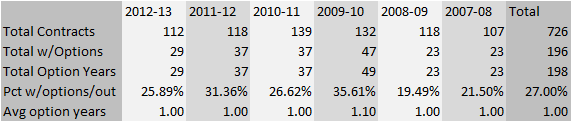
For starters, we’ll consider the overall use of options of all kinds. Between the 2007-08 and 2012-13 signing seasons, 726 guaranteed MLB free agent contracts were agreed upon, 196 (27.00%) of which came with options. Only two of those, so far as my research could identify, contained more than one option year: the deals signed by Kevin Gregg and Scott Atchison in the 2009-10 season. This table shows the figures by season for free agent contracts:
Of the 301 extensions that were reached in that same time frame, 160 (53.16%) included options. Those 160 deals included a total of 202 option years, meaning that there were 1.26 option years for every deal that included some kind of option. This table shows the figures by season for extensions:
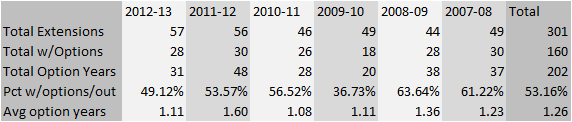
Clearly, and unsurprisingly, extensions are much more likely to come with options attached. Twice as likely, as it turns out. (And, as we'll see in a later installment, options in extensions are almost always straight club options.) Primarily, no doubt, that is a reflection of the fact that teams have much stronger bargaining positions with respect to players who have yet to qualify for free agency. The strongest motivations for teams guaranteeing future money for players who have yet to reach the open market are extending control, achieving cost savings, and obtaining cost certainty. In exchange for achieving such goals, teams often demand the right to achieve upside and retain flexibility in the event of injury or performance decline.
The 2009-10 Confluence
Of course, as the astute observer will note, there is one very interesting exception to the overall distribution: the 2009-10 season. As this chart shows, the sudden equalization of the use of options between free agent and extension contracts is quite out of line with the surrounding seasons:
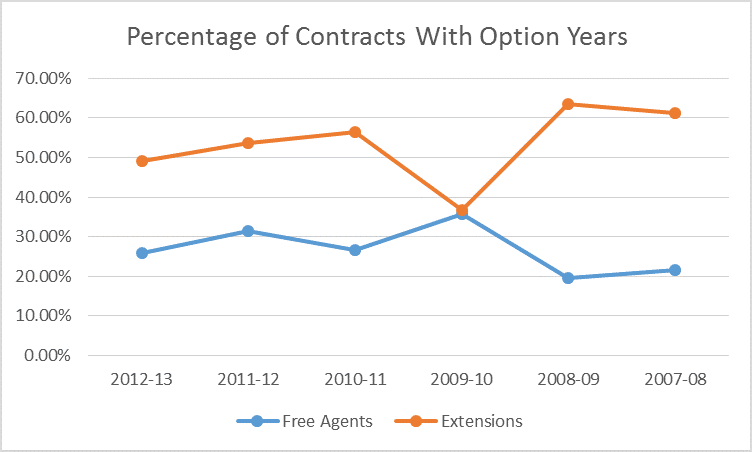
So, what is the explanation for that shift? The most obvious explanation would seem to be the broad international economic downturn, which added an element of uncertainty to all of baseball’s dealings. Prying an option year from a free agent can be expensive, and teams may have been less willing to commit cash to get the upside of an option. On the other hand, the risk and uncertainty hit players as well, which may have increased club leverage to demand options in the extension context.
Alternatively, or additionally, it could just be that early, market-setting deals paved the way for an odd year. Utilizing comparable contracts to set parameters for other deals can lower the transaction costs and even the perceived risks for parties. If the most relevant models for contract structures tended not to include options, there may have been a copycat effect.
The 2011-12 Multi-Option Boom
One other figure that stands out from the above tables is a seemingly aberrational year in terms of the number of option years per option contract in the extension bucket. Take a look:
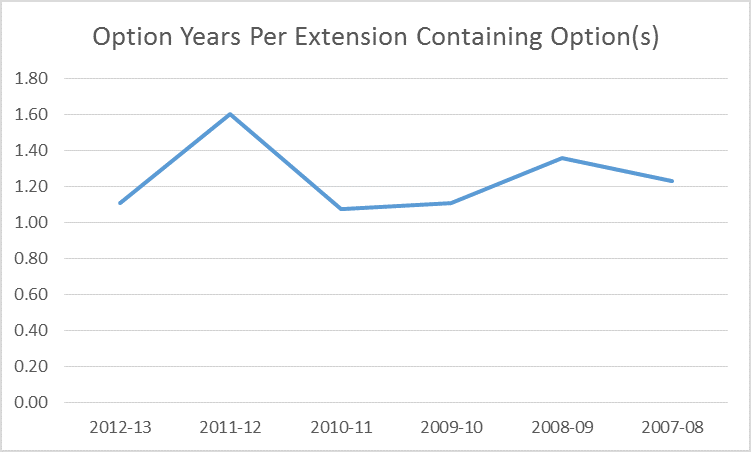
For the 2011-12 signing season, the average option deal suddenly included over 1.5 option years. Three option years were agreed to with Salvador Perez, Sergio Santos, Jose Tabata, and Wade Davis. And a host of players, including Gio Gonzalez and Clay Buchholz, gave up two option years.
Once again, I am far from certain of the proper explanation for the shift. It could be (as noted above) that a few teams and agents simply followed early trend-setting deals. Once the extension market was established, players with around one service year tended to give up three option years while those with around two service years generally signed deals with two options.
Alternatively, industry financial trends may be the cause. Teams may have aggressively worked to extend control before anticipated TV revenue inflows changed market perceptions, choosing to make substantial guarantees in exchange for option years that cover free agent-eligible seasons. Or, somewhat alternatively, teams may have decided to commit portions of their expected new cash before it started to flow, utilizing it to lock up option years.
Whatever the reasons for it, the 2011-12 boom in lengthy option terms may have lent to the general industry perception that teams are increasingly locking up younger players to longer-term deals that enhance team control. But, as the graph shows, the numbers returned to approximately historical levels in the 2012-13 signing season. It will be interesting to see where things head moving forward.
—
Of course, it could be that options are such a negotiation-specific element that seeming patterns really tell us relatively little about how the market is moving. Either way, I hope that this broad look at recent option usage provides a reasonably useful descriptive account.
In the next installment on options, we will break things down by option type to look at how varying forms of options are utilized in the market.
*Starting from the MLBTR transaction and extension trackers, I built out the dataset by mining Cot's on Contracts, Cot's data on non-active players from Baseball Prospectus player cards, and ESPN.com's free agency tracker. I then supplemented those results with internet searches to resolve any conflicts among the various sources and to identify, to the extent possible, any missing information that may have fallen through the cracks. The MLBTR trackers will be updated to reflect the complete information utilized in this and future posts.
C.J. Nitkowski Q+A
Lefty pitcher C.J. Nitkowski's fascinating career began when the Reds drafted him in the first round in 1994. From there, he pitched in the Tigers, Astros, Mets, Cardinals, Rangers, Yankees, Braves, Pirates and Nationals organizations, also pitching in a number of Triple-A towns along the way, before playing in Japan and then Korea. With big-leaguers like Kevin Youkilis, Luis Mendoza, Chris Volstad and Luke Scott now heading overseas, and Japanese ace Masahiro Tanaka in the process of signing with a North American team, Nitkowski's unique perspective seems more timely than ever. Nitkowski's career ended in 2012, and he currently works as an analyst for MLB.com, CBS Sports and MLB Network Radio. He can also be found on Twitter. This interview has been edited for length.
MLBTR: What is it like to have to [bounce around] from year to year and not know where you're going to be?
CJN: I really thought my career was over in 2002, and it didn't end until last January, so I always felt I was on borrowed time anyway. [And] at least early on, for me, I always felt like I was still going to be in the game. It's just a matter of where you're going to be. It wasn't that bad. It was probably harder on my wife, as far as the travel goes, or getting released suddenly. I just kind of got used to it, to be honest with you. I think, probably because I was traded my first full year — I was drafted by the Reds in '94 and traded at the deadline in '95, so right away, I was on that carousel. Almost immediately in my career, I was used to moving around. I never got frazzled by it. If anything, the stress level would have been on her, just because she had the kids, and a lot of times she was doing things by herself, and moving by herself. But for me personally, I'd gotten so accustomed to it.
As a Triple-A player, how do you follow big-league baseball? Do you look for situations where you might be able to help?
Oh, sure, especially [when] I was older. When you're younger, you're in an organization, you're paying attention to what's going on up top, and you kind of know what your opportunities are going to be. Your job is just to make sure that you're ready. But as you get older, if you're fortunate enough to get an out clause in your contract, which I had a bunch toward the end of my career, then you're paying attention to everything that's going on.
Some guys completely leave that stuff up to their agent, and aren't involved. [But] I was always proactive, especially in the second half of my career, making sure I really knew what was going on in different organizations, and where I thought there were needs and where I could sell myself as a potential fit. Having that out clause was big, just because you see what's going on, you say, "Wow, there's a team that really has a need right now," and you try to use that to your advantage. A good agent should be on top of it, but I always tell guys, especially when you're in the minor leagues and you're older, there's not a lot of benefit for your agent. It's more work than it probably is worth. So you really need to be proactive and take a little more control of your career. I was always a guy who did that, and there were quite a few times when it worked for me.
Like what?
When I was with the Pirates in '05, I was pitching really well in Triple-A, probably the best I've pitched, and really just paying close attention to what was going on. [I] saw the Nationals had a need, and we were able to work something out where I had my out clause and went to pitch for them. When I got released by the Braves in '04, [I] called the Yankees myself, because I realized they had a need. I was on a guaranteed contract with the Braves anyway, so I knew I was going to get a big-league salary the rest of the year. I called them, and they called me back, and within a couple hours, they said, "Yeah, it's a good fit." I knew what was going on there.
What do you think organizations owe people who are in your situation, Triple-A veterans who might see opportunities in other organizations?
It can be frustrating, because if you don't have the out [clause], you're sitting there going, "Ugh, I cannot believe I decided to sign with this team, and gosh, if I were in that organization right now, of course I would get a callup." [You don't] know whether you actually would or not, but you believe you would've. You see an opportunity with other teams in the big leagues, and you might see it as, "They have nothing in Triple-A." And here you are, pitching great for an organization that doesn't have opportunities, or an organization that just doesn't particularly see you as a guy that they're going to make a move with.
A lot of times, guys will feel like they've been lied to or misled [by] organizations that want to stockpile some older veterans. Which we don't see as much as we used to. But there would be teams that would just want to get a bunch of veteran guys around, and then kind of hold onto them. It can be really frustrating when you feel like you're doing a good job, or you feel like you're absolutely ready to go back to the big leagues or get to the big leagues, but you can't get out. I've always told guys to be very careful, when you become an older guy, about where you sign, and what organization you sign with.
It's a really good idea to talk to other players, and see how their experience went with a front office. I remember a good buddy of mine — two years in a row, he'd call me and ask me about organizations, and both times, I told him not to sign with them, because I had a bad experience [with] the front office, and both times, he did it anyway. And both times, he called me in the middle of the year, going, "I can't believe I'm stuck in this organization." I said, "Man, I told you." You're in your mid-30s in Triple-A. That was not a place you want to be. Even though it might look like there was opportunity up top, it's not the right spot. You look around, you pay attention, you talk to other guys, make sure you get an organization where you feel like you'll be treated like a professional.
A lot of players who take opportunities overseas [wouldn't] be starters in the big leagues, but might be just an injury or two from being starters in the big leagues. What is it like to have to make that decision between going overseas and having to wait for an opportunity that might [present itself] in the US?
Poll: The Best Transaction Of 2013
As baseball fans around the world mark the end of 2013, let's take one more look back before plowing ahead to 2014. As always, all manner of different MLB transactions went down this past year, and each and every one was documented by MLB Trade Rumors. Signings, extensions, trades, and more — every move took place in a different context and was subjected to public scrutiny.
So, now that we have the benefit of looking back at the year as a whole, which single move was the best, considering the particular situation and what we now know? Was it a wise extension, a nifty trade, or a big free agent signing? I browsed through the MLBTR Transaction Tracker and came up with a (highly subjective) list of my favorite moves over the past year. Though the some moves have already begun to bear fruit, while others await a new season, each still has years to go until it can be evaluated in its entirety. Nevertheless, I think it will be interesting to see how MLBTR readers view things.
Here are the nine candidates I chose, along with a brief synopsis of the reasons why they merit consideration. (Needless to say, feel free to disagree with my choices in the comments.)
Extensions
- White Sox extend LHP Chris Sale for five years, $32.5MM — Chicago locked up a young ace-caliber pitcher for the same type of contract that has been used to secure other good young arms. But Sale may be the best of the bunch, and he signed his deal just before new money and spending patterns may have broken the mold of young starter extensions.
- Brewers extend CF Carlos Gomez for three years, $24MM — Talk about buying low. Milwaukee locked up Gomez for his first three free agent-eligible seasons, right before the center fielder broke out with a stellar 8.4 rWAR campaign. While I won't proffer a guess as to what he'd ultimately have commanded in free agency this offseason, I think it is safe to say it would be multiples of his actual deal.
- Diamondbacks extend 1B Paul Goldschmidt five years, $32MM — This one does not require much explanation. Goldschmidt signed his extension with Arizona after a very promising run in his first season of full-time action. Then, he nearly won an MVP award.
- Red Sox extend 2B Dustin Pedroia for eight years, $110MM — The heart of the Sox has been worth at least three wins above replacement in every season he has seen regular action (and even reached that mark in the 75 games he played in 2010). His $13.75MM average annual value looks quite affordable compared to the $24MM guaranteed on average annually to Robinson Cano for the next decade.
Trades
- Nationals acquire RHP Doug Fister for LHP Robbie Ray, IF Steve Lombardozzi, and LHP Ian Krol — Fister has been one of the best ten pitchers in the game over the last three years, by fWAR, and has two seasons of reasonably-priced arbitration eligibility still to come. Yet the Nats were able to bring him in for a good-but-not-great prospect and two players with seemingly limited ceilings.
- Tigers acquire SS Jose Iglesias for OF Avisail Garcia — Even if you think that this was an even-value deal, it must be counted as a win for Detroit. Why? Just look at the haul that Matt Garza brought to serve as a short-term rental. GM Dave Dombrowski not only filled a sudden and unexpected hole during a key part of the season, but managed to adapt to Jhonny Peralta's suspension in a way that arguably enhanced the club's long-term health as well.
- Braves acquire LF Justin Upton and 3B Chris Johnson for UT Martin Prado, RHP Randall Delgado, SS Nick Ahmed, RHP Zeke Spruill, and 1B Brandon Drury — The signature trade of the 2013 offseason was a coup for Atlanta, in ways expected and not. Upton provided a strong season, even if he did not keep up his torrid start over the course of the year. But the real stunner was the huge campaign from Johnson; he was more productive than Prado, the main piece that the Braves gave up.
Signings
- Red Sox sign 1B Mike Napoli for one year, $5MM — While the limited guarantee came only after Napoli's original three-year deal fell apart over health concerns, GM Ben Cherington still deserves kudos for holding together the relationship. Even as he limited the club's exposure with a minimal $5MM promise, Cherington got his man into Fenway and held onto the upside. Needless to say, it worked out well for Boston, which was happy to pay Napoli his $8MM in earned incentives (and to lock him up to another seemingly solid deal for the club).
- Yankees sign C Brian McCann for five years, $85MM — No, we don't know how this deal will turn out. And yes, there have been other big-money signings to consider. But, to me at least, this contract stands out amongst recent major free agent signings for its value potential. Not only does McCann take over a spot that had been filled essentially at replacement level, but the limited length of the deal lowers the risk compared to other top-flight players that have signed. And it comes with upside, as the slugging lefty could reach new heights at Yankee Stadium and can take plenty of at-bats at DH to preserve his legs.
—
So, which move do you think was the best of 2013? (Response order will be randomized.)
What Was The Best MLB Transaction Of 2013?
-
Diamondbacks extend 1B Paul Goldschmidt 14% (2,858)
-
Red Sox extend 2B Dustin Pedroia 13% (2,597)
-
Yankees sign C Brian McCann 13% (2,575)
-
Nationals acquire RHP Doug Fister via trade 13% (2,569)
-
White Sox extend LHP Chris Sale 12% (2,416)
-
Braves acquire LF Justin Upton and 3B Chris Johnson via trade 11% (2,206)
-
Other 8% (1,667)
-
Red Sox sign 1B Mike Napoli 6% (1,166)
-
Tigers acquire SS Jose Iglesias via trade 5% (1,019)
-
Brewers extend CF Carlos Gomez 4% (801)
Total votes: 19,874