
Reds Outright Justin Nicolino
The Reds announced today that lefty Justin Nicolino has been outrighted to Triple-A after clearing waivers. He had recently been claimed from the Marlins.
In the end, then, the Cincinnati organization was able to grab and stash the 26-year-old, who’ll add to the team’s collection of youthful pitching depth. Nicolino obviously won’t factor into the immediate plans at the MLB level, but he’ll presumably have a chance to build innings and challenge for a place in the pecking order with a team that could well end up with a lot of chances available in the majors.
Nicolino has surrendered 4.65 earned runs per nine over his 201 1/3 MLB innings to date, all of which have come with Miami over the past three years. He has managed only 86 strikeouts in that span. While Nicolino has generated plenty of grounders and harmless infield flies in the minors, he has not excelled particularly in either area in the majors.
Tommy Hunter To Open Season On DL
Phillies righty Tommy Hunter will open the year on the DL after being diagnosed with a hamstring strain, as Jim Salisbury of CSNPhilly.com was among those to report on Twitter.
It’s not clear at the moment just how long Hunter will be sidelined, but skipper Gabe Kapler says the belief is it isn’t a serious injury, as Bob Brookover of the Philadelphia Inquirer reports. Saying the team is acting “conservatively,” Kapler explained that there are no “long-term concerns” at the moment.
Hunter is expected to play a key role in the Phillies pen after joining the organization on a surprisingly hefty two-year deal over the winter. He was promised $18MM after a strong 2017 season in which he not only worked to a productive 2.61 ERA in 58 2/3 innings but ran up a career-high 9.8 K/9 against 2.1 BB/9.
The early returns have not exactly been exciting, though it’s certainly not worth rushing to any conclusions. Hunter managed only one strikeout and allowed three earned runs in his 4 1/3 Grapefruit League frames.
[RELATED: Updated Phillies Depth Chart]
While the injury to Hunter leaves the Phillies down another arm, after already losing a few hurlers to open the year, it does clear space for Jake Thompson. The younger righty, once considered a promising rotation prospect, had shown some promise in camp. He’ll likely be joined in the bullpen by 23-year-old Victor Arano, who’ll get his first full crack at the majors.
Diamondbacks To Extend Ketel Marte
TODAY: The deal is now official.
YESTERDAY, 4:26pm: Zach Buchanan of The Athletic has tweeted the full breakdown. Marte will receive a $2MM signing bonus and $1MM salary for the coming season, followed by $2MM, $4MM, $6MM, and $8MM salaries through the guaranteed seasons (2019-22).
The options are valued at $10MM and $12MM, each of which come with a $1MM buyout. Incentives (details of which remain unknown) could tack on another $4MM overall.
11:41am: The Diamondbacks have agreed to a five-year, $24MM extension with middle infielder Ketel Marte, Robert Murray of FanRag reports. The deal also comes with a pair of option years worth a combined $22MM, which could make it a seven-year, $46MM pact. Marte is a client of the Legacy Agency.
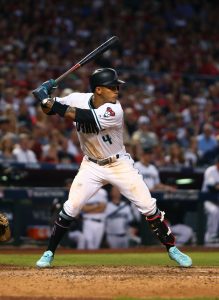
The Diamondbacks already had Marte under control for the next half-decade, including four arbitration-eligible years, but the extension means they won’t go through that process at all with him. The Phillies made a similar decision Sunday when they signed infielder/outfielder Scott Kingery to a five-year, $24MM guarantee of his own.
The 24-year-old Marte is about to begin his second season in Arizona, which acquired him from Seattle in a blockbuster November 2016 trade. Because the deal also featured Taijuan Walker, Jean Segura and Mitch Haniger, Marte flew under the radar at the time, especially after enduring a rough 2016 with the Mariners. Marte impressed his new team last year, however, even though he didn’t post eye-popping offensive numbers in the majors.
After spending nearly the first three months of 2017 at the Triple-A level, where he raked over 338 plate appearances (.338/.391/.514 – good for a 135 wRC+), the Diamondbacks promoted Marte in late June. The switch-hitter went on to bat .260/.345/.395 (89 wRC+) with five home runs and three stolen bases in 255 PAs. To his credit, Marte collected nearly as many walks (29) as strikeouts (37), and as Jeff Sullivan of FanGraphs wrote in December, there’s data suggesting he could be in line for a breakout. Marte was somewhat of a Statcast darling last year, evidenced by his 19th-place ranking in sprint speed and a quality xwOBA (.342).
While Marte’s only a .265/.319/.361 hitter (84 wRC+) with eight homers and 22 steals in 968 major league PAs, the D-backs seem optimistic he’s indeed capable of more in their uniform. And they saw him fare nicely in the field last season, where he logged four Defensive Runs Saved and a 1.1 Ultimate Zone Rating in 507 innings at shortstop. Marte’s now likely to give up short in favor of Nick Ahmed, a gifted defender who missed most of last season, and move to second. It’ll be a relatively new position in the bigs for Marte, who hasn’t lined up at the keystone since logging 31 innings there as a rookie in 2015.
Photo courtesy of USA Today Sports Images.
Tracking Non-Roster Invitees With Big League Experience
More than 600 non-roster players were invited to MLB Spring Training with a chance to win an Opening Day roster spot. Nearly half of them have MLB experience and are hoping for a return to the Majors, following the path of close to 40 former big leaguers who made their team’s respective Opening Day roster last April after signing a Minor League deal during the offseason.
Here’s this year’s list of non-roster invitees with MLB experience, including reported salary in the Majors and opt-out dates. This post will be updated as necessary through the end of Spring Training.
Last updated: 3/27/18
*Players currently projected by Roster Resource to make an Opening Day Roster are in bold/italics.
NATIONAL LEAGUE
- ARIZONA DIAMONDBACKS | Depth Chart
- Anthony Recker, C REASSIGNED
- Josh Thole, C RELEASED
- Kristopher Negron, INF/OF REASSIGNED
- Ramon Flores, OF REASSIGNED
- Rey Fuentes, OF REASSIGNED
- Cesar Puello, OF REASSIGNED
- Jake Buchanan, SP/RP REASSIGNED
- Kris Medlen, SP/RP $1.1MM salary in Majors; opt-out 3/27
- Antonio Bastardo, RP RELEASED
- Michael Blazek, RP/SP REASSIGNED
- Jorge De La Rosa, RP $2.25MM salary in Majors
- Neftali Feliz, RP REASSIGNED
- Fernando Salas, RP $1.5MM salary in Majors
- ATLANTA BRAVES | Depth Chart
- Rob Brantly, C REASSIGNED
- Christian Colon, INF REASSIGNED
- Sean Kazmar, INF REASSIGNED
- Danny Santana, INF/OF
- Ezequiel Carrera, OF $650K salary in Majors
- Jaff Decker, OF REASSIGNED
- Anibal Sanchez, SP/RP $1MM salary in Majors
- Luke Jackson, RP REASSIGNED
- Miguel Socolovich, RP REASSIGNED
- CHICAGO CUBS | Depth Chart
- Chris Gimenez, C REASSIGNED
- Taylor Davis, C
- Efren Navarro, 1B/OF
- Mike Freeman, INF/OF
- Peter Bourjos, OF RELEASED/Signed MLB contract with ATL
- Anthony Bass, SP/RP
- Kyle Ryan, RP
- CINCINNATI REDS | Depth Chart
- Tony Cruz, C REASSIGNED
- Cliff Pennington, INF $1.5MM salary in Majors
- Phil Gosselin, INF/OF
- Patrick Kivlehan, INF/OF REASSIGNED
- Darnell Sweeney, INF/OF REASSIGNED
- Ben Revere, OF REASSIGNED
- Mason Williams, OF REASSIGNED
- Vance Worley, SP/RP $1.5MM salary in Majors; opt-out at end of camp
- Barrett Astin, RP REASSIGNED
- Kyle Crockett, RP REASSIGNED
- Dylan Floro, RP REASSIGNED
- Joe Mantiply, RP (Injured) REASSIGNED
- Kevin Quackenbush, RP
- Oliver Perez, RP RELEASED
- Ben Rowen, RP REASSIGNED
- COLORADO ROCKIES | Depth Chart
- Daniel Castro, INF REASSIGNED
- Shawn O’Malley, INF/OF (Injured)
- Brooks Pounders, RP/SP REASSIGNED
- LOS ANGELES DODGERS | Depth Chart
- Rocky Gale, C REASSIGNED
- Max Muncy, INF/OF REASSIGNED
- Travis Taijeron, OF REASSIGNED
- Daniel Corcino, RP REASSIGNED
- C.C. Lee, RP REASSIGNED
- Mark Lowe, RP RELEASED
- Pat Venditte, RP REASSIGNED
- Zach Neal, SP/RP REASSIGNED
- MIAMI MARLINS | Depth Chart
- Bryan Holaday, C
- Scott Van Slyke, 1B/OF
- Cristhian Adames, INF
- Johnny Giavotella, INF REASSIGNED
- Yadiel Rivera, INF
- Eric Campbell, INF/OF
- J.B. Shuck, OF
- Tyler Cloyd, SP/RP REASSIGNED
- Jacob Turner, SP/RP
- Jumbo Diaz, RP
- Javy Guerra, RP
- Drew Rucinski, RP REASSIGNED
- Alex Wimmers, RP REASSIGNED
- MILWAUKEE BREWERS | Depth Chart
- Christian Bethancourt, C
- Ji-Man Choi, 1B
- Nick Franklin, INF/OF
- Wade Miley, SP $2.5MM salary in Majors (Injured)
- Michael Brady, RP REASSIGNED
- Erik Davis, RP REASSIGNED
- Ernesto Frieri, RP RELEASED
- J.J. Hoover, RP $1.1MM salary in Majors
- Radhames Liz, RP/SP
- NEW YORK METS | Depth Chart
- Jose Lobaton, C REASSIGNED
- Phillip Evans, INF
- Ty Kelly, INF/OF REASSIGNED
- Matt den Dekker, OF REASSIGNED
- A.J. Griffin, SP REASSIGNED
- Matt Purke, RP REASSIGNED
- PHILADELPHIA PHILLIES | Depth Chart
- Matt McBride, C/1B/OF REASSIGNED
- Will Middlebrooks, 3B/1B $1.2MM salary in Majors (Injured)
- Adam Rosales, INF RELEASED
- Ryan Flaherty, INF/OF RELEASED/Signed MLB deal with ATL
- Pedro Florimon Jr., INF/OF $600K salary in Majors
- Collin Cowgill, OF REASSIGNED
- Danny Ortiz, OF REASSIGNED
- Drew Hutchison, SP
- Fernando Abad, RP RELEASED
- Pedro Beato, RP REASSIGNED
- Francisco Rodriguez, RP RELEASED
- PITTSBURGH PIRATES | Depth Chart
- Ryan Lavarnway, C REASSIGNED
- Jackson Williams, C REASSIGNED
- Todd Cunningham, OF REASSIGNED
- Daniel Nava, OF/1B RELEASED/RE-SIGNED
- Casey Sadler, SP/RP REASSIGNED
- Damien Magnifico, RP REASSIGNED
- Richard Rodriguez, RP REASSIGNED
- Bo Schultz, RP REASSIGNED
- Kevin Siegrist, RP REASSIGNED
- SAN DIEGO PADRES | Depth Chart
- A.J. Ellis, C $1.25MM salary in Majors
- Raffy Lopez, C
- Allen Craig, 1B REASSIGNED
- Dusty Coleman, INF
- Shane Peterson, OF REASSIGNED
- Kyle Lloyd, SP REASSIGNED
- Tyson Ross, SP $1.75MM salary in Majors; opt-0ut 5/15, 6/15
- Chris Young, SP/RP RELEASED
- Jonathan Aro, RP
- Michael Mariot, RP REASSIGNED
- Tom Wilhelmsen, RP RELEASED
- SAN FRANCISCO GIANTS | Depth Chart
- Trevor Brown, C REASSIGNED
- Hector Sanchez, C REASSIGNED
- Kyle Jensen, 1B/OF REASSIGNED
- Andres Blanco, INF RELEASED
- Chase d’Arnaud, INF REASSIGNED
- Josh Rutledge, INF
- Orlando Calixte, INF/OF REASSIGNED
- Alen Hanson, INF/OF REASSIGNED
- Gregor Blanco, OF $1MM salary in Majors
- Derek Holland, SP $1.75MM salary in Majors
- Manny Parra, RP
- Madison Younginer, RP REASSIGNED
- Jose Valdez, RP REASSIGNED
- ST. LOUIS CARDINALS | Depth Chart
- Francisco Peña, C
- Alex Mejia, INF REASSIGNED
- Wilfredo Tovar, INF REASSIGNED
- Jordan Schafer, OF/RP RELEASED
- Sean Gilmartin, SP/RP REASSIGNED
- Jason Motte, RP RELEASED
- Preston Guilmet, RP REASSIGNED
- WASHINGTON NATIONALS | Depth Chart
- Miguel Montero, C $1.3MM salary in Majors
- Jhonatan Solano, C REASSIGNED
- Reid Brignac, INF RELEASED
- Chris Dominguez, INF/OF REASSIGNED
- Ryan Raburn, OF RELEASED
- Moises Sierra, OF REASSIGNED
- Jeremy Hellickson, SP RELEASED/RE-SIGNED
- Edwin Jackson, SP REASSIGNED
- Tommy Milone, SP REASSIGNED
- Cesar Vargas, SP REASSIGNED
- Tim Collins, RP REASSIGNED
- David Goforth, RP REASSIGNED
- Roman Mendez, RP REASSIGNED
- Chris Smith, RP REASSIGNED
—
AMERICAN LEAGUE
- BALTIMORE ORIOLES | Depth Chart
- Pedro Alvarez, DH $1MM salary in Majors
- Luis Sardiñas, INF REASSIGNED
- Ruben Tejada, INF REASSIGNED
- Danny Valencia, INF/OF $1.2MM salary in Majors
- Jaycob Brugman, OF REASSIGNED
- Craig Gentry, OF $900K salary in Majors
- Alex Presley, OF REASSIGNED
- Colby Rasmus, OF $3MM salary in Majors
- Jayson Aquino, SP/RP REASSIGNED
- Eddie Gamboa, SP/RP REASSIGNED
- Tim Melville, SP REASSIGNED
- Asher Wojciechowski, SP/RP REASSIGNED
- Josh Edgin, RP REASSIGNED
- Andrew Faulkner, RP REASSIGNED
- Jeff Ferrell, RP REASSIGNED
- Perci Garner, RP REASSIGNED
- Jason Gurka, RP REASSIGNED
- Jhan Mariñez, RP REASSIGNED
- Joely Rodriguez, RP REASSIGNED
- BOSTON RED SOX | Depth Chart
- Dan Butler, C REASSIGNED
- Oscar Hernandez, C SUSPENDED
- Ivan De Jesus Jr., INF REASSIGNED
- Rusney Castillo, OF REASSIGNED
- Steve Selsky, OF REASSIGNED
- Justin Haley, SP/RP REASSIGNED
- Kyle Martin, RP REASSIGNED
- Fernando Rodriguez, RP REASSIGNED
- CHICAGO WHITE SOX | Depth Chart
- Jake Elmore, OF/INF REASSIGNED
- Jacob May, OF REASSIGNED
- Hector Santiago, SP/RP $2MM salary in Majors
- Xavier Cedeño, RP REASSIGNED
- Jeanmar Gomez, RP REASSIGNED
- TJ House, RP/SP REASSIGNED
- Bruce Rondon, RP REASSIGNED
- Robbie Ross Jr., RP REASSIGNED
- Rob Scahill, RP REASSIGNED
- Chris Volstad, RP/SP REASSIGNED
- Michael Ynoa, RP RELEASED
- CLEVELAND INDIANS | Depth Chart
- Ryan Hanigan, C RELEASED
- Mike Napoli, 1B RELEASED/RE-SIGNED
- Michael Martinez, INF/OF (Injured)
- Richie Shaffer, INF/OF REASSIGNED
- Brandon Barnes, OF REASSIGNED
- Rajai Davis, OF $1.75MM salary in Majors; opt-out 3/22
- Melvin Upton Jr., OF RELEASED
- Stephen Fife, SP REASSIGNED
- Adam Wilk, SP/RP REASSIGNED
- Matt Belisle, RP $1.5MM salary in Majors
- Jeff Beliveau, RP REASSIGNED
- Preston Claiborne, RP REASSIGNED
- Evan Marshall, RP REASSIGNED
- Alexi Ogando, RP/SP REASSIGNED
- Neil Ramirez, RP REASSIGNED
- Carlos Torres, RP RELEASED
- DETROIT TIGERS | Depth Chart
- Derek Norris, C REASSIGNED
- Jarrod Saltalamacchia, C REASSIGNED
- Brayan Peña, C REASSIGNED
- Alexi Amarista, INF/OF RELEASED
- Pete Kozma, INF REASSIGNED
- Jim Adduci, OF/1B REASSIGNED
- Niko Goodrum, OF/INF
- Chad Huffman, OF/1B REASSIGNED
- Victor Alcantara, RP REASSIGNED
- Enrique Burgos, RP REASSIGNED
- Travis Wood, RP/SP RELEASED
- HOUSTON ASTROS | Depth Chart
- Tim Federowicz, C REASSIGNED
- Mike Hauschild, SP/RP REASSIGNED
- KANSAS CITY ROYALS | Depth Chart
- Ryan Goins, INF $1MM salary in Majors
- Cody Asche, OF/3B REASSIGNED
- Tyler Collins, OF REASSIGNED
- Terrance Gore, OF REASSIGNED
- Michael Saunders, OF RELEASED
- Clay Buchholz, SP REASSIGNED
- Ricky Nolasco, SP RELEASED
- Blaine Boyer, RP
- Mike Broadway, RP REASSIGNED
- Seth Maness, RP REASSIGNED
- LOS ANGELES ANGELS | Depth Chart
- Chris Carter, 1B $1.75MM salary in Majors
- Colin Walsh, INF/OF REASSIGNED
- Rymer Liriano, OF REASSIGNED
- Eric Young Jr., OF REASSIGNED
- Vicente Campos, SP REASSIGNED
- John Lamb, SP REASSIGNED
- Ian Krol, RP REASSIGNED
- Branden Pinder, RP REASSIGNED
- MINNESOTA TWINS | Depth Chart
- Bobby Wilson, C REASSIGNED
- Jordan Pacheco, C/INF REASSIGNED
- Brock Stassi, 1B REASSIGNED
- Erick Aybar, INF RELEASED
- Taylor Featherston, INF
- Gregorio Petit, INF
- Nick Buss, OF REASSIGNED
- Chris Heisey, OF RELEASED
- Ryan LaMarre, OF
- Myles Jaye, SP/RP REASSIGNED
- Michael Kohn, RP (Injured)
- NEW YORK YANKEES | Depth Chart
- Erik Kratz, C
- Adam Lind, 1B/OF RELEASED
- Jace Peterson, INF/OF $900K salary in Majors
- Shane Robinson, OF $950K salary in Majors
- David Hale, SP/RP
- Wade LeBlanc, SP/RP RELEASED/Signed MLB contract with SEA
- OAKLAND ATHLETICS | Depth Chart
- Steve Lombardozzi, INF REASSIGNED
- Nick Noonan, INF REASSIGNED
- Slade Heathcott, OF REASSIGNED
- Eric Jokisch, SP/RP REASSIGNED
- Simon Castro, RP
- Bobby Wahl, RP REASSIGNED
- SEATTLE MARINERS | Depth Chart
- Tuffy Gosewisch, C REASSIGNED
- Matt Hague, 1B/3B REASSIGNED
- Gordon Beckham, INF RELEASED/RE-SIGNED
- Rey Navarro, INF REASSIGNED
- Zach Vincej, INF REASSIGNED
- Junior Lake, OF REASSIGNED
- Kirk Nieuwenhuis, OF
- Christian Bergman, SP/RP REASSIGNED
- Hisashi Iwakuma, SP $2.5MM salary in Majors (Injured)
- Casey Lawrence, SP/RP
- Ryan Cook, RP REASSIGNED
- Ryan Garton, RP REASSIGNED
- TAMPA BAY RAYS | Depth Chart
- Curt Casali, C REASSIGNED
- Johnny Monell, C REASSIGNED
- Adam Moore, C REASSIGNED
- Micah Johnson, 2B/OF REASSIGNED
- Brandon Snyder, INF/OF
- Jason Coats, OF REASSIGNED
- Ryan Weber, SP/RP REASSIGNED
- Cody Hall, RP REASSIGNED
- Adam Kolarek, RP REASSIGNED
- Vidal Nuño, RP REASSIGNED
- Dustin McGowan, RP RELEASED
- Colton Murray, RP REASSIGNED
- Dan Runzler, RP RELEASED
- Evan Scribner, RP RELEASED
- Jonny Venters, RP REASSIGNED
- TEXAS RANGERS | Depth Chart
- Curt Casali, C RELEASED/SIGNED with TB
- Mike Ohlman, C REASSIGNED/TRADED to BOS
- Trevor Plouffe, 3B/1B RELEASED/RE-SIGNED
- Hanser Alberto, INF REASSIGNED
- Darwin Barney, INF RELEASED
- Destin Hood, OF REASSIGNED
- Bartolo Colon, SP RELEASED/RE-SIGNED
- Paolo Espino, SP/RP REASSIGNED
- Jon Niese, SP/RP RELEASED
- Adrian Sampson, SP REASSIGNED
- Edinson Volquez, SP 2-yr contract; $2MM salary in Majors in ’19 (Injured)
- Austin Bibens-Dirkx, RP/SP REASSIGNED
- Steve Delabar, RP REASSIGNED
- Erik Goeddel, RP RELEASED/Signed with SEA
- Deolis Guerra, RP REASSIGNED
- Kevin Jepsen, RP
- Shawn Tolleson, RP (Injured)
- TORONTO BLUE JAYS | Depth Chart
- Danny Espinosa, INF
- Deck McGuire, SP/RP REASSIGNED
- Chris Rowley, SP/RP REASSIGNED
- Luis Santos, SP/RP REASSIGNED
- Al Alburquerque, RP REASSIGNED
- John Axford, RP
- Craig Breslow, RP REASSIGNED/RE-SIGNED
- Tyler Clippard, RP
- Rhiner Cruz, RP REASSIGNED
- Chad Girodo, RP REASSIGNED
- Jake Petricka, RP $1.3MM salary in Majors (Injured)
—
Padres Release Chris Young
Veteran right-hander Chris Young has been released by the Padres, according to Chris Cotillo of SB Nation (via Twitter). Young triggered his opt-out rights after learning that he would not be added to the Opening Day roster.
The Pads had given Young a long look as a rotation candidate this spring, but ultimately decided against keeping the 38-year-old. He had been slated to earn a $1MM base salary in the majors, with a hefty potential incentives package that included up to an additional $6MM more.
Young had been hoping to bounce back with the Pads after a pair of miserable seasons. He has already shown he can be useful in his late thirties, with two sturdy campaigns in 2014 and 2015, but has stumbled to a 6.52 ERA in his 118 2/3 frames since the start of 2016. This spring, he recorded 15 strikeouts against four walks in his 14 1/3 innings, but also coughed up four dingers and a dozen earned runs.
San Diego’s decision to keep reliever Adam Cimber left no space in the bullpen and created additional 40-man roster pressure, leaving Young on the outside looking in. Presumably, he could still rejoin the organization on another minors deal if he’s unable to find a better situation elsewhere.
The decision means we won’t see Young pitch for the Padres for the first time since 2010. But it could suggest that another old favorite, Tyson Ross, will earn his way back onto the team after also joining as a non-roster player. Ross, whose career dove when shoulder issues arose, has reputedly looked good this spring and has allowed only five earned runs in his 15 Cactus League frames.
MLBTR Poll: When Will Greg Holland Sign?
We’ve already seen most of the backlog of high-profile free agents clear out late in camp. But one familiar name remains available: closer Greg Holland, whom we profiled in full back in January. Despite some uncertainties, he was and is quite an accomplished reliever who seemed worthy of a rather large and lengthy contract.
Though it seemed at one point he’d return to the Rockies, and reportedly had a $50MM-or-so offer on the table, Holland’s market has gone dark of late. Over the past month or so, teams such as the Braves, Diamondbacks, Cardinals, and Rangers have been tied loosely to Holland. The Cards seem to be the most obvious match on paper, as a contender with a fairly hefty budget and an unresolved closing situation. But they haven’t yet emerged as a strong pursuer.
On the whole, there’s simply no indication that any of those organizations, or any others, are hot after the veteran righty — let alone willing to make him a significant, multi-year commitment. True, it’s still anyone’s guess what kind of contract Holland will secure. (Remember that Alex Cobb did still score a long-term pact after the similarly placed Lance Lynn did not.) But the smart money may now be on some kind of creative, one or two-year arrangement not unlike the one he signed last winter when coming off of Tommy John surgery.
Rather than thinking about what Holland will get, though, today’s poll will focus on when he’ll finally put pen to paper.
At this point, there’s no chance that Holland will be on an Opening Day roster. Presumably, though, he’s pitching on his own and wouldn’t require a terribly lengthy window to reach MLB readiness. Perhaps, then, it’s still sensible to believe that he’ll come to agreement in relatively short order and be prepared to pitch for nearly all of the coming season.
In theory, a signing could come in the next few days. Waiting until after the start of the season to sign once was once a strategically meaningful consideration, but is not of ongoing consequence now that repeat qualifying offers have been outlawed as part of the new CBA’s tweaks to the QO system.
Of course, waiting until the season is underway might still hold some appeal for other reasons. There could certainly be some merit to waiting to see how closer situations shape up around the game. Turnover in the ninth inning is hardly a new thing, but it’s not often that a ready-made solution is standing by to be signed whenever the need arises. Organizations that face early-season crises, whether due to injury or performance, would then have an intriguing alternative in Holland.
The question, then, would become whether Holland will wait until after the June draft to ink a new contract. That was the approach taken by fellow Scott Boras clients Kendrys Morales and Stephen Drew, who agreed to partial-season deals in 2014 after the draft compensation attached to their signings had dissipated. As a high-leverage reliever, Holland might be even better situated for this approach. Though he wouldn’t be marketing a full season of output, he might still earn well since he’d be valued most for his contributions down the stretch and into a hypothetical postseason run.
So, when do you think Holland will end up finally choosing his new club? (Link for app users.)
When Will Greg Holland Sign?
-
In the early months of the season. 40% (3,184)
-
Before or just after the season starts. 29% (2,262)
-
Within weeks after the June draft. 23% (1,830)
-
Near the trade deadline. 8% (649)
Total votes: 7,925
NL Notes: Padres, Brewers, Verdugo
The Padres are in the process of finalizing their pitching plans for the start of the coming campaign. Righty reliever Adam Cimber has forced his way onto the Opening Day roster after turning in an unexpectedly excellent spring, as Kevin Acee of the San Diego Union Tribune reports on Twitter. The 27-year-old built off of a quality 2017 effort in the upper minors — over which he threw 80 2/3 innings of 2.90 ERA ball with 7.3 K/9 and just 1.1 BB/9 — by posting nine scoreless frames in the Cactus League. Meanwhile, veteran righty Chris Young will not break camp in the majors, Acee also tweets. It’s not known at this point whether he’ll exercise his opt-out clause, but that’s at least an option for the towering 38-year-old, whose spring (15 strikeouts but also four home runs in 14 1/3 innings) largely imitated his past two seasons’ output (116 strikeouts but also 35 home runs in 118 2/3 innings).
Here are a few more notes from the National League:
- It seems increasingly unlikely that the Brewers will make a move to alleviate their evident logjam of bats. As Bob Nightengale of USA Today reports, that has left some eyebrows raised among the team’s players, some of whom still aren’t sure exactly how much playing time they’ll get once the season gets underway. It’s not exactly a new subject, of course, as the Milwaukee roster has been under a microscope all winter long. But it’s interesting to consider it from the player’s perspective, as Nightengale does. As third baseman Travis Shaw puts it: “Depth is a nice problem to have, but I’m sure it sucks individually for a couple of guys.” Meanwhile, skipper Craig Counsell says “there’ll be a lot of shuffling going on” early in the season, as MLB.com’s Adam McCalvy reports, but also notes that he anticipates some clarity to emerge as the season goes along.
- Pedro Moura of The Athletic takes a long look (subscription link) at talented Dodgers prospect Alex Verdugo, who drew much better reviews in camp this year than he did in his brief MLB call-up in 2017. The change wasn’t to his swing mechanics, though. Instead, Verdugo impressed the organization by making strides with his work ethic and attitude. As Moura documents, those improvements were the result of intentional offseason effort, though Verdugo’s overall level of professionalism also surely remains a work in progress.
Minor MLB Transactions: 3/26/18
We’ll use this post to run down the day’s minor moves:
- After being designated for assignment yesterday, catcher Chris Herrmann was released by the Diamondbacks, per a club announcement. The 30-year-old won’t get a chance to prove he can return to the strong batting output he produced in 2016 — at least in Arizona. That effort earned Herrmann a career-high 256 plate appearances last season, but he managed only a .181/.273/.345 batting line. He has, however, enjoyed a solid spring, swatting two long balls and carrying a .300/.324/.567 slash in 34 Cactus League plate appearances.
- The Nationals have brought back Alejandro De Aza on a minor-league deal after releasing him to avoid the necessity of a $100K retention bonus, SB Nation’s Chris Cotillo tweets. Soon to turn 34, De Aza is at this point mostly an organizational depth piece, though he has at times in the not-so-distant past been a significant contributor at the MLB level. Indeed, he carries an approximately league-average overall offensive line through nearly three thousand major-league plate appearances, most of which have come since the start of the 2012 season. De Aza played only briefly in the majors last year with the Nats and hit .280/.368/.403 in his 212 Triple-A plate appearances.
- Also re-signing after being released was infielder Gordon Beckham, who’ll head to the minors with the Mariners, per Cotillo (via Twitter). The 31-year-old had a torrid spring but, like De Aza, has generally been on the downswing of late after receiving quite a lot of opportunities earlier in his career. Until last year, Beckham had played in at least 88 MLB contests annually since cracking the majors (despite minimal minor-league seasoning) in 2009. But his chances, which were already on the decline, largely petered out in 2017, as he made it into just 11 games in the majors. In his 355 plate appearances at Triple-A in the Mariners organization, Beckham posted a .262/.313/.393 batting line.
- The Diamondbacks have sent outfielder Ramon Flores to the Red Sox, Cotillo also tweets. It is not apparent what Arizona is getting back in return, or whether Flores might even be the PTBNL in the recent swap between the teams. Either way, it’s a minor transactions. Flores signed a minors deal with Arizona and has struggled this spring. He carries only a .204/.281/.256 slash line in 331 plate appearances, but has generally hit well at Triple-A. Last year, Flores hit .312/.409/.460 with ten home runs and 68 walks against 70 strikeouts in his 493 trips to the plate at the highest level of the minors.
Offseason In Review: Cleveland Indians
This piece is part of MLBTR’s 2017-18 Offseason In Review series. Click here to read the other completed reviews from around the league.
A 102-win Indians ballclub let all seven of its free agents depart this winter, and gave out just one guaranteed contract. The Tribe will bank on a sustained breakout from Yonder Alonso and some reinforcements from the farm to supplement a core that’s won the division two years in a row, in hopes that they can end MLB’s longest championship drought.
Major League Signings
- Yonder Alonso, 1B: Two years, $16MM
- Total Spend: $16MM
Trades and Claims
- Claimed RHP Ben Taylor from the Red Sox
- Claimed INF Rob Refsnyder from the Yankees
Option Decisions
- Exercised Michael Brantley‘s one-year, $11MM option
- Exercised Josh Tomlin‘s one-year, $3MM option
Notable Minor League Signings
- Mike Napoli, Rajai Davis, Matt Belisle, Carlos Torres, Ryan Hanigan, Stephen Fife, Melvin Upton Jr., Michael Martinez, Brandon Barnes
Notable Losses
Indians Depth Chart; Indians Payroll Information
Needs Addressed
One of the Indians’ most important decisions came right at the end of the 2017 season, as they elected to pick up their $11MM option over outfielder Michael Brantley. That call long seemed an easy one in the affirmative, but ongoing shoulder and ankle problems have added quite a lot of uncertainty to the 30-year-old’s outlook. It’s something of a risk for the Cleveland organization, but it seems Brantley is progressing well and he could still represent a significant value if he can make it back to full health and come anywhere near his peak level of production.
Otherwise, the Cleveland brass entered the offseason with a simple to-do list: re-sign or replace their outgoing free agents in order to keep last year’s team as intact as possible. After a 102-win season in which the club won an AL record 22 consecutive games, there wasn’t any need for a significant overhaul. Most of the core was under control headed into 2018, so the organization’s tapestry of talent would likely require only minor patches to be successful in the coming season.
It soon became evident that rival clubs valued the Tribe’s outgoing free agents far more than the team itself. Santana and Shaw both exceeded MLBTR’s expectations in terms of earning power, and departed for Philadelphia and Colorado, respectively. As each of their other five free agents found new homes, the Indians were forced to opt for the “replace” route.
The club signed Alonso to fill Santana’s shoes, added Davis and Upton Jr. to battle for Jackson’s role, and snatched up Belisle and Torres out of the late-winter reliever bargain bin. Mission accomplished, right? Well, sort of. While each of those moves serves the purpose of patching a hole left by a free-agent departure, each serves as the equivalent of purchasing a $200 laptop because you can’t afford a Macbook. They’ll do the same job, but they don’t come with the same kind of reliability. That leaves some questions as to whether the club will be able to enjoy the same success; if one of their replacement options collapses, they’ll suddenly have a problematic hole on the roster.
Alonso, for instance, is coming off a rare age-30 breakout season in which he became something of a poster boy for the fly ball revolution. Between the A’s and Mariners, he posted a strong .266/.365/.501 batting line with a career-high 28 home runs. That homer total far exceeded anything he’d ever done in the majors or minors, so there’s some understandable skepticism about whether or not he’ll be able to repeat such numbers as he enters an age in which baseball players typically begin to decline.
Still, perhaps that’s not giving enough credit to Alonso. He did, after all, make some clear changes to his swing that we can point to as evidence for his breakout. And he also altered his approach at the plate; those changes were mentioned far less by both the media and respected baseball statistic outlets, but contributed just as much to his breakout campaign. As Alonso himself put it in an interview with MLB.com’s Jordan Bastian, “For me, it’s about driving the baseball, using my legs, doing things that I do. My pitch sequence. My pitch location. What pitches I can handle. What pitches I can’t. And then after that, just going and compete.” Focusing on the pitches he could handle worked out well for his on-base ability, as his walk rate spiked to a 13.1% clip that far exceeded his previous career high of 10.4%. The resulting .365 on-base percentage falls exactly in line with Santana’s career average, meaning that he’d actually prove a suitable replacement for the long-time Tribe slugger as long as he can continue a seemingly repeatable improvement in patience and pitch selection.
 Additionally, it’s worth noting that even if Alonso doesn’t end up producing to his 2017 levels, the Indians have some reasonable backup solutions. It’s feasible that Edwin Encarnacion could shift out of the DH spot (though he certainly wouldn’t provide much value defensively), allowing someone like on-base machine Yandy Diaz to get at-bats as the team’s designated hitter. The club also has Bobby Bradley waiting in the wings, who ranks among the top first base prospects in baseball. Point being, if Alonso regresses significantly, the Indians can probably reshape their roster to accommodate without taking a sizeable hit to their run-scoring ability.
As far as the outfield goes, it’s difficult to imagine Davis, who was recently added to the 25-man roster, producing to the level that Jackson did last season. (Of course, Jackson himself was acquired on a minor-league deal.) The 37-year-old Davis brings with him the nostalgia of a memorable game-tying homer in Game 7 of the 2016 World Series. But after he hit just .235/.293/.348 last season between the A’s and Red Sox, he probably won’t provide any real offensive value with his bat. His biggest asset to the team will be his stolen base ability, which continues to inexplicably persevere even as the outfielder approaches the age of 40.
Speaking of 37-year-old players, Belisle was also recently informed that he’s made the team. Though he’s not necessarily an exciting addition, he ‘s a reliable presence for quality innings. Across the past three campaigns, the right-hander has posted a 2.96 ERA and has typically managed to out-pitch his peripheral statistics. Again, he’s not Shaw or Smith, but he’s certainly not a pushover. Considering the bullpen will still be led by Cody Allen and Andrew Miller, there’s not much to worry about, anyway. With an embarrassment of riches in the starting pitcher department, the Tribe will likely consider flamethrower Danny Salazar for a bullpen role if he continues to struggle in the rotation.
Questions Remaining
 The club’s outfield crew isn’t likely to intimidate other contenders. While Lonnie Chisenhall and Brantley are terrific when they’re able to take the field, neither can seem to do so on a consistent basis. Bradley Zimmer and Tyler Naquin have both shown great upside, but they’ve also had their weaknesses exposed; neither is a sure bet to find sustained success throughout the 2018 season. The even bigger overarching issue is that each of those four players bats from the left side of the plate. The Tribe’s only righty-hitting outfielders are Davis (see above) and Brandon Guyer, who was recently named to the Opening Day roster but struggled mightily last year and comes with injury concerns. While the team has some right-handed bats and switch-hitters elsewhere in the lineup, one has to imagine that such a severely lefty-heavy outfield puts them at a disadvantage against opposing southpaws.
The organization’s dearth of vertical depth in the bullpen department is no small matter, either. The club has seven solid relievers on the active roster, but the relief corps at Triple-A is a gaggle of waiver claims and offseason minor league signees. Though they’ve lucked out in the past with waiver claims like Tyler Olson, it’s statistically unlikely that they’ll continue to win the lottery with players that other teams let go. Of course, it’s fair to note too that the rotation depth could filter down to the pen if and when more of the team’s starters are at full health.
The health and production of second baseman Jason Kipnis is certainly up in the air after an injury-plagued age-30 season that ended up being one of the worst offensive showings of his career. His poor play resulted in a swirl of offseason trade rumors and uncertainty about his future in Cleveland, but he’s found his swing in training camp as evidenced by his six homers and .375 batting average in Cactus League play. It’s tough to know what to expect from Kipnis, but he’s an interesting bounce back candidate to watch.
The Tribe’s catching tandem of Yan Gomes and Roberto Perez isn’t what you’d call an offensive juggernaut, but they both provide plenty of defensive value and are likely to combine for another above-average performance in relation to the rest of the league. Beyond them, super-prospect Francisco Mejia is waiting in the wings, itching to prove himself in the event of an injury to one the aforementioned duo. Mejia’s more of a bat-first backstop, and his hit tool is one of the best in the minors. Indeed, the organization is even considering utilizing him in the outfield as a means of moving up his timeline to contribute in the majors (potentially offering another means of giving a boost to the uncertain outfield mix). While none of these three players is without his flaws, it’s hard to imagine catcher being a significant area of weakness for the Indians.
It’s more likely than not that we’ll see some kind of offensive decline from Encarnacion as the slugger enters his age-35 season. What that will look like isn’t easy to predict. Some sluggers like Paul Konerko only experienced a modest power drop-off at 35, while others such as Mark Teixeira seemed to have the rug pulled out from under them entirely at that age. As one of the few intimidating right-handed hitters in the Tribe’s lineup, they’ll be counting on him to offer at least something close to his usual power output.
Outside of that, the Indians appear well-poised to make another run at a championship. A rotation that produced the best fWAR of all time is back in its entirety, with reasonable depth options at Triple-A and a couple of impressive prospects in Triston McKenzie and Shane Bieber not far off. The left side of their infield sports two MVP candidates in Francisco Lindor and Jose Ramirez, and it wouldn’t be a surprise to once again see those two combine to top 60 homers while providing stellar defense. All in all, questions about this team’s composition are little else but nit-picking.
Overview
The front office didn’t do much this offseason, and as such this iteration of the Indians doesn’t look quite as strong as the one that finished the season with 102 wins last year. But if they did get weaker, it certainly isn’t by much. The most important pieces remain on hand, and they have some intriguing depth in the form of high-upside prospects. That likely means a third consecutive AL Central championship and a return to the postseason.
How would you grade the Indians’ offseason work? (Poll link for app users)
How Would You Grade The Indians' Offseason?
-
C 46% (1,485)
-
B 27% (888)
-
D 16% (529)
-
F 5% (169)
-
A 5% (167)
Total votes: 3,238
Photos courtesy of USA Today Sports Images
Giants To Designate Jarrett Parker, Select Derek Holland
The Giants have designated outfielder Jarrett Parker for assignment, per John Shea of the San Francisco Chronicle (via Twitter). His roster spot was needed for the addition of lefty Derek Holland, who’ll make the rotation after signing over the winter as a minor-league free agent.
Parker, 29, has seen 382 total MLB plate appearances over the past three seasons and generally acquitted himself well. He has also been rather productive at the highest level of the minors and had a strong showing this spring, with a .220/.333/.561 slash (though also twenty strikeouts in his 48 plate appearances).
Still, the Giants elected to risk losing Parker rather than carrying him on the Opening Day Roster. It seems the organization will instead keep veteran Gregor Blanco as its lone left-handed-hitting outfielder to open the season, unless it goes instead with youngster Steven Duggar.
As for Holland, it has been clear for some time that he was destined to earn a job in San Francisco this year. As the Giants lost several rotation pieces, Holland worked 15 solid spring innings, over which he allowed seven earned runs and recorded 18 strikeouts against five walks. He’ll earn a $1.5MM salary with as much as $2.5MM more in incentives.