
Mariners Claim Levi Stoudt, Designate Canaan Smith-Njigba
The Mariners announced that right-hander Levi Stoudt has been claimed off waivers from the Reds. To create 40-man roster space, Seattle designated outfielder Canaan Smith-Njigba for assignment.
The move is a bit of a homecoming for Stoudt, who returns to the organization that made him a third-round pick in the 2019 draft. Stoudt was one of the four prospects the Mariners dealt to the Reds at the 2022 trade deadline as part of the Luis Castillo blockbuster, and Stoudt’s time in Cincinnati saw the 26-year-old make his Major League debut. Appearing in four games last season, Stoudt posted a 9.58 ERA in his first 10 1/3 innings of big league work.
Despite the achievement of making it to the Show, 2023 was a difficult season overall for Stoudt, who had a 6.23 ERA in 82 1/3 innings with Triple-A Louisville. The righty was rocked for 20 homers over those 82 1/3 frames, and his 58 strikeouts only slightly exceeded his 50 walks. Stoudt has a decent fastball that averaged 94.4mph in his abbreviated MLB tenure but his strikeout rates have been decreasing over his three pro seasons while his control has always been somewhat inconsistent.
This was enough to make the Reds feel Stoudt was an expendable piece, as Cincinnati designated the righty earlier this week. A return to the Mariners might help Stoudt get on track, and the M’s will get a chance to more closely evaluate him during Spring Training. If Stoudt can stabilize his performance, he can act as a big league-ready depth arm to be called upon at Triple-A, should the Mariners be in need of a spot starter or long reliever to eat some innings.
Smith-Njigba’s time in Seattle might not last long, as the Mariners only claimed him off waivers from the Pirates 10 days ago. Like Stoudt, the 24-year-outfielder also has a pretty brief MLB resume, posting a .493 OPS over 44 plate appearances with Pittsburgh over the last two seasons. His numbers at the Triple-A level have been a lot more impressive, as Smith-Njigba has hit .273/.366/.439 in 686 PA with the Pirates’ top affiliate since the start of the 2021 campaign.
It wouldn’t be a surprise to see Smith-Njigba change teams again via waiver claim, if another club is intrigued by this Triple-A protection and the outfielder’s set of tools, even if Smith-Njigba has yet to really manifest his potential. Baseball America ranked him as the 28th-best prospect in the Mariners’ farm system, with concerns about a “lack of speed or defensive value,” but Smith-Njigba has power potential and an “above-average approach and a good balance of aggression and patience.”
Pirates Sign Chase Anderson To Minor League Deal
The Pirates have signed Chase Anderson to a minors contract, according to FanSided’s Robert Murray (X link). The veteran right-hander will receive an invitation to Pittsburgh’s big league Spring Training camp.
Anderson pitched for three different organizations in 2023, beginning when he signed a minor league deal with the Reds last offseason. Cincinnati traded Anderson to Tampa in May before he could enact an out clause in his contract (since hadn’t yet been placed on the active roster), and Anderson made two relief appearances for the Rays before he was designated for assignment and then claimed off waivers by the pitching-needy Rockies.
The result was a 5.42 ERA over 86 1/3 innings in 2023, with all but five of those frames coming in a Rox uniform for the right-hander. Anderson didn’t provide much in the way of results for Colorado and he missed around six weeks due to shoulder inflammation, but he at least ate some innings for a Rockies team desperate to find any healthy starters for any period of time.
The Pirates’ pitching situation isn’t as dire as Colorado’s, yet the Bucs are heading into 2024 with a lot of questions in their rotation. Martin Perez and Marco Gonzales were acquired as bounce-back candidates, joining Mitch Keller and a host of younger and more unproven rotation candidates. Rumors continue to swirl that Pittsburgh might yet bolster its rotation with a more higher-profile starter, but adding a veteran depth starter like Anderson is standard operation procedure for any team heading into Spring Training.
As he enters his age-36 season, Anderson is getting further and further away from his prime years with the Diamondbacks and Brewers. Anderson posted a solid 3.94 ERA over 857 innings (starting 160 of 166 games) from 2014-19, but the last four years have been a major struggle. Since the start of the pandemic-shortened 2020 campaign, Anderson has only a 6.19 ERA in 192 innings for five different teams at the Major League level. Should he appear in a big league game with his new team, the Pirates will be the eighth different club of Anderson’s 11 MLB seasons.
Tanner Scott Wins Arbitration Hearing Against Marlins
Left-hander Tanner Scott won his arbitration hearing with the Marlins, according to MLB.com’s Mark Feinsand (X link). The Marlins were looking to pay Scott $5.15MM in 2023, but the reliever will instead earn his desired figure of $5.7MM.
The salary checks in just slightly under the $5.8MM that MLBTR contributor Matt Swartz projected for Scott, but it’s still a very nice raise for the southpaw in his final year of arbitration eligibility. Scott avoided arbitration in his first two winters of eligibility, and his $5.7MM salary is more than double the $2.825MM he earned in 2023.
The payday comes in the wake of the best season of Scott’s seven-year MLB career. The lefty posted a 2.31 ERA over 78 innings for Miami, and only four pitchers topped Scott’s total of 74 appearances. Beyond the durability, Scott’s Statcast page is a veritable sea of red, as he ranked in at least the 90th percentile of almost every major statistical category. The eye-popping numbers included a 33.9% strikeout rate, 26.3% hard-hit ball rate, and 35.3% chase rate that all ranked among the league’s elite.
Scott’s 7.8% walk rate was modest in comparison, sitting at “only” the 60th percentile of all pitchers. Yet this stat was perhaps the key element to Scott’s success, given how control problems have plagued his career — Scott had a career 14.2% walk rate prior to his greatly improved 7.8BB% last season. Pundits and scouts have long felt that Scott had elite potential if he could ever harness his stuff, and 2023 is a very promising sign that Scott has now turned the corner at age 29.
Scott moved into the closer’s job down the stretch for Miami and looks to assume that same role heading into the coming season. Since he is set to hit free agency next winter, Scott stands out as a potential trade chip if the Marlins aren’t in contention by the deadline. There was even some speculative trade buzz around Scott this winter given the Marlins’ surplus of left-handed relievers, though the Fish already moved another southpaw last week when Steven Okert was dealt to the Twins for Nick Gordon.
Scott’s case was the final pending arbitration hearing of the 2023-24 offseason, and the players emerged with a winning record from this year’s slate of hearings. Players won nine of the 15 cases that went to arbitration.
Rangers Notes: Jung, Duffy, Rotation
TODAY: The MRI revealed a minor strain for Jung, according to RangersToday.com’s Jeff Wilson and other reporters. Both Jung and manager Bruce Bochy feel Jung will be recovered for Opening Day, with some slight disagreement on the timeline — Jung said he’ll miss two weeks, while Bochy feels Jung will be sidelined for three weeks.
FEB. 16: Camp only just opened this week, but the Rangers are already facing one potentially worrisome injury situation. Third baseman Josh Jung experienced discomfort in his calf while fielding grounders today and is headed for an MRI, tweets Jeff Wilson of RangersToday.com. The club will provide further details once the imaging has been performed and evaluated by medical personnel.
Jung just turned 26 years old this week and was the fourth-place finisher in American League Rookie of the Year voting this past season. The former No. 8 overall draft pick belted 23 home runs and slashed .266/.315/.467 with sharp defense at the hot corner. Were it not for a fractured left thumb that kept him out of action for six weeks, he’d very likely have been a top-three finisher and could’ve potentially even given eventual winner Gunnar Henderson a run for his money.
At this point, there’s no indication the team believes the injury to be serious, though the pending MRI exam suggests there’s at least some degree of concern. The Rangers are relatively deep in infield talent, so in the event that Jung needs to miss any time, they’ll have options. Ezequiel Duran stepped up in Duran’s absence last season, and Josh H. Smith has ample experience at the corner as well. Veteran Matt Duffy is in camp as a non-roster player this spring and would give the Rangers a solid glove and contact-oriented bat at the position if he makes the team.
On the topic of non-roster Duffys, Matt isn’t the only one in camp. Veteran left-hander Danny Duffy also inked a minor league pact with Texas this season and could be an important depth piece for a club that will open the season with Max Scherzer, Jacob deGrom and Tyler Mahle on the injured list and all likely out into the summer. The 35-year-old southpaw hasn’t pitched in the big leagues since the 2021 season due to injuries but has been with the Dodgers (2022) and Rangers (2023) for the past two seasons while working toward a return. Texas used him as a reliever in the minors in ’23, but Kennedi Landry of MLB.com tweets that Duffy is building up as a starter in camp this time around.
It’s a familiar role for Duffy, the longtime Royals hurler who’s made 204 of his 234 career appearances out of the rotation. Aside from a brief dalliance in the bullpen in 2015-16, Duffy was a fixture on Kansas City’s starting staff from 2014-21, during which time he logged a 3.82 ERA in 1015 innings while punching out 21.3% of his opponents against an 8.2% walk rate. Duffy is now 35 years old and hasn’t pitched in the bigs since undergoing surgery to repair a torn flexor tendon in Dec. 2021. He’s pitched a total of 42 1/3 innings in the minors across the past two seasons. Expecting a full bounceback to his peak Royals form isn’t realistic, but if he’s healthy he should be a legitimate option to help the staff.
Getting any contributions from Duffy or fellow non-roster invitees José Ureña and Adrian Sampson would be a boon for the Rangers. Texas is set to enter the season with a rotation including Nathan Eovaldi, Jon Gray, Andrew Heaney, Dane Dunning and likely Cody Bradford. It’s a much weaker group than the World Series-winning outfit that finished out the 2023 season with Scherzer and current free agent Jordan Montgomery atop the staff. But general manager Chris Young has indicated he doesn’t anticipate any more additions to the big league roster at this point, strongly suggesting that the current group is the one the Rangers will carry into the season.
Evan Grant of the Dallas Morning News takes a look at the in-house depth options that stalled out last season. Former top prospects Jack Leiter, Cole Winn, Owen White and Zak Kent all struggled in various ways in ’23. Righty Kumar Rocker, the No. 3 pick back in 2022, underwent Tommy John surgery last May.
That group was expected to produce some pivotal long-term rotation pieces, but each prospect has seen his stock drop amid poor performance and/or injury. Grant notes that Leiter, who was shut down for nearly two months last year to work on his mechanics, spent the offseason working out with American League Cy Young runner-up Sonny Gray and veteran catcher Curt Casali. The trio all attended Vanderbilt (at different times, obviously). Gray worked with Leiter on simplifying his approach and his plan on the mound. Grant chatted not only with Leiter but also White and Kent about some of the changes they’ve made as they look to get back on track and contribute at a time when the Rangers will be leaning more heavily on internal pitching depth than at any point in 2023.
White Sox Sign Bryan Shaw To Minors Deal
The White Sox announced that right-hander Bryan Shaw has been re-signed to a minor league contract. The deal contains an invitation for Shaw to attend Chicago’s big league spring camp.
This is Shaw’s third minor league deal with the Pale Hose in a little under a year’s time, as he initially signed with the team last spring and then inked a new contract in April after not making the Opening Day roster. Shaw was eventually selected twice to Chicago’s active roster during the season, with a DFA and an outright assignment in between.
On the field, Shaw delivered a 4.14 ERA over 45 2/3 innings out of the White Sox bullpen. It was a nice bounceback from the 5.40 ERA that Shaw posted with the Guardians in 2022, as Shaw allowed a lot less hard contact and drastically cut back on his home run rate. The righty’s 40.2% grounder rate was the lowest of his 13 MLB seasons, which was a bit of a concern since Shaw doesn’t miss many bats (only a 20.9% strikeout rate). Shaw enjoyed a big finish to his year, as he had an 0.92 ERA over his last 18 appearances and 19 2/3 innings.
Shaw was a quality bullpen workhorse during his prime 2013-17 years with Cleveland, though his results have been much more inconsistent over the last six seasons. Since Opening Day 2018, Shaw has a 5.07 ERA over 314 innings with the Rockies, Mariners, Guardians, and White Sox, with his 2021 and 2023 seasons standing out as the only successful campaigns within that six-year run.
Now entering his age-36 season, the White Sox can see what Shaw still has left in the tank, and there’s no risk for the club on just a minor league deal. Depending on how things play out in camp, it wouldn’t be a surprise to see Shaw perhaps again end up as a late cut, only to rejoin the Sox again on another minors contract once their roster situation is a little more settled.
Shaw’s return does provide one familiar face within a relief corps that has undergone a big overhaul both this winter and even dating back to last season’s trade deadline. The five pitchers who made the most appearances for the White Sox last season (Aaron Bummer, Gregory Santos, Kendall Graveman, Reynaldo Lopez, Keynan Middleton) are no longer on the roster, while Shaw’s 45 2/3 frames ranked sixth on Chicago’s list. While the Sox seem to be leaning towards a rebuild, however, they have also added some veteran arms to fill those gaps in the bullpen, such as John Brebbia, Tim Hill, and minor league signings like Shaw, Jesse Chavez, Dominic Leone, Corey Knebel, and several others.
Phillies Sign David Dahl To Minors Contract
The Phillies have agreed to a minor league deal with outfielder David Dahl, according to the New York Post’s Joel Sherman (via X). The contract will become official when Dahl passes a physical.
Dahl didn’t see any big league action during the 2022 season, but he returned for a cup of coffee in the form of four games with the Padres at the start of the 2023 campaign. A quad strain then sidelined Dahl for the better part of two months, and after San Diego released him in June, Dahl didn’t get another MLB call-up after signing another minors deal with the Dodgers.
The outfielder will now look for another fresh start in Philly, in what has become something of a journeyman career for the former top prospect. Dahl was selected by the Rockies with the 10th overall pick of the 2012 draft, but his career has been marked by injuries, most notably a lacerated spleen suffered during an on-field collision while playing in the minors in 2015. Debuting in the majors in 2016, Dahl hit .297/.346/.521 over 921 plate appearances with Colorado from 2016-19, and was named to the 2019 NL All-Star roster.
Dahl’s performance dropped off badly in 2020, to the point that the Rockies (surprisingly, at the time) non-tendered him that offseason. Dahl signed with the Rangers but couldn’t regain his form, hitting .210/.247/.322 over 220 PA for Texas before being released in August 2021. The Phillies are now the fifth team Dahl has joined on a minor league contract since he was cut loose by Texas.
Brandon Marsh underwent arthroscopic knee surgery last week and won’t get into any Spring Training games until early March, though the Phillies believe Marsh will be ready to go for Opening Day. President of baseball operations Dave Dombrowski didn’t think his team would look for outfield help in the wake of Marsh’s surgery, though between Dahl and yesterday’s deal with Whit Merrifield, the Phils have now signed two outfield-capable players in as many days.
Of course, this doesn’t necessarily indicate any concern over Marsh’s timeline, since Merrifield can also play second base and Dahl’s deal isn’t even guaranteed. Dahl (like Marsh) is a left-handed hitter, so Philadelphia has a number of other lefty-swinging outfield candidates on the depth chart in Jake Cave, Simon Muzziotti, and Cal Stevenson.
Blue Jays, Daniel Vogelbach Agree To Minor League Deal
TODAY: Vogelbach will earn $2MM if he makes the Jays’ active roster, as per Jon Heyman (via X).
FEB. 16: The Blue Jays are in agreement with designated hitter Daniel Vogelbach on a free agent deal, reports Robert Murray of FanSided (X link). The ISE Baseball client inks a minor league deal with an invite to big league Spring Training, reports Jon Heyman of the New York Post (on X).
Vogelbach has spent the past year and a half in Queens. The Mets acquired the left-handed hitter from the Pirates in a swap for reliever Colin Holderman at the 2022 deadline. Vogelbach had a strong finish to the ’22 campaign, hitting .255/.393/.436 in 55 contests. He didn’t maintain that production last season.
In 319 plate appearances, Vogelbach hit .233/.339/.404 with 13 home runs. He walked at a strong 13.2% clip while striking out a little more than a quarter of the time. The overall offensive production was marginally above average, but it wasn’t the kind of performance needed to compensate for his limited role. Vogelbach didn’t log a single defensive inning and hasn’t started a game in the field since 2021. The Mets also shielded him almost completely from left-handed pitching. Vogelbach faced an opposing southpaw just 16 times all year.
There’s limited roster utility for a platoon DH. That puts a lot of pressure on Vogelbach to hit very well against right-handed pitching. He did that two seasons ago when he turned in a .261/.382/.497 line in pitcher-friendly home parks with Pittsburgh and New York. After last year’s diminished output, the Mets opted not to tender him an arbitration contract that would likely have landed in the $2-3MM range.
Vogelbach will battle in camp for the role that Brandon Belt played a year ago. The Jays deployed the longtime Giant as a lefty-hitting platoon DH. Belt had a strong season but now looks likely to sign elsewhere in free agency. The Jays brought in righty-swinging Justin Turner to serve as their primary DH and occasional option at the corner infield spots. Vogelbach isn’t going to take the larger half of a platoon from Turner, but he could vie for a spot as a lefty bench bat who picks up some starts at DH if Turner needs a day off or gets the nod in the infield.
Geraldo Perdomo To Open Season As Diamondbacks’ Shortstop
The Diamondbacks head into 2024 with a pair of intriguing young shortstops. Arizona carried both Geraldo Perdomo and top prospect Jordan Lawlar on last year’s playoff roster. Perdomo held the job throughout the postseason and will continue in that role for the upcoming year.
“Perdomo is going to be our starting shortstop,” manager Torey Lovullo declared from the team’s Spring Training complex this week (relayed by Alex Weiner of Arizona Sports and Steve Gilbert of MLB.com). “He’s earned that right. I know he has worked very hard on his right-handed swing. … He deserves the opportunity to show me he’s able to handle a full workload as an everyday shortstop.”
Perdomo was an All-Star last season at age 23. He earned that nod with an impressive .271/.378/.409 batting line through the first half. Perdomo’s offensive production cratered down the stretch, as he hit .214/.322/.297 coming out of the All-Star Break. It looked as if that mediocre finish could at least open the door for Lawlar to seize the job, but the D-Backs are clearly bullish on Perdomo’s ability to rebound.
Overall, Perdomo is coming off an impressive year. His .246/.353/.359 line is right around league average. Perdomo drew walks at a strong 12.9% clip while striking out less than 18% of the time. His offense bounced back in October, as he turned in a .275/.362/.392 slash in 17 playoff contests. Perdomo logged nearly 900 regular season innings at shortstop. Defensive Runs Saved graded him slightly below average, while Statcast’s defensive marks had him just above par.
As Lovullo implied, one of the biggest remaining questions is whether the switch-hitting Perdomo can do enough damage from the right side of the plate. He didn’t hit for any power against left-handed pitching a year ago, running a .242/.304/.274 line in 71 plate appearances. Perdomo showed gap power as a lefty bat, collecting 18 doubles and six homers with a .246/.362/.374 slash.
It seems he’ll get a chance to prove he’s capable of handling pitchers of either handedness. Barring injury, it’s likely that means Lawlar is headed back to Triple-A Reno to start the year. Arizona acquired Eugenio Suárez to play third base and has Ketel Marte locked in at second. They signed Joc Pederson to take the bulk of the DH at-bats. There’s no path to regular playing time on the infield if everyone’s healthy. Arizona certainly won’t want Lawlar playing sparingly in a utility capacity.
The 2021 #6 overall pick could benefit from additional reps at the top minor league level. Lawlar barely played in Reno before Arizona called him up last September. He had just 16 games of Triple-A experience. The right-handed hitter spent the majority of the season at Double-A Amarillo. He turned in a stout .263/.366/.474 line with 15 homers and 33 steals over 89 games there in his age-20 campaign.
Reno’s extreme hitter-friendly nature can throw a wrench into the evaluations for Arizona prospects on both the position player and pitching sides. That’s probably not much of a concern with Lawlar, though, as he remains a consensus top-tier talent. He placed among the sport’s top 10 prospects on recent lists from FanGraphs, Keith Law of the Athletic and Baseball America. ESPN’s Kiley McDaniel slotted him in the top 20.
If Lawlar starts the season in Reno, Emmanuel Rivera and Jace Peterson project as the depth infielders. Neither is a great fit at shortstop, so the Snakes could add a glove-first middle infielder to back up Perdomo and Marte. Minor league signee Kevin Newman fits the bill and is trying to crack the MLB team as a non-roster invitee in Spring Training.
Nationals Sign Zach Davies To Minors Contract
The Nationals have signed right-hander Zach Davies to a minor league deal, Andrew Golden of the Washington Post reports (X link). Davies’ contract includes an invitation to the Nats’ big league Spring Training camp.
Now entering his 10th Major League season, Davies is looking to rebound after a difficult 2023 campaign. The righty posted a 7.00 ERA over 82 1/3 innings in Arizona’s rotation, with subpar secondary metrics almost across the board. Injuries also limited Davies’ playing time, as separate IL stints for an oblique strain and back inflammation cost him roughly 10 weeks of action. The Diamondbacks designated Davies for assignment and then released him just before the end of the regular season, giving him an early jump on free agency.
Davies posted a 3.79 ERA over 683 2/3 innings and 123 starts with the Brewers and Padres from 2015-20, developing a reputation as a solid back-of-the-rotation type. Never a big strikeout pitcher or a hard thrower, Davies nevertheless found success with a formula of limited walks and hard contact, plus an outstanding changeup that was quietly one of the best pitches in baseball.
Unfortunately for Davies, the formula stopped working during a rough 2021 season with the Cubs, though he rebounded to some extent in 2022 with a 4.09 ERA over 134 1/3 innings for the D’Backs. That performance earned him another one-year contract from Arizona last offseason, and all told, Davies earned $7.9MM over his two seasons as a Diamondback, counting base salaries, buyouts, and a few incentive clauses.
With that 2021-22 turnaround in mind, it stands to reason that the 31-year-old Davies might be able to again bounce back, especially if he stays healthy. Returning to his 2022 numbers would be a nice result for both Davies and the Nationals, as it would put the right-hander in line for another guaranteed contract next offseason, and Washington would benefit from having a solid veteran presence in the rotation.
The rebuilding Nationals have Josiah Gray and MacKenzie Gore as the younger centerpieces of their rotation, with sophomore Jake Irvin and veterans Patrick Corbin and Trevor Williams filling out the rest of the starting five. Former top prospect Cade Cavalli is expected to return around midseason from Tommy John surgery, and former first-rounder Jackson Rutledge and rookie DJ Herz are also expected to contribute some innings. Davies is the most clear-cut starting candidate of Washington’s group of minor league signings, which include such names as Robert Gsellman, Adonis Medina, and Spenser Watkins.
There isn’t much certainty within that group, so between inconsistency and injuries, Davies would seemingly have a pretty good shot at making the Opening Day roster. Since D.C. isn’t likely to be in contention, any of Davies, Williams, or (if the Nats eat most of his remaining salary) Corbin stand out as possible trade candidates at the deadline, if the Nationals want to clear some rotation space for Cavalli and the other more inexperienced pitchers down the stretch.
What Could Cody Bellinger’s Market Look Like On A Short-Term Deal?
As the top free agents continue to linger on the market, an increasing number of fans have begun to inquire — on social media, in the comments at MLBTR, in questions to the MLBTR Podcast and in our regular chats here at MLBTR — about the possibility of any of the top four pivoting to a short-term deal. MLBTR’s Darragh McDonald recently outlined the potential pitfalls in that scenario for lefty Blake Snell, whose stock isn’t likely to ever be higher than it is right now coming off his second career Cy Young win at 31 years of age. Jordan Mongtomery, likewise, probably won’t have a better platform than this past year’s postseason heroics. Like Snell, he’d be 32 next winter, which won’t do his earning potential any favors. Matt Chapman is also heading into his age-31 season.
If there’s one of the “big four” who might be best-suited to go with a short-term deal, it’s the youngest of the bunch: Cody Bellinger. At 28 years of age (29 in July), a return trip to free agency for Bellinger would come at a time when he’d still be positioned as one of the youngest names on the market. A short-term deal for Bellinger would also allow him to hit free agency next winter without a qualifying offer — he rejected one from the Cubs in November, and players can only receive one QO in their career — and it could provide him the opportunity to “prove” that his 2023 output wasn’t a fluke.
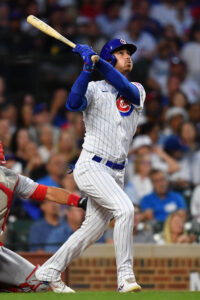
After a pair of injury-ruined 2021-22 seasons, Bellinger was non-tendered by the Dodgers. He’d undergone shoulder surgery following the 2020 season, and agent Scott Boras has unsurprisingly contended that Bellinger was never fully healthy during that pair of dreary seasons in ’21-’22, when he slashed a combined .193/.256/.355 in 900 plate appearances. The Cubs bet $17.5MM on Bellinger bouncing back to something closer to his prior Rookie of the Year and NL MVP form and were rewarded with a huge .306/.356/.525 slash with 26 homers and 20 steals.
It was an outstanding resurgence but not one without its red flags. Bellinger’s 15.6% strikeout rate was a career-low, but his 7.2% walk rate was the second-lowest of his career. More concerning to interested teams was Bellinger’s batted-ball profile. Despite his success at the plate, Bellinger ranked in the 27th percentile or lower among MLB hitters in terms of average exit velocity, hard-hit rate and barrel rate. At his peak, Bellinger was a hard-contact juggernaut who ranked among the league leaders in virtually every Statcast category of note. The opposite was true in 2023, and there are likely some teams who wonder whether he can continue to produce at such lofty levels in the absence of premium (or even league-average) quality of contact.
It puts Bellinger in a precarious situation. He surely feels he’s back to his MVP form, but players coming off such a dominant performance rarely have to take a one-year “prove-it” deal. Bellinger and Boras surely feel he’s already “proven it” and that the 2021-22 can now be framed as injury-marred outliers. Teams are clearly wary of regression, if not all the way to the miserable 2021-22 output than to something decidedly less than his 2023 output.
It’s not an identical situation to the one faced by Carlos Correa in free agency two winters ago, but there are some parallels. Both were atypically young free agents and were regarded as strong defenders at premium positions. Both had won Rookie of the Year early in their careers. Neither was at his offensive peak upon reaching free agency. Correa didn’t enter the 2021-22 offseason with the Boras Corporation representing him, but he changed agencies and hired Boras midway through the offseason.
Correa’s eventual contract — a three-year, $105.3MM deal with the Twins — shocked baseball, both due to the landing spot and to the fact that top-ranked free agents rarely settle for such a short-term arrangement. He had a pair of opt-outs baked into the contract, allowing him two more bites at the free agent apple.
A similar structure, logically speaking, could provide Bellinger some protection against another injury or regression while still rewarding his massive rebound season with a top-tier annual value. There’s some merits and risk for both parties, even if it’s not the type of deal he envisioned upon bouncing back to such lofty heights with the Cubs.
The problem Bellinger might run into, however, is finding the 2024 equivalent of the 2022 Twins. Minnesota was a clear postseason hopeful aiming to win now but also had plenty of payroll room at that late stage of the offseason. The Twins were also nowhere near the luxury tax threshold. It looked like an ideal short-term partnership (though it’s obviously since turned into at least a seven-year match).
For Bellinger, the landscape looks different. Right now, there are only five Major League teams whose projected payroll is more than $20MM south of their 2023 payroll levels. Two — the White Sox and Rockies — aren’t aiming to contend and aren’t likely to put down a lucrative short-term offer for Bellinger. A third, the Padres, is only facing such a gap between current spending and 2023 spending because they’ve actively been working to cut payroll by as much as $50MM. Signing Bellinger isn’t in the cards, barring a major last-minute philosophical shift. That’s particularly true when considering that the Padres are $22MM shy of the luxury threshold; signing Bellinger would put them right back into the tax penalty when it’s clearly been a goal to reset that level.
The luxury tax is a key issue here, too. Signing Bellinger short-term will likely require a high annual value and multiple opt-outs. For a team that’s already in luxury territory, that means a potentially exorbitant overall price. As such, when looking for Bellinger landing spots on a short-term deal, it’s best to break the 30 teams up into a few different categories. Let’s run through them…
Current Luxury Tax Payors
Phillies: Over the past week, there’s been plenty of speculation about the Phillies jumping at one of the top four free agents on a short-term deal. That’s primarily due to president of baseball ops Dave Dombrowski’s comment that he can’t promise that no further additions are coming because an unexpected opportunity can always present itself. But the Phils are a third-time payor who already have a projected $261MM of luxury obligations, putting them firmly into the second tier. Even a conservative estimate of a $25MM AAV on a short-term deal would mean paying a 62% tax on the contract’s first $16MM and a 95% tax on the final $9MM. In other words, it’d cost the Phillies around $18.5MM in taxes on top of Bellinger’s actual salary. Assuming an evenly distributed $25MM, that’s a total of $43MM in just 2024 to sign Bellinger. And, again, on a short-term deal the AAV will likely be much higher. Correa’s AAV was $35.1MM.
Astros: Houston’s $254MM of projected luxury obligations is a near-perfect match with Philadelphia. Unlike the Phillies, the Astros are only a first-time offender right now. They’d owe a 20% tax on the first $2MM of Bellinger’s deal, a 32% tax on the next $20MM and a 62.5% tax thereafter. Bellinger would push them into the third tier of penalization, meaning their top pick in the 2024 draft would be pushed back 10 spots. The Astros already have a record-high payroll. Signing Bellinger for even a $25MM AAV would cost around $8.675MM in taxes on top of his salary, require the forfeiture of their second-highest draft pick (by virtue of the QO) and knock their top pick back by 10 spots. Ouch.
Rangers: If Texas were going to push further into luxury territory than their current projection of $243MM (just $6MM over the first threshold), it’d surely be to sign a pitcher — likely Montgomery. The outfield is already largely set with Evan Carter, Leody Taveras and Adolis Garcia, with top prospect Wyatt Langford blitzing toward the majors. GM Chris Young has all but said he’s done signing Major League free agents. This match isn’t happening.
Blue Jays: The Jays are about $11MM over the first luxury barrier. They’re a second-time payor. That’d mean a 30% tax on the first $9MM or so of Bellinger’s deal, plus a 42.5% tax on the next $20MM and a 72.5% tax on anything thereafter (in addition to the same draft losses outlined for the Astros). GM Ross Atkins has said any notable addition would likely require subtracting elsewhere on the roster. The Jays could fit Bellinger into the mix by giving George Springer and Vladimir Guerrero Jr. more time at designated hitter, but Atkins’ comments make this hard to see. Just for illustrative purposes, a $25MM AAV on a Bellinger deal would cost the Jays $9.5MM in taxes, while jumping into Correa range would mean about $15.5MM in taxes (on top of his 2024 salary).
Braves: Atlanta is rolling with a Jarred Kelenic–Michael Harris II-Ronald Acuña Jr. outfield, with Matt Olson at first base and Marcell Ozuna at designated hitter. They don’t fit even from a roster vantage point, and they’re already $33MM over the tax line anyhow. It’s interesting to note that between the contracts they ate and the associated taxes, they wound up spending about $26MM to take on Kelenic, which isn’t all that far off from what Bellinger might end up costing — but that was much earlier in the offseason.
Yankees, Mets, Dodgers: The Yankees don’t really have room in their outfield, and the Dodgers/Bellinger relationship might not be the healthiest at the moment anyhow. Regardless, all three of these clubs are third-time payors who are already into the top luxury tier, meaning any additional dollars spent come with a 110% tax. Signing Bellinger to a $25MM AAV deal would mean $27.5MM in taxes. Bump that to $30MM AAV and you’re at $33MM in taxes. A $35MM AAV matching Correa comes with $38.5MM in taxes. All of that is on top of any salary for Bellinger.
Relatively Close to the Luxury Tax
Cubs: The incumbents! It’s not the spiciest take to suggest it, but this still seems like the most logical fit. The Cubs obviously wouldn’t have to forfeit any draft picks to sign Bellinger, since they’re the ones who made him the QO (although they would give up the right to receive a compensation pick). He’d “block” Pete Crow-Armstrong in center field or Michael Busch at first base, but perhaps only for a year. And, with injuries, both PCA and Busch would very likely still get their opportunities. The Cubs are $29MM shy of the luxury tax threshold and have $195MM in actual payroll commitments. Bellinger would push them well past the $203MM franchise-record mark and perhaps just over the first luxury tier, but should that matter? This is the cleanest and best fit, and a short-term arrangement should only add to the appeal.
Red Sox: Like so many of the teams on this list, if the Sox were to make one more big splash, it’d probably be on pitching (likely Montgomery). Boston is $39MM from the tax line and sits at $177MM in actual payroll commitments. They have the financial wherewithal to do this, but they also have an outfield of Tyler O’Neill, Jarren Duran, Wilyer Abreu and Ceddanne Rafaela — with DH Masataka Yoshida also in the fold. This doesn’t feel viable.
Angels: The Angels’ focus should be on pitching, but owner Arte Moreno has historically balked at long-term deals for starting pitchers. The Halos have Taylor Ward and Mike Trout in the outfield, but Mickey Moniak and Jo Adell aren’t the most exciting options for the remaining spot. Moniak hit well in 2023 but did so with a .397 BABIP and 35% strikeout rate that both scream for regression. Adell was once a top prospect but is out of options and hasn’t established himself. Moreno said this week the team will likely operate on a lesser budget in 2024, but we’ve seen time and again that he’s drawn to star hitters and Bellinger on a short-term deal would fit that mold. With $188MM in tax obligations, the Angels could sign Bellinger and still avoid reaching the threshold.
D-backs: Arizona is already at a new record payroll ($142MM) and is surprisingly within striking distance of the $237MM tax line ($189MM). Bellinger wouldn’t put them over, but signing him would require a level of aggression we’ve not seen from the Snakes since they shocked the world with their Zack Greinke signing nearly a decade ago. The Diamondbacks don’t need outfielders, necessarily, but center fielder Alek Thomas hasn’t proven himself at the plate. On a short-term deal, could GM Mike Hazen feel opportunistic?
Padres: The entire baseball world has learned to never say never with regard to San Diego president of baseball operations A.J. Preller, but in an offseason where they Padres have been trying to cut payroll by as much as $50MM and have pronounced questions at the back of the rotation, this feels like a bridge too far. If the Friars were to trade Ha-Seong Kim, pick up some kind of arm in that deal and then reallocate some of the savings to Bellinger, you could almost squint and see it. Typing this feels crazy, but that’s often how I feel when writing about Padres moves that actually did happen as well. The Padres are $25MM shy of the tax line at the moment. Signing Bellinger likely puts them over for a third straight year, meaning a 30% tax on a portion of his deal.
Giants: San Francisco already signed a center fielder to a nine-figure deal. They now have an all-lefty outfield and substantial questions in the rotation. It does feel like the Giants have the capacity for one more big move — they’re $33MM from their franchise-record payroll and $24MM from the luxury tax threshold — but if they make that move it’ll probably be on a pitcher. Still, they could probably sign Bellinger short-term and only cross into tax territory by $5-8MM. And since they didn’t cross the CBT threshold in ’23, they’d only be hit with a 20% tax.
Nowhere Near the Luxury Tax
Royals: Let’s get weird! I don’t think anyone seriously expects the Royals to sign Bellinger … but no one seriously expected the Twins to sign Correa. They also didn’t expect the Royals to sign Bobby Witt Jr. to a $288.78MM extension, or to spend a (so far) combined $109.5MM on seven big league deals in free agency this winter. But here we are! This would be a shocking fit — more shocking than the Twins signing Correa — but take a look at the Kansas City outfield candidates: MJ Melendez, Kyle Isbel, Drew Waters, Nelson Velazquez, Hunter Renfroe, Dairon Blanco. Bellinger is an immediate upgrade over every member of that group. The Royals currently project for a $115MM payroll and $161MM of luxury obligations. They’re around $28MM shy of their franchise-record payroll, which came back in 2017 and under a different owner.
Mariners: The M’s have been operating under TV-related budget constraints. President of baseball operations Jerry Dipoto has never signed a free agent hitter to a contract larger or longer than Mitch Garver‘s two-year, $24MM deal since taking the reins in Seattle. This doesn’t seem particularly plausible barring a late change in approach from ownership. Perhaps the allure of signing a star like Bellinger short-term would be enough to spur that tactical shift. It’s unlikely, but we’re talking about dark horses here, aren’t we?
Twins: Like the Mariners, the Twins have been working to reduce payroll. Their current projection of $123.5MM is right around the bottom end of their reported $125-140MM target range for payroll. Minnesota has been open to adding a right-handed-hitting outfielder and further rotation depth. They did this with Correa, so let’s not rule them out entirely. But if they were to, say, trade Kyle Farmer to free up $6.3MM and then make one more notable addition, a pitcher like Montgomery seems much more plausible than another lefty-swinging outfielder.
Orioles: If the Orioles make another big splash after Corbin Burnes, it seems likely to be on a pitcher. Their outfield is set with Austin Hays, Cedric Mullins and Anthony Santander, plus top prospects like Colton Cowser and Heston Kjerstad on the MLB doorstep.
Cardinals, Brewers: The Cardinals already have more outfielders than they know what to do with, and Bellinger isn’t going to displace Paul Goldschmidt at first base. Milwaukee has a similar situation in the outfield, and they’ve got Rhys Hoskins at first base.
Tigers: President of baseball operations Scott Harris suggested this week he’s not inclined to sign another “everyday-type” hitter, instead preferring to give legitimate looks to the team’s young hitters. With Riley Greene, Parker Meadows, Kerry Carpenter and veteran Mark Canha in the outfield/DH mix, plus Spencer Torkelson at first base, there isn’t a great roster fit here anyhow.
Pirates, Marlins, Reds, Guardians, Rays: Five of the lowest-payroll clubs in the game. It seems safe to say no one from this group is going to seriously pursue Bellinger, even on a short-term deal.
Nationals, A’s, Rockies, White Sox: All four of these teams are in some form of rebuild/reset. The A’s certainly aren’t going to spend this type of money. Nats GM Mike Rizzo suggested he’s done adding MLB free agents. The Rockies balked at Bellinger’s one-year price last winter and are in a worse spot now. Maybe you could call the White Sox an off-the-wall dark horse, but would GM Chris Getz forfeit a draft pick to sign Bellinger short-term, knowing he’d either opt out next winter or perform poorly enough to be an unwanted contract in 2025? Doubtful.
—
The ideal fit for Bellinger on a short-term deal is a team that’s not already a tax payor or is only minimally over the line. The Cubs have been considered something of a presumptive favorite due to Bellinger’s strong year there in 2023, but as outlined above, they also make sense both from a roster and financial standpoint. Other plausible long-shot options when considering the tax and payroll ramifications could include the Angels and Giants. The Padres could add Bellinger without paying substantial taxes, but it’d run counter to the team’s cost-cutting efforts this winter. Long-shot fits with the D-backs and particularly the Royals sound a bit more sensible than one might imagine at first blush.
We certainly don’t know that Bellinger will wind up going short-term, but he’s the most sensible candidate to do so of the remaining marquee Boras clients, and if he goes that route, it could open the door for some unexpected suitors.