
Braves Acquire Aaron Bummer In Six-Player Deal
The Braves announced the acquisition of reliever Aaron Bummer from the White Sox for a five-player package. Chicago acquires starters Michael Soroka and Jared Shuster, middle infielders Nicky Lopez and Braden Shewmake and minor league righty Riley Gowens. All but Gowens occupy spots on their teams’ 40-man rosters.
Bummer, a 30-year-old southpaw, had spent his entire career with the ChiSox. He developed from an unheralded 19th-round selection into one of the game’s more quietly excellent setup men. Bummer broke through in 2019, when he turned in a 2.13 ERA over 67 2/3 innings on the back of an eye-popping 72.1% grounder percentage.
The following February, Chicago signed Bummer to a long-term extension. Various injuries impacted him between 2020-22, as he spent time on the shelf with biceps and lat issues in his throwing arm and a right knee strain. Bummer remained effective when healthy, turning in a 2.92 ERA over that stretch.
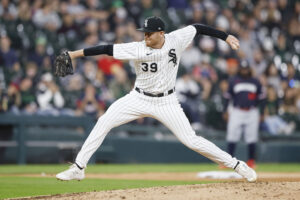
That strong run prevention mark collapsed this past season. Bummer was tagged for nearly seven earned runs per nine over 58 1/3 innings. Among pitchers with 50+ frames, only 12 had a higher ERA than his 6.79 mark. While that’ll make this a head-scratching move for many Atlanta fans, it’s clear the front office is placing a lot more stock in Bummer’s promising underlying indicators.
Bummer struck out an above-average 29.2% of batters faced this year. He has fanned just under 27% of opponents over the course of his career. He averaged 94.5 MPH on his sinker (a solid mark for a left-hander) and missed bats against hitters of either handedness. While he’s no longer posting ground-ball numbers reminiscent of peak Zach Britton, he kept the ball on the ground at a lofty 58.2% clip. That’s the 10th-highest rate among relievers who logged at least 50 innings.
Certainly, Bummer isn’t a flawless pitcher. While he tends to keep the ball down, he gives up a fair amount of hard contact. He has well below-average control and walked over 13% of opposing hitters this past season. While an elevated batting average on balls in play was a big reason for his disappointing ’23 campaign, he didn’t do himself many favors by handing out so many free passes.
The Braves clearly feel Bummer’s results will more closely match those he managed before this year. He joins A.J. Minter and Tyler Matzek as potential high-leverage options from the left side. Pierce Johnson and Joe Jiménez are mid-late inning righties to help bridge the gap to closer Raisel Iglesias.
If Bummer returns to form, he could be a longer-term bullpen piece. He’ll make $5.5MM next season in the final guaranteed year of the aforementioned extension. He is guaranteed a $1.25MM buyout on a $7.25MM club option for 2025, while the deal also contains a $7.5MM team option (with a $1.25MM buyout) for the ’26 season.
It’s a consolidation trade for a win-now Atlanta team that can afford to target specific players it considers finishing touches to a championship-caliber roster. The White Sox are in the opposite position. Fresh off a 101-loss season, first-year general manager Chris Getz has set out to add depth to a team that has become far too top-heavy.
Trading a reliever for five players — four of whom are MLB options — is one way of doing so. While none of the four big leaguers is near the peak of their trade value, it’s easy to envision any of them playing a role on the 2024 White Sox from day one.
Soroka may be the most recognizable name. A former first-round pick and top prospect, he earned an All-Star nod and runner-up finish in NL Rookie of the Year balloting in 2019. Soroka had pitched to a 2.68 ERA over 29 starts in his age-21 season. He looked like one of the sport’s brightest young pitching talents before his career was sidetracked by horrible injury luck.

The right-hander sustained successive tears of his right Achilles tendon nine months apart in 2020 and ’21. The injuries cost him almost two full seasons. While he returned to the mound in 2023, he struggled to a 6.40 ERA over seven big league outings. Soroka had quite a bit more success in Triple-A. Over 17 starts with their top affiliate in Gwinnett, he pitched to a 3.41 ERA with an above-average 25.9% strikeout rate. Forearm inflammation ended his season in September but is not expected to require surgery.
Soroka accrued MLB service time throughout his injury rehab. As a result, he has over five years of service and will be a free agent next winter. MLBTR contributor Matt Swartz projects him for a $3MM salary in his final season of arbitration. That made him a non-tender candidate for Atlanta, particularly since he can no longer be optioned to the minors. The White Sox are apparently willing to commit something in that range to see if he can recapture mid-rotation or better form.
Chicago has almost nothing in the way of rotation locks beyond Dylan Cease. Soroka now seems likely to get that opportunity. He could be joined by Shuster, a former first-round pick out of Wake Forest. The left-hander secured an Opening Day rotation spot with Atlanta a season ago. He struggled in his first MLB look, allowing a 5.81 ERA with a well below-average 13% strikeout rate over 52 2/3 innings.
Shuster had similarly discouraging numbers in Gwinnett. He was tagged for a 5.01 ERA through 16 starts with the Stripers. He struck out only 17.9% of hitters in Triple-A while walking 12.6% of opponents. While there aren’t many positives in Shuster’s 2023 performance, he’s only a year removed from ranking as one of the top pitchers in the Atlanta system. He’d posted a 3.29 ERA with a strong 26.2% strikeout rate in the minors in 2022, drawing praise for a potential plus changeup along the way.
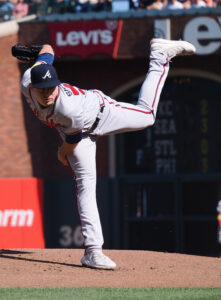
Still just 25, Shuster could battle for a spot at the back of the Chicago rotation in Spring Training. He still has two option years remaining and has less than one year of MLB service. The Sox will hope he can put his tough debut behind him and reach the back-of-the-rotation projection of many prospect evaluators.
In some ways, Shewmake is a position player analogue of Shuster’s. He’s also a former first-round college draftee who’d generated some fanfare in Atlanta as recently as last spring. The Texas A&M product had a big Spring Training that led to some speculation he could open the season as the Braves’ starting shortstop. Atlanta rolled with veteran Orlando Arcia instead, a move that turned out well.
Not only did Arcia put together an All-Star season, Shewmake had a rough year in the minors. He hit .234/.298/.407 over 526 plate appearances for Gwinnett. He connected on 16 homers but hit only .264 on balls in play, keeping his on-base percentage down.
Scouts have questioned how much offensive upside the lefty-hitting Shewmake brings to the table. He’s soon to turn 26 and has only played two MLB games. Yet he’s a plus runner who went 27 of 28 in stolen base attempts in Triple-A. Shewmake can play either middle infield spot and has a pair of minor league options.
Adding middle infield talent was a necessity for Getz and his staff. The Sox had almost nothing at second base, relying on Lenyn Sosa and Romy González there. After buying out Tim Anderson, they were even lighter at shortstop. Shewmake could battle for a job, while Lopez seems likely to step into an everyday role at one of those positions.
The Sox are plenty familiar with Lopez from his days with the Royals. The 28-year-old has received elite grades for his defense at both middle infield spots and in more limited time at third base. It’s an all-glove profile, as Lopez has bottom-of-the-scale power. He’s a .228/.297/.284 hitter in 742 plate appearances over the past two seasons.
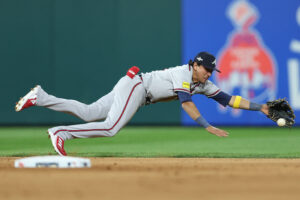
Lopez has between four and five years of service and is projected for a $3.9MM arbitration salary. That felt like a luxury for an Atlanta team that relies on Matt Olson, Ozzie Albies, Arcia and Austin Riley almost every day. It’s a more palatable sum for a team that’ll use Lopez as a bottom-of-the-lineup regular — as the Sox now seem positioned to do.
Rounding out the return is Gowens, a 24-year-old righty who was selected in the ninth round of this past summer’s draft. He pitched to a 6.30 ERA but struck out almost 28% of opponents over 12 starts during his junior year at Illinois. Baseball America praised the life on his fastball in his draft report, suggesting he could project as a reliever in pro ball.
It’s an unexpected trade made possible by the discrepancy in the organizations’ depth. Atlanta could afford to package some players who had fallen towards the back of the roster for a reliever with upside but legitimate question marks. Chicago buys low on a handful of players at positions of need, hoping that one or two can click and provide more value than they would have received out of Bummer.
Images courtesy of USA Today Sports.
Competition Committee Considering Additional Minor Rule Changes
Yesterday, ESPN’s Jeff Passan reported that MLB’s Competition Committee was considering trimming two seconds off the pitch clock when runners are on base. That isn’t the only potential rule change under discussion this offseason.
Ken Rosenthal of the Athletic reports a number of additional, fairly minor, alterations that’ll be considered. Perhaps most notable would be a requirement that pitchers work from the stretch whenever a runner is on base. Pitchers tend to work from the stretch to hold runners on but sometimes throw from a full windup or hybrid delivery when there’s a runner on third given the unlikelihood of that runner trying to steal home.
The committee is also considering reducing the number of mound visits per team in a game from five to four. A team that used all four would still get one extra visit in the ninth inning.
Another potential change: requiring a pitcher that warms up to face at least one batter. A pitcher who comes out of the bullpen is already required to face at least one hitter, barring injury. Unless that pitcher completes an inning within the first hitter or two, they have to go up against a minimum of three batters.
That only applies for a new pitcher entering the game, however. A pitcher who has faced three or more hitters and concluded the preceding inning can warm up for the beginning of an ensuing frame before being subbed out. While a rare occurrence, this sometimes happens when the batting team calls for a pinch-hitter that spurs a pitching change, usually to mitigate the pinch-hitter’s platoon advantage. Since the oncoming reliever throws warm-up pitches of his own, that can lead to consecutive warm-up breaks with no at-bat, causing a few minutes of dead time. Requiring a pitcher who warms up to face the first hitter would eliminate that occurrence (while offering a slight advantage to the offense in such scenarios).
Free agent infielder Whit Merrifield, one of the player representatives on the committee, proposed a change designed to prevent fielders from blocking a runner’s direct path to any base. The goal of that proposal is to minimize fielder-runner collisions and eliminate scenarios in which an infielder uses his lower body while receiving a throw to shield a runner from sliding into a base. That happens somewhat frequently on stolen base attempts.
Rosenthal covers a few more changes under consideration in a piece that’s worth a full read for those interested in rules minutia. The competition committee consists of six MLB officials, four player representatives and umpire Bill Miller. A simple majority can implement those changes without approval of the Players Association, essentially giving MLB control over on-field rules adjustments.
Red Sox Exploring Top Of Rotation Market
Starting pitching is a clear priority for the Red Sox. Boston’s new chief baseball officer Craig Breslow acknowledged as much last week, although they’re certainly not alone in that pursuit.
That could extend to the top end of the market. Jeff Passan of ESPN wrote on Tuesday that the Sox were targeting front-line starting pitching. Jon Heyman of the New York Post suggests Boston is looking to add multiple starters this offseason. It stands to reason Breslow and his staff could look to pair an impact acquisition with a more affordable, if lower ceiling, addition.
Free agency offers a few possibilities. The Red Sox surely have some level of interest in Shohei Ohtani, but he wouldn’t be a factor in the 2024 rotation after his elbow procedure. Yoshinobu Yamamoto, Blake Snell, Aaron Nola and Jordan Montgomery are generally regarded as the next tier of free agent starters. AL Cy Young runner-up Sonny Gray is probably below that group in earning power because he’s 34 years old but fits in terms of short-term impact.
This afternoon, Ian Browne of MLB.com suggested in an appearance on the ITM podcast that the Boston front office prefers Montgomery to Snell or Nola (Twitter link via Steve Perrault). Sox executives chatted with Montgomery’s representatives at the Boras Corporation during last week’s GM Meetings, although they’re presumably targeting multiple Boras clients to varying degrees. (Snell is also represented by the Boras Corp.)
Montgomery turned in a 3.20 ERA through 188 2/3 innings between the Cardinals and Rangers. It was third straight sub-4.00 showing over 30+ starts. Montgomery chipped in 31 frames of 2.90 ERA ball during Texas’ run to a World Series. During the regular season, the 30-year-old southpaw struck out a near-average 21.4% of opponents while keeping his walks to a tidy 6.2% clip.
He may not have the upside of Nola or Snell, each of whom misses more bats. Montgomery has better control than Snell and hasn’t had the spotty ERA or home run issues that have troubled Nola in two of the past three seasons, however. He also has the advantage of not requiring a signing team to surrender draft compensation. The midseason trade rendered Montgomery ineligible for the qualifying offer. Snell, Nola and Gray all received the QO. Yamamoto, of course, is not subject to the QO as a foreign professional.
Roster Resource projects the Sox for roughly $189MM in luxury tax commitments. That’s well below the $237MM base threshold, leaving plenty of potential spending room for Breslow and his staff. It’s also possible the Sox look to the trade market for rotation help. It’s difficult to envision the Rays trading Tyler Glasnow in division. Players like Corbin Burnes or Shane Bieber could be available as they enter their final seasons of arbitration eligibility.
Boston’s current rotation mix is a high-variance unit. Nick Pivetta, Chris Sale, Brayan Bello, Tanner Houck and Garrett Whitlock have all shown substantial upside.They also come with uncertainty to varying degrees. Houck and Whitlock might be better suited for relief. That could also be true of Pivetta, although he finished the 2023 season pitching very well over multiple innings. Sale has battled injuries and Bello seemed to wear down in the second half of his first full MLB season.
Nationals Showing Renewed Interest In Jeimer Candelario
The Nationals are among the teams that have shown interest in Jeimer Candelario this offseason, reports Jesse Rogers of ESPN. Rogers also tied the free agent corner infielder to the Blue Jays, while a prior report suggested the Angels, D-Backs and Reds had checked in.
Of those teams, only Washington has employed Candelario before. The rebuilding Nats took a $5MM flier on the switch-hitter last offseason. Candelario had been non-tendered by the Tigers on the heels of a dismal 2022 season. He bounced back in D.C., hitting .258/.342/.481 over 99 games. Washington was able to flip him to the Cubs for prospects DJ Herz and Kevin Made, executing the kind of buy-low/midseason trade sequence that noncompetitive teams attempt each offseason.
Candelario didn’t quite maintain that form in Chicago. He hit .234/.318/.445 in 41 games as a Cub, finishing the season with a .251/.336/.471 batting line in 576 plate appearances. He connected on 22 home runs and 39 doubles with league average strikeout and walk rates. It was Candelario’s third above-average season in four years.
As a result, the 29-year-old (30 next Friday) is in a much better position for this free agent trip. He should secure at least a three-year pact and has a good case for four years. MLBTR predicts he’ll land a $70MM guarantee over four seasons, ranking him as the #5 position player in the free agent class.
Bringing Candelario back would obviously be a much more significant commitment for the Nats than it was 12 months ago. Washington has clear opportunity at third base yet again. After the Candelario deal, they turned to journeyman Ildemaro Vargas and former top prospect Carter Kieboom at the position. Washington third basemen hit .189/.247/.311 in 224 plate appearances from July 31 onward.
That’s an untenable situation even with the team still amidst a rebuild. Some kind of third base acquisition feels inevitable. While they could be another rebound candidate (e.g. Brian Anderson or non-tender possibility Nick Senzel), Candelario would be a clearer upgrade. General manager Mike Rizzo said last week the team was looking to add a middle-of-the-order lineup presence.
It doesn’t appear the Cubs have as strong an interest in a reunion. Rogers reports that Chicago looks unlikely to retain Candelario. They have third base questions of their own, with Nick Madrigal, Patrick Wisdom and Miles Mastrobuoni among the in-house options. None of that group projects as an everyday player for a contender, but the Cubs could look to alternatives in free agency or trade. Matt Chapman is the top free agent at the position; J.D. Davis, Jorge Polanco and Eugenio Suárez are among speculative trade possibilities.
Ronald Acuña Jr. Wins NL MVP
For the first time in his career, Ronald Acuña Jr. is an MVP. The Baseball Writers Association of America announced this evening that Acuña was unanimously selected as the National League’s top player. Dodger teammates Mookie Betts and Freddie Freeman finished second and third, respectively.
Acuña has been a star for years. The sport’s #1 prospect before he reached the majors in 2018, he won Rookie of the Year and finished 12th in MVP voting during his debut campaign. He got onto MVP ballots in each of the next two seasons and has been named to the All-Star Game in every season since his rookie year (excluding the 2020 campaign in which there was no Midsummer Classic).

In 2023, he firmly cemented himself as one of the top three to five players in the game. Acuña turned in an unbelievable .337/.416/.596 batting line over an NL-high 735 trips to the dish. He led the majors in hits and runs scored from the top of a loaded Atlanta lineup and paced the Senior Circuit in OPS. The Venezuela native tied his career high with 41 home runs and stole a major league leading 73 bases.
That power-speed impact was unparalleled in baseball history. Acuña became the first player ever to go 40-70. One could quibble with his NL-leading 14 times caught stealing or middling defensive grades in right field, but the sheer offensive dominance and unprecedented nature of Acuña’s stat line made him the clear choice in the eyes of voters.
While this was his career season to date, Acuña could be a perennial MVP candidate He won’t turn 26 until December and is squarely in the midst of his prime. Only adding to the appeal for the Braves is that they have their superstar outfielder on perhaps the game’s most team-friendly contract. Acuña is signed for a total of $61MM over the next three years, while the team has options that could (and very likely will) keep him in Atlanta through 2028.
Acuña winning the award was expected. That he received all 30 first-place votes is a bit more surprising. Betts ranked second on every ballot, hammering home how clearly that duo had separated themselves from the pack. The Dodger star hit .307/.408/.579 over 693 plate appearances. He played solid defense in right field and handled the middle infield with aplomb, logging action at second base and shortstop.
Freeman and Matt Olson were third and fourth on every ballot, with Freeman picking up four more third-place nods to secure the #3 spot overall. Corbin Carroll, Juan Soto, Austin Riley, Luis Arraez, Cody Bellinger, William Contreras and Blake Snell all received at least one fifth-place vote. Others receiving votes: Francisco Lindor, Bryce Harper, Fernando Tatis Jr., Ha-Seong Kim, Ozzie Albies, Logan Webb, Pete Alonso, Marcell Ozuna, Devin Williams, Dansby Swanson, Kyle Schwarber, Zac Gallen, Christian Walker, TJ Friedl and Nick Castellanos.
As noted by Sarah Langs of MLB.com (on X), this is the first time in MLB history in which both MVP selections were unanimous. Shohei Ohtani took all 30 first-place nods in the American League. Full voting results are available courtesy of the BBWAA.
Image from USA Today Sports.
Wisconsin Legislature Approves Brewers’ Stadium Renovation Plan
The Wisconsin state legislature passed a bill approving stadium renovations at Milwaukee’s American Family Field on Tuesday, as covered by Jessie Opoien of the Milwaukee Journal Sentinel. While the bill still needs approval from governor Tony Evers to officially pass, he has already announced his intent to sign off.
Under this funding plan, the state is agreeing to pay just under $366MM to support the stadium upgrades through 2050. Milwaukee County and the City of Milwaukee will each contribute $67.5MM. The Brewers are expected to pay roughly $150MM — around $100MM of that via rent and approximately $50MM devoted to discretionary upgrades. In total, the public funding amounts to a little over half a billion dollars over the course of 26 years.
Once signed into law by the governor, the plan will put to rest any questions about the Brewers’ future in Milwaukee. The team’s lease at American Family Field, which had been set to expire after the 2030 season, will be extended through 2050. In August, team officials floated the possibility of relocation if a lease extension weren’t agreed upon this fall. That’ll no longer be a concern for Brewer fans, at least for the better part of the next three decades.
“We now can all go to sleep tonight knowing the Brewers are going to be here for the next generation in a great, beautifully maintained ballpark that is worthy of the fans’ support,” the team’s business operations president Rick Schlesinger told reporters (including Opoien) on Tuesday.
Some residents will surely have qualms about committing significant public funding to stadium upgrades. There was opposition among the state senate, with the bill passing by a narrow 19-14 margin.
The Brewers have played in Milwaukee since 1970. The franchise began as an expansion team in Seattle but spent only one season there before moving to Wisconsin. With the Rays and Brewers reaching agreements on stadium deals, the A’s are the only franchise that will be relocating in the near future. MLB’s owners unanimously approved the Athletics’ application for relocation to Las Vegas this morning.
A’s Acquire Abraham Toro
The A’s have acquired infielder Abraham Toro in a trade with the Brewers. Minor league pitcher Chad Patrick is headed back to Milwaukee. Oakland already had four vacancies on the 40-man roster, so no further move was necessary.
Toro, 27 next month, has now been traded three times in his career. The former Astro draftee went to the Mariners in the Kendall Graveman deal at the 2021 deadline. Toro didn’t find consistent offensive success over a season and a half in Seattle. He hit only .213/.276/.342 in 605 plate appearances (roughly one full year of playing time) through the end of the 2022 campaign.
As a result, the Mariners looked to upgrade at second base. They sent Toro alongside designated hitter Jesse Winker to Milwaukee for Kolten Wong. The trade didn’t work out for anyone involved. Wong was released by August while Winker slumped to a .199/.320/.247 line before hitting free agency. Toro barely played for the Brew Crew, getting into just nine MLB contests.
Toro spent most of the season on optional assignment to Milwaukee’s Triple-A team in Nashville. The switch-hitter had solid numbers there, running a .291/.374/.471 batting line over 414 plate appearances. He only hit eight home runs but walked at an excellent 11.8% clip while striking out 17.6% of the time. Despite the solid numbers, Milwaukee stuck with light-hitting rookie Brice Turang at second base and rotated through a number of third base options. 26-year-old rookie Andruw Monasterio and scuffling veteran Josh Donaldson got looks at the hot corner instead of Toro.
That limited usage made him a non-tender candidate approaching Friday’s deadline. While his projected $1.3MM arbitration salary isn’t exorbitant, it’s almost twice the league minimum rate. Toro is also out of minor league option years. Milwaukee would have had to keep him on the MLB roster or designate him for assignment at the beginning of next season.
Oakland is apparently more willing to take that shot. The A’s have almost nothing locked down in the infield. Second baseman Tony Kemp hit free agency. A’s third basemen (primarily the since-traded Jace Peterson, Jordan Diaz and Aledmys Díaz) combined for dreadful .192/.271/.285 batting line. Toro has a solid minor league track record and is eligible for arbitration through 2026. The A’s can afford to give him some run in what’ll be another uncompetitive season to see if he can hit MLB pitching.
The move for Milwaukee is mostly about clearing the roster spot and projected salary. Rather than a straight non-tender, they’ll pick up a mid-tier pitching prospect. Patrick joined the A’s before the trade deadline in the deal that sent Peterson to the Diamondbacks.
A former fourth round pick, Patrick spent the 2023 campaign in the upper minors. He logged a 5.59 ERA over 124 innings between the Arizona and Oakland organizations. The Purdue-Northwest product struck out 23% of opponents while issuing walks at a slightly high 9.4% clip. He won’t be eligible for the Rule 5 draft until next offseason, so Milwaukee can keep him in Nashville as non-roster rotation depth.
Diamond Sports Group Could Drop Guardians, Rangers Broadcasts
The ongoing Diamond Sports Group bankruptcy could soon affect another two franchises. Evan Drellich and Mike Vorkunov of the Athletic report that the broadcasting corporation is considering dropping its in-market TV deals with the Guardians and Rangers before the 2024 season.
Diamond, which operates the Bally Sports networks, already severed contracts with the Padres and Diamondbacks during the 2023 campaign. MLB stepped in to handle in-market broadcasting for those clubs. Diamond had sought to pay reduced rights fees to the Twins, Reds, Guardians and Rangers during the year as well. The bankruptcy court eventually awarded those teams their full rights fees.
If Diamond officially drops two more agreements, the Cleveland and Texas organizations will have to find alternate means of broadcasting within their local markets. MLB could step in to ensure those games aren’t blacked out, as it did for the Padres and D-Backs. Perhaps the franchises could line up an agreement with a new regional sports network during the offseason. In any event, it’s a suboptimal situation — albeit one which team executives were surely anticipating at this point.
“Our intention is to broadcast almost all of (our) Major League Baseball teams next year,” one of Diamond’s attorneys said in today’s bankruptcy proceedings (relayed by Drellich and Vorkunov). “There are a few, a very few, for which we do not have agreements in place. And that, frankly, at this point, are too expensive for us to broadcast without concessions. I am told that those discussions are taking place, there have been reach-outs to both of the teams involved.”
Diamond has local broadcasting deals with 11 teams. That figure was 14 at the beginning of the ’23 season. In addition to the lapsed deals with San Diego and Arizona, Bally’s contract with the Twins expired at the conclusion of the year. Dan Hayes of the Athletic wrote yesterday that a new short-term deal with Diamond to carry Minnesota’s 2024 broadcasts hasn’t been ruled out.
The Angels, Braves, Brewers, Cardinals, Marlins, Rays, Reds, Royals and Tigers also have existing contracts with Diamond. Jonathan Randles and Steven Church of Yahoo! Finance write that attorneys for both Diamond and Sinclair — the media conglomerate which had acquired Diamond in 2019 — indicated in today’s court proceedings that Diamond might be liquidated entirely at the end of the 2024 MLB season. (Sinclair and Diamond now operate independently after Diamond accused Sinclair of siphoning funds from the subsidiary.)
The uncertain TV rights picture could impact the spending habits for those franchises. The Twins are scaling back payroll this offseason. Only the franchise’s ownership and front office know precisely how much that’s a result of the TV picture, but Minnesota president of baseball operations Derek Falvey has called it a contributing factor.
While the Twins have run almost exactly average player payrolls, Cleveland and Texas have been on opposite ends. According to Cot’s Baseball Contracts, the Guardians ranked 25th in Opening Day payroll this year. The Rangers opened the season ninth and have the fifth-highest projected outlay for 2024 on the heels of their World Series win.
Padres, Cal Mitchell Agree To Minor League Contract
The Padres are signing outfielder Cal Mitchell to a minor league deal, reports Britt Ghiroli of the Athletic (X link). He’ll be in MLB camp as a non-roster invitee.
It’s a homecoming for the San Diego native. A product of Rancho Bernardo high school, he was a second round pick of the Pirates in 2017. Mitchell hit well enough in the low minors to hold a spot among the top 30 prospects in the Pittsburgh system for a few years. He carried that offensive success as high as Triple-A, where he posted a .339/.391/.547 line in 63 games in 2022.
That earned the left-handed hitter his first MLB opportunity. Mitchell didn’t produce much in that initial look, posting a .226/.286/.349 showing across 232 trips to the plate. The Bucs kept him on optional assignment to Triple-A Indianapolis for the majority of 2023. He didn’t find the same kind of success as he had there a year ago.
Mitchell hit .261/.333/.414 over 78 Triple-A contests this past season. His strikeout rate doubled, ending at an alarming 29.4% clip. He played in only two big league games and was designated for assignment in September. Mitchell cleared outright waivers and became a minor league free agent at season’s end.
Still just 24 (25 in March), Mitchell will battle for a spot in the San Diego outfield in exhibition. He’s limited to the corners. San Diego has Juan Soto and Fernando Tatis Jr. there but limited depth otherwise. Taylor Kohlwey occupies a 40-man roster spot after hitting .276/.390/.437 in Triple-A.
Mariners To Add Brant Brown To Coaching Staff
The Mariners are hiring Brant Brown in an unspecified coaching role, reports Daniel Kramer of MLB.com (X link). Craig Mish of SportsGrid reported this afternoon that Brown was interviewing with Seattle.
Brown, 52, spent the 2023 season as hitting coach with the Marlins. He’d previously served as a hitting coach with the Dodgers before joining eventual NL Manager of the Year Skip Schumaker’s first staff in Miami. Brown has spent the past half-decade coaching major league hitters. Before joining Los Angeles, he had worked for the Mariners as a minor league coordinator.
Specifics of his new role in Seattle are unclear, although Mish indicates it’s a bigger role on the hitting staff than Brown had held in Miami. Considering he was already the hitting coach with the Fish, it’s possible he’ll take on something like an offensive coordinator role with Seattle.
The Marlins were a slightly below-average offensive team this past season. They finished 19th with a .316 on-base percentage and .405 slugging mark. Miami was only 26th in overall run scoring, although their pitcher-friendly ballpark surely plays a role in that. That’s also true of the roster, which was still built primarily around pitching. Miami’s 2023 numbers were improved on those from the preceding season; they finished 27th in OBP and 28th in slugging the year before Brown’s arrival.
Miami will look for a hitting coach for a second straight offseason. John Mabry and Jason Hart held assistant hitting coach roles this past season. Mabry has a fair amount of prior experience as a lead hitting voice. Barry Jackson of the Miami Herald indeed floats him as a possibility to step into Brown’s place.