
Free Agent Stock Watch: Matt Capps
MLB teams made what's arguarbly the riskiest investment in baseball 17 times last offseason, signing free agent relief pitchers to multiyear deals. Not surprisingly, many of the deals haven't worked out, but that won't stop baseball's owners from handing out another round of generous contracts to the relievers who hit the open market this offseason.
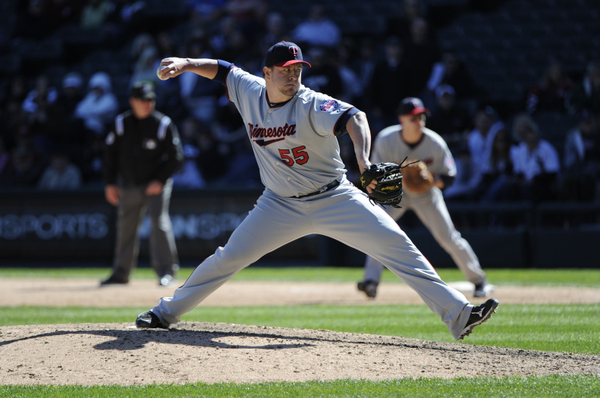
Relievers like Matt Capps, who are mere months away from free agency, have every reason to wonder if they'll be among the beneficiaries of teams' never-ending search for bullpen stability. Unfortunately for Capps (and the Twins), his numbers have fallen off in 2011, so his case for a multiyear deal isn't as strong as it would have been last year.
The 27-year-old is striking out far fewer hitters this year (4.5 K/9, 12.3 K%) than in 2010 (7.3 K/9, 19.3 K%). Capps' average fastball velocity has dropped from 94 mph to 92.8 mph and opposing hitters are making more contact than they did a year ago. When they do make contact, it's much less likely to be a ground ball now (38.8% ground ball rate) than it was in 2010 (49.8% ground ball rate). The right-hander's ERA now sits at 4.34 (4.27 xFIP), about two runs higher than last year's 2.47 mark (3.31 xFIP).
To his credit, Capps has cut down on walks (1.2 BB/9) compared to last year (2.1 BB/9), but that doesn't make the warning signs disappear. The market for relievers who are losing fastball velocity, inducing fewer ground balls and generating fewer swings and misses doesn't tend to be strong.
It's a lot for the Twins to take into account when deciding whether to offer arbitration this offseason. Capps projects as a Type A free agent, so Minnesota could theoretically obtain two top draft choices by offering arbitration if he declines the offer and signs elsewhere.
But would any team surrender a high draft choice for the right to sign Capps? And, perhaps more to the point, wouldn't Capps' representatives at Wasserman Media Group recommend that their client accept an offer of arbitration? After all, Capps earns $7.15MM this season and would earn a raise by accepting arbitration.
All of this makes it seem unlikely that Capps will obtain an arbitration offer from the Twins, so it's hard to imagine him hitting the market tied to draft pick compensation. All Capps will cost is cash and owners have shown a willingness to overpay for serviceable relievers before. If he obtains multiyear security on the open market despite his decline in performance, he won't be the first reliever to profit from baseball's over-eager owners.
Photo courtesy Icon SMI.
When The 40/60/80 Arbitration Rule Doesn’t Work
If you’re interested in contracts between teams and players, there’s a good chance you’ve heard of the 40/60/80 rule (see below for explanation). It’s easy to remember and easy to use, but there’s a problem. It doesn’t work – at least not to the extent that some suggest it does. There’s a broad selection of arbitration eligible players – Michael Bourn, Brett Gardner (pictured) and Clayton Kershaw for example – for whom the approximation will not work this offseason.
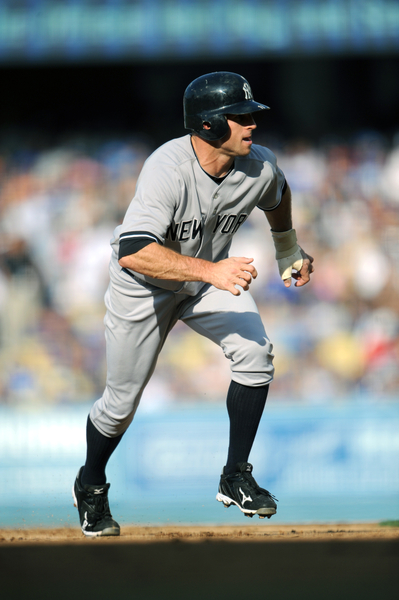
So why do we use it? First of all, the alternative’s a whole lot more complicated. To accurately project arbitration earnings for individual players, teams and agencies use comparable players and traditional stats instead of the 40/60/80 rule. Yes, 40/60/80 works as a guideline, but too many players and types of players are exceptions for it to provide consistently accurate projections. Though that’s probably not reassuring for saber-minded readers and writers, it’s all in the name of more accurate estimates for players’ salaries.
Before we go too much further, let’s briefly return to the origins of the 40/60/80 rule. David Studenmund showed in the 2007 Hardball Times Baseball Annual that, as a group, arbitration eligible players earn about 55% of what free agent players do (on a per win basis).
Tom Tango then built on Studenmund’s research and determined that, generally speaking, we can say first year arbitration eligible players earn about 40% of what free agents earn, second year arbitration eligible players earn about 60% of what free agents earn and third year arbitration eligible players earn about 80% of what free agents earn.
The points Studenmund and Tango make are convincing – the 40/60/80 rule works to describe what has happened to groups of players. “It’s a rule of thumb, and should be used generally speaking,” Tango explained in late July.
But when I asked Tango about the rule, he acknowledged that it has its limitations.
“If you look at specific players, you really should look at ‘comps,’” he said.
That’s what Major League teams and MLB agents do each winter. To prove that the player in question deserves the salary their side is proposing, executives and agents point to comparable players. If the player goes to arbitration, the arbitrators who hear the case and provide the verdict take into account salary and service time information and, according to baseball’s collective bargaining agreement, must consider “all comparable players.”
In other words, those in the baseball industry ensure that their comparisons are accurate by looking to the specifics. Generally speaking, the 40/60/80 rule works, but it doesn’t account for the nuances of baseball’s arbitration system.
“If you are trying to figure something more robust, I would not rely on the rule of thumb,” Tango wrote on his blog. “You’d have to come up with something not so linear,”
That could mean a sliding scale that would adjust for role players, superstars and award winners.
“Or, more likely, you can forget about WAR altogether,” Tango continued. Instead, we could do something similar to what teams and agents do – value players based on RBI, homers, saves, wins and other back of the baseball card stats.
Using WAR to project earnings can be deceptive for many types of players. Superstars don’t come close to earning 40% of their ‘market value’ as first time arbitration eligible players. Versatile utility types also pose problems. According to WAR, the Cardinals should have non-tendered Ryan Theriot after he posted negative WAR last year. Instead they traded Blake Hawksworth for Theriot and gave the infielder a $3.3MM contract. Since elite defenders aren’t particularly well-compensated in arbitration, you wouldn’t want to use WAR to project earnings for a player like Bourn or Ben Zobrist. The same goes for players with OBP-driven value; arbitrators don’t reward high on base percentages nearly as well as WAR does. Closers, on the other hand, can earn as much as position players through arbitration, even though WAR suggests they’re far less valuable. Super twos, the players who go to arbitration four times instead of three, complicate the 40/60/80 rule as well.
When there are this many exceptions to the rule, it's time to start questioning its effectiveness. Though it does work as a descriptor of the past, as Studenmund and Tango showed, it isn't a reliable predictor for individuals. The 40/60/80 rule starts with free agent value and works backward. But in reality, arbitration cases look back to performance, not forward to free agent value. As a result, significant discrepancies emerge when we use the 40/60/80 rule for individuals.
Wins above replacement is a more sophisticated and meaningful statistic than saves or runs batted in, yet WAR’s role in arbitration is limited at best. The 40/60/80 rule describes earnings for groups of players from the past, so using the rule to anticipate earnings for individuals in the future will not produce accurate results. It may seem old-fashioned, but the best way to establish a framework for a player’s earning potential is the same as it's ever been: comparing him to his peers with traditional stats.
What is the 40/60/80 rule?
The sabermetric principle suggests arbitration-eligible players earn roughly 40% of their free agent value as first-time arbitration eligible players, 60% of their free agent value their second time through arbitration and 80% of their free agent value while third-time arbitration eligible. Value, in this case, is determined by calculating the cost of obtaining wins above replacement on the free agent market (usually $4-5MM per win above replacement).
Photo courtesy Icon SMI.
Olney On Bell, Yankees, Pirates
As ESPN.com's Buster Olney points out, the American League Cy Young race is shaping up to be a compelling three-way contest. Justin Verlander, C.C. Sabathia and Jered Weaver rank first, second and third, respectively, in MLB in innings pitched and are among the leaders in just about every other category. Here are Olney's latest notes from around the league…
- The Padres kicked around the idea of signing Heath Bell to a multiyear deal as they got closer to the trade deadline without seeing offers they liked for their closer. Bell says he would accept an offer of arbitration from San Diego, so Olney outlines the Padres' options. They could work out a trade involving Bell this month (with less leverage than before), they could sign him to a multiyear deal or, they could offer arbitration in the offseason and be prepared for Bell to accept if another club doesn't dangle a major deal.
- The Yankees are well-positioned to pursue the next starting pitcher who becomes available on the trade market, since they kept their top prospects this July. They also figure to pursue Weaver when he hits free agency after the 2012 season.
- The Pirates made modest upgrades (Derrek Lee and Ryan Ludwick) instead of paying more for better players and Olney says the approach makes sense given their modest chances of winning the NL Central.
Elias Rankings For Free Agents Who Switched Leagues
Every summer prospective free agents on non-contenders get traded to new teams and, sometimes, to different leagues. The Elias Rankings for free agents are separate for the American and National Leagues, so players who projected as Type Bs in the American League won't necessarily project as Type Bs if they are dealt to the NL. Here's an update on the Elias Rankings for the prospective free agents who were traded between leagues last week (current projections, last week's projections):
- Edwin Jackson, Cardinals – A Type B in the American League, Jackson remains a Type B with St. Louis.
- Octavio Dotel, Cardinals – He was a Type B with Toronto and his status hasn't changed.
- Orlando Cabrera, Giants – He remains unranked in the NL. He's close to Type B status, however.
- Derrek Lee, Pirates – Like Cabrera, Lee remains unranked, but within striking distance of Type B status.
- Kosuke Fukudome, Indians – Though Fukudome cannot be offered arbitration, his projected ranking changed from a Type B to unranked.
Rockies Notes: O’Dowd, Pomeranz, Giambi
The Phillies tied the Rockies in the ninth inning of yesterday's game when John Mayberry hit a two-run home run. Shane Victorino led off the tenth inning with another homer and Colorado lost 4-3. Here's the latest on the Rockies, who are 51-57…
- Woody Paige of the Denver Post says the Rockies won't contend next year and argues that GM Dan O'Dowd should take the blame for "his failure at the deal deadline to get rid of the veteran players who have proven they're incompetent."
- Drew Pomeranz, the player to be named in the Ubaldo Jimenez deal, told Troy E. Renck of the Denver Post that he didn't expect to be traded from the Indians, even though he heard some rumors.
- Jason Giambi told O'Dowd that he doesn't mind getting traded this month, as long as it doesn't hurt his chances of re-signing in Colorado after the season, according to Jim Armstrong of the Denver Post. Giambi hopes to re-sign with the Rockies this offseason, instead of pursuing a DH job or joining a different National League team.
Elias Rankings Update
After the season the Elias Sports Bureau will take all players over the 2010-11 period, divide them into five groups for each league, and rank them based on various statistics. Then each player will be labeled a Type A, B, or none. Those designations and the possible accompanying arbitration offers determine draft pick compensation (click here for a refresher).
Eddie Bajek has reverse-engineered the Elias rankings, and he's providing that information exclusively at MLB Trade Rumors. Here's a look at how the players rank for the period beginning with the 2010 season running through August 1st, 2011.
Quick Hits: Pirates, Jimenez, Dodgers
It's easy to be overwhelmed by all of the action on July 31st, but we've summarized this month's trades by division. Earlier today, Zach Links looked back at the American League (East, Central, West) and the National League (East, Central, West). Here are some more links for Sunday night…
- The Pirates explored "huge deals" without coming close to completing them, GM Neal Huntington told MLB.com's Jenifer Langosch (Twitter link).
- Ubaldo Jimenez has the right to void the Indians' $8MM team option for 2014 because he was traded, as MLB.com's Jordan Bastian points out (on Twitter). There isn't currently a deadline for the decision.
- A lot of teams will likely start the waiver process tomorrow, according to ESPN.com's Buster Olney (on Twitter). Teams were allowed to start passing players through waivers last week to clear them by Monday.
- Athletics owner Lew Wolff told Bill Shaikin of the LA Times that he wants Frank McCourt to sell the Dodgers. "My hope is that the Dodgers will be sold to a party that will restart this great franchise, and that Frank and his family will benefit from a positive sale," Wolff said. He's the first MLB owner to publicly call on McCourt to stop fighting for his team, as Shaikin notes.
MLBTR Originals
Here's a look back at our original work from the week – with all of the trades that went down, there's a good chance you missed some of these the first time around…
- We rounded up reaction to the deadline in general and took stock of the Hunter Pence trade, the Carlos Beltran trade and the trade that sent Edwin Jackson to St. Louis for Colby Rasmus.
- Dan Mennella examined this week's moves from a fantasy angle.
- Howard Megdal paged through the history books and determined that it's pretty rare for outfielders like Beltran to get traded midseason.
- Dan asked and you answered – Beltran isn't quite as appealing as B.J. Upton.
- Tim Dierkes presented some projected Type B free agents who could be acquired because of the potential for a draft pick.
- We provided an updated projection for this winter's Elias Rankings.
- I talked to Jose Bautista about some of his trade deadline experiences.
- Tim asked a question that will resonate around MLB this August: is Wandy Rodriguez overpaid?
- Tim also presented potentially available bats by wOBA.
- Mike rounded up the best of the blogs for another edition of his Baseball Blogs Weigh In feature.
AL East Notes: Rays, Bedard, Hairston, Jimenez
The deadline has passed and the Yankees are the only team in the AL East that didn't make a deal. The Rays were pretty quiet, too, but there may have been a reason for that…
- Rays executive VP of baseball operations Andrew Friedman underwent an appendectomy last night, according to Marc Topkin of the St. Petersburg Times. However, that didn't stop Friedman from conducting business from his hospital room this afternoon.
- The Red Sox and Mariners will each cover some of the incentives on Erik Bedard's contract, GM Jack Zduriencik told Larry Stone of the Seattle Times (Twitter link).
- The Red Sox had interest in Scott Hairston, according to Joel Sherman of the New York Post (on Twitter). However, the Mets weren't interested in minor salary relief or a marginal prospect.
- Boston wasn’t the only interested team, by the way. The Braves talked to the Mets about acquiring Hairston as a bench bat, according to ESPN.com's Jerry Crasnick (on Twitter).
- Jack Curry of the YES Network hears that the Yankees wanted a shoulder MRI for Ubaldo Jimenez, but the Rockies declined (Twitter link).
Trade Reaction: Ubaldo, Rangers, Furcal, Mariners
We've seen dozens of deals completed this month. To help you make sense of it all, here are some reactions to the moves from around MLB…
- Yahoo's Jeff Passan breaks down the deadline for all 30 teams. The Astros might receive Passan's harshest criticism. Passan's response to this morning's Michael Bourn trade: "To send him to Atlanta without getting at least Mike Minor or Randall Delgado, let alone Julio Teheran or Arodys Vizcaino, shows a deep misunderstanding by GM Ed Wade of the proper way to rebuild." Ouch.
- The Rangers, Phillies, Braves, Giants and Mets are winners for ESPN.com's Jayson Stark. The Yankees, Angels, Reds and Cubs are losers, Stark writes. The Astros face harsh criticism once again: "They're basically starting to shape themselves for 2015," one NL executive told Stark. "It's almost like they're doing an expansion team."
- Brian Sabean (Giants), Jon Daniels (Rangers), Dan O'Dowd (Rockies) and Jed Hoyer (Padres) are among the general managers on Jim Bowden's list of top deadline deal-makers at ESPN.com.
- In a separate piece, Passan looks back at flameout rates for pitching prospects and concludes that the Indians made a great deal in acquiring Ubaldo Jimenez for a package of players including Drew Pomeranz and Alex White.
- One front office polled its members about winners and losers and the Rangers were the unanimous top choice, according to ESPN.com's Buster Olney (on Twitter).
- ESPN.com's Keith Law says Rafael Furcal is an upgrade for the Cardinals at short because St. Louis didn't have any legitimate alternatives. Furcal, Law writes, is an average defender with a plus arm.
- The Mariners did well to acquire Charlie Furbush, Francisco Martinez, Casper Wells and one of the Tigers' top three picks from the 2010 draft for David Pauley and Doug Fister, who benefit from spacious Safeco Field, Law writes.
- Law says the Mariners did well to obtain Trayvon Robinson for two months of Erik Bedard and Josh Fields ("a throw-in"), but he isn't sure what the Dodgers were doing in this deal.
- The Rangers' bullpen will be substantially better with Mike Adams and Koji Uehara, Law writes at ESPN.com. San Diego gets Robbie Erlin and Joe Wieland from the Rangers, two pitchers who "make up in probability for what they might lack in upside."