
Quick Hits: Alexei Bell, Worst Moves, Prospects
Cuban outfielder Alexei Bell recently held a showcase in Mexico, as Ken Rosenthal of FOX Sports tweets. The 32-year-old has long been a prominent player on his home island, and recently departed in search for an opportunity in the majors. Thirteen MLB clubs sent someone to watch his workout, per Rosenthal: the D-Backs, Dodgers, Phillies, Royals, Blue Jays, Giants, Yankees, Marlins, Cardinals, A’s, Red Sox, Padres, and Reds.
Here are a few analytical links to consider as camp opens:
- Dave Cameron of Fangraphs has rounded up the ten worst offseason transactions to go with his prior list of the ten best. The top spot on each list involves the same swap. He also issues demerits for the Rockies‘ signing of Gerardo Parra and subsequent trade of Corey Dickerson, the Royals‘ decision to give big money to Ian Kennedy, and the Orioles‘ re-signing of Chris Davis.
- You can find Baseball America’s updated listing of the ten best prospects for each team right here. Looking past the premium names that appear on league-wide lists gives a better sense of the depth of a system, of course, and quite a few players will ascend over the coming year. BA’s J.J. Cooper examines some of the top names that fell just shy of that outlet’s top-100 list.
- ESPN.com’s Keith Law has also provided a top-ten list for every organization’s farm, with a narrative breakdown of the system as well. It’s well worth a read, but does require an Insider subscription.
Free Agent Spending Trends: Pitching vs. Hitting
With the bulk of this offseason’s free-agent spending complete, I thought it might be interesting to look back at some spending trends over the last several free-agent periods. There was a big jump in overall spending in 2013-14, and the market has continued to grow since. While the total spend decreased last year, AAV continued to rise, and we’re headed for new records in both total outlay and dollars per year this winter.
One interesting aspect of the 2015-16 market, of course, has been the general success experienced by pitchers. While several notable bats have come in under expectations, pitching flew off the shelves and still seems in demand. True, Yovani Gallardo has yet to sign, but reports suggest he could still be in line for over $40MM. It’s not clear the same can be said for fellow qualifying-offer-bound hitters Ian Desmond and Dexter Fowler, each of whom came into the winter with greater anticipated earning power than Gallardo.
So, how have spending patterns shifted over the past three years? Let’s go to the data. (For what it’s worth, I tried to break things down further, but was ultimately uncomfortable with the lines I would’ve been forced to draw between, say, relievers and starters or infielders and outfielders.)
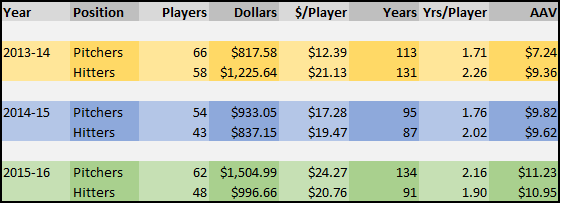
(Image link for mobile app users..)
Clearly, there’s a shift in results. Let’s take a look at a few of the key figures across the three-year period, in graph form. To begin, we have witnessed a major swing in the total outlay made to pitchers as opposed to hitters:
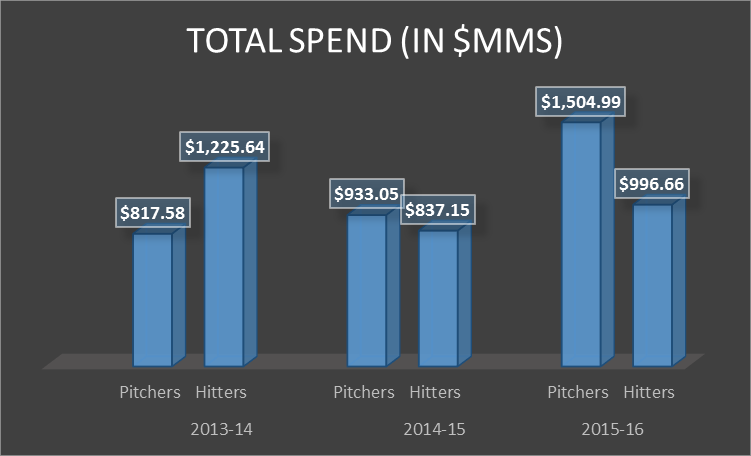
(Image link.)
Free-agent pitchers have posted some notable gains by other measures, too. Consider the average length of contract:
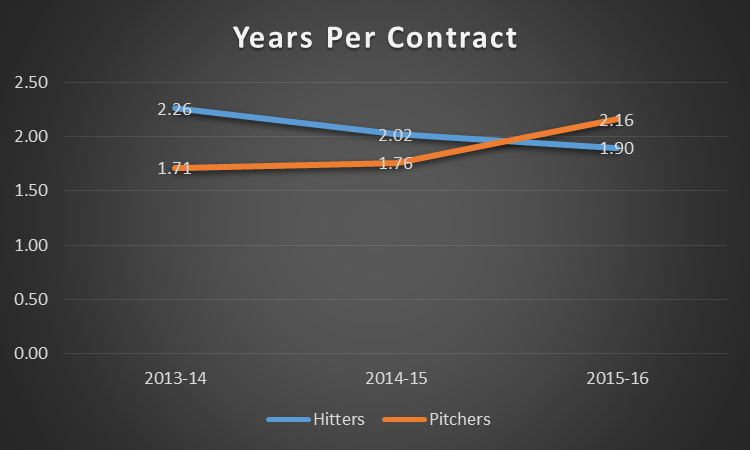
(Image link.)
There’s also been a bump in AAV that closed down a gap that existed at the start of the period in question:
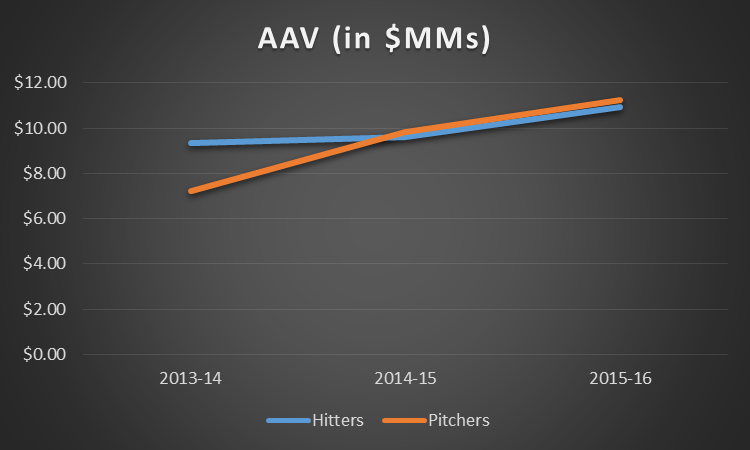
(Image link.)
It’s possible that this is simply a straightforward reflection of the quality of the players available. Let’s have a look at the pitchers who were able to command $30MM+ overall commitments (that includes posting fees, where applicable):
2013-14
Masahiro Tanaka ($175MM), Ubaldo Jimenez ($50MM), Matt Garza ($50MM), Ricky Nolasco ($49MM), Jason Vargas ($32MM), Scott Feldman ($30MM)
2014-15
Max Scherzer ($210MM), Jon Lester ($155MM), James Shields ($75MM), Ervin Santana ($55MM), Brandon McCarthy ($48MM), David Robertson ($46MM), Francisco Liriano ($39MM), Andrew Miller ($36MM)
2015-16
David Price ($217MM), Zack Greinke ($206.5MM), Johnny Cueto ($130MM), Jordan Zimmermann ($110MM), Jeff Samardzija ($90MM), Mike Leake ($80MM), Wei-Yin Chen ($80MM), Ian Kennedy ($70MM), Scott Kazmir ($48MM), Kenta Maeda ($45MM), J.A. Happ ($36MM), John Lackey ($32MM), Darren O’Day ($31MM)
And here’s what that looks like in table form, to get a visual sense of the impact this volume and quality of players may have had on driving salary.
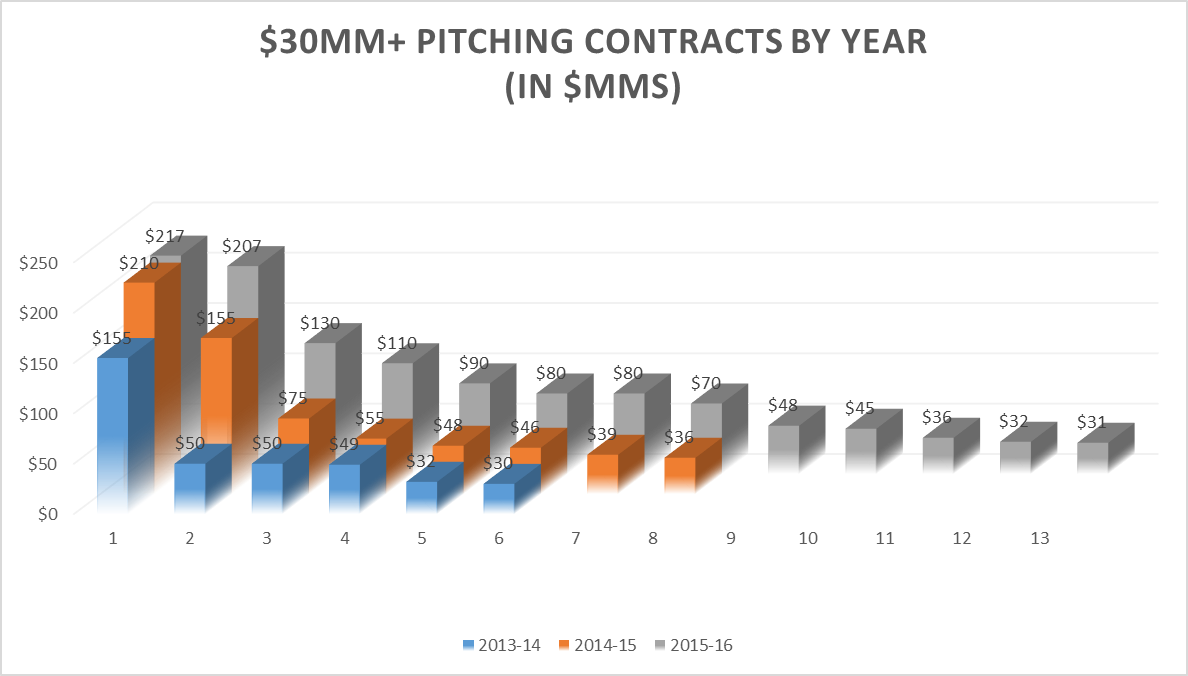
(Image link.)
It’s possible that some of the inclination toward pitching is the result of an imbalance between the volume and quality of hitting versus pitching prospects entering the game right now. Fangraphs’ Jeff Zimmerman wrote a couple of years ago about the shifting aging curve for batters, and that could play a role in the trend as well. Alternatively, the increased demand for arms could be attributable to the very thing (enhanced injury risk) that makes them such a risky investment in the first place.
Mariners Sign Joel Peralta To Minors Deal
FEBRUARY 16: Peralta can earn a hefty $2.5MM in incentives, Heyman tweets.
FEBRUARY 9, 5:21pm: Jon Heyman reports that Peralta’s contract comes with a $1.25MM base salary, should he make the club (Twitter link). That figure can increase based on performance incentives.
1:02pm: The Mariners have signed veteran righty Joel Peralta to a minor league deal, per a club announcement. A client of Mark Gilling, he will receive an invitation to Major League camp.
Peralta will be entering his age-40 season after a subpar campaign with the Dodgers in which he battled through shoulder and neck issues. He ended with a 4.34 ERA over just 29 frames with 7.4 K/9 against 2.5 BB/9. Peralta has never induced many groundballs, which continued last year, and he struggled to prevent the long ball (1.86 HR/9, 14.6% home run per flyball rate).
That marked a significant downturn from his prior years’ efforts. Dating back to a breakout 2010, in which he emerged as a quality pen piece for the Nationals at 34 years of age, Peralta averaged a 3.34 ERA (with an identical 3.34 FIP) and 9.7 K/9 against 2.6 BB/9 for a five-year stretch.
If there’s hope for a return to that lofty standard, it may lie in the fact that Peralta has never been reliant upon velocity and still works with something close to the same average fastball speed that allowed him to succeed previously. By measure of Pitch F/X pitch values, the veteran’s heater and splitter remain quality offerings, with his curveball turning suddenly into a huge negative. If that can be fixed, then perhaps he reverse a sharp drop in his swinging strike rate (from 11.7% to 7.9%, year over year).
A glance at the incredible Brooks Baseball database shows some inconsistency in the breaker. Peralta’s release speed on the hook was much lower than usual to start the year, with the offering losing a bit of vertical movement as he increased his arm action. It is worth noting that Peralta allowed just two earned runs in his final ten frames, including one postseason appearance, while logging a dozen strikeouts without permitting a free pass.
If nothing else, Peralta provides some depth — if not some upside as well — to a re-worked Mariners pen. As ESPN.com’s Jayson Stark notes on Twitter, he joins Steve Cishek, Joaquin Benoit, Justin DeFratus, Evan Scribner, and others in a unit that lost players like Fernando Rodney (free agency), Carson Smith (trade), and Tom Wilhelmsen (trade).
Koji Uehara: No Current Plans To Retire
Red Sox reliever Koji Uehara said today that he has no current plans for retirement, Peter Abraham of the Boston Globe reports (links to Twitter). He added that his surgically-repaired wrist is doing well and hasn’t prevented him from beginning a throwing program.
Though he’s coming off of injury, entering the final year of his contract, and set to turn 41 the day before Opening Day, Uehara indicated that he still has an open-ended timeline ahead of him. “I will keep pitching unless I am terrible and no team wants me,” Uehara said with a laugh.
Ultimately, Uehara has every confidence in his ability to perform into his fifth decade. “Age is a number,” he said. “Bring me a present that day.” On the whole, the statistics certainly support that (brilliantly-stated) attitude from the Japanese star.
Outside a bit of a rough stretch last June, Uehara put up a strong overall campaign after signing a two-year, $18MM deal just before the start of 2014-15 free agency. He ended the year with a 2.23 ERA over 40 1/3 innings, with 10.5 K/9 against 2.0 BB/9. That K:BB ratio fell well below his typical rate — which has paced the rest of the league by a comical margin. But he still fell within the top twenty pen men in the game by that measure as well as by K%-BB%.
Boston won’t be asking quite as much from the standout veteran this year as it has in the past, as Craig Kimbrel is set to move into the closer’s role. But he’s still a key piece of the pen, and continued dominance from both of those pitchers could give the club one of the game’s best late-inning combos. Of course, this season will also set Uehara’s trajectory as he nears open-market eligibility for the offseason to come.
Astros Avoid Arbitration With Evan Gattis
The Astros have reached a deal to avoid arbitration with slugger Evan Gattis, according to Evan Drellich of the Houston Chronicle (Twitter link). Gattis will be guaranteed $3.4MM in the deal, Drellich tweets, but $100K of that comes in the form of a buyout for a $5.2MM club option for the 2017 campaign.
Gattis was a first-time arb-eligible player this year, so the contract does not impact his free-agent timeline. The sides had been set for a hearing this afternoon, but that won’t be necessary after agreeing to terms. Gattis had filed at $3.8MM, with Houston countering at $3MM. Entering the offseason, MLBTR projected the bat-first ballplayer to take home $3.4MM — which turned out to be the final agreed-upon value.
The settlement represents a creative solution. For Houston, there’s some nice cost-saving potential build into this arrangement. Gattis has put up 49 home runs over the past two seasons, and that kind of power output could lead to a big raise through the arb process. While he now locks in a ceiling on his 2017 earning capacity without getting any promises that he’ll be tendered, Gattis has insured against any injury or performance issues this spring by securing what appears to be a fully-guaranteed deal. (Arb agreements are only partially guaranteed unless otherwise provided.)
Both player and team will hope for a more well-rounded effort in the coming season. The 29-year-old swatted a career-best 27 long balls last year, but saw his overall output drop to a disappointing .246/.285/.463 slash over 604 plate appearances. For a player that spent the vast majority of his time in a DH role, that’s not quite enough production. Though Gattis did suffer from a low .264 BABIP, that figure was explained in part by the fact that he made less hard contact and had a higher infield fly rate in 2015 than he had previously. The slow-footed former catcher also put the ball on the ground more frequently.
Of course, Gattis will first have to work his way back from hernia surgery. He’s not expected to miss much time, if any, but it will put him on the back foot to start the spring and may have played a role in his decision to take Houston up on this contractual arrangement rather than rolling the dice on a hearing.
Latest On Adrian Beltre, Rangers
There’s long been chatter of a possible extension between the Rangers and veteran third baseman Adrian Beltre, and Jon Morosi of FOX Sports reports that there’s cause for optimism that a deal can be reached this spring.
Beltre is entering the final season of the five-year deal that brought him to Texas before the 2011 campaign. Texas exercised a club option for the 2016 season this time last year, locking in the decision ahead of time in exchange for a bit of salary shuffling on the part of Beltre.
It’s been a productive relationship thus far, to be sure, and both sides appear inclined to continue things past the present season. GM Jon Daniels said earlier in the winter that the club has interest in a new deal, and Beltre expressed much the same recently.
Beltre’s agent, Scott Boras, tells Morosi that there’s reason to think something can get done during camp. “I’d say there are certainly grounds for a discussion of advancing Adrian’s contract, yes,” Boras said when asked whether a deal could be in place by the start of the season. “I think Adrian already had a discussion with them, in which he expressed a desire to stay,” he added. “They want him there, and we’re going to work on that.”
It’s unclear at this point what kind of contract would be considered. Beltre will soon turn 37, is coming off of thumb surgery, and did slip a bit at the plate last year — posting a still-strong .287/.334/.453 slash after carrying a .899 OPS over his five prior campaigns. Then again, it’s notable that he managed not only to stay productive at the plate but also to continue playing premier-level defense while battling through the serious thumb issue for most of the year.
Certainly, Beltre would have plenty of value on the open market if he can match his 2015 campaign, and would be pursued that much more heavily if he can bounce back to his lofty prior levels. There’s some uncertainty, but also some upside, that will surely impact his earning capacity. On the other side of the equation, Texas will need to weigh the presence of rising players in the organization, including top prospect Joey Gallo and even former top prospect Jurickson Profar, whose respective development paths could impact the team’s infield mix. But even if those players hit their ceilings, there’s probably enough flexibility to get all involved the plate appearances they’d need. While Gallo is a third baseman by trade, he has dabbled in the outfield and could also slide across the diamond with Mitch Moreland headed for free agency.
Latest On Gurriel Brothers
The current location of major Cuban ballplayers Yulieski Gurriel and Lourdes Gurriel is still unknown after their recent defection, but they tell MLB.com’s Jesse Sanchez that they are training in secret in preparation for a move to a big league organization. As Sanchez notes, such an “underground” approach is not uncommon for players seeking to complete their journey away from Cuba.
There are many obstacles still left for the brothers to navigate, of course, but their intentions are not in doubt. “I know there are a lot of people who worried about us,” said Yulieski, “but we are working hard and training every day to accomplish our dreams to play in the Major Leagues.”
Notably, the pair does have hopes of signing as a package, which is certainly an intriguing possibility. “We would like to play together on the same team, have my brother near me,” Yulieski tells Sanchez. “But if the circumstances don’t permit it and we have to go different paths, that’s what we will do.”
As that quote hints, there very well could be a variety of practicalities that make a common team unlikely. For one thing, the elder Yulieski would likely do well to sign shortly after reaching eligibility, both to increase his value as a near-term contributor and to speed his ascent to the majors. But his younger sibling would need to wait until he turns 23 — and thereby sheds bonus pool limitations — to maximize his earnings.
Needless to say, it also isn’t clear whether the same teams that will be most interested in adding a veteran third baseman will also be best-positioned to make a more future-looking investment in Lourdes. Of course, as Dave Cameron of Fangraphs has recently suggested, the package concept could also provide some wiggle room for navigating MLB’s rules.
One important question is whether Yulieski has, as reported, achieved Panamanian residency. He declined to address that matter with Sanchez, but did say that he hopes to join a major league organization “this year” and has intentions “to play as soon as possible.” Notably, Panama’s top immigration officer has denied that Yulieski has current residency, per this Spanish-language link to La Prensa.
Poll: Will The Blue Jays Extend Bautista & Encarnacion?
Early-career extensions are always fun, but tend not to come with the same drama of talks with pending free agents. Sometimes deals get done late in camp, locking in an important player for years to come and keeping them from the open market; last season, for instance, the Red Sox locked in righty Rick Porcello just after the season began. Of course, Porcello himself was acquired in part because the team did not retain Jon Lester after failing to agree upon an extension despite extensive negotiations in the prior offseason.
As the Lester situation shows, the stakes are often ratcheted up in cases of players with a close identity to their clubs. That’s probably all the more true when (again, as in the case of Boston and its lost lefty) there’s widespread public acknowledgement of mutual interest and close attention from fans.
The Blue Jays face a particularly interesting set of extension questions as camp nears. One of those has already been answered, as the club reached a two-year arrangement with star third baseman Josh Donaldson, who will still have one year of arbitration remaining at the end of that contract.
Much more interesting, time-sensitive, and PR-fraught talks still remain to be had, however, with a pair of star sluggers who are key faces in the organization. Both Jose Bautista and Edwin Encarnacion bloomed late in their careers, upon coming to Toronto. In each case, the team (under then-GM Alex Anthopoulos) bet on the players with extensions that turned into bargains for the organization. With those contracts set to expire after this season, they’re on the clock.
The case for a pair of big new extensions is pretty simple. There’s no question that both players are still producing at a high level at the plate, as they each landed in the top ten in the game by measure of wRC+, and they’ve each expressed interest in contract talks. Many fans are hopeful of pacts, with emotions running after a great run in 2015 was followed by a bad breakup with Anthopoulos. And the Blue Jays’ new front office tandem of Mark Shapiro and Ross Atkins has publicly suggested that there will be an attempt at reaching new deals with the pair.
But that’s not all Shapiro and Atkins are considering here, of course. Bautista (35) and Encarnacion (33) are getting on in years. While the former is still capable of manning right field, it isn’t hard to imagine a time in the not-so-distant future where both players are limited to first base and/or DH roles.
Ultimately, as MLBTR’s Mark Polishuk recently wrote in discussing Bautista as an extension candidate, it’s an open question whether it makes sense for the organization to try to lock up both players. And it isn’t entirely clear whether the front office will be willing to enter anything approaching market-rate deals with the pair.
That will all begin to be resolved as contract talks begin in earnest. For now, though, it’s a good time for a poll: do you think that the Jays will get deals done with either or both?
Which Blue Jays Extension Scenario Is Most Likely?
-
Joey Bats gets a new deal, EE walks 46% (3,914)
-
Both sluggers are extended 23% (1,964)
-
Neither Bautista nor Encarnacion signs a new deal 16% (1,347)
-
Edwin Encarnacion re-ups, Bautista hits the market 15% (1,296)
Total votes: 8,521
Minor MLB Transactions: 2/16/16
We’ll track the day’s minor moves in this post. For starters:
- The Nationals have signed corner infielder Neftali Soto, according to Matt Eddy of Baseball America. Soon to turn 27, Soto has spent most of his professional time with the Reds, with whom he reached the majors briefly in 2013-14. He was acquired by the White Sox last year and ultimately spent the season at Triple-A, putting up a .246/.343/.307 slash and just two home runs in 231 plate appearances. Soto has shown more in the past, especially in the power department — he hit 30 homers in 414 Double-A plate appearances back in 2011 — though it’s been a while since he had sustained success in the upper minors.
Quick Hits: Granderson, Molina, Braun, Capps
Dave Cameron of Fangraphs provides his ten favorite transactions of the winter thus far, with the Braves‘ haul in the Shelby Miller trade topping the list. For an additional look back at the market action that’s already in the books, Steve Adams and I discussed a few under-the-radar acquisitions that we liked in the most recent edition of the MLBTR Podcast.
Here are a few more notes as camp approaches:
- Upon arriving at Spring Training today, Mets outfielder Curtis Granderson told reporters, including ESPN New York’s Adam Rubin, that team doctors have told him that his surgically repaired thumb is “all good to go.” Granderson went under the knife in November to repair a torn ligament in his left thumb and spent about a month and a half in a brace, but he appears to be mostly back up to speed now. As Rubin notes, Granderson is again projected to be the Mets’ primary leadoff hitter, though his struggles against left-handed pitching would seem to create a reasonable opportunity to get Juan Lagares into the lineup.
- Likewise, Cardinals catcher Yadier Molina has had his cast removed and is beginning to strengthen his own thumb, MLB.com’s Jenifer Langosch writes. The veteran’s importance to his club is hard to overstate, and he says he’s going to try to be ready by Opening Day. He was delayed when the injured digit required a second surgery, so a full recovery by the start of the season may be a big ask.
- The Brewers are weighing a move of Ryan Braun back to left field, Tom Haudricourt of the Milwaukee Journal-Sentinel writes. It seems as if the organization will weigh several options, but getting Domingo Santana and his live arm into right field would appear to have some appeal.
- Right-handed reliever Matt Capps is preparing a comeback bid, agent Paul Kinzer tells Jon Morosi of FOX Sports (via Twitter). The former Pirates, Nationals, and Twins closer hasn’t worked in the bigs since 2012 while struggling with health issues. He did not appear in the regular season at all last year after spending camp with the Braves.