
How Aggressive Will The Tigers Be This Winter?
The ill-fated Miguel Cabrera extension is off the books in Detroit, leading to the most payroll flexibility the team has had in quite some time. As it stands, the only three players on guaranteed contracts for the 2024 season are Javier Baez, Mark Canha and Carson Kelly. That trio combines for $40MM in guaranteed salary. Only Baez is signed beyond the 2024 season. Detroit also has a small arbitration class. Left-hander Tarik Skubal, righty Casey Mize, catcher Jake Rogers and outfielder Akil Baddoo project to earn a combined $7.5MM, per MLBTR contributor Matt Swartz.
Suffice it to say, there’s ample payroll space available in the Motor City. Detroit trotted out a payroll as high as $200MM back in 2017, albeit under the ownership of the late Mike Ilitch. Since his son, Chris, took over as the team’s control person, the Tigers haven’t fielded an Opening Day payroll north of $135MM. Then again, the Tigers have been rebuilding for much of Chris’ time in charge of the club, so aggressive spending hasn’t typically on the radar.
Many Tigers fans entered the current offseason expecting some degree of change in that regard, however. The AL Central is perhaps the sport’s weakest division, and the Tigers have some interesting young players emerging to form a core group. Spencer Torkelson and Riley Greene both took big steps forward in 2023. Skubal returned from flexor surgery and pitched like a genuine top-of-the-rotation arm. Reese Olson looks like a mid-rotation piece. Kerry Carpenter has swatted 26 homers and hit .277/.334/.473 in his first 149 big league games. Former No. 1 overall pick Casey Mize will come back from Tommy John surgery in 2024. Jason Foley, Will Vest, Tyler Holton and Alex Lange all had nice years in the bullpen (Lange’s command issues notwithstanding). It’s easy to see the reasons for optimism.
At the same time, that doesn’t necessarily portend a return to the Tigers’ former status as one of the league’s most aggressive offseason spenders. For one thing, the now-former front office regime helmed by Al Avila attempted to reestablish the Tigers as just that when signing Baez and Eduardo Rodriguez. The former hasn’t worked out at all and now stands as one of baseball’s most immovable/undesirable contracts. The latter performed well enough to opt out of the remaining three years and $49MM after an uneven tenure in Detroit.
New president of baseball operations Scott Harris will surely be wary of further saddling the team with unwanted contracts. His most recent organization — the Giants, where he was GM — has a recent track record of clearly preferring shorter-term, manageable commitments in free agency. They haven’t inked a free agent for more than three years under Farhan Zaidi’s watch as president of baseball operations. That doesn’t mean Harris will operate from the exact same playbook, but it’s notable context nonetheless.
To that end, the general expectation surrounding the Tigers this winter has been that the team will at least one, if not two arms in free agency. Adding a bat to the middle of the lineup also seems like a sensible enough fit. The question is: to what extent are the Tigers willing to spend?
Recent reports have indicated that the Tigers have interest in both Seth Lugo and Kenta Maeda, for instance, but Evan Petzold of the Detroit Free Press wrote this morning that the Tigers prefer Lugo on a one-year deal. He’s understandably seeking a three-year pact after a breakout 2023 campaign. Petzold also reports that rebound candidate Luis Severino is on the Tigers’ radar. He’s likely to sign a one-year deal this winter. Maeda is generally expected to sign for no more than two years. Between those three targets, a preference for shorter-term additions seems to be on the table for the Tigers.
Cody Stavenhagen of The Athletic frames things similarly in his latest mailbag, writing that the Tigers seem likelier to dish out multiple short-term deals — similar to last year’s one-year pact with Michael Lorenzen — than they are to ink a notable arm on a heftier deal. The Tigers reportedly checked in on Lance Lynn before he signed a one-year, $11MM deal with the Cardinals. Stavenhagen suggests that contracts of that nature (and the Cardinals’ one-year, $12MM deal with Kyle Gibson) are roughly what one could expect the Tigers to offer in free agency. Similarly, he writes that Canha could be the team’s most significant position-player acquisition this winter.
There’s no firm indication that the Tigers won’t be a bit more aggressive in free agency and pursue some notable names on multi-year deals. Unexpected market circumstances can always emerge, perhaps leading a team to land a major free agent they never expected early in the winter. The Twins surely didn’t enter the 2021-22 offseason expecting to sign Carlos Correa, for instance, and the Tigers’ ample flexibility leaves them open for opportunistic adds of that nature, should they arise.
The trade market also can’t be discounted as a means of adding some notable talent. Harris and his staff proved over the past year that they’re plenty willing to make deals with other clubs. Since the beginning of last offseason, Detroit has traded Joe Jimenez to Atlanta and Gregory Soto and Michael Lorenzen to Philadelphia (in separate swaps). The Tigers picked up Zach McKinstry in a spring trade with the Cubs earlier this year and added Canha in a deal with Milwaukee just a few weeks ago. It’s perfectly reasonable to think they might be more active in trades than in free agency; some combination of both avenues is likely at the end of the day.
However, those hoping for a bigger splash may want to look back to Harris’ comments earlier this month when asked about having sufficient resources to sign a premier free agent (link via Chris McCosky of the Detroit News): “If we feel like we are close enough to where a big free agent pushes us over the edge, sure, we have an ownership that’s going to support us to be able to do that. But, as this game has taught us time and time again, sometimes, teams over-estimate their proximity to being a team that’s right on the verge of the playoffs, and they spend a lot of money and it doesn’t push them forward. It pushes them back. We have to be really careful.”
D-backs Acquire Eugenio Suarez
The D-backs and Mariners on Wednesday agreed to one of the first notable trades of the offseason, with Seattle sending third baseman Eugenio Suarez to Arizona in return for reliever Carlos Vargas and catcher Seby Zavala. Both teams have announced the deal. The trade gives the Diamondbacks the power-hitting third baseman they were looking for while the M’s pick up a controllable power arm, a backup catcher option and shed some meaningful salary.

Suarez, 32, has spent the past two seasons in Seattle after coming over from the Reds alongside Jesse Winker in the trade that sent Justin Dunn and Brandon Williamson to Cincinnati. While the trade was originally more about the Mariners absorbing the remainder of Suarez’s contract in order to acquire Winker on the heels of an excellent couple seasons at the plate, it was Suarez who rebounded and wound up providing the Mariners with the middle-of-the-order punch they’d been targeting.
Suarez clobbered 49 home runs back in 2019 — the second season of a seven-year, $66MM contract extension he’d signed with the Reds prior to the 2018 campaign. His bat tailed off considerably in 2020-21, however, and the Reds shopped him around as they looked to pare back payroll coming out of the pandemic-shortened 2020 season, which was played without fans and came with substantial revenue losses for all 30 clubs.
Upon landing in Seattle, Suarez was largely back to form. While still quite strikeout prone, he popped 31 long balls in 2022 and posted an overall .236/.332/.459 batting line that was about 30% better than league average after adjusting for home park and league run-scoring environment (by measure of wRC+). His 2023 season wasn’t as successful. Suarez posted very similar batting average and OBP marks, but his power dropped off considerably. He complemented this past season’s .232/.323/.391 batting line and 22 homers with his best defensive showing in quite some time (at least in the estimation of Statcast, who credited him with 11 Outs Above Average).
Suarez’s overall approach at the plate, however, is a profile from which the Mariners have voiced a desire to move on. Seattle president of baseball operations Jerry Dipoto said earlier this month at the GM Meetings that he was looking to add high-contact hitters to his lineup — an understandable goal after his team’s 25.9% strikeout rate ranked second in all of Major League Baseball this season. Finding a trade partner for Suarez, in that specific regard at least, is addition by subtraction; Suarez fanned in 30.8% of his plate appearances in 2023 and 31.2% in 2022.
The 2024 season is the final guaranteed year on that $66MM contract for Suarez. He’s owed an $11MM salary plus at least a $2MM buyout on a $15MM option for the 2025 season. In all, the trade trims $13MM of guaranteed salary off the Mariners’ books. It also creates a notable hole at the hot corner, however. Recent trade acquisition Luis Urias is one potential option for the M’s, but he’s coming off a down season and was picked up in buy-low fashion. Presumably, a win-now club like the Mariners would want a more solid option at the position. Time will tell whether the Mariners find that player via free agency or, more likely (at least based on Dipoto’s track record), via trade.
As for the D-backs’ end of things, even Suarez’s slightly diminished 2023 production would be an improvement over their third basemen this past season. Arizona third basemen combined for a dismal .234/.303/.340 line in 2023. Suarez probably isn’t going to help out in terms of batting average, but he should bring more power to the position at a relatively reasonable price point of $13MM. Arizona now projects for about a $114MM payroll, per Roster Resource, which checks in $10MM shy of last year’s mark and about $18MM shy of their franchise-record level, established in 2018.
The trade fills at least one immediate need for the Mariners, who watched Tom Murphy become a free agent at season’s end. Zavala gives them an option to replace him as Cal Raleigh‘s backup behind the plate.

The 30-year-old Zavala has tallied 514 plate appearances in the big leagues but mustered a tepid .210/.275/.347 slash in that output. While he’s shown above-average power at times in the minors — including a 20-homer showing in 82 games of Triple-A ball in 2019 — Zavala’s output at the plate has been undercut by his own prolific strikeout rates. He’s gone down on strikes in 35.8% of his Major League plate appearances to this point in his career. He won’t come to the plate nearly as often as Suarez, however, so even though Zavala has his own contact issues, the swap could still prove to bolster the team’s overall contact skills, as has ostensibly been one of their goals.
Furthermore, Zavala grades out as a strong defender behind the dish. Statcast rates him as above-average in terms of blocking balls in the dirt, and he’s regularly drawn plus framing grades both at FanGraphs and via Statcast. Zavala’s 14% caught-stealing rate this past season was well shy of the league-average 20%, as is his career 17% mark. He nabbed a roughly average 24% of would-be base thieves in 2022, however, and he’s hardly the only backstop who struggled to control the running game in 2023, when MLB’s new rules regarding pickoffs and slightly larger bases dramatically increased stolen bases throughout the league.
Zavala doesn’t have any minor league options remaining, so he’ll have to open the season on the Mariners’ active roster or else be traded or placed on outright waivers. It’s always possible they add another backup catcher to supplant him, but for now he stands as the clear favorite to back up Raleigh heading into next season.
The piece of the trade with larger appeal for Seattle could very well be the flamethrowing Vargas, who made his MLB debut with Arizona in 2023. Vargas pitched in just 4 2/3 innings (allowing three runs) and had suspect surface-level numbers in Triple-A Reno: 7.02 ERA, 17% strikeout rate, 15.1% walk rate. Grisly as those numbers may be at fist glance, however, there’s also a fair bit of intrigue around the young righty.
Vargas only just turned 24 last month, and in his brief time on the D-backs’ big league roster, he averaged 99.4 mph on his four-seamer and 98.8 mph on his sinker. Per Statcast, only seven of the 851 pitchers who tossed at least one inning last year averaged a better mark on their four-seamer and sinker. Vargas is one of the game’s hardest-throwing pitchers, and his sinker produced a massive 59% ground-ball rate in Triple-A.
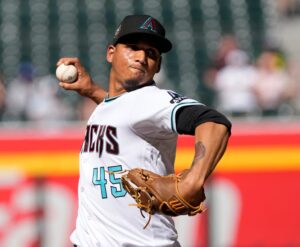
When considering the substantial command issues that Vargas has shown not only in 2023 but throughout his professional career — he’s walked 11.5% of opponents in his overall minor league career — he’s clearly something of a project. That said, he’s also controllable for at least six seasons and still has a minor league option remaining for the 2024 campaign. The Mariners could see this as a similar bet to the one they made on Andres Munoz, who was a similarly live-armed but unproven young reliever with command issues when they picked him up from the Padres.
As it stands, the subtraction of Suarez still weakens the Seattle roster overall, so if there’s no subsequent move to add another third base option or at least to reallocate the $13MM in savings, this will still be widely viewed as a salary dump — even if there’s some legitimate long-term potential with Vargas. But the offseason is also quite young, and both the free-agent and trade markets have various options to consider at the hot corner or at second base, if Seattle is comfortable sliding another former Diamondback, Josh Rojas, over to third base.
A deal for Matt Chapman would be wildly uncharacteristic for Dipoto, who hasn’t signed a free-agent hitter to a multi-year deal since taking the reins in Seattle, but the market offers some more affordable options such as Gio Urshela and Justin Turner. The trade market is light on pure third basemen but has several shortstops, second basemen and/or multi-position names who could fit into the Seattle infield: Willy Adames, Jonathan India, Jorge Polanco, Kyle Farmer and perhaps Brendan Donovan among them.
Given the strong young core in Seattle and this past season’s narrow miss of the playoffs, there’s little reason to think the team is preparing for a notable step back. Dipoto has made a name for himself as perhaps the most active baseball operations leader in the game when it comes to the trade market, and is stands to reason that further moves will follow. With Suarez in Arizona, the M’s now project for a payroll around $133MM, per Roster Resource, which is about $7MM shy of last year’s total and about $25MM shy of their franchise record. There should be resources to further augment the roster in the days and weeks ahead.
USA Today’s Bob Nightengale first reported that the Mariners and D-backs had agreed to a trade involving Zavala and other players. Ryan Divish of the Seattle Times broke the news that Suarez and Vargas were in the swap.
Nearly Half The League Has Reached Out To Yoshinobu Yamamoto
As the best pitcher in Japan who’s been made available to MLB teams at just 25 years of age, Orix Buffaloes right-hander Yoshinobu Yamamoto has always been expected to command an aggressive bidding war. Yamamoto’s 45-day negotiation window with MLB clubs opened yesterday morning, and he’s unsurprisingly drawn widespread early interest.
Agent Joel Wolfe of Wasserman, who’s representing Yamamoto, told the Kyodo News last night that he’s already heard from 11 to 14 teams. Yamamoto’s negotiation window officially opened yesterday morning.
“This is by far the player with the most interested teams that I have ever seen at the beginning of free agency,” said Wolfe, an executive vice president of one of the sport’s largest agencies. As one would expect, Wolfe indicated that Yamamoto isn’t approaching free agency with any restrictions based on geography. (Even if Yamamoto does have some specific geographic preferences, those would likely be kept close to the vest — if only as a means of retaining leverage in talks.)
The list of teams already linked to Yamamoto in free agency nearly outnumbers the list of teams who’ve not yet had public ties to him. The Cardinals, Phillies (even after re-signing Aaron Nola), Diamondbacks, Tigers, Yankees, Mets, Blue Jays, Cubs, Giants, Red Sox and Dodgers have all been reported to have interest in Yamamoto. That’s 11 teams right there, and it’s surely not a comprehensive list. Yamamoto figures to draw interest from contending clubs and non-contenders alike, given the rarity with which a free agent of this caliber reaches the market at such a young age. Even a team eyeing 2025-26 as a more realistic range for competing could outbid the field for Yamamoto and know that he’d be squarely in his prime years when that window for contention is more earnestly open.
Yamamoto has been evaluated extensively by MLB scouts, with the consensus being that he’s a legitimate No. 1 or No. 2 caliber arm in a big league rotation. Between that ceiling, his age and his brilliant track record in Japan, he’s expected to command the largest contract ever for an NPB pitcher making the jump to MLB — perhaps a deal in excess of $200MM (plus the requisite posting fee). Yamamoto has won three straight Sawamura Awards in Japan — NPB’s equivalent of MLB’s Cy Young Award — and just posted a career-best 1.21 ERA in 2023. He’s logged a sub-2.00 ERA in four of his past five seasons while punching out better than 27% of his opponents against a tidy 5.7% walk rate.
Any team that signs Yamamoto will owe a posting/release fee to the Buffaloes. That fee is equivalent to 20% of the contract’s first $25MM, plus 17.5% of the next $25MM (a combined total of $9.375MM), plus 15% of any money thereafter. Using MLBTR’s predicted nine-year, $225MM deal as a hypothetical example, that contract would come with a $35.625MM fee — a total outlay of $260.25MM for the signing team. Given Yamamoto’s youth and the substantial demand for him, it wouldn’t be at all surprising if any deal wound up containing an opt-out a few years into the pact, thus allowing him to return to free agency in his late 20s after having the potential to establish himself as a genuine top-of-the-rotation arm in the Majors.
Shota Imanaga Likely To Be Posted By Monday
The Yokohama BayStars of Japan’s Nippon Professional Baseball are planning to post left-hander Shota Imanaga for Major League teams sometime between now and Monday, reports Mark Feinsand of MLB.com. While prior reporting had indicated that Imanaga might not be posted until fellow NPB ace Yoshinobu Yamamoto had already signed, it instead appears that Imanaga will be posted about a week after Yamamoto. That creates some overlap in the two posting periods but also gives Imanaga at least a few days for teams that miss out on Yamamoto to explore the possibility of instead signing him.
While both Imanaga and Yamamoto are highly regarded, Imanaga is widely expected to sign the lesser contract in terms of both years and dollars. That’s due partially to the fact that Yamamoto is regarded as the superior pitcher, of course, but the primary reason for Yamamoto being projected to sign a deal more than twice as lucrative as Imanaga is the age gap between the two. Yamamoto just turned 25 in August; Imanaga turned 30 in September.
As such, Imanaga’s age is more in line with that of standard Major League free agents, who tend to reach the open market around 30-31 years of age. There are exceptions, but particularly among pitchers, a player reaching the market in his mid-to-late 20s is quite rare.
Although Imanaga doesn’t have the bonus allure of being an atypically young free agent, he nonetheless figures to command a weighty long-term deal himself. The southpaw’s 2023 season featured 148 innings of 2.80 ERA ball — his second straight sub-3.00 mark and his third in five years. (The two other seasons “only” saw Imanaga post marks of 3.08 and 3.23.) Imanaga fanned 29.5% of his opponents this past season against a superlative 3.8% walk rate.
Dating back to 2019, Imanaga boasts a 26.2% strikeout rate and 5.9% walk rate in addition to a cumulative 2.79 earned run average — including a no-hitter in the 2022 season. He isn’t necessarily overpowering in terms of velocity, though MLBTR contributor Dai Takegami Podziewski noted late in the year that he’d added some life to his heater and was averaging between 92-93 mph during the 2023 season. He pairs that heater with a splitter, curveball and cutter/slider hybrid, as noted in Brandon Tew’s breakdown of that 2022 no-hitter over at Sports Info Solutions.
Whenever Imanaga is posted, it will mark the start of a 45-day window for him to negotiate with all 30 MLB clubs. Any team that agrees to sign Imanaga will also be agreeing to pay a release fee to the BayStars — the size of which is dependent on the size of Imanaga’s contract. In addition to the guaranteed money owed to the pitcher himself, his new team will need to pay a release fee equal to 20% of the contract’s first $25MM, plus 17.5% of the next $25MM and 15% of any dollars thereafter. MLBTR predicted a five-year, $85MM contract for the lefty, which would come with a $13.875MM release fee owed to the BayStars on top of the contract itself. Future club/player options and earnings unlocked via incentives/bonuses are also subject to that system (and, in this hypothetical instance, would come with a 15% fee owed to the Yokohama club).
To this point, Imanaga has been linked to several MLB clubs — most recently the Cubs but also the Dodgers and Red Sox. It stands to reason that virtually every mid- or large-market club with a need for pitching will have some degree of interest. Imanaga has been one of the steadiest performers in Japan for the better part of a half decade and has thus been heavily scouted by MLB teams for quite some time now. He’ll likely be on the radar for other bigger-spending teams like the Mets, Yankees, Cardinals, Giants, Angels and Blue Jays (to name a few) over the next six to seven weeks.
Tigers Showing “Serious” Interest In Kenta Maeda
The Tigers have “serious” interest in free agent righty Kenta Maeda, reports Evan Petzold of the Detroit Free Press. The club views him as a possible veteran stabilizer for a young rotation and also hopes a potential Maeda deal would help to “establish themselves in the Japanese pitching market” in the future, Petzold writes.
Following Eduardo Rodriguez‘s decision to opt out of the remaining three years on his contract, Detroit’s starting staff currently projects to include Tarik Skubal, Casey Mize, Matt Manning and Reese Olson. Righty Sawyer Gipson-Long, 26 next month, posted solid results in his first four MLB starts last year but struggled in Triple-A as well. Relievers Joey Wentz, Beau Brieske and Alex Faedo have all made starts in the majors but struggled in a rotation role. Last year’s Rule 5 pick, Mason Englert, survived the season on the 40-man roster but could head to Triple-A to begin the year. No one else on the Tigers’ 40-man roster has meaningful experience as a starter in the Majors.
Some form of veteran pickup is needed, and Maeda somewhat quietly had a stronger season than many realize in 2023. This past season was the veteran righty’s first full year back from Tommy John surgery, and he gave the Twins 104 1/3 innings of 4.23 ERA ball with strong strikeout and walk rates of 27.3% and 6.5%, respectively.
However, Maeda’s end-of-season numbers are perhaps disproportionately impacted by one catastrophic start. On April 26, with the Twins playing host to the Red Sox, Maeda was shelled for 10 runs in just three innings. He landed on the injured list immediately after that outing and wound up missing nearly two months due to a triceps strain. That day’s 89 mph average fastball was his lowest of the entire season. It seems fair to presume that he was not pitching at close to full strength that afternoon.
Maeda’s return from the injured list included five shutout frames against the same Tigers who are now showing interest in him, and from that point forth he was one of the league’s more effective starters. In his final 88 1/3 innings, Maeda turned in a sharp 3.36 earned run average while fanning a hefty 29% of his opponents against a 7% walk rate. He’s still a soft-tosser by today’s standards, but the 91.2 mph he averaged on his heater following his return from the injured list is still 2.2 mph faster than the 89 he averaged in that meltdown against the Yankees. Maeda also averaged 5 2/3 innings per start down the stretch, showing a bit more ability to work through a lineup than many of the five-inning arms that populate today’s rotations.
It’s been generally quiet thus far on the Maeda front, with few teams prominently linked to the 35-year-old righty. Twins president of baseball operations Derek Falvey said after the season that he wouldn’t rule out reunions with any of his team’s free agents, Maeda included, but Minnesota is also expected to trim payroll by $10-20MM amid uncertainty regarding the team’s future television rights. Trades of Kyle Farmer, Max Kepler, Jorge Polanco and/or Christian Vazquez could create some extra leeway for Minnesota to pursue a reunion with Maeda, but there’s no indication it’s a serious consideration at this time.
Despite the lack of chatter surrounding Maeda to this point, however, he figures to draw wide-reaching interest. Beyond the excellent run following his triceps injury this season, the righty was the runner-up finisher in 2020 American League Cy Young voting and has long since established himself as a viable mid-rotation presence. In 866 1/3 career big league innings between the Dodgers and Twins, Maeda sports a 3.92 ERA, 26.7% strikeout rate and 7% walk rate. His postseason resume includes another 41 2/3 frames of 3.24 ERA ball.
As for the Tigers, there’s virtually no free agent they can’t pursue from a purely financial standpoint. Javier Baez is the only player on a guaranteed contract beyond the 2024 season, and next year’s payroll currently projects at $74MM. That’s nowhere near 2017’s franchise-record $200MM Opening Day payroll, and while that outlay was committed under the late Mike Ilitch, even under his successor and son Chris, the Tigers have trotted out a payroll as high as $135MM (2021).
Cardinals Rumors: Yamamoto, Gray, Trade Scenarios
The Cardinals added the first two of what they expect to be at least three starting pitchers this week, agreeing to a reunion with veteran righty Lance Lynn on a one-year deal worth a guaranteed $11MM and another one-year deal with Kyle Gibson worth $12MM. They’ll still look to add another arm, be it via free agency or trade. Among the more high-profile names they’re considering, per Derrick Goold of the St. Louis Post-Dispatch, are NPB ace Yoshinobu Yamamoto and AL Cy Young runner-up Sonny Gray. Goold’s report was published prior to the Cardinals’ agreement with Gibson, though it’s hard to imagine a one-year deal for a veteran innings eater would derail the club’s plans for higher-profile targets.
Pursuits of both right-handers were generally expected from a Cardinals club looking to add as many as three starting pitchers this winter — with at least one playoff-caliber arm among the presumed preferences. Goold has previously linked the Cards and Yamamoto, and he now writes that Yamamoto does not have any geographical preferences as he tests MLB free agency. He’s open to pitching on either coast or somewhere in between.
Despite his lack of MLB experience, the 25-year-old Yamamoto is widely projected to land the largest contract of any non-Shohei Ohtani pitcher this offseason. He’s considered by big league scouts to be a potential No. 1 or 2 starter in North American ball, and his combination of age and sterling track record make him an excessively rare type of free agent. Yamamoto has won the Sawamura Award, Japan’s equivalent of the Cy Young Award, in three consecutive seasons and just wrapped up a career-best campaign with a 1.21 ERA. He’s posted a sub-2.00 ERA in four of the past five seasons in NPB, fanning more than 27% of his opponents against a pristine 5.7% walk rate during that stretch.
Bidding on Yamamoto is expected to be fierce, perhaps pushing north of $200MM. (MLBTR ranked Yamamoto second among this offseason’s free agents and predicted a nine-year, $225MM deal.) He’s already drawn interest from a wide array of teams, reportedly including the Phillies (even after re-signing Aaron Nola), D-backs, Tigers, Red Sox, Yankees, Blue Jays, Giants, Mets, Dodgers, Cubs and surely more.
Gray, 34, would be a less-expensive but still high-profile upgrade to the St. Louis staff. He finished second to Gerrit Cole in American League Cy Young voting this season on the heels of a 2.79 ERA in 184 innings for the AL Central-champion Twins. He rejected a qualifying offer at season’s end, so he’d cost the Cards a draft pick and $500K of their international bonus pool, though for a pitcher of his track record, that’s perhaps not a detriment.
Gray’s age figures to limit the length of offers he ultimately commands. It’d be somewhat surprising to see him sign for more than four years, as even a four-year pact would run through his age-37 season — an age at which teams have tended to cap long-term deals in free agency. Gray is also on the radar for the Phillies, Braves and Red Sox. The Twins have voiced that they’d love to keep Gray as well — and Gray has said publicly that interest in a return is mutual — but with Minnesota expected to scale back payroll by around $10-20MM amid uncertainty regarding their television rights deal, it’s tough to envision them making the top bid.
In addition to their ongoing free-agent pursuits, the Cards are well-positioned to explore the trade market for potential rotation help. The team still generally has a glut of young position players, with more names on the roster than at-bats to go around. Dylan Carlson, Tyler O’Neill, Lars Nootbaar, Jordan Walker, Alec Burleson, Brendan Donovan, Tommy Edman, Nolan Gorman, Masyn Winn and Ivan Herrera simply don’t all have paths to regular playing time — particularly with veterans like Nolan Arenado, Paul Goldschmidt and Willson Contreras locked into the infield corners and catching duties.
As has been the case dating back to the summer, the Cardinals appear open to trading O’Neill and Carlson, per Katie Woo of The Athletic. However, just as it was last offseason and this past summer, Nootbaar is expected to stay in St. Louis. The 26-year-old hit .261/.367/.418 last year and cemented himself as the team’s center fielder. Injuries have limited Nootbaar in his early career, but he’s proven he can draw walks at an elite level while displaying intriguing batted-ball metrics and showing enough pop to top 20 homers per year if he can avoid the injured list. Add in his speed and ability to play all over the outfield, and he’s a valuable player whom the Cards understandably view as a core piece.
It’s not long ago that Carlson was viewed as a core piece, but after a pair of lackluster seasons at the dish, it seems the Cards are largely ready to move on from the one-time top prospect. It was something of a surprise that the switch-hitting center fielder wasn’t traded at the deadline, and it’d be even more surprising if he went the whole offseason without changing hands. The 25-year-old Carlson has batted .230/.316/.364 over the past two seasons — a far cry from the .266/.343/.437 output he turned in back in 2021. With three seasons of club control remaining and a projected $1.8MM salary in arbitration (via MLBTR contributor Matt Swartz), he should still draw interest.
That said, it’s doubtful a trade of Carlson or O’Neill (a free agent next winter looking to rebound from a down year) can command the type of rotation upgrade that now looks increasingly necessary after signing Lynn and Gibson. If the Cards are indeed focused on upgrading the top half of their staff, they’d perhaps need to make more controllable members of the roster available. Woo writes, however, that the Cards “prefer to hang onto” infielders Nolan Gorman and Brendan Donovan. Presumably, first baseman/outfielder Alec Burleson is in the mix of names that could be moved, but his own lackluster production through his first 400 MLB plate appearances (plus his limited defensive ceiling) has probably deflated his stock a bit.
All in all, it’s a bit surprising that the Cards jumped the market for a pair of back-end innings eaters. Doing so ensured the stable, bulk innings the front office no doubt coveted, but it also only ratchets up the pressure to come away with a more meaningful upgrade at the front of the group. “More moves to come,” president of baseball operations John Mozeliak said today, per Goold.
Cardinals Sign Lance Lynn To One-Year Deal
November 21: The Cards have now made it official, announced they signed Lynn to a one-year deal with a club option for 2025.
November 20: The Cardinals and right-hander Lance Lynn are in agreement on a one-year contract with a club option for the 2025 season, reports Jeff Passan of ESPN. Lynn, a client of Headline Sports Group, will earn around $10MM on the contract, which is still pending the completion of a physical. Jon Heyman of the New York Post puts the guarantee at $11MM, noting that there’s a $10MM salary in 2024 and a $1MM buyout on the 2025 option. The deal also contains $3MM in potential performance incentives. The option is valued at $10MM, per the Associated Press. That value would escalate by $1MM apiece if Lynn tallies 170 and 190 innings next season.

It’s a homecoming for the 36-year-old Lynn, whom the Cardinals selected with the No. 39 overall pick in the 2008 draft. The 6’5″ righty spent the first six seasons of his career in St. Louis, solidifying himself as a quality big leaguer by throwing 977 2/3 innings of 3.38 ERA ball. Lynn reached free agency on the heels of that strong run but did so fresh off the shakiest strikeout, walk and home run rates of his career in 2016. He rejected a qualifying offer from the Cards that offseason and found a tepid market, ultimately landing with the Twins on a one-year deal that was agreed upon after spring training had commenced.
Things in Minnesota didn’t go that well, but Lynn rebounded to an extent following a trade to the Yankees and reinvigorated his career in a subsequent four-year stint between the Rangers and White Sox. From 2019-22, Lynn was one of the American League’s most durable and best starters. He pitched 571 innings of 3.42 ERA ball in that time, whiffing 26.8% of his opponents against a 6.2% walk rate. That success came under a three-year, $30MM deal originally agreed to with Texas and a two-year, $38MM extension signed with Chicago following a trade to the ChiSox.
The second season of that extension, this most recent year, marked the worst season of Lynn’s lengthy career. Lynn was baseball’s most homer-prone pitcher in 2023, surrendering an average of 2.16 long balls per nine frames (yielding 44 overall). He remained healthy and ate up plenty of innings, totaling 183 2/3 frames between the Sox and the Dodgers, but his 5.73 earned run average on the year was the second-highest of any qualified starter, leading only Kansas City’s Jordan Lyles.
Despite that career-worst showing, Lynn will still secure an eight-figure guarantee. The Cardinals, in need of at least three starting pitchers this winter, surely value Lynn’s durability and the bulk innings he can bring to the table. They’re also likely heartened by the fact that even through all of his home run woes, Lynn still posted an above-average 23.8% strikeout rate and a solid 8.3% walk rate. The veteran righty’s 12.9% swinging-strike rate remained well above the league average for a starting pitcher as well, and he also induced chases on pitches off the plate at a slightly above-average 32.4% rate. Lynn still has good spin on his four-seamer and cutter as well.
While there are plenty of positive indicators, there’s no sugarcoating the bottom-line results in 2023. It was a poor season from Lynn through and through, and he’ll need to rebound in a substantial way in order to have a meaningful impact on the Cardinals’ rotation. Given the Cardinals’ dire need for help on the starting staff, St. Louis fans were understandably hoping for a clearer upgrade with their first addition.
That said, the Cards still have at least two holes to fill on the staff. If Lynn ends up being the “third” of the three additions to the rotation this offseason, the overall outlook will be much improved. Adding a durable innings eater who can still miss bats and limit walks to round out the fourth or fifth spot in the rotation is perfectly sensible, particularly on a one-year contract with a club option. If the team’s forthcoming additions are more in this same vein, however, it’ll be fair to question the overall direction of the offseason. As with all early-offseason transactions, it’s impossible to glean full context; the overarching picture will be much clearer come spring training.
Lynn’s return to the Cardinals pushes their projected 2024 payroll to a bit more than $159MM, per Roster Resource. The Cards closed out the 2023 season with a payroll in the $178MM range, and president of baseball operations John Mozeliak has indicated that he does not expect payroll to rise substantially. That, however, is not an indication that the Cardinals only have about $20MM of flexibility with which to work. The Cards tendered contracts to both Dylan Carlson and Tyler O’Neill — both of whom stand as obvious trade candidates.
O’Neill is projected by MLBTR contributor Matt Swartz to earn $5.5MM in 2024, while Carlson is projected to earn $1.8MM. Further, the Cardinals shed several meaningful salaries at the 2023 trade deadline but had been budgeting for a larger payroll prior to their summer sale. In all likelihood, there’s somewhere closer to $40MM with which to work — even after agreeing to terms with Lynn — and that number could further change a bit pending the outcome of various trade scenarios.
MLBTR Chat Transcript
Click here to read a transcript of Tuesday’s chat with MLBTR’s Steve Adams.
Angels Name Barry Enright Pitching Coach
The Angels announced Tuesday that they’ve hired Barry Enright as their new pitching coach. The former big league righty has spent the past two seasons on the D-backs’ staff, working as an assistant pitching coach under Brent Strom.
Enright, 37, pitched in the Majors from 2010-13, splitting his time between the two teams for which he’s now coached. Arizona selected him in the second round of the 2007 draft and gave him his MLB debut in 2010. He spent two seasons there and also had briefer stints with the 2012-13 Halos. As Bill Shaikin of the L.A. Times points out, Enright’s final year with the Halos overlapped with Mike Trout‘s rookie year in Anaheim.
Overall, Enright pitched 148 2/3 innings in the Majors. While his career on the mound didn’t yield the best results, we’ve seen time and time again that a successful big league playing career is in no way a prerequisite for a successful run as a coach or manager. His time with the D-backs surely proved quite instructive, as Strom is regarded as one of the industry’s top pitching minds.
Enright joins a revamped Halos coaching staff under incoming manager Ron Washington. Since the end of the season, the Angels have moved on from hitting coach Marcus Thames, pitching coach Matt Wise and catching coordinator Drew Butera. In their places, the Angels have hired Johnny Washington as hitting coach, Jerry Narron as catching coach and now Enright as pitching coach. The Angels have also added former big league infielder Ryan Goins as an infield coach and veteran coach/manager Bo Porter to be Washington’s first base coach.
Padres Name Mike Shildt Manager
11:30am: The Padres have announced the hiring of Shildt on a two-year contract.
“Mike is a proven winner as a manager at the Major League level, and he brings over two decades of experience in professional baseball to the position,” president of baseball ops A.J. Preller said in a prepared statement. “In his time here, Mike has displayed a strong baseball intellect, a passion for teaching the game, and has established relationships with players and staff at both the minor and Major League levels. We believe that Mike is the right person to lead the Padres forward in our continued pursuit of a World Series championship.”
10:48am: The Padres are set to name former Cardinals skipper Mike Shildt their new manager, Kevin Acee of the San Diego Union-Tribune reports. Dennis Lin of The Athletic adds that a formal announcement is expected today. Shildt has spent the past two seasons in the Padres’ player development department.

The Padres somewhat surprisingly wound up with a managerial vacancy this offseason after allowing now-former skipper Bob Melvin to interview with the Giants, who ultimately hired him and signed him to a three-year contract. He’d previously been under contract with the Padres through the 2024 season.
Shildt, 55, beat out a field of reported candidates including former Angels skipper Phil Nevin, current Padres bench coach Ryan Flaherty and Angels infield coach Benji Gil. Former Yankees bench coach, who was hired as the Mets’ manager earlier this month, also interviewed for the Padres post. San Diego had some level of interest in recently ousted Cubs skipper David Ross, though it’s not clear whether he ultimately interviewed for the position.
Shildt’s own ouster in St. Louis was something of a shocking development a couple years back. He’d been viewed as an extension candidate late in the season as the Cardinals rattled off 17 consecutive wins to surge back into postseason contention, and there’d been no public indication that Shildt’s job was in jeopardy. However, Cards president of baseball ops John Mozeliak cited “philosophical differences” for the rationale behind the move, with additional reported details filtering out in the days and weeks following the decision.
The dismissal of Shildt was particularly surprising given the Cardinals’ success under his watch. His St. Louis predecessor, Mike Matheny, was fired midseason in 2018 after a 47-46 start to the year. The Cards went 41-28 under Shildt to close out that season, and his next three years produced records of 91-71, 30-28 (during the pandemic-shortened season) and 90-72. Shildt was named the National League Manager of the Year in 2019 and finished third in 2021. Overall, he was 252-199 as the Cardinals’ skipper.
Shildt will now get a second crack at managing in the big leagues. His appointment in San Diego will somewhat incredibly make him the fourth full-time Padres manager in a span of just six years (and fifth if you include interim skipper Rod Barajas, who finished out the 2019 season after Andy Green was let go). San Diego hasn’t had a manager last more than three full seasons on the job since Bud Black helmed the club from 2007-15.
In addition to his time as the Cardinals’ manager, Shildt has a lengthy background in a baseball career that began as a scout in the early 2000s. He eventually was named a coach in the low levels of the Cardinals’ system, slowly rising through the ranks and holding a variety of coaching titles as he climbed the organizational ladder. The Cards added him to their Major League staff as Matheny’s bench coach in 2017. He’ll bring more than two decades of experience in scouting, coaching and player development to the table as the new dugout leader in San Diego.