
Orioles Sign Reed Garrett To Minor League Deal
The Orioles announced Thursday that they’ve signed right-handed reliever Reed Garrett to a minor league contract. He’ll likely vie for a roster spot in big league camp this spring.
Garrett, 30, was with the Nationals organization in 2022, pitching 9 1/3 innings at the big league level and another 47 1/3 frames of Triple-A ball. He yielded an unsightly seven runs on 13 hits and eight walks during that brief Major League cup of coffee, but Garrett was quite good with the Nats’ Triple-A club, notching a 3.04 ERA with a 27% strikeout rate, 9.2% walk rate and 47.4% ground-ball rate.
Back in 2018, Garrett was the fifth pick in the Rule 5 Draft, going from the Rangers organization to the Tigers, where he’d make his MLB debut the following season. He tossed 15 1/3 frames with Detroit but struggled with his command and the long ball in that time, yielding 14 runs before being designated for assignment and returned to Texas.
Those brief looks in 2019 and 2022 are Garrett’s only big league experience to date, and they’ve resulted in a combined 7.66 ERA with more walks (21) than strikeouts (16) over the life of 24 2/3 innings. Obviously, those results don’t generate much cause for optimism, but Garrett has had success both in Triple-A (3.87 ERA in parts of three seasons) and during a two-year run with the Seibu Lions of Japan’s Nippon Professional Baseball (3.46 ERA in 106 2/3 frames). Between that success and Garrett’s intriguing fastball (96 mph average with above-average spin), the O’s saw enough to give the righty a chance to pitch his way into their bullpen plans during the upcoming 2023 season.
Red Sox Have Received “Significant” Interest In Tanner Houck
Demand for controllable starting pitching is, as always, through the roof in Major League Baseball, but it’s in perhaps shorter supply than at any point in recent years. The Marlins are one of the few teams with starting pitching available on the trade market, as they’re reportedly open to offers on just about anyone other than ace Sandy Alcantara and top prospect Eury Perez. Other options are few and far between, though Chris Cotillo of MassLive.com writes that the Red Sox have received “significant” trade interest in righty Tanner Houck as teams explore alternatives to Miami’s starting pitching glut.
That’s not to say that a deal of Houck is expected or likely. Houck doesn’t have a definite role on Boston’s starting staff thanks to the presence of Chris Sale, Corey Kluber, James Paxton, Garrett Whitlock, Nick Pivetta and Brayan Bello, but the injury risk among that group means that Houck can’t be expressly ruled out of the running, either. Sale has pitched just 48 1/3 innings over the past two seasons, and Paxton has just 21 2/3 frames across the past three MLB seasons combined. Kluber rebounded with 164 innings in 2022 but prior to that had thrown just 116 2/3 innings over a three-year period himself.
Moreover, the 26-year-old Houck could yet find himself with a pivotal role in Boston’s bullpen after impressing as a reliever in 2022. Just four of Houck’s 32 appearances last year were starts; he tossed 43 1/3 innings out of the Red Sox’ bullpen and worked to a sterling 2.70 ERA with a solid 24.2% strikeout rate, 8.4% walk rate and 53% grounder rate. Overall, the former No. 24 overall draft pick logged a 3.15 ERA in 60 innings between his two roles, showing roughly average strikeout rates with slightly below-average command but above-average ground-ball tendencies.
It was the continuation of a strong start to Houck’s still-fledgling career. The hard-throwing righty made his debut when he started three games in the shortened 2020 season, and overall he’s pitched 146 innings of 3.02 ERA ball at the MLB level. However, he’s never topped 119 innings in a professional season, and his 2022 campaign ended in August when he required surgery to address a back injury.
Prior to his big league debut, Houck had some struggles against left-handed opponents, although he’s worked to incorporate a splitter, which has helped to remedy that issue. A hefty 89% of the splitters Houck has thrown over the past two seasons have come against left-handed batters, and in his career opponents have mustered an awful .115/.207/.231 output against the pitch.
Houck is controlled for another five seasons and won’t reach arbitration until after the 2024 campaign. As such, it’s only natural that opposing teams would inquire about his availability. That doesn’t necessarily mean a trade is looming, although the Boston Globe’s Alex Speier reported just two weeks ago that the Red Sox were open to dealing a big league pitcher — “potentially including Houck” — in the right deal. Cotillo, meanwhile, adds that the Sox would be more willing to part with Houck than either Whitlock or Bello, although again, that’s a far cry from saying Houck is someone the Sox are looking to move. That Speier report came before it was publicly known that Trevor Story‘s entire 2023 season was in jeopardy following an elbow injury that necessitated internal brace surgery.
In the weeks since that report from Speier, the Red Sox have agreed to a one-year deal with outfielder Adam Duvall, whom they believe can handle center field for them, and brought in veterans like outfielder Greg Allen and catcher Jorge Alfaro on minor league deals. The Red Sox aren’t punting on the 2023 season in the wake of Story’s injury — not after already signing Kluber, Justin Turner, Masataka Yoshida, Kenley Jansen, Chris Martin and Joely Rodriguez for a combined $173.2MM.
As such, it stands to reason that any deal involving Houck would need to involve Major League talent heading back to Boston. The Sox could theoretically withstand the subtraction of Houck from the pitching staff thanks to those aforementioned bullpen additions and a decent crop of depth options in the rotation (which, in addition to the previously listed names, includes Josh Winckowski, Bryan Mata and Kutter Crawford). There’s also quite a bit of rotation depth still available in free agency, so the Sox could always look to backfill via the open market in the event that they trade a current starting pitcher.
Potential areas for improvement on the big league roster include the middle infield, where Enrique Hernandez and Christian Arroyo figure to play prominent roles following Story’s injury, and behind the plate, where the combination of Reese McGuire, Connor Wong and Alfaro could all vie for time. It’s feasible, too, that the Sox could still pursue a long-term option in center field, although those are also in short supply this winter and the addition of Duvall at least ostensibly lessens such a need.
For now, it seems the Sox plan to head to camp with the idea of Houck stretching out as a starter, then scale him back to a short relief role if necessary. That said, given the dearth of options for teams seeking rotation help on the trade market, this probably won’t be the last time Houck’s name pops up on the rumor mill in the weeks leading up to Spring Training. There’s no indication a deal is likely, but other teams will surely make efforts to pry Houck and others loose — particularly now that a major injury to Story has altered Boston’s 2023 outlook.
Mets, Tomas Nido Agree To Two-Year Deal
The Mets have agreed to a two-year, $3.7MM contract with catcher Tomas Nido, reports Robert Murray of FanSided (Twitter link). The contract buys out his final two seasons of arbitration eligibility and will pay the ACES client $1.6MM in 2023 and $2.1MM in 2024.
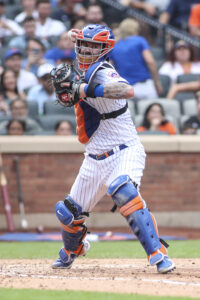
Nido had been projected by MLBTR contributor Matt Swartz to earn $1.6MM in 2023. He’d originally reached a one-year agreement worth $1.575MM, but he’ll instead get a bump for the upcoming season and lock in his final two years of club control at fixed price points. The deal grants the Mets a bit of additional cost certainty beyond the current season and ensures that they’ll retain control over a strong defensive backup at an affordable rate.
The 28-year-old Nido has posted a .236/.275/.338 batting line in exactly 500 Major League plate appearances over the past three seasons. It’s tepid offense at best, and while he’s been slightly below-average in terms of preventing stolen bases (22% caught-stealing rate), Nido has thrived in other defensive aspects of the game. He’s drawn standout framing marks from each of Statcast, FanGraphs and Baseball Prospectus, the latter of which also grades him as well above-average in terms of blocking pitches in the dirt. Nido has tallied just 1132 innings hind the plate since Opening Day 2021 but nonetheless racked up a whopping 18 Defensive Runs Saved.
Nido, at one point, was one of four catchers on the Mets’ roster before they lined up with the Orioles on a trade sending James McCann to Baltimore. He’s now likely to open the season behind Omar Narvaez, but the Mets will have top prospect Francisco Alvarez looming in the minors as an heir-apparent who could quickly reach the Majors in the event of an injury to Narvaez. Alvarez, 21, reached the Majors briefly in 2022 and went 2-for-12 with a home run and a double.
There’s been some speculation about him potentially serving as a DH option for the Mets early in the year, but as SNY’s Andy Martino wrote this morning in the wake of the Mets’ one-year deal with Tommy Pham, Alvarez won’t be a DH at the Major League level. He’s instead expected to get everyday reps behind the plate in Triple-A Syracuse. Narvaez is playing under a two-year, $15MM contract, but the second season of that deal is a player option valued at $7MM. If he has even a decent season with the Mets, he’ll likely decline that option and return to the market, setting the stage for Alvarez and Nido to take over as the primary catching tandem.
Nido’s deal is a low-cost move for the Mets, but it still slightly elevates their luxury-tax bill on the season. Had Nido remained on the $1.575MM deal to which he’d previously agreed, the Mets would’ve only owed him that salary and paid a 90% tax on that sum (a combined $2.9925MM expenditure). Instead, Nido’s luxury hit will be based on the $1.85MM average annual value of his new contract. The new contract will tack on an additional $272,500 to the team’s luxury bill. Nido will be a free agent following the 2024 season.
Royals, Padres Among Teams Interested In Aroldis Chapman
Both the Royals and Padres have some level of interest free-agent lefty Aroldis Chapman, tweets Mark Feinsand of MLB.com. This comes just one day after the Marlins were also reported to have interest in the former Yankees, Cubs and Reds closer.
The 2022 season was a rough one for Chapman, who’ll turn 35 next month. The lefty’s fastball, which once averaged better than 101 mph, dropped to a 97.5 mph average in 2022. Simultaneously, his command troubles spike to their worst levels since back in 2011. Chapman’s 26.9% strikeout rate in 2022 was better than league-average but still a career-low by a wide margin, and he walked a massive 17.5% of his opponents, which is the second-worst mark of his career.
Chapman’s 4.46 ERA was passable but nevertheless the highest of his career, and he missed six weeks of the season with an Achilles injury in addition to a roughly three-week absence owing to a leg infection related to a recent tattoo he’d received. He was also left off the Yankees’ postseason roster after skipping a team workout
Kansas City has taken its share of low-cost gambles on former high-profile closers in recent years, inking Trevor Rosenthal prior to the 2020 season and also bringing former K.C. stars Wade Davis and Greg Holland back for buy-low reunion tours. Chapman would be a page out of a similar playbook.
With just an $85MM projected payroll (via Roster Resource) and plenty of uncertainty behind closer Scott Barlow, the Royals represent a sensible enough on-paper fit. They already have three potential southpaws for the ‘pen, with Amir Garrett, Anthony Misiewicz and Richard Lovelady on hand, but Misiewicz does have a pair of minor league option years remaining. And, if Chapman were able to bounce back into form, he could potentially be someone they look to flip to another club as the trade deadline draws nearer.
As for the Padres, nary a free agent with any name value passes by without being connected to them. The Friars already have a deep bullpen, headlined by Josh Hader, Robert Suarez, Luis Garcia and a hopefully healthy Drew Pomeranz, but Chapman would add another big arm to the mix. Ownership and president of baseball operations A.J. Preller have shown a clear affinity for high-profile stars in recent years, even if some of those name-brand players have been past their peak production.
Then again, they’re also already sitting on a $251MM payroll, and Chapman could push them into the third tier of luxury penalization, given the projected $270.6MM currently on their luxury ledger. In terms of monetary penalization, the jump from adding Chapman likely wouldn’t be large. The Padres would pay a 42% tax on every dollar up to $273MM in luxury obligations, and that number would jump to 75% thereafter. However, presuming Chapman won’t command much more than a few million dollars on a one-year rebound deal, that sum won’t be particularly burdensome.
That said, there’s a greater cost to consider if the Padres want to continue spending in free agency. Exceeding the luxury tax threshold by more than $40MM also results in a team’s top pick in the subsequent year’s draft pushed back by 10 places. Tacking on even a $3MM salary for Chapman would come with something like $4MM in costs between his salary and luxury tax penalties, but would more importantly drop the Padres out of the top 30 in the 2024 draft while also reducing the size of their bonus pool. Further trades, of course, could always alter that calculus, but the Padres were recently reported to be approaching a “self-prescribed” spending limit. It wouldn’t be a surprise to learn that the point at which payroll begins to detrimentally impact future drafts is indeed that limit.
While much of the free-agent market moved at an accelerated pace this offseason, the market for left-handed relievers has been curiously slow. Taylor Rogers took until late December to land his three-year deal with the Giants, and Chapman joins the likes of Andrew Chafin, Matt Moore, Will Smith, Brad Hand and Zack Britton as a southpaw reliever of note that has yet to sign a team for the 2023 season.
Mets To Sign Tommy Pham
Jan. 20: Pham has passed his physical, tweets Nightengale. The outfielder will earn a $200K bonus upon reaching 225 plate appearances with the Mets, and he’ll unlock additional $200K bonuses for every 25th plate appearance thereafter, all the way up through 450 plate appearances. With the physical complete, the Mets should announce the deal sooner than later.
Jan. 18, 10:26am: It’s a one-year, $6MM contract for Pham, tweets Jon Heyman of the New York Post. USA Today’s Bob Nightengale adds that the contract contains $2MM of available incentives and is expected to be finalized Thursday.
10:08am: The Mets and Pham have agreed to terms on a contract, Martino tweets. The deal is pending a physical.
9:44am: The Mets have an offer on the table to free-agent outfielder Tommy Pham and is optimistic about completing a deal, reports SNY’s Andy Martino. The Mets also made offers to Andrew McCutchen and Adam Duvall, per the report, but McCutchen preferred to go back to his original team in Pittsburgh while Duvall had the opportunity for more playing time in Boston.
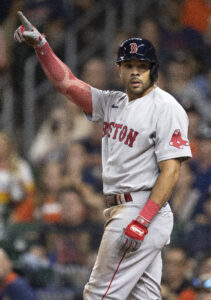
Pham, 35 in March, split the 2022 season between Cincinnati and Boston, batting a combined .236/.312/.374 with 17 home runs and eight stolen bases in 622 plate appearances. It was a down season overall, but Pham’s line included a stout .273/.338/.446 batting line against left-handed pitching.
Additionally, Pham’s batted-ball profile also serves as a portent for increased production in the future. His 92.2 mph average exit velocity ranked in the 93rd percentile of all big league hitters, while his 48.2% hard-hit rate ranked in the 89th percentile, per Statcast. Even if bat doesn’t bounce all the way back to the levels those numbers suggest, there’s a good chance he can be a useful platoon option. Also, Pham also still drew favorable rankings for his arm strength in the outfield (74th percentile) and average sprint speed (66th percentile). Defensive metrics panned his glovework on the whole (0 DRS, -6 OAA), but the tools are there for him to rebound in that capacity as well.
From 2015-19, Pham was one of the game’s most underrated outfielders, batting a combined .277/.373/.472 (130 wRC+) with a hefty 12.2% walk rate against a 23.3% strikeout rate. He’s been a slightly below-average hitter overall since that time, but given his speed, arm strength and solid production against lefties, he’s a nice bat to have on the bench.
Pham is mostly limited to left field at this point in his career — he has just 91 innings in center field an seven in right field since 2018 — but he’ll give the Mets some outfield insurance while perhaps serving as a right-handed complement to lefty DH Daniel Vogelbach. That’s especially true if the Mets look to move on from Darin Ruf after a disappointing couple months in Queens following last year’s acquisition at the trade deadline.
While Pham himself might not be a backup option to Brandon Nimmo in center field, adding him to the mix provides the Mets with some additional cover in the event of an outfield injury. For instance, both left fielder Mark Canha and (especially) right fielder Starling Marte have experience in center field, so either could shift to center should Nimmo need a day off or a trip to the IL, with Pham then slotting into left field and Marte/Canha covering the other two outfield slots.
The Mets also have 24-year-old Khalil Lee as a lefty-hitting outfielder who can fill in at all three spots, though he has a minor league option remaining. Pham’s addition creates the possibility of sending Lee to Triple-A Syracuse for regular playing time — a luxury the team may not have previously been able to afford. Previously, the Mets’ only outfielders on the 40-man roster all projected to be on the big league roster as well, so the extra depth fills a clear need.
On top of Pham’s $6MM, the Mets owe a 90% luxury tax of $5.4MM, bringing their total tab for the signing to $11.4MM. New York’s projected bottom-line payroll for the 2023 season jumps to a bit more than $356MM, with about $374MM in luxury-tax considerations on the books. That puts them in well into the top luxury bracket and sets the stage for the Mets to be a third-time payor in the 2024 season, which point they’d owe an even steeper 110% tax on every dollar spent above the top line. Owner Steve Cohen has shown little concern with such penalties, however, and Pham’s luxury hit will be a relative drop in the bucket compared to the sum the Mets were planning to pay Carlos Correa before concerns regarding his medicals scuttled the 12-year deal between the two parties.
Mets Among Teams Interested In Andrew Chafin
The market for lefty reliever Andrew Chafin is “heating up,” per Jon Heyman of the New York Post (Twitter link), and the Mets are among the teams with interest. SNY’s Andy Martino tweets that as many as seven other clubs have been talking with Chafin, however. Mets GM Billy Eppler said yesterday that he still hoped to add another outfielder and a reliever, and he’s checked one of those two items off his list before lunch today by agreeing to a one-year deal with Tommy Pham.
Chafin, 32, is quite arguably the best reliever remaining on the free-agent market and entered the offseason as one of the top overall lefties available. He declined a $6.5MM player option with the Tigers at the end of the 2022 season and ought to be able to clear that guarantee by a fair measure — likely on a multi-year deal. That’s to be expected after the southpaw turned in a 2.83 ERA inn 57 1/3 innings last season while drawing similar reviews from fielding-independent marks like FIP (3.06), xERA (2.92) and SIERA (2.97).
While Chafin doesn’t throw especially hard, averaging just 91.8 mph on his heater in 2022, the veteran southpaw does offer one of the best blends of missed bats, solid command and ground-ball tendencies of any reliever in the game. Chafin fanned 27.6% of his opponents in 2022, combining that with a quality 7.8% walk rate and a 51.3% ground-ball rate. Chafin was one of just nine qualified relievers in all of baseball who topped a 25% strikeout rate and 50% ground-ball rate while also sporting a walk rate lower than 8%. He also limited hard contact quite well, yielding an 87.5 mph average exit velocity that ranked in the 73rd percentile of pitchers and a 33.8% hard-hit rate that sat in the 81st percentile, per Statcast.
Chafin isn’t necessarily elite in any one single way, but he’s well above-average in a variety of important areas. Coupled with his age and handedness, that ought to lead to widespread appeal on the free-agent market. The bullpen market as a whole got out to a quick start, but the market for lefties has been slower to develop — evidenced by the fact that Chafin, Matt Moore, Will Smith, Brad Hand and Zack Britton are among the still-available names.
The Mets indeed represent a nice fit for Chafin, though a veteran of this stature is an upgrade to virtually any bullpen in the sport. New York currently projects to have Brooks Raley and perhaps one of David Peterson, Joey Lucchesi or Tayler Saucedo in the ‘pen as lefty options for manager Buck Showalter. Adding Chafin could allow the Mets to either carry three southpaws or to begin the year with both Peterson and Lucchesi in the Triple-A rotation, keeping both stretched out as viable starting depth in the event of injuries at the MLB level.
Again, though, there simply aren’t many teams that Chafin wouldn’t improve, so finding suitors for him is likely more a matter of determining how many motivated spenders remain on the market. The Mets certainly fall into that bucket and wouldn’t bat an eye at the 90% luxury tax they’ll have to pay on top of Chafin’s salary, but there are certainly other contenders and hopeful contenders with some money to spend who could give the Mets some competition in the bidding.
The Cardinals Would Be A Good Trade Partner For The Marlins (Or Just About Any Team)
It’s been largely quiet from the Cardinals since the team inked longtime division rival Willson Contreras to a five-year contract, officially tabbing him as the heir to franchise icon Yadier Molina. Filling the void left by Molina was clearly the top priority for the Cards this winter, though they were also loosely tied to the market for the top available shortstops and some free-agent pitchers.
With Contreras now signed, a look up and down the roster in St. Louis reveals a strong group that’s likely to contend for another NL Central crown in 2023. The Cardinals could use another left-handed reliever — Andrew Chafin, Matt Moore, Zack Britton and Brad Hand are among the still-available names — and perhaps they could stand to find a more potent backup to Contreras. Broadly speaking, however, it’s a deep and talented roster with a nice group of relievers, plenty of rotation depth and a good bit of positional flexibility, thanks to the versatility of players like Tommy Edman and Brendan Donovan.
All that said, it also doesn’t feel as though the Cardinals are done this winter. For one thing, their entire rotation, aside from lefty Steven Matz, will reach free agency next winter. The Cards could also stand to add another bat to the mix; while young sluggers Juan Yepez and Nolan Gorman offer upside as candidates who can spend some time at DH, neither has quite established himself as a proven big league bat just yet.
In left field, the Cardinals have a quality option in Tyler O’Neill — if he’s healthy. A shoulder impingement and two hamstring strains limited O’Neill to 96 games and quite possibly contributed to a diminished .228/.308/.392 batting line. In center, 24-year-old Dylan Carlson is a former top prospect whose numbers were solid in ’22 but not quite what they were in 2021. Lars Nootbaar had a breakout second half in right field. It’s a talented trio, but not to the extent of the Cardinals’ star-studded infield. Moveover, the Cardinals have other young outfield options waiting in the wings, with Alec Burleson already having made his debut, Moises Gomez all but ready on the heels of a huge minor league season, and uber-prospect Jordan Walker also looming in Triple-A.
It feels like, for all the young talent the Cards have, there’s room for at least one more notable bat to be plugged into the lineup. And, with so many starting pitchers set to reach the open market (or, in Adam Wainwright‘s case, retire) next offseason, the Cardinals would probably love to add some controllable pitching.
Looking through the Cardinals’ depth chart, there’s virtually no player who could both be conceivably available and also unattainable for the Cards. The Redbirds have prospects and young, MLB-ready talent at virtually any position, which sets them up for innumerable trade possibilities, be it with the Marlins or another club.
Let’s run through some of the talent they could dangle when seeking an impact bat or high-end pitcher to slot into the rotation:
A Top Catching Prospect
Ivan Herrera was viewed as the Cardinals’ catcher of the future for the past several years, but with Contreras now signed for a half decade, a cloud has been cast on his role with the club. Herrera could still function as a high-quality backup to Contreras, and Contreras is a good enough hitter that he could slot in as a DH on days he’s not behind the plate. Perhaps that opens the door for Herrera to carve out a larger role than most backup catchers might hold, but this is a 22-year-old who just batted .268/.374/.396 against older Triple-A competition and ranks as the game’s No. 84 prospect over at Baseball America. He’s a nice safety net and a potentially very overqualified backup to Contreras… but he’d also be highly appealing to any club lacking a long-term option behind the plate.
Outfielders Galore
As mentioned above, any of O’Neill, Carlson or Nootbaar would hold appeal to other clubs, albeit to varying extents. O’Neill has just two years of club control remaining and is coming off a down season … but he also mashed at a .286/.352/.560 clip and clubbed 34 homers while playing strong defense in 2021. Plenty of teams are looking for a righty bat and might be intrigued to gamble on a rebound. Both Carlson (who was mentioned in Juan Soto rumors) and Nootbaar (who was reportedly of interest to the Jays and A’s in their talks about catching trades this offseason) offer even more club control and plenty of long-term upside.
Trading anyone from that group would absolutely require the Cardinals to receive big league talent in another area: be it a more impactful, established offensive presence to slot into the outfield or perhaps a quality starting pitcher with multiple years of club control remaining. In either instance, any of O’Neill, Carlson or Nootbaar would probably be just one of multiple players moved as part of the return for an established big leaguer.
Beyond their stable of current MLB outfielders, the Cards have Burleson, Gomez and Walker. Burleson, the No. 68 prospect on Baseball America’s Top 100 list, struggled in 53 plate appearances during last year’s MLB debut but posted a massive .331/.372/.532 slash in 109 Triple-A games. Gomez played 60 games apiece in Double-A and Triple-A, hitting a combined .294/.371/.624 with 39 home runs. Walker, a 2020 first-round pick who ranks among the sport’s top ten overall prospects on just about any publication, is perhaps the most “untouchable” of all the Cardinals’ young hitters. However, like Gomez and Burleson, he also offers a near-MLB replacement should the Cards move one of their current big league outfielders in a trade package. Walker was drafted as a third baseman, but Nolan Arenado‘s presence means he’ll likely debut as an outfielder. After hitting .306/.388/.510 as a 20-year-old and one of the youngest players in Double-A, he’s probably not far off.
Young Infielders
The St. Louis infield is mostly set with Arenado and Paul Goldschmidt at the corners, Tommy Edman at shortstop and Brendan Donovan at second base. It’s unlikely the Cards would move anyone from that group, though if you wanted to argue that Donovan, the third-place NL Rookie of the Year finisher, could be included in a package for an impact player, that’s at least loosely feasible. The A’s reportedly asked about him in talks for Sean Murphy, although perhaps the fact that the Cardinals balked at Oakland’s asking price tells us most of what we need to know about Donovan’s availability (or lack thereof).
It’s a strong group, and both Edman and Donovan can be deployed virtually anywhere on the diamond. Each played at least five positions in 2022 alone. Perhaps Donovan will ultimately settle into some type of super-utility role, but that’d require a step forward from another young infielder — which the Cardinals just so happen to possess.
Nolan Gorman didn’t exactly explode onto the scene in his rookie campaign, but he held his own with a .226/.300/.420 batting line and 14 homers in 313 plate appearances. Much of his production came early on and was followed by a strikeout-laden slump — he fanned in 32.3% of his plate appearances — but Gorman is another former top prospect who also tattooed Triple-A pitching in the form of a .275/.330/.585 output, including 16 home runs in just 188 plate appearances. Originally a third baseman, he shifted over to second base because of Arenado. He now has a fair bit of experience at both spots.
Down on the farm, 20-year-old Masyn Winn occupies the No. 56 spot on BA’s Top 100 list. Like Walker, he’s already spent a full season in Double-A. He didn’t hit quite as well, but his .258/.349/.432 output was league-average by measure of wRC+ (100), and like Walker, he was one of the league’s youngest players. BA lauds Winn for having “by far the strongest throwing arm in the minor leagues” and touts him as a plus-plus runner and gives him a chance to be an above-average defender at shortstop. Winn was drafted as a two-way player, but he’s only pitched one inning in pro ball.
Starting Pitching Prospects
It’s perhaps counterintuitive to have just mentioned how the Cardinals need controllable starting pitching and then tout a deep crop of quality pitching prospects from which they could trade. But attrition among pitching prospects is even greater than position players. That’s not to say those arms don’t have value — of course they do — but it’s easier to bank on those arms converting when hoping to fill one rotation spot. Hoping to fill three to four rotation spots with in-house prospects is nothing short of insanity.
The Cardinals aren’t short on intriguing arms, with Gordon Graceffo, Matthew Liberatore and Tink Hence all actively ranking, or having recently been ranked on various top-100 lists around the industry. Hence (No. 57) and Graceffo (66) are just a few spots apart on BA’s top 100 at the moment.
Both Liberatore and fellow lefty Zack Thompson (the No. 19 pick in 2019) have reached the Major Leagues already but have not yet established themselves. Liberatore posted ERAs north of 5.00 in both Triple-A and in 34 2/3 big league innings last season, but he’s still just 23 years old and has at least six years of club control — plus a pair of minor league option years remaining. Thompson threw an identical 34 2/3 Major League innings in 2022 but did so primarily out of the bullpen. He also pitched to a pristine 2.08 ERA, and while his 19.9% strikeout rate and 10.3% walk rate both leave something to be desired, he averages just shy of 95 mph with his heater and did rack up an impressive 53.7% ground-ball rate.
St. Louis has further depth in the form of righty Dakota Hudson, who’s been pushed out of their rotation but is a ground-ball machine with two years of club control remaining. Hudson has just a 4.31 ERA and 13.3% strikeout rate since returning from Tommy John surgery, and his once-blistering sinker averaged just 91.6 mph post-surgery. Still, he’s a ready-made fourth or fifth starter candidate with three option years remaining. Jake Woodford is cut from a similar cloth as a low-strikeout, ground-ball oriented pitcher who could slot into the back of a rotation, although he also posted a 2.23 ERA in 48 1/3 innings out of the St. Louis bullpen this past season (albeit with some good fortune on balls in play and a fluky-low home run rate).
Some of these arms will be earmarked for opportunities in the 2024 rotation, and there’s a good chance some will see their stock dip after an injury or a step back in performance. Still, their present-day value gives the Cardinals the opportunity to condense some of that talent into a trade for a more established player.
—
Overall, the Cardinals’ wealth of young talent is remarkable for a perennially competitive team that hasn’t drafted higher than 18th overall in the past 15 years and, within the past four years, has pulled off trades for in-their-prime stars like Paul Goldschmidt and Nolan Arenado. It’s an excellent position in which to find themselves as an organization, but if there’s one “downside” (and I’m using that term loosely), it’s the timing of this surfeit of young talent.
The trade market, in general, is quite bleak right now. Miami’s quartet of available arms has dominated headlines, but there’s little else of substance on the market. The Pirates reportedly have a sky-high asking price on Bryan Reynolds that makes him unlikely to be moved in the first place, and one can only imagine they’d ask for even more from a division rival. There are certainly other names that could change hands between now and Opening Day, but the obvious candidates aren’t clear upgrades to the Cardinals. The Mariners have a pair of back-end starters (Chris Flexen, Marco Gonzales), while the Twins (Max Kepler) and A’s (Seth Brown) have some outfielders who could be available. There’s just not a ton to be excited about on the trade market right now.
That shouldn’t stop the Cardinals’ front office from trying to force other teams’ hands and convince them to part with starting pitching help or perhaps a slugging bat that might not be a natural trade candidate at first glance. Failing that, the Cardinals are as well positioned as just about any team in the league to swing a deal with the Marlins whenever Miami finally make what feels like an inevitable trade.
MLBTR Chat Transcript
Click here to read a transcript of Tuesday’s chat with MLBTR’s Steve Adams.
Red Sox Among Teams Interested In Adam Duvall
The Red Sox are among the teams pursuing free-agent outfielder Adam Duvall, as first reported by Chris Henrique of Beyond the Monster. MassLive.com’s Chris Cotillo tweets that a resolution on Duvall’s free agency, be it him signing with the Sox or another club, could come as soon as this week. The Red Sox, Cotillo adds, view Duvall as “plenty capable” of playing center field.
Slotting Duvall into the center field mix alongside left-handed-hitting Jarren Duran would allow Boston to shift Enrique Hernandez back to the middle infield, in the wake of Trevor Story‘s recent elbow surgery. Duvall doesn’t have pronounced platoon splits — he draws slightly more walks against lefties but hits for similar power and has an identical .230 average against lefties and righties — so it’s possible that he could even be thrust into center field on a regular basis, if the Sox are comfortable with the defensive component of that fit.
Duvall, 34, has elite defensive grades in left field in his career but has just 593 innings in center field — most of which came with the Braves over the past two seasons. He’s fared well there, too, logging four Defensive Runs Saved and five Outs Above Average in that limited time.
With the bat, Duvall has clear plus power, but he’s never gotten on base much and has also grown increasingly strikeout-prone in recent years (30.4% over the past four seasons). His 2022 season was cut short by a torn tendon sheath in his wrist, leaving him with an ugly .213/.276/.401 batting line and a dozen homers in 315 trips to the plate. Duvall smashed 38 home runs as recently as 2021, but that was accompanied by his typical blend of low average and OBP marks; in 555 plate appearances for Atlanta in ’21, Duvall hit .228/.281/.491.
That’s par for course for Duvall, a career .230/.289/.465 hitter who has thrice topped 30 home runs in a given season and also has a 2021 Gold Glove Award under his belt. If he’s back to full strength last year’s season-ending wrist surgery, he could give the Red Sox a much-needed right-handed bat in a lineup where only Hernandez, Justin Turner and Christian Arroyo project for regular reps. Bench options like Bobby Dalbec and Rob Refsnyder could give Boston some additional righty bats on days they face a left-handed starter.
Red Sox chief baseball officer Chaim Bloom said last week that following Story’s injury, he’d likely seek multiple up-the-middle additions to the lineup. Duvall, assuming he plays center field, could fit that billing, but the Sox would likely still have other additions in store. Boston was also connected to former Rangers, A’s and White Sox infielder Elvis Andrus over the weekend. Boston currently projects to have a payroll of about $183.5MM next season and has a bit more than $209MM in luxury-tax obligations on the books — both of which are well shy of last year’s totals.
Red Sox Trade Connor Seabold To Rockies
11:47am: The Rockies have announced the trade.
11:28am: The Rockies have acquired right-hander Connor Seabold from the Red Sox in exchange for a player to be named later or cash, reports Mark Feinsand of MLB.com (via Twitter). Boston designated Seabold for assignment last week when finalizing their deal with free-agent starter Corey Kluber. The Rockies had an open spot on the 40-man roster, so a corresponding transaction won’t be required.
Seabold, 26, was a mildly surprising DFA by the Red Sox, if only due to his recent status as one of the organization’s more promising pitching prospects. There are pronounced durability concerns about the right-hander, however, due in no small part to elbow trouble in 2021 and a forearm strain in 2022. Seabold has just 364 professional innings since being drafted back in 2017 — that modest total coming despite his status as a starting pitcher.
As far as his Major League work is concerned, Seabold has yet to find success. He’s tallied just 21 1/3 innings in the Majors, all with the Red Sox, and he’s been tagged for 25 runs in that time. Things have gone more smoothly in Triple-A, where Seabold pitched well as recently as this past season: 86 1/3 innings, 3.32 ERA, 24.7% strikeout rate, 5.3% walk rate.
Despite concerns about his ability to stay on the field and a shaky MLB performance to date, Seabold is more or less a big league-ready arm who’ll give the Rockies some depth on the pitching staff, if not a player who could legitimately vie for a starting job this spring. Colorado’s rotation will be without Antonio Senzatela to begin the season, due to the righty’s ACL tear late last year, and the staff has little certainty beyond righty German Marquez and lefty Kyle Freeland (both of whom are looking for a rebound performance anyhow). Jose Urena, Ryan Feltner and Austin Gomber are the ostensible front-runners, but each posted an ERA north of 5.00 in 2022.
Seabold also has a minor league option year remaining, so if he doesn’t win a job out of camp, he can still be sent to the minors without first needing to clear waivers.