
Rockies Sign Pierce Johnson
The Rockies added an arm and a local product to their bullpen Tuesday, announcing the signing of free-agent righty Pierce Johnson to a one-year deal. The contract reportedly comes with a $5MM guarantee for Johnson, a client of John Boggs & Associates. He can earn an additional $750K of incentives. It’s a nice guarantee for a pitcher coming off an injury-plagued season, though the Rockies perhaps needed to make an aggressive offer in order to persuade the righty to spend his home games at Coors Field, even if Johnson is a Denver native.

Johnson, 31, once ranked among the sport’s top pitching prospects with the Cubs, who originally drafted him with the No. 43 overall pick in 2012, but he didn’t establish himself in Chicago or in San Francisco after being plucked off waivers by the Giants in 2018. An impressive strikeout rate in Triple-A might’ve helped him garner some attention overseas, however, and Johnson parlayed a dominant one-year stop with the Hanshin Tigers of Japan’s Nippon Professional Baseball in 2019 into a three-year run with the Padres.
In 2020-21, after signing a two-year deal that contained a 2022 club option, Johnson was a reliable member of the San Diego bullpen. Through 78 2/3 frames, he pitched to a 3.09 ERA with an excellent 32.1% strikeout rate — albeit against an 11.1% walk rate that resided well north of the league average.
The Padres picked up their $3MM option on the heels of that strong showing, but the 2022 season brought an unwelcome change of fortune, as Johnson was sidelined for much of the season due to a forearm injury. When healthy enough to pitch, Johnson totaled just 14 1/3 innings of 5.02 ERA ball; his 32.8% strikeout rate and 12.5% walk rate were at least loosely in line with his 2020-21 levels, but Johnson was plagued by a sky-high .382 average on balls in play. Whether because of the forearm injury or something else, Johnson’s fastball — which averaged 96.3 mph in 2020 — sat at a diminished 94.7 mph in 2022.
Rough as the 2022 season was for Johnson, that 3.09 ERA from 2020-21 — paired with a 13.9% swinging-strike rate and elite spin rate on his curveball — surely garnered interest from multiple clubs. He’ll end up pitching for his hometown Rockies, joining a bullpen that lost Carlos Estevez to the Angels and will likely also see veteran Alex Colome sign elsewhere. While Daniel Bard is entrenched as manager Bud Black’s closer, Johnson has an opportunity to take the lead in a largely unsettled setup corps if he can return to form.
Beyond Bard and Johnson, the Colorado bullpen has righty Dinelson Lamet and lefty Brent Suter as veteran options but is otherwise lacking in experience. Lucas Gilbreath has shown some potential in two big league seasons, but outside of injured Tyler Kinley (who’s recovering from Tommy John surgery), the Rockies don’t have another reliever with even a full year of Major League experience on the 40-man roster.
With Johnson now on board, the Rockies’ projected payroll bumps up to nearly $163MM, per Roster Resource. That puts them nearly $20MM past their franchise-record Opening Day payroll of $145MM, set back in 2019. The extent to which Colorado can continue spending, with payroll already at that level, remains unclear, though in addition to another bullpen arm, the Rox could still use help in center field, in the rotation and at catcher.
Thomas Harding of MLB.com first reported the two sides were in agreement on a one-year deal (via Twitter). The New York Post’s Joel Sherman reported the terms of the contract.
Red Sox Sign Kenley Jansen
Dec. 13: The Sox have made it official, announcing the signing. Infielder Hoy Park was designated for assignment in a corresponding move.
Dec. 7, 11:03am: Jansen will be paid an even $16MM in each season of the contract, per Alex Speier of the Boston Globe.
9:35am: The Red Sox are in agreement on a two-year, $32MM contract with free-agent right-hander Kenley Jansen, reports ESPN’s Jeff Passan (Twitter link). The Wasserman client becomes the third free-agent reliever to sign in Boston this winter, joining righty Chris Martin and lefty Joely Rodriguez in what’s becoming a rapidly overhauled bullpen.
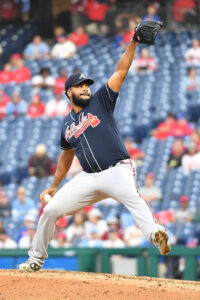 Change was necessary in the Boston ‘pen, however, as Red Sox relievers logged the fifth-worst ERA in baseball (4.59) and ninth-worst FIP (4.13) — due in no small part to combining for the fifth-highest walk rate of any relief corps in MLB. The ninth inning, in particular, was a revolving door for the Sox in 2022. Nine different relievers recorded saves, and righties John Schreiber, Tanner Houck and Matt Barnes finished the season in a three-way tie for the team lead, at eight apiece.
Jansen, nine saves away from 400 in his illustrious career, should bring some much-needed stability to the situation. The 35-year-old’s velocity is down a couple miles per hour from its 2014 peak, but he’s managed to find plenty of success even as his deadly cutter has faded from an average of nearly 95 mph to a 92.2 mph average with the Braves in 2022.
It was just a one-year stay in Atlanta for Jansen, who’d spent the prior 12 seasons of his big league career with the Dodgers, but the results were strong. Jansen saved 41 games and pitched to a 3.38 ERA with even better secondary marks: a 32.7% strikeout rate, an 8.5% walk rate and a 2.76 SIERA, to name a few. That walk rate, in particular, marked a pronounced rebound from an uncharacteristic spike to 12.9% in 2021, which now looks more like an anomaly than the start of a worrying trend.
Jansen’s 2022 season wasn’t without its red flags. Last season’s 11.4% swinging-strike rate was a career-low by a full two percentage points and clocked in 3.9 percentage points south of his 15.3% career mark. He also required a stint on the injured list due to an irregular heartbeat for the fourth time in his career. Jansen has had a pair of cardiac ablation procedures in hopes of finally putting the heart issues behind him. While it seems he’s not entirely clear of the longstanding issue, it’s also encouraging that he returned in the minimum 15 days this time around.
The 2022 season marked Jansen’s 13th season in the Majors, all of which have resulted in an ERA of 3.71 or lower (including nine sub-3.00 campaigns and four sub-2.00 seasons). Despite the brief absence due to his heartbeat issue, the otherwise-durable Jansen topped 60 innings in nine of the past ten full, 162-game seasons. It’s fair to say that he’s gone from virtually unbeatable in his 20s to “merely” excellent in his 30s, but Jansen still possesses a 3.08 ERA in 292 innings since turning 30.
A deepened relief corps with newly signed veterans allows the Red Sox to more confidently give some key young arms a look in the rotation. Garrett Whitlock has oscillated between starting and relieving, but the organization plans to use him as a starter in 2023, GM Brian O’Halloran said earlier in the offseason. Fellow righty Tanner Houck could also get a look in the rotation, O’Halloran added, though no formal decision has been announced on that front. In all likelihood, his role will depend on the manner in which the Sox are able to either bolster the starting rotation and/or further deepen the bullpen.
The Red Sox paid the luxury tax by a narrow margin in 2023, but with the potential departures of Xander Bogaerts, J.D. Martinez, Nathan Eovaldi, Michael Wacha, Rich Hill and Matt Strahm (who’s reportedly nearing a deal with the Phillies), Boston’s current luxury projection is nearly $60MM shy of the first-tier tax threshold — even including the salaries of newcomers Jansen, Martin and Rodriguez. Boston had more money coming off the books than nearly any team in the sport this winter, and as things stand, they’re more than $70MM from their franchise record for Opening Day payroll.
In that respect, the deluge of near-misses the Sox have had in free agency thus far are extra discouraging. The Red Sox made a three-year offer to Jose Abreu before he signed in Houston, for instance, and they reportedly believed they were close to a three-year, $40MM deal with righty Zach Eflin before he the Florida native the same contract with his home-state Rays. Boston has also reportedly made offers to Andrew Heaney and Tommy Kahnle before they agreed to deals with the Rangers and Yankees, respectively, and the Sox had talks with the Brewers about Kolten Wong before he was traded to the Mariners.
Frustrating as it must be for both the front office and fan base to see so many pursuits come up empty-handed, the Sox are still sporting as much financial firepower as any team on the market. Bringing Jansen into the fold gives the Sox a strong end-of-the-game presence, as he can join Martin and Schreiber in handling high-leverage spots next season. There’s still work to be done in the rotation and in the lineup, and Boston continues to pursue a reunion with Bogaerts as well as a possible extension with third baseman Rafael Devers. Jansen checks one notable item off chief baseball officer Chaim Bloom’s to-do list, but expect plenty of additional activity from the Sox as they look to leverage their considerable financial resources.
Giants Sign Ross Stripling
1:05pm: The Giants announced the signing.
11:58am: The Giants have agreed to a two-year, $25MM contract with free-agent righty Ross Stripling, reports ESPN’s Jeff Passan (Twitter link). Stripling, a client of Excel Sports Management, will be able to opt out of the contract after the 2023 season. It’s the exact same set of terms the Giants used to reel in lefty Sean Manaea earlier this week.
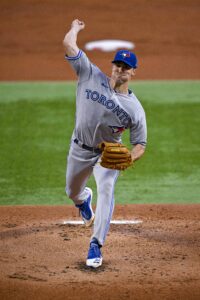
The contract contains a $5MM signing bonus that’ll be paid out in equal $2.5MM installments — one in 2023 and one in 2024, per Joel Sherman of the New York Post (Twitter link). Stripling will also earn a $7.5MM salary this coming season before deciding whether to opt out of a $12.5MM salary for the 2024 campaign.
Stripling, 33, is surely a familiar face for Giants president of baseball operations Farhan Zaidi, whose time as Dodgers general manager overlapped with Stripling’s time in Los Angeles. The veteran righty has served as a swingman for much of his time in the Majors, often functioning as a sixth starter with the Dodgers or with the Blue Jays, who acquired him at the 2020 trade deadline.
The 2022 season, however, saw Stripling step into a full-time rotation role when the Jays lost lefty Hyun Jin Ryu to Tommy John surgery. Stripling proved to be a godsend, making 24 starts and pitching to a 2.92 ERA in 123 1/3 innings out of the rotation. That’s an average of just over five frames per start, but Stripling’s results were nothing short of excellent.
In Stripling, the Giants will add a versatile arm who’s had success in multiple roles. He won’t overpower many hitters with a fastball that averaged just 91.9 mph, but Stripling offsets a below-average 20.7% strikeout rate with a solid 43.8% grounder rate and some of the best command in the Majors. This past season’s 3.7% walk rate was the third-lowest mark of any pitcher to throw at least 100 innings in 2022, and his 11% swinging-strike rate and 37.9% opponents’ chase rate at least suggest that there’s some strikeout upside even with the pedestrian velocity.
It bears mentioning that from 2020-21, Stripling logged an unsightly 5.14 ERA and 5.52 FIP in 150 2/3 innings between the Dodgers and Jays, due in no small part to a mammoth average of 2.2 homers per nine innings pitched. However, the long ball hasn’t been a prominent source of trouble for him outside those two seasons, and he registered a career-best 0.8 homer per nine frames this past season. Aside from that two-year rough patch, Stripling carries a sub-4.00 ERA in his other five MLB campaigns.
For the Giants, Stripling adds even more depth to an already strong group of potential starters. He joins the aforementioned Manaea as a complement to ace Logan Webb, lefty Alex Wood and righties Alex Cobb and Anthony DeSclafani. The Giants also enjoyed a nice rebound from swingman Jakob Junis in 2022, giving them at least seven rotation options on the big league roster.
It’s fair to wonder whether the addition of Stripling more formally removes the Giants from the bidding on free-agent ace Carlos Rodon, who opted out of the second year of his contract in San Francisco and has reportedly been seeking a deal of at least six to seven years in length this winter. Susan Slusser of the San Francisco Chronicle reported yesterday that the Giants remained in pursuit of Rodon even after agreeing to terms with Manaea, but Stripling further crowds the pitching staff.
Regardless of whether Rodon remains in the cards, the forthcoming additions of Manaea and Stripling position the Giants well in the event of injuries arising elsewhere on the starting staff. That’s critical for the Giants, given the health track records of several of their in-house options. DeSclafani tossed only 19 innings in 2022 due to a tendon injury in his ankle that ultimately required surgery. Wood and Cobb worked a mostly full slate of starts last year, but Cobb pitched just 158 innings from 2019-21 and Wood logged only 48 1/3 innings from 2019-20 due to shoulder and neck woes. Even Webb, who worked a team-high 192 1/3 innings in 2022, missed a few weeks in 2021 due to a shoulder strain.
After bringing Stripling into the fold, the Giants are up to a projected $157.6MM payroll for the upcoming season and a luxury-tax ledger just north of $180MM, per Roster Resource. They’re still more than $40MM south of their franchise-record $200.5MM Opening Day payroll and more than $50MM shy of the $233MM luxury-tax barrier. That type of payroll space sets the stage for another marquee addition, should the Giants find a deal to their liking. They’ve already added Manaea, Stripling and Mitch Haniger, in addition to retaining Joc Pederson on a qualifying offer, but the Giants have been linked to Rodon and are one of the primary suitors for free-agent shortstop Carlos Correa, so the Stripling pact surely isn’t their final move of the offseason.
Rays Designate J.P. Feyereisen For Assignment, Expect To Trade Him
10:40am: At the press conference to introduce Eflin, general manager Peter Bendix said the Rays fully expect to find a trade partner for Feyereisen (Twitter link via Topkin).
9:58am: The Rays have designated right-hander J.P. Feyereisen for assignment in order to open a spot on then roster for right-hander Zach Eflin, whose previously reported three-year deal is now official.
While Feyereisen’s DFA might raise some eyebrows, given a sensational 2022 season in which he pitched 24 1/3 shutout innings for Tampa Bay with a 25-to-5 K/BB ratio, the decision comes less than a week after the right-hander required surgery to repair the labrum and rotator cuff in his ailing right shoulder. Feyereisen won’t throw a ball for at least four months and is expected to be shelved well into the 2023 season. Marc Topkin of the Tampa Bay Times tweets that Feyereisen isn’t expected back until late August.
Prior to the 2022 season, Feyereisen had enjoyed success in the upper minors but displayed more red flags in the big leagues. A 2.73 ERA in 56 innings between the Brewers and the Rays in 2021 was clearly encouraging, but Feyereisen walked a whopping 14.1% of his opponents that season, making that output appear unsustainable. The Rays, however, managed to sharpen his command in 2022, as he fanned 29.1% of hitters against a tidy 5.8% walk rate. His career walk rate of 12% is still concerning, particularly when coupled with the recent shoulder operation, but Feyereisen clearly has the makings of a solid late-game reliever if he can sustain his improved 2022 command.
The Rays, of course, could have opted to keep Feyereisen on the 40-man roster and place him on the 60-day injured list when Spring Training commences — there’s no injured list in the offseason — but they’re in somewhat of a bind, given that Feyereisen is just one of several players ticketed for the 60-day IL when camp begins. Both Shane Baz and Andrew Kittredge figure to require placement on the 60-day IL themselves, as each is recovering from Tommy John surgery. Waiting until Spring Training to make those moves would’ve effectively left the Rays working with a 37-man roster throughout the offseason.
Even with Feyereisen’s recent surgery, there’s a strong chance today’s DFA will spell the end of his time with the Rays. He has only two-plus years of MLB service time, meaning an acquiring team could control the 29-year-old righty for another four seasons. Even if he’ll miss a considerable portion of the 2023 season, there’s plenty of appeal in adding an arm of Feyereisen’s caliber, whether via a small trade or waiver claim, knowing he can be reasonably expected to be healthy for the 2024-26 seasons. The Rays clearly didn’t feel they had the luxury of rostering three immediate 60-day IL placements for the remainder of the offseason, but other clubs with greater flexibility won’t have such pressing concerns.
Guardians To Sign Mike Zunino
The Guardians are in agreement on a contract with free-agent catcher Mike Zunino, reports Ken Rosenthal of The Athletic (Twitter link). It’s a one-year, $6MM contract for the Wasserman client, tweets Robert Murray of FanSided.
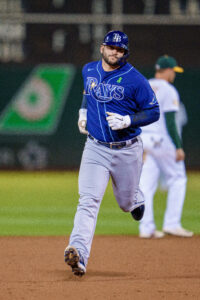
Zunino, 32 in March, should continue the tradition of high-quality defense behind the plate in Cleveland, though like many of his recent predecessors, he’s seen his fair share of struggles at the plate. The former No. 3 overall draft pick (Mariners, 2012) has batted under .200 in five of his ten Major League seasons, though he’s partially offset his penchant for punchouts with strong glovework and enormous power.
The 2022 season was perhaps the worst of Zunino’s career, as he turned in a .148/.195/.304 batting line in 123 plate appearances before undergoing season-ending surgery to alleviate thoracic outlet syndrome. Just one season prior, however, Zunino mashed a career-best 33 home runs through just 375 plate appearances while batting .216/.301/.559. He’s had several seasons in which his power and defense have made him a valuable all-around asset even in spite of his perennially low batting averages and on-base percentages. All told, Zunino is a career .200/.271/.410 hitter with 146 home runs in 2958 plate appearances.
While the Guardians had a clear need for help behind the plate, Zunino is somewhat antithetical to the general hitting philosophy the Guardians relied on in 2022 when surging to the AL Central crown. Cleveland emphasized hitters who put the ball in play above all else, even designating struggling and strikeout-prone DH Franmil Reyes over the summer, and finished out the season with an MLB-low 18.2% strikeout rate as a team. Zunino, however, has a career 34.7% strikeout rate — one of the highest levels of any hitter during his decade in the big leagues.
Defensively, Zunino has been about average in terms of throwing out potential base thieves, with a career 28% caught-stealing mark that sits narrowly ahead of the 27% league average during his MLB tenure. That said, he’s consistently rated anywhere from above-average to excellent in terms of pitch framing, and Defensive Runs Saved credits him with a hearty +51 mark over his 6894 career innings behind the dish.
Zunino might not be quite on the same defensive level as the man he’ll be replacing, free agent Austin Hedges (arguably MLB’s best defensive catcher), but even if the pair both struggle to keep their average north of .200, Zunino trounces Hedges in terms of career power output and (to a lesser extent) on-base percentage. There will likely be even fewer balls in play off the bat of Zunino than with Hedges (career 27.7% strikeout rate), but the pitches on which Zunino does connect will be put into play with considerably more authority. Zunino’s career 89.7 mph average exit velocity and 41.6% hard-hit rate tower over Hedges’ marks of 86.4 mph and 29.8%, and Zunino has been particularly strong in this regard since 2021 (91 mph average exit velocity, 44.9% hard-hit rate).
Of course, all of that assumes good health, which is a lot to presume in the wake of an ominous TOS procedure. Thoracic outlet surgery is far more common among pitchers than position players, so there’s not much of a precedent for how a hitter — particularly a catcher — will recover from the ailment. Symptoms of TOS often include numbness in the hand/fingertips and weakness in the shoulder area, so there’s certainly some medical risk.
Zunino becomes the second free-agent addition to the reigning AL Central division champions, who recently signed slugger Josh Bell to a two-year, $33MM contract that allows him to opt out of the deal after one season. Bell and Zunino will unquestionably add some thump to a Guardians club that ranked 29th in baseball in both home runs (127) and ISO (.129). They’ll also boost the Guards’ projected payroll to a bit more than $92MM, which is miles away from the franchise-record mark of $135MM in 2018 but still a far sight north of last year’s $68.2MM Opening Day mark.
The one-year term of the deal is reflective both of Cleveland’s general aversion to long-term free-agent deals and to the fact that the front office hopes to have its catcher of the future on the cusp of MLB readiness. Bo Naylor, selected with the No. 29 overall pick in 2018, made his big league debut briefly in 2022, though he did not reach base in a tiny sample of eight plate appearances. Naylor, however, hit .271/.427/.471 in 52 Double-A games before ascending to Triple-A and batting .257/.366/.514 in an additional 66 games.
Scouting reports on Naylor, the younger brother of Cleveland first baseman/outfielder Josh Naylor, cite a need to improve his defense behind the plate and improve his bat-to-ball skills at the plate — he fanned in 25.9% of his Triple-A plate appearances — so it seems likely that Cleveland will hope he can continue to work on those areas of his game in the upper minors to begin the season.
There’s little sense in carrying the younger Naylor brother as a backup catcher when he’s viewed as a potential long-term regular, and the typically low-payroll Guardians likely wouldn’t commit $6MM to Zunino in order for him to serve as a backup. Cleveland has fellow catcher Bryan Lavastida on the 40-man and recently invited former Royals and Rangers backstop Meibrys Viloria to Spring Training. Either could open the season as Zunino’s backup, and it remains possible that the front office will add another name to that backup competition between now and Opening Day.
Marlins Finalize Coaching Staff
The Marlins have finalized their coaching staff under rookie manager Skip Schumaker, the team announced Tuesday. Pitching coach Mel Stottlemyre Jr., bullpen coach Wellington Cepeda and bullpen coordinator Rob Flippo are all holdovers from the prior staff. The rest will be comprised of newcomers — most of whom have Major League playing experience.
Rod Barajas has been named the team’s field coordinator, while Jon Jay is the new first base and outfield coach. Brant Brown has been tabbed as Miami’s new hitting coach, and he’ll be assisted by John Mabry. Jody Reed will serve as the Marlins’ third base and infield coach, and Luis Urueta will take over as Schumaker’s bench coach. Griffin Benedict, meanwhile, has been hired as a quality assurance coach.
Since retiring as a player following the 2012 season, the 47-year-old Barajas has spent nine years with the Padres in various coaching roles and was also the Angels’ Major League catching coordinator in 2022. The former catcher briefly served as the Padres’ interim manager for their final eight games in 2019 and was also San Diego’s bench coach. Barajas hit .235/.284/.407 and won a World Series ring with the D-backs during a 14-year playing career.
Jay, 37, was an active player up through the 2021 season and will now take his first big league coaching role. A longtime teammate of Schumaker in St. Louis, he’s a Miami native who spent a dozen seasons playing at the MLB level from 2010-21. Along the way, Jay hit .283/.348/.373 while logging extensive time at all three outfield positions.
Brown, 51, played in parts of five big league seasons and saw a brief run with the then-Florida Marlins in 2000. He’s spent the past three seasons as a co-hitting coach with the Dodgers and has previously held coaching gigs with the both the Mariners and Rangers. He batted .247/.301/.445 in 424 big league games.
Mabry, who’ll take over as the new assistant hitting coach for the Fish, is no stranger to big league coaching. He spent seven seasons with the Cardinals, first as assistant coach and then as the lead hitting coach, and he’s been on the Royals’ staff for each of the past three seasons. The 52-year-old played parts of 14 seasons in the Majors, hitting .263/.322/.405 and, in his final season with the Cardinals in 2005, briefly overlapped with Schumaker, who made his big league debut with St. Louis that same season.
The 60-year-old Reed had an 11-year playing career himself, batting .279/.340/.350 while spending the majority of his time with the Red Sox. He’s since had minor league coaching and development positions with the Dodgers and Yankees, including a nine-year stint with the latter.
Urueta is one of two newcomers who doesn’t have big league playing experience, though despite being just 41 years of age, he joins Miami with a lengthy coaching history. After spending more than a decade coaching and managing in the D-backs’ minor league system, Urueta was added to the big league staff in 2018 and eventually elevated to the position of bench coach. He returned to a minor league role for the 2022 season, however.
Benedict was with the Cubs’ Triple-A affiliate in 2021-22, serving as the team’s hitting coach. Prior to that, he spent 10 seasons as a bullpen catcher and instructor with San Diego. Benedict played a pair of minor league seasons and also spent seven years working for the Padres’ scouting department.
ESPN’s Enrique Rojas first reported Urueta’s hiring back in November, while the hiring of Barajas and Reed were reported at the same time by Jon Heyman of the New York Post and Jordan McPherson of the Miami Herald.
Marlins Have Made Offer To Justin Turner
The Marlins have made an offer to free-agent corner infielder Justin Turner, per Barry Jackson and Craig Mish of the Miami Herald. There are other teams interested, per the report, but Miami’s offer is generally viewed as a “competitive” one. In addition to the Marlins, Turner has received interest from the incumbent Dodgers — who declined a $16MM club option on him — as well as the Diamondbacks.
Turner, 38, would give the Marlins a direly needed right-handed bat to help with the team’s miserable production against left-handed pitching. Miami was the worst team in baseball against lefties in 2022, and it wasn’t particularly close, as Marlins hitters turned in a .208/.273/.325 batting line versus southpaws. That resulted in a 71 wRC+, which trailed the 29th-ranked D-backs by a measure of 10 points and suggested that Miami hitters were 29% worse than league average against lefties (after weighting for home park and league environment).
As such, a veteran of Turner’s stature would be a massive boon to Miami’s run-scoring potential. The longtime Dodgers slugger posted a .275./349/.389 batting line against lefties in 2022 and carries a stout .276/.358/.460 output against left-handed pitchers over the course of a 14-year career in the Majors. Setting aside his platoon splits, Turner batted .278/.350/.438 in 2022 (123 wRC+) and has been at least 23% better than league average at the plate in each season dating back to 2014.
With the Marlins, the expectation would be that Turner would split his time between third base, first base and designated hitter. Turner has scarcely played first base in the Majors, logging just 238 innings in his career — none since 2016. He’s long been a solid third baseman, but his defensive grades have begun to dwindle in his late 30s, and the Dodgers used him at designated hitter in about half of his 128 games in 2022. Each of Defensive Runs Saved (-1), Ultimate Zone Rating (-2.1) and Outs Above Average (-2) panned Turner’s glovework at the hot corner in 574 innings, although while each mark was below-average, none painted him as a complete liability, either.
It’s been a quiet offseason for the Marlins, who’ve done little to address their roster outside of a trade for Rays reliever JT Chargois. The offense, which ranked 24th in the Majors in homers (144), 28th in runs scored (586), 26th in batting average (.230), 27th in on-base percentage (.294) and 28th in slugging percentage (.363) could stand upgrades at multiple positions.
It’s not quite clear just how much Miami has to spend this winter, but Mish and Jackson suggest Miami was willing to put forth an offer in the neighborhood of two years and $40MM for Jose Abreu before he signed with the Astros, suggesting that general manager Kim Ng has at least some leeway in her pursuits of veteran free agents.
The Marlins are projected by Roster Resource to trot out an Opening Day payroll in the neighborhood of $95MM at the moment. Turner would likely add more than $10MM to that figure, pushing the Marlins close to the franchise’s $115MM Opening Day record, set back in 2017 under former owner Jeffrey Loria.
Pirates Notes: Reynolds, Bednar, Catchers
Even after Bryan Reynolds requested a trade from the Pirates, the team has given no indication of plans to shop him. General manager Ben Cherington called Reynolds’ request “disappointing” but immediately added that the request could have “zero impact” on the team’s approach to its All-Star center fielder. That appears to be the case, as while several clubs have inquired on Reynolds in the days since his trade, Ken Rosenthal of The Athletic writes that the asking price is still through the roof — so much so that execs with three other clubs cast strong doubt on the chances of him actually being moved, per the report.
High asking prices are nothing new for the Pirates when it comes to Reynolds, though many onlookers might’ve wondered whether Reynolds’ request for a trade would grease the wheels on a transaction finally coming to fruition. It only ever takes one team to budge on the right prospect and/or make an unexpectedly strong offer, so situations such as this one can change quickly if circumstance dictate.
As it stands, however, Bucs seem intent on holding to the sky-high asking prices they’ve set on Reynolds in the past. The Seattle Times reported last year that Pittsburgh’s asking price for Reynolds when the Mariners asked at the 2021 trade deadline began with then-prospect Julio Rodriguez. The Miami Herald indicated last spring that Pittsburgh asked the Marlins for 2021 first-rounder Kahlil Watson, 2020 first-rounder Max Meyer and additional pieces. Both Watson and Meyer were consensus top-75 prospects in all of baseball at that point.
The calculus has inherently changed at least slightly since those reported asking prices, if only because Reynolds has inched closer to free agency. That said, he’s still under Pirates control for another three seasons, set to earn $6.75MM in 2023 before a pair of arbitration raises in 2024 and 2025. He’s also fresh off yet another strong season in which he slashed .262/.345/.461 (125 wRC+) with a career-high 27 home runs. Reynolds’ rate stats are down a bit from his brilliant 2021 season, though that’s at least partially due to a sluggish start in 2022; he finished the year quite strongly.
In all likelihood, Reynolds will continue to serve as one of the most oft-speculated and simultaneously least-attainable names on the trade market. It’s old hat for the 27-year-old by now, as he’s been the focus of trade pursuits for the bulk of his big league career. Such is the life of a young star on a rebuilding Pirates team, as both Reynolds and teammate David Bednar can attest. However, while Reynolds has at least looked to engineer his own exit from the perennial deluge of trade rumblings, Bednar has done no such thing. As Jason Mackey of the Pittsburgh Post-Gazette writes, Bednar didn’t outwardly clamor for a long-term deal when asked about signing an extension but strongly implied he hopes to stay:
“I think you guys know how I feel about Pittsburgh. I love this place more than anything. But that’s the business part of it. I’m not worried about that. I’m just worried about getting outs for the whole season.”
It’s only natural that Bednar’s response would be one of affection for the city of Pittsburgh. He was, after all, born in Pittsburgh and raised in the area, attending nearby Mars Area High School before going to college in Easton — closer to Philadelphia. His family still lives in the Pittsburgh area.
Acquired from the Padres in the trade that sent Joe Musgrove to San Diego, Bednar has quickly emerged as one of the National League’s best relievers, pitching to a combined 2.40 ERA (2.57 FIP, 2.73 SIERA) with a huge 32.7% strikeout rate against a strong 7.8% walk rate in 112 1/3 innings with the Pirates. He moved into the closer’s role in 2022, saving a career-best 19 games, and has averaged just shy of 97 mph on his heater since being acquired by his hometown club. He comes with even more team control than Reynolds, as he’s not scheduled to become a free agent until the 2026-27 offseason. Teams have understandably placed plenty of inquiries, but the Pirates have (also understandably) set a lofty asking price on Bednar, just as with Reynolds.
While fans of baseball’s other 29 teams might be focused on who the Pirates might trade away, be it this offseason or next summer, Pittsburgh fans are more keenly focused on just how the Bucs might continue adding pieces this winter. The Pirates have already signed Carlos Santana, Vince Velasquez and Jarlin Garcia to one-year contracts as they look to improve their 2023 roster, and they’ll surely need to factor a catcher (or multiple catchers) into that equation.
Rob Biertempfel of The Athletic suggested recently that the Pirates plan to not only add a new starting catcher but also a backup in the weeks ahead. Top prospect Endy Rodriguez is the only catcher on the 40-man roster at the moment, and well-regarded as the 22-year-old switch-hitter may be, he’s played in all of 37 games above A-ball.
In 2022, the Pirates leaned on a combination of Jason Delay, Roberto Perez, Tyler Heineman, Andrew Knapp and Michael Perez behind the plate, creating a revolving-door effect that the team likely wishes to avoid in the future. Part of that was due to a May hamstring injury for Perez, which required surgery and ended the two-time Gold Glove winner’s season far earlier than anticipated. There’s been some mutual interest in the Bucs re-signing Perez, but Pittsburgh also reportedly has shown interest in former division rival Tucker Barnhart.
There are myriad options available in free agency, in addition to a few high-profile names on the trade market (e.g. Sean Murphy, Danny Jansen). However, with Rodriguez and 2021 No. 1 overall pick Henry Davis rising through the system, the Pirates are likely content to add some stopgap options while a pair of potential catchers of the future continue to develop in the upper minors.
Guardians Sign Josh Bell
December 12: The Guardians have made it official, announcing that they have signed Bell to a two-year deal.
December 6: The Guardians have agreed to a two-year, $33MM contract with free-agent first baseman Josh Bell, reports Jon Heyman of the New York Post. Bell, a client of the Boras Corporation, will be able to opt out of the contract after the first season of the deal.
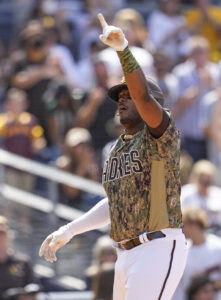
It’s a short-term but lucrative annual deal for the 30-year-old Bell, who looked poised for a long-term commitment in free agency before a sluggish finish to the season following a trade to the Padres. The veteran switch-hitter opened the season on a tear with the Nationals and maintained that production into late July, but after slashing .301/.384/.493 with the Nats (143 wRC+), Bell hit just .192/.316/.271 in San Diego.
Ups and downs are nothing new for Bell, who at multiple points in his career has appeared on the cusp of solidifying himself as a star-caliber slugger, only to fall into a prolonged slump. Back in the first half of the 2019 season, for instance, the former No. 61 overall draft pick erupted with a .302/.376/.648 batting line and 27 home runs. That netted him what remains the only All-Star nomination of his career, but following the Midsummer Classic, Bell backtracked with a solid but unspectacular .233/.351/.429 slash.
His offensive doldrums spiraled out of control in 2020, when he turned in a career-worst .226/.305/.364 slash in the shortened 2020 season. Following that disappointing campaign, the Pirates sold low on the former top prospect by flipping his final two years of club control to the Nationals in exchange for righty Wil Crowe and minor leaguer Eddy Yean.
A month into Bell’s Nationals tenure, it looked to be more of the same, but he righted the ship in May. From May 1, 2021 through this year’s trade deadline, Bell came to the plate 945 times and recorded a stout .289/.373/.489 slash with 39 big flies, 46 doubles, an 11.5% walk rate and a 15.3% strikeout rate that’s far lower than many would expect from a 6’4″, 255-pound first baseman with 30-homer power.
In spite of that sizable frame and the clear raw power Bell possesses, however, he’s never really been a consistent power threat — at least not to the extent one would expect. The juiced-ball season in 2019 was his lone 30-homer campaign (37, to be exact), and his season-to-season home run totals have otherwise ranged between 12 (2018) and 27 (2021).
It’s hard not to wonder what might happen were Bell to commit to elevating the ball more, but that’s easier said than done for any hitter. Bell’s enormous 49.9% ground-ball rate is far higher than one would expect for a slugger of his stature, and he’s taken that mark north of 50% in each of the past three seasons, topping out with a mammoth 55.7% grounder rate in 2022. Since 2020, only five hitters in baseball have put the ball on the ground more frequently than Bell — a confounding trait for a switch-hitter with plus raw power. Three different teams have been unable to coax consistent power production from Bell, but the Guardians will give their best effort to unlock his maximum potential.
To be clear, Bell remains a well above-average hitter in the aggregate, even with the glut of grounders and a career punctuated thus far by peaks and valleys. Dating back to 2019, he’s been 20% better than the average hitter by measure of wRC+, and his career mark in that regard sits at 116 (16% better than average). Bell is a lifetime .262/.351/.459 hitter whose only below-average season at the plate came in the shortened 2020 season.
Also appealing to the Guardians was surely the fact that Bell, like so much of their team, is exceedingly difficult to strike out. No team in baseball fanned at a lower clip than the Guardians’ 18.2% last year — nor was anyone particularly close. Bell, who struck out at just a 15.8% rate in 2022, should fit right in. He’s kept his strikeout rate at 19% or lower each season other than that grisly 2020 campaign, and he’s also drawn walks in an excellent 11.8% of his 3406 career plate appearances.
All of that aligns well with Cleveland’s general offensive philosophy, and while it seems that Jose Abreu was the Guards’ first choice — Cleveland reportedly made him a three-year offer before he signed in Houston — Bell still adds some needed thump who can join Josh Naylor in splitting time at designated hitter and first base. Bell isn’t an all-world defender at first, but he’s improved his defensive ratings from sub-par to slightly above average in recent seasons, and the Guardians surely feel confident that he’s a reliable source of at least 15 to 20 homers with a robust on-base percentage. He’ll join Jose Ramirez as a switch-hitting, middle-of-the-order threat, continuing to give the Cleveland lineup plenty of balance.
If things go according to plan and Bell can ward off another prolonged slump to close out the season, he’ll be a strong candidate to exercise that opt-out provision and return to the open market a year from now. As previously laid out, the overall offensive track record for Bell is quite strong; had he not fallen into that San Diego swoon, he and Boras might have had a case for a contract upwards of five years in length. Depending on the extent of Bell’s success, the Guardians could even issue him a qualifying offer upon opting out.
We predicted that Bell would still be able to command a four-year deal around this AAV on our Top 50 free agent rankings, but the two-year term and opt-out provides some of the best of both worlds. If Bell performs well, he can collect a hearty salary in 2022 and try again for a lengthier deal a year from now. If not, he’ll at least have a second season around the going rate for a bat-first slugger of this nature. And, even if he forgoes the opt-out next offseason, a strong 2024 showing could position him for a multi-year deal.
From a payroll vantage point, Cleveland had ample room to plug him into the mix — history of low payrolls notwithstanding. Bell, assuming an even distribution of his $33MM guarantee, pushes the Guardians to just $35.3MM in guaranteed salary next season. Add in another $35.7MM in projected salaries for arbitration-eligible players (tip of the cap to MLBTR contributor Matt Swartz) and a slate of pre-arbitration players to round out the roster, and the Guardians will sit around the $87MM mark next season — at least as things currently stand.
The Guardians opened the 2021 season with just a $49.6MM payroll and were at $68.2MM to begin the 2022 campaign, but they won the AL Central in ’22 and are only five years removed from trotting out an Opening Day payroll of nearly $135MM. At least on paper, there should be room to make further additions, though that’ll depend on ownership’s willingness to further ramp up payroll as they look to repeat in a weak division.
Giants Continuing Rodon Pursuit Even After Manaea Deal
The Giants’ agreement with lefty Sean Manaea appeared to give them a full rotation, but Susan Slusser of the San Francisco Chronicle reports that even after guaranteeing Manaea $25MM over the next two years (with an opt-out after year one), San Francisco remains engaged with Rodon and agent Scott Boras about a potential reunion.
Manaea, 31 in February, can join Logan Webb, Alex Wood, Alex Cobb and Anthony DeSclafani in comprising a prototypical five-man rotation, but there ought to be room for Rodon on the roster even with that quintet in place. That’s true both because Rodon is a clear upgrade over the majority (arguably all five) of those in-house arms, and also because the internal group comes with a fair bit of injury risk and health uncertainty.
DeSclafani, for instance, was limited to just 19 innings this past season, thanks to a tendon injury in his ankle that eventually required surgical repair. Each of Wood, Cobb and Webb made at least 26 starts, but Cobb and Wood also have lengthy injury histories. Cobb pitched just 158 total innings from 2019-21, owing to groin, back and wrist strains. Wood has made 26 starts in consecutive seasons now, but he pitched just 12 2/3 innings in 2020 and just 35 2/3 innings in 2019 due to back and shoulder injuries. Even Webb, who worked a team-high 192 1/3 innings in 2022, missed a few weeks in 2021 while battling a minor shoulder strain.
No team can be realistically expected to navigate an entire 162-game season with only five starters. While the Giants have some depth with swingman Jakob Junis and minor leaguers Sean Hjelle, Thomas Szapucki, Tristan Beck and Keaton Winn all on the 40-man roster, they also have ample payroll space to make a Rodon-sized splash and figure out the allotment of innings at a later date. Roster Resource projects a $151MM payroll for the upcoming season and a luxury-tax ledger that’s a bit higher ($168.3MM) but nowhere near the first tier of penalization, which begins at $233MM in 2023.
Rodon was reported earlier in the offseason to be seeking a six-year deal worth more $30MM-plus on an annual basis, and Slusser more recently reported that he and Boras have been seeking at least seven years. What’s not clear is whether that shift in length of desired contract comes with a shift in the per-year asking price. We’ve seen teams this offseason increasingly show a willingness to stretch contracts to greater lengths as a means of tamping down AAV. Clubs had been moving away from longer-term, lower-AAV deals for some time — Bryce Harper being a notable exception — instead showing a preference for shorter-term deals at high annual values. That hasn’t been the case this winter, with Trea Turner, Xander Bogaerts, Brandon Nimmo and Jacob deGrom all signing lengthier deals than expected but at lesser annual rates of pay than their highest-paid peers at their respective positions.
Put more simply, if Rodon and Boras set out seeking $180-200MM in total guarantees this winter but were having difficulty finding that, it’s at least possible that the shift toward a deal of seven-plus years in length might be more about reaching that $180MM-plus benchmark than about now seeking seven years at $30MM-plus per season. A seven-year deal worth $185MM, as a purely speculative example, wouldn’t line up with the previously reported AAV target for Rodon but would ensure his place among the ten highest-compensated free agent pitchers in MLB history.
Of course, anything in that vicinity would still shatter most industry expectations heading into the offseason. Two months ago, the most common question regarding Rodon was if he’d done enough to secure a sixth guaranteed year or would need to “settle” for a five-year contract. While reports of Rodon pursuing six, seven or even more years at or near the $30MM AAV threshold don’t serve as a guarantee that he’ll eventually reach those heights, they still represent a departure from where his market was expected to land.
In many ways, that’s a microcosm of the free-agent market at large since the offseason ended. Teams have been willing to spend far more freely than in recent winters, as last March’s collective bargaining agreement assured five years of labor peace and also gave front offices and owners clarity on where the luxury-tax thresholds will sit for the foreseeable future.
Beyond Rodon, the Giants are also known to be keenly interested in shortstop Carlos Correa — their top target after missing on free-agent outfielder Aaron Judge. Whether they’re willing to pony up and make commitments to both Rodon and Correa isn’t clear, though it’d certainly register as a surprise, as that pairing could wind up costing something in the range of $450-500MM combined.