
Guardians Release Kirk McCarty
NOVEMBER 17: McCarty has been released, according to the transactions log at MLB.com.
NOVEMBER 15: The Guardians announced a series of roster moves in setting their 40-man roster in advance of next month’s Rule 5 Draft. In addition to tonight’s pair of trades — Nolan Jones to the Rockies; Carlos Vargas to the D-backs — Cleveland has designated lefties Anthony Gose and Kirk McCarty for assignment. The series of subtractions from the 40-man paves the way for the Guardians to select the contracts of infielder Angel Martinez and lefties Joey Cantillo and Tim Herrin. Cleveland also selected infielder Juan Brito, whom they acquired from Colorado in exchange for Jones. The team’s 40-man roster is at capacity.
It’s been quite the year for McCarty, from a transactions standpoint. Originally called to the Majors as a Covid replacement in April, McCarty was returned to the minors shortly thereafter but formally selected to the 40-man roster the following month. Cleveland designated him for assignment on July 3, after which he was claimed by the Orioles, who designated him for assignment just nine days later and lost him on waivers… back to the Guardians. Beyond that series of moves, McCarty was optioned to the minors on four separate occasions over the course of his roller coaster season.
The 27-year-old McCarty generated decent but unspectacular results at the big league level in his his rookie effort this year, logging a 4.54 ERA in 37 2/3 frames. His 16.4% strikeout rate was well below average, but he turned in a respectable 8.2% walk rate. McCarty has well above-average spin on his fastball and curveball, but he doesn’t throw especially hard or miss many bats, and the 2.63 HR/9 he yielded this season is an obvious red flag. He was solid in Triple-A (3.52 ERA in 65 1/3 innings) and does have multiple minor league option years remaining, so another club in need of some left-handed depth could conceivably take a look.
Gose, 32, was one of baseball’s feel-good stories in recent years. Originally a second-round pick and top prospect as an outfielder, his career stalled out after he was unable to produce much at the plate in the Majors or in the upper minors. Gose, a two-way star in high school who some scouts preferred as a pitcher in the draft, got back on the mound in A-ball as a 26-year-old in 2017 and, after taking several years to refine his command and learn to control his blazing fastball, finally made it back to the big leagues in 2021.
Gose didn’t just return to the Majors last year, though. He tossed 6 2/3 innings out of the Cleveland bullpen and allowed just a run on two hits and two walks with nine strikeouts and a heater that averaged 99.2 mph. It was a small sample, of course, but Gose stormed out of the gates in 2022 with 20 1/3 innings of 3.10 ERA ball and a 31.4% strikeout rate. Walks looked like an issue (14%), but by that point Gose’s big league pitching career consisted of 27 innings of 3.00 ERA ball with 36 strikeouts.
The Yankees pounced on Gose for four runs in his next outing, however, after which he landed on the injured list. The Guardians initially characterized the move as one made out of necessity with a doubleheader looming, but Gose’s absence proved protracted, and more than two months after he was shelved, the team announced Gose had undergone Tommy John surgery. The Sept. 14 date of the procedure all but formally rules Gose out for the 2023 campaign, so it’s no surprise to see the Guardians open his roster spot in this fashion.
Joining the Guardians’ 40-man roster are two of their top 30 prospects — Martinez and Cantillo — as well as a lefty reliever (Herrin) who posted eye-popping numbers in Double-A. Baseball America ranks Martinez 12th in Cleveland’s system and Cantillo 15th. Martinez hit .278/.378/.471 as a 20-year-old between High-A and Double-A this season. Cantillo was limited to just 60 2/3 innings by a shoulder strain this season but made 14 appearances (13 starts) with a 1.93 ERA and 35.5% strikeout rate. Herrin, 26, turned in a 2.01 ERA and 41.6% strikeout rate in 22 1/3 Double-A innings before being bumped to Triple-A, where he recorded a 4.98 ERA and “just” a 30.9% strikeout rate in 47 frames.
A’s Claim Brent Rooker
The Athletics announced Thursday that they’ve claimed outfielder/first baseman Brent Rooker off waivers from the Royals. Kansas City designated Rooker for assignment earlier in the week.
Rooker, 28, was the No. 35 overall draft pick by the division-rival Twins back in 2017. The hope was that the former Mississippi State slugger could be a quick-the-Majors source of pop for the Twins, and that proved to be partially true. Rooker mashed his way through the minor leagues, reaching Triple-A by the 2019 season and hitting .281/.398/.535 through 274 plate appearances there. Minnesota gave him a brief big league look during the shortened 2020 season, and Rooker responded with a 6-for-19 showing, including a homer and a pair of doubles.
Unfortunately, that brief production didn’t carry over into a larger sample in 2021. Rooker remained productive in Triple-A (.245/.367/.564, 20 homers in 62 games) but managed only a .201/.291/.397 slash with an ugly 32.9% strikeout rate in 213 plate appearances at the MLB level in 2021. The Twins sent Rooker to San Diego alongside Taylor Rogers in the trade that brought Chris Paddack and Emilio Pagan to Minnesota, and Rooker again thrived in Triple-A while struggling in limited MLB action.
Overall, Rooker is a .200/.289/.379 hitter in 270 Major League plate appearances but a .274/.387/.590 hitter in 906 Triple-A plate appearances. While he’s seen time both in left field and at first base in his career, however, scouting reports at the time of the draft called it a stretch for him to ever be a full-time outfielder, and that’s just how things have played out so far. In just 386 2/3 innings in the outfield corners, Rooker has posted -11 Defensive Runs Saved, -7 Outs Above Average and a -4.8 Ultimate Zone Rating. Ultimately, if he’s to solidify himself in the big leagues, his bat will need to carry the day, and he’ll likely need to move to either first base or designated hitter.
Rooker has one minor league option year remaining, so the A’s will be able to shuttle him between Oakland and Triple-A Las Vegas in 2022 — assuming he lasts the whole offseason on the 40-man roster. Oakland is as good a landing spot as Rooker could have hoped for, given that the rebuilding A’s only have two set outfielders in the out-of-options Cristian Pache and Ramon Laureano — the latter of whom could be traded. Lefty-swinging Seth Brown will rotate between the outfield corners, first base and DH, but there’s clearly playing time available for Rooker if he can hit his way into a roster spot next spring.
Mozeliak: Cardinals Seeking Catching Help, Left-Handed Bat
The Cardinals bid farewell to a pair of franchise icons at season’s end, as Albert Pujols and Yadier Molina officially closed the books on their playing career. For the first time in nearly two decades, St. Louis enters an offseason unsure of who’ll receive the bulk of the playing time behind the dish the following season. While the Cardinals have in-house options in Andrew Knizner and Ivan Herrera, president of baseball operations made clear in an appearance on MLB Network Radio on SiriusXM this week that he’s actively exploring the market for catching upgrades.
“Clearly, with Yadi retiring, we know we need to upgrade at catching — especially when you think about the day-to-day demands of that role,” said Mozeliak. “That’s something that we’re going to look at, whether it’s trade or free agency.”
Asked about interest in top catcher Willson Contreras, Mozeliak declined to publicly comment on the free agent’s potential market, calling that a “dangerous game” and instead simply doubled down on interest in catching help: “We are in the catching market.”
Contreras, a longtime division rival, is this year’s top free-agent catcher, with former Red Sox and Astros backstop Christian Vazquez the clear No. 2 option. They’re not the only names available, of course, but they’re the two clear-cut starting catchers coming off strong 2022 campaigns. Rebound candidates include Omar Narvaez, Mike Zunino and Tucker Barnhart, all of whom had down 2022 seasons but were quite recently considered quality starting options behind the dish.
As Mozeliak alluded to, the trade market should produce a handful of alternatives. Oakland’s Sean Murphy will be available, though the asking price for three years of his services will be understandably steep. The Blue Jays, meanwhile, have a trio of starting-caliber catchers on the roster in Danny Jansen, Alejandro Kirk and top prospect Gabriel Moreno. Jansen, with two years of remaining club control to Kirk’s five and Moreno’s six, is generally seen as the likeliest of the group to move.
Whatever path the Cards take, an addition at catcher feels like a foregone conclusion. Knizner, 27, has served as the primary backup to Molina in recent seasons and managed only a .204/.292/.288 slash through 536 big league plate appearances. Optimists might suggest that he’d improve with more consistent playing time than he received Molina and his iron-man approach to catching, but Knizner has also drawn sub-par defensive marks along the way. The 22-year-old Herrera went 2-for-18 in his MLB debut this year but turned in a solid .268/.374/.396 line in Triple-A. Still, a team hoping to vie for a return to the postseason could use more certainty behind the dish, perhaps easing the well-regarded Herrera into a larger opportunity — as opposed to simply throwing him into a trial-by-fire run at the starting job.
Catching help isn’t all that’s on the menu this winter for Mozeliak, GM Mike Girsch and the rest of the front office, though. Mozeliak didn’t specify a position but did voice hope of adding a left-handed bat to help balance out his lineup. Given that most of the available catching options are right-handed bats — Narvaez and the switch-hitting Barnhart being the exceptions — it’s likely the Cards will have to make an additional move to achieve that goal.
“When you look at our offense, trying to find something from the left side to try to help bolster our day-to-day lineup is something we think we could benefit from,” said Mozeliak. “…”When you think about our club from the left side, we could just use a little extra pop. Some of our better hitters are right-handed, and so we’re just looking for more balance in our lineup.
The Cards aren’t totally devoid of left-handed bats but do skew more toward the right side of the dish — particularly when it comes to the team’s power hitters. Lars Nootbaar showed some impressive power from the left side of the dish and likely secured himself a spot in the 2023 outfield, but he’s the main source of left-handed pop the Cardinals have at the moment. Rookie of the Year finalist Brendan Donovan had an outstanding all-around season but hit just five homers and posted a lowly .097 ISO (slugging minus batting average). Switch-hitters Tommy Edman and Dylan Carlson were both vastly better hitters from the right side of the plate than the left. Twenty-two-year-old Nolan Gorman certainly has power from the left side of the plate but struggled increasingly as his rookie season wore on.
Last offseason’s signing of Corey Dickerson seemed intended to provide some help in this space, and while Dickerson rebounded from an awful start to finish with a roughly league-average batting line, he’s again a free agent and the Cardinals are surely hoping for more than average output from whoever is acquired to fill this role. The free-agent market isn’t exactly teeming with productive left-handed hitters who could be plugged into the St. Louis lineup, though veterans like Michael Brantley, Michael Conforto and old friend Matt Carpenter are all available. The former two will both be returning from shoulder surgery, whereas the latter enjoyed an otherworldly rebound with the Yankees before suffering a fractured foot that derailed his comeback effort.
As is so often heard from baseball operations leaders, Mozeliak also touched on the adage that a team can never have too much pitching, noting that “you’re always just one injury away from being in a tough spot.” While he didn’t characterize the Cardinals’ search for rotation depth as quite the same level of priority as a catcher and left-handed bat, Mozeliak suggested that the Cardinals will “keep the pulse” of the starting pitching market as the offseason progresses.
With Adam Wainwright, Miles Mikolas, Jordan Montgomery, Steven Matz, Jack Flaherty and Dakota Hudson, the Cardinals have at least six rotation options — Mozeliak also listed Drew VerHagen as a potential depth option there — but bolstering that group with a swingman or some veterans on minor league deals could well be on the eventual to-do list.
NPB’s Hiroshima Carp To Sign Matt Davidson
The Hiroshima Carp of Japan’s Nippon Professional Baseball have signed infielder Matt Davidson to a one-year contract, per Yahoo Japan. Davidson is represented by CAA.
It’ll be the first stint overseas for Davidson, the No. 35 overall pick in the 2009 draft (D-backs) and former top prospect who’s appeared in parts of six MLB seasons dating back to his 2013 debut. The bulk of Davidson’s MLB action has come with the White Sox, for whom he slugged 46 home runs between the 2017-18 seasons. However, despite Davidson’s clear plus power, he’s been hampered by a lofty 34.3% strikeout rate that has helped suppress his overall output. In 1112 plate appearances at the MLB level, Davidson is a .220/.290/.430 hitter with 54 home runs. He most recently appeared in 13 games between the A’s and D-backs in 2022.
Though he’s had his struggles at the big league level, Davidson has a much stronger track record in Triple-A — including a 2022 season in which he posted a mammoth .310/.414/.644 slash with 32 home runs in just 332 plate appearances between the top affiliates for Oakland and Arizona. The Pacific Coast League is notoriously hitter-friendly, but it’s nonetheless impressive to see that Davidson has slugged 60 round-trippers in his past 170 Triple-A games — and 93 in his past 275 games, dating back to 2019.
Even with consistent production in Triple-A over the past few seasons, Davidson hasn’t gotten much in the way of an MLB look. He’s appeared in just 35 big league games since Opening Day 2019. In Japan, Davidson will receive consistent playing time and a far heftier salary than he’d have otherwise earned as a likely minor league signee who’d be seen as a depth option for a Major League club.
Mariners Have Shown Interest In Kolten Wong
Fresh off yesterday’s acquisition of Teoscar Hernandez, the Mariners are again looking to the trade market to solidify some areas of need. Seattle has reached out to the Brewers to inquire on the potential availability of second baseman Kolten Wong, reports Jon Morosi of MLB.com (Twitter link).
Wong is a natural target for the Mariners, given their lack of a clear starter at second base and a lineup that skews a bit right-handed. The Brewers picked up a $10MM club option on the two-time Gold Glove winner just last week, but Milwaukee’s massive arbitration class and mounting payroll opens the door for the trades of some players on notable salaries. While picking up Wong’s option shows that the team is certainly comfortable committing what was a net $8MM to him — the option had a $2MM buyout — Milwaukee also surely recognized that at one year and $10MM, Wong may also be a desirable trade commodity.
Should the Brewers ultimately trade Wong, they might not feel compelled to look outside the organization for an alternative. Luis Urias is currently slated to play third base in 2023, but he has ample experience at second and could appear there more regularly in the absence of Wong. Alternatively, former first-round pick Brice Turang played a full season in Triple-A at just 22 years of age and held his own against more seasoned competition, batting .286/.360/.412 (108 wRC+) with 13 home runs, 24 doubles, two triples, 34 steals (in 36 tries), a 10.8% walk rate and a 19.6% strikeout rate. He’s already on the 40-man roster and quite arguably ready for a look in the big leagues.
The 2022 season was an odd one for Wong — one of his best with the bat and perhaps his worst with the glove. The 32-year-old smacked a career-high 15 home runs and batted .251/.339/.430, adding 24 doubles, five triples and 17 steals (in 23 tries) along the way. The 2022 season marked a second straight year of improved power for Wong, who put the ball on the ground at a 47% clip during his eight-year tenure with the Cardinals but has dropped that to 42% as a member of the Brewers. Whether it’s been a conscious decision to elevate the ball more regularly or simply an organic development in his swing path, the uptick in power is noticeable. It’s come with a slight bump in his strikeouts, but Wong’s 17.7% rate in 2022 was still well shy of the league average.
On the defensive side of the game, however, the 2022 season was a bizarre and borderline nightmarish one for Wong. Typically one of the game’s best defenders at his position, Wong made a stunning 17 errors — more than he’d totaled in the three prior seasons combined. When his option was picked up, Wong told the Milwaukee Journal-Sentinel’s Todd Rosiak that his legs weren’t fully healthy in 2022, which he felt contributed to his surprising defensive shortcomings (Twitter links). Wong missed time in June with a calf strain that sent him to the injured list, and it’s certainly plausible that his legs cost him some of his typical defensive excellence.
Though he’s a natural fit for the Mariners, Wong is no lock to be traded and is but one of many options Seattle could pursue at the position. Old friend Jean Segura is the top second baseman on the market, and Brandon Drury is another potential free-agent option, although he played far more third base than second base in 2022. The Mariners could, for a second straight offseason, try to convince a premier shortstop to sign in Seattle and slide over to second base. Dipoto’s Mariners appear committed to keeping J.P. Crawford at shortstop, even on the heels of his own down season with the glove.
Braves Unlikely To Pursue Big Name Shortstops If Swanson Signs Elsewhere
The Braves have had more success in extending young, core players than any team in recent memory, but for a second straight offseason they’re facing the potential departure of a longtime regular who’s helped to anchor the infield. Dansby Swanson, like Freddie Freeman before him, reached the open market without signing an extension, has rejected a qualifying offer and is now free to field interest from the game’s other 29 teams.
Atlanta reportedly offered Swanson an extension in the neighborhood of $100MM at some point over the course of the season, but the widespread expectation is for him to outpace that guarantee by a comfortable margin. (MLBTR predicted a seven-year, $154MM contract on last week’s Top 50 free agent list.) One of the biggest questions on the minds of Braves fans is just what the team will do at shortstop. Can Swanson be retained? And, if not, where does the team turn? The market offers a trio of high-end alternatives in the form of Trea Turner, Carlos Correa and Xander Bogaerts.
As Ken Rosenthal of The Athletic reports, however, it’s unlikely that the Braves will make a legitimate play to sign any of the big free-agent shortstops other than Swanson. President of baseball ops Alex Anthopoulos went out of his way to mention Vaughn Grissom and Orlando Arcia as in-house alternatives at last week’s GM Meetings, and Rosenthal adds that the Braves are generally reluctant to add a major salary that “takes up too high a percentage of their payroll” — including oft-speculated fit Jacob deGrom.
Braves fans were understandably heartened by CEO Terry McGuirk’s comments about Atlanta growing to have one of the game’s five largest payrolls, but what McGuirk didn’t stress was just how close the Braves already are to reaching that territory before making a single addition. Last month at MLBTR, I pointed out that for the Braves to make even one high-priced acquisition, they’d need to exceed the luxury-tax threshold; making a pair of big-name additions — or signing one premier free agent and, say, extending Max Fried — could shatter the threshold and send the team barreling into at least the second tier of luxury penalization.
As things currently stand, Roster Resource’s Jason Martinez projects the Braves to be less than $5MM away from tier one of the luxury tax . They’d be a first-time luxury payor, so the penalty on the first $20MM by which they cross that threshold would “only” be 20%. The penalty on the next $20MM would jump to a 32% tax.
We’ll get back to the shortstop quandary, but it’s worth digressing and taking a deeper look at just what the luxury tax realities might look like for the Braves.
To put this into more specific context, we can use deGrom as an example. Many believe that the four-time All-Star and two-time Cy Young winner could secure an average annual value of $40MM or more this winter. A $40MM AAV on deGrom would push the Braves’ luxury-tax bill up into the $268MM range — an overage of roughly $35MM. The 20% tax on that first $20MM would come out to $4MM, and the 32% tax they’d be paying on the next $15MM would be another $4.8MM. So to sign deGrom for a $40MM AAV, the Braves would effectively need to be willing to pay $48.8MM in total — at least for the upcoming season. With Justin Verlander seeking a deal comparable to that of Max Scherzer, this can all be applied to him as well.
It’s a similar, but not quite so extreme case with Swanson. Using the $22MM AAV on MLBTR’s predicted contract as an example, Swanson would push the Braves a bit more than $17MM over the luxury tax on his own. That’d make our predicted $22MM AAV more akin to paying $25.4MM this season. And, of course, signing Swanson at that rate would mean that any subsequent salary additions of note would then push the Braves into the second tier of penalization, subjecting them to the same 32% rate mentioned in the deGrom example.
The other wrinkle is that any such signing would further cause the team’s luxury bill to balloon in future seasons. The Braves already have about $135MM of luxury obligations on their 2024 payroll, two years down the road, and that doesn’t include potential club option pickups for veterans like Charlie Morton, Kirby Yates and Collin McHugh — nor does it include arbitration salaries for Fried, A.J. Minter and Kyle Wright. Paying the luxury tax for consecutive seasons would cause those rates of penalization also increase (30% in tier one, 42% in tier two, etc.).
Certainly, there are ways for the Braves to lower their current luxury tab and provide further breathing room, though the path to doing so is not an easy one. There’s little hope of finding a team willing to cover even a small portion of the $36MM still owed to Marcell Ozuna through 2024. Atlanta would probably welcome the opportunity to shed the $9MM owed to Eddie Rosario in 2023, but that’s also far easier said than done after he hit .212/.259/.328 in the first season of a two-year, $18MM contract. One recent source of Twitter speculation among fans — a possible trade of Ronald Acuna Jr. — is not something the Braves are considering, per Rosenthal.
Lengthy digression aside, let’s get back to the shortstop question. If, as Rosenthal suggests, the team is likely to be “out of the picture” for any of Correa, Turner or Bogaerts in the event of a Swanson departure, what might that mean for their 2023 outlook at shortstop?
Grissom and Arcia are in-house candidates, as alluded to by Anthopoulos, but Grissom’s bat wilted after a torrid start to his rookie season in 2022. He still finished with a terrific .291/.353/.440 batting line in 156 plate appearances, but Grissom slashed .420/.463/.660 in his first 54 plate appearances and just .220/.294/.319 over his final 102 trips to the plate. He also skipped Triple-A entirely on his way to the Majors, and scouting opinions on his long-term outlook at shortstop vary. Arcia, once one of the game’s top-ranked prospects, was a roughly league-average hitter in a part-time role last year but carries a .233/.288/.356 slash (70 wRC+) over the past five years.
The free-agent market has some modest stopgaps who could help ease Grissom into the full-time role at shortstop. Elvis Andrus was released by the A’s over the summer, but that was more about preventing his 2023 vesting option from kicking in than about his play. He had a strong finish after signing with the White Sox and hit a combined .249/.303/.404 with 17 homers and 18 steals between the two clubs. Jose Iglesias keeps hitting for average and rarely striking out — .291/.325/.408, 13.1% strikeout rate since 2019 — but defensive metrics have soured on the soon-to-be 33-year-old over the past two seasons. Old friend Andrelton Simmons is a free agent, too, but he’s batted just .216/.277/.261 in 536 plate appearances since Opening Day 2021.
None of those free-agent options are going to inspire Braves fans much — save for the possible nostalgia of a Simmons reunion — but they highlight the fact that it’s a thin crop beyond the “Big Four.” The trade market, then, could be a more palatable approach for Anthopoulos to explore. Cleveland’s Amed Rosario is a clear trade candidate with just a year to go before free agency and a mounting (by the Guardians’ standards) price tag. He’s projected by MLBTR contributor Matt Swartz to earn $9MM next year, and a low-payroll Guardians club that’s deep in MLB-ready middle infield prospects could look to cash in on the 27-year-old, as I recently explored at greater length.
The Yankees figure to be open to moving on from Isiah Kiner-Falefa now that Oswald Peraza is ready for a look in the Majors. The Reds would likely be open to dealing Kyle Farmer, with whom Anthopoulos is surely familiar dating back to his Dodgers days. Arizona’s Nick Ahmed and St. Louis’ Paul DeJong are veteran alternatives who could be had for pennies on the dollar, as the D-backs and Cardinals would surely welcome the chance to just shed some of the respective $10MM and $11MM remaining on their contracts. Both are buy-low options, at best, coming off poor showings in recent seasons. Any of Kevin Newman (Pirates), Nicky Lopez (Royals) or the oft-injured Adalberto Mondesi (Royals) could likely be had in a deal, but each has some obvious red flags.
To be clear, there’s no indication that the Braves plan to simply stand pat this winter. A reunion with Swanson remains eminently plausible, even if previous extension attempts with his representatives — the same agents who represent Freeman, for what it’s worth — have yet to bear fruit. It’d push the Braves into luxury territory for the first time in franchise history, but based on McGuirk’s comments about a potential top-five payroll club, that’s something on which the front office will have a green light, at least with regard to Swanson.
What does seems far less likely is a lavish spending spree that sees the Braves make multiple marquee splashes on the free-agent market. If Swanson does sign elsewhere, it’s the bulk of the Braves’ heavy lifting may very well come via the trade market and the middle tiers of the free-agent market.
Royals Release Sebastian Rivero
The Royals announced Wednesday that they’ve requested unconditional release waivers on catcher Sebastian Rivero, whom they designated for assignment last week. He’d be a free agent upon clearing.
Being placed on release waivers surely isn’t how Rivero wanted to spend his 24th birthday, but that’s the position in which he finds himself. The Venezuelan-born backstop has appeared briefly in each of the past two big league seasons with the Royals but struggled to a .167/.236/.197 batting line in a tiny sample of 73 plate appearances. Rivero has had more success in Triple-A, albeit in a similarly small number of plate appearances. In 171 trips to the plate there, he’s slashed .266/.322/.380.
Rivero was optioned to the minors the maximum five times during the course of the 2022 season, plus another three times in 2021. The up-and-down nature of his time with the Royals over the past two seasons, coupled with the canceled 2020 minor league season, have played a role in limiting his overall experience in the upper minors. Despite debuting as a teenager back in 2016, Rivero has appeared in just 383 games as a professional. He sports an above-average 29% caught-stealing rate but has posted sub-par framing marks in the minors, per Baseball Prospectus. He’ll likely land with a team in need of some catching depth on a minor league deal this offseason.
Angels Sign Tyler Anderson
The Angels have made a notable addition to their starting staff, announcing agreement Wednesday on a three-year contract with free-agent lefty Tyler Anderson. It’s reportedly a $39MM guarantee with $13MM salaries paid out annually. Anderson had received a one-year, $19.65MM qualifying offer, but his deal with the Halos means he’s turning that down for a more lucrative pact. Anderson is represented by the Beverly Hills Sports Council.
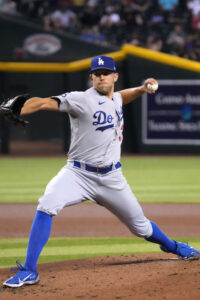
Anderson, 33 in December, turned in a career-best season with the Dodgers in 2022, pitching to a 2.57 ERA in a career-high 178 2/3 innings. Along the way, he punched out 19.5% of his opponents against a 4.8% walk rate and 40.1% ground-ball rate.
A former first-round pick of the Rockies (No. 20 overall, in 2011), Anderson showed promise as a rookie in 2016 (3.54 ERA in 114 1/3 innings) before beginning to struggle at Coors Field and eventually incurring a fairly serious knee injury that derailed some of his prime years. Anderson was diagnosed with a chondral defect in the cartilage of his left knee, which sidelined him for the better part of a year and led to the end of his tenure with the Rockies.
Since leaving Colorado, Anderson’s climb back to big league relevance has been impressive, to say the least. Signed to a one-year, make-good deal by the Giants heading into 2020, Anderson did just that in the Covid-shortened season. A 4.37 ERA in 11 starts/13 total appearances wasn’t exactly eye-popping, but it earned him another big league deal with the Pirates the following season. Both the Phillies and Mariners went hard after Anderson at the ’21 trade deadline, with the lefty ultimately landing in Seattle. His 31 starts of roughly league-average pitching netted him a late one-year deal with the Dodgers.
As they so frequently do, the Dodgers found a way to coax a new level of performance out of Anderson in 2022. Anderson didn’t overhaul his pitch repertoire but did rely more heavily on his changeup than he has in all but the shortened 2020 season. R.J. Anderson of CBS Sports points out that Anderson also abandoned a changeup grip he’d been using in recent years and went back to an old grip that wound up generating more drop and limiting hard contact more effectively than ever before. Anderson ranked in the 98th percentile of MLB pitchers in terms of average exit velocity and opponents’ hard-hit rate, and he sat in the 95th percentile in terms of opponents’ chase rate on pitches off the plate.
It’ll now be incumbent upon the Angels to help Anderson sustain the 2022 version of himself even as he pitches into his mid-30s. It’s the first multi-year contract of Anderson’s career, and, more surprising, the first multi-year contract the Angels have given out to a free-agent starting pitcher since signing Joe Blanton ten years and three general managers ago. Owner Arte Moreno has seemingly been averse to multi-year pacts for free agent starters in all but a few special cases — the Halos pursued Gerrit Cole, for instance — and it’ll be Anderson who bucks that trend at a time when Moreno is exploring a potential sale of the franchise. It’s also the second straight winter in which Moreno and general manager Perry Minasian have jumped the market to sign a pitcher who’d received a qualifying offer; the Angels signed Noah Syndergaard to a one-year, $21MM contract last year before his QO decision was formally due.
Anderson will step into a rotation that’s fronted by two-way superstar Shohei Ohtani, giving manager Phil Nevin a fourth lefty to follow his ace in the rotation. The Angels’ trio of Patrick Sandoval, Reid Detmers and Jose Suarez enjoyed, in somewhat under-the-radar fashion, a very productive 2022 season.
Adding Anderson gives the Angels a strong quintet on which to lean, and the Halos have a handful of in-house options to round out a six-man rotation if they prefer to get Ohtani an extra day of rest. Righties Chase Silseth, Griffin Canning, Chris Rodriguez, Janson Junk, Touki Toussaint and Davis Daniel are all on the 40-man roster, as are southpaws Tucker Davidson, Jhonathan Diaz and Kenny Rosenberg. That certainly doesn’t preclude further additions, and it’s possible that some of those depth options won’t even last the entire offseason on the 40-man roster.
The deal pushes the Halos to a projected $173MM for the 2023 season, per Roster Resource’s Jason Martinez. For luxury-tax purposes, the Anderson deal pushes the Angels to a projected $187.5MM.
The Angels opened the 2022 season with a franchise-record $188.6MM payroll, so by signing Anderson they’re already vaulting themselves up to about $15MM from their highwater mark. With several holes to fill around the roster — infield, perhaps corner outfield, bullpen — they’re likely ticketed for what will be a third consecutive season of pushing to a new franchise record.
Because the Dodgers paid the luxury tax in 2022, their compensation for losing Anderson will be a pick between the fourth and fifth rounds of next year’s draft. The Angels, meanwhile, as a team that neither received revenue sharing nor paid the luxury tax, will surrender their second-highest draft selection and see their league-allotted international bonus pool reduced by $500K.
Jon Heyman of the New York Post first reported Anderson and the Angels were in agreement. Joel Sherman of the New York Post first reported it was a three-year deal in the $40MM range, while Mark Feinsand of MLB.com specified the $39MM guarantee. Jeff Fletcher of the Orange County Register reported the even annual salary disbursement.
Bryce Harper To Undergo Elbow Surgery Next Week
Phillies star Bryce Harper will undergo elbow surgery to repair his damaged ulnar collateral ligament next Wednesday, president of baseball operation Dave Dombrowski announced today (Twitter link via Scott Lauber of the Philadelphia Inquirer). Imaging hasn’t conclusively determined whether Harper will require a full Tommy John surgery (i.e. ligament replacement) or whether an internal brace procedure could suffice, so the team won’t have a timeline until the surgery is performed.
Harper was diagnosed with a UCL tear back in May but was able to continue his 2022 season as the Phillies’ primary designated hitter. Position players who sustain UCL tears are often able to continue hitting, but throwing is obviously not an option with such an injury. Even in the event of a full Tommy John surgery, it should be noted that Harper could very likely return to the field as a DH for a notable portion of the 2023 season.
Shohei Ohtani, for instance, spent only the first five weeks or so of the 2019 season on the injured list before returning as a designated hitter. His surgery was performed in early October of 2018 — some seven weeks earlier in the offseason than Harper will go under the knife. Every player’s rehab is different, of course, but a summer return would seem plausible even in the worst-case scenario for Harper. If an internal brace procedure is sufficient, Harper could conceivably return in even shorter order.
Even with the damaged UCL, Harper remained a force in the middle of the Phillies’ lineup. Harper homered in three consecutive games following the diagnosis and batted .295/.381/.510 the rest of the way after learning of the tear. A broken thumb sustained when he was hit by a pitch sidelined him for a notable portion of the summer, but neither injury could prevent Harper from mashing when healthy enough to play. His postseason teetered on historic, as Harper slashed .349/.414/.746 with six home runs and seven doubles in just 71 plate appearances. His NLCS-winning home run against the Padres will forever be etched in Phillies lore.
Harper is still only four years into the 13-year, $330MM contract he signed as a free agent prior to the 2019 season, but to this point it’s hard to call the contract anything other than a roaring success. Since putting pen to paper and making Philadelphia his long-term home, Harper has batted a combined .282/.384/.546 (not including this year’s postseason exploits), won an NL MVP Award and helped bring the Phillies back to the postseason for the first time since 2011. He’s still owed $222MM over the remaining nine years of the deal, though with the typical AAV for premium players now well north of $30MM, that $24.667MM AAV looks like a bargain for Harper.
Blue Jays Trade Teoscar Hernandez To Mariners
Mariners president of baseball operations Jerry Dipoto wasted little time making his first big splash on the trade market this offseason, as the Mariners announced Wednesday that they’ve acquired All-Star right fielder Teoscar Hernandez from the Blue Jays in exchange for setup man Erik Swanson and pitching prospect Adam Macko.

Hernandez, who turned 30 a month ago, will give the Mariners a heart-of-the-order slugger who’s posted a stout .283/.333/.519 batting line with 73 home runs and 71 doubles through 1337 plate appearances over the past three seasons. Hernandez has been a Statcast darling since the time of his big league debut, regularly posting top-of-the-scale exit velocity and hard-hit rates; that was no different in 2022, when Statcast ranked him in the 94th percentile or better in hard-hit rate, average exit velocity, max exit velocity, barrel rate and expected slugging percentage.
That penchant for elite contact and plus power output from Hernandez comes at something of a cost. While he’s curbed his once-sky-high strikeout totals to an extent, Hernandez still fanned in 28.4% of his plate appearances last season. He got the strikeout rate all the way down to 24.9% in 2021, so there’s perhaps hope for some further gains, but as of right now that number is an outlier with regard to the rest of his career. His walk rate, meanwhile, has steadily clocked in between six and seven percent over the past few seasons — a good bit shy of league average.
Beyond the huge power, Hernandez possesses deceptive speed. He’s only tallied 24 steals (in 32 tries) over the past three seasons, including just six in 2022, but Hernandez’s sprint speed ranks in the 84th percentile of MLB players, per Statcast. With slightly larger bases expected to perhaps spur a bit more running in 2023, Hernandez is among the many players who could conceivably begin to take off with a bit more frequency. Hernandez is also known for having one of the game’s strongest throwing arms. Despite that speed and arm strength, however, he draws consistently below-average grades for his glovework in right field; Defensive Runs Saved and Outs Above Average have pegged him as a negative defender in each of the past four seasons. In 2022, he tallied minus-3 DRS, minus-5 OAA and a minus-3.1 Ultimate Zone Rating.
Even if his speed and arm don’t translate to plus right field defense, Hernandez has been a well above-average all-around player in recent years, when looking at the sum of his parts. Both FanGraphs and Baseball-Reference peg him right at eight wins above replacement in his past 324 games. Those 324 games have come across three seasons, though one was the shortened 2020 campaign. Generally speaking, Hernandez has avoided major injuries. He missed three weeks this season due to an oblique strain and was sidelined in 2021 by a positive Covid test (plus three games on the paternity list). Overall, however, he’s played in 84.3% of his team’s possible games since 2020.
Barring an extension, Hernandez will be a one-year rental for the Mariners — and a relatively pricey one, at that. Hernandez will reach six years of service time in 2023 and become a free agent next winter. MLBTR contributor Matt Swartz projects a sizable $14.1MM salary for him this season.
Dipoto said at last week’s GM Meetings that he sought at least one outfield upgrade this winter, if not two. Hernandez should slot into right field alongside center fielder and AL Rookie of the Year Julio Rodriguez, but his presence in Seattle creates some additional questions. The club opted not to make a qualifying offer to Mitch Haniger, for instance, and while Hernandez’s acquisition doesn’t squarely rule out Haniger returning to rotate through the outfield corners and DH, today’s trade inherently makes a reunion feel less likely.
The Mariners will have to determine whether they’re comfortable with a combination of former top prospects Jarred Kelenic, Kyle Lewis and Taylor Trammell in left field. Jesse Winker is another left field/DH option, though as of yesterday, the Mariners were discussing trade packages involving Winker. It’s easy enough to envision that group, with some help from utilitymen Dylan Moore and Sam Haggerty, holding down the fort in the corners and at DH, but further additions shouldn’t be ruled out.
The Mariners, after all, are squarely in win-now mode. And even with Hernandez aboard, they have ample payroll capacity; acquiring Hernandez is an approximate $12.7MM net add to the payroll, as Swanson had been projected by Swartz to be paid $1.4MM. They’re projected by Roster Resource for a $143.5MM payroll following the swap, and that’s a ways shy of the $162MM peak they trotted out in 2018. A return to the playoffs has likely boosted revenue a bit, and MLB has agreed to various lucrative streaming deals that afford each team considerable annual payouts in the five years since that previously established record payroll.
Turning to the Blue Jays’ side of the deal, they’ll simultaneously add a much-needed power arm to the bullpen and shed that aforementioned (and approximate) $12.7MM in payroll. They’re still projected for what would be a franchise-record Opening Day payroll in the $176MM range, but the trade gives them some more flexibility while adding a crucial arm to the relief mix. Swanson, originally acquired by the Mariners in the trade that sent James Paxton to the Yankees, struggled as a starter but has broken out as a powerhouse in the Seattle bullpen.

The 3.31 ERA, 24.3% strikeout rate and 6.9% walk rate Swanson logged in 35 1/3 innings during the 2021 season were a step in that direction, but it wasn’t until this past season that he became a dominant late-inning force. Swanson’s 2022 campaign resulted in 53 2/3 innings of 1.68 ERA ball with a massive 34% strikeout rate against just a 4.9% walk rate. In all, since establishing himself in 2021, Swanson owns a 2.33 ERA in 89 innings of relief — a mark that is largely supported by fielding-independent metrics (2.59 FIP, 2.87 SIERA).
Swanson is an extreme fly-ball pitcher, so some may have concern about his transition from a pitcher-friendly setting at T-Mobile Park to the homer-happy confines of Toronto’s Rogers Centre, but the fact is that very few of the fly-balls he yields are hit with authority. Among the 385 pitchers with at least 80 innings over the past two seasons, Swanson has induced infield pop-ups at the sixth-best rate in MLB.
Swanson was also a batted-ball deity on the mound in 2022, ranking near the top of the league in terms of average exit velocity (98th percentile), hard-hit rate (96th), expected ERA and wOBA (97th), expected slugging percentage (94th), overall strikeout rate (96th) and opponents’ chase rate on pitches off the plate (93rd). He may not be a household name, but for the 2022 season at least, Swanson can lay claim to legitimately being one of MLB’s most dominant relievers.
Unlike Hernandez, who’ll be a free agent next winter, Swanson is a relatively long-term piece for the Blue Jays. With three-plus years of Major League service time under his belt, he’s controllable through the 2025 season. And, because his breakout was of the “late blooming” variety, he didn’t build up the type of long track record that would reward him handsomely in his first trip through the arbitration process. The Jays will almost certainly pay Swanson less over the next three seasons than they’d have paid Hernandez in 2023 alone.
It’s the same timeline to free agency shared by Toronto closer Jordan Romano, who’s also controlled through 2025. Swanson figures to serve as the primary setup option to Romano, though he’ll be joined by veterans Yimi Garcia, Anthony Bass, Adam Cimber and Tim Mayza in what already looks like a deeper and more formidable relief corps.
Also heading to Toronto in the trade is the left-handed Macko, a significant addition to the team’s prospect base. Baseball America and FanGraphs both rated the 21-year-old as Seattle’s eighth-best prospect, touting his curveball as anywhere from a plus pitch (60-grade, FanGraphs) to a plus-plus (70, Baseball America) offering on the 20-80 scale. His fastball is another above-average offering, climbing as high as 98 mph, and his slider gives him the potential for a third average or better pitch.
Injuries — most notably a shoulder issue — and spotty command have been red flags in Macko’s development thus far. He pitched just 38 1/3 frames at High-A in 2022, logging a 3.99 ERA with a massive 35.9% strikeout rate but also a concerning 12% walk rate. It’s a pair of major “ifs,” but if Macko can get healthy and refine his command to even just shy of league average, the potential for a quality big league starter is present. Failing that, the fastball velocity and wipeout breaking pitch have obvious late-inning relief potential. Baseball America’s scouting report on Macko notes that he was one of the Mariners’ most sought-after targets in recent trade talks, too, and the Jays themselves could very well be asked about him in talks with other teams moving forward.
Overall, trading a popular and gregarious middle-of-the-order hitter for a reliever, even an ostensibly excellent one, could be a tough pill for Jays fans to swallow. That said, there’s clear potential to come out ahead in the gambit, as they’ll add three years of a bargain-priced, high-end reliever and a prospect with potential to quickly rise up national rankings with some better luck in the health department. The $12MM+ in payroll savings figures to be reallocated to free-agent pursuits or perhaps to additional targets on the trade market, too, so this will be but one step in a layered process that could ultimately benefit both teams.
As for the Mariners, they’ll add a thunderous bat to the heart of a lineup that also includes Rodriguez, Ty France and Eugenio Suarez. Dipoto and his charges, however, figure to continue to add to the lineup as they seek to take the Mariners beyond the ALDS heights they reached in 2022. Parting with Swanson thins out the bullpen, though Seattle is deep in that regard. Parting with Macko subtracts yet another quality prospect from a farm system that has been depleted, but not emptied, by recent trade activity (Luis Castillo, most notably). That said, even if the M’s can’t extend Hernandez, he’ll be a clear qualifying offer candidate next offseason, so they could potentially recoup a 2024 draft pick in the event that he proves to be a one-and-done case in Seattle. And for the time being, there’s no denying that the team’s 2023 lineup looks decidedly more formidable with Hernandez aboard.
ESPN’s Jeff Passan first reported that Hernandez had been traded to Seattle (Twitter link). TSN’s Scott Mitchell reported that the Jays were getting bullpen help, and Ryan Divish of the Seattle Times first reported the specific names involved.