
Red Sox Extend Xander Bogaerts
Just a week after locking up free-agent-to-be Chris Sale with a five-year extension, the Red Sox secured long-term control over another member of their core Monday when they announced a six-year extension with shortstop Xander Bogaerts. The deal reportedly guarantees Bogaerts $120MM from 2020-25 (in even, $20MM increments) and contains a vesting option for the 2026 season. The vesting option is reportedly worth another $20MM and would kick in if Bogaerts made 535 plate appearances in 2025. Bogaerts, a client of the Boras Corporation, is also said to have received an opt-out provision after the 2022 season.
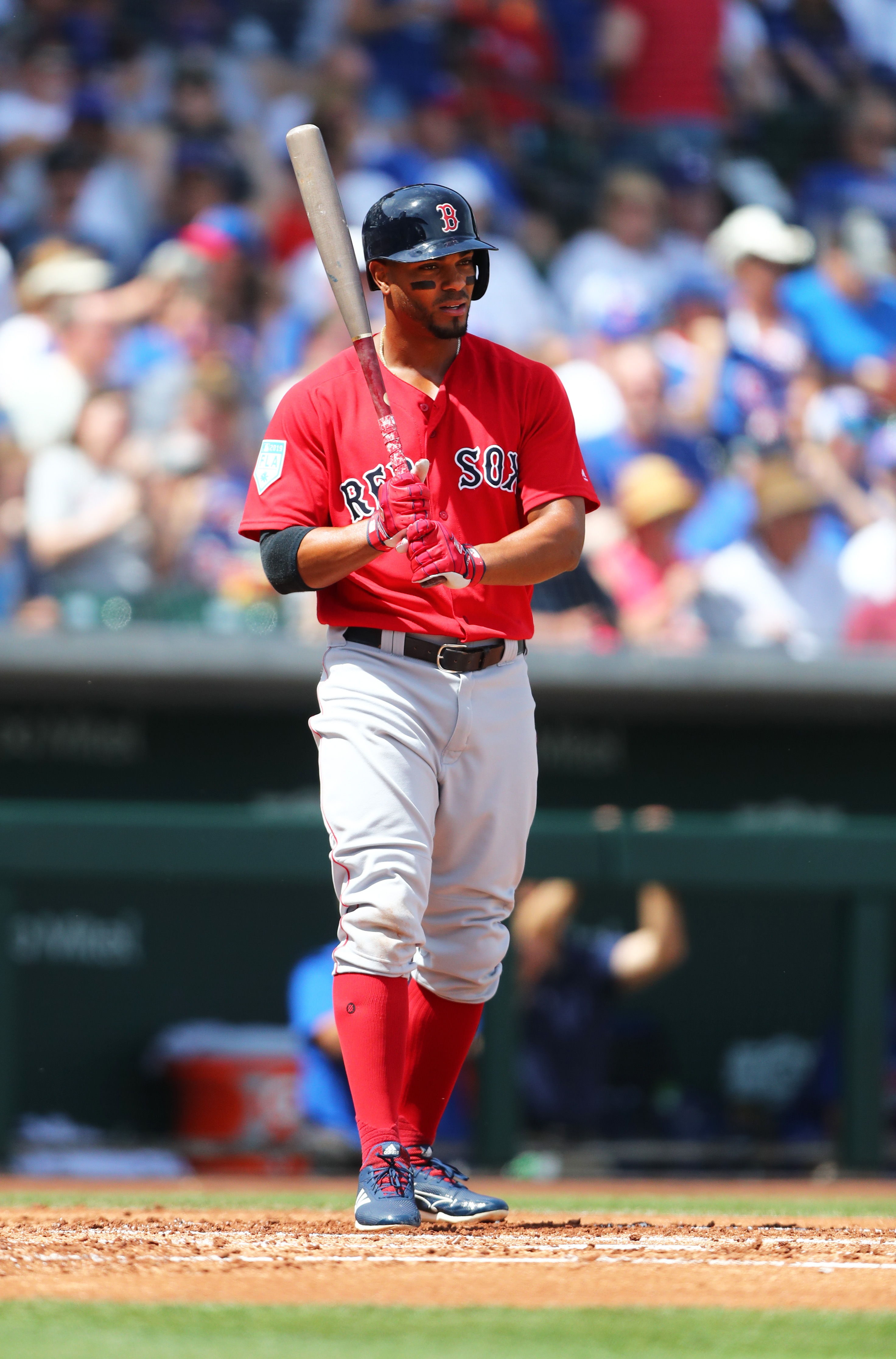
Bogaerts and the club had been in talks during the winter, and though neither side wanted negotiations to extend into the season itself, it seems things were close enough to the finish line that a deal was able to be struck just beyond Opening Day.
Bogaerts, who turned 26 last October, originally signed with Boston as a 16-year-old amateur out of his native Aruba, and quickly developed into one of baseball’s best prospects. He made a quick impact in his 2013 rookie season, helping solidify a problematic third base position for the Red Sox as the team went on to win the World Series. He didn’t fully begin to blossom until the 2015 season, and Bogaerts has gone on to generate 17.6 fWAR over the last four seasons, hitting .295/.354/.446 with 61 homers over 2588 plate appearances. This includes a career-best 23 homers, .883 OPS, and 133 wRC+ in 2018, as Bogaerts rebounded from an injury-marred 2017 campaign to help lead the Red Sox to another World Series title.
Defensively, Bogaerts has been something of a mixed bag at shortstop. The Defensive Runs Saved metric has never looked kindly on his glovework (-48 DRS) while his UZR/150 mark of -0.3 posits him as just slightly below average. There has been some speculation that Bogaerts could eventually move from shortstop, and while that change doesn’t look to be happening anytime soon, that decision could eventually hinge on Rafael Devers‘ development as a third baseman, plus whether prospect Michael Chavis plays at second base, third base, or elsewhere around the diamond.
The pact between Boston and Bogaerts is just the latest in a precedent-setting number of extensions over the last few weeks, as multiple superstars (both near and far from free agency) have chosen to lock in guaranteed paydays with their current teams. Of this group, players who were going to be free agents after the 2019 season included Bogaerts, Sale, Nolan Arenado, Justin Verlander, Paul Goldschmidt, and Aaron Hicks.
It’s clear that the lack of free agent activity in the last two offseasons has influenced many of these decisions, and in Bogaerts’ case, he’ll forego entering the open market for his age-27 season. Keeping a young player who may just be entering his prime on a $20MM average annual value looks like a very solid deal for the Red Sox. Bogaerts also has the ability to opt out of the contract as he enters his age-30 season, if he feels he can top the three years and $60MM still owed to him.
For luxury tax purposes, Bogaerts’ new deal will add an even $20MM to Boston’s Competitive Balance Tax bill beginning in 2020. This is no small factor in the contract, given the rather onerous tax situation the Red Sox find themselves in, though some relief from at least the top level of the CBT structure could come as several contracts come off the books for the club next winter.
It also helps the Red Sox afford what would be their biggest extension yet — a pact with Mookie Betts before the reigning AL MVP hits free agency following the 2020 season. Betts has been firm in his desire to go year-to-year in arbitration rather than sign a long-term deal before getting his chance on the open market, so the topic of an extension could be moot, though Boston will surely continue to explore the possibility of keeping the star outfielder at Fenway Park even if a $300MM+ commitment is required. The Bogaerts and Sale extensions are evidence, if Betts needs any, that the Sox are serious about keeping this winning core of players together.
WEEI’s Evan Drellich broke the news that the two sides were close to a deal (Twitter link). ESPN.com’s Jeff Passan reported the terms of the contract (Twitter links). The New York Post’s Joel Sherman reported the inclusion of the vesting option (Twitter links). MLB Network’s Jon Heyman added some details on the option and also first reported that Bogaerts had passed his physical Monday morning (Twitter links). The Boston Globe’s Alex Speier reported the final details on the vesting option, while Chris Cotillo of MassLive.com tweeted the annual breakdown.
Offseason In Review: Boston Red Sox
This is the latest post of MLBTR’s annual Offseason in Review series, in which we take stock of every team’s winter dealings.
The Red Sox made some long-term investments in core members of their World Series team, though saying goodbye (maybe?) to some important relievers has left uncertainty within the bullpen.
Major League Signings
- Nathan Eovaldi, SP: Four years, $68MM
- Steve Pearce, 1B: One year, $6.25MM
- Total spend: $74.25MM
Trades And Claims
- Acquired RP Colten Brewer from the Padres for IF Esteban Quiroz
Notable Minor League Signings
- Erasmo Ramirez, Carson Smith, Gorkys Hernandez, Juan Centeno, Zach Putnam, Jenrry Mejia, Brian Ellington, Ryan Weber, Dan Runzler, Bryce Brentz, Tony Renda
Extensions
- Chris Sale, SP: Five years, $145MM (Sale can opt out after the 2022 season; contract contains a vesting option for the 2025 season)
- Xander Bogaerts, SS: Six years, $120MM (Bogaerts can opt out after the 2022 season; contract contains a vesting option for the 2026 season)
Notable Losses
- Craig Kimbrel (still unsigned), Joe Kelly, Drew Pomeranz, Ian Kinsler, Brandon Phillips (still unsigned), Robby Scott, William Cuevas
[Red Sox organizational depth chart][Red Sox payroll information]
Needs Addressed
It didn’t take long for the Red Sox to bring back their World Series MVP, as Steve Pearce was re-signed to a one-year contract by mid-November. Pearce began the season on the injured list due to a strained calf but isn’t expected to miss much time before resuming his duties as Mitch Moreland‘s first base platoon partner and a late-game pinch-hit candidate. His $6.25MM price tag is a bit steep compared to what other aging (Pearce turns 36 in mid-April) first base/DH types received on the open market, though it’s probably safe to assume that the team might have considered it an extra thank-you bonus for Pearce’s postseason exploits. Plus, if he replicates the .901 OPS he posted over 165 PA with the Sox last season, Pearce may suddenly look like a bargain.
Speaking of Boston postseason heroes, Nathan Eovaldi posted a 1.61 ERA over 22 1/3 innings during the 2018 playoffs, including an instantly-legendary six-inning relief stint in the marathon that was Game 3 of the World Series. That performance was the cherry on top of an outstanding comeback season for Eovaldi, who missed all of 2017 due to Tommy John surgery before returning for a 3.81 ERA, 5.05 K/BB rate, and 8.2 K/9 over 111 regular season frames for the Rays and Red Sox. Beyond just regaining his velocity post-surgery, Eovaldi’s 97.2mph average fastball actually represented a new career high for the right-hander.

Now re-established as a quality starter, Eovaldi drew a lot of attention in the free agent market, though the Sox were helped by the fact that Eovaldi reportedly only gave serious consideration to Boston and Houston (Eovaldi’s hometown club). Boston ultimately re-signed Eovaldi on a four-year, $68MM contract.
There is no small amount of risk baked into that signing, as Eovaldi has two Tommy John surgeries under his belt and has averaged just 121 innings per year during his eight MLB seasons. (The Phillies and perhaps at least one more of Eovaldi’s many suitors this winter apparently had interest in signing him to work as a reliever, which seems like it would’ve been a hard sell to a pitcher with so many rotation offers on the table.) Despite the concerns, Eovaldi has never pitched as consistently well as he did during his three-plus months in a Red Sox uniform, so it could be that the team’s vaunted pitching braintrust may have unlocked something within Eovaldi to give the Sox faith that the righty can be a front-of-the-rotation arm going forward.
With some key players slated to reach free agency after the 2019 and 2020 seasons, Eovaldi’s deal also helped solidify the team’s core over a slightly longer term. The Sox took another big step towards this end by extending Chris Sale, keeping the ace southpaw out of the 2019-20 free agent market by inking him to a five-year, $145MM deal. We’ll address some of the concerns about the Sale contract in the next section, though in terms of pure performance, it’s hard to argue that Sale wasn’t deserving of such a financial commitment. Sale has the best K/9 (10.9) and K/BB ratio (5.29) of any pitcher in the history of the sport with at least 1000 career innings, to go along with a 2.93 ERA.
Xander Bogaerts was the next 2019-20 free agent land a new contract, agreeing to remain in Boston for a guaranteed $120MM from 2020-25. The shortstop has generated 17.6 fWAR from 2015-18 and is coming off a 2018 season that saw him post his best numbers yet (.288/.360/.522 in 580 PA). A similar season could have pushed Bogaerts’ price tag close to the $200MM mark since he doesn’t turn 27 until October. Instead, now the Sox know they have Bogaerts in the fold for a $20MM average annual value through at least 2025, and maybe 2026 depending on a vesting option.
Boston tried to shop its group of catchers all offseason long but never found a deal. Instead, the Sox kept Sandy Leon in the organization after he cleared waivers and accepted an outright assignment to Triple-A. This might count as something of a minor victory for the club, since Leon is still on hand to provide defensive depth behind Christian Vazquez and Blake Swihart.
Questions Remaining
It was a relatively quiet winter in Beantown, and there was certainly more than a bit of speculation surrounding what moves the Red Sox didn’t make, rather the ones they did.
With Joe Kelly gone to the Dodgers and a reunion with Craig Kimbrel looking unlikely, Boston’s bullpen is down its closer and one of its top setup men from 2018. The Red Sox didn’t address these vacancies in any major way — rookie Colten Brewer made the Opening Day roster after being acquired from San Diego, while some experienced names like Erasmo Ramirez, Zach Putnam, Jenrry Mejia, and old friend Carson Smith were brought into the mix on minor league deals.
As it stands, Matt Barnes and Ryan Brasier will share closing duties, leading a bullpen mix comprised mostly of returning pitchers now expected on take on a larger role. Since Boston’s relief corps was pretty solid on the whole last year, it isn’t quite the nightmare scenario that many Boston fans are fearing. The Sox seem to be taking the stance that since they’re such overwhelming favorites for a postseason spot already, they can take the first couple of months to evaluate their relief options and see if anyone emerges. If not, Boston will likely pursue an established late-game reliever at the trade deadline (or they might do so even if Barnes and/or Brasier thrive, to add further depth).
Of course, this is something of a risky strategy with the Yankees (or maybe even the Rays) poised to battle for the AL East title. Settling for even a middle-of-the-pack bullpen for a few months could cost the Red Sox in a division race that could easily come down to a game or two in the standings. While the Sox might still have an advantage over the American League as a whole, they surely want to win the division rather than tempt fate in the Wild Card game.
Bogaerts’ extension came after the team’s self-imposed Opening Day deadline for extension talks, so we probably shouldn’t rule out any further deals. Still, there was more buzz about a potential new Bogaerts contract than there was about a new pact for pending free agent Rick Porcello, as the Red Sox didn’t seem overly interested in a new contract even with Porcello offering something of a discount.
J.D. Martinez is another possible departure if he opts out of the final three years and $62.5MM left on his contract. There also hasn’t been much traction between Martinez and the team in solidifying their future arrangement, though the Sox could be betting that Martinez chooses to stick with his contract rather than test a free agent market that has been increasingly hostile to defensively-limited players. Even with another elite hitting season, would Martinez land more than $62.5MM for his age 32-34 seasons, as he becomes increasingly closer to being a DH-only player? Martinez saw a limited market even last winter, and his situation might not improve now that he’d be two years older and with a compensatory draft pick via the qualifying offer (which the Sox would surely offer) hanging over his services.
The biggest unanswered question is what it will cost to keep Mookie Betts beyond the 2020 season. Betts certainly doesn’t sound as if he’s considering signing an extension, so there might not have been much Boston could have done to get him to reconsider his stance on testing free agency (aside from a Mike Trout-esque offer). With two years of team control remaining, there isn’t necessarily any urgency to lock Betts up immediately, though his price tag only seems to be rising. Betts already rejected a $200MM extension offer prior to his MVP season in 2018, and retaining his services may take a $300MM+ commitment at this point.
Boston’s major investment in Sale also carries some red flags. While Sale has been a durable arm over his career, his performance declined down the stretch in 2017, and he pitched just 17 regular-season innings after July 27 in 2018 due to shoulder issues (plus 15 1/3 innings over five postseason appearances). If health problems are only starting to crop up now that Sale has celebrated his 30th birthday, it doesn’t auger well for him continuing to stay healthy for the life of that extension. The Red Sox are also now averaging $75MM in salary to three rotation members in Sale, Eovaldi, and David Price through the 2022 season. Price has also had some health issues over the last few years, while Eovaldi’s injury history is well-documented.
The question of money, of course, is at the heart of every transaction (or non-transaction) Boston made this winter. The Red Sox soared over the luxury tax threshold last season, topping the highest penalty level ($237MM) and thus faced slightly under $12MM in tax payments and a ten-slot drop for their first round draft pick. Even as the Competitive Balance Tax has risen to $206MM for 2019, Roster Resource has Boston’s projected luxury tax number at slightly more than $253.2MM, well over the $246MM threshold that would trigger another maximum penalty. If the Sox spend more than $246MM, their 2020 first-round pick will again drop back ten spots. They’ll also pay $14.4MM in taxes for their payroll up to that $246MM mark and an additional 75 percent tax on every dollar from that point forth. If that $253.2MM projection proves accurate, the Sox would pay a total of $19.8MM in luxury taxes.
MLBTR’s Steve Adams detailed Boston’s payroll situation in a recent analysis of why the Sox were hesitant about re-signing Kimbrel, or making a lot of big splashes this winter. Extending Sale increased his luxury tax number, thus sending the team over the $246MM threshold and into the max penalty danger zone once more. With this in mind, the Red Sox were reportedly even open to trade offers for Bogaerts, Porcello, and Jackie Bradley Jr. this winter as the club looked to cut costs.
The counter-argument, as Steve noted, is that the big-market Red Sox could absorb that tax hit as a giant one-year expense in the name of fully reloading for another World Series run while their core group is still together. Enough salary will come off the books after the season (Porcello, Pearce, Moreland, Eduardo Nunez, Brock Holt, and Boston’s remaining commitment to Pablo Sandoval) that the Sox might even have a shot at ducking under the $208MM luxury threshold for 2020 entirely, though it’ll be difficult considering the arbitration raises due to Betts, Bradley, Andrew Benintendi, Eduardo Rodriguez, and maybe Barnes is his arbitration salary is boosted due to accumulating saves. (Brasier could even reach arbitration as well, depending on where this year’s Super Two cutoff lands.)
Extensions to retain stars like Sale and Bogaerts, however, look to have been the only type of big splurge the club was willing to make to send it beyond the $246MM border this year. Any further moves the Red Sox could make are likely to wait until midseason, when their deadline pickups will only have two-plus months of salary commitments remaining. These pickups could include finding a reliever, maybe rotation depth, or possibly another second baseman in the vein of their acquisition of Ian Kinsler last summer. It’s still unknown how much Dustin Pedroia will be able to contribute in 2019, leaving Boston with a combination of Holt and Nunez until Pedroia is ready, with Tzu-Wei Lin, an injured Marco Hernandez, and top prospect Michael Chavis as further potential options.
Second base is the biggest question mark around the diamond, as the Sox can be reasonably hopeful that Vazquez and Rafael Devers take steps forward from their mediocre 2018 showings to shore up the catcher and third base positions. Without a ton of bench depth and a lack of money to spend on more upgrades, however, Boston will again be counting heavily on its superstars.
2019 Season Outlook
With all of these questions in mind, Fangraphs projected the Red Sox to take a big dropoff from their 108-win performance in 2018, as Boston is currently projected to win “only”…. 94 games. Needless to say, the Sox still look like heavy favorites to again reach the postseason, though they’ll be neck-and-neck with the Yankees all year long for the AL East crown.
How would you grade what the Red Sox did this offseason? (Link to poll for Trade Rumors app users.)
How Would You Grade The Red Sox Offseason?
-
C 40% (1,477)
-
B 28% (1,049)
-
D 16% (606)
-
F 8% (305)
-
A 8% (281)
Total votes: 3,718
Photo courtesy of USA Today Sports Images
East Notes: Hot Seat Managers, Orioles, Bundy, Pedroia
Following an offseason that featured an arms race between several of the NL East’s contenders, expectations are higher than ever for the Braves, Mets, Nationals, and Phillies. For that reason, writes Joel Sherman of the New York Post, there will be no excuses for managers Gabe Kapler, Dave Martinez, and Mickey Callaway this time around. The trio of rookie managers all endured disappointing 2018 seasons, but with their ballclubs making significant additions in the winter, the new year comes with heightened pressure to deliver and win now. It bears mentioning that first-year Mets general manager Brodie Van Wagenen was not part of the front office that hired Callaway prior to last season. Though it’s still early to speculate about managerial turnover, the developing bloodbath in the NL East will be a story to watch throughout the season and into the winter.
Here are some other notes from the East…
- Orioles right-hander Dylan Bundy, once an uber-prospect with tantalizing potential, has undergone well-documented struggles in recent years, culminating in his surrendering 41 home runs last season. Jon Meoli of The Baltimore Sun details new pitching coach Doug Brocail’s plan to implement changes that will help Bundy return to the form that brought him success earlier in his career, including his career-best 2016 season.
- Also in Baltimore, new skipper Brandon Hyde has thus far refrained from anointing a closer and does not intend to do so anytime soon, writes Meoli. Though Mychal Givens, who finished the 2018 season in the closer role after the midseason trades of Zack Britton and Brad Brach, appeared the best candidate to close, Hyde’s Orioles are comfortable sticking to a committee approach for the foreseeable future.
- Red Sox second baseman Dustin Pedroia, who has been dealing with left knee inflammation and began the season on the IL, will begin a rehab assignment on Thursday with the Class-A Greenville Drive, per Pete Abraham of the Boston Globe. Pedroia has been receiving at-bats in extended spring training; the timetable for his return to MLB action is yet unknown.
Sandy Leon Clears Waivers, Accepts Outright Assignment
March 28: Leon has accepted his assignment to Triple-A, the team announced.
March 26: 1:14pm: Abraham now tweets that Leon has not actually not yet made a decision on whether he’ll accept the assignment. He has 48 hours to do so.
12:54pm: The Red Sox announced Tuesday that catcher Sandy Leon has cleared waivers and been outrighted to Triple-A Pawtucket. Evan Drellich first reported (via Twitter) that Leon had gone unclaimed, and the Boston Globe’s Peter Abraham tweets that Leon has accepted an outright assignment.
Because Leon has more than three years of MLB service time (4.149 years), he could’ve rejected the assignment in favor of free agency. However, only players with five-plus years of service can reject an outright assignment without forfeiting the salary on their contract, so electing free agency would’ve cost Leon $2.475MM. He’ll remain with the organization and, while he won’t count against the 40-man roster, he will count against the team’s luxury tax calculations (a technicality that was changed in the last CBA).
Leon, 30, struggled through an awful season at the plate in 2018, hitting just .177/.232/.279 through 288 PAs. His bat has continually declined since what now looks like a clear outlier campaign in 2016, but he’s regarded as a terrific defender in terms of limiting the running game, framing pitches, and managing a staff.
Despite that proficient glovework, however, Leon found himself squeezed off the Boston roster by a cluttered catching mix no longer deemed tenable by the organization. Boston spent the entire 2018 campaign juggling playing time for Leon, Christian Vazquez and seldom-used former top prospect Blake Swihart. With both Swihart and Leon out of minor league options and Vazquez locked in as the team’s No. 1 catcher, the Sox ultimately cut bait on Leon in favor of Swihart, who’ll now serve as the primary backup in 2019. If Leon does stick with the club, he could eventually resurface in the big leagues in the event of an injury or prolonged struggles for one either Vazquez or Swihart.
Rick Porcello Attempted To Work Out Extension With Red Sox
Red Sox righty Rick Porcello tried to get the team’s interest in a new contract over the offseason, he tells Rob Bradford of WEEI.com. While the sides completed some background work, talks never gained traction.
Porcello says he and agent Jim Murray “expressed our willingness to take a discount” in order to expand the relationship. The club was not able to work out a scenario that made much sense from its perspective and ultimately did not put an offer on the table for the veteran starter.
As things stand, the 30-year-old is set to play out the final season of the four-year, $82.5MM deal he inked early in the 2015 season. He had just wrapped up his first spring with the Sox after being acquired earlier that winter for Yoenis Cespedes.
Porcello has to this point had an uneven tenure in Boston. He has been durable, taking all but a handful of his scheduled starts and twice topping 200 innings, but has only once posted a sub-4.00 ERA — a sparkling 3.15 ERA, 22-4 campaign in 2016. His once-excellent groundball rate has drooped, though he’s also generating more strikeouts than he did with the Tigers.
By some measures, last year was actually one of Porcello’s best in Boston. He easily set a new personal high-water mark with 8.9 K/9 and still managed a sturdy 44.1% groundball rate and stingy 2.3 BB/9 walk rate. With a 3.77 SIERA and 3.87 xFIP, Porcello was about as good from a peripheral perspective as ever before.
That said, Porcello’s outcomes have long lagged ERA estimators’ expectations. He has allowed 4.26 earned runs per nine in over three hundred career starts, and no longer has the advantageous mix of experience and youth that he did at the point of his prior extension.
It’s not terribly surprising to learn that the Red Sox weren’t particularly eager to work out a new contract. Having gone on to lock up Chris Sale, the team is committed to four starters for at least the next several years. Facing some budgetary restrictions, the team even reportedly considered dealing Porcello. The veteran hurler would surely be worthy of some kind of future investment, but perhaps not a significant one — in advance of the coming season, at least. It is not known what kind of annual payout the veteran hurler might have been seeking.
Porcello says he remains interested in remaining with the club and would be open to mid-season talks, though the team has signaled it isn’t inclined to do so. That leaves the righty preparing to “leave a positive last impression” in 2019. Even if he reaches the open market, it’s not hard to imagine a reunion, though both sides will perhaps first spend some time exploring alternatives.
Red Sox Place Sandy Leon On Waivers
The Red Sox have placed catcher Sandy Leon on waivers, as per WEEI.com’s Evan Drellich (Twitter link).
The move comes after months of trade rumors surrounding Boston’s catching situation, as the team didn’t plan on keeping all three of Leon, Christian Vazquez, and Blake Swihart on its Opening Day roster. No deals materialized, however, as Boston’s attempts were undoubtedly complicated both by a busiest-than-expected catching market this winter, as well as the simple fact that none of the trio played well in 2018. (Plus, all three were out of minor league options.)
As of last spring, the Red Sox were known to be putting a rather large asking price on Swihart befitting his former top-prospect status, and it isn’t known if that price dropped in the wake of Swihart’s lackluster performance last season. Vazquez came with a notable financial cost (owed $13.55MM through 2021), while even Leon’s modest $2.475MM salary for 2019 could be seen as an overpay for a defense-only catcher, given what players with similar skillsets have landed this winter.
That said, it seems likely that several teams will check in on Leon now that they’ll just have to pay his salary (rather than give something up to the Sox in a trade). Leon is ranked by both Baseball Prospectus and StatCorner as a top-tier pitch-framer, and has also received above-average marks for his blocking and throwing arm. More anecdotally, teammates and coaches have raved about Leon’s ability to call a game and manage pitchers. At the plate, Leon has a surprisingly strong 2016, but has since batted only .201/.262/.317 over 589 plate appearances.
If Leon isn’t claimed, he will be removed from Boston’s 40-man roster and then have the choice to either become a free agent or remain with the Red Sox as Triple-A depth. Assuming he leaves, Boston would then have just Vazquez and Swihart behind the plate, and Juan Centeno as their top minor league depth candidate.
Vazquez is himself a strong defender, and obviously the Sox aren’t ready to give up on a player they only recently extended. Swihart is still a question mark defensively (both at catcher and elsewhere around the diamond), though the Red Sox also still think enough of his potential that they’re willing to take the defensive dropoff as Swihart continues to develop. With all this uncertainty, Boston could possibly be a midseason candidate to acquire a catcher at the deadline, though it’s worth noting that the club was content to use a defense-first approach to the catcher position last season and it still led to a championship.
AL East Notes: Red Sox, Tepera, Norris, Trumbo
Chris Sale‘s freshly-inked 5-year contract extension will leave the Red Sox searching for answers to a number of questions as they move forward, writes Rob Bradford of WEEI. With Sale’s contract including an opt-out after 2022, the Red Sox could find themselves in a tricky situation at that time. Bradford notes that the contracts of fellow starters Nathan Eovaldi and David Price expire after 2022, and lefty Eduardo Rodriguez is controllable through 2021, meaning that if Sale chooses to exercise his opt-out clause, the team could find itself wanting for starters. Of course, it’s far from a foregone conclusion that Sale will opt for free agency after the third year of his new contract, but it is certainly a situation that Red Sox brass will monitor as that time draws nearer. Pressure could be on the Red Sox to find and develop a new guard of young pitchers to fill the shoes of big-name Boston starters.
Some other notes from the AL East…
- The Blue Jays received some encouraging news today, with manager Charlie Montoyo informing reporters (including Sportsnet’s Shi Davidi) that right-handed reliever Ryan Tepera, who has recently been dealing with elbow inflammation, will not require surgery. Having been cleared, Tepera will resume throwing on Tuesday. Montoyo added (Twitter link) that fellow right-hander Bud Norris is expected to be ready to play on Opening Day and will pitch an inning today.
- Orioles designated hitter Mark Trumbo will begin the season on the IL, reports Dan Connolly of The Athletic. After undergoing knee surgery last September, the slugger will have to wait to make his 2019 debut. With Trumbo on the shelf, Orioles manager Brandon Hyde may look to allocate DH at-bats by committee, though Trey Mancini appears the most obvious candidate to fill that role. While it remains unclear just how much time Trumbo will miss, he said that it could be a month or more before he’s able to take the field (via MASN’s Roch Kubatko on Twitter).
- The Rays will get right-handed pitcher Sam McWilliams back, according to Juan Toribio of MLB.com (Twitter link). McWilliams had been selected by the Royals in December’s Rule-5 Draft, but will be returned to his prior club after failing to crack Kansas City’s Opening Day roster. McWilliams, who is not on the Rays’ 40-man roster, will report to minor league camp with the Rays.
Red Sox, Chris Sale Agree To Extension
TODAY, 1:43pm: Bob Nightengale of USA Today adds (via Twitter) that Sale’s vesting option for 2025 will be exercised if Sale earns a top-10 finish in AL Cy Young voting in 2024 and does not finish the year on the IL.
SATURDAY, 8:12am: The Red Sox have officially announced Sale’s new contract.
FRIDAY, 9:01pm: Sale has passed his physical, Rosenthal tweets, so all that remains is for the contract to be announced. Sale will earn $30MM in each of the first three seasons of the deal, after which time he has the right to opt out of the remaining two seasons. Those campaigns are valued at $27.5MM, meaning Sale will be deciding on two years and $55MM versus a trip onto the open market.
There’s further upside in the deal as well, ESPN.com’s Jeff Passan reports (Twitter links). It includes a vesting option at a floating value (minimum $20MM) based upon games started. There are also Cy Young-based escalators in years 2021-24 and in the option year. Sale receives full no-trade protection beginning in the middle of the 2020 season.
There are competing reports on the accounting of the deal. Rosenthal and others say the deal will wrap in Sale’s preexisting 2019 salary, creating a readjustment of his luxury tax hit for the present season (and pushing the team into the highest level of penalties). That’s not the case, though, per Speier (Twitter link). He reports that the Boston organization will elect to keep the ’19 season separate, which will avoid immediate tax entanglements but increase the luxury tax hit over the new years of the deal, potentially leading to future luxury obligations.
2:30pm: The Red Sox and ace Chris Sale are closing in on a contract extension, as first reported by Alex Speier of the Boston Globe. Sale, a client of Jet Sports Management, will receive $145MM over five seasons (2020-24) if he passes a physical, Ken Rosenthal of The Athletic reports (Twitter links).
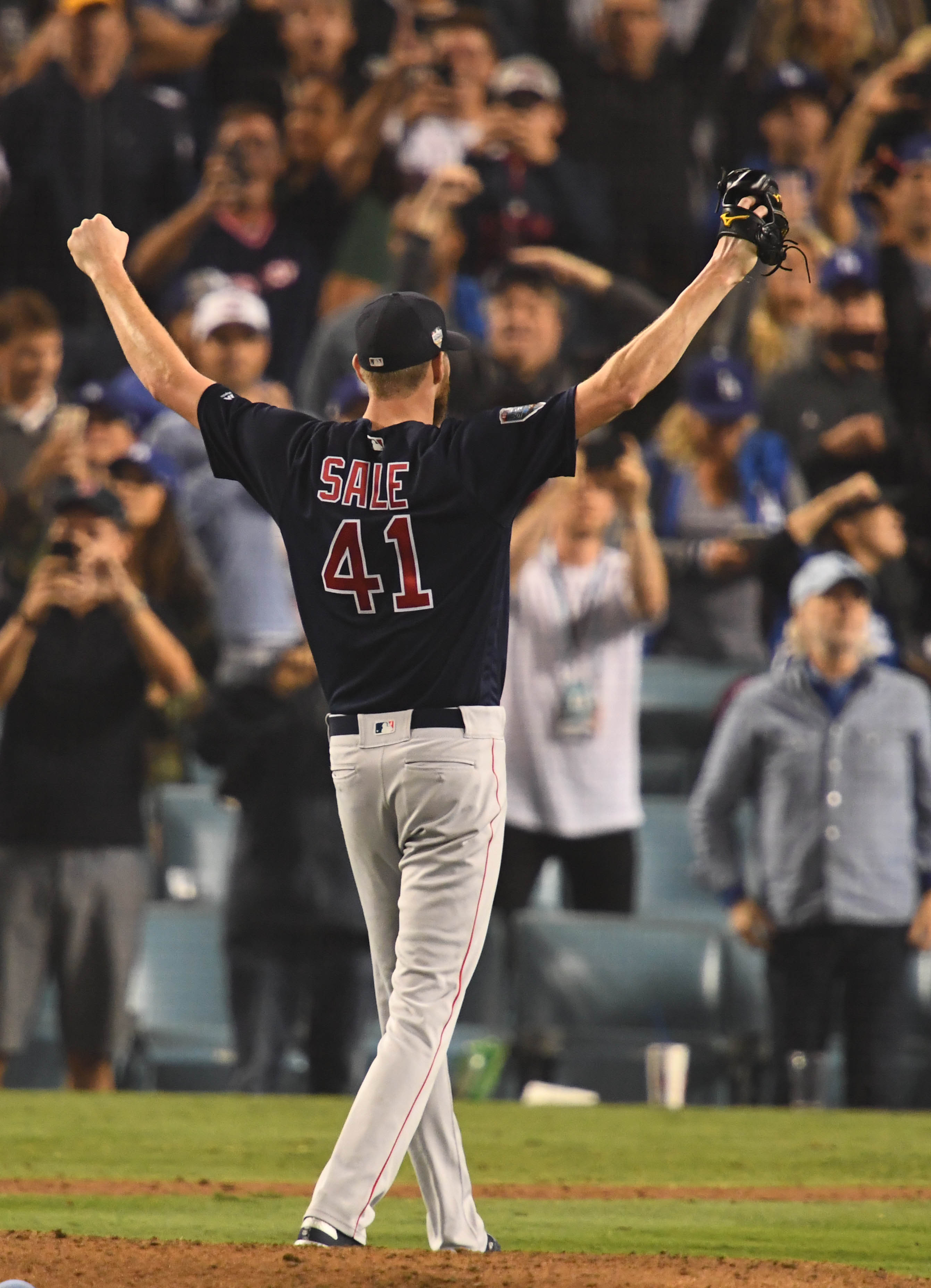
Earlier this spring, both Sale and the Red Sox expressed mutual interest in working out a long-term arrangement that’d keep the left-hander, who is slated to become a free agent at season’s end, in Boston for the long term. MLBTR’s Jeff Todd recently broke down several possible scenarios when exploring what a Sale extension would cost the Sox.
Sale, 30 next week, has been among the game’s elite starters since moving to the rotation with the White Sox back in 2012. He’s made seven consecutive All-Star teams and registered six consecutive Top-5 finishes in American League Cy Young voting, though he’s somewhat incredibly never taken home a Cy Young trophy himself.
Since being traded to Boston in the 2016 blockbuster that sent Yoan Moncada, Michael Kopech, Luis Alexander Basabe and Victor Diaz to Chicago, Sale has pitched to a brilliant 2.56 ERA while averaging 13.2 strikeouts and just 1.9 walks per nine innings pitched. That level of K/BB excellence is nothing new for Sale, who holds the all-time Major League records for both K/9 (10.88) and K/BB ratio (5.31) among pitchers with at least 1000 innings pitched.
Any extension for Sale would begin in his age-31 season — he’ll pitch the 2019 season at age 30 — and figures to come with as much as a 100 percent increase over this year’s $15MM salary. The length of the contract was surely a sticking point in negotiations between Sale and the Sox, given last season’s shoulder troubles that limited him to 158 regular-season innings. Beyond that, his age likely gives Boston some degree of pause, as teams have become increasingly reluctant to guarantee players — particularly pitchers — significant salaries into their late 30s.
The luxury tax also undoubtedly plays a factor in negotiations, as the Red Sox’ payroll currently carries about $240.8MM in annual values that count against the tax ledger (as MLBTR recently examined when highlighting the unlikelihood of a Craig Kimbrel reunion). Should the Sox cross the $246MM threshold, they’d move into the top bracket of luxury penalization, which would include a 75 percent tax on any dollars spent beyond that point and would also cause their top pick in the 2020 draft to be pushed back by 10 spots, though for the Sox, keeping Sale from testing the open market looks to have been deemed worth of incurring that level of penalization.
It’s still possible that the Sox manage to lessen the luxury hit, though; Boston is reportedly shopping catcher Sandy Leon and his $2.475MM salary, and trimming that off the books would lighten the sting in terms of luxury payments on a new contract for Sale. A theoretical $30MM annual value for Sale would effectively take his luxury hit from $15MM (his current one-year salary, as options are treated in the CBA) to $27.5MM (the five-year, $150MM term plus this year’s $15MM salary divided over a six-year span). That $12.5MM increase currently stands to put the Red Sox about $6.5MM over the top luxury line, so shedding Leon’s contract could ultimately leave Boston’s luxury commitments at about $250-251MM. That’s still a huge penalty, but they’d only be paying the 75 percent tax on about $4-5MM of expenditures in that scenario.
Sale is far from the lone key Red Sox player who is (or was) slated to hit the open market following the 2019 season, but given the luxury implications another extension would present, he may be the only one to sign a long-term deal. Shortstop Xander Bogaerts and right-hander Rick Porcello are also free agents following the 2019 campaign, while designated hitter J.D. Martinez has the ability to opt out of the remaining three years and $62.5MM on his contract. Looking further down the line, reigning AL MVP Mookie Betts will become a free agent following the 2020 season, though Betts flatly stated this week that he doesn’t expect to sign an extension before free agency.
In the now likely event that a Sale extension is finalized, it would mark the 17th contract extension signed by a player this spring alone, including the sixth by a would-be free agent and the fifth worth greater than $100MM in total guarantees (as shown in MLBTR’s Extension Tracker). Players throughout the league have become frustrated with the slow pace of free agency and the lack of spending outside of the very top tiers of the free-agent market. Rather than test what has become a largely stagnant market, many players are simply opting into long-term arrangements with their current club, thus forgoing the stress and oft-disappointing outcomes free agency has presented over the past two years.
AL East Notes: Red Sox, Duffy, Rays, Sabathia
After chronicling some Blue Jays notes earlier today, let’s take a look around the rest of the American League East…
- “Unless something completely unanticipated happened,” Dave Dombrowski figures the Red Sox will halt all extension talks by Opening Day, the team president of baseball operations told the media (including Chris Cotillo of MassLive.com). Most players like to have any negotiations wrapped up before the actual games begin, with Dombrowski also citing his preference for a lack of distractions. Xander Bogaerts, Rick Porcello, and potentially J.D. Martinez (if he exercises an opt-out clause) are all scheduled for free agency after the season. Talks with Bogaerts earlier this winter failed to materialize into an extension, while the Sox hadn’t yet discussed a new contract with Porcello as of late February. Of course, the Red Sox already took care of one major 2019-20 free agent by inking Chris Sale to a new deal that will keep the southpaw in Boston through the 2024 season.
- Rays third baseman Matt Duffy is likely headed to the IL to begin the season, manager Kevin Cash told reporters (including Eduardo A. Encina and Marc Topkin of the Tampa Bay Times). Duffy has been bothered by a hamstring problem for much of the spring, and will have tests done after he was a late scratch from today’s game lineup. The versatile Rays shouldn’t have much of a problem filling in for Duffy in the short term, as Joey Wendle, Yandy Diaz, and Daniel Robertson are all options at third base. Encina and Topkin also think that Duffy’s injury could open the door for Guillermo Heredia to break camp with the team, unless the Rays choose to use the roster spot on an extra pitcher.
- The Yankees are considering including C.C. Sabathia on their Opening Day roster in order to immediately get the veteran lefty’s five-game suspension out of the way, George A. King III of the New York Post writes. Sabathia is already slated for a stint on the injured list as he recovers from an offseason angioplasty and a knee operation, though he would head to the IL after the first five games are up. The downside for the Yankees is that they would have to play with just 24 active players during the course of Sabathia’s suspension, though there is an off-day within those first five games if any pitchers need some early recovery.
Extension Rumors: Cole, Verlander, Red Sox, Castellanos
The Astros are currently discussing extensions with starters Gerrit Cole and Justin Verlander, Ken Rosenthal of The Athletic reports (subscription required), though a deal with either seems unlikely. Rosenthal notes that the Astros may not be keen on paying market price for a multi-year extension with Verlander when that deal would begin in his age-37 season. Cole, meanwhile, is a Scott Boras client and thus likelier to test the free-agent market. Boras’ most recent extension for a starting pitcher was Nationals righty Stephen Strasburg, who (like Cole) was in his walk year when he signed a $175MM guarantee on a seven-year deal beginning in his age-28 season. Cole is in his age-28 season right now, so he’d be a year older than Strasburg at the time of a theoretical extension, but he’s also been more durable, reaching 200 innings in three of the past four seasons. Rosenthal makes a slightly less-aggressive comp than that, pointing out that Cole will reach free agency at the same age as Patrick Corbin and with better career stats. Corbin agreed to a six-year deal worth $140MM with the Nats this winter.
Since it’s officially “Extension Season” — as MLBTR’s Extension Tracker shows, there have been a virtually unprecedented 16 extension agreements during Spring Training — here’s more extension chatter from around the game…
- Rob Bradford of WEEI spoke to J.D. Martinez about the opt-out clause in his contract with the Red Sox at the end of the season. Martinez, who can opt out of the remaining three years and $62.5MM on his current deal, said there haven’t been any discussions about an extension or a restructuring of the contract to this point. Unlike last summer, however, he at least left open a slight window for in-season talks in his most recent interview with Bradford. Martinez has an opt-out after the third year of his contract as well, at which point there’d be two years and $38.75MM remaining on the deal.
- Red Sox left fielder Andrew Benintendi was drafted five spot behind Alex Bregman and reached the Majors barely a week after the Astros’ third baseman, but Benintendi tells Bradford that his those similarities didn’t make him take particular note of Bregman’s $100MM extension. Rather, the 24-year-old Benintendi says it’s “fun to watch all these guys sign some deals” in a nod to the bevy of extensions throughout MLB. Benintendi and his reps have not discussed an extension with the Sox this winter, though he tells Bradford that he would “definitely” listen if the Sox initiated talks.
- MLB Network’s Jon Heyman spoke to Red Sox president of baseball operations Dave Dombrowski about the team’s current slate of extension candidates (all links to Twitter). While it’s common for players to place Opening Day deadlines on extension talks, Dombrowski somewhat unusually took a similar stance. “We’re focused on winning this year,” he said. “…Unless something unexpected happens, we’re not going to do anything once the season starts.” Heyman notes that Xander Bogaerts, specifically, has stated an aversion to in-season negotiating. Regarding Martinez, Dombrowski merely stated that the Sox are “hopeful” he won’t opt out of his contract.
- The Tigers “haven’t engaged in any kind of [extension] conversations” with Nicholas Castellanos this spring, GM Al Avila told MLB.com’s Jason Beck yesterday. There’s been no formal offer or even any formal discussions on the matter with Castellanos’ agent, according to Avila, though he said the possibility of a deal is “obviously… in our minds.” Castellanos has expressed a desire to remain in Detroit on a long-term deal, though the rebuilding Tigers will undoubtedly view him as a possible trade asset this summer as well. If the two sides can eventually find a common ground in terms of price, however, Avila said he wouldn’t rule out an in-season extension. “He hasn’t said anything to the contrary,” Avila said of Castellanos being willing to negotiate beyond Opening Day. “I think he would be open to it.”