
Koji Uehara Retires
Veteran reliever Koji Uehara has retired, Jim Allen of the Kyodo News reports. The 44-year-old Uehara last pitched in the majors in 2017, after which he returned to his native Japan to join the Yomiuri Giants of Nippon Professional Baseball. It proved to be a full-circle move by Uehara, who began and ended his career with Yomiuri.
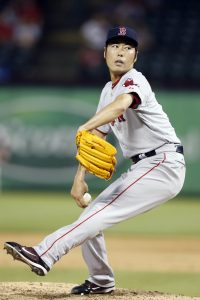
Uehara was often dominant as a starter for Yomiuri from 1999-2006 before mostly working out of the Giants’ bullpen from 2007-08. The right-hander then headed to the majors in 2009 when he signed a two-year, $10MM contract with the Orioles, who initially deployed him as a starter.
Uehara transitioned to the Orioles’ bullpen in 2010 and began a lengthy run as one of the majors’ most effective relievers. During a six-season, 324-inning span from 2010-15, Uehara’s pristine command helped him place first among relievers in two key categories – BB/9 (1.19) and K/BB ratio (9.56) – as well as seventh in ERA (2.08) and 19th in K/9 (11.42).
While Uehara’s major league excellence began with Baltimore, his tenure there was short-lived. The club traded him to the Rangers in July 2011 for reliever Tommy Hunter and a then-unproven slugger named Chris Davis, who later became the highest-paid Oriole ever and remains with the franchise today. Meanwhile, Texas clinched playoff berths in both of Uehara’s seasons with the team and won the American League the year it acquired him, though it wound up losing a classic seven-game World Series to the Cardinals.
Uehara returned to the World Series in 2013 with the Red Sox, who inked him to a one-year, $4.25MM contract prior to the season. It’s safe to say that deal ranks among the wisest the Red Sox have ever doled out, as it began a fruitful four-year union between the sides. Uehara was never greater than during his first year in Boston, where he logged 74 1/3 regular-season innings of 1.09 ERA ball and 12.23 K/9 against 1.09 BB/9. That brilliance carried into the playoffs, where Uehara earned ALCS MVP honors after combining for six shutout innings in a six-game victory over the Tigers. Uehara then totaled another 4 2/3 scoreless frames during the Red Sox’s World Series triumph over the Cardinals, whom he closed out in Game 6.
Although Uehara was never part of another title-winning team, he remained a quality reliever throughout his major league career – which concluded with a one-year stint with the Cubs. Across Baltimore, Texas, Boston and Chicago, the one-time All-Star produced 480 2/3 innings of 2.66 ERA ball with 10.7 K/9, 1.5 BB/9 and 95 saves, leading to upward of $50MM in earnings.
As great as Uehara was in the majors, he’s even more accomplished in his homeland. Uehara registered a 3.02 ERA and a 112-67 record over 312 appearances and 205 starts with Yomiuri, where he earned a slew of personal and team awards. MLBTR congratulates Uehara on two outstanding decades in pro baseball and wishes him the best moving forward.
Photo courtesy of USA Today Sports Images.
Cubs Claim Chandler Shepherd
The Cubs have claimed righty Chandler Shepherd, per Gordon Wittenmyer of the Chicago Sun-Times. Shepherd was designated for assignment by Boston yesterday morning.
Shepherd, 26, transitioned to a full-time starter last season for Boston’s AAA-Pawtucket affiliate after having spent the majority of his four-year professional career in the bullpen. The experiment’s continued this season, to less-than-sparkling results: though the righty’s strikeout rate has jumped to an encouraging 9.10 men per nine, he’s allowed 11 homers in just 29.1 IP out of the Pawtucket rotation, with little of corner-painting command he’d so often exhibited in years prior.
Shepherd will report to AA-Tennessee, per Wittenmyer, where his role is as yet undetermined. FanGraphs’ Kiley McDaniel and Eric Longenhagen laud his “standout curveball” but project him as a “likely” long reliever in the majors.
Ben Zobrist Remains On Leave From Cubs Indefinitely
Veteran utilityman Ben Zobrist has been away from the Cubs since May 8th owing to a previously undisclosed personal matter. It emerged today that the indefinite absence relates to marital troubles that have resulted in divorce proceedings, as ESPNChicago.com’s Jesse Rogers reports.
Details of the matter are really not of interest from a baseball perspective, but Zobrist’s absence does have an obvious impact on the Cubs’ roster situation. It is not known whether he is receiving his salary — $12MM this season, his final under contract in Chicago — during his absence. By placing Zobrist on the restricted list, the Cubs have been able to avoid playing a man down.
Manager Joe Maddon says there’s still “no indication” as to when Zobrist will return to the club. The Cubs informed the 14-year veteran, who’ll soon turn 38 years of age, that he’s free to take as much time away as he needs.
Zobrist has appeared primarily in the corner outfield and at second base this year. In his absence, the club will likely continue to spread playing time at those positions among a deep and versatile assortment of other players.
Details On Madison Bumgarner’s No Trade List
The Athletic’s Ken Rosenthal has the details on Giants lefty Madison Bumgarner‘s limited no-trade list, which, per the five-year, $35MM extension (plus 2018 and ’19 option years) he signed prior to the 2013 season, may contain up to eight teams. The four-time all-star may reportedly block trades to the Braves, Red Sox, Cubs, Astros, Brewers, Yankees, Phillies, and Cardinals at the upcoming trade deadline.
If the list seems curious for its contender bent, it’s by design: Bumgarner’s reps seem to have carefully selected the teams most apt to pursue the lefty for a pennant push later this season. High-profile players can often negotiate some sort of compensatory bonus if they’re moved to a team on their restricted list at any point during that contract, and the former World Series hero seems no exception.
Atlanta, it seems, is the dead giveaway here – Bumgarner grew up deep in the North Carolina hills, the nether regions of the far-reaching heart of Braves country, and was raised a die-hard Atlanta devotee. He’d surely jump at the opportunity to join a pennant-chasing Braves team, one that will likely have rising stars Mike Soroka and Max Fried on a strict innings limit as the season progresses, though whether the suddenly stingy Atlanta front office will have interest is an altogether different conversation.
As Alex Pavlovic of NBC Bay Area explains, there’s been no indication that Bumgarner will block deals to any of the teams included on his list, though explicit comments from the hurler on the matter are as yet in the dark. SNY’s Andy Martino tweets that the Yankees, Bumgarner’s most-connected suitor, are “not particularly high” on the lefty, an impression that could certainly shift with another couple months’ strong performance, coupled with a continued depletion of the team’s starting staff.
After two injury-riddled seasons, in which Bumgarner’s peripherals slumped considerably, the one-time ace has rekindled some of his mid-decade mojo: his 84 xFIP- and 91.8 average fastball velocity are his best marks in the categories since the 2015 season, and his 11.5% swinging strike rate has jumped to above his career average. He’s again striking out over a batter per nine, and his BB rate has swung back to barely-traceable levels, with the 1.45 mark actually the lowest of his career.
If there’s an area of concern, it’s the ground-ball rate, which has plummeted to a career-low 36.8%, leaving the 10-year vet more vulnerable than ever to the longball. There’s also, of course, his status as a rental: teams are more loath than ever to give up high quality talent for just two-plus months of even a star player, and Bumgarner, even during his heyday, was always closer to third starter than ace.
His postseason reputation precedes – no, surrounds – him, though modern front offices won’t fall prey to the blue ox beside his Paul Bunyan October lore, and are now much more likely to consider the sample in which it was done. Indeed, Bumgarner’s 93 career xFIP- in the postseason – interestingly a mark considerably worse than late-season whipping boy Clayton Kershaw‘s 82 figure – is a fact which, if ever relevant at the outset, almost certainly won’t be dismissed in considerations.
There’s also the matter of Giants majority owner Charles Johnson, of whom Bumgarner is said to be a favorite, and an ownership group that’s always willing to shell out for hometown stars of seasons past. The Bumgarner saga may drag on well into the summer, but it’s still a distinct possibility the lefty will stay in San Fran for the long haul.
Quick Hits: Jeter, DeShields/Gallo, Bryant
Derek Jeter recognized the social divides that developed in the clubhouses of his playing days between Spanish-speaking players and native English speakers, but since taking over the Marlins in Miami, where Spanish is omnipresent, Jeter has made it a priority to develop the language skills of everyone in the organization – including himself, per James Wagner of the New York Times. While emphasis is often placed on international players developing their English-language skills, Jeter’s programming ensures that the education highway runs in both directions. Major league players cannot be mandated to take language classes because of the collective bargaining agreement, but players in lower levels of the organization are now required to take classes, as are some coaches and Jeter himself, who attends a 90-minute weekly class with the executive team. The branding here is positive for Jeter, who has yet to make much headway in terms of fan engagement in Miami, but the internal benefits of a growing language program will have no end to its usefulness. Tangible effects may not reach the playing field for some time, but it’s encouraging nonetheless to see the Marlins taking a proactive approach to community engagement, emphasizing relationships with players from Latin America, and broadening avenues of communication within the organization. Let’s take a look at a couple of on-field situations throughout the league…
- After another lackluster start at the plate for Delino DeShields, he finds himself back in Triple-A to work on developing a more line drive approach at the plate, per Jeff Wilson of the Fort Worth Star-Telegram. Deshields is one of the fastest players in the league, fifth overall with 16 Bolts this season (individual run times of 30+ ft/sec sprint speeds) and ninth in Sprint Speed, per Statcast. His speed is obviously an asset in the field as well, where Statcast has him tied for 7th with three Outs Above Average this season (three four-star catches). None of which was enough to keep him in Texas after hitting .182/.321/.284 through 108 plate appearances. How much time the 26-year-old spends in Triple-A may have as much to do with his ability to drive the ball as it does Joey Gallo‘s ability to stick in center. It’s certainly uncommon for a third baseman-turned-corner-outfielder to transition into center, but the hulking 6’5″ Gallo hasn’t looked wholly out of place for the Rangers thus far, -1 DRS and -0.3 UZR through 88 innings this season, but over 188 career innings as the outfield captain, Gallo grades out at 1 DRS, 1.4 UZR. Replacing DeShields, a career 77 wRC+ hitter, with Gallo’s 115 wRC+ upgrades center field offensively for Texas, but this is a head-to-head battle worth tracking as the season moves along.
- Chicago’s Kris Bryant finally found his power stroke for the Cubs, with credit going to his new Axe Bat, per The Athletic’s Sahadev Sharma. Bryant never tapped into his power after returning from a shoulder injury last season as he finished the season with an uncharacteristically low, but still solid .188 ISO. He has hit four home runs in his last six games, raising his 2019 isolated power to .268, and while that would be a career high if he keeps it up all season, it’s closer to his career average of .232 ISO than his numbers from 2018. This season’s power surge tracks back to a broken bat on April 26th, when Bryant switched to an Axe Bat and promptly homered. An Axe Bat’s defining feature – you might guess – is a handle shaped more like the handle of an axe, though this particular handle is unique to Bryant, christened as the “Bryant Handle” as it was geared specifically towards Bryant’s rather unique grip. Whether it’s the bat, or something mental, or simply the strength in his injured shoulder finally being built back up to normal levels, a maintained resurgence of power from Bryant could make the difference for a Cubs lineup that has struggled at times since Bryant’s shoulder injury last season.
Cubs Activate Xavier Cedeno, Place Allen Webster On IL
The Cubs have activated left-hander Xavier Cedeno from the injured list to make his 2019 debut, per MLB.com’s Jordan Bastian (via Twitter). In a corresponding move, right-hander Allen Webster takes Cedeno’s slot on the injured list with radial nerve inflammation in his throwing arm.
Cedeno split 2018 between a pair of Cub rivals in the Brewers and White Sox, pitching to a combined 2.43 ERA across 48 games. Cedeno, 32, put together back-to-back solid campaigns for Tampa Bay after being DFA’ed by the Nationals early in 2015, but a forearm injury cost him most of 2017, leading to another non-tender prior to 2018. He bounced back successfully for the White Sox and Brewers, pitching without a real platoon split as right-handers mustered only a .212/.316/.288 line versus lefties who hit .207/.281/.293 against Cedeno. Still, the Brewers rarely used Cedeno for more than a batter at a time, and he got as many as four outs in an appearance only thrice last season.
Webster, meanwhile, already hit a career high in appearances with 12 so far this season in Chicago, though his 11 total innings have a ways to go before catching the 59 innings he threw as a starter for the Red Sox back in 2014. Results have been underwhelming for Webster in 2019, 4.91 ERA to 5.48 FIP while surrendering 11.5 hits per nine innings.
Cubs Recall Addison Russell, Place Pedro Strop On Injured List
3:36pm: Strop’s injury will cost him more than the 10-day minimum, it seems. The right-hander told reporters that an MRI performed earlier today revealed a Grade 2 strain (Twitter link via Gordon Wittenmyer of the Chicago Sun-Times). Strop says that there’s no timeline for his return at this point. For now, he’ll take three to four days to rest the hamstring before he begins working back.
3:20pm: Russell is in tonight’s lineup, playing second base and batting eighth, the team announced. Zobrist has been placed on the restricted list after being granted a leave of absence to deal with a personal matter, per the club.
Chicago also announced that right-hander Pedro Strop has been placed on the 10-day injured list due to a hamstring strain, with lefty Mike Montgomery coming off the injured list in his place.
2:34pm: The Cubs have decided to activate shortstop Addison Russell for tonight’s game, according to David Kaplan of NBC Sports Chicago (Twitter links). He will see his first game action since last September.
It seems that the timing of the decision was driven by the potential unavailability of Ben Zobrist and Daniel Descalso. The former missed yesterday’s game with an undisclosed personal matter while the latter has been nursing an ankle injury.
Russell recently finished a 40-game suspension issued under the MLB-MLBPA Joint Domestic Violence, Sexual Assault and Child Abuse Policy. His former wife has alleged a variety of abusive actions during their marriage.
The Cubs initially optioned Russell to Triple-A, though his stay proved short. A lifetime .242/.313/.392 hitter through nearly two thousand MLB plate appearances, he carries a .222/.357/.467 batting line in 56 PA this year at the highest level of the minors.
Russell is five days away from passing into the 4+ MLB service class. Assuming he stays up, he’ll be eligible for arbitration twice more before qualifying for free agency.
Cubs Reinstate Oscar De La Cruz, Transfer Tony Barnette To 60-Day IL
The Cubs announced Friday that they’ve reinstated minor league right-hander Oscar De La Cruz from the restricted list now that his 80-game suspension has been completed. In order to open a spot for De La Cruz on the 40-man roster, Chicago transferred Tony Barnette from the 10-day injured list to the 60-day injured list.
De La Cruz, 24, received an 80-game suspension last July after testing positive for the banned substance furosemide. He’d been working through his first season at the Double-A level and struggling a bit, having pitched to a 5.24 ERA with diminished control through 16 starts.
De La Cruz was the Cubs’ top-ranked prospect by some outlets back in 2017 but has seen his stock dip in recent years — even before being hit with this suspension. He’s made three starts with Class-A Advanced Myrtle Beach this season, as the league’s drug policy allows players to make unpaid rehab appearances to get up to speed at the tail end of suspensions. He’ll head to Double-A Tennessee.
As for Barnette, the former Rangers reliever was signed to a big league contract this winter but hit the injured list late in Spring Training due to inflammation in his shoulder. The 35-year-old had been pitching on a rehab assignment in Triple-A Iowa, but the Cubs’ press release indicates that Barnette was pulled back from that assignment. Jordan Bastian of MLB.com tweets that Barnette is still experiencing tightness in his problematic shoulder, so it seems as though he won’t be an option for the Cubs anytime in the near future.
Cubs Reinstate, Option Addison Russell
May 2: The move is official. The Cubs have reinstated Russell to the 40-man roster and optioned him to Triple-A. Injured closer Brandon Morrow, who was recently shut down from throwing for at least two weeks following an injection, was moved from the 10-day injured list to the 60-day injured list to open a 40-man spot for Russell.
April 30: The Cubs will option infielder Addison Russell to Triple-A Iowa when he is activated from the restricted list Thursday, the team revealed to reporters (Twitter link via Gordon Wittenymyer of the Chicago Sun-Times). He’s yet to play in the Majors in 2019 due to a 40-game suspension under the league’s domestic violence policy (which was issued back in September).
Russell will split time between shortstop and second base in Iowa, per Mark Gonzales of the Chicago Tribune (Twitter link). He’s previously served as Chicago’s primary shortstop in large part because of his defensive abilities — Russell has just a career .242/.313/.392 line at the plate and tallied a career-low five homers in 2018 — but Javier Baez has thrived both offensively and defensively in that spot this season. Offseason signee Daniel Descalso has seen the lion’s share of playing time at second base so far in 2019 and posted an overall .268/.358/.380 in 81 trips to the plate. David Bote and Ben Zobrist, too, have chipped in at second base in the season’s early stages, though Zobrist has yet to replicate last year’s production.
The 25-year-old Russell won’t accrue service time on his optional assignment, of course, and it’s not clear when he’ll return to the Majors. President of baseball operations Theo Epstein suggested that the time in Triple-A will serve as a means of allowing Russell to get up to speed after the early downtime, which could point to several weeks in the minors for Russell. He’s already played six games with Iowa, as league policy allows players to begin an unpaid minor league assignment toward the end of their suspensions.
One would imagine that once the organization decides to bring Russell back to the MLB level, he could supplant outfielder Mark Zagunis on the active roster, though the overall health of the roster at that point will obviously dictate the corresponding move to facilitate Russell’s return.
Latest On Brandon Morrow
Cubs reliever Brandon Morrow received an injection of “synthetic lubricant” earlier this week in the latest bid to get him back to health, as Gordon Wittenmyer of the Chicago Sun-Times was among those to cover on Twitter. He’ll be shut down for at least two weeks before he can resume throwing.
Morrow had been shut down recently after experiencing a setback in his rehab effort. He underwent elbow surgery last November after problems in and around the joint cost him the latter half of the 2018 season.
The news of the injection provides another rough timeline, though it’s tough at this point to assume things will go according to plan. As Wittenmyer notes, the best-case-scenario now is probably that Morrow makes it back to the MLB mound some time in July — about a year after he went on the shelf with an issue that was then expected only to cost him a few weeks.
A fully functioning version of the 34-year-old Morrow would make for a heck of a mid-season addition. The Cubs have hit their stride of late but still face a season-long battle in a tough division. With payroll constraints and a farm system that has already been mined rather heavily for promotions and trade chips in recent years, the oft-injured Morrow may yet be the organization’s best hope for a boost in the bullpen.
Unless and until he’s fully up to speed, the Cubs will likely continue to rely upon Pedro Strop as the primary closer. Steve Cishek, Brad Brach, and Brandon Kintzler also have substantial late-inning experience in the majors.