
Latest On The Cubs, Bryce Harper
Cubs executives met with Bryce Harper and agent Scott Boras during the Winter Meetings, holding discussions that reportedly were around three hours in length, Gordon Wittenmyer of the Chicago Sun-Times reports. No deal appears to be close between the two sides, though the most intriguing detail stemming from the meeting is that president of baseball operations Theo Epstein asked Harper and Boras to check in with the Cubs before agreeing to a deal with another team, in order to give the Cubs more time to try and create payroll space for the free agent slugger.
We’ve heard all offseason long that the Cubs have little in the way of spending capacity, and outside of modest deals to sign Daniel Descalso and Kendall Graveman, there hasn’t been much activity at all coming out of Wrigley Field. The decision to exercise Cole Hamels‘ club option is still the Cubs’ biggest move this winter, and that transaction required a corresponding move (trading Drew Smyly to the Rangers) in order to clear some money off the books.
The Cubs certainly have their share of high-priced contracts that haven’t yet worked out — Jason Heyward, Yu Darvish, Tyler Chatwood, Brian Duensing, Brandon Kintzler, and Brandon Morrow stand out as players who delivered subpar seasons in 2018, either due to injuries or just a poor performance. Of course, those same reasons present major obstacles in finding a trade partner for any of those names. Adding to the team’s difficulty is that the Cubs firmly intend on being contenders in 2019, which is why they aren’t seriously considering dealing the likes of Kris Bryant or Anthony Rizzo.
Some creativity will certainly be required if Epstein and his front office plan to make a serious run at Harper, considering that Boras has every intention of landing a record-setting contract for the outfielder. Chicago could certainly explore the type of luxury tax-reducing salary dump trade that the Dodgers have become experts at in recent years, most recently their seven-player swap with the Reds just two days ago. That very deal has been rumored to be part of the Dodgers’ own pursuit of Harper, so the Cubs could already be behind the Dodgers in that regard, though Harper (like most major Boras clients) isn’t expected to sign until later in the offseason.
As per Roster Resource, the Cubs are currently on the hook for a payroll in excess of $220MM next season, which comes with a projected luxury tax price tag of just under $234.5MM (reminder: the luxury tax payroll carries some different calculations than solely the dollar figures on the MLB payroll). This puts them in position to exceed the $206MM Competitive Balance Tax threshold, and thus pay a tax penalty of 20% of every dollar on the overage. This is the “first-timer” rate for any team that exceeds the threshold but stayed under the line in the previous season. If the Cubs’ tax bill were to exceed the $246MM mark next season, they’d face a larger financial penalty as well as a ten-spot drop in the draft order for their highest selection in the 2019 amateur draft. (The Red Sox faced this penalty for their $40MM+ overage last season.)
The Cubs have owed luxury tax just once in their history, as crossing the CBT threshold in 2016 resulted in a $2.96MM tax bill. Needless to say, this was a small price to pay considering that the Cubs ended their World Series drought that season. As MLBTR’s Tim Dierkes has observed in the past, the actual dollar amount surrendered for these luxury tax payments is a veritable drop in the bucket for a big-market team, so there isn’t any major financial downside for a team to pass the threshold once, or even multiple times.
The Cubs are also expected to have even more revenue on hand in the form of a new TV contract, though it could be that ownership wants to have that money firmly in place before making any future financial commitments. 2019 is also the last year of guaranteed salaries for Hamels, Morrow, Kintzler, Duensing, Ben Zobrist, Steve Cishek, and Pedro Strop, so quite a bit of payroll money will be available next winter to help in ducking under the tax threshold, or at least avoiding the higher $40MM+ overage penalty.
Cubs Sign Kendall Graveman
TUESDAY: Per Heyman, Graveman will earn an additional $100K for each of the following performance milestones: 15 games started, 18 GS, 21 GS, 23 GS, and 25 GS. The incentives package means that Graveman can earn up to $2.5MM in 2019.
SUNDAY: Chicago has announced the signing.
SATURDAY: The Cubs have agreed to a deal with free agent pitcher Kendall Graveman, per ESPN’s Jesse Rogers (via Twitter).
Graveman gets a major league contract worth $575K for 2019 with a $3MM club option for 2020. That option year does not include a buyout. Even one day on the 2019 roster, however, will trigger an escalator clause to bring Graveman’s salary to $2MM, and he can earn an additional $500k in performance bonuses.
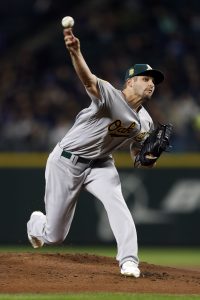
Graveman, 28, had been relatively productive the last four seasons for the Oakland A’s when not dogged by injury. His high water mark came in 2016, working to a 10-11 record in 186 innings over 31 starts with a 4.11 ERA (4.39 FIP). For his career, Graveman carries a 23-29 record and 4.38 ERA across 78 career starts.
The A’s say goodbye to another piece from the Josh Donaldson trade of 2014. Infielder Franklin Barreto is now the only player remaining from the trade that sent Oakland’s star third baseman to Toronto the year before he would win the MVP award with the Blue Jays. Graveman spent four seasons in Oakland, the last of which was mostly lost to injury. He made only seven starts in 2018 with a 7.60 ERA before undergoing Tommy John surgery.
For the Cubs, they get to closely monitor the recovery of a potential rotation arm in 2020 at a very low cost. From their presumed 2019 rotation, only Hamels will be a free agent after next season, but Kyle Hendricks will be entering his final year of arbitration, and Jose Quintana will be facing the first of consecutive club options. There’s almost no downside for the Cubs here, while Graveman gets to benefit from the medical resources of the a large market team as he rehabs from Tommy John.
The timetable for his 2019 return is as of yet unclear, but it’s not expected he will play much of a role, if any, on the Cubs next year, per Gordon Wittenmyer of the Chicago Sun Times (via Twitter).The Cubs signed Drew Smyly in a similar situation before last season, only to flip him to the Rangers to help cover the cost of Cole Hamels‘ club option this year. Garrett Richards, in a similar situation, signed for two years and $15.5MM guaranteed with the Padres, though he carries a longer track record of success than Graveman.
The financials of the deal were first reported by 670thescore.com’s Bruce Levine, while Fancred’s Jon Heyman noted earlier than Graveman received a major league deal (Twitter links). Heyman added the information about the escalator clause and performance bonus (via Twitter). Photo courtesy of USA Today Sports Images.
Minor MLB Transactions: 12/23/18
The latest minor moves from around baseball:
- Veteran right-hander Steve Johnson, 31, announced his retirement Friday on Instagram (hat tip to Roch Kubatko of MASNsports.com), ending a pro career that began when the Dodgers used a 13th-round pick on him in 2005. Johnson never got past the Double-A level with the Dodgers, though the Baltimore native eventually reached the majors with his hometown Orioles. The O’s selected Johnson in the 2009 Rule 5 Draft, and he went on to amass 59 1/3 innings with the club from 2012-15. Johnson added another 16 2/3 frames with the Mariners in 2016, the last time he appeared in the bigs. In total, Johnson tossed 76 innings of 4.26 ERA ball with 10.2 K/9 and 5.6 BB/9 at the game’s highest level. He wrapped up his career last season with Lancaster of the independent Atlantic League.
- The Cubs have signed left-hander Mike Zagurski to a minor league contract with an invitation to major league camp, Jerry Crasnick reports. The 35-year-old spent last season with the division-rival Brewers, though he only threw one big league inning – a disastrous frame in which he yielded seven earned runs. But Zagurski did thrive as a member of the Brewers’ Triple-A affiliate in hitter-friendly Colorado Springs, with which he posted a 3.20 ERA, 13.2 K/9 and 3.4 BB/9 in 45 innings. Zagurski has held his own in Triple-A with a few organizations, evidenced by his 2.84 ERA, 12.3 K/9 and 4.1 BB/9 over 294 1/3 frames. However, Zagurski has had a horrid time across 76 1/3 MLB innings with the Brewers, Philles, Diamondbacks, Yankees and Pirates, having logged a 7.78 ERA with 9.08 K/9 and 5.66 BB/9.
NL Notes: Reds, Anibal, Nats, Tulo, Darvish
The Reds were keen on retaining Matt Harvey entering the offseason and held talks with him right up until he agreed to join the Angels on a one-year deal yesterday, Cincinnati GM Nick Krall tells Bobby Nightengale of the Cincinnati Enquirer (Twitter links). However, the Reds simply weren’t comfortable matching the $11MM guarantee promised by the Halos. That said, Krall made clear that the Reds still hope to add another starting pitcher, be it via free agency or trade, and the GM also added that his club is pursuing another outfielder and some bullpen help. “We need to improve this club, and we know that,” said Krall, whose largest offseason move to date has been acquiring Tanner Roark. While the durable Roark certainly helps to shore up the back of the Reds’ rotation, there’s still plenty of question marks in the mix of in-house rotation options.
A few notes from around the National League on a quiet Wednesday evening…
- The Nationals have had “ongoing conversations” with Anibal Sanchez‘s agent, Gene Mato, since the Winter Meetings, tweets Jesse Dougherty of the Washington Post. That said, there are still multiple teams interested in Sanchez, who enjoyed a career renaissance with the Braves in 2018, as he pitched to a 2.83 ERA with 8.9 K/9, 2.8 BB/9 and a 45 percent ground-ball rate. There’s no shortage of skeptics with regard to Sanchez’s resurgence, though the substantial increase in his usage of a cut-fastball and the fact that he allowed less hard contact than any qualified pitcher in baseball last season (per Statcast) should pique the interest of some clubs. Mato told MLBTR’s Tim Dierkes last week that teams interested in Sanchez “realize it wasn’t luck” that fueled his 2018 rebound.
- Robert Murray of The Athletic writes that the Brewers sent three representatives to watch Troy Tulowitzki‘s audition for MLB clubs yesterday (subscription required). Murray spoke to multiple scouts in attendance who had positive things to say about how Tulo looked on that given day, though obviously the primary question isn’t whether the 34-year-old is healthy right now, but whether he’ll be able to hold up over the course of a full season. The Brewers could utilize Tulowitzki at either third base or second base, with Travis Shaw manning the other spot. Given Shaw’s experience (and proficiency) at the hot corner, second base would be Tulowitzki’s likeliest position in Milwaukee. There were at least 11 other clubs on hand at yesterday’s showcase, however, so Milwaukee is but one of many possible landing spots for the former Rockies star. Any team that signs Tulowitzki would only owe him the league minimum of $555K in 2019.
- Cubs right-hander Yu Darvish went through his second day of a throwing program as he works his way back from an arthroscopic debridement procedure in his right elbow (Instagram link). The Chicago organization said at the time Darvish’s surgery was announced that the right-hander is expected to be ready for Spring Training 2019, and the fact that he’s throwing in mid-December is an encouraging sign in that regard. Injuries limited Darvish to just 40 innings with the Cubs in a disappointing first season with the team. The six-year, $126MM contract for Darvish looks all the more problematic for the Cubs in light of reports that the team has extremely limited financial resources at its disposal this offseason. The fact that the Cubs spent a combined $186MM on Darvish, Tyler Chatwood and Brandon Morrow last winter, then acquired the second season of Brandon Kintlzer’s contract at the deadline this summer, only to now be handcuffed by payroll issues is undoubtedly a bitter pill for Cubs fans to swallow.
Melisa Reidy Details Alleged Abuse By Addison Russell
Melisa Reidy has previously alleged, but not publicly detailed, abuse by former husband and Cubs shortstop Addison Russell. She greatly expanded upon her story in a lengthy interview with Kelly Wallace of Expanded Roster.
Needless to say, Reidy’s extensive account of abuse is extremely troubling. It includes multiple instances of serious physical battery along with ongoing emotional abuse. Reidy relays her recollection in full detail. Those interested in reviewing the full interview should follow the above link. (If the site is still having server issues, you can also access the story at this Twitter link.)
Russell is currently serving a 40-game suspension under the MLB-MLBPA Joint Domestic Violence Policy. It is not immediately apparent whether the league had access to all of the details presented today by Reidy, but she previously acknowledged having spoken with league investigators after finalizing her divorce. Neither is it known whether Reidy’s newly expanded allegations will lead to further investigation from the commissioner’s office.
In terms of his ongoing employment situation, Russell was recently tendered a contract by the Cubs, though that is not a guaranteed commitment. It is not known the extent to which Reidy’s full allegations (or other information) were available to the team. At the time, president of baseball operations Theo Epstein said the organization wished “to try to become a small part of the solution for Addison, his family, Melisa Reidy and the larger issue of domestic violence prevention.” In a statement issued through the team, Russell apologized to Reidy for what he described as his “past behavior” while also stating an intention to “become part of the solution.”
Troy Tulowitzki Hosts Workout For MLB Clubs
At least 11 teams were on hand to watch Troy Tulowitzki work out earlier today, reports Tim Brown of Yahoo Sports. The Giants, Angels, Red Sox, Cubs, Padres, White Sox, Orioles, Yankees, Phillies, Tigers and Pirates were all represented at the showcase, Brown reports (as were other, unnamed teams), with some clubs even sending their top executives to get a first-hand look at the former Rockies star. Angels GM Billy Eppler was in attendance, per Brown, as were new Giants president of baseball ops Farhan Zaidi and manager Bruce Bochy.
Since being released by the Blue Jays last week — with two years and $38MM remaining on his contract — Tulowitzki has been separately connected to a handful of teams including the Pirates, the Yankees, the Cubs and the Giants. His agent, Paul Cohen, recently told Susan Slusser of the San Francisco Chronicle that Tulowitzki is open to playing second base or third base with a new team. Brown, notably, writes that the biggest appeal for Tulowitzki will be the promise of regular at-bats at one positions (as opposed to moving between those three spots in a utility role).
It doesn’t seem as though there’s any early favorite to add Tulowitzki, who’ll cost his new team only the Major League minimum of $555K next season. (Toronto is on the hook for the remainder of his salary.) At that price, it’s justifiable for virtually any team to take a look at Tulowitzki and see if he can rediscover some of the form that once made him one of the game’s premier players. While few would expect him to return to his 2013-14 levels of output, that type of performance is hardly necessary from someone whose new team will pay him the league minimum. Tulowitzki’s bat was at least league-average in both 2015 and 2016, so if he’s healthy there’s plenty of reason to believe he can at least be fairly productive at the dish. How he adjusts defensively after undergoing surgery on both heels last year could be a more pressing question — particularly if he’s also adjusting to a new position after spending his entire pro career at shortstop.
Cubs Sign Daniel Descalso
3:54pm: Descalso’s contract comes with a small incentives package as well, Heyman tweets. He’ll earn $50K for reaching each of 425, 450 and 475 plate appearances in a given season, plus another $100K upon reaching 500 PAs.
2:02pm: The signing has now been announced. Descalso will earn salaries of $1.5MM and $2.5MM, per MLB.com’s Jordan Bastian (via Twitter).
10:42am: The Cubs have agreed to terms with veteran utilityman Daniel Descalso, according to reports from Ken Rosenthal of The Athletic (Twitter link) and Jon Heyman of Fancred (via Twitter). Descalso, a client of Pro Edge Sports, will be promised $5MM over two seasons, per Rosenthal (Twitter links). There’s a club option as well for the 2021 season, with a $3.5MM price tag and $1MM buyout.
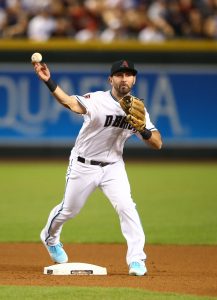
This move, if completed, promises to deliver the Cubbies some of the veteran grit they felt they were missing in a 2018 season in which they came up a bit short of their own lofty expectations. It would also bring Descalso back to the NL Central division after a four-year foray into the NL West.
Descalso will help the Cubs cover for the absence of Addison Russell over the first month or so of the season, likely seeing quite a bit of action at second while Javy Baez plays short. Once Russell returns to the club from his domestic abuse suspension, as now seems to be the plan, Descalso will in all likelihood step back into the utility role to which he’s best suited.
If that’s all that takes place, the Cubs would feature a variety of versatile position players to work with. Russell and especially Baez would occupy a fair bit of the middle-infield action, with Descalso filling in there and at third base. Presumably, Ben Zobrist and Ian Happ will spend the majority of their time in the outfield, though both have ample experience on the dirt as well. Just where David Bote will fit in all of this isn’t clear, but the Cubs certainly won’t mind having the depth and he’s optionable as well.
Of course, there could yet be further roster tweaks still to come. The Cubs have engaged the market in a surprisingly spartan manner thus far, with the club sending signal after signal that it’s not going to add much payroll. But there could still be trade possibilities to work through and it’s still reasonable to wonder whether the Chicago organization has a big strike still in it if the right opportunity arises.
Descalso, of course, spent the early portion of his career with the bitter-rival Cardinals. He earned his playing time as a gritty, pesky, versatile player who did enough in the field and on the bases to overlook his generally subpar bat.
In recent years, though, the 32-year-old Descalso has opened up some new aspects to his game. Beyond getting acquainted in the corner outfield, he has become an increasingly aggressive flyball hitter. The initial returns have been impressive, as Descalso has turned into a lite version of a three-true-outcomes hitter.
Last year, in 423 trips to the plate, Descalso popped 13 long balls. He struck out and walked at career-high rates, 26.0% and 15.1% respectively, while turning in a productive overall .238/.353/.436 slash. That was good for a 111 wRC+, a nice number for a player who had never before topped 90 in a given season. With quality baserunning added in, Descalso clocked in at 1.6 fWAR — easily a career-high.
Descalso hasn’t played much shortstop in recent seasons, though that is in part no doubt a reflection of the needs of his former teams. It’s also not a primary concern for the Cubs, who can utilize Baez and Russell at the position.
Photo courtesy of USA Today Sports Images.
Market For Troy Tulowitzki
There are six teams currently in the running to sign shortstop Troy Tulowitzki, per Susan Slusser of the San Francisco Chronicle (via Twitter). Tulo and his agent plan on narrowing the field as early as tomorrow.
Though they’ve been rumored as a logical landing spot, the Oakland A’s are not one of the clubs with expressed interest. Tulo was an A’s fan growing up, but according to his agent Paul Cohen, Oakland has not been in touch with the California native. Speculatively speaking, the Pirates, Mets, Yankees, Padres or Brewers could be potential fits for the 5-time All-Star.
One team that has checked in with Tulo is the the Cubs, per Fancred’s Jon Heyman (via Twitter). Considering the financial restraints and lofty aspirations of Chicago’s Northsiders, Tulo makes sense as a low-cost, high-ceiling target, despite the presence of Javier Baez at shortstop. Addison Russell will also be an option for Chicago when he returns from his suspension, but there’s obviously enough uncertainty there for the Cubs to take a look.
There’s not a team in the league that wouldn’t want a healthy and productive Tulowitzki on their roster, but after missing all of 2018 with bone spurs in his heels, it’s unclear how much of peak-Tulo remains. Tulowitzki, 34, hasn’t been a significant contributor since 2016, his first full season in Toronto.
For the first decade of his career, however, he was perhaps the preeminent two-way shortstop in the sport. He boasts a career .290/.361/.495 line with 224 home runs and 9.4 BB% against 16.6 K%.
Defensively, prime Tulo was as good as they come. He posted positive defensive metrics at short as recently as 2016, lending credence to his stated desire to stick there. After his somewhat surprising release from the Blue Jays, however, his agent indicated a willingness to move off that spot if needed.
The trade that sent Tulo from Colorado to Toronto in the summer of 2015 was dispiriting and disillusioning for the superstar – nonetheless, he mentored Josh Donaldson as the latter blossomed into an MVP for competitive Blue Jays clubs in 2015 and 2016, per the Athletic’s John Lott (subscription link). Tulo’s intensity sometimes plays poorly with the media, but his presence ought to buoy whichever clubhouse welcomes him next. Whether or not he has anything left to offer on the diamond is the open question.
Orioles Hire Brandon Hyde As Manager
DEC. 14: The O’s have announced the hiring.
DEC. 11: 7:25pm: Elias has shot down reports that the Orioles have even offered anyone the job, let alone hired a new manager, per Roch Kubatko of MASNsports.com.
7:06pm: Hyde will indeed get the job, Ken Rosenthal of The Athletic reports.
6:59pm: The Orioles “are closing in on” naming Cubs bench coach Brandon Hyde their manager, Joel Sherman of the New York Post tweets.
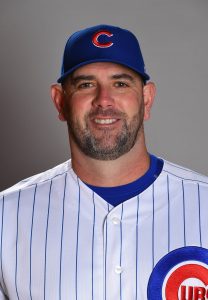
It didn’t take long for Hyde to emerge as the choice for the job in Baltimore, whose search for Buck Showalter’s successor only began in earnest a couple weeks ago. Rookie general manager Mike Elias, whom the Orioles hired less than a month ago, reportedly considered six candidates for the managerial role. Along with Hyde, Rockies bench coach Mike Redmond, Nationals bench coach Chip Hale, Royals catching/quality control coach Pedro Grifol, Diamondbacks director of player development Mike Bell and ex-Indians and Nats manager Manny Acta were in the running for the position.
Earlier this offseason, the 45-year-old Hyde garnered interest from the Blue Jays, Twins and Angels when they were seeking managers. He comes with plenty of coaching experience, having worked as a minor league manager with the Marlins from 2005-09 before serving as their bench coach from 2010-12. Hyde had been on the Cubs’ coaching staff since 2013, twice functioning as their bench coach (under both Rick Renteria and Joe Maddon) and once as their first base coach. His departure means the Cubs will have to find a new bench coach for the second straight offseason. Hyde only landed the role last year because Dave Martinez left to become the Nationals’ manager.
A former minor league catcher and first baseman in the White Sox organization, Hyde’s entering an unenviable situation in Baltimore. The Orioles finished with the majors’ worst record in 2018 and are now in the early stages of a full rebuild. The franchise’s hope is that he and Elias will be up to the task of putting together its next contender, but given that they’re both neophytes, it’s likely the duo will be afforded plenty of patience.
Photo courtesy of USA Today Sports Images.
Cubs, Cardinals Pursuing Daniel Descalso
The Cubs are “in strong pursuit” of Daniel Descalso, according to Ken Rosenthal of The Athletic (Twitter link). They’ll have interesting company in the bidding, though, as the division-rival Cardinals are also involved on their former infielder, as previously rumored and as Bob Nightengale of USA Today Sports tweets.
Descalso, 32, was a mainstay with the Cards for several years, but has spent the past four seasons out west with the Rockies and D-Backs. In that time, the veteran has not only spread his wings a bit defensively but heated up a bit with his left-handed bat.
Known primarily as a utility infielder, Descalso has now spent a fair amount of time in the corner outfield. It’s likely that these and other clubs will mostly value him for his ability to field any position on the dirt, but it surely doesn’t hurt that he’s now familiar with left field.
At the plate, Descalso has earned a rather expansive role in Arizona by producing sturdy on-base numbers. He’s still a clearly below-average hitter over the course of his career, but Descalso has also perhaps shown some newfound abilities at the plate as an acolyte of the flyball revolution.
Last year, Descalso popped a career-high 13 long balls and turned in a healthy .198 ISO — well north of anything he had shown previously. An aggressive new approach also resulted in quite a few more strikeouts (26.0%) than usual, but Descalso more than made up for that by setting new career marks (by a wide margin) with a 15.1% walk rate and 43.1% hard-contact rate. The results — a .238/.353/.436 slash — were impressive.
Given those changes, and Descalso’s preexisting reputation as a reliable veteran and generally solid defender, it’s not hard to see why these two contending clubs have interest. Presumably, others do as well, though the infield market is still quite overloaded with possibilities.