
Rangers Announce Five Members Of Coaching Staff
The Rangers announced five members of their 2019 coaching staff Wednesday, including the hiring of Dodgers assistant hitting coach Luis Ortiz as their new hitting coach. In addition, Texas announced that bench coach Don Wakamatsu and third base coach Tony Beasley are returning to the staff in those roles next season. Bullpen coach Hector Ortiz will move to the role of first base coach, while 2018 first base coach Steve Buechele has been named a special assistant in the baseball operations department. Jayce Tingler, meanwhile, will return for a second stint with the coaching staff as the player development field coordinator.
Luis Ortiz, 48, served on the Dodgers’ coaching staff under newly hired manager Chris Woodward this past season. The new role with the Rangers represents a homecoming of sorts. While he’s not a native of Texas — Ortiz was born in the Dominican Republic — he began his coaching career in the Rangers system and spent the 2008-12 seasons as a hitting instructor/coordinator for the organization. Since that time, he’s been a field coordinator and hitting coordinator with the Padres and spent another two seasons as an assistant field coordinator in the Indians organization.
Tingler previously served as an outfield/baserunning coach in 2015-16 before spending the 2017-18 seasons as an assistant GM in the front office. He was a popular managerial candidate this offseason and connected to multiple vacancies, though he clearly remained with the Rangers organization. He has eight years of minor league managerial experience under his belt — all in the Rangers system.
The remaining decisions for the Rangers all center on the pitching side of the equation. With Hector Ortiz moving to first base coach, they’ll need to add a new bullpen coach. Texas also formally announced what was reported earlier this week by MLB.com’s T.R. Sullivan — that pitching coach Doug Brocail will not have his contract renewed. Beyond that, the Rangers also announced that assistant pitching coach Dan Warthen will not be asked back for the 2019 season, either. Those decisions “will be announced in the near future,” per tonight’s release.
Minor-League Pitching Signings: 11/14/18
We’ll use this quiet morning to catch up on a few recently reported minor-league signings of veteran pitchers that we haven’t yet covered (with a hat tip to Chris Cotillo of MassLive.com for noting them) …
- The Dodgers inked righty Kevin Quackenbush to a minors deal, his representatives at Full Circle Sports Management announced. Quackenbush broke into the majors in intriguing fashion back in 2014, then gave the Padres two more seasons of useful innings, but has fallen off more recently. He was banged around in a brief MLB showing last year with the Reds, but did give the team’s top affiliate 47 frames of 2.68 ERA ball with 10.7 K/9 and 2.1 BB/9.
- Righty Jake Buchanan is heading to the Athletics on a minor-league pact, Melissa Lockard of The Athletic tweets. Now 29 years of age, Buchanan has seen action with three teams in the majors but has yet to command a significant opportunity at the game’s highest level. Last year, he struggled to a 5.17 ERA in 156 2/3 Triple-A innings with the Diamondbacks. Buchanan was originally an eighth-round pick of the Astros.
- The Rays have a deal with southpaw Ryan Merritt, according to Marc Topkin of the Tampa Bay Times (via Twitter). Whether or not he makes it back to the majors, Merritt’s status as a legend was safely established when he turned in 4 1/3 scoreless innings for the Indians in the 2016 ALCS. Despite that stunning appearance, Merritt hasn’t seen much regular-season MLB action. That’s due in no small part to the fact that he has had knee and shoulder troubles arise. Merritt did return last year, rather unbelievably allowing only two walks, while recording 52 strikeouts, in his 71 1/3 Triple-A frames.
- Southpaw Tommy Layne is going to the Cardinals along with former MLB starter Williams Perez, according to Josh Jones (via Twitter), Brian Walton of TheCardinalNation.com (via Twitter) and the Mariners Minors Twitter account (link). Layne, 34, has appeared in 216 MLB games over a six-year run at the game’s highest level, but hasn’t been there since 2017. He was quite effective in 29 upper-minors innings last year in the Cards system, working to a 1.24 ERA with 11.2 K/9 and 1.2 BB/9, so he could compete for a job in camp. The 27-year-old Perez was a gap-filling piece for the Braves in 2015 and 2016. He, too, impressed in the upper minors last year, with a 2.45 ERA in 99 frames (mostly at Double-A) in the Mariners system.
Six Players Decline Qualifying Offers
The seven free agents who were issued qualifying offers by their former teams must decide by 4pm CT today whether or not to accept. You can get the full rundown of how the qualifying offer system works here, but in brief — if a player takes the offer, they will return to their team on a one-year, $17.9MM contract for the 2019 season and can never again be issued a QO in any future trips to the free agent market. If a player rejects the offer, their former team will receive a compensatory draft pick should another club sign the player. (The signing team will also have to give up at least one draft pick and potentially some funds from their international signing bonus pool.)
Most free agents reject the QO in search of a richer, more long-term contract, and this is expected to be the case for most (though not all) of this year’s qualifying offer class. The MLB Player’s Association has now announced all of these decisions, so they’re all official:
- A.J. Pollock will enter free agency after turning down the Diamondbacks‘ qualifying offer, tweets Jon Heyman of Fancred. He’ll be the top center fielder available and should draw interest from a fair number of teams, though his market demand is not yet clear.
- Bryce Harper declined the Nationals‘ qualifying offer, per Mark Zuckerman of MASNsports.com (via Twitter). That’s utterly unsurprising, as the superstar is lining up nine-figure offers as we speak.
- Craig Kimbrel is heading to the market rather than taking the one-year pact to stay with the Red Sox, Chris Cotillo of MassLive.com was among those to tweet. The veteran closer is expected to command a much larger and lengthier contract in free agency.
- Patrick Corbin won’t be accepting the Diamondbacks‘ qualifying offer, as per Fancred Sports’ Jon Heyman (Twitter link). No surprises with this decision, as Corbin is set to receive the biggest contract of any free agent pitcher this winter.
- Yasmani Grandal won’t accept the Dodgers‘ qualifying offer, ESPN’s Alden Gonzalez (via Twitter). Even in the wake of another mediocre postseason performance, there was little doubt Grandal would turn down the QO, as he projects to earn a strong contract as the best catcher in the free agent market.
- Dallas Keuchel has rejected the Astros‘ qualifying offer, MLB.com’s Mark Feinsand reports (Twitter link). The ground-ball specialist and 2015 AL Cy Young Award winner will hit the open market, and it remains to be seen if a return to Houston could be in the cards. The Astros could also lose Charlie Morton in free agency, and Lance McCullers Jr. will miss all of 2019 recovering from Tommy John surgery.
- Hyun-Jin Ryu has accepted the Dodgers‘ qualifying offer, as we explored in detail earlier today. Ryu becomes the sixth player to ever accept a QO, out of the 80 free agents who have been offered the deal over the last seven offseasons.
Hyun-Jin Ryu To Accept Dodgers’ Qualifying Offer
3:04pm: Ryu will indeed accept the qualifying offer, Fancred Sports’ Jon Heyman tweets.
12:01pm: Left-hander Hyun-Jin Ryu is “most likely” going to accept the one-year, $17.9MM qualifying offer issued to him by the Dodgers, MLB.com’s Mark Feinsand (Twitter link) hears from a source, though nothing has been finalized as of yet. The seven free agents who have qualifying offers pending have until 4pm CT today to accept or decline the one-year contracts.
Of those seven names, Ryu was the only one who seemed like a realistic candidate to accept the QO, given his significant injury history. Separate surgeries on Ryu’s shoulder and elbow cost him all of the 2015 season and limited him to just a single game in 2016, and a torn groin sidelined Ryu for almost three months of the 2018 campaign. The southpaw also had DL stints for more minor hip and foot issues in 2017.
These health concerns surely would’ve impacted Ryu’s stock on the free agent market, plus rejecting the qualifying offer would’ve meant that Ryu’s next team would’ve had to surrender draft picks and potentially international signing pool funds in order to sign him. The QO, Ryu’s health history, and his age (he turns 32 in March) all factored into a relatively modest placement for the left-hander on MLBTR’s Top 50 Free Agents list — Ryu was ranked 20th, with a projected three-year, $33MM contract (from the Dodgers).
If he does end up accepting the qualifying offer, Ryu would lock in a big payday for 2019 that is worth more than half of that $33MM projection. The $17.9MM salary, in fact, would represent just under half of Ryu’s entire Major League earnings to this point, as he originally signed a six-year, $36MM contract with Los Angeles for over the 2013-18 seasons. He’ll get another opportunity to prove that he can remain healthy over a full season, while doing so in a familiar environment of Dodger Stadium and playing for a contending team. Ryu is also ineligible to ever receive another qualifying offer in any future trips into the free agent market, and thus wouldn’t have any further draft pick/international money compensation attached to his services.
From the Dodgers’ perspective, committing $17.9MM to an oft-injured starter is something of a risk, considering that the team already has several rotation options in Clayton Kershaw, Walker Buehler, Rich Hill, Ross Stripling, Kenta Maeda, and Alex Wood (not to mention youngsters like Brock Stewart or Caleb Ferguson). Starting pitching depth has been a centerpiece of the Dodgers’ success, however, as the team has dealt with injuries to virtually all of its starters over the last few years. Even in the unlikely event that all of these arms stay healthy, the Dodgers could still deploy the excess pitchers in the bullpen — Wood, Stripling, and Maeda all spent time as relievers down the stretch last season.
Furthermore, Ryu pitched so well in 2018 that the Dodgers felt a one-year, $17.9MM investment was worth seeing if the lefty could stay healthy and duplicate his performance. Ryu posted a 1.97 ERA, 5.93 K/BB rate, and 9.7 K/9 over 82 1/3 innings last season, with a 90.2 mph average fastball that was in line with his pre-surgery velocity. There also wasn’t much batted-ball luck baked into Ryu’s numbers, as his wOBA and xwOBA were a perfect match (.268).
Ryu would become the sixth free agent to ever accept a qualifying offer, of the 80 who have been issued the one-year deals since the QO system was introduced for the 2012-13 offseason. Ryu’s situation bears a lot of similarities to that of Brett Anderson, whose own lengthy injury history also factored into his decision to accept a qualifying offer from the Dodgers following the 2015 season rather than test free agency.
Chase Utley To Retire
Longtime MLB star Chase Utley was released today by the Dodgers, clearing the way for his formal retirement. He announced in a press conference earlier this summer that he would retire at the end of the 2018 season.
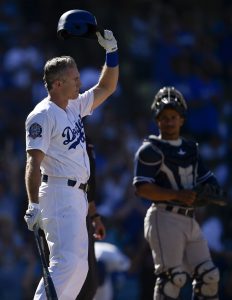
Utley, 39, turned in a compelling 16-year run at the major-league level. In addition to possessing high-end all-around talent, Utley will be remembered as perhaps the consummate grinder of his generation. Of course, his hard-nosed play also occasionally drew the ire of opposing players and fans.
There’s ample cause to view Utley as a strong Hall of Fame candidate. The former No. 15 overall pick (Phillies, 2000) ran up a cumulative .275/.358/.465 batting line with 259 home runs, 1103 runs scored, 1025 RBIs and 154 stolen bases. The six-time All-Star won four Silver Slugger Awards at second base — each coming between 2006-09, when he was widely considered to be one of the best players in all of baseball. From 2005-13, Utley raked at a .290/.378/.503 clip — good for a robust 129 OPS+.
Put it all together, and Utley compiled more than 60 wins above replacement by measure of both Baseball-Reference (65.4) and Fangraphs (63.2). More than half of that tally came during a ridiculous five-year run from 2005 through 2009, when Utley racked up value by contributing in all facets of the game. That monster peak coincided with the Phillies’ rise into a powerhouse. Utley paired with Jimmy Rollins to form an outstanding up-the-middle duo and the club fielded a variety of other high-end talents.
Utley’s single best season, by measure of wins above replacement, came in 2008 when he helped lead the Phillies to a World Series Championship. Then 29 years of age, Utley hit .292/.380/.515 with 33 homers during the regular season and played a pivotal role in helping the Phils advance beyond the NLCS against the Dodgers.
Over the years to come, Utley ramped down into merely a highly above-average player. He was churning out 3+ WAR campaigns through 2014 — marking a decade-long run in which he reached at least that annual tally (by B-Ref’s measure). The inevitable breakdown campaign came in 2015, but Utley still found a way to bounce back. He turned into a sturdy role player after moving to the Dodgers via trade. Utley was particularly useful during the 2016 and 2017 campaigns, when he appeared in 265 total games, providing the Dodgers with 918 plate appearances of .246/.321/.400 hitting and over 1600 innings of solid glovework.
It was clear during the 2018 season that the end was near. Utley faded at the plate in limited action while dealing with thumb and wrist injuries. When he announced in the middle of the year that he’d hang up his spikes for good, it came as little surprise. The Dodgers preferred to keep him on the roster for the duration of the 2018 campaign, though Utley was not active for the postseason.
By retiring now, Utley will forego the remainder of his contract with the Dodgers. He had been under contract for the 2019 season at a rate of $1MM. Giving up that cash will leave Utley just under the $125MM mark for career earnings. That’s a hefty haul, to be sure, but he earned every cent. It’ll be interesting to see how Hall voters ultimately handle Utley’s case. He doesn’t have the individual accolades that many prefer to see among Hall of Famers, but he had one of the better peaks of any second basemen in recent memory, has one of the more impressive overall resumes at that position, and will no doubt draw support from those who value his broad-based contributions to many successful teams.
Photo courtesy of USA Today Sports Images.
Latest On Bryce Harper, Manny Machado
We took a look yesterday at some of the early chatter on Bryce Harper. While the early chatter has been less voluminous with regard to fellow superstar Manny Machado, there’s little doubt that he will have his moment as well. As the stage-setting GM Meetings draw to a close, let’s check in on some additional notes on the market’s most-hyped free agents.
- Some eyebrows raised this evening when it was observed that the White Sox had unveiled a stage set at Chicago’s United Center featuring Bryce Harper‘s name. As Chris Cwik of Yahoo Sports explains, there’s no reason to think this was the beginning of the roll-out of a signing; our readers from the south side can safely inform friends and neighbors that there’s nothing imminent. More likely, it’s part of a recruiting pitch for the popular young free agent, who is in Chicago today. The news shouldn’t be blown out of proportion, clearly, but that doesn’t mean it’s of no consequence. Evidently, the White Sox are serious enough pursuers that they have secured an in-person visit and are putting resources into a pitch. That certainly dovetails with recent reports and public statements from the organization indicating that the club is looking to spend. It also bodes well for Harper’s market that a team such as the White Sox is making a run at him even after he reportedly turned down a $300MM offer to remain in D.C.
- As for the cross-town Cubs, all indications remain that they do not see themselves as a contender for Harper’s services, as ESPNChicago.com’s Jesse Rogers reiterates on Twitter. As Rogers puts it, if the club is “playing possum,” it’s “doing a heck of a job” at selling the act.
- It remains to be seen what stance the Giants will take with regard to Harper, particularly as Farhan Zaidi settles into his new digs atop the club’s baseball operations department. As John Shea of the San Francisco Chronicle reports, though, agent Scott Boras certainly seems to see San Francisco as a viable landing spot for his client. Harper, he says, views the organization fondly — and would not only deliver value on the field, but off of it. As for the club’s viewpoint, it’s tough to say whether Harper will be deemed a sensible target. CEO Larry Baer said “there’s no restrictions” for his new top baseball decisionmaker; whether or not to join the bidding on Harper (or other hyper-expensive free agents) is “a judgment [Zaidi] is going to need to make.”
- Of course, as Shea highlights, and Baer himself noted, that sort of outlay did not fit the M.O. of either of Zaidi’s prior two ballclubs — even those pesky division rivals to the south. Speaking of the Dodgers, Dylan Hernandez of the Los Angeles Times wrote recently that Harper is a player worthy of breaking the mold (and the bank) to acquire. Beyond his qualities as a ballplayer, Hernandez argues that Harper has the star power — and the right kind of attitude — to thrive in Los Angeles.
- Interestingly, the Cardinals, per Jon Heyman of Fancred, “do not seem interested” in Machado despite seemingly lining up from the perspective of roster need. But there has been quite a lot of discussion in St. Louis circles as to whether Harper might be a target. Derrick Goold of the St. Louis Post-Dispatch laid out the state of affairs recently. The Cards, he says, are seen as “a factor” in the market for Harper. While some would write the St. Louis organization off due to a lack of monster contracts on their ledger, it’s worth bearing in mind that the club has entered significant bids for players such as Jason Heyward (see here) and David Price (see here) in recent seasons, and also sought to acquire Giancarlo Stanton last winter.
- And what of the Yankees? The situation hasn’t really changed since last we checked in, but Joel Sherman of the New York Post takes a crack at thinking through how things may play out. There’s little indication at present that the New York club has any real intention of going for Harper. But Machado makes for a much more intriguing roster fit, and could prove particularly tantalizing.
Report: Document Raises Questions About Dodgers’ Payroll Intentions
Though the Dodgers’ pockets are among the deepest in the game, they haven’t been known (at least under their current front office leadership) for handing out monster contracts. The Dodgers, in fact, successfully dipped under Major League Baseball’s luxury tax threshold for the first time under the Guggenheim ownership group in 2018.
Still, when the Los Angeles organization swung a massive contract swap last December to sneak beneath the tax line, the general assumption was that the club mostly saw an opportunity to re-set its tax rate. After all, the scheme under the current collective bargaining agreement includes enhanced penalties for repeat offenders, increasing the incentives for performing a limbo act at least once every few years. Many wondered if the timing was designed at least in part to coincide with a 2018-19 free agent market that features some premium talent.
Now, though, there’s some evidence that the Dodgers may have different plans altogether. According to a report from Bill Shaikin of the L.A. Times, a 2017 document prepared for potential investors suggested that the organization projected to remain beneath the luxury tax threshold for years to come. Specifically, the Dodgers told investors they projected to carry a $185MM payroll for 2019 and 2020 before increasing that number to $191MM in 2021 and $196MM in 2022. The organization predicted soaring revenue despite a streamlined budget (including with regard to player salaries).
Some provisos are assuredly warranted. As Shaikin explains, this document hardly binds the team in a legal sense. And a “high-ranking team official” tells Shaikin that the payroll numbers represented only a “forecast.” That said, it’s also fair to point out that any organization could theoretically expose itself to potential liability by including any known misrepresentations in a bid to draw investors.
Notably, too, the document was prepared before the team qualified for the postseason last year and ultimately went on to make consecutive World Series appearances. And it’s somewhat unclear whether the salary levels contemplated would relate to actual expenditures or calculations for purposes of assessing the competitive balance tax. Over the long haul, that might not matter much, but it certainly weighs into both the team’s immediate plans and the intentions behind the numbers it presented.
So, what might all this mean for the Dodgers’ near-term spending outlook? Most immediately, a source indicated to Shaikin that it’s quite likely the Dodgers will go past $200MM for the coming season. Whether or not that’s due to tweaked thinking since this document was prepared, it seems that the $185MM figure is no longer realistic.
Even if the Dodgers were to stick to that kind of spending level, the constraints may not be as great as one might imagine. Presently, the Dodgers are within just a few million dollars of that $185MM sum, though that estimate includes yet-undetermined arbitration salaries and doesn’t account for factors like non-tendered players or potential trade candidates with notable salaries (or projected salaries).
Furthermore, L.A.’s luxury tax ledger, which is based on the average annual salary of the team’s contracts rather than actual year-to-year salaries, is cleaner. Currently, the Dodgers payroll sits at just a bit north of $161MM for purposes of the CBA — well shy of this year’s $206MM luxury tax barrier. Even if one of Hyun-Jin Ryu or Yasmani Grandal were to accept a $17.9MM qualifying offer, the Dodgers would be at just over $179MM in luxury tax dollars, although that outcome would throw a wrench into the supposed 2019 bottom-line payroll target.
All things considered, it’s eminently possible for the Dodgers to add a premium salary — even after re-upping Clayton Kershaw at a rate that’s just short of the loftiest AAV in history — while staying out of the tax. It would take some finagling, and would perhaps mean parting with talented players on generally appealing contracts, but the document does not seem to conclusively take the Dodgers out of the hypothetical running for highly-paid players.
In the broader picture, of course, there’s surely something to be gleaned from this document. The notion of a payroll that trudges northward with inflation certainly does not align with the general image of the Dodgers as a freewheeling financial behemoth. It generally suggests that the organization will prioritize efficient spending while generally avoiding massive and lengthy contractual entanglements — a description that won’t be surprising to those that have followed the club’s course under president of baseball operations Andrew Friedman.
That said, it’s difficult to reach any firm conclusions based solely upon this document. For instance, the Dodgers’ financial experts may simply have been projecting payroll to grow steadily from its then-projected future rate, rather than making any detailed assessment of the ever-complicated process of compiling a roster from season to season. And there are always creative possibilities that could be part of the planning here. The Dodgers’ wealth of young talent leaves the team capable (in theory, at least) of shedding contracts that go bad in future seasons. Most importantly, business plans change, and individual player investment decisions will surely not be dictated by the directional thinking at one point in time.
Dodgers Exercise Dave Roberts’ Option, Plan To Continue Negotiating Extension
The Dodgers have exercised their 2019 club option on manager Dave Roberts, president of baseball operations Andrew Friedman tells reporters (Twitter link via Bill Plunkett of the Orange County Register). The two sides have been discussing an extension since the 2018 season ended, and while they’ve yet to reach an agreement, talks on a multi-year deal will continue. Friedman adds that he expects a multi-year deal to be reached at some point.
Though there have been numerous reports pointing to a likely extension — Fancred’s Jon Heyman indicated yesterday that a four-year deal could be in the works — the Dodgers’ front office has had plenty of other issues with which to deal in the days since the World Series concluded. The team has already renegotiated David Freese’s contract to retain him for the 2019 season at a slightly lesser rate than his previous club option would’ve called for. More prominently, Dodgers brass hammered out a contract extension for ace Clayton Kershaw that guarantees him $93MM through the 2021 season.
Added to the pile of complications is the fact that the Dodgers have been in the process of sorting out how they’ll proceed without general manager Farhan Zaidi, who left the organization to become the president of baseball operations for the division-rival Giants. Meanwhile, third base coach Chris Woodward has been named the new manager of the Rangers, while minor league hitting coordinator Paco Figueroa is on his way to the Phillies, where he’ll serve as an outfield/baserunning coach.
The delay in lining up the terms of a new contract with Roberts, then, is somewhat understandable. And while some Dodgers fans will bristle at the notion of a new contract given Roberts’ affinity for platoon-based matchups and an adherence to limiting the number of times a starting pitcher is allowed to face an opposing lineup, the front office is clearly pleased with both the on-field results and the manner in which Roberts has managed a clubhouse filled with big personalities. Los Angeles has appeared in back-to-back World Series and won an NL West division title in each of Roberts’ seasons at the helm, and the Dodger staff has been largely successful in getting high-profile players to buy into functioning in reduced roles that are often dependent on matchups.
Giants Name Farhan Zaidi President Of Baseball Operations
10:40pm: Zaidi’s contract is a five-year deal, tweets Baggarly.
9:39pm: The Giants have formally announced Zaidi’s hiring.
“I am delighted to return to the Bay Area and to join one of the most storied franchises in the game,” Zaidi said in a statement. “I have watched the Giants from afar and I have great respect for the organization’s culture and many accomplishments. I am excited about this new opportunity and I’m looking forward to getting right to work.”
9:30pm: Andrew Baggarly of The Athletic tweets that Zaidi will be formally introduced at a press conference at 1pm PT tomorrow afternoon.
8:41pm: Dodgers general manager Farhan Zaidi has accepted an offer from the division-rival Giants to become their head of baseball operations, reports Henry Schulman of the San Francisco Chronicle (via Twitter). MLB.com’s Jon Morosi reported earlier today that the Giants had offered the title of president of baseball operations.

The addition of Zaidi brings an analytical/data-oriented approach to the Giants organization and marks a departure from the team’s longstanding pairing of Brian Sabean — who remains with the organization in an advisory role — and recently dismissed general manager Bobby Evans. That’s not to say that the Giants are completely without an analytics department, but they did come with the reputation of carrying a more traditional scouting-focused front office group. Under Zaidi, an MIT grad with a Ph.D in economics from UC Berkeley, they’ll surely beef up the implementation of more modern, data-driven decisions from a roster construction and in-game standpoint.
Early suggestions at the time of Evans’ dismissal were that the Giants would hire both a president of baseball operations and a general manager. Zaidi, presumably, will have autonomy in selecting a GM to work alongside him, though as the new president, he’ll have final say on all baseball operations matters. The bump in title was a necessity in luring Zaidi away from Los Angeles — teams generally only let their execs jump to other organizations if the offer includes a promotion — but he’s been reported to be among the organization’s top choices for the past few days.
By taking this position, the 41-year-old Zaidi will be returning to his old stomping grounds; Zaidi broke into baseball across the bay as a member of the Athletics front office, rising from a baseball operations analyst to the position of assistant GM over a more than decade-long run with the organization. While in Oakland, he aided the A’s with statistically-focused player evaluation in the draft, free agency and on the trade market, arbitration cases, contract negotiations and advance scouting.
Zaidi will be tasked with rejuvenating a Giants roster that has become stagnant as its young core has grown older. The Giants thrived earlier this decade, winning three titles in a five-year span on the backs of brilliant showings from Buster Posey, Tim Lincecum, Madison Bumgarner, Matt Cain and Pablo Sandoval, among others. That once-elite core has withered with time, and while Bumgarner and Posey remain prominent figures in the organization, each has been slowed by injuries in recent seasons. That’s true elsewhere on the roster, as well; Brandon Belt and Joe Panik, in particular, are among the Giants position players who’ve struggled to remain on the field, while high-priced pitchers Johnny Cueto, Jeff Samardzija and Mark Melancon have each been felled by health troubles as well.
The divergent paths that could be taken under Zaidi and a newly structured front office will make the Giants one of the more fascinating teams to watch this offseason. On the one hand, CEO Larry Baer has voiced a desire to aim to be competitive every season — an attitude that likely pushed Evans and Sabean to load up on veterans last offseason. But the additions of Andrew McCutchen and Evan Longoria didn’t restore the organization to prominence, and Longoria’s contract now joins those of Cueto, Samardzija and Melancon as undesirable commitments that’ll be tough for the Giants to escape.
However, that desire to remain competitive comes from ownership, and if going for it in 2019 is something of a mandate, then perhaps Zaidi & Co. will seek to supplement a flawed roster as best they can. San Francisco has been mentioned as a possible landing spot for Bryce Harper for the past year-plus, and the team’s successful effort to dip under the luxury tax barrier this past season only makes them a more logical landing spot if ownership is willing to commit the money.
Conversely, though, if Zaidi and the eventual San Francisco GM ultimately conclude that a more long-term outlook needs to be taken, that narrative would quickly change. Should that be the case, the Giants could go in the extreme opposite direction, making Bumgarner available on the trade market while also dangling lefty Will Smith. Complementary pieces like Sam Dyson, Hunter Strickland and Panik could all generate varying degrees of interest. Giants leadership would have its work cut out should they try to move many veterans beyond that group, however. Posey, Melancon and Brandon Crawford all have full no-trade clauses, while Samardzija, Belt and even Bumgarner all have limited no-trade clauses in their respective contracts.
For now, it’s unclear exactly how the Giants will proceed — only that the manner in which the organization has typically operated will likely be changing, as will the general composition of the team’s front office, scouting staff and analytics department.
Dodgers Reportedly Nearing Extension With Dave Roberts
5:40pm: The two sides “will have” a deal, tweets Fancred’s Jon Heyman, who adds that the expectation is for a new four-year deal to be completed by tomorrow.
12:30pm: The Dodgers are “getting close” to striking a new contract with manager Dave Roberts, according to Ken Rosenthal of The Athletic (via Twitter). It has widely been anticipated that the sides would line up on a deal.
Roberts has overseen three productive seasons in Los Angeles, reeling off division titles and taking the club to the World Series in each of the past two seasons. Of course, the Dodgers have lost in both trips, though it’s tough to judge those results too harshly. Along the way, Roberts has worked closely with the front office to deploy a supremely deep and flexible roster.
All indications have been that the Dodgers would keep Roberts at the helm, though the mechanism for doing so hasn’t been certain. There has been plenty of optimism for a new contract, though it has also remained possible that the team would simply exercise its $1.1MM option over Roberts. It seems likely he’ll receive a significant pay bump over that salary level, which was reached when he was hired as a rookie skipper.