
Free Agent Profile: Jeff Samardzija
After an offseason trade to the White Sox, Jeff Samardzija struggled through his worst season in four years as a starting pitcher. He’ll still likely aim for a sizable multiyear contract in free agency.
Strengths/Pros
Samardzija is, first and foremost, a workhorse. He tossed 647 1/3 regular season innings from 2013-15, sixth-most in baseball. David Price is the only free agent with more during that span, and he only had eight additional innings. Samardzija has never been on the disabled list and has never missed a start due to injury. The 6’5″, 225 lb. righty seems built to last.

Samardzija has lower mileage on his arm than most of his fellow free agents, mainly because he spent a portion of his big league career as a reliever. As a 31-year-old with no DL time, Samardzija has still only thrown 1502 pro innings. Yovani Gallardo, who is a year younger than Samardzija, has 1901 innings. Johnny Cueto and Scott Kazmir have mileage similar to Gallardo. Ian Kennedy has 1590 2/3 innings, a total held down by 2009 shoulder surgery. Jordan Zimmermann and Wei-Yin Chen have lower mileage than Samardzija, but both had Tommy John surgery. Mike Leake, who recently turned 28, has 1115 career innings.
Samardzija has shown the ability to pitch at the front end of a rotation. He was his team’s Opening Day starter in each of the past three seasons, and earned an All-Star nod in 2014. That season, Samardzija posted a 2.99 ERA in 219 2/3 innings. His 4.7 K/BB ratio ranked 14th among qualified starters. He also brings the heat. From 2012-15, Samardzija averaged 94.6 miles per hour on his fastball, second only to Stephen Strasburg among those with 600 innings.
Samardzija turned the corner with his control in 2014, walking only 1.8 batters per nine innings. His 1.9 mark from 2014-15 ranks 15th among qualified starters, and many of those ranked above him are soft-tossers. From 2012-14, Samardzija showed an elite combination of skills and durability, ranking eighth in MLB with a 3.35 SIERA for those with 600 or more innings. During those three years, Samardzija was firmly operating in Jordan Zimmermann/Jon Lester territory. That valuation was borne out when Samardzija (along with Jason Hammel) netted the Cubs Addison Russell and Billy McKinney in a trade with the Athletics.
Weaknesses/Cons
There’s no tiptoeing around the fact that 2015 was a very rough season for Samardzija. He allowed the most hits and earned runs of any MLB starter, and he tied for the most home runs allowed in the AL. In his four seasons as a starter, his 6.9 K/9 was easily a career worst, as were his 4.96 ERA, 1.22 HR/9, and 39% groundball rate. In his 32 starts, he allowed five or more earned runs in 11 of them. Samardzija had a stretch in August where he gave up 22 earned runs in three starts. Zack Greinke didn’t give up his 22nd earned run until his 21st start of the season. A childhood fan of the White Sox, Samardzija’s season on the south side of Chicago did not go as planned.
In four seasons as a starter, Samardzija has posted a 4.03 ERA over 822 innings, and his only campaign below 3.81 was 2014. In each of the 2012, ’13, and ’15 seasons, Samardzija’s SIERA was significantly below his ERA. What has caused the big righty to post higher-than-expected ERAs in three out of his four seasons as a starter? Batting average on balls in play, home run per flyball rate, and issues pitching out of the stretch have all manifested in those three seasons, but none consistently. His All-Star season, 2014, was the only one where all three of those factors were normal. I asked SIERA creator Matt Swartz about this, and he concluded, “You have to figure he’s more likely to underperform his SIERA than the average pitcher, but nothing jumps out as a persistent problem.”
With the White Sox, Samardzija reduced the usage of his two-seam fastball in favor of the cutter, perhaps unsurprisingly. That pitch change mix supports the narrative that Samardzija can be fixed. On the other hand, why couldn’t Samardzija right the ship during the 2015 season?
Samardzija received and turned down a qualifying offer from the White Sox, so signing him requires draft pick forfeiture. Teams with unprotected picks in the teens such as the Red Sox, Diamondbacks, and Orioles could shy away.
Personal
Jeff Samardzija was born and raised in Merrillville, a town in Northwest Indiana. Inspired by his older brother Sam, Jeff played football, baseball, and basketball at Valparaiso High School. Tragically, Jeff lost his mother Debora during that time to a rare lung disease. With his father and brother in mind, Jeff looked at colleges close to home and landed a football scholarship to Notre Dame. Jeff was a star wide receiver for the Irish, but quietly pitched for the college’s baseball team as well. A baseball teammate noted Jeff resembled the shark from Finding Nemo, giving him a nickname that stuck. Since most teams thought he was destined for the NFL, Samardzija fell to the fifth round in the MLB draft in 2006. Cubs GM Jim Hendry was a good friend of Samardzija’s baseball coach Paul Mainieri, who urged Hendry to draft the greatest athlete he’d ever coached. Jeff agreed to a $250K deal with the Cubs, provided he could return to Notre Dame for his senior season.
After making seven appearances for Cubs minor league affiliates in Boise and Peoria, Samardzija had to decide whether to commit to the Cubs or enter the 2007 NFL draft as a potential first-round pick. Samardzija surprised the Cubs by working out a five-year, $10MM deal to commit to baseball. Samardzija ascended through the Cubs’ minor league system more because of his contract than due to success. As an up-and-down reliever, Samardzija briefly kicked around a return to football in April 2010. However, he had a decent year out of the Cubs’ pen in 2011, and then Theo Epstein’s regime took over the team’s front office. Samardzija removed his distractions that offseason and told Epstein he wanted to be a starting pitcher. He was awarded the Cubs’ fifth starter job out of camp in 2012, and his MLB career took off.
Market
We see Samardzija in a tier with Wei-Yin Chen and Mike Leake, a notch below David Price, Zack Greinke, Jordan Zimmermann, and Johnny Cueto. Comparing Samardzija’s contract with Chen’s will offer an interesting data point on whether teams are really moving past ERA. ERA makes Chen look better than Samardzija, yet Samardzija has a better reputation with the team executives to whom we’ve spoken, as well as superior skill-based stats. For some teams, Samardzija offers a chance at a #2 type starter coming off a down year, resulting in a potential bargain. Samardzija is an innings guy at worst, with the same high floor as Leake. Leake, however, doesn’t offer the same ceiling.
Though the draft pick loss will be an issue for some, a potential list of suitors for Samardzija includes the Orioles, Red Sox, Yankees, Blue Jays, Tigers, Royals, Twins, Astros, Angels, Rangers, Marlins, Nationals, Cubs, Cardinals, Diamondbacks, Padres, Dodgers, and Giants. He could be a top choice for a team like the Tigers, who intend to add multiple starters and therefore may sit out the $100MM+ market. Former Cubs GM Jim Hendry currently works for the Yankees (at least for now), so there’s an obvious connection with Shark.
Expected Contract
In June 2014, Jon Paul Morosi of FOX Sports reported Samardzija rejected a five-year extension offer from the Cubs worth slightly more than $85MM. A few months prior, Homer Bailey had signed an extension with the Reds for six years and $105MM, and that comparable may have compelled Samardzija to turn down the Cubs. The Cubs’ argument may have been that Bailey was younger than Samardzija, and that’s why he received a sixth year. That same question still exists: is there a team willing to sign Samardzija through 2020, his age 35 season? Given the list of teams above, as well as the pitcher’s durability, I think there will be enough suitors for Samardzija and his agents at Wasserman Media Group to get a fifth year on the open market. A slightly lower average annual value could bolster that case – Samardzija may cost $16-17MM per year, as opposed to $20MM+ salaries for guys like Rick Porcello and, presumably, Zimmermann. I’m predicting a five-year, $80MM deal for Samardzija.
Offseason Outlook: Texas Rangers
Despite losing ace Yu Darvish to Tommy John surgery in Spring Training, the Rangers shocked everyone with a return to the postseason. Now, they’ll look to build toward a 2016 return despite possibly losing a few key contributors to free agency.
Guaranteed Contracts
- Prince Fielder, 1B/DH: $120MM through 2020 ($6MM paid annually by Tigers)
- Elvis Andrus, SS: $103MM through 2022 (can opt out after 2018 or 2019 seasons)
- Shin-Soo Choo, OF: $102MM through 2020
- Cole Hamels, SP: $73.5MM through 2018
- Yu Darvish, SP: $21MM through 2017
- Adrian Beltre, 3B: $18MM through 2016
- Derek Holland, $11.5MM through 2016 (includes buyout of 2017 option)
- Martin Perez, SP: $9.75MM through 2017 (includes buyout of 2018 option)
- Josh Hamilton, OF: About $6MM through 2017 (can opt out after 2016 season)
Arbitration Eligible Players (service time in parentheses; projections via MLB Trade Rumors)
- Mitch Moreland (5.067) – $5.6MM
- Tom Wilhelmsen (4.089) – $3.0MM
- Chris Gimenez (3.163) – $1.0MM
- Shawn Tolleson (3.122) – $2.6MM
- Tanner Scheppers (3.111) – $800K
- Robinson Chirinos (3.103) – $1.4MM
- Jake Diekman (3.049) – $1.0MM
- Jurickson Profar (2.167) – $508K
- Nick Tepesch (2.136) – $508K
Contract Options
- None
Free Agents
Most pundits were throwing dirt on the Rangers’ grave as early as March. The news of Yu Darvish’s Tommy John surgery and pre-existing injuries to Derek Holland, Martin Perez and others led observers to wonder how Texas could conceivably contend in a tough AL West — especially considering no one knew what to expect from Prince Fielder coming off 2014 neck surgery.
As we know now, the story played out quite differently. Fielder returned with a flourish, earning American League Comeback Player of the Year honors. The club rode early, albeit unsustainable hot streaks from the likes of Nick Martinez and Wandy Rodriguez, each of whom helped bridge the gap to the return of Holland and Perez. Shawn Tolleson stepped up and solidified the ninth inning after former Rookie of the Year Neftali Feliz was designated for assignment and released. Everything seemed to click for the Rangers, whose outlook heading into 2016 already looks vastly improved.
That’s due, in large part, to the fact that the Rangers effectively did some of their offseason shopping in July. The loss of the five prospects with which GM Jon Daniels parted to acquire Hamels undoubtedly stung, but the Rangers softened the blow by convincing the Phillies to surrender live-armed lefty setup man Jake Diekman, take on the remainder of Matt Harrison‘s contract and include $9.5MM in cash. Hamels will probably be the Opening Day starter for Texas next season unless Darvish is ready to go for the opener. Regardless of their ordering, that duo will create a formidable one-two punch for second-year manager Jeff Banister.
The Rangers have Holland, Perez, Martinez, former first-rounder Chi Chi Gonzalez and Nick Tepesch as internal rotation options to fill in behind the co-aces, but there’s still interest in re-signing Colby Lewis, and a reunion with Fort Worth native Yovani Gallardo can’t be ruled out. Gallardo should command at least a three-year deal, if not four, but the Rangers made sure to recoup some value by a qualifying offer to the right-hander, so they’ll secure a 2016 draft pick if he’s not retained.
Adding a starting pitcher is said to be a priority for the Rangers, and I’d imagine they’ll look to add an arm even if a new pact with Lewis is reached. Lewis delivered 204 innings for an injury-hampered club, but he turned 36 in August and logged a 4.66 ERA (4.17 FIP) this season. If he can be had on a one-year deal, it could make sense to lock down those innings but still bring in a younger arm that can be relied upon for better results.
It’s not clear whether the Rangers would be open to free agents that require draft pick forfeiture, but reports early in the offseason indicated that they’d only be interested in Matt Wieters if the Orioles’ catcher did not receive a QO. (Of course, Wieters did receive one and made the surprising decision to accept, so he’s not a consideration anymore.) If the team is intent upon keeping its pick, then the free agent pitching options could include names like J.A. Happ, Scott Kazmir, Rich Hill, Mike Leake, Mike Pelfrey, and Chris Young.
Of course, that prior report on Wieters also seems to indicate an openness to upgrading at catcher. Daniels has expressed a willingness to do so this winter, but the need isn’t as strong as many would think. Robinson Chirinos is far from a household name, but the 31-year-old batted .232/.325/.438 with 13 homers this season to go along with more or less average pitch-framing numbers and a solid 29 percent caught-stealing rate. He’s not a defensive wizard nor is he an elite slugger, but his bat is above-average for a catcher, he’s a competent defender and he can be had for little more than the league-minimum. Wins above replacement pegs Chirinos at about four wins over the past two seasons (4.2 rWAR, 3.8 fWAR). That’s a useful starter, especially at his price, and clear free-agent upgrades aren’t readily available, especially with Wieters and A.J. Pierzynski off the market. Jonathan Lucroy could potentially be a sizable upgrade, but he finished the year battling post-concussion symptoms, casting some doubt on his ability to get behind the dish every day. (He played only first base upon return from the disabled list.) The Brewers would probably be open to moving him for a significant return, but they may be able to extract more from an acquiring team if Lucroy is traded this summer once he demonstrates his health. Whenever he’s made available, the Rangers will probably at least check in.
Looking around the infield, the Rangers are set with Mitch Moreland at first base, Rougned Odor at second, Elvis Andrus at shortstop and Adrian Beltre at third base. In the event that either corner option falls to injury — each has had some struggles with the injury bug in recent years — prospect Joey Gallo could again enter the fold. Gallo wowed early in his Major League debut, but his penchant for strikeouts was soon exposed. He ultimately landed in Triple-A and struggled to make contact there as well. Still, Gallo is a potential 40-homer threat, and the Rangers may want to find a way to see him in the Majors for an extended time next year, as he could be the team’s regular third baseman as soon as 2017.
Texas will probably shop Andrus’ unfortunate contract around to see if there are any takers for the 27-year-old, but that’s not likely (at least, not without the Rangers taking on a similarly undesirable deal or absorbing an enormous amount of cash). Andrus’ bat never developed like Texas hoped, and it in fact regressed heavily following the 2012 season. Defensive metrics have been down on Andrus over the past two seasons as well, with his once premium ratings slipping to well below-average over that two-year span.
One idea that the Rangers are said to be considering is a long-term contract for Odor. Still just 21 years old, Odor looked utterly lost early in the season, and a .144/.252/.233 batting line in mid-May finally earned him a demotion back to the minors. Odor remained at Triple-A for about five weeks before returning with a 3-for-3 showing on June 15. That big game set the tone for the rest of his season, as the highly touted young infielder would hit an incredible .292/.334/.527 with 15 home runs over his final 91 games. That’s outstanding production for any second baseman, let alone one who is younger than the average player in the Class-A Midwest League. An extension would guarantee Odor his first fortune while possibly extending the Rangers’ club control into Odor’s free agent years by a season or two. Odor currently projects to be a free agent heading into his age-27 season, so he can still hit the open market at a young age even if he signs away a free agent year in exchange for his first major payday.
The X-factor in the infield is shortstop Jurickson Profar. Formerly ranked the No. 1 prospect in all of baseball, Profar’s career has stalled after he twice ripped a muscle in his shoulder, requiring a pair of surgeries and a lengthy rehabilitation. Profar is making up for some lost time by playing in the Arizona Fall League, but he’s been DHing there and still needs to work his way back up to full-time fielding efforts. If it seems like forever ago that Profar homered in his first Major League at-bat, that’s because that long ball occurred back in 2012. The Rangers almost certainly wouldn’t sell this low by trading Profar now, especially when he’s so close to a possible Major League return. They’ll instead see if he can handle some time in the middle infield next year, possibly starting him out at Triple-A while working him back in with the glove. In the unlikely event that the team is able to find a taker for Andrus, the Rangers could bring in a veteran shortstop like Cliff Pennington or Clint Barmes (if not a more expensive option like Alexei Ramirez or Jimmy Rollins) to handle shortstop and hope that Profar can eventually slide into regular reps there. Or, young Hanser Alberto, who filled in admirably for the injured Beltre in late 2015, could see some time there.
In the outfield, Choo’s contract isn’t exactly favorable in its own right, but his second half makes it look far less daunting for the Rangers. The 33-year-old delivered a strong August and a Herculean September to end with a .343/.455/.560 second-half batting line. He won’t repeat the .420 BABIP that he logged following the break, but Choo walked at a 14.4 percent clip and slugged 11 homers over his final 305 plate appearances, so the improved production wasn’t all BABIP smoke and mirrors. Perhaps it’s not enough to convince a team to take on Choo’s contract in a trade, but it’s enough that the team can feel more comfortable that he can hold down a prominent role heading into the 2016 campaign.
The Rangers’ first major move of the offseason was to ship out Leonys Martin in an intradivision trade that netted Tom Wilhelmsen, James Jones and a player to be named later from the Mariners. In doing so, Texas essentially named Delino DeShields Jr. its starting center fielder. He’ll receive the bulk of the at-bats there and bring plenty of speed to the top of the order. A left-handed hitting backup option might be worth considering, though Jones, acquired in the Martin trade, could fill that role, and DeShields’ .334 OBP versus right-handers in 2015 doesn’t suggest that a platoon is necessary.
Hamilton is in line to receive quite a bit of playing time as well, but he underwent a second minor knee operation this winter and struggled to stay healthy in 2015. The Rangers picked him up on the cheap from the Angels and aren’t heavily invested in Hamilton from a financial standpoint, so I don’t envision him standing in the way of a significant bat, should an opportunity present itself. A right-handed bat is said to be something Daniels and Co. are seeking this offseason, and left field would make a reasonable place to deploy that bat. However, a run at Justin Upton or Yoenis Cespedes could simply be deemed too pricey. Texas already has $76.5MM committed as far out as the 2018 season and $54MM in both 2019 and 2020. Adding another $20MM+ salary to the ledger for those seasons this far in advance is a risky endeavor and probably shouldn’t be deemed likely unless the club shuffles some salary by dealing Andrus or Choo.
Perhaps a more likely scenario would be an addition in the Steve Pearce mold — a player who can at least platoon with Hamilton in left field and can also fill in for Mitch Moreland at first base if needed. Pearce crushes left-handed pitching and would bring a bit of versatility to the table as an emergency option elsewhere around the infield (he played some second base in Baltimore in 2015). Texas could pursue a reunion with Mike Napoli, who filled that role last year, but Napoli’s left-field experience is limited to 2015, whereas Pearce has more than 2,000 innings of outfield experience between the Majors and Minors.
With Tolleson, Wilhelmsen, July acquisition Sam Dyson (one of the most underrated trade pickups of the year) and brilliant rookie Keone Kela serving as right-handed bullpen options and Diekman representing a terrific left-handed option, there’s a lot of talent in the bullpen. Sam Freeman is a potential second lefty after logging a 3.05 ERA in 38 1/3 innings, but while Freeman struck out 40 hitters in that time he also walked 25 men — an average of nearly six free passes per nine innings. A lefty with better control is something the Rangers may consider, and there’s the possibility that they’ll pursue a more proven ninth-inning arm. Tolleson was great for much of the season but did wilt late in the year. Then again, that could have something to do with Banister’s alarming decision to pitch Tolleson on five consecutive days from late September into early October.
The bottom line for the Rangers is that a team that was little more than an afterthought seven months ago is now entering the offseason with firm expectations of contending in 2016. Daniels and his staff will look to supplement the team’s lineup and rotation with complementary pieces, knowing full well that much of the club’s core is already in place.
MLBTR Mailbag: Freeman, Angels, Mets, Marlins, Chapman
With the offseason underway and multiple blockbuster trades already in the books, let’s dive into another edition of the MLBTR Mailbag…
I was wondering what the return for Freddie Freeman would look like. Since I am a Pirates fan, and am asking within that context, then what would the Pirates need to offer to get a deal done? — Kellen H.
No fewer than a dozen questions asking about the Pirates and Freeman this week. Sorry to disappoint Pirates fans, but I don’t see a realistic way that it gets done. Freeman is owed $118.5MM over the next six seasons, which is just about double the largest contract in Pirates franchise history. Add that to the likely prospect price — one would imagine names like Tyler Glasnow, Josh Bell, Reese McGuire, Jameson Taillon, etc. coming up in talks — and it’s just not realistic, barring a huge shift in the Pittsburgh payroll.
With the Angels trading their top two minor league prospects to Atlanta for Simmons, are they in a position to acquire any offense via trade (i.e. Trevor Plouffe, Brett Gardner, Todd Frazier)? Or are the Angels relegated to Free Agent spending? Did they spend Sean Newcomb and Chris Ellis wisely or could they have gotten more for the pair (i.e. Jay Bruce, Yasiel Puig)? — Marcus R.
I liked the Simmons deal for the Angels quite a bit and wholeheartedly disagree with the suggestion that Jay Bruce would’ve been “more” to get for Newcomb/Ellis.
The Angels probably don’t have a ton of pieces to move for Frazier — the Reds are looking for controllable, MLB-ready players and the Angels are thin in such types of impact talent, especially on the position-player side of things. Plouffe could potentially be had for a pair of power bullpen arms, though, and Gardner could be attainable as well, though the Angels probably don’t want to surrender any more starting pitching, and I’d imagine that’s the ask for him.
How do you think the Mets are going to replace the power in their lineup from the departure of Cespedes and Murphy. Is Ian Desmond an option for them? — Jonathan V.
They don’t really need to replace Murphy’s power. His postseason performance was never sustainable, and he’s never had that much pop. Murphy is consistently about 5-10 percent above the league average in terms of park-adjusted offense, which is valuable but not irreplaceable. The Mets were already contending without Cespedes, so I don’t think they suddenly need to scramble to find a 35-homer bat or anything, either.
The Mets will have full seasons of Syndergaard, Matz and Conforto next season, and that alone should make up for much of the value lost when Cespedes signs elsewhere. The team had a down performance from Dillon Gee for the early portion of the season and lackluster numbers from guys like John Mayberry, Darrell Ceciliani and Kirk Nieuwenhuis before Cespedes and Conforto came onto the scene. Full years of their young players will replace a large portion of the value brought to the table by Cespedes.
All that said, I can see them making a play for Desmond, but he’s not going to bring Cespedes-style power to the picture for them or anything.
With the probable 2016 returns of Jose Fernandez and Henderson Alvarez, I believe the Marlins will be in a good spot to at least contend for a NL Wild Card Spot, given both Fernandez and Alvarez are healthy. They also would need one other quality starter in the rotation. Is it probable that the Marlins will seriously pursue some of the quality starters on the market such as Scott Kazmir, Wei-Yin Chen, Jordan Zimmerman or Yovani Gallardo? — Jamil V.
That’s a more bullish view than I have on the current iteration of the Marlins, but nonetheless I do think they’ll be in the market for a mid-rotation starter. I picked them to sign J.A. Happ in our free agent prediction contest. Happ had a huge breakout with the Pirates, and the Marlins hired special assistant Jim Benedict — who played an integral role in advance scouting and working with the pitchers in Pittsburgh — away from the Bucs this winter. The Marlins can reportedly spend around $12MM annually on a pitcher this winter, and I think Happ will come in a bit south of that AAV anyhow.
If not him, then yeah, I can see Gallardo being in play. Chen and certainly Zimmermann will command annual values out the Marlins’ comfort zone, and Kazmir could fit that description as well. Miami could reasonably make plays for either Ian Kennedy or Mike Pelfrey from a financial standpoint, but they may not be keen on dealing with Scott Boras (who represents those two and Chen as well) after the recent anger expressed toward Boras by president David Samson.
What do you think its going to take for the Rangers to get a solid catcher this year? — Mike C.
I think they already have one in Robinson Chirinos. He doesn’t hit for much average, but a .232/.325/.438 batting line out of a catcher is pretty strong. Chirinos’ production was slightly above that of a league-average hitter and worlds better than a league-average catcher. The league-average batting line for a catcher in 2015 was .238/.302/.376, so Chirinos got on base at an above-average clip and showed considerably more power than most backstops. He’s also caught 31 percent of base-stealers in his career and improved his pitch-framing skills in 2015. He could improve defensively, but you could do a lot worse than Chirinos as the primary catcher.
In light of the Craig Kimbrel trade, what kind of return can Cincinnati expect on Aroldis Chapman? With just one year of control, compared to three for Kimbrel, will the Reds receive significantly less than the Red Sox gave the Padres? — Tim S.
Yeah, the return on Chapman is going to be less than what the Padres received for Kimbrel. Even if the contracts were closer to even, it’d be really hard for me to imagine a team paying more than Boston did for Kimbrel — that was quite a bit to give up, even for a reliever that dominant. The Reds want MLB-ready players, and looking at their roster, outfielders seem like a potential area of focus (especially if Jay Bruce is traded this winter). For me, you’re looking at one MLB-ready position player and maybe another lower-level piece or two, with the secondary portion of the return dependent upon the quality of the headliner.
Offseason Outlook: Washington Nationals
For the first time in a while, the Nationals enter the winter with a variety of question marks and a lack of linear solutions.
Guaranteed Contracts
- Max Scherzer, SP: $190MM through 2021 ($105MM deferred, payable in seven installments of $15MM over 2022-2028)
- Ryan Zimmerman, 1B: $72MM through 2019 (including buyout of 2020 club option, $10MM personal services contract)
- Jayson Werth, OF: $42MM through 2017
- Gio Gonzalez, SP: $12.5MM through 2016 (includes buyout of 2017 club option)
- Jonathan Papelbon, RP: $11MM through 2016 ($3MM deferred to 2017)
- Yunel Escobar, INF: $8MM through 2016 (including buyout of 2017 club option)
- Bryce Harper, OF: $5MM through 2016 (remains eligible for arbitration through 2018)
Arbitration Eligibles (projections via MLB Trade Rumors)
- Craig Stammen (5.160) – $2.4MM
- Drew Storen (5.140) – $8.8MM
- Stephen Strasburg (5.118) – $10.5MM
- Wilson Ramos (5.047) – $5.3MM
- Jose Lobaton (4.138) – $1.5MM
- Danny Espinosa (4.113) – $2.7MM
- David Carpenter (4.016) – $1.5MM
- Tyler Moore (3.018) – $1.0MM
- Anthony Rendon (2.130) – $2.5MM
- Non-tender candidates: Stammen, Lobaton, Carpenter, Moore
Options
- Casey Janssen, RP: team declined $7MM mutual option, paid $1.5MM buyout
- Nate McLouth, OF: team declined $6.5MM club option, paid $750K buyout
Free Agents
Ian Desmond (declined qualifying offer), Doug Fister, Denard Span, Matt Thornton, Jordan Zimmermann (declined qualifying offer)
The 2015 season was filled with disappointment and controversy for the Nats, who entered the year heavily favored in the NL East. Underperformance abounded on a talented roster, much as occurred in 2013, and GM Mike Rizzo will now look for a similar bounce back.
Once again, there will be a new skipper in the dugout, though this time the outgoing manager (Matt Williams) was fired. (Davey Johnson‘s retirement had long been planned.) Dusty Baker got the nod, but not until the team had engaged in a highly publicized dalliance with Bud Black. Washington was openly mocked for reportedly looking to get a manager on the cheap, though the team obviously reached terms with Baker and seems to have spent big on highly-regarded new pitching coach Mike Maddux.
That was hardly the way the team wanted to start the winter — especially after a late fade punctuated by an ugly dugout fight in which high-price closer Jonathan Papelbon tried to choke superstar Bryce Harper.
In many ways, that incident frames the team’s offseason. Papelbon was the team’s major deadline addition, unseating Drew Storen as the closer but bringing the promise of an excellent 1-2 punch in the late innings. That combo started out well, but it (and the team’s season) fell apart as Williams mismanaged, Storen faded, and Papelbon raged.
Now, the question is whether the Nationals will shop Papelbon, Storen, or both. Harper has reportedly chatted with Papelbon in an effort at conciliation. And GM Mike Rizzo says that both righties will remain with the team unless a “real baseball offer” comes in. That leaves at least some window for either or both to stay on in D.C. for the final year of their respective contracts.
Of course, the club badly needs pen arms. Washington has been tied to upper-tier trade candidates such as Aroldis Chapman since the trade deadline, and is one of many teams with reported interest in top free agent Darren O’Day. Significant additions of that kind would probably enter the picture (and the payroll) as Papelbon and/or Storen depart.
Regardless what happens at the back end, the Nats face a lot of questions in the pen. Lefty Felipe Rivero, an underappreciated piece of the Jose Lobaton/Nate Karns deal, had a nice rookie campaign. Righty Blake Treinen still has a huge arm, though he’ll need to take a step forward in harnessing it. We’ve yet to hear conclusively whether the team will take the risk on Craig Stammen and his projected $2.4MM salary after he missed the entire season with arm surgery. He’s expected to be ready for the spring, but even if he’s healthy, he’ll only be stepping back into the void left by Aaron Barrett, who’ll miss most or all of 2016. David Carpenter is another injury/arb question mark. There are other options in the organization, including Rafael Martin, Sammy Solis, and Matt Grace,
Tanner Roark could end up back in the pen if he’s bumped from the rotation, and some less experienced starters — A.J. Cole, Taylor Jordan, Taylor Hill, and Austin Voth — potentially could as well. But there are a lot of question marks in that group, and it seems likely that the Nationals will be hunting for relief arms at all levels of the market.
The rotation, on the other hand is set … probably. You could’ve said the same last year, after all, and the club added Max Scherzer on top of an already highly-regarded staff. That group fell shy of expectations, and will lose Jordan Zimmermann and Doug Fister to free agency, but still ought to be pretty good. Scherzer, Stephen Strasburg, and Gio Gonzalez form a good (and potentially excellent) trio at the top, Joe Ross was highly impressive in his debut last year, and Roark still profiles as a sturdy innings eater. The club also has some options and upside behind that group, with Cole perhaps ready for a real opportunity and consensus top overall pitching prospect Lucas Giolito not far behind (and ascending at a rapid pace).
Of course, Ross was mistakenly overlooked by many when news broke that he’d been traded to D.C. Taking top billing in that swap was Trea Turner, a swift young shortstop who got a brief taste of the big leagues last year. It will be quite a lot to ask of him to step in directly for the departing Ian Desmond — who, it should be noted, leaves big shoes despite a rough 2015 — but the Nats have other options as well. Yunel Escobar was acquired last winter due, in part, to his ability to step in at short for 2016. Danny Espinosa remains an outstanding defender and showed more with the bat last year, making him a platoon option up the middle. And Turner could ultimately be joined by another promising youngster, Wilmer Difo, as a double-play pairing. He, too, got a cup of coffee last year with the big club and could conceivably enter the picture this coming season.
The aforementioned group of players could combine in some form to occupy the middle infield positions. But we’ve heard whispers that the team could consider trading away Escobar, possibly in a reversal of the move (well-compensated reliever for well-compensated infielder) that brought him to D.C. in the first place. In that scenario, perhaps, the club would add a left-handed-hitting infielder to join the mix. Turner and Escobar, like most of the other Nats regulars, hit from the right side. And while Espinosa and Difo are both switch hitters, both are historically much more effective against southpaws.
It might not be out of the question, then, for the team to pursue a player like Daniel Murphy or Ben Zobrist. Both would add another left-handed bat to a heavily right-handed mix while contributing depth to the infield. (The latter hits from both sides of the plate.) Fellow free agent Kelly Johnson might represent a budget version of that type of player.
Adding another infield piece makes all the more sense when one considers the durability questions that still follow both Anthony Rendon and first baseman Ryan Zimmerman, both of whom are all but certain (injuries aside) to occupy the starting jobs at the infield corners. Much the same holds for left fielder Jayson Werth, who is aging and has been on the DL quite a bit recently — though, generally, his stints have been for acute injuries that might not reflect any particular long-term concerns.
There are in-house reserve options at the corners, but there are limits to their function. First baseman, bench bat, and emergency outfielder Clint Robinson did a nice job at the plate and could represent a cheap piece to pair with Zimmerman, he’s of limited utility in the National League given his poor glove on the grass. Much the same holds true of right-handed power source Tyler Moore, except that he doesn’t have as obvious a function on the team. A more versatile utility piece — such as those mentioned above — would also supply some support in the outfield while opening up opportunities to gain the platoon advantage.
Of course, there’s a more direct outfield need in center. Denard Span is hitting free agency, and the fact that he didn’t receive a qualifying offer — making him, arguably, the most eligible candidate who did not — signals that there’s little likelihood of a reunion. That leaves the toolsy but strikeout-prone Michael A. Taylor in position to take over. He’s a premier defender with legitimate power and wheels on the basepaths, but he’s still a question mark in terms of getting on base.
With Taylor ready but still raw, the club appears to have two primary routes available. The easier, more straightforward one would be to add a quality fourth outfielder who is capable of playing center and swings from the left side (so as to complement Taylor and also Werth). Though Matt den Dekker could fill that role, too, the team will probably try to do better while keeping him around for depth.
On this year’s free agent market, Gerardo Parra makes for the most obvious fit, and the Nats reportedly tried to add him at the trade deadline. A swap might also procure that sort of option. Rizzo has shown a proclivity for dealing for veterans on affordable, mid-length contracts, with Span, Fister, and Lobaton all representing examples. Brett Gardner of the Yankees, Leonys Martin of the Rangers, and Ender Inciarte of the Diamondbacks are a few names that come to mind, and all of those teams could well have interest in Storen in a swap. The Blue Jays, too, might like the idea of building out the back of their pen and could stand to part with Ben Revere. And depending upon what direction the Cardinals go, Jon Jay could be a target.
The catching position also carries some uncertainty. Wilson Ramos had a tough season in 2015, and is now just one year away from free agency. The same as true of Lobaton, the switch-hitting reserve, who could theoretically end up non-tendered despite his reasonable salary. It’s not as if there’s a ready replacement coming through the minors, as the team’s nearest catching prospect — 22-year-old Pedro Severino — hasn’t yet shown enough bat to profile as an upper-division regular. There was some reason to believe that Washington could make a run at Matt Wieters in free agency, but obviously there wasn’t enough interest there for the backstop to decline his qualifying offer, and he’s no longer available. An upgrade, if any, would have to come via trade. While that’s far from certain at this point, one would have to think the Nats would at least want to know the price on Jonathan Lucroy if he’s shopped.
If Rizzo (or his bosses) wants to shake things up, it’s not out of the question for the Nats to add a major free agent in the outfield. Indeed, MLBTR’s Tim Dierkes pegged D.C. as the likeliest landing spot for the tough-to-call Justin Upton. Presumably, an addition of that kind would mean that Harper — or, potentially the new player himself — would play somewhat out of position in center. Personally, I see Jason Heyward as the best match of the major free agent outfielders, since he hits from the left side and would probably be the most capable defender in center of the bunch. As I explained in a profile of his free agent case, Heyward also might command a slightly lesser AAV and could seek an opt-out clause. And the Nationals’ ownership has shown quite an affinity for complicated contract structures that spread financial commitments out over time. But those possibilities still seem fairly speculative. Indeed, Rizzo said recently that he doesn’t expect the team to “be big players for one of the big free agent outfielders.”
Truly bold action could come from elsewhere. Strasburg showed that he can still produce at an ace level down the stretch last year, and would be a highly appealing rental arm at his salary. The Nationals would surely be able to find a substantial return if they shopped him, and the team was reportedly willing to consider deals last winter for Desmond and Zimmermann. I suspect that Rizzo would be willing to move him in the right deal, but am skeptical that a sufficient offer would come in.
More likely, albeit still rather remote, is the extension route. Strasburg may be too close now to free agency to take a serious pass at negotiations, particularly since he looks like the best pitcher on next year’s market by a landslide. But his down-and-up 2015 could leave him willing to sacrifice some money to relieve some risk. Similarly, now could be the time to float a proposal to Rendon, who had an injury-filled 2015, though he’s still four years from free agency. And, of course, there’s always the at-least-theoretical possibility of getting something done with Harper, who met and exceeded the enormous expectations with a historically-relevant campaign last year. Locking him up, in turn, might well require a record-setting contract — a topic that I explored and put to a reader vote a little while back.
Rumors of the Nationals’ demise are premature. True, the core of the team is no longer the same as the 2012 iteration and its successors. But many of the same pieces are still in place, and the organization has supplemented quite nicely. Indeed, as noted above, a whole new wave of talent — Ross, Giolito, Turner, Taylor, and more — is not only lined up but designed to fit with the team’s needs. But patience only holds so long when the talent level (and payroll) is as high as it has been in recent campaigns, and Rizzo will need to be at his creative best to re-energize the big league roster without sacrificing too much prospect value and/or spending capacity.
MLBTR Originals
A look back at the original reporting and analysis found on MLBTR the last seven days:
- On the most recent edition of the MLB Trade Rumors Podcast, host Jeff Todd welcomed Peter King of CBS Radio News. King, a respected journalist with a fascinating career, is a hot stove junkie who once followed transactions by way of newspaper and now regularly visits MLBTR. A new episode of the MLB Trade Rumors Podcast is released every Thursday and can be accessed on iTunes, SoundCloud, and Stitcher.
- Recently, MLB Trade Rumors launched a brand new official Instagram account:@TradeRumorsMLB. Each day, we’re sharing conversation-inspiring images about the hottest topics in baseball. From there, we invite you to give us a like, weigh in with your thoughts in the comments section, and even share the link with a friend. So, what are you waiting for? If you don’t have an Instagram account, this is the perfect excuse to sign up and get one. Follow us on Instagram today!
- There’s a lot of work ahead for the Mariners’ new front office and Mark Polishuk ran down some of their different options this offseason. In a way, GM Jerry Dipoto finds himself in something of the same position that he was in as the Angels general manager — a few superstars on huge contracts, a few regulars best suited to platoon duty, little minor league depth, and some payroll limitations.
- Meanwhile, Dipoto’s old club will be looking to get back to the postseason in 2016. Steve Adams discussed the Andrelton Simmons acquisition and forthcoming moves that could be in store for the Halos. The Angels seem like logical players for free agent help on the pitching market and they’ll have to address holes at catcher, second base, third base, in left field and possibly at DH.
- The Marlins have a lot of ground to make up in the NL East, but enter the offseason with a talented core, a bit of free cash, and a desire to compete, Jeff writes.
- The Astros were thought to be a few years away from contention but they advanced their timetable in 2015. Now, it remains to be seen how much further owner Jim Crane is willing to boost the payroll, Mark writes. The payroll has gradually risen from a measly $26MM in 2013 to roughly $50.5MM in 2014 to last year’s total, so it seems like a boost into the $95-$100MM range could be coming this winter.
- The AL East champion Blue Jays will have to rebuild their pitching staff this winter, though their first priority will be sorting out an unexpected front office shuffle, Mark writes. The next step for the Jays will be to explore extending Bautista and Encarnacion, which will be very interesting negotiations. Beyond that, everything is on the table for Toronto, including a possible reunion between new president Mark Shapiro and one of the pitchers he was fond of in Cleveland.
Offseason Outlook: Los Angeles Angels of Anaheim
The Angels remained in Wild Card contention until the final day of the season but ultimately fell short to the Astros for that spot. With a playoff miss in the books, the 2015 campaign may now be remembered more for the disintegration of the front office than the on-field product. A new regime will look to return the Halos to postseason baseball next year.
Guaranteed Contracts
- Albert Pujols, 1B/DH: $165MM through 2021
- Mike Trout, OF: $134.25MM through 2020
- Andrelton Simmons, SS: $53MM through 2020
- C.J. Wilson, LHP: $20MM through 2016
- Jered Weaver, RHP: $20MM through 2016
- Huston Street, RHP: $18MM through 2017 (includes buyout of 2018 option)
- Joe Smith, RHP: $5.25MM through 2016
Arbitration Eligible Players (service time in parentheses; projections via MLBTR)
- Fernando Salas (5.048) – $2.2MM
- Cesar Ramos (5.003) – $1.7MM
- Hector Santiago (4.016) – $5.1MM
- Collin Cowgill (3.151) – $1.0MM
- Garrett Richards (3.148) – $6.8MM
- Kole Calhoun (2.130) – $3.6MM
- Non-tender candidate: Cowgill
Contract Options
- David Murphy, OF: $7MM club option with a $500K buyout — Declined
- David DeJesus, OF: $5MM club option with a $1MM buyout — Declined
Free Agents
Other Financial Commitments
- $48MM to the Rangers through 2017 for Josh Hamilton
- $2.5MM to the Braves in 2016 for Erick Aybar
The series of events that will perhaps have the largest impact on the Angels’ offseason began over the summer, when then-GM Jerry Dipoto abruptly resigned over differences with manager Mike Scioscia and his coaching staff. Reports at the time indicated that Dipoto was frustrated by the field staff’s resistance to implementing information from the club’s analytics department. (Now-former pitching coach Mike Butcher has since been reported to have been heavily resistant as well.) Owner Arte Moreno, it would seem, endorsed his manager over his GM, prompting Dipoto’s exit. Former GM Bill Stoneman assumed the vacated post for the remainder of the year, and Yankees assistant GM Billy Eppler was tabbed as the new GM shortly after their season ended.
Dipoto’s exit isn’t the only change, however, as assistant GMs Scott Servais and Matt Klentak have both departed. Servais will serve as manager of the Mariners, where Dipoto was hired as general manager, and Klentak was the hand-picked choice of Phillies president Andy MacPhail to succeed Ruben Amaro Jr. as GM. Special assistant Tim Bogar joined Servais in the Seattle dugout as the club’s bench coach. Suffice it to say, there will be a different brain trust making the calls in Anaheim this offseason.
And that new brain trust hasn’t taken any time to make an impact on the organization. A confession: this post was written and ready to go a few days ago, but it didn’t get onto the site with all of the activity going on at the GM Meetings. No big deal, right? It’s not like the Angels would do something to drastically re-structure the fabric of their organization in the few days between– Oh. Rewrite it is, then!
Eppler’s first move as GM might technically have been to claim Todd Cunningham off waivers last month, but everyone will remember that less than two months into his tenure, the Angels swung a blockbuster deal that sent Erick Aybar, left-hander Sean Newcomb and right-hander Chris Ellis to the Braves in exchange for Andrelton Simmons and minor leaguer Jose Briceno. With this trade, the Angels have dramatically altered the long-term configuration of their infield, proactively acquiring the game’s premier defensive player (sorry, Jason Heyward) in advance of a 2016-17 shortstop market that looks barren and will most likely be headlined by the very guy over whom the Halos would’ve been looking to upgrade (Aybar). Acquiring Simmons technically knocks $2.5MM off the 2016 payroll, but they’re covering that difference by sending the cash to the Braves, anyhow. The takeaway from the trade is that shortstop won’t be an issue for the Angels for the next half-decade.
What it means for the rest of the offseason is harder to figure, because the Halos didn’t really address an immediate need and burned some significant trade pieces in the process. There are still plenty of holes to address, and free agency now looks like the primary way to do it. That could mean that the team will need to be willing to forfeit draft picks to sign significant free agents.
The sting of sacrificing draft selections might have been lessened if the Angels had made a qualifying offer to David Freese on his way out the door. But there was a risk he’d have accepted, and the team ultimately elected to let him hit free agency unencumbered by draft pick compensation. Los Angeles still has interest in re-signing Freese at an annual rate less than the QO, though Freese currently leads a thin crop of free-agent third basemen, so he should have interest elsewhere also.
The Halos currently have about $145MM committed to next year’s payroll between guaranteed contracts, arbitration eligible players (minus non-tender candidate Collin Cowgill) and the $24MM they owe the Rangers for Josh Hamilton‘s salary. The luxury tax ledger is calculated a bit differently — it’s based on average annual value of their contracts — but should come in just a few million north of that sum as it stands.
That outlook clears up significantly after 2016, when C.J. Wilson, Jered Weaver and Joe Smith are all free agents, although some of those departures highlight a clear need for the Angels this winter; starting pitching help that is controlled beyond 2016 will be a goal. When he was GM, Dipoto’s long-stated mission was to acquire cost-controlled arms, and he did well to acquire Andrew Heaney, Tyler Skaggs, Hector Santiago and Nick Tropeano via trades. However, Tropeano hasn’t proven himself in the Majors, and Skaggs is coming off Tommy John surgery from August of 2014. It’s nice to have options, but a team with the Angels’ financial firepower figures to spend on some stability as well, especially having dealt away a potential front-end starter in Newcomb.
Looking at what the Angels have in-house, Garrett Richards looks every bit the part of a budding ace, and Heaney has undoubtedly earned himself a long look in 2016 with a terrific rookie season. There’s little certainty beyond that duo, though, as even the names that comprised the 2015 rotation come with question marks. Matt Shoemaker was a brilliant rookie in 2014 but a wildly inconsistent sophomore whose end-of-year numbers from 2015 look like back-of-the-rotation production, at best. Weaver’s fastball velocity dipped to the low 80s, and he was hit hard and hit often in 2015. Wilson underwent season-ending elbow surgery in August. Santiago was excellent, but he hasn’t shown consistency in the Majors, as evidenced by losing his rotation spot with Anaheim as recently as 2014.
With that in mind, the Angels seem like logical players for free-agent help on the pitching market. Mid-level arms that could be had without significantly escalating the risk of crossing the luxury tax barrier include Wei-Yin Chen, Marco Estrada, Yovani Gallardo and Ian Kennedy, to name a few. As MLBTR’s Tim Dierkes pointed out to me recently, Eppler has somewhat of a connection to Kennedy, having been in the Yankees front office while Kennedy was drafted and rose through the farm system.
A run at high-profile names — David Price, Zack Greinke, etc. — probably shouldn’t be entirely written off, although another $20MM+ AAV contract would bring the Halos significantly closer to the luxury tax threshold. It’s possible that the club could free up some room by moving Wilson, who apparently caused some frustration among his teammates when he opted to undergo his season-ending procedure. Moving Wilson’s $15.5MM annual salary wouldn’t offset a $30MM-per-year price tag on Price or the similarly lofty AAVs that other top-tier free agents will command, but it makes the blow easier for the Angels to absorb while leaving room to pursue other needs.
Turning to the ‘pen, the Angels are in pretty good shape. Huston Street will return as the club’s closer after inking a two-year extension earlier this year. Joe Smith has been excellent in the first two seasons of a three-year deal, and he’ll be joined in the setup crew by righties Trevor Gott and Fernando Salas. Mike Morin figures to earn another chance as well. Though he slumped badly after a strong rookie showing in 2014, Morin’s strand rate (44.4%) was far and away the lowest in baseball of any pitcher with 30+ innings. That number screams “fluke,” and as such isn’t likely to be repeated. Morin’s 10.4 K/9, 2.3 BB/9 and 21.2 percent K%-BB% indicate better days ahead. Left-handed options include Cesar Ramos and Jose Alvarez, each of whom had strong seasons. Depth additions seem more likely than major adds, especially considering the fact that righty Cam Bedrosian, who dominated Triple-A but struggled in the Majors, figures to earn another shot at some point in 2016.
Pitching questions aside, the bigger needs for the Angels are on offense, where the club faces holes at catcher, second base, third base, in left field and possibly at DH. Chris Iannetta and David Freese are free agents, while left field was a revolving door in 2015. David Murphy, Matt Joyce, David DeJesus and Shane Victorino all saw time there but are all free agents now. Johnny Giavotella manned second base for much of the 2015 campaign after mainstay Howie Kendrick was traded for Heaney. Giavotella was slightly below the league average with the bat but also played questionable defense and lacks significant upside.
C.J. Cron appears set to open the season at first base in the wake of Albert Pujols‘ foot surgery, and he should eventually split time with Pujols at first and DH. While neither is a great defensive option and Cron does have his flaws (namely, a lack of plate discipline), Cron has the power to join Pujols as a source of 30 home runs. While the former first-round pick struggled greatly for the first two months of the season and was demoted to Triple-A, he hit .285/.325/.507 with 15 homers over his final 290 plate appearances upon being recalled. Pujols should be ready to go in early May, but his absence could lead the Halos to seek a bit of power that could begin the season at DH and shift to the bench when Pujols is activated.
A versatile piece such as Daniel Murphy makes some sense for the Angels, who were said in July to be eyeing left-handed bats to fill out their roster. Murphy could serve as an upgrade over Giavotella at second base or see more regular time at the hot corner if Freese isn’t re-signed. Internal options such as Caleb Kowart and Kyle Kubitza have seen their stock tumble, as neither player’s power has developed as hoped. The trade market has options at either position, with names like Yunel Escobar, Trevor Plouffe, Luis Valbuena, Jed Lowrie, Javier Baez, Starlin Castro and Jedd Gyorko among the offseason’s potential trade candidates. The Angels are said, in particular, to be intrigued by Plouffe, who could be made available if and when Minnesota reaches an agreement with Korean slugger Byung-ho Park. Bedrosian is said to be one name that intrigues the Twins, who have their eyes on hard-throwing relief help.
Catcher is a similar situation, and the open market is rather devoid of talent now that both Matt Wieters and A.J. Pierzynski came off the board early. With Carlos Perez and Jett Bandy currently serving as the only MLB-ready options on the roster, there’s a need for some type of move. Potential trade candidates could include Jonathan Lucroy, Kurt Suzuki and Wilson Ramos, though Lucroy finished the season with concussion issues while Suzuki and Ramos each struggled greatly. If a longer-term add is the goal, then perhaps the Braves’ Christian Bethancourt or the Yankees’ Gary Sanchez are plausible options. Eppler is, after all, quite familiar with Sanchez from his time in New York.
One area in which the Angels could aim higher is in the outfield. While the team was said to prefer lefty bats this summer, it eventually warmed to right-handed hitters and was linked to Yoenis Cespedes and Justin Upton. Either of those players could reasonably fit into the club’s long-term plans, with only Mike Trout, Pujols, and now Simmons under control beyond the 2017 season. The AAV of the contract might present some problems, though the previously mentioned theoretical savings from a Wilson trade could be applied here as well. A run at Jason Heyward makes sense, too, especially if he can be had at a lower annual value over a longer term, as MLBTR’s Jeff Todd recently hypothesized in his free-agent profile. If the Simmons trade taught us one thing, it’s that prime-aged, elite defense holds great value to the restructured front office.
The Angels’ mega-signings of Pujols and Hamilton, plus significant second-tier expenditures have clogged their long-term outlook for years, but there’s a light at the end of the tunnel after the 2016 campaign. While the team shouldn’t necessarily look to repeat past mistakes and over-commit to aging sluggers, the current market features a number of more youthful options that could fit into the team’s long-term outlook or be locked up on shorter deals (e.g. a three- or four-year pact for a mid-tier starter).
The Angels have the financial means to spend on nearly any free agent, and with the team’s luxury tax fears likely to dissipate next winter, long-term commitments aren’t necessarily as problematic as they once were. Of course, some future cash could also go to extensions with players such as Calhoun and Richards, both of whom look like fairly appealing targets for long-term deals.
We can’t know for sure what to expect out of a rookie general manager — A.J. Preller taught us that much last winter — but Eppler made his presence felt with the Simmons trade, and in doing so, filled an impending but glaring need a year before it needed to be addressed. With a number of holes to fill and increasing spending capacity, I’d expect the Simmons swap to be just the first move of what should be a highly active offseason.
Offseason Outlook: Miami Marlins
The Marlins have a lot of ground to make up in the NL East, but enter the offseason with a talented core, a bit of free cash, and a desire to compete.
Guaranteed Contracts
- Giancarlo Stanton, OF: $318.5MM through 2027 (includes buyout of 2028 option)
- Christian Yelich, OF: $49MM through 2021 (including buyout of 2022 club option)
- Martin Prado, 3B/OF: $11MM through 2016 ($3MM to be paid by Yankees)
- Mike Dunn, RP: $3.45MM through 2016
- Ichiro Suzuki, OF: $2MM through 2016
Other Commitments
- Jarrod Saltalamacchia, C: $8MM owed through 2016 (released 5/5/2015)
Arbitration Eligibles (projections via MLB Trade Rumors)
- Aaron Crow (5.000) – $1.975MM
- Henderson Alvarez (4.051) – $4.0MM
- David Phelps (3.156) – $2.5MM
- Dee Gordon (3.154) – $5.9MM
- Adeiny Hechavarria (3.060) – $2.3MM
- A.J. Ramos (3.030) – $2.8MM
- Tom Koehler (3.016) – $3.9MM
- Bryan Morris (3.011) – $1.1MM
- Carter Capps (3.007) – $800K
- Jose Fernandez (3.000) – $2.2MM
- Non-tender candidates: Crow, Alvarez
Options
- None
Free Agents
The Marlins were riding high entering 2015, but a tumultuous season ended with yet more changes. Ultimately, GM-turned-manager Dan Jennings was sent out, with Don Matingly joining the organization to run the dugout and Michael Hill remaining the head of baseball ops. There was plenty of drama along the way, including another lengthy DL stint for superstar Giancarlo Stanton, the release of catcher Jarrod Saltalammachia, and trades of failed offseason acquisitions Michael Morse and Mat Latos.
In spite of that, the organization’s fundamental core remains intact. Stanton and Christian Yelich still look like cornerstone pieces, even if they weren’t able to put it on display consistently all year. Miami’s major winter addition, Dee Gordon, was spectacular. Young ace Jose Fernandez made it back from Tommy John surgery and looks ready to re-establish himself as a top-shelf ace, though some (hopefully) minor arm issues cropped up late in the year and his innings will need to be managed. The Marlins’ corner outfield duo is already under contract for the foreseeable future. The team could well push for long-term deals for the other two this winter, but they’ll be back regardless.
There was a time not long ago when a fifth player seemed worthy of mentioning with that group: center fielder Marcell Ozuna. Miami tried to extend him after a breakout 2014 in which he showed above-average pop and a quality glove. Ozuna received a mid-season demotion after a tepid start, saw his name arise in summer trade rumors, and was reportedly the subject of in-fighting between former manager Dan Jennings (who wanted to play him) and owner Jeffrey Loria (who didn’t). Jennings won that battle, as the soon-to-be 25-year-old did play, and played well (.278/.320/.469 in his 172 second half plate appearances). But Loria obviously went on to win the war. In recent days, Ozuna agent Scott Boras and Marlins president David Samson have swapped barbs, so it doesn’t seem as if the situation is improving.
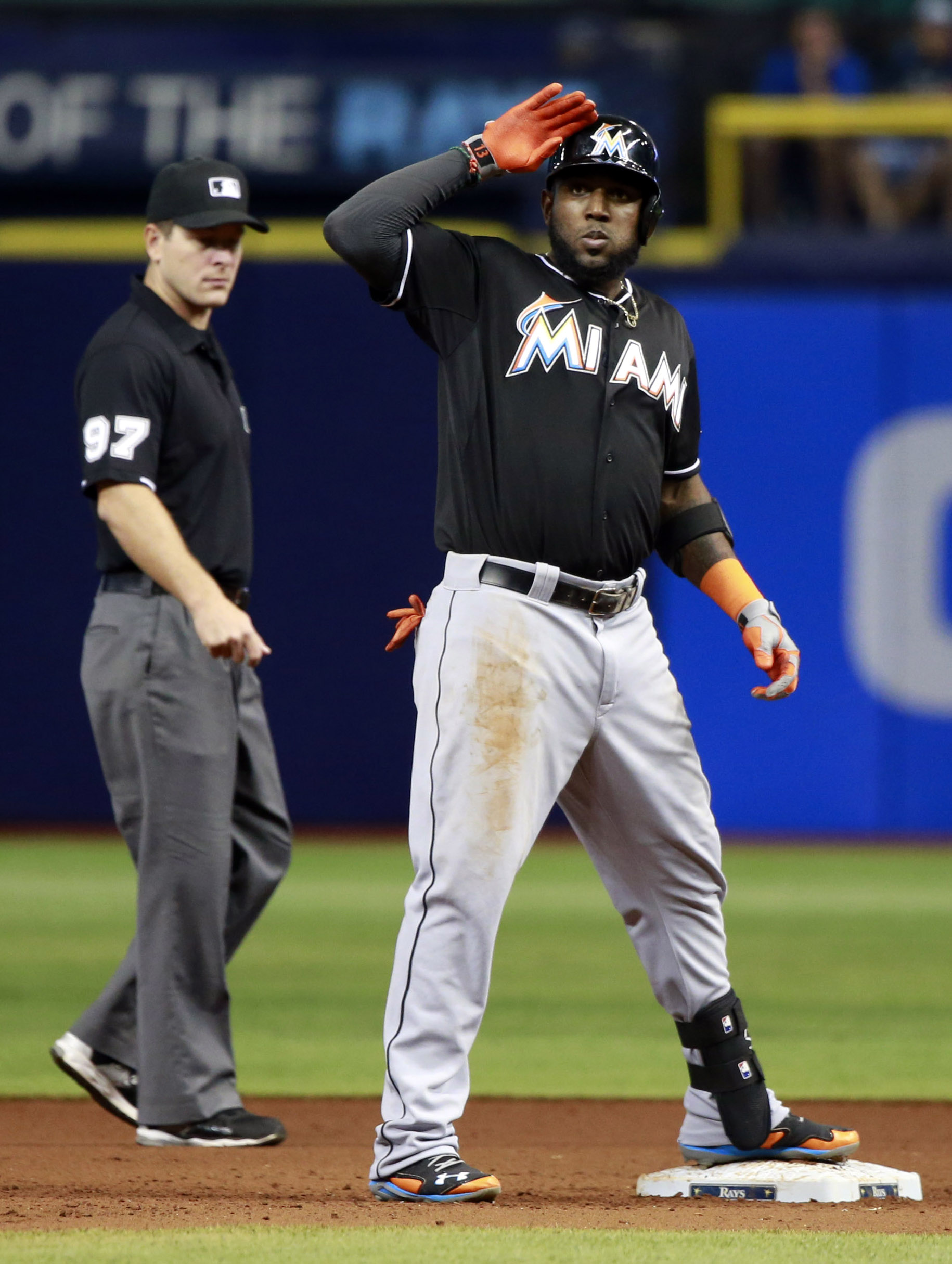 Making a decision on Ozuna represents the lynchpin of the Marlins’ offseason. If he’s retained, the organization would be set with an exciting, young trio of regulars (joined by veteran reserve outfielder Ichiro Suzuki). In the seemingly more likely scenario of a trade, Miami might well be left to search for a replacement externally. It isn’t impossible to imagine Miami giving out a mid-length contract to a veteran, with Denard Span possibly available at an appealing price point and Dexter Fowler standing at the top of a limited market, but a shorter-term signing could be more likely. Though the soon-to-be-renamed Marlins Park isn’t a great draw for hitters looking to rebuild value, the club could theoretically promise playing time and a center field job to someone like Austin Jackson.
If the front office isn’t willing or able to attract those kinds of players, it’s possible to imagine a scenario where a capable defender and right-handed hitter — Drew Stubbs comes to mind (though former Marlin Jake Marisnick would have worked nicely) — splits time with Yelich in center. In that scenario, the southpaw swinging Derek Dietrich could spend time in left when righties are on the hill, opening a route to more playing time for him in the process. Dietrich has yet to prove himself a capable fielder, but his bat showed up last year and a broader opportunity could be in order.
Dealing away a controllable piece like Ozuna is never easy, but it probably also represents the only reasonably plausible means for the organization to add a high-level pitcher. The team has made clear that’s a top priority, and it’s easy to see why. Henderson Alvarez could rejoin Fernandez at the top of the rotation after a lengthy absence due to shoulder surgery, but he’s now a major injury question mark. It’s probably also unfair to expect the 25-year-old to be a sub-3.00 ERA pitcher going forward, as he’s never posted a sub-3.70 SIERA even in his best seasons. It’s not even clear yet whether Alvarez will be tendered a contract, though it surely would be difficult to give him up with another year of control still remaining. Jarred Cosart showed promise after coming to the Marlins in the middle of 2014, but struggled last year with command, results, and health issues. The club has received plenty of innings from Tom Koehler in recent years, making him a nice arm to have at the back of the rotation, but his upside appears limited. Adam Conley is a reasonably interesting arm who showed well in his debut last year, but there are probably limits to what can be expected of him. Otherwise, the team has depth/swingman options such as Brad Hand and David Phelps as well as some unestablished pieces that have at least tasted the big leagues, including Justin Nicolino, Jose Urena, and Kendry Flores.
In retrospect, at least, it hurts to think about the arms that Miami has traded away in recent years. Nathan Eovaldi, Andrew Heaney, and Anthony DeSclafani have all had their share of success since leaving town. Trading Ozuna carries the same kind of risk, though he ought to be able to fetch a similarly controllable player in return — especially after a strong run at season’s end. We’ve heard lots of talk of the Indians as a potential match, which makes a lot of sense on paper, and MLBTR’s Steve Adams has previously identified the Mariners, Giants, Brewers, and Padres as hypothetical trade partners. Of course, Ozuna could also hold appeal to clubs that have center fielders on hand but need corner pieces, such as the White Sox, Rays, Royals, and Reds. And the division rival Braves and Phillies both could conceivably match up as well.
There’s also some indication that the Fish could be looking to spend some cash — perhaps up to $15MM annually — on an open-market rotation addition. (If they don’t add an arm via Ozuna, they could seek two free agents.) Depending on what kind of term of years Miami would be willing to commit to, that would put the team in play for a wide variety of mid-rotation arms. Among the top fifty free agents, as rated by MLBTR’s Tim Dierkes, only the very top arms appear to be completely out of reach. With a protected top pick (seventh overall) and a penchant for trading their competitive balance selections, the Marlins might not be too worried about giving up a second-round draft pick to add the right pitcher. It’s possible to imagine a run at the Jeff Samardzija – Mike Leake – Wei-Yin Chen – Kenta Maeda tier of arms, though taking aim at the next group down might be more realistic. If Miami prefers a younger arm and doesn’t mind taking some injury risk, Brett Anderson could be a target. High-performing veterans such as John Lackey and Hisashi Iwakuma might at least be worth pursuing. Otherwise, it’s also possible to imagine the club chasing a less expensive that can deliver innings. With former Pirates pitching guru Jim Benedict now in Miami, J.A. Happ could make added sense as a reliable arm with some upside. (Miami paid a steep price to add Benedict, it’s worth noting, and will surely look to benefit from some of the same magic he worked in Pittsburgh.)
The trio of traded pitchers noted above did, of course, bring back players in return, two of whom — Gordon and Martin Prado — feature heavily in the current infield alignment. (DeSclafani went for Latos, which obviously did not work out at all.) Prado has drawn a good deal of trade interest, and only has one year remaining on his deal, but the Miami front office continues to put out word that he’s not really available. Though he’s no longer the very good hitter he once was, Prado has delivered a league-average bat with quality defense at third base, and remains a valuable member of any team that hopes to contend. The 32-year-old also represents a corner outfield and second base option, expanding his versatility (and hypothetical trade market).
Shortstop is settled with the slick-fielding Adeiny Hechavarria, who is highly valued by the club despite his light bat. There’d be interest in an extension, but it seems that the club isn’t optimistic that the 26-year-old could be locked up at a reasonable price.
There’s some uncertainty at first base and catcher, though both positions figure to be filled by internal options with some possible external supplementation. Lefty slugger Justin Bour was rather productive last year, slashing .262/.321/.479 and popping 23 home runs over 446 plate appearances. But he’s been dominated in limited exposure to opposing southpaws, and looks in need of a platoon mate. It’s plausible to imagine the club pursuing hitters such as Mark Reynolds in free agency. Steve Pearce and Mike Napoli could also fit, though they’ll be looking for bigger roles and more money. Behind the dish, the 24-year-old J.T. Realmuto should continue to receive a chance to seize a long-term role. He started slowly with the bat, but showed plenty of offensive promise over the course of the season. While WAR measures liked his defensive work quite a bit, he’ll need to improve some of the league’s worst framing numbers. The switch-hitting Tomas Telis provides an option as a reserve catcher, and the organization could still bring back free agent Jeff Mathis, a highly-regarded performer in the field whose limitations on offense are well documented.
As the team looks at ways of filling in its final roster spots, the bullpen also figures to get some consideration. A.J. Ramos stepped in well for the disappointing Steve Cishek. The outgoing submariner brought back a control-challenged but live-armed righty in Kyle Barraclough, who probably earned a pen spot after spinning 24 1/3 frames of 2.59 ERA pitching after the trade (despite walking 6.7 batters per nine). Carter Capps was a revelation, but ended the year on the DL with elbow issues. Assuming he’s able to return to health, he’ll join Bryan Morris and lefty Mike Dunn to make up a fairly solid set-up group. It probably isn’t strictly necessary to add to this group, which could be supplemented by whatever rotation options don’t stick there, but a veteran acquisition is always possible.
All told, Miami could conceivably look at this as a winter to regroup, return to health, and make a few targeted acquisitions. But the Ozuna conundrum and the desire for a young pitcher add an element of intrigue. While the front office/field staff upheaval appears to be nearing a conclusion, the Loria-led team could yet surprise as it looks to arm Mattingly with the tools to deliver a winner.
Offseason Outlook: Toronto Blue Jays
The AL East champions will have to rebuild their pitching staff this winter, though their first priority will be sorting out an unexpected front office shuffle.
Guaranteed Contracts
- Troy Tulowitzki, SS: $98MM through 2020 (includes $4MM buyout of $15MM club option for 2021)
- Russell Martin, C: $75MM through 2019
- Jose Bautista, RF: $14MM through 2016
- R.A. Dickey, SP: $12MM through 2016
- Edwin Encarnacion, 1B/DH: $10MM through 2016
Arbitration Eligible Players (service time in parentheses; projections via MLB Trade Rumors)
- Brett Cecil (5.152) – $3.4MM
- Michael Saunders (5.138) – $2.9MM
- Justin Smoak (5.077) – $2.0MM
- Ben Revere (4.149) – $6.7MM
- Josh Thole (4.126) – $1.8MM
- Josh Donaldson (3.158) – $12.0MM
- Drew Hutchison (3.128) – $2.6MM
- Aaron Loup (3.083) – $900K
- Steve Delabar (3.008) – $700K
- Non-tender candidates: Saunders, Delabar
Free Agents
- David Price, Marco Estrada, Mark Buehrle, Dioner Navarro, Mark Lowe, LaTroy Hawkins, Munenori Kawasaki, Cliff Pennington, Jeff Francis, Maicer Izturis
The afterglow of the Blue Jays’ first postseason appearance since 1993 quickly wore off with the stunning news that Alex Anthopoulos wouldn’t be returning as Toronto’s general manager. It was more or less expected that the Jays’ playoff run would ensure a new contract for Anthopoulos, but since that proposed extension reportedly gave the final decision-making authority to new club president/CEO Mark Shapiro, Anthopoulos said he “didn’t feel like this was the right fit” for him and walked away from the job.
Anthopoulos’ departure reportedly came as a surprise to both Shapiro and Rogers Communications (the club’s ownership group), though the Jays’ interest in a president with a baseball operations background was evident even a year ago during their flirtations with the likes of Dan Duquette and Kenny Williams. This implied that Anthopoulos was no longer Rogers’ choice to be the top baseball voice in the organization, so expecting him to accept a loss of autonomy in the wake of a division title may have been a bit naive on ownership’s part. If Anthopoulos’ decision truly caught the club off-guard, then the Jays are somewhat under the gun in beginning a GM search just as offseason business is getting underway.
Naming Tony LaCava as the interim general manager (and extending his contract) does ensure some continuity within the front office, and LaCava himself could be a fit as the permanent GM. He has been a long-time assistant GM in Toronto, he briefly worked with Shapiro in Cleveland’s front office and he has been considered for GM jobs with other teams (the Pirates, Angels, Dodgers and Orioles) in the past. Current and former members of the Indians front office like Ross Atkins, Derek Falvey, De Jon Watson, Josh Byrnes and Tyrone Brooks have been mentioned as possible candidates for the GM position, though everything seems speculative at this point.
This organizational drama has added another layer of intrigue into what was already going to be a very busy offseason for the Jays. The most clear-cut business has already been taken care of, as the Jays exercised their club options on Jose Bautista ($14MM), R.A. Dickey ($12MM) and Edwin Encarnacion ($10MM) for 2016. A combined $36MM is a more-than-reasonable price for two elite sluggers and a solid 200+ inning starter.
The next step for the Jays will be to explore extending Bautista and Encarnacion, which will be very interesting negotiations. The two men are entering their respective age-35 and age-33 seasons and Bautista’s defense has been falling off to the point that he could soon be best suited as a mostly-DH type, as Encarnacion is now. Extending any player into their late 30’s is a dicey proposition, and extending two such players could be especially risky. The counter argument, of course, is that Bautista and Encarnacion are still two of the game’s best hitters, both posting big numbers in 2015 despite battling some nagging injuries. While the Jays could wait to see if either declines next season, waiting also carries the risk of letting either slugger hit the open market on the heels of another big performance. The Bautista and Encarnacion talks will be a big subplot of this Blue Jays offseason, particularly if the team favors one over the other.
With these contract option years now officially on the books, Toronto is committed to $71MM for five players next season. The Jays will pay a projected $33MM to their nine-player arbitration class, with Josh Donaldson getting the biggest raise (from $4.3MM in 2015 to $12MM in 2016) in the wake of his MVP-caliber season. Important contributors like Marcus Stroman, Roberto Osuna, Chris Colabello, Kevin Pillar and Aaron Sanchez are still on their pre-arb contracts, which gives the team a bit of financial breathing room as it tries to figure out how much to spend on the pitching staff.
While nine-figure payrolls aren’t new for the Jays, it has yet to be determined just how much they’re willing to spend this winter. Last year’s Opening Day payroll was just under $126MM and that number went up during the year after their big deadline trading spree. It’s fair to assume that Shapiro and LaCava will have at least that $126MM figure to work with in the offseason. While it has been speculated that Rogers hired Shapiro in part because of his experience with modest payrolls in Cleveland, Shapiro wasn’t afraid to make notable signings (the Nick Swisher and Michael Bourn deals) and extensions (i.e. Victor Martinez, Jhonny Peralta) in his time as the Tribe’s GM and president.
It could also be that Shapiro will receive more financial leeway than Anthopoulos. The Jays were heavily criticized by fans and local media for making virtually no major moves between the Dickey trade in December 2012 and the Donaldson trade in November 2014, and in hindsight, that seeming transactions freeze could’ve been the first sign of ownership disenchantment with Anthopoulos in the wake of the disastrous 2013 season, rather than a sign that Rogers wasn’t willing to spend. Given how attendance and TV ratings skyrocketed from August through October, Rogers now has clear evidence that a winning team will be a huge boost to revenue.
That doesn’t mean, however, that the club is willing to spend the $200MM+ it will take to sign David Price to a new deal this winter. Price has been vocal about how much he enjoyed pitching in Toronto, though with teams such as the Dodgers and Cubs likely in the running for Price’s services, it would be a surprise to see the Jays win a bidding war. Russell Martin’s $82MM contract from last winter was the biggest free agent deal in franchise history while Vernon Wells‘ $126MM deal from 2006 is still the largest overall contract the Jays have ever handed out; the team would likely have to spend as much as those two deals combined, if not more, to retain Price.
Besides Price, Marco Estrada and the possibly (but not certainly) retiring Mark Buehrle are also hitting the open market. Estrada’s strong performance in both the regular season and postseason boosted his price tag, and the Jays could well re-sign him if that price is around three years and $30MM. If it goes much higher, I suspect the Blue Jays would be willing to let him walk — especially since they would receive a draft pick in return, as Estrada was issued a qualifying offer. The two sides are in the midst of discussing a multi-year deal right now, though there have been no indications that a deal is close.
As for Buehrle, he’s been leaning towards retirement for a while. If he did come back, it might be on a one-year farewell tour type of deal with his hometown Cardinals or a return to the White Sox, rather than re-signing with the Jays.
Right now the Jays’ rotation consists of rising star Stroman, Dickey, and Drew Hutchison (whose inconsistent 2015 season makes him only a fifth starter candidate at best). One of the two open spots could be filled internally by Osuna or Sanchez, and the latter is the likelier pick since he’d be easier to stretch out. Sanchez was originally intended to be a reliever last spring, then became a starter in the wake of Stroman’s injury. He struggled prior to a lat injury (5.21 FIP, 42-to-37 K/BB ratio in 66 innings) but returned to thrive in a relief role. It’s possible that a full spring of preparing solely to start will lead to better results for Sanchez, who’s just a year removed from being labeled one of baseball’s top pitching prospects.
Shifting either Sanchez or Osuna to the rotation is a risky move for a contender, however, as both are unproven as MLB starters and using either to start weakens the bullpen. Osuna’s transition from A-ball starter in 2014 to star Major League closer in 2015 was already unlikely enough that the Jays may not want to further press their luck by pushing Osuna any further. His 78 combined IP in the regular season and playoffs last season was a career high, so he’d certainly be on an innings limit as a starter. Thus, the Jays would need a replacement for the latter portion of the season.
Everything therefore seems to point to the Jays adding at least one notable front-of-the-rotation arm and quite possibly a mid-tier starter as well. There’s no shortage of aces in free agency, and the Jays might not mind losing a first-rounder to sign a qualifying offer free agent since they’d be getting back a comparable draft pick back if Estrada leaves, and their current pick (No. 26) is toward the end of the first round as it is. Aiming for free agency, however, will test how much the team is willing or able to spend. The Jays have been linked to Johnny Cueto, Mike Leake and Jeff Samardzija in the past, though that was under Anthopoulos. Shapiro and LaCava may have different opinions of how well either starter would fare in Toronto, especially on an expensive long-term deal.
Rather than free agency, the Blue Jays could acquire pitching via the trade market. Shapiro has denied a report claiming he directly criticized Anthopoulos for moving top prospects at the deadline, though it would still be somewhat surprising to see the Jays continue to deal youngsters since building from within is Shapiro’s stated preference. Dealing from the Major League roster, however, could address both the pitching staff and a couple of question marks around the diamond.
Left field, for instance, has Ben Revere as the incumbent and set to earn a $6.7MM salary through arbitration. This could be a bit high for the Jays’ liking since Revere is a somewhat limited offensive player and has mixed reviews over his career (as per advanced metrics) as a left fielder. The Jays could try to deal Revere as part of a package for a starter and then go with a Michael Saunders/Dalton Pompey platoon in left. Then again, Saunders could himself be a trade or even a non-tender candidate given his $2.9MM arbitration projection. Dealing him for value could be difficult since he barely played in 2015 due to knee injuries. Pompey isn’t likely to be traded given his high prospect pedigree, though counting on him for anything more than a part-time role is a risk given how he looked overmatched at the plate when he began last season as the starting center fielder and was eventually demoted.
First base could be another position of depth. Encarnacion will mostly be used as a DH, leaving Colabello and Justin Smoak splitting time at first. Colabello was a hugely successful under-the-radar signing last winter, giving the Jays an .886 OPS in 360 PA. Colabello is still a year away from arbitration eligibility which could make him a very attractive trade chip, especially if the Jays think he’ll come back to earth next season (given that he did post a stunningly high .411 BABIP). Smoak, meanwhile, hit .226/.299/.470 with 18 homers in 328 PA while providing solid defense. The switch-hitter is an ideal backup for whomever is getting the lion’s share of time at first, whether it’s Colabello or a new addition.
This is just my speculation, but Shapiro’s former team in Cleveland is one of the few that has high-quality, controllable arms potentially available this winter. The Jays actually came close to landing Carlos Carrasco at the trade deadline for a package of Pompey, Jeff Hoffman and Daniel Norris, so it’s possible Shapiro could revisit those talks from the other side of the table to pursue Carrasco or Danny Salazar. (Though of course, a new offer would have to be made since Hoffman and Norris have since been dealt.)
You can also make the case that the Blue Jays could just stand pat with their everyday regulars given how the team turned into world-beaters on both offense and defense once their final lineup was solidified at the deadline. Given how injuries really left the Jays short-handed in early 2015, keeping the outfield and first base surplus intact could be a wise move, as a number of veterans in the lineup already come with notable injury histories. Devon Travis‘ return theoretically makes Ryan Goins expendable, though Goins is perhaps too valuable a bench piece to deal — he provides tremendous defense at either middle infield spot, which comes in handy since it’s far from guaranteed that Travis or Troy Tulowitzki stays healthy all year.
For now, Toronto’s bench lines up as Goins, Smoak, at least one of Saunders or Pompey and then Josh Thole (the knuckler-catching specialist for Dickey) as the backup catcher. Dioner Navarro did a good job in the backup role last year, though he’s expected to depart for a team that can offer him more playing time.
The bullpen was a problem area for much of the year, seemingly rounding into form around the deadline, but injuries in the playoffs exposed the lack of depth. If Sanchez is moved into the rotation, the Jays will need a new reliever to set up Osuna. Brett Cecil pitched very well last season and could do the job, though he could be better deployed outside of a set role and used in high-leverage situations (particularly against left-handed hitters) whenever they may arise in the later innings. Aaron Loup had solid numbers against lefty bats strictly in a LOOGY role, though the Blue Jays will probably look to bolster their bullpen southpaw corps. Free agent Tony Sipp could be a possibility if Shapiro wanted to bring in a familiar face from his Cleveland days.
LaTroy Hawkins is retiring and Mark Lowe is a free agent, so the Jays will also need some help on the right-handed side of the bullpen ledger. Darren O’Day, Tyler Clippard and Shawn Kelley are some of the bigger names available in free agency, though it’s worth noting that Shapiro has never pursued notable free agent reliever signings when he ran the Tribe. Rather than spend on a righty reliever, the Blue Jays could just keep Sanchez in the bullpen for another year (with an eye to him replacing Dickey in the 2017 rotation), sign a low-cost right-hander and funnel all available money towards the rotation.
Toronto has enough clear areas of need on the roster that it’s obvious what will be targeted no matter who takes over as the full-time general manager (Shapiro will ultimately be calling the shots anyway). The Jays certainly have work to do on the pitching front, but with so much of their league-best offense likely returning, the club has expectations of another postseason run in 2016.
Offseason Outlook: Houston Astros
The future is now for the Astros, as they’ll be looking to continue their winning ways and return to the postseason.
Guaranteed Contracts
- Jed Lowrie, IF: $15MM through 2017 (includes $1MM buyout of $6MM club option for 2018)
- Luke Gregerson, RP: $12.5MM through 2017
- Carlos Gomez, OF: $9MM through 2016
- Jose Altuve, 2B: $8MM through 2017 (plus club options for 2018-19)
- Scott Feldman, SP: $8MM through 2016
- Pat Neshek, RP: $7MM through 2016 (includes $500K buyout of $6.5MM club option for 2017)
- Jon Singleton, 1B: $6.5MM through 2018 (includes $500K buyout of $2.5MM club option for 2019; club also has options for 2020-21)
Arbitration Eligible Players (service time in parentheses; projections by MLB Trade Rumors)
- Luis Valbuena (5.148) – $5.8MM
- Jason Castro (5.104) – $4.6MM
- Hank Conger (4.051) – $1.8MM
- Chris Carter (3.159) – $5.6MM
- Marwin Gonzalez (3.133) – $1.9MM
- Samuel Deduno (3.096) – $700K
- Dallas Keuchel (3.089) – $6.4MM
- Josh Fields (3.000) – $800K
- Evan Gattis (3.000) – $3.4MM
- Non-tender candidates: Carter, Gattis, Deduno
Free Agents
Jeff Luhnow’s extensive (and sometimes controversial) rebuild of the Astros began to pay dividends a bit earlier than expected, as most pundits figured the young club was still a year or two away when the 2015 season began. For Houston fans suffering through years of losing baseball, however, the successes of 2015 couldn’t have come soon enough. The Astros led the AL West for much of the season, and while a September swoon cost them the division, they still beat the Yankees in the AL Wild Card game and took the Royals to the full five games in their ALDS matchup.
The Astros weren’t afraid to spend some money last winter in order to upgrade their bullpen, lineup and rotation, nor did they shy away from dealing notable prospects like Brett Phillips and Domingo Santana in their big midseason deal for Carlos Gomez and Mike Fiers. Now that they’ve established themselves as a playoff threat, the next step will be to see how much more owner Jim Crane is willing to boost the payroll and whether or not Luhnow will sacrifice any more of his vast prospect capital in order to enhance the Major League roster.
Just under $43MM is committed to seven players on the 2016 Astros, and another $31MM is projected to go to nine arbitration-eligible players (though it’s no guarantee all will be tendered, as I’ll explore later). That adds up to $74MM for 16 players, which is already more than the $72.64MM the Astros spent on their last Opening Day roster. The payroll has gradually risen from a measly $26MM in 2013 to roughly $50.5MM in 2014 to last year’s total, so it seems like a boost into the $95-$100MM range could be coming this winter. Crane has repeatedly stated that Luhnow will have more funding available as the team’s development warrants, so if the team is contending again, it wouldn’t be a surprise to see the Astros pass the $100MM threshold if it means securing a player to help them make a deeper postseason run.
With so much young talent both on the Major League roster and developing down on the farm, it stands to reason that the Astros won’t be a one-year wonder. For starters, Houston’s lineup will be improved simply by getting an entire year of rookie sensation Carlos Correa and healthy full seasons from Gomez and George Springer. Gomez is entering the last year of his contract, so he’ll be lined up for a major free agent deal next winter if he gets back to his past All-Star form.
Correa, Springer, Gomez and Jose Altuve form the core of Houston’s lineup, though the Astros have several questions to be answered elsewhere around the diamond. For one, those four are all right-handed hitters, so the Astros have a distinct need to add lineup balance in the form of at least one notable left-handed bat. Several regulars are arbitration-eligible, and the team could consider not tendering contracts to some familiar names in order to free some money for bigger upgrades.
Third baseman Luis Valbuena, first baseman Chris Carter and DH Evan Gattis are all cut from the same cloth as low-average, low-OBP sluggers who provided pop in the form of a combined 76 homers. While their overall arbitration price of $14.8MM isn’t exorbitant, three players with the same limited skill set could be seen as a redundancy for a contending team. Valbuena is the most likely to stay, as he’s currently the most notable left-handed bat on the roster and can be platooned with Jed Lowrie. Valbuena is also a free agent after 2016, with prospect Colin Moran on track to get at least a share of the job by 2017.
Though Carter and Gattis are hard to replace from a power standpoint, it wouldn’t be too hard for Houston to find players to top their combined 0.3 fWAR in 2015. The Astros will pursue trades for both before the tendering deadline, and my guess is that if it came down to a non-tender decision, they’d keep the longer-tenured Carter and let Gattis go. Even if Houston tenders one or both, however, I’d suspect both would still be shopped during the rest of the offseason. You could even make a case that the ‘Stros could non-tender both sluggers in order to really shake things up, but that’s an unlikely move given how Carter boosted his trade value with a late surge in September and through the playoffs.
If Carter, Gattis or both are gone, who takes over at first or DH? Prospect A.J. Reed dominated high-A and Double-A pitching last season and will compete for a roster spot in Spring Training, though it might be too early to count on him since he’s yet to play a game at the Triple-A level. You’ll likely see him hit the bigs sometime in 2016, however. The Astros won’t yet give up on former top prospect Jon Singleton due to his young age (24) and long-term contract, though Singleton has done little in 420 career PA to prove that he’s even worthy of a roster spot on a contending team, let alone regular playing time. Former 33rd-rounder Tyler White is another option after his monster season split between Double-A and Triple-A.
The non-tender question can also be asked about the catcher’s job, though my guess is that the Astros stick with the Jason Castro/Hank Conger tandem. The team loves Castro’s defense, relationship with the pitching staff and clubhouse leadership role, while Conger also had good pitch-framing numbers and hit .229/.311/.448 with 11 homers over 229 PA. Houston has been cited as a possible destination for Matt Wieters, who is an upgrade on paper. Given the question marks about his injury history and the lack of any other distinct better options on the open market, the Astros might feel more comfortable to keep their familiar catching platoon and spend elsewhere.
Left field is the only clear hole in the lineup as Colby Rasmus will hit free agency after nicely rebuilding his value with a solid regular season and a Ruthian postseason. The Astros have young options to play left field next season, as a Preston Tucker/Jake Marisnick platoon is probably the top alternative if Rasmus or another everyday regular can’t be obtained. This said, it wouldn’t be a shock if Rasmus re-signed since he enjoyed his time with the club and at least sounds open to returning. (Not to mention that Rasmus is a left-handed hitter.)
If he still intends to retire within a few seasons, Rasmus has a case for becoming the first player to accept a qualifying offer. Rasmus could take the one-year, $15.8MM deal to remain in a familiar spot for another season, as while he’d obviously make far more money in a multi-year contract, he might not want to risk being in another uncomfortable clubhouse situation for what could be the final few years of his career. (Jeff Todd and Steve Adams recently raised this point on the MLBTR Podcast.) Houston seems comfortable with the idea of Rasmus accepting. Retaining a short-term established player, after all, fits with the Astros’ long-term outfield plans with prospects Daz Cameron, Kyle Tucker and Derek Fisher all on the horizon, as well as Tucker and Marisnick in the fold right now. It’s probably still likely that Rasmus rejects the QO, but he at least has a few more layers to his decision than most.
Luhnow faces an interesting juggling act in adding players to help his team win now, yet also still maintaining and relying on the youth movement that the Astros worked so hard to build. Top-tier free agents like Justin Upton, Yoenis Cespedes or Alex Gordon would more than fill the club’s need in left field, though that would represent one less spot for Cameron and company in a few years’ time. (Center field could well be open if Gomez leaves, though Springer is surely ticketed as a long-term piece.) Of the top names, Gordon may be the best fit for Houston given that he’s a left-handed hitter, and also because the analytically-minded Astros are the sort of team that would particularly appreciate how Gordon can contribute in all facets of the game.
The same “now vs. the future” debate could be had about first base. With Reed’s big bat looming, do the Astros need a big upgrade like Chris Davis or could they acquire a short-term veteran bat like Justin Morneau to platoon with Carter/Gattis until Reed arrives? Davis checks a lot of boxes as an ideal signing for the Astros — he’s a Texas native, a left-handed hitter and brings even more power than Carter or Gattis while providing a much better all-around game. Davis can contribute from day one while Reed may need some time to acclimate to Major League pitching. That said, signing Davis would block Reed for the first few years of his career, and making Reed a full-time DH so early in his career probably isn’t something the Astros want.
Another concern is Davis’ price tag, which could be in the six-year/$144MM range and thus would easily surpass Carlos Lee‘s six-year, $100MM deal from 2006 as the biggest contract in Astros history. Payroll boost notwithstanding, I don’t see Houston splurging on two nine-figure contracts this offseason, so they’d have to choose whether they want to make a big impact (if any) on the pitching or offense front.
Speaking of pitching, the rotation projects as Dallas Keuchel, Collin McHugh, Scott Feldman, Lance McCullers and Fiers, with young arms like Vincent Velasquez, Dan Straily, Michael Feliz and Brett Oberholtzer available as depth (not to mention Mark Appel down in Triple-A). Keuchel stepped forward as an ace and Cy Young Award contender in 2015, and his contract extension talks will be one of the club’s underlying subplots. Expect to hear more about this topic in February and March when teams generally turn from offseason additions to extension business. McHugh has now delivered consecutive seasons of 3+fWAR pitching, Feldman is a reliable veteran innings-eater when healthy and McCullers and Fiers have already showed the ability to dominate MLB hitters in their brief careers.
Plenty of teams would be satisfied with this pitching situation as it stands, though the Astros are thought to be in the market for a front-of-the-rotation arm to pair with Keuchel. Remember, Houston pursued James Shields last winter even before their breakthrough season, and pursued the likes of Cole Hamels and Tyson Ross at the trade deadline. While the Astros ended up with a controllable arm in Fiers and a bigger name hurler in Scott Kazmir, their next step is to land a pitcher who is both an ace and will be in Houston for several years.
Kazmir himself has stated he’d like to be that ace, though his middling results as an Astro both diminished his market value and perhaps hurt his chances of a return. I wouldn’t be surprised to see the Astros check in on any of the top free agent pitchers, with David Price and Johnny Cueto perhaps getting the most focus since Houston already expressed in both starters last summer. Also, neither pitcher has a qualifying offer draft pick attached to their services, though the Astros might not mind surrendering a first-rounder for the right signing given how many good prospects are already on board. Price’s $200MM+ price tag may be too much to afford, though I could definitely see Houston getting involved with Cueto in the $115MM-$120MM range.
If a major arm is added to the rotation, Feldman stands out as a possible trade chip. The right-hander was shut down with a strained throwing shoulder in September, so obviously he’d have to prove he’s back to normal in Spring Training. Feldman brings a decent track record on a one-year, $8MM deal and could be very attractive to teams looking for a last-minute rotation boost.
This leaves the bullpen, which will be another major target area for the second straight offseason. The Astros relief corps had the sixth-lowest bullpen ERA in the game last season, though it faded badly down the stretch with a league-worst 5.63 ERA in September and October (and that doesn’t count the infamous meltdown in Game 4 of the ALDS). Luke Gregerson, Pat Neshek, Will Harris and Josh Fields will return, while Houston has already declined their $3.5MM option on veteran righty Chad Qualls, whose peripherals suggest he pitched much better than his 4.38 ERA would indicate.
Southpaws Tony Sipp, Oliver Perez and Joe Thatcher are all free agents, so the Astros will certainly have to address a dearth of lefty relief. Signing one of the winter’s top left-handed bullpen arms (Antonio Bastardo or Sipp himself) would add another significant contract to the Houston bullpen that already has over $12MM invested in 2016 salaries for Gregerson and Neshek.
The biggest relief investment could come in the form of a major closer like Aroldis Chapman or Craig Kimbrel, both of whom were heavily targeted by Houston at the deadline. The Reds and Padres are known to be asking for a large return for either closer, yet Houston is one of the few teams with the prospect depth to afford surrendering a notable minor leaguer or two for a reliever. A star closer would make the Astros’ already solid bullpen even deeper, and with the rotation ideally providing more stable innings, the relievers are more likely to be sharp late in the season.
As noted earlier, Luhnow was aggressively seeking out top talent last winter before the Astros had proven they could put a winner on the field. With a postseason berth now giving the franchise extra credibility with free agents, Luhnow could be one of the offseason’s busiest general managers given the plethora of options he has to improve the team.
Offseason Outlook: Seattle Mariners
A new front office has a busy offseason ahead as the Mariners will try to end baseball’s longest postseason drought.
Guaranteed Contracts
- Robinson Cano, 2B: $192MM through 2023
- Felix Hernandez, SP: $104MM through 2019
- Kyle Seager, 3B: $92.5MM through 2021 ($15-20MM club option for 2022, with buyout between $0-$3MM based on performance)
- Nelson Cruz, RF/DH: $42MM through 2018
- Seth Smith, OF: $7MM through 2016 (includes buyout of $7MM club option for 2017)
Arbitration Eligible Players (service time in parentheses; projections via MLB Trade Rumors)
- Mark Trumbo (5.027) — $9.1MM
- Charlie Furbush (4.121) — $1.7MM
- Tom Wilhelmsen (4.089) — $3MM
- Non-tender candidates: Trumbo, Furbush
Free Agents
New general manager Jerry Dipoto has wasted little time in reshaping Seattle’s baseball operations, hiring several new faces for the minor league, player development and scouting departments in an effort to upgrade a talent pipeline that faltered under former GM Jack Zduriencik. A lot of changes have been made to the on-field unit as well, most visibly in a revamped coaching staff led by a first-time manager in Scott Servais. It adds up to an organization that will (in theory) be on the same page and use analytical information as a cornerstone, something that wasn’t the case under Zduriencik’s tenure or in Dipoto’s previous GM stint in Anaheim.
While this bodes well for the Mariners over the long term, Dipoto will have to hit the ground running this winter. The M’s fell way short of lofty offseason expectations in 2015, though with so many major stars on board, the feeling definitely still exists in Seattle that the Mariners are closer to contending than they are to a rebuild. It makes sense for the Mariners to go for it while Nelson Cruz, Robinson Cano, Felix Hernandez and Kyle Seager are all still productive, as it’s not known how long the window will be open; after all, Cano and Hernandez showed some warning signs of decline last season.
The Angels signed some major free agents when Dipoto was GM, though it’s well-known that owner Arte Moreno played a huge role in the signings of Albert Pujols and Josh Hamilton. Dipoto himself is a bit more reticent about free agents, telling Ryan Divish of the Seattle Times that “the trade market is always my first alternative. You draft, scout and develop, you trade, and to me free agents augment the roster you have. In a perfect world, you get to a stage where the foundation is strong enough you use free agency as a pure accent move rather than a foundational builder.”
This would seem to imply that the M’s probably won’t be players for Chris Davis, Jason Heyward, Justin Upton or other open-market superstars who could turn roster weak spots into immediate strengths. Further complicating matters is the fact that Seattle fell painfully shy of a protected pick in the first round of the 2016 draft, falling to the 11th overall selection by virtue of a tiebreaker with the White Sox (who had the same 76-86 record). If the Mariners were to sign a free agent who had rejected a qualifying offer, they’d lose that 11th overall pick (the top unprotected pick in next year’s draft), which I highly doubt Dipoto would be willing to do given his quest to rebuild the farm system.
With almost $79MM committed to just five players in 2016, the Mariners also might not have the available payroll to afford another huge salary. While massive contracts may not happen, Seattle could still ink a few lower-cost free agent deals.
For instance, the industry expects that the Mariners will re-sign Hisashi Iwakuma, as both the team and the player have interest in a reunion. This would be a good move for a Seattle team in need of proven starting pitching, and since Iwakuma turns 35 in April and the free agent pitching market is rather deep, the M’s might be able to re-sign him on a two-year deal in the $28-30MM range. If there’s enough demand that a third year is required, then the club is looking at a three-year/$42-45MM contract for the Japanese righty. Things could change on the open market, of course, though at the moment the M’s look like the early favorite for Iwakuma’s services.
Assuming Iwakuma re-signs, he would join Hernandez, Taijuan Walker and new acquisition Nate Karns in Seattle’s rotation. James Paxton is tentatively slotted into a spot as well, though he’s failed to pitch more than 74 innings in either of the last two seasons due to a shoulder injury (in 2014) and an injured finger tendon (in 2015).
Roenis Elias, Vidal Nuno and former top prospect Mike Montgomery are on board as depth options or fifth starter candidates if Iwakuma leaves. A fairly inexpensive veteran could also be added to the mix to fight for that last rotation job, and the M’s have had some good luck with veteran reclamation projects looking to rebuild themselves at pitcher-friendly Safeco Field.
Karns, left-hander C.J. Riefenhauser and minor league outfielder Boog Powell came to Seattle in Dipoto’s first notable deal as GM, with Brad Miller, Danny Farquhar and Logan Morrison heading to Tampa Bay in return. Karns posted a 3.67 ERA, 8.9 K/9 and 2.59 K/BB rate over 147 innings with the Rays last season in his first extended taste of Major League action. He’s a bit old for a rookie (Karns turns 28 in November) but he’s controlled through the 2020 season and looks to be a very promising arm in the M’s rotation for years to come.
Riefenhauser hasn’t shown much over his 20 career MLB innings, though he adds a needed left-handed option to a bullpen that Dipoto has openly stated will be an area of focus this winter, and he has a strong Triple-A track record. Tom Wilhelmsen and Carson Smith are basically the only relievers who look to have guaranteed jobs next year. Rookie Tony Zych will get a long look in Spring Training after an impressive late-season callup, while Charlie Furbush will probably return unless the biceps injury that sidelined him for much of the second half continues to be an issue (which could lead to a non-tender).
Wilhelmsen and Smith both saw action at closer in the wake of Fernando Rodney‘s implosion, and it wouldn’t be a surprise if the Mariners brought in a more established ninth-inning man given that Wilhelmsen has struggled to keep the closer’s job both in 2015 and in the past, while Smith also lost the gig back to Wilhelmsen late last year. Joakim Soria makes sense as a target, or perhaps someone with past closer experience like Jonathan Broxton if the M’s wanted to at least keep Wilhelmsen/Smith in the mix for the closing job. The Mariners are one of a few teams who have scouted Korean closer Seung-hwan Oh, who could be an intriguing option as he’s planning to make the jump to North American baseball.
Seattle could be very deep or very thin in left-handed relief options depending on Furbush’s health, Riefenhauser’s Spring Training performance and the roles of Nuno/Montgomery (who could be used in the bullpen or kept stretched out in the minors as starters). The Mariners will at least check in on the offseason’s top-tier lefty relief options (Antonio Bastardo, Tony Sipp, etc.) and veteran Joe Beimel could also be re-signed to reinforce the southpaw corps.
Around the diamond, the Mariners are only set at third base (Seager), second base (Cano), and wherever Cruz plays, which is probably more likely to be DH than right field next season. He’s been a defensive liability for years, and Dipoto has spoken of wanting to improve the Mariners’ athleticism and defense, particularly in regards to playing in a spacious ballpark like Safeco Field.
Powell and the recently-claimed Dan Robertson were Dipoto’s first steps towards addressing this outfield need, as both can play all three positions. Robertson may be more of a depth option while Powell is likely on the verge of reaching the bigs after a solid performance in 246 Triple-A PA in 2015. An everyday assignment may be a stretch, but Powell could certainly factor into the Mariners’ wide-open center field spot, if not early in the year then midseason. Powell and left field incumbent Seth Smith are both left-handed hitters, so a right-handed hitting free agent outfielder like Rajai Davis or Chris B. Young could be a fairly inexpensive fits as platoon partners. Robertson could also be an internal option for a right-handed platoon bat, and Franklin Gutierrez is another familiar face the M’s could look to re-sign for a part-time role.
If the Mariners want a full-time option in center, any number of free agent or (further) trade possibilities could be considered. Jackie Bradley, Juan Lagares, Leonys Martin, Marcell Ozuna, Dalton Pompey and Melvin Upton could all conceivably be made available for trade this winter. Denard Span would make sense in free agency, as he wouldn’t cost a draft pick since the Nationals didn’t extend him a qualifying offer. Austin Jackson likely isn’t an option given how he has already under-performed in an Mariners uniform. Dexter Fowler and Colby Rasmus, the other two major center fielders on the market, do have qualifying offers attached so they’re not likely to be targeted.
While I noted earlier that the Mariners probably won’t be big free agent spenders, if they were to make a big splash, Yoenis Cespedes could be a fit. Due to his midseason trade, Cespedes isn’t subject to the qualifying offer and can be signed without draft pick compensation. He certainly matches Dipoto’s preference for an athletic outfielder, though while he’s one of the game’s best defensive left fielders, Cespedes has graded as below-average in center over his career. He could handle center for a year and then move back to his customary left field spot once Smith’s contract is up, or Cespedes could be installed into left immediately and Smith would become trade bait.
With Miller now in Tampa Bay, that solidifies Ketel Marte as the top choice at shortstop. Marte played well enough last year to crack Baseball America’s midseason top 50 prospects list and earn his first call-up, then fit right in to the tune of a .283/.351/.402 slash line over 247 PA. Marte has the inside track on the everyday job, with Chris Taylor on board as the middle infield backup.
Mike Zunino is still too young (24) to be considered a bust, especially given his top prospect pedigree and his already-outstanding defensive ability. At the plate, however, Zunino posted a miserable .174/.230/.300 line over 386 PA last season, so Seattle certainly needs a catcher to pick up some of the offensive slack. While Chris Iannetta himself struggled at the plate in 2015, I’m guessing Dipoto might be interested in his former Angels backstop as a veteran mentor to Zunino who can still contribute on the field. If not Iannetta, Geovany Soto or Alex Avila make sense among free agent catchers, though if the Mariners weren’t committed to Zunino at least half the playing time, they could aim for Dioner Navarro or A.J. Pierzynski.
The first base situation became clearer when Morrison was sent to the Rays, and his departure probably saves the M’s from having to non-tender him to avoid a projected $4.1MM arbitration salary. Mark Trumbo delivered some pop after joining the club from the Diamondbacks, though his lousy defense resulted in only 0.4 fWAR in 361 PA as a Mariner. Trumbo’s limited skill set and projected $9.1MM salary combine to make him a non-tender candidate as well, though my guess is that the M’s would explore trading Trumbo rather than simply cutting him for no return.
With so much uncertainty at first, any number of interesting bats like Adam Lind, Ryan Howard, Brandon Moss, Adam LaRoche, Yonder Alonso or Pedro Alvarez being available in trades (or free agency, in the case of non-tenders). While none are guaranteed to be big offensive powerhouses, they could at least be part of a platoon that could do more at a lesser cost than Trumbo’s $9.1MM, especially since some of the teams making those deals would have to eat some money, i.e. the Phillies and Howard or the White Sox and LaRoche. A huge signing like Chris Davis can’t be completely ruled out simply because he’d be such a big upgrade, though as mentioned earlier, giving up another first-round draft pick and adding another huge salary would seem counter to what Dipoto is trying to do with the team. A trade could be the likelier route to a first base upgrade.
With all this talk of trades, however, it’s well worth looking at what exactly the Mariners have to offer in return. Further trades from the Major League roster could be a bit difficult, though, since the M’s were already lacking in depth. As noted earlier, Trumbo or Smith could be trade bait. If another catcher is acquired, Jesus Sucre, John Hicks or Steve Baron could be dealt. One of Elias, Nuno or Montgomery could be moved if Iwakuma re-signs and Paxton proves he’s healthy. These small pieces won’t combine for any blockbusters, but Seattle could help their own depth problems by moving expendable pieces for bench parts that are more likely to contribute in 2016. Case in point, that deal with the Rays looks like a strong one on paper for Dipoto, as Morrison and Farquhar might have outlived their usefulness in Seattle.
Baseball America ranked the Mariners’ farm system 25th of 30 teams prior to the season, and that was before top prospects Alex Jackson and D.J. Peterson both suffered through rough 2015 campaigns. While both (Jackson, in particular) are still well-regarded, Dipoto and his new minor league staff may not have the same attachment to Zduriencik’s prospects and could see them as trade chips while they still have value. On the other hand, the reason for the player development overhaul was to better develop prospects both in the future and in the present, not to write off the current batch of young talent. Given how thin Seattle’s system is, you’re probably only going to see a notable prospect traded if Dipoto and his staff have already decided against the player.
In a way, Dipoto finds himself in something of the same position that he was in as the Angels general manager — a few superstars on huge contracts, a few regulars best suited to platoon duty, little minor league depth, and some payroll limitations. In Anaheim, however, those limitations were Moreno not wanting to exceed the $189MM luxury tax threshold, while in Seattle, Dipoto will have at least $130MM to work with. While that’s a healthy number, if you count Iwakuma’s projected salary with the five players under contract, that leaves roughly $33MM for 19 members of the 25-man roster.
Dipoto won’t be judged entirely on his first offseason, of course, especially given the less-than-great shape the organization was in when he inherited the job and the sweeping changes he’s already trying to implement. Many of the players from the Mariners’ 87-75 season in 2014, however, are still around, so a return to contention shouldn’t be out of the question as long as at least some of the major question mark positions are resolved.