
Profiling Possible Top Rule 5 Picks
After finishing with the worst record in baseball, the Phillies will pick first in the upcoming Rule 5 draft. The draft, set to be held on December 10th, is the final activity of the Winter Meetings. Teams have a chance to select players from rival franchises with a main rules:
- Any player on the 40-man roster is protected
- Players signed at age 19 or older are protected for four seasons
- Players signed at age 18 or older are protected for five seasons
If none of those conditions apply to a player, then he may be selected in the draft. Draft picks cost $50K and the drafting team must keep a player on the major league roster for the entire season in order to retain him. Injured players must spend at least 90 active days on the roster.
If a team decides not to fulfill these conditions, the former club can reacquire the player for $25K. Sometimes, the team refuses to pay the fee, as was the case when the Phillies selected Shane Victorino from the Dodgers. There is also a minor league portion of the draft with slightly different rules and requirements. For the scope of this post, we’ll focus on the major league portion.
The Phillies and the Rule 5 Draft
The Phillies are one of the most successful teams in the Rule 5 draft in recent years. Dating back to 2009, they’ve made the following picks: David Herndon (2009), Michael Martinez (2010), Ender Inciarte (2012), Kevin Munson (2013), Odubel Herrera (2014), and Andy Oliver (2014).
Herndon, Martinez, and Herrera were the most successful of those picks with Herrera looking like a building block for Philadelphia. Many of you will recognize Inciarte, an able outfielder for the Diamondbacks. The Phillies failed to keep him on the active roster for a season and had to return him.
Teams generally select players who fit one of these profiles:
- Left-handed relievers
- Hard throwing, wild pitching prospects
- Back-up catchers
- Polished hitters with uncertain defense
- Athletic, raw position players
Herrera, along with fellow successful pick Delino DeShields (Rangers), fell into the latter category. The toolsy athletes are probably the riskiest bucket to pick, but they also come with the highest upside.
In full rebuild mode, it’s my opinion that the Phillies will benefit most from an aggressive pick at first overall. Rather than playing the relief market, I expect them to target a possible starting left fielder. Herrera and Aaron Altherr are the only two starting outfielders on the roster. Both are exciting young players who emerged during the 2015 season. Both also come with risk. The Phillies will want to build redundancy.
Other options on the 40-man roster include Cody Asche, Darnell Sweeney, and Roman Quinn. Asche and Sweeney are penciled in as the left field platoon, but that’s not how the team will enter Spring Training. Quinn is not yet major league ready. Given the internal options, there is room to give a Rule 5 pick a long look in left field.
The 40-man roster currently stands at 37, meaning the club could pick up to three players if it chooses. Rarely do teams take more than two, but the Phillies might be the exception. The bullpen is a work in progress, and there are enough interesting relievers to give two a look after picking an outfielder.
The Candidates
We recently cited J.J Cooper of Baseball America’s list of Rule 5 names to remember. Of those, five stand out as first pick material to me. This is not to say that the Phillies scouts won’t fall in love with another player or decide to go with a pitcher. But these are my best guesses to go first overall in the draft.
Jabari Blash, OF, SEA
This is the second time Blash, 26, is eligible for the draft. The Mariners left him unprotected last year, and he went unpicked. That’s unlikely to happen this year after he blasted 32 home runs between Double- and Triple-A. It wasn’t a matter of dominating the weaker opponents either. After a BABIP-fueled outburst in Double-A, the righty finished with 22 home runs in 228 plate appearances in Triple-A. His BABIP actually fell to .263, yet he still posted a strong .264/.355/.640 line.
Pros: Power, athleticism, a high walk rate, upper-minors success, and plus defense.
Cons: A big whiff rate that could get out of hand in the majors.
Tyler Goeddel, OF, TBR
Cooper describes Goeddel, 23, as one of the most polished hitters in the draft. The right-handed hitter is eligible for the first time after hitting .279./350/.433 over 533 plate appearances at Double-A. He’s a well-rounded asset with some power (12 home runs) and speed (28 stolen bases).
Pros: Athleticism, youth, plate discipline, plus defense, power, and speed.
Cons: Yet to reach Triple-A.
Jake Cave, OF, NYY
Entering his age 23 season, Cave is still relatively young like Goeddel. He was once thought to possess upside similar to Jacoby Ellsbury, but injuries and time have sapped his speed. The lefty is viewed as an ideal fourth outfielder with some latent power, decent wheels, and the ability to do a passable job in center field. He hit .269/.330/.345 in 563 Double-A plate appearances. He received a brief, successful trial in Triple-A too.
Pros: Can play all three outfield spots, decent contact skills and plate discipline
Cons: More of a fourth outfielder
Zach Borenstein, OF/1B, ARI
Borenstein, 24, is a left-handed power prospect who has lost some steam. He performed well at Double-A last season with a BABIP-fueled .314/.394/.511 line in 327 plate appearances. He was miserable in a 53 plate appearance try in Triple-A. A questionable defender, Borenstein may be a better candidate for the Phillies second pick.
Pros: History of power, strong plate discipline once he adapts to a level
Cons: Iffy Triple-A track record, game power was best in 2013
Balbino Fuenmayor, 1B, KAN
Now there’s an 80-grade baseball name. As you might expect, Fuenmayor is a right-handed, aggressive power hitter. The 26-year-old is recovering from a torn ACL.
When healthy, Fuenmayor hit .354/.386/.591 with 15 home runs in 308 Double-A plate appearances. He also had a small sample of success in Triple-A. Unlike the others listed here, he’s a first baseman if not a designated hitter. The Phillies have two of those – Ryan Howard and Darin Ruf. They might be willing to try another.
Pros: Excellent half season in 2015, power and contact skills
Cons: Aggressive, questionable defender
My best guess
I expect the Phillies to select Goeddel or Blash first overall. Both are candidates to step in and perform at a high level much like Herrera did last season. At the very least, they’ll offer plus defense. Their multi-faceted skill sets should ensure other means of production too. Goeddel is probably the safer of the two options, and I like that he’s younger too.
Remember, these picks can be traded. There’s nothing stopping the Phillies from taking a shot on both athletes. They’re liable to match the production of Sweeney who can be optioned. Asche is viewed as a trade candidate. The trade route would also give the club the option of evaluating two players during the spring and picking their favorite. It’s probably an unlikely path, but it’s an open option.
MLBTR Originals
A look back at the original reporting and analysis found on MLBTR the last seven days:
- After catching up on the league’s pre-Thanksgiving Day trades and signings, host Jeff Todd welcomed veteran left-hander Wade LeBlanc on the latest edition of the MLB Trade Rumors podcast. A new episode of the MLB Trade Rumors Podcast is released every Thursday and can be accessed on iTunes, SoundCloud, and Stitcher.
- MLBTR’s Brad Johnson ran down some of the best fits for free agent Jason Heyward. In a poll with readers, more than 21% of you said that the Cardinals would wind up inking the outfielder. The Angels and Yankees also got a significant share of the pie.
- The MLB deadline to tender contracts to arbitration-eligible players is coming up on Wednesday and Pedro Alvarez of the Pirates is one of the more notable non-tender candidates out there. Charlie Wilmoth examined the pros and cons of letting Alvarez go. The Bucs could also retain Alvarez at his projected $8.1MM salary and try to move him later, but that would be something of a risk for Pittsburgh given their budgetary constraints.
- The Blue Jays’ five-year, $65MM extension for Jose Bautista back in 2010 was widely panned, but years later, it turned out to be a savvy deal by then-GM Alex Anthopoulos. Now, it’s time for Toronto to consider another extension for the slugger, as Mark Polishuk writes. Bautista is still hitting at an elite level as he enters his age-35 season, and thus he doesn’t really have any comparables among past players with at least 6 years of service time who signed multi-year extensions. It’s hard to peg his value, but Mark envisions a four-year deal in the range of $80-$100MM for Bautista since that’s likely what he would get if he were a free agent this offseason.
- The Mets are hardly assured a return trip to the World Series in 2016, but they’re as well situated as any for another run, Jeff writes. Jeff ran down some of the Mets’ options to get back to the top, including scenarios involving their stellar pitching.
- Recently, MLB Trade Rumors launched a brand new official Instagram account:@TradeRumorsMLB. Each day, we’re sharing conversation-inspiring images about the hottest topics in baseball. From there, we invite you to give us a like, weigh in with your thoughts in the comments section, and even share the link with a friend. So, what are you waiting for? If you don’t have an Instagram account, this is the perfect excuse to sign up and get one. Follow us on Instagram today!
- In the latest edition of the MLBTR Mailbag, Steve Adams fielded questions on Trevor Plouffe, Brandon Belt, Darren O’Day, and more.
- The Dodgers’ new-look front office has done a lot of wheeling and dealing already, but there’s more to come as it continues to overhaul the league’s most expensive roster, Jeff writes. Jeff looked at the many paths the unpredictable Andrew Friedman could take this offseason, including a major shakeup in the outfield.
The Best Suitors For Jason Heyward?
Free agency has progressed slowly this winter. Some of the biggest signings to date have been starting pitchers with late-season breakouts (Rich Hill, J.A. Happ). The markets for several of the flashiest names available have yet to develop, and that’s especially true of Jason Heyward.
The Angels have been mentioned once on these pages as a possible match. Earlier this week, Jon Morosi of FOX Sports said the Angels “aren’t ruling out a pursuit.” So that’s maybe, possibly one public suitor.
Every other Heyward rumor relates to his former Cardinals. While he fits their playing style to a T, Heyward isn’t exactly needed. The St. Louis roster features veterans Matt Holliday and Brandon Moss. Randal Grichuk is an exciting young center fielder with big power and plus defense. Stephen Piscotty made a successful late season debut. Some combination of Peter Bourjos, Jon Jay, and Tommy Pham can fill in the cracks.
Sure, Heyward is an improvement over some of those options, but is his production enough to justify the $200MM investment predicted by MLBTR’s Tim Dierkes? I don’t think so. The team does have a need in the rotation with Lance Lynn out for the season and top prospect Alex Reyes suspended 50 games for marijuana use. It might be smart to use monetary resources on pitching.
In his free agent profile, Jeff Todd agreed with Dierkes 10-year, $200MM valuation, saying “It’s hard to put Heyward in the same production bracket as Robinson Cano (ten years, $240MM), and you could argue that he’s not as valuable a free agent as Prince Fielder (nine years, $214MM), depending upon how one values defense and baserunning.” Then again, you can also argue that Heyward, 26, offers more future value than Cano or Fielder did at the time of their signings. When they inked their respective deals, Cano was entering his age 31 season while Fielder was set to turn 28.
It used to be that $200MM really limited a player’s market to just a few teams. In today’s cash rich environment, any team can compete for a top free agent. While it wasn’t a free agent signing, the always penurious Marlins actually own the richest contract in major league history (Giancarlo Stanton). Heyward, therefore, is a relatively affordable, young asset. Clearly, his market won’t be constrained to a team that doesn’t need him and another that isn’t “ruling out a pursuit.”
MLB.com’s Dan O’Dowd offers two more alternatives – the Dodgers and Orioles. His justifications? The Dodgers have the cash, and Heyward would add athleticism over incumbent Andre Ethier. With the Orioles, a run at Heyward would likely depend upon the club falling short on re-signing Chris Davis. O’Dowd also likes how Heyward would fit into the Angels lineup.
Let’s explore some other possible fits for Heyward.
The Yankees are always a safe bet to be involved with a player like Heyward. They’re said to be shopping Brett Gardner, possibly to make room for a Heyward pursuit. His left-handed bat and athleticism in the outfield would play awfully well at Yankee Stadium.
New York’s rivals, the Red Sox, are a dark horse candidate. The club is much more fixated on pitching, and they’re currently rich in outfielders. If their pursuit of David Price goes sideways, Boston could try to use some of their outfield depth to acquire star pitching. The would open a role for Heyward.
After attempting to contend in 2015, it’s hard to gauge the White Sox plans. They’ll try again to build around Chris Sale and Jose Abreu, but will they commit more resources to the effort? Across town, the Cubs could benefit from an OBP oriented veteran like Heyward to help support the various young phenoms. They’re supposedly more focused on pitching.
The Phillies could technically afford to sign Heyward. Their only payroll commitment beyond 2017 is a $2MM buyout on Matt Harrison. With their ability to financially bully the other NL East clubs, I expect Philadelphia to rebound quickly from their current nightmare. But this offseason might be one too soon for a forward thinking free agent signing of this magnitude. And it might be difficult to convince Heyward to ink with a rebuilding club.
The Mariners and Giants are the other two clubs I could foresee entering the bidding. Seattle is keen to become more athletic under new GM Jerry Dipoto. After signing Cano and Nelson Cruz in recent offseasons, I’m not sure they could stomach the price tag.
San Francisco is a rich market club that likes to play quietly in free agency. The team has plenty of outfielders, but only Hunter Pence stands out as name brand talent.
So where do you think Heyward will land? Is it one of these teams or somebody completely off the radar?
Which Team Will Sign Jason Heyward?
-
Cardinals 22% (4,305)
-
Angels 17% (3,374)
-
Yankees 16% (3,142)
-
Cubs 8% (1,618)
-
Giants 7% (1,474)
-
Dodgers 6% (1,186)
-
Other 6% (1,185)
-
Mariners 5% (1,021)
-
Red Sox 3% (692)
-
Orioles 3% (681)
-
Phillies 3% (607)
-
White Sox 3% (548)
Total votes: 19,833
Offseason Outlook: New York Mets
The Mets surprised in 2015, taking a weak NL East over a disappointing Nationals club and then streaking all the way to the World Series. Getting back is hardly assured, but the organization is as well situated as any for another run.
Guaranteed Contracts
- David Wright, 3B: $87MM through 2020
- Curtis Granderson, OF: $31MM through 2017
- Juan Lagares, OF: $23MM through 2019 (including buyout of 2020 club option)
- Michael Cuddyer, OF: $12.5MM through 2016
- Jon Niese, SP: $10MM through 2016 (including buyouts of 2017-18 club options)
Arbitration Eligibles (projections via MLB Trade Rumors)
- Ruben Tejada (4.171) – $2.5MM
- Lucas Duda (4.137) – $6.8MM
- Addison Reed (4.002) – $5.7MM
- Carlos Torres (3.114) – $800K
- Jenrry Mejia (3.085) – $2.6MM
- Matt Harvey (3.072) – $4.7MM
- Jeurys Familia (3.030) – $3.3MM
- Josh Edgin (3.015) – $600K
- Non-tender candidates: Tejada, Mejia
Options
- None
Free Agents
- Jerry Blevins, Yoenis Cespedes, Tyler Clippard, Bartolo Colon, Kelly Johnson, Eric O’Flaherty, Bobby Parnell, Juan Uribe, Eric Young, Daniel Murphy (rejected QO)
It all starts with the rotation for GM Sandy Alderson and newly-extended skipper Terry Collins. The youth, talent, and recent track record of the arms assembled — high-performing youngsters Jacob deGrom, Matt Harvey, Noah Syndergaard, and Steven Matz; veteran Jon Niese; and a recovering Zach Wheeler — suggests that the unit could be special.
If there’s a question about that staff, it’s probably whether last year’s workload will impact next year’s health and effectiveness. Harvey drew most of the headlines in that regard, throwing a career-high 216 innings (including the post-season) in his first season back from Tommy John surgery. But deGrom (+37 1/3 innings) and especially Syndergaard (+65 2/3) went well over their largest prior single-season innings tally. And all the pitchers will be looking to bounce back from a shortened layoff after a deep postseason run.
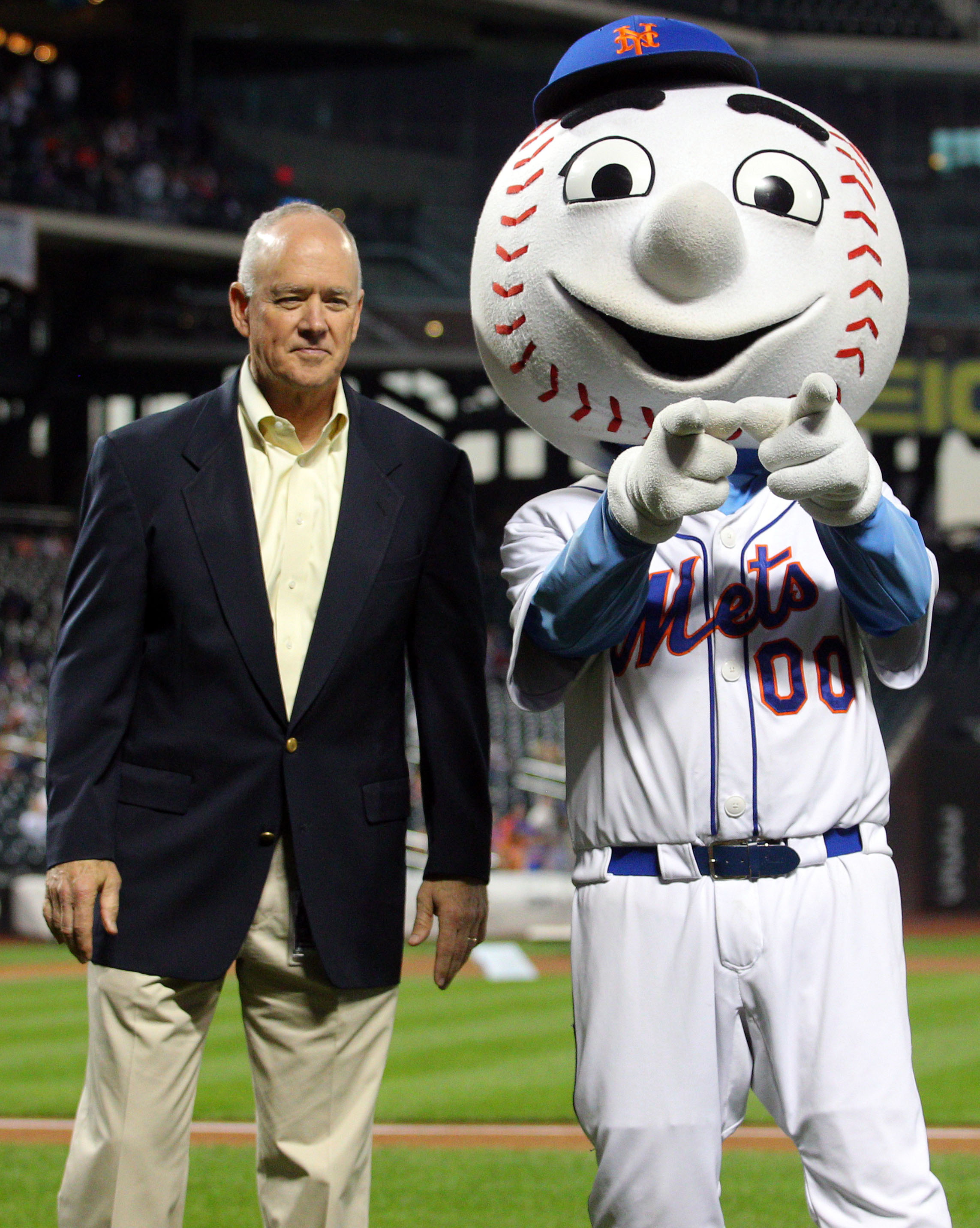
That concern will likely motivate the organization to maintain depth. But the club has already shown at least some willingness to move arms when the need arose: Wheeler was set to be shipped out in the failed Carlos Gomez deal, while Michael Fulmer was one of several young pitchers that ultimately were traded over the summer.
And we’ve yet to see any indication that the organization is lining up for a significant payroll increase. Last year, the Mets topped $100MM on Opening Day for the first time since 2011, and there’s probably about $80MM already committed to 2016. There’s less on the books down the line, but a host of outstanding players will be reaching arbitration eligibility and (hopefully) commanding big raises.
It remains interesting to consider, then, whether any pitching assets could be cashed in to facilitate upgrades elsewhere. The most obvious candidate, perhaps, is Niese, whose salary could be re-allocated. But that would remove a layer of security and could require the signing of a swingman type to provide depth. Bartolo Colon has done enough to command a rotation spot, and he won’t likely be cheap, but he’ll be available for a short-term commitment and a return hasn’t been ruled out.
There are some recently-injured arms to consider, too. Youngster Rafael Montero might also be somewhat expendable and would represent a useful trade chip — if he can show that he’s back to full health. It may be less likely at this point, but Wheeler could still be used to help the Mets fill a hole elsewhere. He has the youth, contract control, and upside to be a major piece for a significant addition, though the risk of his Tommy John recovery holds down his value.
The most intriguing, but least likely, scenario involves the four young pitchers who are slated for the 2016 rotation. They’re all huge assets that are valued as such by the Mets. We’ve heard no indication that a trade is a serious consideration, and it’s impossible to imagine a deal at this point that didn’t involve a high-end, controllable young player who could slot right into the New York lineup at a position of need. Matz is arguably the most susceptible to a trade, if only because he’s less established, but there’s a reasonable argument to be made that the club should cash in Harvey now.
One alternative to trading arms is to double down with an extension. Harvey is the closest to free agency, but the Boras client seems unlikely to forgo free agency (thus increasing the appeal of the trade concept). Syndergaard appears worthy of long-term consideration, but both he and the team may want to let things play out a bit more before committing. That leaves deGrom as the candidate who makes the most sense on paper. He wouldn’t be the first 1+ service-time pitcher to sign an extension, as Ricky Romero, Julio Teheran, and Madison Bumgarner have already set a market. It seems likely that the Mets would need to beat Bumgarner’s record $35MM guarantee for a 1+ arm — and not by a little bit — to get something done. Not only has deGrom been unbelievably good (2.61 ERA), he’s also a solid Super Two candidate (1.139 years of service). While deGrom is relatively old at 27, Bumgarner’s pre-2012 contract is rather out of date given the still-rising cost of pitching.
The biggest pitching needs for the Mets probably come in the bullpen. Jeurys Familia turned into a late-inning monster last year, but he has racked up 155 1/3 innings over the last two regular seasons and threw another 14 2/3 in the postseason. He’d probably be pairing with Jenrry Mejia in the late innings, but that talented right-hander could be headed for a non-tender after twice being busted for PEDs. (Either way, he’ll miss about half of 2016 to serve his suspension.) The club does have another set-up option in Addison Reed, who showed a nice turnaround after coming to New York last summer. He’ll be expensive thanks to his steep arbitration starting point, but indications are that the Mets will tender Reed a contract.
Another late-inning righty might be nice, though Hansel Robles had a very nice rookie campaign and Carlos Torres could bounce back from a rough 2015. But left-handed relief is the bigger need. Sean Gilmartin was a nice surprise as a Rule 5 pick-up, and he’ll take one spot. The resurgent Josh Smoker joins Dario Alvarez as 40-man southpaw options, Josh Edgin could return later in the year from Tommy John surgery, and a reunion with injured hurler Jerry Blevins is said to be a consideration. But there’s every reason for the club to pursue a reliable lefty arm. There are several free agents that could fit the bill, led by Antonio Bastardo and Tony Sipp.
Any money spent in the pen, though, would likely reduce the free cash that could be used to pursue upgrades elsewhere. While the club doesn’t have any gaping voids in its lineup, there are certainly areas that could use improvement — especially for an organization that is looking to seize a rare window in which it enjoys cheap and outstanding starting pitching.
When the Mets locked up Juan Lagares last winter, they surely expected he’d be an every day option in center. But that’s now in question, leaving the team weighing a left-handed-hitting complement — if not something more. A player like Will Venable could make sense as a fourth outfielder. If the club wants to add someone for more regular duty, it could be well-positioned to seek value (and take on some health risk) in Denard Span or to swing a trade for Ben Revere of the Blue Jays, Ender Inciarte of the D’backs, or Charlie Blackmon of the Rockies. Free agent Gerardo Parra might stand as a middle-ground option who could function more as a traditional fourth outfielder or take near-regular reps, as circumstances dictate.
Of course, it’s also still at least conceivable that the club could look to shake things up further. The clamor to bring back Yoenis Cespedes seems to have died down. (A return never seemed terribly plausible anyway.) But there are other possibilities. The very top of the market is probably out of reach, but if New York is willing to relegate Lagares to a pure fourth outfielder role, then Dexter Fowler could be a match. (Unlike Span, the switch-hitting Fowler — who hits lefties better than righties — doesn’t make for a natural platoon pairing.) And there’s always the possibility of dealing Lagares, who could hold appeal to teams that believe in him and have a need up the middle. Dealing Lagares after an off year is probably not the optimal scenario from a long-term value perspective, but the Mets’ surprising World Series run has changed the calculus somewhat.
Whoever is added could also see some time in the corners, where Curtis Granderson is aging and Michael Conforto is still not fully established despite a very promising partial season debut. Michael Cuddyer is also still a factor in the outfield, of course, though one wonders whether he’ll need to find more of his time at first base, as an interleague DH, and as a bench bat. Lucas Duda will be expected to continue handling the lion’s share of the time at first, but Cuddyer presents a good option to spell him when southpaws take the hill.
The major complication in the corner infield is David Wright. Some have wondered whether he’ll continue to be a viable defensive option at third with his throws visibly hampered by his back issues. It may be too soon to pull the plug on Wright’s days at third, but he could ultimately follow the path of Ryan Zimmerman of moving across the diamond in the midst of a major extension. At the very least, the Mets need to have some contingency plan in place in the event that Wright’s rather serious back issues cause problems once again.
Wright’s situation only adds to the intrigue up the middle. There’s no shortage of options, but there’s little in the way of certainty. Once-maligned, now heroic shortstop Ruben Tejada may be non-tendered after his bad-luck broken leg in the post-season. Trade deadline redemption man Wilmer Flores was moved off that position late in the year and seems to profile better at second or third. Top shortstop prospect Amed Rosario only just turned 20 and still needs to conquer the upper minors, but Gavin Cecchini and Matt Reynolds are close and ready, respectively. Another highly-regarded youngster, Dilson Herrera, didn’t light the world on fire in his first big league stint but is line for another chance. And Eric Campbell and Danny Muno could factor at second (or, if needed, third).
Given that array of options, there are several approaches that the front office could consider. Holding pat, certainly, is one. Signing Ben Zobrist or even bringing back Daniel Murphy would provide an immediate option at second and/or third, but both free agents are expected to command $12MM or more annually over reasonably lengthy terms. Adding a second baseman, moreover, would likely leave the team with some combination of Flores and Reynolds at short while blocking Herrera. The shortstop market also offers possibilities. Ian Desmond is the biggest (and most expensive) name, but veteran stopgaps like Alexei Ramirez and Jimmy Rollins could also make some sense.
It’s also worth wondering whether the Mets could consider trading from its stockpile of middle infielders — especially if a veteran is brought in. We already know that New York is willing to part with Flores, at least in certain circumstances, since he would’ve been the other key piece (with Wheeler) in the nearly-completed Gomez deal. The younger players listed above hold varying degrees of appeal, and one could conceivably be cashed in — possibly in concert with other pieces — to add anything from an established bullpen arm to a center field-capable outfielder.
There’s another area of some depth that could provide Alderson with a trade chip: the catching position. Travis d’Arnaud seems to have cemented himself as the starter heading into 2016 after battling through injury to slash .268/.340/.485 last season. Both d’Arnaud and Kevin Plawecki drew strong defensive ratings last year, but the latter player — a younger, less experienced option who was pressed into big league duty — didn’t quite prove up to the task. Plawecki, though, still has plenty of promise and trade value, and New York could always rely on Johnny Monell and/or a veteran addition to serve as a reserve option behind d’Arnaud.
Financial constraints still limit the Mets’ maneuverability, and it’s fair for fans of the club to wonder when those restrictions will truly be loosened. (And also to dream on what kind of roster could be compiled this winter with a payroll befitting a New York-based franchise.) But even if the cash outlay will remain modest, there are plenty of creative options available to allow the Mets to capitalize on a good, cheap core and build a roster that can compete for another NL East title — and hope to achieve more.
Non-Tender Candidate: Pedro Alvarez
MLB’s deadline to tender contracts to arbitration-eligible players is coming up on Wednesday, and one of the more interesting cases is that of Pirates first baseman Pedro Alvarez, who seems at least somewhat unlikely to return to the Bucs next season. MLBTR projects that Alvarez would make $8.1MM through the arbitration process in 2016 (after which he would become eligible for free agency). That’s a figure that the Pirates could be reluctant to pay, and there are any number of signals that both Alvarez and the Bucs appear ready to move on from one another.
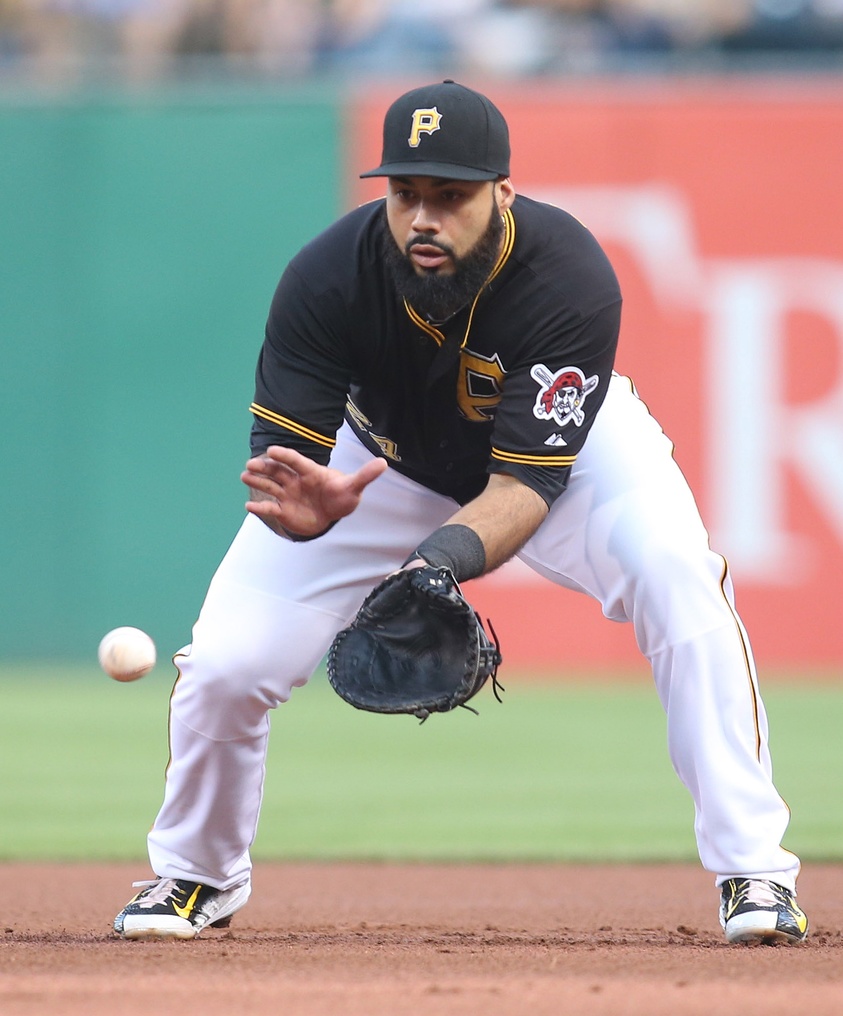 Already this offseason, reporters have indicated that the Pirates are listening to trade offers for Alvarez. Last week, CBS Sports’ Jon Heyman reported that Alvarez himself would prefer to be dealt. And the Bucs’ signing of fellow left-handed first baseman Jake Goebbert to a big-league deal last week suggests that the organization is planning for the possibility that Alvarez won’t be back. Goebbert doesn’t look like a long-term answer at first base, and he has options remaining, so the Bucs could simply mostly want him for minor-league depth. But they could also platoon him with righty Michael Morse at first until the Super Two threshold passes, at which point they could promote top prospect Josh Bell.
It seems at least somewhat likely, then, that Alvarez will head to a new team this winter. The question is how he’ll do it. The Pirates could still try to trade him before next week’s deadline, but it’s questionable whether they’ll be able to find a suitor, given that other teams know the deadline will force the Bucs’ hand. They could tender Alvarez and plan to trade him later, but that would be somewhat of a risk, particularly given that they don’t generally have huge payrolls and they have many key players whose salaries are increasing (including Neil Walker and Mark Melancon through arbitration and Andrew McCutchen, Josh Harrison and Starling Marte through their long-term deals). Or they could non-tender him.
Even leaving aside the looming deadline, assessing Alvarez’s trade value is difficult. What does appear fairly clear is that he should have little value to any team in the National League. Via FanGraphs, Alvarez ranked as the third-worst defensive player in the Majors last year, ahead of only Matt Kemp and Hanley Ramirez. The Bucs moved Alvarez to first in 2015 after he suffered inexplicable throwing issues at third base in 2014, but the move across the diamond did him few favors, as he struggled badly with the fundamentals at his new position and made 23 errors. Essentially, unless he dramatically improve at one of the two defensive positions with the help of a new team’s coaching staff, he’s close to unplayable at either position.
That would make Alvarez a better fit for the American League, where he can DH. His 27 home runs in 2015 have to appear tempting to opposing clubs, particularly ones with ballparks more favorable to home-run power than PNC Park. Unfortunately, Alvarez has offensive shortcomings as well — he’s struck out in more than a quarter of his plate appearances in every year he’s been in the league, and he therefore struggles to post good batting averages.
Still, absent context, Alvarez’s .243/.318/.469 line in 2015 (or the .243/.320/.454 Steamer projects for him next season) would make him a decent DH, particularly given that he might hit somewhat better in certain ballparks. AL designated hitters batted .264/.334/.454 in 2015, and Alvarez would appear to fit in fairly well. As I pointed out in September at Bucs Dugout, however, using Alvarez as a full-time DH would limit the flexibility many teams like to have with that lineup spot. Many full-time DHs, like David Ortiz, Alex Rodriguez and Kendrys Morales, are significantly better hitters than Alvarez, and many teams without that kind of strong DH option divide plate appearances at that position among several players, many of whom also play in the field. Also, some of the teams who fared worst at DH in 2015, like the Tigers and Athletics, did so because of the performances of veterans who are signed to long-term deals and who seem likely to return to their positions next season.
This isn’t to say that there won’t, or shouldn’t, be interest in Alvarez. The Orioles, who struggled at DH last year and who play in a ballpark friendly to left-handed home run hitters, stand out as one potential fit. But trading Alvarez might be somewhat tricky for the Pirates, particularly given that, if they tender him a contract, he won’t be particularly cheap. To be worth his likely $8.1MM salary, he’ll have to produce something like one win above replacement. In the past two seasons combined, he’s been worth less than one win, via both FanGraphs and Baseball Reference. So trading for Alvarez and taking on his salary would require a leap of faith — that his incredible power can somehow overwhelm his shortcomings, or (if his new team uses him in the field with any regularity) that his defense can improve.
It will be interesting, then, to see if the Pirates can pull off a trade involving Alvarez, and if not, what they do with him. Non-tendering him and spending elsewhere would be defensible, particularly with Bell waiting in the wings. Non-tendering Alvarez would also free the Bucs to spend on some other left-handed first base option for next season. The Pirates could also tender Alvarez, use him in a platoon with Morse, hope he recoups some value with a couple decent months in the field, and then either trade him or keep him, depending on the team’s position in the standings and how Bell is doing at Triple-A Indianapolis. We’re only days from the deadline to tender contracts, and it’s not at all clear which direction the Pirates will go.
Photo courtesy of USA Today Sports Images.
Extension Candidate: Jose Bautista
In the wake of Jose Bautista‘s breakout 2010 season, the Blue Jays signed the right fielder to a five-year, $65MM extension that covered his final year of arbitration eligibility and first four free agent seasons. (It also included a $14MM club option on the 2016 campaign.) This extension generated quite a bit of controversy at the time. An MLBTR poll revealed that over 72 percent of readers polled felt the deal was unwarranted, and several pundits felt the Jays should’ve sold high on Bautista rather than gamble that his out-of-nowhere slugging prowess wouldn’t just as suddenly disappear.
Instead, that extension turned out to be one of Alex Anthopoulos’ canniest moves as Toronto’s general manager. Bautista has averaged a .933 OPS over the last five seasons, and he leads all players with 173 home runs over that same span. Needless to say, that $65MM deal has turned into one of the largest bargains in the sport, and the club’s decision to pick up Bautista’s $14MM option for the coming season was the easiest of no-brainers.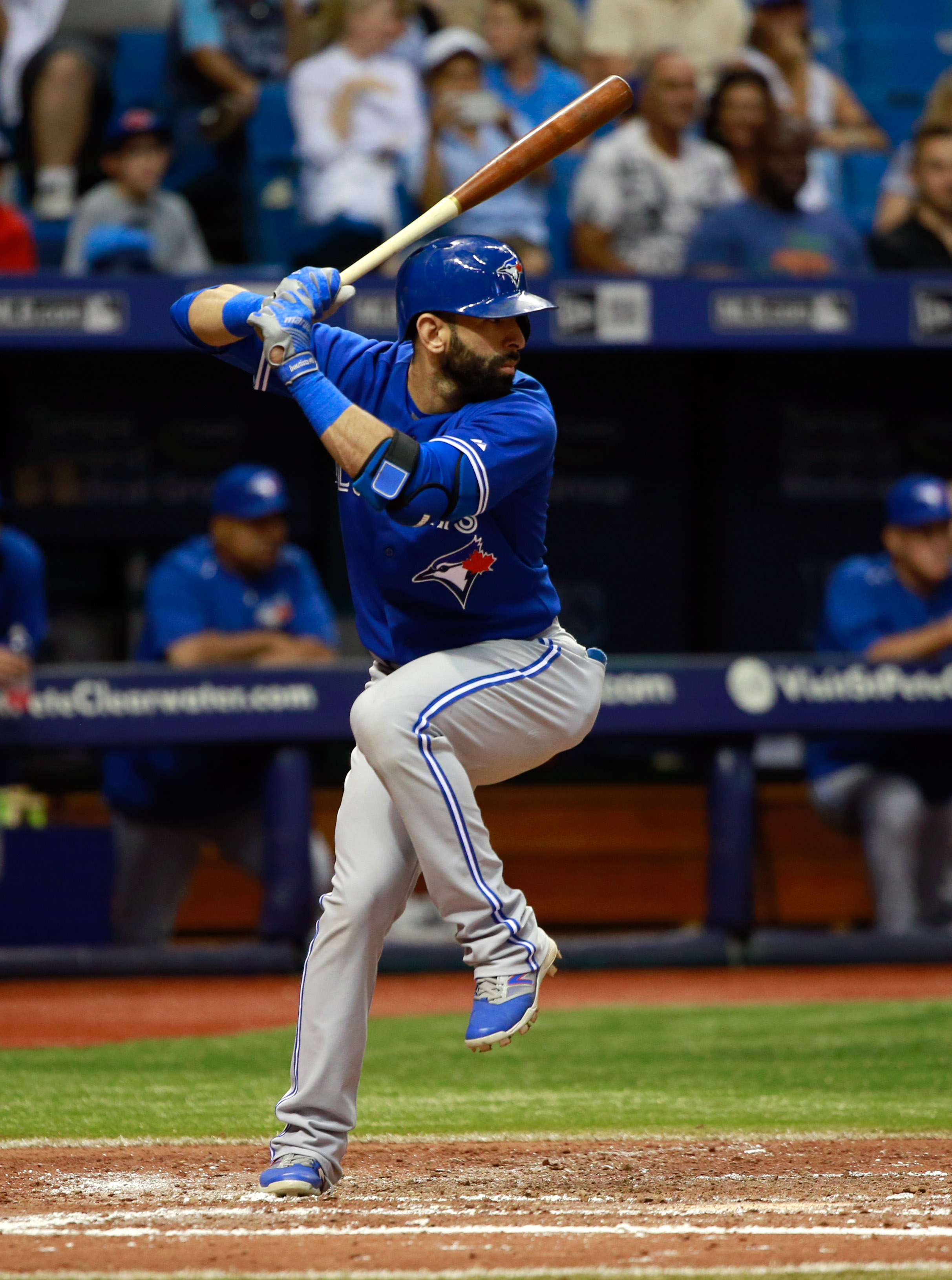
With this track record under his belt (and in the wake of a certain instantly-iconic postseason blast), Bautista has a lot of negotiating power on his side if the Jays want to negotiate an extension this offseason. That being said, there are a large number of factors to consider in this particularly interesting extension case, as if Bautista and the Jays were to reach a new deal, it would very likely set a new contractual precedent.
Bautista is still hitting at an elite level as he enters his age-35 season, and thus he doesn’t really have any comparables among past players with at least 6 years of service time who signed multi-year extensions. Looking at veteran sluggers who have signed big free agent deals in recent years, Bautista has out-performed the likes of Victor Martinez, Nelson Cruz or Carlos Beltran and also lacks major baggage like Cruz’s PED suspension history or the torn ACL that cost Martinez his entire 2012 season. Since V-Mart was limited to DH-only duty and still received a $17MM average annual value, Bautista and agent Jay Alou can certainly make the case that Bautista’s superior hitting numbers and added defensive value deserves a $20MM+ AAV.
It may sound like a big salary for a player in his mid-30’s, yet power is a valuable commodity. Tim Dierkes predicts that five of this winter’s free agents (Jason Heyward, Chris Davis, Justin Upton, Yoenis Cespedes, Alex Gordon) will all find deals with an AAV north of $20MM per season; add Bautista to that group, and he and Davis topped them all by each posting a 147 wRC+ in 2015. There’s enough interest in Ben Zobrist that he could also conceivably find a four-year deal entering his age-35 season, and while Zobrist far outpaces Bautista in defensive versatility, Bautista is also the far superior hitter. To sum up, if Bautista hit the open market this winter, he’d very likely find a four-year deal in the $80MM-$100MM range.
This is the price tag the Blue Jays will need to approach in order to extend their star. If they’re open to meeting this price, it might be a smart move to tear up Bautista’s 2016 contract and essentially start the extension next season by giving him a raise to at least $20MM and then three more $20MM+ seasons through 2019 (with possibly a vesting option for 2020). Starting a four-year extension in 2017 would mean the Jays are on the hook for a big salary in 2020 when Bautista would be entering his age-40 season. If I’m the Jays, I’d much rather pay Bautista a $20MM+ salary next year than I would for 2020 since the team is obviously much more confident that Bautista will still be a top run producer in the short term.
We’ve already looked at the pros of a Bautista deal, so now let’s focus on the cons. Despite Bautista’s consistency, guaranteeing big money to any slugger in his mid-30’s carries a lot of risk. Of the three veteran free agents I cited earlier, Martinez and Beltran both struggled through injury-plagued down years in the first seasons of their latest contracts. Bautista’s 2012 and 2013 seasons were both shortened by injuries — a bad wrist that required surgery after the 2012 campaign and a bruised hip that led the Jays to shut Bautista down in late 2013.
He also played through a shoulder injury for much of 2015 that didn’t much affect his hitting, though it weakened his usually-strong throwing arm and may have contributed to his subpar defensive metrics (-3 Defensive Runs Saved, -12.5 UZR/150). Bautista’s defensive numbers in right field have fluctuated over the years, though it also wouldn’t be a surprise if his 2015 stats are the first sign of a permanent downswing.
So if the Blue Jays were to extend Bautista, it would be under the assumption that he might only be a couple of seasons away from permanent first base/DH duty. It’s this scenario that poses the biggest question mark to a Bautista extension, as the Jays already have Edwin Encarnacion as a full-time 1B/DH. Encarnacion is also eligible for free agency after the 2016 season, is 26 months younger than Bautista and he’s posted slightly better numbers in some notable stat categories since the start of the 2012 season.
Bautista: 2266 PA, 130 HRs, 355 runs, .261/.377/.522, .387 wOBA, 146 wRC+, 18 fWAR
Encarnacion: 2431 PA, 151 HRs, 352 runs, .274/.371/.549, .391 wOBA, 149 wRC+, 16.3 fWAR
In Russell Martin and Troy Tulowitzki, Toronto already has two major salaries on the books for the next four and five years, respectively. Another big long-term commitment will be added if the club extends Josh Donaldson. It’s hard to see the Blue Jays committing over $40MM per season in additional salary through the rest of the 2010’s to two more players, especially two players in their mid-30’s who would be locked into the first base and DH spots.
Unless Bautista or Encarnacion could somehow be talked into another team-friendly deal, the Jays may well have to choose which of the two franchise cornerstones they want to keep in the fold. Encarnacion is younger but Bautista is the better athlete of the two. In terms of pure dollars, Bautista’s age makes him slightly cheaper to extend since Encarnacion would likely push for another guaranteed season or two. Then again, if the Jays are willing to spend big money to retain a slugger, going with the younger option makes more sense if they feel all else is equal or if they feel Encarnacion will age better over the next few years.
Optics will also play a big role in a Bautista extension. The Blue Jays organization already took a PR hit with its revived fanbase this offseason given the awkward nature of Anthopoulos’ departure. It wouldn’t help public perception of new president/CEO Mark Shapiro or the Rogers Commnications ownership group if a new deal couldn’t be worked out with the face of the franchise. Bautista hasn’t been shy about expressing his opinions on the club’s business over the years, and one suspects he would speak up if he doesn’t feel the Jays are making a concerted effort to extend him.
From Bautista’s perspective, an extension would allow him to remain in a familiar spot, keep him playing for a contender if the Jays keep up their 2015 form and, in all likelihood, spend the rest of his career in Toronto. Given all of the factors that will go into Bautista’s extension case, it will fascinating to see if the two sides can reach a new deal or if Bautista will be tossing a bat while wearing another team’s uniform in 2017.
Photo courtesy of Kim Klement/USA Today Sports Images
MLBTR Mailbag: Plouffe, Belt, O’Day, Angels, Happ
Thanks as always for the large volume of questions for this week’s mailbag. Before delving into this week’s questions, I’ll begin by stating (in light of a huge number of questions pertaining to these two) that it seems extremely unlikely for either Freddie Freeman or Jose Fernandez to be traded this offseason. Braves GM John Coppolella strongly denied the notion that he’d even entertain trading Freeman, and the Marlins would be selling low on one of the game’s premier pitching talents before he even becomes overly expensive. There’s clearly some level of animosity between agent Scott Boras and owner Jeffrey Loria/president David Samson, but the overwhelming media consensus since the initial mention of a Fernandez trade possibility is that the Marlins’ ace will remain in Miami, and that’s the expectation here as well.
On to this week’s topics…
“If the Twins were to trade Trevor Plouffe for a bullpen arm, what would a potential return be? What teams match up with the Twins for this hypothetical trade?” — Josh K.
The Angels stand out as the best fit to me and already have reported interest, with the Twins said to be intrigued by young right-hander Cam Bedrosian. He alone isn’t enough to land Plouffe, I wouldn’t think, but adding someone such as Trevor Gott, whose 96 mph fastball would fit the Twins’ desire of adding power arms, makes the notion more palatable. Plouffe has value as a solid defender at third with a league-average bat, but he’s not necessarily cheap and comes with only a couple years of team control remaining.
The White Sox have a clear need at third, but the two teams may not want to deal within the division. San Diego makes some sense as a fit, also, if they’re ready to move on from Will Middlebrooks and prefer to play Jedd Gyorko at second base while keeping Yangervis Solarte, Cory Spangenberg and Carlos Asuaje in utility roles. They have plenty of intriguing relief arms to discuss with Minnesota (e.g. Kevin Quackenbush, Brandon Maurer, Tayron Guerrero).
“Now that Brandon Crawford has been extended for 6/75, what is Brandon Belt‘s value? He profiles similarly as a solid, albeit extremely streaky offensive threat, with elite defense for his position. Obviously that skillset is less appreciated at first base. What would a Belt extension be worth or conversely, what is his trade value for the Giants?” — Keevan T.
We have Belt projected at $6.2MM this winter, his third of four trips through the arbitration process as a Super Two player. Based on that, he’ll probably earn $9-10MM or so in his final arbitration year, so we’ll call it $16MM for his final two arb seasons. (Side note: a straight two, year, $15-16MM extension shouldn’t be entirely ruled out this winter, as the Giants have shown an affinity for locking in cost certainty without buying out free-agent years in the past.)
It’s hard to envision Belt’s agents at Excel Sports placing anything less than a $15MM value on his free-agent years. There’s a case to be made that he could earn more than that as a free agent right now, but he’s signing two years in advance, so there’s typically some form of trade-off. Freddie Freeman‘s name probably gets dropped as a comp in these talks (Excel also reps Freeman), and his free-agent seasons cost about $21MM on average at the time of his signing. That was a rare pre-arb deal in which Freeman might not have taken too significant a hit in terms of pricing out his FA years, though, and I don’t think the Giants would be interested in paying Belt something like $19-20MM annually for those FA seasons.
Something in the vicinity of $83-85MM over six seasons would give Belt ~$17MM per free-agent season, but the Giants probably would have some hesitation due to his injury history and recent concussions. They’d probably try to drop the price down into the Crawford range based on that or knock a year off the contract entirely (something like five years, $65-67MM), but that could be viewed as too big a trade-off from the player side.
Belt probably doesn’t get the credit he deserves for his offense since he plays in one of the worst hitting environments in baseball, but his park-adjusted numbers suggest he’s been 30 percent better than a league-average bat over the past four seasons. That needs to fetch a young MLB contributor and further prospect value or at least one notable Top 50-ish prospect and some not-insignificant second-tier pieces. I realize that’s a highly generalized description of his trade value, but it’d be a fool’s errand to try to peg a specific team and return for his services.
“With the reports of the offers that Darren O’Day is getting from the Dodgers and Nationals among others, should the O’s have extended a qualifying offer to O’Day? Of course, the robust market is in part a result of him not having a QO, but it seems as though as the best reliever on the market and with strong bullpens being en vogue after the Royals’ run, he may have turned it down. Was the risk of him accepting just too high for the O’s?” — Dave S.
The fact that O’Day doesn’t have draft compensation tied to his name is a significant factor in his market. The only relievers we’ve seen reject a QO were David Robertson and Rafael Soriano. The former had a legitimate chance at the largest relief contract ever last offseason due to his save total, while the latter was coming off of a lights-out, 42-save campaign.
Saves aren’t compensated the way they used to be on the free-agent market. I do think they still inflate value, though, and O’Day’s numbers and age (he’s three years older than Robertson was when he hit the market) limit his earning power. $36MM is being mentioned as his absolute peak right now. If we assume something like 4/28 for his ultimate contract, then O’Day would be getting about 3/12 on top of a theoretical QO, which isn’t much for a pitcher of his talents and consistency. With that in mind, there’d have been a strong case for him taking the $15.8MM and trying again next winter.
“I’ve seen Daniel Murphy‘s name connected to the Angels in many FA predictions/articles, obviously with good reason. His left handed bat could fill multiple holes in the Halos line-up and his versatility at 2B/3B seems to be just what Dr. Moreno/Eppler/Scioscia ordered. However, because he rejected a QO he’ll force the Angels to surrender their top pick (25th as of now). Is Murphy really worth the loss of that pick? Do you feel it makes more sense for the Angels to sign a top tier FA as a precursor to a Murphy signing in an effort to maximize their gains? Or is it more likely that Eppler holds the top pick due to it’s value as a building block for the future of his Angels?” — Jake T.
I do think it’s worth it for the Angels. Their farm system is in disarray at the moment right now, so I understand the want to preserve the pick. I feel like if Eppler were truly set on stockpiling picks, though, the qualifying offer would’ve been made to David Freese (who admittedly did have a case to accept but also one to reject as the only starting-caliber third baseman on the market). The Angels have also been loosely tied to names like Jason Heyward, who’d require draft pick forfeiture, and owner Arte Moreno has shown a willingness to spend to win now over building through the draft in the past. Murphy adds two or more wins to the Angels next season, balances out the lineup and could fit in at second or third base. He’s a great on-paper fit, and the Angels are clearly aiming to win in the near-term.
“Even after the Rays traded Nathan Karns, I’m getting the impression that they could trade another one of their young starting pieces. If they do, who do you think is most likely to go and what type of package could he net?” — Taylor L.
It’s not really Tampa Bay’s style to attach a bad contract — although given their lack of spending, they rarely have bad contracts — to something of value simply to clear payroll. They’d be selling low on Drew Smyly, Matt Moore or Alex Cobb, none of whom are expensive yet, and it’s tough to see them moving Jake Odorizzi, who isn’t even arb-eligible yet. Erasmo Ramirez makes more sense to me. I can envision the Rays feeling as though they acquired him, built up his value and profited off his strong season just before he begins to get expensive. They can probably get more than Mike Montgomery back for Ramirez at this point, and that was the initial cost of acquisition.
“What are your thoughts on the market for J.A. Happ? Initially, I thought 2/20 to 24 range would get it done. However, the fact he doesnt require draft pick compensation makes him a bit more attractive, no? Is he in that 3/30 range and upwards?” — Nathaniel M.
Happ’s in that 3/30 range for me after the turnaround he had in Pittsburgh. That might be more than the Pirates care to pay to retain him based on the short sample of dominance he had there, but I have to imagine he feels the Bucs were a large part of the success he had. And, we saw the Pirates pony up with $39MM for Francisco Liriano after he revitalized his career there. That Happ doesn’t require draft pick compensation does work in his favor, as does the shorter term for which he can be had.
Offseason Outlook: Los Angeles Dodgers
The Dodgers’ new-look front office has done a lot of wheeling and dealing already, but there’s more to come as it continues to overhaul the league’s most expensive roster.
Guaranteed Contracts
- Clayton Kershaw, SP: $163MM through 2020 (includes player opt-out after 2018)
- Adrian Gonzalez, 1B: $64MM through 2018
- Carl Crawford, OF: $41.75MM through 2017
- Andre Ethier, OF: $38MM through 2017 (includes buyout of 2018 club option)
- Brandon McCarthy, SP: $31MM through 2018
- Hyun-Jin Ryu, SP: $21MM through 2018
- Yasiel Puig, OF: $19.5MM through 2018 (can opt into arbitration when eligible; on track for 2017 eligibility)
- Brett Anderson, SP: $15.8MM through 2016 (accepted qualifying offer)
- Erisbel Arruebarrena, SS: $13MM through 2018
- Alex Guerrero, IF/OF: $10MM through 2017
- J.P. Howell, RP: $6.25MM through 2016 (exercised player option)
- Jose Tabata, OF: $4.75MM through 2016
Other Obligations
- Matt Kemp, OF: $14MM through 2019 (salary obligations remaining with Dodgers as part of trade with Padres)
- Michael Morse, OF: unreported portion of $8MM salary for 2016 (likely sufficient to make up all or most of difference between it and Tabata’s salary; agreed to as part of trade with Pirates)
Arbitration Eligibles (projections via MLB Trade Rumors)
- A.J. Ellis (5.151) – $4.5MM
- Kenley Jansen (5.073) – $11.4MM
- Justin Turner (5.045) – $5.3MM
- Juan Nicasio (4.084) – $3.1MM
- Yasmani Grandal (3.115) – $2.7MM
- Luis Avilan (3.077) – $1.1MM
- Joe Wieland (3.027) – $508K
- Scott Van Slyke (2.151) – $1.2MM
- Chris Hatcher (2.146) – $900K
Free Agents
Brandon Beachy, Zack Greinke (exercised opt-out provision, rejected qualifying offer), Chris Heisey, Jim Johnson, Howie Kendrick (rejected qualifying offer), Jimmy Rollins, Justin Ruggiano, Chase Utley
Andrew Friedman, Farhan Zaidi and co. have not been shy at all about taking advantage of the Dodgers’ deep pockets since taking the helm in Los Angeles. But the group has been more freewheeling than free spending in the traditional sense. For example: the club signed Hector Olivera last March, then flipped him (and ate the $28MM signing bonus) in July — before he ever appeared with the major league club — in a trade that brought in Alex Wood, Jose Peraza, Luis Avilan, and rental pieces. In the process, L.A. ate not only Olivera’s signing bonus, but also the tens of millions of dollars owed to Mat Latos, Michael Morse, and Bronson Arroyo.
That wasn’t even the only multi-player deal consummated with Atlanta. In their first year of office, we’ve also seen this front office team ship out a former superstar (and pay down part of the contract), sell a controllable All-Star and flip the key piece of the return for a one-year veteran, acquire the Phillies’ long-time double-play combo (here and here), roll the dice on risky free agent pitching, effectively purchase a draft pick, put late-season trust in an unproven prospect, and spend big internationally (on more than one occasion).
The organization also parted ways with skipper Don Mattingly, who was criticized at times for tactical decisions even as he drew strong reviews for handling a clubhouse full of personalities and payroll. In Mattingly’s place, the Dodgers have tabbed Dave Roberts as the new manager. That move could open the top brass up to criticism, as it’s his first time running a dugout. But, that sort of risk hasn’t seemed to hold sway in Los Angeles (and the Dodgers are hardly the only team to recently hire an inexperienced manager). Roberts will be tasked with leading an expensive, talented, and carefully constructed roster to an NL West crown and beyond.
With such a wide-ranging track record, it’s largely a fool’s errand to predict what the Dodgers’ brain trust will do this winter. But it’s clear what their biggest decision is, at least at this point: whether or not to re-sign Zack Greinke. The right-hander’s opt-out clause was perfectly timed to coincide with a 222 2/3-inning, 1.66 ERA masterpiece of a season. It doesn’t hurt that he held opposing teams to less than three earned per nine in his prior two seasons in L.A. The net result is that he’s going to be extremely expensive, in average annual value if not also years, as a free agent. With potential competition from the rival Giants, the stakes are high. Of course, we’ve also seen the Dodgers connected to varying degrees with top free agents (e.g. David Price, Jordan Zimmermann), and potential trade targets such as Shelby Miller, so it’s prudent at this point to consider all options open.
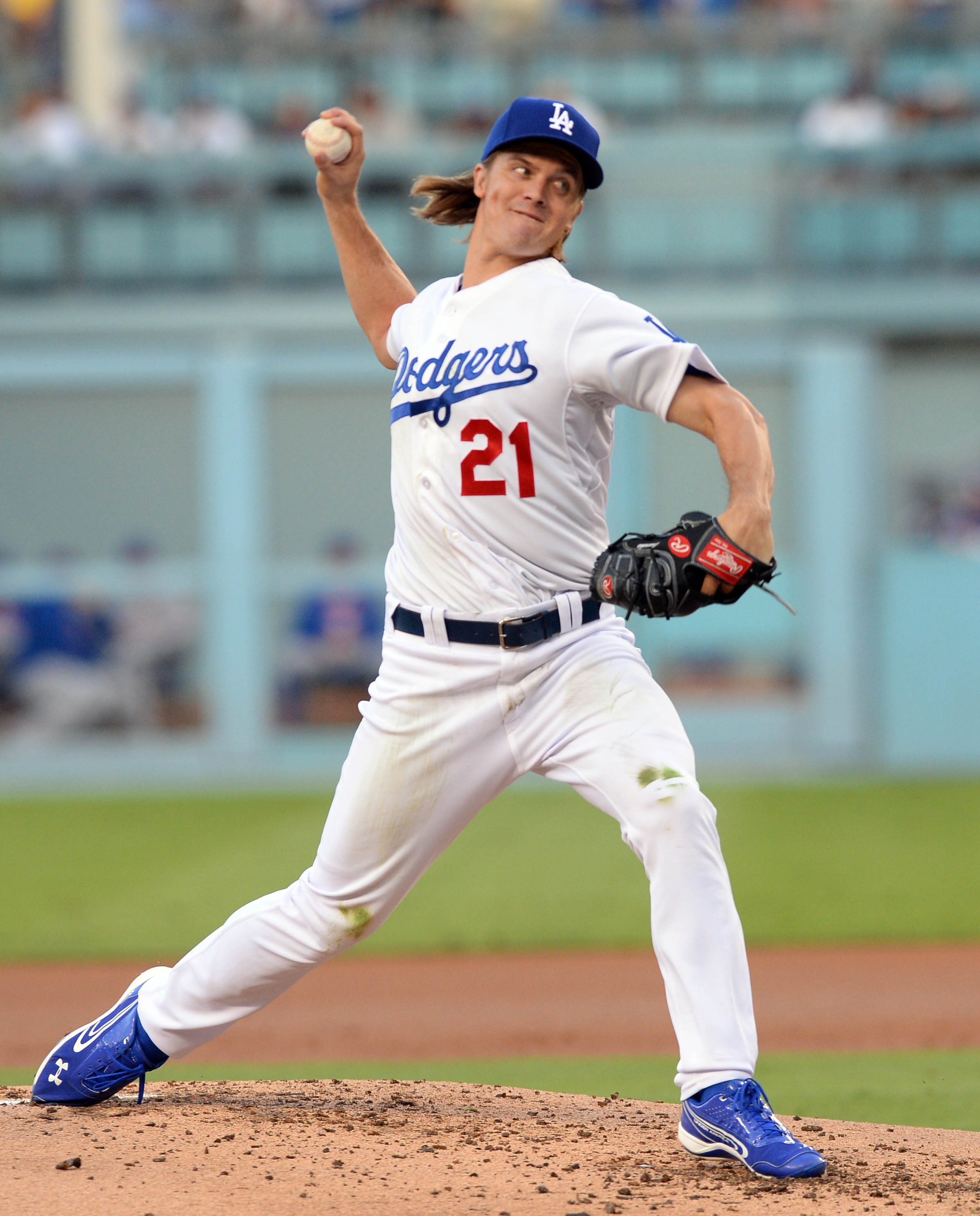
Whether or not the team brings Greinke back into the fold, moreover, the rotation figures to be an area of focus. That’s true despite the fact that Brett Anderson chose to return on a one-year, $15.8MM qualifying offer. Clayton Kershaw — the best pitcher in baseball — is firmly ensconced atop the rotation, and Alex Wood joins Anderson as a nice mid-rotation arm. But there’s a lot of uncertainty elsewhere, as Hyun-jin Ryu and Brandon McCarthy will each be working back from serious injuries (the former, hopefully, before the latter).
The team isn’t without options behind that group. Mike Bolsinger, Carlos Frias, Zach Lee, and Joe Wieland all have had a taste of the bigs. Jharel Cotton and Chris Anderson could soon be nearing MLB readiness as well. (That’s before considering the team’s two highest-upside young arms — Julio Urias and Jose De Leon — who could theoretically be ready as soon as 2016, but shouldn’t be pushed forward out of necessity.) But for a contending team that has seen its depth tested in recent years, there’s a good argument to be made for adding a veteran, even if Greinke or another top arm signs on.
While the rotation has some questions, the pen is the area that drew the most fan ire last year. But that’s not to say the relief corps has any obvious holes heading into 2016. Kenley Jansen remains a high-leverage stud. The team has right-handed middle-relief and/or set-up options including Chris Hatcher, Pedro Baez, Yimi Garcia, and Juan Nicasio — every one of whom struck out 10 or more batters per nine and carried a sub-4.00 ERA last year. And the Dodgers return southpaws Luis Avilan and J.P. Howell, with the former coming over in the aforementioned Olivera/Wood swap and the latter exercising his player option.
That looks to be a pretty strong group, and many of the younger rotation options noted above could slide into the pen if a need arose. But there’s still a reasonable argument to be made that the club ought to be proactive. For one thing, there’s only one elite arm in the pen as things stand. For another, that particular elite arm — Jansen — will reach the open market after the season. Whether or not the club will feel at all compelled to line up a replacement for him now, it makes sense that it is at least exploring the relief market for opportunities. We’ve heard talk that players such as Darren O’Day (via free agency) or even Aroldis Chapman (in a trade) might be real considerations.
The position player side of things is less interesting in some ways and more interesting in others. The infield is in good shape: Corey Seager appears set to take over at shortstop after his impressive debut, Adrian Gonzalez is locked in at first, and the Yasmani Grandal/A.J. Ellis pairing behind the dish figures to be maintained.
Los Angeles still has an array of options at second and third, with Justin Turner, Enrique Hernandez, Jose Peraza, and Alex Guerrero all on hand. (The last name on that list, Guerrero, could also end up as trade bait. And Turner is coming off of surgery, though we’ve not heard any indication that he’ll be limited.) Of course, all of those players hit from the right side, so it would be nice to add a lefty-swinging option. The team has been said to have interest in a reunion with Chase Utley, who could fill such a role. While that mix does not scream out for an upgrade, one of those positions could also theoretically be filled from the outside if a great opportunity arose.
Things start to get fun, though, when you turn to the outfield. Andre Ethier and Carl Crawford are both expensive, left-handed hitters who should probably be part-time players at this point. Joc Pederson showed both his rather steep upside and the reasons for doubt as he followed up on a huge first half with miserable play down the stretch. Yasiel Puig had his worst season as a big leaguer and continued to generate controversy, though he still carries one of the highest ceilings in all of baseball. Scott Van Slyke took a step back last year but still offers a supplementary right-handed bat. Guerrero (in the corner) as well as Hernandez and even Peraza (up the middle) could also contribute on the grass.
It’s not outlandish to imagine that group remaining intact. Those players represent a fairly intriguing blend of upside and depth, after all, as well as ample lineup construction possibilities. It didn’t prove unworkable to allocate playing time last year with such a wide variety of options. And, after all, there’s always injury and underperformance to account for.
That being said, there are several scenarios where this outfield mix could be shaken up — perhaps significantly. The free agent market is full of quality outfielders, some of whom could be alluring enough to force other transactions to clear space — though we haven’t heard much to suggest that. Even without a major addition, change could make sense. Ethier and Crawford are somewhat redundant, and any cost savings could be re-allocated if a willing trade partner is found. The former, of course, has been much more productive of late and carries more trade value. (Indeed, the remainder of his deal looks manageable, if a bit expensive.) Pederson seems unlikely to be moved, but he’d represent a big chip if the team wants to make a deal without giving up its young pitching prospects.
And then there’s Puig, who draws as many whispers as any player in baseball. There’s still no reason to believe that he’ll be shopped, per se, but if L.A. is really open to trading him the possibilities are more or less endless. Given his talent, established ceiling, and cost/control, it’s hard to imagine any team in baseball that wouldn’t be intrigued. It’d be hard to sell him now after a down season, as the return surely wouldn’t be what it might’ve been last winter, but Puig still represents a (hypothetical) centerpiece to a major deal — possibly one that would return a high-end, controllable starter.
One thing that’s clear is that there are relatively few limitations on what the Dodgers can do. Even if the goal is to pare back the payroll, the organization has not only immense spending capacity but also high-end, controllable talent (at the majors and in the minors) from which to deal. That creates an opportunity and sets an expectation for the creative front office.
MLBTR Originals
A look back at the original reporting and analysis found on MLBTR the last seven days:
- After an offseason trade to the White Sox, Jeff Samardzija struggled through his worst season in four years as a starting pitcher, but he’ll still likely aim for a sizable multiyear contract in free agency, as Tim Dierkes writes. Draft pick compensation could be a deterrent for some suitors, but for other teams, the hurler represents an opportunity to add a strong No. 2 starter at a (relatively) reasonable price.
- On the most recent edition of the MLB Trade Rumors Podcast, host Jeff Todd spoke with MLB.com’s Angels beat writer Alden Gonzalez to get the latest on the Angels. A new episode of the MLB Trade Rumors Podcast is released every Thursday and can be accessed on iTunes, SoundCloud, and Stitcher.
- The Rangers are looking to return to the postseason even though they could lose a few key contributors to free agency. Steve Adams took an in-depth look at how the Rangers could improve despite the roadblocks they’ll be facing this winter.
- Can the Pirates put together a deal to land Freddie Freeman? Probably not, according to Steve Adams, MLBTR’s resident Debbie Downer. The most recent edition of the MLBTR Mailbag also touches on the Angels’ remaining trade options and whether the Mets need to seek out some power in the middle of their lineup.
- For the first time in a while, the Nationals enter the winter with a variety of question marks and a lack of linear solutions, Jeff writes. It has been widely speculated that Gerardo Parra is a strong fit for the Nationals’ lineup, but there are plenty of other moves that GM Mike Rizzo could make in the coming months.
- Staying on top ain’t easy. Over the weekend, Steve Adams looked at what the Royals will have to do to defend their crown.
- Recently, MLB Trade Rumors launched a brand new official Instagram account:@TradeRumorsMLB. Each day, we’re sharing conversation-inspiring images about the hottest topics in baseball. From there, we invite you to give us a like, weigh in with your thoughts in the comments section, and even share the link with a friend. So, what are you waiting for? If you don’t have an Instagram account, this is the perfect excuse to sign up and get one. Follow us on Instagram today!
- Steve and Jeff each hosted live chats this week, check out the transcripts here and here.
Offseason Outlook: Kansas City Royals
Fans of Kansas City baseball were treated to a World Series title for the first time in 30 years in 2015, but there’s little time for GM Dayton Moore and his staff to rest, as the club will have a number of holes to fill this winter as it seeks a return to the promised land in 2016.
Guaranteed Contracts
- Yordano Ventura, SP: $21.25MM through 2019 (includes buyout of 2020 option)
- Omar Infante, 2B: $17.75MM through 2017 (includes buyout of 2018 option)
- Jason Vargas, SP: $16.5MM through 2017
- Edinson Volquez, SP: $12.5MM through 2016 (includes buyout of 2017 option)
- Wade Davis, RP: $10.5MM through 2016 (includes buyout of 2017 option)
- Kendrys Morales, DH: $9MM through 2016 (plus 2017 mutual option)
- Eric Hosmer, 1B: $8.25MM through 2016 (arbitration eligible following 2016 season)
- Alcides Escobar, SS: $5.75MM through 2016 (includes buyout of 2017 option)
- Luke Hochevar, RP: $5.5MM through 2016 (plus 2017 mutual option)
- Kris Medlen, SP/RP: 5.5MM through 2016 (plus 2017 mutual option)
- Kelvin Herrera, RP: $2.55MM through 2016 (arbitration eligible following 2016 season)
- Salvador Perez, C: $2MM through 2016 (plus three club options)
Arbitration Eligible Players (service time in parentheses; projections via MLB Trade Rumors)
- Greg Holland (5.028) – $11.3MM
- Drew Butera (5.018) – $1.1MM
- Mike Moustakas (4.111) – $5.7MM
- Tim Collins (4.097) – $1.475MM
- Jarrod Dyson (4.088) – $1.7MM
- Danny Duffy (4.085) – $4.0MM
- Lorenzo Cain (4.074) – $6.1MM
- Louis Coleman (3.018) – $1.0MM
- Non-tender candidates: Holland (Tommy John surgery), Butera, Collins, Coleman
Contract Options
- Alex Gordon, $14MM player option: Gordon declined
- Wade Davis, $8MM club option: Exercised
- Alcides Escobar, $5.25MM club option: Exercised
- Alex Rios, $12.5MM mutual option: Royals declined ($1.5MM buyout)
- Jeremy Guthrie, $10MM mutual option: Royals declined ($3.2MM buyout)
Free Agents
- Alex Gordon, Johnny Cueto, Ben Zobrist, Franklin Morales, Ryan Madson, Chris Young, Rios, Guthrie
While Royals fans celebrate the highest pinnacle in baseball, they’re left perhaps with a bittersweet taste in their mouths knowing that Game 5 of the World Series could have been the last in franchise icon Alex Gordon’s career with the team. Gordon is a free agent after declining a player option and a qualifying offer and will test the open market this winter in search of a significant deal. While some might hope to see Gordon take a discount to remain in Kansas City, his initial contract extension with the Royals proved quite favorable for the team, and he may now look to max out his market. Early indications are that the Royals are hoping to retain Gordon on a three- or four-year deal, but I expect clubs to be willing to offer five years, or at the very least, four years at an extremely premium annual value (think Hanley Ramirez money).
The Royals have never given out a contract worth more than $55MM, but if they’re to retain any of their top three free agents, that’s probably going to have to change. Zobrist is the possible exception, but he’s already been linked to roughly a dozen teams and is said to be seeking a four-year pact. If Zobrist does receive four years, it’ll be for more than $55MM in total. Cueto seems bound for a $100MM+ contract somewhere despite some late struggles — his dominant World Series effort probably quelled concerns to some degree, though there are still some red flags — and that type of contract is difficult to envision from the Royals.
Kansas City, then, could face the notion of needing to find a new left fielder, a possible right field upgrade, a second base upgrade, at least one (possibly two) starting pitcher(s) and multiple arms to fill out the bullpen. The front office is riding high on the team’s 2015 success, but Moore and his staff know there’s no shortage of work to be done, and the resources to accomplish that work might be tighter than many realize.
They Royals are already sitting at a projected $90.3MM in payroll, assuming they tender only Mike Moustakas, Lorenzo Cain, Danny Duffy and Jarrod Dyson from their class of arb-eligible players. There are undoubtedly some additional World Series funds in Dayton Moore’s war chest, but when factoring in league-minimum players, the Royals are around $95.4MM — or only about $17MM shy of last year’s club-record $112.8MM Opening Day payroll. It should be noted that the Royals do have insurance on the contract of Jason Vargas, who had Tommy John surgery this past summer. The Kansas City Star’s Andy McCullough reported at the time that the team will get about $6MM of his $8.5MM salary back if he does not pitch next season, creating the potential for a bit more financial breathing room. Nonetheless, a return for either Zobrist or Gordon could bring them within striking distance of last year’s mark while only addressing one of the aforementioned needs.
The Royals are set behind the plate, where Salvador Perez, as most know, has one of the most team-friendly contracts in recent memory. He’s guaranteed $2MM next season and has three club options on his deal which range from $3.75MM (2017) to $6MM (2019). There’s been talk of extending Perez to make him a Royal for life, but from a pure baseball perspective, I’m not sure I see a reason to do so — at least not at this time. Perez is already under control cheaply through his age-29 season. As it stands, he’ll hit the open market entering his age-30 season and coming off an eight-year Royals career in which he’s been more heavily used than any catcher in the game. Perez caught 137 games in 2013, 146 (!) in 2014 and 139 in 2015 (not including postseason games). If that usage pattern continues, there’s no telling how his body will age, especially considering the fact that his 6’3″, 240-pound frame is rather large for a catcher in the first place. An extension that begins in 2020 seems overly risky from the team’s vantage point.
Turning to the infield, Eric Hosmer is a lock at first base, and there’s no doubt as to who will be manning shortstop (Alcides Escobar) or third base (Moustakas). The one possible area of upgrade, as previously mentioned, is at second base. Omar Infante is earning $7.75MM next season and has a sizable amount of money remaining on his contract, but he’s batted a dreadful .238/.268/.329 in two years with the Royals. That type of production won’t cut it for a contending club, and I wouldn’t be surprised if the Royals shopped Infante around to see about lining up on an exchange of bad contracts. One speculative trade scenario would be to swap Infante for Milwaukee’s Matt Garza. While he’s owed more money, Garza could rebound in Kansas City’s large park and with their tremendous defense, making him a more palatable allocation of finances. (And, from the Brewers’ vantage point, Infante could fill in around a thin infield and would save them some money.)
If Infante is still in Kansas City next season, it could be in a bench role with either Christian Colon or an external addition slotting into the everyday role. That could mean a reunion with Zobrist on a three-year deal in the $16-18MM-per-year range — Zobrist has spoken highly of his time in Kansas City and resides in the relatively nearby Nashville, Tenn. — or a run at one of several free-agent second basemen. Howie Kendrick strikes me as a Royals-esque target, given his perennially high contact rate and his track record of solid defense (even if metrics like UZR and DRS felt he slowed down in 2015). Kendrick probably requires at least a three-year deal as well, however, if not four years, though I can envision a lesser annual rate than that of Zobrist in his case. Nevertheless, it’d make for a risky investment by the Royals. Chase Utley would be a more affordable alternative, though he’s far from a sure thing himself.
In the outfield, Cain will reprise his role as one of the game’s most valuable all-around players in center field. Last winter’s Alex Rios signing never paid full dividends, as he suffered a broken hand early in the season and was never terribly productive. The Royals could go with a platoon of Dyson and Paulo Orlando in right field, but the club balked at pursuing a platoon scenario with Dyson upon Nori Aoki‘s departure following the 2014 season, so perhaps they’ll look for another full-time solution to keep Dyson in a reserve role.
Korean outfielder Ah-seop Son makes plenty of contact and has been favorably compared to Aoki. We’ll learn the outcome of Son’s posting next week, and it wouldn’t be surprising to see Kansas City take a look. Aoki himself is again a free agent, though he dealt with concussion issues late in the season. Gerardo Parra is another affordable corner option that fits the Royals’ profile, and a pursuit of either Austin Jackson or Denard Span has some logic behind it, if the allure of playing for the reigning World Champs makes either free agent more amenable to shifting out of center field.
The rotation is a clear area of need for Kansas City, as Cueto, Chris Young and Jeremy Guthrie are all free agents (though Guthrie lost his rotation spot this season anyhow). Additionally, the team will probably be without Jason Vargas until at least August or September, as the veteran lefty underwent Tommy John surgery in late July.
That leaves Yordano Ventura, Edinson Volquez, Danny Duffy and Kris Medlen as rotation options, and there’s plenty of uncertainty within that group. Ventura was demoted to Triple-A but recalled before making an appearance down there due to Vargas’ injury. While he was much improved after that possible wake-up call, he’s yet to demonstrate prolonged consistency in the Majors. Duffy logged a 4.35 ERA, 4.65 FIP and 4.80 xFIP as a starter last season before shining in a relief role. He’ll probably return to the rotation, but he’s never topped 155 innings in a season and hasn’t held up for a full year in the rotation. Medlen tossed a combined 88 2/3 innings in returning from his second Tommy John surgery, making an increase of 100 or so innings a lot to ask.
Bringing back Young, whose extreme fly-ball skill set meshes quite well with Kauffman Stadium and the Royals’ emphasis on outfield defense, could be a nice low-cost way to add some of the needed innings for Kansas City. Other low-cost options could include Colby Lewis and Mike Pelfrey.
Of course, the Royals don’t necessarily need to limit themselves to the bargain bin. While a run at David Price or a Zack Greinke reunion doesn’t seem realistic, Kansas City could play in the middle tier of rotation arms if owner David Glass is comfortable escalating the payroll beyond 2015’s Opening Day mark. Scott Kazmir, Yovani Gallardo and Ian Kennedy are among the names whose annual values shouldn’t break the bank, and Kansas City could continue to employ its usage of mutual options to offset some of the early costs on a contract. Medlen, Morales, Hochevar and Volquez could each depart following the 2016 season, so backloading some contracts is an avenue that the Royals will consider. Kennedy, Pelfrey and perhaps Wei-Yin Chen, in particular, are plausible targets given Scott Boras’ seemingly strong relationship with ownership and the front office. (Hosmer, Moustakas, Rios, Hochevar, Colon, Holland and both Franklin and Kendrys Morales are repped by Boras.)
Trades, too, will be an avenue worth exploring. Options are vast, though in addition to the aforementioned Garza/Infante bad-contract swap, Oakland’s Jesse Chavez is reported to be available and would serve as an affordable name with whom the Royals are familiar. (Chavez pitched in Kansas City back in 2010-11 before breaking out with the A’s.) The names of Shelby Miller and Julio Teheran have both circulated in the rumor mill as well, though the cost of acquisition on either player would be high.
Whatever route the front office chooses, external rotation options are needed, as many of the arms from Kansas City’s once-vaunted farm system have graduated to the Majors (Duffy, Ventura) or been traded. John Lamb and Brandon Finnegan, for instance, went to Cincinnati in the Cueto deal, while Jake Odorizzi went to Tampa in the James Shields/Wil Myers trade. (Although, in retrospect, perhaps we should begin referring to that as the Wade Davis/Jake Odorizzi trade.)
As dominant as Kansas City’s bullpen has been in recent years, it’s going to be an area of need this winter. Brilliant closer Greg Holland pitched the better part of a year with a tear in his ulnar collateral ligament before succumbing to Tommy John surgery. Kansas City will non-tender Holland but hopes to work out a backloaded two-year deal to keep him in the organization. Regardless of the result of those efforts, Holland isn’t pitching in 2016.
That moves Davis into the closer’s role, which he’s more than equipped to handle. Kelvin Herrera can serve as his primary setup man, and the team will hope for Hochevar to look more like his dominant 2013 self than his 2015 self. That’s not to say he had a poor year — Hochevar, in fact, was quite solid in his first year back from Tommy John — but the blow of losing Holland would be softened were Hochevar to again deliver a sub-2.00 ERA.
The Royals are losing reclamation projects Ryan Madson and Franklin Morales to free agency and will need to replace both, in addition to Holland. Tim Collins will be back from his own Tommy John at some point, but a left-handed reliever should be acquired in some capacity. Tony Sipp is said to be a target of the Royals. As far as right-handed options to replace Madson and Holland, the Royals are believed to be interested in a reunion with Joakim Soria, but his price tag will be quite high. Shawn Kelley, Mark Lowe and Korean right-hander Seung-hwan Oh could all be more affordable options, to name a few.
While that, of course, is a rather lengthy to-do list for Moore and his staff, many of the pieces for a contending club are already in place. Cain, Hosmer, Moustakas, Perez and Escobar is a nice group of position players to build around, and a bullpen anchored by Davis and Herrera will be formidable. The rotation looks suspect at the moment, but there will be additions made, and Kansas City’s elite defense and huge park should benefit whatever collection of arms comprises next year’s rotation, much as it has the past two seasons.