
2015-16 Top 50 MLB Free Agents With Predictions
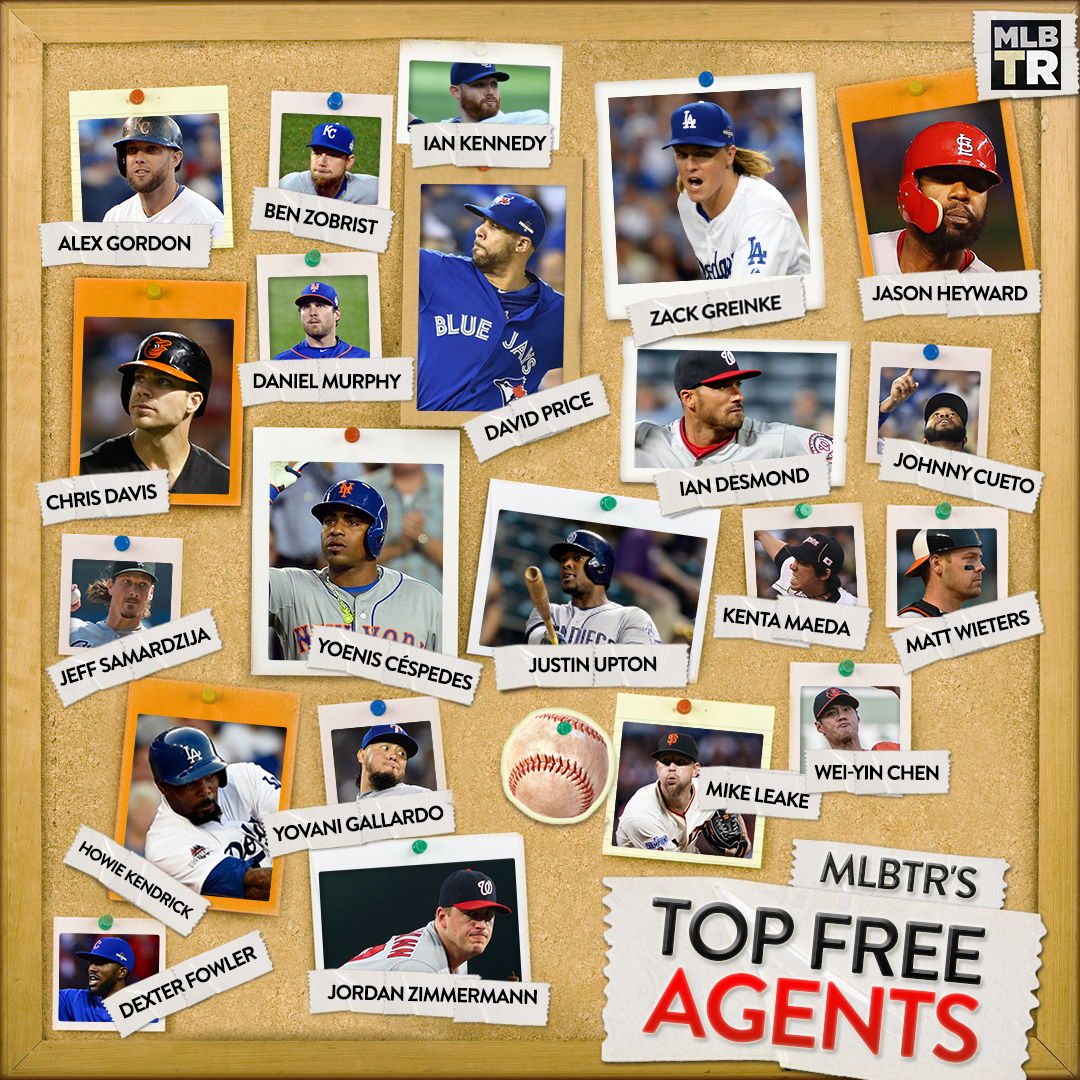
Just in time for the tenth anniversary of MLB Trade Rumors, our Top 50 Free Agents list has arrived! The entire list of available free agents can be found here, and you can filter by position, signing team, and qualifying offer status with our free agent tracker here.
New to MLBTR? You can follow us on Twitter, download our free app for iOS and Android, listen to our podcast, and sign up for our free weekly newsletter.
This is the fifth year for our free agent prediction contest, which allows you to test your prognostication abilities against those of the MLBTR writing team as well as other readers. Last year 3,469 people entered, with Carson Pennington taking home the batting title with 15 correct picks out of 49, a .306 average. Mark Polishuk topped MLBTR writers with 14 correct. The contest is back for 2016 and is open now! You can enter your picks anytime between now and November 13th at 11:59pm central time, and you’re free to make changes up until that point. A Facebook account is required to participate in the contest. Once all top 50 players have signed, the winners will receive cash prizes.
This year, I asked MLBTR writers Steve Adams, Jeff Todd, Mark Polishuk, Charlie Wilmoth, Zach Links, and Brad Johnson to send me their picks so I could compare to my own. Discussions with the MLBTR writing team, especially Steve and Jeff, helped inform the predictions found below. Each player’s team was picked in a vacuum, so we’re not predicting the Nationals will sign both Justin Upton and Gerardo Parra. Additionally, we’ve added our contract predictions to the mix. We vetted these as much as possible, but with 50 predictions and a volatile free agent marketplace, we know we’ll be off on some. Still, the contract predictions give a more clear criteria, as players are ranked by earning power. Without further ado, we’re proud to present MLBTR’s Top 50 Free Agents!
MLBTR Originals
A look back at the original reporting and analysis found on MLBTR the last seven days:
- On Friday, MLBTR rolled out its 2015-16 Top 50 MLB Free Agents list, with predictions as to where each player will wind up. Where will David Price land? How much will Jason Heyward earn? Click the link to hear Tim Dierkes’ picks!
- On the most recent installment of the MLBTR Podcast, Jeff welcomed Tim to discuss the site’s annual top 50 free agent predictions. A new episode of the MLB Trade Rumors Podcast is released every Thursday and can be accessed on iTunes, SoundCloud, and Stitcher.
- From a pure payroll standpoint, the Diamondbacks look to be in excellent shape moving forward, but there is still work to be done, as Steve Adams writes. The pitching staff will be Arizona’s top priority and Steve looked at the second-tier arms that might appeal to Arizona.
- There’s a new regime in Philadelphia and it’ll be up to the revamped front office to make something of its blank slate, Jeff writes. Overall, Jeff sees the Phillies having a fairly modest offseason, though he thinks that they should at least explore creative trades.
- How do rival clubs view Cubs shortstop Starlin Castro? MLBTR’s Brad Johnson asked readers to weigh in on Sunday night with their thoughts.
- Addressing Heyward’s impending free agency is step No. 1 to the Cardinals’ offseason, Charlie Wilmoth writes. Beyond that, Charlie looks at how the Cards might beef up their bench and keep up their strong pitching.
- The Braves are looking to put an excellent product on the field when they open their new park in 2017 and Jeff ran down what they might do this winter to set themselves up for their future home. Atlanta was willing to part with its long-term control over Evan Gattis and Craig Kimbrel last offseason, so it would seem that anything is on the table for them in terms of trades.
- Recently, MLB Trade Rumors launched a brand new official Instagram account:@TradeRumorsMLB. Each day, we’re sharing conversation-inspiring images about the hottest topics in baseball. From there, we invite you to give us a like, weigh in with your thoughts in the comments section, and even share the link with a friend. So, what are you waiting for? If you don’t have an Instagram account, this is the perfect excuse to sign up and get one. Follow us on Instagram today!
- If you missed out on last week’s chat, check out the transcript here.
Offseason Outlook: Arizona Diamondbacks
The Diamondbacks remained in contention longer than most expected in 2015. GM Dave Stewart, chief baseball officer Tony La Russa and senior VP of baseball ops De Jon Watson will look to supplement the club’s core of exciting young position players this winter.
Guaranteed Contracts
- Yasmany Tomas, OF: $52.5MM through 2020 (Tomas can opt out of the final two years, $32.5MM)
- Paul Goldschmidt, 1B: $27.5MM through 2018 (including buyout of 2019 club option)
- Aaron Hill, 2B/3B: $12MM through 2016
Arbitration Eligible Players (service time in parentheses; projections via MLBTR)
- Daniel Hudson (5.117) – $2.0MM
- Jhoulys Chacin (5.045) – $1.8MM
- Jeremy Hellickson (5.045) – $6.6MM
- Josh Collmenter (5.000) – $2.8MM arbitration projection; has a $1.825MM club option.
- Matt Reynolds (4.046) – $800K
- Welington Castillo (4.009) – $3.6MM
- Patrick Corbin (3.105) – $2.3MM
- Randall Delgado (3.100) – $1.0MM
- Rubby De La Rosa (3.097) – $3.2MM
- A.J. Pollock (3.052) – $4.3MM
- Non-tender candidate: Hellickson, Chacin, Reynolds
Contract Options
- Brad Ziegler, RHP: $5.5MM club option — exercised earlier this week
- Josh Collmenter, RHP: $1.825MM club option — exercised earlier this week
Free Agents
From a pure payroll standpoint, the Diamondbacks look to be in excellent shape moving forward. Arizona has just $32.68MM committed to five players for the 2016 season (including the exercised options on Brad Ziegler and Josh Collmenter), and one of those commitments (Aaron Hill) will be shopped this winter. If the club tenders all of its arb-eligible players, that’d bring the total commitment to just over $58MM, and it’s possible that a few of those names will be non-tendered. Jeremy Hellickson is listed as one such candidate above, but he could also be traded to a club in need of innings. The former AL Rookie of the Year has now struggled for three straight seasons. A team without the financial wherewithal to spend much more than that might look at Hellickson as a reasonable roll of the dice, but he’s no longer the inexpensive upside play the Diamondbacks acquired last offseason, and Arizona arguably has more intriguing (or at least more affordable) internal options.
With that in mind, the pitching staff will be Arizona’s top priority this offseason. Patrick Corbin returned from Tommy John surgery and was highly impressive, so he figures to be a lock for the rotation. Another lefty, Robbie Ray, figures to have nailed down a rotation spot after posting a 3.52 ERA with solid peripherals in 127 1/3 innings of work. Chase Anderson and Rubby De La Rosa each posted ERAs well north of 4.00, though in De La Rosa’s case it’s worth noting that he utterly dominated right-handed hitters and was crushed by lefties. The D-Backs probably aren’t ready to go this route yet, but he seems very capable of becoming a late-inning bullpen weapon if he’s unable to find a third pitch to help him keep lefties off balance. Anderson, while his results weren’t outstanding, has looked the part of a capable fourth/fifth starter for two straight seasons now. Arizona also has Jhoulys Chacin, who delivered solid results in Triple-A and the Majors and could, at the very least, serve as a swingman for a reasonably affordable price tag.
Top prospect Archie Bradley had a difficult season. The right-hander suffered a fractured sinus when a rocket off the bat of Carlos Gonzalez came back up the middle and hit him in the face. It was a gruesome, frightening scene, but Bradley was back on the hill less than a month later. That return was short-lived, as a bout of shoulder tendinitis sidelined him for more than two months. Bradley, presumably, is still a big part of Arizona’s future, but he’s yet to deliver on the hype that made him one of the Top 10 prospects in baseball prior to the 2014 season. Other intriguing, upper-level arms include Braden Shipley and Aaron Blair. Both righties rank in the Top 100 prospects, per MLB.com, and both could arrive in 2016. That gives Arizona the option of letting the kids audition for rotation spots or packaging some upper-level talent to make a run at a proven rotation upgrade.
GM Dave Stewart has made no secret of his desire to add rotation help this winter. The D-Backs courted James Shields last offseason and figure to be in on the second tier of free agent arms this offseason as well. Mike Leake‘s name has already been mentioned in connection with the team on more than one occasion, and considering the fact that the longtime Reds hurler played his college ball some 10 miles from Chase Field at Arizona State, the former Sun Devil may very well have interest in signing on as a Diamondback.
If Stewart and his staff want to aim for more upside, Jeff Samardzija has inconsistent results but top-of-the-rotation potential. Scouts love Samardzija’s frame and pure stuff, and Arizona is a heavily scouting-driven organization in an age of increasingly analytic-minded clubs. Stewart has also shown a willingness to spend on the international front (Yasmany Tomas, Yoan Lopez), so if Japanese right-hander Kenta Maeda is posted this winter, look for the Diamondbacks to show interest. Jordan Zimmermann is somewhere between the very top of the pitching market and that second tier, and he could conceivably be of interest as well. Additionally, the Arizona Republic’s Nick Piecoro recently listed older veterans that will command shorter-term deals, such as John Lackey and Hisashi Iwakuma, as excellent fits for the D-Backs — a notion with which I firmly agree.
Any of those pitchers could command north of $15MM on an annual basis, but the Diamondbacks’ lack of long-term commitments on the books should make them relatively easy to fit into the picture while also presenting the opportunity to backload some contracts a bit to add more talent in 2016. The team does face some increasing arbitration salaries, but Ziegler, Hill, Hellickson and Hudson are all slated to come off the ledger next winter, lessening the risk of backloaded signings.
The bullpen is another area of need, and the team made an effort to upgrade in the most dramatic way possible over the summer by pursuing Aroldis Chapman. With just one year of control remaining, Chapman strikes me as an imperfect fit, to say the least. Some reports have indicated that the goal is to acquire and extend the flamethrowing lefty, but Chapman would, assuredly, command a record-setting contract for relief pitchers. Great as Chapman is, a lengthy commitment to a relief pitcher doesn’t seem like an optimal way for the D-Backs to maximize their long-term financial flexibility.
If the Diamondbacks are set on trading for a relief ace, I’d submit that a more reasonable trade target would be the Phillies’ Ken Giles. Philadelphia isn’t likely to consider Giles a building block due to the volatile nature of relievers, and his most valuable (i.e. least expensive) seasons will be, in some sense, wasted in Philadelphia as the club looks to rebuild. In a similar vein, Milwaukee’s Will Smith is a highly appealing relief arm on a rebuilding team that will begin to get expensive this winter via Super Two status. As such, the Brewers may be open to trading him even though he’s controlled through 2019.
Wiser still may simply be to make some short-term investments in free-agent relief help. Ryan Madson had a dominant rebound season with Kansas City and should receive, at most, a two-year commitment. Shawn Kelley is coming off an impressive year in San Diego after multiple seasons of strong peripherals but less-impressive bottom-line results. At least one lefty reliever should be added in some capacity, as well. Antonio Bastardo and Tony Sipp make for attractive targets, having stifled both left- and right-handed hitters in recent years.
Turning to the lineup, the D-Backs have little work to do. The outfield is strong, with David Peralta, Ender Inciarte and the grossly underrated A.J. Pollock comprising a solid starting unit. Tomas could factor into a corner position and provide the lineup with some thump, but his 2015 struggles and the team’s depth could allow him to start in the minors if he has a poor spring showing. Pollock is an extension candidate, albeit an older one at the age of 27. It’ll be tough to balance out the team’s desire to buy free-agent years and Pollock’s age, as he’s currently slated to hit the open market entering his age-31 season. Delaying that much more significantly dampens his earning power, so the options are probably a three-year deal to buy out his arb years (giving the team financial certainty), a four-year deal to delay free agency by one season (in the Michael Brantley mold, perhaps) or a significant six-year deal that rewards Pollock handsomely up front while dampening his mid-30s earning power.
The acquisition of Welington Castillo proved to be a huge victory for Stewart and his staff, as Castillo would go on to out-produce the man for whom he was traded — Mark Trumbo. (There were, of course, four other players in the deal, but Castillo was the most immediate piece of help Arizona received.) He should be the team’s regular catcher in 2016, though because he’s a not a great defender, adding a veteran, defense-first backup option isn’t a bad idea. Slugging prospect Peter O’Brien reportedly will give catching another try, but the powerful righty switched to the outfield earlier this year after developing issues with his throws back to the mound. Few scouts have pegged O’Brien as a catcher, and the outfield, first base or (following a trade) DH might be a more realistic future for him.
In the infield, Paul Goldschmidt ranks among baseball’s most elite all-around players, but the rest of the group isn’t as certain. Jake Lamb is a potential regular at third, but he hit just .249/.313/.358 with a 26.5 percent strikeout rate from June through September after returning from a stress reaction in his left foot. Chris Owings and Nick Ahmed have the defensive chops to be a stellar middle-infield duo, even if Ahmed won’t ever hit much. However, Owings is supposed to be known for his bat but instead posted an anemic .227/.264/.322 batting line with only four homers. Owings was plagued by shoulder issues in 2014 that eventually required surgery, and those troubles lingered into 2015. He has an outstanding Triple-A track record, so there’s hope for a turnaround, but he’s far from a sure thing.
Prospect Brandon Drury can handle both second base and third base, making him a candidate for the Opening Day roster given uncertainty surrounding Lamb and Owings, but the D-Backs seem like a strong candidate to pursue a versatile infield piece. Mike Aviles, Clint Barmes and old friend Cliff Pennington all make some sense in that regard, and Asdrubal Cabrera represents a higher-upside option that could move around the infield. He’d probably command starter money, though, which may be more than Arizona cares to spend, as the hope is that the cheap, young, in-house infielders figure it all out.
The elephant in the room (or in the infield, as it were) is Hill, who is owed $12MM next season in the final year of his contract. Drury’s presence means that Hill is even more redundant than he was in 2015. He’s been an obvious trade candidate for quite some time, but no takers have materialized due to his high salary and eroded production. The D-Backs will try to move him and may ultimately have to release him, but his situation creates opportunities for other clubs.
Arizona has already shown a willingness to part with prospect value as a means of shedding payroll, doing so blatantly in the Touki Toussaint/Bronson Arroyo trade with the Braves and doing so somewhat less blatantly earlier in the 2015 campaign by essentially trading a Competitive Balance draft pick to Atlanta in exchange for salary relief on Trevor Cahill‘s deal. A rebuilding team with holes around the infield — think Phillies or Brewers — could offer to take on some or all of Hill’s contract in exchange for prospect value from the D-Backs.
That, of course, isn’t an ideal scenario for the D-Backs, but if the $12MM were able to be reallocated toward an immediate boost in the rotation or in the bullpen, then the team would be receiving much more apparent benefit than in the midseason trade of Toussaint. Shedding Hill’s salary would leave Arizona with just $46MM in 2016 commitments, which would be enough flexibility to pursue virtually any free agent on the market. That doesn’t mean fans should expect a run at David Price or Zack Greinke, but dealing Hill would create room to add a pair of second-tier free agents in addition to two relief upgrades and possibly some infield depth.
The D-Backs have some work to do, but their excellent outfield, the presence of Goldschmidt and a full year of Corbin in the rotation form a great start to a contending roster. If either Lamb or Owings breaks out and the team leverages its wide-open payroll capacity to make a few legitimate pitching upgrades, it’s not hard to envision meaningful baseball in Arizona sooner rather than later.
Offseason Outlook: Philadelphia Phillies
The deck has been cleared in Philly, and now it’s time for the new front office to chart a course.
Guaranteed Contracts
- Ryan Howard, 1B: $35MM through 2016 (including buyout of 2017 option)
- Matt Harrison, SP: $28MM through 2017 (including buyout of 2018 option)
- Carlos Ruiz, C: $9MM through 2016 (including buyout of 2017 option)
- Miguel Gonzalez, SP/RP: $4MM through 2016 (contract includes 2017 vesting option)
Arbitration Eligibles
- Andres Blanco (5.007) – $1.0MM
- Jeanmar Gomez (4.063) – $1.5MM
- Freddy Galvis (3.021) – $1.9MM
- Non-tender candidates: none
Options
- Cliff Lee, SP: $27.5MM club option ($12.5MM buyout) — option already declined by club
Free Agents
The Phillies constitute a fairly blank slate, in more than one respect. Heading out of the 2015 season after a year that featured an unusual amount of change, it’s hard to predict exactly how the club will proceed.
Philadelphia also features a brand new, hard-to-predict leadership group. Plurality owner John Middleton has been around for some time, but has steadily increased his ownership share and only recently stepped into the public spotlight for the first time. Incoming president Andy MacPhail has been running teams for quite a while, but was last at the helm in 2011 with the Orioles. He made the first big move of his tenure by firing long-time Phillies executive Ruben Amaro Jr. and replacing him with Matt Klentak. The youthful executive got his start under MacPhail in Baltimore, and more recently served as Jerry Dipoto’s assistant GM with the Angels, but has never functioned as a general manager. Philadelphia also decided to retain veteran baseball man Pete Mackanin as manager — his first permanent post after serving as an interim skipper on several occasions. The organization is even rolling out a new data and information system — the aptly-named “PHIL” — which is expected to assist the organization’s fledgling sabermetric efforts.
The fresh-look front office will inherit little in the way of future commitments. After sporting $100MM+ payrolls for each of the last seven years, the Phils have less than $65MM in obligations written in ink for 2016 and just a shade over $25MM thereafter. That’s quite a turnaround for a club that carried over $200MM in future promises in advance of the 2014 campaign.
As that wide-open future payroll would suggest, there aren’t many veteran pieces left. Ryan Howard has $35MM left on his deal, but that includes the buyout on a 2017 option, so he’s almost certainly entering his last year with the team (if he’s not moved beforehand). Veteran catcher Carlos Ruiz is in the same boat, though he only costs another $9MM. Cliff Lee‘s buyout is included in the 2016 tally, as is the remainder of the money promised to Miguel Gonzalez. And the only other commitment that the team has is to lefty Matt Harrison, who was included as part of the salary workout undertaken in the summer’s Cole Hamels trade.
Neither is there much to worry about on the arbitration side of things. Just before Klentak was hired, the club outrighted former top prospect Domonic Brown, bringing his disappointing tenure with the organization to an end. He wouldn’t have earned much more than the $2.6MM he received through arbitration last year, and comes with another season of control thereafter, but the organization decided to cut bait after he put up back-to-back .634 OPS campaigns while delivering poor glovework in the corner outfield.
The remaining arbitration cases seem fairly easy. Jeanmar Gomez is a cheap and solid middle reliever. Andres Blanco, a historically light-hitting utilityman, had a career-best .292/.360/.502 batting line over 261 plate appearances (with most of the damage coming against lefties). There’s little harm in keeping him around on a cheap salary. It won’t be expensive to retain Freddy Galvis, either. While he’s not much of a hitter, he’s a good and versatile defender and strong baserunner.
Some would argue that it’s preferable to give a look to younger players rather than relying on the likes of Blanco and Galvis. But cheap veterans such as these allow teams to make promotions based upon developmental considerations rather than desperation. And it’s always good to have some experience and leadership in the clubhouse.
There are some other returning pieces that will factor into the offseason plans, of course. We’ll start in the infield, where Cesar Hernandez joined Blanco and Galvis in the middle infield (along with the since-traded Chase Utley). Like Galvis, he’s a light-hitting but versatile player who gives the organization flexibility. Youngster Darnell Sweeney, acquired in the Utley deal, will factor into the mix as well after making his MLB debut last year. The club could conceivably utilize those in-house options up the middle in 2016, or trade any one of them if an opportunity arises to add a new player who’s ready for big league action. Top prospect J.P. Crawford is the future at shortstop, and could end up as a mid-season call-up, but he has yet to play above the Double-A level. Third base is even easier: Maikel Franco will look to build off of his strong 2015 and make himself into a star.
The opposite scenario is in play at first and behind the plate. Philly could dump Howard and Ruiz for whatever salary relief it can find. Darin Ruf and Cameron Rupp are standing by as short-term replacements, or time-share options, depending upon what direction the team goes. Neither of those players is terribly exciting, of course, and both are much more useful against southpaws, but they could be paired with a variety of short-term free agents. There’s plenty of left-handed-hitting first base options, with Pedro Alvarez representing a somewhat interesting trade possibility, and catchers such as Jarrod Saltalamacchia and Alex Avila — both of whom are historically much better against righties — could be drawn by the promise of playing time.
In the outfield, too, Philly has somoe options but very few things etched in stone. Odubel Herrera was one of the more productive Rule 5 picks you’ll ever see last year, and he’ll get a chance to repeat in center. Aaron Altherr and Cody Asche are the only other 40-man outfielders under club control, though a number of the players discussed above (e.g. Galvis, Hernandez, Sweeney) have outfield experience. Altherr had an impressive debut, and could get a shot at regular playing time, while Asche has often been talked about as a trade piece since he might have more value to other teams that would put him back at third. There’s certainly room here to add a future-oriented piece, though it wouldn’t be surprising if the team simply brought back Jeff Francoeur and added another veteran free agent. This may be a place for the team to take a shot on a veteran who might like the idea of hitting at Citizens Bank Park and receiving everyday playing time. Austin Jackson comes to mind, as does Matt Joyce, a left-handed hitter who could platoon with Francoeur.
In the aggregate, a variety of positions — including, at least, second base, first base, catcher, and the corner outfield — remain unclaimed for the future. That’s not to say there aren’t down-the-line options in the organization, as prospects such as Scott Kingery (second base), Jorge Alfaro (behind the dish, if he can return to health and stick there), and Nick Williams, Cornelius Randolph, and Roman Quinn (in the outfield) are all filtering up. But those aren’t super-premium prospects of the Crawford variety, and prospect depth is always a good thing to have; if nothing else, of course, it provides trade chips when a team finally does reach contention (as the Astros and Mets both demonstrated this summer).
As with the position-player side of things, the rotation has a few interesting youngsters, some less-than-inspiring depth options, and an increasingly interesting group of prospects who might not quite be ready. Aaron Nola and Jerad Eickhoff were both solid in their late-season rotation runs, and ought to open the year with the big league staff. Beyond them, there’s little certainty. Adam Morgan should get a look this spring after posting a respectable-enough 4.48 ERA over his first 15 MLB starts. But ERA estimators suggest he was much worse, and his minor league track record isn’t terribly inspiring. None of the other returning pitchers who made starts last year for the Phils —Alec Asher, David Buchanan, and Severino Gonzalez — managed a big league earned run average of lower than 6.99. Matt Harrison could ultimately provide some frames, but his back issues are so serious that it’s hard to count on him for much.
There are more arms coming, some of whom (e.g., Jake Thompson, Zach Eflin, Ben Lively) could factor into the mix next year. But the Phillies don’t want to rush those pitchers to the majors — and start their service clocks — out of necessity. Dangling open rotation spots is a great way to attract buy-low free agents who’ll eat innings and could turn into summer trade chips. While CBP is a turn-off for pitchers, the leash should be relatively lengthy. Though last year’s choices of Aaron Harang and Chad Billingsley didn’t turn out so well, the organization will almost certainly add two or three rotation arms in free agency (and/or via trade). Doug Fister and Mat Latos might be drawn elsewhere, but pitchers like Mike Pelfrey, Trevor Cahill, Rich Hill, Alfredo Simon, Dillon Gee, Ryan Vogelsong, Kyle Lohse, Bud Norris, and Edwin Jackson are among the other hypothetical options. Some might require modest but not-insignificant comments, while others could even be minor league free agent targets.
There will be some open bullpen spots, too, though the unit had some useful performances last year. Young closer Ken Giles led the way, of course, taking over in the ninth after the departure of Jonathan Papelbon. Many have suggested that it could be an opportune time to cash in on Giles, and the club will have to consider it if a good offer can be procured. (It hurts to give up bright, young players, and it can be painful to part with a high-end closer, but Philly can move Giles if the Braves can trade Craig Kimbrel.)
Otherwise, the aforementioned Gomez joined pitchers like Luis Garcia, Elvis Araujo, and Hector Neris in posting sub-4.00 ERA campaigns. Dalier Hinojosa was even better, though he greatly outperformed his peripherals. The club just added Dan Otero from the A’s via waiver claim. Southpaw Mario Hollands, who underwent Tommy John surgery in April, could come back on line at some point in the year. All told, compared to the rest of the team’s issues, the bullpen looks plenty solid. But that’s not to say that a veteran addition or two wouldn’t be worthwhile. That’s especially true, of course, if Giles is dealt, in which case the Phils may be able to draw some free agents with late-inning experience who would be intrigued at the possibility of acting as closer.
Broadly speaking, it’s hard to imagine the new front office trying to spend its way into immediate contention, given that it’s starting with one of the league’s weakest current rosters. Indeed, the club finished with the game’s worst record in 2015.
On the bright side, Philadelphia was able to finish on a high note with a decent second half while still landing the number one overall pick in next summer’s draft. With plenty of bonus money to spend in the draft and on next year’s international market, much of the organization’s attention will remain on accumulating young talent. The Rule 5 draft could again prove fruitful. And the Phils’ incredible payroll flexibility could open the doors to more creative routes, such as taking on expensive veterans packaged with talented young players from other organization that need to shed salary.
That’s not to say that there’s no merit to considering MLB additions of more significance than were made last year. There’s plenty of appeal to the idea of spending money to improve competitiveness and — in some cases — to tamp down future arbitration earnings and add potential trade pieces. It would be surprising, really, were Philly to completely ignore that possibility this winter. I’d expect the team to look for opportunities as players fall through the cracks amongst a talented group of free agents.
In truth, though, it’s not yet known whether the Phils will follow a slower course (like the fellow big-market-dwelling Cubs) or instead try for nearer-term competitiveness with a more blended approach. Some have suggested a more aggressive approach to infusing MLB-level talent into the system: chasing younger free agents who will contribute when the club is ready to contend. There’s a new TV deal and fans to be appeased, and it’s hard to argue that the Phils don’t have the capacity to spend. In theory, that strategy could include position players such as Jason Heyward and Justin Upton and pitchers like Mike Leake, Brett Anderson, and Kenta Maeda (if posted by his NPB club). Should the club decide to dump Howard, moreover, a run at Korean slugger Byung-ho Park (who’s in the middle of the posting process as we speak) could make sense.
There’s certainly some merit to the idea, at least if good value can be achieved, but the new front office has said it doesn’t intend to build through open-market signings (at least yet). It will also be difficult to woo top players into a rebuilding situation. And it’s always dangerous to pre-commit. Though the organization has deep enough pockets to take some risks, it surely wants to avoid handcuffing itself again with bad contracts.
My own expectation is that a more modest offseason lies ahead, particularly since Hamels has already been shipped out. Creative trade concepts ought to be pursued, and value sought on the open market, but it wouldn’t be surprising if something like a Giles swap ended up being the biggest move of the winter. Then again, with brand new baseball ops leadership in place, anything seems possible again in Philly.
Offseason Outlook: St. Louis Cardinals
Check out all the entries in the 2015-16 Offseason Outlook series here.
After racking up more regular-season wins than any other team in 2015, the Cardinals are set to contend again, as they usually do. First, though, they’ll need to address Jason Heyward‘s impending free agency.
Guaranteed Contracts
- Adam Wainwright, SP: $57.5MM through 2018
- Matt Carpenter, 3B: $46MM through 2019 (plus 2020 club option)
- Yadier Molina, C: $30MM through 2017 (plus 2018 mutual option)
- Jhonny Peralta, SS: $22.5MM through 2017
- Matt Holliday, OF: $18MM through 2016 (plus 2017 club option)
- Lance Lynn, SP: $15MM through 2017
- Jon Jay, OF: $6.225MM through 2016
- Jordan Walden, RP: $3.75MM through 2016 (plus 2017 club option)
Arbitration Eligible Players (service time in parentheses; projections by MLB Trade Rumors)
- Brandon Moss (5.160) – $7.9MM
- Peter Bourjos (5.062) – $1.8MM
- Steve Cishek (4.143) – $7.1MM
- Tony Cruz (4.105) – $1.0MM
- Trevor Rosenthal (3.058) – $6.5MM
- Matt Adams (3.033) – $1.5MM
- Seth Maness (2.154) – $1.2MM
- Non-tender candidates: Moss, Bourjos, Cishek, Cruz
Contract Options
- Jaime Garcia, SP: 2016 club option for $11.5MM with $500K buyout (exercised). The Cardinals also have a $12MM 2017 option with a $500K buyout
- Jonathan Broxton, RP: 2016 club option for $9MM with $1MM buyout (declined)
Free Agents
- Jason Heyward, John Lackey, Matt Belisle, Randy Choate, Mark Reynolds, Carlos Villanueva
After winning 100 games and then losing in the NLDS, the Cardinals will try to fly even faster into the wind this offseason. Whatever solutions they come up with to their immediate roster issues, it will be difficult for them to continue to perform at such a toweringly high level. Of course, they should still be a strong team. The problem of how best to maintain a 100-win team is a great one to have.
The possibility of losing Heyward looms large. Heyward, acquired last winter after the tragic death of Oscar Taveras, had the kind of season he usually has — his offensive numbers were, on the surface, a bit disappointing, but he contributed all sorts of value with his fielding and baserunning, frequently changing games with his glove and arm. His youth and broad skill set will make him a mint in free agency, although he could receive somewhat less per season than the usual top free agent might. MLBTR’s Jeff Todd recently predicted Heyward would receive a ten-year, $200MM contract, perhaps with an opt-out. Any contract at or near that level is a risk, and the Cardinals will have plenty of competition, but they could certainly bid for Heyward at that price, given their modest payroll commitments in 2017 and beyond.
If Heyward signs elsewhere, the Cardinals can be flexible. They could pursue a lower-cost free agent outfielder, but it’s more likely they’ll simply go with veterans Matt Holliday and Jon Jay plus some combination of young outfielders Randal Grichuk, Stephen Piscotty and Tommy Pham, all of whom had surprisingly strong seasons in 2015. The Cardinals could then spend their available funds on other positions.
One of those positions could be starting pitcher, but likely only if they’re acquiring a top-flight player. The Cardinals have Lance Lynn, Michael Wacha and a healthy Adam Wainwright under control for 2016, along with Jaime Garcia, whose option they’ve already decided to exercise after a successful comeback season. They also have Carlos Martinez, although a season-ending shoulder strain makes his short-term future somewhat uncertain. Their depth options, like Tyler Lyons and Tim Cooney, are also fairly good ones, and top prospect Alex Reyes could potentially enter the picture late in the season. So despite the impending departure of John Lackey, there’s little reason for the Cardinals to pursue an innings-eater type.
They could, however, conceivably aim higher — they’ve already been mentioned as a possible bidder for this winter’s top free agent, David Price. Pursuing a free agent like Price (or Heyward, for that matter) does seem a bit tricky from a budgetary perspective, at least in the short term; the Cardinals’ Opening Day payroll was $122MM in 2015, and between their $90MM or so in existing commitments for 2016 and arbitration-year salaries on top of that, they don’t appear to have much room for a highly paid player. Given their very limited future commitments ($65MM in 2016, $33MM in 2017, and practically nothing after that), though, it would seem possible for the Cardinals to increase their payroll somewhat for 2016 with the understanding that they can limit their spending in the future if they need to.
Besides, if the Cardinals were to decide to pursue top free agents, they would have ways to trim payroll. In addition to non-tendering Brandon Moss, Peter Bourjos and Steve Cishek (all of whom had subpar 2015 seasons), the Cardinals could conceivably clear payroll space by trading someone like Garcia, especially if they sign a top starter. Garcia had a brilliant comeback season in 2015 and is well worth his option, but the Cardinals could look at his injury history and figure they might be able to get more certainty by spending their money differently. The Cardinals have also already declined Jonathan Broxton’s option, and they could also attempt to save a bit by non-tendering light-hitting backup catcher Tony Cruz.
The Cardinals could also potentially upgrade at first base, particularly if Heyward leaves. They were 25th in the big leagues in home runs last season, with 137, and first could represent one way to address that problem. Chris Davis would represent a huge improvement, and Korean slugger Byung-Ho Park might be a lower-cost option. Of the two, Park might be somewhat more likely — the Cards bid on Jung-Ho Kang last offseason, and GM John Mozeliak said at the time that the organization was interested in delving further into the market for Asian players. If the Cardinals do re-sign Heyward, they could pass on first base upgrades and have Piscotty spell Matt Adams there on occasion, particularly against lefties. Adams could also become a trade candidate in that scenario — he didn’t hit well in 2015, but a team with a bigger hole at first (or a need for DH) could have interest in taking a flyer on his bat.
Trevor Rosenthal, Kevin Siegrist and Seth Maness will all presumably be back in the bullpen. The Cardinals can also hope for more from Jordan Walden, who missed most of 2015 with a shoulder injury. A variety of other pitchers, including Sam Tuivailala, Miguel Socolovich and Lyons, could also contribute. It wouldn’t be a surprise to the Cardinals add a lefty to complement Siegrist, though, particularly if they plan on saving Lyons to start if needed. Lefty Randy Choate is a free agent, and the Cards might benefit from adding someone who they trust a little more against righties. Someone like Antonio Bastardo or Tony Sipp would make sense, although those pitchers figure to be in demand this offseason, with a relatively thin group of lefty relievers on the market. If the Cardinals can’t find someone from outside the organization, minor league southpaw Dean Kiekhefer could be a possibility. The Cards will also likely at least consider re-signing righty Carlos Villanueva, who was effective in multi-inning stints last season, although the need for him would be lessened somewhat by replacing Choate with a lefty capable of pitching full innings.
The Cards will also need to address their bench somewhat. They have solid outfield depth, but they’re a bit thin on catching and infielders. At catcher, Cody Stanley would probably have been the next man up if Cruz departs, but he’ll be serving an 80-game PED suspension for much of next season. The Cardinals can also use a somewhat stronger backup catcher than they’ve had recently, too, with Yadier Molina getting older (he’s now 32) and coming off a subpar offensive season. And now that the Cardinals have outrighted Pete Kozma, they only have Greg Garcia as an obvious backup to Jhonny Peralta and Kolten Wong, unless they want to push Cuban shortstop Aledmys Diaz to the big leagues after only 58 Triple-A plate appearances (or use minor league vet Dean Anna, who remains on their 40-man roster even though they showed little interest in him last season).
Beyond the roster tweaking, though, a key problem for the Cardinals this season is how to maintain, or even approximate, the amazing pitching results they got in 2015. The Cards’ 2.82 team ERA ran a full run behind their xFIP and about three quarters of a run behind their SIERA. They held batters to a .275 wOBA with runners on base and .266 with runners in scoring position. Each mark was at least 20 points better than their nearest competitor. They left 79.4% of runners on base, more than four percentage points better than the next-best team. Ed Feng of the Power Rank calculates that the Cardinals saved 105 runs more than expected via the clustering (or lack thereof) of their opponents’ hits.
The Cardinals gave about a third of that cluster luck back on offense. Still, as Ben Lindbergh of Grantland suggested in August, it’s difficult to find reasons that fully explain how the Cardinals’ pitchers got such great results last season. It’s probably unwise, therefore, to expect them to do so again in 2016, just as the Cards’ 2014 offense didn’t maintain anything resembling the amazing .330 average with runners in scoring position they’d posted the previous year.
Obviously, though, there isn’t much the Cardinals can do to address that problem other than to attempt to upgrade their roster the way they normally would. And, of course, they won 100 games last year, and it generally takes some good fortune to be that successful, even if you’re great. The Cardinals could win ten fewer games in 2016 and still be competitive. If they’re able to re-sign Heyward, or compensate for his departure with additions elsewhere, they should be right in the thick of the NL Central race yet again.
Offseason Outlook: Atlanta Braves
After undergoing a fairly extensive tear-down last winter, the Braves will look to begin rebuilding toward a return to contention in 2017, when they are set to open a new park.
Guaranteed Contracts
- Freddie Freeman, 1B: $118.5MM through 2021
- Andrelton Simmons, SS: $53MM through 2020
- Nick Markakis, OF: $33MM through 2018
- Julio Teheran, SP: $29.6MM through 2019 (includes buyout of 2020 club option)
- Hector Olivera, 3B: $32.5MM through 2020
- Nick Swisher, OF: $15MM through 2016*
- Michael Bourn, OF: $14MM through 2016*
- Cameron Maybin, OF: $9MM through 2016 (includes buyout of 2017 club option)
- Dian Toscano, OF: $4MM through 2018 (includes buyout of 2019 club option)
- Jason Grilli, RP: $3.75MM through 2016 (includes buyout of 2017 club option)
*Indians will pay $10MM of the collective obligations to Swisher and Bourn in 2016
Arbitration Eligible Players (service time in parentheses; projections by MLB Trade Rumors)
- Mike Minor (4.138) – $5.6M
- Pedro Ciriaco (3.049) – $800K
- Shelby Miller (3.030) – $4.9MM
- Arodys Vizcaino (2.168) – $1.1MM
- Chris Withrow (2.132) – $600K
- Non-tender candidates: Ciriaco
Contract Options
- None
Free Agents
Things got ugly in the second half for the club, which all but collapsed down the stretch. In addition to the sales of a few last short-term veterans, the Braves’ summer featured a bad contract swap of Chris Johnson for Nick Swisher and Michael Bourn and — more importantly — the acquisition of Hector Olivera in a deal that sent lefty Alex Wood and prospect Jose Peraza to the Dodgers (among other pieces changing hands). That made for a less-than-ideal 2015 product, but that wasn’t really the point.
We may have been given a hint at the Braves’ endgame when the club parted with the controllable Wood for an unproven, somewhat older player in Olivera. Having spent the winter accumulating as many upper-level young arms as it could via trade, Atlanta gave one up for the chance at five fairly cheap years of Olivera. That move suggests that Atlanta already sees a light at the end of the tunnel of its quick rebuild. After all, Wood certainly could’ve brought back youthful prospects instead.
With a newly resurgent farm system and at least the nucleus of a core in place, the Braves are probably ready to begin adding at the major league level. But having parted with so much MLB-level talent in the last year or so, it’s unlikely that the organization really expects contention in 2016. Instead, the focus will be on 2017 and beyond.
So, what might the club look to do this winter under the leadership of newly-promoted GM John Coppolella and president of baseball operations John Hart? Let’s start with the possibility of further swaps, as it’s hard to rule anything out after Atlanta was willing to part with its long-term control over Evan Gattis and Craig Kimbrel last offseason.
It would take something awfully compelling for the Braves to consider moving Freddie Freeman or Andrelton Simmons, the pair of young infielders who figure to bridge the team’s most recent contender to its (hopeful) future outfit. Frankly, the possibility seems too remote to seriously consider as something that’s on the table.
Righty Julio Teheran, though, has generated more chatter. He’s taken a value hit after an uninspiring 2015, but he’s cheap, young (still 24), and durable (607 1/3 innings since the start of 2013). It’s hard to know how interested Atlanta is in parting with him, but the ask would surely be high in spite of his difficulties.
After all, while the Braves have compiled an impressive volume of young arms, few have established themselves in the big leagues. It would be risky to move on from Teheran, especially after having already sent out Wood. Shelby Miller had a strong season and looks like a great get from the Jason Heyward/Jordan Walden deal. (An extension with Miller could be pursued, at least to buy up his arb-eligible seasons.) The other key piece in that swap, Tyrell Jenkins, is one of several younger arms who’ll look to crack (or stay in) the big league staff in the coming years. Matt Wisler, Mike Foltynewicz, and Manny Banuelos are also recent trade additions in that general mold, and top prospect Lucas Sims is coming up behind that group. Further off are interesting names like Touki Toussaint, Kolby Allard, and Max Fried, among others.
Rounding out the 2016 rotation will involve a mix of depth pieces like Williams Perez and Ryan Weber and, perhaps, a veteran acquisition or two. The club has indicated it will tender a contract to lefty Mike Minor in hopes that he can reestablish himself after a tough run of injuries, but he’ll be hard to count on.
It’s possible to imagine Atlanta adding a mid or long-term arm on the free agent market, though it seems more likely that the club will look to bail out an undervalued asset than to beat the market for a top-end hurler. It wouldn’t be too hard to imagine this opportunistic front office pouncing if someone like Jeff Samardzija or Ian Kennedy find demand lacking, though I’d expect they will value the loss of a draft pick quite highly in weighing such decisions. While Atlanta’s #3 overall selection is protected, the team will probably like the idea of preserving an additional early draft slot (and the pool money that comes with it). Otherwise, there’s certainly some merit to the idea of utilizing the team’s unclaimed rotation spots to draw a pitcher (Doug Fister being the popular, but potentially too pricey, example) who could be looking for a one-year bounce-back deal. And Atlanta should be a popular destination for minor league free agents seeking a chance to prove themselves in the spring.
There’s even more uncertainty in the bullpen, where Arodys Vizcaino reemerged to have a nice year and take over as the closer. After him, though, the team’s most-used and most effective pen arms were traded (Jim Johnson, Luis Avilan) or hurt (Jason Grilli). The team still controls Grilli for two more years (the second via option) and could put him back in the ninth when he returns from injury, both to boost his trade stock and to tamp down Vizcaino’s arb platform. Rule 5 pick Daniel Winkler will need a roster spot to open the year in order for the team to earn his permanent rights, while another Rule 5 selection — Andrew McKirahan — could provide a left-handed option. Unfortunately, southpaw Paco Rodriguez — who was acquired from the Dodgers — is going to be out for the year after undergoing Tommy John surgery, but Chris Withrow — another Los Angeles import (separate trade) — could be ready and provides some interest. Veteran Peter Moylan could be brought back, and the club can also get some frames out of Brandon Cunniff, who logged the most relief innings last year of any returning pitcher in the organization.
There are a number of other names that could be in the mix, but none seem particularly worth mentioning. Atlanta took advantage of the fact that it had late-inning opportunities to offer last year when it signed Grilli and Johnson, and it could do so again. The club will also just be looking to get innings wherever it can. Last year’s roster ultimately included a veritable who’s who of once-quality pitchers who were looking for big league chances. But there’s also quite a realistic scenario where the Braves make a real investment in a reliever or two via free agency, as the team’s front office has hinted in recent weeks.
Moving back to the position player side of the equation, the infield seems largely set — potentially. Simmons, Freeman, and Olivera will take three spots. Third base prospect Rio Ruiz, who didn’t exactly master Double-A but spent the year there at 21 years of age, could eventually push Olivera off of the hot corner. That would open new questions and new possibilities, but there are some more immediate issues to be addressed.
Jace Peterson probably warrants another audition at second, though he’ll need to improve on a .239/.314/.335 batting effort. It’s possible — perhaps likely — that the team will look to supplement him with a veteran. The team signed Alberto Callaspo and Kelly Johnson as role-playing depth pieces last year, and figures to do something similar this winter. Top prospect Ozhaino Albies may ultimately be an appealing option up the middle, but he’s just 18 and is further off away than was the traded-away Jose Peraza.
Its certainly possible that the organization will consider adding a more significant infield piece this winter. That’s all the more true given reports that Olivera will spend some time in Puerto Rico playing the corner outfield. There are several free agents who might function as bridge players — Howie Kendrick and Daniel Murphy among them — and a variety of hypothetical trade candidates.
The club faces more questions behind the dish, where Christian Bethancourt remains an intriguing but frustrating player. He played only sporadically in the majors, endured a mid-season demotion (though he hit well at Triple-A), and drew questions about his mental approach. In a mid-season interview, Hart explained that he liked the young backstop’s tools, but felt that he was failing to grasp what it took to be a big league catcher. The issue was “not dedication,” said Hart. Instead: “It’s a level of preparedness you need for what [pitching coach] Roger [McDowell] expects and a championship organization expects, especially when dealing with young pitchers.” It’s possible that Atlanta will entertain change-of-scenery offers, though he seems more likely to get another chance. Last year’s primary backstop ended up being veteran A.J. Pierzynski. He remains a candidate to return, particularly after the club resisted the urge to trade him at the deadline, though he’ll test the market first. Otherwise, another elder statesman might be found. The Braves have been mentioned as a hypothetical suitor for Matt Wieters, who attended Georgia Tech, and he certainly could be the sort of (relative) buy-low that the organization would find intriguing. But it’s not yet clear whether Atlanta will be a leading contender for his services, especially since he’ll likely require a signing team to sacrifice a draft pick.
In the outfield, Nick Markakis — last year’s surprise free agent splurge — will handle right. Cameron Maybin figures to see the bulk of the action in center — barring a trade, at least. He was a nice comeback surprise after being included as part of the salary balancing in the Craig Kimbrel deal. Though his production tailed off late, he ended up with a .267/.327/.370 batting line to go with 23 steals and ten home runs. On the other hand, defensive metrics hated his glovework despite historical success.
While there would have to be interest if an appealing offer came in, the club is probably best off sticking with Maybin for the time being. He isn’t too expensive, his option conveys a bit of upside, and he could turn into an even more valuable mid-season trade chip. Maybin is likely just keeping the seat warm for Mallex Smith, who earned a mid-season promotion to Triple-A in his age-22 campaign. He still needs to conquer that level, and is far from a surefire prospect, but a summer promotion could be in order if he does and if there’s a need at the major league level.
Of course, the Braves do have another option in center: the veteran Bourn, who came over in the aforementioned trade along with Swisher. Bourn could help bridge the gap as well. Neither of those players produced last year, and may not last the year if they falter. (Both have options for 2017 that vest at 550 plate appearances, and it’s hard to imagine a scenario where that is allowed to take place.) But they’ll do for the meanwhile, and the organization has another fourth outfield type on hand in Adonis Garcia (though he’s not a good bet to repeat his production).
Given that array of outfield options, it’s easy to dream on the team wading into the free agent market. It would be foolish to rule out such an effort, though it’d also be rather shocking to see any nine-figure deals handed out. As with the rotation, it’s possible to imagine the Braves seeing what the market will yield. That could come in the form of a one-year, bounceback signing or a multi-year pact with a mid-level free agent who falls through the cracks.
Entering the winter, there’s an argument to be made that Atlanta should be increasingly aggressive in free agency (after having already shown just that trait on the trade market). After all, if the team hopes to be prepared for legitimate contention in 2017, this robust free agent market might present the right moment to strike.
Having demonstrated a willingness to spend on the mid-tier market last year, in signing Markakis, players his price range certainly seem in play. Costlier additions, though, may not be forthcoming. There’s some open current and future payroll, but not a lot: the club has just under $75MM in commitments for 2016 before accounting for arbitration, and that number drops into the $50MM to $60MM range over the four seasons to follow. Even with the promise of new stadium and TV revenue, it would be dangerous to tie up too much future payroll for an organization that has started a season with a payroll over $100MM only once (2014).
All told, the offseason promises more of the same creativity out of Atlanta, albeit with a nearer-term focus. And we can’t discount the possibility of a big surprise out of this creative front office duo.
Poll: What Is Starlin Castro’s Trade Value?
As we recently outlined in our offseason outlook series, the Cubs are in a fantastic financial position. With the exception of Jon Lester, the best players on their roster are either club controlled or on a team friendly extensions. In fact, only three players (besides Lester) are on substantial, market-rate contracts – Miguel Montero, Jason Hammel, and Starlin Castro.
Castro’s name stands out like a sore thumb. The 25-year-old has six years of major league experience and 11.3 career WAR. He was supposed to be a long-term cog for Chicago, but now the Cubs have a roster crunch in the middle infield. Addison Russell has firmly claimed the starting shortstop job. Next season, second base will likely belong to one of Castro or Javier Baez with Chris Coghlan and Tommy La Stella providing depth.
Given the available internal depth, it’s widely assumed that the Cubs will shop Castro this winter. But what can they get in return? While Castro is young, he’s inked to a four-year, $38MM contract. If he was a free agent, MLBTR’s Tim Dierkes thinks Castro could sign for those same four-years and $38MM – if not more. However, he’s hurt his stock significantly with recent struggles.
Castro has looked like two different players throughout his career. In 2013 and 2015, he barely outperformed replacement level. In 2011, 2012, and 2014, he produced three WAR seasons. Overall, he’s a slightly below average defender at shortstop with inconsistent offense.
Which player is he – the above average shortstop or the replacement level depth guy? He’s probably both. Offensively, he’s a slightly aggressive hitter with decent but modest pop (10 to 14 home runs in each of the last five seasons). He keeps his strikeouts to a minimum, but he also doesn’t walk.
Without serious power or on base skills, he leans heavily on a high average to provide value. In his best seasons, he posted a .315 or better BABIP with a league average line drive rate. In his two worst years, his line drive rate dropped while his ground ball rate increased. That could indicate any number of mechanical, mental, or preparation-related issues.
Whoever employs him next season should probably plan to take the good with the bad. At worst, he probably won’t embarrass your club. At best, he’s a solid core performer. But what is that worth? We know consistency can be important to major league clubs. Building a contender depends upon managing both floor and ceiling. Castro’s inconsistency is point against him.
For argument’s sake, let’s say he projects as a two-win player. Teams pay about $12MM to $16MM per season for two-win players. With those assumptions, he’s worth anywhere from $10MM to $26MM more than his current contract (we could get more complicated with the model too). If that’s the case, the Cubs should find somebody willing to offer a relatively high profile prospect. A true top prospect is definitely off the table. Although there isn’t a fit with the Rangers, I could see somebody like Chi Chi Gonzalez as a match in value.
However, we could easily build a lower projection and hence a lower surplus value. Most models usually assume that players will decline pretty consistently from year-to-year, even when they’re young like Castro. Breakouts happen but injuries and other factors tend to sap talent more reliably.
Deciding upon the projection is the hard part. If the Cubs mean to trade Castro, they will have to shop around to find which teams have the rosiest outlook. As you might expect, there aren’t any comparable trades to reference. Young players who sign seemingly team-friendly extensions usually stay with their club until late in the contract. When they’re discarded, it’s usually because they’ve completely cratered.
We’re left to guess how rival clubs may view Castro. Will they see upside related to his youth? Is he valuable due to his position and potential for above average production? Can opposing GMs exploit the Cubs roster crunch by playing coy? These are just some of the factors to consider as you answer today’s poll.
What Is Starlin Castro's Trade Value?
-
Slightly positive - he could net an adequate prospect 48% (6,426)
-
Neutral - the Cubs will have to include money to get a good player in return 23% (3,034)
-
A lot - they can get at least one high quality prospect 21% (2,783)
-
Negative - the Cubs will have to include cash and accept a middling return to offload him 8% (1,072)
Total votes: 13,315
MLBTR Originals
A look back at the original reporting and analysis found on MLBTR the last seven days:
- On the most recent installment of the MLBTR Podcast, Jeff welcomed MLBTR’s Steve Adams to the show to discuss his philosophy on liberally extending qualifying offers. The discussion then moves into this year’s market, covering a host of possible QO recipients — including players such as Marco Estrada (Blue Jays), Daniel Murphy (Mets), Denard Span (Nationals), David Freese (Angels), Matt Wieters (Orioles), Ian Kennedy (Padres), and Colby Rasmus (Astros). A new episode of the MLB Trade Rumors Podcast is released every Thursday and can be accessed on iTunes, SoundCloud, and Stitcher.
- Justin Upton, baseball’s first overall draft pick a decade ago, will reach free agency this winter at age 28 with a solid track record of hitting for power. Recently, MLBTR’s Tim Dierkes looked at Upton’s market and potential contract. Tim sees the Padres outfielder netting a seven-year, $147MM contract on the open market.
- Scott Boras might start out by seeking a Russell Martin-type deal for client Matt Wieters, but will he get it? Tim looked at the market that awaits the Orioles catcher in the coming months.
- Charlie Wilmoth looked at the A’s offseason and what they’ll have to do to rebound from a 94-loss season. Charlie wouldn’t rule out anything in Oakland, and that includes trades of Stephen Vogt, Jesse Chavez, or even Josh Reddick.
- Here’s a refresher on the qualifying offer system and how it works.
- Could the Cubs and Jake Arrieta hammer out an extension this winter? Tim sees it as a possibility for the Cubs, who could fortify their team in a number of ways this offseason.
- Recently, MLB Trade Rumors launched a brand new official Instagram account:@TradeRumorsMLB. Each day, we’re sharing conversation-inspiring images about the hottest topics in baseball. From there, we invite you to give us a like, weigh in with your thoughts in the comments section, and even share the link with a friend. So, what are you waiting for? If you don’t have an Instagram account, this is the perfect excuse to sign up and get one. Follow us on Instagram today!
- After one of the most frenetic offseasons in recent history, the Padres entered the 2015 season with elevated expectations and a wildly different roster than the one inherited by first-year GM A.J. Preller. Unfortunately, things didn’t go as planned for the Padres in 2015, and Steve ran down some of their options this winter to turn things around.
- Is Jordan Zimmermann a top-of-the-staff stalwart or a steady mid-rotation arm? Jeff looked at both sides of the coin and concluded that the 29-year-old could still get a hefty six-year pact.
- Mike Leake is poised to be one of the youngest free-agent pitchers in recent memory and Steve sees some serious dollar signs in his future.
- With several key players hitting the free agent market, the Orioles’ roster could look significantly different come Opening Day, Mark Polishuk writes. There has been a lot of discussion as to whether the Orioles should extend a QO to Matt Wieters, and Mark opines that the catcher would reject it if offered.
- If you missed out on last weeks chat, get caught up with the transcripts here and here.
Offseason Outlook: Chicago Cubs
The Cubs’ primary offseason goal is to add an impact starting pitcher. They will also address center field, consider trades for surplus position players, and explore an extension for Jake Arrieta.
Guaranteed Contracts
- Jon Lester, SP: $125MM through 2020; mutual option for 2021
- Starlin Castro, 2B/SS: $38MM through 2019; club option for 2020
- Anthony Rizzo, 1B: $32MM through 2019; club options for 2020 and 2021
- Miguel Montero, C: $28MM through 2017
- Jorge Soler, RF: $18MM through 2020; may opt into arbitration after 2017
- Jason Hammel, SP: $11MM through 2016; club option for 2017 that may become void based on ’16 performance
- David Ross, C: $2.25MM through 2016
Arbitration Eligible Players (service time in parentheses; projections by MLB Trade Rumors)
- Clayton Richard (5.154) – $1.1MM
- Chris Coghlan (5.148) – $3.9MM
- Jonathan Herrera (5.101) – $1.1MM
- Travis Wood (5.004) – $6.4MM
- Pedro Strop (4.156) – $4.7MM
- Jake Arrieta (4.145) – $10.6MM
- Taylor Teagarden (4.093) –
- Hector Rondon (3.000) – $3.6MM
- Justin Grimm (2.170) – $1.0MM
- Non-tender candidates: Herrera, Teagarden
Contract Options
- None
Free Agents
- Dexter Fowler, Trevor Cahill, Dan Haren, Tommy Hunter, Jason Motte, Fernando Rodney, Chris Denorfia, Austin Jackson
 Expectations have been raised for the 2016 Cubs, after the club reached the NLCS for the first time in 12 years. The team’s position player core has the potential to be in place for at least five more years. Jorge Soler is under team control through 2020, while Anthony Rizzo, Kris Bryant, Addison Russell, Kyle Schwarber, and Javier Baez are under control through 2021. At 26 years old, Rizzo is the elder statesman of the group. Bryant, Russell, Schwarber, and Baez are years from arbitration, and Soler ($3MM) and Rizzo ($5MM) are also very cheap. Theo Epstein and company have assembled something special and have lined the players up for sustained success.
Bryant’s rookie season defense suggests he’ll remain mostly at third base next year, although manager Joe Maddon dabbled with him at each outfield position and may continue to do so. Rizzo is locked in at first base. The veteran tandem of Montero and Ross will return at catcher.
The Cubs have a middle infield surplus. Russell will remain the starting shortstop, so the question is what to do with Baez and Castro. Both players were acquired under the Jim Hendry front office, though Epstein’s group brokered the extension with Castro in the summer of 2012. Castro’s 2015 season was near replacement level, and he lost the starting shortstop job to Russell in August. Partially because of an injury to Soler that forced Chris Coghlan back to the outfield, Castro became the starting second baseman in September and had a blistering month. He continued in that role throughout the playoffs.
Castro won’t turn 26 until March, and he’s an enigma. He tallied 529 hits from age 20-22, joining Alex Rodriguez as the only middle infielders to accomplish that feat in baseball history. Since then he’s had replacement level seasons in 2013 and ’15, sandwiching a solid 2014. The Cubs prefer Russell and Baez over Castro as defensive shortstops, so it’s unclear whether another team would install Castro at short. He did show pretty well at second base late in the year.
If Castro became a free agent right now and demanded a four-year deal with a club option, I think he could get $38MM or a bit more. So perhaps the Cubs could move him without eating salary, though they wouldn’t get a player back with much surplus value. The Mets, Padres, White Sox, and Yankees could be potential trade partners for the Cubs, who would presumably look to add starting pitching. Most of those teams have pitching depth, and the Cubs could look to add to their bullpen as well.
Baez, who turns 23 in December and comes with six years of control, is also a trade candidate. He was able to cut his strikeout rate a bit in Triple-A this year, while dealing with the tragic passing of his sister as well as a broken finger. Baez’s star potential gives him much more trade value than Castro, and it would be risky for the Cubs to move him. The flip side of that is that making him available opens the door to controllable upper-tier arms like Carlos Carrasco and Tyson Ross, pitchers the Cubs pursued in July. All in all, Castro is more likely to be dealt than Baez this winter, yet there is a reasonable chance the club enters the season with both and delays the trade decision. Baez could serve as the team’s backup infielder to start the season.
Schwarber’s bat is well ahead of his glove. He joined the Cubs in mid-June and clubbed 21 home runs in 304 plate appearances, including his postseason onslaught. The plan remains the same for 2016: bring him along as a catcher when possible, while keeping his bat in the lineup as the left fielder. Trading Schwarber at this point in his career would be an extremely bold move that I don’t anticipate the Cubs making. Trading Chris Coghlan is a safer alternative. He and Schwarber both bat left-handed, so they can’t form a left field platoon. Coghlan remains affordable in his final year of team control, and he hit .264/.355/.476 against right-handed pitching this year. I’m reminded of Seth Smith, who was traded to the Padres for Luke Gregerson two years ago. The Angels, Astros, Giants, Orioles, Padres, Royals, and White Sox could be potential trade partners for Coghlan.
Though he’s cut from the same cloth as Baez, the Cubs could consider trading Soler for controllable pitching. Soler posted a replacement level rookie season, with poor defense and a 30% strikeout rate. His 112 total games played marked a pro career high. Still, Soler flashed All-Star potential in the playoffs. Like Baez, the safe move here is to retain Soler and see what he becomes.
With Schwarber and Soler penciled in at the outfield corners, center field is the Cubs’ clearest position of need. Coming off the healthiest season of his career, Dexter Fowler is due a qualifying offer and perhaps a four-year contract in the $60MM range. While the Cubs have the capacity to sign him, they may acknowledge that a four-year deal wouldn’t provide good value. If Denard Span does not receive a qualifying offer and the Cubs aren’t scared off by his September hip surgery, he could be a cheaper replacement on a shorter term. The Cubs have 2012 first-rounder Albert Almora working his way up the minor leagues, so a shorter-term investment makes sense. Bringing Austin Jackson back is an option, or the Cubs could look into a trade for the Yankees’ Brett Gardner. Epstein has named outfield defense as an area of improvement, which could mean exploring trades for players like Leonys Martin or Juan Lagares.
Despite some decisions to be made on the position player side, the Cubs’ offseason focus will be on their rotation. The group is currently fronted by Jake Arrieta and Jon Lester. After the season, Epstein spoke of his desire to add “impact pitching,” as well as big league depth. He seems open to the “necessary evil” of free agency, and this year’s class is stacked with David Price, Zack Greinke, Johnny Cueto, and Jordan Zimmermann. Jeff Samardzija could also be considered a potential impact arm. Then there’s John Lackey, who Epstein signed as Red Sox GM six years ago. Greinke, Zimmermann, Samardzija, and Lackey would likely require the Cubs to forfeit their first-round draft pick. The Cubs could make trade attempts for Carrasco, Ross, Jose Quintana, Sonny Gray, Matt Harvey, or Stephen Strasburg, though some of them will be off-limits and they come with varying amounts of team control. In the end, expect the Cubs to come away with someone they’re comfortable starting in the first three games of a playoff series.
Hammel and Hendricks can capably fill out the back of the Cubs’ rotation. Hendricks, 26 in December, won’t reach arbitration until after the 2017 season, and the Cubs could include him as part of a trade for a better pitcher like Ross. Epstein’s mention of depth is important, as the club avoided major injuries in 2015. They need to safeguard against possible injuries in 2016, especially with ace Jake Arrieta reaching 248 2/3 frames. That means starting the year with at least six capable options. Travis Wood could be stretched out if needed, but the Cubs should probably add two starters.
The Cubs assembled an interesting collection of relievers by the time the playoffs started, with a surprisingly heavy reliance on failed starters Wood, Trevor Cahill, and Clayton Richard along with Hector Rondon, Pedro Strop, and Justin Grimm. Wood’s past as a starter will drive his arbitration price up to more than you’d like to pay, but he posted a 2.95 ERA and 11.0 K/9 in regular season relief and should be retained. It’s unclear whether Cahill, 28 in March, will embrace a relief role as a free agent. He was very good in that role for 22 1/3 innings after joining the Cubs, and the team should find a way to bring him back.
Perhaps in the new year, the Cubs will explore an extension for Arrieta. A big factor is who they are able to acquire – if it’s David Price on a seven-year deal, the Cubs would seem unlikely to make Arrieta their third long-term $25MM+ pitcher. If it’s two years of Tyson Ross, maybe there’s room for a huge deal for Arrieta. We project Arrieta to make a big leap to a $10.6MM salary in arbitration for 2016, and then he’d be due another raise for 2017. Signing him now could allow the Cubs to temper those two arbitration salaries, but it would be a question of how many years the pitcher would need on top. Arrieta’s projected free agency begins with his age 32 season, and Scott Boras is his agent. Zack Greinke’s new deal will also begin with his age 32 season. Whatever Greinke gets for his free agent years, Boras will expect the same. That could be $150MM over five years, $160MM over six, or something else, but we should know by January. The Cubs have to ask the hard question of whether giving Arrieta ace money through age 36 or 37 is prudent, when they already control his age 30 and 31 seasons.
If the Cubs are already looking at $185MM or so over seven years to lock Arrieta up in January 2016, how much higher would the price be in January 2017? Can the Cubs wait this year out to see how Arrieta’s arm holds up after all the added innings, or will the window to extend him be mostly closed by that point? If a long-term deal can’t be reached, the Cubs could at least gain cost certainty by signing Arrieta to a two-year deal.
In 2015, Joe Maddon’s Cubs got close enough to taste their first World Series in 70 years before running into the Mets buzzsaw in the NLCS. The Cubs were playing with house money with a lot of fans this year, as many perceived this club to be a year early. Now, the team will hike ticket prices and add to the payroll to assemble a playoff-caliber rotation to complement their exciting young position players.
Free Agent Profile: Mike Leake
The Reds fast-tracked Mike Leake toward free agency by having him skip the minor leagues almost entirely, and he’s now poised to be one of the youngest free-agent pitchers in recent memory.
Strengths/Pros
The biggest positive for Leake heading into free agency is his age. Because the former No. 8 overall pick went straight from college ball to the Reds’ Major League rotation — with a pit stop in the Arizona Fall League along the way — he racked up six years of service time quickly. Leake doesn’t turn 28 until November, so the first year of his free-agent contract will come at a time when most comparably aged players are still two, if not three years removed from free agency. And, because he skipped the minors, his 1110 career professional innings are 170 innings fewer than the next lowest among his free-agent competitors (Marco Estrada).
For the second consecutive year, Leake posted a 3.70 ERA. That marks three straight seasons with a sub-3.75 ERA and at least 190 innings. All but two months of those three years came while pitching his home games at an extremely hitter-friendly home venue: Cincinnati’s Great American Ball Park. Leake was able to thrive in large part due to his excellent control (2.3 BB/9 for his career) and his strong ground-ball rate. Leake’s 50.2 percent career mark in that regard is impressive, and it’s ticked upwards over the past two seasons, now siting closer to 53 percent.
Leake’s mix of pitches is an interesting component of his free agent stock. Detractors can point to the fact that he doesn’t throw particularly hard, but his fastball has increased in average velocity each season, per Baseball Info Solutions. He’s also less reliant on that fastball than nearly every pitcher in the game; Leake’s 44.1 percent fastball usage was the seventh-lowest among non-knuckleballers this year, and he’s thrown it at just 45 percent in his career. Leake throws five different pitches at about 10 percent each, and you won’t find another starter who does that on a year-to-year basis. Four of those five pitches rated as above-average offerings this season.
Though he has just one season of 200-plus innings, Leake has been virtually injury free throughout his career. He landed on the DL late in the 2010 season with right shoulder fatigue but avoided the DL for the next five years, until a hamstring injury sidelined him for about two weeks in August. He dealt with some forearm tightness at season’s end, but it wasn’t serious and didn’t lead to major concern.
Leake batted quite well early in his career, and while he had his worst season at the plate in 2015, he’s an overall .212/.235/.310 hitter in the Majors. That’s obviously not good, relative to the rest of the league, but it’s not bad for a pitcher. Leake has six career homers and has hit a pair of long balls in each of the past two seasons. For NL clubs with interest, that’s a nice bonus element.
Because Leake was traded from Cincinnati to San Francisco, he’s ineligible for a qualifying offer. The same cannot be said for second-tier free agents such as Jeff Samardzija, Wei-Yin Chen, Ian Kennedy and Jordan Zimmermann — all of whom will likely require interested teams to surrender a draft pick upon signing.
Weaknesses/Cons
Leake is highly durable in the sense that he’s steered clear of the DL, but he’s not exactly a big innings eater. His career-high is 214 1/3 in 2014, but he’s never surpassed 200 otherwise. He’s young and durable, but teams will stop short of considering placing a “workhorse” label on him. Part of that is due to the fact that Leake is undersized for a pitcher. He’s listed at 5’10” and 190 pounds in the Reds’ media guide.
Perhaps more concerning for clubs is that in an age where velocity and strikeouts are being emphasized more than ever, Leake doesn’t bring either to the table. His career-best K/9 rate is 2014’s 6.9, and he averaged just 5.6 K/9 in 2015. Leake has added some life to his fastball each year, but this season’s 90.9 mph average still rated below the 91.7 mph league average for starting pitchers.
Leake has owned right-handed hitters over the past two seasons, but he’s had less success against lefties, and that’s been a trend throughout his career. He’s yielded a .274/.324/.444 batting line to lefties throughout his big league tenure. Some of that should be taken with a grain of salt, as those numbers aren’t park-adjusted, but that’s still the rough equivalent of Evan Longoria‘s 2015 batting line — hardly an ideal result.
Part of the reason for those struggles against lefties is that while he throws five pitches, Leake’s changeup is decidedly below average. The same pitch values linked to above indicate that Leake’s changeup has been a positive pitch in just one season (and not by much). Perhaps it helps keep hitters off balance, but the pitch should seemingly be scratched from his arsenal. Leake’s cutter also ranks as a negative for his career, though it was a good pitch for him in 2015.
Market
Leake’s age, clean bill of health on his right arm and lack of a qualifying offer will make him appealing to a number of clubs. The Giants are known to very much want to re-sign Leake, and the California native is open to remaining in San Francisco. However, the Giants will face competition.
The Diamondbacks have already been linked to Leake on multiple occasions, and he makes sense for any club hoping to bolster the middle of its rotation. That could include the Tigers, Orioles, Yankees, Cubs, Dodgers, Blue Jays, Marlins, Mariners, Rangers, and Twins.
Leake is a native of Fallbrook, Calif., which is about 56 miles north of San Diego, 75 miles south of Anaheim and 98 miles south of Los Angeles, so perhaps he’ll have some desire to latch on with one of the Southern California teams, if they show interest. However, Leake also played college ball at Arizona State, whose campus is all of 10 miles from Chase Field. It’s not hard to imagine him having interest in returning to the area, and the D-Backs are reportedly interested.
Expected Contract
Four years has been the going rate for the market’s top secondary arms in recent seasons, with Ervin Santana, Matt Garza, Ricky Nolasco, Ubaldo Jimenez, Brandon McCarthy and Jason Vargas all serving as examples. However, each of those pitchers was at least two full years older than Leake at the time they hit the open market. Leake’s skill set doesn’t necessarily leap off the page and lead to visions of five- and six-year contract offers, but teams will undoubtedly recognize that they’re buying far more of a pitcher’s prime than they would with virtually any other free agent arm.
As such, five years seems not only possible but likely for Leake and his representatives at the Beverly Hills Sports Council. That’s an atypical number of years for a starting pitcher based on recent markets, as Leake would become the first pitcher in three years to ink a five-year pact (Anibal Sanchez, 2012). Typically, it’s a four-year ceiling for the second-tier of arms and a minimum of six year’s for the market’s truly elite, but there’s a stacked crop of starting pitchers this offseason, and Leake isn’t your average free agent due to his age.
Rick Porcello — a similar pitcher to Leake in terms of both age and skill set — recently commanded $20MM per free agent year on an extension with the Red Sox. That huge annual value, however, came when Porcello was younger than Leake and also was somewhat of a trade-off for keeping the term of the contract to four years. That deal serves to emphasize the value that teams will place on young arms, even if they’re not traditional power pitchers that can rack up a strikeout per inning. Because he’ll command a term of at least five years on the open market, Leake won’t be able to make that trade-off for the higher annual value, but he should still do well for himself. I’m predicting a five-year, $80MM contract.