
12 Years Later, This Trade’s Still Paying Off For Yankees
It has been a dozen years since the Yankees swung a trade for outfielder Nick Swisher, who paid immediate dividends as part of the franchise and whose acquisition continues to benefit the organization to this day. On Nov. 13, 2008, the Yankees sent two minor league pitchers – Jeff Marquez and Jhonny Nunez – as well as veteran infielder Wilson Betemit to the White Sox for Swisher and young hurler Kanekoa Texeira. Most of the pieces in the swap – Marquez, Nunez and Texeira – failed to pan out in the majors, but the move revived the switch-hitting Swisher’s career and helped him land a sizable payday in free agency down the road.
If we go back to the start, Swisher opened his career as a rather effective member of the Athletics, who chose him 16th overall in the 2002 draft. As a member of the big club from 2004-07, Swisher batted .251/.361/.464 (118 wRC+) with 80 home runs and 10.0 fWAR over 1,924 plate appearances, aiding Oakland in three plus-.500 seasons and a playoff berth. However, almost six years after spending a high pick on him, the A’s sold the affable Swisher, dealing him to the White Sox in January 2008 for a package led by left-hander Gio Gonzalez. That worked out fine for Oakland, which received a couple terrific years from Gonzalez before trading him to the Nationals in December 2011 in yet another notable transaction.
While the A’s profited from Gonzalez’s presence, his career took a bad turn in his first year out of Oakland. The 2008 campaign was one of the worst of Swisher’s time in the game, and he was unable to win the favor of then-White Sox manager Ozzie Guillen as a result. While Swisher was seemingly a solid clubhouse presence in the majors, Guillen thought the opposite. He said in November 2008, a little while after the White Sox parted with Swisher: “To be honest with you, I was not happy with the way he was reacting at the end of the season. He wasn’t helping me either.” Maybe the relationship would have been better had Swisher produced, though he instead struggled to a .219/.332/.410 line (93 wRC+) in 588 PA. But Swisher did pop 24 home runs, his third of nine straight seasons with 20-plus, and Yankees general manager Brian Cashman decided to buy low on him.
To this day, the Swisher pickup looks like one of the most brilliant decisions of Cashman’s lengthy tenure atop New York’s front office. Swisher was a quality contributor throughout his time as a Yankee, including in a 2009 campaign that saw the team win its most recent World Series championship. From that season through 2012, Swisher’s last as a Yankee, he hit .268/.367/.483 (128 wRC+) with 105 HRs and 14.4 fWAR across 2,501 PA, also earning his lone All-Star berth in the process. But the Yankees were not willing to commit to Swisher once he became a free agent before 2013, which, for multiple reasons, was a wise call in hindsight.
In January 2013, the Ohio-born Swisher returned to his native state on a four-year, $56MM contract with the Indians. Unfortunately for Cleveland, it didn’t get anything close to the Yankees’ version of Swisher. Owing in part to knee problems, Swisher slashed a below-average .228/.311/.377 (92 wRC+) with 32 homers and minus-0.5 fWAR in 1,146 PA in an Indians uniform. They dealt Swisher and fellow outfielder Michael Bourn to the Braves for infielder Chris Johnson in August 2015. That proved to be Swisher’s final season in MLB, though he did return to the Yankees on a minor league contract in 2016 before his career came to an end later that year.
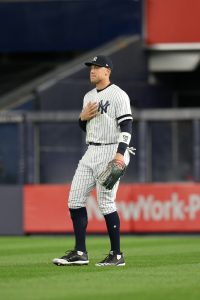
The season after Swisher said goodbye to pro baseball, another star was born in New York. Towering right fielder Aaron Judge, a top 100 prospect in his younger days, exploded on the scene in 2017, batting .284/.422/.627 (174 wRC+), smacking 52 homers and racking up 8.3 fWAR. Judge fell short of AL MVP honors then, but he won Rookie of the Year in his league and was part of a club that took the eventual title-winning Astros to a seven-game LCS.
While injuries have somewhat limited Judge’s availability since his initial season, you can’t argue with the production he has managed when he has been able to take the field. Since his second year, Judge has recorded a line of .278/.392/.528 (good for a 146 wRC+) and amassed 54 dingers with 9.7 fWAR.
Judge is now 28 years old, a two-time All-Star and perhaps the face of the Bronx-based franchise, but he may have never gotten there if not for Swisher. Allowing Swisher to depart in free agency entitled the Yankees to a compensatory selection in the ensuing draft. They used that pick, No. 32 in 2013, on Judge – a former Fresno State Bulldog. So, not only did the Yankees benefit from Swisher’s best seasons as a pro, but stealing him from the White Sox 12 years ago is still paying off for them in a big way.
Photo courtesy of USA Today Sports Images.
Cashman Optimistic That Judge Will Be Ready For Start Of Season
Yankees outfielder Aaron Judge appears to be making quite a lot of progress while awaiting word on whether and when the season will occur. GM Brian Cashman says the organization is “excited to believe that he’s going to rejoin us at full capacity,” as Kristie Ackert of the New York Daily News reports.
The “very unique” rib injury suffered by Judge has been complicated to treat and largely defied clear timelines. It’s rather notable, then, to hear Cashman speak with such clarity on the matter.
Though specifics on Judge’s readiness and the 2020 season schedule aren’t yet known, it sounds as if Judge would be ready to go for a shortened Spring Training that could launch in June. With little time for all players to ramp up for a compressed season, it’ll be critical for the towering outfielder to get himself to 100% before baseball re-launches.
Cashman indicated that Judge isn’t fully out of the woods yet. Imaging “shows the healing” and has left the team hopeful of “expected healing moving forward,” says Cashman, so it sounds as if there’s a lot of progress but also some ground left to be covered.
Yankees Have Over Half A Billion Dollars On Books Past 2020
2020 salary terms are set to be hammered out in the coming days. But what about what’s owed to players beyond that point? The near-term economic picture remains questionable at best. That’ll make teams all the more cautious with guaranteed future salaries.
Every organization has some amount of future cash committed to players, all of it done before the coronavirus pandemic swept the globe. There are several different ways to look at salaries; for instance, for purposes of calculating the luxury tax, the average annual value is the touchstone, with up-front bonuses spread over the life of the deal. For this exercise, we’ll focus on actual cash outlays that still have yet to be paid.
We’ll run through every team, with a big assist from the Cot’s Baseball Contracts database. Next up is the Yankees:
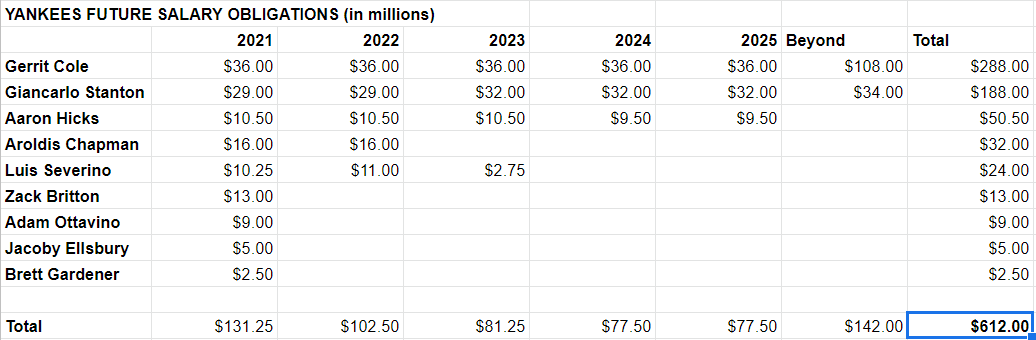
Yankees Total Future Cash Obligation: $612MM
*Giancarlo Stanton (after 2020) and Gerrit Cole (after 2024) can opt out
*total reflects that Marlins to pay $30MM if Stanton does not opt out
*Zack Britton contract includes opt-out opportunity after 2020 if team does not exercise 2022 club option
*Jacoby Ellsbury (released) still owed buyout on 2021 club option, pending grievance
*total does not include J.A. Happ vesting option ($17MM) with 165 innings/27 starts (will likely be pro-rated for shortened season)
(click to expand/view detail list)
Which 15 Players Should The Yankees Protect In An Expansion Draft?
The last MLB expansion draft took place on November 18th, 1997. Each of the 28 existing teams was able to initially protect 15 players, with the Devil Rays and Diamondbacks mostly alternating picks to fill their new rosters.
The first round consisted of one player being taken from each of the 28 teams, giving the Devil Rays and D’Backs 14 players each. At that point, each of the 28 teams was able to protect an additional three players. After the completion of the second round, each team added another three players to their protected list. In the third round, the Rays and D’Backs would each take an additional seven players, with each new club ending up with 35 in total.
Detailed rules can be found here, but basically each team’s best prospects were not eligible for the draft. Still, about a quarter of the players chosen were minor leaguers. Also, players with no-trade clauses or ten-and-five rights had to be put on protected lists unless they waived those rights. And there would be no reason to protect players eligible for free agency.
We thought it would be fun to determine each team’s current 15-player protected list, as if a new two-team expansion draft is scheduled for November. For simplicity’s sake, only players with MLB experience will be eligible for our mock expansion draft.
We’ll begin by shaping the Yankees’ 15-player protected list.
Free agents James Paxton, Masahiro Tanaka, DJ LeMahieu, J.A. Happ, and Brett Gardner will be excluded. Gardner has a club option the Yankees might like to pick up, but we’ll assume they don’t have to burn a protected spot on him.
Gerrit Cole, Giancarlo Stanton, and Aroldis Chapman automatically take up three of the 15 spots due to their no-trade rights. That leaves 12 more players to protect. The MLBTR staff generally agreed that these eight additional players should be protected:
Aaron Judge
Gary Sanchez
Luis Severino
Gleyber Torres
Miguel Andujar
Gio Urshela
Jordan Montgomery
Chad Green
That leaves four spots for these 16 players:
Zack Britton
Luis Cessa
Thairo Estrada
Mike Ford
Clint Frazier
Ben Heller
Aaron Hicks
Kyle Higashioka
Jonathan Holder
Tommy Kahnle
Mike King
Jonathan Loaisiga
Adam Ottavino
Mike Tauchman
Luke Voit
Tyler Wade
With that, we turn it over to the MLBTR readership! In the poll below, please select exactly four players that you think the Yankees should protect in our upcoming mock expansion draft. Click here to view the results.
Quick Hits: Judge, Team Finances, Tsutsugo
Should the Yankees sign Aaron Judge to a long-term extension? Joel Sherman of the New York Post isn’t sure, noting that Judge already has a significant injury history, is already under team control through his age-30 season, and how the Yankees’ financial situation will be impacted in the post-coronavirus baseball world. There’s also the fact that the Yankees have generally shied away from contract extensions since Hal Steinbrenner took over the team, and the two players whose deals were most recently extended (Aaron Hicks and Luis Severino) have battled injuries since inking those new contracts. Judge is in the first of his three arbitration-eligible seasons, and back in January agreed to an $8.5MM deal for the 2020 season.
More from around baseball….
- Most of the 30 teams have already arranged to pay non-baseball employees through the end of May, with such clubs as the Phillies, Tigers, Rockies, and Padres already committed to avoiding job cuts or furloughs beyond May 31. However, there is concern and, “among front-office officials there is an expectation,” ESPN.com’s Buster Olney writes, that there could be major job losses within baseball operations departments after the draft in June. Scouts could be in particular danger, as some clubs have already made moves in recent years towards relying on video analysis rather than in-person reports for scouting purposes. As one team executive tells Olney, “it just doesn’t make any sense to me that these [teams] need to dump people making $40K, $50K. Those savings are not difference-making,” even for franchises that will be taking a big revenue hit this season. Such actions are likely to hurt a team’s reputation around the sport, and could impact future chances of hiring or keeping front office personnel in the future.
- Yoshitomo Tsutsugo has been in Japan since late March, and Marc Topkin of the Tampa Bay Times writes that the newly-acquired Rays slugger is continuing to work out in preparation for his first Major League season. Keeping in touch with Rays staff throughout, Tsutsugo has been involved in various workout, hitting, and throwing routines. As to when Tsutsugo will be able to return to North America, nothing will be determined until (or if) a plan to launch the 2020 season is underway, and Tsutsugo be further delayed given travel restrictions between Japan and the U.S. For instance, Tsutsugo could face a mandatory 14-day self-quarantine upon arriving in America, regardless of any COVID-19 symptoms he may or may not show.
Miguel Andujar Feeling “100 Percent” After Shoulder Rehab
After a small tear in his right labrum limited Miguel Andujar to just 12 games last season, the Yankees slugger declared himself healthy and ready to hit the field whenever (or if) the 2020 season gets underway. In an e-mail to George A. King III of the New York Post, Andujar said he is “very happy where I am at physically” as he approaches one full year since his last MLB game (last May 12).
“I feel great. I am working out five days a week building strength, working with the trainers, exercising and doing my best to stay sharp,” Andujar wrote. “It’s been almost a year since my injury and I feel 100 percent….For a while I was working out away from (Steinbrenner Field) with a trainer, hitting and staying sharp. I am back at the complex doing everything I can to prepare myself.”
Andujar was tentatively expected to be ready for Opening Day even if the season had started on time, and the 25-year-old admitted to being especially anxious to get back to action given that he missed virtually all of the 2019 campaign. That lost season opened the door for Gio Urshela to unexpectedly emerge as a big offensive contributor at third base, leading to the Yankees’ desire to try Andujar out at first base and left field during Spring Training in order to figure out ways to keep his bat in the lineup.
For his part, Andujar is happy to learn these new positions. “I am ready to play wherever the team needs me. I am ready to play, period,” he said. “I’ve continued to prepare to play any position I am asked to play. I look at it as having a number of doors open for me. They are all opportunities for me to play and I am going to try to take advantage of everything that is presented to me.”
Given that Andujar has struggled defensively over 143 career games as a third baseman, there was speculation even before his injury that a move off the hot corner was inevitable. His spring audition as a first baseman was a little shaky, and he was slated for much more corner outfield playing time in camp before the COVID-19 shutdown.
Delivering even passable glovework at any position would make Andujar all the more valuable, considering what Andujar has already shown at the plate. Andujar quickly emerged as one of the game’s top young hitters in 2018, batting .297/.328/.527 with 27 homers over 606 plate appearances and finishing second to Shohei Ohtani in AL Rookie Of The Year voting.
AL Notes: JDM, Red Sox, Astros, Click, Yanks, LeMahieu
Let’s check in on some of the American League’s highest-profile clubs…
- Major League Baseball handed down its decision on Boston’s sign-stealing scandal from its World Series-winning season in 2018 a couple weeks ago, stripping the Red Sox of their second-round pick this year and suspending scout/replay coordinator J.T. Watkins for the upcoming campaign. Count designated hitter J.D. Martinez among those who are not pleased with Watkins’ short-term ban. The superstar slugger told Peter Abraham of the Boston Globe, “They just ruined this guy’s career with no evidence.” In regards to the overall punishment, Martinez said to Abraham: “If they went to court with that, it would get thrown out. There was nothing there. The judge would laugh.”
- Speaking of teams that have recently been embroiled in sign-stealing scandals … Astros general manager James Click succeeded Jeff Luhnow atop the front office in the offseason as a result of the prior regime’s transgressions. Chandler Rome of the Houston Chronicle profiles Click, how he has adjusted to the job, how the rookie GM’s trying to work through the coronavirus and how he’s attempting to change the culture of a franchise in turmoil. As you’d expect, Click has stayed in touch with owner Jim Crane and new manager Dusty Baker during the pandemic. Regarding the Astros as a whole, Click said to Rome: “I have a better feel for the organization now. While it’s not ideal to do it remotely, it is certainly something that can be done. It’s hard to say how much more of a feel I have for the organization, but definitely more, and I’m hoping they also have a feel for me. We’re all still getting to know each other.”
- As we covered last week, the Yankees could lose one of their MVPs, infielder DJ LeMahieu, when free agency opens next offseason. Kristie Ackert of the New York Daily News argues that they shouldn’t risk it, writing that the Yankees need to do all they can to keep the soon-to-be 32-year-old LeMahieu from hitting the market with an extension. LeMahieu stated in March that he and the Yankees haven’t engaged in “serious” negotiations, so it’s unclear how much of a priority he is for New York. However, you can’t go against Ackert’s point that he’s a key part of the team’s current roster. LeMahieu played all over the Yankees’ infield after signing a two-year, $24MM contract going into last season, slashed .327/.375/.518 with 26 home runs and 5.4 fWAR in 655 plate appearances, and was in the running for AL MVP honors.
Latest On Aaron Judge, Other Injured Yankees
May 6: In light of Boone’s comments yesterday, the New York Post’s Dan Martin reports that the club has privately been expecting a June or July recovery date for Judge. The slugger hasn’t experienced any setbacks along the way, per Martin, but it seems the organization has simply anticipated that his recovery process will be a fairly lengthy one.
May 5: Yankees skipper Aaron Boone provided updates on several injured Yankees in an appearance on MLB Network Radio on SiriusXM earlier this morning (Twitter link, with audio).
Center fielder Aaron Hicks, on the mend from 2019 Tommy John surgery, is throwing from 90-plus feet and is taking soft toss from both sides of the plate as he continues his rehab. Hicks went under the knife about six and a half months ago and was initially slated for a timeline of eight to ten months. He’s “trending in a really good direction,” per Boone.
The outlook appears even brighter for lefty James Paxton and slugger Giancarlo Stanton. The former is now three months (to the day) removed from back surgery and is expected to be recovered by “mid-May,” per Boone. Paxton has tossed five bullpen sessions already and pitched a simulated game just yesterday. Stanton, meanwhile, is “doing really well and should be good to go whenever we get ready to go back.”
On Aaron Judge, the projection is a bit murkier. He’s slated to undergo another CT scan in “a couple more weeks,” which suggests that the right fielder’s fractured rib has not yet fully healed. Judge’s entire injury scenario has been shrouded in varying degrees of uncertainty. It took the club several weeks early in camp to diagnose the stress fracture in his rib, and only two weeks later did the team reveal that Judge was also found to have a collapsed lung. Near the end of March, Boone revealed that Judge’s injuries may have dated all the way back to last September. It’s been a frustrating saga for Yankees fans, and it seems there’s still no definitive timetable in place for the 28-year-old’s recovery — or at least not one they’re comfortable sharing publicly just yet.
The One Who Got Away From Cleveland
Tomorrow marks the two-year anniversary of a seemingly innocuous decision that ultimately backfired. On May 4, 2018, the Indians designated third baseman Gio Urshela for assignment. Five days later, they traded him to the Blue Jays for cash considerations, ending his decade-long tenure in the organization.
The decision to move on from Urshela made perfect sense at the time. He had never been a top prospect, instead profiling as a glove-first depth infielder. His offensive numbers in the high minors were fine but unspectacular. That wasn’t the case in MLB, though, as he’d hit just .225/.273/.314 (56 wRC+) in parts of three seasons. Most pressing, he’d exhausted all his minor-league options by 2018. Rather than carrying Urshela on an active roster already featuring Francisco Lindor, José Ramírez, Jason Kipnis and Erik González (himself out of options and capable of playing shortstop), the front office elected to move on.
Urshela played in just 19 games in Toronto before they too cut him loose. He cleared waivers, was traded to the Yankees, and didn’t return to the majors in 2018. He became a minor-league free agent after the season. Presumably finding no MLB interest, he returned to the Yankees on a minor-league deal last November.
That under-the-radar series of events proved massively important in 2019. With Miguel Andújar injured, the Yankees turned third base over to Urshela. He responded with an out-of-nowhere breakout, hitting .314/.355/.534 (132 wRC+) in 476 plate appearances. It’s an open question whether he can sustain anything approaching that production moving forward, but his underlying batted ball metrics were fantastic. In February, 68% of MLBTR readers opined the hot corner in the Bronx was Urshela’s to lose, even with Andújar returning. The 28-year-old is under team control through 2024, making him a potential long-term asset for the New York organization.
For the Indians (and to a lesser extent, the Jays), seeing Urshela’s success with an AL rival has to be a bitter pill to swallow. Obviously, they couldn’t have seen his 2019 season coming. No one around the league did, seeing as Urshela was available for little more than an MLB roster spot an offseason ago. Every team has players they wish they hadn’t let get away in retrospect (some significantly more painful than losing Urshela). Perhaps the 28-year-old simply needed a change of scenery and/or a new voice on the player development side to unlock another gear. Regardless of how and why it happened, there’s no doubt Urshela washing out in Cleveland proved to be a huge gain for the Yankees.
Remembering A Disastrous World Series Performance
The worst bullpen meltdown of the 2001 World Series was not the one you think. You probably go right to Byung-Hyun Kim blowing saves in games four and five in Yankee Stadium, putting the Diamondbacks on the brink of elimination heading into game six. But that’s not it.
You might also think of Mariano Rivera blowing the save in game seven. Mark Grace singled, Rivera turned a sac bunt attempt into runners on first and second, Tony Womack eventually knocked home the tying run. Then Tim McCarver – without so much as a spoiler alert – laid out exactly what was about to happen like he’d seen it already, and Luis Gonzalez shoveled a ball over the drawn in infield to win the World Series. Just like that, the greatest closer of all time blew game seven of the World Series, ending a Yankee dynasty in its tracks.
But that’s not it either. I’m talking about Jay Witasick‘s beautifully disastrous performance in game six.
With the Yankees up three games to two in the 2001 World Series, the series shifted back to Arizona for a critical game six. The Yankees were just one win away from their fourth consecutive World Series championship, while the Diamondbacks, in their fourth season, hadn’t yet existed in a world in which the Yankees were not the champs. Kim’s consecutive blown saves put Arizona in this position, but in game six, it would be the Yankees bullpen that would implode. Though Jay Witasick’s meltdown didn’t come in as high a leverage situation as Kim’s (nor Rivera’s), it was something to behold.
Witasick entered Game 6 with runners on second and third with the Yankees trailing 5-0. It was still early. The game was in reach. Here’s how hitters fared against Witasick that inning:
- Single to LF
- Single to LF
- Single to LF
- Single to RF
- Tony Womack strikes out swinging (phew!)
- Single to CF
- Double to LF
- Single to CF
- Double to CF
- Reggie Sanders strikes out swinging (finally!)
In a game when the Yankees could have clinched a World Series victory, Joe Torre let Witasick stay in the game to surrender four consecutive hits – twice! – in one inning. By the time Reggie Sanders finally struck out, the Diamondbacks led 12-0. Relievers are often made to wear it the way Witasick did here, but a win in this game meant a World Series title. This wasn’t a normal game. This was the type of game when – normally – you never give up. Witasick’s 8 earned runs tied him with Grover “Pete” Alexander for the most runs ever given up in a World Series game. Alexander took 2 1/3 innings to give up that many in the 1928 World Series against the Yankees.
Witasick would give up two more hits the next inning (he started another inning!), giving him a final line that looks like this (parents, cover your children’s eyes): 1 ⅓ innings, 10 hits, 9 runs (8 earned), 4 strikeouts. Randy Choate came on and allowed Witasick’s stragglers to score, by which point the Diamondbacks led 15-0. Luis Gonzalez – their consensus best player – was pulled for rest in the bottom of that inning (the 4th inning!). Given the stakes of the game, it’s amazing that Torre allowed Witasick to get shelled the way he did.
I’ll give Torre this: games four and five of the 2001 World Series went into extra innings, and leading 3 games to 2 going into game six, the Yankees had some cause to pack it in by the time Andy Pettitte left the game without recording an out in the third inning. And it’s not as if Witasick was giving up home runs. These were mostly bleeders through the left side of the infield – but they weren’t totally cheap knocks either.
On the other hand, when Pettitte exited the game, it was still just a 5-0 deficit in the 3rd inning. Of course, Torre also had reason to doubt whether his offense could come back from a deficit that large. In the first five games of the series combined, the Yankees had scored a total of four runs in innings 1 through 8. Without a pair of clutch ninth-inning home runs from Tino Martinez and Scott Brosius, the Yankees came dangerously close to losing all 7 games of the series (which, of course, would have been impossible).
Still, Witasick’s ill-fated stint in the third and fourth inning of game 6 stands out as a woeful performance with the season on the line. Witasick put together a solid professional career, pitching for 7 teams over 12 years with a 4.64 ERA/4.69 FIP, and it’s hardly his fault that Torre decided to pack this one in by the third inning, but it’s worth a re-watch nonetheless.